




Abstract
Why is rebel governance more responsive in some areas than in others? In recent years, scholars have started to examine the determinants of rebel governance. Less attention has been given to explaining variation in the responsiveness of rebel governance, that is, the degree to which rebels are soliciting and acting upon civilian preferences in their governance. This article seeks to address this gap by studying local variation in rebel responsiveness. I argue that rebel responsiveness is a function of whether local elites control clientelist networks that allow them to mobilize local citizens. Strong clientelist networks are characterized by local elite control over resources and embeddedness in local authority structures. In turn, such networks shape local elites’ capacity for mobilizing support for, or civil resistance against, the rebels, and hence their bargaining power in negotiations over rebel governance. Drawing on unique interview and archival data collected during eight months of fieldwork, as well as existing survey data, the study tests the argument through a systematic comparison of four areas held by the Forces Nouvelles in Côte d’Ivoire. The analysis indicates that the strength of local elites’ clientelist networks shapes rebel responsiveness. Moreover, it provides support for the theorized civil resistance mechanism, and shows that this mechanism is further enhanced by ethnopolitical ties between civilians and rebels. These findings speak to the burgeoning literature on rebel governance and to research on civil resistance. In addition, the results inform policy debates on how to protect civilians in civil war.
Introduction
The rise of the Islamic State in Iraq and Syria (ISIS) brought attention to rebel governance in civil war. Rebel governance is ‘the set of actions insurgents engage in to regulate the social, political, and economic life of non-combatants during civil war’ (Arjona, Kasfir & Mampilly, 2015: 3). But ISIS was not the first rebel group to govern civilians; between one-quarter and one-third of all rebel groups engage in some form of governance (Huang, 2016: 71; Stewart, 2018). A burgeoning literature examines why rebels invest resources and manpower in governance while fighting a war. Yet, studies of rebel governance often ignore that rebel regimes differ in responsiveness, that is, the degree to which the rebels are soliciting and acting upon civilian preferences in the way they govern (two exceptions are Rubin, 2020; Weinstein, 2007). This is a problematic omission given that rebel governance can serve to both protect and repress civilians. Internal variation in rebel responsiveness has been documented in many civil wars, including in Liberia (Lidow, 2016), Colombia (Arjona, 2016) and the Philippines (Rubin, 2020). For example, the Sudan People’s Liberation Movement/Army (SPLM/A) administration differed in local responsiveness, where the Nuba Mountains stood out because the rebels were ‘genuinely concerned with the welfare of the local population’ (Rolandsen, 2005: 66). These examples raise the question: Why is rebel governance more responsive in some areas than in others?
This article advances knowledge on how civilians shape rebel governance. Building on studies theorizing that civil resistance plays a key role in shaping rebel behaviour (Arjona, 2016; Kaplan, 2017; Rubin, 2020), I argue that rebel responsiveness is greater in localities where local elites have strong clientelist networks than where they have weak clientelist networks. When clientelist networks are strong, local elites control resources and are embedded in local authority structures in a way that allows them to mobilize local citizens. Local elites that have strong clientelist networks can therefore mobilize both greater support for, and civil resistance against, the rebels. This mobilization capacity determines local elites’ bargaining power in negotiations over local governance, allowing some local elites to demand greater governance responsiveness than others. I probe the theory on the Forces Nouvelles (FN) rebels in Côte d’Ivoire. Côte d’Ivoire is a relevant case because rebel responsiveness varied significantly across rebel-held localities (Martin, Piccolino & Speight, forthcoming). Drawing on unique data collected during eight months of fieldwork, I compare FN governance across four areas with varying levels of rebel responsiveness.
The article makes three contributions. First, by advancing knowledge on how and why rebel responsiveness varies, it answers the call for more work on the character of rebel governance (Mampilly & Stewart, forthcoming). Previous research has uncovered various dimensions of the character of rebel governance and its importance for civilian life, but variation in responsiveness is largely ignored. Ignoring variation in the character of rebel governance means that instances of unresponsive governance are lumped together with instances of responsive governance. This has theoretical ramifications because variation in rebel responsiveness can influence civilian–rebel relations in profound ways (Arjona, Kasfir & Mampilly, 2015: 3).
Second, by theorizing the role of local elites, I contribute to the growing collection of work on how civilians shape the dynamics of civil war (Arjona, 2016; Kaplan, 2017; Rubin, 2020). Local elites often feature in these accounts of how civilians organize to influence rebel rule, yet the conditions that enable them to do so remain undertheorized. Arjona (2016: 260), for instance, calls for further research on ‘the role of leadership and its relation to informal institutions’ under rebel rule. Not accounting for local elites is a significant shortcoming because elites often play a critical role in the dynamics of civil war and violence (Balcells, 2017; Kalyvas, 2006). This study, in contrast, shows how variation in the strength of local elites’ clientelist networks shaped rebel responsiveness in Côte d’Ivoire.
Third, the article shows how theories of political clientelism offer valuable insights to research on civil war. While there are studies demonstrating how clientelism is important for understanding the remobilization of ex-combatants (Themnér, 2013), postwar state-building (Speight, 2014; Utas, 2012), and electoral violence (Berenschot, 2020), there is little research on the effect of clientelism on rebel governance. This is problematic because the political clout of local patrons does not invariably erode during civil war (Speight, 2014: 224; Utas, 2012: 14–18). Thus, the article contributes by examining under what conditions local elites can repurpose clientelist networks to challenge rebel rulers.
Previous research
The rebel governance literature has grown rapidly in recent years. One strand focuses on rebels’ incentives for investing resources and manpower in governing, suggesting that rebels govern because they anticipate that it will boost civilian support (Huang, 2016; Weinstein, 2007; Wickham-Crowley, 1987), enhance territorial control (Arjona, 2016; Mampilly, 2011), promote international legitimacy and support (Jo, 2015; Stewart, 2018), and ensure continued economic production (Lidow, 2016). These studies are generally agnostic about the character of rebel governance. Huang’s (2016) dataset, for instance, records whether rebels created certain institutions, but does not capture differences in their responsiveness.
A second strand unpacks variation in the character of rebel governance, such as its effectiveness (Mampilly, 2011), scope (Arjona, 2016) and inclusiveness (Stewart, 2018; Weinstein, 2007). Research on the responsiveness of rebel governance is, however, scarce. Weinstein (2007) studies rebel governance responsiveness and links it to variation in rebel resource endowments, but does not focus on local variation. To date, Rubin (2020) constitutes the only study that addresses local variation in rebel responsiveness. Focusing on how kinship ties increase civilian collective action capacity, he argues that civilian collective action affects the responsiveness of rebel governance because it enables civil resistance. Studying the communist insurgency in the Philippines, he finds that dense kinship ties increase rebel investments in services and, as service provision becomes prohibitively costly, deters rebel territorial control. He does not, however, investigate the role of clientelist bonds between local elites and citizens. Moreover, he examines territorial control as the outcome rather than systematically assessing rebel responsiveness. In sum, apart from Rubin (2020), there are few studies that directly explore why rebel responsiveness is greater in some localities than in others. I seek to address this gap by drawing on insights on political clientelism to develop a novel argument about the conditions under which civilians – and local elites in particular – are more likely to shape rebel behaviour.
Explaining rebel responsiveness
This article focuses on local variation in the responsiveness of rebel governance – the degree to which rebels solicit and act upon civilian preferences in their governance. When rebels are responsive towards the population, civilian representatives are included in decisionmaking, security governance is protective rather than repressive, taxation is perceived as fair rather than unfair, and there is extensive rather than limited service provision (van Baalen, 2020: 9–11). While civilians can still suffer under responsive rebel governance, these distinctions serve to identify a spectrum of rebel responsiveness. To exemplify, rebels that deploy police to mete out harsh unpopular punishments on civilians are less responsive than rebels that use police to protect civilians from crime, all else equal.
Previous research shows that rebels are incentivized to provide governance to enhance civilian support, territorial control and legitimacy. These strategic goals are, however, difficult to attain when the local commanders responsible for implementing governance operate with significant autonomy (Lidow, 2016) or lack the necessary skills to do so. To boost their governance, aspiring rulers therefore often seek to enlist local elites as brokers for their political project (Migdal, 1988: 141). Local elites can exercise autonomous control over society (Boone, 2003; Migdal, 1988; Utas, 2012) and are ‘individual actors outside the central leadership of a country who exercise influence over and demand loyalty from other political actors, including citizens’ (Reuter et al., 2016: 666–667). Local elites’ attractiveness as brokers hinges on their capacity to mobilize citizens for collective ends. This mobilization capacity constitutes a double-edged sword (Reuter et al., 2016: 667). Local elites with greater mobilization capacity are better at securing support for the rebels, for example, by assisting recruitment efforts, raising resources and providing intelligence (Rubin, 2020: 466). But local elites can also use their mobilization capacity to mount civil resistance against the rebels. Civil resistance here refers to collective opposition to a rebel group or its rule through the use of nonviolent methods like protests, strikes and demonstrations (Arjona, 2016: 63).
Civil resistance against rebels is more common than generally assumed (Kaplan, 2017: 27–32). It can generate heavy costs on insurgents and alter rebel calculations about governance in four different ways (cf. Chenoweth & Stephan, 2011: 41–55). First, it can weaken civilian support, which can negatively affect population-based benefits such as food, recruits and intelligence (Arjona, 2016: 64). Second, resistance can undermine the economic basis of the rebellion, for instance, through tax boycotts or disruptions of transportation (Lidow, 2016: 28). Third, resistance can generate loyalty shifts within the rebels’ ranks, such as between factions or the political and military wings (Stephan, 2015: 135). Fourth, resistance can increase diplomatic pressure on the rebels, decrease their international legitimacy, or lead to the loss of external support (Jo, 2015). The more the rebels depend on one or several of these pillars, and the more disruptive the civil resistance, the higher the costs for maintaining the prevailing situation. Because repressing nonviolent campaigns can backfire and heighten these costs, rebels cannot necessarily deal with civil resistance through violence (Arjona, Kasfir & Mampilly, 2015: 3).
Since both more responsive rebel governance and civil resistance are costly for the rebels, rebels make concessions when they expect the costs and opportunity costs (loss of future population-based benefits) of civil resistance to be higher than the costs of concessions, and vice versa. Since this bargaining likely takes place continuously under rebel rule, rebel responsiveness develops gradually. This does not mean that rebels make concessions every time; local elites may celebrate some victories and fail to influence the rebels on other issues. Nevertheless, the greater local elites’ mobilization capacity, the more likely they are to successfully demand concessions that accumulate and make rebel governance increasingly responsive. 1
Why do some local elites have greater mobilization capacity than others? I argue that mobilization capacity is a function of whether elites control strong clientelist networks. Clientelism refers to a ‘relationship between actors […] commanding unequal wealth, status or influence, based on conditional loyalties and involving mutually beneficial transactions’ (Lemarchand, 1972: 69). While kinship and ethnicity can play a role in clientelism, clientelist networks allow local elites to mobilize citizens beyond their immediate cultural affinity and enable them to overcome collective action problems in areas with large or heterogenous populations. This is important because civil resistance depends on mass participation (Chenoweth & Stephan, 2011: 58–59). Clientelist bonds between local elites and citizens play an important role in political mobilization more generally, for example, during elections (Baldwin, 2013; Koter, 2013) and in state-building processes (Boone, 2003). Distinguishing between strong and weak clientelist networks, I argue that two features are important for local elites’ mobilization capacity under rebel rule.
A first feature is whether citizens depend on local elites for access to resources (Lemarchand, 1972: 72). Resources can be access to state funds, means of subsistence like land, insurance and credit, protection, and status (Scott, 1972: 9). These resources are critical for clientelist networks because they enable local elites to trade resources for loyalty and obedience (Berenschot, 2020: 174). A common transaction is to exchange electoral support for material goods (Baldwin, 2013; Berenschot, 2020; Koter, 2013). When local citizens depend on local elites, they are more susceptible to mobilization calls by elites (Koter, 2013: 194). Control over resources therefore helps local elites to remain relevant under rebel rule. Local elites that lack control over resources and instead are dependent on national elites, in contrast, are more likely to weaken under rebel rule as they get cut off from the political centre. Moreover, since reciprocity is a defining feature of the relationship between patrons and clients (Lemarchand, 1972; Koter, 2013), local elites are incentivized to uphold their end of the bargain and provide resources to citizens to maintain their preferential role as patrons (Utas, 2012: 8). Thus, local control over resources strengthens local elites’ mobilization capacity by generating incentives for citizens to remain loyal to elites.
A second feature is whether local elites are nested in local authority structures. Clientelist networks are not only defined by resource transactions, but also by immaterial loyalties (Lemarchand, 1972: 72). Local elites that have ties to unelected public authority figures with the capacity to regulate social life – chiefs, marabouts, imams, and other notables – are better positioned to broker between rebels and local citizens than those without such ties (Baldwin, 2013; Berenschot, 2020; Koter, 2013). Such public authority figures can draw on qualities such as personal loyalty, status, legitimacy, or religious supremacy to organize local citizens (Koter, 2013). Baldwin (2013), for instance, shows that citizens are more likely to vote for candidates that have close ties to customary chiefs because citizens trust those candidates to be better at service delivery. Ties to local authorities can therefore help local elites maintain citizens’ loyalty when their control over resources decreases, whereas elites without such ties are more likely to become irrelevant. Actual capacity to regulate social life is important here, since not all customary or religious leaders enjoy equally strong authority over local citizens (Boone, 2003; Koter, 2013). Hence, embeddedness in local authority structures strengthens local elites’ mobilization capacity by providing them with the authority to instigate collective action.
The argument yields two testable implications. First, I expect rebel governance to be more responsive in areas where local elites command strong clientelist networks than in areas where elites have weak clientelist networks. Second, regarding the causal process, I expect areas with stronger clientelist networks to see more disruptive civil resistance and more substantial rebel concessions than areas with weaker clientelist networks.
Before proceeding to the empirical analysis, I make three qualifications to the argument. First, I argue that the cost of resistance is conditioned by ethnopolitical ties between civilians and the rebels. Civil resistance by rebel constituencies is more costly because the rebels’ expectations about civilian support are higher for rebel constituencies than for enemy constituencies (Ottmann, 2017). This is important in ethnic or religious civil wars, where political allegiance may be more readily assumed based on observable community characteristics. Thus, local elites’ bargaining leverage increases if those elites represent a rebel constituency.
Second, rebels must weigh the costs and benefits of territorial control and may avoid governing territories where the threat of civil resistance makes territorial control prohibitively costly (Rubin, 2020: 465–466). Rebel responsiveness is costly because it entails devoting resources and manpower to civilian protection and welfare, lowering taxes, and compromising on rebel goals to meet civilians’ demands. Features that make an area more lucrative offset these costs. The implication is that rebels are incentivized to remain in localities with high strategic value, access to natural resources, or certain symbolic features, even when appeasing local elites makes governance very costly.
Finally, the cost of civil resistance is conditional on the degree to which the rebels perceive civilian support and international legitimacy as paramount for the armed Case study areas and the demilitarized zone in Côte d’Ivoire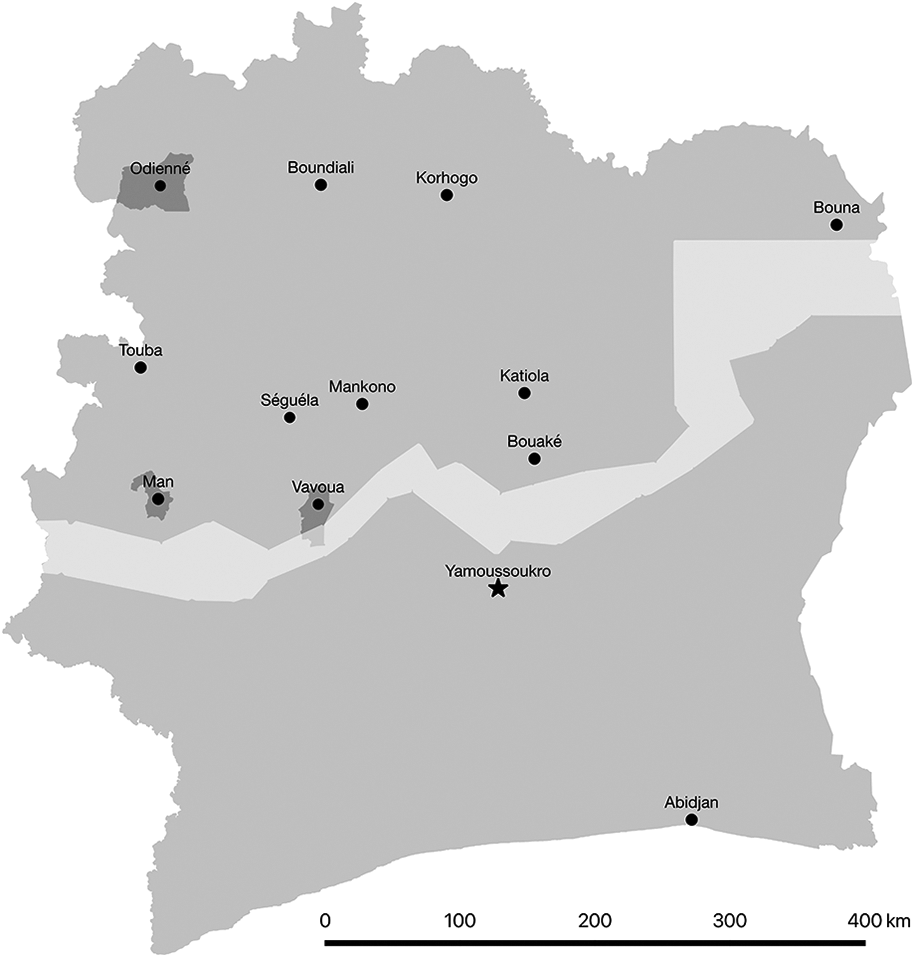
Rebel governance in Côte d’Ivoire (2002–10)
This study focuses on rebel governance under the FN in Côte d’Ivoire. The FN, a rebel group seeking the removal of President Laurent Gbagbo of the Front Populaire Ivoirien (FPI) and an end to discrimination of Northerners, invaded Côte d’Ivoire from Burkina Faso on 19 September 2002. In 2003, the war resulted in a military stalemate that divided the country along a demilitarized zone (Figure 1), leaving 60% of the country under rebel control. Subsequently, the FN created a rebel administration that governed political, social and economic affairs (Fofana, 2012). The responsiveness of the FN administration did, however, differ substantially across localities.
The civil war in Côte d’Ivoire had several characteristics of analytical importance. First, the civil war in Côte d’Ivoire had an ethnic dimension. While the Ivorian civil war defies easy dichotomization, the war generally pitted ‘Northerners’ against ‘Southerners’. The FN relied on a heterogenous constituency that consisted of people that were perceived as ‘Northerners’ because they voted for the Rassemblement des Républicains (RDR), belonged to a northern ethnic group (e.g. Malinké, Senoufo), or identified as Muslim (Fofana, 2012: 85–87). Second, the Ivorian civil war was a conventional war that involved battles along a stable frontline rather than guerrilla warfare strategies. Thus, the FN relied on military force rather than covert penetration to conquer territory (Balcells, 2017: 155). Third, Côte d’Ivoire saw limited fighting and an eight-year long stalemate, which allowed the rebels to focus on governance (Martin, Piccolino & Speight, forthcoming). Finally, rebel governance in Côte d’Ivoire took place in the presence of peacekeepers from the United Nations Operation in Côte d’Ivoire (UNOCI). These peacekeepers patrolled the demilitarized zone and had contingents all over the country, including in rebel-held territories (Balcells, 2017: 156).
To test the argument, I compare FN governance across four localities: Odienné, northern Man, southern Man and Vavoua. The unit of analysis is the FN sector, a demarcated area similar to present-day subprefectures under the control of a specific commander. 2 The cases were selected to encompass variation in rebel responsiveness (Table I). I evaluate rebel responsiveness across four domains – civilian participation, security governance, taxation and service provision – and build on original data collected during eight months of fieldwork in 2017–20. The data include 93 semi-structured interviews with experts, local elites, former FN members and residents, 3 and some 1,500 local newspaper articles collected in Ivorian archives, including the unique local newspaper Le Tambour produced by a group of journalists that remained in the rebel zone. 4 The articles serve to verify information from the interviews and offer a rare glimpse of the daily interactions between civilians and rebels. Finally, the analysis builds on secondary sources, like NGO reports, and survey data collected by the Ivorian National Institute of Statistics (INS, 2008). 5 The analysis relies on the method of structured and focused comparison (George & Bennett, 2005) and each case study proceeds in three parts: (1) the responsiveness of rebel governance, (2) the strength of local elites’ clientelist networks, and (3) local elite and rebel bargaining over local governance.
Overview of the case comparison and findings
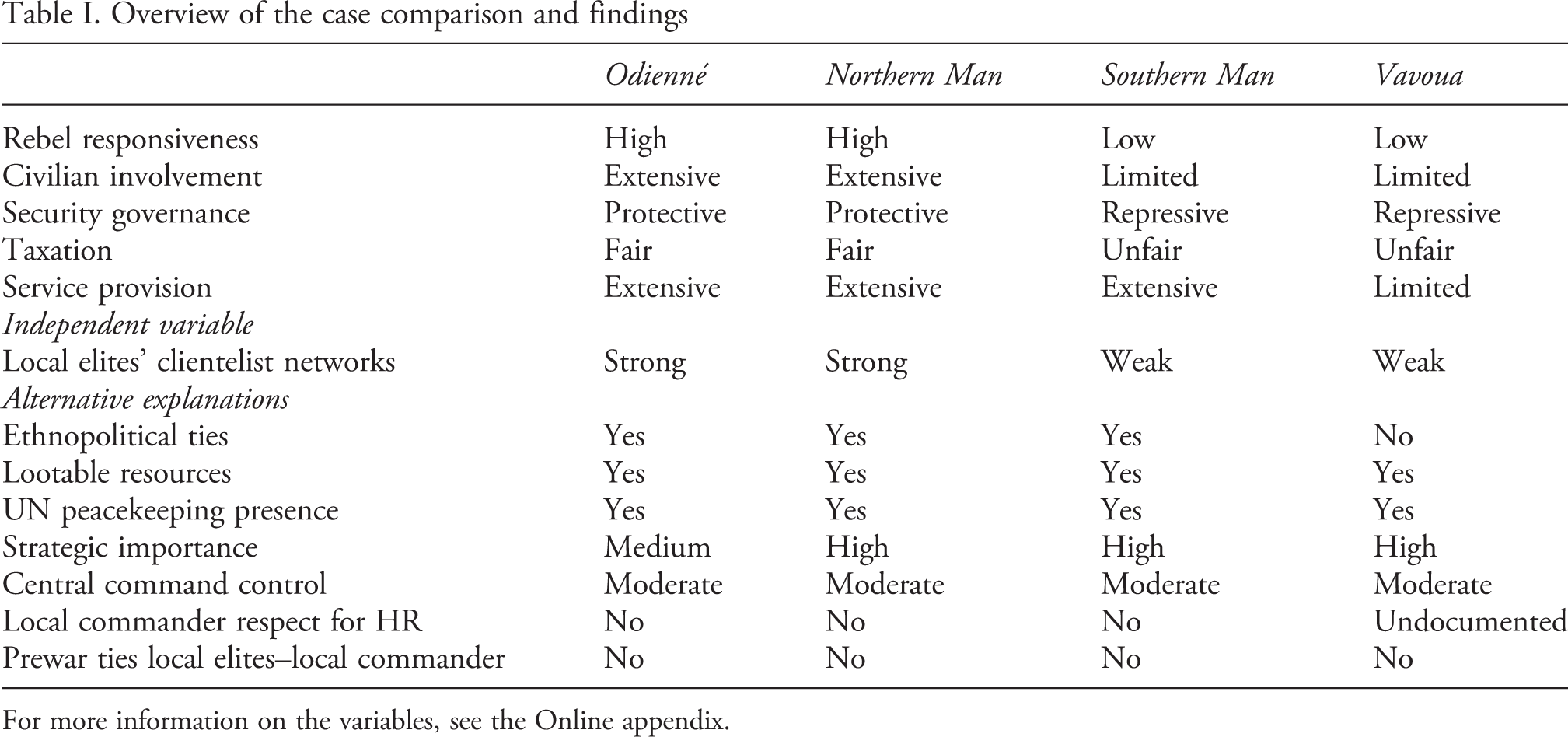
For more information on the variables, see the Online appendix.
High rebel responsiveness in Odienné
Odienné is a town in north-western Côte d’Ivoire. Most residents identify as Muslim and belong to the Malinké ethnic group. Rebel responsiveness in Odienné was generally high. Zone commander Ousmane Coulibaly often involved civilians in decisions on local governance, 6 most notably by assembling a civilian council that ensured that no decisions would go ‘against the interests of the people’. 7 Moreover, the rebels invested heavily in civilian protection and welfare. The rebels established a police station, deployed police patrols to quell crime, and took action to enforce discipline among the rank-and-file (Le Tambour, 2005a,b,c). These efforts spared civilians from violence – in a survey, less than 3% of respondents reported exposure to violence in 2002–08, significantly less than the average at 11%. 8 Taxes were perceived as fair, and negotiated in discussions with traders. The FN also invested in the public schools, cleaning the streets, and establishing a provisory landfill (Le Tambour, 2005b). Teachers described the FN’s efforts as critical and substantial, stating that without their support, ‘schools would not have existed’ in Odienné. 9 In 2005, 77.5% of the schools were operational and national exams in 2008 showed that the schools maintained a comparatively high standard (Le Patriote, 2005a; Nord-Sud Quotidien, 2008b). What explains the high degree of rebel responsiveness in Odienné?
Local elites in Odienné controlled a strong clientelist network and have served as intermediaries between citizens and outsiders like the Ivorian state for close to a century (Cotten, 1969; Toungara, 1996). Six influential families, almost exclusively members of the RDR, dominated political mobilization – in the 2001 municipal elections, the RDR won more than 71% of the votes (Fraternité Matin, 2001). Paramount among these families are the Touré family, who hold the position of canton chief and are believed to be the descendants of emperor Vakaba Touré of the Kabadougou Kingdom (ca. 1860–80) (Cotten, 1969).
An important reason for the ruling families’ influence was that they controlled access to key resources. Most people in Odienné work as cash-crop farmers or traders. Because the six families control access to land, credit and outside commodity buyers, citizens depend heavily on local elites. Members of the ruling families control the local traders’ association and the processing and export of cashews – Odienné’s main cash-crop. These resources have long allowed political and customary elites to dictate the terms of political, social, or economic activities in Odienné (Toungara, 1996: 52). According to one respondent, ‘you cannot do anything in the city without these authorities’. 10 A second reason for the political clout of local elites is that they are deeply steeped in local authority structures. The brief era of empire imprinted the idea of the Touré as the irrefutable rulers of Odienné, and today the ruling families enjoy hereditary control over both the chieftaincy and mosques. As one respondent noted: ‘[r]espect for the traditional chieftaincy, it dates back centuries’. 11 For most residents, the ruling families’ authority makes defying them unthinkable, and citizens continue to ‘cast ballots as they are instructed by lineage patriarchs to whom they owe allegiance’ (Toungara, 1996: 50).
The strength of local elites’ clientelist network made them a formidable challenger of the rebels in Odienné. Respondents noted that the FN disrespecting the ruling families would trigger a revolt: ‘[t]he population was going to revolt and then the rebel leader would have to leave the city of Odienné that same day […] even if they were armed, the people are stronger than arms in Odienné’. 12 Indeed, acts of civil resistance in 2002–05 led a newspaper to declare Odienné ‘the most troublesome’ of all rebel zones (Le Tambour, 2005a). The ruling families effectively unseated three unpopular and abusive rebel commanders (Le Tambour, 2003, 2005b,c). Amdallah Koné, the first commander, was dismissed by the rebel leadership after the ruling families mobilized a public protest that ‘saw the participation of a large segment of the population’ 13 and threatened that ‘the people will get fed up and they will revolt’. 14 A member of the FN’s political wing admitted that they dismissed the commanders to avoid open revolt, because local elites were ‘very influential in Odienné’. 15 Local elites played a key role in the mobilization process and all resistance events followed elite mobilization calls. Consistent with the theory, respondents asserted that local elites translated their leverage over the rebels into real changes in local governance. This leverage led the FN to start investing more in policing, schools and reforming the way they taxed businesses. The removal of local commanders went hand in hand with concrete investments in civilian protection and welfare, including the rehabilitation of the hospital and measures to address public safety (Le Tambour, 2005a). According to a local trader, the rebels made these concessions because ‘they feared a rebellion against the rebellion’. 16 In sum, a strong clientelist network helped local elites demand greater rebel responsiveness in Odienné.
High rebel responsiveness in northern Man
The city of Man is located in western Côte d’Ivoire. Northern Man consists of several neighbourhoods with a distinct Dioula character, such as the city centre, Dioulabougou, Air France, Libreville and Domoraud. Despite a tendency by outsiders to view the Dioula as a homogenous group, they are not an ethnic group but a broader identity that encompasses Muslims, ‘Northerners’, and immigrants from all over West Africa. Rebel governance in northern Man was largely responsive. Zone commander Losseni Fofana regularly solicited Dioula representatives in decisions on local governance (Heitz-Tokpa, 2013: 259) and invited Dioula youth leaders to serve as liaisons between civilians and the FN. One Dioula broker, Mamadou Maméry Soumahoro, met Fofana every Thursday to give him ‘a general account of things going wrong in town’ (Heitz, 2009: 122). The FN also invested in security provision by enforcing discipline among the troops and establishing a semi-professional police force (Chelpi-den Hamer, 2011: 119–120, 178). Rebel soldiers that clearly overstepped these rules were ‘sought-after, found, and placed under arrest’. 17 Taxes were perceived as fair and determined in negotiations with the trade unions. The FN also invested in civilian welfare, for example by mobilizing and supporting volunteer teachers. These efforts ensured that 70% of the primary schools opened in late 2003 and that the schools could continue to operate according to the national curriculum (ROCARE, 2004: 27–34). The rebels also made efforts to clean the city, prevent the spread of disease, and rehabilitate decayed infrastructure (Le Jour, 2006; Le Tambour, 2007b). What explains the responsiveness of rebel governance in northern Man?
Local elites in northern Man controlled a strong clientelist network capable of bridging ethnic and national cleavages among the Dioula. The most important local elites were local RDR leaders with strong ties to influential merchant families in Dioulabougou (Heitz-Tokpa, 2013: 182). These local elites controlled political mobilization in the Dioula community, and despite being outside of its traditional stronghold in northern Côte d’Ivoire, the RDR grew to become the second largest party in Man by 2001 (Fraternité Matin, 2001).
The political clout of local elites stemmed in large part from their control over the local economy. While they did not have access to state rents, they controlled the largest and wealthiest labour unions in Man (Heitz-Tokpa, 2013: 249). Big traders known as diatigi played a privileged role in the regional cash-crop trade, as creditors, investors and transporters. This generated strong dependencies between local elites and citizens involved in cash-crop farming and trading. 18 Moreover, Dioula elites controlled other influential organizations, like youth and civil society organizations. 19 Local elites were also deeply nested in local authority structures like the mosques, chieftaincy and merchant community. Religion played a key role. 20 Prominent Dioula merchants are often attributed a certain social and religious prestige that allows them to exercise both ‘social and moral constraints over local market practices’ (Perinbam, 1973: 430). Respondents spoke of how the role of Dioulabougou elites went far beyond trade and politics because elites’ devotion to Islam helps manage long-distance trade relationships. As one respondent declared: ‘[i]t’s Islam that unites us’. 21
The Dioulabougou merchants showed clear sympathies for the FN, but this did not make them complacent about the problems that FN rule brought. Because civil resistance risked imposing heavy costs on the rebels, it enabled local elites to hold the FN accountable to greater responsiveness. Extortion and high taxes led the leaders of the trader’s union to organize protest marches to demand greater security and fairer taxation (Heitz-Tokpa, 2013: 270). Youth leaders adopted similar tactics by marching to the FN headquarters to voice grievances about local governance. 22 The most high-profile act of civil resistance took place in 2006 when the transport union called a three-day strike to demonstrate against high taxes. Instead of forcefully countering the strike, the FN leadership negotiated with union leaders and reached an agreement that reduced all taxes (Le Tambour, 2007a). According to one rebel leader, the FN chose concessions over violence because they depended on the transporters economically (Heitz-Tokpa, 2013: 252). ‘They had to listen’, explained a union leader, ‘because they depended on us. If there is no transportation, nothing works. Everything gets blocked and you get a dead city’. 23 Importantly, most civil resistance acts were directly linked to organizations controlled by local elites. 24 Maméry, the most important broker, played a key role in both enhancing and checking the rebels’ power. For example, on the occasion of a ‘gigantic march’ of about 3,000 people supporting the rebels, Maméry promised to use his organization ‘as a watchdog against all sorts of misconduct’ (Le Tambour, 2004). In sum, the strength of the Dioulabougou clientelist network allowed local elites to pressure the rebels and, in consequence, the FN took several measures to assuage elites and the population.
Low rebel responsiveness in southern Man
Southern Man mainly consists of neighbourhoods of the city populated by the Yacouba ethnic group, such as Grand Gbapleu, Gbêpleu, Lycée and villages on the outskirts of town. Rebel governance in southern Man differed compared to northern Man and was generally unresponsive. Yacouba representatives were much less involved in decisions on local governance than their Dioula counterparts. While the vice-mayor sometimes served as an intermediary (Heitz, 2009: 123), most respondents saw him as inconspicuous or little more than a rebel puppet. As noted by one respondent: ‘[i]t was the Malinké [Dioula] who were like the chiefs […] and whom the rebels listened to’. 25 There were also stark differences with northern Man regarding rebel policing. Police patrols against crime were both confined to and more effective in northern neighbourhoods (Heitz-Tokpa, 2013: 279), and Yacouba respondents said that they feared reprisals for filing complaints with the rebels. According to a survey, the Yacouba reported significantly greater insecurity than the Dioula (Figure 2). For instance, while 38% of Dioula reported suffering violence, 57% of the Yacouba did so. Likewise, rebel taxes were perceived as less fair by the Yacouba than Dioula, and the survey data show that Yacouba respondents were more likely to report loss of productive assets than Dioula respondents. In contrast, there were no notable differences in service provision. How can low rebel responsiveness in southern Man be explained?
Local elites among the Yacouba controlled a weak clientelist network. The most prominent Yacouba elites in the early 2000s were members of the Union pour la Démocratie et la Paix en Côte d’Ivoire (UDPCI), a political party with a stronghold in Man but without a national following (Allouche & Bley, 2017: 158). The party was created by the late General Robert Gueï to serve as a vehicle for his presidential ambitions and dominated political mobilization in southern Man in the early 2000s.
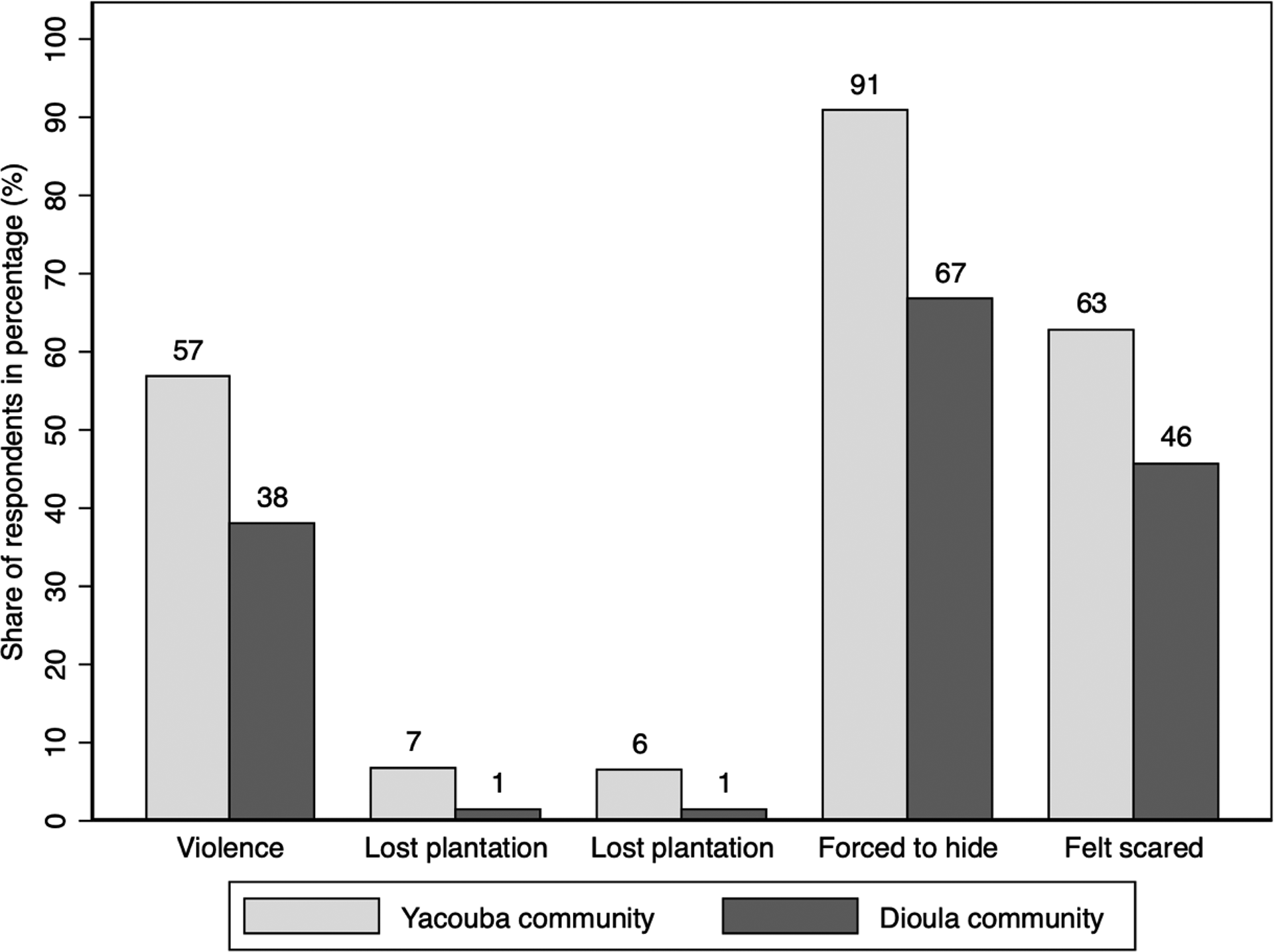
Civilian insecurity in Man by ethnic community, 2002–08
Electoral success, largely driven by General Gueï’s charisma, concealed that local elites among the Yacouba played only a minor role in most citizens’ life. Local elites did not control access to resources. Most Yacouba are smallholder cash-crop farmers. However, local elites do not control access to land and farmers were not generally members of large professional associations. 26 Instead, Yacouba farmers depend on big planters and large commodity buyers (often Dioula) from outside the region. 27 Thus, the Yacouba did not have a politically relevant planter bourgeoisie capable of mobilizing local peasants (Boone, 2003: 193). And while local UDPCI leader Siki Blon Blaise was seen as someone that brought state funds to Man, his ability to do so was curtailed by the beginning of the war. The overall weakness of local authority among the Yacouba also impaired the emergence of more resilient local elites. Yacouba chiefs traditionally held relatively limited authority, an authority that weakened even further during the colonial and postcolonial era (Chauveau, 2000: 112). According to Boone (2003: 190), the introduction of cash-crop farming increasingly generated Yacouba villages ‘that were not unified by common ancestry, myths of origin, or spiritual leaders’. These weaknesses meant that Yacouba elites lost most of their relevance during the war. When party leader General Gueï was killed on the first day of the rebellion, the UDPCI disintegrated (Heitz-Tokpa, 2013: 67–68) and fragmented the Yacouba political space into ‘a bazaar of political parties’ (Nord-Sud Quotidien, 2008c).
The weakness of local elites’ clientelist networks prevented the mobilization of civil resistance against the FN, despite numerous grievances about rebel governance. Yacouba respondents explained that such resistance would have been impossible to organize and would lead to severe repercussions. Instead, Yacouba elites adopted a combination of submission and evasion in their dealings with the rebels. In fact, the two most foremost politicians among the Yacouba, Siki Blon Blaise and Albert Flindé, had little influence over the FN, because ‘he who doesn’t have a gun can’t speak’. 28 They spent most of the crisis in Abidjan bickering among themselves rather than organizing the population (Le Jour, 2009). One reason why Yacouba elites refrained from challenging the FN was their tenuous control over local youth. Yacouba politicians and chiefs held little legitimacy in the eyes of Yacouba urban returnees left unemployed by economic depression (Chauveau 2000: 112). Enticed by fast material returns and a wish to overturn the role of elders, some Yacouba youth seized the opportunity to join the FN and prey on the population, thereby heightening intergenerational conflict (ICG, 2004: 15–17). Thus, local elites held limited leverage over the FN and rebel responsiveness remained low.
Low rebel responsiveness in Vavoua
Vavoua in central Côte d’Ivoire is an ethnically heterogenous area where the firstcomer Sokuya and Gouro ethnic groups live alongside latecomers like the Malinké and Mossi. Rebel responsiveness in Vavoua was unresponsive to civilian preferences and even the FN described Vavoua as ‘the most neglected’ of all FN zones (Le Jour, 2008b). The rebels ignored civilian sentiments and created no mechanisms for soliciting civilians. Discussing grievances with the rebels was unthinkable: ‘[t]he rebels were like gravel. You fall on them, you get hurt, they fall on you, you get hurt. So, we were truly afraid to approach them’. 29 Rebel policing served to repress rather than protect civilians; there was a culture of widespread impunity for abusing civilians (ICG, 2006: 11) that even the FN leadership acknowledged (Nord-Sud Quotidien, 2008d). Insecurity increased rather than decreased over time. Residents described that taxes were unfair and bore more resemblance to blatant extortion. Service provision was equally neglected. With 83.85% of the schools closed, education was in a state of despair (ROCARE, 2004: 27–30). Volunteer teachers received no remuneration, whereas formal teachers said ‘that there was nothing in the world’ that could convince them to work in Vavoua (Le Jour, 2003). Other services were equally poor. In 2008, a journalist described a city in ‘a deplorable state’ (Le Patriote, 2008), while the RDR mayor described an ‘emergency in education and health care’ (Le Jour, 2008a). What explains the low degree of rebel responsiveness in Vavoua?
Local elites in Vavoua controlled weak clientelist networks. Up until 1993, Vavoua was dominated by the ruling Parti Democratique de Côte d’Ivoire (PDCI). The political space fragmented with the introduction of multiparty democracy in 1990 and the death of the local PDCI strongman in 1996. Both the RDR and FPI gained ground, while the PDCI split between two rivalling candidates. 30 In the 2001 municipal elections, four party lists gained significant backing, with no candidate gaining more than 35% of the vote (Fraternité Matin, 2001).
One reason for the weakness of these political networks was their limited control over resources. Local politicians were not generally from Vavoua and had a poor record of channelling state funds to the population. Because local elites ‘did not care about the development of the city’, 31 they had weak local support. Chiefs in Vavoua do not control access to land, therefore the pre-eminence of smallholder cash-crop farming in Vavoua meant that citizens depended on outside commodity traders rather than local notables. Ethnic heterogeneity further prevented the emergence of a dominant farming cooperative. Nor could local elites fall back on other sources of authority. Chiefs among the autochthonous Gouro and Sokuya hold relatively limited authority, which has historically ‘prevented the emergence of a powerful and centralized political authority that could rely on either clans or large villages’ (Meillassoux, 1974: 47). Chiefly positions were often contested, 32 and chiefs generally shunned party politics. 33 While somewhat more influential, chiefs among the allogenes (the Malinké and Mossi) also suffered from low authority, in part due to a large number of Mossi youth and their high mobility.
Deep dissatisfaction with rebel rule did not lead to any civil resistance in Vavoua. Respondents only recalled one smaller protest by local youth following the killing of a young man by the rebels, but the protest was quickly dispersed and had little impact on the FN. 34 Residents explained that local elites deemed resistance infeasible and too dangerous. Respondents further said that both political and customary leaders were persecuted by the FN. Many fled the area, including the RDR mayor. Interviewees further agreed that local elites held very little influence over the FN. ‘It was like David against Goliath’, explained one respondent. 35 Local elites were forced into submission, because ‘everyone was under the guise of the rebels’. 36 With local elites unable to serve as a watchdog over the FN, zone commander Zakaria Koné could rule through fear and coercion, and had few incentives to adapt to civilian preferences. ‘When we say chief, we mean Zakaria Koné’, explained one respondent. ‘He was the leader, the one who decided if you will live or if you will die’. 37 In 2008, Koné was dismissed and arrested by the FN leadership. The arrest came in response to his refusal to disarm his troops following the signing of the Ouagadougou Agreement in 2007. According to the FN, the decision had little to do with the maltreatment of the population in Vavoua (Nord-Sud Quotidien, 2008a). Thus, there was an absence of powerful local elites, and rebel governance remained unresponsive.
Comparative analysis
Rebel governance in the four FN-held areas differed widely in its responsiveness. Examining data on civilian exposure to violence across the localities further illustrates differences in rebel responsiveness. The FN were the main security providers in all localities, yet the survey data reveals stark contrasts in the degree to which they effectively protected civilians (Figure 3). 38 What explains this difference in rebel responsiveness?
The analysis provides support for the argument that local elites with strong clientelist networks are better at demanding rebel responsiveness by mobilizing civil resistance. Local elites in Odienné and northern Man commanded strong networks and mobilized civil resistance on several occasions. This enabled them to negotiate a greater say in local governance, more civilian protection, fairer taxation and more service provision. Hard Civilian insecurity in Odienné, northern Man, southern Man and Vavoua, 2002–08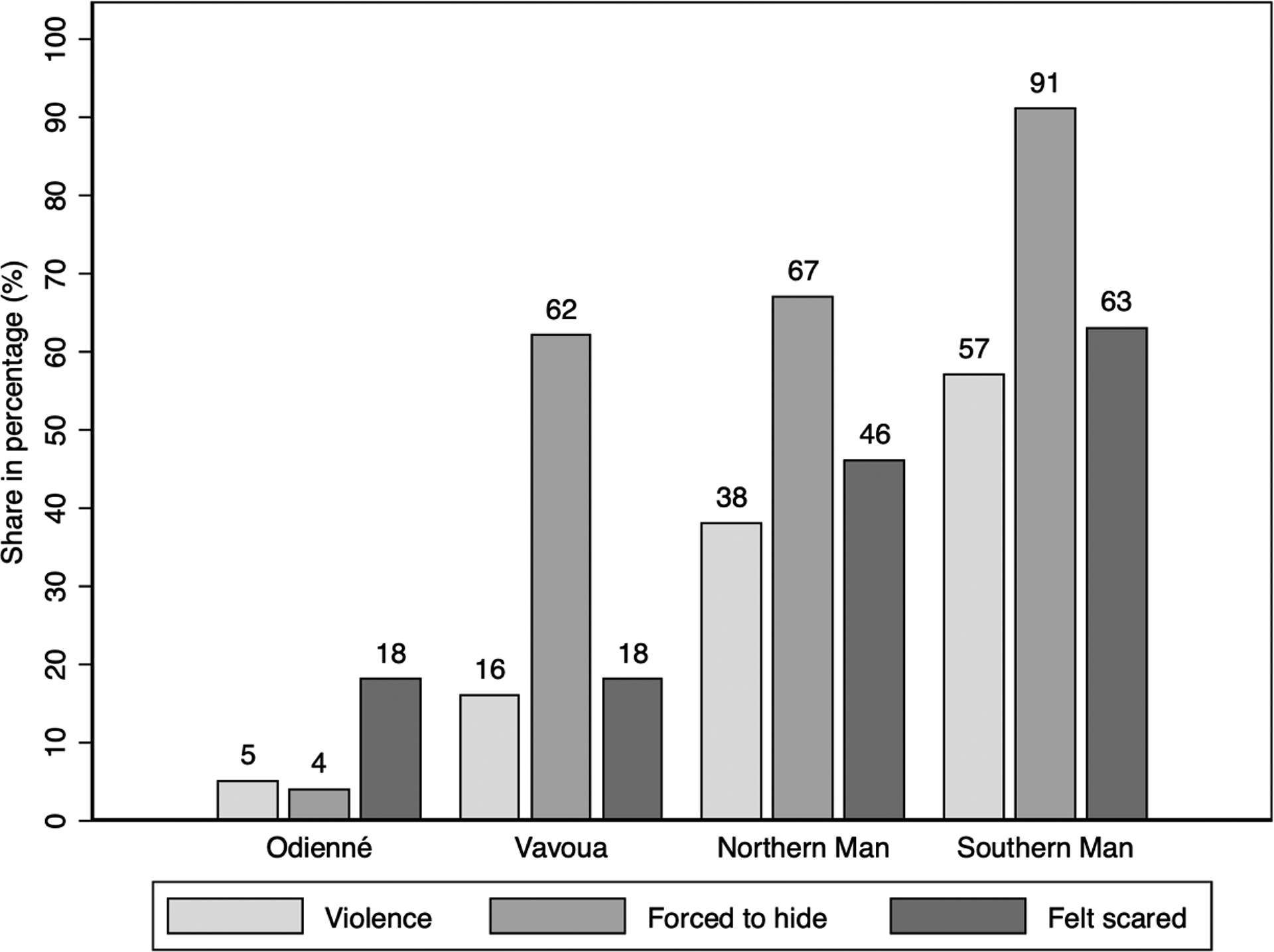
Several additional findings on the dynamics of rebel responsiveness emerge from the analysis. First, the analysis shows that the rebels also benefited from collaborating with local elites with strong clientelist networks. The ruling families in Odienné brought greater public support, recruitment and legitimacy to the rebellion, enabling the FN to mobilize large demonstations in their support (Le Patriote, 2005b; Nord-Sud Quotidien, 2006). Accommodating the Dioulabougou network in Man brought similar benefits and helped the rebels organize several large demonstrations (one allegedly gathering some 50,000 participants) in support of their agenda (Le Patriote, 2005b). It also allowed zone commander Losseni Fofana to reap significant profits from taxing the trade in coffee, cocoa and timber (Heitz-Tokpa 2013: 252). Thus, both the costs of ignoring, and benefits of appeasing, local elitesby shedding light on when rebels use were much higher in Odienné and northern Man than in southern Man and Vavoua.
Second, the evidence suggests that strategic and symbolic value offset the high cost of appeasing local elites in Odienné and northern Man. In Odienné, its importance for the transborder trade incentivized the rebels to endure high governance costs. Its symbolic value as the capital of the Malinké also mattered, as abandoning a core constituency would have been a significant propaganda defeat. Northern Man’s location close to the demilitarized zone and central role in the extraction of natural resources likely affected the rebels’ willingness to tolerate high governance costs. Thus, even though rebel governance was more costly in Odienné and northern Man than in southern Man and Vavoua, the cost remained modest compared to the FN’s vast economic profits.
Finally, one important deviation from the theoretical expectations is that the FN engaged in extensive service provision in southern Man, despite the weakness of Yacouba elites’ clientelist networks. Two explanations may account for this deviation. First, investments in education may have been a strategy to prevent mass flight. The west was heavily affected by fighting at the beginning of the war (ICG, 2003). Supporting the schools prevented an exodus that would have left the rebels with a smaller population base. As noted by one respondent, ‘the Forces Nouvelles had no interest in letting the zone perish completely’. 39 Second, the central rebel leadership played a more prominent role in the provision of education than in other governance domains. Local FN administrations did contribute to investments in education, but central rebel institutions, like the central education committee C2E, played a key role. 40 This meant that education provision in southern Man was less dependent on local elite leverage than other features of rebel rule.
The most plausible alternative explanation is that variation in ethnopolitical ties between civilians and the FN account for the difference in rebel responsiveness. Comparing the size of rebel constituencies (RDR voters, northern ethnic groups, Muslims) suggests that ethnopolitical ties were a necessary but insufficient condition for rebel responsiveness. The FN adopted responsive governance only in studied areas with a significant ethnopolitical constituency. Comparing Odienné, where vote support for the RDR was 71% in 2001 and 94% identified as ‘Northerners’, to Vavoua, where RDR support was 35% and 25% identified as ‘Northerners’, illustrates this variation. 41 Respondents in all cases noted that ethnopolitical ties to the FN mattered because resistance by ethnopolitical constituents was seen as more costly than by other constituencies.
Yet, ethnopolitical ties did not automatically grant more responsive rebel governance. First, the Yacouba in southern Man generally supported the rebellion (Fofana, 2012: 66) and constituted about half of the rebel soldiers locally (Chelpi-den Hamer, 2011: 135). Nevertheless, rebel governance remained largely unresponsive in southern Man. While Yacouba support for the FN declined over time, this decline was likely endogenous to the FN’s low responsiveness. 42 Second, civilians held remarkably similar grievances against the FN across the cases, and rebel governance was initially unresponsive in all four areas. Improvements in responsiveness followed acts of civil resistance, suggesting that belonging to the rebel constituency provided insufficient leverage for greater rebel responsiveness. A Malinké trader in Odienné captured this sentiment well; ‘we protested, we negotiated, and we even revolted […] because with the Forces Nouvelles in 2004–2005, we had to […] tell them that we did not agree on certain things’. 43 Thus, ethnopolitical ties enhanced civil resistance efforts, but were insufficient for rebel responsiveness
Additional alternative explanations related to access to lootable resources, presence of UN peacekeeping forces, the area’s strategic importance, FN central command control, local commander respect for human rights, and prewar ties between zone commanders and local elites incompletely account for rebel responsiveness (Table I). I discuss these alternative explanations in the Online appendix.
Conclusion
This article offers theory and evidence to show that the strength of local elites’ clientelist networks, conditional on ethnopolitical affiliation with the rebels, shapes the responsiveness of rebel governance. Comparing cases in Côte d’Ivoire reveals that strong clientelist networks enabled local elites to demand greater rebel responsiveness by mobilizing civil resistance.
The study highlights the need to move beyond the existence of rebel governance and investigate its character (Mampilly & Stewart, forthcoming). The main variation in Côte d’Ivoire was not the extent of rebel governance, but the degree to which rebels solicited and acted upon civilian preferences in their governance. Similar variation exists across rebel groups. The main difference between the National Resistance Army in Uganda and ISIS, for instance, was not the extent of rebel rule, but the stark contrast in its responsiveness. Studying variation in rebel responsiveness can generate new knowledge on civil war, for instance, by shedding light on when rebels use governance as an instrument of, rather than an alternative to, violence, or why civilians cooperate with rebels or counterinsurgents (Arjona, 2016: 309).
The study also has theoretical implications for the study of how civil resistance shapes rebel behaviour (Arjona, 2016; Kaplan, 2017; Rubin, 2020). First, it shows that local elites can play a key role in mobilizing resistance when they control strong clientelist networks. This suggests that local elites should be brought into the study of rebel governance more systematically, not least because clientelist ties between elites and citizens shape the functioning of local institutions and redefine affinities such as ethnicity and kinship (Lemarchand, 1972: 70). While local elites often feature prominently in the case evidence in existing studies (Arjona, 2016; Kaplan, 2017; Rubin, 2020), the conditions under which elites successfully shape rebel governance remain undertheorized. Thus, rather than presenting a rival explanation of civil resistance, I show that bringing local elites into current explanations can help gain insights into how and when civilians initiate civil resistance against rebels.
Second, the study demonstrates that insights from the literature on political clientelism matter for the study of rebel governance. The role of political clientelism often remains overlooked, despite its importance for understanding local politics more generally (Baldwin, 2013; Koter, 2013). A common assumption is that clientelist relations lose their importance in civil war (Speight, 2014: 224). In contrast, this study shows that clientelist bonds between local elites and citizens can remain intact and allow elites to take up the position as rebel brokers.
The article is based on an analysis of rebel governance in Côte d’Ivoire, which has implications for generalizability. First, the analysis suggests that ethnopolitical ties between the rebels and civilians influenced the dynamics of civil resistance and rebel governance. This implies that the determinants of civil resistance against rebels may be different in civil wars with a prominent identity cleavage compared with civil wars without a clear identity cleavage (cf. Pischedda, 2020). Second, because military power rather than civilian support determines territorial control in conventional civil wars like Côte d’Ivoire (Kalyvas & Balcells, 2010), the FN may have been more prone to endure high governance costs. The FN chose to improve the responsiveness of governance rather than withdrawing to avoid losing control over strategic territories. Hence, they adopted a different strategy than the rebels in the Philippines and Colombia, who chose to limit governance (Arjona, 2016) or withdraw (Kaplan, 2017; Rubin, 2020) when faced with civil resistance. Third, UNOCI peacekeepers may have increased the costs of civil resistance, for instance, because repressing resistance is more costly in the presence of peacekeepers. Finally, limited fighting in the Ivorian civil war allowed the FN to focus on governance. Thus, beyond Côte d’Ivoire the findings are primarily applicable to similar identity-based and conventional civil wars with limited territorial contestation.
Understanding the determinants of rebel responsiveness is of great importance for scholars and policymakers alike. The number of people living in conflict zones has increased since the 1990s, and in 2016 some 840 million people were estimated to live in conflict zones (Østby, Rustad & Tollefsen, 2020). 44 Hence, a large number of people live in the presence or under the control of rebel groups. Although it is important to recognize that civilians suffer greatly in civil war, this study highlights that civilians can also shape how rebels behave. Identifying the conditions under which civil resistance is feasible and likely to influence rebel governance can help establish a blueprint for civilians that hope to mimic these efforts and external actors that seek to support them (Kaplan, 2017: 307–309). In particular, it can help to uncover when support for nonviolent civilian action serves as an alternative to armed civilian protection (Stephan, 2015: 145).
Footnotes
Replication data

Acknowledgements
I gratefully thank Abel Gbala and Abiba Koné for superb research assistance, and Jessica Moody, Jeremy Speight, Niels Terpstra, Kristine Höglund, Johan Brosché and three anonymous reviewers for excellent comments.
Funding
The author thanks the Anna Maria Lundin Foundation, Forskraft Foundation, and Program on Governance and Local Development at Gothenburg University for funding the fieldwork.