




Abstract
This article posits that free-market institutions and practices reduce economic distortions that provide rents for underground organizations, which ultimately form criminogenic environments. Rents from market distortions provide ‘lootable income’ that feeds ‘criminal organizations’, which rely on violence for enforcement of contracts. Using an index of economic freedom, this study contrasts several relevant measures of political freedoms, political discrimination of individuals and groups, and measures of equal access to state ‘goods’ as proxies for political legitimacy and discrimination on the homicide rate. Fixed effects regression results suggest robustly that economic freedom, not political legitimacy, inclusive politics, or state capacity, reduces the homicide rate, results that are stubbornly significant and substantively large. The basic results are robust to a barrage of model specifications, different sample sizes, and estimation strategies, including instrumental variables analysis. The evidence suggests that unusually high homicide rates might be based in quotidian organizational activities related to ‘illegal’ markets rather than to political grievance-based explanations relating to relative deprivation and political legitimacy. Countries wishing to encourage growth-promoting policies need not fear higher levels of interpersonal violence based on various arguments linking free-market policies to societal disarray.
Crime is a social mirror.
While large-scale violent events such as civil wars are relatively rare, societies suffer many other forms of everyday insecurity, particularly from violent crime (Geneva Declaration on Armed Violence and Development, 2015; Institute for Economics and Peace, 2017). Richer countries generally escape civil war, but they do still suffer violence in terms intentional killings, often due to various forms of organized crime (Kalyvas, 2015; United Nations Office on Drugs and Crime, 2019a). Higher state capacity is highlighted often as to why industrialized democracies have lower homicide rates compared with developing countries (Pinker, 2011). What exactly matters about governance, however, is debated. The dominant view is that wealth and democracy pacify since they reduce anomie and increase institutional legitimacy (LaFree & Tseloni, 2006; Stamatel, 2016). Scholars of public health, in particular, focus on inequality and unfair distribution of political and economic power as causes of crime and interpersonal violence (Kawachi, Kennedy & Wilkinson, 1999; Wilkinson & Pickett, 2009). This study argues that independently of state capacity and political legitimacy, economic governance that ensures open, competitive free-market conditions reduces the incentive for investment in violence-specific organizations rooted in shadow economy activities. Fewer economic distortions reduce capturable ‘rents’ and lower the incentives for groups to form in the shadows, raising the demand for private justice. Such conditions ultimately lead to the institutionalization of ‘criminogenic’ violence (Wikström & Treiber, 2016).
Utilizing the latest data for a large cross-section of countries over a period of roughly three decades, fixed effects regression analysis reveals robustly that more open, free-market economic policies and practices reduce the homicide rate independently of state capacity measured by per capita income levels and the strength of legal institutions. Moreover, economic freedom matters more than grievance-based (state-legitimacy-based) indicators, such as exclusionary political processes. In many specifications, greater egalitarian governance increases the homicide rate, rather than reducing it, as many broad theories of legitimacy propose. The results are robust to a host of alternative specifications, omitted variables, outliers, influence points, and alternative estimating methods, including instrumental variables analysis. While the level of development indicated by per capita income and democracy also mostly lower homicide rates, their effects are less robust compared with the effects of economic freedom. The results taken together suggest that quotidian organization in the shadows associated with capturing rents from distorted economic governance matter more than do many standard explanations based on grievance-related, state legitimacy-based arguments about anomie. Next, I briefly examine the trends in the homicide data over time and across regions, outline the theory, discuss methods and data, present results, and conclude.
Why homicide?
The United Nations Office on Drugs and Crime (UNODC) estimates that crime-related deaths between the years 1990 and 2017 were roughly four times more than the deaths from civil war in that period, and they suggest that organized crime can be blamed for over one million deaths between 2000 and 2017 (United Nations Office on Drugs and Crime, 2019a). These horrific statistics clearly require much deeper understanding of the causes of interpersonal violence, and more specifically from the point of view of how targeted policy can address the causes of organized criminality, regardless of the nature of the more slowly changing structural conditions that shape and, in turn, are shaped by governance. 1 According to the United Nations Office of Drugs and Crime (2019a: 49–51), the largest proportion of homicides in most parts of the world can be attributed to organized crime and other forms of murder, rather than to domestic-partner violence (United Nations Office on Drugs and Crime, 2019b). Europe shows one of the highest shares of domestic partner homicides, which is still roughly 20% of all homicides (United Nations Office of Drugs and Crime, 2019b: 50).
Fortunately, the global trend in the homicide rate is decreasing, the reasons for which remain a matter of contention, but one that can illuminate how governance may matter for reducing homicides. Pinker (2011: 121) carefully assesses all extant explanations for the negative trend in homicides globally and suggests that ‘the Leviathan got bigger, smarter, and more effective’. 2 This article, thus, dissects just how the Leviathan has become ‘smarter’, contrasting economic governance with other indicators of state ‘effectiveness’, such as the level of development, the quality of democratic institutions, and various measures of corruption and the rule of law. This study focuses on this broad governance mechanism based on the national level, even if there are many localized factors explaining crime and violence, which may or may not always relate to the broader political economy of societies. Before addressing theory, I examine the homicide data used in this study for assessing their reliability by checking against similar data examined by others.
Figure 1 is based on UNODC data presented by the World Bank’s World Development Indicators (WDI). These data are crosschecked with other specialized agencies, such as the World Health Organization (WHO), INTERPOL, and data supplied by national governments. The data show (Figure 1), that the global homicide rates are decreasing gradually, a result true for both the developing countries and the developed industrialized democracies.
The crime rate globally has dropped in the past 27 years from a high of over ten homicides per 100,000 people in 1995 to a little over seven. The rich countries defined as the industrialized democracies have seen a decline of the murder rate from roughly two deaths per 100,000 to a little over 0.5 deaths during this same period. While the rich countries and the poorer ones The developed- and developing-country trends in the homicide rate, 1990–2017 Regional trends in the homicide rate, 1990–2017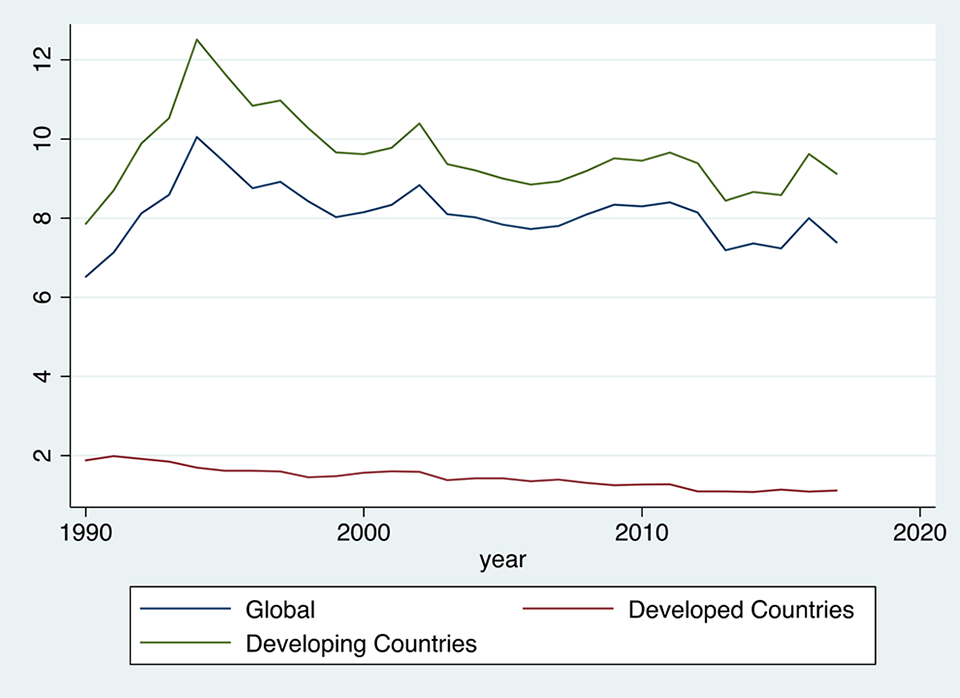
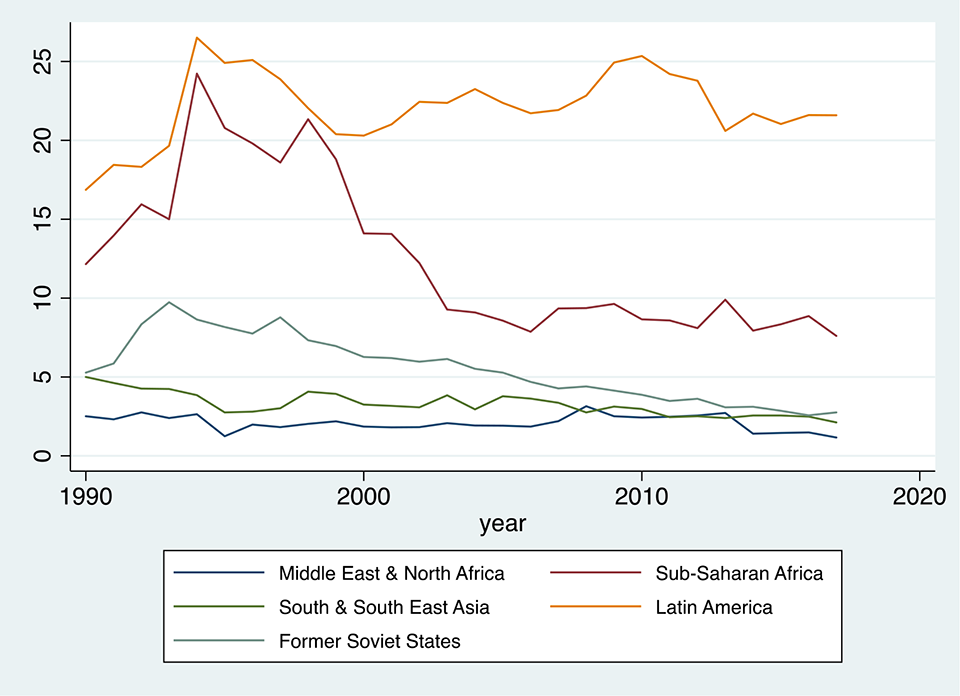
The Latin America–Caribbean region, which has historically had the highest rates, does not show any decline in the murder rate, despite the recent gains in formal democracy and a massive reduction in the incidence of organized armed conflict there (Pettersson, Högbladh & Öberg, 2019; Rivera, 2016). Contrarily, sub-Saharan Africa shows a steep reduction since 1995. The homicide rate decreases from 24 deaths per 100,000 to roughly eight deaths. There is, however, a great deal of heterogeneity within regions, which needs to be explained in multivariate analyses using fixed effects regression because the causes of homicide are indeed complex and multifarious (United Nations Office on Drugs and Crime, 2019a). What should be noted, however, is that the data used in this study closely resemble the patterns and trends reported by others (Eisner, 2015).
Theory
The received wisdom contained in many journalistic accounts on globalization is that the spread of ‘neoliberal’ economic policies precipitates a ‘race to the bottom’ in social standards, increasing crime and violence (Klein, 2007). Indeed, the rise of populism across the world apparently signals a ‘new anxiety’ about the future of free-market capitalism and globalization, mostly due to rising within-country inequality (Collier, 2018; Stiglitz, 2019). As some suggest, free-market economies drive individualistic, materialistic values over communitarian ones, increasing conflict rather than cooperation among individuals, classes, and groups (Rodrik, 2011). These grievance-based explanations of relative deprivation and social disruption see free market capitalistic policies driving criminogenic environments, not least due to their effects on inequality and the gradual erosion of institutional legitimacy (Kawachi, Kennedy & Wilkinson, 1999; Wilkinson & Pickett, 2009).
Bjørnskov (2015) laments the sweeping claims made about the connection between growing ‘neoliberal’ policies and crime. Using homicide data from the US states and the Economic Freedom Index for US states, he shows that higher levels of reforms towards greater economic freedom show no relationship to murder rates, but he finds some evidence to suggest that economic freedom may lower many forms of crime. Moreover, at least one cross-sectional analysis using a large number of countries reports that greater economic freedom reduces the homicide rate (Stringham & Levendis, 2010). These studies appeal to libertarian arguments, suggesting that something akin to spontaneous order and greater societal cooperation comes about because of free markets. Departing somewhat from this broad view, I suggest a more micro-level organizational logic for the negative association between economic freedom and the murder rate, tying interpersonal violence to theories of civil war based on organization logics.
Critics of the spontaneous order arguments about capitalism and peace acknowledge the ‘dark side’ of economics, where homo economicus might easily be a ‘bandit’ or highwayman rather than a producer, trucker, or trader (Hirshleifer, 2001; Skarpadas, 2003). Indeed, much like theories of civil war that stress ‘opportunity’ factors, or the ‘feasibility’ of organization of large-scale rebellion because of the availability of lootable income (Collier & Hoeffler, 2004), I suggest that distorted, monopolistic economic policies offer various forms of ‘lootable income’ (rents) for groups to organize in the shadows, increasing the risk of violence among other organized groups, or individuals, over ‘turf’ and the enforcement of contracts – these environments of ‘quasi-illegality’ are referred to by criminologists as ‘criminogenic environments’. In other words, higher than normal rates of death are organized with purpose, often referred to generically as ‘gang violence’ (United Nations Office on Drugs and Crime, 2019a). Violent underground environments form for quotidian reasons, such as the acquisition and protection of property and the enforcement of transactions, a process that is well explained in accounts of how mafia organizations and inner city gangs form and become institutionalized (Gambetta, 1993; Venkatesh, 2008). In most of the industrialized rich countries, violence forms around banned activities, such as drug peddling and prostitution, but these ‘markets’ remain thin and generally contained, and organization is fairly weak compared with state institutions. In many poorer countries, shadow economic activity leads to more thick shadow activity due to higher levels of transactions taking place in the shadows broadly in society. This shadow activity is more encompassing and entrenched, with state institutions and actors also often complicit in much of the illegality (Fisman & Miguel, 2008). These environments lead ultimately to higher demands for private justice, which increases violence.
Like many others, I define ‘sound economic governance’ as policies and institutions that increase economic freedoms, which reduce distortions in markets, allowing entrepreneurialism to drive investment and innovation (Berggren, 2003; de Haan & Sturm, 2009; Easterly, 2006). Where there are free market policies, where goods and services approximate the world market price, and import restrictions, tariffs, and monopoly are absent, entrepreneurs will invest in servicing societal demand for goods and services with ‘legitimate’ taxable investment, production, and trade. Transactions in such an environment are ‘above board’, and disputes are resolved by regular institutions at relatively low cost – justice, in other words, is public. Government agencies, insurance companies, banks, and regulatory authorities are available to settle disputes, where the state remains only a guarantor, for example in legal battles in courtrooms. In such environments, there is little need for private justice. Indeed, the ease of tax collection and the increasing volume of taxes collected from regular economic activity lead to ‘wealthy’ states in a virtuous cycle of prosperity and peace (Acemoglu & Robinson, 2012). In many ways, thus, state capacity and free-market economic policies may go together because of the indirect effect of good policy on development, which means that any examination of economic freedom’s effect on the homicide rate needs to parse out the effects of development and the solidity of legal institutions (rule of law), which are standard indicators of state capacity (Fearon & Laitin, 2003).
Contrarily, where economic policies are restrictive and predatory, where rent-seeking by economic and political elites is high, or where state-sanctioned monopolies fix prices, often resulting in shortages of goods desired by a public, then entrepreneurs have high incentives (and payoffs) for organizing the supply of goods through illegal markets. Such organizations grow by capturing rents from smuggling and other shadow-economy (illegal) activities, such as protection rackets. Distorted markets supply rents in ways analogous to natural resource rents blamed for the organization of rebellion (Collier, Hoeffler & Rohner, 2009). For these reasons, many poorer parts of the world have massive shadow economies, making up more than half the size of the regular economy (Krueger, 1990; Medina & Schneider, 2018). Under these conditions, even where states are relatively ‘strong’ in terms of policing capability, private violence grows as the density of transactions in the shadows grows. Even in the rich world, when there are super profits to be made, such as from smuggling illicit drugs, organizations survive sanction by states. If in the rich world, such illegal markets remain ‘thin’, in poorer countries these illegal markets are fairly ‘thick’. Indeed, some economists see general crime as a type of externality of market altering rent seeking (Paul & Wilhite, 1994).
Criminologists studying structural causes of crime and interpersonal violence quite correctly identify state capacity and state legitimacy as important factors (LaFree & Tseloni, 2006; Nivette, 2011; United Nations Office on Drugs and Crime, 2019a). They argue that the problem of crime and murder relates to inegalitarian practices and structures (Fajnzylber, Lederman & Loayza, 2002; Kawachi, Kennedy & Wilkinson, 1999; Nivette, 2011). These scholars argue that structural conditions of income inequality and other inegalitarian processes of governance increase interpersonal violence (Wilkinson & Pickett, 2009). For this perspective, sound political governance relates to ‘egalitarian’ governance that ensures rights and inclusivity, which increase state legitimacy and societal trust. Increased social and political capital are expected to reduce interpersonal violence. While such attributes of governance are desirable in their own right and intrinsically valuable, do they reduce interpersonal violence as claimed by so many (Kawachi, Kennedy & Wilkinson, 1999; LaFree & Tseloni, 2006; Lappi-Seppälä & Martti, 2014)? For assessing the strength of economic freedom’s organizational logic proposed here, I contrast the effects of economic freedom with indicators capturing state legitimacy and social capital. Admittedly, my study aggregates phenomena at the national level, which does not necessarily capture all the fine-grained phenomena, such as effective policing at local levels, or the strength of local institutions and legitimacy, but the national level is relevant in the context of the broad theory covering governance, as I do here. The location of criminality, even when thinking internationally, does not necessarily have to be where the distortions in economic life lie, but it is reasonable to assume that organized criminality usually affects urban areas where the volume of transactions in the shadows is likely to be high.
The empirical evidence for a connection between inequality and state-legitimacy related crime is highly mixed. As some have pointed out, the inequality–crime connection holds empirically only because of omitted variables bias. In other words, the effect of inequality is simply a cross-national phenomenon explained by unmeasured country-level fixed factors, such as ‘culture’ and colonial heritage (Neumayer, 2005). The causes of crime are heterogenous, and empirical models estimating cross-country variance are likely to be biased due to omitted variables. Indeed, when Neumayer corrects for omitted country-level factors, the positive effect of income inequality on homicide rates vanishes. Another study, using a sample of Latin American countries, finds that income inequality does not matter for explaining the high murder rates there (Rivera, 2016). The lack of empirical evidence linking income inequality and other measures of state legitimacy to homicide rates might suggest then that income inequality measured as ‘vertical inequality’ might not be such a good proxy for capturing the link between governance and societal disarray as many claim (Kawachi, Kennedy & Wilkinson, 1999).
Thus, I also use indicators of ‘horizontal inequality’, or group-based political exclusion. Studies of ethnic conflict suggest that inequality between groups is what matters (Cederman, Gleditsch & Buhaug, 2013). In order to find out the relative power of the grievance arguments, measured in terms of political exclusion and inequality, I contrast these grievance factors with those of economic freedom. There is no reason, other than for the organizational argument, why economic freedom might reduce homicides to a greater extent than egalitarian, fair and inclusive political governance and structural conditions, if indeed grievances mattered more than opportunity. Thus, I posit the following hypothesis: H1: Economic freedoms reduce homicide rates more than political legitimacy and state capacity.
Data and methods
I utilize a cross-sectional, time-series (TSCS) dataset measuring the annual homicide rate for roughly 140 countries over 28 years (1990–2017). The Wooldridge test for serial correlation revealed that the data are first-order serially correlated. Thus, I utilize OLS regression with the Driscoll-Kraay (DK) standard errors that are robust to serial correlation and heteroskedasticity, but additionally account for bias from spatial dependence (Hoechle, 2007). According to Hoechle (2007), the small sample properties of the DK method are significantly better than those of the alternative covariance estimators when cross-sectional dependence is present. I estimate fixed effects throughout to avoid bias from omitted variables (Neumayer, 2005). In any case, in robustness tests, I subject the data and models to alternative estimation strategies, such as the Newey-West method with time and country fixed effects, Poisson models with the homicide rate transformed from rate to a count, and finally instrumental variables regressions for addressing reverse causality.
The homicide rate is a valid indicator of the level of violent crime in a society because deaths are less likely to be underreported (Fajnzylber, Lederman & Loayza, 2002; Neumayer, 2005; Rivera, 2016). I rely mainly on the World Bank’s World Development Indicators (WDI), which has consistently reported homicide rates taken from UNODC, the World Health Organization (WHO), INTERPOL, and national governments (World Bank, 2016). Moreover, the World Bank is careful not to include battle-deaths associated with civil war, although terrorist attacks are included as premeditated murder. Since such attacks are carried out by groups with connections to organized crime, and since mass murder requires some logistics, these data are well suited for testing the theoretical propositions (LaFree & Grunewald, 2018). I obtain a correlation of r = 0.996 between the WDI homicide data and those presented by the Homicide Monitor maintained by the Igarapé Institute in Rio de Janeiro, Brazil. 3
I use the Fraser Institute’s Index of Economic Freedom (EFI) as the main independent variable, which measures the degree to which states have open and competitive free-market economic policies and institutions. The EFI has undergone much scrutiny for both validity and reliability (Berggren, 2003; de Haan, Lundstrom & Strum, 2006). Several dozen indicators are aggregated into five main areas. Each of the areas indicates the degree to which markets are free of state interference and restrictions and of monopoly practices.
Minimal government – the degree to which an economy is privately owned.
Legal security and property rights (sanctity of private property rights and legal security, including the effectiveness of policing).
Sound money – the degree of central bank independence.
Free trade – the extent to which nationals are free to trade with foreigners.
Low business regulation – the extent to which businesses are free to hire and set wages.
The index stretches from 0 (no freedom at all) to 10 (totally free) and captures well the institutional and policy dimensions associated with lower economic distortions and the bureaucratic burden on an economy (Easterly, 2006). Notice, however, that ‘area 2’, legal security and property rights, also measures the effectiveness of state security forces, including the business costs of crime. This suggests that there might be partial identification of the index with the dependent variable. Thus, I enter ‘area 2’ separately in all models to parse out legal security and property rights from the rest of the index, which in many ways accounts for state capacity independently of the level of development.
The political variables are taken from the Varieties of Democracy (V-Dem) project that measures democracy according to various ‘types’ of democracy. Electoral democracy is a minimal definition of democracy where free and fair elections exist. V-Dem’s ‘liberal democracy’ measure additionally has a basket of liberal values, and ‘egalitarian democracy’ includes many indicators of the equality of access to rights, state services, and access to political and economic resources (Coppedge et al., 2011; V-Dem, 2017). There is generally very high correspondence between the V-Dem polyarchy measure and the widely used Polity IV measure of democracy. 4 The V-Dem data are collected on the basis of expert codings, which are subjected to various sophisticated methods of cross-validation, such as Item Response Theory, that reduce intercoder bias and error (Pemstein et al., 2018).
The intercorrelations among the EFI, electoral, liberal, and egalitarian democracy measures do not exceed r = 0.50, which is positive as expected, but unproblematic in terms of multicollinearity (see Online appendix Table A.I). The political exclusion indicators measure the degree to which access to justice, political rights, and state services and public goods are equitable among classes and social groups. I also include indicators of state-provided private goods through favouritism, and perhaps due to positive discrimination towards social and political groups. Equity in access to state jobs for social and political groupings, for example, captures the ‘fairness’ of political governance thought of as impartiality. Additionally, I use V-Dem’s measures for government corruption and corruption in the public service as additional indicators of state legitimacy (McMann et al., 2016).
Naturally, I also control for important confounders but limit them so as not to overfit the basic model (Achen, 2005). Instead, I subject my analyses to robustness tests where a barrage of alternative models are tested. The basic controls are limited to four variables. First, I enter the level of development of a country, which is often taken to be a good measure of state capacity closely connected with such features as economic openness and democracy (Fearon & Laitin, 2003). Thus, per capita income’s effects need to be parsed out from the effects of economic freedom and democracy. I use GDP per capita in constant 2010 USD sourced from the World Development Indicators (WDI) online database. 5 Secondly, I enter a government’s dependence on oil, which essentially captures some degree of wealth that is generally unearned through industrialization. Oil-wealthy states are reported to be badly governed and contain higher homicide rates (Stretesky, Long & Lynch, 2016). I utilize the WDI’s variable measuring oil rents to GDP, which captures the importance of oil production. Next, I include a measure of the size of a society by controlling for population size, taken from the WDI because market size relates to how economically open a state is (Alesina & Spolaore, 1997). See summary statistics and intercorrelations in Online appendix Tables A.I and A.II.
Since homicide rates and economic freedoms may trend over time, I enter year dummies to capture the effects of time independently. Note that I always include the minimum definition of democracy (electoral democracy) in all models estimated to avoid any spuriousness, except for those models where other types of democracy are estimated. Fixed effects analyses are used throughout to avoid bias from omitted variables. When using the Poisson models, which are non-parametric models based on the maximum likelihood estimator, I include year and country fixed effects, which is unproblematic in terms of the ‘incidental parameter bias’ for these types of models (Allison, 2012).
Finally, any positive correlation between my main variable of interest, economic freedom, and the homicide rate could be endogenous. Even if fixed effects analysis eliminates omitted variables bias, it does not account for the possibility of reverse causality. In other words, high homicide rates may create the conditions of governance that lower economic freedoms and vice versa. Two-stage instrumental variables analysis addresses reverse causality, where an exogenous instrument z is used to explain x (instrument relevance), but z cannot be caused by y, nor must z directly cause y (instrument exclusion). In other words, the effects of the instruments on y must occur only through x (Angrist & Pischke, 2009). Instruments that satisfy these conditions are generally hard to find, but I follow Easterly (2006), who instruments economic freedom with legal origins of countries and distance from the equator for explaining per capita income and the growth rates of income. As he (2006: 33) writes: Since the institutions of economic freedom originated in Europe and then spread to other temperate regions where Europeans settled (with some exceptions), I use distance from the equator as one instrument for economic freedom.
The validity of the instruments depends on two criteria – instrument relevance and instrument exclusion. The relevance of the selected instruments is tested by a joint F-statistic in the first stage of the IV regression (Bound, Jaeger & Baker, 1995). Following others, I use the recommended F value of over 10 at the 10% level of the Stock-Yogo weak identification F test, as well as the Kleibergen-Paap and Cragg-Donald tests for weak instruments (Baum, Schaffer & Stillman, 2003). The exclusion criteria, or the selected instruments’ effect on y working only indirectly through the treatment variable is tested via the Hansen J-test (Hansen, 1982).
Results
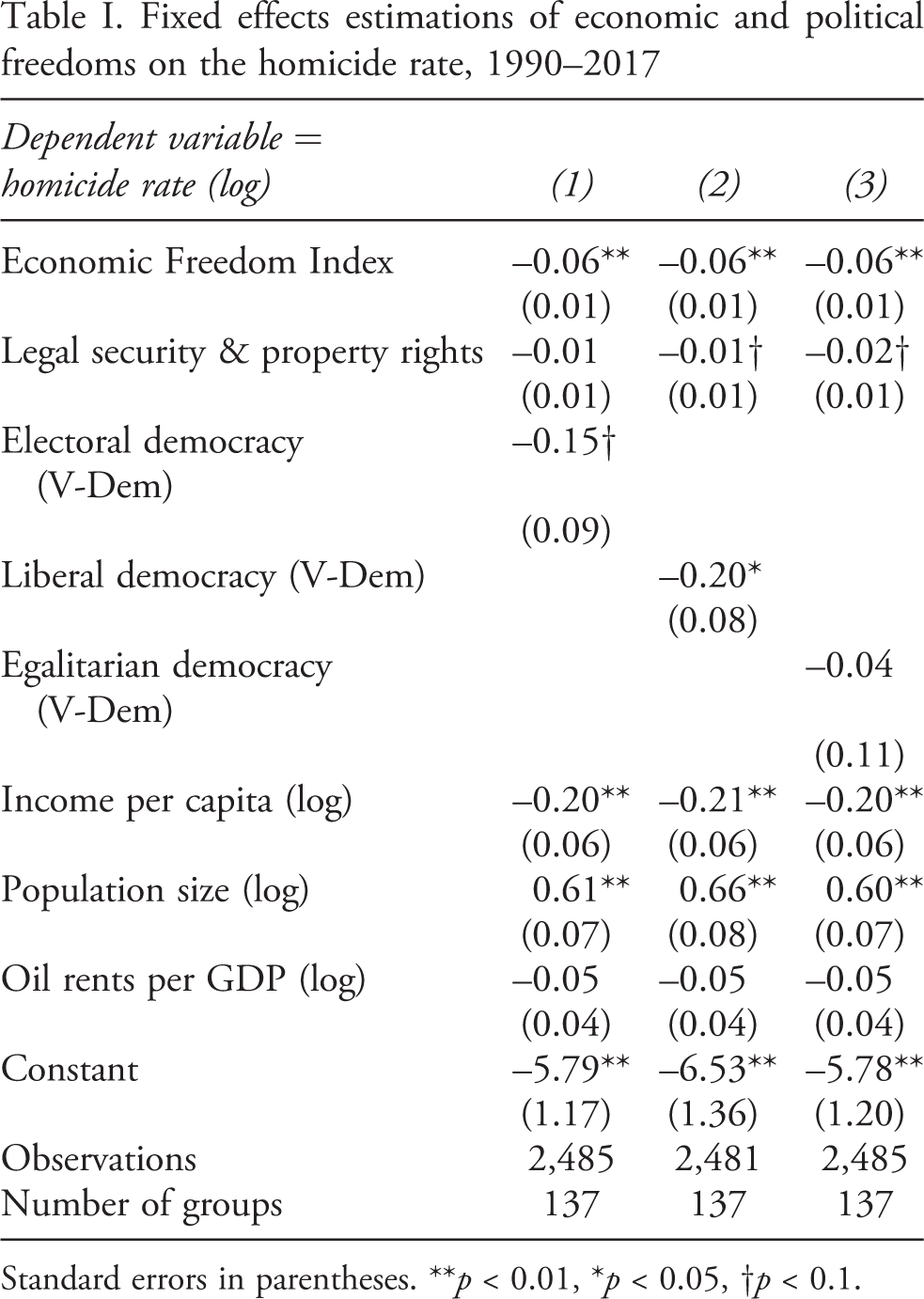
Fixed effects estimations of economic and political freedoms on the homicide rate, 1990–2017
Standard errors in parentheses. **p < 0.01, *p < 0.05, †p < 0.1.
In Column 2, the effect of economic freedom remains negative and statistically significant when liberal democracy is entered in the model. It seems that the liberal elements of democracy matter strongly negatively, a result that is statistically significant and independent of the controls. Substantively, a standard deviation (within) increase in the liberal aspects of democracy, holding all of the other variables at their mean values, reduces the homicide rate by 4% of a standard deviation (within) of the homicide rate (a little more than three times smaller than the partial effect of a similar increase in economic freedom). Nevertheless, these results support others that expect a significant negative effect of democracy on homicides (LaFree & Tseloni, 2006; Stamatel, 2016). 8 In Column 3, however, egalitarian democracy, which is democratic governance that includes strong redistributive components and legitimacy-increasing equity criteria, has no statistically significant effect on the homicide rate, independently of the control variables. Economic freedom, however, remains negative and statistically highly significant. This result supports others that find no effect of income inequality on crime and homicide (Neumayer, 2005; Rivera, 2016).
The results on the rest of the controls are interesting and consistent with much previous research. Large populations show a statistically significant positive effect on the crime rate, independently of the openness of a country’s economy, suggesting that population size may capture state capacity effects where the reach of law enforcement is likely to be weaker, once economic and political factors are controlled. It might also very well be that large countries that are closed provide even greater lootable opportunities due to economies of scale, leading to even greater illegal organization. Interestingly, per capita income and population size happen to be the most robust predictors of civil war (Ward, Greenhill & Bakke, 2010). Oil wealth is unrelated to the homicide rate across the estimations, contrary to the findings of others that use only cross-sectional studies (Stretesky, Long & Lynch, 2016). The time trend shows a decreasing homicide rate independently of all the other variables in the model. Interestingly, time might indeed be capturing some dimension of state integration through processes of globalization because organized criminality is best fought collectively through state cooperation and the diffusion of policing technologies across space, not totally unrelated to ways in which economic policies have spread across space (Simmons & Elkins, 2004).
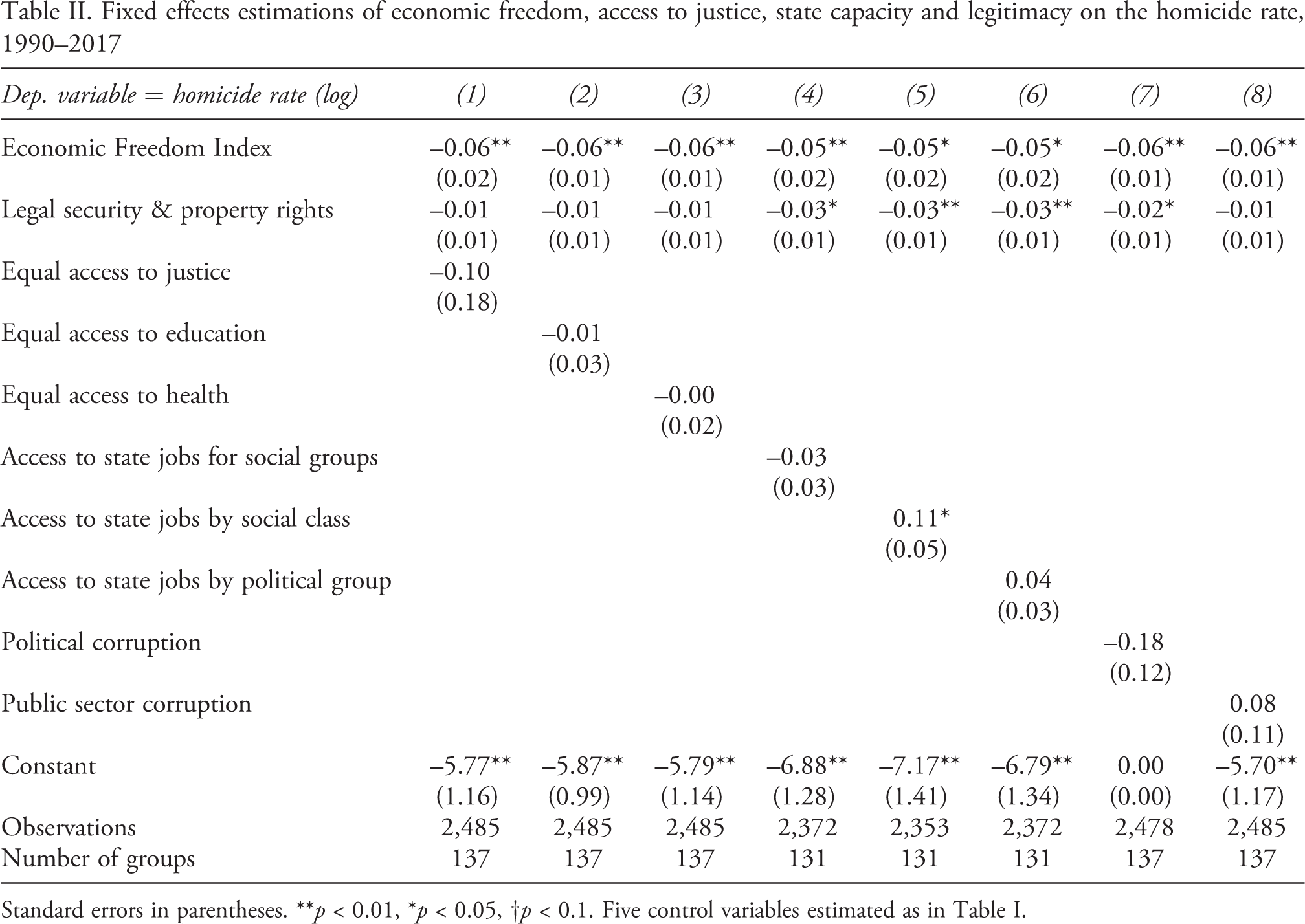
Fixed effects estimations of economic freedom, access to justice, state capacity and legitimacy on the homicide rate, 1990–2017
Standard errors in parentheses. **p < 0.01, *p < 0.05, †p < 0.1. Five control variables estimated as in Table I.
Table III displays the results of political exclusion of groups based on class, identity groups, such as caste, ethnicity, and religion, the rural–urban distinction, and political groupings. Can group grievance-based explanations linked to political legitimacy and anomie matter for explaining interpersonal violence?
Fixed effects estimations of economic freedom and political exclusion on the homicide rate, 1990–2017
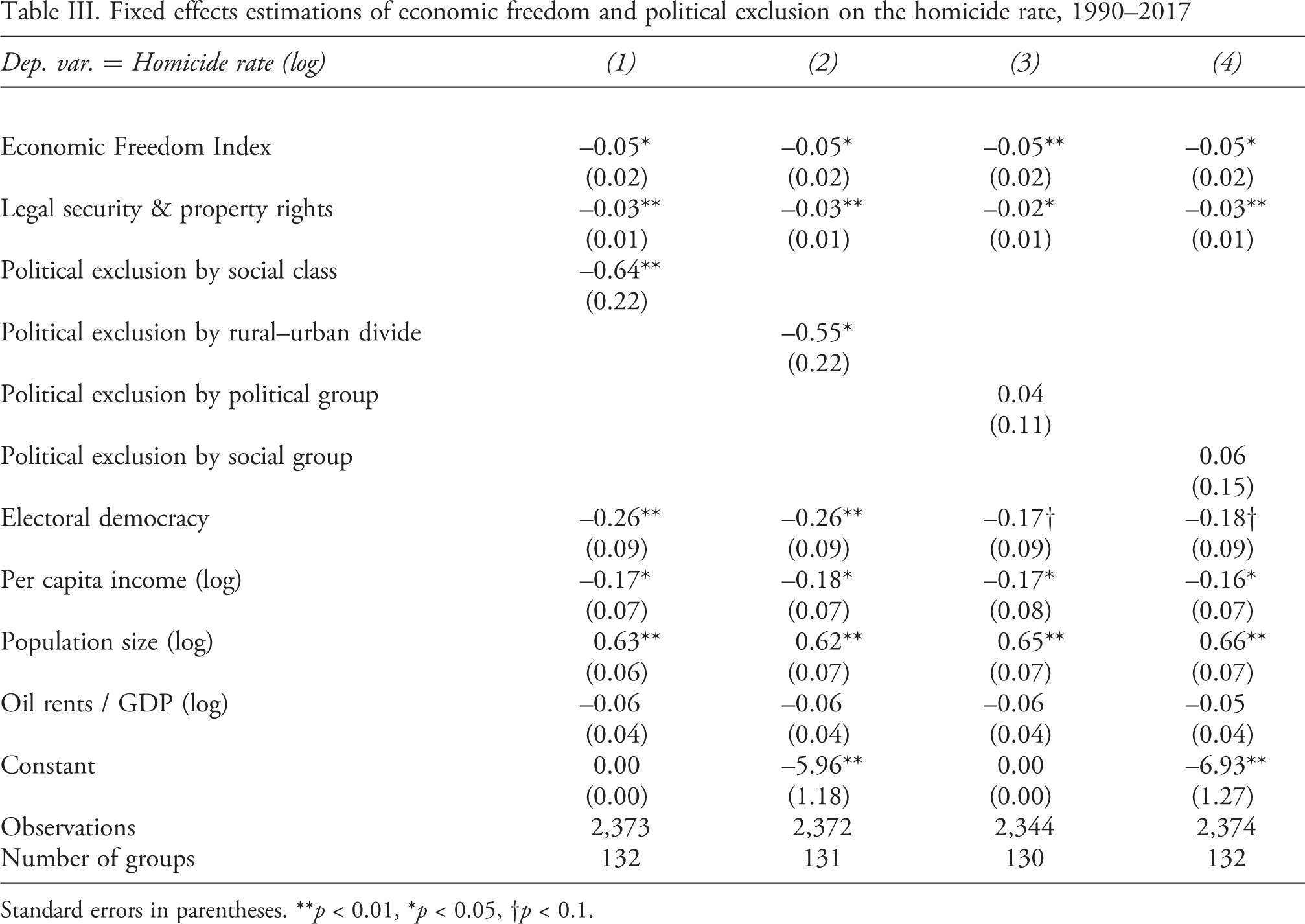
Standard errors in parentheses. **p < 0.01, *p < 0.05, †p < 0.1.
Next, I subject the basic model presented in Table I (Column 1) to several different changes in specification. Another way of testing robustness is to focus on the stability of effect size of the main variable of interest rather than focusing on statistical significance (Plümper & Neumayer, nd). These results are presented in the Online appendix (Table A.III). From running the model with no controls at all through various model changes, sample sizes, and alternative data, the effect of economic freedom remains stubbornly statistically significant, independently of legal security and property rights. The results, thus, are robust to a barrage of specification changes, sample sizes, and alternative data.
Next, I transformed the homicide rate into a count variable for estimating a Poisson model, but since my data are overdispersed, I use negative binomial regression (Long & Freese, 2006). I employ robust standard errors to account for any undue influence points, estimating two-way fixed effects model. The negative effect of economic freedom holds, and the results on the other variables are comparable with Table I (results not shown but available from author). Can we be certain that the association of economic freedom negatively with homicides explains the organizational argument? The UNODC reports that the vast majority of homicides of men might be attributed to organized crime, while women are murdered by intimate partners (United Nations Office on Drugs and Crime, 2019b). The WDI data report the homicide rates by gender for 108 countries. Running the basic model yields a statistically significant negative effect for economic freedom only for the male homicide rate. The effect is statistically not significant for women only, which through inference, supports the organizational mechanism (results not shown but available upon request).
Instrumental variables regressions of economic freedom on homicide rates, 1990–2017
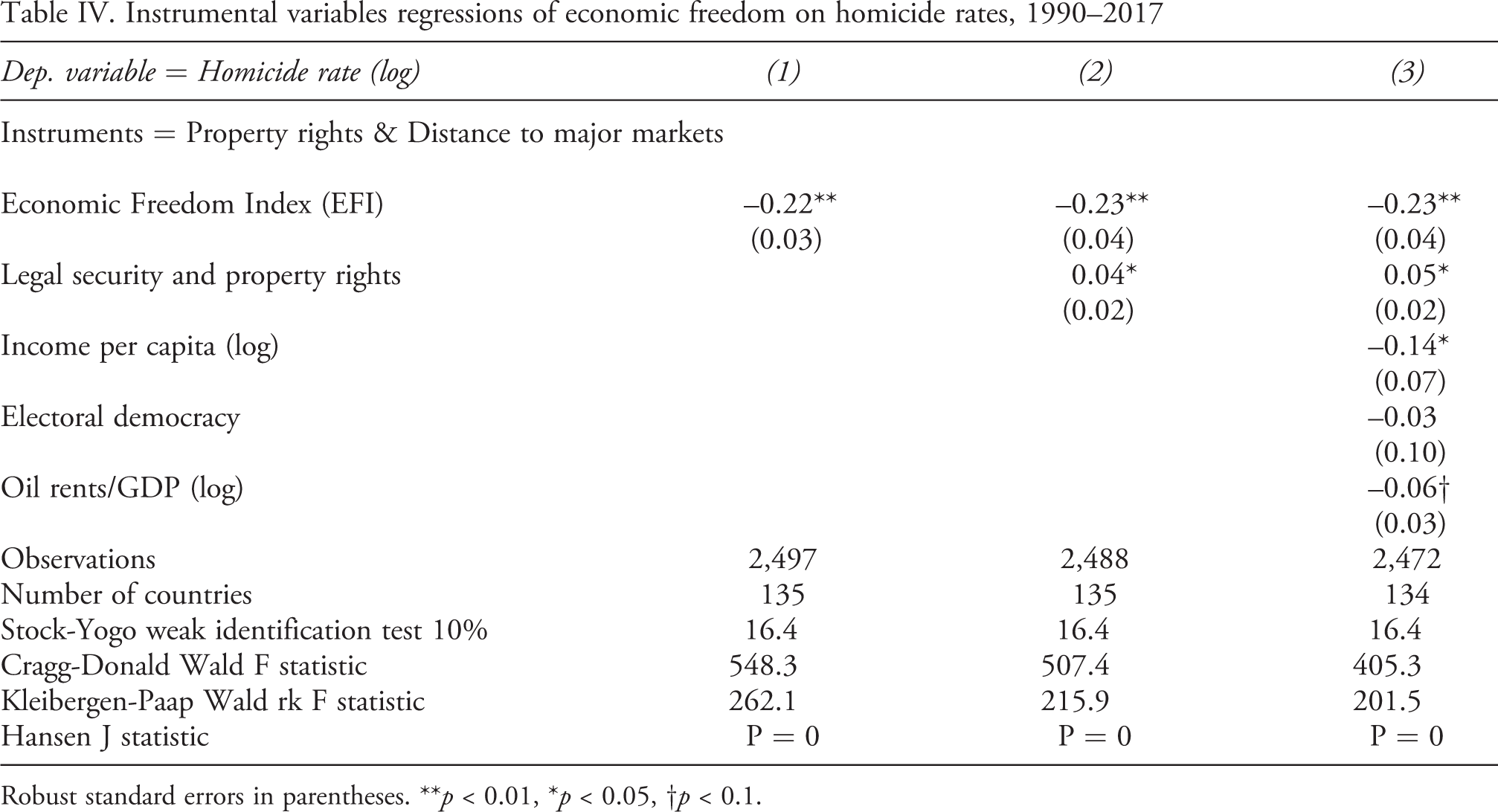
Robust standard errors in parentheses. **p < 0.01, *p < 0.05, †p < 0.1.
The question of endogeneity due to reverse causality remains a nagging issue. Could it be that low homicide rates determine higher levels of free-market economic conditions? Table IV displays the results of the instrumental variables analyses.
As seen across the columns, whether economic freedom enters the models with and without each of the controls, it shows negative and statistically highly significant effects, suggesting that economic freedom reduces the homicide rate and not the other way around. In fact, the effect size of economic freedom increases by a factor of four in these analyses. The F-statistic for weak identification is above the 10 threshold, and the Kleibergen-Paap and Cragg-Donald Wald tests suggest that the instruments are relevant. The Hansen J-test, which is statistically not different from 0, suggests that the instruments pass the exclusion criteria.
The fixed effects analyses above, which are generally unbiased by omitted variables, plus the instrumental variables analyses, suggest strongly that economic freedom reduces homicides, independently of state capacity (per capita income) and legitimacy (democracy) criteria. There is strong and consistent evidence to accept the hypothesis. The evidence taken together also suggests that ‘grievance’ factors emanating from structural inequalities and exclusion that may indicate greater state legitimacy are poor predictors of homicide. Some measures of inequality and political exclusion, surprisingly, display the opposite sign, supporting previous studies that use different data and estimating strategies (de Soysa & Noel, 2018). Clearly, opportunities to commit crime surely explain homicides more than societal grievances, which means that these opportunities must lie in the organizational logic associated with distorted economic policies, proxied here as economic freedom. If economic freedom reduced crime because people cooperated spontaneously due to greater trust and social capital, why income inequality and discriminatory politics would not increase crime in equal measure is a mystery.
Conclusion
Criminology is the study of why people ‘break the law’ (Sutherland, 1947). The dominant view seems to be that crime is a ‘social mirror’ because it reflects certain social structures that prevent more fair and legitimate governance (Kawachi, Kennedy & Wilkinson, 1999). People apparently break laws because they view institutions as illegitimate, where anomie drives crime and violence. Recent policy reports surveying the vast literature on homicide mention, among other factors, that governance needs to be fair and inclusive for reducing the homicide rate (Geneva Declaration on Armed Violence and Development, 2015; United Nations Office on Drugs and Crime, 2019a). There is little question that fair and impartial governance that increases equity is intrinsically valuable, but what exactly is meant by fair? Taking recent anxieties about the future of free-market economies, rising inequalities, and globalization’s effect on communitarian values and social capital, I examine the question of how economic governance in terms of economic freedoms reduces conditions that increase homicide (Collier, 2018; Rodrik, 2011; Stiglitz, 2019). The results show robustly that greater economic freedom, rather than political freedoms or fair political governance, drives lower homicides. There is little support in the data analyzed here that political exclusion and discrimination increase grievance-based interpersonal violence. Clearly, such conditions must be ended on moral and practical grounds related to many other outcomes.
I argue that closed, dirigiste economies, where markets are distorted by rent-seeking and monopoly, generate investment in the shadows, leading to criminogenic environments that increase private sources of justice. Such conditions increase violence and murder, presumably regardless of other mechanisms, such as fair governance. Interpersonal violence or large numbers of murders occur due to the organizational capabilities and logics of ‘illegal’ activity. Quotidian transactions in unregulated markets increase violence due to private justice, not unlike the violence that occurs around illegal transactions in inner cities, even in the richest countries. By reducing distortions in an economy through rent-seeking and monopoly, societies are also less likely to face the costs of high crime, avoiding the vicious cycles of violence and poverty. As Pinker (2011), cited above, has suggested, murder rates are decreasing, not only because states have become ‘stronger’, but also because they have become ‘smarter’. Careful theory-building that help us understand better how economic governance affects the homicide rate will allow more targeted policies for stopping the killing. Experts in criminology already identify such factors as empowering local governance, better policing, gun control, youth employment, and education, etc., but my results clearly suggest that countries wishing to increase growth and development by practising free-market policies by increasing economic freedoms do not generally need to fear increasing levels of interpersonal violence. This study has focused on the broader question of governance at the national level. Future research might probe links from distorted economic policies to the organizational bases of violence at local levels, as well as probe the interrelationships between bad governance, crime, and armed violence within and across borders in more integrated ways, which some have already begun to do (Collier, Hoeffler & Rohner, 2009; Kalyvas, 2015; LaFree & Grunewald, 2018; Pinker, 2011).
Footnotes
Replication data
The dataset and do-files for the empirical analysis in this article, along with the Online appendix, can be found at http://www.prio.org/jpr/datasets and  .
.
Acknowledgements
I am deeply grateful to three anonymous reviewers and the editor for extremely insightful comments and suggestions. Their guidance led to a much improved manuscript. I am grateful to Karin Dyrstad, Charles Butcher, and several members of the VIP group at ISS, as well as Jorunn Kaasa, for extremely useful comments on a previous draft. Comments received at the SPECTRE / Dublin IPE meeting in September 2019 are gratefully acknowledged. However, only I am to blame for the ways in which I have made use of all this good advice.