




Abstract
As hydro-meteorological hazards are predicted to become more frequent and intense in the future, scholars and policymakers are increasingly concerned about their security implications, especially in the context of ongoing climate change. Our study contributes to this debate by analysing the pathways to water-related conflict onset under drought conditions in the Middle East and North Africa (MENA) region between 1996 and 2009. It is also the first such analysis that focuses on small-scale conflicts involving little or no physical violence, such as protests or demonstrations. These nonviolent conflicts are politically relevant, yet understudied in the literature on climate change and conflict, environmental security, and political instability. We employ the method of qualitative comparative analysis (QCA) to integrate quantitative and qualitative data at various scales (national, regional, local) for a sample of 34 cases (17 of which experienced conflict onset). Our findings show that pre-existing cleavages and either autocratic political systems or cuts of the public water supply are relevant predictors of nonviolent, water-related conflict onset during droughts. Grievances deeply embedded into socio-economic structures in combination with a triggering event like a drought or water cuts are hence driving such water-related conflicts, especially in the absence of proper political institutions. We thus argue that drought–conflict links are highly context-dependent even for nonviolent, local conflicts, hence challenging determinist narratives that claim direct interlinkages between climate change, hydro-meteorological disasters and conflict.
Introduction
Over the coming decades, ongoing climate change is likely to increase the frequency and intensity of hydro-meteorological events like droughts and floods even under moderate greenhouse gas emission scenarios. At the same time, both the number of people living in areas vulnerable to such events and the value of assets located there is increasing (IPCC, 2018). A case in point is the 2006–09 drought in north-eastern Syria, which had devastating impacts on local livelihoods due to a combination of rainfall scarcity, a history of state-driven agricultural expansion (leading to a degradation of land and groundwater resources), the presence of relatively large and poor populations, the termination of subsidies for fuel and fertilizer, and a lack of external support (de Châtel, 2014; Selby, 2019).
In this context, researchers and policymakers alike have frequently speculated about a link between climate-related disasters and an increasing risk of violent conflict (Peters, 2018). Former UN Secretary-General Ban Ki-Moon, for instance, warned: ‘[e]xtreme weather events continue to grow more frequent and intense, in rich and poor countries alike, not only devastating lives but also infrastructure, institutions and budgets – an unholy brew that can create dangerous security vacuums’ (United Nations, 2011).
A number of studies have picked up and tested such claims. Eastin (2018), Nardulli, Peyton & Bajjalieh (2015) and Schleussner et al. (2016), among others, find a statistically significant correlation between climate-related disasters and armed conflict occurrence. Other scholars, by contrast, are unable to find such a link in large-N, cross-case studies (e.g. Ghimire, Ferreira & Dorfman, 2015; Omelicheva, 2011; Slettebak, 2012). Droughts hold special importance within this debate. Several articles have been devoted to studying the impact of drought on violent conflict in particular. These articles often focus on hazards (in the form of exogenous weather events, mostly unusually low rainfall) rather than disasters (the societal impacts of hazards). However, they still provide important insights into disaster–conflict links as they focus on societies vulnerable to hazards-turning-into-disasters (for instance due to insufficient water infrastructure and high agricultural dependence).
Some of those studies provide evidence for an impact of drought on conflict risk (Maystadt & Ecker, 2014; Raleigh, Choi & Kniveton, 2015; von Uexkull, 2014), while others do not (O’Loughlin, Linke & Witmer, 2014; Salehyan & Hendrix, 2014; Yeeles, 2015). This divide is largely mirrored by qualitative research, which controversially debates the role of rainfall deficits for large-scale violence in Syria (Gleick, 2014; Selby et al., 2017), Darfur (De Juan, 2015; Selby & Hoffmann, 2014) and northern Kenya (Adano et al., 2012; Schilling et al., 2014), for example.
In recent years, a number of nuanced studies using improved methods and datasets seem to indicate that hydro-meteorological hazards increase the risk of violent conflicts under certain conditions. Von Uexkull et al. (2016) find that droughts during the growing season make armed conflicts in Africa and Asia more likely, but only among agriculturally dependent and politically excluded groups. According to Detges (2016), the presence of road and water infrastructure is crucial in accelerating or mitigating drought–violence links in sub-Saharan Africa. Besides, Ide (2015) shows that renewable resource scarcity, often a consequence of hydro-meteorological hazards, facilitates violent conflict escalation under conditions of negative othering, relatively equal power balances between the groups in conflict, and acute political change. Similar conditional links are also highlighted by Feitelson & Tubi (2017), Ide et al. (2020) and Schleussner et al. (2016). Most often these studies provide stronger and more robust results for low-intensity violence causing only a small number of fatalities (when compared to full-blown civil wars). These findings are in line with early qualitative research results claiming that environmental conflicts ‘tend to be subnational, diffuse and persistent’, and only occur if certain scope conditions are present, such as lack of ingenuity and pre-existing cleavages (Homer-Dixon & Blitt, 1998: 11).
However, with the exception of a few studies employing political ecology approaches (e.g. Bassett, 1988; Benjaminsen, Maganga & Abdallah, 2009), the literature has paid little attention to small-scale conflicts involving little or no physical violence (henceforth: nonviolent conflicts) in the face of hydro-meteorological hazards or disasters. While such conflicts have less impact on human security and development when compared to armed clashes or even civil wars, they are worth studying for at least three reasons.
First, nonviolent conflicts can be a driver of emancipation and social change. Civil resistance, for example, has effectively challenged dominant and unequal political power structures (Stephan & Chenoweth, 2008), for instance in Georgia (2003), the Ukraine (2004/5) and Egypt (2011). Second, nonviolent conflict episodes such as demonstrations or sit-ins can be a starting point for conflict escalation, eventually leading to violent confrontations (Bartusevičius & Gleditsch, 2019). When overwhelmingly peaceful protests against the Assad regime in 2011 were met with repression, for example, an escalation process towards a devastating civil war started (Selby et al., 2017). Finally, nonviolent conflict can be an indicator for legitimate grievances, which should be taken seriously by political institutions and, if applicable, external mediators, peacebuilders and development workers. 1
As discussed above, the recent literature largely agrees that disasters triggered by hydro-meteorological hazards, and especially droughts, increase the risk of small-scale violent conflict events in certain contexts. From a theoretical point of view, such a link should be even more pronounced for nonviolent conflict events. When confronted with water scarcity during a drought or unequal vulnerability to a flood, for instance, especially poor and/or marginalized groups might lack the financial or administrative capacities to stage a violent confrontation (Fröhlich, 2016; Tarrow, 1998). A relatively strong government, the urgent need to sustain livelihoods (and to care for disaster victims), social and/or moral stigmatization of violence, and the considerable risks involved in violent activities might further discourage such conflicts (Collier, Hoeffler & Rohner, 2009; Salehyan, 2008). Nonviolent activities like demonstrations or sit-ins, by contrast, require fewer financial and organizational resources, and are at least in some contexts associated with lower personal risks. Due to their higher perceived legitimacy, they can also be supported much more easily by ‘external’ actors like political parties or (international) nongovernmental organizations (NGOs).
Indeed, the qualitative literature provides numerous studies of cases where protests or demonstrations, often specifically concerning water issues, were initiated after hydro-meteorological disasters. When Hurricane Mitch and a number of droughts had reduced water availability in the municipality of Cordega (Nicaragua) during the late 1990s and early 2000s, disadvantaged households pressed influential community members to stop illegal water appropriation by rich cattle owners (Gomez & Ravnborg, 2011). In the Ferghana Valley, drought frequently ignites intercommunal water disputes – including demonstrations, threats and scuffles – along ethnic cleavages (Bichsel, 2009). In Yemen, drought has been proven to accelerate competition over already scarce water resources, often resulting in protests and court cases against rural-to-urban water transfers (Weiss, 2015). But a systematic, cross-case analysis of such conflict cases is not yet available.
In this article, we present the first study on nonviolent conflict onset in the context of hydro-meteorological hazards. Specifically, we investigate the conditions of nonviolent, water-related conflict onset under drought conditions in the Middle East and North Africa (MENA). Although the MENA region as a whole has been extensively studied in the climate-conflict literature, our study provides new evidence for countries so far hardly investigated, such as Algeria, Jordan and Turkey (Adams et al., 2018). Methodologically, we employ a qualitative comparative analysis (QCA), thus combining quantitative and qualitative data to disentangle complex causal pathways for a medium number of cases (Schneider & Wagemann, 2012).
This article proceeds as follows. In the next section, we introduce our theoretical framework before outlining our research design. Subsequently, we present and discuss our results and conclude the article by reflecting on policy implications and further research tasks.
Drought and water-related conflict
In this study, we understand conflict as a situation in which at least two social groups (i) perceive their interests as mutually incompatible and (ii) act based on these perceptions (Ide, 2016). Our definition hence only captures manifest conflicts that are articulated by concrete actions, while latent or structural conflicts might be present quite some time before or after manifest actions, or even without them at all. Nonviolent conflicts here refer to small-scale, often local conflicts which involve no or very limited physical violence. As discussed above, the organizational requirements and opportunity costs involved in joining a nonviolent conflict are low compared with armed conflicts or civil wars, hence making the former more prevalent. Typical examples of nonviolent conflicts (on which we focus in this study) include protests and demonstrations. Conflicts that are handled by the national political systems (e.g. through electoral competition) or the formal judicial system, however, are not included in our definition, because their local nature and/or small-scale repertoire of actions can be contested. We consider conflicts to be water-related if at least one party explicitly articulates demands or grievances about water access, water availability and/or water infrastructure (Houdret, 2012).
Along with almost all other environmental security scholars, we reject determinist positions, hence assuming no direct link between drought and water-related, nonviolent conflict (henceforth: water-related conflict). Rather, we hypothesize that the occurrence of water-related conflict during drought is conditional on a number of contextual factors. Four of these are considered in further detail here.
First, water-related conflicts rarely occur in a political vacuum. This is especially the case as the comparatively low economic value of water and the availability of technological solutions (e.g. obtaining water from tankers, buying virtual water in the form of food) render intense disputes about water cost-inefficient (Selby & Hoffmann, 2014). Rather, socio-environmental conflicts often overlap with existing grievances, hence forming subdimensions of broader societal conflicts (Homer-Dixon & Blitt, 1998). The water conflict between Israel and Palestine, for instance, is deeply embedded into the broader material and discursive structures of the Israeli–Palestinian conflict (Fröhlich, 2012). Similarly, the nonviolent water conflict between highland and lowland dwellers in Thailand is also the result of existing tensions between ethnic Thai valley populations and marginalized, supposedly ‘foreign’ hill tribes (Ide, 2016). Thus, we assume that the occurrence of water-related conflict under drought depends on the presence of pre-existing grievances in the form of cleavages. These exist if the groups in question have been engaged in broader conflict prior to the start of the drought.
However, cleavages exist in all societies, but rarely transform into open (though nonviolent) conflicts (Fearon & Laitin, 2003). Social movement studies have demonstrated that protests are most likely to occur when people feel that their legitimate grievances cannot be successfully articulated and dealt with by the existing political or juridical system (Benford & Snow, 2000). Autocratic political systems that allow for little democratic participation are particularly likely to ignite such feelings (Geddes, Wright & Frantz, 2018). 2 The perceived corruption of the political elite, the lack of proper responses by state institutions and the inability to change this situation through elections, for example, made forest-dependent communities actively protest large-scale logging in Kalimantan, Indonesia, during the reign of Suharto (Barber, 1998). We therefore hypothesize that the presence of an autocratic regime is an important context factor for the onset of water-related conflicts. One should note, however, that autocracies might also discourage nonviolent conflict actions because risks can be high (due to potential repression and punishment) while the gains might be low (as elites are not accountable to the broader public). Yet many cases in our sample are protests by ‘ordinary’ local people (often coordinated by local networks or well-respected individuals) who might have few other options to express their political demands, and who consider non-action in the face of rising grievances and/or livelihood insecurity not to be an option (Tarrow, 1998).
In addition to grievances and the lack of effective ways to articulate them, the occurrence of a conflict event is also dependent on the presence of sufficient opportunities. Even spontaneous, bottom-up protests are often coordinated and led by local elites such as traditional authorities or urban middle classes with considerable social capital (Tarrow, 1998). Conflicts are also more likely to occur in areas with a high population density, as more people can be mobilized and logistical constraints are less challenging (Dixon, 2009). It is no coincidence, for example, that the anti-regime protests in Syria in 2011 mainly occurred in (peri-)urban areas and were led by young, well-educated and well-networked people (Fröhlich, 2016). We therefore assume that better opportunities for mobilization make the onset of water-related conflicts more likely.
Specifically, we propose that high nightlight emissions are a well-suited indicator for mobilization opportunities. Nightlight emissions refer to the light intensity of a certain area during the time when no daylight is present. High nightlight emissions are indicative of three conditions, all of which facilitate mobilization of social movements: (1) a high electrification rate (indicating a certain level of development, hence allowing people to allocate time to conflict activities), (2) a continuous supply of power (thus enabling people to organize via digital media), 3 and (3) a high population density (and therefore a larger group of persons that can potentially join a movement) (Segerberg & Bennett, 2011; Shortland, Christopoulou & Makatsoris, 2013).
Finally, even with grievances and opportunities present, conflicts are usually ignited by a trigger, that is, by a specific event taking place at a certain time that causes at least one party to take action in order to pursue its interests (Hendrix & Glaser, 2007). The escalation of Hindu–Muslim conflicts in Gujarat (India), for instance, was triggered by the burning of a train, some of whose passengers were Hindu nationalists (Chatterjee, 2012). A drought in itself can also be a trigger, as hydro-meteorological hazards lay open and reinforce (perceived) societal contradictions and inequalities (García-López, 2018). But droughts are slow-onset events that gradually unfold over longer periods, and therefore might be less suitable to trigger conflicts (at a certain point in time). We therefore add another triggering factor to the analysis: water cuts, defined as interruptions of the regular water supply provided by state or private actors. In particular, water cuts that go beyond short-term interruptions (lasting just a few hours) or regular interruptions (which happen in areas with insufficient supply and/or infrastructure and to which locals are usually well adapted) can put significant strains on livelihoods and cause grievances related to disappointed expectations. We thus hypothesize that during droughts, such water cuts trigger the onset of water-related conflicts.
The following section (and particularly the subsection ‘Data and calibration’) provides further information on the operationalization of these four factors highlighted by our conceptual framework.
Methods and data
Method
In order to analyse the factors driving water-related conflicts under drought conditions, we employ the method of qualitative comparative analysis (QCA). In a nutshell, QCA is a set-theoretic method based on Boolean algebra that is able to detect (combinations of) conditions sufficient and/or necessary for a given outcome (Schneider & Wagemann, 2012). Implicit to this is a weak understanding of quasi-necessity and quasi-sufficiency as there are no perfect (deterministic) predictors of the human behaviour and social interactions (Legewie, 2013). The method of QCA has been successfully used in environmental security research (e.g. Bretthauer, 2015; Hossu et al., 2018; Ide, 2015, 2018) and is particularly suitable for our research design for three reasons.
First, one of the core assumption of QCA is ‘conjunctural causation’ (Schneider & Wagemann, 2012: 78), that is, a given outcome can be the result of a complex interaction of several factors. The QCA algorithm is geared towards detecting such INUS conditions (insufficient but necessary parts of an unnecessary but sufficient condition for a given outcome). It hence mirrors our theoretical assumptions, which highlight context dependence and the interaction between different conditions.
Second, QCA is able to integrate quantitative and qualitative data in a single analysis. For this, it employs a calibration procedure which determines for each case whether it is in (1) or out (0) of the set of cases to which a certain condition applies (for instance, in or out of the set of democratic states). While partial set-membership scores are possible, we opt for a binary (crisp-set) QCA because the outcome relevant to this study can only have two values (occurrence or absence of water-related conflict), hence making a fuzzy-set analysis mathematically infeasible (Ragin, 2009).
Finally, and relatedly, QCA serves as a bridge between quantitative and qualitative analysis (Schneider & Wagemann, 2012). On the one hand, it is able to process qualitative data derived from a deeper knowledge of particular cases and contexts, and on which no quantitative information is available. This enables us to include variables like cleavages and water cuts in our analysis that are rarely considered by quantitative approaches. But on the other hand, QCA produces generalizable findings for a medium number of cases and employs reproducible mathematical procedures that can also be subjected to robustness tests (Skaaning, 2011; Vis, 2012). As research on environmental security and climate-conflict links is often criticized for fierce debates between or mutual ignorance of quantitative and qualitative approaches (Ide, 2017; Scheffran et al., 2012; Solow, 2013), employing such an integrated research design promises to shed new light on debates around climate-related hazards and conflict. 4
Case selection
In order to draw our sample, we utilized the PRIO-GRID dataset (Tollefsen, Strand & Buhaug, 2012), which projects a raster of cells with an edge length of 0.5° (∼55 km at the equator) over the world map. Afterwards, we identified those cell-years that suffered from a meteorological drought in the recent past. Specifically, we included all cell-years into the sample with a Standardized Precipitation and Evapotranspiration Index (SPEI) of 0.0833 or higher, indicating that at least one of the previous 12 months was characterized by an unusually severe drought (SPEI1 > 1.5) when compared with historical averages. Such a drought hazard can be considered very severe and likely at least partially exceeds the coping capacities of local societies, hence resulting in a (small-scale) disaster. The comparative advantage of the SPEI data is that it measures drought against historical averages (hence being a good proxy for extreme events) and that it includes temperature and evapotranspiration in addition to precipitation as drivers of drought (hence measuring conditions on the ground more adequately) (Almer, Laurent-Lucchetti & Oechslin, 2017).
The resulting cell raster was merged with the Water-Related Intrastate Conflict and Cooperation (WARICC) dataset. WARICC is a comprehensive event dataset containing information on water-related conflict and cooperation for several states in the MENA region for the time period 1996–2009 (Böhmelt et al., 2014). 5 We selected all conflict events which took place in a cell-year characterized by drought. In order to make sure that the analysis would focus on somewhat sustained conflicts about water at the local level, we excluded international events (scale value of 4), low intensity events (WES values of 1 and 2, which often simply refer to the existence of local water problems or rather mild verbal statements 6 ) and events where water was not the object of contention.
As WARICC codes all events with an unknown location in the country as having taken place in the capital, we also excluded conflicts in capitals unless the description explicitly referred to the capital city. By doing so, we yielded a sample of 17 water-related conflicts, of which ten were described as protests, five as demonstrations (including sit-ins and road blockages), and two as riots (see Online appendices 2 and 3 for further details). All of them were nonviolent in the sense that they included no or only very limited physical violence 7 against humans (although property was actively targeted in some cases), and no casualties occurred.
These conflict events were matched by a further 17 non-conflict cases. Selecting such cases is no easy task, as the absence of an entry in WARICC can indicate either that the cell-year is free of water-related conflicts or that the respective conflicts have not been reported. Indeed, studies have shown that news media from which databases like WARICC draw their information substantively underreport local-level conflicts, and speculated whether such false negatives impact the validity of cross-case analyses (Funder et al., 2010; Ide & Scheffran, 2014).
In order to determine our set of non-conflict cases, we thus selected cell-years characterized by cooperative events according to WARICC. However, our study does not deal with water-related cooperation, and most cooperation cases recognized by WARICC in fact do not represent water-related cooperation between distinct groups in the narrow sense of the term. 8 Rather, we use the presence of a cooperative event in the WARICC data as an indicator for media attention to a given region during a particular period of time. This minimizes the risk that intense (yet nonviolent) water-related conflicts occurred, but were not covered for the respective cell-year. Using instances of cooperation is therefore a promising strategy to reduce potential reporting biases in the sample of non-conflict cases.
Again, we excluded events on an international scale or with significant international involvement, events with an unclear spatial (capital) coding, and events that may have occurred simultaneously with and masked local conflicts (e.g. opening of a new dam). We also made sure that the Environmental Justice Atlas does not register a conflict for the respective cell-year in any of the non-conflict cases (Temper, del Bene & Martinez-Alier, 2015).
Figure 1 provides an overview about the 34 cases under study. One should note that while we used PRIO-GRID’s cell-years to generate the sample and extract quantitative data, WARICC’s geo-coordinates and event descriptions (along with the available literature, see below) enabled us to work on a more fine-grained level of analysis including specific villages, towns or districts.
Data and calibration
The previous subsection has already explained datasets used and the calibration procedure for the outcome of the analysis (water-related, nonviolent conflict onset). As discussed in the second section, we assume that four variables are relevant as necessary, sufficient and/or INUS conditions for the outcome.
Firstly, as an indicator for grievances, we calibrate whether cleavages between social groups existed in a location prior to a drought (cleavages = 1) or not (cleavages = 0). We do so based on qualitative information for each case, collected from academic books and journal articles, news media reports identified via the Factiva database (Dow Jones, 2018), the Environmental Justice Atlas (Temper, del Bene & Martinez-Alier, 2015) and, if appropriate, additional websites. Especially for Gaza, Israel, Turkey and the West Bank, we also consulted with country experts to gain a deeper knowledge of the cases. Online appendix 2 provides summary descriptions of all cases, along with complete lists of the sources used.
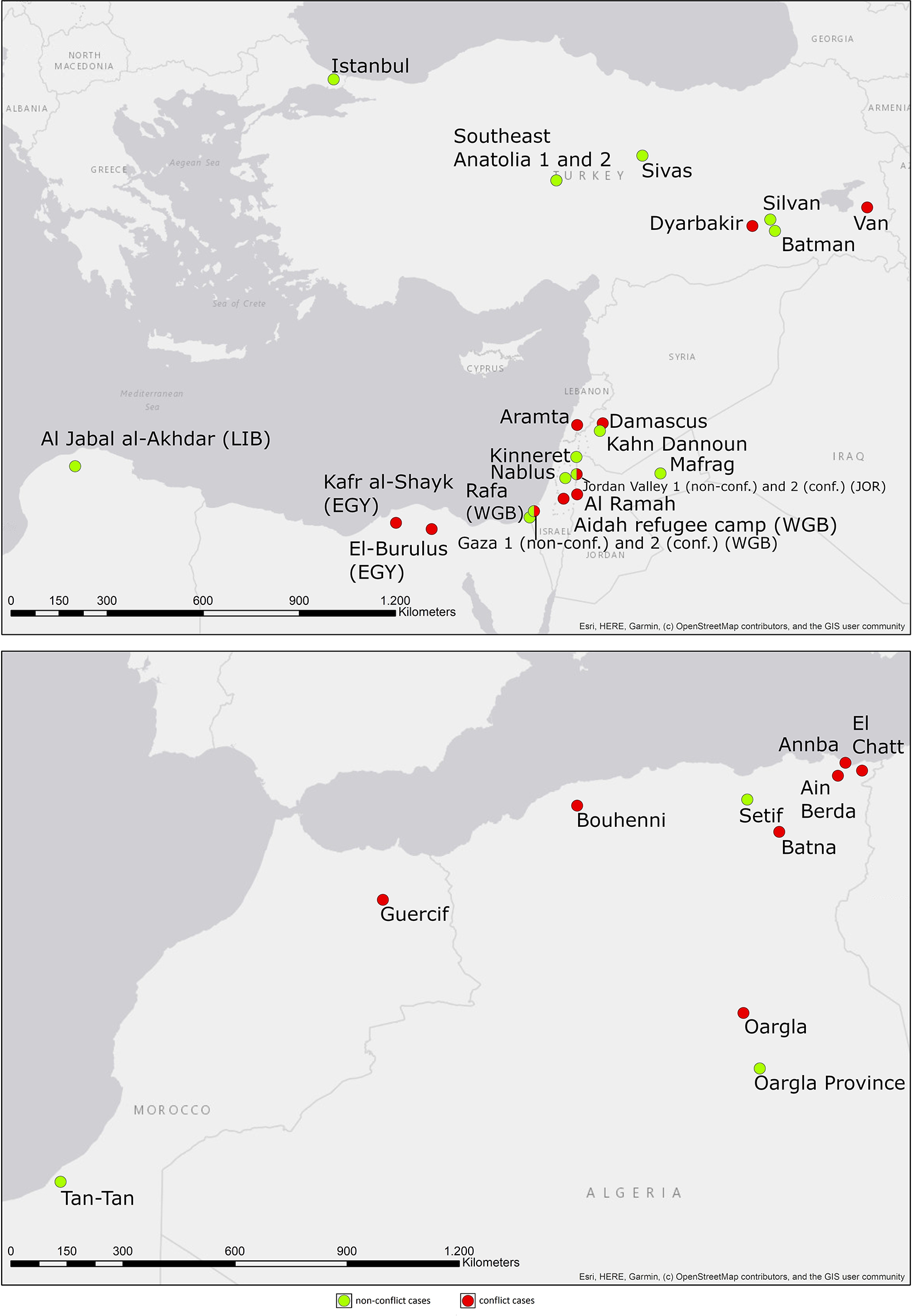
Location of the cases under study
Secondly, quantitative data on the regime type currently in power are obtained from Autocratic Regime Data, which is currently the most widely accepted dataset on the presence or absence of autocratic regimes (Geddes, Wright & Frantz, 2014). If the case is located in a country-year classified as autocratic by this dataset, we consider it as autocratic (auto_reg=1); if not, as democratic (auto_reg=0).
Thirdly, PRIO-GRID supplies information on nightlight emissions based on data collected by NOAA and DMSP (Tollefsen, Strand & Buhaug, 2012). We used the calibrated mean values which are standardized between 0 and 1, as these are most suitable for cross-regional and cross-temporal analyses. As no theoretically meaningful cutoff point is available, we follow established procedures and use a natural gap in the data to calibrate the nightlights condition (Schneider & Wagemann, 2012). Cases with a normalized value below 0.112 are calibrated as having low night emissions (nlight = 0), while cases with a normalized value above 0.142 are considered to have high emissions (nlight = 1). We perform various tests to check the robustness of this calibration decision (see next section and Online appendix 1).
Lastly, we rely on the qualitative information collected (see above) to calibrate whether the cases experienced longer interruptions of the regular water supply prior to the conflict onset (water_cuts = 1) or not (water_cuts = 0).
Conditions for water-related conflicts under drought
Results
In a first step, we perform an analysis of (quasi-)necessary conditions for the onset of water-related conflicts during drought. The relevant measure here is consistency, which indicates the degree to which the presence of a condition overlaps with the outcome (hence indicating the potential strength of a causal link between them). A score of 0.9 or above is the generally accepted threshold for considering a condition necessary (Schneider & Wagemann, 2010). The consistency scores for the presence of cleavages (0.82), of an autocratic regime (0.71), of high nightlight emissions (0.71) and of water cuts (0.77) are below this threshold, hence indicating that there are no necessary conditions for water-related conflict onset under drought conditions. Similarly, none of the conditions used for robustness tests (see below) come close to being a necessary condition.
Results of the QCA
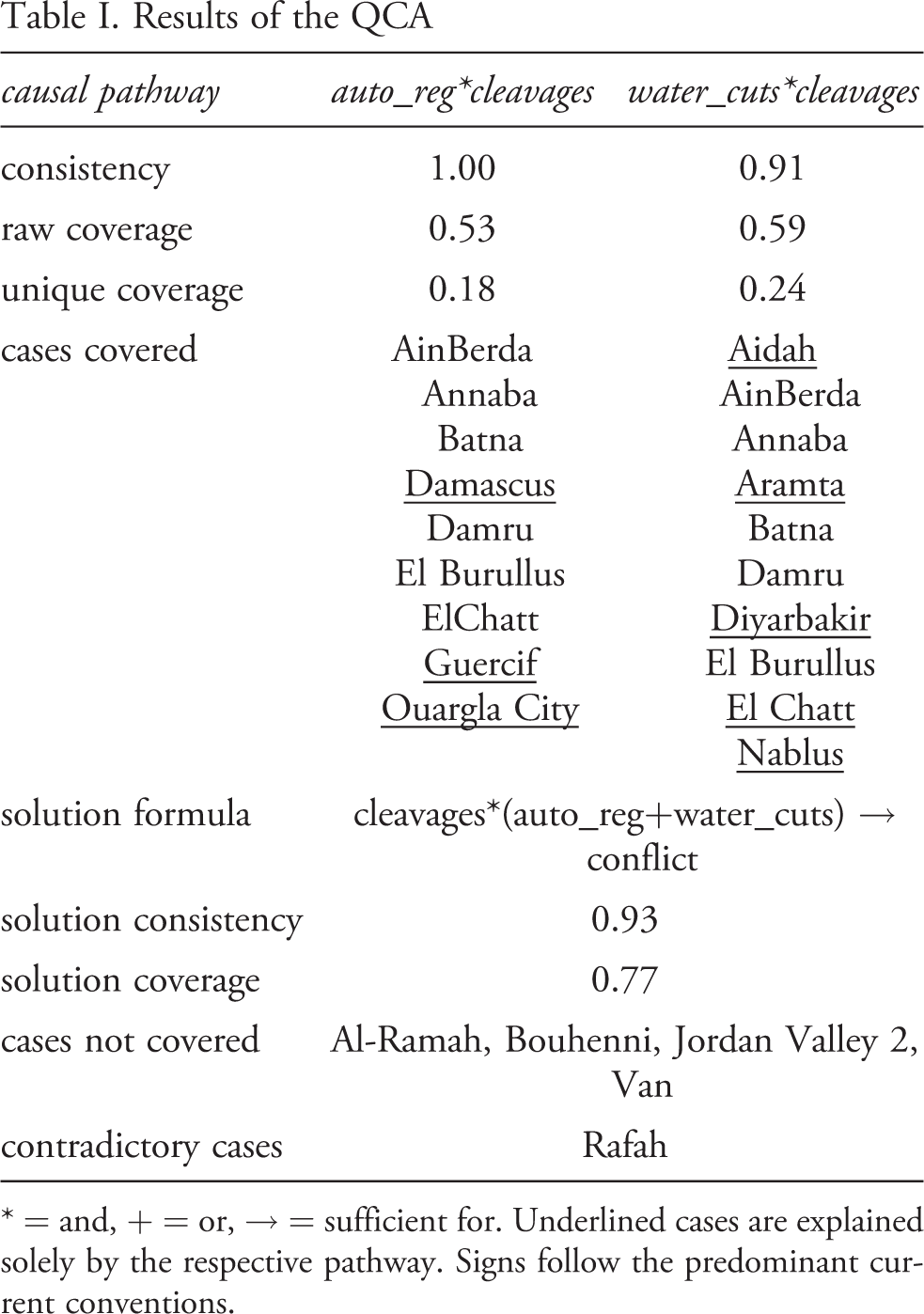
* = and, + = or, → = sufficient for. Underlined cases are explained solely by the respective pathway. Signs follow the predominant current conventions.
The resulting solution formula can hence be read as follows. The combined presence of pre-existing cleavages and either an autocratic regime or water cuts is a (quasi-)sufficient condition for the onset of water-related, nonviolent conflict. The consistency (0.93) and coverage (0.77) values of this solution are well above established thresholds for sufficiency analyses in QCA (0.8 for consistency, around 0.6 for coverage) (Legewie, 2013; Schneider & Wagemann, 2010). The solution explains 13 of the 17 conflict cases and 16 of the 17 non-conflict cases analysed, which is a high explanation rate (> 85%) when compared to other applications of QCA and statistical approaches (Schneider & Wagemann, 2012). As Table I shows, there are four deviant cases with regard to coverage (conflicts unexplained by the solution), while one further case is deviant regarding consistency (Rafah is covered by the solution formula, but experienced no conflict). The possible reasons for the deviant cases are discussed in further detail below.
Interestingly, high nightlight emissions, which we use as an indicator for mobilization opportunities, does not appear as a relevant necessary or INUS condition in the QCA analysis. While it is not uncommon for hypothesized causal conditions to turn out insignificant in the analysis, we discuss the possible reasons for this in the subsequent section.
Before the results are substantively interpreted and discussed, we check their robustness. The literature recommends performing five types of robustness tests: (1) alternative frequency thresholds, (2) alternative consistency thresholds, (3) alternative sets of cases, (4) alternative causal conditions, and (5) alternative calibration decisions (Cooper & Glaesser, 2016; Schneider & Wagemann, 2012; Skaaning, 2011). We perform 20 alternative runs of the QCA covering all five types of robustness tests (see Online appendix 1 for a full description). All tests yield solutions that are in a sub- or super-set relation with the solution formula of the main analysis (and thus do not contradict it), hence increasing our confidence in the results. The pathway auto_reg*cleavages is exactly yielded by 18 out of 20 robustness tests, while the pathway water_cuts*cleavages is still exactly yielded by 12 out of 20 robustness tests. 9 The QCA results are hence considered robust.
Discussion
The presence of pre-existing grievances or cleavages is part of both pathways to nonviolent, water-related conflict onset under droughts. As hydro-meteorological hazards are predicted to get more frequent and/or intense with ongoing climate change, this echoes claims that climate change is a ‘threat multiplier’ (Okpara, Stringer & Dougill, 2016: 90), but is hardly the main driver of conflicts (Brzoska, 2018). But pre-existing cleavages alone are neither a necessary nor a sufficient condition. Only their combined presence with either water cuts or an authoritarian regime is considered to trigger water-related conflicts during droughts, again highlighting the strong context-dependence of environment-security linkages (Ide, 2015; Raleigh, Linke & O’Loughlin, 2014; Scheffran et al., 2012).
Both pathways are plausible in the context of our theoretical expectations discussed above. In the first pathway (auto_reg*cleavages), an already ongoing conflict cannot be articulated or mediated due to the presence of an authoritarian regime. The drought might add further grievances, for instance due to decreasing water access and increasing livelihood insecurity, or it heightens the (perceived) discrimination of certain groups, for example regarding water access or resources for disaster relief. In this pathway, drought thus functions as a trigger which ignites pre-existing conflicts that are not articulated within or mediated by existing political structures. While fear of repression and punishment by the regime could theoretically inhibit protests, the affected groups often either have longstanding tensions and a history of conflict with state institutions, or feel that their livelihoods are so severely affected that the costs of non-action would be too great (Le Billon & Duffy, 2018; Tarrow, 1998). As scholars of social movements have repeatedly shown, ‘the diffusion of grievances, the structural availability of protesters, and especially the embeddedness of protesters in pre-existing networks of civic associations’ are the main explanatory variables for protests in autocratic regimes (Brym et al., 2014: 286).
This reading of the QCA solution is further backed up by the qualitative evidence we gathered on the cases (see Online appendix 2 for full case descriptions with references). Ouargla City in southern Algeria, for example, has been characterized by intense tensions between Arab and Berber populations, as well as by grievances about marginalization vis-à-vis northern Algeria. These grievances could not be effectively articulated to or even mediated by the authoritarian political system. They were further fuelled by sinking groundwater tables, caused by, among others, the local petroleum industry (which generated few benefits for the inhabitants of the region). When sinking water tables combined with a drought to put further strain on agricultural and tourism-related livelihoods, inhabitants of Ouargla City and the surrounding villages engaged in riots and road blocks on 29 February 2004, to protest against the water situation (Recioui et al., 2018).
Similarly, the city of Guercif in northern Morocco is a regional commercial centre, yet economically and in terms of livelihoods strongly dependent on agriculture. Due to the dry climate, groundwater is highly important for agriculture. But safe access to freshwater and groundwater is unequally distributed, mostly along socio-economic lines, which is a source of longstanding tensions. Although elections were held, the political system remained essentially autocratic and provided few opportunities to deal with these issues. When a drought further worsened the situation and national elections provided a symbolic context to articulate demands, local citizens organized protests about inadequate access to and unequal distribution of basic services such as water on 28 September 2002 (MAP, 2002).
For the second pathway (water_cuts*cleavages), pre-existing cleavages play an important role as well. They combine with drought-related livelihood insecurity (and often poverty) to produce widespread grievances. This results in high levels of instability and structural conflict, which are ‘ignited’ by water cuts, possibly because they make (perceived) inequalities (regarding water access) more visible, or because they aggravate perceptions of indifference by the state, or because they escalate livelihood insecurity and the associated grievances. Democratic institutions (if existent) are presumably not sufficient to mediate in such situations, especially as they are relatively weak in many of the cases covered by this pathway (Lust, 2011), and therefore the presence (or absence) of an authoritarian regime plays no explanatory role.
This interpretation of the QCA results is again supported by qualitative evidence from cases. For instance, the Aidah refugee camp close to Bethlehem, just like other parts of the Palestinian West Bank, is strongly affected by the Israeli–Palestinian conflict, and the respective cleavages are hence very strong. The Israeli occupation and a lack of proper maintenance of the existing infrastructure frequently cause problems regarding water supply and quality. Aidah suffered from water cuts during a drought in summer 2008. The cuts were ascribed to conscious decisions by Israeli authorities to prioritize their own people’s water needs, and democratic means to contest these decisions were not available. In consequence, the camp inhabitants protested against their water situation on 10 September (Crump et al., 2012).
Also, the poor, predominantly agricultural village of El Chatt in northeastern Algeria is characterized by grievances related to its inhabitants’ marginalization and tensions between Arabs and Berbers. In the face of a severe drought and ensuing freshwater cuts that lasted for around a month, pre-existing tensions intensified in early 2003. On 15 January, people started protests against this situation which quickly escalated into riots ( Le Matin, 2003).
Interestingly, opportunities for mobilization, for which we use nightlight emissions as a proxy, do not emerge as part of the solution formula. This might be due to two (interrelated) reasons. First, the nonviolent, often short-term and small-scale conflicts we study are not as dependent on mobilization opportunities as large-scale, sustained and/or armed conflicts. People can gather relatively spontaneously or coordinate by word-of-mouth, especially when facing common hardship (such as water scarcity) in a familiar setting. Second, the presence of widely accepted opinion leaders or traditional institutions might be more relevant than population density, wealth and electrification (Ratelle, 2013), especially with regard to small-scale protests. A case in point is the pivotal role that women’s networks played in initiating water protests in the Turkish town of Diyarbakır (the case with the 9th lowest nightlight emissions in the sample) in June 2006 (Al Jazeera, 2008).
Deviant cases
Discussing deviant cases regarding coverage (conflict cases not explained by the QCA solution) and regarding consistency (non-conflict cases covered by the QCA solution) is helpful to identify omitted conditions, calibration errors and tasks for future research (Schneider & Rohlfing, 2013).
Of the four deviant cases regarding coverage, three are characterized by the presence of an authoritarian regime and water cuts, but the absence of cleavages. The two Jordanian cases (Al-Ramah and Jordan Valley 2) are very low-intensity conflicts even in the context of our sample. In both cases, a small number of locals publicly expressed concerns about water cuts. It is hence possible that for such small-scale conflicts, prior cleavages are not essential. Alternatively, neoliberal policies of the Jordanian regime since the 1990s, namely the cutback of farming subsidies in the Jordan Valley and the partial privatization of the water sector in Al-Ramah, could have been a source of grievances prior to the onset of the conflicts (in 2002 and 2009). Such longstanding structural issues could also help to explain why locals (mildly) challenged the Jordanian state despite the potential of authoritarian backlash. However, this issue is not discussed in the academic sources and media reports we could access.
The Algerian case of Bouhenni also experienced water cuts and an authoritarian regime, but no pre-existing cleavages. In contrast to the two Jordanian cases, however, the water-related conflict in 2005 was rather intense, as the police had to forcefully remove a road blockade after mediation failed. But according to the sources we consulted ( Liberté, 2005), the town suffers from very high unemployment rates and insufficient provisions of public services, which might have been a source of grievances about the central government, especially among young people, who also were the main instigators of the conflict. But again, these social problems are not explicitly linked to grievances and conflict in the sources we use.
In the Turkish city of Van, water-related protests occurred in 2006. Grievances were present (mainly in the context of the larger Turkish–Kurdish conflict), but no water cuts were reported and a democratically elected regime was in power. Yet, it is still possible that the inhabitants of the city saw little chance in pursuing their water-related claims through the political or legal system, given the widespread discrimination of the Kurdish minority (which could then be considered a functional equivalent to auto_reg) (Yegen, 2010).
The only deviant case regarding consistency is the city of Rafah, located in the Gaza Strip, in early 2005. Despite the presence of a drought, strong cleavages (mainly between Israelis and Palestinians) and water cuts, no conflict about water has been reported. This is presumably due to the reduction of conflict and fighting activity in 2004, the corresponding improvement of the water situation, and the fact that inhabitants preferred to protest against other, presumably more important issues such as Israeli military violence (Moore & Guy, 2012).
Overall, the analysis of the deviant cases supports the results of the main analysis, as Rafah can be considered an exceptional case, while Van and Bouhenni would be covered if equivalents of the relevant conditions auto_reg and cleavages are considered. The two Jordanian conflicts are likely either special cases (due to their low intensity) or characterized by existing grievances (about neo-liberal water policies) not covered by the literature we consulted. However, the potential relevance of neoliberal policies, ethnic discrimination and socio-economic marginalization in the cases not covered by the solution formula highlights the need to pay additional attention to these factors in future analysis, even if they are directly translated into political grievances (see also Selby & Hoffmann, 2014).
Conclusion
This study aimed to disentangle pathways to small-scale, low-intensity conflicts about water during droughts. It fills an important gap in the literature on environmental security, natural hazards, climate change and conflict, which largely focuses on violent disputes causing 25 or more battle-related deaths. However, analysing less intense conflicts is important, as they can be a driver of social change, a starting point for violent escalation, and an indicator for legitimate grievances.
Our findings show that the combination of pre-existing cleavages and either an authoritarian regime or water cuts facilitates the onset of nonviolent, water-related conflict during droughts. This is in line with theoretical expectations (formulated in the section ‘Drought and water-related conflict’) stating that such conflict onsets are driven by (i) grievances (in the form of cleavages, sometimes accelerated by droughts), (ii) a lack of effective means to articulate these grievances in a given legal or political system (authoritarian regime), and (iii) a specific trigger (drought or water cuts). In terms of policy, this implies that in regions that are confronted with a combination of intense drought and pre-existing tensions, politicians and development workers should make sure to avoid water cuts and to give inhabitants the opportunity to articulate their grievances within the existing political and/or legal system.
Our study contributes to wider debates in a number of ways. First, it supports claims that climate change, when resulting in a higher frequency or intensity of droughts, can indeed be linked to increased conflict risks (Brzoska, 2018; Sakaguchi, Varughese & Auld, 2017). While we do not treat drought as a causal condition in the QCA, the causal pathways detected together with qualitative evidence from the 34 case studies indicate that droughts can multiply the risk of conflict onset. Second, however, our analysis makes clear that such a link is strongly conditional on the presence of a number of context factors, thus lining up with a number of recent studies drawing similar conclusions (e.g. De Juan, 2015; Ide et al., 2020; Schleussner et al., 2016; von Uexkull et al., 2016).
Third, we add to a growing literature on low-intensity conflicts (e.g. Bartusevičius & Gleditsch, 2019; Day, Pinckney & Chenoweth, 2015). We do so by shedding light on some of their so-far unexplored drivers, such as droughts and water cuts, but also by showing that certain opportunities for mobilization (specifically those indicated by our nightlight emissions condition, such as population density and access to electricity) perhaps play less of a role for small-scale conflict onset than previously assumed (Coscieme et al., 2017). We also introduce a novel procedure to address the issue of false negatives, particularly acute in the study of low-intensity conflicts, by using reported cooperation as a proxy for media attention.
Fourth, we demonstrate how our method, QCA, can be used to bridge the divide between qualitative and quantitative approaches in environmental and climate security research (Ide, 2017; Solow, 2013), as well as in peace and conflict studies more broadly (Wood, 2017). Using a medium number of cases, we integrated data on the national (e.g. on regime type) and the local level (e.g. on water cuts), as well as qualitative (e.g. on pre-existing cleavages) and quantitative information (e.g. on nightlight emissions).
In this context, our study also illustrates pathways for future research. Water cuts, which we identified as a crucial triggering factor, have so far hardly been discussed in the relevant literature. Their interactions with drought response policies and broader inequalities might be particularly relevant here (Carse, 2017). Differentiating more strongly between completely nonviolent conflict and conflicts which contain some minor forms of violence (such a physical violence against property) would be another step forward, especially with regard to policy relevance. The question of when and why people protest against authoritarian institutions despite limited prospects and a risk of repression also require further attention.
Further, as we have illustrated in our discussion of deviant cases, factors like neoliberal policies and socio-economic marginalization likely play a crucial role for water-related conflict onset, yet often remain understudied. Addressing them more thoroughly would also enable environmental security scholars to link up closer with political ecologists, who have worked on the intersection between environmental degradation, inequality and neoliberalization for quite some time (Abrahams & Carr, 2017; Le Billon & Duffy, 2018). In the end, cooperation between scholars using different theoretical and methodical approaches is key to study, and eventually address, intertwined global problems such as exclusion, poverty, climate change and conflict.
Footnotes
Replication data

Funding
Research for this study was funded in part by the Australian Research Council (DE190101268) and the German Science Foundation’s (DFG) Clusters of Excellence ‘CliSAP’ (EXC177) and ‘CLICCS’ (EXC2037).