




Abstract
We investigate the relationship between transnational terrorism and the restrictiveness of immigration policies. We argue that transnational terrorism may create incentives for governments to implement more restrictive migration policies. First, more restrictive policies may make terrorism a more costly endeavor, discouraging future terrorist activity. Second, voters may hold the government accountable for the increased insecurity and economic instability terrorism produces; more restrictive migration policies may signal political resolve and meet public demand for security-providing policies, consequently reducing the government’s chances of electoral defeat. We provide an empirical analysis of the effect of transnational terrorism on migration policy restrictiveness for a sample of 30 OECD countries between 1980 and 2010. We find that a greater exposure to transnational terrorism is associated with stricter migration controls, but not stricter migration regulations regarding eligibility criteria and conditions. This finding is robust to different model specifications, estimation methods, operationalizations of terrorism, and instrumental-variable approaches. It points to the securitization of immigration, providing partial support for the notion that transnational terrorism incentivizes migration policy change towards greater restrictiveness. However, the policy response appears to be surgical (affecting only migration controls) rather than sweeping (and thus not influencing broader migration regulations) for the countries in our sample.
Introduction
A few days after his inauguration, on 27 January 2017, US president Donald Trump issued Executive Order 13769 titled ‘Protecting the nation from foreign terrorist entry into the United States’ (Trump, 2017); colloquially, this order became known as the ‘Muslim travel ban’. Explicitly referring to the terrorist attacks on New York and Washington, DC, on 11 September 2001 (9/11), as motivation for his actions, Trump ordered a number of restrictions regarding immigration into the United States, ranging from travel bans for citizens of certain countries to the elimination of visa waiver programs and stricter screening of refugees and potential migrants.
Trump’s actions hint at three important points that are highly relevant to our study. First, terrorism 1 can have important policy consequences. Indeed, it has been argued that the 9/11 attacks and subsequent terrorist incidences in European countries have shaped international cooperation as well as defense, security, privacy, and foreign policy in many nations (e.g. Epifanio, 2011; Messina, 2014; Neumayer, Plümper & Epifanio, 2014). Second, there is a ‘memory’ associated with terrorism, leading to long-run effects of terrorism on policymaking; for instance, the 9/11 attacks are still relevant for policy decisions over 15 years later. Third, Trump’s executive order points to the securitization of immigration, meaning that non-security issues – such as migration – are linked to security concerns (Messina, 2014). While the securitization of immigration is exemplified in Trump’s executive order, it is also reflected in popular opinion. For instance, a 2016 Gallup poll across 14 European countries found that 66% of respondents believed terrorism by non-residents to be a serious problem, while at the same time 55% of respondents thought that migration is a similarly serious issue, with concerns about both issues being strongly positively correlated. 2
Motivated by this discussion, we study whether migration policy indeed becomes more restrictive in response to transnational terrorism. 3 While informative, existing research on the nexus between terrorism and migration policies focuses on the impact of the 9/11 attacks, the post-9/11 era, or only examines changes in individual countries (Epifanio, 2011; for an overview see Messina, 2014). We add to this literature by providing a first systematic cross-country study of the role of transnational terrorism in migration policy change, using country-year data for 30 OECD countries for the 1980–2010 period. Importantly, this country sample allows us to compare country cases where immigration policies are relatively well developed, transnational terrorism is prevalent, and migration issues are salient, so that the securitization of immigration may indeed play a role.
We argue that migration policies become more restrictive in response to terrorism (i) because of security considerations (where more restrictive policies make terrorism a more costly endeavor) and (ii) because governments, held accountable for increased insecurity by the electorate, respond to voters’ increased fear and demand for security, so as to avoid electoral defeat. Our empirical analysis shows that increased exposure to transnational terrorism – especially when it involves casualties – is associated with stricter migration control measures, but not with stricter migration regulations regarding eligibility criteria and conditions. This finding is robust to different model specifications, estimation methods, operationalizations of terrorism, and endogeneity concerns. Our analysis thus provides partial support for the notion of a securitization of immigration. However, the policy response to the transnational terrorist threat appears to have been surgical (affecting only instruments of migration control) rather than sweeping (and thus not affecting broader migration regulations), making the far-reaching approach of the Trump administration the exception rather than the rule.
The effect of transnational terrorism on migration policy restrictiveness
Migration policy: Definition and dimensions
Following Helbling et al. (2017: 82) we define migration policies as ‘government’s statements of what it intends to do or not do (including laws, regulations, decisions or orders) in regards to the selection, admission, settlement and deportation of foreign citizens residing in the country’. These policies consist of two main dimensions: migration regulations and migration controls (Helbling et al., 2017: 85). While the former refer to binding legal provisions that create or constrain rights such as eligibility criteria, the latter are mechanisms (e.g. the detention of illegal migrants) that help monitor whether the migration regulations are actually adhered to. Using these definitions, below we first discuss the general relationship between migration policy and transnational terrorism; afterwards, we discuss whether transnational terrorism may interact differently with migration regulations and migration controls.
From transnational terrorism to migration policy restrictiveness
A government may respond to transnational terrorism by restricting migration policies to provide additional security against future attacks. This argument is rooted in a rational-choice framework of terrorism, where terrorists (as rational actors) weigh the benefits of terrorism (e.g. from achieving political objectives) against its costs (e.g. due to capture), choosing to engage in terrorism only when the former outweigh the latter (Schneider, Brück & Meierrieks, 2015: 132–133). More restrictive migration policies may increase the costs of carrying out terrorism. For instance, tougher migration controls may warrant more expensive (forged) documents to avoid detection (Schneider, Brück & Meierrieks, 2015). Similarly, stricter migration regulations concerning labor migration and asylum-seeking may make it more difficult (i.e. more costly) for terrorists to enter a foreign country. If stricter migration policies sufficiently raise the costs of terrorism, they may consequently discourage terrorist activity by (rational) terrorist actors.
Whether restrictive immigration policies actually reduce terrorism is, however, not clear, as this question has hardly been addressed in the literature. Böhmelt & Bove (forthcoming) provide first evidence that terrorism can indeed ‘travel’ from one country to another via larger migration populations; yet, they find that this only holds for countries with very lax migration policies. Still, even if governments do not know whether closing the borders is an effective measure to actually increase security, more restrictive migration policies may still be an attractive policy option to curb the political fallout from terrorism.
The literature on electoral accountability and retrospective voting suggests that election outcomes also depend on how voters evaluate the performance of an incumbent government (e.g. de Vries & Giger, 2014). The electorate may hold accountable the government for the negative economic effects of terrorism such as reduced investment and tourism (e.g. Sandler & Enders, 2008; Meierrieks & Gries, 2013) as well as for the fear and other forms of psychological distress associated with terrorism (e.g. Huddy et al., 2005: 595). That is, when terrorism occurs voters are anticipated to punish the government at the ballot box for its failure to provide safety (a public good) and macroeconomic stability (Gassebner, Jong-A-Ping & Mierau, 2008).
Indeed, there is ample evidence that terrorism affects voting behavior and government stability. For instance, Gassebner, Jong-A-Ping & Mierau (2008) show that terrorism increases the probability of a government being replaced after an election. Bali (2007) finds that the 2004 Madrid attacks influenced turnout and voting decisions, leading to the replacement of the Spanish government. Berrebi & Klor (2008) find that right-wing parties receive more votes when Israeli localities are affected by terrorism. Similarly, Getmansky & Zeitzoff (2014) show that the mere risk of being victimized by a terrorist attack already affects voting behavior.
Public demand for counterterrorism measures is likely amplified by the mass-psychological consequences of terrorism (e.g. increased psychological distress at the macro level). Such cognitive processes may give rise to probability neglect, with individuals tending to focus on bad outcomes (e.g. getting killed in a terrorist attack) and neglecting the extremely low probability of actually being affected (Sunstein, 2003). When the danger of an event is weighted much more strongly than its likelihood (as in the case of terrorism), the demand for protection against this event is potentially excessive, further compelling governments to take action to calm their citizens (Sunstein, 2003).
To meet public demand for counterterrorism measures and avoid electoral punishment, a government may consequently respond to terrorism by making migration policies more restrictive. 4 For one, more restrictive migration policies may indeed produce security, thus meeting public demand for policies that provide safety or restore public confidence in the ability of the government to do so. For another, restricting migration may also be an attractive option because it is associated with low political costs, given that the group most strongly affected by such policies (the migrants) has little political say. What is more, governments may resort to ‘scapegoating’, capitalizing on feelings of xenophobia in the electorate that result from terrorism to justify tighter migration policies. Indeed, several studies have shown that terrorist attacks may lead to more negative attitudes towards immigrants and increase support for more restrictive immigration policies (e.g. Huddy et al., 2005; Legewie, 2013).
To summarize, we hypothesize that more transnational terrorism is associated with a higher likelihood of adopting more restrictive migration policies (i) because such policies may increase the material costs of carrying out transnational terrorism (e.g. by making it more difficult for terrorists to infiltrate a country) and (ii) because the government wants to avoid electoral defeat, given that terrorism produces grievances (fear, economic instability, etc.) for which the electorate will hold it accountable.
From transnational terrorism to stricter migration regulations and controls
Summary statistics
On the other hand, more transnational terrorism may have larger effects for migration controls. First, migration controls are more directly related to border control, so that they may more meaningfully increase the costs of terrorism when tightened. For instance, relevant migration controls may include information sharing between states and sanctions for airline carriers that enable irregular migrants to enter another country. What is more, migration controls may respond more notably to terrorism because they are more visible to the average voter. When policy visibility is high, it is easier for voters to connect those policies to the political process (Gingrich, 2014), in turn making it easier for the government to reap the electoral rewards when such policies are popular. In case of tighter migration controls, the average voter may perceive them when, for example, traveling or requesting a new passport; this visibility of migration controls will then enable citizens to connect such measures to government responses to transnational terrorism. By contrast, more restrictive immigration eligibility criteria (e.g. stricter labor requirements for potential migrants) are not necessarily known by the average citizen, nor do they play any role in their daily life. Consequently, this may make it less likely that tightening migration regulations in response to transnational terrorism translates into voter approval.
In sum, we therefore hypothesize that (i) transnational terrorism is associated with a higher likelihood of adopting more restrictive migration regulations and controls because both policy dimensions may similarly impact the terrorists’ calculus and a country’s political climate or, alternatively, that (ii) transnational terrorism is especially associated with a higher likelihood of adopting more restrictive migration controls (rather than migration regulations) because migration controls may more strongly affect the terrorists’ calculus and voter approval.
Data and methodology
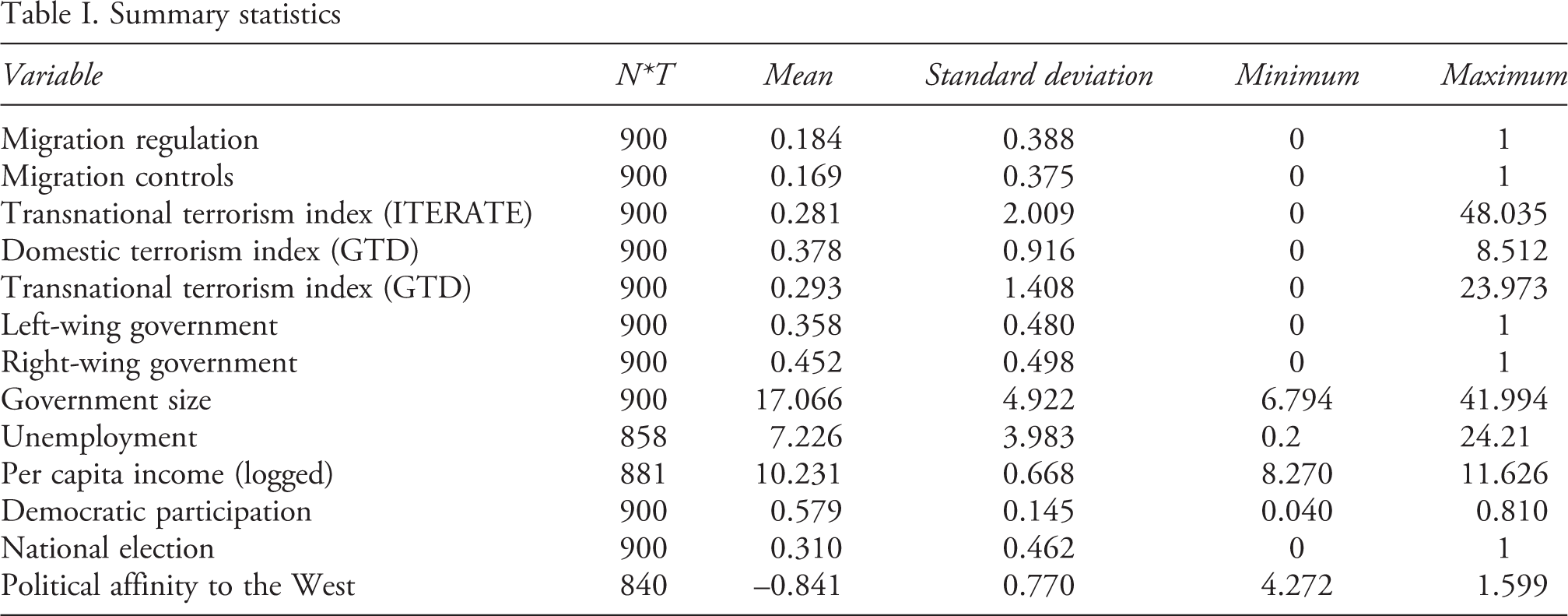
To test whether transnational terrorism is associated with a higher likelihood of adopting more restrictive migration policies, we collect country-year data for 30 OECD countries for the 1980–2010 period. The countries in our sample are: Australia, Austria, Belgium, Canada, Chile, Denmark, Finland, France, Germany, Greece, Hungary, Iceland, Ireland, Israel, Italy, Japan, Luxembourg, Mexico, the Netherlands, New Zealand, Norway, Poland, Portugal, South Korea, Spain, Sweden, Switzerland, Turkey, the United Kingdom, and the United States. This sample is chosen due to the availability of data concerning country-specific immigration policies, which we describe below in more detail. The summary statistics are reported in Table I.
Dependent variable
To measure a country’s immigration policy choices, we draw on the Immigration Policies in Comparison (IMPIC) dataset (Helbling et al., 2017). This dataset provides the first encompassing data collection on the degree of restrictiveness of immigration policies in 33 OECD countries 5 for the period 1980–2010. Besides its exceptionally large temporal and geographical coverage, this dataset also allows us to differentiate between migration regulations and migration controls, so that we can also study whether (more visible) border control mechanisms are more affected than (more general) immigration regulations. More information on the exact regulations and controls included in the IMPIC dataset is provided in the Online appendix (supplementary Table 1).
In the IMPIC dataset, migration regulations are associated with the three main channels through which migration occurs: labor migration, migration due to family reunification, and migration by asylum-seekers and refugees (Helbling et al., 2017: 85). These regulations are binding legal provisions that create or constrain rights and cover eligibility criteria and conditions. ‘Eligibility criteria’ are requirements a migrant has to fulfill to qualify for a certain entry route, whereas ‘conditions’ refer to additional requirements that need to be fulfilled. For example, labor migration regulations measured by IMPIC account for migration quotas or age limits for potential labor migrants (as eligibility criteria) and for minimum language skill requirements (as an additional condition associated with labor migration).
According to internal validity tests reported in Schmid & Helbling (2016), regulations associated with labor, family, and refugee migration constitute a comprehensive and consistent dimension of immigration policymaking. We thus follow their proposed aggregation method to create a unified migration regulation variable, ‘[combining] regulations of family, labor, and asylum immigration policies [into] one dimension, […] using unweighted arithmetic means to allow for symmetric substitutability’ (Schmid & Helbling, 2016: 22). Then, our first dependent variable is the change in migration regulation; this variable is coded 1 when there is a change towards more restrictive regulations in the unified migration regulation variable for a country-year pair and 0 otherwise.
Our second dependent variable is the change in migration controls; this variable is coded 1 when there is a change towards more restrictive controls and 0 otherwise. In the IMPIC dataset, migration control mechanisms include, for example, the establishment of registers of aliens, the collection and sharing of biometric information on migrants, detention of illegal migrants, and sanctions against firms that employ illegal migrants or airlines that transport foreign passengers lacking relevant documentation (Helbling et al., 2017). Validity tests have shown that control mechanisms constitute a migration policy dimension different from immigration regulations (Schmid & Helbling, 2016), making it meaningful to study separately the effect of transnational terrorism on migration regulation and migration controls. Indeed, the correlation between our two dependent variables is very low (r = 0.08, p = 0.02).
Main explanatory variable
To indicate a country’s exposure to transnational terrorism, we first construct a preliminary terrorism variable (premterror) for country i at year t:

We then use this preliminary index to create our index of transnational terrorism memory (henceforth transnational terrorism index, terrorit ). This index is constructed as follows:
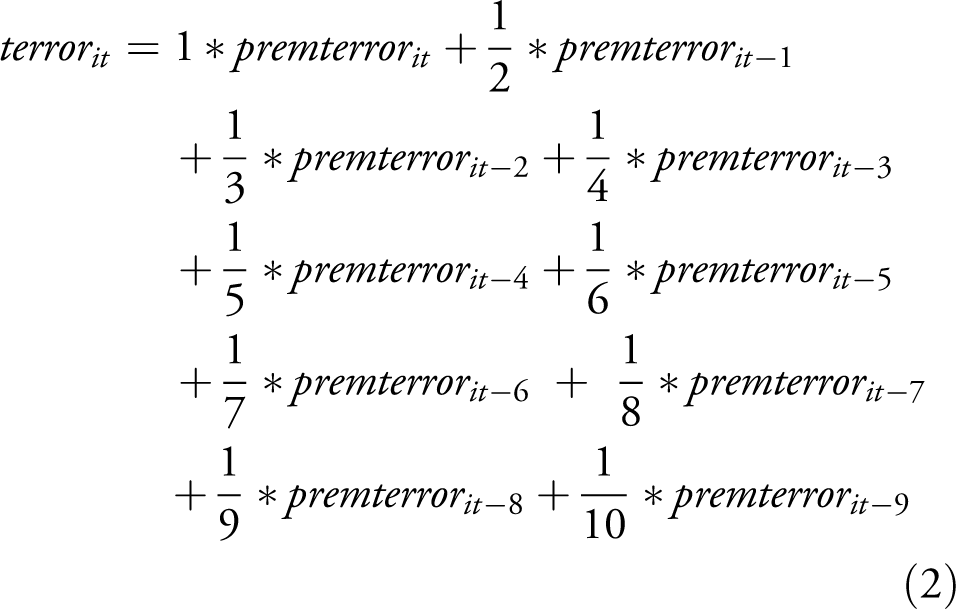
Regarding this index and its construction, several remarks are necessary: In Equation (1), attack refers to the number of transnational terrorist attacks; wounded and killed refer to the individuals wounded or killed in these attacks per country-year observation. Data on transnational terrorism is drawn from the International Terrorism: Attributes of Terrorist Events (ITERATE) dataset (Mickolus et al., 2016). As a robustness check, we also use data on transnational terrorism from Enders, Sandler & Gaibulloev (2011) and Gaibulloev & Sandler (2019b); these authors create transnational terrorism series using data provided by the Global Terrorism Database (GTD)
6
which itself does not report transnational terrorism separately. Enders, Sandler & Gaibulloev (2011) argue that ITERATE measures transnational terrorism more consistently than GTD; therefore, ITERATE is our main data source.
7
For our analysis we only consider transnational attacks carried out by terrorists operating outside their country of origin. For instance, we include attacks by the Algerian Groupe Islamique Armé (GIA) in France, but do not consider attacks by the German Red Army Faction (RAF) against US targets in Germany (even though the latter attack also counts as a transnational terrorist incident in ITERATE). We do so because regarding immigration policies we expect policymakers to respond differently to ‘imported’ transnational terrorism (as, e.g. by the GIA) than to ‘homegrown’ terrorism with transnational ramifications (as, e.g. by the RAF).
8
In particular, we expect policymakers to tighten migration policies only when facing ‘imported’ transnational terrorism, given that only this subtype of transnational terrorism may be plausibly curtailed by stricter immigration policies. The weighting scheme in Equation (1) is chosen in a way that the ferocity of terrorism matters more strongly than its frequency. We expect more vicious terrorist attacks to receive wider media attention (e.g. Rohner & Frey, 2007) and infuse more fear into targeted societies than terrorism that does not produce casualties. Consequently, public pressure on politicians to effect migration policy change ought to be stronger when terrorism is especially ferocious. As a robustness check reported below, we also consider a different weighting scheme. Our main explanatory variable, the index of transnational terrorism memory, accounts for the occurrence of transnational terrorism in the contemporaneous period (t) and weighs it the most. Importantly, the index also accounts for a country’s history of transnational terrorism by including information on past terrorism. This aggregation reflects the ‘memory of terrorism’, that is, the fact that past terrorism still shapes present perceptions of transnational terrorism risk. For instance, past terrorism could still affect present (perceived) exposure to terrorism through continuing media coverage, memorials, the treatment of past terrorism in the arts, and through narratives that persists within communities. At the same time, we assume that there is a certain decay associated with the ‘memory of terrorism’, so that our index weights terrorist activity that occurred closer to the present more strongly. This idea is rooted in psychological research on ‘forgetting curves’, where memory decay is a function of time (e.g. Wixted & Ebbesen, 1991).
9
Figure 1 shows that social exposure to transnational terrorism was especially influential during 1980–91 (reflecting the Cold War-era wave of left-wing terrorism) and the 2001–10 period (reflecting a wave of religious-Islamist terrorism), with a relative lull between 1992 and 2000. Figure 1 also shows the difference between our terrorism index and observational data on transnational terrorism. For instance, in contrast to observed terrorist activity (plotted in Figure 1 as the mean number of transnational terrorist incidents per year), our index does not wane quickly after 2001, suggesting that the social memory of terrorism may have still strongly influenced public discourse for the remainder of the 2000s.
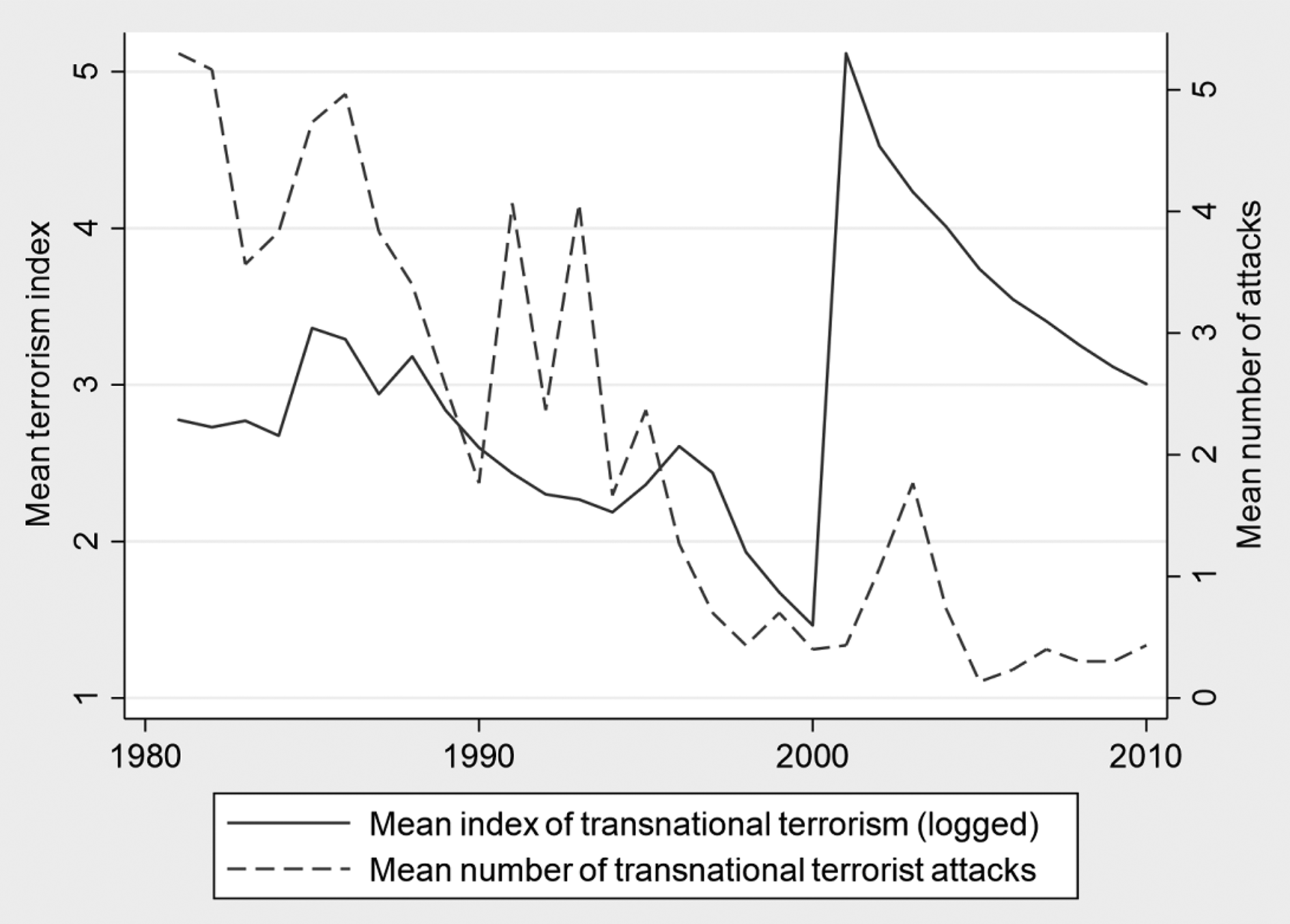
Transnational terrorist activity, 1980–2010
Model and controls
Empirical model
We examine the effect of transnational terrorism on the change of migration policies (towards more restrictiveness) using the following model:

For country i at year t polchange in its q-form refers to a binary dependent variable coded as 1 for the positive outcome of a tightening of migration regulations or to a binary dependent variable coded as 1 for the positive outcome of a tightening of migration controls. For these dependent variables the binary logit regression model is appropriate, which allows us to examine how a set of explanatory variables – the transnational terrorism index (terror) and a vector of controls (X) – affects the probability of a policy change occurring (Long & Freese, 2006). As a robustness check, we also report the results for the baseline model using OLS. 10 We lag all variables by one year because we assume that changes in the explanatory variables affect the policy outcomes only after some time, for example because of parliamentary procedures.
Controls
As for the vector of controls, we first account for the effect of policy diffusion. It is operationalized as the mean of the dependent variable for all countries net of the policy change in the respective country of interest. We expect migrants to select their target destination also with respect to migration policies, choosing countries where policies are more lenient. Consequently, countries may then become involved in a ‘race-to-the-bottom’ (i.e. becoming more restrictive) to avoid administrative, economic, and political costs that may otherwise be associated with increased immigration.
Second, we control for governments’ ideological orientation. We include two separate dummy variables that take on the value 1 if the party of a country’s chief executive officer has a left-wing or right-wing orientation, respectively; therefore, a centrist orientation is the reference group. Data on ideological orientation are drawn from the Database of Political Institutions (DPI) of Beck et al. (2001). Natter, Czaika & de Haas (2018) find that partisan affects vary according to types of migration policies and migrant categories considered. Thus, we remain agnostic about the expected effect of government ideology on migration restrictiveness.
Third, government size is operationalized as the share of government consumption to total GDP, with the data coming from the Penn World Table (PWT) (Feenstra, Inklaar & Timmer, 2015). A larger government share ought to coincide with a larger welfare state (i.e. more public spending on health, education, social benefits, etc.). We expect government size to positively predict policy change towards more restrictiveness because restrictive immigration policies may serve to protect the ‘closed system’ of the welfare state against external influences (e.g. the cross-border flow of labor).
Fourth, data on the unemployment rate is drawn from the World Development Indicators (WDI) (World Bank, 2016). When unemployment is low, there ought to be a stronger demand for labor, leading to more lenient immigration policies to satisfy this demand. Conversely, when unemployment is high, there is little demand for (foreign) labor; at the same time, public opinion is expected to more strongly favor restrictive immigration policies to protect domestic employees from foreign competition.
Fifth, we control for a country’s level of per capita income, using data from the PWT. Similar to the unemployment rate (which reflects short-run macroeconomic dynamics), we expect higher per capita income levels (which reflect long-run economic success) to predict more restrictive policies. Here, richer countries are anticipated to pursue such policies to protect their prosperity.
Sixth, we control for a country’s quality of democratic institutions, employing an index of participatory democracy drawn from the V-DEM Dataset (Coppedge et al., 2018). This index indicates how strongly citizens can influence government policy, for example through tools of direct democracy, engagement in civil society organizations or subnational elected bodies. We expect greater democratic participation to positively predict more restrictive migration policies. For instance, more means of participation may enable political parties with anti-immigration agendas to influence migration policies more easily, for example via referenda.
As a robustness check, we amend our baseline model with two additional controls. 11 First, we control for the effect of the 9/11 attacks which are an obvious outlier (also visible in Figure 1). We model this outlier by including a dummy variable that takes on the value of 1 for the years after 2001 for the United States. Second, we control for the timing of national elections, that is, elections for national parliaments and (in case of direct elections) for the head of the executive, with the data coming from the DPI. On the one hand, experiencing an election may lead to more restrictive migration policies, especially when migration is a ‘hot-button issue’. On the other hand, terrorist organizations may strategically plan their attacks around elections to maximize political impact (Aksoy, 2014).
Finally, to control for time dependence, we follow Carter & Signorino (2010) and include time 1 , time 2 , and time 3 , where time refers to the number of years since the last policy restriction was observed. For instance, the inclusion of these time controls ought to account for the fact that countries with a history of past policy restrictions may be more prone to a further tightening of these policies in the future (e.g. due to the role of persistent political cultures). Not accounting for time dependence would violate the independence assumption of the logistic regression model, potentially yielding misleading results (Carter & Signorino, 2010).
Empirical results
Baseline results
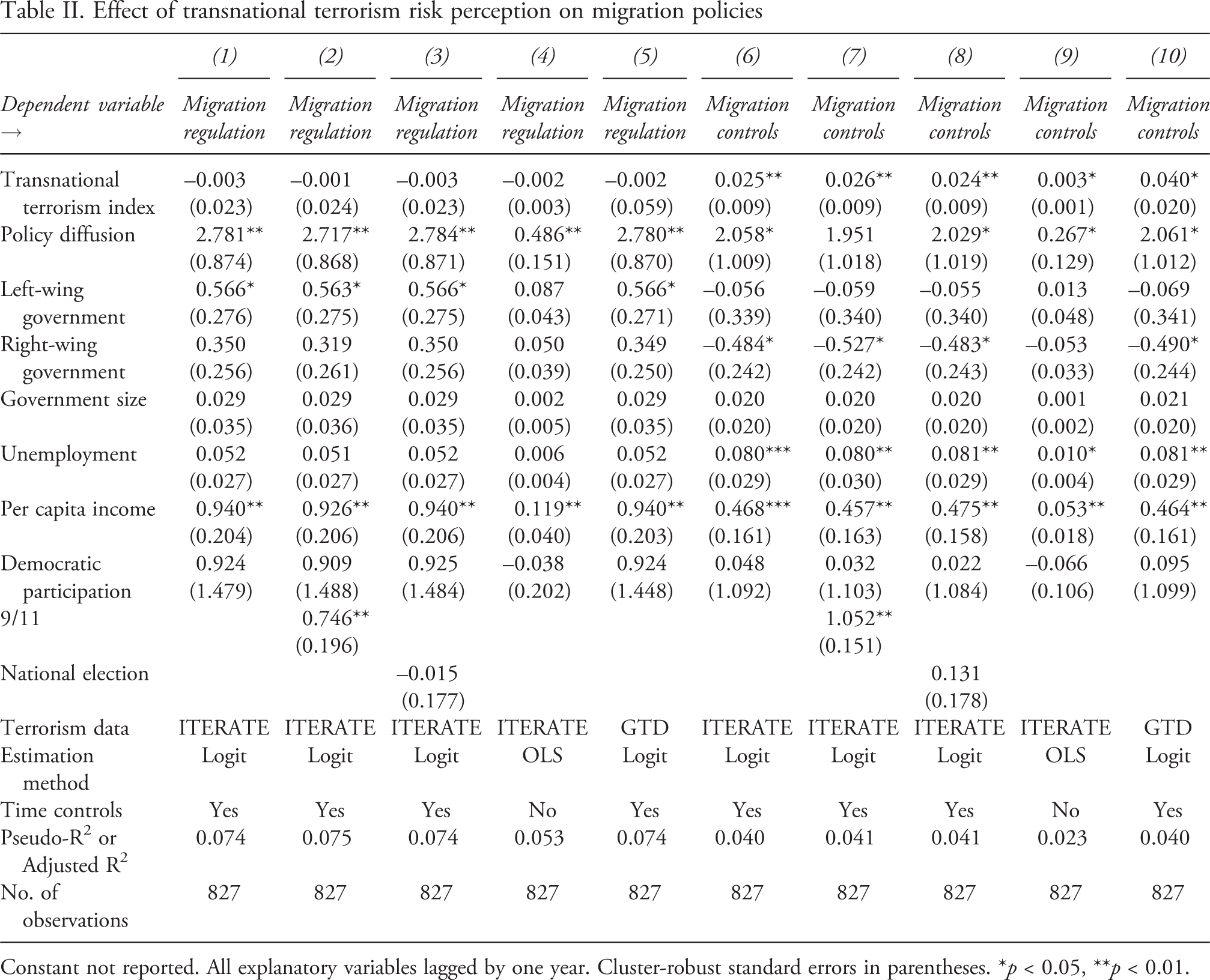
The empirical results from our baseline specifications are reported in Table II. With respect to our main explanatory variables of interest, we find that – regardless of which specification is run and which data source is used to measure terrorism – higher values of the terrorism index are associated with more restrictive migration controls. In terms of substantiveness, the odd-ratios from Specification (6) suggest that a one-unit increase in the terrorism index increases the likelihood of tighter migration controls by approximately 2.5%. By comparison, a one unit increase in unemployment increases the likelihood of tighter migration controls by approximately 8.4%. By contrast, we do not find that higher levels of the terrorism index are associated with more restrictive migration regulations.
These findings provide partial support for our main hypothesis: a history of transnational terrorism incentivizes migration policy restrictiveness. However, the policy response appears to be surgical (affecting only the restrictiveness of migration control) rather than extensive (and thus not influencing broader migration regulations). This may speak to our earlier discussion that stricter migration controls may be the preferred policy response to transnational terrorism because they are more likely to affect the terrorists’ calculus (e.g. by nature of being more closely related to border crossings and control) and to increase (feelings of) security among citizens due to their visibility. In addition to that, governments may be more reluctant to exacerbate migration regulations in response to transnational terrorism because these stricter regulations may reduce the supply of labor migrants, creating adverse macroeconomic effects, especially when labor is scarce; such economic considerations may reduce incentives for office-holders to overly limit migration. 12
Effect of transnational terrorism risk perception on migration policies
Constant not reported. All explanatory variables lagged by one year. Cluster-robust standard errors in parentheses. *p < 0.05, **p < 0.01.
Robustness checks
As a robustness check, we assess whether our findings are affected by different operationalization of our terrorism index. For one, using a different weighting scheme may affect our results. We construct a different index where the ferocity of transnational terrorism (i.e. the number of individuals wounded or killed in an attack) is no longer weighted more strongly than the frequency of terrorism. For another, different assumptions about the ‘memory of terrorism’ (i.e. the extent to which past transnational terrorist activity affects the present) may matter. Therefore, we consider three different types of ‘terrorism memory’ decay: a first one where memory decays more slowly compared to our baseline indicator and in a linear way; a second one where memory decays more quickly and exponentially; and a third one where there is no ‘terrorism memory’, so that past experiences of transnational terrorism do not affect present perceptions. 13
The results using the alternative operationalizations of the terrorism index are reported in Table III. First, we find that applying a different weighting scheme does not affect our baseline findings (Specifications (1) and (5) of Table III). We still find that more social exposure to terrorism makes it more likely that migration controls are tightened, while it does not matter to migration regulation change. Second, different assumptions about the form of the decay of ‘terrorism memory’ do not alter our baseline results (Specifications (2), (3), (6), and (7) of Table III). However, when we assume that there is no ‘terrorism memory’ (Specifications (4) and (8) of Table III), we find that there is no effect of transnational terrorism on both migration policy measures. However, we believe this lack of ‘terrorism memory’ to be highly implausible. For instance, this very strict assumption would mean that the 9/11 attacks were no longer policy-relevant after 2002; as highlighted in the introduction, recent migration policy choices by the Trump administration show that this is clearly not the case.
Next, we examine whether our main finding is driven by the frequency or ferocity of transnational terrorism. To do so, we use the three constituent parts of our terrorism index as individual regressors, assuming the baseline decay of ‘terrorism memory’ as defined in Equation (2). As reported in Table IV, we find that no measure of transnational terrorism memory affects migration regulation change. This finding is consistent with earlier results. By contrast, our findings indicate that a greater ferocity of transnational terrorism affects migration control policy change, while its frequency does not matter. For instance, this latter finding may suggest that more bloody attacks are more successful in instilling fear and producing economic instability and media attention, thus creating stronger incentives for the governments of attacked countries to respond by tightening migration controls.
Endogeneity
Potentially, the results reported above are affected by endogeneity. The most likely source of endogeneity is simultaneity. Simultaneity would imply that migration policies also affect transnational terrorism. For instance, (more) restrictive migration policies may induce feelings of injustice abroad, contributing to frustration and facilitating terrorist activity (Böhmelt & Bove, forthcoming).
To address potential endogeneity concerns, we estimate a series of simultaneous-equations instrumental-variable probit models, following Rivers & Vuong (1988). In the reduced-form equation we regress the terrorism index (our potentially endogenous variable) on an instrumental variable and the baseline controls, while simultaneously estimating the structural equation (probit model), therefore controlling for endogeneity (Rivers & Vuong, 1988).
Instrumental variable
Our instrumental variable measures a country’s political affinity to the West, where the term ‘West’ as a shortcut refers to the United States, the United Kingdom, France, and Germany as the most important Western powers. To measure political affinity to the main Western powers, we first extract data from Bailey, Strezhnev & Voeten (2017) on a country’s ideal-point, a one-dimensional measure of a country’s foreign policy preferences as revealed in their voting behavior at the United Nations (for a detailed discussion of the construction of the ideal-points, see Bailey, Strezhnev & Voeten, 2017). Affinity to the West is then operationalized as the difference between a country’s ideal-point and the mean ideal-point of the four major Western powers.
14
Consequently, positive (negative) values of this affinity score would coincide with high (low) political affinity to the most important Western powers. We expect this affinity to positively predict transnational terrorism. As put by Gaibulloev & Sandler (2019a: 335): Political affinity offers terrorist groups a means of lashing out at targeted countries’ values by hitting softer venue countries, espousing or following similar foreign policy positions. Terrorist attacks based on political proximity represent ‘attack transference’ to more vulnerable countries. Such transference makes the most of terrorists’ limited resources and may have far-reaching political influence by affecting the foreign policy positions of many intimidated countries. As a consequence, affinity-based terrorist attacks may have larger effects than terrorist attacks directed at grievance-generating countries, thus making displaced attacks desirable and cost-effective from the viewpoint of the terrorists.
Different operationalizations of terrorism index
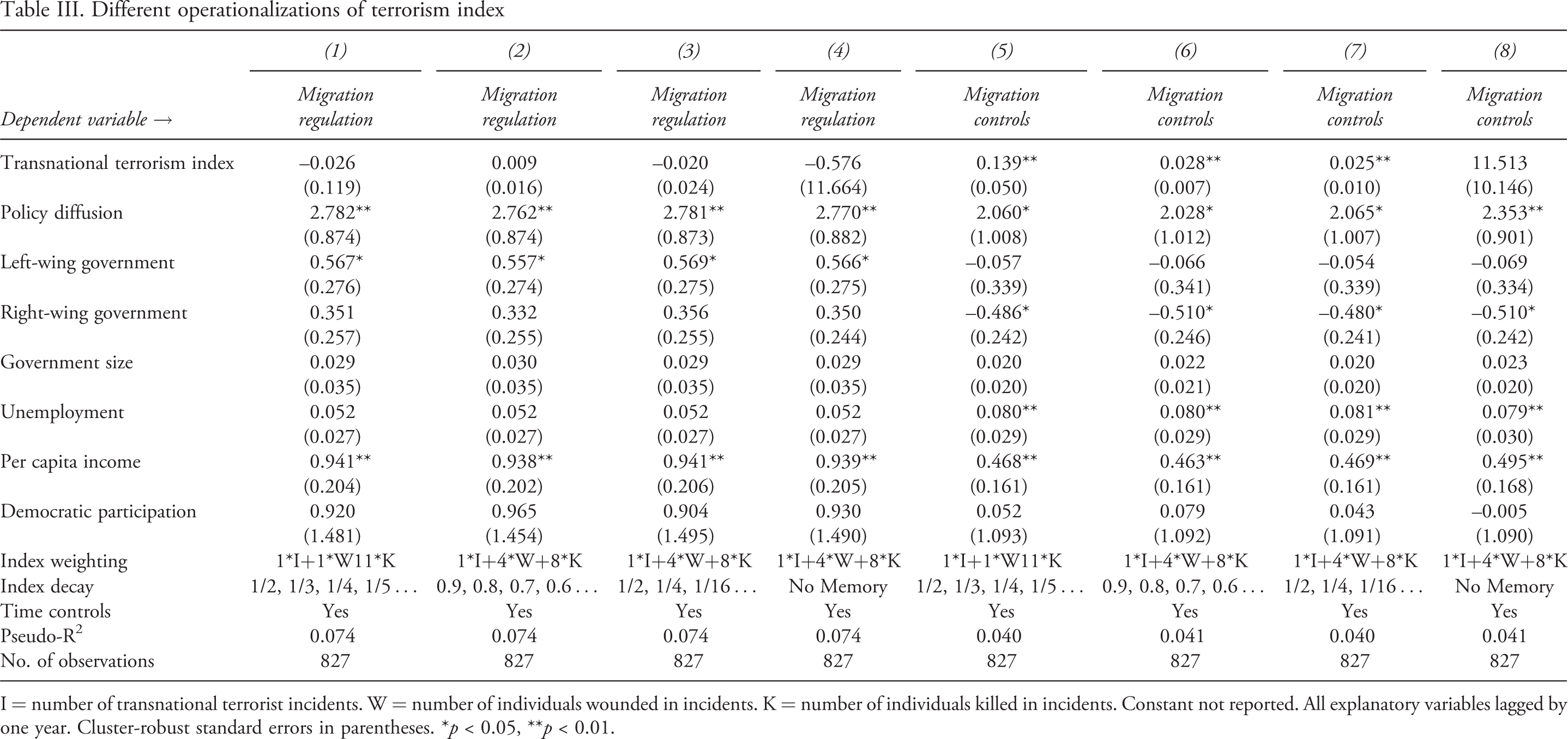
I = number of transnational terrorist incidents. W = number of individuals wounded in incidents. K = number of individuals killed in incidents. Constant not reported. All explanatory variables lagged by one year. Cluster-robust standard errors in parentheses. *p < 0.05, **p < 0.01.
Frequency and ferocity of terrorism and migration policy
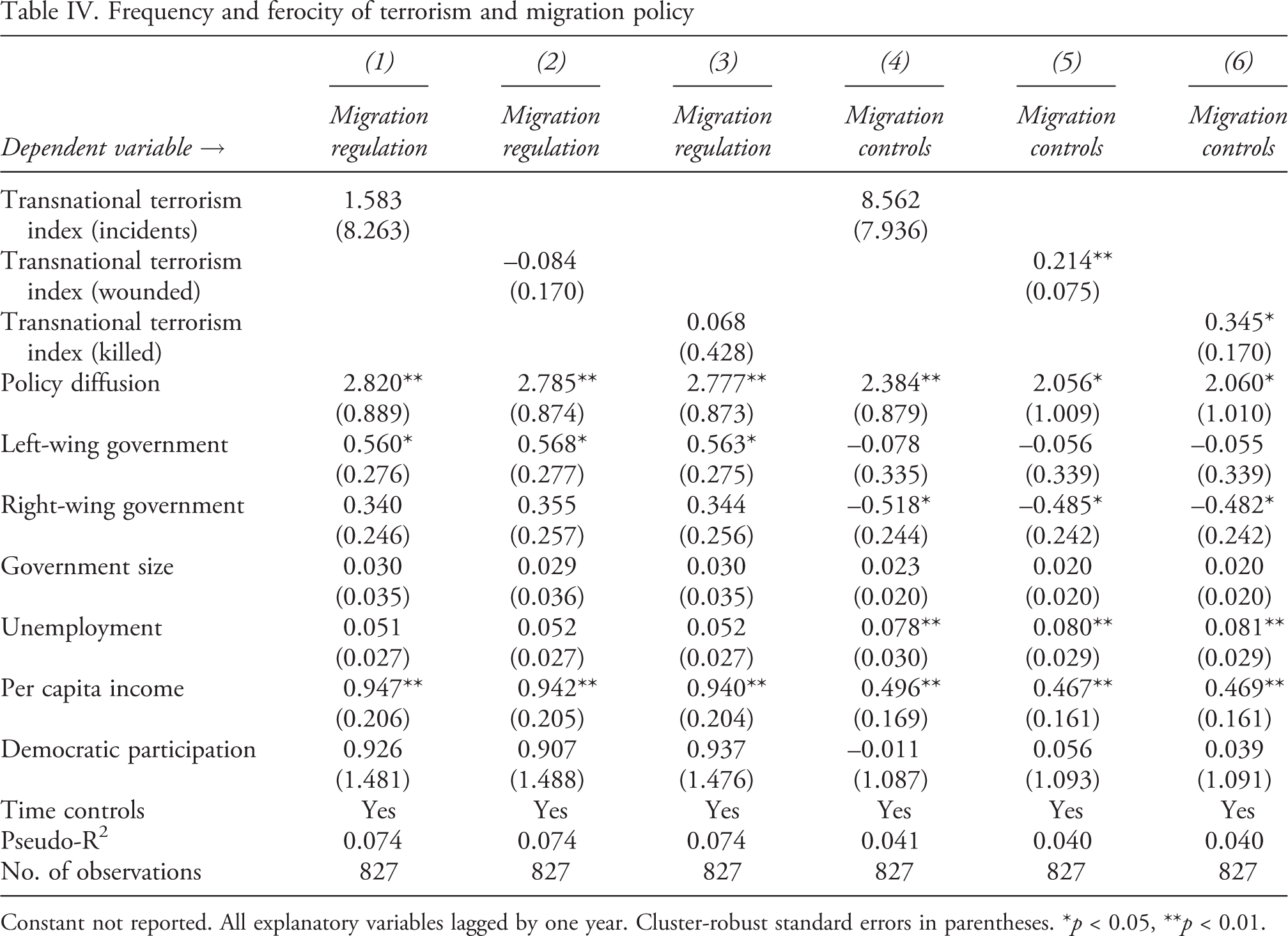
Constant not reported. All explanatory variables lagged by one year. Cluster-robust standard errors in parentheses. *p < 0.05, **p < 0.01.
Indeed, Gaibulloev & Sandler (2019a) find that countries that are politically close to the major Western powers are more likely to attract transnational terrorism. By contrast, we could find no argument in the literature that political proximity to the West (as revealed in voting behavior at the United Nations) should affect migration policy change. Thus, we expect political affinity to the West to affect migration policy changes only through its effect on the terrorism index.
Instrumental-variable regression results
Our instrumental-variable estimates are reported in Table V. First, these results show that the reduced-form regression results are as expected, with political affinity to the West positively predicting transnational terrorism. The instrument is also sufficiently strong, as indicated by the F-test statistics surpassing the threshold of F = 10 usually associated with instrument weakness.
Second, with respect to migration regulations, we find terrorism to be endogenous, as indicated by the significant Wald test of exogeneity of the instrumented variable, which tests whether the error terms in the reduced-form and structural equation are correlated (tests for exogeneity in the context of IV-probit models are discussed in more detail in Rivers & Vuong, 1988: 358–361). However, there is no evidence that terrorism leads to more restrictive migration regulations even when instrumented.
Instrumental-variable estimates
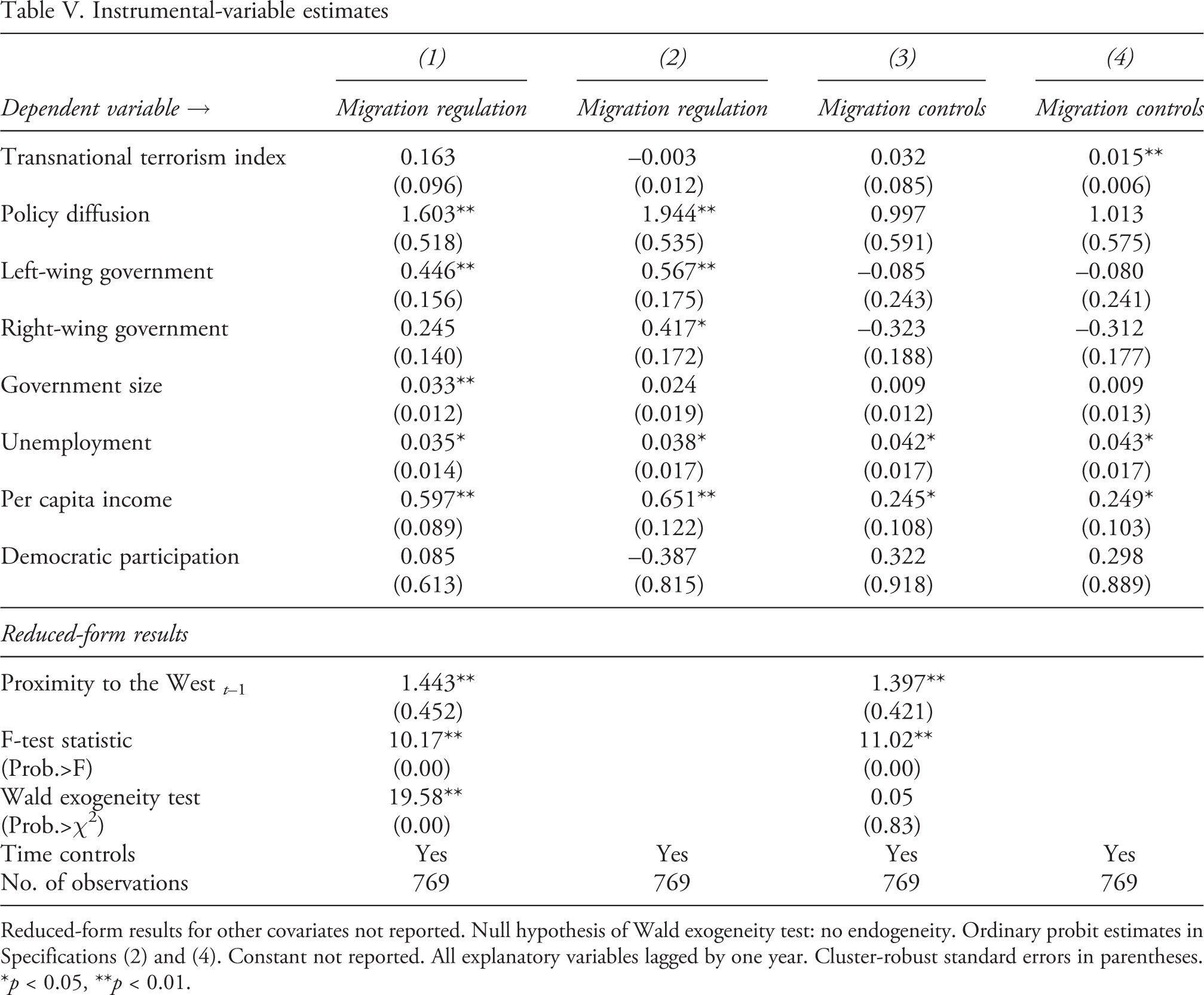
Reduced-form results for other covariates not reported. Null hypothesis of Wald exogeneity test: no endogeneity. Ordinary probit estimates in Specifications (2) and (4). Constant not reported. All explanatory variables lagged by one year. Cluster-robust standard errors in parentheses. *p < 0.05, **p < 0.01.
Robustness
As a robustness check, in the Online appendix we report and discuss results from an alternative IV-approach, where terrorism is instrumented by local military capacity. These alternative IV-estimates strongly mirror those reported in the main text.
Period-specific effects
Our analysis covers both the era of left-wing transnational terrorism (Cold War era) and religiously-motivated (Islamist) transnational terrorism (post-Cold War era). As an extension to our baseline results, we examine whether the effect of transnational terrorism exposure on migration policies differs between these time periods. Potentially, migration policy change is more responsive to terrorism after the end of the Cold War due to Islamist terrorism (especially by Al-Qaeda-like groups) having become more prominent, where this type of terrorism (i) tends to be more lethal and likely to target civilians (Piazza, 2009) and (ii) is more likely to provoke xenophobia and feelings of threat due to its inherent ‘otherness’ (Legewie, 2013). This may have contributed to a greater securitization of migration in the 1990s 15 and 2000s.
Effects in Cold War and post-Cold War eras
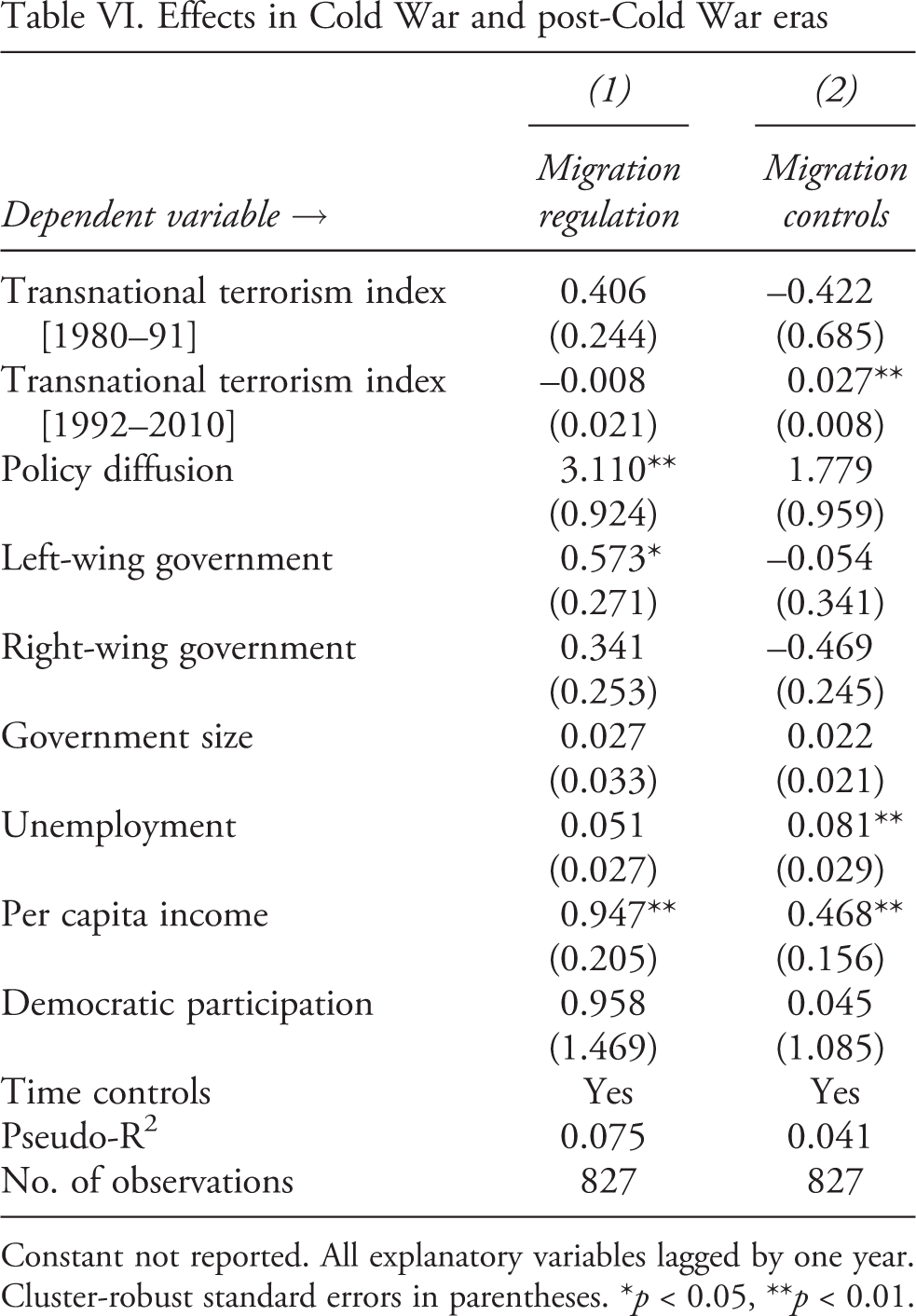
Constant not reported. All explanatory variables lagged by one year. Cluster-robust standard errors in parentheses. *p < 0.05, **p < 0.01.
We report our empirical findings regarding period-specific effects of transnational terrorism on migration policies in Table VI. First, there is no strong evidence that the effect of transnational terrorism on broader migration regulations is different for the Cold War and post-Cold War eras. Second, and more interestingly, we find that migration controls were tightened in response to transnational terrorism only after the end of the Cold War. The latter finding may indeed suggest that the relative dominance of Islamist terrorism after the end of the Cold War has resulted in stronger security concerns and greater public demand for corresponding migration policy responses.
Domestic terrorism
Between 1980 and 2010, many countries in our sample experienced terrorist campaigns not only by transnational but also by domestic terrorist groups (e.g. Euskadi Ta Askatasuna in Spain, the Partiya Karkerên Kurdistanê in Turkey, and the Frente Patriótico Manuel Rodríguez in Chile). 16 Using data from Enders, Sandler & Gaibulloev (2011) and Gaibulloev & Sandler (2019b), we find that between 1980 and 2010 the countries in our sample saw over 9,000 domestic terrorist attacks. By contrast, according to ITERATE the same countries saw only approximately 1,900 ‘imported’ transnational terrorist attacks during the same time period. In other words, domestic terrorism was much more pronounced during our period of observation.
Domestic terrorism may also have had policy consequences. Most importantly, instruments of migration control (e.g. the collection of biometric information or the issue of identification documents) may have been introduced primarily to combat domestic rather than transnational terrorism. Possibly, then, the effect of past experience with transnational terrorism on migration control restrictiveness – as evidenced in Tables II to V – might be spurious.
To analyze whether domestic terrorist activity indeed also affects migration policymaking, we first create a domestic terrorism index as in Equations (1) and (2), using data on the number of domestic terrorist incidents and the number of individuals killed and wounded in these attacks from Enders, Sandler & Gaibulloev (2011) and Gaibulloev & Sandler (2019b). We then use this domestic terrorism index to run empirical models as in Equation (3).
Domestic terrorism and migration policy change
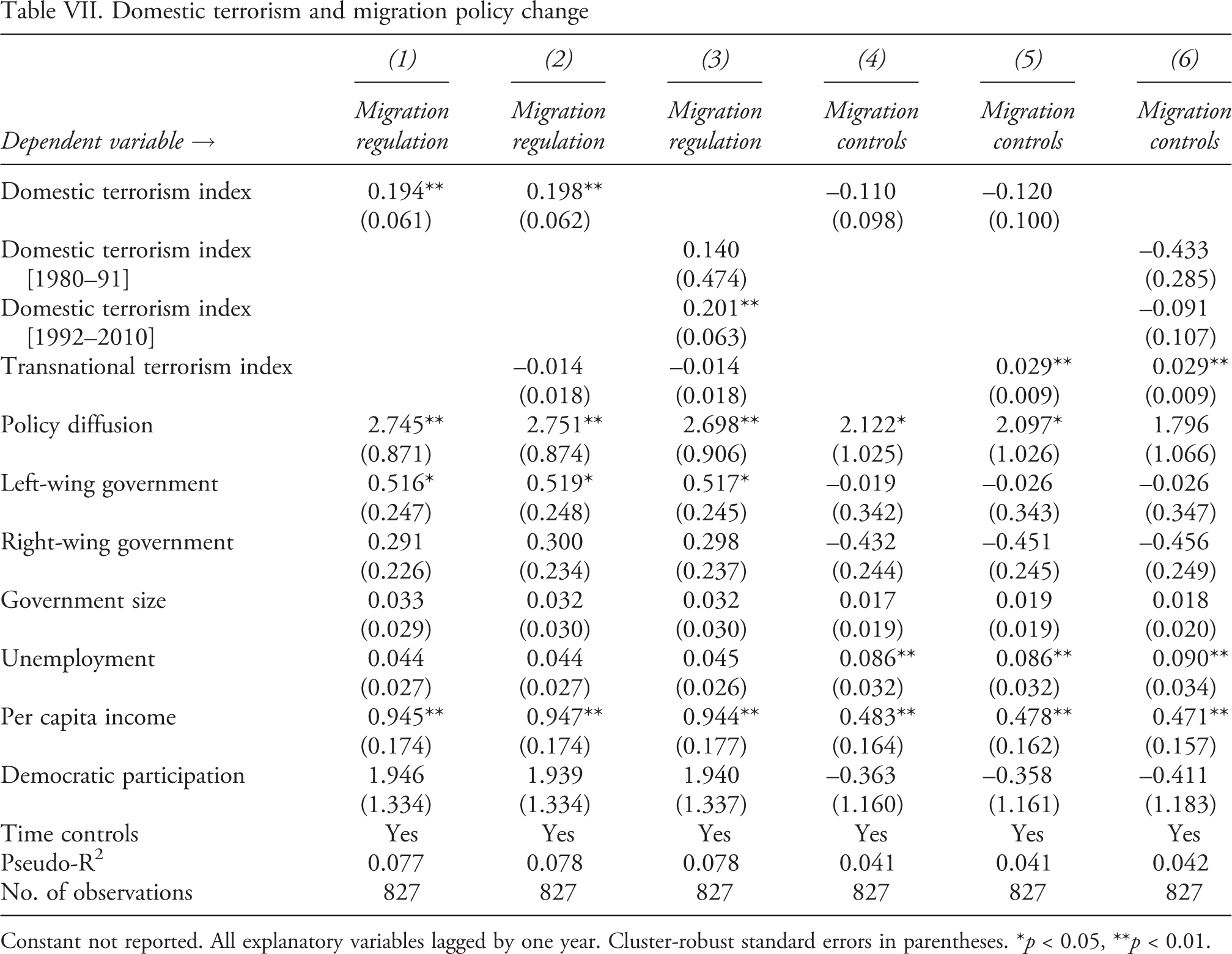
Constant not reported. All explanatory variables lagged by one year. Cluster-robust standard errors in parentheses. *p < 0.05, **p < 0.01.
Conclusion
We study the effect of transnational terrorism on migration policy change for a sample of 30 OECD countries between 1980 and 2010. Creating a novel index of transnational terrorism memory (which reflects a country’s past experience with transnational terrorism), we find that a greater exposure to transnational terrorism – especially when it is ferocious and occurring after the end of the Cold War – is associated with moves towards stricter migration controls, but not with stricter migration regulations. Our main finding provides partial support for the notion of a securitization of immigration. We show that terrorism affects migration control mechanisms through which the adherence to migration regulations is monitored but not the regulations themselves. Policy responses to transnational terrorism are thus surgical rather than sweeping. We argue that governments may implement more restrictive migration controls during times of (perceived) terrorism risk because they want to kill two birds with one stone. First, stricter immigration controls may indeed effectively reduce terrorism, for example by increasing the costs of carrying out attacks from abroad. Second, by introducing more controls a government can signal political resolve and avoid electoral defeat when terrorism undermines perceptions of public safety and economic stability.
However, more restrictive immigration policies may also come at a price. For example, they may involve high implementation and maintenance costs (e.g. increased public spending on immigration and enforcement agencies) that can put a strain on public coffers. Additionally, more restrictive controls may disincentivize labor immigration, potentially producing further long-run costs for ageing OECD economies. As a matter of fact, the potential adverse effect of stricter regulations on the labor supply and – subsequently – economic growth may constitute an important factor constraining incentives for office-holders to overly tighten migration policy in response to transnational terrorism. A careful inspection of such potential trade-offs ought to be highly relevant to policymakers, while also informing future research on the nexus between terrorism and migration policies.
Footnotes
Replication data

Acknowledgements
We gratefully acknowledge helpful comments by Tobias Böhmelt, Jesús Fernández-Huertas Moraga, Gallya Lahav, Anthony M Messina, Kimberly Morgan, Ragnhild Nordås, Seraina Rüegger, Conrad Ziller, and three anonymous referees.
Notes
References
Supplementary Material
Please find the following supplemental material available below.
For Open Access articles published under a Creative Commons License, all supplemental material carries the same license as the article it is associated with.
For non-Open Access articles published, all supplemental material carries a non-exclusive license, and permission requests for re-use of supplemental material or any part of supplemental material shall be sent directly to the copyright owner as specified in the copyright notice associated with the article.
