




Abstract
Authorization of the use of force by the United Nations Security Council (UNSC) is believed to increase levels of public support for military action. While scholars have performed sterling research both in theory and empirics on the power of UNSC authorization, there is still much that we do not understand. In particular, we believe that it is necessary to conduct a further study on ‘failed’ authorization cases. As Terrence Chapman points out in his theoretical framework, the general public can derive valuable information based on which of the permanent members of the Council casts a veto; this in turn affects public attitudes towards the use of force. An expected veto cast by the perpetual nay-sayer would not serve as information for the general public. However, if the veto is cast by an allied state of a proposer of the authorizing resolution, the negative vote functions as an information short-cut signaling that the use of force presents a variety of problems, thus reducing public support for the military action. Using online survey experiments, we find supportive evidence for this argument. Our data also suggest that surprising negative information changes the perceptions of legitimacy, legality, public goods, and US interest in a proposed military action, but is unrelated to the perception of costs, casualties or duration.
Introduction
Authorization of the use of force by international organizations (IOs), such as the United Nations Security Council (UNSC; hereafter, Council), is believed to positively affect how people regard military action. Once the Council gives its approval, the public is believed to give higher levels of support for such military action. In fact, as the contrast between the 1990–91 Persian Gulf War and 2003 Iraq War suggests (Thompson, 2006, 2009), US uses of force which were authorized by the UNSC received significantly higher levels of support from the general public than unauthorized uses. The effects are empirically confirmed both within countries initiating and leading the use of force, like the United States of America (USA), and in ‘third-party’ countries like the United Kingdom (UK) and Japan (Chapman, 2007, 2011; Johns & Davies, 2014; Fang, 2008; Grieco et al., 2011; Ikeda & Tago, 2014; Tago & Ikeda, 2015; Thompson, 2006, 2009; Voeten, 2005). 1
One of the more interesting implications of authorization by international organizations is that of ‘surprises’. Chapman (2011) describes how surprise approval (and disapproval) of US use of force generates different public reactions. He points out that organizations comprising member-states that are predisposed to veto a given resolution ‘communicate little about policy merit when they oppose policies as they are expected to do so’ but ‘support from such member-states can convince audiences that a policy is worth supporting’ (Chapman, 2011: 104). He goes on to point out that ‘the opposite is true for organizations that are comprised of “friends” or traditional allies of proposing state’; their disapproval is unexpected and thus causes negative perceptions among the public due to a strong signal of ‘a given policy may be costly or overly aggressive’ (Chapman, 2011: 104).
We believe that negative surprises (i.e. opposition from friends and allies) may provide more information than a positive surprise (affirmative votes from the usual ‘nay-sayers’). As Soroka (2014) suggests in his widely cited political communication study, there is a negativity bias in public perception (especially in the democracies). Negative news is more eye-catching to the general audience and thus the media reports it more frequently. Such biased news reports would create more negativity in people’s attention; this generates a spiral of negativity bias. 2
In line with this negativity bias argument, we hypothesize that opposition from friends (i.e. negative surprise) could have a significant effect on the public’s perception of the use of force – that is, we argue that the power of the veto to change people’s perceptions is conditioned by the state casting it. Since an expected veto would fail to provide new information to the public, it would not change public perceptions much. However, if the veto is cast by a state which would rarely cast negative votes (instead choosing to abstain), this type of negative surprise creates an information short-cut which signals to the public that the use of force would come with a variety of problems. 3 By contrast, the impact of the positive surprise – unexpected affirmative votes from the usual nay-sayers – could be mild. People tend to care about negativity, that is, if there is a failure, especially in unexpected way.
Information transmitted by UNSC authorization failure
Under the current international order that prohibits the use of force against the territorial integrity or political independence of any state, 4 successful authorization of the use of force by the UN Security Council can be seen as an exceptional measure which therefore sends positive and persuasive information on the military action both to the audience of the force-initiating state (Chapman, 2007, 2011; Fang, 2008; Grieco et al., 2011; Johns & Davies, 2014) and to third-party foreign audiences (Ikeda & Tago, 2014; Tago & Ikeda, 2015; Thompson, 2006, 2009).
Mobilizing the support of both domestic and foreign audiences is crucial when military action commences. This is especially true for a democracy, where a national leader needs to persuade domestic citizens about the appropriateness and legitimacy of the use of force. Furthermore, even if a national leader can successfully mobilize resources and legitimacy for the use of force from his/her own society, it is better to secure outside help than not. In fact, while a state may have the capacity to conduct a military operation by itself, such a state using force would face a variety of restrictions in its military moves (Tago, 2005, 2007). 5 A lack of foreign support would even increase the chance of failure of the military operations (e.g. Graham, Gartzke & Fariss, 2017). Achieving foreign support would suggest a positive policy outcome to the domestic audience of the state that initiated the use of force (Thompson, 2006, 2009), which eventually leads to higher domestic support for a national leader’s decision to start a military action.
According to the information transmission argument (Chapman, 2007; Fang, 2008; Thompson, 2006, 2009; Voeten, 2005), the reasons why the UNSC can function as an informative agent is its membership. The fact that Council members have diverse policy preferences means that it is difficult to gain approval for the use of force. Thus, the very action of working through such an organization serves as a costly signal of limited intentions of coercive action. Similarly, gaining approval also generates information on policy consequences that is regarded as disinterested and thus credible.
This heterogeneity of IO membership and its possible implication for the impact of an IO’s authorization were theorized by Chapman (2007, 2011). His theoretical framework suggests four ideal types of authorization of the use of force: a successful authorization from either a heterogeneous or homogeneous organization, and a failed authorization from either a heterogeneous or homogeneous organization. Among these ideal types, a more informative authorization can be given by international organizations composed of member-states with more heterogeneous policy preferences. A successful authorization at such a heterogeneous organization could mean that the use of force is accepted by international society (‘accepted’ even by states with different interests from the state leading the military action). Thus, for instance, authorization by the UN Security Council matters more to the US government and public audience than authorization by North Atlantic Treaty Organization (NATO).
Furthermore, Chapman’s informational perspective leads our attention to the failed authorization. He argues that the failure to authorize a resolution by a heterogeneous institution like the UNSC is unlikely to affect public opinion because it is a ‘noisy’ signal about the merits of proposed military action (Chapman, 2011: 107). Authorization failure due to expected opposition from hostile major powers would not reduce the level of support in public opinion since it is already factored in. Indeed, this theoretical implication is confirmed by an experimental study in Japan. Tago & Ikeda (2015) show that failed authorizations due to Chinese and Russian vetoes do not change the perception of the Japanese public toward US use of force.
So far, existing studies confirm that both successful and failed authorizations provide information to the public. While most scholarly attention has been given to successful cases, as the findings by Chapman (2011) and Tago & Ikeda (2015) suggest, failure matters as well. In fact, when we think of the reality of international relations, it is more frequent that major powers disagree with each other and authorization cannot be achieved in the UNSC. As we can easily recall from the history of the UN, successful authorization was rare during the Cold War (e.g. Korean War) and even after the end of Cold War, we are now seeing more major power incompatibility over significant international conflicts like Syria, Ukraine, and North Korea. Failure of authorization could be the default status.
If that is the case, we should pay more attention to failed authorizations and carefully distinguish which types of failure in the UNSC result in information transmission regarding a proposed military action. Indeed, as Soroka (2014) argues in his influential political communication study, there is a public negativity bias. People, by their nature, are more interested in negative stories. Errors, mistakes, loss, and failure all gather public attention due to our negativity bias, and we receive more information from them. In our case, for instance, we can conceptualize three different cases of failed authorization: (1) draft resolutions vetoed by the ‘perpetual nay-sayers’ (Thompson, 2009), (2) draft resolutions vetoed by friendly and allied states, and (3) draft resolutions self-withdrawn by the proposing state. 6 Among these three cases, a surprising failure (i.e. friend’s veto) case should generate a powerful impact in reducing the level of support toward a proposed military action: surprising failures should convey more meaningful information to the general public.
We consider that there are multiple ways in which such a surprise failure might transmit information. Firstly, failure in multilateral approval might send a signal to audiences in terms of intentions. If authorization failed due to a veto, the veto casting country is somehow thinking that the use of force is not desirable and should not be approved. Here, if a veto comes from the nay-sayers like China and Russia for the USA, the value of information may be minimal for the public because the public cannot tell if China and Russia are vetoing out of their pure and serious concerns over the use of force or if they simply like to disturb the USA by consistently opposing its proposals. But if a veto is cast by the allied states like UK and France for the USA, their negative votes would have a significant weight in making an assessment about the use of force. That is, the British and French vetoes suggest that the proposed US use of force would harm even those closest allies. Given that a veto is costly to cast because of a high likelihood of serious deterioration of diplomatic relationship with the USA, once it has been cast, this sends a clear message to the world. 7
Secondly, failed authorization could be perceived negatively in terms of costs and consequences of the use of force. In particular, if the veto is cast by a major power that is close to the proposing country (such as the UK and France to the USA), this is a clear message that there will be no help from a key major power allied state. This lack of support could easily increase the cost of military operation because burden-sharing is not possible and other allied/friendly countries may stop helping the proposer state because of the explicit opposition by the vetoing country. 8 By contrast, if a veto is cast by China or Russia – a major power country that will not usually assist US use of force in terms of military operations – no new cost and consequence information would be generated.
Furthermore, the legality of military action could be crucial information. Any failed authorization followed by military action would result in a violation of international law in the strict sense. The UN Charter does make exceptions for the use of force: Article 51 (the self-defense clause) and UNSC approval are the only two cases in which a state is allowed to use armed force internationally. No matter who casts a veto, the fact of violation of international law would not be changed. Self-withdrawal also would not change the fact of illegality. Therefore, by comparison with a successfully authorized case, any failure would harm the perception of the general public in terms of the legality of the use of force.
Finally, we must note that the perception of legitimacy of the use of force could be different from legality. ‘Legitimacy’ is a ‘quality of “oughtness”, of being right and proper, that is attributed to some political object’ (Brewer, 1972: 76) and the term ‘legality’ could be interpreted by people more narrowly than legitimacy. Some would regard an action as ‘right and proper’, that is, legitimate, in a political and general moral sense rather than in law. This is in line with Chapman’s argument (2007, 2011) that pre-known/pre-expected opposition from perpetual nay-sayers would not harm perceptions of legitimacy among the foreign public. Such opposition is regarded as politically and morally biased from the beginning and therefore does not damage US efforts to foster international support and bolster its image of political/moral legitimacy. An expected veto would therefore not increase opposition to the military action among the general public. However, when an unexpected surprise veto by the UK or France is cast, the legitimacy of the US use of force would be called into question, both on political and moral grounds. A democratic allied state that shares the core principles of political norms is casting a negative vote against the USA’s proposal (even by paying a cost for future deterioration of diplomatic ties with the USA). The general public would regard such military force as a less legitimate action.
In short, in cases of US-initiated use of force (the focus of our study) no information is transmitted to domestic and foreign audiences by the vetoes of perpetual nay-sayers like China and Russia. The audience knows that the nay-sayers would not agree with the USA in general. By contrast, a surprise veto by US allies like France and the UK will generate strong negative perceptions; no help from the allies suggests a lower probability of success and a self-serving intention by the USA, which would result in limited support among the general public. Also, in addition to this negative information, people would regard a use of force as less legitimate.
9
Hypothesis 1 (negative surprise impact hypothesis): An unexpected (surprise) veto either by the United Kingdom or France on a proposed US use of force will significantly increase opposition to the military action among the general public.
Hypothesis 2 (negative surprise mechanisms hypothesis): When there is an unexpected (surprise) veto either by the United Kingdom or France, the public receive negative information regarding cost, consequence, intention, legality, and legitimacy.
To further test the above-mentioned hypotheses, we are interested in finding out who would be more affected by the negative and/or positive surprise information regarding UNSC authorization since different groups of people may pay attention to a certain aspect (e.g. cost) of use of force and be more sensitively affected by a particular informational cue. As previous studies (e.g. Grieco et al., 2011) have revealed, 10 different types of people react differently to the same political/diplomatic information. In the US case, the divide exists between Republican and Democrats. UN authorization is ‘important in gaining majority support for a mission among Republicans, but it is essential for Democrats’ (Grieco et al., 2011: 579).
However, in the cases of third-party states other than the USA, party affiliation may not be a good marker to distinguish who pays more attention to UN authorization. We consider that the dove and hawk categorization is a good starting point for us (Russett, 1990). Dovish people consider that the use of force should never be allowed even when the UN Security Council has given permission. 11 This could create an attitude that negative surprise would not generate informational effect. By contrast, hawkish people think that the use of force is acceptable in general; also, they may be more attentive to the detail of the upcoming use of force. For instance, they may believe that the military operation should be done with its allies like the UK and France since it would increase the chance of success – this would be regarded as good news by hawks in a third-party state like Japan because they believe that failure would jeopardize the US-hegemonic stability, upon which Japan’s national security is heavily reliant. Alternatively, they may think that a surprise veto is a very bad signal that the major power countries would not give diplomatic or material support to the proposed military action. A hawkish audience might be more sensitive to cost and alliance burden-sharing information; therefore, they may be influenced by the negative surprise cues. In this particular study, we take an exploratory approach to determine whether the groups react differently.
Research design
We use online survey experiments to test the hypotheses. We adopt the scenario developed by Tago & Ikeda (2015) and set Japan as a field of experiment. 12 The scenario is based on a military intervention involving regime-change in state A in the Middle East. The authoritarian regime in country A faces a popular movement demanding democratization. The government of A orders the armed forces to kill the people involved with this movement, resulting in mass political killing in the country. Because country A is a major oil producer, the price of crude oil rapidly increases after the media report the mass killing and a flood of refugees leaving the country. The incident destabilizes the security of the entire region. The USA asks the UNSC to adopt a resolution that authorizes the member-states to take all necessary measures to stop the mass killing and recover regional peace and security.
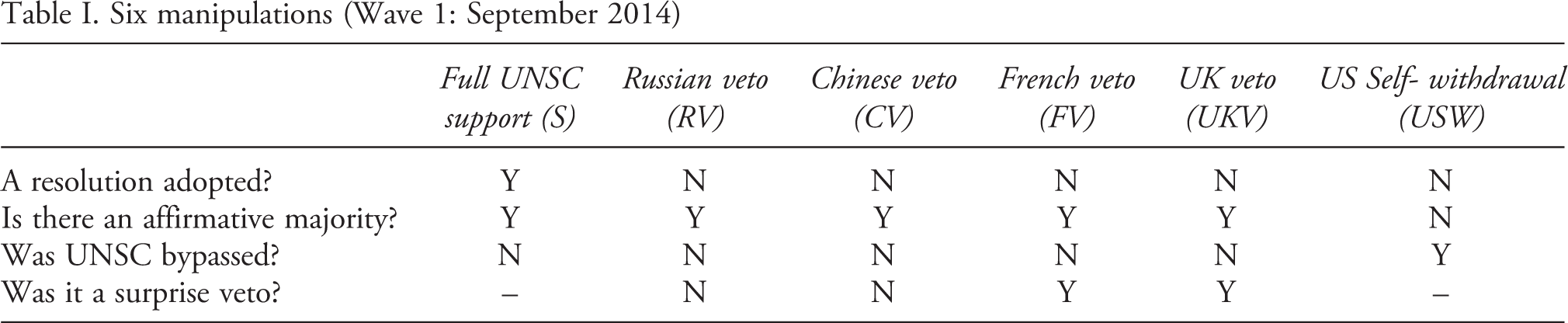
Six manipulations (Wave 1: September 2014)
Five manipulations (Wave 2: January 2018)
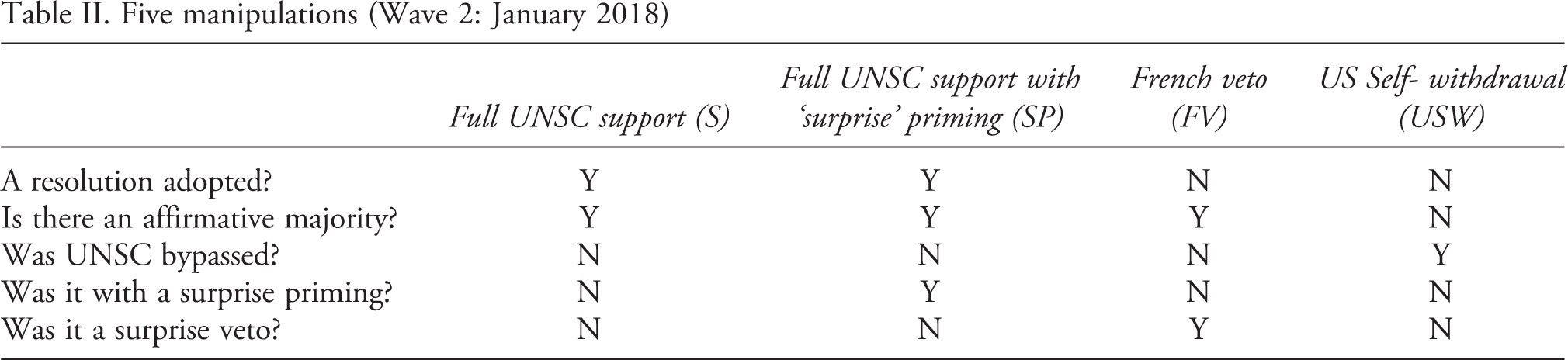
These treatment conditions are listed in Tables I and II and formed our key independent variable, having been randomly assigned to each respondent. In the scenario, regardless of successfully obtaining a resolution from the UNSC, the US government, with overwhelming support from its domestic audience (the general US public and the US Congress), has started multinational military operations against the country.
We conducted two waves of survey experiments, the first one 4–10 September 2014 through Nikkei Research Inc. (http://www.nikkei-r.co.jp/english/) and the second one 10–11 January 2018 through Yahoo Japan Crowdsourcing (https://crowdsourcing.yahoo.co.jp). The first survey covered 2,149 individuals and the second survey covered 1,257 individuals between the ages of 20 and 69. Although the theoretical implications of our arguments could be applicable to both US citizens (i.e. domestic audiences) and non-US citizens (i.e. domestic audiences in a third-party country), we decided to focus on the latter in this study. Persuading the international audience could be tougher than the domestic audience, since foreign leaders and their public would have a different view about the international conflict (Thompson, 2009).
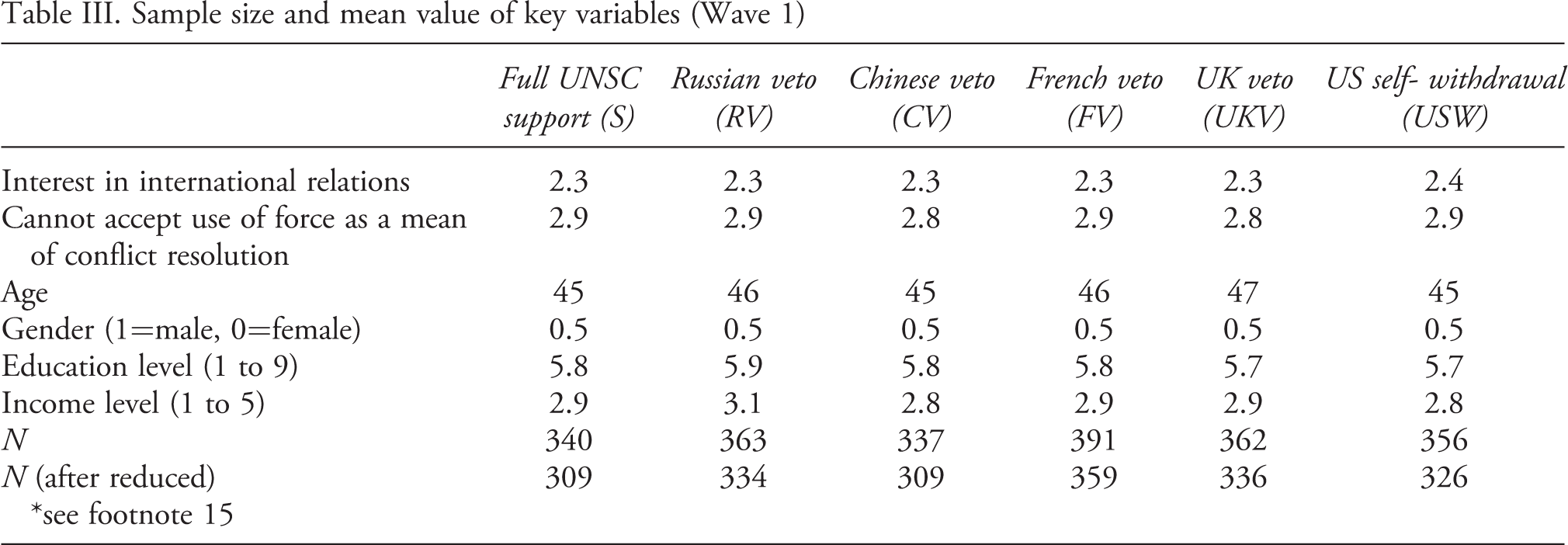
Sample size and mean value of key variables (Wave 1)
Sample size and mean value of key variables (Wave 2)
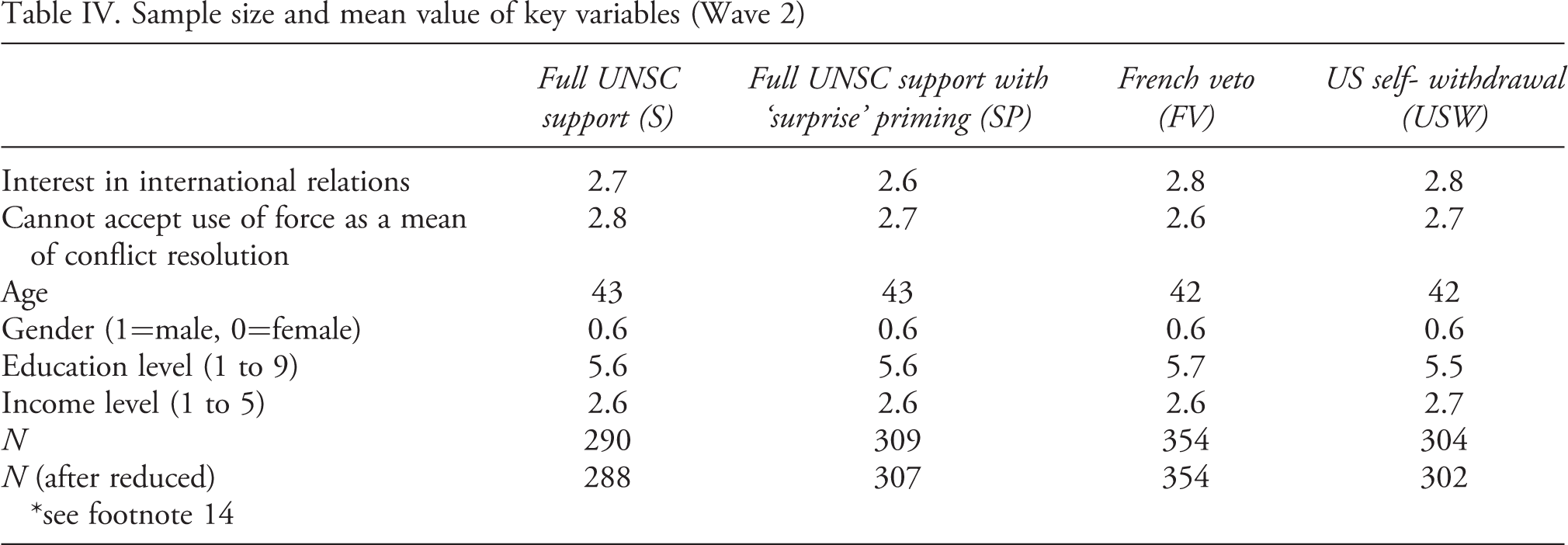
Tables III and IV show the sample size, mean age, gender balance, income level, education level, and the mean scores for two different questions regarding level of interest in international relations and level of acceptance of using force as a means of conflict resolution (these questions were included at the end of the survey after the manipulation provided). The two tables clearly show that the random assignment of the six (Wave 1) and four (Wave 2) manipulations was implemented successfully and that there is therefore no systematic difference among the sample groups in terms of basic attribution and key political positions and attitudes. 15
To measure the level of foreign domestic support for use of force in our survey (a test of H1), two questions were prepared. First, respondents were asked if they approved of the use of force initiated by the USA. Possible choices were: approve, somewhat approve, somewhat disapprove, disapprove, and do not know. 16 Second, respondents were asked if they approved of the material support of sending the Japanese Self-Defense Forces to a military coalition led by the USA. Again, the same five choices were given.
In addition to those two questions, we set nine questions (Q2-1 to Q2-9) to capture what kinds of information are delivered to the Japanese public via UNSC authorization success/failure manipulation (thus testing H2); 17
Wave 1: September 2014
Wave 2: January 2018
Q2-1. Do you think this use of force has legal problems?
Q2-2. Do you think this use of force will be expensive?
Q2-3. Do you think this use of force is done for the sake of international society?
Q2-4. Do you think this use of force will be prolonged?
Q2-5. Do you think this use of force will lead to a lot of casualties?
Q2-6. Do you think this use of force has limited legitimacy?
Q2-7. Do you think this use of force is carried out for the sake of US interests?
Q2-8. Do you think this use of force can be avoided by pursuing diplomatic negotiations further?
Q2-9. Do you think this use of force will fail?
Respondents are asked to choose agree, somewhat agree, cannot say either way, somewhat disagree, and disagree for each question. We randomized the order of the nine questions. We adopt the ANOVA and Tukey-Kramer multiple comparison method to test significance of the mean difference of each pair of manipulation conditions.
Finally, before providing the hypothetical scenario and the experiment manipulations, we ask whether respondents believe that the use of force is permissible By preference group, Wave 2: January 2018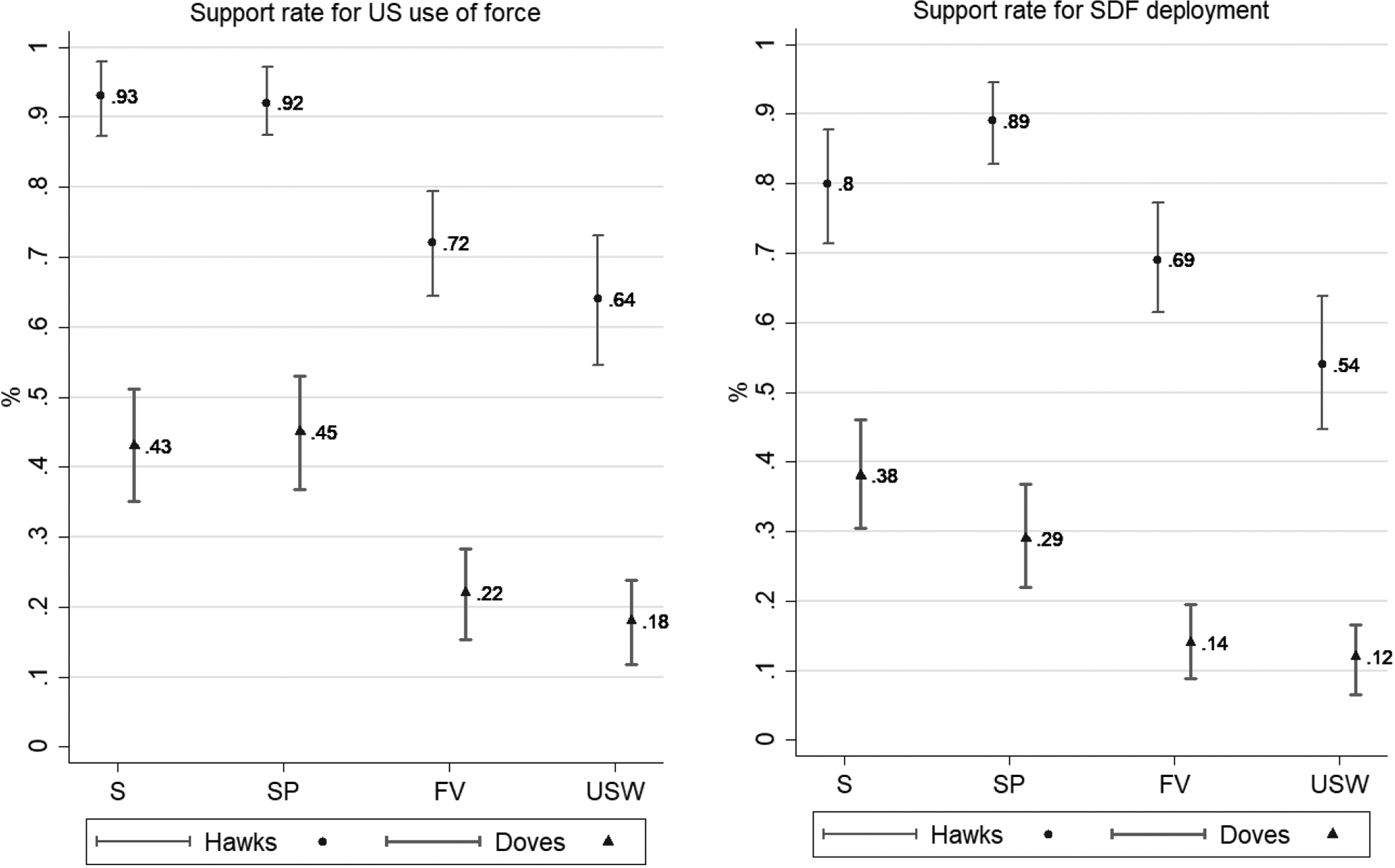
Results
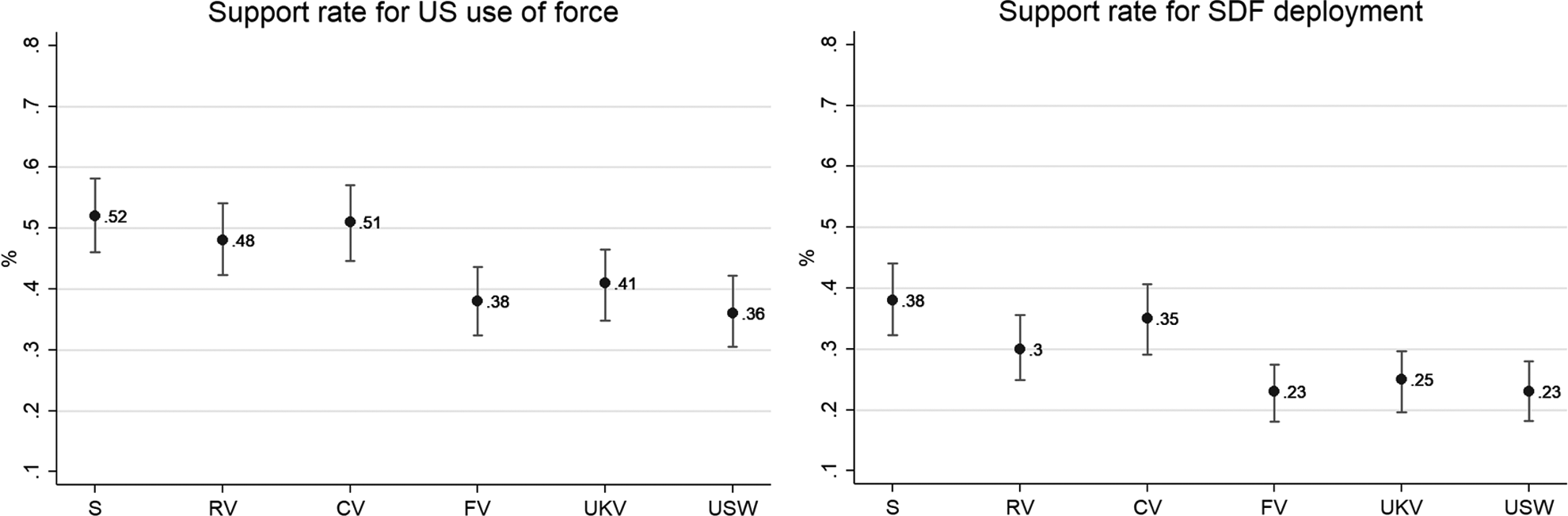
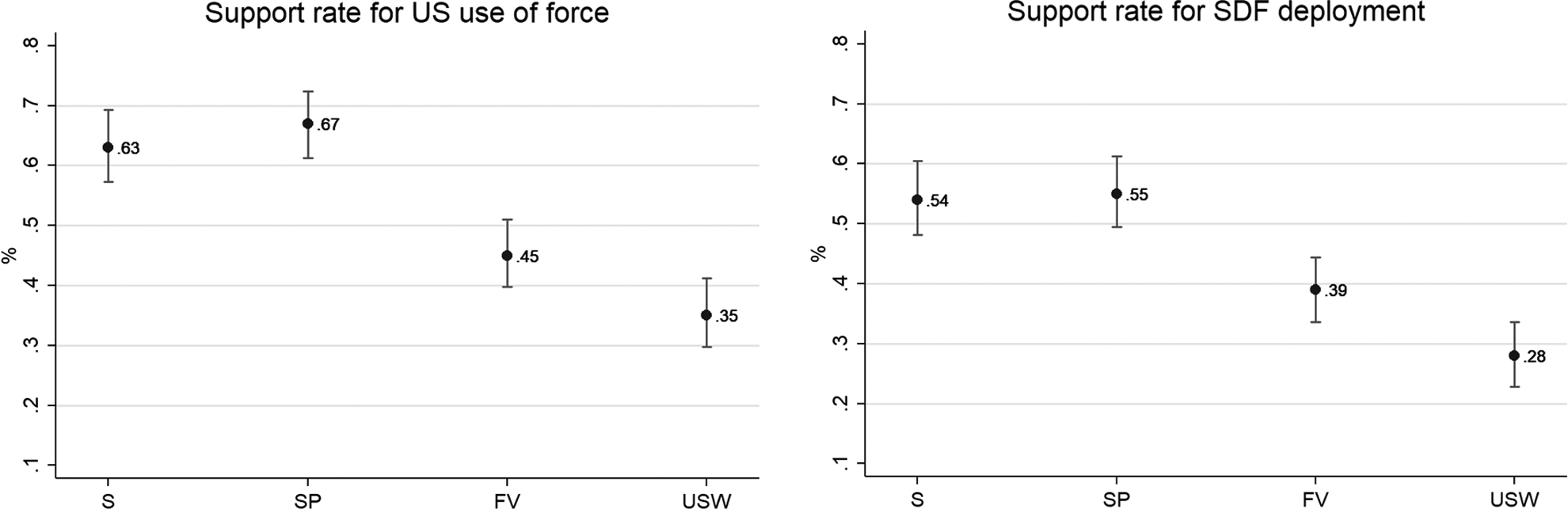
Figure 1 (Wave 1) and Figure 2 (Wave 2) show average support rate by the six and four UNSC manipulations for US use of force and sending Japanese Self Defense Forces (JSDF) troops along with US forces, respectively. 18 First, on average, the respondents tend to give higher levels of support for US military action than for JSDF contributions to a military operation in the Middle East. A comparison of the percentage level presented in the vertical axis of the right and left panels in Figures 1 and 2 provide good evidence of this. There is indeed a difference of 13–18%.
The figures show that full UNSC authorization (S in Wave 1, and S and SP in Wave 2) obtains a high level of support for both US use of force and JSDF troop deployment (52% for US use of force and 38% for JSDF deployment in Wave 1; 63% for US use of force and 54% for JSDF deployment in Wave 2). In cases of vetoes, we see two groups: first, Chinese and Russian vetoes (CV and RV) tend to generate a relatively high support for the use of force (the support rates are 48% and 51% for US use of force and 30% and 35% for JSDF deployment, respectively, in Wave 1); second, French and UK vetoes (FV and UKV) end up with relatively low support rates; namely, 38% and 41% for US use of force and 23% and 25% for JSDF deployment, respectively, in Wave 1 (French veto ended with 45% for US use of force and 39% for JSDF deployment in Wave 2). Finally, the level of support declines when the US government withdraws its draft resolution (USW: support rate ends up with only 36% and 23% in Wave 1 and 35% and 28% in Wave 2). The differences between a successfully authorized case (S) and French-veto (FV), UK-veto (UKV) and self-withdrawal (USW) are statistically significant. Hypothesis 1 (negativity surprise impact hypothesis) is supported.
Motivations, Wave 2: January 2018
By contrast, we must emphasize that the differences of unanimous support (S) and positive surprise (i.e. surprise priming, SP) stimuli in the Wave 2 were not statistically significant. That is, surprise due to ‘rare support from the nay-sayers’ would not generate further positive perceptions among the public. There is no bonus from surprise support even if we emphasize in the experiment that Chinese and Russian affirmative votes are rare and thus (possibly) informative. While we consider that further evidence is required and thus this is based on preliminary evidence, a positive surprise could be weaker than surprising negativity information.
Furthermore, in order to see if a surprise will significantly affect their support for the military action among the hawkish general public but less among the dovish general public, we used a question regarding ‘preference over the use of force in general.’ Three groups were generated, depending on how respondents answered the question. We code as ‘hawkish’ those who say they can approve or somewhat approve a military action as a mean of solving an international dispute; we code as ‘dovish’ those who say they cannot approve a military action either no matter what or in most cases. Also, a third group was based on those who selected the do not know option.
Figure 3, based on the data from Wave 2, shows how different use of force preference groups – i.e. hawks and doves – react to a US use of force. First, 92–93% of hawkish respondents support US use of force when there is successful authorization (S) and successful authorization with surprise priming information (SP), while only 64–72% of them support it when there is a French veto (FV), or the US self-withdraws a draft resolution (USW). Secondly, among the doves, a successful authorization and a successful authorization with surprise priming information secure only 43–45% of support while a French veto and US self-withdrawal end up with 18–22% of support. The same pattern is confirmed also by the support rate for JSDF deployment. Hawkish respondents have an 80–89% rate of support for US use of force when there is a successful authorization and a successful authorization with surprise priming, while only 72% of them support it when there is a French veto. Among the doves, a successful authorization and a successful authorization with surprise priming led to 29–38% of support while a French veto and US self-withdrawal end up with 12–14% of support. The hawks change their perception by around 29–35% but the doves do so by about 25–27%. A difference between the hawkish and dovish audience exists, but it is not large. To counter our original expectation, the negative surprise cues may not be influential to the hawkish people since they fail to transmit information on the cost and alliance burden-sharing; we believe that the hawks care more about this information.
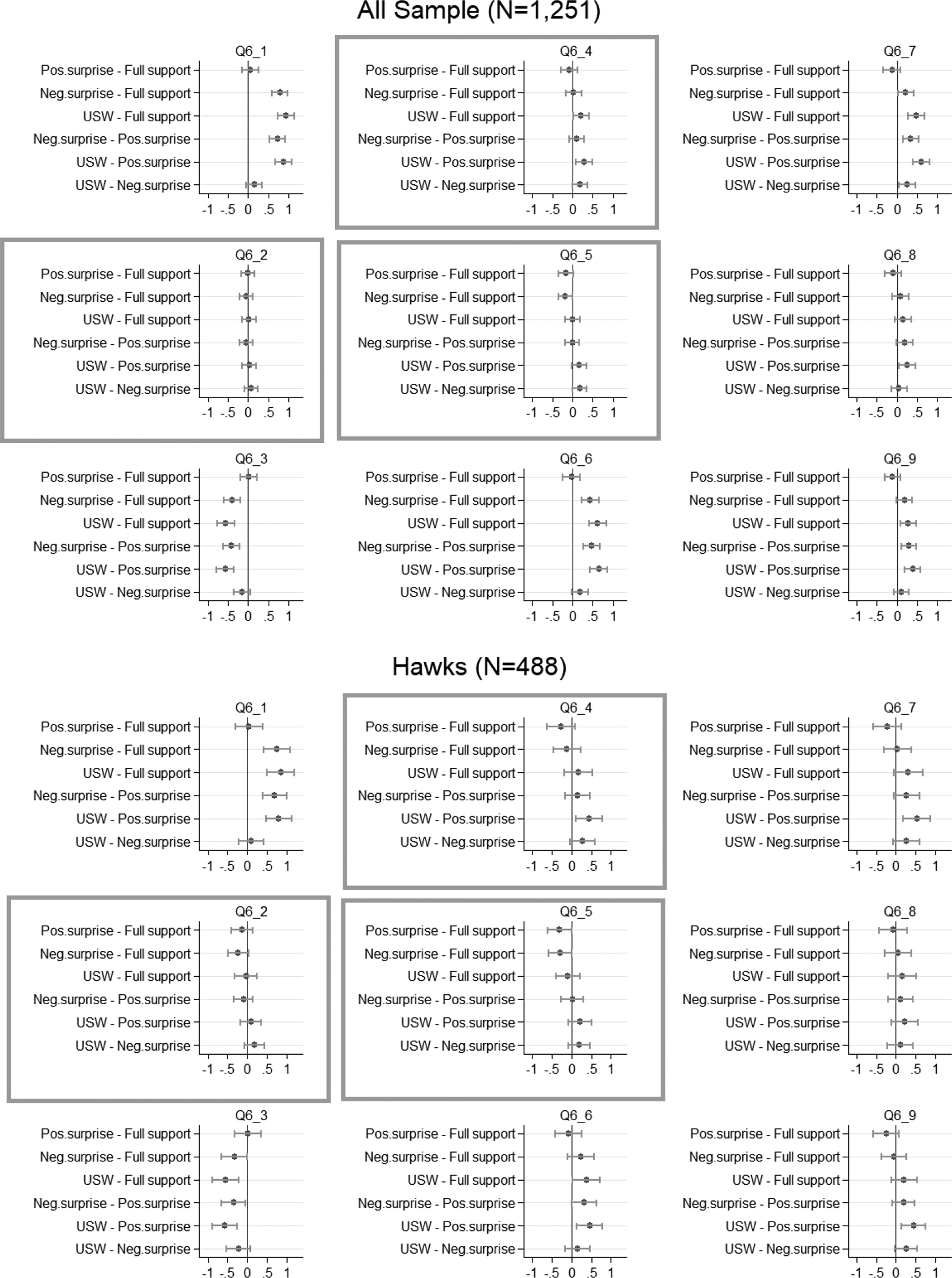
We next move on to revealing what drives the changes in people’s support for the military action – the mechanism of support changes with regard to an unexpectedly vetoed use of force (Hypothesis 2: negativity surprise mechanism). Figure 4 shows the difference in means calculated and tested by Tukey’s multiple comparison method. 19 As can be seen in all panels of Figure 4, the responses for Q6-2: ‘Perception on cost’, Q6-4: ‘Perception on duration’, and Q6-5: ‘Perception on casualty’ did not change much by informational stimuli of UNSC authorization success or failure (emphasized in box). Japanese people’s reactions were not mediated by the perceptions of cost, duration, and casualty of a potential use of force. By contrast, Q6-1: ‘Perception on illegality’, Q6-3: ‘Perception on contribution to public goods’, Q6-6: ‘Perception on low legitimacy’, Q6-7: ‘Perception on contribution to US interest’, and Q6-9: ‘Perception on possibility of failure’ made statistically significant differences in most cases.
In particular, in this survey the UNSC’s authorization consistently affects Japanese respondents’ perceptions of legality, legitimacy, public goods, and US interest. The exploratory nature of our research yielded the surprising finding that cost and burden-sharing perceptions are not affected by the cues, since previous studies have emphasized the cost as key information transmitted by IOs’ authorization (e.g. Chapman, 2011: 44–45). We consider that this could be a reason why we do not see much difference between the doves and hawks in our data. A possible and plausible interpretation of this finding would be that our experiment is about the UN and not an alliance-based institution such as NATO. The information on cost, duration, and casualty would be more likely to be conveyed by different international cues than the UNSC. 20
Conclusion
We have hypothesized that an unexpected veto from allies such as the UK or France on a proposed US use of force would significantly increase opposition to the military action among the general public because the public receive negative information from their veto. ‘No’ from either one of the democratic major powers matters to the respondents of the experiments. We do not find the same effect for the case of Russian and Chinese vetoes (i.e. non-democratic major powers) and this can be explained by the fact that their vetoes are expected. Also, our experiment, with its series of questions on public perceptions of the use of force, has revealed that the perceptions of legality, legitimacy, public goods, and US interest explain why people support the US use of force under the particular conditions of UN authorization success and failure. What mattered was not cost, expected consequence, or intention.
It is surprising that there is no difference in terms of cost of the military operations and intention of the coalition leader state even if there is a successful or failed UN authorization. Thompson (2006, 2009) argues that the information on cost and intention will be transmitted to the general public through the successful UNSC resolutions. However, this study shows clearly that it was not the case. 21 Japanese survey respondents did not consider that it would be a less costly operation and it would be a restricted, less coercive operation if there is a successful authorization by the UN Security Council. It is possible that the Japanese experiment participants, who have had the Peace Constitution for nearly 70 years and shared a stable, high level of confidence in the UN (Norris, 2009), tend to believe in the power of UN authority and attribute more legitimacy to a UNSC resolution than other countries’ citizens. While we admit that Japan may be a likely case to observe the power of legitimacy, it must also be noted that the conventional wisdom that a UN resolution would engender better perceptions in terms of cost and intentions is somehow denied by the two waves of survey experiments in Japan. Further studies are needed to see how robust our results are when compared with other countries’ respondents.
Supplemental Material
Supplemental Material, JPR809786_OnlineAppendix - Negative surprise in UN Security Council authorization: Do the UK and French vetoes influence the general public’s support of US military action?
Supplemental Material, JPR809786_OnlineAppendix for Negative surprise in UN Security Council authorization: Do the UK and French vetoes influence the general public’s support of US military action? by Naoko Matsumura and Atsushi Tago in Journal of Peace Research
Footnotes
Replication data

Acknowledgments
We thank Associate Editor Han Dorussen and three reviewers for their valuable comments and suggestions.
Funding
The corresponding author is grateful for the financial support provided by the Murata Science Foundation (H29) and the first author is thankful for the financial support provided by the Center for Social Systems Innovation, Kobe University.
Notes
Appendix
References
Supplementary Material
Please find the following supplemental material available below.
For Open Access articles published under a Creative Commons License, all supplemental material carries the same license as the article it is associated with.
For non-Open Access articles published, all supplemental material carries a non-exclusive license, and permission requests for re-use of supplemental material or any part of supplemental material shall be sent directly to the copyright owner as specified in the copyright notice associated with the article.
