




Abstract
Fragmentation of armed opposition movements through the rise of new rebel groups constitutes a significant challenge to conflict termination and peacebuilding. Yet, the question of why some rebel movements remain cohesive whereas others see a number of contending groups during the course of the armed conflict has received limited attention in existing research. This article addresses this gap by analyzing the determinants of the rise of rebel contenders in intrastate armed conflicts worldwide, 1975–2013. The theoretical framework focuses on barriers to entry, that is, variations in the costs and disadvantages that must be borne by nascent rebel contenders that are not borne to the same extent by incumbent rebel groups. The study proposes that strong social networks underpinning incumbent groups create structural barriers to entry for nascent groups by aggravating challenges of organization building. It further suggests that the interaction between incumbent groups and the government influences strategic barriers to entry as changes in government policies produce windows of opportunity for nascent groups to form. Consistent with these arguments, the study finds that when incumbent groups have strong networks – because rebels either tap into ethnic networks or draw on a leftist ideology – the risk of fragmentation is lower. Furthermore, when the government accommodates groups, through either negotiations or democratic concessions, the risk of fragmentation increases.
Introduction
Fragmentation of armed opposition movements through the rise of new rebel groups represents a significant challenge for conflict termination and peacebuilding. In Syria, the fragmentation of the opposition has been identified as a key obstacle to resolving the conflict, as it, for instance, has made it difficult to determine which groups should be included to represent the opposition side in the peace talks. A divided opposition movement is not a unique attribute to the Syrian civil war. Afghanistan, Burundi, Colombia, Israel/Palestine, Liberia, Northern Ireland, and the Philippines are other examples where the emergence of new rebel contenders during the course of the ongoing conflict has produced fragmented movements. While we know that such fragmentation has significant bearing on conflict intractability, producing conflicts of longer duration that are more difficult to end (Cunningham, 2006; Cunningham, Gleditsch & Salehyan, 2009; Cunningham, 2011; Nilsson, 2008; Walter, 2003), we still have a limited understanding of why some armed opposition movements become fragmented, whereas others do not.
A growing case-based literature has documented how organizational cohesion, civil war dynamics, and external patronage may impact on the likelihood of within-group splits (e.g. Christia, 2012; Kenny, 2010; Tamm, 2016; Woldemariam, 2016). In its wake, there has been a handful of quantitative studies that have probed the determinants of rebel group fragmentation, but often with limited geographical scope, studying particular types of conflicts, or focusing specifically on splinters (e.g. Asal, Brown & Dalton, 2012; Seymour, Cunningham & Bakke, 2016; Otto & Salverda, 2015). Yet, spurred by the empirical observation that a majority of the new rebel contenders that become active in ongoing armed conflicts have no organizational ties to the existing rebel groups, we move beyond the prevailing focus on splinter groups in the current literature. We posit that many of the organizational challenges involved in becoming viable rebel contenders apply independently of whether the fighting cadres have defected from existing groups or not. We study fragmentation as the rise of rebel contenders during the course of an armed conflict and provide the most comprehensive analysis of this phenomenon to date, using data on all internal armed conflicts between 1975 and 2013.
To explain why some of these armed movements see a higher likelihood of fragmentation than others, our theoretical framework draws on existing arguments that highlight variations in the costs that must be borne by nascent rebel contenders – that is, aspiring groups – which are not borne to the same extent by already active groups. Borrowing from economics, we refer to these costs and disadvantages as ‘barriers to entry’ and argue that where barriers to entry are high, nascent rebel contenders are less likely to become viable challengers to the state, thus lowering the risk of fragmented movements. Specifically, we theorize that structural barriers to entry exist where strong social networks underpin incumbent rebel groups and deprive nascent rebel contenders of the organizational input – for example, fighting forces and civilian support – necessary to become viable challengers to the state. We furthermore theorize that the interaction between incumbent groups and the state creates variations in strategic barriers to entry. Both accommodation and repression of incumbent rebel groups may create windows of opportunity that help new groups overcome coordination problems and participation constraints.
The statistical analysis reports several findings consistent with these arguments. Corroborating the salience of social ties in crowding out nascent groups, we find a lower likelihood of movement fragmentation in conflicts where incumbent groups have an ethnic or leftist base. We find no effect, however, of religious ties. Our results also show that the risk of movement fragmentation is greater during negotiations and in a period of transition towards more accommodative political institutions. We do not find, however, that repression increases fragmentation, which suggests that the heightened costs of mobilization from repression may outweigh the strategic opportunities for newcomers to capitalize on the hardship facing incumbent groups.
This study contributes to the growing literature on the determinants of fragmentation in three ways. First, whereas most existing analysis of fragmentation is concerned with the processes that precipitate splits within existing rebel groups, our study recognizes the more multifaceted process that produces these divided movements. Doing so, we move the focus away from internal group dynamics to the broader puzzle of why some movements see the rise of a number of viable rebel contenders, whereas others do not. Second, our answer to this question is embedded in one overarching theoretical framework, which not only offers a way of integrating a number of disparate theoretical insights from existing work, but may also represent a way forward for incorporating additional variables. Theoretically, the barriers-to-entry approach also highlights that prevailing explanations for why rebel groups fall apart are not necessarily complete for understanding when we see the emergence of viable rebel contenders. Third, our core findings contribute to a better understanding of fractionalized armed conflicts for academics and policymakers alike. If fragmentation occurs where social ties are weak, the lack of unifying ties may itself reinforce the need for a peacemaking approach that accommodates this diversity. If state accommodation increases the risk of fragmentation, then efforts to promote negotiated settlements and more democratic institutions should be cognizant of these risks.
Fragmentation of opposition movements
Why do some armed opposition movements fragment through the establishment of new rebel groups whereas others do not? Alongside already active rebel groups, an opposition movement may contain a number of nascent (or latent) groups, in the form of factions plotting to splinter off from incumbent groups, factions that have already defected and strive to survive, or unaffiliated groups that have just initiated violence to further their demands. 1 Many of these groups never become viable challengers to the state: they disband before they are able to expand their rebel organization and engage in large-scale violence (Lewis, 2017). Yet, some of these nascent groups are able to mobilize sufficient organizational resources and resist initial hostility both from government actors and incumbent groups that seek to dismantle opposition. When they do, we observe the fragmentation of an opposition movement through the rise of a new rebel group – what we refer to as a ‘rebel contender’. 2
The process of movement fragmentation may unfold through two main pathways: either an additional rebel actor forms when leadership and rebel cadres splinter off from an existing organization, or an organization without clear ties to existing rebel groups decides to launch an armed struggle. Previous research has predominantly focused on the former process of within-group splits. One strand of this literature links splintering to low organizational cohesion: intragroup struggles are more likely when groups lack a strong social base or organizational integration, which in turn paves the way for internal feuds, defection, and noncompliance (Asal, Brown & Dalton, 2012; Kenny, 2010; McLauchlin, 2015; Staniland, 2014). Some note that military setbacks, such as territorial losses or military casualties on the side of the rebel group, as well as battlefield gains, may also produce organizational schisms (Christia, 2012; Woldemariam, 2011). A second strand of literature highlights the external determinants of fragmentation, including state repression (McLauchlin & Pearlman, 2012; Seymour, Cunningham & Bakke, 2016; Shapiro, 2013), state concessions or offers of sponsorship of breakaway factions (Olson Lounsbery & Cook, 2011; Seymour, Cunningham & Bakke, 2016), and the role of external patrons (Tamm, 2016).
We draw on theoretical insights from this literature to study why some civil war opposition movements fragment whereas others do not. Since many of the above arguments have been explored primarily through case studies or tested on a subset of civil war opposition movements, their general applicability is still unsettled. We therefore expand on this literature to undertake a global, statistical analysis of fragmentation of all armed opposition movements. Importantly, we part with the existing literature in its prevailing focus on within-group splits. Our conceptualization of movement fragmentation incorporates also the process by which nascent rebel groups become viable contenders to existing groups. 3 Admittedly, there may be significant differences between the two pathways to movement fragmentation. 4 Yet generally, we posit that the predominant focus on splinter groups is too narrow. Of the 149 rebel contenders that emerged in the context of an ongoing civil war during the time period we study, 59 were the result of within-group splits, whereas 90 were joiners, that is, groups without known affiliations to incumbent groups. Besides this empirical relevance, we also suggest that the rise of unaffiliated rebel groups in the context of ongoing conflict has more in common with the rise of splinter groups than with the first movers in civil war onsets. Nascent groups that attempt to set up viable fighting organizations in the context of an ongoing conflict will face greater costs and disadvantages than those faced by the conflict’s first movers. Most importantly, rebel contenders – independently of whether the group is a splinter or a joiner – must compete with incumbent groups over organizational input and strategic leverage. In order to become viable challengers, even splinter groups will struggle with the mobilization of civilian support, organizational resources, rank-and-file recruitment, and gaining leverage in the bargaining with the government. 5 In this study we therefore probe the determinants of rebel movement fragmentation within one theoretical framework. This, we argue, significantly expands on the scope of the existing research.
Barriers to entry for rebel contenders
To explore movement fragmentation, our theoretical framework emphasizes variations in the costs and disadvantages that must be borne by nascent rebel contenders but that are not borne to the same extent by incumbent groups – what we refer to as ‘barriers to entry’. In short, we propose that where barriers to entry are high, nascent groups are less likely to become viable rebel groups and we are less likely to observe movement fragmentation. The concept is borrowed from the economic literature on industrial organization, where it denotes cost advantages of incumbent versus entrant firms in a market (c.f. Bain, 1956; Stigler, 1983 [1968]). In this literature, a distinction is made between ‘structural’ and ‘strategic’ barriers to entry: the former denotes costs to entrants stemming from structural characteristics of the industry; the latter denotes costs that arise from strategic behavior of the industry’s incumbents (Lutz, Kemp & Dijkstra, 2010). Applying this to opposition movements, we argue that structural barriers to entry may arise from the presence of strong social networks underpinning incumbent rebel groups, whereas strategic barriers to entry can be influenced by the dynamic interaction between incumbent rebel actors and the government. We move on to develop these arguments in more detail.
Structural barriers to entry
Rebel group formation requires the mobilization of sufficient organizational resources to transform nascent groups into viable armed challengers to state authority (cf. Lewis, 2017). Nascent rebel groups often must compete with incumbent groups over the same pool of resources, such as potential recruits and civilian support. 6 The fierceness of this competition will depend on the capacity of incumbent groups to control resources under their command, which, we argue, will be a function of the social networks that underpin them. Incumbent groups with strong social networks will raise the structural barriers to entry for rebel contenders in three important ways.
First, incumbent organizations’ strong social networks directly restrict newcomers’ access to resources that are crucial for effective organization-building. As Jenkins notes, groups ‘sharing strong distinctive identities and dense interpersonal networks exclusive to group members are highly organized and hence readily mobilized’ (Jenkins, 1983: 538; see also Tilly, 1978). These social networks have a horizontal dimension, which integrates the participants within the organization, and deters defection both by facilitating in-group policing and by fostering commitment to the collective and to the cause (Staniland, 2014). 7 The social endowments that these networks bring play an important role in fostering norms, beliefs, and shared meaning that facilitate cooperation among group members (Staniland, 2014: 9; Weinstein, 2007: 49). Horizontal social ties thus produce more cohesive organizations and reduce the likelihood that fighters leave the organization (c.f. McLauchlin, 2015). The resulting low supply of militants from incumbent groups to nascent joiners or splinters increases the costs for these to establish themselves and should reduce the likelihood of fragmentation.
Second, incumbent rebel groups with strong social networks are likely to be more effective in building and maintaining the cooperation of civilian constituencies, deterring and punishing their defiance, and recruiting and socializing new members (Parkinson, 2013; Staniland, 2014). This vertical dimension of the social network, nesting the incumbent groups with their civilian constituencies, not only bolsters the logistic, financial, and military base of incumbent groups, but also facilitates control and policing of non-cooperation (c.f. Kalyvas, 2006). Assuming that civilian support within a given geographical and temporal space is a finite resource, civilians’ reluctance or fear of switching their alliances may effectively deprive nascent groups of a crucial source of organizational input.
Third – and more indirectly – barriers to entry for nascent groups may arise not only through the higher costs for obtaining the necessary resource input to build viable military organizations, but also from the military threat incumbent organizations represent. Since incumbents’ social networks facilitate more resilient fighting organizations, incipient rebel contenders – both splinters and joiners – may be militarily overrun before they have the chance to establish themselves. Indeed, interrebel fighting is a widespread phenomenon in many civil wars (Fjelde & Nilsson, 2012). The sheer threat of military annihilation and the anticipation of fierce competition from incumbent groups with strong social networks may in itself deter splintering or lead to early failed attempts to mobilize from unaffiliated groups. In Sri Lanka, for example, the Liberation Tigers of Tamil Eelam (LTTE), a group underpinned by strong ethnic networks and a socialist ideology, engaged in fierce fighting against contending Tamil groups to establish dominance. This violence severely crippled nascent groups, such as PLOT (splintering off from LTTE in 1979) which by late 1986 was virtually eliminated by LTTE (Lilja & Hultman, 2011: 194–195; UCDP, 2017; Mahoney, forthcoming).
The above discussion links the presence of strong social networks to a lower likelihood of movement fragmentation. Qualitative literature has carefully documented variations in the social foundations of rebel groups across different conflict contexts, for example the overlap between military hierarchies and quotidian social networks among Palestinian organizations in Lebanon (Parkinson, 2013), and the role of prewar social ties in forging cohesive insurgent organizations in South Asia (Staniland, 2014). Our effort to highlight general patterns across cases and over time leads us to adopt a more aggregate approach. Below, we propose three general characteristics of incumbent rebel groups that may underpin the establishment of strong social networks and thus increase the structural barriers to entry for rebel contenders: a shared ethnic identity, a common leftist ideology, or a joint religious base. 8
First, social networks may result from group mobilization along ethnic lines. Ethnic affiliations delineate the pool of likely supporters for rebel organizations and make it easier to police free-riding, which in turn aid rebel recruitment efforts and prevent defection (Eck, 2009; Wucherpfennig et al., 2012). Social networks embedded in a shared ethnicity also provide resources that facilitate organization-building – for example, language, experience, and established modes of interaction (Habyarimana et al., 2007) – that may also generate solidarity and trust. Because of these characteristics, ethnicity may function as a coordination device that facilitates organization-building and rebel group cohesion (Eck, 2009; Gates, 2002; Weinstein, 2007). The potential for effective collective action from shared ethnic identity works not only through horizontal ties, but also through vertical ties with civilian constituencies. The ascriptive markers of ethnicity facilitate monitoring and sanctioning of non-collaboration from civilian constituencies (Fjelde & Hultman, 2013). In line with these conjectures, Otto & Salverda (2015) find that groups that mobilize along ethnic lines are less likely to experience splintering. In her tracing of the early fate of 16 rebel groups in Uganda, Lewis (2017) finds that ethnic mobilization and ethnic narratives are crucial when distinguishing groups that became viable military challengers to the state from those that failed early.
Second, ideology may constitute another base for forging strong social networks. A coherent ideological foundation may assist recruitment efforts, help coordinate action around shared beliefs, and prevent defection by forging alliances between group members and inducing loyalty (Eck, 2010; Weinstein, 2007: 52). Eck’s (2010) study of the Maoist movement in Nepal demonstrates how political education and ideological propagation can be central for forging close-knit ties with the civilian population, for convincing individuals to join the rebellion, and for maintaining a cohesive group. Kalyvas & Balcells (2010: 421) similarly note how a leftist ideology during the Cold War helped shaped the beliefs – among masses and rebel entrepreneurs – about the necessity, but also feasibility of radical change via armed struggle and that ‘the key to success lay in the patient construction of a highly structured political organization’ that guaranteed discipline. An ideological foundation, particularly around leftist aspirations, may thus create horizontal and vertical linkages in a similar vein as ethnicity. 9
Third, strong social networks may develop around religious identity, and thereby facilitate recruitment and cooperation among members of the movement (Gates & Nordås, 2015; Weinstein, 2007). Strong social ties are crucial for recruitment efforts of religious organizations (Stark & Bainbridge, 1980), and also help strengthen individual commitment to that group (Cunningham et al., 2011: 4). Religious organizations can draw on horizontal ties by appealing to a faith and thereby a stronger sense of community, but also capitalize from stronger vertical ties between the potential members and a higher principle, such as obligation or God (Gates & Nordås, 2015: 5–6). Similarly, the fear of punishment from a higher authority may induce cooperation and limit defection from organizations fighting for a religious cause (Johnson & Krüger, 2004). Strong ties underpinning incumbent religious groups may thus crowd out efforts to set up rival organizations.
In sum: in contrast to groups that draw primarily on economic endowments or coercion in soliciting civilian support or attract rebel recruits, we expect incumbent groups that mobilize along shared ethnic identity, a leftist ideology, or religion, to be better able to restrict the supply of rebel fighters to nascent rebel contenders; to deprive them of access to crucial organizational input by forging strong ties with civilian constituencies; and to be able to levy credible military threats to deter rebel contenders. This leads to the following hypotheses:
H1: Conflicts where existing rebels mobilize around ethnicity see a lower probability of rebel contenders rising during the course of the armed conflict.
H2: Conflicts where existing rebels mobilize around a leftist ideology see a lower probability of rebel contenders rising during the course of the armed conflict.
H3: Conflicts where existing rebels mobilize around religion see a lower probability of rebel contenders rising during the course of the armed conflict.
Strategic barriers to entry
Besides the structural barriers to entry, the dynamic interaction between incumbent group(s) and the state may influence the strategic barriers to entry for nascent rebels. Most directly, critical turning points in the bargaining between incumbent groups and the state may signal new opportunities also for nascent groups to reap pay-offs. Explaining the rise of contending groups in social movements, Meyer & Staggenborg (1996), for example, argue that groups that show signs of being successful by putting their issue on the public agenda or by influencing public policy are most likely to invite the rise of contending groups. Existing groups can open a ‘policy window’ where aggrieved groups and entrepreneurs perceive that change is possible, thereby provoking mobilization. When an issue is ‘closed’, additional organizations are unlikely to form. Often, impetus for mobilization will follow from critical events, such as government conciliatory actions, which create a perception that policy change is possible (Meyer & Staggenborg, 1996: 1638). We argue that government accommodation may lead to movement fragmentation also in armed conflicts. Nascent rebel groups – whether factions plotting to splinter off or unaffiliated groups deciding whether to initiate a violent campaign – may then perceive opportunities to realize political goals, such as political reform, self-determination or policy change, as well as private material spoils accruing to those ‘in the game’. We expect such opportunities to invite the formation of rebel contenders.
In addition, critical turning points in the bargaining with the government can lead to disagreement over strategic priorities and reveal diverging preferences among factions within the incumbent groups. Organizational schisms may, in turn, weaken their internal cohesion and lower the strategic barriers to entry for rebel contenders. Partly, such processes can be decisive for splinter groups deciding to break away, partly as they can create room for unaffiliated groups to form as incumbent groups are caught up in their own infighting. Not only conciliatory moves, but also coercive moves such as repression, may have this indirect effect of raising the costs of maintaining organizational cohesion (c.f. Perkoski, 2015). We identify three critical turning points in the government–rebel interaction that seem particularly salient: the onset of negotiations, transitions towards more inclusionary political institutions, and government repressive spells.
First, the onset of negotiations signals government willingness to make concessions. Some of these concessions will be related to the public goods aspect of rebellion, for example a willingness to share executive power or grant self-determination, while others come with potential for immediate and tangible pay-offs for incumbent rebel groups invited to the negotiation table, such as government posts, state patronage or other perks. Negotiations thus open a window of opportunity, where the prospective gains that nascent rebel entrepreneurs previously deemed uncertain may be within reach. Such opportunities may lead to fragmentation along different paths. First, negotiations may lead to movement fragmentation when governments deliberately use concessions as part of a strategy to induce defection and thus divide and rule (Johnston, 2007; Nilsson, 2010). Co-optation of rebel factions may invite the rise of rebel contenders if hardliners break off to establish separate organizations or unaffiliated groups radicalize and mobilize in the space left by the side-switching factions. Negotiations may also accentuate divergent strategic preferences between segments within incumbent groups, for example inducing internal schisms over the necessity of political compromise versus the use of violence (Stedman, 1991: 16; Zartman, 1995: 6) or who should legitimately represent the movement (Pearlman, 2009). The initiation of negotiations can thus exacerbate group divisions and lead to splits within incumbent groups (Darby & Mac Ginty, 2000: 233; Olson Lounsbery & Cook, 2011). For example, the armed movement in Bodoland in India has seen an increasing fragmentation in association with negotiations. When NDFB-RD decided to negotiate with the government in 2012, factions explicitly opposing such a direction broke off and formed the NDFB (S), which fought the government over the coming years (UCDP, 2017). A weakening or appeasement of incumbent groups may also lower the structural barriers to entry by creating organizational space for unaffiliated groups to form.
Political concessions towards more open and inclusive political institutions may have similar effects as negotiations. Political reforms may bring voice and political influence to the rebel movement, for example through opportunities to stand for elections, political decentralization, or representation in a power-sharing government. Such political openings may offer significant spoils to actors who can credibly bargain for influence. Similar to negotiations, concessions in the political sphere may thus inspire increased mobilization efforts or a turn to violence among nascent rebel groups, but also accentuate latent divisions within incumbent groups. In Chad in the early 1990s, for example, the new President Deby pursued a policy of accommodation and political liberalization, and some rebel factions even left the armed struggle and joined the regime. Yet, the move towards democracy and the power-sharing partly produced a schism within the regime which led to the launch of the MDD rebel faction and partly invited the rise of other groups that perceived to be losing out, thus making an armed bid for the spoils (Atlas & Licklider, 1999; UCDP, 2017).
Finally, existing literature has highlighted that not only conciliation but also increases in state repression may constitute critical turning points that increase the risk of movement fragmentation (c.f. Perkoski, 2015; Seymour, Cunningham & Bakke, 2016). Spikes in the state’s repressive actions impose costs on incumbent groups, partly through heightening the cost of resource mobilization (Tilly, 1978), partly by creating internal disagreement within the organization on how to address these costs (DeNardo, 1985). Much like accommodation, repression may accentuate internal divisions within incumbent groups. McLauchlin & Pearlman (2012), for example, note how acts of repression may disrupt the organizational arrangements underlying a stable power-sharing agreement by reinforcing disagreements between moderate and radical factions. Discontented factions may take advantage of that uncertainty to establish a new faction, thereby revealing divisions within the movement. Shapiro (2013) suggests that coercion may undermine group cohesion by forcing the group to move from a centralized, hierarchical structure to a more decentralized structure in order to survive. A flatter and more clandestine structure (as a result of repression) makes the group less susceptible to government infiltration, but may undermine group capacity for internal policing and unity, precipitating fragmentation. Fragmentation may also be an intended outcome of state repression, often used selectively, for example through leadership decapitation, to provoke intramovement competition and generate divisions (Ash, 2014; Seymour, Cunningham & Bakke, 2016). While repression may also have the opposite effect, increasing collective action, unifying an organization, and fostering in-group cohesion in the face of a common enemy (e.g. McCarthy & Zald, 1977; DeNardo, 1985), we propose that generally the divisive impact will outweigh the consolidating effect.
In sum, we expect strategic barriers to entry to be low at the onset of negotiations, when the government democratizes, or when we see spikes in government repressive actions.
H4: The onset of negotiations increases the probability of rebel contenders rising during the course of the armed conflict.
H5: A democratizing move increases the probability of rebel contenders rising during the course of the armed conflict.
H6: A repressive move increases the probability of rebel contenders rising during the course of the armed conflict.
Research design
Unit of analysis and dependent variable
Our statistical analysis includes all internal armed conflicts worldwide between 1975 and 2013 that meet the criterion of the Uppsala Conflict Data Program (UCDP) of at least 25 battle-deaths per calendar year (Melander, Pettersson & Themnér, 2016). For each conflict-year, we code the rise of a new rebel contender the first year a rebel group becomes active in an armed conflict (with a unique ID). To code this variable, we rely on the UCDP Dyadic Dataset’s (v. 1-2014) list of the ID of all armed non-state actors that any given year meet the 25 battle-deaths criterion (Gleditsch et al., 2002; Harbom, Melander & Wallensteen, 2008; Melander, Pettersson & Themnér, 2016). Given our theoretical focus, we only record the rise of a rebel contender if the conflict is under way, meaning we never code the rise of a rebel contender the first year a conflict is active. 10 In line with previous studies, we treat an armed conflict as a continuation of the same conflict episode as long as the number of casualties does not drop below the 25 battle-death threshold for more than two consecutive years. For our dependent variable this implies that if a new group becomes active after two years of inactivity in the armed conflict, we code this as a new conflict episode, not the rise of a rebel contender. Since our theoretical framework focuses on the competition from new groups, we impose two other restrictions on our dependent variable. First, the same group can only be coded as a rebel contender once – the first time it emerges – even if it resurfaces after several years of inactivity. Second, we exclude new groups that emerge as the result of an alliance formation between existing groups since such pooling of resources does not present the same rivalry. Our dependent variable Rise of rebel contender takes the value of 1 in conflict years where a new rebel group becomes active in an ongoing conflict and 0 otherwise. Note that this dependent variable includes both rebel groups without recognized ties to existing groups and groups that form as factions that splinter off from existing groups. Since we focus on the conflict level, all rebel groups sharing the incompatibility are in some sense part of the same opposition movement and compete for the same constituency and both of these phenomena represent a fragmentation of the armed movement as such.
Independent variables
We suggest three separate measures to capture the social ties described in the theoretical argument. First, we include a variable denoting whether there exists a clear ethnic rebel base in the existing movement. The coding of the variable Ethnic rebels is based on the ACD2EPR dataset. To code the prevalence of ethnic ties we follow Wucherpfennig et al. (2012) and require first, that a significant number from an ethnic group participates in the fighting organizations and second, that the rebel organization publicly announces that it pursues a claim directly linked to an ethnic group. As a second indicator of social ties, we construct a dummy variable Leftist rebels, denoting whether any of the active rebel groups claimed to be guided by a leftist agenda (including socialist and Marxist groups). Here we rely on an updated version of a dataset provided by Forsberg & Karlén (2013), which is based on data on Marxist groups in Kalyvas & Balcells (2010); information on group ideology contained in the Minorities at Risk Organizational Behavior Database (Asal, Pate & Wilkenfeld, 2008); the Terrorist Organization Profiles dataset published by the National Consortium for the Study of Terrorism and Responses to Terrorism (2013); and the encyclopedia texts from UCDP (2015) and associated case-experts. Third, we construct a dummy variable denoting whether the rebels have a religious base. We mirror the operationalization for ethnic ties: the variable Religious rebels is coded as 1 if the conflict parties mobilize from distinct religious groups and if the incompatibility has a religious dimension. The latter is the case if the belligerents have ‘explicit aspirations to create a state or a region within the state, governed by religious laws and legislation, or whether one specific religious tradition should be given a special role’ (Svensson, 2007: 936). 11 We rely on data from Svensson & Nilsson (2018).
To examine the strategic barriers to entry for rebel contenders we propose three measures. First, the dichotomous variable Onset of negotiations records whether any of the existing warring parties initiate negotiations in a given year. We assume primarily the first occurrence of negotiations will lower the strategic barriers to entry. Subsequent years of ongoing negotiations are thus coded as 0. Data are taken from the UCDP conflict encyclopedia (UCDP, 2015). Second, we construct a variable that captures swift openings of the political system in the direction of more liberal and accommodative institutions. The variable Democratizing move is coded as 1 if we see a positive change in the Polity2 index of two points or more since previous year (Marshall, Jaggers & Gurr, 2014). Third, we focus on sudden negative changes in the level of repression. The variable Repressive move is based on Farris’s (2014) latent measure of human rights violations and political repression, which is based on several repression data sources (see Farris, 2014, for details). The latent variable model is better able to account for reporting bias and changing standards of accountability over time. We compare the current value on the index to the value in the previous year, and code the variable as 1 if we see change towards the more repressive end and 0 otherwise.
Control variables
We control for several possible confounding variables. First, the social underpinnings of the rebellion as well as the strategic interaction with the state could be related to the duration of the conflict. The variable Conflict duration counts the number of years the conflict has been ongoing. Second, the intensity of fighting may be associated with rebel movement divisions and influence how the government responds to conflict. The variable Conflict intensity–war is coded 1 if the conflict claimed at least 1,000 battle-deaths in a calendar year. Both variables are taken from the UCDP Dyadic Dataset v. 1-2014 (Gleditsch et al., 2002; Harbom, Melander & Wallensteen, 2008; Melander, Pettersson & Themnér, 2016). Third, external involvement may influence both the resources and the preferences of the belligerents, and precipitate fragmentation on the rebel side (Seymour, Cunningham & Bakke, 2016). We control for whether the conflict is Internationalized through secondary warring parties, using data from the UCDP (Themnér & Wallensteen, 2014).
In addition, we control for temporal dependence within our panels by including Time since fragmentation – a decay function of the time since the last (if any) entry of a rebel contender, with a half-life parameter of two years. 12 Finally, since the risk that a new rebel contender forms may depend on whether there are already multiple parties to the conflict, we introduce a variable Multiparty conflict, coded 1 if more than one rebel group was active in the conflict the previous year and 0 otherwise. All control variables are introduced at t–1 to reduce the risk of reverse causal order.
Analysis
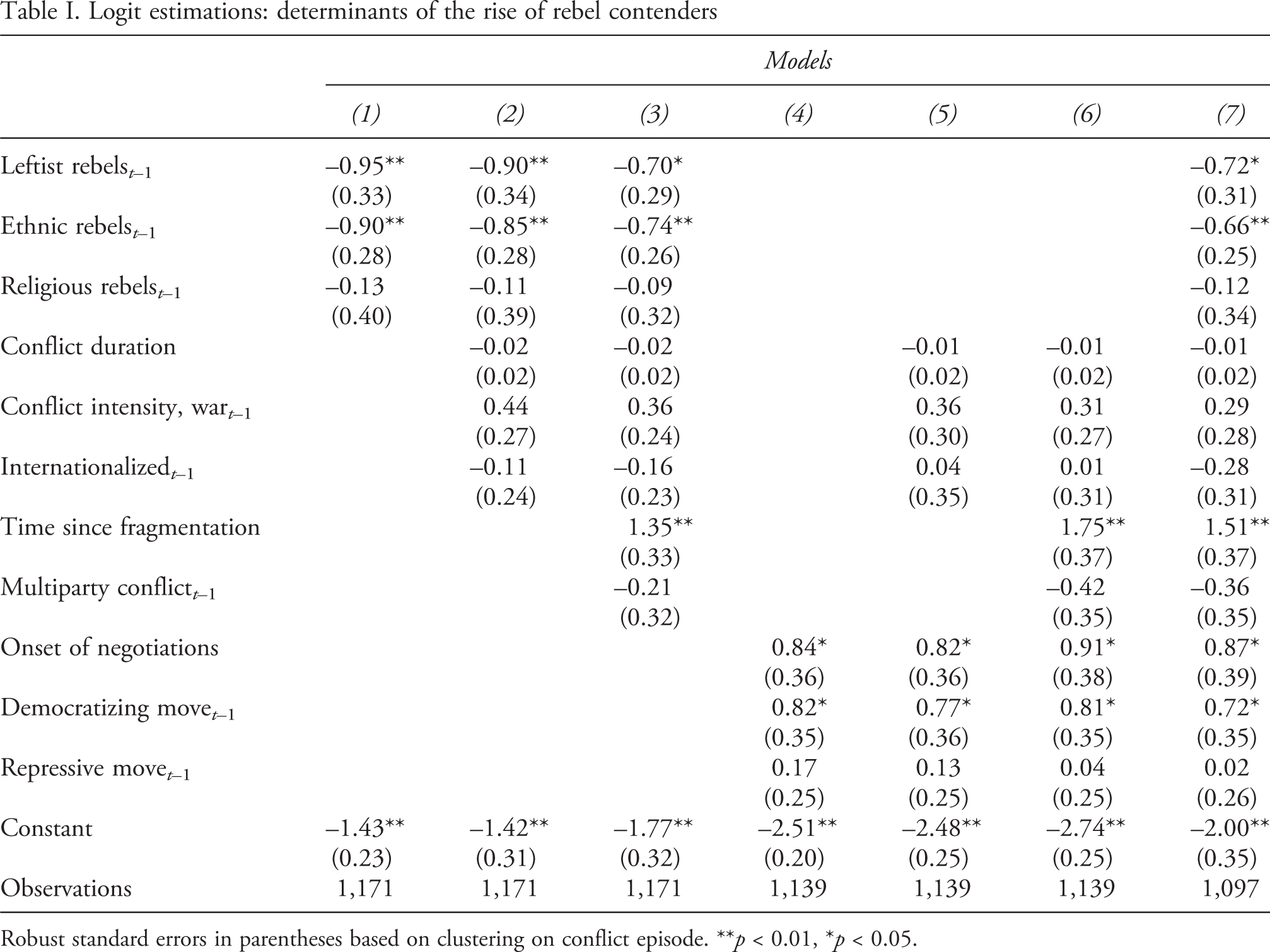
We begin by presenting some descriptive statistics on fragmentation of the rebel side in armed conflicts worldwide from 1975 to 2013. Out of 249 conflict episodes, we see the rise of a rebel contender in 65 of these. Many conflict episodes see fragmentation processes stretching over several years, with the same conflict episode repeatedly seeing the rise of new rebel contenders. Out of the 65 conflict episodes that see the rise of one or more rebel contenders, 36 conflict episodes experience one year with fragmentation, 17 conflict episodes experience fragmentation two times during the episode, whereas the remaining 12 conflict episodes see three or more instances. Descriptive statistics for our main variables are reported in the Online appendix, Table A-I. For our statistical analysis of the determinants of rebel movement fragmentation we rely on logistic regression models. Our results are presented in Table I. We explore our two clusters of independent variables – related to structural and strategic barriers to entry – in separate models, first on their own (Models 1 and 4) and then with a more extensive set of control variables (Models 2–3 and 5–6). Finally, we introduce all variables in the same model (Model 7).
Our first three hypotheses, relating to structural barriers to entry, are tested jointly in Models 1–3, and posit that the existence of strong ethnic, ideological, and religious ties prevent fragmentation by forging more cohesive movements and making it harder for nascent groups to become viable contenders. As reported in Model 1, conflicts in which existing groups have an ethnic base are less likely to experience fragmentation of the movement. In support of Hypothesis 1, the coefficient for Ethnic rebels is negative and significant at the 95% confidence level. We also see that conflicts where existing rebel organizations have a leftist base see a lower risk of fragmentation. The coefficient for Leftist rebels is negative and significant at the 95% confidence level. This supports Hypothesis 2, suggesting that rebel groups with a leftist ideology will forge cohesive cadres that make it difficult for rival groups to establish themselves.
We do not find a similar pattern for conflicts with groups with a strong religious base. The coefficient for Religious rebels is negative, as suggested by Hypothesis 3, but far from statistical significance. 13 This may suggest that there is a need to further separate between different types of religious movements, as organizations that have a more extreme religious ideology may be more closely knit than others (Cunningham et al., 2011). One open question is, for example, whether conflicts fought over Islamist aspirations are more likely to experience fragmentation than other religiously defined conflicts.
In Model 2 we introduce a range of control variables pertaining to conflict characteristics: conflict duration, conflict intensity, and the presence of foreign military support. The results reported above remain very similar. In Model 3 we also add controls for time since fragmentation and whether the conflict has several active rebel groups. The results for our main variables of interest are robust across all models.
Logit estimations: determinants of the rise of rebel contenders
Robust standard errors in parentheses based on clustering on conflict episode. **p < 0.01, *p < 0.05.
Turning to Hypothesis 6, we do not find any evidence that a swift increase in the level of repression increases the risk of fragmentation. The coefficient for Repressive move is positive across all our models, but never statistically significant. One reason why a spike in repression is not associated with fragmentation in our data could be that repressive shocks also simultaneously increase the costs of mobilization, by fostering organizational cohesion among incumbent groups and raising the cost of mobilization for nascent groups.
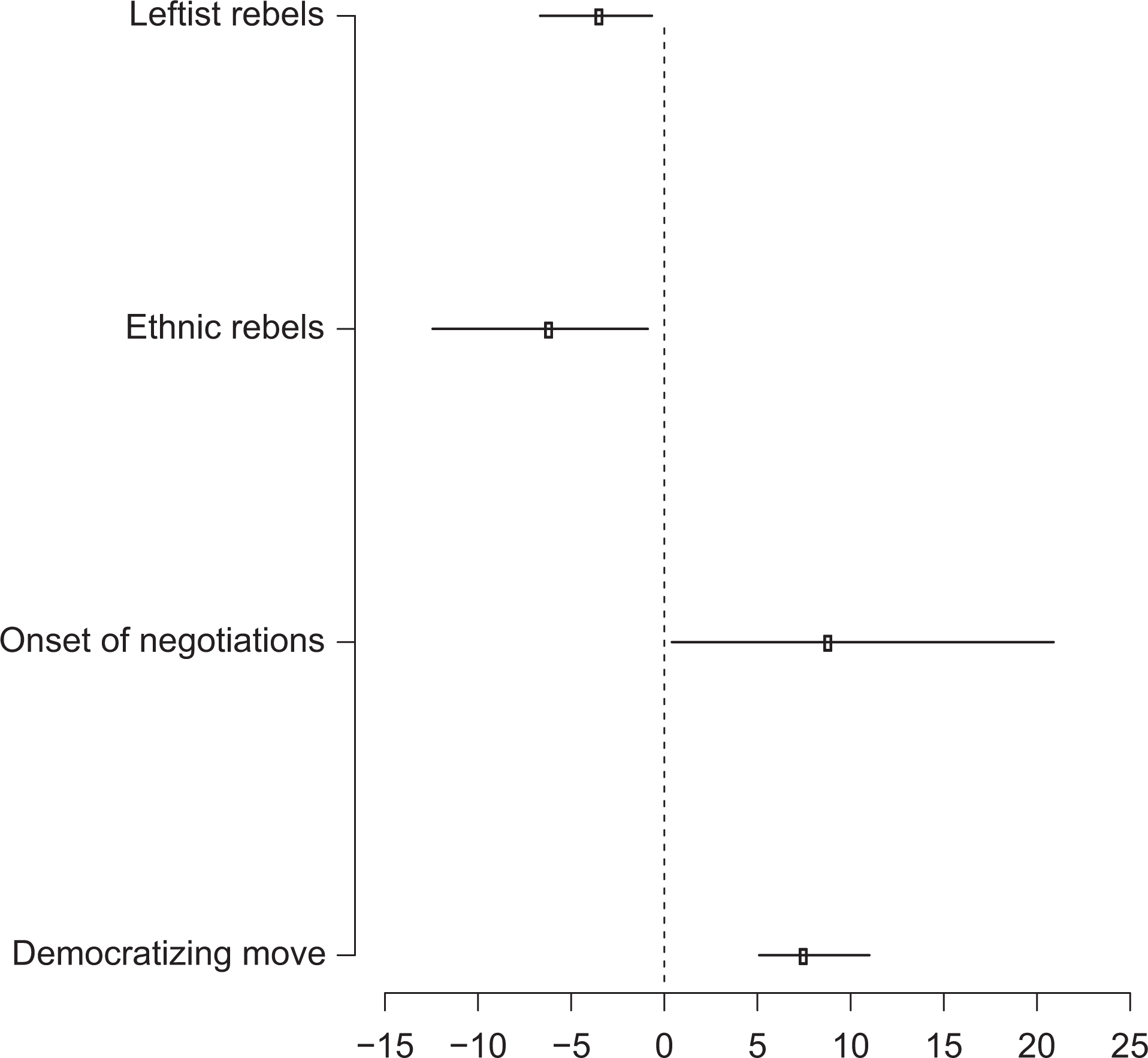
First differences, networks, policy change, and rebel movement fragmentation
Model 7 includes all independent variables and control variables in one model. The results remain consistent with those reported above. 14 Based on these estimates, substantive effects of statistically significant coefficients for our main variables are shown in Figure 1. 15 The white dots show the change in the predicted probability of fragmentation when moving from 0 to 1 on the variables of interest, whereas the lines show 95% confidence intervals. All calculated first differences are significant at the 95% confidence level. The strongest effect in substantive terms is for negotiations. Setting all dichotomous variables at the median observed value and the continuous variables at their means, the onset of negotiations increases the risk of fragmentation with 9.2 percentage points from a baseline risk of 7.8%. In other words, with the onset of negotiations the probability of a new rebel contender more than doubles. The impact of a swift democratization is also sizeable: for a country that experienced a change in the polity scale of 2 or more since the previous year, the risk of fragmentation increases with 7.2 percentage points from a baseline risk of 7.7%. Conflicts where the existing rebels are mobilizing on the basis of a leftist ideology see a 4.1% risk of fragmentation, which can be compared to a baseline risk of 7.9% when there is no leftist ideology. The effect of having an ethnic base is also substantial: with an ethnic base the annual predicted risk of fragmentation is 7.8%, compared to 14.2% in its absence.
As robustness checks of our results we have included a range of additional control variables. 16 To Model 7, Table I, we have included controls for Cold War; presence of natural resources (oil, drugs, and diamonds); GDP per capita (to proxy for state capacity); whether the conflict incompatibility relates to government power or territorial demands; whether incumbent groups are strong relative to the government; and mountainous terrain. We have also included the squared term of conflict duration and replaced the dummy variable for multiparty conflict with a count of the number of groups active in the movement the previous year. Overall, the results are consistent across these specifications. However, including a control for territorial incompatibility or GDP per capita renders the coefficient for Ethnic rebels non-significant. The coefficient for territorial conflict enters with a negative sign and is significant at the 95% confidence level. Yet, the salience of ethnicity for mobilization is most likely a cause, not a consequence, of how the incompatibility is voiced. As regards GDP per capita, the introduction of this measure reduces the sample by several hundred observations, and is not in itself a significant predictor of fragmentation. All other findings remain significant at the 90% confidence level. Furthermore, we carry out a range of additional robustness checks, which are described in the Online appendix, Table A-IV. We use an alternative measure of democratization that excludes the endogenous components of the Polity index; we control for absolute levels of democracy and repression; we employ a yearly measure of negotiations rather than onset of negotiations; and we use a combined measure of social ties. As a final robustness check we have re-run all models in Table I after excluding four conflicts where the level of actor fragmentation is so pervasive that UCDP is unable to distinguish the non-state armed actors and codes them jointly as ‘insurgents’ – Syria, India (Kashmir), India (Punjab), and Thailand (Patani) – and our main results remain the same.
To probe the different pathways to fragmentation we also run our analysis separating rebel contenders created by breakaway factions from existing rebel actors – splinters – and those that form without organizational ties to existing groups – joiners (see Online appendix, Table A-VII). Overall, coefficients are in the same direction for the two outcomes, but generally less precisely estimated. This is particularly true for splinters, possibly due to the limited number in our sample. As more data become available, future research should further explore different pathways to fragmentation.
Conclusions
Why do some armed opposition movements become fragmented, whereas others do not? This study proposes that the likelihood of additional rebel contenders entering an ongoing conflict will depend on the structural and strategic barriers to entry. More specifically, we argue that where incumbent groups are underpinned by strong social networks it will be more difficult to set up contending groups. Our finding that movements with an ethnic or ideological base have a lower risk of fragmentation is in line with this expectation. Moreover, strategic barriers to entry, we argue, will be shaped by government policies. We find that the onset of negotiations and more accommodative political institutions both invite fragmentation. Repression has no effect, possibly because repression could foster both collective action and organizational unity, but also could produce schisms and reveal divergent interests.
This study suggests important avenues for future research. We have conceptualized and analyzed fragmentation as one process, thus moving beyond the current focus on within-group splits. Yet our theoretical focus on shared challenges for rebel contenders – independent of organizational history – to overcome participation constraints and coordination costs also masks potentially important differences related to the different processes. While maintaining the broader empirical scope, future research should probe what shapes the diverging pathways along which contending groups form, that is, whether we see alliance formations, splinter factions, takeovers, or the establishment of completely new organizations (see e.g. Christia, 2012; Staniland, 2014). Furthermore, when probing the influence of social ties and government policies, we have controlled for potentially confounding variables relating to the conflict environment and rebel group characteristics. Yet, the technologies of rebellion are likely to exercise particular constraints on the opportunities to form viable rebel groups. Future research should examine these issues further. Finally, more attention to how groups form could lead to new insights into other outcomes, for example why some rebel groups endure for many years, whereas others are more short-lived (e.g. Perkoski, 2015), or whether some groups are more likely to be signatories to peace agreements.
This research comes with important policy implications. Civil wars that develop into multiparty conflicts often become more protracted. Our findings contribute to a better understanding of fractionalized armed conflicts for academics and policymakers alike. If fragmentation occurs where social ties are weak, this lack of unifying networks may reinforce the need for a peacemaking approach that accommodates diversity. If state accommodation increases the risk of fragmentation, then efforts to promote negotiated settlements and more democratic institutions should be cognizant of fragmentation risks when advocating such measures to end conflict.
Footnotes
Replication data

Acknowledgements
We are very grateful for feedback from participants at the Annual Meeting of the International Studies Association, Montreal, 16–21 March 2011; the European Network for Conflict Research (ENCoRe) Workshop, Barcelona, 1–2 October 2015, and the Annual Meeting of the Peace Science Society (International) Oxford, Mississippi, 13–14 November 2015. In particular, we thank Will Moore, David Cunningham, Erik Melander, Kristine Eck, and Daniel Finnbogason for excellent comments on previous versions of this article. We also extend our thanks to Isak Svensson, Erika Forsberg, and Niklas Karlén and the UCDP team. Equal authorship is implied.
Funding
We gratefully acknowledge support from Riksbankens Jubileumsfond (grant no. NHS 14-1701:1), the Swedish Research Council (grant nos 2015-01235; 421-2009-1833), and the Research Council of Norway (grant no. 250-441).
Notes
References
Supplementary Material
Please find the following supplemental material available below.
For Open Access articles published under a Creative Commons License, all supplemental material carries the same license as the article it is associated with.
For non-Open Access articles published, all supplemental material carries a non-exclusive license, and permission requests for re-use of supplemental material or any part of supplemental material shall be sent directly to the copyright owner as specified in the copyright notice associated with the article.
