




Abstract
Refugees and internally displaced people (IDPs) are not always safe where they resettle in ethnic civil wars, in which civilians’ identities overlap with the ethnic profile of armed combatants. This article argues that IDPs are also vulnerable in non-ethnic civil wars, through two related mechanisms that indicate civilians’ loyalties: (1) where the displaced are from and when they left; and (2) resettlement patterns. The first can suggest loyalties when the displacement is associated with territorial conquest and expulsion of suspected sympathizers. In turn, the displaced would be considered disloyal by the armed group responsible for the expulsion, and could be subject to further violence where they resettle. The second mechanism relates to the first: if displaced civilians are considered disloyal, then resettling with other, similarly stigmatized civilians can improve their security by reducing the household’s risk of discovery. However, clustering together with other IDPs can have a perverse effect: even though living in an enclave may reduce a particular household’s likelihood of suffering violence, the group itself is endangered because it is more easily detected. Armed groups can collectively target IDPs who resettle in clusters, either for strategic or retributive reasons. Implications of the argument are tested with detailed subnational panel data on IDP arrivals and massacres in Colombia, and the analyses provide support for the argument. The findings indicate that collective targeting of IDPs occurs even in civil wars without an ethnic cleavage, following voluntary resettlement patterns, and reinforces IDP security as a policy priority.
‘Safety?’ the wife of Pablo said. ‘There is no such thing as safety. There are so many seeking safety here now that they make a great danger.’ Ernest Hemingway, For Whom the Bell Tolls
Introduction
In 1997, as the civil war in Colombia was intensifying, 42 families sought refuge from violence in a home for the elderly near Medellín. Soon they received written threats from counterinsurgents that warned they would be killed unless they left the home within two weeks ( El Tiempo, 1997b). The ethnicity and religion of the internally displaced people (IDPs) did not exclusively overlap with one side or the other fighting the war, which could make them vulnerable to attacks, as in the wars in Bosnia and Iraq (e.g. Weidmann & Salehyan, 2013). Why would counterinsurgents threaten the IDPs who had resettled together, far from their homes?
This article explains why and how IDPs become endangered, even in civil wars that are not defined by an ethnic or sectarian cleavage. The timing of displacement, and where an IDP is from, can signal IDPs’ loyalties. This is possible because territorial conquest is typically accompanied by displacement, and those who are expelled are often assumed to have collaborated with the ‘losing’ side. As a result, IDPs looking for new places to live carry a stigma and are vulnerable to further violence. Armed groups could target them either for strategic purposes – for instance, to prevent their permanent settlement in an area the armed group was trying to control – or because of animosity and revenge.
Because IDPs know they are at risk of detection and possible violence, they have to choose carefully where to resettle. 1 When armed groups collectively target civilians, based on a group-level, shared characteristic, the best options for a household’s safety are to move towards others similarly targeted to avoid detection, or to an armed group’s stronghold for protection (Steele, 2009). However, while households might reduce the odds that they will suffer direct violence by ‘hiding’ among others like them, this strategy endangers the group because it provides a more visible target to armed groups. This dynamic is likely even in non-ethnic conflicts, because displacement itself can indicate loyalties, rather than an observable trait. Where such loyalties are perceived as threatening to armed groups contending for territorial control, or the object of animus, violence against group members becomes more likely. An implication of this argument is that rather than securing safety in new communities, greater numbers of IDPs should be associated with a higher probability of observing collective targeting, all things equal.
To test the implications of the argument, I exploit fine-grained spatial and temporal variation in civilian resettlement and violence in the Colombian civil war. I create a panel dataset of municipality-months and analyze the relationship between IDP arrivals in municipalities and the probability of subsequent violence. The results are consistent with the theory: the probability of violence increases in municipalities where IDPs seek refuge. Further, the probability of violence increases as the ratio of IDPs from the same municipality – an indicator of IDP clustering – increases.
The article makes three central contributions. First, it identifies new factors that contribute to variation in civilian victimization in civil wars: the timing and origin of displacement and resettlement patterns. These displacement circumstances and resettlement patterns endanger civilians by signaling their loyalties, even in the context of non-ethnic civil wars. The logic of the argument is general and should apply across civil wars: when civilians’ loyalties are suspect, because of the timing of their displacement, or their ethnicity or sect, they have incentives to resettle together. Armed groups, in turn, can more easily target clusters of resettled civilians with collective violence. Second, the article analyzes patterns of resettlement and ensuing violence with micro-level, quantitative data from within one civil war, extending the empirical evidence for IDP and refugee insecurity to a new conflict. Third, it raises an important policy issue: the vulnerability of IDPs not just to poverty, but also to security risks.
The article proceeds in four remaining parts. In the next section, I review the literature, and in the third section, I outline my theory to explain how resettlement can endanger IDPs even in non-ethnic civil wars. The subsequent section presents the empirics and analysis, as well as a discussion of results and caveats. The fifth section concludes.
The dangers of displacement in recent literature
Displacement – civilian migration that is provoked by an armed group or groups during a civil war – is often referred to as civilian ‘flight’ from violence. But scholars have shown that even when the displaced cross international borders they do not necessarily escape violence (Lischer, 2005; Muggah & Mogire, 2006; Onoma, 2013; Salehyan & Gleditsch, 2006; Savun & Gineste, 2016; Terry, 2002). A growing body of literature also links internal displacement to violence, primarily through IDPs’ participation in rebel groups (Bohnet, Cottier & Hug, 2016) or self-defense forces (Muana, 1997; Muggah, 2006), but also by association with negative externalities (Choi & Piazza, 2016). In Iraq, Lischer (2008) and Weidmann & Salehyan (2013) find instead that increased violence is the result of IDP victimization. Lischer warns that segregation could worsen sectarian victimization in the future, but Weidmann and Salehyan conclude that violence should decline after segregation has been established. Balcells, Daniels & Escribà-Folch (2016) find that in Northern Ireland, intergroup violence does not decline with segregation. The distinction seems to turn on the motivation underlying the violence: if it is strategic, it is likely to decline into a balance-of-power equilibrium; if it is driven by enmity, segregation should not lead to the decline of violence between the two groups, but should be ongoing.
In Iraq and Northern Ireland, the likelihood of ongoing victimization was linked to civilians’ identities, because being Sunni or Shia, Protestant or Catholic, connected individuals to the warring armed groups. But what happens in civil wars without an ethnic or sectarian cleavage? The relative safety of refugees in non-ethnic civil wars tends to be assumed, because the sources to identify the potentially disloyal are typically assumed to be ascriptive traits, rather than those that emerge from the war itself, or from political identities, which are harder to observe. Yet recent research suggests that such targeting is also possible in non-ethnic civil wars (Balcells, 2017; Balcells & Steele, 2016; Steele, 2011). In this article, I extend these insights to IDPs and argue that the timing and place of displacement can indicate civilians’ loyalties in ways that make them vulnerable to future violence. The next section builds on the literature and derives testable hypotheses.
Resettlement and collective targeting
I argue that the circumstances of displacement and resettlement can signal loyalties to armed groups and complicate the ability of the displaced to find safety, even in the absence of attributes like ethnicity or sect. The displaced could be vulnerable to violence because of vengeance or animosity, but also for strategic purposes, particularly in irregular civil wars.
In irregular civil wars, armed groups compete for territorial control, but not by attacking each other head-on (Kalyvas, 2005). Instead, weaker insurgents avoid confrontations with stronger state armed forces and its allies by blending in with civilians. In the quest for territorial control, armed groups try to identify their opponents’ civilian supporters and seek to expel or kill them. Fewer ‘disloyal’ civilians in a territory facilitates control, because the rival armed group will be deprived of material and intelligence assistance, and sympathetic civilians will feel safe enough to collaborate. However, loyalties cannot be observed directly, so armed groups rely on perceptions. Loyalties are signaled by membership in a group: ethnic groups and sects can be perceived as unreliable, but so can neighborhoods, unions, and political party supporters (Steele, 2009, 2017).
To eliminate the disloyal civilians from a territory, armed groups employ collective targeting. Collective targeting defines some civilians as legitimate objects of violence based on a group-level, shared characteristic (Gutiérrez Sanín & Wood, 2017; Steele, 2009; Wood, 2010). In other words, people in the targeted group are targeted because of their membership in the group. 2 Collectively targeted violence can include lethal and non-lethal forms, and they often coincide. For example, some members of the targeted group may be killed, at the same time that threats or orders to leave a community are issued to other members of the group. Armed groups use collective violence to expel disloyal civilians from a community (Steele, 2011, 2017).
Those civilians who leave face a new challenge: securing their safety.
3
Resettling alone is risky, because individuals living in new communities can be ‘discovered’, either based on the timing of their arrival and their region of origin, or based on their appearance or language. In turn, the resettled could be at risk of more violence. For example, the US Committee for Refugees noted that: Uprooted Burundians of one ethnic group are often regarded as dangerous by members of the other ethnic group. The military suspects that many internally displaced Hutu are rebels. Many Hutu suspect that camps of displaced Tutsis are bases for militia activity. (USCR, 1998: 54)
When civilians’ loyalties can be inferred, either through ascriptive characteristics or the circumstances of their displacement, then I expect that IDPs and refugees will cluster together, rather than risk being discovered on their own. 4 The cluster can either emerge autonomously with other civilians, or in a stronghold of an armed group. As group-level identifiers are more physically apparent, households outside clusters will face greater risk of detection and violence. However, both civilians with ascriptive traits that tie them to one side of a cleavage in the war, and those who have been displaced and are suspect as a result of their place of origin and timing of expulsion, have incentives to cluster together for safety. In the latter, enclaves and camps become associated with IDPs from certain regions. For instance, among the settlements that grew in the comunas around Medellín in the 1990s, some were associated with IDPs from the Chocó region, while others were known as areas where people from Eastern Antioquia arrived. Seeking protection by an armed group should also lead to patterns of clustering. In Burma, for instance, the Karen National Union (KNU) strongholds allowed ‘Karens displaced or disturbed by military action [to] relocate deeper into the mountains, that is, deeper into KNU territory’ (Cusano, 2001: 145).
Clustering and collective targeting
Clustering together in neighborhoods and communities can have a perverse effect: even though resettling with others might reduce any particular household’s probability of suffering violence, all else equal, the community may be more endangered (as Pilar feared in For Whom the Bell Tolls). Why would armed groups target IDPs collectively?
The literature on mass violence during civil wars identifies several mechanisms that potentially trigger collective violence. Because clusters of IDPs could be perceived as supporters of an armed group, a rival armed group might target them to punish its adversary (Fjelde & Hultman, 2014; Sánchez Torres & Salamanca Núñez, 2007; Sullivan, 2012). The IDPs might also be seen as supporters of insurgents, who could become victims of a state strategy to target them in order to defeat the insurgents (Valentino, Huth & Balch-Lindsay, 2004; Valentino, 2004). Collective targeting may be one way to deter civilians from collaborating with rival armed groups in the future (Downes, 2008; Ziemke, 2012), or to punish perceived defections in the past (Kalyvas, 1999). The bulk of recent literature on mass violence treats it as a strategic choice, but hatred, revenge, and fear may also play a role (Balcells, 2017; Bulutgil, 2015; Petersen, 2002; Suárez, 2007). Any combination of these mechanisms could be triggered by the arrival of a suspect group of civilians to a new locality.
The logic of IDP targeting illuminates observations from various wars about dangers civilians face even after leaving their communities. For example, Fellman (1989: 75) notes that ‘flight became a part of war rather than an escape from it’ in Missouri during the US Civil War. During the civil war in Guatemala, Stepputat (1999: 68) finds that the army pursued expelled populations. In Colombia, Francis Deng (1994: 66), the UN Rapporteur for Internal Displacement, noted in 1994 that ‘Often, fleeing does not result in an end to persecution.’ Specifically, the likely persecution is collective violence.
The timing of individuals’ displacement could indicate their loyalties in the civil war, and make them suspicious. As the group grows larger, the easier it will be to identify it. This leads to Hypothesis 1:
H1: The probability of collective violence increases as the number of internally displaced increases in a given community.
The corollary to the first is Hypothesis 2: in addition to the timing and scale of IDP arrivals, the place of origin may be an additional signal of loyalties that endangers the displaced. Further, the probability of violence should increase as the concentration of IDPs from a particular place increases, since it will be easier to detect them. Alternatively, many IDPs arriving from many different locations will attenuate their risk.
H2: As the proportion of IDPs to places of origin increases, the probability of collective violence increases.
Finally, I discussed above the possibility that IDP clusters could be targeted for strategic purposes, or because of revenge or animus. These motivations have different observable implications: if violence is predominantly strategic, then it is most likely to occur where armed groups calculate that it will have an impact on their chances for territorial control. If enmity or vengeance drives the violence, then its likelihood should not be linked to the size of the cluster. In contrast, very large enclaves are less likely to be effective targets of strategic collective violence, because it will be costly to apply enough violence to force settlers to leave again. This possibility would be consistent with a curvilinear effect: beyond some threshold, attacks against IDPs should be less likely if a strategic logic is at work. I test for this possible modification of H2 in the next section as well.
Empirics
The argument suggests that collective violence should be more likely where IDPs resettle together. To test the hypotheses, I use data on IDP resettlement and violence in Colombia. Colombia is an appropriate setting to test the theory, because it is an irregular, non-ethnic civil war with resettlement that is not directed by a large-scale program. All three characteristics are important. In irregular civil wars, the involvement of civilians in territorial competition between armed groups implies that where civilians resettle will be relevant for armed groups, so they may have strategic incentives to target IDPs. The main cleavage of the war is not related to any ascriptive trait, which makes it a ‘least likely’ case: evidence of collective targeting against IDPs in the context of Colombia would indicate that it is likely in other settings in which IDPs’ loyalties are more easily inferred. It would also be indirect evidence that displacement and clustering per se can endanger civilians. Additionally, unlike in conflicts such as Ukraine (Zhukov, 2014) and Guatemala (Sullivan, 2012), the Colombian state did not forcibly resettle IDPs (Muggah, 2000). Rather, IDPs chose destinations on their own, usually at the household level. The argument presented here does not depend on visible, established resettlement camps to invite violent attacks, but identifies how independent decisions about resettlement can lead to dangerous outcomes for the group. Finally, Colombia collects micro-level data on internally displaced people. Before introducing the data and the empirical strategy, I provide a brief overview of the Colombian civil war.
The Colombian civil war
Over the past 30 years, the civil war in Colombia has produced one of the highest levels of internal displacement in the world, reaching a peak in the early 2000s. Insurgent groups in Colombia formed in the 1960s, but widespread civilian displacement only started to increase in the late 1980s after the formation of ‘self-defense forces’. These groups formed in some regions in response to the insurgents’ increasing presence, narco-traffickers’ expanding land claims, and in the absence of an effective state response (Romero, 2003). Eventually they became counterinsurgent militias known in Colombia as paramilitaries.
Insurgents, especially the Revolutionary Armed Forces of Colombia (FARC), and paramilitaries expanded throughout the 1990s. The displacement of civilians coincided with this expansion and the increased violence that accompanied it.
5
The violence ebbed following a peak in 2001 and 2002, and soon after, Internal displacement in Colombia, 1998–2006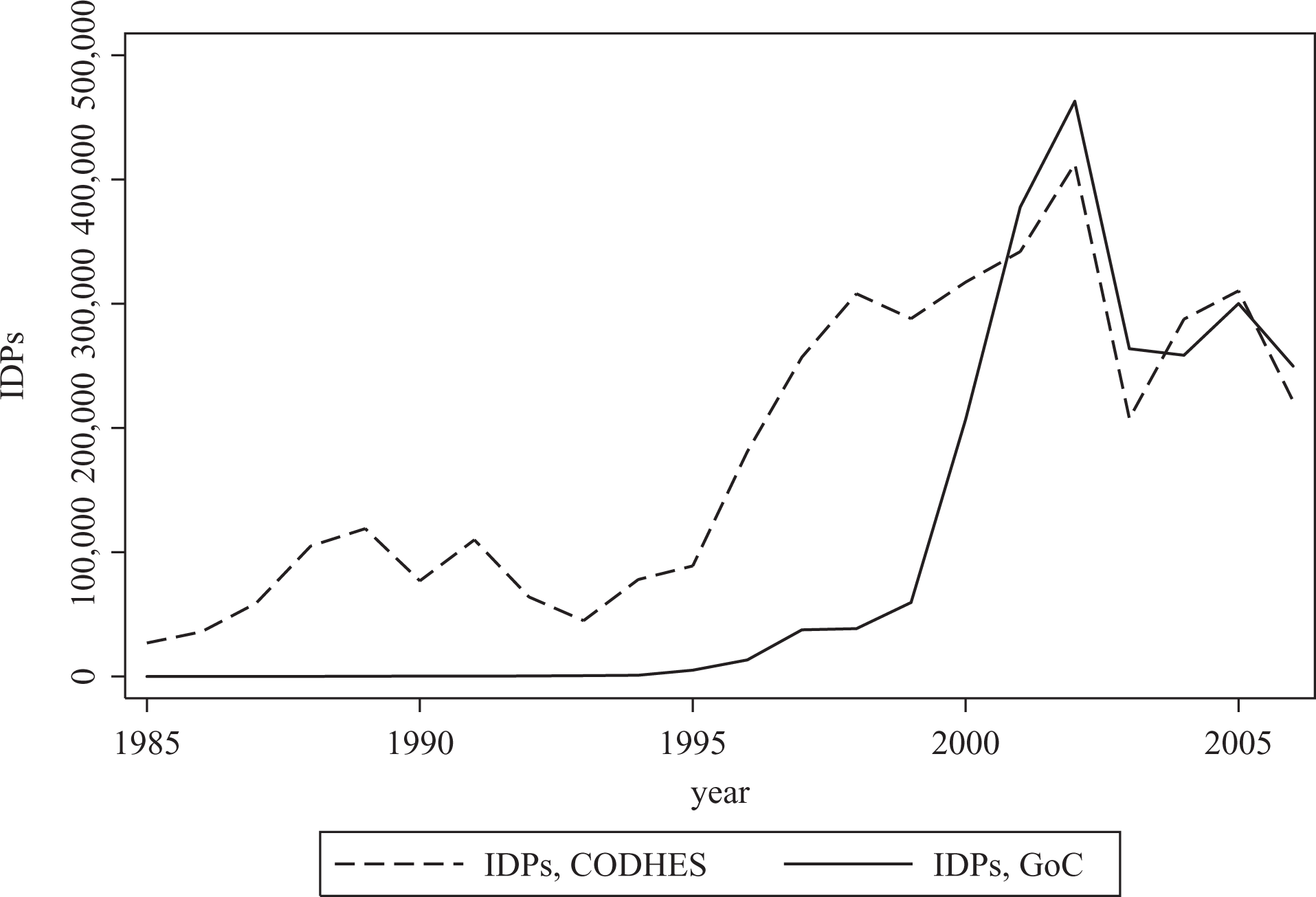
In all, roughly four million people, nearly 10% of the total population, were displaced between 1988 and 2006, when paramilitary demobilizations were officially completed, and the time period for which I have disaggregated data. Figure 1 shows the annual scale of displacement, as recorded by the Bogotá-based NGO CODHES and the Colombian government (GoC). 6
In Colombia, though the central government does not organize resettlement, it does respond to displacement. In 1997, the government began registering IDPs. Individuals approach a branch of the Department of Social Prosperity (DPS) to register in the Unique Registry of Victims (RUV). Officials in regional offices then review the application to assess whether or not the claim of displacement is credible. If the application is found to be reliable, then the household enters into the RUV and becomes eligible for humanitarian assistance. The RUV contains 2.9 million people between 1997 and 2007, which the agency acknowledges is incomplete.
Data
The data on displacement, resettlement, and violence in Colombia are among the richest available. I test the hypotheses using a panel dataset of resettlement and violence at the municipality-month level between 1998 and 2006. 7
Dependent variable
As a proxy for collective targeting, I use massacres. They are an appropriate indicator of the kind of violence I expect to observe if the argument is correct, because on average, collective targeting will victimize multiple people. The data on massacres come from the Human Rights Observatory (HRO) in the office of the Vice President. The HRO collected data from the Colombian security agency, the police, and human rights organizations. Massacres are supposed to enter the dataset when three or more people are killed in one day, in one location, and are recorded by the municipality and date. An alarming 1,339 massacres are recorded between 1998 and 2006. Still, the mean of massacre observations in a municipality in a given month is 0.011, with a standard deviation of 0.120. Massacres committed by all armed actors in the Colombian conflict are included in the dataset: the paramilitary umbrella group the United Self-Defense Forces of Colombia (AUC), the FARC, the National Liberation Army (ELN), or the military. Unfortunately, the data are not accurate enough to disaggregate by perpetrator: 66% are identified as ‘delinquency’ rather than a specific armed group.
The main dependent variable is Massacre dummy, which I created by first aggregating the data to the municipality-month level, and generating a count variable, Massacres. When Massacre is greater than zero – in other words, when at least one incident of mass violence in one municipality-month was recorded – I coded the Massacre dummy variable as 1. A dummy variable is appropriate because I expect a massacre to be more likely, but not necessarily increasing in frequency, as the number of IDPs increases. Further, this blunter measure increases the reliability of the indicator. Though event size bias makes massacres more likely to be captured accurately than other forms of lethal violence, missing data is still a concern (Price & Ball, 2014). By reducing precision, we are more likely to avoid errors associated with missing data. (The Online appendix includes alternative indicators and measures of collective targeting, including the Massacre variable, the massacre rate per 100,000 residents, and homicides. The results are consistent across measures.)
Independent variables
The main independent variable comes from the RUV dataset on internally displaced people within Colombia. IDPs is the aggregate registered IDP households by month and arrival municipality between 1998 and 2006. 8 For the analyses, I use IDP hh, t–1 (log), which is the number of IDP households arriving in a municipality-month, lagged one month and logged in order to account for over-dispersion. 9 As indicated in Online appendix Table A.1, the mean of arriving IDPs in one month is roughly 4.5 households, with a standard deviation of about 31.
To test H2, I create an indicator of IDP clusters from the same dataset. Clusters of IDPs from the same municipality should be more vulnerable to collective targeting. IDPs per origin measures the ratio of IDPs per place of origin for the arriving IDP population. This variable was created by summing all of the arriving IDPs per month, and dividing by the total number of recorded municipalities of origin for that month. In order to capture substantive effects, the variable is standardized. One standard deviation is 10, meaning ten additional people per place of origin. The expectation is that as the ratio of people arriving to places of origin increases, the probability of a massacre will also increase. In contrast, when IDPs arrive from many different places, it should dampen the risk of a massacre, because it will become more difficult to infer loyalties.
To try to disentangle the mechanism driving the violence, I include a squared term of IDPs per origin in some models. If collective violence against IDPs is primarily strategic, rather than retributive, we should see an indication of a curvilinear relationship between the cluster indicator and the probability of a massacre.
Controls
Control variables fall into three groups: violence, poverty, and geography. To control for past violence in a municipality that could be related to the probability of a massacre, I include Homicides, collected by the HRO. The measure includes any murder recorded by the police in the municipality, lagged one month. I also include the violent events attributed to paramilitaries and the FARC in that municipality, lagged one month.
Massacres might also depend on the historical presence of insurgent or counterinsurgent forces (Sánchez Torres & Salamanca Núñez, 2007; Sullivan, 2012). To indicate presence, FARC events, cumulative is the total number of violent events attributed to the FARC, starting in 1998, and Paramilitary events, cumulative is the total number of events attributed to the paramilitaries beginning in 1998. Both variables are lagged one month. The data come from the HRO.
Poverty and economic activity could be linked to the probability of a massacre, to the extent that less well-off municipalities suffer higher levels of violence. NBI is an indicator of poverty calculated with 1993 census data. It reflects the proportion of the population whose basic needs are unmet in a municipality, so the higher the value, the worse the poverty. The ICA is the commercial tax collected in the municipality (in 1,000s of pesos), and reflects economic activity. While the NBI indicator is constant, ICA varies annually.
A subset of the controls could influence both resettlement locations and the probability of massacres. Population is the municipal population in 1993, based on the census, and I use the natural log. More populous municipalities could have a higher probability of massacres, and may also be more attractive to IDPs for perceived security or access to benefits. Larger municipalities may similarly correlate with both massacres and resettlement, so I include Area, which is the size of the municipality measured in square kilometers. More remote municipalities may be attractive destinations for some IDPs, but also leave them more vulnerable to armed groups. I include three indicators of accessibility: Elevation, measured in kilometers above sea level, Distance, kilometers to the nearest departmental capital, and Roads, the total length of paved roads in 1995 in kilometers. These variables were all provided by CEDE, a development economics institute at the Universidad de los Andes in Bogotá. 10 The descriptive statistics are presented in Online appendix Table A.
Analysis
To test H1, that an increase in IDP arrivals is likely to increase the probability of collective targeting, I regress if a massacre occurred on the total IDPs who arrived in the municipality one month prior. I estimate several models, first accounting for temporal dependence and then addressing spatial dependence. The first models are time-series cross-sectional with a binary dependent variable (BTSCS). This can be problematic, and the best approach is contested (see Beck & Katz, 2001; Green, Kim & Yoon, 2001). I begin with the BTSCS approach advocated by Beck, Katz & Tucker (1998). Regular logit models are inappropriate because they assume independence across observations, and in many cases of binary outcomes, especially rare ones, such an assumption is violated. Severe inconsistency is the result of such a violation, as well as an inflation of the effects. Instead, Beck, Katz & Tucker (1998) argue that in the case of rare events (as with massacres), BTSCS models are equivalent to hazard models, and can be estimated as such to account for potential time dependence. Included in the Table I models is Timecount, the time passed since the last massacre in a municipality. In addition, I include the recommended splines.
An alternative strategy is to employ fixed effects, which exploits temporal variation within municipalities for inferential leverage. The advantage of this approach is that it reduces concerns of omitted variable bias due to unobserved heterogeneity across municipalities (Green, Kim & Yoon, 2001). The trade-off with this approach is substantial loss of variation. The analyses focus only on the subset of municipalities with a propensity for massacres, and test whether or not IDPs and IDPs per origin increase the probability of a massacre within that subset.
IDP arrivals and the probability of a massacre
Splines not reported; t statistics in parentheses. †p < 0.1, *p < 0.05, **p < 0.01, ***p < 0.001.
Results
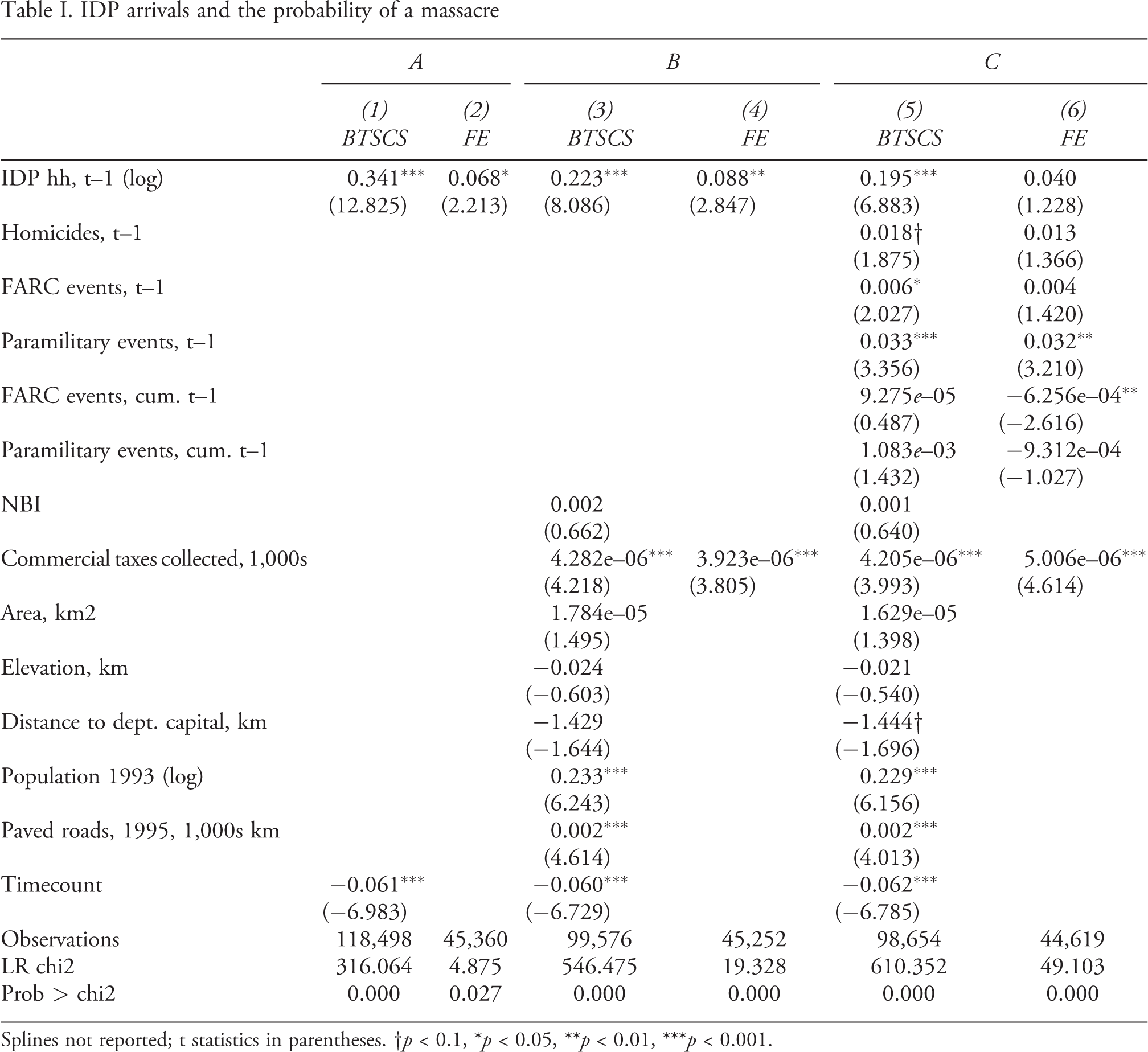
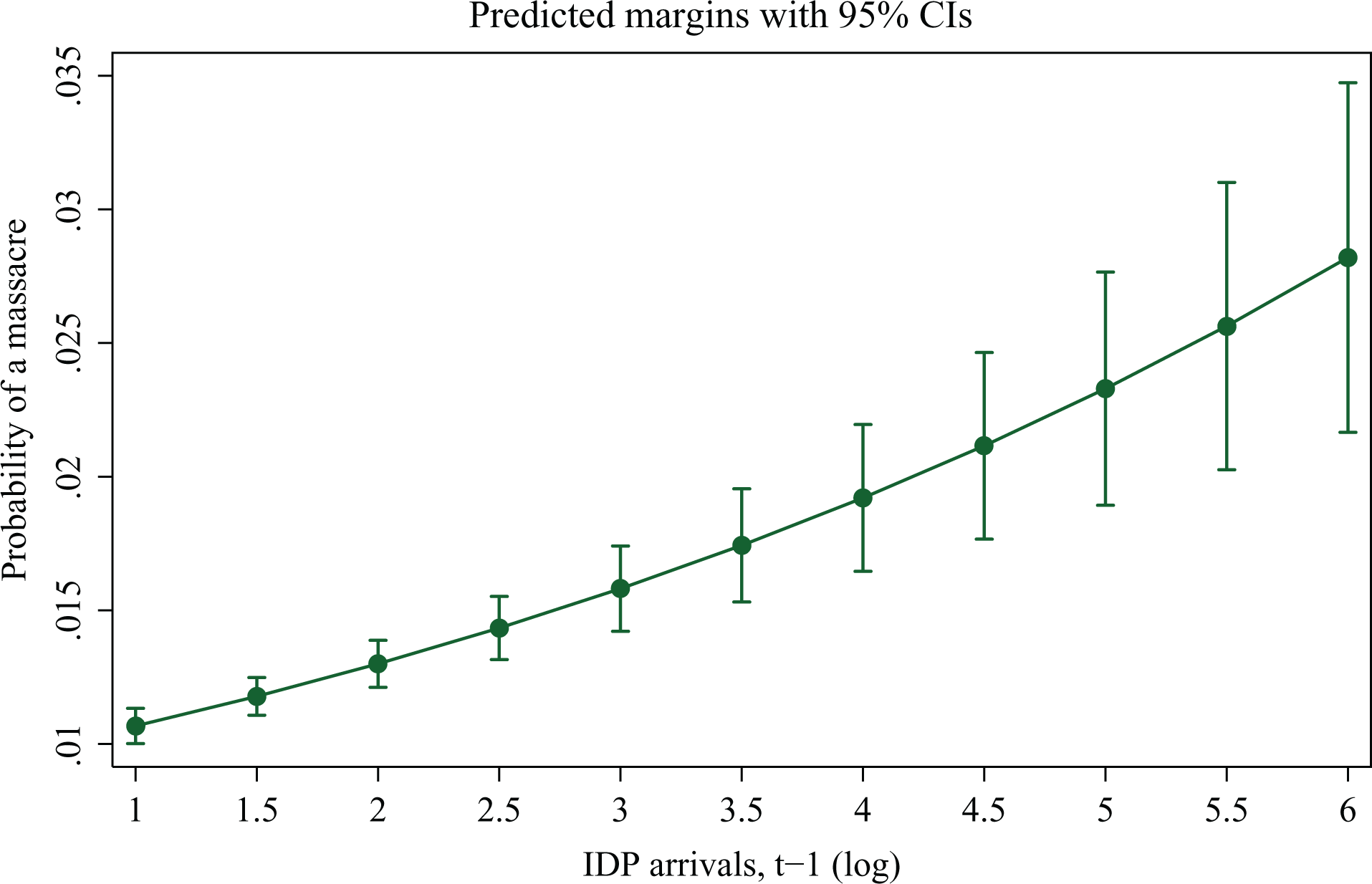
The results from the BTSCS and fixed effects (FE) models are presented in Table I. Group A is a simple bivariate test, and Group B includes geographic and poverty controls. Group C includes violence, geographic, and poverty controls. The key variable of interest – IDP arrivals one month prior – is statistically and substantively significant across most models. The full model BTSCS specification, Model 5, indicates that an approximately three-fold increase (the natural log base is approximately 2.72) in the number of displaced households arriving to the municipality the previous month is associated with an increase in the the probability of a massacre by 19.5%. Figure 2 plots the predicted probabilities for different values of IDP households based on Model 5. 14
IDP arrivals and the probability of a massacre
Model 6 presents the results from the full logit model with municipal fixed effects. The results show that the effect of IDP arrivals on the probability of a massacre is positive, but does not reach conventional levels of statistical significance. It is possible that the neighborhoods in which massacres occur are important, which is reflected in the spatial lag models below.
Violence, as indicated by Homicides, is positively associated with the probability of a massacre, but not statistically significant. FARC events and Paramilitary events also have a positive association, though the insurgents’ recent activities are sensitive to the specification, and recent paramilitary events have a stronger association with massacres. Cumulative FARC events reaches statistical significance in Model 6, but this is substantively negligible. Otherwise, the cumulative violence variables are not statistically significant.
Poverty as estimated by NBI does appear to have a slightly negative impact on the probability of a massacre, and greater economic activity is associated with a higher probability of a massacre, but it is substantively insignificant across models. More populous municipalities are likelier to have massacres than less populated ones, as are larger municipalities, though the substantive effect is close to zero. Accessibility, captured by Distance and Elevation, are not significant, and though Roads is, it is substantively unimportant. Finally, Timecount, the time since last massacre, is negative as expected: municipalities with long periods without massacres are less likely to experience a massacre. Splines 1 and 2 are statistically significant, but substantively negligible (they are not displayed in the tables).
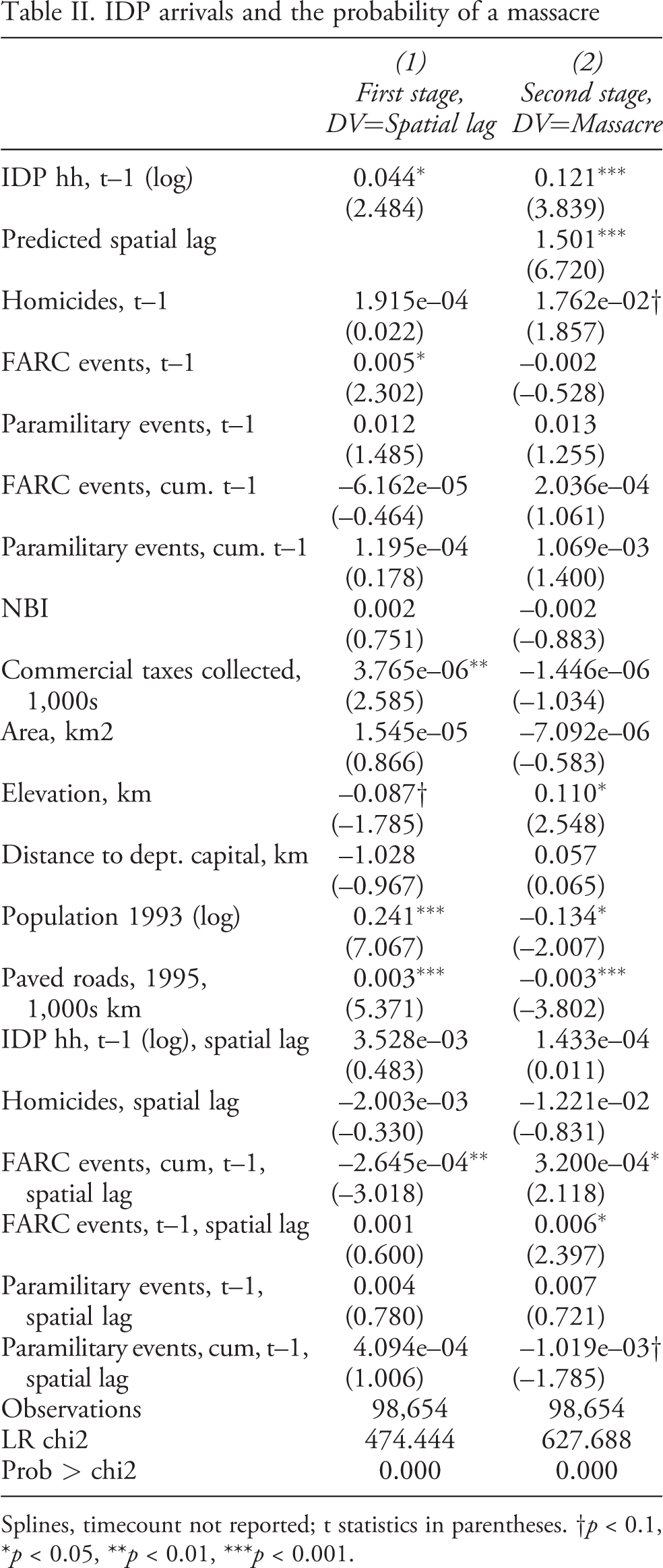
Table II displays the results of the spatial dependence models with BTSCS specifications. The results from the second-stage model are comparable to the models without the spatial lag. A 2.7-fold increase in IDP arrivals is associated with a 12% increase in the probability of a massacre.
Clusters of IDPs
To test H2 and the possible threshold, I repeat the analyses with IDP per origin and a squared term in Models 2 and 4; the results are presented in Table III. Odds ratios are presented to ease interpretation; values greater than 1 are positive, and less than 1 are negative. IDPs per origin is positive, and substantively and statistically significant. The magnitude of the odds ratio depends on the model specification. In the full BTSCS model (5), an increase of one standard deviation in the proportion of IDPs per origin (ten additional households per origin) is associated with an increase in the probability of a massacre of roughly 20%. The fixed effects model dampens this effect, but it remains quite large: the probability of a massacre increases by roughly 14.5% with each additional ten households per origin. The analyses also suggest that violence against IDPs in the Colombian context is more often strategic than retributive: as the group reaches a substantial size, the likelihood of an attack declines, as the squared term is negative and significant.
The coefficients on the control variables in Table III are largely similar to those in Table I. Violence is positively associated with the probability of a massacre, though the magnitude is smaller than the effect of IDPs per origin. Further, only Paramilitary events retains its significance in the fixed effects model, and is associated with a nearly 3% increase in the probability of a massacre. Cumulative violence is not statistically significant, save for past insurgent events, which reaches statistical but not substantive significance in the fixed effects model.
The geographic controls indicate that the size, location, and population are all positively associated with a higher probability of a massacre. Municipalities with larger populations are substantially more likely to experience a massacre. Accessibility, as indicated by Elevation and Distance, does not seem to have a relationship with massacres; though Roads is statistically significant, it is not substantively important. Poverty controls indicate that poverty appears to be unassociated with the probability of a massacre.
IDP arrivals and the probability of a massacre
Splines, timecount not reported; t statistics in parentheses. †p < 0.1, *p < 0.05, **p < 0.01, ***p < 0.001.
Discussion: Caveats and qualitative evidence
Though the results of the quantitative analyses are consistent with my argument, they depend on a key assumption: that massacres following IDP resettlement reflect collective targeting against IDPs. In the absence of more fine-grained, reliable data, I assess the plausibility that the analyses reflect the mechanisms of the theory by consulting press and NGO materials.
There is evidence of violence against IDPs in Colombia, particularly by paramilitary groups, and often because of their status as IDPs and their presumed loyalties. Roldán (2009) writes that in 2001, paramilitary leader Carlos Castaño dispatched members of the AUC to Medellín to ‘finish off guerrilla nests’ – they were searching for displaced families. In a 1998 report, Human Rights Watch (1998) cites an interview with a displaced person in the Medellín press: ‘It is very difficult to live in the city. […] On the one hand, there is the misery of poverty, and on the other hand the psychosis [of fear]. People from the [paramilitaries] threaten that they will come here and even things up once and for all’ (Human Rights Watch, 1998).
IDP arrivals per origin and the probability of a massacre
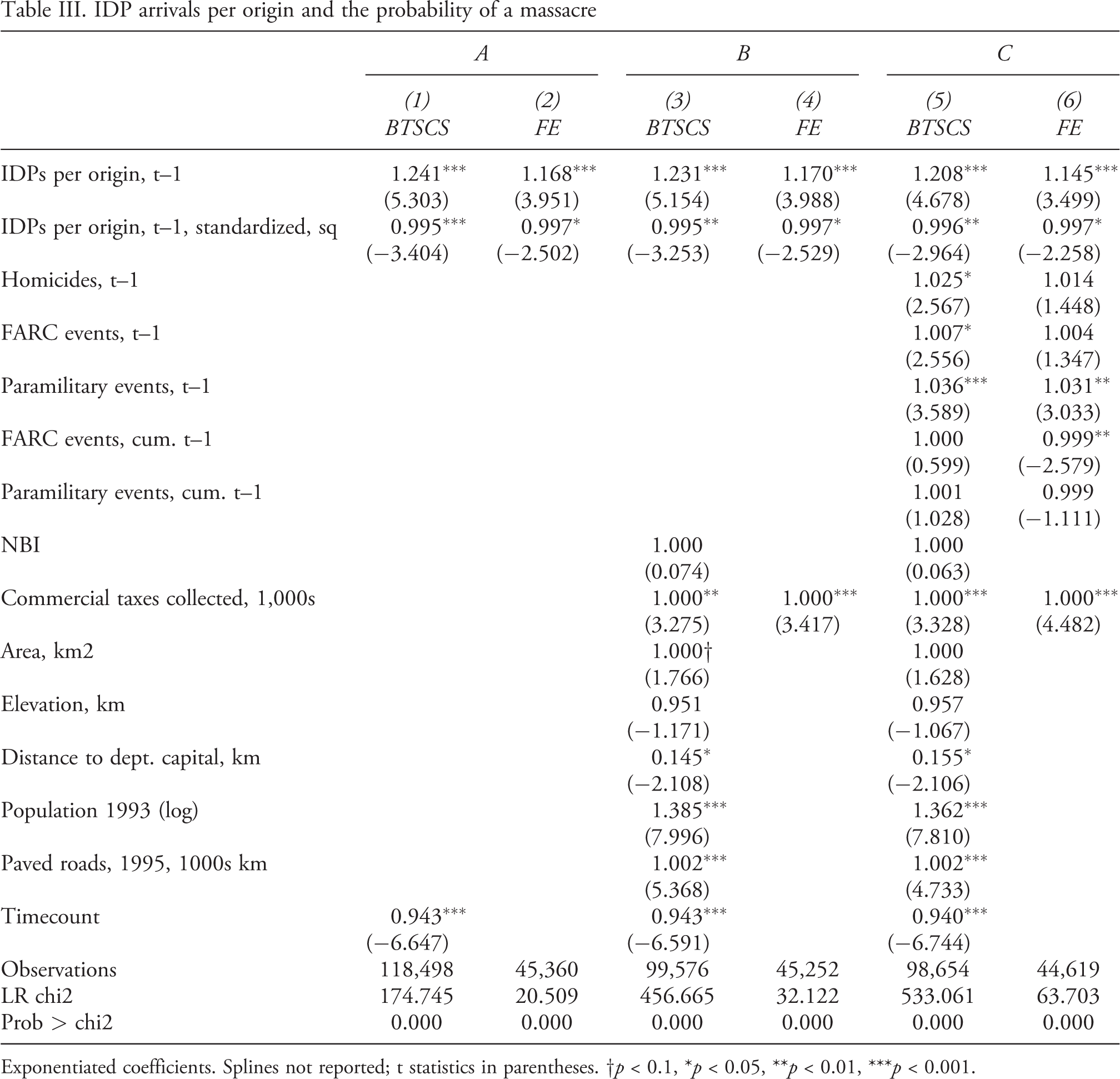
Exponentiated coefficients. Splines not reported; t statistics in parentheses. †p < 0.1, *p < 0.05, **p < 0.01, ***p < 0.001.
Further, though it is more difficult to document, there is some evidence that IDPs from the same place of origin were targeted, consistent with Hypothesis 2. In April 1997, El Tiempo reported that many of the 1,160 IDPs who arrived in Quibdó from Urabá had either fled elsewhere or had stopped going to receive aid from the Red Cross for ‘fear of the threats they had received from the paramilitaries’ ( El Tiempo, 1997a). In its 1998 report, Human Rights Watch (1998) notes, ‘A shelter for Middle Magdalena displaced families was the target of repeated attacks in 1996 and 1997, eventually forcing it to close. Associations of the displaced are under constant threat, particularly from paramilitary groups, who have gone to camps and other areas where there are displaced to threaten them.’ More generally, a UN-sponsored workshop on the status of IDPs in 1999 noted: ‘On numerous occasions, IDPs have been attacked by armed actors. Accused of supporting one armed group or another, IDPs have been tracked down either in collective settlements or in neighborhoods with a high concentration of displaced people’ (Brookings Institution, 1999).
IDP arrivals per origin and the probability of a massacre
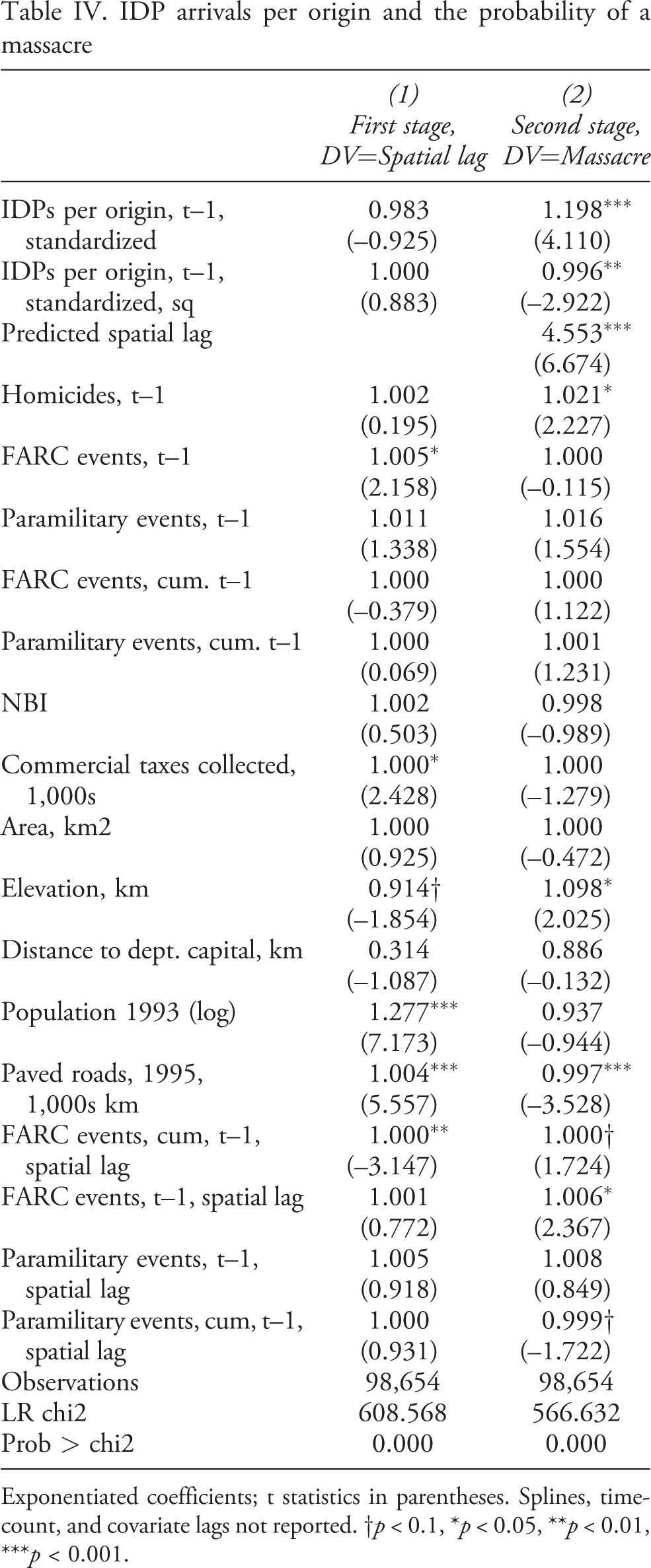
Exponentiated coefficients; t statistics in parentheses. Splines, timecount, and covariate lags not reported. †p < 0.1, *p < 0.05, **p < 0.01, ***p < 0.001.
These accounts lend support for the interpretation of the quantitative analyses: an increase in the arrival of IDPs to a municipality, and of IDPs from the same area, is associated with a higher likelihood of a massacre because the IDPs themselves are targets of collective violence. The examples also illustrate the point that as IDPs cluster together in new settlements, they attract the attention and violence of armed groups.
Conclusion
This article has provided a theory to account for why and how IDPs face collective violence, even in non-ethnic civil wars. I argue that armed groups are likely to target displaced civilians depending on where and when they left their homes, and how they resettle. When civilians’ origins – and by extension, their loyalties – can be detected, they are likely to resettle with others like them. While this strategy may reduce a household’s vulnerability to violence, it increases the group’s risk. I test implications of the argument and find that an increase in the arrival of displaced people also leads to an increase in the probability of collective targeting, indicated by massacres. For an average municipality, a nearly three-fold increase of IDP households leads to an estimated 20% increase in the probability of a massacre. The impact is also positive and significant when arriving IDPs cluster together, as indicated by the proportion of IDPs to municipalities of origin. As the ratio increases by another ten households per place of origin, the probability of a massacre increases by 14–20%. The findings contribute to the growing body of literature on refugee and IDP security and the spread of violence. Incorporating resettlement also improves our understanding of variation in mass violence, and reflects a more complete view of local-level dynamics within civil wars.
Future work could build on the findings here in three directions. First, the conditions under which an armed group would pursue civilians beyond the community of displacement should be specified. While IDPs clustering together could be an easy target, it does not mean that they will become one. One possibility is that local receptor communities prevent collective targeting of resettled IDPs. Second, as described in the Data section, the massacre data in these analyses are not disaggregated by actor. While the theory is agnostic about the type of armed actor more likely to perpetrate collective targeting, future refinements could develop extensions, perhaps depending on the form of warfare or stage in the war. However, to test more precise expectations along these lines, the data would have to be more reliable. Third, this work is consistent with IDPs being targeted for their presumed association with an armed group because the time frame between arrival and targeting tested here is relatively short. However, it does not rule out the possibility of another, longer-term dynamic: IDPs could join armed groups or actively work for them in the new location, as a reaction to targeting initially, a pattern with some empirical support elsewhere (Bohnet, Cottier & Hug, 2016; Muggah, 2006). Future work could further study this possibility and its relevance for IDP security.
The findings also have policy implications. Many IDPs do not escape violence by fleeing, at least initially. Rather, resettlement can trigger further violence and endangerment. Even though the risk of violence that IDPs face may be lower in their new communities than in their origin communities, it is still an important concern. As a result, IDPs need security as well as humanitarian assistance, similar to what others have argued for refugees (Lischer, 2005; Terry, 2002). The results also suggest that at least in some contexts, the larger the settlement of IDPs, the less danger of attacks. Though there are trade-offs to larger settlements of the displaced, it may enhance the safety of IDPs in contexts in which violence is motivated by strategic rather than retributive reasons.
Footnotes
Replication data

Acknowledgements
The author thanks participants at the University of Maryland Contentious Politics Workshop, and the Kobe University Advancement for the Study of International Relations Workshop, as well as Sho Akahoshi, Laia Balcells, Valentina Calderón, Mario Chacón, Sarah Daly, Stephen Engel, Julián Flórez, Matthew Johnson, Adria Lawrence, Spencer Piston, Ken Scheve, Livia Schubiger, Jake Shapiro, Ryan Sheely, Seiki Tanaka, Juan Vargas, Elisabeth Wood, three anonymous reviewers, and Editor Desirée Nilsson for valuable comments on previous versions. I thank Fabio Sánchez and Ana María Ibáñez for sharing data. Bin Peng, Jessica Di Salvatore, and Rafael Ch provided excellent research assistance.
Funding
The author acknowledges support from a Fulbright-Hays DDRA grant, a National Science Foundation graduate fellowship, and the Air Force Office of Scientific Research (AFOSR) award no. FA9550-09-1-0314. Any errors or omissions are my responsibility.
Notes
References
Supplementary Material
Please find the following supplemental material available below.
For Open Access articles published under a Creative Commons License, all supplemental material carries the same license as the article it is associated with.
For non-Open Access articles published, all supplemental material carries a non-exclusive license, and permission requests for re-use of supplemental material or any part of supplemental material shall be sent directly to the copyright owner as specified in the copyright notice associated with the article.
