




Abstract
As a fundamental concept in peace research, trust, or the lack of it, has shown to be associated with the onset of violent conflict, the instability of negotiated settlement, and the sustainability of peace. Despite its proven importance, the question of how political trust can be built after civil conflicts has only received limited attention and remains unanswered. While previous studies demonstrated that improved provision of public services plays a significant role in a trust-building process, the present article shows a more nuanced picture, namely that service enhancement only works if it reflects the needs of people. Projects that do not properly mirror the needs of people, however, have no direct effect on building political trust. Using micro-level data from Sierra Leone, the article finds that people are more likely to trust governments that are willing to listen and respond to their needs and demands. Though government performance carries the previously hypothesized effect, its explanatory power reduces substantively once responsiveness is introduced into the analysis. This finding also holds when potential biases due to endogeneity and sample selection are considered. Results from a mediation analysis also indicate that if government performance has any effect, it is transmitted through the responsiveness mechanism. Overall, this article contributes to the literature by clarifying the mechanism of trust-building in post-conflict societies.
Introduction
Many scholars have argued that in developed countries government performance is one of the major determinants of trust in government (Hetherington, 1998; Levi, Sacks & Tyler, 2009; Rothstein, 2009). They reasoned that satisfactory performance renders government legitimacy, which in turn enhances government’s trustworthiness. This relationship, however, may not hold in post-conflict states for two reasons. Firstly, for these countries high levels of political legitimacy, stability, and state capacity are usually out of their reach. Secondly, due to the war experiences, critical security situation, and economic hardship, people living in post-conflict countries are likely to have different preferences and priorities than those living in stable democracies. For these reasons, it remains to be seen to what extent the relationship between government performance and trust in the government can be generalized to post-conflict societies.
Existing studies in post-conflict states commonly found that exposure to violence is a strong determinant of social trust (e.g. Cassar, Grosjean & Whitt, 2013; Cuesta & Alda, 2012; De Luca & Verpoorten, 2011; Rohner, Thoenig & Zilibotti, 2013), yet there is only a handful of studies devoted to the topic of trust in government (Askvik, Jamil & Dhakal, 2010; Hutchison & Johnson, 2011; Sacks & Larizza, 2012; Stoyan et al., 2016). The latter set of studies found that satisfaction with government services is a strong predictor of trust in government, a finding consistent with studies in developed countries (e.g. Hetherington, 1998).
This article shows that demonstration of concern by governments is an important but overlooked factor that mediates the relationship between government performance and political trust. Trust development is an evolutionary process that involves constant evaluation and learning about the behaviors of the trustees. For this reason, responding to the needs and demands of local people is a necessary move to generate positive experiences that support attitude change. As trust is also an affective attitude (Jones, 1996) and positive emotions enhance trust (Kenworthy et al., 2015; Pettigrew, 1998), demonstration of concern plays a decisive role in a trust-building process as well. This mechanism is particularly relevant in post-conflict states, as trust building is a path-dependent process. People living in stable democracies usually already hold a certain, relatively stable belief towards government institutions. In contrast, people living in post-conflict societies might be more willing to revise their beliefs towards the new government. 1 This makes civil–government interaction a decisive factor moderating political trust in a post-conflict society.
Some authors have argued that preventing politicians from exploiting a trust relationship is the key to successful trust building (e.g. James, 2002). To achieve this, politicians bind their hands and devolve power to people by building up more inclusive institutions that allow citizens to participate in the policymaking process. This article also tests this hypothesis. Yet, I found only weak support for the argument. If institutions have any positive effect on trust, the effect is mediated by government responsiveness. In other words, the power of inclusive institutions hinges on their role as a platform to gather voices to show responsiveness rather than as a way to guard against potential exploitations. Activating the latter mechanism requires at least a moderate sense of empowerment which citizens in a new democracy may not be aware of and may not have the capability to actualize.
Extant studies do no more than show the presence of a relationship between level of political trust and various indicators of public services or government performance (e.g. Sacks & Larizza, 2012). Whether or not this relationship works through the channels they describe remains unclear and unproved. This form of causal ambiguity poses challenges for political scientists because the exact mechanism through which the variable exerts its effect remains unknown. For this reason, there is an increasing demand in the field of political science for research focusing more on causal mechanism (e.g. Bennet & Checkel, 2014; Gerring, 2008; Imai et al., 2011). In light of this development, the second part of my analysis tries to unpack the mechanism of trust building. To do so, I performed a mediation analysis investigating the mediated effects of the factor, demonstration of concern. My result shows that both government performance and institution have no direct effect on trust building once government responsiveness is introduced as a mediating factor. All in all, these findings imply that in post-conflict states, political trust is less likely to be built based on exchange or protection. In contrast, it is more likely to be determined by the level of care that a government demonstrates towards its citizens, the degree to which a government engages its people in the policymaking process, and how responsive a government is to the demands of its citizens.
This article contributes to the literature in two ways. First, I found that the role of public services in trust building has probably been misunderstood. While this is not to say that government performance is unimportant, my findings hint that the causal mechanism in post-conflict states can be quite different and needs further analysis. Second, most of the previous research has only relied on basic estimation methods such as OLS and multilevel analysis, which are incapable of addressing the empirical challenges of endogeneity and selection bias (e.g. see Askvik, Jamil & Dhakal, 2010; De Juan & Pierskalla, 2016; Hutchison & Johnson, 2011; Sacks & Larizza, 2012; Stoyan et al., 2016). This article engages these challenges by applying the instrumental variable method and Heckman’s selection model to deal with the potential endogeneity bias and the data attrition problem commonly encountered in studies using survey data.
In the following section, I will explain why the issue of political trust is crucial in a post-conflict environment and elaborate on different trust-building mechanisms.
Building political trust after civil war
Trust is a fundamental concept in the field of peace research. It is referred to as the foundation of social cooperation and positive peace (Galtung, 1969: 190). The concept is also embedded in the classical theories of war and conflict resolution. For example, in the negotiated settlement literature, based on the model of security dilemma, Walter (1997) showed that the possibility of opponents eventually exploiting trust forms a critical barrier to civil war settlement. Similarly, based on the bargaining model of war, Walter (1999) also theorized that because establishing trustworthiness and credibility is the key to solving the commitment problem, trust can be regarded as a precondition of peace. Furthermore, trust in government also determines the success of a peacebuilding process. Recently, De Juan & Pierskalla (2016) argued that a low level of political trust can undermine the implementation of peace agreements and reduce citizens’ compliance with law, which in turn increases the risk of conflict recurrence. The issue of political trust is crucial for financial reasons as well. Levi & Stoker (2000) pointed out that low trust in government can decrease tax compliance and hinder the progress of reconstruction. If a new government is unable to secure a stable stream of income to restore public services, people are more likely to withdraw their support for the government and restart a new phase of violence. For example, based on the case of post-apartheid South Africa, Fjeldstad (2004) showed that tax compliance mirrors people’s perception of the trustworthiness of their government. In short, because the capacity of a state to raise revenues determines security, development, and political stability of a country in the long run (Besley & Persson, 2010), any agenda of post-conflict state-building should give priority to the issue of political trust.
The importance of the issue begs the question of how political trust can be built after widespread political violence which has often destroyed the social fabric of a society. Multiple theories have been proposed. In the following I will discuss three channels that highlight different aspects of a trust-building process.
Exchange
According to the social exchange theory (Blau, 1964), trust building can be seen as a social exchange process, in which one side of the relation provides benefits to the other and to invoke reciprocation. A key difference between economic exchanges and social exchanges is that the latter may involve benefits without intrinsic economic values (Whitener et al., 2006).
This view is consistent with a popular empirical finding in the political science literature: the level of political trust is associated with the performance of a government (e.g. Hetherington, 1998; Levi, Sacks & Tyler, 2009). Following Hetherington (1998), these studies define political trust as an evaluative orientation and consider satisfaction with government services a factor contributing to legitimacy. When a government dutifully performs its functions, it is considered as legitimate. Therefore, it is argued, improvements in public services should induce citizens’ confidence in government (Hutchison & Johnson, 2011). Further to the argument, Sacks & Larizza (2012) highlighted the behavioral mechanism that underlies this exchange relationship. Focusing on public service quality, they posited that citizens tend to ‘reward relative improvements or sanction deteriorations in services’ (Sacks & Larizza, 2012: 5). In other words, a trust relationship is developed gradually when a government provides quality services to its citizens and gains legitimacy for governance. When it fails to meet its citizens’ expectations, they withdraw their trust and view the government as untrustworthy.
Hypothesis 1: People will be more likely to develop trust in government if they have benefited from improved public services or development projects.
Institutional protection
Trust also involves the risks of incurring losses because it can potentially be exploited (Hardin, 1996; Hoffman, 2002; James, 2002). Thus, trust depends on the trustworthiness of a trustee (Hardin, 1996; James, 2002; Lewis & Weigert, 1985: 970). Therefore, trust building and establishing trustworthiness are two sides of the same coin. This reasoning suggests that if a government wants to enhance its citizens’ trust in it, it needs to establish trustworthiness.
Social scientists often use the game of the prisoner’s dilemma to model trust, which is usually defined as the cooperative equilibrium of the game (e.g. Deutsch, 1960; James, 2002; McGillivray & Smith, 2000). Whereas a history of dishonesty triggers non-cooperation and punishment, a history of trustworthiness reinforces the credibility of the trustees. And it is this virtuous cycle that supports the strategy of trust and making trust self-enforcing in the long run.
Although cooperation is a more desirable outcome in the prisoner’s dilemma game, it is unsustainable in the short run. This implies that though gains from exchange exist, cooperation is never guaranteed. In this case, an institutional device is required to render the strategy of ‘no exploitation’ self-enforcing and the equilibrium of cooperation sustainable (James, 2002; McGillivray & Smith, 2000). One good example of such an institutional device is an inclusive decisionmaking institution that is able to protect people’s interests. By being given a chance to influence and to deliberate in the policy process, the public feels that their interests are more likely to be taken into account. If citizens have an opportunity to fight against proposals that might harm their interests, they are more likely to trust their government on the whole as they have a means to oversee development issues and limit government predation.
Hypothesis 2: Having a consensus-based decisionmaking institution is more likely to induce citizens’ trust.
Engagement
The above approaches emphasize that trust is based on interests. But as Jones (1996) argued, trust is also an affective attitude. Social psychologists have long argued that constant contact can reduce anxiety and prejudices (Pettigrew & Tropp, 2006). Consequently, having citizens engaged in the policymaking process not only enhances knowledge about the other party, it also reduces anxiety and increases empathy, thus generating a positive emotion towards the actors (Pettigrew & Tropp, 2008). As Kenworthy et al. (2015) showed, these positive emotions play an important role in a trust-building process. Consequently, governments can build trust by creating positive experience in their contacts with their citizens.
How can these positive experiences be generated? Governments can achieve this by engaging citizens through communications and showing their concerns. Engagement through communication can help people establish mutual expectation and shape preferences (Lynch, 2002). Experiments by Fehr & List (2004) showed that trustworthiness depends on whether or not power is employed. If the threat to punish is available but not used, trustworthiness is highest. On the other hand, if the threat to punish is used, trustworthiness is lowest. In other words, the diplomatic strategy of engagement has the advantage of minimizing the direct application of power and therefore inducing trust. Similarly, different authors have argued that demonstrating concern and sensitivity to the needs of other people leads others to perceive trustworthiness (McAllister, 1995; Ruokonen, 2013; Sacks & Larizza, 2012; Whitener et al., 2006). Accordingly, what a government could do to establish trustworthiness is to listen and respond to people’s needs and demands. By doing so, the government initiates a positive feedback loop that supports positive evaluation.
In contrast to the exchange view discussed before, this cognitive process is not contingent upon the realization of benefits (e.g. public services) and can be activated by gestures, such as respect and willingness to communicate. Such small gestures have the power to shape people’s perception about an actor and an organization (Greenberg, 1994). In this way, trust building can be understood as a perception management process instead of an exchange process.
A good example of this trust-building process can be found in Sierra Leone. To improve accountability and policy responsiveness, international donors such as the World Bank and the United Nations Development Programme (UNDP) proposed a decentralization reform to the Sierra Leone central government in 2004. In brief, the reform called for a change of political structure that can shorten the distance between the state and the local people and promote good governance. They reasoned that decentralization can create more space for the local authority and community to interact and provides more access points to politicians so that the authority can respond to the needs of people. The reform in the agriculture sector can serve as an example of the decentralization reform. As a part of the reform, the government introduced the Agricultural Business Unit (ABU) initiative. The objective of the initiative was to devolve more power related to planning and decisionmaking to the local people, by creating more community-based farmer groups to manage agricultural issues such as labor and land use at the grassroots level (Maconachie, 2008). According to Maconachie (2008), ABU farmers were given greater power to decide on issues that had been out of their control. For instance, because of the reform, they can now decide when to increase the size of land for cultivation, how much harvest to save for investment, and how much they should contribute to the local council. Farmers were also given more power to monitor activities of the local government. In contrast, the role of the central government was reduced to mainly providing training and initial capital such as loans and credit.
The experience of the ABU initiative offers a good example to illustrate the importance of engagement in the trust-building process. Maconachie (2008) found that the initiative did not reach the desired outcomes because there was a lack of meaningful engagement and contacts between farmers and local politicians. For instance, farmers often complained that local councilors were not interested in going to the field to learn about the local conditions. Local staff also felt that they were being excluded from the process as they were never asked to join meetings. This lack of meaningful engagement and communications induced grievances and skepticism towards the purposes of the initiative among farmers (Maconachie, 2008). The distrust even led some of the stakeholders to question whether or not there was a hidden agenda behind the program, ultimately leading to more exclusion. High levels of distrust were reported among all involved, including farmers, local staff, and the central government. And allegations of power abuse, misuse of funds, and corruption were frequently reported. Conceivably, if all parties had been more engaged in communications and more responsive to the needs of other people, a higher level of trust could have been cultivated.
Hypothesis 3: A local government that is more willing to listen and respond to the needs of people is more likely to be trusted.
Data
Most of the existing studies rely on data from developed regions (e.g. Levi, Sacks & Tyler, 2009; Kenworthy et al., 2015) or relatively peaceful societies (e.g. Hutchison and Johnson, 2011). However, traumatized by the experience of violence, people living in a post-conflict environment are likely to have different preferences and concerns than citizens living in stable democracies. For this reason, Sierra Leone, a developing country which experienced civil war, was chosen as a case in this analysis. Data were drawn from the 2007 and 2008 National Public Services (NPS) surveys conducted by the Evaluations Unit of the Institutional Reform and Capacity Building Project (IRCBP) administered by the Government of Sierra Leone and the World Bank. NPS is a nationally representative survey, with households randomly sampled from all 19 local councils of the country. In total 6,424 households participated in the survey.
Given the focus of this article on trust-building mechanisms, I only included respondents that participated in both waves of the survey, to allow for a comparison of responses across time. To ensure data quality, I excluded observations in which the interviewers considered that (1) the overall truthfulness of the responses is low; (2) the respondents had serious problems speaking or understanding them; and (3) the respondents were not willing to answer some of the questions because some people (e.g. government officials) were present during the interviews. In total, 2,422 observations satisfied these three criteria and were included in the analysis. The difference in number can be explained by several additional factors: district change, targeted respondents who were not at home or had moved out of the neighborhood, and missing responses to one or more questions. The missing data problem is common in analyses using survey data. To address this issue, I used the Heckman selection model to check against potential bias in my analysis (see the Method section below).
Given limited space, I will only discuss the dependent variable and the key independent variables below. The details of the control variables, including the descriptive statistics, original survey questions, and coding can be found in the Online appendix.
The coding of the dependent variable, Trust, is based on responses to the following question: ‘In your opinion, do you believe local councilors or do you have to be careful dealing with them?’ The dependent variable is a binary variable and is equal to 1 when a respondent stated that he or she had not trusted the local councilor in 2007 but did so in 2008. It should be noted that responses were recorded only when a respondent indicated that he or she knew about the local councils. To cope with this data issue, I generated a dummy variable, Aware, to differentiate this type of response. The dichotomization of the variable, however, treats other possibilities (e.g. consistent distrust and steady trust) as the same. I still rely on the logit model because it allows me to take care of other methodological issues (see the Models section below), which required modeling techniques not easily incorporated with a multinomial logit model. This at first may raise concern about the validity of the findings, but as I will show in the robustness check section, this assumption does not affect the findings in any major ways.
To test Hypothesis 1, I include a variable, Benefit, in the analysis. It is a binary variable and is equal to 1 when the respondent indicated that he or she had benefited from development projects that a local councilor had been doing in 2008 but not 2007. The coding is based on the following two questions: ‘Do you know of any projects the Local Council is doing or has done?’ and ‘Have you benefited from any of these projects?’ As a robustness check, I also produced a new set of indicators to measure if respondents perceived improvements in five different kinds of public services (education, healthcare, road, water, and market) as alternative measures of Benefit.
To test Hypothesis 2, I include a variable, Consensus, in the analysis. The variable denotes the percentage of respondents in the region who considered that the whole neighborhood had made the decision at a public meeting through consensus or voting. The coding is based on the question: ‘When there is a decision to be made in the community/neighborhood on an issue that affects you, such as deciding between building a new school or a road, how does this decision usually get made?’
The independent variable, Listen, indicates whether or not a respondent perceived that the local councilors had been attentive to his or her needs. This dummy variable is coded based on the responses to the question: ‘Do you think the Local Council listens to what people in this town/neighborhood say or what they need?’ The variable is equal to 1 when the respondent stated that he or she did think so in 2008 but not 2007. If active listening has anything to do with trust building, as Hypothesis 3 suggests, people who perceived politicians differently over time should be more likely to change their attitudes towards the politicians. The reverse, however, can also be true. For this reason, I used a simultaneous probit model to account for potential bias.
Other than the dependent and independent variables introduced above, I also included a set of socio-economic variables as controls. Youths, migrants, and women are three underprivileged groups in Sierra Leone (Fanthorpe, 2005; Labonte, 2012). For this reason, the war experience may lead them to have greater difficulties in developing trust towards political authority. The same also holds true for those that were exposed to violence during the war period (De Juan & Pierskalla, 2016). Moreover, social capital and community relations are found to be correlated with political trust as they tend to reinforce citizens’ experiences with their governments (Nannestad, 2008; Putnam, 1993; Rothstein, 2000). To control for the effects of social capital and community relations, I also include the variables Member (the number of social groups that the household joined) and Community (perception of how easy it is for people in the community to work together) in my analysis.
Models
In addition to the logit model, I also utilized a multilevel logistic regression, a probit model with sample selection, and a simultaneous probit model to accommodate various empirical issues in my analysis. I will explain each of them below.
The multilevel logistic regression model was used due to the hierarchical structure of the data. As individuals are influenced by similar contextual factors, observations in the same unit are not completely independent. If the dependence is strong, the usual logit model will give smaller standard errors and misleading results (Steenbergen & Jones, 2002). The multilevel model becomes a better choice because it is able to correct for the dependence. Essentially, I estimated the following two-level model:


The model is similar to the usual logit model, with the difference that the constant term now contains a random component uj , which may vary across cluster j in which individual i resided. The random component has mean 0 and its variance will be estimated explicitly. 2
The regular logit model may incur a selection bias since only respondents that were repeatedly interviewed would enter my analysis. As people who trusted the local government less might have a higher likelihood of migrating and might therefore not be interviewed for the second time, this will inflate the size of the estimates obtained from models that do not take this selection effect into consideration. I used the probit model (with sample selection) proposed by Van de Ven & Van Pragg (1981) to tackle this problem. The model regresses attitude change and migration decision at the same time and assumes that the error terms in the equations are correlated. Consequently, joint estimation enables me to correct for the bias associated with the selection effect. The additional variables that I used to model migration decisions include a set of socio-economic variables found to be associated with the decision to migrate: education level, age, economic well-being, and whether or not the person has a history of migration (e.g. see Strauss & Thomas, 1995).
The single equation model discussed thus far may suffer from simultaneity bias if trust attitude reversely affects perception on responsiveness. To account for the potential bias, I applied the two-step estimator by Rivers & Vuong (1988) to estimate the simultaneous probit equations. The instruments that I used in the first-stage are two variables: Listenj (the proportion of respondents in cluster j that considered local councilors responsive) and Visit (whether or not a local politician had visited the community between the two sampling periods). The use of the community-average as an instrument is based on the idea that social capital usually affects an individual’s perception through socialization (Putnam, 1993). This community-level variable is exogenous to individuals because a random person is usually not powerful enough to influence the perception of the leaders at the community level (Cuesta & Alda, 2012). I also included the variable Visit as a part of my over-identification strategy. The variable may correlate with trust attitude because it affects the variable Trust through the endogenous variable. For this reason, the variable can still be qualified as an instrument (Cameron & Trivedi, 2005). However, one should note that given the non-experimental nature of the study, this modeling exercise should be read as an attempt to provide identification. The finding based on this model is better treated as a robustness check than as conclusive evidence.
Key findings
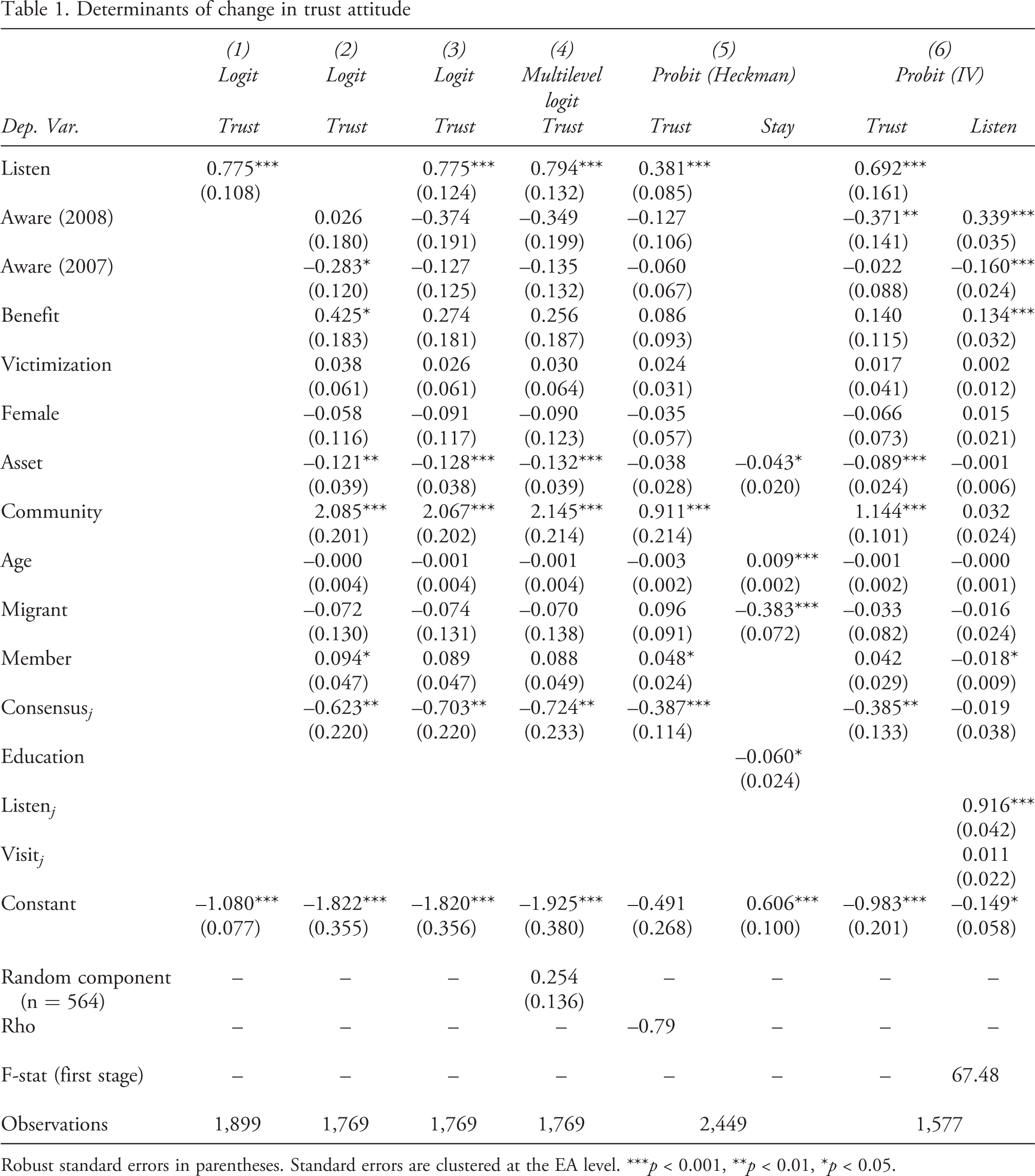
Estimation results are summarized in Table I. Results based on Models 1, 2, and 3 demonstrate that people who perceive that a politician is more attentive to their needs and demands are more likely to change their attitudes from mistrusting to trusting, consistent with Hypothesis 3. In other words, being responsive has a strong and significant effect on trust building. As Figure 1 shows, respondents that had less than two items in their households (i.e. over 75% of all households) are about 20% (in probability) more likely to start trusting their local councilors if they think that the councilors listen to their needs. When compared with Model 3, the model with the multilevel specification (Model 4) gives similar results.
In contrast, in Model 2, though Benefit is a strong determinant of positive attitude change, its effect is short of statistical significance once the variable Listen is added to the model (Model 3). The substantive effect of project benefits also becomes much smaller. It drops from a 53% increase (Model 2) to a 31% increase (Model 3), both in terms of odds ratio.
This finding is different from what has been reported in studies that do not control for the effect of responsiveness or engagement. The difference can potentially be explained by the civil war history of the country, a background factor which is absent from previous studies (e.g. Hetherington, 1998), which propose that improved public services can create political trust by enhancing political legitimacy. While we might expect political legitimacy to be enhanced in this way in relatively peaceful societies, this mechanism is unlikely to work in societies with a recent violence history as victimization tends to undermine political trust (De Juan & Pierskalla, 2016). Another possible explanation for the difference in findings is that while the existing studies model the level of political trust (e.g. Askvik, Jamil & Dhaka, 2010; Hutchison & Johnson, 2011; Sacks & Larizza, 2012; Stoyan et al., 2016), I model the change in the level of political trust. The nuances between the two appear to be trivial but are empirically distinct because they are determined by different processes. It should be noted that the transformation between level and change is often only assumed and not automatic. For example, the well-established negative relationship between income (level) and civil war does not mean that recessions will trigger civil wars spontaneously. As another example, the positive relationship between income and democracy does not imply that economic growth will prompt democratization. Quite the opposite, it is recession, not growth, that usually triggers democratization (Haggard & Kaufman, 1995).
Estimates based on Models 1 to 4 suggest that people living in areas with a consensus-based decisionmaking system are less likely to change their evaluations of the government positively, contrasting to Hypothesis 2. This pattern appears to be surprising but can potentially be explained by the social capital argument of Putnam (1993), which states that civil experience is a strong determinant of political trust. Studies have shown that people who are better connected with their neighbors tend to trust their governments more (Nannestad, 2008). In Sierra Leone, political patronage is a defining feature of local politics (Jackson, 2007). This political structure often induces favoritism and political fragmentation, making consensus sometimes a disguised form of violence, creating tension in the community rather than reducing it (Ferme, 1998). Because this structural feature can lead to negative civil experience that spoils political trust, it may explain why a consensus-based decisionmaking system could be related to a negative change in trust attitude.
Estimates from Models 1 to 4 may suffer from the sample selection problem because only respondents that were repeatedly interviewed would enter the analysis. As people who trust the local government less may have higher chances of moving away, dropping these observations is likely to inflate the size of the estimates obtained from models that do not take this selection effect into account. I applied the selection model to re-estimate the effect of perceived responsiveness on positive change in trust attitude. The result confirms that there is a selection bias. Nevertheless, the estimate corresponding to the coefficient of the variable Listen remains statistically significant at the 0.1% level. The odds ratio obtained from the selection model is equal to a 46% increase, which is still sizable.
Determinants of change in trust attitude
Robust standard errors in parentheses. Standard errors are clustered at the EA level. ***p < 0.001, **p < 0.01, *p < 0.05.
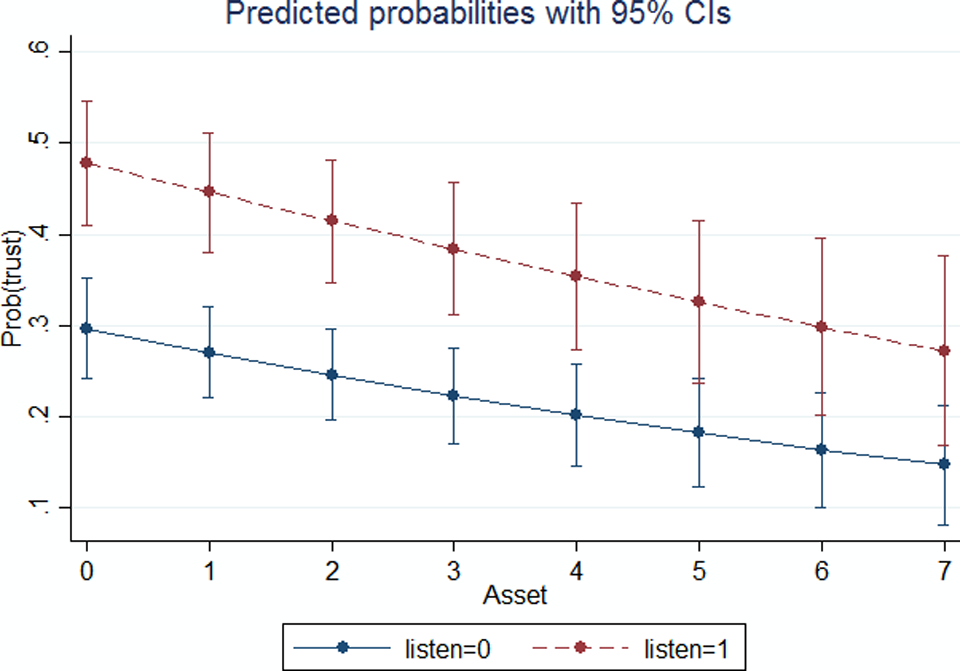
Marginal effect of the variable Listen
All in all, findings based on different models provide strong support for Hypothesis 3, which states that government responsiveness is a strong determinant of trust building. On the other hand, I only found weak supportive evidence for Hypothesis 1 and no supportive evidence for Hypothesis 2 as the estimated coefficient corresponding to the variable Benefit is statistically insignificant and the coefficient corresponding to the variable Consensus has an opposite sign.
Robustness checks
+ Base outcome: Trust (2007) = 0 and Trust (2008) = 0. Dependent variable is equal to 1 when Trust (2007) = 0 and Trust (2008) = 1. # Base outcome: Trust (2007) = 1 and Trust (2008) = 1. Dependent variable is equal to 1 when Trust (2007) = 1 and Trust (2008) = 0. See the Online appendix for the remaining estimation results. Robust standard errors in parentheses. Standard errors are clustered at the EA level. ***p < 0.001, **p < 0.01, *p < 0.05.
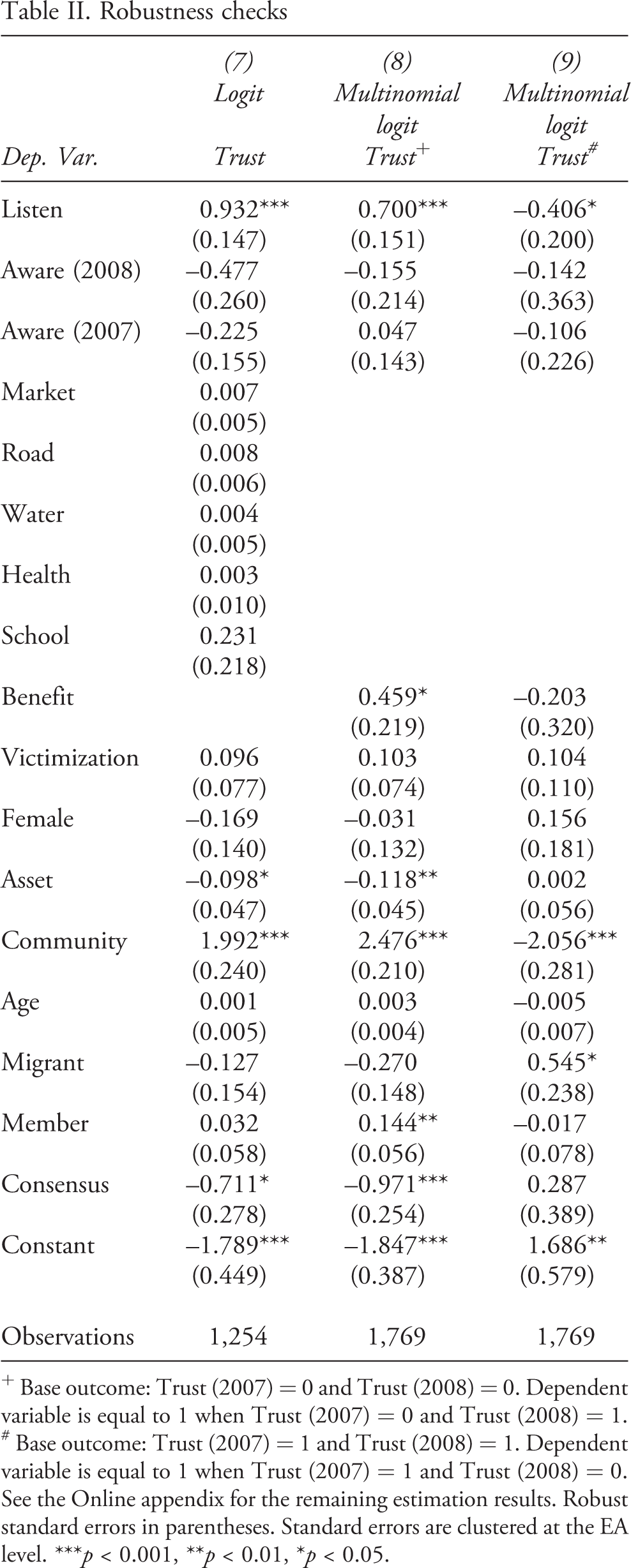
To employ the selection model and the IV model, in my previous analysis, I mainly relied on the logit model. Given that the dependent variable in the logit model is binary in nature, I had to treat people who did not change their trust attitudes and those who adjusted their trust attitudes downward as the same. This treatment may affect the validity of the previous findings. To investigate whether or not the treatment may bias towards the previous results, I distinguished the differences in responses and re-estimated the model with specification similar to Model 3. Model 8 essentially compares the people who changed from mistrusting to trusting with those who remained mistrusting (i.e. the baseline). The estimated coefficient of the Listen variable remains highly significant. Making yet another comparison, Model 9 compares the people who changed from trusting to mistrusting with those who remained trusting. Estimation results further reveal that the relationship between attitude change and active listening is symmetric: people would mistrust local politicians who did not listen to their needs.
Sacks & Larizza (2012) found that the quality of government services is a major contributing factor to political trust. Though my results do not provide any empirical support for the effects of public services, the non-finding may be explained by the use of different indicators. As a robustness check of my previous analysis, I used the satisfaction measures suggested by them (i.e. satisfaction with education and healthcare services). Although none of the satisfaction indicators is found to be statistically significant, the estimated coefficient of the Listen variable remains highly significant. 4
Corruption can be considered as an exploitation of the trust relationship between government and citizens (James, 2002). For this reason, as a further check, I used corruption perception as an alternative indicator of trustworthiness. Consistent with the previous findings, the estimate obtained from the new model indicates that responsiveness is an important factor explaining revision in trust attitude.
I also included some further controls that do not enter previous stages of my analysis due to a large amount of missing data or their less immediate relationship with trust building. Nevertheless, these additions do not refute the previous findings.
Finally, one may think that people from the same ethnic background might be more willing to trust one another. 5 Unfortunately, because information pertaining to the ethnic identity of the local councilors is not available, I am unable to control for the effect directly in the regression analysis. 6 In spite of that, as I will show below, the data I used in this study suggest that this kind of ethnicity effect is irrelevant in my case.
One implication of this ethnicity hypothesis is that co-ethnics tend to respond similarly. For instance, if respondent A is more likely to become trusting towards a politician because of their shared ethnic background, respondent B, from the same ethnic group, should also be more likely to do so if the hypothesis is true. The same pattern is expected to hold should respondent A become mistrusting. In short, an implication of the hypothesis is that respondents that share the same ethnic background should behave similarly, regardless of the directions of the changes.
To test whether or not co-ethnics tend to respond similarly, I employed a random sampling technique by selecting the first two individuals showing up in the sample list for all units contained in the surveys (i.e. systematic sampling). Then I used the z-test to check whether or not the pairs that share the same ethnic background are more likely to give similar responses. The null hypothesis is that the proportion of pairs that share the same ethnic identity and give the same trust evaluation is equal to the proportion of pairs that do not. The corresponding p-values of the two-tailed tests are 0.84 (year 2007) and 0.64 (year 2008), implying that shared ethnic background does not have any statistical power in predicting whether or not a pair would give similar responses. Given the absence of regularity, co-ethnics are not more likely than non-co-ethnics in revising their trust evaluations.
Exploring the trust-building mechanism
Results thus far reveal that the Benefit variable has no direct effect on the change in trust evaluation. But it is important to note that one factor can affect trust attitude through multiple mechanisms. For example, a person may interpret the undertaking of a project as demonstration of concern. In this case, whether or not the project will reap appreciable benefits is only a secondary concern. In contrast, the performance account usually implies that trust is conditional on having noticeable improvements. In that case, trust is based on exchange and the concern part may or may not be relevant. The question then becomes to what extent being responsive to the needs of people is the key mediating factor in the whole trust-building process. Is appreciable performance necessary for the purpose of signaling concern and responsiveness?
To better assess the role of responsiveness in trust building, I estimated the structural equation model specified in Figure 2. The model allows the institution variable to influence trust building directly (i.e. the protection explanation) or indirectly via the variable Listen. It also allows development projects to affect trust attitude directly (i.e. performance is necessary) or indirectly, again, via the variable Listen.
The model contains a system of three equations with Trust, Listen, and Benefit as endogenous variables and Consensus and Project as exogenous variables. The Benefit variable is treated as endogenous because it is contingent upon the existence of a project (i.e. project benefits are derived from projects). The variable Project is treated as exogenous because the undertaking of a project was not completely controlled by the survey respondents. The Trust, Benefit, and Listen variables capture the subjective feelings of a respondent, while the Consensus and Project variables provide a more objective description of reality. In sum, the system of equations below tries to model the internal evaluation process of an individual. 7



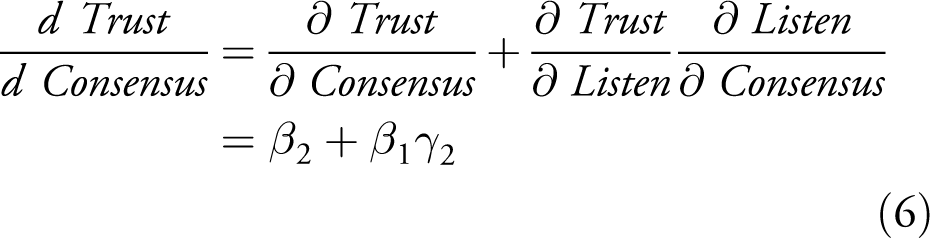
The direct and indirect effects of a variable can be obtained easily from the model. As Figure 2 shows, institution affects the likelihood of having a positive change The mediation effects of responsiveness of government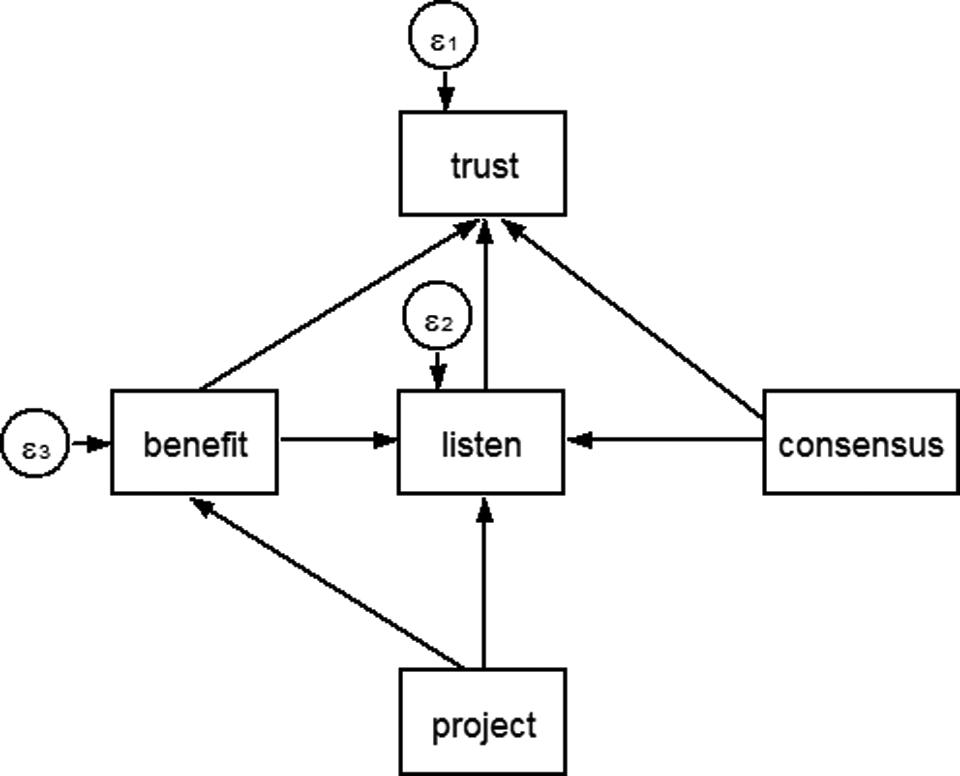
Direct and indirect effects of institution and development project on trust building
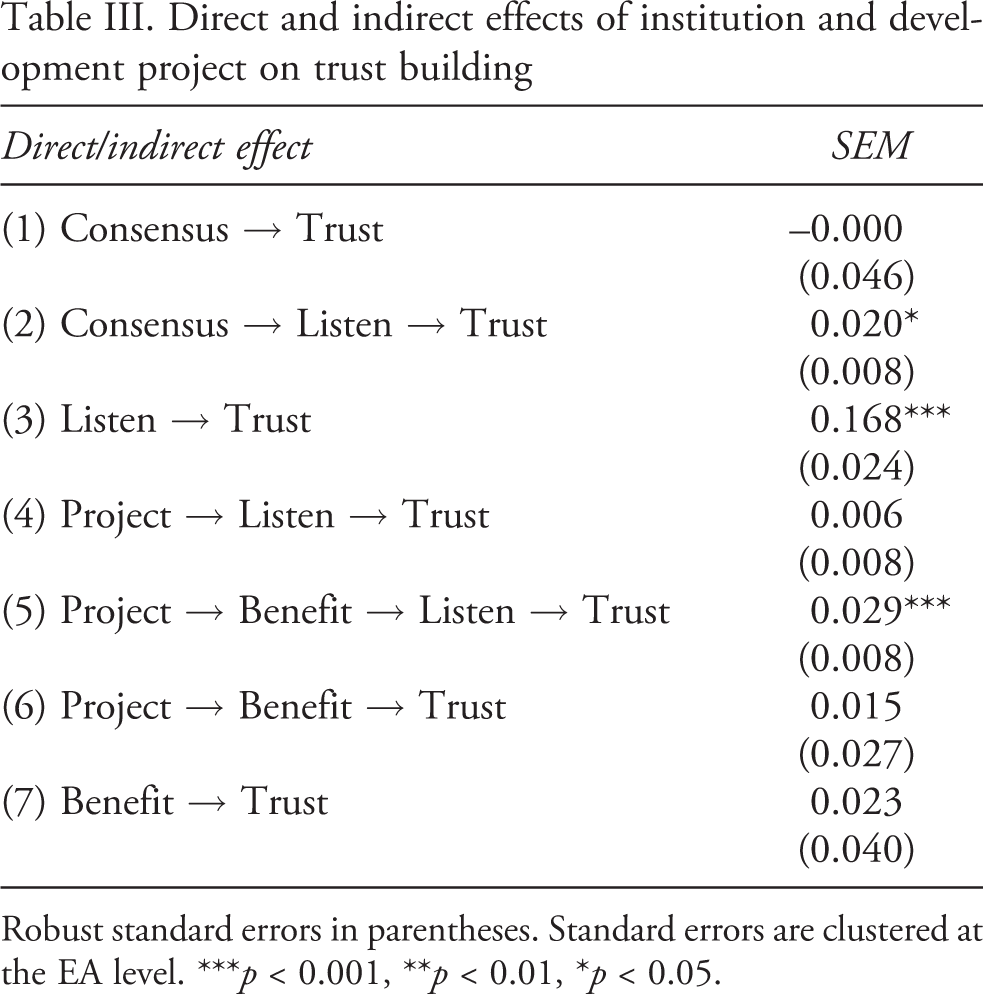
Robust standard errors in parentheses. Standard errors are clustered at the EA level. ***p < 0.001, **p < 0.01, *p < 0.05.
Conclusion
The case of Sierra Leone has several features that may not allow my findings to be generalized to other post-conflict environments. Firstly, though Sierra Leone is characterized by its great ethnic diversity, the civil war did not stem from ethnic identity (Dupuy & Binningsbø, 2007; Fanthorpe, 2005). Whether the finding is generalizable to societies that suffered from a deep ethnic divide is subject to further examination. Secondly, the root cause of the civil war in Sierra Leone was the power imbalance between authority and villagers originating from the accountability deficit of the governing body (Jackson, 2007). As government responsiveness directly speaks to this problem and the whole point of decentralization reform was to address this issue (Casey, Glennerster & Miguel, forthcoming), increased responsiveness may not work equally well if a war is fought for other reasons. Finally, accountability in rural Sierra Leone started at a low level. This low starting point may reduce the expectations of the public and makes every small improvement count. Given the above, the finding is most relevant to a post-conflict society that experienced non-ethnic civil war and suffered from serious accountability deficit.
Past research has shown that the lack of political trust is associated not only with the onset of civil war, but also with the stability of negotiated settlement, the success of state-building, and the spell of peace. This article contributes to the literature by clarifying the causal mechanism of trust building. It argues that being responsive to the needs of people is the key to successful trust building. My findings confirm this hypothesis and suggest that demonstrating concern for the needs of people and engaging them in policy formulation have the most promising effect in enhancing political trust in a post-conflict environment. By contrast, though inclusive political institutions and improvements in public service provisions were deemed important, their effects are less relevant or indirect. These findings imply that although improvement of public services may carry other strategic or normative values and can bring benefits to people, if the improvements do not reflect the needs of people, they will not be effective in changing their attitudes towards the government. Listening and responding to the demands of people are the most effective ways of restoring trust and peace.
Footnotes
Replication data

Acknowledgements
Earlier versions of this article were presented at the International Studies Association Annual Convention in Atlanta, the European Network for Conflict Research Workshop in Bonn, and the Research School on Peace and Conflict Symposium in Oslo. I would like to thank Lutz Krebs, Marijke Verpoorten, Christian von Haldenwang, Kristen Ringdal, Andrew Delatolla, Luca Raineri, Anne Härtel, Theresa Ammann, Ortrun Merkle, Toby Chan, the conference/workshops participants, the anonymous reviewers, and an associate editor of the journal for their valuable comments. All errors are mine.
Funding
Financial support by the Dutch library consortium (UKB) to make this article open access is gratefully acknowledged.