




Abstract
Consumers expect managers to respond to positive reviews, but it is unclear whether these responses are beneficial. This research finds that managerial responses to positive reviews can positively impact consumers when managers follow conversational norms for responding to compliments. It proposes that managers downplay the compliments that their firms receive via positive reviews (e.g., “Dinner was fantastic!”) and examines two norms-based strategies for doing so: (1) shifting the content of the compliment (e.g., “We’re glad dinner was good.”) and (2) shifting the recipient of the compliment (e.g., “our suppliers helped.”). First, an experiment and Google Local data show a disconnect between how consumers think managers should respond and how managers currently respond. Second, six experiments test the proposed response strategies. Compared with managers who do not respond to positive reviews and managers who write responses currently recommended by industry or academics, managers who downplay compliments improve readers’ evaluations of the firm and engagement on the platform. Downplaying the compliment improves consumer outcomes by conveying the manager's humility, which is normative. Downplaying is most effective when the manager reduces credit to the firm, appreciates someone else involved (e.g., supplier, reviewer), and uses moderately positive descriptors (e.g., “good” rather than “fantastic”).
Keywords
Word of mouth (WOM) is no longer a simple consumer-to-consumer exchange about products, brands, or services (Moore and Lafreniere 2020). Firms can now insert themselves into consumers’ conversations, and increasingly, they are doing so: 21.1% of the reviews posted on Google Local in 2020 were accompanied by a reply from the firm, up from 8.5% in 2016 (Web Appendix A). It is worthwhile for managers to respond to WOM, particularly online reviews, because nearly 90% of consumers rely on reviews when making purchase decisions (Russell 2024) and because over 70% of consumers expect managers to respond to reviews (Brzezicki 2021).
The practice of managerial responses is unsurprising in the context of negative WOM. Prior work has examined how managers should respond to unhappy consumers in order to improve consumer outcomes (e.g., Herhausen et al. 2019, 2022). Appropriate responses to negative reviews can mitigate the negative effects of complaints on revenue (Lee, Xie, and Besharat 2016) and can even influence subsequent review ratings in a positive way (Gu and Ye 2014; Proserpio and Zervas 2017; Wang and Chaudhry 2018).
In contrast, the value of managerial responses to positive WOM is less certain, and industry guidelines and academic recommendations diverge on how best to respond. Some review platforms recommend that managers write longer, more tailored responses (e.g., Yelp; Moon 2023) because such responses ought to improve relationships, increase loyalty (e.g., Van Asperen, De Rooij, and Dijkmans 2018), and increase the salience of WOM (Chen et al. 2019). In contrast, some academics recommend that managers write brief, generic responses (e.g., “thank you”) and delay responding until after the review reaches the second page (i.e., when the review is buried behind newer reviews; Manis, Wang, and Chaudhry 2020), building on findings that managerial responses to positive reviews can negatively influence revenues and subsequent review ratings (Crijns et al. 2017; Lee, Xie, and Besharat 2016; Wang and Chaudhry 2018). Thus, there is little consensus on how managers should respond to positive reviews, and it remains unclear whether managerial responses to positive WOM can impact consumers positively.
One possible reason that managerial responses to positive reviews may impact consumers negatively is that it matters what managers say in their responses. We address this possibility by developing a norms-based model of how managers should respond to positive reviews so that these responses impact consumers positively. First, we examine empirically what practitioners and consumers think managers should say (i.e., injunctive conversational norms; Web Appendix A). We find that practitioners think managers should thank the reviewer and repeat a positive aspect of the review, which is in line with the conversational norm in everyday conversation to agree with the speaker. However, consumers view writing a positive review as comparable to complimenting the firm, so they think managers should not only agree with the reviewer but also follow an additional conversational norm to be humble. Second, we build on work that describes how people respond to compliments (e.g., Pomerantz 1978) to theorize about how managers can respond to positive reviews in a way that is normative to consumers. We propose that managers’ responses should downplay the compliments that their firms receive via positive reviews, and we identify two strategies for doing so: shift the content of the compliment and shift the recipient of the compliment. We then theorize about why and when these strategies will elicit positive consumer outcomes. Third, we examine how managers currently respond to reviews posted on Google Local and find that these two downplay strategies are underutilized. Finally, in six experiments, we show that these downplay strategies—both separately and jointly—can increase consumers’ choice and evaluations of the firm, as well as engagement on the review platform. They do so because they increase perceptions of the manager's humility, which more closely follows the injunctive conversational norm.
Our model goes beyond prior work on responses to positive reviews, which has explored stylistic components (e.g., Crijns et al. 2017) and basic social niceties (e.g., “thank you”; Chen et al. 2019; Wang and Chaudhry 2018), to provide a comprehensive investigation of whether, how, and why managers should respond to positive reviews. In doing so, we make several theoretical contributions to the marketing and interpersonal communications literatures. First, we extend existing theory (Pomerantz 1978) by providing the first empirical test of different responses to compliments and by using a norms-based lens to help explain why some responses perform better than others. Second, we identify a new pathway—humility and adherence to the injunctive conversational norm—through which managerial responses influence consumers. Third, we identify three moderators of our proposed downplay strategies that highlight when these strategies are most effective.
To marketing practice, we offer insights for firms and review platforms about whether and how managers should respond to positive WOM. First, our experiments show a positive impact of appropriate managerial responses to positive reviews (compared with no responses). Indeed, while most reviews on Google Local are positive (e.g., 81.58% are 4- or 5-star reviews), only 15.21% of positive reviews include a response from the firm (see the “Descriptive Data” section). Thus, highly rated firms may stand out among their similarly rated competitors by increasing their response rates. Second, and critically, we examine how managers should respond to such reviews. We compare responses that downplay the compliment with responses that are recommended by industry and academics and find that downplay responses more positively impact consumers’ choice and evaluations of the firm. We also offer specific guidance on how managers’ responses to positive reviews should downplay the compliment by examining whether, to whom, and how much the manager shifts credit. Third, our findings have implications for review platforms: We show that normative managerial responses to positive reviews can increase user engagement. Thus, platforms might benefit from enabling users to interact with managerial responses as they do with reviews, for example, by rating them as helpful.
Industry Guidelines for Managerial Responses to Positive Word of Mouth
Review platforms recommend that managers should respond to positive reviews because the majority of consumers say they are more likely to pick a business that responds to reviews (Moon 2023). Further, they suggest that in responding, managers should offer a token of appreciation (“thank you”) and repeat a positive aspect of the review (e.g., Bester 2023; Google for Small Business 2023; Moon 2023; Wellington 2022) because it signals that employees read reviews thoroughly (Cvetkovic 2022). If needed, managers may also invite the reviewer back or propose to continue the conversation offline (Moon 2023).
Intuition and prior research suggest that this response strategy ought to improve consumer outcomes. This is because any factor that increases the accessibility of positive information should increase consumers’ likelihood of using that information to make decisions (Feldman and Lynch 1988; Herr, Kardes, and Kim 1991). Further, by highlighting the fact that many other consumers are aware of (and praising) a particular product (Amblee and Bui 2012; Babić Rosario et al. 2016), these responses should increase the salience of positive WOM on review platforms, thereby increasing sales and revenue (Babić Rosario et al. 2016; You, Vadakkepatt, and Joshi 2015). However, recent academic research recommends different response strategies.
Academic Guidelines for Managerial Responses to Positive Word of Mouth
Academic research in marketing has shown that managerial responses to positive WOM can negatively impact firms’ revenue and subsequent review ratings (Crijns et al. 2017; Lee, Xie, and Besharat 2016; Wang and Chaudhry 2018). Further, and different from current industry guidelines, this research has found that responses that are tailored to the contents of positive reviews (i.e., those that repeat a positive aspect of the review) can strengthen this negative impact (Wang and Chaudhry 2018). To explain this effect, Wang and Chaudhry (2018) theorize that consumers do not see highly tailored responses as beneficial to the reviewer or conversation because the reviewer is already aware of the positive aspects in their review. Consequently, readers may perceive these responses as more promotional than others.
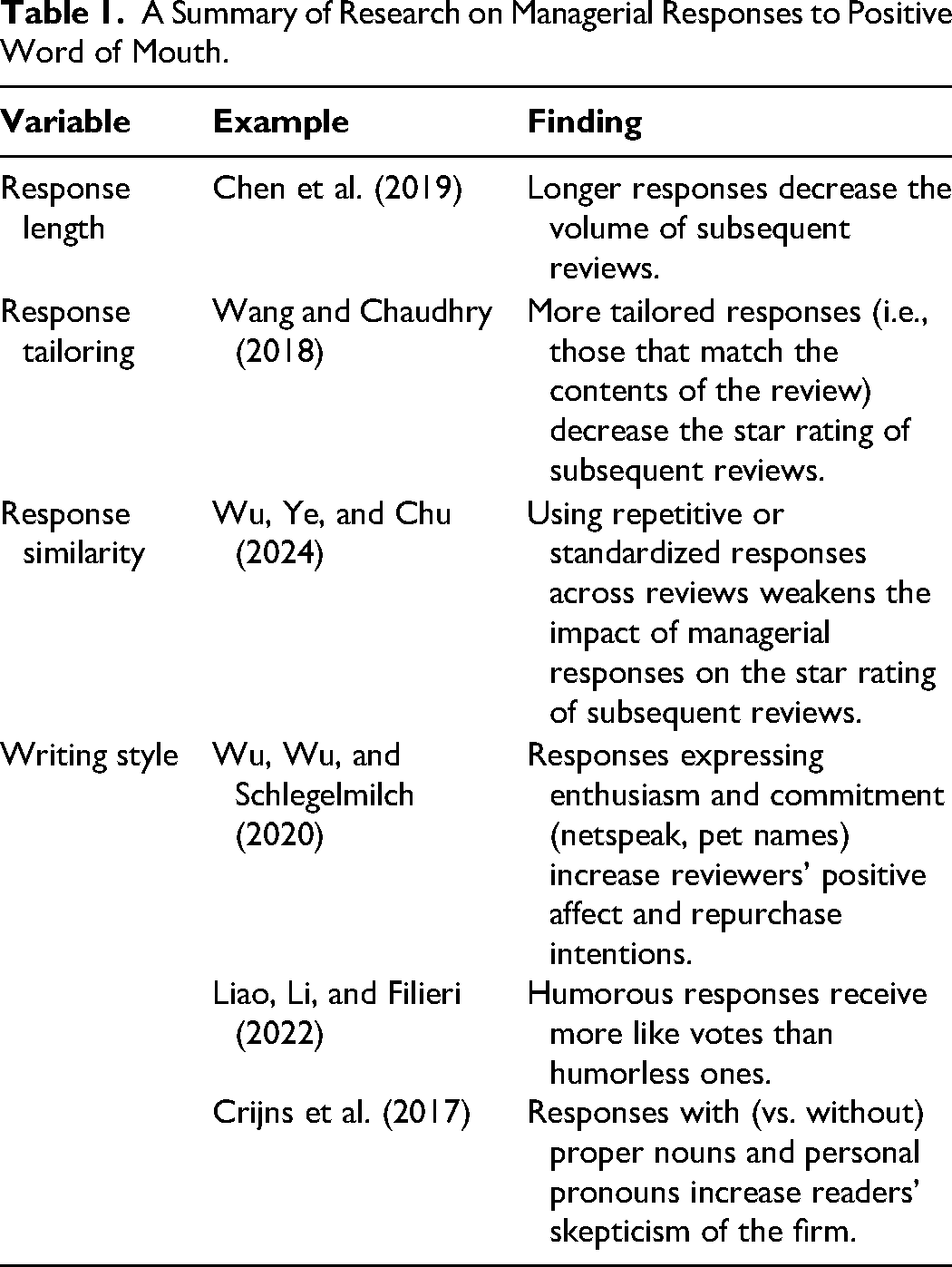
Yet, with a few exceptions (Table 1), there is little research on how to improve managerial responses to positive WOM. Foremost, some prior work has suggested that managers can lessen the negative effect of responses by writing a short “thank you” and by delaying their response until after the review is buried behind new reviews (Manis, Wang, and Chaudhry 2020; Wang and Chaudhry 2018). Other research has examined stylistic techniques that managers can employ in responding to positive reviews. For example, humorous responses receive more like votes from consumers than humorless ones (Liao, Li, and Filieri 2022). Similarly, the presence versus absence of netspeak (e.g., emojis) and pet names (e.g., “my dear”) in responses can increase reviewers’ positive affect and repurchase intentions (Wu, Wu, and Schlegelmilch 2020). Yet despite this prior work, it remains unclear whether and how managers can best respond to positive reviews to impact consumer outcomes positively. In particular, beyond basic tokens of appreciation (i.e., thank you) and stylistic aspects of responses, it is not clear exactly what managers should say (i.e., what content they should use) in responding to positive reviews. To address this question, we adopt a perspective that is lacking in prior work: We use a norms-based lens to examine managerial responses.
A Summary of Research on Managerial Responses to Positive Word of Mouth.
The Current Research
Injunctive Conversational Norms in Managerial Responses
We propose that managerial responses to positive reviews may elicit more positive responses from consumers if they adhere to injunctive conversational norms (Cialdini, Kallgren, and Reno 1991). Injunctive conversational norms refer to a set of nondeclared rules that lay out the socially appropriate way to communicate in a given context (i.e., what ought to be communicated). Language philosophers posit that people should adhere to such norms to understand one another during conversation (Grice 1975; Searle 1976). Consistent with this, adhering to the conversational norms of a given context improves communication (Gibbs 1985; Grice 1975; Kronrod and Danziger 2013). For example, advertisements are more effective when the language used fits the media in which it appears (e.g., popular vs. professional magazine; Xu and Wyer 2010). But what norms do consumers think managers should follow in their responses to positive reviews?
We suggest that, in responding to positive reviews, managers may benefit from following the norms that guide responses to compliments. We draw on recent work in communications to propose that positive reviews can be considered equivalent to compliments (Cenni and Goethals 2021). Compliments are expressions of positive evaluations or praise of others (Holmes 1988), both of which are common in positive reviews. For example, a review that reads “Dinner was fantastic!” or “Service was great!” can be interpreted as a compliment because the reviewer is expressing a positive evaluation of—and praising—the firm. Beyond this, readers should also recognize positive reviews as compliments to firms because the manager is a part of the online conversation (Moore and Lafreniere 2020) and is expected to engage with positive reviews (Brzezicki 2021). Indeed, when a firm reads a positive review, they respond to it as a compliment by expressing gratitude (e.g., “Thank you!”)—the most common way to start a response to a compliment (e.g., Alqarni 2020; Chen 1993).
The compliments literature identifies two injunctive conversational norms that responses to compliments in everyday speech tend to follow: agreeing with the speaker and being humble. First, in any conversation, there is a norm to agree with the speaker (Pomerantz 1978). In the case of managerial responses, this norm is followed by showing gratitude, such as when the manager thanks the reviewer, and/or by repeating the compliment. Such responses show agreement by acknowledging that the compliment has been received and by affirming the compliment. Second, in the case of compliments, there is also pressure on recipients to be humble by reducing self-praise. Thus, recipients are pressured to accept the compliment but show humility (Placencia, Lower, and Powell 2016; Spencer-Oatey 2008), and they must proceed carefully to comply with both norms. Overall, this suggests that if managers wish to respond to positive reviews appropriately, they should agree with the reviewer by saying thank you, but they should also show humility in some way.
If that is the case, industry guidelines seem to recommend strategies that follow the agreement norm (e.g., thank the reviewer and repeat a positive aspect of the review) but overlook the humility norm. Further, none of the response variables examined in academic research consider these injunctive conversational norms. For instance, Wang and Chaudhry (2018) recommend a brief “thank you” but did not view norms as the underlying mechanism for their recommendation; as with industry guidelines, this conforms to the agreement norm but not the humility norm. This may help explain why managerial responses, particularly those tailored to the review, have been shown to negatively influence revenue and subsequent review ratings (Crijns et al. 2017; Lee, Xie, and Besharat 2016; Wang and Chaudhry 2018). Specifically, responses that do not follow norms may not reflect what consumers consider to be ideal (Bueno de Mesquita and Shadmehr 2023) and may seem odd to consumers (Pomerantz 1978). Consider, for example, how people respond to compliments in everyday conversation (e.g., “Hey, great jacket!”). Others may find it puzzling if the recipient of the compliment responds by repeating the compliment (e.g., “Thank you for saying my jacket is great!”). Thus, we propose that managerial responses that follow both the agreement norm and humility norm should ultimately have the greatest positive impact on consumers.
We conducted a pilot experiment to test our theorizing that (1) a positive review is comparable to giving a business a compliment and (2) consumers think firms ought to express agreement (e.g., by showing gratitude) and humility when responding to positive reviews, compared with other marketplace settings (Web Appendix B). The experiment used a six-level within-subjects design (n = 602). Participants were presented with six marketplace communication scenarios in random order: a firm's response to a positive review, a firm's post on social media, a firm's advertisement, a customer service agent's phone conversation, a customer's product recommendation, and a customer's response to a compliment from another customer. Then participants answered the same four questions in random order about their communication expectations in each scenario: (1) “Should the firm [customer] be promotional and persuasive?” (2) “Should the firm [customer] use formal language?” (3) “Should the firm [customer] express gratitude?” And (4) “Should the firm [customer] be humble?” At the end of the study, participants were asked if they think that writing a positive review about the business is comparable to giving a compliment to the business (1 = “yes, it's the same,” and 2 = “no, it's different”). As anticipated, the observed proportion of participants who selected, “yes, it's the same” (82.72%) was significantly higher than the null hypothesis proportion (50%; z = 16.05, p < .001). Further, participants thought that managers should show more agreement (via gratitude) and more humility when responding to positive reviews than when advertising, posting on social media, or providing customer service. Interestingly, these two expectations were even higher for managers responding to positive reviews than for customers responding to compliments.
Overall, these findings support our theorizing that consumers think managers should show agreement and humility in their response to positive reviews. Next, we present a model for responding to positive reviews in a manner that meets these expectations.
How Should Managers Respond to Compliments?
As noted, managers may benefit from agreeing with the reviewer by writing “thank you” (as suggested in industry and academic guidelines), but prior literature and our pilot study suggest that they may also benefit from being humble by reducing self-praise. To comply with both norms, we suggest that managers offer a token of appreciation but downplay the compliment that their firm received (Table 2). We investigate two strategies for responding: (1) shift the content of the compliment and (2) shift the recipient of the compliment.
Strategies for Downplaying the Compliment in Managerial Responses.
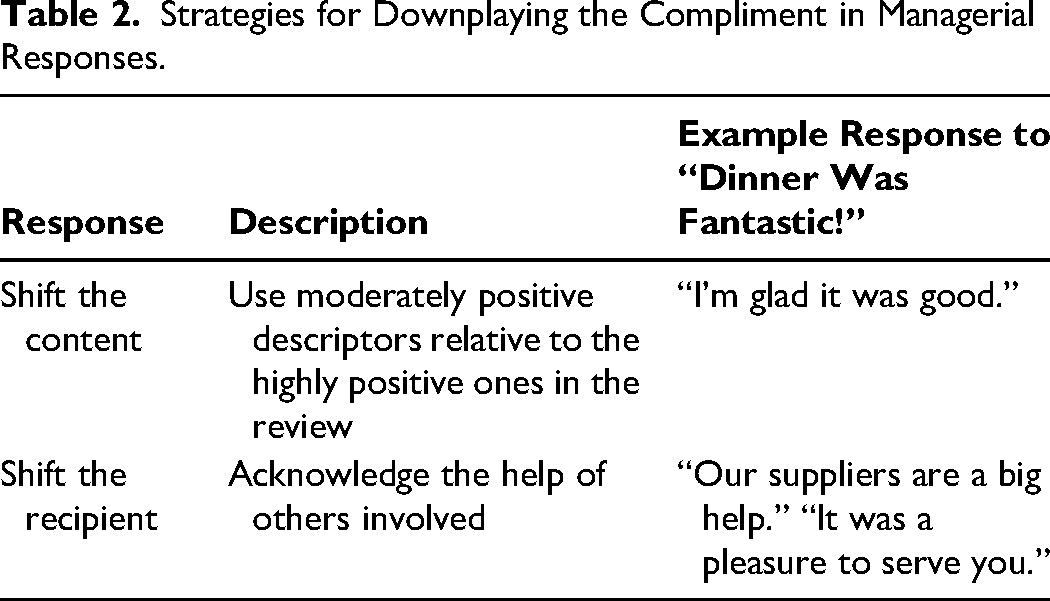
First, managers may reduce self-praise by using scaled-down positive descriptors compared with those used in the original compliment (Holmes 1986; Pomerantz 1978). Here, the focus is on downplaying the content of the compliment, which often uses extremely positive attributes (e.g., “Dinner was fantastic!”; Pomerantz 1978), by subtly counterproposing that the firm has less positive attributes. Thus, the manager may improve readers’ inferences of their humility by shifting to more moderate praise terms than those in the original compliment (e.g., “We’re glad it was good.”).
Second, managers may reduce self-praise by appreciating a coparticipant who helped the firm earn the reviewer's compliment (Pomerantz 1978). Here, the focus is on downplaying the recipient of the compliment by subtly counterproposing that the firm had a lesser role. For example, if a customer said, “Dinner was fantastic!,” the manager may acknowledge the help of a third party (e.g., “Our suppliers are a big help.”) or the customer (e.g., “It was a pleasure to serve you.”).
Why downplaying the compliment impacts readers
Overall, our key independent variable is language use in managerial responses. Language philosophers contend that language can imply speakers’ intentions or beliefs even when they are not explicitly stated (i.e., implicatures; Grice 1975; Searle 1976). In other words, when a manager responds to reviews, readers make inferences regarding the manager's underlying intentions, which may ultimately impact the readers’ choices, evaluations of the firm, and engagement on the platform (Moore and Lafreniere 2020).
When a manager downplays the compliment that their firm received, readers infer that the manager intended to reduce self-praise and therefore that the manager is humble. Indeed, humility can be inferred from (1) the ability to accurately acknowledge one's limitations and abilities and (2) an interpersonal stance that is other-focused rather than self-focused (Tangney 2000; Van Tongeren et al. 2019). In turn, when the manager is humble, readers infer that the manager followed the injunctive conversational norms for responding to compliments (i.e., gave an ideal response; Bueno de Mesquita and Shadmehr 2023).
Ultimately, we expect downplay responses to improve readers’ choice and evaluations of the firm because adhering to the conversational norms for a given context improves consumer outcomes (e.g., Kronrod and Danziger 2013; Xu and Wyer 2010). 1 Since downplay (vs. other) responses should increase firm evaluations and choice, they should also increase the number of readers who rate the response as useful (i.e., engagement intentions, which can benefit both the firm and platform; Chen, Dhanasobhon, and Smith 2008; Moore 2015). To test the impact of downplay responses, we assess all three dependent variables (choice, evaluation, and engagement intention).
Comparing different response strategies
Because our two proposed downplay strategies (shifting the content or recipient) do not overlap linguistically, nothing precludes a manager from using one or both in a single response. Building on this, we expect the two strategies to positively impact consumer outcomes both separately and jointly. Both appreciating others (e.g., crediting a coparticipant) and acknowledging one's limitations (e.g., scaling down the positive descriptor) should improve readers’ inferences of the manager's humility (e.g., Chancellor and Lyubomirsky 2013), so each should have a positive impact. Consequently, we suggest that managerial responses may include one or both downplay strategies, and we test these strategies separately and jointly, thereby offering additional options to managers responding to positive WOM.
To test our framework and offer theoretical and practical implications, we compare our proposed downplay strategies with other conventional managerial responses rather than with responses that reflect a clear norms violation (e.g., “We are the best!”; see the “Descriptive Data” section). First, we compare a downplay response with no response. Because managerial responses to positive reviews can negatively impact readers (e.g., Wang and Chaudhry 2018), this comparison will contribute to the literature by establishing that managerial responses to positive reviews can also have a positive impact. Second, we compare downplay responses with other recommended responses to positive reviews: saying “thank you” (Manis, Wang, and Chaudhry 2020; Wang and Chaudhry 2018) and repeating the compliment (e.g., using the same praise terms; ReviewTracker 2022). Our proposed downplay responses are similar to these recommended responses in that they all use “thank you” to convey the manager's underlying intention to agree with the reviewer, which is in line with the agreement norm. However, we argue that downplay responses should have a greater positive impact on consumer outcomes because they also convey the manager's underlying intention to reduce self-praise. This is consistent with the humility norm. This additional inference of humility should be closer to what consumers view as an ideal response (i.e., one that complies more fully with both norms; Bueno de Mesquita and Shadmehr 2023).
Overall, we predict that, compared with no response and to other recommended responses, a managerial response that downplays the compliment in positive WOM—whether it downplays the recipient, the content, or both—will have the greatest positive effect on outcomes for the firm and the platform because it will enhance inferences of the manager's humility, which more closely adheres to injunctive conversational norms (Figure 1).
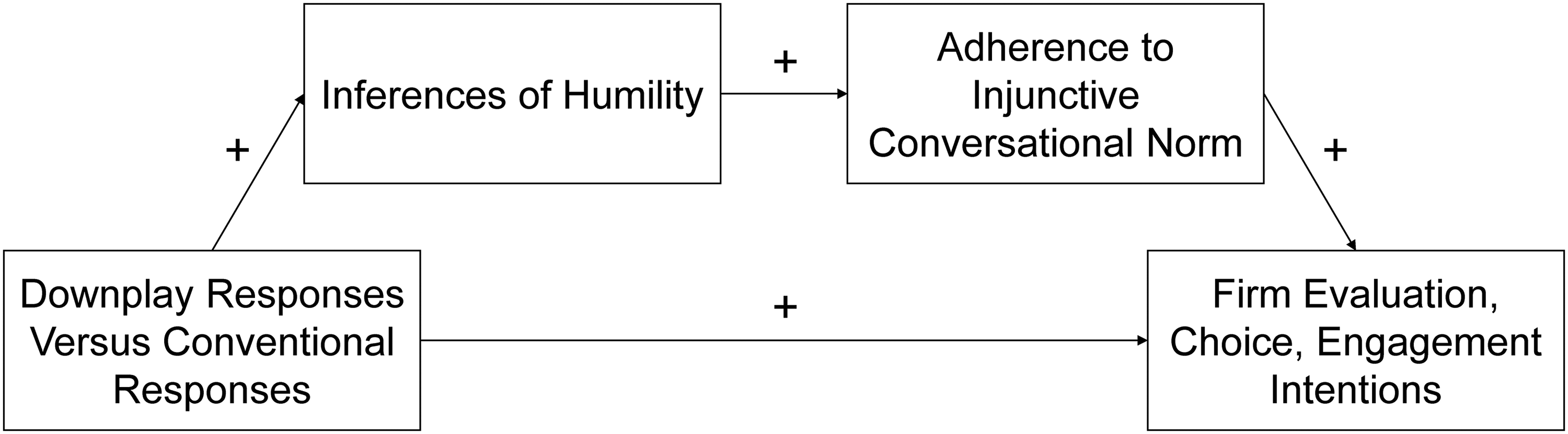
Proposed Serial Mediation Model.
What Should Managers Avoid in Downplaying a Compliment?
We suggest that managers should downplay the compliments that their firms receive in positive WOM—but what should managers avoid in writing such a response? We expect that the proposed positive effect of downplay strategies will be reduced by moderating factors that obscure readers’ inferences of the managers’ underlying intentions. As noted, when a manager downplays the compliment (by subtly counterproposing a shift in credit), readers should infer the manager's intention to reduce self-praise and therefore that the manager is humble (Tangney 2000; Van Tongeren et al. 2019). We consider three factors that should obscure inferences of the manager's underlying intentions: whether, to whom, and how much the manager shifts credit. These factors reflect responses that some managers use on Google Local (“Descriptive Data” section) and endorse in a survey (Web Appendix C). Thus, examining these factors clarifies which potential responses are the most helpful and guides managers on how to write appropriate responses.
First, whether a manager shifts credit should matter. In response to compliments, managers can conceivably suggest that the firm was overpraised without specifying a change in credit (e.g., “You made us blush!” or “You’re too kind!”). This response strategy is a seemingly reasonable alternative to addressing the humility norm because the manager expresses discomfort with the praise without having to point out any limitations. However, such a response shows no intention or willingness to reduce self-praise. The lack of a counterproposal should obscure readers’ inferences of the manager's humility, which is characterized by accurately acknowledging one's limitations (Peterson and Seligman 2004; Tangney 2000). Thus, it should not positively impact outcomes for the firm or the platform.
Second, to whom a manager shifts credit should matter. Here, we rely on the notion that readers should infer that managers have greater humility when they takes a stance that is other-focused. As such, managers could conceivably use this opportunity to highlight other employees who do great work at the firm (e.g., “Our hosts are also great!”). However, when a manager downplays the compliment by crediting a nonparticipant, acknowledging others who were not involved in the experience, it becomes unclear if the manager is crediting the nonparticipant to be other-focused or to be promotional (e.g., to highlight other positive aspects of their firm); this should also obscure readers’ inferences of the manager's humility. Thus, a downplay response that credits a nonparticipant should not positively impact outcomes for the firm or the platform.
Third, how much a manager shifts credit should matter. To shift the content of the compliment, managers can use scaled-down descriptors that vary in their degree of positivity (e.g., “we’re glad your dinner was [great/good/okay/acceptable]”). Compared with highly positive descriptors in reviews, less positive descriptors in managerial responses should signal that the manager is humble, and neutral descriptors may even seem like stronger signal. However, when a manager uses a descriptor that is not positive (e.g., reasonable), readers should not infer the manager as having more humility because it becomes unclear if the manager intended to reduce self-praise or to disagree with the reviewer by endorsing a negative self-view (Weidman, Cheng, and Tracy 2016). Thus, a response that shifts to a neutral descriptor should not positively impact outcomes for the firm or the platform.
Descriptive Data: What Do Managers Write in Response to Positive Reviews?
To understand how managers are currently responding to positive WOM, we coded managerial responses to Google Local reviews (Li, Shang, and McAuley 2022; Yan et al. 2023). This dataset is publicly available, and we obtained over 278 million reviews across 39 states and the District of Columbia. Each state has a different start date, ranging from February 2001 to December 2007, and an end date of September 2021. In this dataset, 14.9% of reviews had a response from the firm (Web Appendix A), from which we selected and coded a random sample of 500 managerial responses to positive reviews. Following prior work, we identified positive reviews as those with a rating of 4 or 5 stars (out of 5; e.g., Wang and Chaudhry 2018). We sampled managerial responses only from positive reviews that contained text.
We hired two independent coders to categorize what managers wrote in their responses to positive reviews. The coders used nine categories to code the responses (Web Appendix A); the categories were not mutually exclusive, and coders indicated whether each category was present or absent in the managerial response. Four categories were consistent with current industry guidelines: tokens of appreciation (e.g., “thank you”), repeating compliments, explaining customer service protocol, and inviting reviewers to visit again (Cenni and Goethals 2021; ReviewTracker 2022). Four categories were based on our conceptualization of responses that downplay the compliment: use scaled-down descriptors (i.e., shift the content), credit the reviewer (i.e., shift the recipient), credit a third party (i.e., shift the recipient), and suggest that the firm was overpraised (e.g., “you made us blush!”; i.e., a boundary condition). Finally, the “other” category gave coders flexibility to identify responses that did not reflect any of the other eight categories. After the first round of coding, the coders shared their results with each other. For responses with different coding outcomes, the coders looked back at their choices and made changes if they felt it was necessary. We instructed the coders to not force conformity if they did not agree with each other. The coding results, including Cohen's kappa for each response, are reported in Table 3.
Coding of 500 Managerial Responses to Positive Reviews on Google Local.
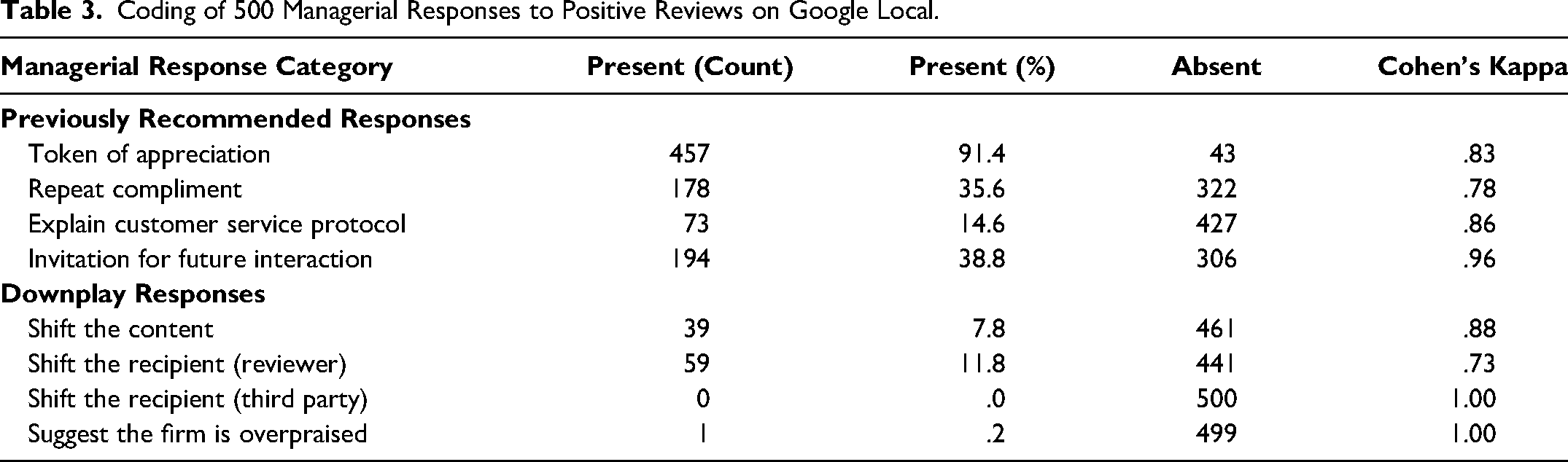
The majority of responses followed current industry guidelines: 91.4% contained a token of appreciation, 35.6% repeated a positive aspect of the review, 38.8% invited the reviewer to return to the firm, and 14.6% explained the firm's customer service protocol. A lower proportion followed academic recommendations (Wang and Chaudhry 2018): 33.2% contained a token of appreciation without adding additional content. An even lower proportion of responses applied our proposed downplay strategies: 7.8% used scaled-down praise terms (i.e., shift the content), 11.8% credited the reviewer for their input (i.e., shift the recipient), and zero responses credited a third party (i.e., shift the recipient). Zero responses shifted both the content and the recipient.
These descriptive data offer practical insight for review platforms and firms. First, the data show how highly rated firms can differentiate themselves from similarly rated competitors. While most reviews are positive (e.g., 81.58% of the reviews on Google Local are 4- or 5-star reviews), only 15.21% of those reviews include a response from firms. Thus, highly rated firms may stand out among their similarly rated competitors by increasing their response rates. Second, and critically, the data show that at least 35.6% of managerial responses may be suboptimal, given that responses that offer a brief token of appreciation or are customized to the contents of positive reviews (i.e., those that repeat the compliment) only adhere to the injunctive conversational norm of agreement. Finally, the data show that the downplay strategies that we propose and test are underutilized: Only 7.8% of responses shifted the content of the compliment, 11.8% shifted the recipient of the compliment, and 0% shifted both the content and recipient of the compliment. Overall, if our proposed downplay strategies (vs. no response or other recommended strategies) positively influence readers, these data show that there is plenty of opportunity for managers to improve consumer outcomes.
Overview of Studies
We report six experiments that provide causal evidence for the predicted effects, test our mediation model, and examine boundary conditions. Experiments 1a and 1b test readers’ reactions to different response strategies. While Experiment 1a compares a downplay response that shifts both the content and recipient with no response and with other recommended responses (token of appreciation and repeat compliment), Experiment 1b compares downplay responses that shift either the content or the recipient with a recommended response. These studies use readers’ evaluations and engagement intentions as dependent variables. Experiment 2 provides process evidence by measuring inferences of the manager's humility and adherence to injunctive conversational norms. It tests our explanation that inferences of the manager's humility impact the dependent variables because humility is a relevant injunctive conversational norm in this context. Experiment 2 also uses a consequential choice as a dependent variable. Experiments 3–5 test our boundary conditions (whether, to whom, and how much a manager shifts credit). Surveys (including complementary measures that do not impact our findings or have implications), data, and analyses for all experiments are available at https://researchbox.org/3817.
Experiment 1a: Testing Response Strategies
This experiment compares our proposed downplay response with three other response options that may benefit firms: no response, a token-of-appreciation response, and a repeat-the-compliment response. We selected no response because the presence versus absence of managerial responses to positive reviews can have a negative effect (Crijns et al. 2017; Lee, Xie, and Besharat 2016; Wang and Chaudhry 2018) and because 85% of the reviews on Google Local did not receive a response from the firm (Web Appendix A). We selected the token-of-appreciation response and the repeat-compliment response because they are recommended by industry and academics and are frequently used on Google Local (Table 3). As noted, the downplay response in this study shifts both the content and the recipient of the compliment because this is a feasible option for managers to employ. Because it conveys the manager's intention to minimize self-praise, a downplay response should lead to greater inferences of the manager's humility than no response, a token-of-appreciation response, and a repeat-compliment response. Thus, a downplay response should have the greatest positive impact on readers’ evaluations and engagement intentions.
Participants, Design, and Measures
Four hundred fifty-five undergraduate students took part in this experiment in exchange for course credit (41.72% female, 56.73% male, .22% nonbinary, 1.32% did not disclose; Mage = 20.18 years). This experiment used a four-level (response strategy: downplay, token of appreciation, repeat compliment, no response) between-subjects design. We asked participants to imagine they wanted to go out for dinner; they heard that a new restaurant opened this week, so they checked out the reviews online. The review was the same across conditions and read, “Dinner was fantastic!” The downplay response read, “Thank you! We’re glad your dinner was satisfying. We try our best, but our local suppliers are a big help.” The token-of-appreciation response read, “Thank you!” The repeat-compliment response read, “Thank you! We loved hearing that your dinner was fantastic!”
Restaurant evaluation was measured with three items: “Please indicate your feelings toward the restaurant” (1 = “extremely bad,” and 5 = “extremely good”); “Please indicate your attitude toward the restaurant” (1 = “extremely negative,” and 5 = “extremely positive”); and “To what extent do you like or dislike the restaurant?” (1 = “dislike a great deal,” and 5 = “like a great deal”; M = 3.93, SD = .60, α = .83). While we expect readers’ evaluations to be positive due to reading a positive review, for accuracy, we use a dependent variable ranging from negative to positive; this conservative test may attenuate the observed effect size. Engagement intentions were measured by asking participants if they would give the owner's response a “useful” vote on Yelp (no = 1, maybe = 2, yes = 3; M = 1.92, SD = .78). Participants in the no-response condition did not report on engagement intentions. Humility was measured with two items: “How humble/modest is the shop owner?” (1 = “not at all humble/modest,” and 4 = “very humble/modest”; M = 3.05, SD = .62, α = .82).
Results
First, an analysis of variance (ANOVA) showed a significant effect of response strategy on restaurant evaluations (F(3, 452) = 2.65, p = .048,
Second, an ANOVA showed that response strategy had a significant effect on engagement intentions (F(2, 339) = 13.44, p < .001,
Finally, an ANOVA showed that response strategy had a significant effect on perceptions of the manager's humility (F(3, 451) = 38.79, p < .001,
Discussion
This study compares our proposed downplay response with no response and with two recommended responses: one from academic research (a token of appreciation; Wang and Chaudhry 2018) and one from platforms (repeat the compliment; Moon 2023). Results show that, compared with these three response strategies, a downplay response improves readers’ evaluation of the restaurant, their engagement intentions, and their inferences of the restaurant owner's humility. Further, when we retested a downplay response compared with no response using a consequential dependent variable, we found similar effects (Web Appendix E).
Experiment 1b: Testing Downplay Strategies
Experiment 1a examined a downplay response that shifts both the content and recipient because this is a feasible option for managers. However, it remains unclear how effective each option is when employed on its own. If both responses are effective separately, this would provide more options to managers. Thus, Experiment 1b examines the individual effects of the two downplay strategies (Table 2). We compare the effects of each downplay option with the recommended token-of-appreciation response (e.g., Manis, Wang, and Chaudhry 2020). Compared with a token of appreciation, a downplay response, whether it shifts the content of the compliment (i.e., using scaled-down praise terms) or shifts the recipient of the compliment to another coparticipant (i.e., the reviewer or supplier), should lead to greater inferences about the manager's humility. Thus, these responses should have a greater positive impact on readers’ evaluations and engagement intentions.
Participants, Design, and Measures
One thousand individuals from Connect by CloudResearch completed the four-level (response strategy: shift the content to scaled-down praise terms, shift the recipient to the reviewer, shift the recipient to a supplier, token of appreciation) between-subjects experiment (59.4% female, 38.1% male, 1.8% nonbinary, .7% no response; Mage = 40.62 years). We employed the same scenario as Experiment 1a. Participants saw a review (“Dinner was fantastic!”) followed by one of four potential responses from the owner. The content-shift response read, “Thank you! We’re glad you had a good night.” The reviewer-shift response read, “Thank you! It was a pleasure to serve you. You made our job easy.” The supplier-shift response read, “Thank you! Though our local suppliers are a big help.” Finally, the token-of-appreciation response (i.e., comparison condition) read, “Thank you!” Restaurant evaluation (M = 4.03, SD = .66, α = .92), engagement intentions (M = 1.85, SD = .80), and humility (M = 3.33, SD = .63, α = .83) were measured as in Experiment 1a.
Results
First, an ANOVA revealed that response strategy had a significant effect on restaurant evaluations (F(3, 996) = 2.99, p = .03,
Second, an ANOVA showed that response strategy had a significant effect on engagement intentions (F(3, 996) = 12.72, p < .001,
Third, an ANOVA showed a significant effect of response strategy on perceptions of the manager's humility (F(3, 996) = 19.36, p < .001,
Discussion
Experiment 1b tests the impact of downplay responses that shift either the content or the recipient of the compliment. As expected, each downplay response (vs. token of appreciation) increases perceptions of the manager's humility, which enhances readers’ evaluations and engagement intentions. These findings suggest that managers do not have to combine the different downplay options into a single response because each is effective on its own.
Experiment 2: Why Downplay Responses Improve Outcomes
This study tests our norms-based explanation for the positive impact of downplay responses on readers’ evaluations and engagement intentions using serial mediation (Figure 1). We anticipate that when a manager downplays the compliment their firm received, readers will perceive the manager as humble, which, in turn, is closer to the ideal response to positive reviews (i.e., it follows injunctive conversational norms; Bueno de Mesquita and Shadmehr 2023). To test this explanation, we use a consequential task where participants choose between two coffee shops: one that responds to a review by downplaying the compliment, and one that repeats the compliment. We selected a repeat compliment response because it is used by managers (35.6% of responses to reviews repeat a positive aspect of the review; see the “Descriptive Data” section) and recommended by industry experts and platforms (e.g., Bester 2023; Google for Small Business 2023; Moon 2023; Wellington 2022). We expect participants to choose the shop that gives the downplay response more often and to have higher evaluations of and engagement intentions for this shop.
Importantly, this study also rules out response length as a potential confound. In our prior studies, the token-of-appreciation responses were shorter than the downplay responses. In this experiment, both managerial responses (downplay and repeat the compliment) have the same word count. This helps to address the possibility that downplay responses were viewed more positively in prior studies because they indicate more effort on the part of the manager.
Participants, Design, and Measures
One hundred ninety-nine participants from Connect by CloudResearch took part in this experiment (52.3% female, 46.7% male, .5% nonbinary, .5% did not disclose; Mage = 36.5 years; we excluded two participants who took the survey more than once).
We asked participants to imagine they wanted to meet some classmates at a coffee shop, so they searched online for a good one nearby. Participants then saw two reviews side by side for two different coffee shops (one review per shop). The identities of the shops were hidden, and we randomized which review appeared on the left side of the screen. The two positive reviews were comparable, such that both reviewers complimented the same attributes and used adjectives with similar sentiment (Hutto and Gilbert 2014; Rocklage, Rucker, and Nordgren 2018). The review of Shop A read, “Going back! The vibe of this place is fantastic. Loved their coffee. The baristas were very nice, too.” The review of Shop B read, “Fabulous coffee, knowledgeable friendly staff, and lots of cool seating. The whole package!” We randomly assigned a response to each of the two reviews from the respective shop owner. The downplay response read, “Thank you! We try our best, though our local suppliers sure help!” The repeat compliment response read, “Thank you for saying that our coffee, staff, and atmosphere are outstanding!”
After viewing the reviews, we asked participants to choose a coffee shop. We informed participants that, as a thank you, they would receive one entry into a draw for a $25 gift card to the shop they selected. After the choice task, participants rated each review separately. We randomly assigned which review was rated first. Coffee shop evaluation (αShop A = .82; αShop B = .81), engagement intentions, and humility (αShop A = .95; αShop B = .92) were measured as in Experiments 1a and 1b. We measured adherence to injunctive conversational norms with a single item: “Sometimes we have typical or common things that we say, but these may not always be the best or ideal response. Setting aside how businesses typically respond, in your view, is this response close to how owners should ideally respond to positive reviews?” (1 = “not close at all,” and 4 = “very close”). At the end of the experiment, participants were debriefed that the winner of the draw would receive cash in lieu of a gift card. One participant received a $25 bonus.
Results
First, as expected, the proportion of participants who selected the shop that wrote a downplay response (60.8%) was significantly higher than the null hypothesis proportion (50%; z = 3.05, p = .001). The effect held regardless of which review was randomly assigned the downplay or repeat-compliment response. When the downplay response was to the review of Shop A, the observed proportion of participants who selected Shop A over Shop B (59 of 100; 59%) was significantly higher than the null hypothesis proportion (50%, z = 1.8, p = .036). Similarly, when the downplay response was to the review of Shop B, the observed proportion of participants who selected Shop B over Shop A (62 of 99; 62.6%) was significantly higher than the null hypothesis proportion (50%; z = 2.51; p = .006).
Second, a mixed ANOVA (controlling for review and which review was rated first) revealed only a significant main effect of response strategy on evaluations of the coffee shops. Participants rated the shop whose owner wrote the downplay response more positively than the shop whose owner wrote the repeat-compliment response (Mdownplay = 4.40, SD = .59; Mrepeat = 4.20, SD = .61; F(1, 195) = 16.23, p < .001,
Third, a mixed ANOVA (controlling for review and which review was rated first) revealed only a significant main effect of response strategy on engagement intentions. Participants were more likely to give the downplay response a useful vote than the repeat compliment response (Mdownplay = 2.45, SD = .69; Mrepeat = 2.07, SD = .81; F(1, 195) = 47.26, p < .001,
Fourth, a mixed ANOVA (controlling for review and which review was rated first) revealed only a significant main effect of response strategy on perceptions of the shop owners’ humility. Participants perceived the shop owner who wrote the downplay response as more humble than the shop owner who wrote the repeat-compliment response (Mdownplay = 3.55, SD = .49; Mrepeat = 2.90, SD = .70; F(1, 195) = 140.43, p < .001,
Fifth, a mixed ANOVA (controlling for review and which review was rated first) revealed only a significant main effect of response strategy on adherence to injunctive conversational norms. Participants perceived the downplay response as closer to an ideal response than the repeat-compliment response (Mdownplay = 3.52, SD = .67; Mrepeat = 3.12, SD = .74; F(1, 195) = 40.19, p < .001,
A serial mediation analysis revealed significant effects on coffee shop evaluation via humility and adherence to injunctive conversational norms when comparing a downplay response to a repeat compliment response (Model 1 in MEMORE; Montoya and Hayes 2017). The total effect of the downplay (vs. repeat-compliment) response was significant (B = .20, SE = .05, 95% CI = [.10, .29]). The serial indirect effect via humility and adherence to injunctive conversational norms (B = .13, SE = .03, 95% CI = [.07, .21]) and the indirect effect via humility (B = .12, SE = .05, 95% CI = [.03, .21]) were both significant. The indirect effect via adherence to injunctive conversational norms was not significant (B = −.001, SE = .02, 95% CI = [−.04, .04]). The total indirect effect was significant (B = .25, SE = .05, 95% CI = [.17, .35]) and the direct effect was insignificant (B = −.05, SE = .05, 95% CI = [−.16, .04]), suggesting full mediation.
A serial mediation analysis revealed similar effects on engagement intentions. The total effect of the downplay (vs. repeat-compliment) response was significant (B = .38, SE = .06, 95% CI = [.27, .49]). The serial indirect effect through humility and adherence to injunctive conversational norms (B = .12, SE = .04, 95% CI = [.05, .22]) and the indirect effect via humility (B = .16, SE = .06, 95% CI = [.04, .28]) were both significant. The indirect effect via adherence to injunctive conversational norms was not significant (B = −.001, SE = .02, 95% CI = [−.04, .04]). The total indirect effect was significant (B = .29, SE = .05, 95% CI = [.19, .38]) and the direct effect was not significant (B = .10, SE = .06, 95% CI = [−.03, .22]), suggesting full mediation.
Discussion
Consistent with our model, this experiment shows that the firm whose manager writes a downplay response is chosen more, elicits more positive evaluations, and receives higher engagement intentions compared with a firm whose manager writes a repeat compliment response of the same length. This is because the downplay (vs. repeat-compliment) response increases inferences of the manager's humility, which conforms better to injunctive conversational norms regarding how managers should respond in this context.
In this experiment, both managerial responses have the same word count in order to control for effort on the part of the manager. However, based on findings that longer, more tailored responses to positive reviews can negatively influence revenues and subsequent review ratings (Crijns et al. 2017; Lee, Xie, and Besharat 2016; Wang and Chaudhry 2018), some academics recommend that managers offer a brief token of appreciation. Further, such brief responses are used in practice: 33.2% of the managerial responses to positive reviews on Google Local contained only a token of appreciation. We conducted a supplemental experiment that compared a downplay response with a brief token of appreciation, and replicated Experiment 2's results: Participants respond more positively to the downplay response because it conveys humility and conforms to injunctive conversational norms (Web Appendix F).
So far, we have shown how and why downplay responses to positive reviews impact choice, evaluations of the firm, and engagement intentions. Our last three experiments test moderators that show how to best implement these downplay strategies.
Experiment 3: Whether the Manager Shifts Credit
Experiment 3 tests a boundary condition for downplay responses by examining what happens when a manager downplays the compliment without counterproposing a lower level of credit. To do so, we select a response that suggests the manager blushed (i.e., “you made us blush!”) because people reliably blush when they receive a compliment that they believe is undue (Crozier 2004; Shearn et al. 1992) and because blushing may be associated with humility by suggesting discomfort with the praise (Weidman, Cheng, and Tracy 2016). Further, this response was identified as a managerial response to positive reviews on Google Local (Table 3). Still, compared with a recommended response, a response that only suggests overpraise should not have a positive impact on readers’ evaluations and engagement intentions because the manager does not reduce self-praise (e.g., by counterproposing a lower level of credit); this should obscure readers’ inferences of the manager's humility.
Participants, Design, and Measures
Five hundred ninety-eight individuals from Connect by CloudResearch completed a three-level (response strategy: token of appreciation, suggest overpraise, downplay) between-subjects study (54.6% female, 43.9% male, 1% nonbinary, .5% did not disclose; Mage = 37.82 years; excluding seven people who completed the study more than once). We employed the same scenario as Experiment 1a. Participants saw a review (“Dinner was fantastic!”) followed by one of three managerial responses. The suggest-overpraise response (i.e., boundary condition) read, “Thank you! You made us blush!” The downplay response (i.e., treatment condition) read, “Thank you! We’re glad your dinner was satisfying. We try our best but our local suppliers are a big help.” The token-of-appreciation response (i.e., comparison condition) read, “Thank you!” Restaurant evaluation (M = 4.07, SD = .62, α = .89), engagement intentions (M = 1.95, SD = .85), and humility (M = 3.33, SD = .57, α = .87) were assessed as in Experiment 1a.
Results
First, an ANOVA revealed that response strategy had a significant effect on restaurant evaluations (F(2, 595) = 3.39, p = .034,
Second, an ANOVA showed that response strategy had a significant effect on engagement intentions (F(2, 595) = 20.21, p < .001,
Third, an ANOVA showed that managerial responses had a significant effect on inferences of the manager's humility (F(2, 595) = 16.92, p < .001,
Discussion
Experiment 3 tests a boundary condition for the positive effect of downplay responses: suggesting that the firm was overpraised without counterproposing a lower level of credit. Consistent with prior experiments, a downplay response that shifts the content and recipient (vs. a token of appreciation) increases inferences of the restaurant owner's humility, which enhances restaurant evaluations and engagement intentions. However, when the downplay response suggests overpraise but does not shift credit, readers’ inferences of the manager's humility are comparable to those when the response offers only a token of appreciation. Thus, whether the manager shifts credit matters, and managers should counterpropose less credit in their response to positive reviews.
Experiment 4: To Whom the Manager Shifts Credit
Experiment 4 retests the individual effect of a downplay response that shifts the recipient of the compliment, and tests a boundary condition of this type of response. Specifically, we examine the impact of a downplay response when the manager appreciates someone who is involved (or not involved) in the reviewer's positive experience. This is a practical moderator to assess because a substantial minority of the managers that we surveyed indicated that they would shift credit to (uninvolved) nonparticipants in responding to positive reviews (Web Appendix C). However, we do not expect a downplay response that shifts credit to a nonparticipant to impact evaluations positively because the manager gives credit where it is not due. This may convey the manager's intention to promote other areas of the firm, but should not influence readers’ inferences of the manager's humility. Instead, we expect a downplay response that shifts credit to a (involved) coparticipant to positively influence readers’ evaluations and engagement intentions because the manager gives credit where it is due. This should convey the manager's intention to minimize self-praise and therefore improve readers’ inferences of the manager's humility.
Participants, Design, and Measures
Two hundred ninety-eight individuals from Connect by CloudResearch completed a three-level (response strategy: token of appreciation, shift to a coparticipant, shift to a nonparticipant) between-subjects study (49.8% female, 48.2% male, 1% nonbinary, 1% did not disclose; Mage = 38.12; we excluded four participants for completing the study more than once). We employed the same scenario as Experiment 1a. Participants saw a review (“Our appetizers were fantastic!”) followed by one of three managerial responses. The token-of-appreciation response (i.e., comparison condition) read, “Thank you!” The coparticipant-shift response read, “Thank you! Though our local suppliers are a big help.” The nonparticipant-shift response (i.e., boundary condition) read, “Thank you! Though our hostesses are a big help.” Restaurant evaluation (M = 3.96, SD = .74, α = .94), engagement intention (M = 1.93, SD = .86), and humility (M = 3.27, SD = .58, α = .82) were measured as in prior studies.
Results
First, an ANOVA revealed that response strategy had a significant effect on restaurant evaluations (F(2, 296) = 8.17, p < .001,
Second, an ANOVA showed that response strategy had a significant effect on engagement intentions (F(2, 296) = 22.88, p < .001,
Third, an ANOVA showed that managerial responses had a significant effect on inferences of the manager's humility (F(2, 296) = 7.02, p < .001,
Discussion
Experiment 4 tests a boundary condition for the positive effect of downplay responses that shift the recipient: participation in the experience. Consistent with Experiment 1b, a response that shifts the recipient of the compliment to a coparticipant (vs. a token-of-appreciation response) increases inferences of the manager's humility, restaurant evaluations, and engagement intentions. However, when the downplay response shifts the recipient of the compliment to someone uninvolved in the reviewer's positive experience, readers’ inferences of the manager's humility are comparable to those when the response does not credit anyone else at all. Thus, to whom the manager shifts credit matters, and managers should not highlight nonparticipants in their responses.
Experiment 5: How Much the Manager Shifts Credit
This experiment tests a boundary condition for downplay responses that shift the content of a compliment. We examine the impact of a downplay response when the manager uses less positive or neutral descriptors (e.g., good, reasonable), relative to those in the reviewer's compliment (e.g., fantastic). As in Experiment 2, all responses are the same length. We test this moderator because some of the managers we surveyed indicated that they would use such descriptors (Web Appendix C). We expect a downplay response with a moderately positive descriptor (e.g., good) to positively impact readers’ evaluations because it should convey the manager's intention to minimize self-praise; this should improve readers’ inferences of the manager's humility. However, a response with a neutral descriptor (e.g., alright) should not have a positive impact on readers’ evaluations because it becomes unclear to readers if the manager intended to minimize self-praise or to convey a lower self-view (Weidman, Cheng, and Tracy 2016); this should obscure readers’ inferences of the manager's humility.
This study also tests a partial alternative explanation for the proposed moderation effect: agreement between the manager and reviewer. Like other conventional responses (Table 3), downplay responses use a token of appreciation to convey the manager's intention to agree with the reviewer, which is the norm in interpersonal communications (Pomerantz 1978). However, a downplay response with a neutral descriptor (i.e., the boundary condition) may imply that the manager disagrees with the reviewer because readers perceive a contrast between (the manager's) neutral descriptors and (the reviewer's) positive descriptors (e.g., Kousta, Vinson, and Vigliocco 2009). This is less of an issue for downplay responses with a moderately positive descriptor because such a descriptor, although scaled down relative to the reviewer's, is still positive—the reviewer's and manager's descriptors still convey some agreement (e.g., Pomerantz 1978). In short, while agreement may not explain the hypothesized positive impact of a downplay response with moderately positive descriptors, it may help explain any negative impact of a downplay response with neutral descriptors. Thus, we test agreement and humility as parallel mediators.
Participants, Design, and Measures
Fourteen hundred thirty-six individuals from Connect by CloudResearch completed a three-level (response strategy: repeat compliment using equivalently positive descriptors, downplay compliment using moderately positive descriptors, downplay compliment using neutral descriptors) between-subjects study (excluding 22 people who completed the study more than once; 60.7% female, 36.8% male, 2.2% nonbinary, .1% did not disclose; Mage = 38.65 years). We used the same scenario as Experiment 1a. Participants saw a review (“Dinner was fantastic!”) followed by one of nine responses. For generalizability, we created three equivalently positive responses, three moderately positive responses, and three neutral responses. We used VADER software (Hutto and Gilbert 2014) to identify appropriate descriptors for each level of valence. The three equivalently positive responses read, “Thank you! We’re glad your dinner was [fantastic, spectacular, magnificent]!” The moderately positive responses read, “Thank you! We’re glad your dinner was satisfying [pleasant]!” or “Thank you! We’re glad you liked your dinner!” The neutral responses (i.e., boundary condition) read, “Thank you! We’re glad your night was [alright, passable, reasonable]!” Restaurant evaluation (M = 3.92, SD = .70, α = .90), engagement intentions (Web Appendix D), and humility (M = 3.15, SD = .64, α = .86) were measured as before. We measured agreement using one item: “To what extent does the restaurant owner agree with the reviewer's assessment?” (1 = “the owner strongly disagreed,” and 5 = “the owner strongly agreed”; M = 4.17, SD = .90).
Results
First, an ANOVA revealed that response strategy had a significant effect on restaurant evaluations (F(2, 1,433) = 37.08, p < .001,
Second, an ANOVA showed that response strategy had a significant effect on humility (F(2, 1,433) = 20.02, p < .001,
Third, an ANOVA showed that response strategy had a significant effect on agreement (F(2, 1,433) = 79.48, p < .001,
A parallel mediation model with a multicategorical independent variable (Model 4; indicator coding; Hayes 2013) revealed significant effects on restaurant evaluations when comparing equivalently positive responses with moderately positive responses or with neutral responses. First, the relative total effect of moderately positive (vs. equivalently positive) responses was significant (partial B = .12, SE = .04, 95% CI = [.00, .17]). The indirect effect via humility was positive and significant (partial B = .12, SE = .02, 95% CI = [.08, .16]) and the indirect effect via agreement was negative and significant (partial B = −.06, SE = .01, 95% CI = [−.09, −.04]). The direct effect was not significant (B = .07, SE = .04, 95% CI = [−.04, .13]), suggesting full mediation.
Second, the relative total effect of neutral (vs. equivalently positive) responses was also significant (partial B = −.40, SE = .04, 95% CI = [−.37, −.19]). The indirect effect via humility was positive and significant (partial B = .05, SE = .02, 95% CI = [.01, .09]) and the indirect effect via agreement negative and significant (partial B = −.14, SE = .02, 95% CI = [−.19, −.10]). The direct effect was significant (B = −.28, SE = .04, 95% CI = [−.37, −.19]), suggesting partial mediation.
Discussion
Experiment 5 tests a boundary condition for the positive effect of downplay responses: the use of neutral descriptors. Consistent with our model, a downplay response that shifts the compliment using moderately positive (vs. equivalently positive) descriptors enhances readers’ evaluations. However, a downplay response that shifts the compliment using neutral (vs. equivalently positive) descriptors does not. While both moderately positive and neutral descriptors convey more humility and less agreement, moderately positive responses show the most humility and neutral responses show the least agreement. These findings suggest that downplay responses that shift the content can improve readers’ evaluations, but they also show that inferences of agreement (a parallel mediation pathway) can oppose inferences of the managers’ humility. Thus, how much the manager shift credit matters, and we recommend that managers shift the content of a compliment with moderately positive descriptors and not with neutral ones.
We note that both Experiments 2 and 5 compare responses with the same word count. This helps address the possibility that downplay responses are viewed more positively because the manager put in more effort. We find similar effects of response strategy when controlling for effort with a direct measure (Web Appendix G).
General Discussion
Although consumers expect managers to respond to positive WOM (Brzezicki 2021), there is a lack of consensus among academics and practitioners about whether and how managers should respond. The current research uses a norms-based lens to develop a model of whether, how, and why managerial responses to positive WOM can positively impact consumer outcomes.
Following prior work in marketing (Kronrod and Danziger 2013), we theorize and find that the injunctive conversational norms surrounding managerial responses to positive reviews differ from those in other marketplace settings (Web Appendix B). Specifically, consumers think managers should follow the norms that guide responses to compliments: agreeing with the speaker and being humble. Accordingly, we propose that managers should comply with both norms by saying thank you and downplaying the compliment (by shifting the recipient and/or the content of the compliment). We explore the proposed model in six experiments using various response strategies.
While prior work has shown the potential negative effects of managerial responses to positive reviews (Wang and Chaudhry 2018), the current experiments show that downplay responses (vs. no response) can positively impact consumers’ choice, evaluations, and engagement intentions. Downplay responses also elicit more positive results than various managerial responses recommended by industry and academics. Downplay responses are like these other responses in that they convey the manager's intention to agree with the reviewer (e.g., by offering a token of appreciation), but they have a greater positive impact on consumer outcomes because they also convey the manager's intention to reduce self-praise (by subtly counterproposing a lower level of credit). As a result, inferences of the manager's humility mediate the observed effects because humility conforms to the additional injunctive conversational norm in this context. Finally, while both types of downplay responses can separately and jointly improve readers’ perceptions of the manager's humility, we find boundary conditions for these effects. Downplay responses should counterpropose a change in credit instead of just suggesting that the firm was overpraised, credit coparticipants instead of nonparticipants, and use moderately positive instead of neutral descriptors.
Substantive Contribution
These findings are important to firms for four reasons. First, there are far more positive than negative reviews (Web Appendix A), providing abundant opportunities for firms to apply our findings and influence readers. Second, most positive reviews have no managerial response (e.g., almost 85% of reviews posted on Google Local are not accompanied by a managerial response; Web Appendix A). Of those with a response, managers most often thanked the reviewer and repeated a compliment (Table 3). Thus, current practice may result in less positive consumer outcomes for a great many positive reviews. Third, our findings offer a way for highly rated firms to stand out among similarly rated competitors: by appropriately responding to positive reviews. Finally, review platforms can also benefit from improved managerial responses to reviews: Downplay responses significantly increase engagement on the platform.
Theoretical Contributions
This work answers a call for research into factors that alter the impact of reviews (Lafreniere and Moore 2023) by demonstrating links between factors that managers can control (i.e., responses to reviews), consumer outcomes that benefit firms (evaluations, choice), and review platforms (engagement intentions). In doing so, we make several contributions to theory.
First, we build on prior research in interpersonal communications that identifies the different ways that people respond to compliments (Holmes 1986; Pomerantz 1978). The current research extends this work by being the first to test empirically the impact of different responses to compliments. Further, by considering the injunctive conversational norms of responding to compliments (i.e., agreeing with the speaker and being humble), we show why responses that only agree with the reviewer (e.g., those that offer tokens of appreciation and/or repeat the compliment) or even disagree with the reviewer (e.g., using neutral descriptors) may be less effective. Instead, responses that adhere to both norms (i.e., downplay responses) can have a positive impact on choice and evaluation of the firm as well as engagement on the platform. Thus, this research is also the first to show how adhering to these norms can improve responses to compliments.
Second, the current research qualifies prior work in marketing showing that managerial responses to positive reviews can negatively impact consumers (e.g., Lee, Xie, and Besharat 2016; Wang and Chaudhry 2018). Consistent with some industry guidelines and academic recommendations, we find that responses that thank the reviewer and/or repeat a compliment in the review are common on review platforms. However, we theorize and find that positive reviews are considered compliments, so managers may benefit from updating the script for their responses to these compliments. Specifically, our model shows that downplay responses can enhance inferences of the manager's humility and therefore improve consumer outcomes over and above both no response and other recommended responses.
Finally, we identify three novel moderators that change inferences of the managers’ underlying intentions and therefore alter the effectiveness of their responses to positive WOM. First, responses that counterpropose a lower level of credit can positively impact outcomes, while those that fail to counterpropose a change in credit (e.g., merely suggesting that the firm was overpraised) do not. Second, responses that credit coparticipants (i.e., who are involved in the positive experience, such as the reviewer or the supplier) can positively impact outcomes, while those that credit nonparticipants (i.e., who are not involved) do not. Third, responses that use moderate praise terms (relative to those in the positive review) can positively impact outcomes, while those that use neutral descriptors do not. In identifying these moderators, we qualify research in psychology (Tangney 2000; Van Tongeren et al. 2019) by showing when suggesting overpraise, appreciating others, and acknowledging one's limitations does not lead to inferences of humility. Specifically, in the context of responding to compliments, people show less humility when they acknowledge someone uninvolved in their success, when they use neutral (rather than positive) descriptors, and when they do not propose a change in credit. This is because such expressions obscure inferences of their underlying intentions.
Practical Contributions
Beyond its theoretical contributions to interpersonal communications, marketing, and psychology, this research offers clear implications for firms and review platforms.
First, given the gap between managerial practice and current findings, managers should consider how they might improve their—or their employees'—responses to positive reviews. Specifically, managers should exercise caution in their use of responses that only emphasize their intention to agree with the reviewer (i.e., a brief “thank you”); instead, they should consider using downplay responses that also convey their intention to reduce self-praise. Further, managers can use both types of downplay responses separately or jointly (i.e., shift the content and/or the recipient of the compliment) to enhance inferences of their humility and improve consumer outcomes. However, to be most effective, downplay responses should propose a change in credit, credit coparticipants, and stick to moderately positive (but not equivalently positive or neutral) descriptors.
Second, this work offers implications for review platforms because it allows website moderators to predict when managerial responses will be more (or less) valuable to them. Specifically, while website moderators and practitioners would do well to continue offering best practice guidelines for managers, they could update their guidelines to encourage downplay responses. They could also inform managers of the downside of not being humble in their responses. Further, website moderators and firms may benefit from adding a useful vote option to managerial responses because managerial responses can increase engagement intentions and receive feedback in the form of endorsements. Finally, they may benefit from prioritizing responses wherein the manager downplays the content and/or recipient of the compliment, because readers evaluate such responses positively.
Future Research
There are several areas for future research. First, although this work builds on research investigating responses to compliments in interpersonal communications, our recommendations could also be tested in that setting. For example, some therapy-oriented groups have developed exercises in which participants practice accepting and agreeing with compliments (e.g., Hood et al. 2020). It is not yet clear how these responses to compliments are received by others, but the expectation to show humility is higher for managers responding to positive reviews than for consumers responding to compliments (Web Appendix B). Thus, researchers could examine how the different responses to compliments are received in consumer-to-consumer exchanges (e.g., Zhou, Daniels, and Samper 2026). In addition, blending marketplace and interpersonal contexts, future work could investigate how our findings might differ when firms are closely tied to individuals (e.g., personal trainers, artists).
Second, our experiments test the effect of managerial responses on readers of WOM, but it is not yet clear how these responses may impact reviewers (Wu, Wu, and Schlegelmilch 2020). For example, our experiments show that managers can positively impact readers by crediting a supplier or a reviewer (Experiment 4). However, we find preliminary evidence that crediting the reviewer (vs. supplier) is more impactful for reviewers because it is more personal to them (Web Appendix H). Thus, researchers may consider how managerial responses to compliments may impact reviewers. This target audience will become more important as review platforms continue to allow reviewers to write updates that accompany their original review.
Third, while this research examines language that signals agreement and humility and complies with norms, other linguistic variables in managerial responses are likely to impact consumer outcomes. For example, the use of dispreferred markers (e.g., “I probably should not say this”) in reviews can improve consumer outcomes and are sometimes used in WOM (Hamilton, Vohs, and McGill 2014). Relatedly, while a manager's use of first-person pronouns (e.g., “I’m happy to help”) can improve consumer outcomes in the customer service context (Packard, Moore, and McFerran 2018), this may harm outcomes in the WOM context if readers perceive first-person pronouns as the manager incorrectly accepting compliments of themselves (rather than on behalf of the firm or employees). Thus, researchers may consider how linguistic variables impact readers’ perceptions of the manager and evaluations of the firm.
Finally, our experiments examine managerial responses to compliments, but it is not clear how these responses may hold for less positive reviews (e.g., 3- or 4-star reviews that contain compliments and criticisms). We find preliminary evidence that managers should address both compliments and criticisms in reviews with positive and negative components (Web Appendix I). Thus, research may consider how to optimize responses to mixed reviews. This type of response would apply to almost 20% of the reviews on Google Local (e.g., those rated 3 or 4 stars; Web Appendix A). These questions and others await further investigation.
Supplemental Material
sj-pdf-1-jmx-10.1177_00222429251408347 - Supplemental material for Giving Thanks: How Managers Should Respond to Compliments in Positive Word of Mouth
Supplemental material, sj-pdf-1-jmx-10.1177_00222429251408347 for Giving Thanks: How Managers Should Respond to Compliments in Positive Word of Mouth by Katherine C. Lafreniere, Sarah G. Moore and Mohamad Soltani in Journal of Marketing
Footnotes
Acknowledgments
The authors wish to thank Joseph Lafreniere (the first author's dad) for his suggestions and feedback on moderator variables.
Coeditor
Cait Lamberton
Associate Editor
Keith Wilcox
Declaration of Conflicting Interests
The author(s) declared no potential conflicts of interest with respect to the research, authorship, and/or publication of this article.
Funding
The author(s) disclosed receipt of the following financial support for the research, authorship, and/or publication of this article: This work was supported by the Social Sciences and Humanities Research Council of Canada (grant number 430-2023-00495).
