



Abstract
Design thinking (DT) has generated significant attention in relation to new product development and innovation and, more generally, value creation activities. Despite its focus on identifying and addressing the needs of users and other stakeholders in an empathetic way, several implementations of DT have resulted in ethically questionable products with negative consequences for firms, customers, and society. This research adopts a grounded theory approach to understand the main ethical concerns with DT as currently practiced and to investigate how DT teams could better include ethical considerations in their work. Based on the analysis of data gathered from in-depth interviews with DT practitioners, it identifies four ethics-related blind spots caused by (1) the exclusion of the natural environment, (2) narrow definitions of users, (3) quick prototyping and testing, and (4) the rapid increase of scale. Using the development of a responsible AI product as an illustration, the authors show that firms can develop three interrelated capabilities to mitigate these blind spots: (1) systemic inclusion of impacted entities and stakeholders, (2) anticipation and mitigation of potential harms, and (3) ethical governance. Together, they form a novel approach: responsible design thinking. The article concludes by discussing contributions to theory and practice.
Design thinking (DT) is becoming a popular approach to value creation (Murtell 2025). Large firms like IBM, Meta, and PepsiCo have applied DT to innovate services, goods, and business models, and to revitalize their brands without undermining their essence (Beverland, Wilner, and Micheli 2015; Gruber et al. 2015). Although DT is conceptualized and practiced in different ways, it is often defined as a problem-solving and value creation process that takes a systemic approach to problem definition, applies abductive reasoning to consider potential alternatives, relies on iteration and experimentation to clarify and refine possible solutions, responds to complexity with collaborative practices, and promotes an empathetic user-centered orientation (Liedtka 2015; Micheli et al. 2019).
In this context, user-centeredness refers to the prioritization of end users’ needs, preferences, and experiences in the product design and development process, spanning the spectrum from individuals’ physical interactions with products to more profound considerations of human wants and needs (Giacomin 2014). Adopting a user-centered approach often entails actively involving users throughout the design process (Norman 2013). Analogous to traditional customer-oriented approaches in marketing (Kohli and Jaworski 1990; Narver and Slater 1990), this emphasis on user-centeredness assumes that catering to users’ needs is an end in itself and that it can lead to positive outcomes, both financial and nonfinancial (Brown 2008; Liedtka 2015).
Despite its widespread adoption, the practice of DT has not been immune to critique. In particular, both practitioners and academics have started to question the assumptions behind DT and its lack of explicit consideration of ethical aspects. For example, Monteiro (2019) argues that DT professionals often overlook their moral responsibilities by insufficiently considering the consequences of their work on aspects ranging from environmental degradation to privacy invasions. Nodder (2013) highlights how persuasive design techniques can be used, both ethically and unethically, to influence user behavior, and Hamington (2019) states that DT's engagement with ethics has only generated superficial checklists. Similarly, experts, such as Donald Norman, have decried the misuse of DT in generating profits at the expense of the natural environment (Norman 2023). Even DT evangelists (e.g., Stanford d.school) have recently scaled down their use of the term “design thinking” (Ackermann 2023), while IDEO's poor financial results have forced the company to close some of its offices (Wilson 2023) and to explicitly advocate for the introduction of more responsible and inclusive design (Getty et al. 2024). These recent developments and criticisms raise concerns over whether DT, in its current form, can lead to ethical and responsible innovation.
Although these critiques highlight significant challenges, there is limited research in the marketing and design literatures that systematically investigates DT's ethical underpinnings and practices (see Web Appendix A). This aligns with broader concerns in both theory and practice about whether and how innovation and marketing can contribute to a “better world” (Chandy et al. 2021; Dahl et al. 2025). This research seeks to identify and address key ethical issues in the domain of DT. Specifically, we aim to answer the following research questions: What are the main ethical concerns with practicing DT as a user-centered approach? How might these concerns be addressed within the DT process?
These research questions are informed by studies in marketing, innovation and ethics, as well as real world cases where deep understanding of users and responsiveness to their needs have led to ethically problematic consequences. A widely discussed example is Juul Labs, a popular electronic cigarette manufacturer that emerged from Stanford University's d.school and whose use of DT has been documented in the Netflix miniseries Big Vape: The Rise and Fall of Juul. The designers of Juul devices began by creating a product ostensibly aimed at helping people quit smoking (Crook 2019). As Juul followed the d.school DT method to keep improving user experience—by developing thumb-drive-shaped pods in tempting flavors like watermelon, mango, and strawberry milk—it soon became clear that these product offerings were an on-ramp for teenage vaping. 1 In Juul's case, the pool of users kept expanding (at its peak the product had 72% of market share in the United States) with Juul becoming a dominant brand especially among high school students where “e-cigarette use increased from 1.5% (220,000 students) in 2011 to 20.8% (3.05 million students) in 2018” (Cullen et al. 2018, p. 1276). Importantly, the company often defended its design choices and marketing campaigns as being user-centered; however, its lack of consideration of potential harms, particularly as its products scaled, cast doubt on the developers’ true intentions and on the effects of the DT method more broadly. In recent years, Juul has been sued by several parties, and, in April 2023, it paid $462 million to settle legal claims over product harm and false marketing (Race 2023).
Similar examples of negative effects of DT include app features like infinite scroll in social media feeds, designed for seamless browsing but leading to smartphone addiction (Harris 2016). In other instances, satisfying the needs of some users, without considering broader consequences, could cause harm to others. For example, Airbnb's use of DT to design a platform where hosts could access more information on guests resulted in unethical usage by hosts as they discriminated against potential guests based on their names and ethnicity (Edelman, Luca, and Svirsky 2017). Furthermore, modern-day product development often involves rapidly scalable technologies (e.g., social networking, AI, automation) with network effects of product risks raising further ethical questions. For example, social media platforms like Facebook are known to use DT to maximize personalization by creating features that keep users engaged. However, this could lead to negative consequences such as false or misleading stories being amplified more than true stories, as users tend to engage with false or misleading stories more because “false news is more novel and novel information is more likely to be retweeted” (Vosoughi, Roy, and Aral 2018, p. 1150).
Such examples illustrate dilemmas that can be meaningfully understood when viewed through established ethical frameworks. Specifically, in this article we draw on three prominent ethical perspectives—deontology, teleology, and care ethics—that capture, respectively, duties, consequences, and relational responsibilities. From a deontological perspective (Verbeek 2006), DT can be critiqued for neglecting fundamental duties (protecting vulnerable populations) and failing to uphold basic rights (truthful representation and equitable access). A teleological analysis (Hunt and Vitell 1986) highlights how the short-term benefits of DT (e.g., increased engagement, user satisfaction, business growth) may be achieved at the cost of long-term harms (e.g., addiction, discrimination, public misinformation). From the perspective of care ethics (Held 2005), DT may be seen as privileging abstract, generalized user experiences over context-sensitive, relational responsibilities, thereby overlooking the needs of vulnerable or marginalized groups. Collectively, these examples highlight how user-centered processes, such as DT, may lack adequate ethical guardrails and can be used, intentionally or unintentionally, to identify and exploit human vulnerabilities and create harmful products.
To explore the main ethical concerns associated with practicing DT and to identify ways to address them within the DT process, we adopt a grounded theory approach (Charmaz 2014; Suddaby 2006) consisting of an initial review of the relevant literature followed by 27 in-depth interviews with theoretically sampled, highly knowledgeable practitioners from world-renowned organizations. This choice of methodology is appropriate as existing theory and practice do not adequately explain the phenomena of interest nor address the main concerns and greater depth of understanding is required (Charmaz 2014; Edmondson and Mcmanus 2007; Flint, Woodruff, and Gardial 2002).
Through our analysis, we identify four ethics-related blind spots in the current DT process that arise from (1) exclusion of the natural environment, (2) narrow definitions of users, (3) quick prototyping and testing, and (4) the rapid increase of scale. We also uncover three ethics-centered capabilities that organizations could cultivate to mitigate these concerns: (1) systemic inclusion of impacted entities and stakeholders, (2) anticipation and mitigation of potential harms, and (3) ethical governance. We contribute to marketing theory and practice by highlighting that user-centered processes are not sufficient to ensure that value creation efforts are ethical, because a broader set of stakeholders (at the micro, meso, and macro levels), including the natural environment, need to be considered, especially as products scale to reach a wider set of users. Building on previous calls to widen the scope of the value creation function of marketing to include a wider array of stakeholders (Chandy et al. 2021) and drawing on the work of MacInnis (2011) on conceptual contributions, we envision and explicate a novel approach: responsible design thinking. This approach incorporates ethical issues into the DT process, broadens the traditional scope of user-centeredness and empathy, and has wider implications for what constitutes market orientation and for the marketing profession. The adoption of responsible DT practices and tools is also expected to have a range of positive impacts on users’ affective connections with the product and the overall perception of a company as well as the reduction of product harms, recalls, and class-action lawsuits. However, the effective introduction of this approach depends on the introduction of ethical governance structures and tools such as performance indicators, key consequence indices, and incentives.
The rest of the article is structured as follows. First, we provide a literature-based exploration of DT, its key attributes, and its appeal to marketers, and we examine its relationship with ethics. We then offer a detailed account of our research methods and findings. We conclude by discussing our contribution to theory and practice and by providing an illustration of an organization that used some responsible DT practices in the context of AI.
Theoretical Framework
Design Thinking: A User-Centered Approach
DT, as currently understood in organizational contexts, emerged at the beginning of the 21st century from firms like IDEO, which, in partnership with Stanford University, aided its rapid diffusion to business and other realms (for a detailed account of its origins, see Auernhammer and Roth [2021]). Although different formulations of the DT process exist, the most common one consists of five main stages: empathize, define, ideate, prototype, and test (Liedtka 2015). Some of the features of DT are distinct from traditional value creation techniques such as stage gate and other types of phased development processes where most emphasis may be placed on creating new technology (as opposed to user-centeredness) and on advocating for a slower pace for development and larger scale tests (Cooper 2019).
A key tenet for DT as a process for value creation (for a review, see Micheli et al. [2019]) is user-centeredness, which is founded on empathy for the user (Brown 2008) and requires employees to immerse themselves in the users’ context to better understand and adopt their viewpoints and to explicitly involve them in the cocreation of ideas (Liedtka 2015). This approach is particularly attractive to marketers given the long-standing tradition of taking customer-centered approaches to design and develop products, specifically in empathy-related research (e.g., Bagozzi et al. 2012; Wieseke, Geigenmüller, and Kraus 2012).
Recent research has further qualified user-centered approaches. For example, Stilgoe, Owen, and Macnaghten (2013, p. 1572) differentiate between user-centered approaches that contribute to a new paradigm of inclusion consisting of “genuine forms of ‘collective experimentation’” and others that “resemble outsourcing.” Patrick and Hollenbeck (2021) propose the concept of “inclusive design” and identify three levels based on the diminishing degree of mismatch between the user and what is being designed. If the DT team is merely addressing accessibility requirements to comply with industry regulations (e.g., to help people with disabilities), it is considered Level 1. If there is greater engagement with end users and the designed object evokes more positive emotions, it is considered Level 2. If the DT team achieves the ideal—where there is little or no mismatch between any consumer and the designed object—it is considered Level 3. Despite this and similar work, several practitioners have criticized DT applications for lacking inclusion. For instance, former Google design ethicist Tristan Harris founded the Center for Humane Technology in 2018, out of frustration with the misapplication of DT, to champion approaches where technology is designed in line with human needs and values. Similar issues have been raised recently in relation to the need for DT to “put ethics first” (Getty et al. 2024) to lead to the creation of more responsible and inclusive products (Norman 2023).
Design Thinking, Empathy, and Ethics
In his seminal article, Brown (2008, p. 87) argues that design thinkers are empathic as they “can imagine the world from multiple perspectives—those of colleagues, clients, end users, and customers (current and prospective). By taking a ‘people first’ approach, design thinkers can imagine solutions that are inherently desirable and meet explicit or latent needs.” This characterization has been endorsed by most DT scholars and practitioners (e.g., Micheli et al. 2019; Rylander Eklund, Navarro Aguiar, and Amacker 2022) and suggests that the DT process includes and positively impacts both the direct users of a product and a wider set of stakeholders. However, scholars have highlighted that even though “the focus on empathy and solving human challenges gives [DT] an ethical impetus, it is generally lacking a specific ethical discourse” (Hamington 2019, pp. 96–97). This is despite the general acknowledgment that design has ethical implications as it influences “ways and modes of living” (Folkmann 2013, p. 11).
Applying an ethical lens to DT would require consideration of fundamental aspects, such as what is right or wrong, fair or unfair, and good or bad based on principles, values, and norms. In line with prior work in marketing (Hunt and Vitell 1986) and design (Hamington 2019; Verbeek 2006), we adopt an analytical framework that draws on three complementary ethical perspectives: deontology, teleology, and care ethics. Deontological theories emphasize moral duties, rights, and obligations irrespective of outcomes. Central to this view is the principle that individuals should always be treated as ends in themselves and never merely as means. From this perspective, designers have a duty to anticipate and prevent harm before solutions are scaled and consider duty-based commitments such as honesty, fairness, transparency, and respect for human dignity.
Teleological frameworks (e.g., utilitarianism) concentrate on assessing the benefits of the goals that are sought through action; in this case, design principles would be based on “balancing the positive and negative outcomes of the specific design against each other” (Verbeek 2006, p. 9). Unlike deontological reasoning, which stresses duties regardless of results, teleology would evaluate DT practices according to the overall distribution of benefits and harms. This perspective is particularly relevant in contexts where new products generate clear advantages for some groups but impose costs on others. Finally, care ethics is a relational approach that entails contextualized responsiveness to stakeholders (Hamington 2019); design principles based on ethics of care would concentrate on relationships, wellbeing, and empathy. Although empathy has often been associated with DT (Brown 2008; Micheli et al. 2019), research in cognitive science suggests that empathy has a complex relationship with morality and that “there is no reason to see empathy and morality as either systematically opposed to one another, or inevitably complementary” (Decety and Cowell 2014, p. 339). For example, a narrow focus on the needs of certain users (selective empathy) can lead to harmful consequences for others, failing to account for broader socioecological impact, as seen in the Airbnb example mentioned previously.
To investigate existing research at the intersection of DT and ethics, we conducted a structured review of the leading peer-reviewed marketing and business journals that are known to publish in the realm of value creation (additional details are provided in Web Appendix A). We also carried out a structured review of the popular press to understand practitioners’ perspectives on the topic (see Web Appendix A). However, through these structured reviews we were unable to find sources that explicitly address the role of ethics in DT, sources that provide a systematic way to understand ethical concerns that arise while making design choices, or any tools that could be deployed to promote ethical decision-making.
In sum, existing ethical frameworks offer valuable principles for guiding design practices; however, there is little integration of these perspectives within a holistic DT framework, leaving both researchers and practitioners without clear guidance on how to systematically embed ethics into the DT process.
Approaches to Responsible Product Design and Development
Although the link between DT and ethics is poorly understood, scholars from diverse academic disciplines—such as design, marketing, and innovation—have long shown interest in the creation of ethical products. Within the domain of design, concepts such as socially responsible design (Costanza-Chock 2020) and sustainable design (McDonough and Braungart 2002) have centered on broad socioecological impacts while not specifically focusing on individual users. Others—such as inclusive design (Patrick and Hollenbeck 2021), universal design (i.e., designing for all users to the greatest extent possible), and human-centered design (Norman 2023)—have placed particular emphasis on the individual user but less on the relationships between different users and other stakeholders, especially as products scale.
In marketing, relevant approaches include societal and sustainable marketing, intended as the integration of social and environmental aspects into marketing activities (Van Dam and Apeldoorn 1996); social marketing, which focuses primarily on the use of marketing tools to address social problems (Hoeffler and Keller 2002); and sustainability/green marketing, which refers to the marketing of sustainable products (Luchs et al. 2010). In recent years, a growing number of scholars have also argued for “Better Marketing for a Better World,” which relates to the use of “marketing activities and ideas to impact outcomes beyond just what is good for the financial performance of firms: BMBW [Better Marketing for a Better World] emphasizes marketing's role in enhancing the welfare of the world's other stakeholders and institutions” (Chandy et al. 2021, p. 1). While relevant, these approaches have focused less on the active roles of and interconnections between users and other stakeholders. An exploration of these relationships, and how they matter to marketers, is especially lacking in the context of new product design and development.
In the field of innovation management, ethical concerns have been considered through the concepts of responsible innovation and sustainable new product development. Responsible innovation is defined as “taking care of the future through collective stewardship of science and innovation in the present” (Stilgoe, Owen, and Macnaghten 2013, p. 1570) and focuses primarily on technological innovation. Sustainable new product development—defined as “an organization-wide process of NPD [new product development] where sustainability concerns are explicitly integrated to minimize impacts on the natural environment, and on animal and human health” (Genç and Di Benedetto 2015, p. 150)—takes a predominantly intraorganizational perspective and emphasizes that sustainability practices should be embedded in the product development process.
In sum, each of these perspectives addresses distinct facets of ethics and sustainability—including aspects related to users, the environment, organizational processes, and technological innovation—but they do not provide marketing scholars and practitioners of DT with any comprehensive framework to embed ethics in their work. This finding, combined with the rise of harmful products developed using DT and the lack of research at the interface between DT and ethics, demonstrates that there is a need for a holistic approach that supports the design of more responsible products. Thus, our research investigates the following research questions: What are the main ethical concerns with practicing DT as a user-centered approach? How might these concerns be addressed within the DT process?
Methodology
All four authors worked collaboratively on data collection and analysis, adopting established techniques for developing grounded theory (Charmaz 2014; Glaser and Strauss 1967; Strauss and Corbin 1990; Suddaby 2006). Our choice of methodology is appropriate for understanding phenomena that are not well explained by existing research (Gioia, Corley, and Hamilton 2013). Moreover, grounded theory is suitable to “understand the phenomenon from the experience of those living that phenomenon” (Gehman et al. 2018, p. 294). From a practical viewpoint, we probe how several knowledgeable informants perceive the ethics of DT as currently practiced (Stigliani and Ravasi 2012). A grounded theory approach also allows combining literature-based insights and qualitative research (Strauss and Corbin 1990) to build theory (Noble and Kumar 2010).
Besides reviewing the academic literature and popular press and gathering information through interviews with practitioners close to the phenomenon under investigation, we bring our first-hand experience to the research (Bradford and Boyd 2020). Our team comprises an experienced marketing scholar, a practicing designer with 30 years of user-centered design experience, a leading researcher in DT, and a scholar in consumer research, marketing, and ethics. These diverse experiences contributed to providing both emic and etic perspectives (Morris et al. 1999) as well as varied ways to interpret the data. In the next sections, we describe the research setting, data collection, and analysis.
Sample and Data Collection
In-depth interviews with knowledgeable individuals close to the phenomenon of interest were carried out during the years 2020–2023. Given the highly sensitive nature of the topics, we first obtained IRB clearance from the first author's institution. Next, we theoretically sampled knowledgeable informants (Gioia and Chittipeddi 1991), starting from marketers involved in DT. Most participants were recruited initially through the authors’ respective personal networks. However, as the need to explore more ethics-related aspects emerged, we included other professionals—such as product design and development, innovation, ethics, and technology experts—using a snowball sampling approach. The set of informants comprises 27 professionals with extensive expertise in design, technology, and innovation. Participants hold diverse roles—such as design directors, CEOs, and founders—with 5 to 40 years of relevant experience working at world-renowned organizations. The sample is geographically diverse, spanning locations in North America and Europe. Industries represented include technology, health care, design services, education, and sustainability. Gender is evenly distributed, and job titles reflect general management and functional roles like ethical AI practices, design research, and sustainability. This diversity ensures the in-depth investigation of comprehensive and varied perspectives (Glaser and Strauss 1967). In addition, because the worldviews of functional experts tend to be different (Beverland, Wilner, and Micheli 2015), the variety of informants’ backgrounds and roles offered us the opportunity to develop a richer understanding. It is important to note that, regardless of their domain of expertise, all our informants were directly involved in DT. Table 1 provides anonymized data on the interviewees.
Overview of Study Participants.
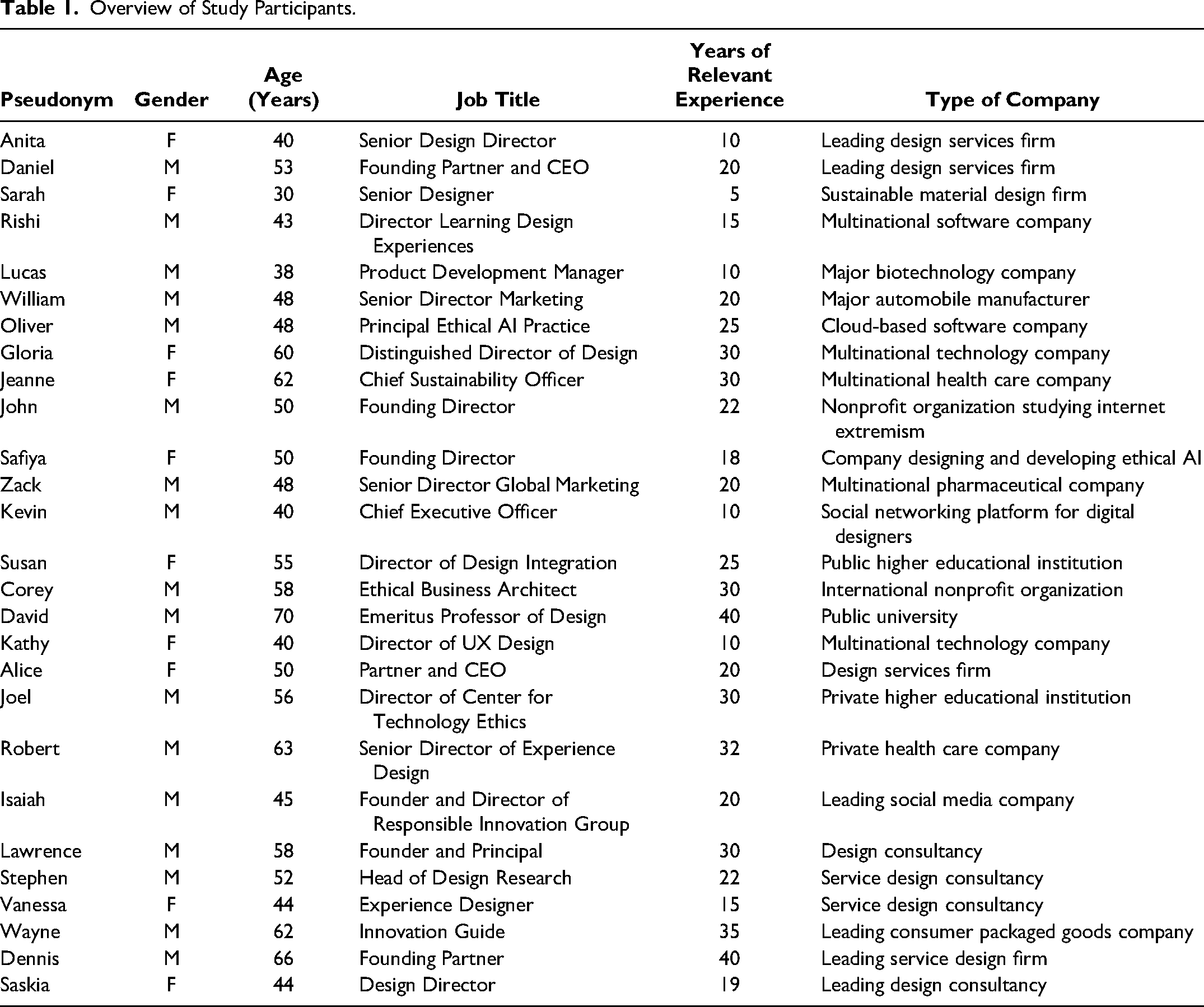
During the interviews, we asked informants about the presence and nature of ethical issues they experienced in the DT process (often following the typical structure of empathize, define, ideate, prototype, and test phases) and their suggestions for mitigating these ethical issues. Given the highly sensitive nature of the topic, we chose to use a combination of closed and open-ended probes. As with most grounded theory studies, the questions were also iteratively amended during data collection (Charmaz 2014; Suddaby 2006) (the interview protocol is reported in Web Appendix B). This flexibility enabled us to explicitly focus on unexpected but relevant issues that emerged during the research. For example, as the importance of including various stakeholders beyond the narrow definition of “user” became clear, we included specific probes on nonusers, groups of users, society, and the environment.
Due to the COVID-19 pandemic, interviews were conducted via Zoom between 2020 and 2022, with each session averaging 75 minutes. Follow-up interviews or exchanges via email were used for clarification. Some informants hesitated to share company-specific examples, but we reassured them about anonymity and adhered to strict IRB protocols, reframing questions to avoid specificity. To explore ethical tensions, we focused on points where ethical considerations conflicted with personal, business, or strategic interests. Interviews continued until theoretical saturation was achieved (Stigliani and Ravasi 2012).
When given permission to do so, Zoom interviews were recorded and the automatically generated transcripts were then rechecked for accuracy and completeness. However, many participants were reluctant to have their interviews recorded, given the highly sensitive nature of some of the topics. In these instances, we took notes and captured as much of the conversation as possible verbatim. When two coauthors were available, one conducted the interview, and the other took notes. Notes were expanded after the interviews to achieve a recounting of “what exactly was said” (Emerson, Fretz, and Shaw 2011, p. 14). This resulted in about 350 single-spaced pages of interview transcripts and notes that were shared with and read by all coauthors.
Data Analysis
All four authors worked collaboratively to analyze the data using established grounded theory techniques, in line with the Gioia method (Gioia, Corley, and Hamilton 2013; see also Gehman et al. 2018). Data analysis was undertaken in parallel with data collection (Suddaby 2006) and consisted of two parts. In the first, we focused on participants’ perceptions of ethical blind spots in DT as currently practiced and their perceptions of why the blind spots existed. We operationally define ethical blind spots as areas of concern where current DT theory or methods do not offer ways to reflect on or answer questions with ethical content. The analysis began by carefully searching the full set of transcripts for excerpts that specifically related to ethical blind spots and cataloguing them in a master document. Next, we independently open coded all excerpts into first-order codes (Strauss and Corbin 1990). During this process, we each went back to the original transcripts to understand the context of the excerpts. This resulted in a total of 27 thematically distinct codes. At this point, we met to discuss our rationales for the definitions of codes and their respective category assignments.
Given the diverse background of the researchers, these vigorous discussions resulted in the unexpected reclassification and rewording of the first-order codes, changing the assignment of many of the excerpts, and reducing the overall number of codes to 22. Next, we independently combined the 22 first-order codes into broader second-order categories (Strauss and Corbin 1990). After extensive discussions and refinement, we identified nine second-order codes. Throughout the analysis and coding, we constantly compared the evolving theory and the data (Charmaz 2014; Isabella 1990). In so doing, we moved between induction and deduction in our data analysis (Gehman et al. 2018; Suddaby 2006). In addition, at various stages of the analysis, we regularly subjected our interpretations to critiques by expert informants, thereby enhancing the reliability of our analysis. Finally, we applied selective coding to develop a third level of four aggregate dimensions. The final model of ethical blind spots in DT is shown in Figure 1.
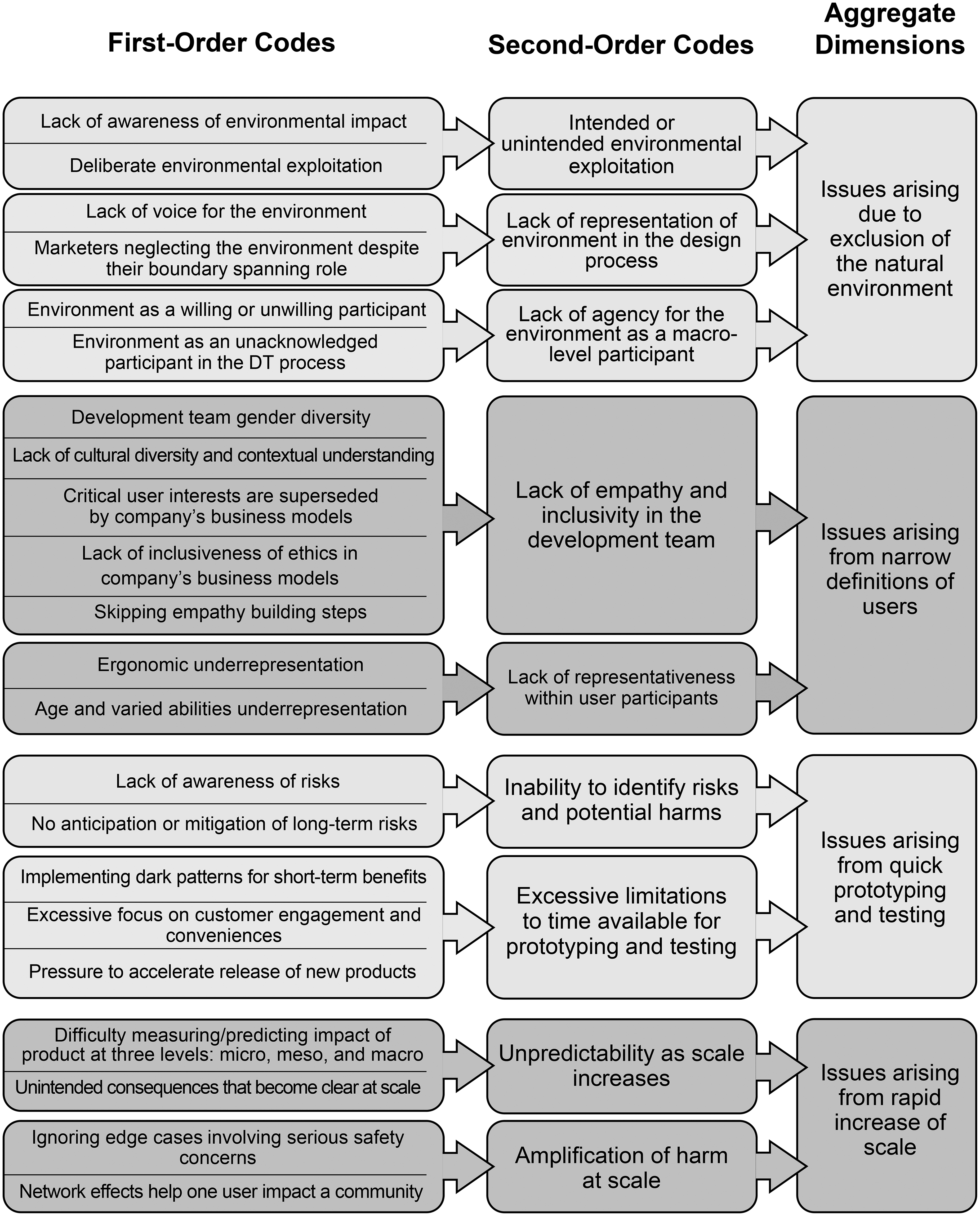
Data Structure: Ethical Blind Spots in Design Thinking.
In the second part of the analysis, our goal was to understand how participants thought the blind spots could be mitigated. When interviewees mentioned information they described as public knowledge, we attempted to verify it by searching for relevant news articles. We also compared our themes and theory with the design books we reviewed to search for tools and practices that might help address these ethical concerns. As we looked for the blind spots, by individually searching through the full set of transcripts, we identified 76 excerpts that specifically related to mitigating the ethical blind spots we had identified and catalogued them in a master document. A process similar to the first step of the analysis was followed to code the data. The data structure that represents the main responsible design thinking capabilities is reported in Figure 2.
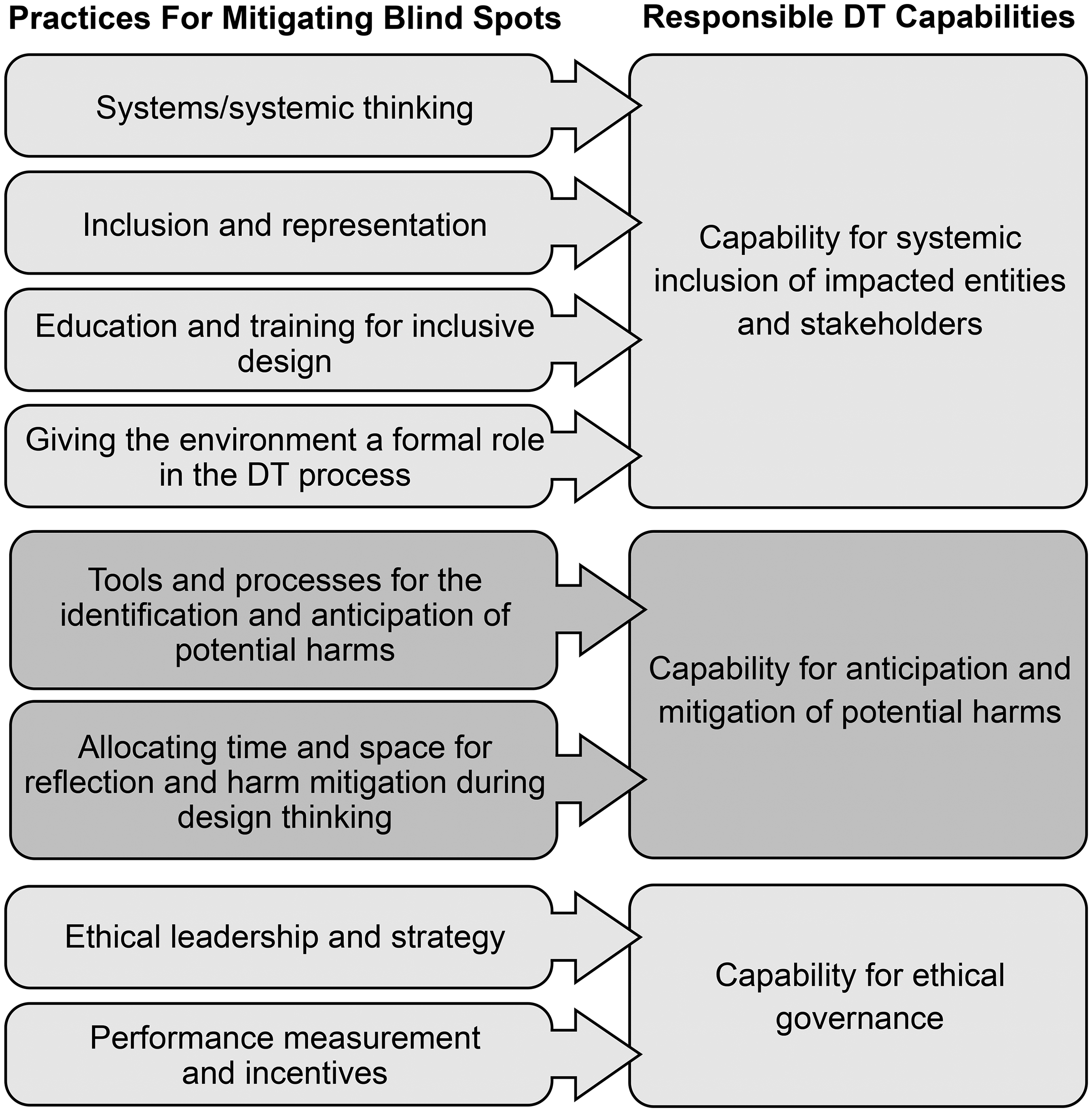
Data Structure: Capabilities for Responsible Design Thinking.
Throughout the process, we incorporated concepts drawn from our chosen ethics frameworks—deontology, teleology and care ethics—in the analysis of the data. Initially, we developed inductive codes around blind spots and capabilities. Once these themes had emerged, we engaged in an interpretive phase where ethical perspectives served as sensitizing concepts. For example, deontological principles were particularly relevant when interpreting informants’ reflections on duties such as fairness, transparency, and obligation to avoid causing harm. A teleological perspective was especially useful when interpreting statements that weighed the relative effectiveness of different design approaches and their outcomes for users, organizations, or the environment. The care ethics view was helpful in several instances, for example when examining reflections on stakeholder inclusion, empathy, and responsiveness to vulnerable groups. Overall, we did not treat the ethical frameworks as a priori coding categories but as interpretive lenses to enrich and refine our understanding of the emerging themes. Thus, our codes reflect our iterative use of induction and deduction in combining theory and data.
Finally, when collecting and analyzing the data, we aimed to ensure trustworthiness by establishing credibility, transferability, dependability, and confirmability (Flint, Woodruff, and Gardial 2002; Pratt, Kaplan, and Whittington 2020). To enhance credibility, we triangulated across multiple sources, engaged in peer debriefings, and shared preliminary findings with informants. To establish transferability, we created thick descriptions (Pratt, Kaplan, and Whittington 2020) to express the key concepts and relationships through our data. Dependability was established by engaging in stepwise replication as each author independently coded segments of the data and then met to discuss and compare interpretations. To establish confirmability, we kept a detailed record of the raw data, initial notes, data summaries, and coding tables.
Findings
This section consists of three parts. The first identifies ethical blind spots in current DT practice alongside their potential antecedents. The second discusses three capabilities that firms can develop to introduce a responsible design thinking approach. Finally, we present our framework for practicing DT more responsibly together with a case study to illustrate how the deployment of principles and tools in line with the approach proposed in this article can lead to the development of more responsible AI-based product offerings.
Ethical Blind Spots
During the interviews, every informant thought that ethical considerations were not explicitly part of the DT process but should be. Our analysis leads to the identification of four ethical blind spots that should be considered in the DT process. The data structure is reported in Figure 1, and additional evidence is provided in Web Appendix C.
Issues arising due to the exclusion of the natural environment
Interviewees most frequently highlighted the exclusion of the natural environment, describing it as a shared resource and a macro-level participant lacking agency or voice. They emphasized the need for design teams to consider environmental impacts and develop “empathy” and due care for the environment, treating it as though it were a person, as mentioned by the senior director of global marketing at a multinational pharmaceutical company: These last few years, and especially 2020, [have] been clarifying for me personally, especially as it relates to all the environmental disasters that appear to be happening at an unprecedented rate. In our product development work, we have people from R&D, marketing, clinical research, ethics and compliance, manufacturing, etc. All of them are “user-centered” in that they have the best interests of the users. However, there is one person missing from the room: the environment. It lacks representation and is often a silent participant in the process. (Zack)
This quote highlights a significant problem: Despite the worsening climate crisis and several calls in marketing to consider environmental impacts during the design and development of products (Chandy et al. 2021; Plangger et al. 2025; Sheth, Sethia, and Srinivas 2011), the firms in our sample did not include the environment as a stakeholder in the DT process. The examples used by our informants show how the maximization of utility for users and the company, while neglecting the effects on the environment, was particularly evident in industries with long lead times, such as health care and pharmaceutical, where the environmental impacts of new technology are less visible early in the innovation process. These impacts normally become salient during discussions about large-scale manufacturing when it may already be too late to change course. Overall, this omission reflects a broader trend where environmental considerations do not form an integral part of the value creation process in marketing and impacts are framed as externalities (Chandy et al. 2021). From a deontological perspective, the exclusion of the environment from the DT process can be seen as a violation of moral duty, irrespective of the outcome.
Our interviewees had theories about why the environment was insufficiently considered. Some highlighted a general lack of awareness about the natural environment's role in product design. For instance, one informant from a multinational software company explained how its cloud-based technologies consume significant energy, often derived from fossil fuels. However, this environmental impact is not always apparent to the firm's designers and developers: One thing we are not trained to be keenly aware of is: in creating value we also extract value from the ecological environment. Often companies treat the negative ecological effects as “oh that's just externality and we can’t do much about it.” Everyone does it. Even if we get sued or fines are placed on us later, that's just going to be the cost of doing business. … When everyone does it, the negative effects scale to a degree that has enormous ecological implications. (Rishi)
This and other quotes (see Web Appendix C) show that, besides considering environmental impacts as externalities, moral disengagement (“everyone does it”) appears to play an important role in ignoring environmental harms (Ogunfowora et al. 2022). The negative consequences (e.g., fines, getting sued) are assumed as costs and weighed against the benefits for what seem to be more relevant stakeholders. Several informants also reflected that DT teams are not always conscious of the fact that environmental resources are used in the value creation process without “expressing consent.” In this sense, the environment is an actor in the design process, but without agency. The distinguished director of design at a multinational technology company raised fairness concerns toward considering the environment as a passive provider of free resources: We get a lot of skepticism from our clients when we present designs for our sustainable business model canvas where costs are associated with environmental goals. After all, everyone uses environmental resources and gets paid by their employers. Doesn’t the environment deserve to be paid too? Most leaders in organizations don’t care about this or often engage in lip service as they are unable to feel the long-term ecological consequences themselves. (Gloria)
The previous quote highlights informants’ concerns that the environment is unfairly treated, lacking compensation and replenishment in the DT process. Adopting a care ethics stance would further challenge the notion that stakeholders must be able to speak to matter and compel designers to recognize their relational responsibility toward nonhuman entities. According to most interviewees, neglecting environmental consequences stems from the lack of environmental measures and misaligned priorities. Although some cited deliberate environmental harm, most raised issues like greenwashing and wasteful introductions of new products, as illustrated by the director of user experience design at a multinational company, who took a teleological stance: During a design thinking session at [leading smartphone manufacturer], our head for environment and social policy raised a key issue about us making great tech, fantastic user interfaces, wonderful user experiences every two years, but seriously do we need to put out new phones so frequently? I know many people in the team who were not happy when this was brought up. … We know how much of it goes to landfills despite our own recycling program and the programs third parties have designed. We take so much from the environment to generate the revenues and profits but have very rudimentary understanding of how much impact we have on it. (Kathy)
While reiterating the superficial understanding of the environmental impact, this quote underscores the ethical tension between user-centered innovation (providing “fantastic user interfaces, wonderful user experiences every two years”), founded in DT's empathic stance, and environmental sustainability. The reluctance of the team members to address the concern of introducing new products too frequently reflects a broader trend where market pressures and consumer demand take precedence over ecological considerations.
Issues arising from narrow definitions of users
Although DT explicitly considers the needs, preferences, and experiences of end users, many informants expressed concerns about the limited guidance provided on addressing the needs of other stakeholders—individuals, groups, or organizations—that can impact or be impacted by the product (Freeman et al. 2010). In addition, interviewees questioned the labeling of external actors, noting that terms like “users,” “customers,” and “consumers” are often conflated despite having distinct connotations. Some informants identified “users” as those individuals directly impacted by the product, “customers” as those paying for it, and “consumers” as the general population. Others advocated the term “human-centered” (rather than “user-centered”) to capture a broader set of stakeholders and emphasize social responsibility. Nearly all agreed that these terms should not be used interchangeably, as they trigger different approaches. In addition, the use of terms like “customer-oriented” or “user-oriented” might narrow the team's focus, causing them to overlook interconnections among stakeholders who could be harmed by the product. The founding director of a company developing ethical AI offered a teleological perspective on this: DT's emphasis on users who benefit from an offering is fine, but how about when user needs or preferences for one group necessarily harm the other? For instance, gene-editing technology (CRISPR) provides us with incredible opportunities to change humans’ biological and physiological characteristics, eradicate diseases, and make significant increases to lifespan. As a thought experiment, consider a company that uses the DT process to develop a niche and expensive service that allows their target personas (wealthy suburban couples) to have better looking, more athletic, healthier, and smarter offspring. Although such a product has the potential to create tremendous value for its target users or market, it will also create a biological divide along socioeconomic lines that will dwarf current disparities in wealth, opportunity, and access. (Safiya)
This passage emphasizes how new technologies can narrowly benefit one set of users who can afford them to the detriment of nonusers. This situation poses further ethical questions, such as how to account for inequities, ensure equitable access to new technologies, and develop an overarching ethical framework to anticipate and manage long-term societal consequences (Baylis 2019). In this regard, care ethics (Held 2005) offers a useful lens to understand the moral obligations of designers, toward not only individual users but also those indirectly affected or excluded by design choices. In so doing, it challenges the notion that DT can be regarded as a morally neutral process, as mentioned by several interviewees; for example: DT as a process cannot be packaged as something that is morally neutral. [For example,] customer orientation is critical to create customer satisfaction and customer retention, but every so often the customers involved in your design process want very morally questionable things. I present to you ashleymadison.com. You cannot always cater to what users want in the name of making an extra dime for your business. (David)
2
David's comment reflects previous calls for the inclusion of moral considerations of multiple stakeholders’ needs along with the importance of understanding physical, emotional, and intellectual needs of direct users. Similarly, Von Thienen, Clancey, and Meinel (2019, p. 28) argue that “a designed product satisfies civilized needs when typical forms of product usage entail morally acceptable behaviour,” highlighting the need for a broader societal perspective to guide DT teams in their pursuit of a more ethically responsible approach to value creation.
Besides concerns over terminology and whether and how to address users’ needs, many informants noted that diversity of backgrounds, lived experiences, and worldviews in the design team is advocated for but not always practiced, which can lead to understanding and addressing the needs of a narrow set of users. DT offers representational tools to generate insights regarding stakeholders’ needs and to identify a variety of use cases, either beneficial or harmful. These include empathy maps, journey maps, and personas (archetypal representations of individuals that capture demographic attributes, individuals’ aims and lived experiences [Micheli et al. 2019]). However, these tools may fall short in identifying unintended consequences if the diversity in the product development team and among users testing the product is low. Additionally, this may lead to a narrow and atomized view of stakeholders and a poor understanding of the relationships among them, as suggested by the founder of a design consultancy: [DT] does not explicitly recognize that the system includes a wide range of interconnected stakeholders such as users, nonusers, suppliers, firms, and other government and nongovernmental entities. User needs and their fulfillment is contingent on value delivery by complex sets of stakeholders in the value creation and delivery ecosystem. Too often, design thinkers … tend to see users and customer needs existing in a vacuum for which specific technological solutions can be created and profits can be recouped. (Lawrence)
Issues arising from quick prototyping and testing
The concerns raised in the previous section primarily arose in relation to the initial stages of the DT process; others were mentioned in connection to later stages, particularly concerning prototyping and testing. DT's emphasis on rapid iteration often aligns with Silicon Valley's “move fast and break things” mentality. For example, IBM research found that DT and agile techniques could reduce time to market by 50% (Brown 2018). However, most interviewees highlighted that quick prototyping alongside resource constraints, time pressures, and managerial impatience acted as barriers to thoroughly addressing user needs and identifying potential harms. For example, Alice, the CEO of a service design firm, complained, “There is always an overemphasis on prototyping, testing, and speed to market as opposed to studying user needs and behavior in a deep manner” (see also Anita's comment in Web Appendix C about skipping important steps to rush products to market). Informants also raised concerns about long-term risks for users and nonusers, as emphasized by the founder of a responsible innovation group at a leading social media company: [We focus on] quick prototyping, quick testing, quick understanding of benefits to the user and maybe some understanding of the risks, you know, to the user, but it's already short term and it's a small sample size … what we found is that you don’t really get a full understanding of the scope of the risks of the product, especially for nonusers. (Isaiah)
In such situations, the need for the organization to reduce time to market directly clashed with care ethics (Hamington 2019). Furthermore, we found that DT teams were often either unaware or unable to anticipate most of the long-term risks given the quick nature of their tests. In some cases, the team was aware of the risks but considered them to be insignificant when tested with a few users. Here too, the antecedents were related to lack of education and training about long-term risks of new technologies, time pressures, and misalignment with business priorities. These issues were especially acute in social media firms primarily focused on maximizing engagement. The director of learning design experiences at a multinational software company commented: I was part of the team that was one of the first to design infinite scrolling into a well-known platform. Our goal was to provide the user with as many relevant results as possible while increasing engagement and time spent on the application. We certainly succeeded on count two but not so sure on count one. When searching, most relevant results usually are returned in the first 10–20 items. For some others, such as teenagers on social media who are browsing, a less goal-driven activity, this can result in hours on the device. Great for engagement with murky addictive consequences for the user. (Rishi)
From a teleological perspective, this example shows that although the DT team might intend to provide positive user experiences (abundant relevant results), some unintended consequences (addictive behavior) might ensue, especially in certain contexts and for some user groups (teenagers). The focus on user engagement was regarded as being particularly problematic, but informants also referred to other performance indicators and incentives that may exacerbate this blind spot. For example: My team and I spent a lot of my time at [company], where they had a humongous user research, market research, and product teams, to figure out user needs to work on. And very often people were saying: I want to do the right thing, I want to slow down and mitigate these risks or even think about what the potential risks might be. But that's not what I’m rewarded for when it comes to my biannual performance review, where I can get up to three times my salary as my bonus, depending on what I get on the performance review. The performance review in turn was heavily weighted on how many products I am part of that made it to market that fiscal year. (Isaiah)
In this and similar cases in our sample, the team members might want to mitigate potential risks, but they are tied to performance indicators and bonuses related to cost reduction and speed to market. This directly conflicts with the careful consideration of potential risks and highlights the need to modify reward structures to support more ethical practices. We observed that this pressure to bring new products to markets at the expense of safety for some users was particularly intense in advanced technology companies, such as social media and AI firms.
Issues arising from the rapid increase of scale
DT thrives on the practice of small iterative experiments such that small n is recommended during need identification and testing to represent a large n in the target market (Liedtka 2015). Products and services developed using DT are almost always scaled from an initial, limited set of users to a broader range of individuals. Informants emphasized that scaling is happening at increasingly faster rates, often thanks to technological improvements in automation, robotics, and AI. Although DT teams use phases of inquiry and divergence to learn from the experience of individuals, the aggregate patterns emerging from scale become the basis for systemic change in the marketplace (Hamington 2019). While tests involving small sample sizes create problems of representation, we also observed that they are less effective in unearthing misuses or adverse effects because of limited variations in use cases. Indeed, the amplification of malicious use was a repeated theme in our interviews, as exemplified by this quote from the senior director of global marketing at a multinational pharmaceutical firm: Often it is challenging to foresee how amplified product risks at scale can affect the users and the system as a whole. This is especially true for products that have network effects. Technology, we find, amplifies behaviors. If you want to be antisocial and reach a lot of people, technology allows you to be. The effects of such amplified antisocial behavior are hard to predict and difficult to control. DT currently offers no tools to study the impact or even consider such amplification effects at scale. (Zack)
Our informants mentioned other examples of malicious uses with implications for privacy and health and well-being of users including misinformation about COVID-19 vaccines, livestreaming videos of violent actions, spreading of deep fakes, and bullying on social media (Vaidhyanathan 2018). Importantly, what may appear statistically nonsignificant harms in small n experiments can become disruptive when operating at scale. This is particularly salient when considering the spread of misinformation by social media companies (Vosoughi, Roy, and Aral 2018), which ostensibly creates “communities” but has real consequences. In democratic societies that uphold free speech, individuals and firms may conflate the right to express opinions with the right to broad dissemination, thereby facilitating the propagation of misinformation. The principal of ethical AI practice at a cloud-based software company mentioned: We need to do better as a society to peel back the layers of the disinformation ecosystem. Social media companies often claim that they can’t address abuse on their platform due to the large scale. Studies continue to show that a small number of bad actors drive a disproportionate amount of the abuse. For example, Facebook's own internal research found that 111 users [classified as “edge cases”] are responsible for the majority of [COVID-19] antivaccination misinformation, but the company failed to do anything about it. Social media promised to create community, democratize access to knowledge, and make the world more open and understanding. The reality, however, is far from this ideal. Many social media platforms have become toxic cesspools. (Oliver)
The weaknesses of iterative prototyping and testing with a small n is particularly germane for products that create or use network effects—situations where the value of a product to its users increases as more people use the same platform (Borgatti, Everett, and Johnson 2018). Even though virality, network effects, and network value theories at the dyad, node, and network levels are well researched and understood, we rarely found projects where harmful network effects were explicitly considered in the DT process. As indicated by Kathy, the user experience design director at a leading technology company, “most design thinkers developing digital interfaces and experiences are not trained to be aware of these implications and often tend to act as pixel pushers for their respective companies.”
Network effects expose products to unintended consequences, as firms have less control over who uses the product and how (Katz and Shapiro 1985). Indeed, we found that some product harms were not known to DT team members at the time of development but became clear as scale increased. In other situations, the DT team was aware of potential harms but continued not to act, considering them edge cases, outliers from the mean. As Chandy et al. (2021, p. 3) observe, “averages can conceal variance that is critical to understanding better world outcomes.” In a world of extreme inequality (e.g., in earnings and accessing services and information), a low average ratio of risks over benefits hides heterogeneity in outcomes among consumers. This reliance on averages can impair marketers’ ability to explore and understand asymmetries in gains, losses, and lived experiences in the value creation process. In relation to this blind spot, the antecedents included lack of education and training (with respect to risks associated with increasing scale), time pressures, incentives, and performance indicators. Overall, although we described the four blind spots individually, they did not exist in isolation. For example, a narrow, noninclusive definition of users—one that fails to represent all impacted stakeholders—can limit understanding of both benign and malicious use cases, which may amplify harm to stakeholders and society when combined with rapid scaling.
Summary of the Ethical Blind Spots: Strengths and Weaknesses of DT as Currently Practiced
In our survey of the DT literature, we did not find any ethics-oriented tools that offer guidance on how to identify stakeholders and address ethical tensions among them, include the natural environment, anticipate and mitigate product harms, or help DT team members unpack the benefits or drawbacks of network effects that come with scale. Considering our data, DT appears to be more effective at the micro level to empathetically identify the needs of a small set of target users owing to small-scale studies and tests, even though it can suffer from issues due to lack of diversity of backgrounds, lived experiences, and worldviews in the DT team. In Figure 3, we summarize DT's strengths and weaknesses in identifying risks and benefits for different stakeholders at small or large scale and over varying periods of time. The graphic indicates areas of relatively high (light gray), mediocre (slightly darker), and low efficacy (dark gray) in exercising due care. Given the emphasis of DT on small and quick iterative prototyping and testing, the strengths are also heightened or weakened depending on the time needed to surface harms. It should be noted that understanding environmental impacts is likely to take time, as suggested in Figure 3; however, some impacts might be known early and ignored, as in the cases of wasteful introductions of new products discussed previously.
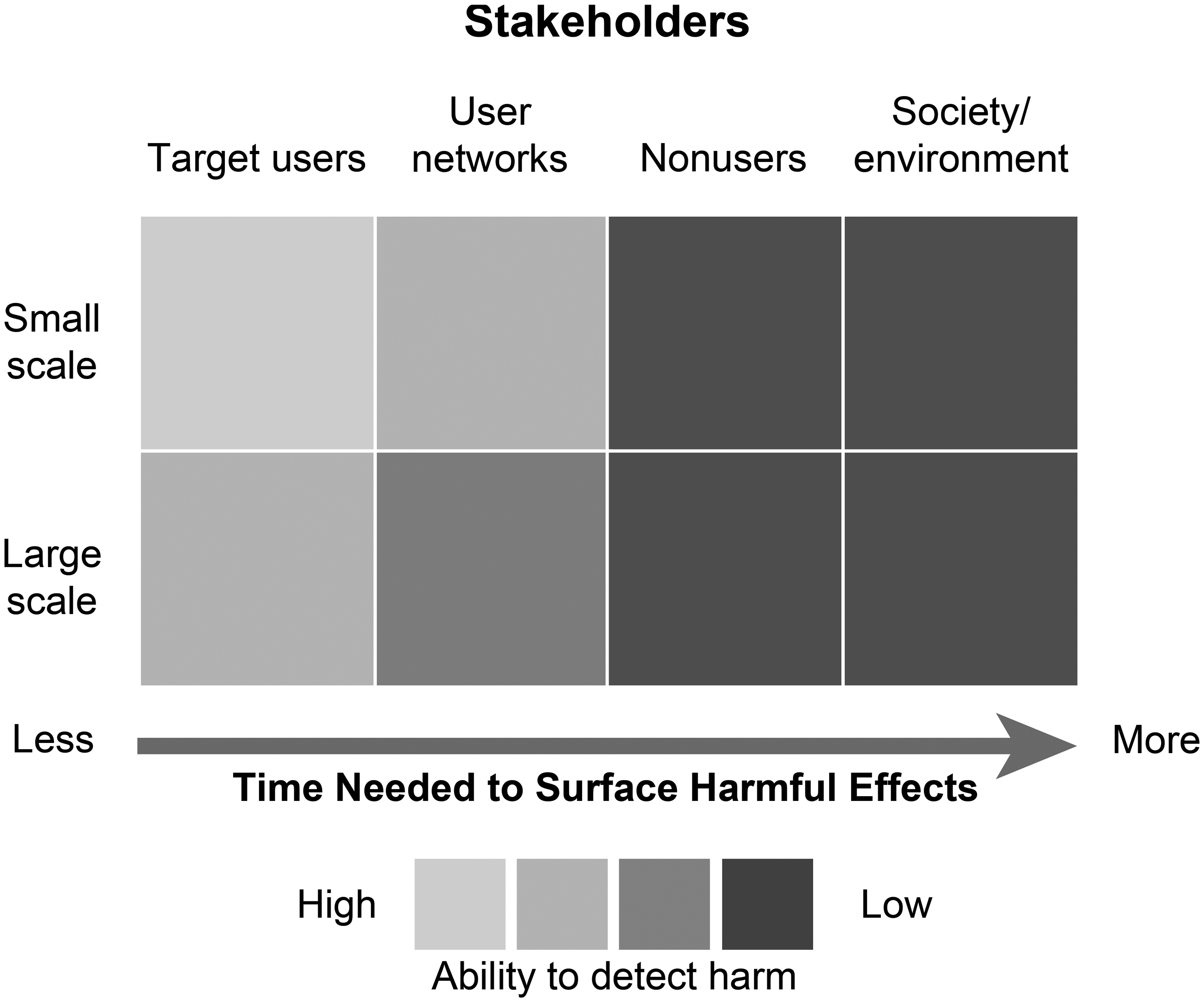
The Potential of DT in Detecting Harms to Different Stakeholders at Varying Levels of Scale and Periods of Time.
Capabilities for Responsible Design Thinking
Following the exploration of ethical issues in relation to DT as currently practiced, the second part of our findings focuses on how ethical considerations could be incorporated in the DT process to mitigate blind spots and weaknesses. Based on our informants’ responses on how to address ethical problems in DT and on our analysis, we identify three capabilities that can help DT teams make more ethics-informed choices (for the data structure, see Figure 2 and for additional quotes, see Web Appendix D). These capabilities consist of practices (e.g., systems, tools, routines) that fall within the realm of DT and organizational elements (e.g., governance, incentives) that may support or conflict with these practices. If these capabilities are sufficiently aligned, they result in responsible design thinking, which we define as a stakeholder-centered problem-solving process that employs systems thinking to help anticipate and mitigate product harm at various levels of scale and is underpinned by ethical governance.
Although this is a general process, we acknowledge differences in firms’ abilities to introduce a more responsibility-oriented practice of DT. This heterogeneity is consistent with the competence-based or resource-based view of firms (Teece, Pisano, and Shuen 1997). In line with what Day (1994) suggested, variations among firms are due to differences in knowledge, anticipatory capabilities, due-care routines, moral reflexivity of decision-makers, and what senior managers consider valued outcomes (Stilgoe, Owen, and Macnaghten 2013; Vink and Koskela-Huotari 2022). In the next sections, we describe each aspect of this approach.
Systemic inclusion of impacted entities and stakeholders
We define this capability as the capacity to establish what constitutes the system, identify its elements (people, processes, policies, etc.), determine how they are connected, prioritize them, and include them in the design process. The following quote refers to efforts undertaken at a leading social media firm to promote a more inclusive approach: We thought of inclusivity in terms of concentric circles. First of all, you have the immediate user of the product. But even that is a massive category because it's like you have a wide range of users, when you have a company like [well-known social media firm] and billions of people using the products every day. You have your average tech bro in Silicon Valley as a user and you have a single mom and shopkeeper in Rwanda as your user. The potential harms to one group are totally different than to another group that team members in a product development team have no awareness of. … Even just teaching the product teams to change the sort of mindset of who we consider in the [main] stakeholder group was a big challenge. Next, you start broadening the conversation with questions such as who might be impacted through primary and secondary effects and include them into your concentric circles. What my team did was to train the development team to broaden their perspective on how they defined stakeholders and understanding about who would be impacted and should be included. (Isaiah)
This quote suggests that, even in the context of mass market products, the inclusion of a variety of stakeholder groups in a methodical manner could lead to a comprehensive understanding of potential consequences and reduce the risk of overlooking ethical considerations. Regarding ways to identify stakeholders and the relationships among them, our informants mentioned different methods, including human-centered systems thinking and the iceberg model,
3
creating antipersonas to surface biases (see Kevin's comment in Web Appendix D), and setting up product councils. For instance, the founder of a design consultancy mentioned: In terms of design process, our belief is that you can’t design for the average, particularly if you are designing a mass market product because you would just get average results. We are always looking for inspiration on the ends of the bell curve for people who have unique needs. So, when we do find these people … we look at a whole wide range of attributes that include different demographic issues such as income, location, where you live, education, background, race, ethnicity, culture, whatever we think are the appropriate psychodemographic characteristics. And when we do our qualitative research, we make sure that we’re not grouping in any one of those areas of attributes, but rather those attributes are being distributed amongst all the people that we’re talking to. … We’re looking for inspiration that can be translated to universal design, not the average solution. (Lawrence)
As noted in the analysis of the blind spots, at the macro level, the natural environment is regarded as an impacted entity without voice or agency. Given the urgency of the climate crisis, most informants emphasized the importance of broadening the notion of “stakeholder” to include environment-related considerations and proposed specific practices. For example, a senior director of global marketing at a multinational pharmaceutical firm argued: As the climate crisis worsens, consumers will shower more dollar love to products that perform more ecological due diligence. I just use two straightforward questions in my team to surface environmental considerations: Do we have a number for the value of the environmental resources we rely on to design, develop, and deliver our products? How are we repaying the environment or reversing these effects we have on it? I give environment a seat at the decision-making table. I find that this simple practice has a profound impact on how far my product leadership and product people go to making the final product ecologically sustainable. (Zack)
The choice of “giving the environment a seat at the decision-making table” not only addresses the question of fairness and accountability but also aligns with growing consumer demand for environmentally responsible practices (Helkkula and Arnould 2022). A vivid illustration is Apple's recent advertisement in which “Mother Nature” is literally given a seat at the table when critical decisions over product development are made (Nudd 2023). Personification of the environment as a stakeholder and being sensitive to product impacts could enable DT teams to empathize with this resource provider. Overall, we posit that the capability of systematically including impacted entities and stakeholders can mitigate the blind spots related to narrow definitions of users and the exclusion of the natural environment.
Anticipate and mitigate potential harms
This capability refers to the use of processes and tools that help identify potential damages arising from product solutions at all levels of scale and to the development of clear pathways to address them. Although this capability is also characteristic of the responsible innovation framework (Stilgoe, Owen, and Macnaghten 2013), limited guidance for application is offered in this respect. In our sample, some firms used different practices to anticipate, identify, and mitigate product-related harms—including questioning, consequence and horizon scanning, red teaming, pilot testing, and the creation of harm mitigation libraries—as described through salient quotes and numerous examples in Table 2.
Examples of Practices to Anticipate and Mitigate Product Harms.
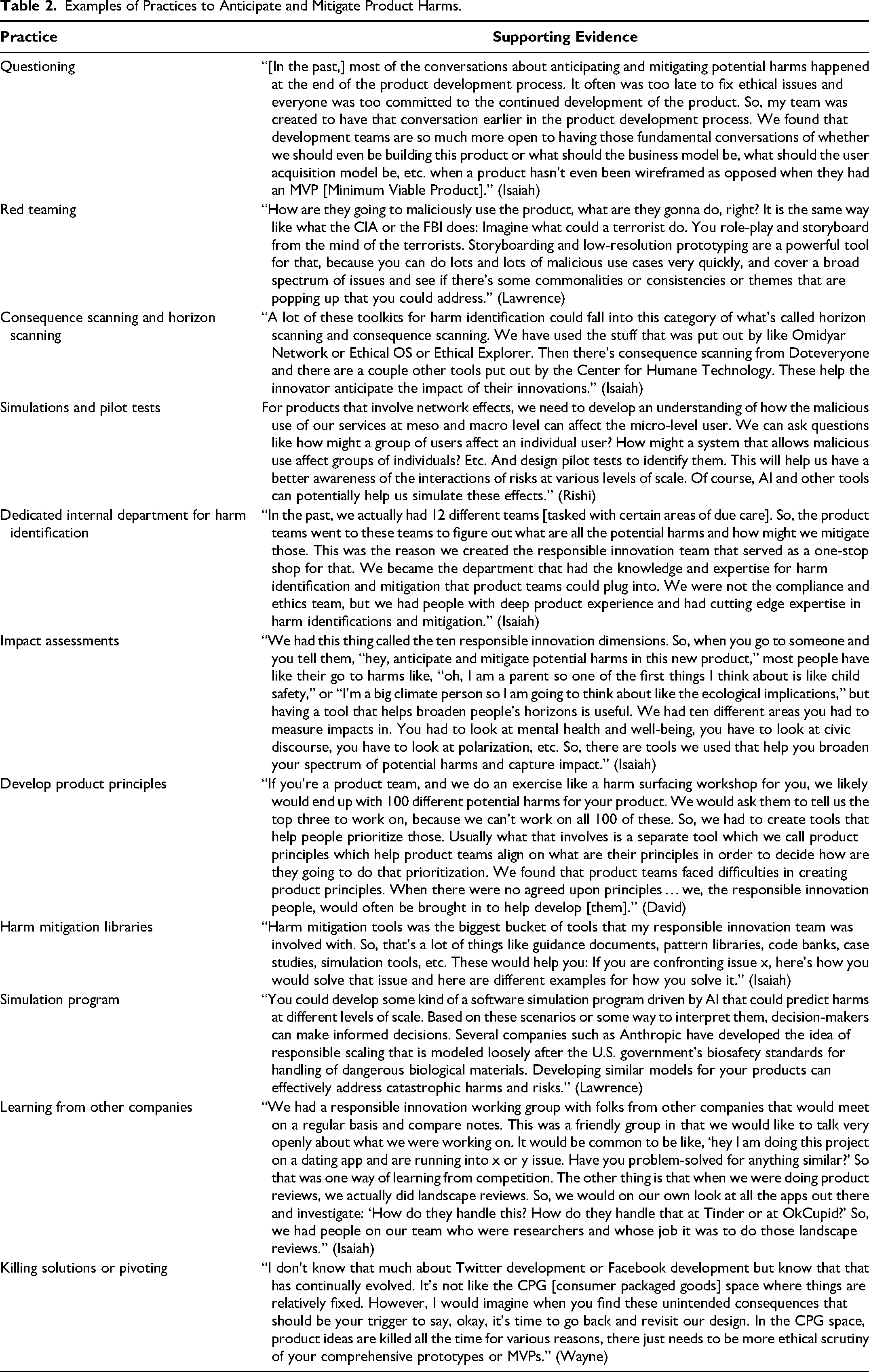
By relying on tools and practices like those mentioned in Table 2, DT teams can develop a comprehensive assessment of potential harms and identify ways to mitigate them. Being able to anticipate unintended consequences is not only likely to enhance utilitarian benefits but it is also an obligation toward society (Andrews 2024). This is particularly important because any technology or product has the potential to be misused or have deleterious effects. In addition, if these issues are not addressed, DT professionals might become morally disengaged in the long term (Ogunfowora et al. 2022).
As some interviewees noted, once the harms are known, firms can mitigate them through responsible scaling and by creating appropriate affordances (Leonardi and Vaast 2017), making the potential malicious uses less likely, as the following quote elaborates: The idea of affordances is an old one in the field of design. Marketers should learn what the term means and help design products such that users are able to accomplish tasks easily and there are cues to help them accomplish those intended tasks. Once unintended or malicious uses are identified, we need to build in systems that make that type of usage impossible or unlikely. Such practices not only increase the safety of the product but also help gain users’ trust. (David)
Several informants also argued that, especially during the latter part of the product development process, DT teams need to thoroughly test the potential impacts of the product on the identified stakeholders and exercise due care, as exemplified by the following quote from the head of design research at a service design consultancy: You can prototype scale by doing pilots and seeing what kinds of trends you’re picking up as your solution scales up. This will get you some kind of indication. Pilots won’t give you 100% confidence, but they can give you stronger and stronger indications of what is likely to happen as you do higher fidelity iterations of the solutions. The more iterations you do to mitigate harms matching different levels of scale the more robust your product will be and less prone to class-action lawsuits. I mean, just look at what happened to Purdue Pharma and Juul. (Stephen)
Beyond the practices mentioned previously and shown in Table 2, allocating time and space for reflection and harm mitigation throughout the DT process was also regarded as an essential element of overcoming the blind spots of DT: Design thinking has two parts in its name: design and thinking. There are lots of tools out there for designing but few to tell you when and how to critically think about designing. Even though DT is a learn-by-doing type of process, we need to reemphasize the need for thinking through various ethical, unethical, and gray-area choices in the process. I find that the balance of time for thinking and reflection on whether our design choices align with the firm's stated mission versus doing is heavily lopsided toward doing. (Rishi)
This quote effectively highlights the importance of deliberation and careful normative reflection, which are particularly salient in Rishi's work environment: the cloud-based software industry where products scale very quickly. This aligns with research in ethics that suggests normative thinking (relying on ethical obligations, stakeholder interests, and organizational frameworks) enhances ethical decision-making (Arkan et al. 2023). Incorporating critical thinking during the DT process by embracing divergent perspectives, competing viewpoints, diverse value systems, and alternative courses of action could enhance accountability and lead to ethical outcomes for a new product.
Overall, we posit that developing capabilities for harm anticipation and mitigation—supported by deliberate reflection, comprehensive assessment, and piloting—are critical to avoid the blind spots resulting from quick prototyping and testing and rapid scaling.
Ethical governance
Whereas the previous two capabilities are directly linked to the DT process itself, this capability is related to organizational factors. Many informants vigorously argued that DT professionals often have limited influence on decisions related to organizational strategies and structures and are often relegated to instrumental roles. For example, an experience designer working at a service design consultancy stated: You can’t be customer centered from bottom up without structures and support from the top, can you? So, you can’t have teams down here saying we’re going to be customer centered, and we’re going to be ethically designing even if it hurts the business bottom line. That is almost impossible if you don’t really have buy-in from the top, right? Which means everything's on the table, including the business model. … It takes an organizational shift in thinking. (Vanessa)
Similarly, informants mentioned that when a company's business model clashed with the interests of some users, the decision was often made to develop the product anyway. In our sample, such deliberate but ethically questionable choices from a due-care perspective happened in companies whose business models had user engagement, time to market, and financial returns at their heart. A director at a leading design consultancy commented: Consulting with social media companies to develop new products and service design features using the DT process has made me realize the fundamental tension between the free-to-the-user services, freemium, and engagement- and advertising-based business models. A business model that preys on human attention in the name of engagement means that users’ attention is more valuable than trying to make them responsible citizens trying to deal with real problems such as climate change, pandemic, health care, education etc. (Alice)
As expressed in the preceding quotes, governance can play a critical role in the ethical orientation of DT teams. We define this capability as the capacity of the firm's senior managers to create and implement principled strategy, governance structures, and incentives for product innovation. According to several informants, a key aspect in this sense is the senior management team's inclusion of ethics as part of its strategic discussions as well as reflections on their own values and principles. Our respondents mentioned that there will always be leaders in organizations that will adopt a “buyer beware” stance, thereby engaging in consumer responsibilization (Giesler and Veresiu 2014). Such an approach is likely to undermine the goals of responsible DT by shifting ethical accountability away from the firm and onto the consumer. Moreover, in line with research indicating a clear gap between the strategy and the ethical obligations of corporations (McManus 2011), interviewees recounted negative examples where ethical concerns were relegated to operational matters. For example, Wayne, who had an extensive background as a DT coach, argued: Ethics need to be in the strategy conversations. For example, a common strategy conversation goes like this: “Hey, folks, you know we can’t afford to completely recapitalize this business, right?” … “We are moving from synthetic materials to naturally sourced materials” becomes just a design constraint. When [we start from design constraints,] it's harder to move us backwards in that journey. Then the conversation becomes that there are materials out there that are out of bounds. So, I think environmental sustainability issues need to be dealt [with] in these strategy discussions to make it really clear to the design team what the ethics of the organization are, and then they can work within that strategy framework. (Wayne) It's a change in how performance is measured … You’ve got to add metrics that are customer experience focused, not just customer satisfaction, you have to come up with true experiential metrics. … And then your bonus structure has to be based on that, and it's not just number of new sign-ins or conversions, there has to be a different way of looking at how we are measuring our KPIs from profit and socioecological impact perspectives. (Vanessa)
The quote underscores the importance of rethinking how performance is measured by including a wider set of indicators and linking them to reward systems. For example, setting key consequence indices (KCIs) (Taneja and Maney 2022) and associated targets and incentives along with more traditional key performance indices (KPIs) could help practitioners embed a responsible DT approach. The adoption of a more reflexive stance, particularly by senior managers, would be particularly helpful too (Stilgoe, Owen, and Macnaghten 2013) (see also Figure 3). Overall, we regard this capability as critical to incorporate ethical considerations in the DT process.
In summary, our findings suggest that the capability of systemic inclusion of impacted entities and stakeholders can mitigate the blind spots related to narrow definitions of users and the exclusion of the natural environment. The capability of anticipation and mitigation of potential harms can reduce the negative effects of the blind spots deriving from quick prototyping and testing and the rapid increase of scale. Finally, ethical governance can help overcome all the identified blind spots. In the next section, we present in detail a novel, more responsible approach to DT.
Adopting a Responsible Design Thinking Approach
Integrating our findings with extant research and drawing on the work of MacInnis (2011) on conceptual contributions, in this research we envision and explicate a new approach: responsible design thinking (see Figure 4). The left side of the figure considers the purpose of the project (e.g., if the company is a design service provider) or the organization. The middle section reports the typical five stages of the DT process but highlights the relevance of the capabilities identified in this research and connects them with the respective ethical blind spots they address (for the relative coding structures, see Figures 2 and 3). At the empathize and define stages, it is essential to systematically consider and include all principal impacted entities, such as various types of users and nonusers and the environment. This enables the use of a deontological lens by recognizing and respecting the inherent rights of all stakeholders, independent of the outcomes, and helps mitigate ethical blind spots arising from overly narrow definition of “the user.” From a teleological point of view, it is essential to scrutinize whether new products are necessary or risk creating waste or unintended harm. In the later prototyping and testing stages of DT, the blind spots necessitate teams to reduce harm and mitigate risks thereby allowing them to practice due care, particularly as products scale. The right side of the figure encapsulates the outcome of the process: The creation of an ethical product that, in addition to being reviewed against the initial purpose, should be evaluated through an integrated lens of deontology (respecting rights and duties), teleology (considering consequences and utility), and care ethics (nurturing context-sensitive relationships and responsibilities). Finally, as indicated at the top of the figure, the introduction of governance structures grounded in the same ethical principles is essential for the effective adoption of a responsible DT approach (Ali et al. 2023). On the front end of the responsible DT process, relevant practices include the creation of antipersonas to surface biases, the establishment of product councils, and the explicit inclusion of the natural environment. On the back end, practices include questioning, consequence and horizon scanning, the creation of red teams and a dedicated internal department for harm identification, simulations, and the explicit consideration of network effects.
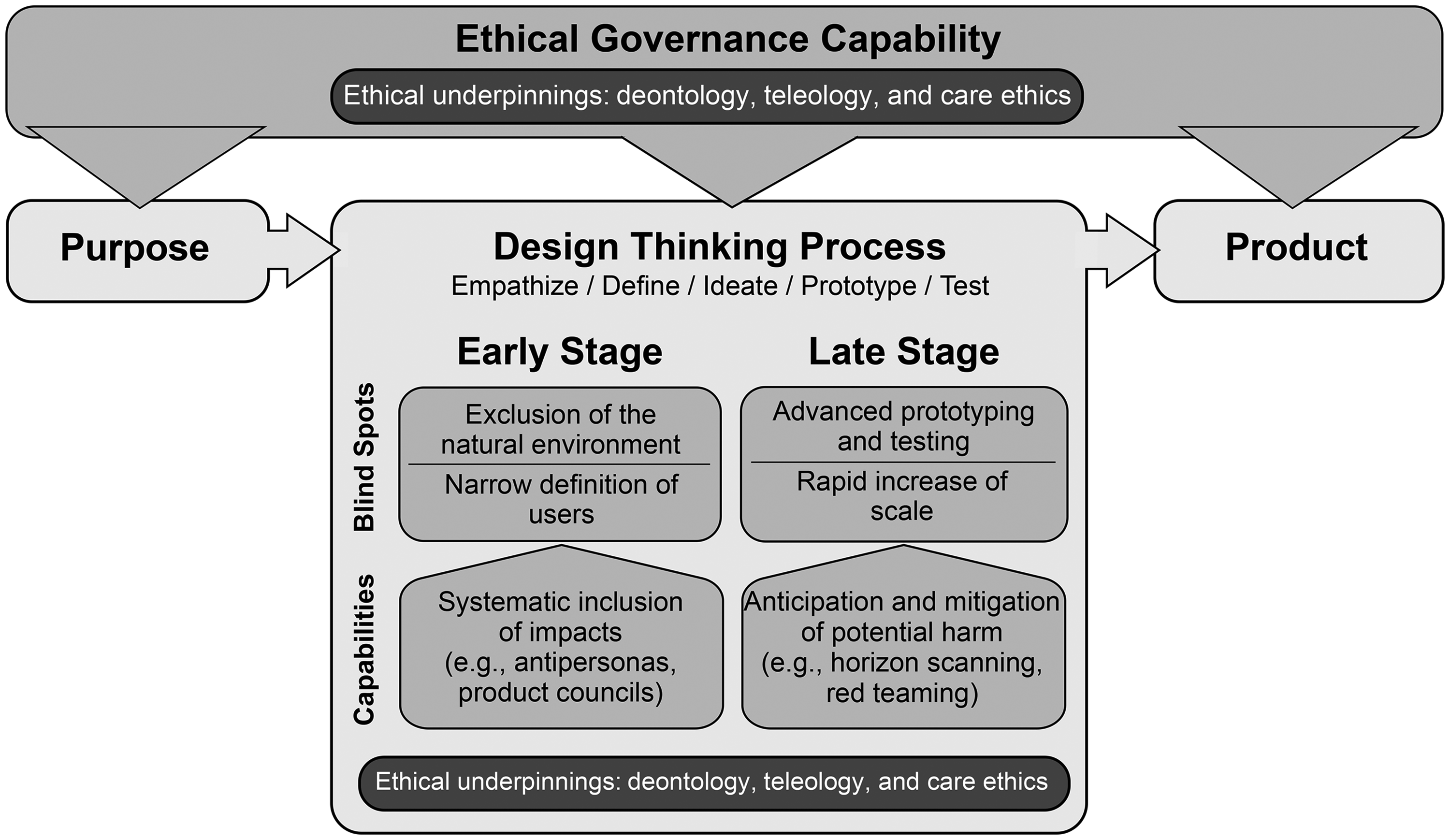
Responsible Design Thinking.
Our review of the literature shows that current conversations on ethics in product development are fragmented across multiple disciplines—including design, marketing, and innovation—and often focus on isolated concepts such as empathy, inclusion, or environmental sustainability. The responsible DT framework proposed here contributes a synthetic vision of ethics in DT by integrating multiple underlying theoretical approaches (deontology, teleology, and care ethics) within the DT paradigm. Rather than treating ethical concerns as afterthoughts, responsible DT embeds them as foundations with the aim of reframing responsibility in DT. In doing so, this approach leverages several existing concepts and tools from DT itself as well as from responsibility frameworks in science and technology studies (Macnaghten and Chilvers 2014; Stilgoe, Owen, and Macnaghten 2013) and aspects of socially responsible design, sustainable marketing, and Better Marketing for a Better World (Chandy et al. 2021; Luchs et al. 2010; Sheth, Sethia, and Srinivas 2011). However, it combines them in a way that is novel, practically applicable, and dynamic, as it highlights the main links between its constituting elements and goes beyond the traditional notion of user-centeredness to explicitly consider the inclusion of a variety of stakeholders, the identification and mitigation of potential harms, and the roles of ethical governance. In the next section, we provide a real-world example of how Salesforce applied practices and tools in line with the responsible DT approach proposed in this research in its product development process using its Einstein GPT generative AI technology.
Salesforce's Application of a Responsible Approach to DT and Product Development
Salesforce is a cloud-based software company headquartered in San Francisco, California. In this section, we examine the role of Salesforce's responsible innovation program in the development of its AI-driven suite of products under the brand Einstein GPT. Information is derived from a publicly available case study (Green et al. 2022) and conversations with knowledgeable informants at the firm, who also allowed us to access the Salesforce Trailhead platform that provides all training on the subject of responsible AI. Even though Salesforce did not use the responsible DT framework discussed in this article (Figure 4), we use its main elements to structure our narrative.
Purpose
In the documents reviewed and the conversations with knowledgeable informants, ethics appeared to be at the heart of Salesforce's purpose (see also Berry et al. 2025). For example, at the beginning of the training modules, Marc Benioff, chairman and co-CEO of Salesforce, is often quoted as saying, “We have to make sure that technology strengthens our societies instead of weakening them. Technology needs to improve the human condition, not undermine it.”
Ethical governance
The senior management team actively sets governance mechanisms and participates in product reviews when necessary. In some instances, the company prioritized ethical concerns over business opportunities; for example when it refused to develop AI products for law enforcement due to potential biases in training data—a stance that contrasts with competitors. Furthermore, Salesforce established the Office of Ethical and Humane Use of Technology, which operates across product, law, policy, and ethics. This office provides regular training and workshops with product developers and designers to ensure that ethical considerations are embedded in the development process.
Systemic inclusion of impacted entities and stakeholders
Ethical guidelines are communicated to employees through a learning platform called Trailhead, which provides a variety of courses. For example, the “Salesforce Ethics by Design” module educates engineers and designers on avoiding biases in relation to stakeholder attributes like race, gender, and age. Another module helps designers, marketers, and developers recognize bias in AI, emphasizing data's roles, the distinctions between ethical and legal considerations, and fostering inclusive AI practices. As an advocate of explainable AI, Salesforce provides end users with clear explanations of its predictions and main predictive factors. Concerning the natural environment, the “Strategy for Sustainable AI” course highlights using right-sized models, efficient hardware, and low-carbon data centers. Smaller, purpose-specific models like Salesforce's Tiny Giant consume less energy while outperforming many larger models. Efficient hardware, such as Google's TPU v5p, and low-carbon data centers minimize environmental impact.
Anticipation and mitigation of potential harms
During the prototyping and testing stages, Salesforce emphasizes building diverse teams and asking domain-specific ethical questions. Designers are encouraged to consider defaults, assumptions, and ways to enhance transparency, whereas engineers focus on fail-safes and harm mitigation. This reflexive approach includes consequence scanning, which introduces “productive friction” by creating checkpoints for teams to pause and assess potential impacts, helping mitigate unintended consequences and identifying positive opportunities. Salesforce uses tools like model metrics (accuracy and performance) and model cards (inputs, outputs, conditions, and ethical considerations) to ensure transparency. Modules cover recognizing biases, employing premortems for interaction bias, and preventing new biases using sociotechnical methods that integrate both technical and social considerations. The Office of Ethical and Humane Use of Technology employs a flagging system (green, yellow, and red) to evaluate whether AI products should proceed, slow down, or stop development. Salesforce also ties performance reviews to KCIs to enhance accountability. Supported by senior managers, dedicated responsible innovation teams coordinate these efforts to ensure rigorous testing, ethical scaling, and responsible product commercialization.
We note that, even though the Office of Ethical and Humane Use of Technology at Salesforce plays a relevant role, it has to advocate for its services to product teams, and this often faces resistance. This aspect highlights the importance of crossfunctional collaboration and senior management sponsorship.
Discussion and Conclusions
DT has become an increasingly popular approach for user-centered problem-solving and innovation. Although its positive effects on financial and nonfinancial performance have been documented (Micheli et al. 2019), DT advocates implicitly assume that a user-centered approach will have ethical outputs for a variety of stakeholders (Ackermann 2023). In this research, we employ a grounded theory approach and find that user-centeredness is not sufficient to ensure the development of ethical products without the explicit consideration of ethical implications for other stakeholders (including nonusers) at various levels of scale (individual, groups, wider society, and the natural environment). Our data show that DT's focus on user-centeredness often leads to neglecting impacts on other stakeholders and, ultimately, to significant socioecological harms. Additionally, we find that DT's reliance on quick, iterative experiments using small sample sizes hinders the anticipation of risks at higher levels of scale. This is particularly problematic in contexts, such as digital media, where products are developed and scaled quickly at low cost to the firm, reaching vast and diverse populations.
Overall, our findings demonstrate that DT, as currently practiced, is ethically underdeveloped and lacks mechanisms to systematically address the blind spots we identified. To help remedy these weaknesses, we develop a novel approach: Responsible design thinking, which promotes the anticipation of harms at various levels of scale—micro (users), meso (groups of users, nonusers, and organizations), and macro (socioecological)—and the consideration of aspects such as network effects and governance structures. In doing so, this research makes several contributions to marketing theory and practice as explained in the following sections.
Beyond User and Customer Centeredness
Similar to customer centeredness, which has been a central tenet of marketing for decades (Narver and Slater 1990), DT prioritizes understanding and addressing users’ wants and needs (Brown 2008). In the DT process, employees are explicitly encouraged to empathically immerse themselves in the users’ context and involve users in cocreating ideas (Liedtka 2015). Our research confirms previous findings in both marketing and innovation literatures by showing that DT can help identify the needs of a small set of users and create value for them. At the same time, it demonstrates how such a user-centered process does not necessarily make a product ethical and may have negative consequences on other relevant stakeholder groups (e.g., nonusers, wider communities, the natural environment). Even though research has shown the benefits of empathy—such as customer satisfaction (Lehnert and Kuehnl 2025), altruism, and several prosocial behaviors (Allard, Dunn, and White 2020; Bagozzi and Moore 1994; Wieseke, Geigenmüller, and Kraus 2012)—and scholars have called for marketing to focus on its “core self … consisting of empathy toward customers” (Pedersen 2021, p. 479), this research highlights that when user-centered, empathic approaches, such as DT, are applied without a systemic lens, they risk reinforcing biases and amplifying inequities. In the context of a typical DT application (Liedtka 2015), the lack of a systemic lens means that the empathize phase would entail engaging with a narrow user group. This would lead to a define phase where the problem to be addressed would only consider the needs of such group, rather than those of a wider set of stakeholders including the environment. This, in turn, would substantially constrain the ideate phase. Finally, this would lead to creating a limited range of prototypes, which would then be tested with a nonrepresentative set of stakeholders in a narrow range of contexts. Overall, this process would also suffer from the lack of identification and mitigation of potential harms and the insufficient consideration of the roles of ethical governance.
As illustrated in Figure 4, to ensure responsible innovation, DT must expand beyond optimizing solutions for users in the short term and integrate ethical principles that account for systemic impact in the long term. Responsible DT, while still being user-centered, recognizes that users are connected, rather than atomized entities, part of a system including the natural environment, and often influenced by social, cultural, and ecological dynamics they may not fully perceive. As illustrated by many informants, users often prioritize instant benefits (e.g., convenience, low cost) while neglecting long-term negative effects (e.g., health risks, long-term dependency). A consequence of DT as currently practiced, is that it tends to emphasize immediate user satisfaction, as in the cases of infinite scrolling and engagement in social media contexts more broadly. Several interviewees also recounted instances of users primarily focusing on their direct personal gains while overlooking social and environmental impacts. Examples include gene-editing techniques and morally questionable services. More widely, although traditional DT enhances individual user experience, it may neglect how pollution, unethical labor practices, and resource depletion ultimately affect society (including the users themselves). A more responsible practice of DT should balance direct user benefits with long-term societal and environmental well-being. From a practical point of view, we recommend that managers create product development teams that reflect diversity in worldviews, experiences, and behaviors and encourage the inclusion of multiple stakeholders, such as extreme users and nonusers, during prototyping and testing, because such practices are key to unearth a wider variety of use cases.
Moreover, our responsible DT framework explicitly recognizes that value extraction from the natural environment is concomitant to value creation activities and does not frame environmental impacts as externalities. While concepts like sustainable innovation (Genç and Di Benedetto 2015) and human-centered design (Norman 2023) are not new, in this research we explicitly advocate for the natural environment to be given “a seat at the table” as a stakeholder in the value creation process. Although this is common to some marketing studies, this research proposes an explicitly ethical framing of the environment as a primary stakeholder in the product development process, even though it has no agency.
This research has significant implications for the conceptualization of market orientation (Kohli and Jaworski 1990) in the context of marketing's value creation function. Marketing is a boundary-spanning function in organizations, as marketers cross the “firm's internal and external customer value-creating business processes and networks for the purposes of satisfying the needs and wants of important stakeholders” (Hult 2011, p. 509). The findings of this research highlight that marketers involved in product development have the unique responsibility of not only representing the voice of the customer but also bringing in wider socioecological concerns (Sheth, Sethia, and Srinivas 2011). If marketers consider the interconnected needs of impacted stakeholders and the natural environment, they will be more likely to anticipate and mitigate product harms (Gupta et al. 2024) and contribute to the creation of products that generate better world outcomes (Chandy et al. 2021; Dahl et al. 2025).
Additionally, responsible DT calls for marketing and innovation leaders to be reflexive about their biases and responsive to changing social circumstances. These aspects have been highlighted also by scholars in the field of responsible innovation (Stilgoe, Owen, and Macnaghten 2013); however, it is important to note that this approach emerged from science and technology studies, and it has been mainly applied to not-for-profit entities (e.g., university-based technology development). Our research focuses on practices introduced in for-profit firms thereby explicitly recognizing the tensions among profit making and broader socioecological responsibilities.
Embedding Harm Anticipation into DT
Marketing and innovation scholars have investigated product harms; for example, in relation to the unintended consequences of marketing choices, often arising out of ignorance, error, ideology, and complexity (e.g., Laczniak 2017). At the same time, product harms have often been treated as externalities despite the centrality of concepts like empathy and customer-centeredness (Spanjol et al. 2024). Although approaches like strategic foresight have existed in strategy and innovation management for a long time (Ehls et al. 2022), the ability to anticipate product harms and mitigate them within the product development process has not received sufficient attention in marketing. In practice, many firms have invested in iterative approaches, such as DT, to identify potential product harms through rapid testing, and quick prototyping has become the mantra of agile organizations (Rigby, Sutherland, and Takeuchi 2016).
This research suggests that quick prototyping and testing involving small samples, which is typical of DT and human-centered design (Norman 2023), rarely helps to reveal potential product harms or mitigate their consequences, especially as products scale rapidly. Gaps in the product team’s knowledge about the harms to individual users, groups of users, and systems persist when small samples are used, as these create problems of representation and are ineffective in identifying misuses or adverse effects, due to limited variations in use cases. In addition, although it is helpful to iterate and receive feedback, informants recounted many instances in which results from quick prototyping provided a false sense of confidence and led to rushing products to market, eventually creating harm to various groups of stakeholders.
The responsible DT approach we propose explicitly advocates for building capabilities to anticipate and mitigate product harms during the value creation process. Specifically, we recommend a more ethical inclusion of different stakeholders in the earlier stages of the DT process, which also ensures sufficient diversity in the product development team, as well as in prototyping and testing. Moreover, traditional DT tools—such as empathy maps, journey maps, and personas—may be helpful in identifying potential harms to immediate users, but they would need to be complemented by other tools and practices, such as consequence scanning, horizon scanning, impact assessments, ethical hacking, harm mitigation libraries, and simulations.
Adopting responsible DT practices and communicating them to users is also expected to have a positive impact on users’ affective connections with the product and the overall ethical perceptions of a company (Hamington 2019). This can lead to downstream outcomes such as customer loyalty, word of mouth, brand equity, and trust (Sheth, Sethia, and Srinivas 2011). Moreover, as responsibility is more clearly embedded into the DT process, companies’ efforts will be more credible and less susceptible to perceptions of greenwashing. Thus, we expect that firms implementing responsible DT will be able to increase their legitimacy and bolster the social contract they have with the communities they operate in. Although this proposed approach can be applied to any context, it would be particularly relevant in industries where products scale very fast (e.g., software and technology, digital platforms, social media) and where product harms and environmental impacts could be most severe (e.g., biotech, pharmaceuticals, consumer electronics). Moreover, this approach could play a significant role in situations where dual use emerging technologies (generative AI, drones, gene editing, etc.)—whose benefits appear to be considerable, but their harmful effects are unknown or not obvious—are deployed.
At the same time, the inclusion of multiple stakeholders and the deeper consideration of socioecological aspects may increase costs and the duration of projects and reduce an organization's capacity to compete or attract investment. In our research, several informants explicitly mentioned the tension between reducing time to market and the need to ensure due diligence from a harm-prevention perspective. Although this is a legitimate concern that may hinder the adoption of the approach advocated in this research, it should be noted that an excessive focus on short term results may eventually lead to worse outcomes in the long term. Indeed, previous research demonstrates the negative effects of lack of due care on firm-level financial outcomes through product recalls and class-action lawsuits and torts (Van Heerde, Helsen, and Dekimpe 2007).
It is important to emphasize that from an ethics point of view, the choices mentioned previously (e.g., including more or fewer stakeholders or allocating more or less time to the identification of potential harms) cannot be resolved unambiguously but rather depend on how the probability and desirability of the outcomes are perceived. In the case of infinite scrolling, if a design team underestimates the likelihood of negative consequences, the decision to implement certain features to increase engagement may seem justified, despite the ethical risks. Current DT principles, as shown by the examples the informants provided, appear to align more closely with utilitarianism (aiming to maximize positive consequences) (Verbeek 2006), rather than with negative consequentialism, which emphasizes minimizing harm (Knutsson 2021). Furthermore, if the DT team perceives the harm as diffused and indirect rather than immediate and severe, it might rationalize engagement-driven design choices (Jones 1991). In this article, we advocate for these ethical aspects to be explicitly considered part of the responsible DT process, rather than as afterthoughts. For instance, the lack of anticipatory thinking could be mitigated by using tools like consequence and horizon scanning, both of which enable DT teams to explore long-term and unintended effects. The narrow definition of users could be addressed through practices like antipersonas and the explicit consideration of nonusers and the environment. The emphasis on certain aspects to the detriment of others (e.g., engagement vs. users’ well-being) could be reduced by developing new ethical governance structures, as we discuss next.
Bringing Ethics into Governance: KPIs, Incentives, and Strategic Alignment
Scholars have emphasized the importance of relating KPIs to the organization's mission and values (Berry et al. 2025), assessing product impacts (Gupta et al. 2024), and tying measurable outcomes to the organization's reward structure (Plangger et al. 2025) to promote more responsible practices. Our informants also extensively cited aspects related to governance. For instance, many interviewees complained about the constraints DT teams are subject to, as they have limited influence over strategic objectives, performance indicators, and incentives. In addition, specific examples of KPIs and rewards related to speed to market, customer engagement, and cost reduction were mentioned in relation to the release of harmful products.
This research shows that ethical governance should be a core consideration in responsible DT and that new governance structures and measurement tools are required. For example, organizations could adopt new KPIs and KCIs in relation to products’ carbon footprints, environmental impact scores, regulatory and legal violations, social media toxicity, content violation rates, and misinformation spread. These indicators could be applied at the individual, group, and network levels. To be effective, they should be linked to organizational priorities and rewards, otherwise organizations may experience means-end decoupling (Bromley and Powell 2012) whereby policies and tools introduced to respond to external pressures face internal resistance or result in gaming, due to their weak relationship with organizational outcomes. In practice, means-end decoupling could mean selective disclosure for legitimacy purposes or improving certain aspects as measured, but decreasing performance (financial, social, or environmental) overall (Ali et al. 2023). To avoid means-end decoupling, besides creating a coherent system of performance indicators and incentives, organizations may have to adopt more sustainable business models (Bocken et al. 2014) that elevate ethical issues at the strategic level and help embed more responsible approaches to product development.
Conclusion
This research posits that a responsible DT approach will lead to more novel and meaningful product development outcomes for users, while creating value for a larger group of stakeholders. Responsible DT challenges fundamental assumptions underpinning the ethics of user-centered, empathic approaches such as DT, requires the explicit inclusion of the natural environment and other salient stakeholders, and regards harm identification and mitigation as fundamental features of the process. Its successful implementation necessitates the introduction of ethical governance structures. In addition, embedding explicit ethical narratives and practices into DT may require longer development cycles but is likely to reduce product harms, minimize legal and regulatory risks, and protect the company’s reputation. If a responsible DT approach is adopted and ethical issues are included in a firm's strategy discussions, we argue that the three capabilities we identified could become valuable resources to the firm’s long-term survival.
Although we expect these dynamics to be common across a range of organizations, this research is not without limitations. As part of our grounded theory approach, we interviewed expert informants from a diverse set of companies. Survey and experimental studies drawing on our results could be used to further investigate the effects of the three interrelated capabilities on the blind spots we identified. Future research could also consider macro-level aspects—such as market turbulence, technological change, and competitive intensity (Slater and Narver 1994)—because they could influence how easily responsible practices are embedded and sustained. In addition, the diffusion of sustainable business models (Bocken et al. 2014) and responsible consumption practices (Webb, Mohr, and Harris 2008) could act as moderators that influence the effectiveness and diffusion of responsible DT practices across firms. Within companies, specific values, cultural attributes, and orientations (Giorgi, Lockwood, and Glynn 2015) could play important roles in enabling or hindering the implementation of responsible DT. Moreover, future research could examine patterns within and across sectors and focus on industries we did not include, particularly those with less evident aspects of user experience such as defense, oil and gas, and business-to-business contexts more generally.
In addition, we collected data mainly in the context of product development. The applicability of responsible DT to other areas, such as advertising and organizational design, could be explored further. Moreover, we acknowledge that our recommendations for responsible DT may call for changes to ways of operating that could encounter resistance in organizations. Such resistance has the potential to suppress critical discussions around ethics, responsibility, and accountability (Schön 1992). For example, shareholders and senior management teams may oppose extending the duration of projects to better anticipate product harms or introducing KCIs alongside more traditional financial and operational KPIs and linking them to rewards may be opposed. Finally, although we view Salesforce as employing several of the responsible DT practices described in this article to design its AI products (see also Berry et al. 2025), the outcomes are not yet visible. Future studies could investigate further potential positive and negative outcomes and moderating factors.
Overall, this work highlights the importance of considering potential harms at various levels of scale as well as other aspects like network effects and governance structures. Although we wish that responsible DT becomes an established practice, our intention is not to be overly prescriptive. Instead, we advocate for an approach where ethics-oriented inclusion, due care, and governance are practiced during project execution. Designing products for users can be valuable; designing with foresight for harms for impacted stakeholders is better, and designing with responsibility is essential for creating a better world.
Supplemental Material
sj-pdf-1-jmx-10.1177_00222429251396423 - Supplemental material for Responsible Design Thinking
Supplemental material, sj-pdf-1-jmx-10.1177_00222429251396423 for Responsible Design Thinking by Minu Kumar, Pietro Micheli, Jatinder Jit (J.J.) Singh and Neil Goldberg in Journal of Marketing
Footnotes
Acknowledgments
The authors are thankful for the time the respondents provided during the interviews and for the information they shared about sensitive topics. They would also like to thank Ajay Kohli, Eric Arnould, Jeanne Liedtka, Marya Besharov, Sarah Wilner, Anastasiya Zavyalova, colleagues at Warwick Business School, and scholars and practitioners at the 3rd Annual Responsible Innovation Conference at San Francisco State University for their feedback and comments on earlier versions of this article. Finally, the authors are immensely grateful to the JM review team for all the constructive feedback during the development of the article through the review process.
Coeditor
Vanitha Swaminathan
Associate Editor
Amber Marie Epp
Declaration of Conflicting Interests
The author(s) declared no potential conflicts of interest with respect to the research, authorship, and/or publication of this article.
Funding
The author(s) received no financial support for the research, authorship, and/or publication of this article.

Data Availability
An alternative disclosure plan was approved for this article. The data that support the findings of this article are not available; however, anonymized data were shared with the Editor in Chief and Associate Editor.