




Abstract
In this article, the authors define and develop the concept of avant-garde market driving, a process whereby producers transform an industry by rebelling against the status quo as a means of social-industrial critique rather than in response to market demand. Avant-garde market driving is primarily driven by a desire to rebel against the status quo, at the expense of widespread acceptance; it involves a multiplicity of like-minded individuals, such as other producers, intermediaries, and consumers; and it occurs particularly in contexts where like-minded consumers seek hedonic or aesthetic novelty or social distinction. Breaking new ground comes with substantial challenges. How do rebel producers overcome the challenges of introducing radically different products and successfully sustain avant-garde market driving? An analysis of the wine market in France reveals that avant-garde market driving is initiated and sustained by symbolic disruption and vertical collaboration among producers and intermediaries. This process can provide a strategic advantage to smaller, low-status firms. Based on our analysis, the authors provide actionable recommendations for producers and intermediaries who wish to engage in avant-garde market driving.
Keywords
Cubist painting, Bauhaus design, Brutalist architecture, minimalist fashion, New Wave cinema, punk rock, experimental literature, and molecular gastronomy all have created avant-garde movements that brought aesthetic, artistic, or conceptual breakthroughs to challenge established cultural norms and values (Cottington 2013; Poggioli 1981). While the impact of avant-garde movements may not be immediate, over time they can significantly shift consumer taste, building established market niches that exist alongside the traditional market—or, in some cases, reshaping the entire industry. Far from being rare, such movements are pervasive: “Across every creative field, from the fine arts to music, there is invariably an avant-garde movement” (Richardson 2019, p. 1). Avant-garde movements have shaped consumer tastes for art, food, fashion, and many other products, and often these movements are taken up by firms to form sustained challenges to the industry's status quo.
However, producers who initiate or join an avant-garde movement face enormous challenges. Established brands are often better known than newer rivals, have long-standing relationships with retailers, and have cultivated loyal consumers. In addition, launching a product that defies convention may confuse consumers, and such confusion can discourage retailers from stocking unconventional products. Despite these considerable obstacles, avant-garde movements can redefine markets.
We define avant-garde market driving as a process whereby producers transform an industry by rebelling against the status quo as a means of social-industrial critique rather than in response to market demand. Avant-garde market driving exhibits three main traits. First, avant-garde market driving is primarily motivated by a desire to rebel against the status quo, at the expense of widespread acceptance or commercial success. Second, avant-garde market driving involves a multiplicity of like-minded individuals, such as other producers, intermediaries, and consumers. Third, avant-garde market driving occurs particularly in contexts where like-minded consumers seek hedonic or aesthetic novelty that challenges the status quo and provides fodder for building and maintaining social distinction.
We aim to understand the process through which obscure rebel producers create and sustain avant-garde market driving, challenging long-established market icons and transforming parts of the market. How do rebel producers overcome the challenges of introducing new, radically different products and successfully sustain avant-garde market driving?
To address this question, we conducted an ethnographic investigation of the French wine market. Wine has been produced in France for thousands of years, and producers conform to a highly institutionalized system of rules and local regulations (Chauvin 2006; Fourcade 2012; Smith Maguire 2013, 2018). Over the last 20 years, a growing number of rebel producers have chosen to violate long-standing norms and regulations governing winemaking. They challenge conventional winemaking practices and embrace experimentation, offering disruptive market offerings in opposition to conventional taste and existing producers (Legeron 2020). Against the odds, some of these rebel producers have enjoyed remarkable success, and the movement continues to expand, contributing to dramatic change in the French wine market (Mullen 2021). We collected interviews with producers, intermediaries, and consumers; conducted participant observation in physical and online shops (Dion and Borraz 2017); and analyzed primary data from publicly available archival sources and video interviews to understand the process through which firms initiate and sustain avant-garde market driving. We find that firms drive the market through a three-stage process. Rebel producers first challenge the status quo by offering radically different products. Second, intermediaries take up the cause, selecting appropriate products that fit the new perspective, identifying their valuable qualities, and valorizing some producers. Finally, intermediaries activate this new way of valuing products by educating consumers and cultivating a small network of connoisseurs—consumers who enthusiastically embrace the new system for purposes of social distinction.
We contribute to the literature on market driving by introducing and defining the concept of avant-garde market driving and identifying the process of avant-garde market driving. Existing research on market driving has focused on the role of disruptive technologies and innovation in market structure (for a review, see Carpenter [2023], Day [2023], Kohli and Jaworski [2023], and Schweitzer, Malek, and Sarin [2023]). In contrast, we explore a strategy in which firms drive the market through symbolic disruption and innovation, developing fundamentally different criteria for valuing new products. We explore the process through which these new criteria emerge and become established in the market. This process can provide a competitive advantage to smaller, low-status firms.
Second, our results offer new insight into the relationship between firms and other market actors in driving markets. Initially, the research on market-driving strategy focused on the strategy of an individual firm. Recent work has explored how firms engage multiple actors to shape consumer tastes (Humphreys and Carpenter 2018; Maciel and Fischer 2020). For example, producers collaborate horizontally to pool resources and coordinate collectively against established incumbents (Maciel and Fischer 2020). Our analysis reveals that avant-garde market-driving firms collaborate vertically with intermediaries such as retailers in the market to establish new ways of valuing products and conveying those values to consumers. The success of avant-garde market driving depends critically on these vertical relationships.
Conceptual Framework
Market Driving and Avant-Garde Market Driving
Marketing scholarship has distinguished two broadly different approaches to market orientation. Market-driven firms seek to understand customers, share information about customer needs within the firm, and respond to meet those needs (e.g., Kohli and Jaworski 1990; Narver and Slater 1990). Market-driving firms seek to influence consumers and competitors or reshape the structure of the market to gain a competitive advantage (Jaworski, Kohli, and Sahay 2000; Kumar, Scheer, and Kotler 2000). Toyota, FedEx, and Amazon illustrate firms that have successfully embraced a market-driven approach, while Apple, NVIDIA, Uber, and other disruptive innovators are often described as market-driving firms (for a review, see Carpenter [2023], Day [2023], Kohli and Jaworski [2023], and Schweitzer, Malek, and Sarin [2023]).
Market-driving strategies can harness any number of avenues to shape consumer thinking, influence the market structure, and gain a competitive advantage. Previous work on market driving has examined how collaboration (Maciel and Fischer 2020), practice complexification (Dolbec, Arsel, and Aboelenien 2022), ideological differentiation (Dion and Arnould 2011; Ertimur and Coskuner-Balli 2015), and consumer socialization (Pomiès and Arsel 2023) can be successful strategies for shaping tastes and categories. For example, craft beer producers use horizontal ties among firms to establish standards that distinguish craft beers from mass-market offerings, in turn creating a new market niche (e.g., Carroll and Swaminathan 2000; Maciel and Fischer 2020). Baristas established new standards for gourmet coffee in France and introduced a hierarchy in the market by making a distinction between high-brow and low-brow coffee (Pomiès and Arsel 2023). Market actors elaborate on marketplace practices, leading to an increase in product diversity and a proliferation in marketplace meanings (Dolbec, Fischer, and Canniford 2021).
As a complement to these market-driving approaches, we define avant-garde market driving as a process whereby producers transform an industry by rebelling against the status quo as a means of social-industrial critique rather than in response to market demand. Despite their lack of commercial motive, avant-garde movements have significantly changed markets, competitive landscapes, and consumers’ taste in culture industries such as fashion, design, cuisine, visual art, music, dance, or literature. Previous research in organizational sociology and consumer research has illustrated how challengers can transform the status quo through social movements (e.g., Khaire and Wadhwani 2010; Rao, Monin, and Durand 2003; Weijo, Martin, and Arnould 2018). For example, high-status chefs transformed classical French cuisine with the introduction of nouvelle cuisine (Rao, Monin, and Durand 2003), which emerged as a challenge to classical French cuisine. Similarly, Weijo, Martin, and Arnould (2018) enumerate how a group of restaurants upend staid Nordic culinary institutions through Restaurant Day and its attendant social movement.
Avant-garde market driving comes with many challenges and substantial risks. Because products are unconventional, consumers may find them confusing and be unable to value them. Many avant-garde movements in art and literature, for example, met initial confusion and even ridicule. A critic of Pablo Picasso stated in the Washington Times in 1921, “A futurist or cubist takes a canvas and throws on some green paint, then a daub of yellow and then of slush. Next, he makes a few circles, smears all the colors together, adds a few straight lines and labels the whole ‘Broad and Chestnut Streets on a Sunday Afternoon.’ These so-called artists are beyond me” (quoted in Park West Gallery [2019]). A 1911 review from the Salt Lake Tribune is subtitled, “It requires an odd sort of taste to appreciate their crazy drawing” (quoted in Park West Gallery [2019]). Similarly, Moby Dick, which defied novelistic conventions at the time, was largely regarded as a failure, and Marcel Proust's first novel was a flop (Watt 2013).
The challenges of consumer understanding and acceptance have further implications when considered in the aggregate. Because avant-garde products are radically different, consumers may also avoid them due to social risk. Early reviews of Coco Chanel's collection called it “outdated,” and some women were reluctant to wear clothes that broke the mold for women's fashion (George 2011). Retailers and other channels may be reluctant to carry new products if there is uncertainty in consumer demand. Given the nexus of challenges that avant-garde newness creates, a theory of valuation is helpful for understanding how firms overcome these challenges to establish and sustain a new, different market niche.
Valuation
To understand how firms overcome these obstacles, it is helpful to understand how people learn to value goods and services in the marketplace. The sociology of valuation suggests that value is based on an economy of convention—the idea that the value of goods and services is determined by shared understandings and conventions within a society (Callon 1998; Cochoy and Dubuisson-Quellier 2013). Value is socially constructed through collective agreements, practices, awards, and judgments, rather than being purely objective or driven solely by supply and demand (Lamont 2012). This pragmatist approach focuses on the activity of valuation as a means of understanding what people and society value. In our analysis, we draw on two key concepts of the activity of valuation: valuation frames and market work.
Valuation frames
In this view, the market is not only the aggregation of a large number of singular transactions but also the frame defining the rules, the format, and the value of those transactions (Callon 1998). The qualities of goods are understood not as intrinsic, but as the outcomes of an ongoing process of qualification and requalification done by market professionals and consumers (Arsel, Zanette, and Da Rocha Melo 2025; Callon, Méadel, and Vololona 2002; Nøjgaard, Sperti, and Smaniotto 2025; Pomiès and Arsel 2023; Smith Maguire 2013).
In this perspective, the concept of a valuation frame is “a shared cognitive and cultural scheme that organizes the valuation experience” (Bessy and Chauvin 2013, p. 97). Valuation frames provide a structure for guiding actors about how they interpret value. These valuation frames are used, created, and modified by market players. Bessy and Chauvin (2013) characterize the power of valuation of market players according to the nature of the valuation frame they produce. These valuation frames can be more or less distributed/concentrated, more or less general/particular, and more or less durable/ephemeral (Bessy and Chauvin 2013).
In avant-garde market driving, rebel producers challenge old valuation frames, making them useless to value new market offerings. Without a relevant valuation frame, consumers have no basis for evaluating the rebel offerings. We therefore examine how market players can establish rival valuation frames. To do so, we turn to the concept of market work.
Market work
The concept of market work offers insight into the mechanisms through which marketplace actors establish, activate, and sustain a rival valuation frame in the market (Cochoy 2008; Cochoy and Dubuisson-Quellier 2013; Nøjgaard 2023; Nøjgaard, Sperti, and Smaniotto 2025; Pomiès and Arsel 2023). Pomiès and Arsel (2023) identify three types of market work: qualification, captivation, and activation. Qualification occurs when market actors define the qualities of a product and the aspects on which it should be evaluated. As Cochoy and Dubuisson-Quellier (2013, p. 5) elaborate, “The main task of market shaping, framing, or ‘agencing’ (Araujo and Kjellberg 2010) is often to define market goods, to qualify them, to build classifications and criteria according to which they may be ranked and valued.” Captivation refers to market actors attracting and retaining customers through their offerings. Groups such as brand communities, coffee shops, reading groups, and wine clubs capture consumers so that taste and valuation criteria can be further shared and disseminated. Activation occurs when market actors orient customers or others toward a particular disposition, such as evaluating an object aesthetically rather than practically.
Studies on market work have investigated the market work of retailers and activists (Cochoy 2008; Nøjgaard 2023; Pomiès and Arsel 2023). In the introduction of gourmet coffee in France, for instance, baristas qualify new products by educating consumers about the differences between gourmet and traditional coffee as well as the attributes of gourmet coffee, and establishing quality standards for those attributes. Through this process, baristas establish tastes that conform to new standards, reduce complexity, and thus facilitate consumers’ decisions (Pomiès and Arsel 2023). Similarly, Nøjgaard (2023) developed a new theoretical model of consumer activism that shows activists’ practices to change how they govern markets. The study extends our understanding of how objects are systemically valorized and revalorized and how formalized methods of consumer activism can play an important role in such processes.
We draw on valuation frames and market work to understand the process of avant-garde market driving. Our aim is to investigate the market work of intermediaries to establish and activate a rival valuation frame that consumers can use to value avant-garde market offerings, which is essential to sustain avant-garde market driving.
Research Methods
To understand avant-garde market driving, we studied the French wine market (for a detailed presentation of the market, see Web Appendix A). We used an ethnographic approach that combines interviews with different actors in the market, participant observations in physical and online shops, and analysis of press articles (Dion and Borraz 2017; Humphreys and Carpenter 2018).
Data Collection
We conducted 62 interviews (2,961 minutes) over two phases of research for a total of 21 winemakers, 20 intermediaries, and 21 consumers (see Web Appendix B). All interviews were conducted in French. In the first phase, we conducted 38 interviews, each lasting between 25 and 150 minutes. We recruited informants using a snowball technique, where initial key informants helped us to identify further participants. We also reached out by email to key rebel winemakers who were mentioned by intermediaries and consumers in our interviews. With intermediaries such as wine sellers and sommeliers, we raised the issues of market evolution and new trends in consumption, production, and distribution; the choice of the range of products; and selling to customers. With winegrowers, we discussed the organization of distribution and other decisions involved with making the wine (cultivating vines, using fertilizer, adding ingredients). With consumers, we talked about their interest in, consumption of, and choice of wine. With each type of informant, we broached the question of the importance of wines associated with the status quo and if they observed anything new on the market. Following our initial round of interviews and observations, we conducted 24 interviews to collect additional data on successful and unsuccessful attempts to cultivate avant-garde market driving. This included purposive sampling for rebel winemakers who were successful and unsuccessful.
We also compiled primary data from publicly available archival sources, as is common for research, including highly visible professionals who have held prestigious positions in the market (Parmentier and Fischer 2021). We collected video interviews with rebel wine producers in our sample (27 videos; 112 minutes). These archival data were collected from blogs and websites about rebel wine producers, such as Vinofocus and DEGUST’Emoi (See Web Appendix C).
To better understand the role of market work in shaping the market, we undertook 26 participant observations with wine merchants and wineries (Dion and Arnould 2011). We observed 17 wine merchants (see Web Appendix D). We chose mainstream wine sellers that offer wine from independent winegrowers. We introduced ourselves as wine-loving clients looking for a bottle of wine to take to a friend's house for dinner. During our visits, we focused on the interactions with the wine merchant/sommelier: description of the sale chronologically to see how the wine merchant spoke about the wine, how they guided the consumer, and what they said about the appelation, the varietals, and the winegrowers. We took photos that seemed interesting in relation to the theoretical questioning (Becker 1974). We made audio recordings at the end of each visit. Following our visits, we researched the winegrowers mentioned by the wine merchant, visited the websites of distributors and winegrowers (if available), and reviewed news articles on the winegrower. We complemented in-store participant observations with five nonparticipant observations of wine e-stores. For each website, we selected 15 mainstream wines and 15 rebel wines and saved wine descriptions.
Data Analysis
We transcribed the four sets of data (62 interviews, 26 audio recordings following our participant observations, and 27 videos). We analyzed the data using the same coding guidelines and switching between the data and the theory (Srivastava and Hopwood 2009). We used two successive rounds of coding: an open coding to reveal concepts such as different practices associated with market work (e.g., shelf placement, description of winemakers), and then a round of theoretical or axial coding (e.g., status markers) to compare and combine the emerging concepts with the literature.
Saturation of the emergent codes—and, eventually, themes—guided our decisions about data completeness (Saunders et al. 2018). Congruent with prior work, we analyzed data and collected additional interviews until a stable meaning system emerged and new interviews yielded few novel insights. This abductive process allows the development of a theoretical understanding based on the different datasets (Klag and Langley 2013). We went back and forth between the fieldwork and the theory, integrating new elements as work progressed to refine the topic and theoretical understanding (Lipscomb 2012).
Findings
We find that avant-garde market driving emerges through a systematic, three-stage process to establish a rival valuation frame and refine social distinction games. We identify the market work of producers that triggers avant-garde market driving and of intermediaries who sustain it (see Figure 1).
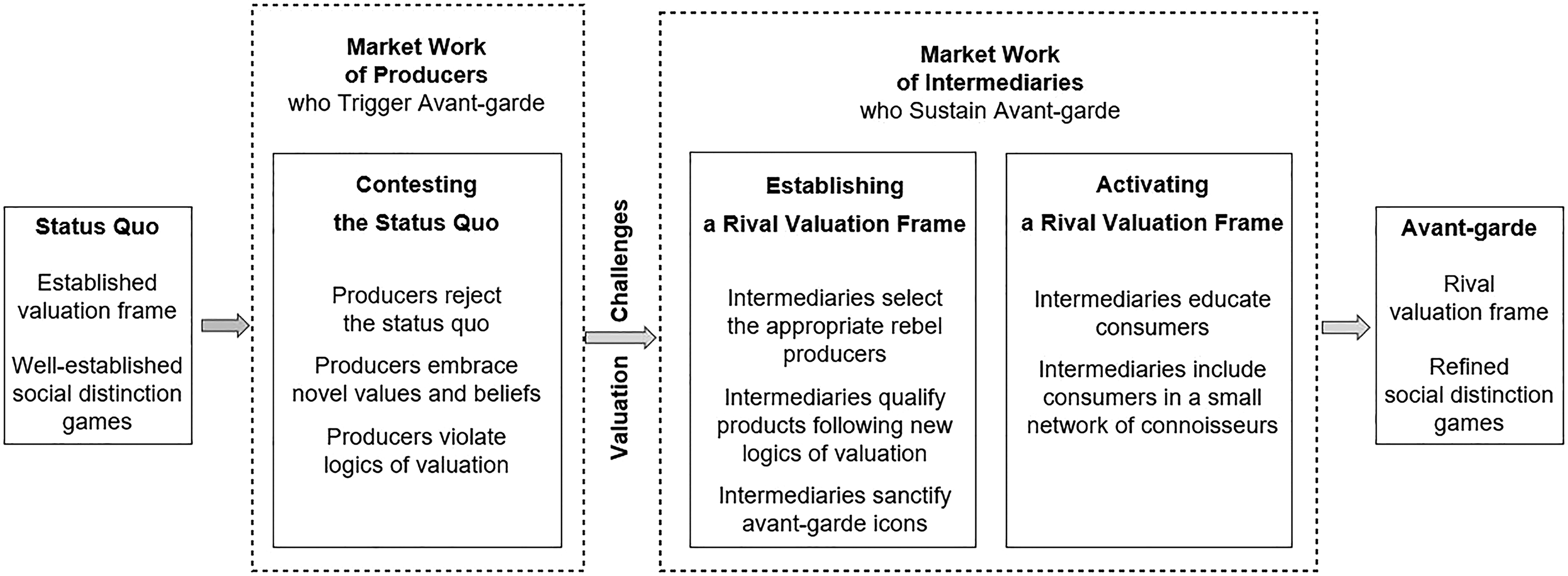
Triggering and Sustaining Avant-Garde Market Driving.
In the first phase, rebel producers contest the status quo. Following a craft logic (Dolbec, Arsel, and Aboelenien 2022), these producers reject the status quo, embrace novel values and beliefs, and create products that violate long-standing market logics of valuation. We use the term “rebel producers” to refer to firms that develop different, oppositional products and practices that, initially, have yet to become recognized as avant-garde. A proliferation of these new products can confuse consumers, who are unable to evaluate them easily. These valuation challenges create strategic opportunities for independent wine merchants to shape consumer thinking and thus become essential to help consumers navigate the market, gaining influence over consumers.
In the second phase, intermediaries establish a rival valuation frame. They select the appropriate rebel producers, qualify products following new logics of valuation, and sanctify new avant-garde icons. Through this process, some rebel producers emerge as avant-garde brands.
In the third phase, intermediaries activate the rival valuation frame by disrupting and stimulating new social distinction dynamics, creating a parallel status structure to the original market. They socialize consumers into appreciating avant-garde brands, stoking their curiosity and taste for novelty. Some consumers who want to express a unique social identity seek out new and different products with the help of intermediaries as guides.
The Status Quo: An Established Valuation Frame
To understand the process that creates and sustains avant-garde market driving, one must first understand the status quo, a system that has been institutionalized over hundreds of years and shaped a standardized, stable, and enduring valuation frame. Since the introduction of wine grapes to France in the 6th century BCE, wine producers discovered that some varieties thrive in some regions but struggle in others. Wines became associated with regions rather than the varietal of grapes used to produce them, and the concept of terroir emerged, the notion that wine is an expression of its natural environment. The essence of the concept of terroir is the belief that certain grape varieties and winemaking methods are best suited to specific environments (Fourcade 2012; Smith Maguire 2013).
Based on the concept of terroir, French authorities have recognized 363 outstanding wine-growing regions, creating the AOC (appellation d’origine contrôlée [“controlled designation of origin”]) system in 1937 (see Web Appendix A). Wine produced within an AOC region is eligible for an AOC designation. An AOC panel tastes wines produced in the appellation; the panel can refuse to grant the AOC label to wines that fail to conform to the organoleptic standards of the appellation (Fourcade 2012). The AOC designation, therefore, ensures wine typicality: The wine is good if it sufficiently represents its appellation (Trébuchet-Breitwiller 2015). A Chablis is a good Chablis if it tastes like a typical Chablis. Over time, a hierarchy of AOCs has emerged, with some gaining more status than others (Chauvin 2006; Smith Maguire 2013).
Over the years, a hierarchy of appellations has been established based on an elaborately stratified cultural field with a well-developed infrastructure of evaluation and a global array of expert assessors, award competitions, and specialist publications producing and circulating conventions for ranking quality and assigning prestige (Karpik 2010; Smith Maguire 2018).
Local, regional, and national trade associations and committees govern the AOC system. Strong social pressure at the local level reinforces the AOC rules. Winemakers who violate the rules are criticized, mocked, and stigmatized, which can be extremely difficult to endure in rural areas. Thus, all market players share the same conception of what constitutes a good wine, which reinforces the established valuation frame and has made the system extremely stable and enduring (Fourcade 2011, 2012; Karpik 2010; Trébuchet-Breitwiller 2015).
The consistency of AOCs is remarkable, apart from variations introduced by weather in different vintages (Trébuchet-Breitwiller 2015). Furthermore, the relative status of producers is remarkably stable, in part due to the terroir-based logic (Fourcade 2011). For example, the first categorization of the top wines of Bordeaux was announced in 1855. Four wines received the top honor as “first growth.” In the years since, only one wine has joined the original elite four (Chauvin 2006). With such stability, consumers can rely on appellations as a key judgment device (Karpik and Dubuisson-Quellier 2013).
The AOC system is crucial for consumers, as it reduces market complexity and enhances goods’ comparability and predictability (Karpik and Dubuisson-Quellier 2013). Intermediaries select wines that are the most typical of each appellation. Diane, a manager for a supermarket chain, explains: When we do tastings to choose our wines, we assess the wines blindly, by appellation. So for example, if we take Chablis, we evaluate the wine in relation to the fact that it is a Chablis. The wine is evaluated on sensory criteria so that it is typical of the appellation. And so we don’t taste a Muscadet in the same way as a Chablis, because the Chablis that we offer in the supermarket must be typical of a Chablis and the Muscadet must be typical of a Muscadet. This is important, because in supermarkets, we do not have the ability to explain to consumers. So you need simple things, because the consumer comes in with input grids that are first the name, and so he can see in relation to that. So consumers know that Chablis is a little bit like that … and they have quite specific expectations regarding each of the appellations.
The AOC also plays a key role in social distinction practices. In France, appreciating a wine is a critical cultural capital that plays an essential role in social distinction games. Wine lovers have to learn the characteristics of each AOC as well as understand how to appreciate and drink the wine. Through long processes of habituation and training, consumers take pride in mastering the complexities of the French culture of AOCs (Fourcade 2011). They need to refine their knowledge of AOCs continuously.
Thus, the AOC system has produced a valuation frame that is remarkable in its concentration, generality, and stability (see Bessy and Chauvin 2013). AOC designations are crucial and well-established judgment devices that frame valuation: They enhance product comparability and increase the predictability of product quality (Karpik and Dubuisson-Quellier 2013). Producers, critics, wine merchants, and consumers share the same understanding of wine characteristics and quality based on the AOC norms and hierarchy (Fourcade 2011, 2012; Trébuchet-Breitwiller 2015). Yet, some producers contest this status quo.
Contesting the Status Quo
Using an alternative craft logic (Dolbec, Arsel, and Aboelenien 2022), some rebel producers contest the status quo. As part of an identity movement (Rao, Monin, and Durand 2003) or reflecting ideological tensions (Press et al. 2014), they embrace novel values and beliefs and create products that violate the established valuation frame.
Producers reject the status quo
In the early 1990s, some rebel producers rejected the practices and logics employed by the status quo, questioning the excessive industrialization of the wine industry. They were especially opposed to the chemicals and all practices that “kill the soil” (using tractors that pack down the soil, removing weeds, etc.) and standardized wine taste (see Press et al. 2014; Smith Maguire and Charters 2021). These rebel producers took risks and opposed the dominant economic and agricultural model. For instance, Didier, who is now considered one of the most emblematic producers of avant-garde wine, explained how he decided to come back to a more “natural” way of cultivating the vine and making wine. He goes on to discuss the social sanctions for violating the norms and values of the status quo. People were pointing at us. They told us, “But what are you doing? Are you falling asleep or what? You need a tractor with wheels, a tractor that pulses! You have to put the vines on a wire, you have to plant Chardonnay, you have to…” … We suffered a bit. We were completely, completely left out. We were the lousy ones! Do you know what lousy is? Well, we were the lousy ones or the boggy ones.
Producers embrace novel values and beliefs
The rebel producers embrace novel values and beliefs based on nature and craftsmanship rather than standardization and productivism (see Lafaye and Thévenot 1993). For instance, Joël, one winemaker we interviewed, describes his goals this way on his website (www.grandjacquet.fr): To be independent, without depending on large groups to market the wines. To live with family and friends, in the middle of the luxuriant nature of the Ventoux, with a know-how, a heritage, a unique art of living which is transmitted naturally and in all conviviality. To obtain wines that respect the vintage, the terroir and that are as natural as possible. To progress and improve constantly, with the desire to make the most of the richness and particularity of the terroir, while respecting the environment, protecting biodiversity, reducing the carbon footprint, and limiting the use of inputs.
Producers violate logics of valuation
Embracing radically different values and beliefs from status quo producers, rebel producers reject the practices that define the status quo. The rebel producers plant grapes differently, process the wine differently, and label their products creatively. Some of them choose to operate outside the AOC system and sell their wines under other designations with limited regulation, such as IGP (indication géographique protégée) or VDF (Vin de France). The IGP and VDF designations are considered the most basic quality tier for wines from France (see Web Appendix A).
By using a low-status designation, rebel producers operate free of AOC regulations, but without the prestige and status that an AOC designation conveys. Unconstrained by AOC regulations and norms, rebel producers can cultivate forgotten varietals, prune their vineyards as they see fit, and craft unconventional blends. Free to experiment and innovate, they produce distinctive wines that express their savoir faire and creativity rather than conventional and typical wines that follow the standards of the valuation frame established by AOC regulations. A blog post published on iDealWine’s website illustrates: Vin de France wines have traditionally been perceived as less prestigious within the hierarchy of wine labels. Yet, for some producers, making wine without an appellation represents the ultimate expression of freedom. Across France, an increasing number of winegrowers are turning their backs on these constraints, opting to produce Vin de France to experiment with new blends or winemaking techniques, or to revive forgotten grape varieties. (Halligan 2019)
Unlike the status quo producers, many rebel producers mention their names only. For example, Hervé Souhault produces several wines, some in the prestigious Saint Joseph AOC appellation and others using the low-status VDF designation. AOC regulations specify the information that producers can provide on a wine label, and the appellation is very important to consumers. However, as Figure 2, Panel A, shows, only the winegrower's name is prominent on the label. Consumers are unaware of the terroir or the grapes, and there is no secondary label providing additional information on the wine. Some winemakers even use no label or name, but only a small drawing on the bottle (see Figure, Panel B). By doing so, the rebel producers use their label as a material device to contest the status quo (see Cochoy and Dubuisson-Quellier 2013; Hennion 2007).
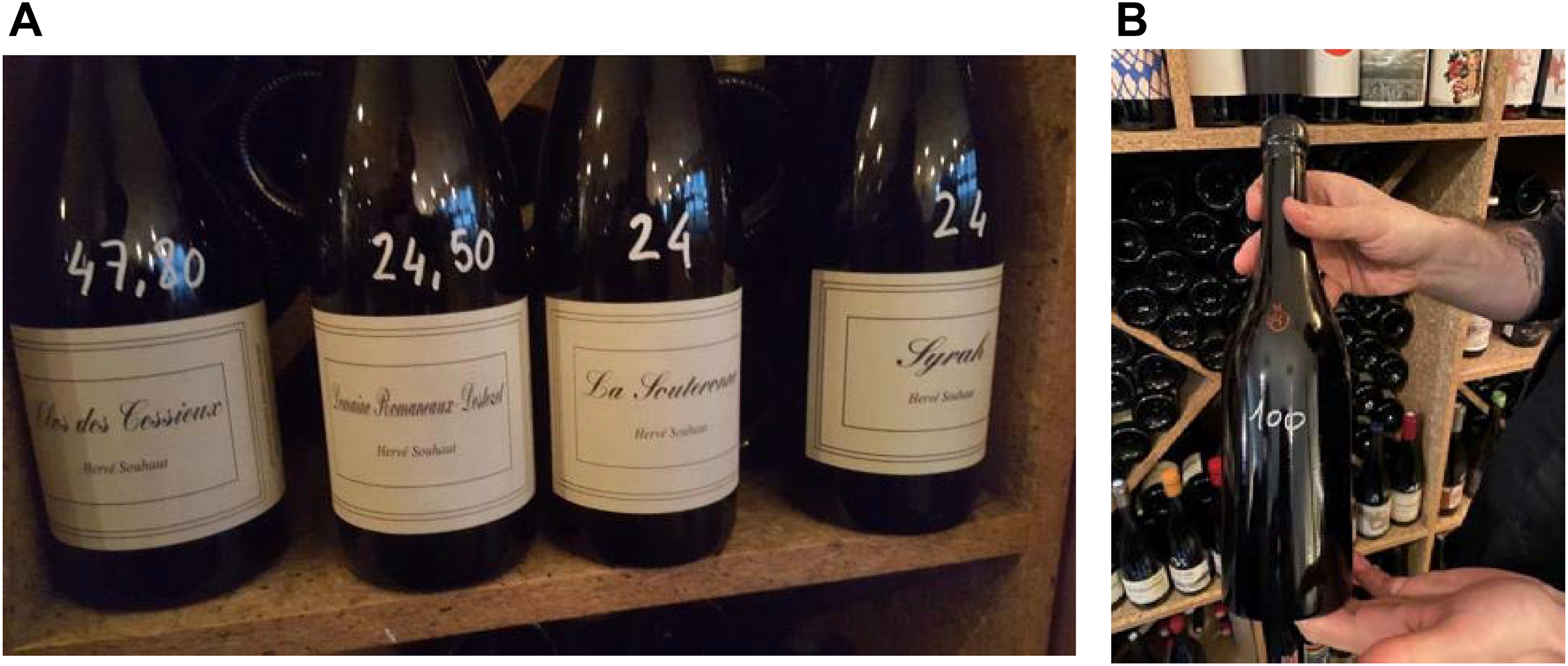
Store Observation at Ici Même Wine Store, Paris.
In sum, rebel producers contest the status quo by embracing novel values and beliefs and crafting new products that violate the established valuation frame of the status quo. As we discuss in the next section, the proliferation of unfamiliar new products not aligned with the established valuation frame creates valuation challenges.
Valuation Challenges
The proliferation of unfamiliar new products creates confusion among consumers who do not know how to evaluate these new products. As rebel producers contest the status quo, they introduce new wines with unfamiliar and hard-to-assess characteristics. With few traditional signs to guide them, consumers are unable to value these new products with the valuation frame of the status quo. Fabio, a consumer who enjoys these wines, explains the valuation challenges it creates for consumers: In fact, it's getting very complex. … There are thousands of winegrowers. … It is clear that looking at the AOCs is easier for someone who does not know a lot about wine. It is easier to see “Chablis” on a wine list.
This confusion creates an opportunity for intermediaries to gain strategic valuation power (see Bessy and Chauvin 2013). Luc, a wine wholesaler, highlights the consumer confusion that rebel producers have created and the crucial role of intermediaries in helping them value goods: It [These new wines] muddies the waters. Consumers get lost. This is the reason why wine merchants are doing well. Thirty years ago, we said, “Wine merchants are going to die, large retailers are going to replace them.” Interestingly, it's just the opposite that happened. There are new wine stores who keep opening. There are more and more wine merchants because people say “I’m lost, I’m going to see my wine merchant.”
In sum, rebel producers contest the status quo by crafting new products that violate the established valuation frame. The proliferation of unfamiliar new products creates confusion among many consumers who are interested in novelty but do not know how to evaluate these new products. This confusion gives intermediaries, such as wine merchants and sommeliers, an essential role in guiding consumers. Intermediaries gain valuation power and take the opportunity to establish a rival valuation frame (see Bessy and Chauvin 2013). Next, we discuss turn to the market work of intermediaries, showing how they establish and activate a rival valuation frame.
Establishing a Rival Valuation Frame
Independent wine merchants and sommeliers draw on their enhanced valuation power to establish a rival valuation frame. Through this process, some rebel producers emerge as avant-garde brands. Our analysis identifies three types of market work they do to establish a rival valuation frame: (1) they select the appropriate rebel producers, (2) they qualify products following new logics of valuation, and (3) they sanctify new avant-garde icons.
Intermediaries select the appropriate rebel producers
Whereas large retailers select wine aligned with the established valuation frame of the status quo (i.e., the AOC system), independent wine merchants and sommeliers select rebel producers that challenge the status quo and embrace novel values and beliefs. This creates an opportunity for independent wine merchants to elevate their status, gain influence with consumers, differentiate from other large retailers, and develop trust-based relationships with their clients (see Bessy and Chauvin 2013).
First, intermediaries select rebel producers who are not too deviant from the status quo. This selection process is crucial as more winemakers join the movement against the status quo. Some rebel producers lack sufficient know-how and focus essentially on “being deviant,” investing too little in mastering outstanding knowledge. Intermediaries consider these winemakers as “extremists” (extremistes), “fundamentalists” (intégristes), or “maniacs” (fous furieux). Bruno, who is an emblematic wine merchant of avant-garde brands, explains: Nowadays, some winemakers have a violent reaction to the use of chemistry and highly technological wines. It is a reaction, in fact. It's a reaction and we don’t make a piece of art merely in reaction. If I make a piece of art, I don’t make a piece of art in reaction to painting. It won’t be a piece of art. I won’t be connected to my terroir if I start saying, “I make wine like this because I don’t want to be like the others.” It's not like that, it doesn’t work.
Second, intermediaries continuously seek novelty. They look for new winemakers, forgotten grape varieties, confidential terroirs, and alternative winemaking practices. This dynamic of novelty raises and maintains customers’ curiosity (see Pomiès and Arsel 2023). This is also an opportunity for intermediaries to sustain valuation challenges and their valuation power (see Bessy and Chauvin 2013). It provides opportunities for new winemakers to attract intermediaries’ attention. For instance, Florent, a winemaker located in a very obscure IGP, says, IGP Cévennes is a fairly wide field of experimentation. And my Equinox cuvée for example, it's this blend of Merlot and Muscat from Hamburg, and this is a grape variety that is very, very little used by French winegrowers. So people are intrigued. So I try to play on the new or very rare side of my wine. … You know, you have winegrowers’ stands, and more and more you have free tasting areas for professionals. That is to say that when someone arrives at a trade show that sees 500 or 600 winegrowers, it is difficult to make a choice in order to be able to taste and meet the winegrowers. And the free tasting space allows them to really choose, without the influence of the winemaker, without any other factor. They can freely taste the wine they want. And I realized that with this somewhat atypical Cévennes IGP white, I was able to hook people in the sense that professionals taste it in a tasting area and say “Well, that's atypical. I will go and taste the rest of the range at this winemaker to see what he does.”
This dynamic of novelty can create challenges for producers. Wine that becomes highly sought-after can lose its appeal. Over time, a wine can lose its novelty; when it becomes too well known, it is less appealing. For instance, Jean draws on his experience as a winemaker: The market always needs new products. In the ’90s, we were famous. In the small world of wine, we were known all over the world. Today we are a brand known by a wide public, which is quite different. The small world of wine, the small world that draws on novelties, the small world that, as I would say, like the world of haute couture that rustles. … That's it … we unfortunately have more trouble. Because the competition is tough. And so it is very difficult to keep up, to be among those we are looking for. … In the ’90s, we were very few in France, I had Japanese, Swiss, American importers coming to me and begging me for my wine. Today, that is no longer the case.
In sum, intermediaries attempt to select products that challenge the status quo. They act as gatekeepers by selecting the appropriate rebel producers that are not too deviant from the status quo. They act as talent spotters by looking for novelty and introducing many new features. This dynamic of novelty is essential to sustain both consumers’ curiosity (Pomiès and Arsel 2023) and valuation challenges, which are essential for intermediaries to maintain their valuation power (Bessy and Chauvin 2013). This market work also shapes some boundaries as only the “appropriate” rebel producers can join the avant-garde, that is, the rebel producers who are not too deviant and who continuously introduce some novelty on the market.
Intermediaries qualify products following new logics of valuation
Previous research has demonstrated the work of intermediaries in qualifying new products (Pomiès and Arsel 2023). In the introduction of gourmet coffee in France, for instance, baristas qualify new products by educating consumers about the differences between gourmet and traditional coffee, the attributes of gourmet coffee, and establishing quality standards for those attributes. Through this process, baristas establish tastes that conform to the new standards, reduce complexity, and thus facilitate consumers’ decisions (Pomiès and Arsel 2023). Similarly, we observe that intermediaries craft differences between mainstream and avant-garde wine. In contrast to coffee, however, intermediaries do not attempt to identify a common set of attributes and establish common standards for each attribute. Instead, intermediaries describe the complexity of each wine and celebrate its singularity, making them less rather than more comparable. This is essential to sustain the valuation challenges on the market and their valuation power.
Intermediaries craft “taste scripts” (Ulver and Klasson 2018) that describe and emphasize wine singularity. They emphasize the winegrower's personality, passion, and unique expertise (see Smith Maguire 2013). For example, during one visit, a wine merchant explained the appeal of a wine from the Languedoc, a region traditionally considered to produce low-quality wine, by highlighting the winemaker: You’ll see, this is a winegrower who does incredible things, who makes a very modern wine. It's made by a woman who does things very differently. She was a literature teacher and she used to write reviews in the wine press. Ten years ago, she decided to buy a vineyard in the Languedoc area because at that time Languedoc vineyards were worthless. There are quite a few winegrowers who settled in Languedoc at that time and who bought vines at ridiculous prices. All of a sudden, this was the moment, for people who were completely different, not traditional people of the vines, who came to live there and make very different wines, very modern and very personal.
By focusing on the winemaker, intermediaries feature the singularity of a wine. A singular wine is appreciated because it is unique, and its singularity is built on the object that is created and produced: where, how, by whom, when, and why (Smith Maguire 2018). Taste judgments are made based on the specific details of production rather than the genre per se. Wine appreciation starts with the distinctiveness of the wine producer (expertise, personality, intuitions, and values), the soil, and the vine. The wine is considered a craft product based on the expertise of winegrowers who know and respect their land and their vines and who will get the best out of both.
Through the way they qualify products, intermediaries emphasize the uniqueness of each wine. They do not try to establish a set of criteria to make wines comparable, as in the case of Indian art (Khaire and Wadhwani 2010) or specialty coffee (Pomiès and Arsel 2023). So, rather than create consistency and conformity among wines, intermediaries seek to cultivate an appreciation for singularity. As opposed to AOC wines that have to follow the typical taste of their AOC, avant-garde wines are singular and difficult to compare to other wines. This singularization of goods maintains the valuation challenges on the market and the valuation power of intermediaries. Without shared quality standards, consumers lack information about quality, are unable to make a fully informed choice, and still depend on intermediaries to guide them in the valuation process (Karpik 2010).
Intermediaries sanctify avant-garde icons
Intermediaries sanctify a small number of avant-garde icons (i.e., highly prized rebel producers who become icons of the rival valuation frame). In justifying high prices, intermediaries emphasize the excellence of the wine, the outstanding craftsmanship of the winemaker, the work involved, and the rarity of the wines. They explain that they are expensive because of the work of producers. The wine is produced without chemicals and follows traditional methods (manual harvesting, plowing with a horse, no chemicals, etc.), which are labor-intensive. In discussing Dagueneau, an emblematic winemaker whose wine is priced higher (€120) than many prestigious wines from Burgundy, Bruno, a wine merchant, says: And the work involved! Behind the bottle, there are 11 people working on an 11-hectare vineyard. There were not so many people at the Romanée-Conti at the time. You had to see the vines, it was crazy! Even the guy from the Clos Rougeard said, “We’ve never seen that! Nobody works like that! It was completely crazy!” His son works the same way.
These winemakers have extremely small vineyards (most are from 3 to 8 hectares), produce small quantities of wine, and sell on allocation only. Intermediaries struggle to have access to these rare wines. It can take years to be able to obtain an allocation for famous winemakers, and this is an important element of their storytelling. Winemakers take pride in selling only on allocation, as this is the best signal of their success. It is also a signal of the intermediary’s reputation, as Jérôme, a famous sommelier, specifies: The strength of a sommelier lies in finding wines that others do not have. I have wines on my wine list that are difficult to obtain, even if you know the winegrowers. This is the strength of a sommelier, it is to have wines that are rare and difficult to find.
In sum, independent wine merchants establish a rival valuation frame through three types of market work: They select the rebel producers, they qualify products following the new logic of valuation, and they sanctify avant-garde icons. Through these practices, intermediaries make no attempt to identify a common set of attributes and establish common standards for each attribute. Instead, intermediaries emphasize the complexity of each wine and celebrate its singularity, making them less, rather than more, comparable. This is essential to sustaining valuation challenges and their valuation power on the market (see Bessy and Chauvin 2013).
Activating the Rival Valuation Frame to Refine Social Distinction Games
Activation occurs when market actors orient customers or others toward a particular disposition, such as evaluating an object aesthetically rather than practically (Pomiès and Arsel 2023). In our case, activation concerns the social distinction game that underlies consumption of these status products (see Atanasova, Bardhi, and Eckhardt 2024; Bellezza 2023; Dion and Borraz 2017).
Intermediaries educate consumers
Intermediaries disrupt social distinction games by educating consumers about avant-garde brands, enabling them to appreciate these brands and utilize their knowledge in the social distinction game. While the social distinction game of the status quo is based on taste typicality and the ability to appreciate tastes typical of a genre (Trébuchet-Breitwiller 2015), the rival valuation frame stresses the ability to appreciate taste singularity. The shift from taste typicality to singularity requires sophistication in taste judgment, as it is associated with a higher level of cultural knowledge and a refined understanding of aesthetics (see Bourdieu 1984; Dolbec 2025). Knowing how to appreciate a singular taste demands mastery of new and refined cultural competencies (see Karpik 2010). Avant-garde connoisseurs like Fabrice enjoy this sophistication: In fact, it's very complex, and that's quite exciting. I don’t like people who simplify. I know I’m totally extreme in my judgment, but I do really think so. Knowing wine is a very long quest. I will not reach the end of this quest in my life. It's quite exciting! … There are thousands of winegrowers. … There are things that I don’t remember in life, but I do remember winemakers and wines. I have a multitude of names in my head, nourished by all these years of being interested in it. … It is clear that looking at the AOCs is easier for someone who does not know a lot about wine. It is easier to see “Chablis” on a wine list.
The growing sophistication of taste judgment opens the door to new, refined social distinction practices among wine lovers and creates a new social distinction game among consumers. What counts is having a “conversational competence in this specialized, esoteric and dynamic aesthetic” (Holt 1997, pp. 103–04). As Luc, an avant-garde connoisseur, explains, these connoisseurs are different from buveurs d’étiquettes (“label drinkers”): These wine lovers do no longer get into the idea of famous labels and what they call “label drinkers.” There is a bit of an insider side; it is about knowing the wine. The more esoteric it is, the more it allows you to be socially stratified. You have to know what the last winemaker did, and so on.
Intermediaries include consumers in a small network of connoisseurs
Intermediaries include some consumers in a small network of connoisseurs who have exclusive access to emblematic and rare avant-garde brands. François, a wine merchant, describes a double market system for the general public and for connoisseurs: Some winegrowers tell me, “Oh no, my customers buy my wine, they don’t buy the appellation.” … Well yes, maybe his loyal customers, his fans yes. … We find this a lot among wine merchants who are a bit specialized like us, in the big cities, in Paris, among city dwellers … let's say being a bit caricatural, but here we are among bobos [bourgeois-bohemians] who really like all these wines. But it's still a small part, it's still marginal. So that would mean that we would have good wines that are for an urban elite, a small and close group of experts who know wine makers. … [It’s] a small group of insiders where the customers know the winemaker, the winemaker knows his customers. There is the feeling of being an insider, of being in a close circle. There are very few bottles, and they keep them for themselves. There is a little network side. Thus, there is a sort of two-speed phenomena.
Having access to rare avant-garde brands gives customers the feeling of being part of a close circle of wine enthusiasts who have access to unique and singular wines (see Dion, Pavlyuchenko, and Prokopec 2025). Consumers may desire novelty but may have no particular preference for or knowledge of particular attributes. As Fabrice, an avant-garde amateur, expresses it: There is an elite dimension, a happy few dimensions. We drink wines that are artisan wines, the labels are a bit rock and roll. … It's quite cutting-edge, quite elitist. These are wines which, by their production, are made not to be produced on a large scale. So it is difficult to find them, which are in some cases quite expensive; so there is a dimension of rarity. All of this creates a bit of elitism, and when there is elitism there is always a bit of snobbery.
In sum, intermediaries, such as wine retailers and sommeliers, attract consumers who are predisposed to appreciate avant-garde brands and use them in the social distinction dynamic. Activating new social distinction dynamics can help the market grow, slowly enlarging the consumer base from a niche group to a more sizable constituency. But more than simply sharing preferences, we find that consumers choose to join a group of others whose values and beliefs they share, including deeply held social and political views (see Bourdieu 1984). A parallel status structure emerges with different taste, evaluation criteria, and knowledge. This creates a double social distinction game: a social distinction game among avant-garde connoisseurs who compete among themselves and a social distinction game against the “old guard,” the conservative consumers who are regarded as unwilling to accept change or new ideas.
Conditions for Success and Failure
Not all rebel producers become successful avant-garde brands, not all avant-garde brands sustain success, and not all intermediaries succeed in creating an avant-garde market driving. Drawing from our understanding of the avant-garde market-driving process, we identify several conditions that explain the success or failure of avant-garde market driving. Success or failure depends critically on the interrelated market work of producers, who craft products that challenge norms and conventions of the status quo, and intermediaries, who form structures for evaluating and appreciating new products that they then convey to consumers. With the help of intermediaries, successful rebel producers acquire status, appeal among buyers, and thus influence. Success or failure for rebel producers can come at any stage of the process.
In stage 1 (contesting the status quo), rebel producers may fail by creating goods not fully aligned with the values and beliefs of the rival valuation frame. For instance, they may appear too commercial, too conventional, or too extremist. Those who succeed are at the forefront of expressing the values of the rival valuation frame and produce well-crafted products that intermediaries judge as singular in stage 2.
Successful avant-garde brands acquire a strong power on the market. They sell on allocation only; they select the intermediaries they want to collaborate with (the ones who show a strong interest in their product, share their values, and sell their wine with the right storytelling). It can take years for intermediaries to have their products in their stores.
However, many rebel producers struggle to find an intermediary that enables them to join the dynamic of avant-garde market driving. First, rebel producers who are too deviant from the existing social order struggle in the market because they have difficulties finding intermediaries to promote them. In the case of wine, successful rebel producers are critical of the status quo but draw on an outstanding savoir faire. They both distinguish themselves from and align themselves with the status quo. Alignment creates legitimacy (this wine is a valid player that merits consideration), while distancing creates difference and elevates value (this wine is more special than a ‘typical’ wine) (see Dolbec 2025). Unsuccessful rebel producers focus on distinction only and fail to align with the status quo.
In stage 2 (establishing a rival valuation frame), rebel producers can fail due to a lack of opportunities for unique storytelling. In these stages, intermediaries select rebel producers for which they can craft singular storytelling, and rebel producers without a unique or compelling story can fail to find intermediaries. For instance, to articulate the charisma of the producer, wine merchants look for anecdotes from the winemaker's childhood, tales of struggle, and transformative moments that culminate in the construction of a winemaker's identity, reflecting the romantic utopia of nature and the peasant tradition. Brands that provide opportunities for unique storytelling and easy alignment with (yet distinct from) the status quo valuation frame succeed. Rebel producers who do not offer opportunities for a unique taste script struggle to find intermediaries (see Smith Maguire 2013). Among the rebel producers who challenge the status quo, intermediaries select rebel producers on which they can craft singular storytelling. To articulate the charisma of the producer, intermediaries look for anecdotes from the producer's childhood, tales of struggle, and transformative moments that culminate in the construction of a producer's identity, reflecting the values and beliefs of the avant-garde.
Successful intermediaries instill a value for novelty, newness, and discovery. They continuously look for new and obscure rebel producers who could be curated as avant-garde. This dynamic of discovery provides many opportunities for new rebel producers who try to attract intermediaries’ attention, but it also presents threats for avant-garde brands who struggle to stay on the forefront.
In stage 3 (activating a rival valuation frame), intermediaries can struggle to activate the rival valuation frame if customers are not interested in avant-garde goods, prefer to stick to traditional values and beliefs embraced by the status quo, or do not want to take the risk of disrupting distinction games. Intermediaries can struggle to shape avant-garde market driving if customers are not interested in avant-garde goods. Customers may not express curiosity in avant-garde products and novel values and beliefs because of their limited cultural competence in the product category. Consumers may prefer to stick to mainstream values and beliefs embraced by the status quo. Some consumers may not like market confusion and prefer to stick to contexts where they have a clear understanding of the market and make informed choices. Consumers may not want to risk disrupting distinction games or invest time and energy in shaping new cultural competencies to play a new distinction game.
In stage 3 and beyond, most rebel producers struggle to maintain their aura of avant-garde over the long term. Intermediaries instill a value for novelty, newness, and discovery. They continuously look for new and obscure rebel producers who could be curated as avant-garde. This continuous discovery dynamic provides opportunities for consumers to stay ahead of the trend and enhance the social distinction game. This dynamic of discovery offers many opportunities for new rebel producers who try to attract intermediaries’ attention but also presents threats for avant-garde brands who struggle to stay on the forefront.
Discussion
Avant-Garde Market Driving
We contribute to the literature on market driving by introducing the concept of avant-garde market driving. We define avant-garde market driving as a process whereby producers transform an industry by rebelling against the status quo as a means of social-industrial critique rather than in response to market demand. Avant-garde market driving is primarily driven by a desire to rebel against the status quo, at the expense of widespread acceptance; it involves a multiplicity of like-minded individuals such as other producers, intermediaries, and consumers; and it occurs particularly in contexts where like-minded consumers seek hedonic or aesthetic novelty or social distinction. Despite their lack of business orientation, many avant-garde market drivers have significantly changed markets, competitive landscapes, and consumers’ mindsets and tastes in cultural industries such as fashion, design, cuisine, visual art, music, dance, or literature.
Our study of rebel winemakers in France shows the processes that initiate and sustain avant-garde market driving (see Figure 1). First, rebel producers trigger the avant-garde by creating products that violate market logics of valuation. In doing so, they challenge the established valuation frame, as consumers do not know how to value these new market offerings. Second, intermediaries establish a rival valuation frame to guide consumers. They provide notable comparisons, convey stories, and valorize some brands. Third, intermediaries activate the rival valuation frame by stimulating new social distinction dynamics among consumers. Through these three processes, some rebel producers emerge as avant-garde brands, and parallel status structures become established in the market.
Our analysis of avant-garde market driving offers new insights into the process through which firms shape consumers’ tastes through symbolic disruption and vertical collaboration, a process that can provide a strategic advantage to smaller, low-status firms.
Shaping the market through symbolic disruption and innovation
Research on market driving has focused on the role of producers in shaping market structure and consumer tastes (e.g., Jaworski, Kohli, and Sahay 2000; Kumar, Scheer, and Kotler 2000). Much attention has focused on using technological and strategic change that reconfigures market structure (for a review, see Carpenter [2023], Day [2023], Kohli and Jaworski [2023], and Schweitzer, Malek, and Sarin [2023]).
In contrast, our results explore symbolic disruption and innovation as a source of market driving. In avant-garde market driving, firms are driven by ideological critique. This ideological critique may come with new techniques (e.g., Pollack's drips, winemakers’ viticultural practices), but it is more importantly driven by ideas—ideas that differentiate new from old products; that need to be translated by intermediaries such as retailers, critics, and other experts; and that potentially provide a level for creating social distinction. Producers find success by working with intermediaries to establish and activate a new framework for valuing products, and this occurs through symbolic differentiation, storytelling, and other techniques that concern conveying the meaning of products to consumers.
With symbolic disruption and innovation, avant-garde firms dramatically expand the dimensionality of value that consumers must consider. The possibilities for differentiation based on brand symbolism become infinite, essentially making brands incomparable for consumers. Rather than identifying and structuring different criteria and enabling consumers to value alternatives, intermediaries craft brands’ symbolic value, creating a competing valuation frame that contests the established frame in the market.
Symbolic disruption and innovation create a novel way for low-status brands to gain a competitive advantage. Higher-status brands have access to more opportunities and more resources, command higher prices, enjoy lower costs, and experience higher rates of survival than lower-status rivals (Benjamin and Podolny 1999; Bothner, Podolny, and Smith 2011; Dion and Borraz 2017; Humphreys and Carpenter 2018). Lower-status firms can gain status over time by emulating other high-status brands as in the case of grappa (Delmestri and Greenwood 2016) or by creating an interstitial hybrid category that bridges the two as in the case of luxury streetwear (Dolbec 2025). In contrast, we find that low-status brands can gain a competitive advantage in a long-established market by challenging the status quo and establishing rival valuation frames. Rebel producers operate with greater strategic flexibility compared with the status quo producers, who must conform to the established valuation frame to retain their status. As the avant-garde market expands, brands that consumers valued for their tradition can become perceived as outdated. Thus, the higher status they enjoy can also transform into a competitive disadvantage.
Vertical collaboration
Originating in the market orientation and competitive strategy literature streams, the concept of market driving, as initially proposed, focused on how an individual firm could gain a competitive advantage by altering market structure or shaping consumer tastes (Jaworski, Kohli, and Sahay 2000). In the case of market structure, for example, market-driving strategies can create “a change in market structure that has the potential to improve customer value and/or the performance of the focal business” (Jaworski, Kohli, and Sahay 2000, p. 48). Similarly, in the case of shaping consumer tastes, research has focused on the actions of an individual firm (Carpenter and Nakamoto 1990; Dion and Arnould 2011; Rosa et al. 1999).
Recent work has explored how firms engage multiple actors to shape consumer tastes (Humphreys and Carpenter 2018; Maciel and Fischer 2020). For example, Humphreys and Carpenter (2018) explore how firms promote their vision to gain status from influential actors; from this process, producers can influence category definitions and set benchmarks within categories. Compared with market driving by an individual firm, collective efforts focus on shared benefits, a shared cause, establishing reputation for the group, pooling resources to challenge incumbents more effectively, the importance of consistency, the importance of coordinated action through suprafirm entities (e.g., associations), and the role of consumers as allies (Maciel and Fischer 2020).
While previous work has fruitfully explored horizontal market-driving efforts between firms (e.g., collaboration of craft breweries; Maciel and Fischer 2020), it has not fully explored the vertical relationships that can be entailed in successful market-driving changes. Our analysis reveals that vertical relationships between producers and intermediaries are important for sustaining market-driving change. Intermediaries—those who stand between producers and consumers—are critical actors in translating new elements in the market and in conveying and constructing value. Without intermediaries, rebel producers would remain niche and would not transform into avant-garde brands.
We find that intermediaries play a pivotal role in establishing and activating a rival valuation frame: They select the appropriate rebel producers, introduce new quality standards, sanctify icons, and refine social distinction games among consumers. Thus, the role of intermediaries is both producer-facing (i.e., they choose which products will constitute the avant-garde and shape their singularity) and consumer-facing (i.e., they translate these new and challenging products to consumers who value novelty and social distinction). Their market work is essential to construct and organize products in the market, which shapes concepts of value and facilitates exchange between producers and consumers (see Cochoy and Dubuisson-Quellier 2013; Nøjgaard 2023; Pomiès and Arsel 2023; Smith Maguire 2013).
Avant-Garde Market Driving in Other Contexts
Our findings on avant-garde market driving are transferable to other avant-garde contexts in which intermediaries establish rival valuation frames and guide consumers to value new market offerings and refine social distinction games. Whether through high-end department stores, underground boutiques, or experimental concept shops, retail spaces have expanded the reach of avant-garde movements across fashion, design, art, and food. While they may begin as small, esoteric departures, history has illustrated how these movements can shape the broader culture over time.
The process of avant-garde market driving depends on the valuation power of the intermediaries, that is, their power to establish and sustain rival valuation frames (see Bessy and Chauvin 2013). In our study of avant-garde, we focus on a multiplicity of small, independent intermediaries. The valuation power is, therefore, dispersed among a multitude of intermediaries. Similarly, many avant-garde fashion movements emerged thanks to a multiplicity of independent intermediaries across the globe who established rival valuation frames on the market (see the emergence of “Japanese avant-garde fashion,” “minimalist fashion,” or “dark avant-garde”). For instance, a group of Belgian designers known as the Antwerp Six revolutionized fashion in the late 1980s and 1990s with their deconstructed approach (Teunissen 2011). Emerging from Antwerp's Royal Academy of Fine Arts, they challenged conventional luxury fashion by focusing on raw edges, asymmetry, oversized silhouettes, and a darker, more intellectual aesthetic. Fashion concept stores around the world like Barneys New York, Colette (Paris), 10 Corso Como (Milan), or Dover Street Market (London, New York, Tokyo, Beijing, Los Angeles), among many others, embraced their vision and aesthetics and solidified their impact on global fashion by establishing rival valuation frames to value their work. Their influence can still be seen in the continued popularity of raw hems, oversized tailoring, and the blending of high fashion with avant-garde streetwear.
This is also the case of Impressionism. Art dealers and gallerists were crucial in transforming Impressionism from a radical, rejected style into a mainstream movement (Tinterow and Loyrette 1994). By strategically promoting Impressionist works, cultivating new audiences, and influencing critics and collectors, curators and other intermediaries organized independent solo exhibitions for Impressionists, bypassing the conservative art institutions that had rejected them and opening galleries in many cities. Gallerists established a rival valuation frame, presenting Impressionism as a sophisticated, modern, and desirable style. They emphasized the idea that Impressionist paintings captured the modern world, appealing to wealthy collectors who wanted to associate with contemporary culture and modern elegance and exclusivity, making it desirable to upper-class buyers. Eventually, wealthy collectors, including American patrons, began buying Impressionist paintings, legitimizing them financially and artistically. Museums followed, turning avant-garde Impressionism into mainstream culture.
In contrast, the valuation power can be concentrated in the hands of a limited number of intermediaries. For example, the Bauhaus movement spread from an avant-garde, school-based movement to a globally recognized aesthetic that transformed architecture, furniture, and consumer goods. By manufacturing, distributing, and marketing Bauhaus-inspired furniture and home goods, retailers like Knoll and Herman Miller turned avant-garde modernism into a mainstream aesthetic that continues to shape contemporary interiors. By establishing a rival valuation frame, they transformed Bauhaus from an experimental avant-garde movement into a global design that continues to shape contemporary interiors.
In sum, our findings can be transferable to many other types of avant-garde movements where intermediaries, through their market work, establish a rival valuation frame to guide consumers in their valuation of avant-garde market offerings and generate new social distinction games.
Recommendations for Producers and Intermediaries
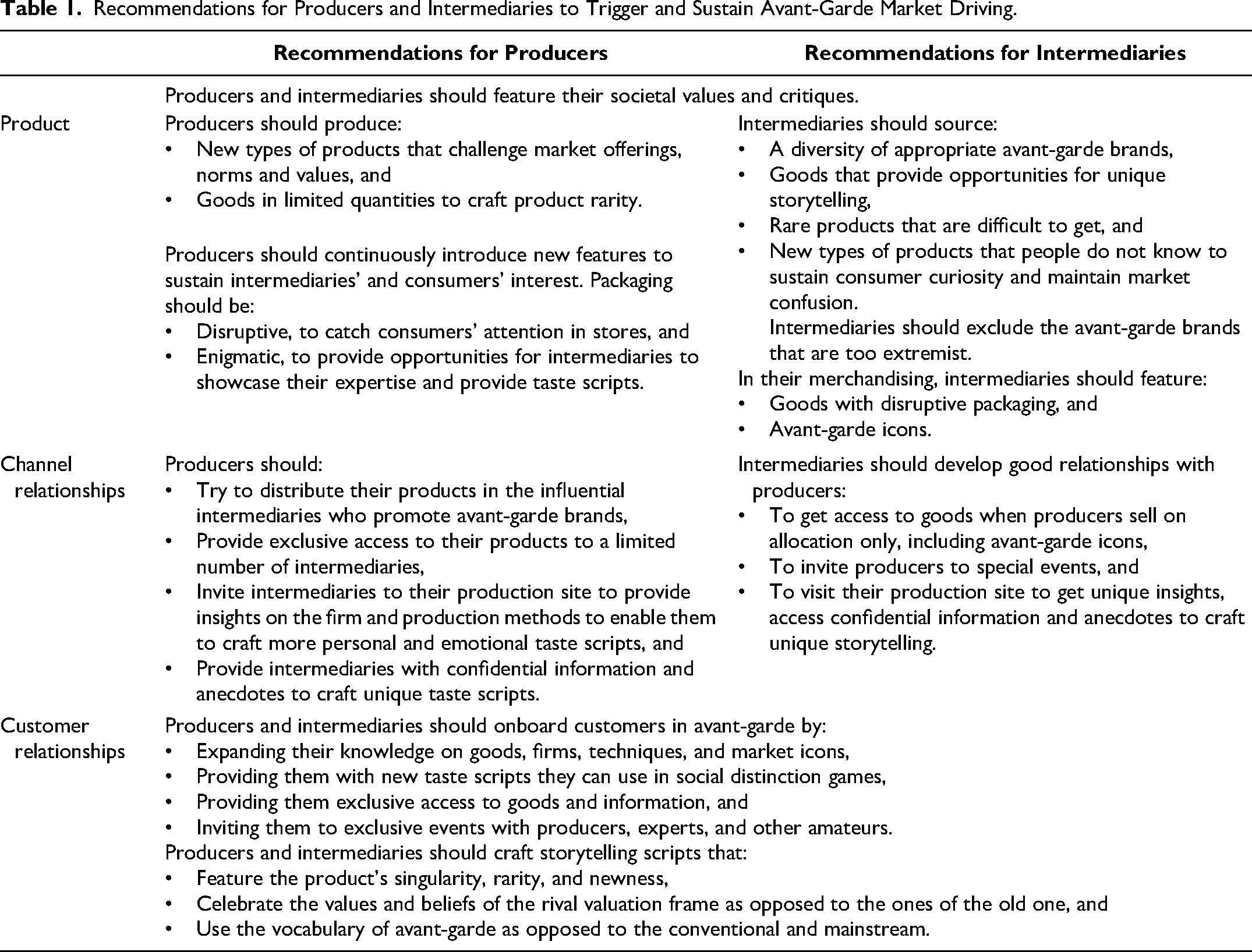
We introduce avant-garde market driving as a novel competitive strategy. The core of this strategy lies in disrupting market offerings, norms, and values. Rebel producers are not alone in their endeavors. Intermediaries play a crucial role in crafting and sustaining avant-garde market driving as they establish rival valuation frames and generate new social distinction games. Table 1 provides recommendations for producers and intermediaries on product management, customer relationships, and channel relationships to trigger and sustain avant-garde market driving.
Recommendations for Producers and Intermediaries to Trigger and Sustain Avant-Garde Market Driving.
Avenues for Future Research
Future research on avant-garde market driving could investigate the strategy of incumbents faced with challenges to their market position and power (see Dolbec 2025). How should producers and intermediaries from the status quo respond to avant-garde entrants? Based on the fear of penalties, middle-status firms conform more than their counterparts because they have more to lose (Durand and Kremp 2016; Sgourev 2013). Might such firms feel pressure to conform to the status quo, move to the avant-garde, or adopt a hybrid strategy?
The implications for the market as a whole also merit consideration. Does avant-garde market driving expand the market or merely shift consumption? Evidence from France suggests that wine consumption fell overall (see Web Appendix A), leading one to consider whether avant-garde strategies may not instead be a way of dealing with market stagnation and decline. Furthermore, consumer heterogeneity in knowledge, ability, and interest may affect how avant-garde brands are perceived and the success of intermediary translation efforts. Our study has focused only on French consumers. How might international consumers react to avant-garde brands? Here, we have limited our analysis to French wine brands being sold to French consumers. It is likely that international consumers may differentially interpret status signals, based on their own cultural context. Accordingly, they might require a unique set of intermediaries. How do intermediaries adapt their market work to international markets where consumers have different product knowledge and expectations?
Another avenue for future research concerns avant-garde market driving over time. Avant-garde brands, like all brands, evolve. What is novel soon becomes banal and can once again become exciting (Warren et al. 2019). In some cases, aspects of popular culture become associated with more exclusive groups of consumers. For example, in the first half of the 20th century, a large part of the repertoire of Italian opera, which today clearly belongs to the domain of high culture, was considered part of popular culture (DiMaggio 1987). In other cases, avant-garde artists become mainstream. Once avant-garde, Cubism is now a part of history. Therefore, future research might explore avant-garde brands in the long run. How do avant-garde brands stay at the forefront? Why do they fail to remain at the forefront? How do they become mainstream? How do they expand to other types of consumers who have different backgrounds (knowledge or experiences)? How do they extend to other countries?
Conclusion
Markets change in many ways and for many different reasons. Recent scholarship in marketing has begun to explore how firms, be they producers or intermediaries, can cultivate and thrive within these shifting dynamics (e.g., Dion and Arnould 2011; Dolbec 2025; Dolbec, Arsel, and Aboelenien 2022; Ertimur and Coskuner-Balli 2015; Humphreys 2010; Humphreys and Carpenter 2018; Maciel and Fischer 2020). By studying the process through which avant-garde market driving triggers and sustains, we hope to shed new light on how these actions can shape and eventually change valuation in the marketplace.
Supplemental Material
sj-pdf-1-jmx-10.1177_00222429251377752 - Supplemental material for Avant-Garde Market Driving
Supplemental material, sj-pdf-1-jmx-10.1177_00222429251377752 for Avant-Garde Market Driving by Delphine Dion, Gregory Carpenter and Ashlee Humphreys in Journal of Marketing
Footnotes
Acknowledgments
The authors gratefully acknowledge the financial support of the ESSEC Business School and thank the JM review team for invaluable advice throughout the review process. The authors would also like to thank Lydiane Nabec, Valérie Renaudin, Mathilde Gollety, and Carole Drucker-Godard for their collaborations in the early stages of this research. In addition, the authors thank colleagues from Aalto University, University of Bath, Bayes Business School, and ESSEC Business School. The authors are grateful to seminar participants at Tulane University, Northwestern University, and University of Innsbruck’s Brand Camp for helpful comments and suggestions. Special thanks go to the informants for generously sharing their time and experiences.
Coeditor
Cait Lamberton
Associate Editor
Eileen Fischer
Declaration of Conflicting Interests
The authors declared no potential conflicts of interest with respect to the research, authorship, and/or publication of this article.
Funding
The authors received no financial support for the research, authorship, and/or publication of this article.
