



Abstract
This article examines how the number of information cues in recommender systems influences consumer search and purchase. E-commerce platforms often display a list of recommended products on product pages, where consumers can browse and click on individual items for details. Given space constraints, determining the appropriate amount of information to display is crucial, as it affects consumers’ use of both recommender systems and nonrecommender search tools. Through a randomized controlled field experiment with an online retailer, the authors test four information designs: no cues (product name only), single cues (either price or review), and dual cues (price and review). They find an inverted U-shaped relationship between the number of information cues and sales, with single cues yielding the highest sales compared with both more information (dual cues) and less information (no cues). This nonlinear effect stems from the interplay between search intensity and efficiency. The no-cue condition increases search intensity but forces consumers to rely on a less efficient nonrecommender search process. In contrast, the highly efficient dual-cue condition provides sufficient information for evaluation but discourages further exploration beyond recommenders. Single cues strike a balance, offering just enough information to aid product evaluation while maintaining high search intensity across both recommender and nonrecommender tools.
Product recommendations are essential search tools for e-commerce platforms, enhancing product discovery and driving significant revenue. A study by Barilliance, a leading provider of e-commerce personalization solutions, analyzed data from over 300 e-commerce sites and found that product recommendations on product detail pages contribute up to 31% of total revenue (with an average of 12%) and increase purchase likelihood by 4.5 times (Serrano 2023). Despite the limited space within recommendation lists, online retailers often display key product information cues—such as prices and reviews—alongside each recommendation thumbnail. These cues provide a quick summary of essential product details, enabling consumers to make preliminary evaluations before clicking on a product's detail page. While more information cues help reduce uncertainty about a product's suitability, fewer cues create greater search frictions within recommendations, requiring consumers to engage more deeply to assess product fit.
Retailers face a dilemma in determining how much information to display in recommendation lists: include more or fewer information cues. Providing very few cues fails to reduce search frictions, forcing consumers to conduct additional searches and complicating recommendation evaluation. Most online retailers aim to streamline the purchase process (Unal and Park 2023) by minimizing search frictions and offering comprehensive product details (Xiao and Benbasat 2007; Zou and Liu 2019). However, displaying many cues may reduce consumers’ incentives to click on recommended products if they feel they already have enough information. This limits product exploration and purchases, as not all details can be conveyed within the recommendation list. Some firms strategically introduce search frictions to encourage exploration and boost sales by limiting displayed attributes (Zhu and Dukes 2017), using vague claims (Mayzlin and Shin 2011), or creating barriers to information access (Ngwe, Ferreira, and Teixeira 2019).
Thus, the amount of information firms provide to consumers is a critical managerial issue (Ursu, Wang, and Chintagunta 2020). Retailers must strategically determine which product attributes to reveal in advertising (Morozov and Tuchman 2024) and search tools (Gu and Wang 2022), as these choices influence both consumer search and purchase behaviors. Our review of the top 40 U.S. e-commerce websites (Geyser 2023) showed that most recommender systems incorporate price and/or review cues into their recommendations (Web Appendix A). Specifically, the two most common designs are dual-cue displays that feature both price and review information (Figure 1, Panel A) and single price cue designs (Figure 1, Panel B). Some retailers opt for a single review cue without price information (Figure 1, Panel C), and a few exclude both cues altogether (Figure 1, Panel D). This diversity in information cue designs motivates our study: We examine how varying the number of information cues (zero, one—either a single price or review cue, or two) in product recommendations on a focal product's detail page affects consumer purchases.
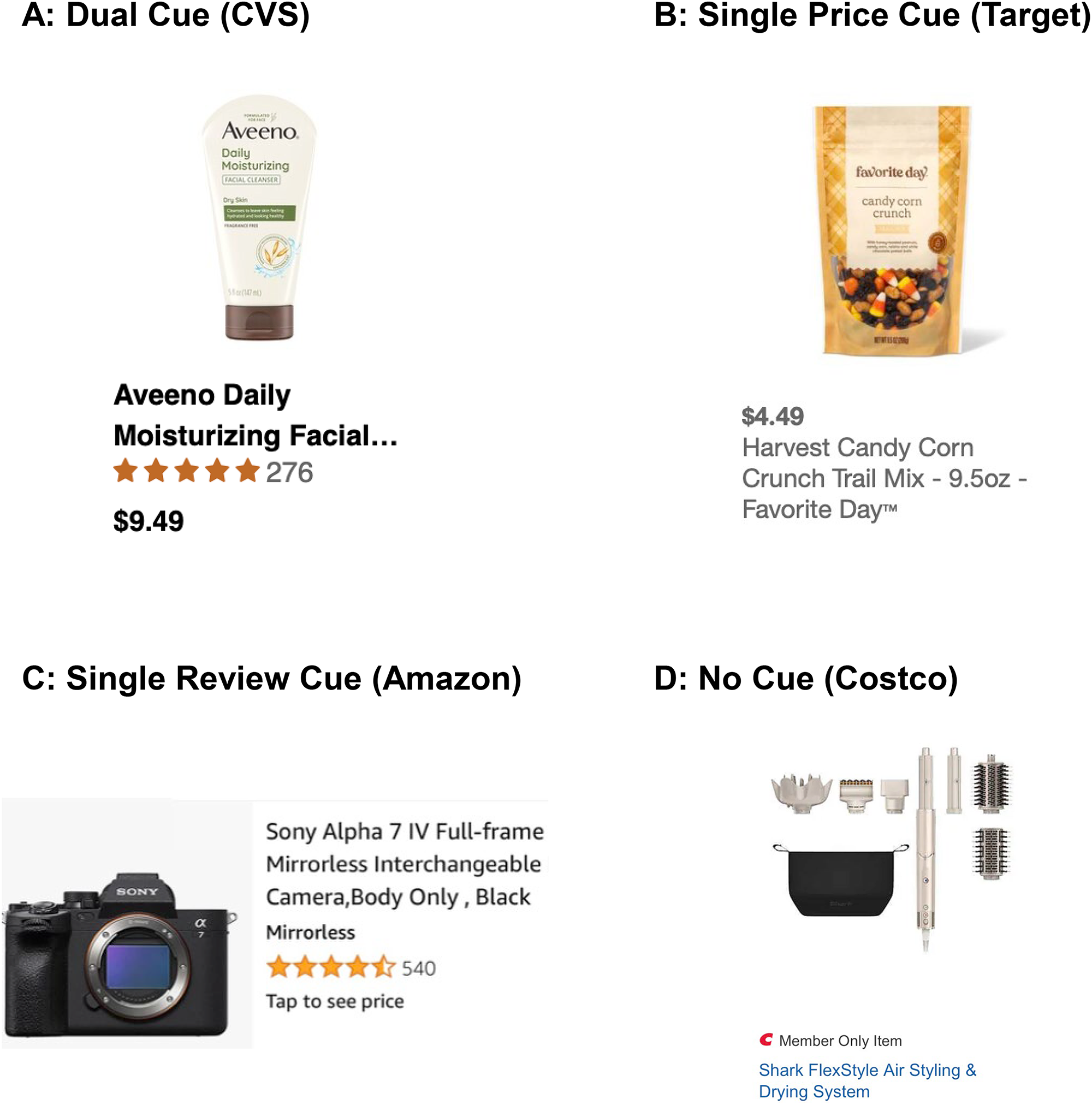
Examples of Information Cue Designs Adopted by Online Retailers.
E-commerce sites typically present product information in two layers (Gu and Wang 2022). The outer layer displays a list of products for quick browsing, while the inner layer provides detailed product information when a user clicks on a specific item from the list. Once on an inner product page, consumers may continue searching by browsing a new list of recommended products or clicking on individual recommendations (recommender search). Alternatively, they may return to a previous product list or use nonrecommender search tools—such as the keyword search box commonly found at the top of most pages—to continue the search (nonrecommender search). Beyond examining the impact on purchases, this article explores how the number of information cues in recommender systems influences consumers’ search behavior as they navigate between product lists (outer layer) and individual product pages (inner layer). We use “browsing” to refer to searching through product lists and “clicking” to refer to searching for specific products within those lists.
Moreover, we differentiate between consumer search activity directly linked to recommender systems (recommender search) and search activity using nonrecommender tools (nonrecommender search). Our article examines four key search metrics: (1) recommender (product) list browsing, referring to browsing the list of products generated by the recommender system; (2) recommender product clicks, which measure clicks on specific products from that list; (3) nonrecommender (product) list browsing, proxied by the browsing of product lists from keyword search results; and (4) nonrecommender product clicks, referring to clicks on specific products outside the recommender system. Browsing and clicking are key steps in the search process that result in consideration and search set formation and ultimately can lead to purchases (Li, Grahl, and Hinz 2022). We propose a conceptual framework that theorizes how the number of information cues influences consumer purchases through these intermediate steps.
We leverage a randomized field experiment conducted by a U.S. online retailer. Despite significant investments in its proprietary recommender algorithm, the retailer saw no substantial improvement in its recommendation-driven sales, which remained below the industry average of 12% (Serrano 2023). In response, platform managers shifted their focus to modifying the information cue design for recommended products on focal product pages. The experiment introduced controlled variations in information display—no cues (product name only, without prices or reviews), single cues (either price or review), and dual cues (both price and review)—while keeping the original underperforming recommender algorithm unchanged. Using a random sample of 47,996 customers, our dataset tracks the search-to-purchase journey at the session level, capturing both purchase outcomes and detailed recommender and nonrecommender search metrics.
Our main analysis reveals a nonlinear inverted U-shaped relationship between the number of information cues and sales. The single-cue condition—displaying either price or review—generates the highest sales, followed by the dual-cue condition, while the no-cue condition results in the lowest sales. This nonlinear pattern arises from the interplay between search efficiency and search intensity across different cue designs. The no-cue condition creates excessive search frictions, making it difficult for consumers to assess product fit within the recommender system. As a result, they disengage from recommenders and shift to less efficient and more time-consuming nonrecommender searches. In contrast, dual cues provide sufficient information for quick decision-making, enabling consumers to evaluate and dismiss mismatched products without clicking on recommendations. However, this high search efficiency limits further exploration beyond recommenders, reducing overall search intensity.
Single cues strike a balance by providing just enough information for consumers to assess product fit, maintaining search efficiency while increasing search intensity. These moderate frictions prompt consumers to browse more recommended product lists, click on more recommended products, and engage with nonrecommender search tools. Even with an underperforming recommender algorithm, consumers in the single-cue condition benefit from using the recommender system rather than being forced to forgo it, as seen in the no-cue condition. This combination—greater search intensity than dual cues and higher search efficiency than no cues—explains the observed nonlinear sales effect. Our supplementary analyses confirm that information cues influence consumer interaction with recommender systems by influencing search frictions and highlight the interplay between recommender and nonrecommender search behaviors.
Our research provides empirical insights for platform information design and makes several contributions to the marketing literature. First, we contribute to the literature on strategic product information revealing (Branco, Sun, and Villas-Boas 2012; Gu and Wang 2022; Morozov and Tuchman 2024). While conventional wisdom advocates for a frictionless online shopping experience (Unal and Park 2023), recent studies suggest that introducing search frictions can enhance company performance (Mayzlin and Shin 2011; Ngwe, Ferreira, and Teixeira 2019). Unlike prior research that assumes recommender systems operate with high accuracy and primarily highlights their benefits, we examine a more common real-world scenario: an underperforming recommender system, often encountered by non-tech-savvy retailers. Our findings reveal a nonlinear relationship between the number of information cues in recommender systems and purchase outcomes, showing that an intermediate level of information disclosure can maximize purchase likelihood (Branco, Sun, and Villas-Boas 2016).
Second, while much of the existing research focuses on the purchase effects of recommender systems (Brynjolfsson, Hu, and Simester 2011; De, Hu, and Rahman 2010), this article complements the emerging literature on the search effects of recommender usage (Wan, Kumar, and Li 2023; Yuan et al. 2024). Previous research has primarily examined consumer search using a single metric, consumers’ (total) clicks on products (Gu and Wang 2022; Tan, Wang, and Tan 2019; Ursu 2018). Building on this, we analyze the interplay between multiple search tools by examining four distinct search metrics, differentiating between product-specific clicks and product list browsing across both recommender and nonrecommender search. Our findings demonstrate that each search metric offers unique insights into how recommender systems influence consumer purchase, reinforcing the importance of considering multiple dimensions of search beyond total clicks.
Third, our work complements the literature on the spillover effects of promotional activities. Extending research on the purchase spillover of recommendations (De, Hu, and Rahman 2010; Kumar and Hosanagar 2019; Kumar and Tan 2015), we find that recommender information cues generate search spillover effects on nonrecommender tools. As the number of information cues decreases, nonrecommender search intensity increases. While prior research has documented the complementary or substitutive relationships between search tools (Wan, Kumar, and Li 2023; Yuan et al. 2024), we find that recommender and nonrecommender searches cannot be readily classified as substitutes or complements, as the relationship depends on the number of information cues provided.
Conceptual Framework and Related Literature
In Figure 2, we present a conceptual framework that theorizes how varying the number of information cues in recommender systems influences consumers’ search processes 1 and ultimately their purchase decisions. We focus on a specific component of recommender systems, the number of information cues (Box 1). The progression from Box 1 to Box 2 illustrates how information design impacts consumers’ evaluation of recommended products by introducing search frictions. Since consumers endogenously choose which search tools to use and how extensively to use them (Wan, Kumar, and Li 2023; Yuan et al. 2024), the variation in search frictions at the recommender stage can influence their usage of nonrecommender tools. In Box 2, we differentiate consumer search by tool type: Recommender search refers to the browsing of recommender product lists and clicking on recommended products, while nonrecommender search involves the browsing of nonrecommender product lists and clicking on products generated by other search tools. These combined search behaviors ultimately affect purchase outcomes, as represented in Box 3.
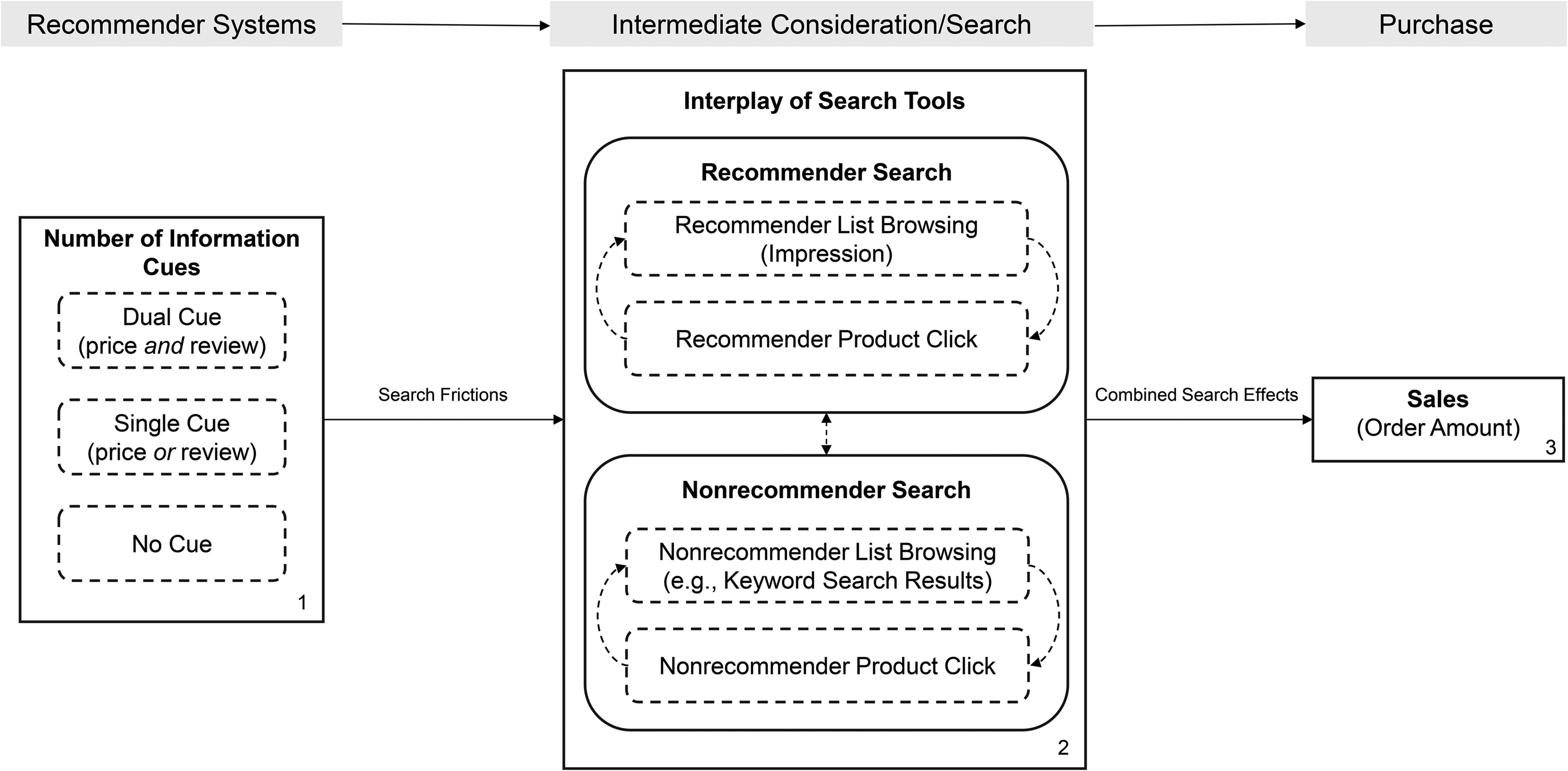
Conceptual Framework.
A Proposed Nested Search Process
Recommender systems, like other search tools, present information in two layers (Chen and Yao 2017; Gu and Wang 2022; Ursu 2018). The outer layer displays a product list, while the inner layer, accessible through clicks, provides detailed information on individual products. A consumer's search process may follow a nested process, moving between product lists (outer) and individual product pages (inner), as illustrated in Box 2 of Figure 2 and elaborated in Figure 3. In Figure 3, we use a solid line to represent the overall customer journey from search to purchase, while a dashed line indicates the proposed nested search process as intermediate steps within this broader journey. Typically, consumers begin their journey by browsing a product list, such as a home page or keyword search results page. Once a consumer clicks on a specific product, they are directed to a focal product's detail page. Within this inner product page, there is often another product list of recommendations, which effectively serves as a new “outer layer” for further exploration, relative to “inner” individual recommended products. At this stage, the consumer can either browse the recommender product list (measured by impressions) and click on a specific product or initiate a nonrecommender product search through a keyword search or other search tools. Each time a consumer clicks on a specific product, the recommendation list appears again, creating a nested search process between recommender and nonrecommender tools.
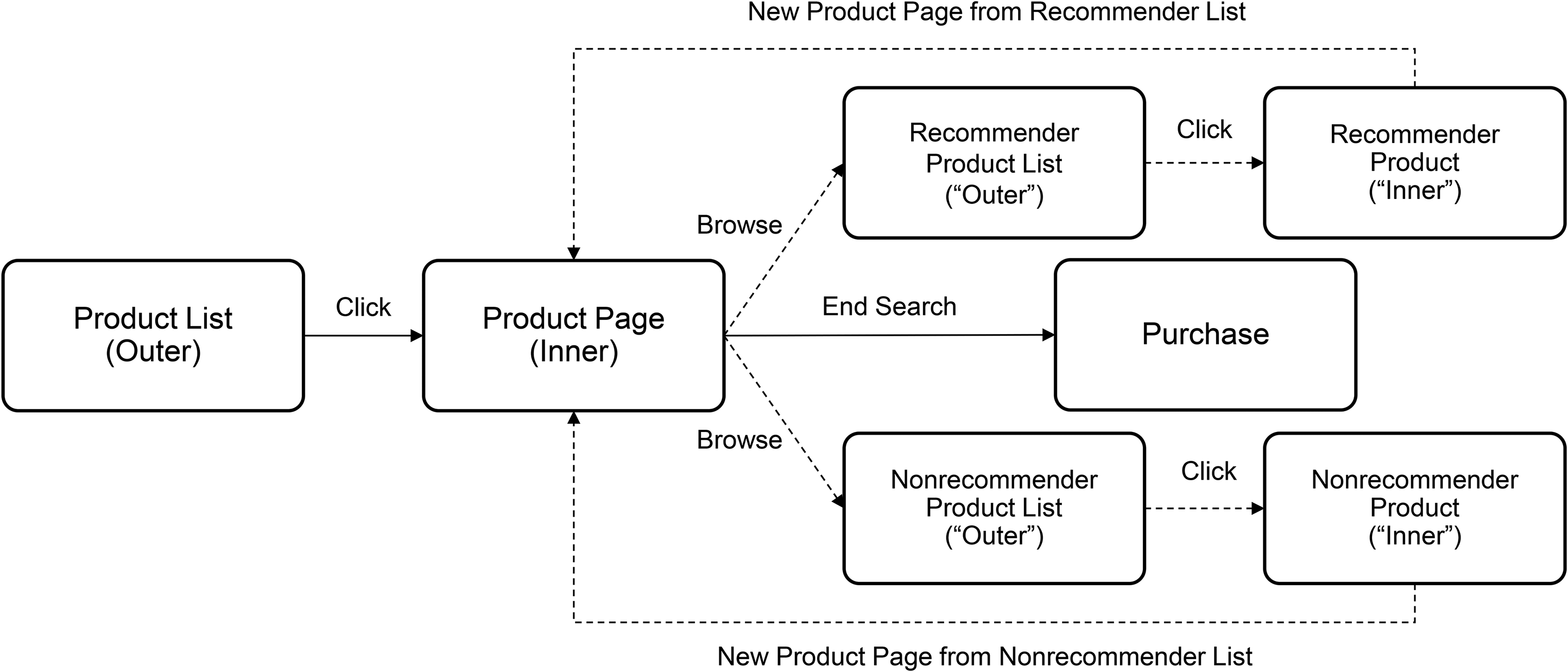
The Proposed Nested Search Process.
As consumers transition from browsing a product list to clicking on a specific product, they must assess the amount of information available and decide how much of it to process, given search costs, before they stop searching (Hauser and Wernerfelt 1990; Honka, Hortaçsu, and Wildenbeest 2019; Ursu 2018). The evaluation of recommendations often depends on comparing the attributes of recommended products to those of the focal product (here referring to the product on the product details page that also shows the list of recommended products). First, the number of information cues directly impacts the attributes being compared. When attributes like prices and reviews are withheld in the recommender list (as in the single-cue and no-cue conditions), consumers must infer missing information (Walters and Hershfield 2020), which may or may not accurately reflect the product's actual attributes. While all recommendations are generated by the same algorithm to ensure consistent underlying product fit, the number of cues can influence consumers’ expectations of missing attributes and subsequent search decisions. Additionally, decision cost theory suggests that the process of comparing product attributes incurs its own costs, ultimately influencing consumer choices (Shugan 1980). As the number of attributes increases, the decision-making process becomes more complex (Chernev, Böckenholt, and Goodman 2015; Payne 1976). This makes the number of information cues a critical factor in forming expectations about missing attributes.
Direct Effects of Information Cues on Recommender Search
Firms must carefully determine the amount of product information provided to consumers, as both too much and too little information can hinder search decisions (Branco, Sun, and Villas-Boas 2016). Online retailers often use various information cues to make product information more accessible, thereby reducing search frictions (Ngwe, Ferreira, and Teixeira 2019; Zou and Liu 2019). This explains the common use of dual-cue recommendations. Clear and accurate explanations of recommendations are essential for fostering trust in recommender systems (Wang and Benbasat 2007) and increasing acceptance of recommendations (Cramer et al. 2008; Kramer 2007). A recommender lacking both price and review cues, as in the no-cue condition, can overly complicate product evaluations due to the absence of comparative attributes (Zhang and Markman 2001), leading consumers to disengage from the recommender system.
Physical stores often introduce deliberate, moderate frictions to encourage customers to browse more extensively and make additional purchases (Ursu and Dzyabura 2020). For instance, IKEA's maze-like layout makes it hard for consumers to anticipate what comes next, encouraging them to explore the entire store and add more items to their carts (Jansson-Boyd 2018). Similarly, online retailers can encourage more product exploration by designing websites with intentional navigation challenges (Ngwe, Ferreira, and Teixeira 2019). For instance, delaying the disclosure of mandatory fees can lead to increased searches and revisits to alternatives (Blake et al. 2021). In our context, where the recommender algorithm has low accuracy, providing both price and review cues allows consumers to quickly realize that the recommender product list does not match their preferences, reducing the likelihood of further clicks on individual items. However, withholding either the price or review cue in the recommender list creates a “nudge” that encourages consumers to click on products in the list to find the missing information. This nudge may guide consumers toward higher recommender list browsing and product clicks in the single-cue conditions compared with the dual-cue condition.
Search Spillover Effects of Information Cues on Nonrecommender Tools
Previous research has demonstrated that the influence of recommendations can extend beyond the recommended products themselves. For instance, recommender systems can positively affect the sales of nonpromoted items (De, Hu, and Rahman 2010) and complementary products (Kumar and Tan 2015), while potentially reducing the sales of substitutable focal products (Kumar and Hosanagar 2019). In mobile app markets, human-recommended apps have been shown to boost both sales and awareness of nonfeatured apps (Liang, Shi, and Raghu 2019). Likewise, in offline settings like vending machines, product recommendations can generate a spillover of attention to nonrecommended products (Kawaguchi, Uetake, and Watanabe 2019). In the proposed nested search process, consumers are constantly choosing between recommender and nonrecommender tools. When consumers find the recommended products unappealing, they can return to nonrecommender search tools, such as by entering a new keyword. Importantly, every time a customer clicks on a product for more details, the interplay between recommender and nonrecommender tools resumes. As a result, the effect of information cues on recommender search is likely to spill over to nonrecommender tools, influencing overall consumer behavior across search tools.
There are two primary search strategies: simultaneous and sequential. In a simultaneous search strategy (Honka and Chintagunta 2017), consumers decide in advance on a fixed number of alternatives to explore. In this case, increased engagement with recommendations would reduce the use of nonrecommender tools, and vice versa. In contrast, in a sequential search strategy (Ursu 2018), the number of alternatives is not predetermined, and consumers continuously adjust their search decisions based on new information. Given the proposed nested search process, varying the number of information cues potentially has a ripple effect through the information-gathering process, impacting search trajectories across both recommenders and nonrecommender tools. Therefore, regardless of the search strategy employed, an interplay between recommender and nonrecommender search tools may arise due to changes in recommender information cues, as outlined in Box 2 of Figure 2 and detailed in Figure 3.
Purchase Effects of Recommender Systems via Consumer Search
Previous studies have primarily focused on the purchase effects of recommender systems, particularly their influence on product sales (De, Hu, and Rahman 2010; Lee, Gopal, and Park 2020; Lee and Hosanagar 2021; Pathak et al. 2010) and sales diversity (Brynjolfsson, Hu, and Simester 2011; Fleder and Hosanagar 2009; Lee, Gopal, and Park 2020; Lee and Hosanagar 2019). More recently, researchers have begun to explore the search effects of recommender systems. Recommendations can expand consumers’ consideration sets, mediating a positive purchase effect (Li, Grahl, and Hinz 2022). Similarly, product recommendations help consumers search for products of higher value and better fit, a significant factor driving higher purchase probabilities (Wan, Kumar, and Li 2023). These findings underscore the importance of consumer search as a crucial intermediate step for understanding the broader purchase effects of recommender systems.
However, the extent to which product recommendations influence consumers' overall search behavior remains unclear (Li, Grahl, and Hinz 2022). On the one hand, recommendations may reduce consumers’ need for extensive search efforts by guiding them toward target products more efficiently (Fong 2017). On the other hand, recommendations can prompt consumers to initiate new searches by informing potential needs or interests they were not previously considering (Shin and Yu 2021). In the following sections, we will empirically investigate how the number of information cues affects recommender search (i.e., recommender list browsing and recommender product clicking) and nonrecommender search, and how these interactions ultimately influence overall purchase behavior.
Research Context and Field Experiment
Research Context
A U.S. online retailer conducted a randomized experiment to identify the causal effect of information cue design on recommender performance. With around 260,000 product listings and annual sales of around $100 million, the retailer has five main product categories, which had varying shares of total sales: beauty (16%), health (4%), home (9%), grocery (31%), and snacks (39%). Despite significant investments in its proprietary recommender algorithm, the sales contribution of the recommender system remained disappointing and fell below the industry average. This discrepancy motivated the retailer to explore enhancements to its recommender system through information cue design experiments.
On a product detail page, a list of recommended products appears below the focal product's image gallery and above the product description section (Figure 4). The visible recommendations depended on the user's screen size, and users had the option to scroll through a total of 35 recommended products. Initially, the retailer's recommender system employed a single price cue design, 2 driven by a collaborative filtering algorithm common in e-commerce recommender systems (Lee and Hosanagar 2019). This algorithm generated recommendations based on historical user behavior and regularly updated the recommended product listings to incorporate new data. However, to isolate the effect of information cues as the sole intervention, the retailer temporarily suspended these regular algorithm updates during the experiment. All our experimental conditions used the same recommender algorithm, meaning the underlying product fit was identical across all groups. This ensured that the recommender product lists remained fixed throughout the study, enabling the retailer to focus exclusively on the impact of varying information cues. In addition, at the top of each page, a keyword search box enabled users to search for other products if the recommendations were unappealing, offering an alternative tool for product exploration.
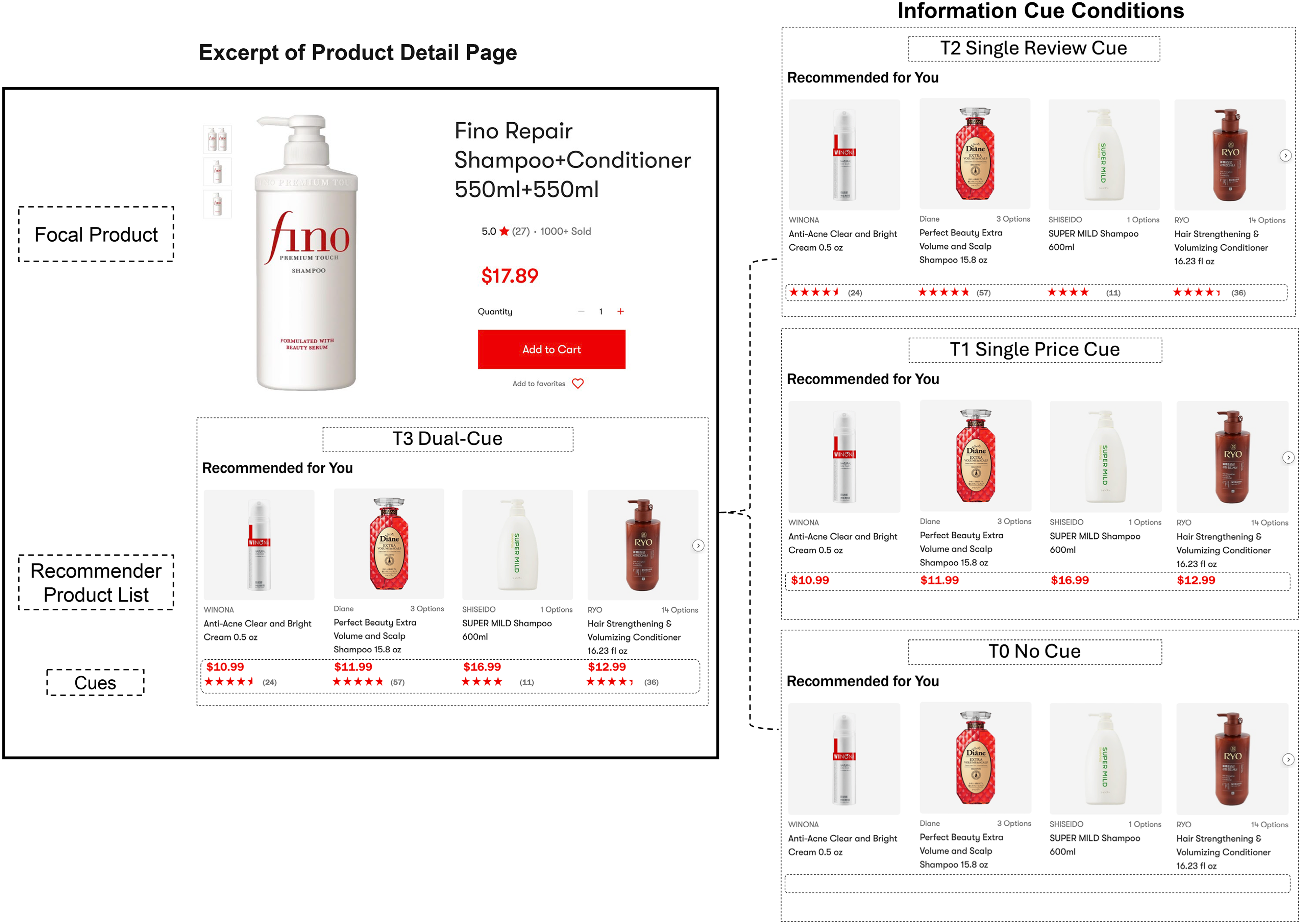
Illustration of Experimental Conditions.
Field Experiment
The retailer conducted a website-specific experiment on its recommendations while keeping mobile apps unchanged from October 31 to December 5, 2019. The decision to focus on website-exclusive users was to avoid complications from app versioning, as users had low update rates, leading to inconsistencies across various app versions. In the experiment, the retailer manipulated the number of information cues displayed on products in the recommended list of a focal product page by either withholding or revealing price and review information. As shown in Figure 4, participants were randomly assigned to one of four conditions, with their assigned condition remaining consistent throughout the experiment. In the dual-cue condition (T3), both price and review details were visible. The single review cue condition (T2) displayed review ratings and volumes but excluded price information. In the single price cue condition (T1), only price information was shown, while review details were omitted. Finally, the no-cue condition (T0) featured thumbnails that displayed only the product name and image, excluding both price and review cues. Since participants voluntarily chose whether to engage with the recommender system, this experiment tests the intent-to-treat effect of varying the number of information cues. Note that, while reviews are optional, consumers must ultimately gather price information before making a purchase decision. Participants could still access both price and review information even when it was withheld in the recommender system by using the nonrecommender search tools or by clicking through to the product page.
Key Variables
Session-level and product-level data
A session is a sequence of user interactions with the website that continues until there is a 30-minute period of inactivity. During each session, users engage in a variety of activities, and the outcomes of these activities are typically aggregated at the customer-session level. These session-level variables form the basis for our main analysis (Lee, Gopal, and Park 2020). Additionally, within a session, we track interactions at the product level (similar to Lee and Hosanagar 2021), such as clicks on individual recommended products, which provide descriptive and supporting evidence to complement our session-level causal analysis. While we lack data on the exact search sequence among tools at the product level, which prevents us from exploring the recursive relationship between recommender and nonrecommender search in depth, our dataset does allow for a thorough examination of how information cues affect various search behaviors.
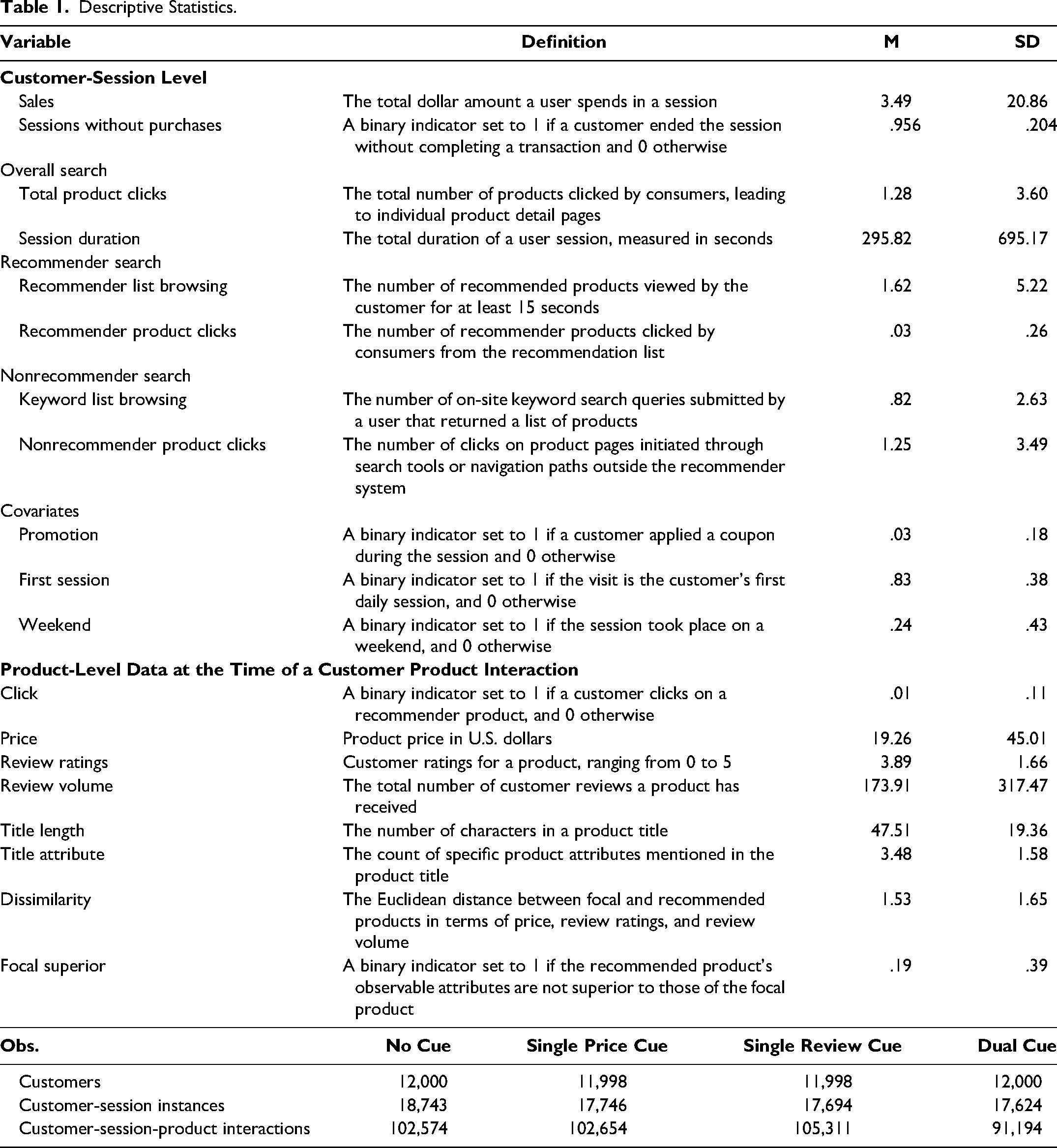
The upper panel of Table 1 shows data at the customer-session level, and the lower panel focuses on product-level interactions. Our analysis includes a random sample of 47,996 customers, evenly distributed across the four experimental conditions based on the information cue designs. This results in 71,807 customer-session instances and 401,700 customer-session-product interactions. Sales performance, measured by the total order amount per session, serves as the ultimate metric to assess the economic impact of information cue strategies. Across all sessions, the average sales are $3.49, with 95.6% of sessions concluding without a purchase. Among sessions that did result in a purchase, the average sales value is approximately $80.
Descriptive Statistics.
Recommender search
Recommender search begins when consumers first browse a list of recommended products, referred to as “recommender (product) list browsing.” We measure this initial stage of exploratory search by tracking “viewable impressions,” counting the recommended products that appear in the customer's view for at least 15 seconds. This time threshold helps ensure active engagement with the product list, rather than a cursory scroll past it. As consumers move from exploratory to detailed evaluative search, they click on specific products from the list. “Recommender product clicks” capture the number of recommended products consumers click on to explore in more depth. Consequently, recommender search includes both the broader exploratory search of product lists, measured by impressions, and the focused evaluative search of specific products, indicated by clicks.
Nonrecommender search
We also measure search behavior using tools outside of the recommender system. “Nonrecommender product clicks” capture all click-throughs to product pages initiated via nonrecommender tools, such as keyword searches and home page navigation. Nonrecommender impressions are often not tracked by online retailers, as tracking impressions for all products can significantly slow page load times. This limitation makes keyword searches—which can generate nonrecommender search impressions—a practical proxy for nonrecommender list browsing behavior. These keyword searches generate lists of products in response to a query entered in the on-site search tool (Ursu 2018), enabling consumers to browse as they search. The number of keyword result lists available for browsing corresponds to the number of times a user enters a keyword that returns results, which we refer to as “keyword list browsing.” We use “nonrecommender list browsing” and “keyword list browsing” interchangeably depending on the context.
Keyword list browsing represents a “loaded impression”—a list of products displayed in response to a search, whether actively viewed or not—whereas recommender list browsing is a “viewable impression,” specifically products seen by consumers. Both reflect the perusal of a list of products. However, the term “impression” may cause confusion as it aligns more closely with advertising contexts. To simplify, we use the term “browsing” instead of “impression” to describe the act of searching across product lists, clearly distinguishing it from “clicking” on specific products within those lists.
Overall search
Overall search metrics reflect the overall search effort by consumers without differentiating between recommender and nonrecommender search. “Total product clicks” represent the total number of products clicked by consumers, including both recommender and nonrecommender clicks, each leading to a product detail page. “Search duration” refers to the total time spent on the website per session (Ursu, Wang, and Chintagunta 2020) and serves as an indicator of search efficiency. Longer durations may suggest inefficiencies in the search process.
Randomization Checks: The A/A/A/A Pretest for Key Variables
Before launching the experiment, the retailer conducted an A/A test, or more precisely an A/A/A/A test (Adobe 2024), to verify the randomization process. In contrast to A/B testing, which splits traffic among different designs to detect performance differences, an A/A test directs traffic to identical designs. This approach aims to confirm that the allocation algorithm is random by ensuring no significant differences emerge among identical test groups. For this pretest, four separate user groups were assigned to the same single price cue design, instead of using the four distinct conditions shown in Figure 4.
The retailer selected a sample of 48,000 customers to validate the A/A test results, detailed in Web Appendix B. The analysis revealed that session-level dependent variables were all statistically nonsignificant. Among the product attribute variables, only one price comparison between two subgroups reached statistical significance. This result does not undermine the randomization process for several reasons. First, given the large number of variables and simultaneous comparisons across four groups, the single significant price metric likely emerged by chance (Benjamini and Hochberg 1995). Nevertheless, we traced the difference to a few price outliers, where some customers interacted with high-priced items ($500 to $1,300), while the average item price across groups was below $20. To reduce the impact of these outliers, we winsorized the price data, 3 a standard approach for managing outliers (Sullivan, Warkentin, and Wallace 2021). After winsorization, the previously significant effect was mitigated, and all metrics became statistically nonsignificant. From a managerial perspective, the retailer's decision to proceed with the randomized experiment, despite its cost, underscores confidence in the algorithm's randomness. Such outliers may naturally but minimally affect overall findings, given the nonsignificance of all key outcome variables.
Overview of Empirical Analyses
Our research is structured around one main analysis and two supplemental descriptive analyses. The main analysis examines the causal effects of varying information cues on recommender search, nonrecommender search, and purchase outcomes. Supplemental Analysis 1 investigates how cue-induced frictions influence consumers’ decisions to click on recommended products, linking information cues (Box 1) with consumer search behavior (Box 2) in our conceptual framework (Figure 2) and providing a model-based explanation of the main findings. Supplemental Analysis 2 employs a system of equations to examine how different search metrics mediate the relationship between information cues and purchase outcomes, further connecting the search process (Box 2) and purchase behavior (Box 3) within our conceptual framework.
Main Analysis: The Effects of Information Cues on Sales, Recommender Search, and Nonrecommender Search
This section presents intent-to-treat causal evidence on key outcome variables at the customer-session level. Rather than following a typical search-to-purchase process, we begin by discussing ultimate purchase outcomes and then examine how different search metrics contribute to purchase outcomes. As overall search metrics (measured by total product clicks and session duration) do not fully account for the observed purchase outcomes, we further break down total product clicks into those specifically tied to recommender systems (recommender product clicks) and those from nonrecommender search tools (nonrecommender clicks). Finally, we explore how product list browsing complements findings from product clicks, the more commonly used search metric. This narrative provides a thorough understanding of how information cues impact consumer search behavior and purchase outcomes, addressing any gaps that individual search metrics alone may not fully explain.
Model
We estimate Equation 1 for all main outcome variables, focusing on individual customer i during web session t. The dependent variable, Yit, represents the key outcome for each session.
The binary variable on the right-hand side, Treati, represents the experimental conditions, where N denotes the set {T1, T2, T3, T0}. T1 corresponds to the single price cue, T2 to the single review cue, and T3 to the dual-cue condition (both price and review), while T0 indicates the absence of both price and review cues. Additionally, the covariates Xit account for factors such as first-session indicators, weekends, and promotions to control for potential heterogeneity. We employ clustered robust standard errors at the customer level to account for any potential session-to-session spillovers that could introduce error dependence within individual consumers. 4 Consistent with prior studies (Lee, Gopal, and Park 2020), we use Tobit regression for continuous outcomes to address potential left-censoring at zero and logistic regression for binary outcomes. Several robustness checks were conducted, including logarithmic transformations and the inclusion of session-level attributes as control variables (as detailed in Web Appendix C), with results showing overall consistency across specifications.
Effects of Information Cues on Sales and Overall Search
Inverted U-shaped effects on sales
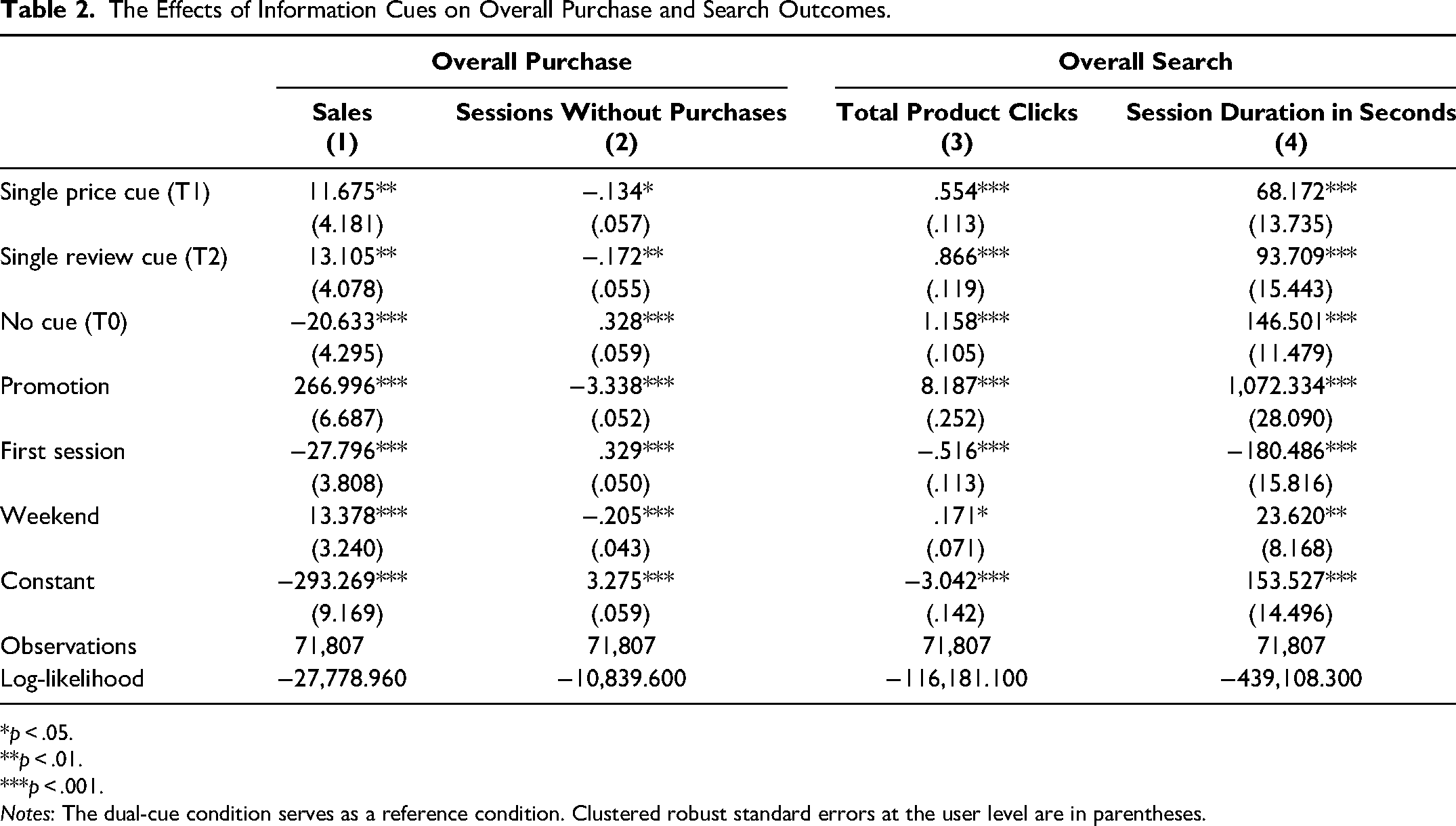
Sales, measured as the total order amount per session (including both recommended and nonrecommended products), serve as a key performance indicator for online retailers. Column 1 of Table 2 reveals an inverted U-shaped relationship between the number of information cues and sales. Specifically, the single-cue conditions significantly increase sales compared with the dual-cue condition (T1 = 11.675, p < .01; T2 = 13.105, p < .01), while sales are substantially lower in the no-cue condition (T0 = −20.633, p < .001). Column 2 further shows that consumers in the no-cue condition are most likely to leave sessions without making a purchase (T0 = .328, p < .001). Notably, the dual-cue condition shows a higher probability of session abandonment compared with the single-cue conditions (T1 = −.134, p < .05; T2 = −.172, p < .05), suggesting that moderate frictions may increase purchase likelihood more effectively than either more information or excessive frictions.
The Effects of Information Cues on Overall Purchase and Search Outcomes.
*p < .05. **p < .01. ***p < .001.
Notes: The dual-cue condition serves as a reference condition. Clustered robust standard errors at the user level are in parentheses.
Higher search frictions and more overall search
We further examine how the number of information cues affects consumers’ overall search behavior. Total product clicks and session duration reflect the extensive and intensive margins of search, respectively (Ursu, Wang, and Chintagunta 2020). Total product clicks (Column 3) represent the total number of products clicked by consumers, including both recommender and nonrecommender products. This metric indicates how extensively consumers expand their consideration sets during their search process. Session duration (Column 4) captures the total time spent per session, reflecting the thoroughness of the search process. In the no-cue condition, consumers exhibit significantly higher total product clicks (T0 = 1.158, p < .001) and longer session durations (T0 = 146.501, p < .001) compared with other conditions. Removing cues from the dual-cue design increases search frictions during the recommender search stage. Both the single-cue and no-cue conditions show statistically higher levels of overall search intensity, aligning with research indicating that increased search frictions stimulate more consumer search (Ngwe, Ferreira, and Teixeira 2019).
Divergent patterns between overall search and purchase
Prior research suggests that larger consideration sets (Li, Grahl, and Hinz 2022) and extended search durations (Ursu, Wang, and Chintagunta 2020) typically increase the likelihood of purchase. However, our findings reveal that higher search intensity, especially in the no-cue condition, does not consistently translate into higher sales. Instead, sales follow an inverted U-shaped pattern, with the single-cue conditions generating the highest sales. This implies that overall search metrics alone do not fully explain the impact of information cues on purchases. While we note some differences between the single price and single review cues, likely due to the intrinsic distinctions between price and review information, the remainder of this article will focus on the number of information cues rather than the type.
Effects on Recommender and Nonrecommender Product Clicks
Consumers’ clicks on specific products serve as a common proxy for search behavior. The previous section highlighted divergent patterns between purchases (sales) and overall search behavior (total product clicks), prompting us to decompose total product clicks into recommender and nonrecommender clicks. Here, recommender product clicks measure the direct effect of information cues on search within the recommender system, while nonrecommender product clicks capture the potential spillover effect of these cues on other search tools.
Direct effect on recommender product clicks
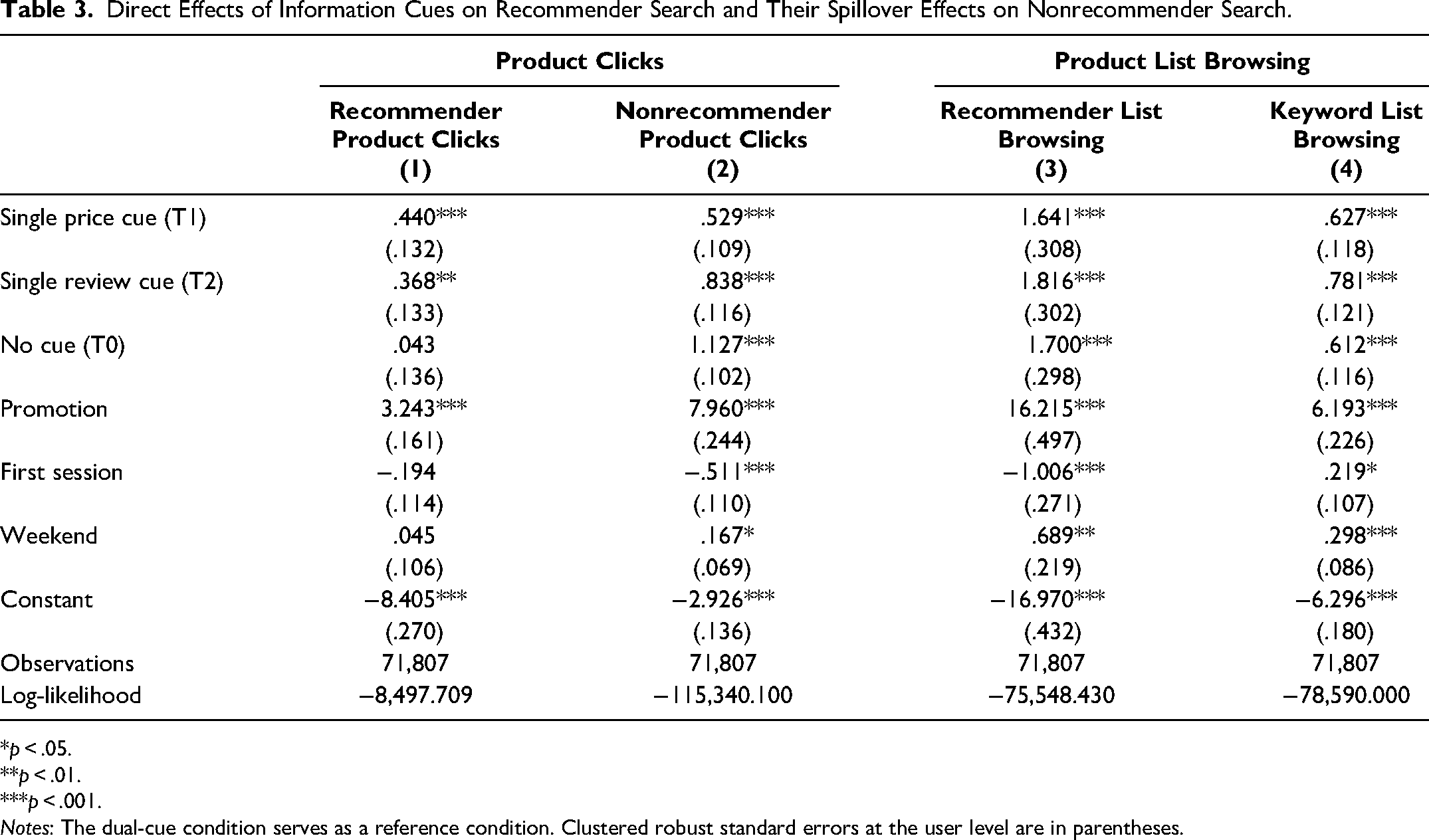
Column 1 of Table 3 indicates that single-cue conditions positively impact recommender product clicks (T1 = .440, p < .001; T2 = .368, p < .01) compared with the dual-cue condition. In contrast, the no-cue condition does not significantly affect recommender clicks. Given the underperformance of the focal retailer's recommendation algorithm, which often suggests mismatched products, consumers in the dual-cue condition can quickly evaluate and dismiss poorly matched items without the need to click. However, when one cue is withheld, the evaluation process for identifying mismatched products may be delayed, resulting in additional recommender clicks as consumers continue their search.
Direct Effects of Information Cues on Recommender Search and Their Spillover Effects on Nonrecommender Search.
*p < .05. **p < .01. ***p < .001.
Notes: The dual-cue condition serves as a reference condition. Clustered robust standard errors at the user level are in parentheses.
Spillover effect on nonrecommender product clicks
Column 2 of Table 3 reveals that information cues not only affect recommender search but also generate a spillover effect on nonrecommender search. As information cues decrease, nonrecommender clicks significantly increase (T1 = .529, p < .001; T2 = .838, p < .001; T0 = 1.127, p < .001). Notably, the no-cue condition leads to the highest number of nonrecommender clicks, despite a lack of significant increase in recommender clicks. Since no-cue consumers cannot assess product fit without clicking, this suggests that they disengage from the recommender system not due to evaluation outcomes but because they lack sufficient information to conduct a meaningful evaluation. This lack of information prompts them to turn to nonrecommender tools for further exploration.
The single-cue conditions also show positive spillover effects on nonrecommender clicks, even as recommender clicks increase. In both the no-cue and single-cue conditions, consumers turn to nonrecommender tools but at different points: Those in the no-cue condition shift before clicking on products (further evidence is in the following section on list browsing results), whereas in the single-cue condition, they explore nonrecommender options after clicking. Specifically, after initially clicking on recommended products, consumers in single-cue conditions may find the recommendations misaligned with their preferences and thus continue their search using nonrecommender tools.
In summary, as the number of information cues decreases, both total product clicks and nonrecommender clicks increase, except for recommender clicks peaking in the single-cue condition. This suggests that the nonlinear sales effect may be largely driven by the divergence in recommender clicks between the no-cue and single-cue conditions.
Excessive Versus “Insufficient” Frictions: Two Opposing Forces in Recommender Systems
Consumers in the no-cue (excessive friction) and dual-cue (insufficient friction) conditions show comparable levels of recommender product clicks but differ significantly in nonrecommender clicks, suggesting that two opposing forces influence recommender search behavior depending on the number of information cues. This contrast is further underscored by the lower sales in the no-cue condition, despite its higher overall search intensity compared with the dual-cue condition. To complement our understanding beyond product clicks, we analyze product list browsing behavior, which offers additional insights into consumer search dynamics.
Additional results on product list browsing
In Columns 3 and 4 of Table 3, withholding one or both cues from the dual-cue design significantly increases both recommender list browsing (T1 = 1.641, p < .001; T2 = 1.816, p < .001; T0 = 1.700, p < .001) and keyword list browsing (T0 = .612, p < .001; T1 = .627, p < .001; T2 = .781, p < .001). While no statistical difference is observed between the no-cue and single-cue conditions, this finding is consistent with our preceding results showing that increasing search frictions, either by having no cues or by showing a single cue, prompts more consumer search. The slight variation in effect size between keyword list browsing and nonrecommender clicks likely reflects that keyword lists are just a subset of all nonrecommender lists contributing to nonrecommender product clicks.
Nonrecommender list browsing (or keyword list browsing) appears to positively correlate with nonrecommender product clicks, supporting the proposed nested search process. However, the increase in recommender list browsing does not translate into a statistically significant rise in recommender product clicks in the no-cue condition. This contrasts with the single-cue condition, where both recommender list browsing and product clicks show positive effects. This pattern suggests that the excessive frictions in the no-cue condition may, on the one hand, cause consumers to initiate product list browsing but, on the other hand, result in discontinuation before reaching the product-click stage, indicating possible opposing forces within the search process.
Opposing forces driving sales: Search intensity and search efficiency
The search metrics in our analysis primarily capture the intensity of consumer search behavior. Whether increased search intensity benefits consumers likely depends on the efficiency of the search process. For instance, the effectiveness of advertisements might depend on search efficiency, as ads could either reduce search time by narrowing options or, conversely, prolong search if they divert consumers toward lower-quality items, increasing the time required to find a suitable product (Morozov and Tuchman 2024). Although both the single-cue and no-cue conditions result in high-intensity nonrecommender search, the underlying motivations may differ, leading to distinct implications for sales.
Consumers may still be able to (partially) assess the fit of recommended products with a single cue. However, in the no-cue condition, where only a product image and name are provided, consumers must click on recommended products to evaluate fit. Despite high initial recommender list browsing, the lack of information in the no-cue condition forces consumers to rely more heavily on nonrecommender search tools, eventually leading them to abandon the recommender system. In contrast, even with a suboptimal recommender algorithm, consumers in the single-cue condition benefit more from engaging with the recommender than from being forced to forgo it, as in the no-cue condition. Thus, consumers in the no-cue condition have longer search durations and more nonrecommender product clicks as they attempt to find a suitable match. This less efficient and prolonged search process can lead to frustration and session abandonment without a purchase. Ultimately, we believe, the interplay between search intensity and search efficiency drives the nonlinear sales pattern observed across different cue conditions.
Supplemental Analysis 1: How the Number of Information Cues Affects the Product Evaluation Process Through Search Frictions
In the preceding analysis, we identified the divergence in recommender product clicks between the single-cue and no-cue conditions as a key driver of the nonlinear sales effect. This analysis delves deeper into the decision-making process behind recommender product clicks. Using a simplified search model framework, we examine how varying the number of information cues may introduce search frictions that ultimately affect the likelihood of recommender product clicks. This introduction of search friction through cue variation is also a crucial link in our conceptual framework, specifically between Box 1 and Box 2 in Figure 2. The aim here is to complement the session-level findings with more granular product-level descriptive evidence.
A Simplified Search Model of Recommender Clicks
The model
5
in Equation 2 applies the basic intuition from the search literature that a consumer will continue searching only if the perceived benefits outweigh the costs. For a recommended product j displayed on the detail page of focal product k, the decision by consumer i to click on the recommended product, Clickijk, is likely based on a comparison of attributes between the recommended product and the focal product. A consumer clicks on the recommended product if the expected utility of the recommended product outweighs the utility of the focal product and the cost of this comparison (Clickijk = 1 if U(Clickijk) > 0). Varying the number of information cues introduces search frictions into this comparison in two ways: by affecting the perceived value of the attributes being compared, E(Uij) and Uik, and by influencing the costs of making this comparison, Cijk. The model specification is as follows: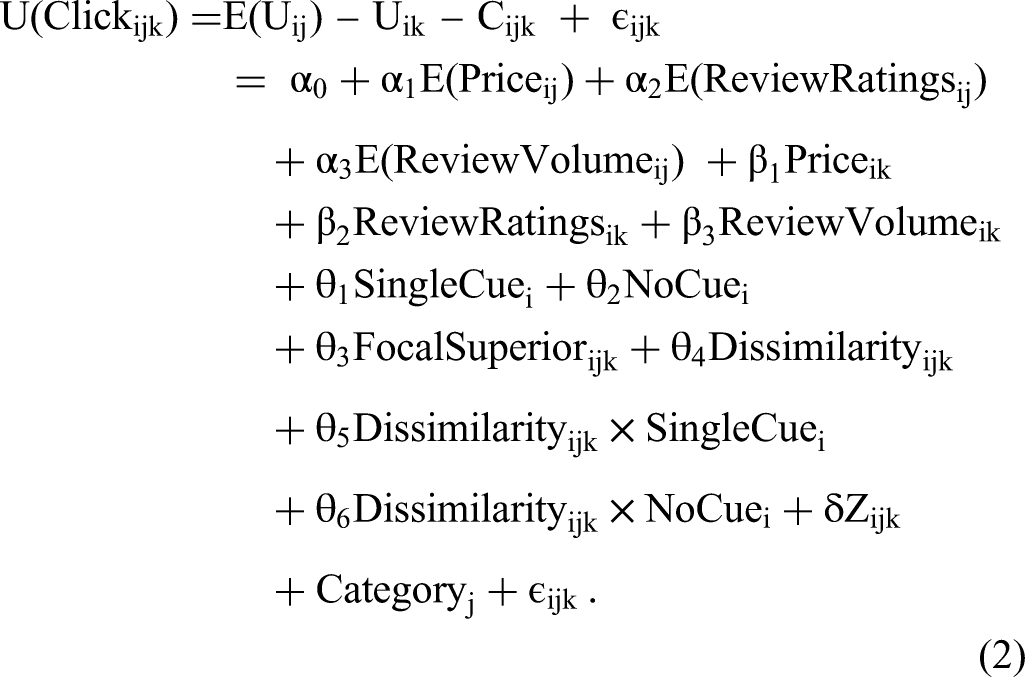
The utility of the focal product, Uik, is based on the directly observed attributes—price, review ratings, and review volume—available on the product detail page. In single-cue or no-cue conditions, consumers only partially observe the attributes of the recommended product, which forces them to form expectations about the missing attributes. Here, E(Uij) represents the expected utility of the recommended product, where consumers infer the missing attributes using one of three rules detailed in Web Appendix D: naive, perfect, or empirical expectations. Naive expectations assume that the missing attributes of the recommended product are identical to the observed attributes of the focal product. Perfect expectations assume that consumers have complete knowledge of the recommended product, including its hidden price or reviews. Empirical expectations rely on the empirical distribution of product attributes within the same category to infer the unknown attributes (Honka 2014).
We use the single review condition to illustrate how the expected price, E(Priceij), operates across three scenarios. Suppose the price of the focal product, denoted as Priceik, is $10 and the recommended product is priced at $20. Under naive expectations, the expected price of the recommended product is assumed to match the focal product, leading to an expectation of $10. For perfect expectations, consumers are assumed to have complete knowledge of the recommended product's price, resulting in an expected value of $20. In the case of empirical expectations, the expected price is determined by drawing from the price distribution within the same product category as the recommended product.
In addition to influencing the actual attribute values, the number of information cues also impacts the costs incurred during the comparison process between the focal and recommended products. These costs are captured by a set of variables, denoted as Cijk. Dummy variables for the single-cue (SingleCuei) and no-cue (NoCuei) conditions capture the average levels of search friction associated with each condition. The dissimilarity variable (Dissimilarityijk) measures the perceived Euclidean distance between the focal and recommended products in terms of prices, review ratings, and review volumes (Dang, Ursu, and Chintagunta 2024). A higher dissimilarity value indicates a greater perceived difference between the focal and recommended products.
We also introduce a focal superior dummy variable (FocalSuperiorijk) to indicate whether the focal product's attributes are superior to the corresponding observable attributes of the recommended product. This variable is relevant to decision difficulty (Chatterjee and Heath 1996). The focal superior variable adapts to the attribute comparison conditions: For example, a focal product is considered price superior if its price is lower than that of the recommended product in a single price cue condition, and it is considered review superior if both its review volume and review ratings are higher than those of the recommended product in a single review cue condition. When no cues are provided for the recommended product, the focal superior variable is assigned a value of zero. 6 This variable complements the dissimilarity measure by providing directional information regarding the attribute comparison. Finally, we account for session-product variables, Zijk, such as the number of recommended products displayed alongside the focal product, as well as whether the browsing session is the consumer's first session of the day, and category fixed effects (Categoryj). We assume ɛijk is Type I extreme value.
Results
Baseline
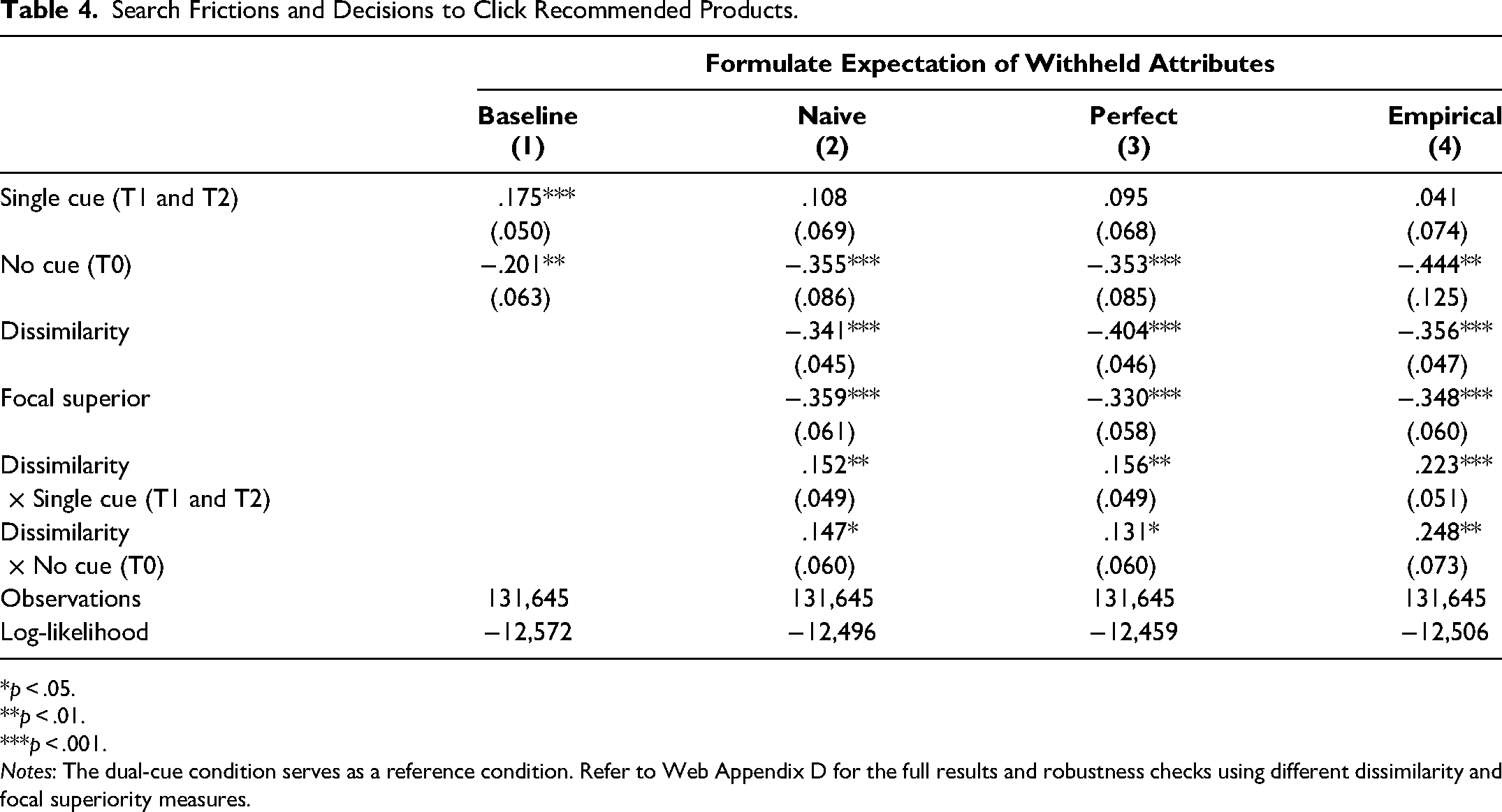
Table 4 presents the main coefficients of interest, using the dual-cue condition as the reference. We combine the single price and single review cue conditions to focus on frictions caused by the number of information cues rather than the types of cues. The baseline model in Column 1 includes only dummy variables for the cue conditions, capturing the average level of search friction. This baseline model does not account for how information cues affect frictions through their influence on expected attributes and comparison costs. The results show that, on average, the single-cue conditions lead to a higher probability of recommender product clicking compared with the dual-cue condition (.175, p < .001), while the no-cue condition results in a lower probability of clicking (−.201, p < .01). This aligns with our preceding findings: Single-cue conditions generate more recommender product clicks, while the no-cue condition, despite higher recommender list browsing, does not lead to significantly more recommender product clicks than the dual-cue condition.
Search Frictions and Decisions to Click Recommended Products.
*p < .05. **p < .01. ***p < .001.
Notes: The dual-cue condition serves as a reference condition. Refer to Web Appendix D for the full results and robustness checks using different dissimilarity and focal superiority measures.
Accounting for search frictions influenced by the number of cues
The models presented in Columns 2 through 4 of Table 4 reflect three different assumptions about how consumers infer unseen product attributes. We primarily focus on the results from Column 4, which represents the most realistic scenario, where consumers rely on their knowledge of product categories to fill in information gaps. The findings indicate that consumers are less likely to click on a recommended product when there is greater dissimilarity between the focal and recommended products (−.356, p < .001) and when the focal product has superior attributes compared with the recommended product (−.348, p < .001). Additionally, the interaction terms between product dissimilarity and the single-cue conditions (.223, p < .001), as well as the no-cue condition (.248, p < .01), are positive and significant. This suggests that the negative impact of product dissimilarity on recommender product clicks is more pronounced when consumers receive dual cues. These results support our preceding assertion that consumers find it easier to compare and dismiss mismatched recommendations when both price and review information are available.
Notably, the positive effect of the single-cue condition on clicks, which was significant in the baseline model, becomes nonsignificant in this model. This change, along with the significant role of comparison costs, supports our hypothesis that the search frictions induced by withholding cues affect how consumers evaluate products when making their decision to click on specific recommendations. The consistency of these results across all three models (Columns 2 through 4) reinforces the robustness of our conceptual framework and conclusions.
Search Strategies Based on Information Cues
This analysis incorporates cue-induced frictions into the decision process for recommender product clicks, complementing our preceding findings and supporting our conceptual framework. Notably, across all three methods of inferring withheld attributes, the no-cue condition consistently shows a significant negative effect on recommender product clicking, while the effect of single cues becomes nonsignificant once we control for comparison variables between the recommended and focal products. This suggests that consumers may adopt different search strategies depending on the number of information cues available. As also mentioned in the main results, no-cue consumers may choose to disengage from the recommender system, not because of product fit evaluation outcomes—since a lack of clicks prevents any meaningful evaluation—but rather due to insufficient information to initiate a proper evaluation. This insufficient information may prompt them to abandon product comparisons altogether. This finding aligns with prior research showing that high information frictions reduce consumer engagement, particularly when demand is elastic and frictions in one area influence behaviors in others (Argyle, Nadauld, and Palmer 2023).
Supplemental Analysis 2: Information Cues and the Search-to-Purchase Path
The main analysis demonstrates the intent-to-treat effects of information cues on individual outcomes but does not explore the specific effect paths between those outcomes. Although a full causal path analysis is beyond the scope of this research, this descriptive analysis empirically investigates connections between individual components of the conceptual framework, linking the initial treatment (information cues), resulting search behaviors, and final sales outcomes.
A Plausible Effect Path of Recommender Information Cues 7
Taken as a whole, the proposed nested search process suggests that information cues in the recommender can influence nonrecommender search. Due to data limitations, we are unable to trace the precise search sequence across tools. Nonetheless, we propose a plausible multistage process, though it relies on strong assumptions: The number of information cues first affects recommender search, which then impacts nonrecommender search. In both types of searches, consumers typically begin by browsing product lists and subsequently click on specific products. The combined effects of recommender list browsing, recommender product clicks, nonrecommender list browsing, and nonrecommender product clicks ultimately drive sales outcomes. To examine this multistage path empirically, we specify a structural equation model (Lin, MacInnis, and Eisingerich 2020) for consumer i in session t, as outlined in Equations 3 through 7:




The variable RBit represents recommender list browsing, while RCit refers to recommender product clicks. NBit refers to nonrecommender list browsing (also known as keyword list browsing), and NCit represents nonrecommender product clicks. The variable Treati denotes experimental conditions as previously defined, and Xit is the vector of control variables, which remains consistent across all equations. These include indicators for first session, weekends, and promotions, helping control for any heterogeneity. We estimate the system of equations, assuming that the error terms across the equations are uncorrelated.
Results
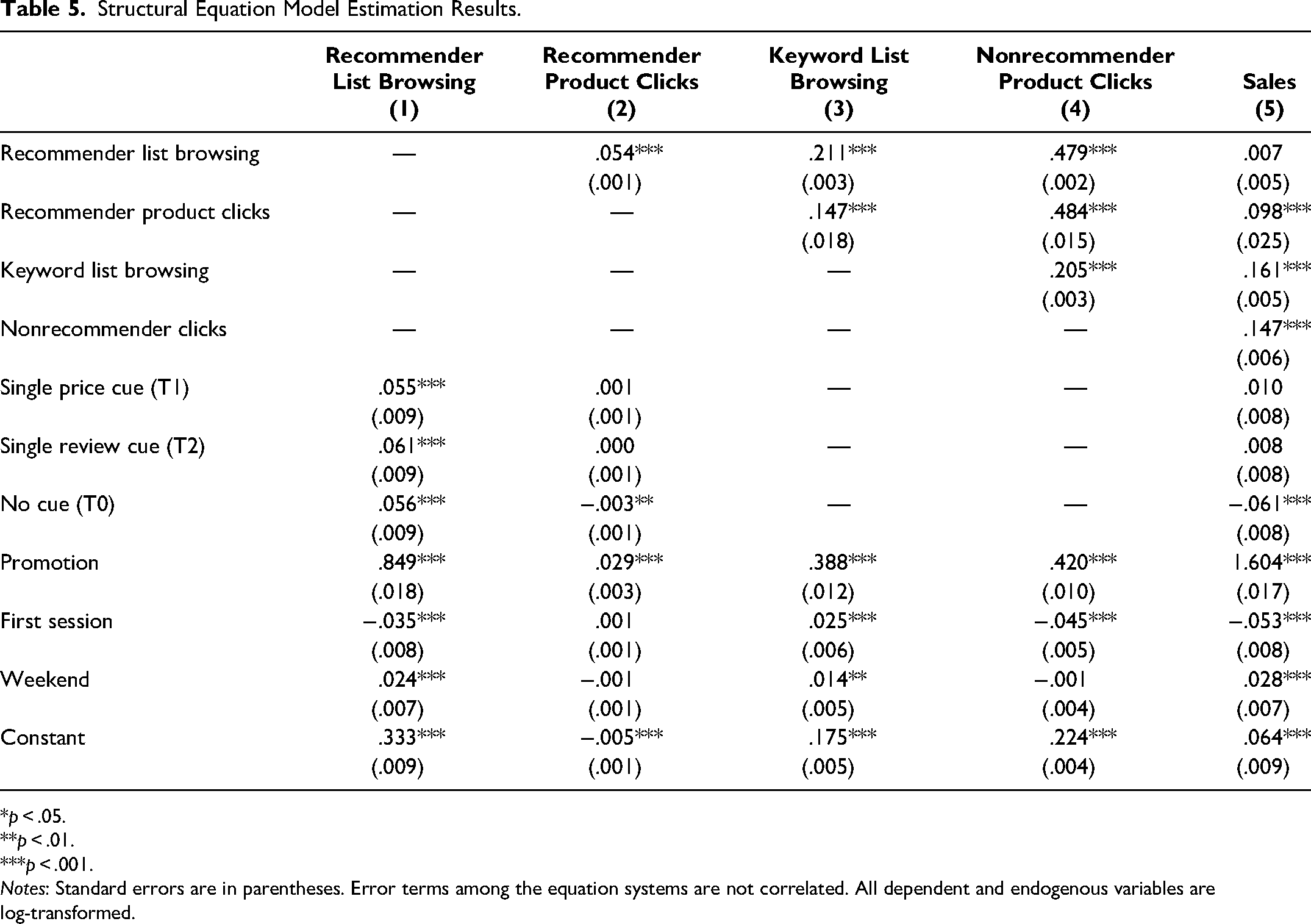
The results in Table 5 support the preceding assertion of a nested search process. Product list browsing has a positive effect on product clicks for both recommender search (.054, p < .001; Column 2) and nonrecommender search (.205, p < .001; Column 4). Additionally, there is a positive spillover from recommender search to nonrecommender search, with both recommender list browsing and recommender clicks significantly increasing keyword list browsing (.211, p < .001; .147, p < .001; Column 3) and nonrecommender product clicks (.479, p < .001; .484, p < .001; Column 4). Second, the effects of information cues on purchases are mediated by both recommender and nonrecommender search. All search metrics, except for recommender list browsing, positively and significantly impact final sales (.098, p < .001; .161, p < .001; .147, p < .001; Column 5). The lack of a direct effect for recommender list browsing suggests that its influence on sales is primarily mediated through other search behaviors.
Structural Equation Model Estimation Results.
*p < .05. **p < .01. ***p < .001.
Notes: Standard errors are in parentheses. Error terms among the equation systems are not correlated. All dependent and endogenous variables are log-transformed.
Finally, the path analysis provides evidence of two opposing forces in the search process, particularly evident in the contrast between the no-cue and single-cue conditions. While the four search metrics capture search intensity and generally have positive effects on purchases, this increased search intensity does not translate to higher sales in the no-cue condition. Notably, the coefficient for the single-cue condition becomes nonsignificant (Columns 2 and 5), while the no-cue condition shows significant negative effects on both recommender product clicks (−.003, p < .01; Column 2) and final sales (−.061, p < .001; Column 5), even after accounting for intermediate search metrics. This suggests that search intensity alone is insufficient to drive higher sales, reinforcing our preceding speculation that search efficiency may play a critical role. The opposing forces between search efficiency and search intensity ultimately contribute to the nonlinear purchase effects across different levels of information cues.
Caveats
This descriptive analysis highlights a key aspect of our conceptual framework: Information cues influence consumer purchases through the interplay of various search tools. For recommender cues to affect nonrecommender searches, consumers generally need to engage with the recommender system first (Li, Grahl, and Hinz 2022). While our model specifies a unidirectional path from recommender tools to nonrecommender tools, a reverse path is equally plausible. For example, consumers might begin by browsing nonrecommender product lists, move to recommender lists, and then return to nonrecommender lists. The actual search path is likely bidirectional, with consumers switching between recommender and nonrecommender tools throughout their search journey. Therefore, the relationship between recommender and nonrecommender search tools cannot be simply classified as purely substitutive or complementary.
Our results should be interpreted as an aggregate representation of the path from recommender to nonrecommender tools, within which more granular and bidirectional search patterns may occur. The model relies on strong assumptions, so readers should interpret the conclusions with caution. Establishing a fully causal path would require randomization of both information cue designs and all four search metrics, as suggested by Liang et al. (2023). Additionally, to fully establish causality, further assumptions about correlated errors among equations and a more detailed dataset capturing the exact search sequences across tools would be necessary.
General Discussion
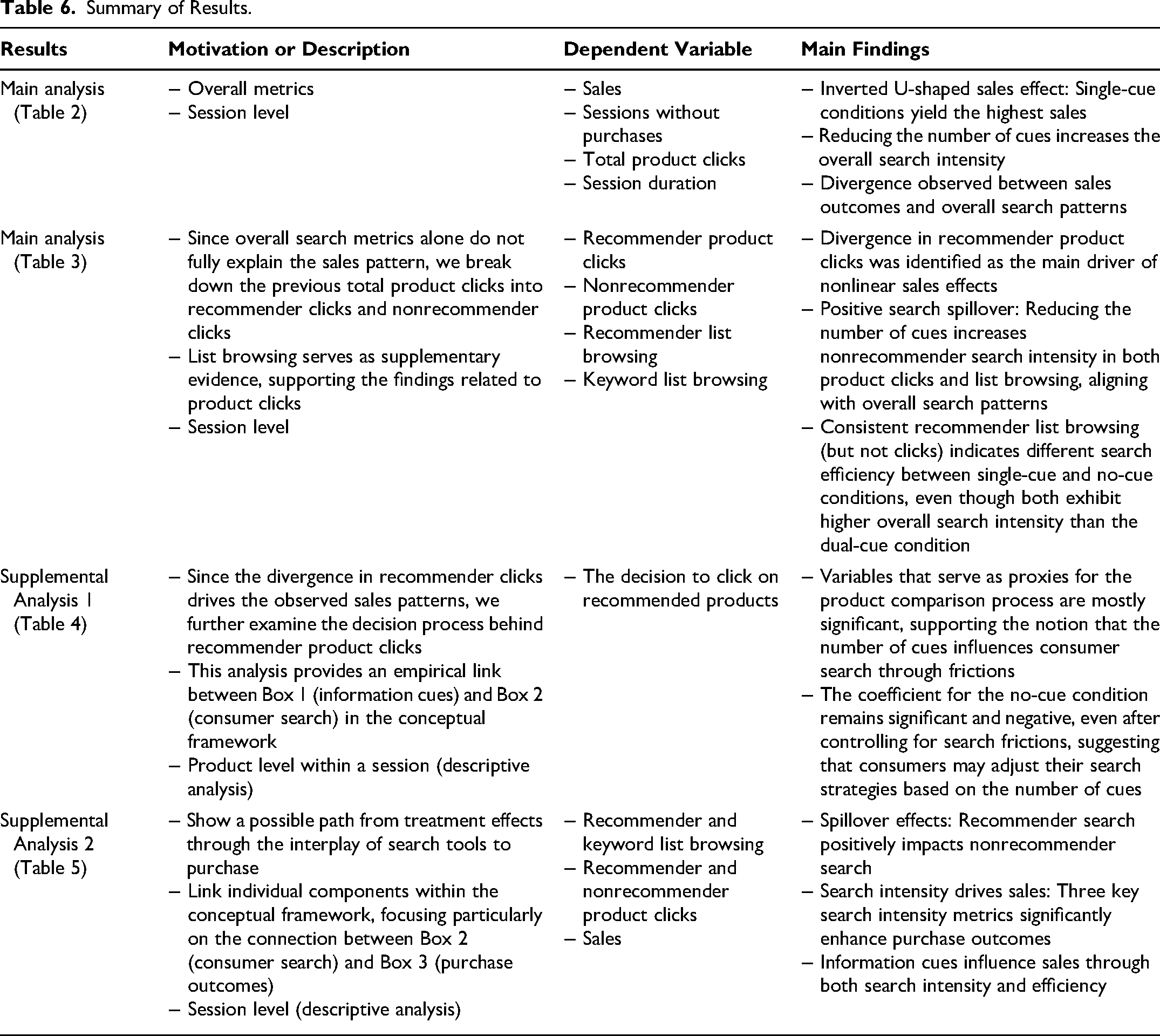
Given the space constraints of recommender systems, it is crucial to balance a frictionless shopping experience (Unal and Park 2023) with the strategic introduction of search frictions by withholding information (Ngwe, Ferreira, and Teixeira 2019). These search frictions shape consumer search and purchase by influencing interactions with both recommender lists and nonrecommender search tools. Our research reveals a nonlinear effect of information cues on consumer purchases, where single cues (e.g., price or review) lead to the highest sales compared with both the dual-cue and no-cue conditions. Single-cue conditions introduce just enough friction to strike a balance between search intensity and efficiency, driving the observed nonlinear sales effect. The excessive search frictions in the no-cue condition discourage recommender usage, while the high efficiency of dual cues limits exploration beyond recommendations. Our article contributes to the literature on strategic product information disclosure and consumer search behavior. We summarize the results in Table 6.
Summary of Results.
Managerial Implications
A brief summary of managerial implications
Our study provides several managerial implications for platform design. First, it highlights the importance of managing the number of information cues displayed within recommendation lists. As retailers continue to add more types of cues, such as promotional offers and sustainability pledges, understanding the impact of the number of cues first is crucial for optimizing cue combinations. Second, our findings suggest that online retailers should integrate different search tools in a coordinated manner. Platform managers should prioritize relevant search tools in alignment with a possible nested search process, ensuring effective coordination among these tools. Third, we demonstrate that nontechnical adjustments to recommender systems, like modifying information cues, can substantially boost sales without the high expenses linked to algorithmic changes. Improving recommender algorithms is typically complex and costly, which can be prohibitive for smaller retailers. In our case, the retailer's attempts to enhance algorithms were unsuccessful, leading the retailer to adopt a third-party recommender service. As marketing tools become more reliant on technology, maintaining a focus on practical and cost-effective marketing strategies is equally essential.
Algorithm accuracy and search efficiency
The retailer's experimentation with information cue design was largely motivated by the low accuracy of its recommender system algorithm. However, high-quality product recommendations may increase the size of consumers’ consideration sets (Zhang, Agarwal, and Lucas 2011). In a scenario where the algorithm performs with higher accuracy, consumers in the dual-cue condition might demonstrate a higher likelihood of engaging with, rather than rejecting, the recommendations. Those additional encounters with better-matched products may lead to more purchases, compared with when the algorithm is less accurate. Additionally, improved recommender performance could have different spillover effects on nonrecommender search behavior, potentially altering the interplay between search tools. Here, algorithm accuracy serves as a key indicator of search efficiency, and this crucial precondition could influence both the results and the broader implications of the findings. Similarly, the search efficiency of nonrecommender search tools also likely plays a critical role in shaping consumer search patterns. Thus, platforms should carefully consider these contextual factors (Kawaguchi, Uetake, and Watanabe 2021) when interpreting our findings, as well as those from other studies.
The possible downside of attracting more recommender clicks
Our findings suggest a complex interplay between recommender and nonrecommender tools, raising an important question for platform design: Should a recommender system always prioritize maximizing recommender product clicks? 8 Consider a scenario in which a consumer, after incurring significant search costs, arrives at a product page featuring both the focal product and additional recommendations. For a goal-oriented consumer with clear purchase intent for the focal product, these recommendations could create an unintended distraction, leading to further, unnecessary search. This diversion may result in a paradox wherein the consumer, overwhelmed by the recommender lists, loses focus on the original product and ultimately abandons the session. In such cases, overemphasizing recommender product clicks could lead to lost sales.
Although our descriptive analysis indicates a positive effect of recommender product clicks on nonrecommender search and sales in this specific context, the broader literature presents more varied outcomes. Previous studies have documented a substitutive relationship between recommender systems and other search tools (Wan, Kumar, and Li 2023; Yuan et al. 2024). These mixed findings align with our speculation that recommender and nonrecommender tools may not be purely substitutes or complements. Platform managers should therefore carefully examine the interactions between different search tools and integrate the platform search tools in such a way that gains in one area do not come at the expense of another.
Limitations and Future Research
Our study is not without limitations. First, although we examine how the number of information cues affects consumer behavior, we observe subtle differences between different types of cues. One potential reason for this is the inherent difference between price and review information. Price is an objective attribute relevant to nearly all consumers, while customer reviews represent subjective individual experiences, which may not hold the same importance for every consumer or product. Additionally, when the price is displayed in the thumbnail, price-sensitive consumers have little incentive to click further, whereas those interested in reviews may find additional insights by clicking, such as detailed review distributions and content. These differences make the type of information cues a valuable subject for future research. Second, each review presents two pieces of information—ratings and volume—which together can convey varying signals and potentially encourage further exploration. Future research could explore the impact of recommending products based on varying price levels (high/low) and review ratings (positive/negative). Third, our findings are contingent on the specific algorithm employed by the retailer. Future studies could investigate how different recommender algorithms and their accuracy moderate the role of information cues.
Supplemental Material
sj-pdf-1-jmx-10.1177_00222429251326941 - Supplemental material for Too Many or Too Few? Information Cues in Recommender Systems and Consequences for Search and Purchase Behavior
Supplemental material, sj-pdf-1-jmx-10.1177_00222429251326941 for Too Many or Too Few? Information Cues in Recommender Systems and Consequences for Search and Purchase Behavior by Xing Fang, SunAh Kim and Pradeep K. Chintagunta in Journal of Marketing
Footnotes
Acknowledgments
The authors gratefully thank the JM review team for their insightful feedback and guidance. The authors are also grateful for the valuable comments from Anna Tuchman, Steven Shugan, John Roberts, and attendees of the 2024 University of New South Wales Marketing Camp.
Coeditor
Shrihari Sridhar
Associate Editor
Kusum L. Ailawadi
Declaration of Conflicting Interests
The author(s) declared no potential conflicts of interest with respect to the research, authorship, and/or publication of this article.
Funding
The author(s) received no financial support for the research, authorship, and/or publication of this article.

Notes
References
Supplementary Material
Please find the following supplemental material available below.
For Open Access articles published under a Creative Commons License, all supplemental material carries the same license as the article it is associated with.
For non-Open Access articles published, all supplemental material carries a non-exclusive license, and permission requests for re-use of supplemental material or any part of supplemental material shall be sent directly to the copyright owner as specified in the copyright notice associated with the article.
