



Abstract
Sponsored content allows brands to partner with creators to reach creators’ audiences on digital platforms. However, both creators’ and brands’ incomplete understanding of this object generates two critical ambiguities: how to determine the value of sponsored content and how to effectively coproduce it. To better understand these ambiguities, the authors theorize sponsored content as an epistemic market object: an object that facilitates marketing functions but is only partially understood by the actors who use it. They analyze a dataset of interviews, podcasts, media articles, and third-party platform reviews about—and by—content creators, brands, and intermediaries. The findings show that brands, creators, and intermediaries create and apply knowledge to address valuation and coproduction ambiguities. However, this knowledge work is incomplete, creating asymmetries in value outcomes and power relationships in a brand–creator partnership. This research contributes to marketing literature and practice by highlighting the role of epistemic market objects in transformative market disruptions that alter the roles of, and the relationships between, market actors. The findings are transferable to other substantive areas such as generative artificial intelligence, the metaverse, nonfungible tokens, online news, and the sharing economy.
Because [sponsored content] is such a new industry, everyone seems to always just be chasing their tails rather than having anyone that's completely on top of it, completely out there showing: “This is the blueprint, this is the standard, and this is what everyone should aspire to.” Everyone's kind of making [it] up as they go along, from creators to brands to everyone, because it is so new, and until it's had that time to settle and good practices are celebrated more, and we are being transparent about it more, it’s kind of shrouded in that mystery where we’re not getting the best practices. —Vix Meldrew, creator, podcast
Sponsored content is produced when an online creator partners with a brand to “integrate a specific product into their content, usually with some degree of creative freedom” (Wies, Bleier, and Edeling 2023, p. 383). It aims to create “a favorable impression of the sponsor brand or one of its products” (Arriagada 2021, p. 253). While it is adaptable to the different platforms in which it is inserted (Sonderman and Tran 2013), helping creators leverage their audiences (Brooks, Drenten, and Piskorski 2021), it has different meanings tied to different—and even conflicting—objectives for brands and creators involved in the process of developing it. For example, the audience-building objectives of content creators (Abidin 2016; Smith and Fischer 2021) might not be compatible with brands’ objectives of awareness and conversion (Hughes, Swaminathan, and Brooks 2019; Leung, Gu, and Palmatier 2022). As our opening quote suggests, ambiguities prevail regarding how to manage this new object.
In this article, we ask: How do the ambiguities around sponsored content shape brand and creator partnerships? We argue that the context in which brands work with creators has been disrupted due to the emergence of platforms (Caliandro et al. 2024; Wichmann, Wiegand, and Reinartz 2022). We categorize this as a transformative market disruption or “adaptive responses to contextual demands and influences” (Giesler and Thompson 2016, p. 502) with regard to brand–creator partnerships. At the center of these partnerships, we theorize sponsored content as an epistemic market object, which we define as “an object that facilitates marketing functions but is only partially understood by the market actors who use it and continuously discover it through knowledge work.” We build on the concept of epistemic object, an object of expert and academic inquiry, resulting in the development and application of knowledge or, in other words, knowledge work (Knorr Cetina 1999). Our review of the literature on sponsored content shows that it is understood differently by the actors that coproduce it: creators, brands, and intermediaries (marketing communication, digital marketing and influencer agencies, third-party platforms and marketplaces, and experts). These differential understandings revolve around two ambiguities: (1) valuation, arising from incommensurable tools and methods for determining the market value of the object, and (2) coproduction, arising from unclear roles, processes, and responsibilities in coproducing the object.
We show that market actors continuously respond to these ambiguities through creation and application of knowledge (e.g., metrics, managerial blueprints, procedures) or, in other words, through knowledge work. Understanding knowledge work that emerges in response to ambiguities is important because as technologies evolve, we are bound to see more transformative market disruptions. For example, our insights can apply to other novel market objects such as nonfungible tokens (NFTs), generative artificial intelligence (AI), the metaverse, and the sharing economy. Our research can inform practitioners about creating knowledge work strategies around epistemic market objects.
To investigate how market actors involved in the production and circulation of sponsored content engage in knowledge work, we performed a large-scale qualitative study. Our data includes in-depth and secondary (podcast) interviews with creators, brand managers, creatives, and other intermediaries (i.e., third-party platform employees and industry experts). We also supplement this with secondary data from articles in the specialized press, case studies, and reviews of third-party platforms.
We identify two types of knowledge work—which we classify as evaluative and orchestrative—that aim to address valuation and coproduction ambiguities. However, we uncover that this knowledge work is incomplete, creating asymmetries in value outcomes and power in partnerships. In doing so, we make two contributions to theory and practice: (1) conceptualizing epistemic market objects as a novel theory to understand transformative market disruptions, and (2) showing how the knowledge work around epistemic market objects fundamentally alters the structure of the market and actor roles and relationships. To start, we introduce the concept of epistemic market objects. Second, we show how knowledge work is performed to address ambiguities raised by this epistemic object and the consequences of incomplete knowledge work. After discussing our contributions, the transferability of our findings to other contexts, and the implications of our work, we end with limitations and future research.
Epistemic Objects and Knowledge Work
Epistemic Objects
Drawing on Rheinberger's (1997) concept of “epistemic thing,” Knorr Cetina (1999) describes epistemic objects as those that are “characteristically open, question-generating and complex” (p. 181). They are only partially understood and differently interpreted by the communities who use them (McGivern and Dopson 2010), therefore being unstable, in flux, and discovered and shaped by each actor's intervention, measurement, and inquiry. They are at the center of different groups that use and make sense of them (Ewenstein and Whyte 2009; Knorr Cetina and Preda 2001; Werle and Seidl 2015; Zwick and Dholakia 2006). Examples include those of scientific inquiry, such as the brain (Godfrey-Smith 1998; Karafyllis and Ulshöfer 2008) and viruses (Aboelenien, Arsel, and Cho 2021), sociotechnical organizations such as financial markets (Knorr Cetina and Preda 2001), organizational procedures such as employee safety inspections (Miettinen and Virkkunen 2005) or flexible production (Werle and Seidl 2015), and sociomaterial objects such as architectural projects (Ewenstein and Whyte 2009).
In management, scholars have used the concept of epistemic objects to understand how they provoke conflicts between different groups, such as the medical community and policy makers (McGivern and Dopson 2010). They have also investigated how the open characteristics of such objects have shaped cross-disciplinary collaborations in health innovation (Nicolini, Mengis, and Swan 2012) and partnerships between the creative and technical sides of the gaming industry (Panourgias, Nandhakumar, and Scarbrough 2014). In marketing, scholars have applied the concept to trading and financial markets (Mayall 2008; Zwick and Dholakia 2006). These examples show that epistemic objects “embody what one does not yet know” (Miettinen and Virkkunen 2005, p. 438), in contrast to objects that are taken for granted and used routinely without any problematization (Werle and Seidl 2015).
In explaining how an object becomes epistemic, Knorr Cetina gives the analogy of an ordinary object, a car, becoming a source of inquiry after breaking down on the road and generating ambiguities for the driver, who had previously taken its materiality for granted (Knorr Cetina 2001). As a result, the driver must inquire about the object and find solutions to its newly emerging ambiguities. Without an object materially breaking down, ambiguities can also emerge from unknown things about, or inner contradictions of, an object, such as employee health and safety (Miettinen and Virkkunen 2005) or disruptions to the context in which the object is embedded, such as flexible production (Werle and Seidl 2015) or autonomous solutions (Frandsen, Raja, and Neufang 2022). Resolving these ambiguities requires knowledge work: developing and applying knowledge.
Who Does Knowledge Work, and How?
Knowledge work is defined as a “set of practices, arrangements, and mechanisms … in a given area of professional expertise [that] make up how we know what we know” (Knorr Cetina 2007, p. 67). It is characterized by the production and application of knowledge (Drucker 1959), which Davenport (2005) describes as “thinking for a living.” It involves gathering and organizing information, problem-solving, improvising, innovating, and connecting different organizational and market actors (Alvesson 2001; Reinhardt et al. 2011). It is essential to organizations where knowledge is both the means of production and the output (Zuboff 1988), such as financial services, architecture, advertising, and research. Thus, knowledge and its production are embedded in professional practices and cultures in knowledge-intensive firms (Alvesson 2001; Blackler 1995). For example, financial market actors create knowledge that assesses, quantifies, and compares aspects of the market for consumers and investors (Anthony 2021; Knorr Cetina 2010; Knorr Cetina and Preda 2001; Zwick and Dholakia 2006).
In a comprehensive analysis of existing work, Reinhardt et al. (2011) describe types of knowledge work, which include analyzing, expert searching, information searching, networking, linking, and problem-solving. These actions can be performed by individual workers such as financial analysts (Anthony 2021); knowledge-intensive organizations that produce and broker knowledge, such as computer consultancy firms (Alvesson 1993; Blackler 1995); or advertising firms (Gordon et al. 2021). Knowledge work also includes boundary-crossing practices such as connecting, outsourcing, and creating representations (Reinhardt et al. 2011). This type of knowledge work is done by intermediaries (individuals or organizations) whose job is to mediate relationships between or within organizations (Bessy and Chauvin 2013; Lilien 2011). For example, advertising agencies or market research firms are intermediaries that navigate different worlds (e.g., consumers, brands, creators, and even academics) and translate knowledge produced in one world to another. In doing so, they mediate the relations between stakeholders to maximize value for all (Gordon et al. 2021).
In this section, we summarized the literature on epistemic objects and knowledge work to reinforce the foundations of our conceptualization of sponsored content as an epistemic market object. Next, we elaborate more on this conceptualization.
Sponsored Content as an Epistemic Market Object
Sponsored content is collaboratively created by creators, brands, and intermediaries by leveraging consumer–creator relationships and consumer-to-consumer networks (Gurrieri, Drenten, and Abidin 2023). It emerged from the transformation of the marketing ecosystem through the rise of social media and platforms (Caliandro et al. 2024). Brands that previously relied on paid editorials and word of mouth sought ways to establish an authentic, positive, and community-friendly presence on social media (Fournier and Avery 2011; Holt 2016; Kozinets et al. 2010). Enabled by affordances (Shamayleh and Arsel 2022) brought by the evolution of social media platforms, such as Instagram's hashtags, location features, partnership links, and short stories, creators were able to develop, showcase, and commercialize expertise in a particular field for a loyal audience, with whom they nurture parasocial relations (Mardon, Cocker, and Daunt 2023a; McQuarrie, Miller, and Phillips 2013; Scholz 2021) while also highlighting their partner brands (Leung et al. 2022). This shaped not only how consumers related to the content and consumed it but also how content is produced (Arriagada 2021), which requires balancing creators’ character narratives (Kozinets et al. 2010) with brands’ and creators’ commercial objectives (Duffy 2017) while managing the audience to benefit both (Campbell and Farrell 2020).
We conceptualize sponsored content as an epistemic market object. Epistemic market objects facilitate marketing functions but are only partially understood by the market actors who use them and continuously discover them through knowledge work. For example, an emergent object such as autonomous solutions can be a source of ongoing inquiries from multiple stakeholders attempting to adopt or market it, which can then expand business ecosystems (Frandsen, Raja, and Neufang 2022). In other cases, market objects can become epistemic due to contextual changes that blur and broaden the boundaries of the entities they serve, such as the case of brands that require a refocus in academic inquiries when both the branding infrastructure and stakeholder environment evolve (Swaminathan et al. 2020). Similarly, the production and valuation of sponsored content have been changing as platforms, through datafication (Caliandro et al. 2024) and changed relationality between market actors (Wichmann, Wiegand, and Reinartz 2022), alter the conditions of its creation. This results in two critical ambiguities, valuation and coproduction, which we abductively synthesize from the existing literature.
How Sponsored Content Creates Ambiguities in Valuation
Valuation refers to how value is attributed to an object, the categories for assessing value, and the debates around these categories (Lamont 2012). Existing research on sponsored content centers around two ambiguities related to the valuation of the object: (1) the models and processes to determine the market value of the object, and (2) the timing and the mode through which the creators of the object are compensated.
Ambiguities in reliably determining the market value of the object
Wherever there is an exchange, valuation becomes a problem (Scaraboto 2015), which leads to knowledge work. For example, in the broader marketing field, the quest for valuation has resulted in models to measure customer valuation (Kumar 2018), brand equity (Keller 1993), and pricing (Kannan, Pope, and Jain 2009). In the case of sponsored content, the object’s market value is contingent on the creator's ability to capture an audience with content that is informative, intimate, socializing, entertaining, and engaging (Hughes, Swaminathan, and Brooks 2019; Leung et al. 2022; Scholz 2021; Tian, Dew, and Iyengar 2023).
Brands determine the value of sponsored content based on return on investment. They rely on metrics such as view counts (or reach) (Cluley 2018; Wies, Bleier, and Edeling 2023), audience size (Hughes, Swaminathan, and Brooks 2019), return on ad spend (Gordon et al. 2021), and reposts (Leung et al. 2022). These metrics aim to measure the value of audience behavior that benefits the brand (Gurrieri, Drenten, and Abidin 2023). Avery and Israeli (2020) recommend five types of pricing options for (1) posting activity, (2) reach, (3) targeted reach, (4) engagement, and (5) performance. Recent work investigates the relationship between audience size and brands’ campaign success. For example, endorsements to smaller audiences lead more often to conversion, compared with endorsements to larger audiences, which are more effective for reach (Tian, Dew, and Iyengar 2023). Beichert et al. (2024) also make similar conclusions in their large-scale study and review of existing work on the relationship between follower levels and return on investment. These ongoing academic inquiries on how sponsored content should be priced and discussions around the metrics that measure returns on investment for sponsored content highlight the ambiguities around valuation.
While brand and creator partnerships can be symbiotic, for example, the brand Glossier capitalizing from a community of creators (Avery 2019) or a vegan creator growing her audience as she partners with different brands (Ashman, Patterson, and Kozinets 2021), they can also be counterproductive when a creator is perceived to sell out by their audience (Mardon, Cocker, and Daunt 2023b) or misbehave and get involved in scandals (Fournier and Eckhardt 2019). Creators themselves not only struggle to manage the impact of such factors on their audience relationships but also seek acknowledgment for the invisible dimensions of creative work, such as community management (Kubler 2023; Trittin-Ulbrich and Glozer 2024). In addition, research shows that compensation structures are mostly arbitrary and there are discriminatory patterns based on race (Christin and Lu 2024). Creators have also been pushing for better pay, as attested by recent creators’ initiatives to value their work, such as the Instagram account @InfluencerPayGap. In sum, the complexity around the uncertain effects of creators’ partnerships with brands on their long-term relationships with their audience, alongside the arbitrary fee systems, highlights the uncertainties they face. These considerations generate ambiguity about how much a sponsored content campaign should cost. Therefore, reliably determining the market value of sponsored content remains an open question.
Ambiguities in the timing and mode of compensation of the creators
Due to the characteristics of sponsored content that blends aspects of earned and paid media (Campbell and Farrell 2020), there have been long-standing ambiguities about how creators should be paid and a strong inclination for brands to provide gifts as payment. According to “The State of Influencer Marketing” (Influencer Marketing Hub 2024), only 41% of brands offer monetary compensation to creators. Of the paid creators, 42% receive payment through affiliate links, giving them a commission on what is sold on the brand's website (Influencer Marketing Hub 2024, p. 43) regardless of how much they worked. Nonmonetary payment or payment through commissions can be an entry-level option for early-career creators (Nascimento, Campos, and Suarez 2020) who start their trajectories as hobbies or passions (Abidin 2016; Luvaas 2021; Postigo 2021). As creators develop expertise, build their brands, and gain quasi-celebrity status (Brooks, Drenten, and Piskorski 2021; Fournier and Eckhardt 2019; Rundin and Colliander 2021), they start to demand concrete fees, but not always successfully. For example, the literature indicates a growing dissatisfaction among creators who demand monetary payment for the creative work and community management they execute for companies (Luvaas 2021; Trittin-Ulbrich and Glozer 2024).
For brands, finding the right formula to pay a creator is challenging, as it requires determining not only the monetary value of the compensation but also the contractual modalities for when payments will be made. While ex-post payments for engagement or performance work well for brands (Avery and Israeli 2020), many creators do not want to work without advance payment, as they believe that creating content is work in itself (Duffy 2017). They expect to be paid regardless of brand outcomes, which can depend on variables other than their own efforts. In contrast, brands see arrangements that reward outcomes, like pay-per-click, as more suitable since they can be better linked to return on investment (ROI) (Leung, Gu, and Palmatier 2022). This mismatch between what works best for brands and what works best for creators creates an ongoing ambiguity about the optimum time and modality to compensate for creator work.
How Sponsored Content Creates Ambiguities in Coproduction
Sponsored content's coproduction involves a series of interactions, which include establishing the partnership between a creator and a brand, actors learning about their collaborators’ respective goals and activities, the creative conception of the content, the delivery of content, and audience management. These interactions require coordination and cocreation among multiple actors, including creators themselves, professionals in agencies, other intermediaries, and brands (Arriagada 2021; Duffy and Sawey 2021; Postigo 2021). Research on sponsored content centers around two key coproduction ambiguities brought by sponsored content's coproduced nature: (1) the appropriate match between a creator and a brand, and (2) the roles in the coproduction of the object.
Ambiguities about the appropriate match between a creator and a brand
Coproduction starts with a brand–creator match, which involves alignment of brand objectives with the creators’ fields of expertise (McQuarrie, Miller, and Phillips 2013), the nature of creators’ relationships with their audiences (Mardon, Cocker, and Daunt 2023b), and audiences’ network size (Goldenberg et al. 2024). Typically, brands are the ones who choose which creators to partner with (Duffy and Sawey 2021). For this, they seek two paths: awareness and engagement. Awareness-based partnerships refer to partnering with celebrity creators or creators with significant numbers of followers, similar to celebrity endorsement models (Erdogan 1999; Tian, Dew, and Iyengar 2023), which benefit from the parasocial intimacy and staged amateurism typical of social media (Leaver, Highfield, and Abidin 2020). However, recent research suggests that this awareness does not always convert to sales, and partnering with macro-influencers does not have the highest return on investment (Beichert et al. 2024; Lanz et al. 2024). A second approach aims to achieve engagement, which expects creators to act as more than endorsers and embed the product's usage and the brand's values in their content (Scholz 2021). For this, creators with smaller follower counts but stronger connections with audiences are recommended as partners (Kay, Mulcahy, and Parkinson 2020; Park et al. 2021). However, these debates have not reached a consensus on the best matching model between a brand and a creator.
Creators aim to partner with brands that will complement their values and image, disclosing possible conflicts of interest (Kozinets et al. 2010) to avoid perceptions of exploitation of their audiences (Mardon, Cocker, and Daunt 2023a). For example, world-famous creator Chiara Ferragni has carefully crafted her social media content with her audience in mind, prioritizing partnerships that enhance her relationship with fans (Keinan et al. 2015). While symbiotic partnerships might emerge, benefiting both actors (Rundin and Colliander 2021), ambiguities on how to fine-tune coproducer choice remain.
Ambiguities in the roles of coproduction
Both brands and creators claim expertise to effectively tailor and communicate a brand's message to audiences (Arriagada 2021). Creators claim that sponsored content works better when reinforcing their character narratives, capturing (Smith and Fischer 2021) and captivating audiences through expertise (McQuarrie, Miller, and Phillips 2013). Character narratives are “enduring personal stories or accounts that we may understand as being related to particular expressed character types” (Kozinets et al. 2010, p. 74). They foster creators’ relations with their audience through staged intimacy and calibrated amateurism. Therefore, creators argue that character narratives should take center stage. For brands, content creation means outsourcing some marketing functions, such as creative work and community management, to creators (Campbell and Farrell 2020). Conversely, brands prefer that sponsored content is tailored to their branding or other commercial goals (Hughes, Swaminathan, and Brooks 2019; Leung et al. 2022).
These misaligned objectives can cause dissonance between the sponsored content campaign and brand messages (Leung, Gu, and Palmatier 2022). Brands’ excessive supervision of the content can also backfire, yielding negative results, such as reduced campaign credibility and diminished interest in the brand (Martínez-López et al. 2020). Childers, Lemon, and Hoy (2019) point out a “content development dance” (p. 267) in which brands, creators, and intermediaries—such as agencies—play different roles in setting the tone of the content, approving content, and mitigating risk. Issues of disclosing the sponsored character of content and where and when the disclosure of partnership will be placed are also ambiguities connected to coproduction (Chen, Yan, and Smith 2023; Voorveld 2019). These ambiguities are not culture-bound, as they have been studied in Brazil (Nascimento, Campos, and Suarez 2020), China (Chen, Yan, and Smith 2023), Italy, and the United States (Keinan et al. 2015). Hence, our methods section describes how we gathered a global and multiactor dataset.
Method
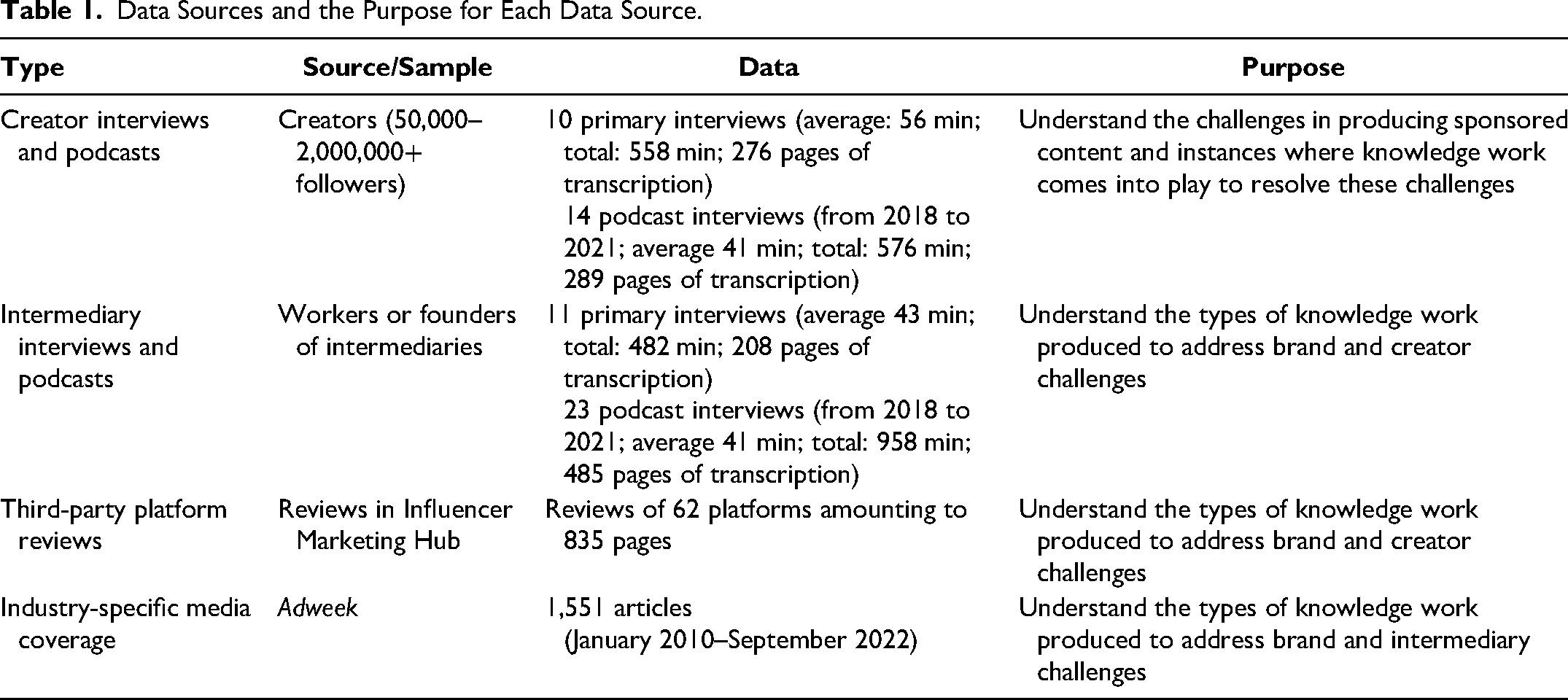
Exploring how market actors perform knowledge work to address the identified ambiguities requires an approach that triangulates data sources from multiple actors. To ensure we capture the global nature of this phenomenon, we include data collection from two continents: Europe and South America. Table 1 summarizes the data sources and how they contribute to answering our research questions. Next, we describe how we collected and analyzed this data and how each source contributed to our analysis.
Data Sources and the Purpose for Each Data Source.
Data Sources
Creator interviews and podcasts
We started our project in 2018 by conducting in-depth interviews (Arsel 2017) with ten Brazilian creators. We chose Brazil for its high prevalence of social media usage and our connections, which allowed us to reach creators with large numbers of followers (from approximately 50,000 to 4 million). The interviews started with personal questions about the participants’ lifestyles, education, and personal history, then moved to professional questions related to their work as creators. While the professional questions touched on how the participants got started, the image they aim to project, and their objectives for their social media accounts, the focus remained on their experiences partnering with brands. All names and other identifying information are anonymized.
To expand our understanding from Brazil to other regions, we collected secondary interviews with creators from the podcast Blogosphere: Serious Influence, which explores the creator industry with guests who are intermediaries, industry experts, and creators, released between 2018 and 2021. Secondary interviews have been previously used in research about creative directors and designers (Parmentier and Fischer 2021) and specialty coffee professionals (Dolbec, Arsel, and Aboelenien 2022). The podcast is hosted in the United Kingdom, and most of the 14 creators interviewed were based in the United Kingdom. The interviews usually start with the creator's professional trajectory, and then cover their experiences and challenges. As this data is in the public domain, we retain the real names and company information.
Intermediary interviews and podcasts
Next, we investigated different intermediaries. Between 2020 and 2022, we conducted in-depth (Arsel 2017) interviews with professionals in marketing communication, digital marketing, and influencer marketing agencies, as well as creator marketplaces (where creators add their profiles to be selected by brands) and in-house influencer marketing workers, using our connections in Brazil and France. These professionals worked in different functions, ranging from employees to founders. Some were responsible for in-house sponsored content campaigns for brands. We used a mix of purposeful and snowball sampling strategies as we sought professionals in different types of agencies and functions and welcomed referrals from our participants. During the interviews, participants were prompted to share their views and personal experiences on issues such as what types of creators were better suited for different marketing objectives, how they were selected and compensated for their work, how they measured the success of campaigns, if they had any problems with creators themselves, and their experiences with other industry actors. To ensure anonymity, pseudonyms are used for their names, and their organizational affiliations are not disclosed.
Like the creator data, we complemented these interviews with 23 podcast episodes from Blogosphere: Serious Influence featuring similar types of actors in the industry, plus adjacent experts (for example, legal). The podcasts were released between 2018 and 2021. These interviews typically included questions about the interviewees’ professional trajectory, the opportunities and challenges of their work, and the industry itself. As with the creator interviews, we did not change the names, organizations, or brands as the interviews are in the public domain.
Third-party platform reviews
We downloaded reviews and descriptions of 62 platforms from Influencer Marketing Hub. These third-party platforms are “software solutions” that “act as support to make life easier for both agencies and brands when managing and working with influencers” (Geyser 2023). This data allowed us to identify challenges in the industry, triangulate our findings with interview and podcast data, and identify technology-based solutions proposed by third-party actors to address valuation and coproduction ambiguities.
Industry-specific media coverage
We collected data from Adweek, a specialized publication focusing on advertising and public relations. We chose Adweek due to its relevance and reach in the marketing industry and its brand-centric approach. The data was collected through Factiva and encompasses all articles that include the term “influencer” 1 published between January 2010 and December 2022. We chose 2010 because it corresponds to the year Instagram launched, the platform on which influencer work first gained traction and has developed the most (Abidin 2016).
Analytical Procedures
Following Spiggle (1994), our data collection, analysis, and interpretation evolved iteratively, as data and theoretical interpretations from the prior phase informed the collection and coding of the subsequent one. The project started with the third author interviewing creators and coding the data as a part of her MSc thesis. Codes and themes revolved around the challenges creators face in adjusting content to brands’ needs and their discontent with fees. To include the perspective of brands and other actors, which was missing in the interviews, the first and second authors collected Adweek data. They openly coded an initial sample selected through the relevance algorithm of Factiva to map changes around the object and industry practices, saving the rest of the data for future iterations. Then, the second author conducted interviews with intermediaries. Open codes included mapping of actors (e.g., intermediaries, platform, market, audience, creator, client), challenges of creator work (e.g., metrics, fake followers, sellout, liability, risk, expertise), compensation models (e.g., cash, perks, sponsorship, unpaid), and outcomes (e.g., monetize, make a living, impressions, ROI). At this point, our theorization shifted from analyzing each actor's challenges separately to uncovering the relational processes between actors. This shaped our axial coding, which aimed to abstract relational processes and outcomes. Inspired by similar multiactor processes around objects (Dolbec, Arsel, and Aboelenien 2022; Epp and Price 2009; Scaraboto and Figueiredo 2022), we centered sponsored content in our analysis. Reflecting that many processes we identified involved ambiguities, we chose epistemic objects and knowledge work as the enabling theories to frame our phenomenon.
We collected podcast and third-party platform data to refine and enrich this theorization. This final data allowed us to add more to our sample of creators and intermediaries, ensure the robustness of our findings, and expand our data's geographical range. Coding first revolved around typifying different types of knowledge work (e.g., fees, matching, tasks). Then we aggregated these individual codes under the axial categories of evaluative and orchestrative knowledge work. Finally, we returned to the complete Adweek dataset to refine our theorization further. The first two authors coded the data separately, with weekly meetings to discuss, triangulate, and refine their analysis. We observed consistency in themes and challenges between the Brazilian and United Kingdom data. We also revised provisional findings after receiving feedback from numerous talks and workshops, feedback from our students who worked in the industry, and friendly reviews. We next present our findings.
Findings
Our analysis shows that market actors perform knowledge work in response to the ambiguities brands and creators face while partnering. Our data has some examples of success stories of partnerships built on ongoing knowledge work. They include long-term partnerships building shared understandings and reduced ambiguities (Hope, creator, interview) or agencies using data to adapt influencer campaigns to specific brands’ goals (Tom Cornish, influencer marketing director, Wavemaker, podcast). Yet challenges predominate in the dataset. In the interviews, creators focus on how they feel exploited, underpaid, and overworked. Employees and founders of agencies who closely work with brands and creators focus on challenges they find in performing knowledge work. Third-party platform reviews start by pointing out ambiguities that result from the knowledge work that their competitors produce. Industry-specific media data shows that there is high skepticism and distrust for sponsored content, represented in article titles such as “Here's Why You’re (Probably) Wasting Money on Influencer Marketing,” “Marketers Created the Influencer Fake Follower Army: Where Do We Go from Here?,” and “If Your Brand’s Influencer Seems Too Good to Be True, Watch Out.”
Next, we focus on how market actors try to resolve ambiguities of valuation and coproduction through two types of knowledge work: evaluative and orchestrative. We then show how, while solving some ambiguities, the knowledge work is incomplete, creating asymmetries in value outcomes (metrics that prioritize limited valuation criteria and overreliance on metrics) and in power (distrust, surveillance, deskilling). We summarize our findings in Figure 1.
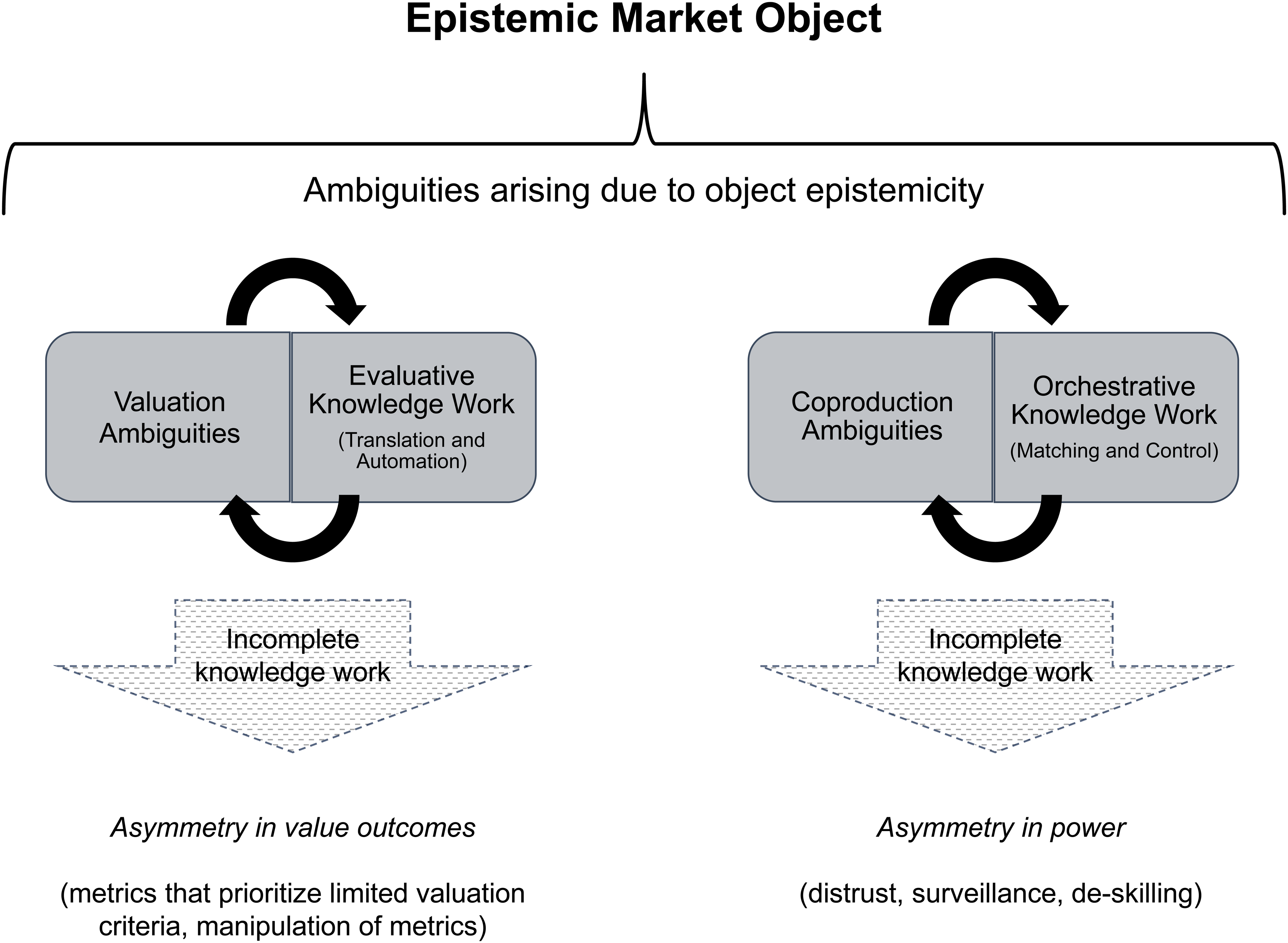
How Knowledge Work on an Epistemic Market Object Creates Asymmetries.
Evaluative Knowledge Work Creates Asymmetry in Value Outcomes in Brand–Creative Partnerships
In their attempt to resolve valuation ambiguities, market actors perform evaluative knowledge work, which we define as expert activities to determine the value of an object, the relevant categories in assessing its value, and how these categories should be prioritized and combined. Our data shows that evaluative knowledge work focuses on two tasks: translation of valuation criteria between actors and automation of valuation.
Translation work
Translation work converts different actors’ higher-order objectives into procedures and measures (Nøjgaard 2023) to ensure mutual understanding and consensus between actors on the value of the object. Creators or brands themselves can do translation, but intermediaries such as agencies and third-party platforms, who have recently gained a prominent role in mediating brands and creators (Gurrieri, Drenten, and Abidin 2023), have increasingly been doing the work. We will start by giving examples for the former and discussing how the inadequacy of brands and creators in translating their value assessment to the other generates opportunities for the latter.
To secure contracts, creators need to translate their audience engagement to brands to convince them of the value of their work. However, audience engagement metrics, such as view counts, shares, and comments, are not fully commensurable with value metrics important for brands, such as sales, market share, and ROI. Similarly, measuring value by the brands’ organizational objectives does not adequately align with how creators themselves attribute value to the content they create, which can be understood more on the grounds of audience involvement and expertise. Creators demonstrate the value of their work by quantifying it through multidimensional media kits that highlight their specific work expertise and translate this expertise into fees they believe they deserve but still need to negotiate: I show the six clothes in the fitting room, but in two videos I talk about the store, like, this store is in such and such a place. I show a little bit about the kind of clothes they sell, how long they have been open…. I leave two videos to talk about the store, you know? Then there are people who hire just that; it's only video, there is no post in the feed. And then a post in the feed I charge, I don't know, R$300. I start with R$300, but there are people who pay R$150 [laughs]. Then I make a package that is videos plus the post, then I give a discount. If the person buys separately, only the videos will be, I don't know, R$500, then with the post, it would be R$800, then if she wants both, I close for R$700. (Lea, creator, interview) When a big brand comes to ask for a budget, it is always more difficult because you don't know how much the brand could and would pay. So, you are always in doubt about how much you can charge because, obviously, we have a value. But when a big brand asks for it, you want to charge more; you know that the company can pay more. Then you mold it, you negotiate with the brands, but it is always a difficult job to price. I find it very difficult to give the value of one's work. You don't even know how much people would pay or not, so it is a challenge, especially in the beginning. (Drew, creator, interview) So, I developed RARA, which is the four-dimensional system of influencer measurement that we use. RARA stands for relevance, authority, reach, and accessibility. In my view, these are the four dimensions of influence. Through adopting this method, we are able to sidestep entirely the unproductive debate about celebrities versus micro-influencers versus brand advocates versus whatever. (Philip Trippenbach, head of influencer, Edelman, podcast)
Automation work
The second type of evaluative knowledge work is automation work, which refers to outsourcing valuation and compensation to algorithms and other proprietary technology. Automating has been integral in a global market transformation trend toward substituting human labor with machines (Zuboff 1988). Automating services connect different actors and provide easy-to-understand overviews of value metrics that appeal to brands or creators. For example, the popular third-party service Emplifi promises “best-in-class tools and AI-powered capabilities” that aid in valuing sponsored content and promises to measure influencer ROI by “put[ting] real numbers to the value created by your influencer marketing campaigns” (Emplifi 2024). Similarly, ShopStyle Collective (platform) offers a feature called Know Your Worth, which “detail(s) the total amount of the order that an influencer is driving to a retailer as well as the average order value they’re delivering—not just the amount of the commission an influencer themselves will earn from that particular order” (Adweek [Pearl 2019]). All these systems aim to replace expert valuation work with automation technology for speed and cost-effectiveness. Figure 2 displays screenshots of the website interfaces of different third-party platforms reviewed by the Influencer Marketing Hub. These screenshots highlight user-friendly—though black-boxed—ROI calculations, content pricing based on creator metrics, payment coordination, and campaign effectiveness assessment.
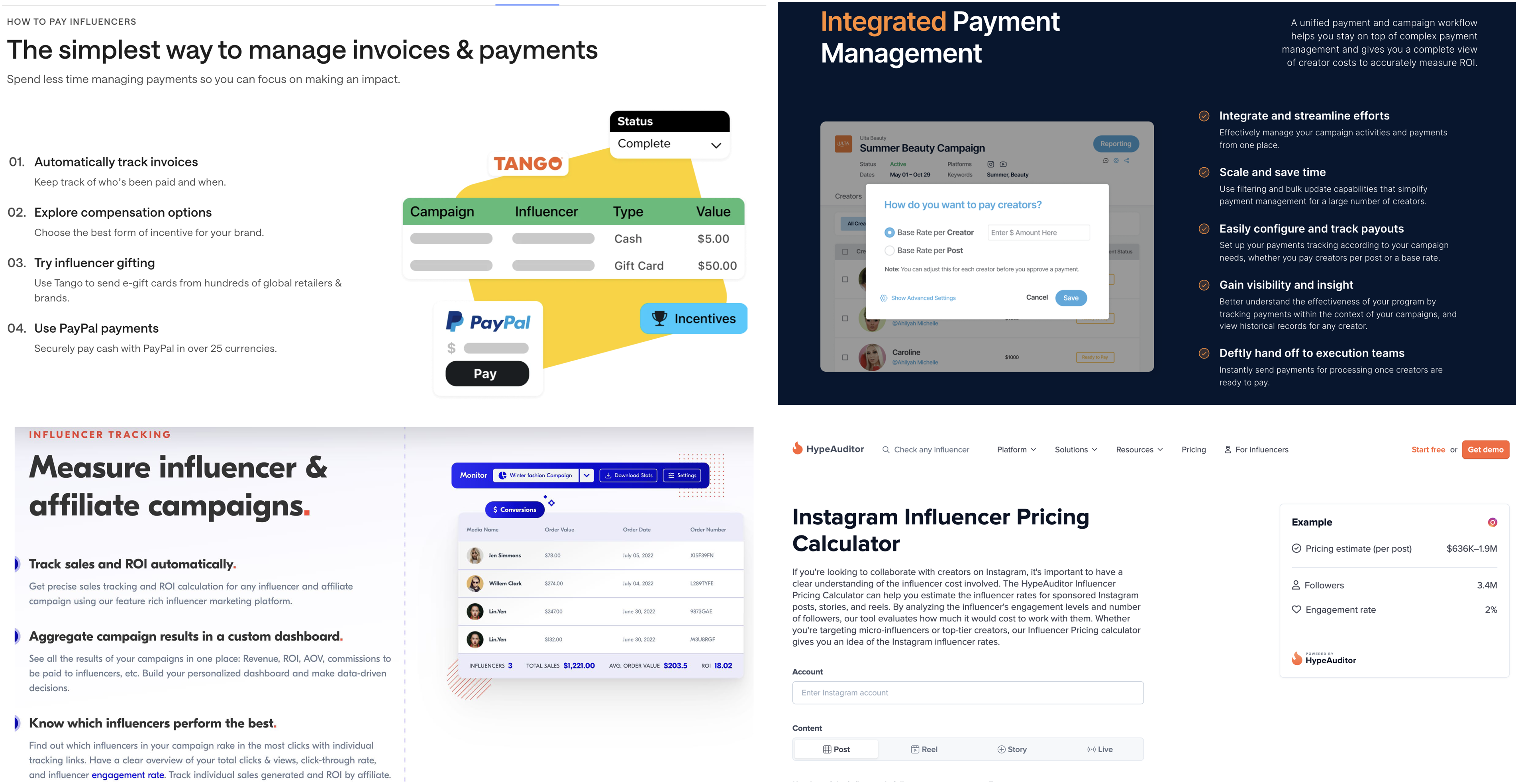
Automating Valuation.
Besides automating the evaluation of creators’ content and audience metrics, third-party platforms also automate the timing of creators’ payments. The platform Narrators proposes a model in which creators are paid before and after they “got to actually create some effective content” (platform review from Influencer Marketing Hub), while the Assembly platform proposes different options for brands: Influencer marketing's biggest criticism over the last couple years—and something that's been turning some companies off to it—is that there are no standards by which influencers are paid. Often, flat fees are based off metrics like reach and engagement. Just like television commercials cost more during popular sporting events, influencers with large and loyal audiences have been charging a premium for their content. But are they really worth what they say they are? To address this, Assembly added two other performance-based methods of payment: cost-per-click (CPC) and cost-per-sale (CPS, also known as a sales commission). (Platform review from Influencer Marketing Hub)
Asymmetry in value outcomes as a result of incomplete evaluative knowledge work
As discussed previously, decision-makers frequently use metrics created to address valuation ambiguities. As in many cases of marketing metrics, these measures are underdetermined and not translatable even across firms in similar industries (see Hanssens and Pauwels [2016] for an overview) and sometimes are referred to as vanity metrics (Rogers 2018). While we acknowledge that it is impossible to build metrics that completely capture a phenomenon, decisions that rely on metrics that exclude the perspectives of some actors will create asymmetries in outcomes for different actors. Although value creation through sponsored content is a multisided and distributed process, our data shows that metrics frequently fail to capture value outcomes for the creators and prioritize brands’ valuation criteria.
First, such metrics, especially when automated, cannot fully capture creators’ relationship with their audience, which is a complex and emotional phenomenon (Mardon, Cocker, and Daunt 2023a; Mardon, Cocker, and Daunt 2023b). The multidimensional value of creator work resides in the creator’s community. While “content can have an effect, selling depends on other factors that are not just [creators]” (Chloe, creator, interview). For example, automatic sentiment analysis can summarize themes in content and audience comments (Gräve 2019), but it cannot precisely assess how the audience relates to the creator and the content, nor can it connect these sentiments to brands’ or creators’ strategic goals. Even if evaluative work can confirm “economic intuition for influencer effectiveness” (Wies, Bleier, and Edeling 2023, p. 403), engagement goes beyond likes and mentions, as it involves emotional components as well (Brodie et al. 2011). Nic Yeeles (CEO, Peg, podcast) critiques the “race to the bottom” approach when the “quantitative reach of any given influencer matters more than the quality of their content (or even their character).” Nick Speller (head of campaigns, Influencer, podcast), who has done some creator work himself, also highlights the challenges of paying creators based solely on ROI through affiliate links: “If that starts to become the norm, the audience will get bored because they’re not enjoying the content, they’re just being sold to continuously.” Finally, content that generates engagement does not guarantee conversion. Yet brands treat influencers as traditional media and make decisions mainly through these metrics: It's a bit silly, sometimes you sit in a room and you think, “I am literally proof that this works; just look at my bank account and the correlation between the screenshots on my Instagram.” But you do have to justify it, obviously to the managers that we work with, or the digital teams that we work with have to ultimately work with us to justify those spends to the people that are used to very traditional media. (Ana Thorsdottir, head of influencer marketing, Mediacom, podcast)
How Orchestrative Knowledge Work Generates Asymmetry in Coproduction
To address coproduction ambiguities, market actors perform orchestrative knowledge work, which we define as purposefully (re)crafting processes and objects (such as briefs and contracts in our context) that help coordinate the interactions and practices of various stakeholders who coproduce an object. We borrow this term from the existing work on how consumers perform orchestration work in the sharing economy to overcome roadblocks and generate value (Scaraboto and Figueiredo 2022). Our data shows two types of orchestrative knowledge work: matching brands with creators and controlling the coproduction process.
Matching work
The first type of orchestrative knowledge work is matching work, which involves finding the best coproducer partners for a project. As Emily Trenouth (head of influencer marketing strategy, Mediacom, podcast) highlights: “The key thing is actually the up-front work, which is landing the right brief and also pairing that with the right influencers.” The two widespread approaches to matching, awareness-based campaigns and engagement-based campaigns, are common, but to achieve either of these, market actors must perform knowledge work to determine the best partner based on the creator's audience size, past work, and brands’ goals: Obviously, reach also sometimes generates sales, sometimes generates desire. But the main focus has to be the reach. When you want, like this, “I want to be known,” you go for the big one, you understand? You go, “I want to make a fast noise, right?” you look at the macros, the greatest influencers, for those who have volume, so to speak. (Nancy, partner, marketing communication agency, interview) What we’d much rather say is that we are working with a brand because their values fit with ours. Their messaging is something that we can try [inserting into] a really great food conversation. … And they are helping us as a community do this, which is far more than we could have done by ourselves. (Jamie Spafford, creator, podcast)
Matching can also be done through marketplaces, in which creator jobs are advertised by “campaign briefs that describe the goal of [the] campaign, the scope of the content [they] are looking for, and a little about who the ideal creator might be” (review of the platform #paid from Influencer Marketing Hub). Registered creators can apply for jobs with less-selective matching criteria compared with other knowledge work we discussed. For example, Elliott (analyst, marketplace, interview) works for a platform that matches brands with creators based solely on performance through affiliate links, without other parameters. Brands provide a link, and all registered creators can post the link and earn a commission: The performance one, which is the one that will be paid according to how much is generated, is a freer, more autonomous thing. So, for example, the briefs don't have so many rules, the influencer posts when he wants, the brand can't make so many restrictions about who will or will not post; something much freer. So, he [the creator] can keep posting because, after all, he will only get commissions for what he sells. And then, because of this, what happens? Then you have to follow up who is posting, how the content is being posted because even though there are no rules focused on how to communicate the product, since it is not a closed value campaign, there are still common-sense rules, such as: do not seem desperate. (Elliott, analyst, marketplace, interview)
Control work
Control work refers to aligning mutual expectations so that goals are achieved and no financial or reputational damage is done to coproducers. Control work involves solidifying expected outcomes, outlining procedures, and establishing boundaries. Brands’ level of control over creators is also a matter of regulation, as laws in several countries dictate how much control a brand can have on the creator for content to be deemed sponsored. For example, the U.K. Advertising Standards Authority and the U.S. Federal Trade Commission have established that any relationship with a brand, including gifts and affiliate links, must follow advertising disclosure guidelines. However, the Australian Association of National Advertisers only considers content sponsored when the “marketer has a reasonable degree of control” (Australian Association of National Advertisers 2021). These examples illustrate how differences in coproduction can arise due to regulatory norms. Not all countries have regulations, and even those with regulations still harbor ambiguities. Agencies and marketplaces mediate these murky lines and organize how each contributes to the coproduction while respecting the law, as Rupa Shah (Legal Consultant) explains in a podcast.
Control work starts with briefs, which bridge the actors’ objectives by defining what each actor wants to achieve with the partnership. Briefs outline the basic parameters of the coproduction, such as campaign goals, expected results, and quantity and quality of content. Creator restrictions (i.e., specifics of images or product placement) are negotiated during the brief stage. Nevertheless, briefs do not always ensure compliance. Contracts should, in theory, account for solving these issues. The widespread usage of contracts helps define legal and usage rights (Zoe Crawford, brand partnerships and events, The7Stars, podcast), fees that intermediaries charge (Alex Carapiet, business director, The Fifth, podcast), exclusivity and other conditions regarding payments (Clara, analyst, influencer marketplace, interview; Nancy, partner, marketing communication agency, interview). Nevertheless, contracts do not always outline all the details needed for coproduction or address problems that might arise during the execution phase, which requires additional control work. Nancy talks about a creator who, despite a contract, “writes everything that comes to her head.” In 2018, PR Consulting Inc. sued “influencer and actor Luka Sabbat for not fulfilling his contract to promote Snapchat Spectacles” (Adweek [Alcántara 2018]). Sabbat failed to post the agreed number of stories on his feed or have the stories vetted by the firm.
Most brands have a vision of creators as paid endorsers with no agency and are unwilling to relinquish control of the coproduction to them, which is also reflected in the briefs. To ensure that creators buy into the brand's values, brands educate creators. For example, Charlotte (in-house PR, luxury brand, interview) described how creators get training about the brand, visit the headquarters, and receive product training. Additionally, brands impose stringent control measures, such as rounds of approval, orders to redo the work, and requests for edits, which some creators see as heavy-handed, as discussed in a podcast: Alice Audley (founder, Blogosphere): I think this often happens within the influencers where you get a campaign brief, you execute it to the best of your ability, and that's what you are being paid for. But then they come back, say that “I want to say you reshoot,” that they don't want to you reshoot it again. Is that something that is pretty frustrating? You are not being paid three times. Lewys Ball (creator): Yeah, that is annoying. And I think, definitely, when I first started, that happened a lot because I was like, OK, I have to say this. And I would just go off and do it and like, not really check it, but now I’m like, time is money, people.
Many agencies and professionals working with influencers know the importance of creator freedom and why it is necessary for creators to simultaneously manage their connection with their audiences and promote brands without ostentatiously endorsing them. Alex Carapiet (business director, The Fifth, podcast) says the best “influencer marketing campaigns are the ones where the brand is really giving the talent the opportunity to fulfill something … where the brand becomes a champion of the piece, giving something to the creator that is going to elevate their content.” Intermediaries perform knowledge work to mediate each actor's roles and strengthen collaboration. For example, Joshua Barnett (managing director, After Party Studios, podcast) mentions how he constructed a narrative and elaborated on the parameters of the content with brands before putting creators on board. Zoe Crawford (brand partnerships and events, The7Stars, podcast) explains that the team in her agency adds “a bit of [their] own flavor to [brand strategy] to make sure it aligns with what [brands] believe” and helps creators “push more and more the amplification of that content.”
Still, facing pressure from brands, content studios have recently emerged to handle the knowledge work in managing content creation and the creative process, dictating scripts, monitoring reach and amplification, preapproving content elements, and leaving the creator with only the task of relaying the message to their audience. Getting content produced by a creator and recrafting and inserting it into the brands’ accounts is an increasingly growing practice that commodifies and depersonalizes influencer work. This deskilling (Zuboff 1988) of creator work also adds to the precarity of their profession. The overt control and commodification of creators’ images reinforce surveillance mechanisms intrinsic to social media platforms (Zuboff 2019). We discuss these power asymmetries next.
Asymmetry in power in brand–creator relationships
Just like in evaluative knowledge work, orchestrative knowledge work prioritizes brand objectives. Our findings show that this can asymmetrically affect the brand–creator partnership in the long run by reducing creators’ roles to mere actors and surveilling their actions through platform affordances. Content becomes a vehicle to promote products and brands rather than providing engaging storylines, mainly benefiting brands. Not tailoring the content to the best interest of all actors decreases the value of partnership outcomes. Creators neglect their development as experts to adapt themselves to brands’ demands. This clashes with the perception of sponsored content as native, emerging organically from creators’ passion (Kozinets et al. 2010). Overtly brand-focused content can deter followers who are happy to see their favorite creator produce content but might be less pleased with them trying to push products all the time, as audiences are interested in (perceived) amateur content (Mardon, Cocker, and Daunt 2023a). However, it is not just brands who have reasons to distrust their partners’ process: Once, I wore [brand] to play at a festival. I didn't look at the clothes properly, it was a very small print, and it was a print … they had printed what looked like slaves and, at the time, this required me to take a position on social networks to apologize and publicly assume that I would never work with this brand again. Anyway, it was very important for me that this happened. I learned a lot, and for sure, it is not a brand that I will work with anymore. It wasn't something clear, it wasn't something that my eyes could notice, but it was a pattern that offended many people, and a brand the size of [brand] couldn't make a mistake at this level, right? So, I took a stand at the time…. Even when the case came to light, they didn't care much about protecting my image; they weren't sympathetic to my image, so I didn't have any sympathy for the brand. (Lea, creator, interview)
The asymmetries in power and control reflect a significant trend in contemporary society where corporations frame and shape the practices of people, such as consumers (Zuboff 2019) and creators themselves (Poell, Nieborg, and Duffy 2021). Visibility, itself a form of surveillance (Lyon 2018), becomes mediated and controlled by not only platforms but also brands, which work symbiotically to define how creators are visible to audiences. Reducing creators’ role to that of hired actors through brand control is fundamentally counter to the value of sponsored content, which lies in creators’ ability to simultaneously be creatives, community managers, and endorsers (Campbell and Farrell 2020). Deskilling and surveilling creators can hinder sponsored-content-based strategies by reducing the creators’ capacity to do interesting and meaningful work.
Discussion
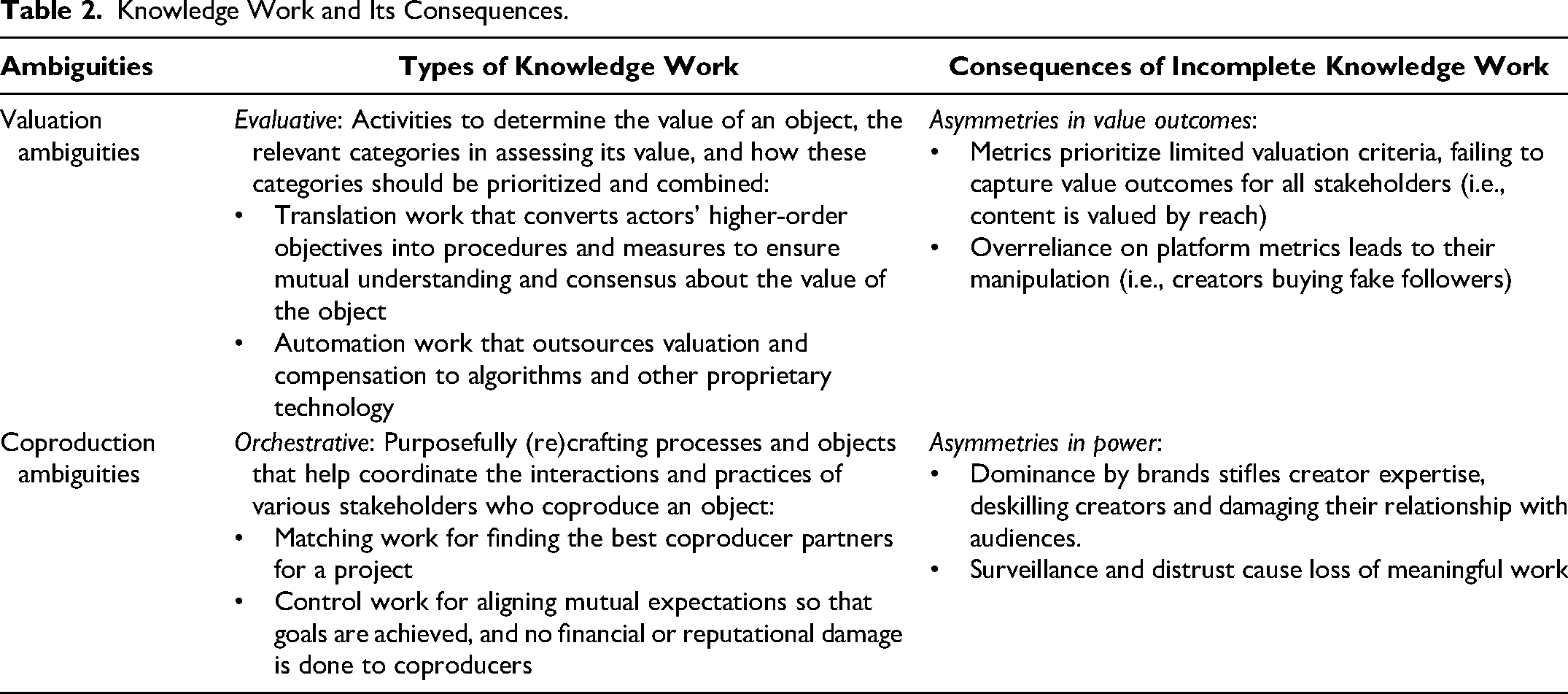
We have shown how brand–creator partnerships have been disrupted by sponsored content, an epistemic object produced and consumed through multisided, distributed, and sometimes difficult-to-grasp interactions among creators, brands, intermediaries, and consumers. This disruption begets ambiguities for valuation and coproduction, and consequent knowledge work does not resolve these ambiguities. This incomplete knowledge work leads to asymmetries in relationships between brands and creators, which fundamentally alter the structure of the market and actor roles and relationships, as summarized in Table 2.
Knowledge Work and Its Consequences.
Academic work that aims to theorize on sponsored content and make recommendations to practitioners must better understand its complex nature and the ambiguities it harbors. As a step toward this direction, we move beyond influence—how creators can affect consumer behavior—and ask whether what we know about influencers and influencing processes adequately accounts for the complexity of sponsored content as an epistemic market object. We next describe our theoretical contributions and the transferability of our findings to other marketing contexts.
Contributions and Transferability
This article provides two contributions to marketing theory and practice: (1) conceptualizing epistemic market objects as a novel theory to understand transformative market disruptions, and (2) showing how the knowledge work around epistemic market objects fundamentally alters the structure of the market and actor roles and relationships. We next explain these contributions, followed by a discussion on the transferability of our theory to other contexts.
Epistemic Market Objects in Theorizing Transformative Market Disruptions
Adding to the broader literature that centers objects in theorizing market processes (Gonzalez-Arcos et al. 2021; Huff, Humphreys, and Wilner 2021; Humphreys 2010; Nøjgaard 2023), we develop the concept of epistemic market objects. As discussed elsewhere (Hoffman and Novak 2018), focusing on objects, from smart devices to platforms, allows for novel theories and clearer strategic paths for practitioners. While epistemic objects have been widely used in organization studies, marketing scholars have paid scant attention to them (see Zwick and Dholakia 2006 and Mayall 2008 for two exceptions). Here, we propose a specific type of epistemic object that facilitates marketing functions but is laden with ambiguities for actors who try to make sense of it and use it in their marketing strategies.
We show that epistemic market objects are transformatively disruptive, as they generate ambiguities that necessitate adaptive responses from market actors through knowledge work. While knowledge work is performed to address these ambiguities, it also continuously creates more ambiguities, changing market dynamics and institutional structures. Therefore, we add to the literature on market disruption and change (Dolbec and Fischer 2015; Martin and Schouten 2014; Scaraboto and Fischer 2013). We show that market-level disruptions do not necessarily happen solely through specific actors’ institutional work to pursue their explicit interests (e.g., consumers seeking more size-based inclusion in fashion). Rather, these changes can also happen through market actors’ inquiries and knowledge work to resolve ambiguities around a market object. This is similar to how brands, as widespread forms of representation, have transformed markets worldwide (Askegaard 2006). As marketers try to understand and manage epistemic market objects and face complex ambiguities that surround them, the knowledge work they perform might not resolve these dilemmas, but their attempts create enough shifts that continuously transform markets.
Knowledge Work and Restructuring of the Market
Our second contribution is showing how the knowledge work around epistemic market objects fundamentally alters actors’ roles and relationships. We particularly highlight the emergence of platforms as new actors in creating and intermediating knowledge, done in tandem with specific conditions and limitations that are inherent to platforms themselves (Caliandro et al. 2024; Kozinets, Ferreira, and Chimenti 2021). Intermediaries are an underrated area in marketing research except for a few past studies (Childers, Lemon, and Hoy 2019; Nilsson, Murto, and Kjellberg 2023). Additionally, their roles as distributors, evaluators, matchmakers, and consultants (Bessy and Chauvin 2013) are underexplored in the context of sponsored content. While past research highlights the effects of platformization on brands and products (Scaraboto and Fischer 2024; Wichmann, Wiegand, and Reinartz 2022), consumers (Caliandro et al. 2024), and culture (Cunningham and Craig 2021), the ways platforms insert themselves in markets have been overlooked. Here, we demonstrate how platforms generate conditions that both disrupt markets through destabilizing actor partnerships and restructure them by contributing to the knowledge work that reshapes these relationships. Despite evidence that creators benefit from platforms (Gurrieri, Drenten, and Abidin 2023), our work shows that increasing platformization of creator–brand relationships leads to the devaluation and precarization of creator work. Furthermore, we demonstrate that these asymmetries shift the roles of existing actors (ad agencies, talent managers) while giving rise to new market actors (proprietary platforms, new types of experts) and new market services (valuation, automation, matching, control) that further capture the value generated through sponsored content.
Transferability of Findings
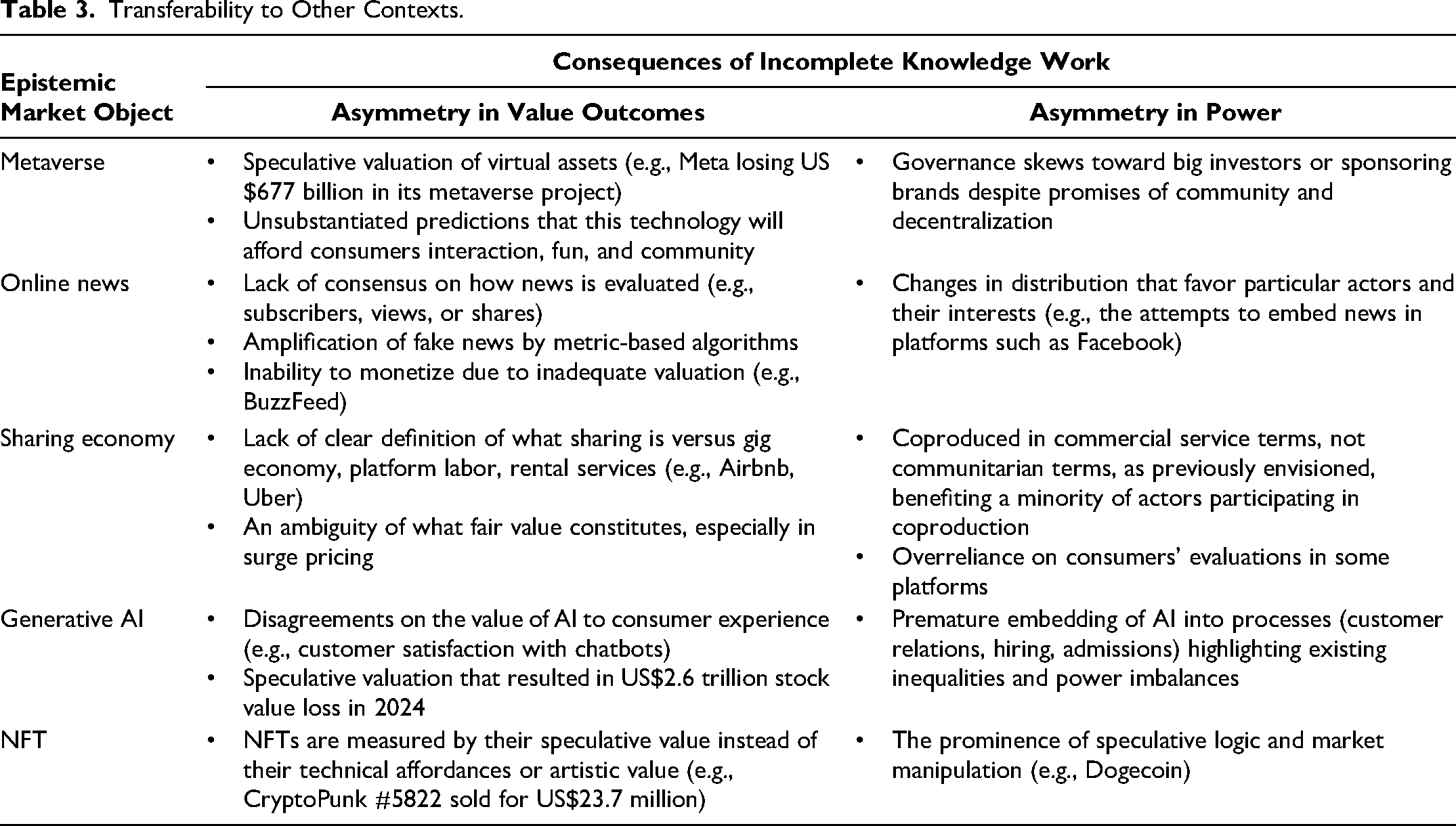
Our contribution of theorizing market disruptions through epistemic market objects is transferable to other contexts where similar ambiguities have developed around market objects that are produced, distributed, and consumed in and through platforms. Table 3 provides examples of other epistemic market objects and the consequences of knowledge work.
Transferability to Other Contexts.
Strategic Recommendations for Practitioners
General Recommendations to Market Actors for Working with Epistemic Objects
Almost all market objects can be prone to epistemicity when the context and infrastructure around them shift. Thus, firms should be proactive when they foresee substantial shifts in the market, whether it is a new technology affecting existing objects (platforms shifting how brands and creators partner) or novel objects (NFTs). Our research underscores the unique opportunities and challenges epistemic market objects pose for marketers. As we demonstrated the limitations of existing knowledge work practices, we suggest marketers not overlook more qualitative matters requiring more holistic types of knowledge work: cultural approaches, brand and creator histories, and relationship-based analysis. Managers should therefore prepare a clear knowledge work strategy that includes multistakeholder (Friedman and Miles 2002; Parmar et al. 2010) and multimethod perspectives when faced with epistemic market objects. To do so, we suggest: (1) calibrating valuation and matching models to incorporate all stakeholders’ interests, and (2) flattening partnership hierarchies.
Calibrate valuation and matching models to incorporate all stakeholders’ interests
Firms must develop valuation and matching models through a multistakeholder approach. To do so, they must avoid overrelying on incomplete metrics that prioritize limited actor interests, overlooking the complexity of the epistemic market object. Models that are embedded in platforms and other big data should be complemented by others that account for all market actors’ viewpoints, practices, and objectives (Harrison and Wicks 2013). Firms can do this by (1) triangulating across stakeholders to align value outcomes, (2) benchmarking with industry actors in the same category to understand points of parity and differences in valuation criteria, (3) deeply engaging with specialized press to perform continuous and systematic qualitative assessment, (4) hiring from different stakeholder groups involved in the management of the object (for example, hiring former creators who transitioned into brand or intermediary roles), and (5) thinking culturally to align long-term objectives with organizational histories, trajectories, and identities.
The preceding actions can help capture the multidimensional nature of an epistemic market object. Metrics and other forms of valuation that recognize the contradictory value outcomes of partners can help prevent manipulation and generate more value collectively. In an analogy with the well-known prisoner's dilemma, when all actors seek individual gains, the outcome can be detrimental for all. Collaboration can counterbalance the actions of actors, such as platforms, who have the power to capture value through leveraging ambiguities.
Flatten partnership hierarchies
Balancing power relationships around the epistemic market object prevents noncollaborative behavior, such as manipulating metrics and the deskilling of partners. Trust is at the base of value creation in collaboration (Scaraboto and Figueiredo 2022). Epistemic market objects that generate value for all parties will lead to stronger partnerships in the long run. Therefore, it is crucial to prevent value extraction by only one partner. Partners should see coproduction as a relational process that generates a competitive advantage for all coproducers, and this can be done more effectively by ensuring that orchestrative knowledge work reduces power asymmetries. We recommend two ways to invest in and leverage trust:
Partners should clearly communicate the skills and workflow necessary to manage their work. This entails reinforcing skills instead of deskilling work and not expecting responsibilities inconsistent with or outside the scope of partner expertise. Partners should communicate and align outcome expectations, assess the risks of the partnership or process, and anticipate action plans to deal with these risks, clearly defining each actor's responsibility in recovery. If not, firms might lose partners when things fall apart without repair or accountability.
Recommendations for Brands
Brands that give sponsored content a prominent role in their communication strategies must recognize creators’ multiple roles and objectives to cultivate parasocial relationships with their audiences. They must also acknowledge intermediaries’ intentions and skills to participate in the conception and alignment of the content strategy itself. Brands should keep in mind that short-term metrics or excessive control of sponsored content hinders its effectiveness and has potentially adverse effects on the industry itself. While conversion is important, campaigns mainly focused on conversion seem to hinder the value of sponsored content itself. Last, they should evaluate if their strategic goals are necessarily obtained through sponsored content.
Brands should invest in creating long-term partnerships with creators and seeing them as equals in partnership. This is important because (1) long-term relationships with creators will reduce the necessity of knowledge work, (2) granting creators more agency can build trust and collaboration between partners, and (3) creators’ audiences can be long-term assets as creators continue in their trajectories as experts.
Recommendations for Creators
Our findings show that the asymmetries in brand–creator partnerships put creators at risk of devaluation of their work and losing their agency and control. To reduce this risk, we suggest two strategies for creators: (1) outsourcing the business side of their work to expert intermediaries or investing in training to build their managerial competencies, and (2) collective action to shape structural imbalances.
Our first recommendation is resolving partnership asymmetries by investing in intermediary services that handle business negotiations. Creators are, after all, brands themselves (Smith and Fischer 2021), and like many managers or founders in small companies, they have creative and social media skills but not always business skills. Outsourcing evaluative and orchestrative knowledge work to experts can provide benchmark metrics and time-tested matching and control processes, allowing creators to focus on and specialize in creative activities and audience management. If they cannot outsource these tasks due to a lack of resources or desire to keep complete control of their brands, creators can invest in managerial training to reduce power asymmetry by building specific skills such as contract writing and negotiating.
Second, creators should engage in collaborative action (Maciel and Fischer 2020) to increase their collective power against other market actors. We recommend that creators actively engage in organizations that represent their interests, such as the influencer marketing associations forming across the globe. While new, these organizations can establish labor standards, set minimum fees, and inform policy around limits of surveillance and control of creator work. We also recommend that creators assess the value of their work by benchmarking with peers with similar audience sizes and qualities rather than being secretive about their fees. Sponsored content does not exist without creators, and organizational legitimacy and collaboration can allow them to better translate the value of their work, shape regulation, and restore the balance of power between themselves and the brands.
Limitations and Recommendations for Future Research
Our work comes with limitations that can be addressed in future research. First, our work sheds light on but does not thoroughly investigate the impact of generative AI, which is lauded for bringing the promise to not only analyze the value of partnership outcomes but also create content itself, altering the context of digital marketing. Future researchers can ask:
How does the prevelance of generative text and image models shape creator–brand partnerships? How does using AI in translating actor interests alter coproduction tensions between creators and brands? How can AI-based black-boxed evaluation models, which we identified as incomplete in our work, become more reliable? How does outsourcing orchestrative work affect the relations between brands and creators?
We recognize that market objects themselves might lead to practices that draw consensus and collaboration, even when they are only partially understood by actors around them. Other market and disruptive phenomena could be theorized as different types of objects, such as boundary objects (Star 2010), that lead to consensus instead of ambiguity. We invite researchers to investigate further knowledge-based objects and their role in markets and market change.
Footnotes
Acknowledgments
The authors thank Markus Giesler, Marc Lenglet, Anissa Pomiès, and Daiane Scaraboto for their feedback on various versions of this manuscript. They also thank numerous colleagues who gave them feedback when they presented the earlier versions of this article. Finally, they thank Meiling Fong, Sarah Herchet, and Ghalia Shamayleh for their research assistance.
Coeditor
Cait Lamberton
Associate Editor
Amber Marie Epp
Declaration of Conflicting Interests
The author(s) declared no potential conflicts of interest with respect to the research, authorship, and/or publication of this article.
Funding
The author(s) disclosed receipt of the following financial support for the research, authorship, and/or publication of this article: The authors received funding from the Social Sciences and Humanities Research Council Canada Explore Grant, Social Sciences and Humanities Research Council Canada Insight Grant #435-2023-0939, and Neoma Business School Area of Excellence “The Future of Work—The Future of Organizing” grant for this project.
