



Abstract
Air pollution is a growing threat to economies and societies. Despite the common knowledge that air pollution impairs emotions and cognition and, hence, behavioral outcomes, the impact of air pollution on consumer spending remains an open question. Analyzing air quality readings and individual-level credit card transactions in South Korea, this article shows that consumers spend more money when air quality is poorer. This correlation is more prominent in hedonic categories, such as entertainment or leisure activities, where the nature of consumption is characterized by greater emotional benefits. The authors consider potential explanations, and the leading hypothesis is that consumers treat spending as a mood-regulating resource. The results survive an array of robustness checks and are supported in a controlled experiment, reinforcing a causal inference behind the main findings. The authors provide implications for stakeholders to develop a sustainable marketing program that not only pursues managerial interests but also concerns consumer well-being in the face of environmental change.
Air pollution threatens economies and societies (U.S. Environmental Protection Agency 2020). More than 135 million U.S. residents are exposed to unsafe levels of air pollution (American Lung Association 2021), and European countries consider air pollution as the single largest environmental risk (European Environment Agency 2020). On a global scale, as many as 99% of the world's population live in regions where air pollution exceeds the safety limits (World Health Organization 2022). In addition to various health concerns, ambient air pollution comprehensively impairs our emotions and cognition (Evans and Jacobs 1981; Lu 2020). Since consumers' purchase and spending behavior is, in principle, motivated by emotional and functional benefits, air pollution is a potential environmental factor, as much as climate change and weather events, that determines such household-level economic activities. However, the impact of air pollution on consumer purchases and spending remains in question among marketing researchers and practitioners.
Previous marketing efforts to investigate environmental factors have focused mainly on weather conditions. Companies are increasingly adopting marketing strategies attuned to weather conditions or climate events. For example, an apparel brand might run specials on raincoats or umbrellas during an unexpected week of rain or promote sunglasses following a forecast of sunny days, a coffee shop might offer discounts on hot drinks on cold weather days, or an ice cream store could introduce “heatwave deals” when the temperature soars during periods of extreme weather. These tactics might not only increase sales but also create a perception of a brand that is in tune with customers’ needs. Marketing researchers have identified several less obvious effects that nevertheless have an influence on consumer behavior and thus could be adopted by practitioners. For example, studies have shown that physical coldness can trigger a need for psychological warmth, resulting in a greater preference for romance movies (Hong and Sun 2012); purchase responses to mobile promotions are quicker and more substantial in sunny weather, in contrast to the slower and lesser responses on rainy days (Li et al. 2017). Additionally, sunshine has been shown to increase household spending with credit cards, presumably because of the positive mood associated with sunlight (Agarwal et al. 2020).
Air pollution, in contrast, has been considered a unique environmental factor in a growing body of economics and management literature. Air pollution decreases labor productivity (He, Liu, and Salvo 2019) such as pear packing (Chang et al. 2016), customer service call completion (Chang et al. 2019), crop collection (Graff Zivin and Neidell 2012), and employees' self-control resources (Fehr et al. 2017). Investors' financial performance can be worse in air pollution because of unpleasant mood (Dong et al. 2021; Li et al. 2021) or low cognitive capacity (Huang, Xu, and Yu 2020). Specifically, investors tend to sell winning stocks and hold losing stocks on polluted days because such disposition effect could help regulate their negative feelings on hazy days (Li et al. 2021). Alternatively, investors' abnormal trading loss on days with air pollution may be attributed to cognitive malfunctioning (Huang, Xu, and Yu 2020).
Despite an extensive discussion on air pollution from economists as well as marketing applications of weather conditions, little is known about how air pollution affects consumer behavior, barring a few domain-specific exceptions. For example, air pollution increases individuals' medical costs (Deryugina et al. 2019) and demand for health care preventives, such as air purifiers (Ito and Zhang 2020), face masks (Zhang and Mu 2018), and health insurance (Chang, Huang, and Wang 2018). The effect of low air quality could be product-specific, illustrated by lower demand for fuel-inefficient cars (Li, Moul, and Zhang 2017) and higher demand for blue-colored consumer goods (Ding et al. 2021) or sustainable household products (Lim, Kim, and Kim 2023).
Consumer spending provides a unique opportunity to study the impact of air pollution on consumer behavior. It represents an individual's daily purchases and consumption with direct and measurable financial implications because consumer expenditure is a key indicator of household economic activities. Unlike single-purpose purchases discussed in prior research, consumer spending involves both emotion-driven and necessity-based demand. Considering that the latter encompasses a variety of consumption goals (e.g., hedonic vs. utilitarian), it should be more appropriate to cautiously interpret any conclusions from previous research when we attempt to understand how air pollution affects spending. In the face of growing environmental change that affects businesses and society at large, a study of consumer spending will provide insight for designing effective marketing strategies that account for consumer preferences (Chandy et al. 2019). Understanding the impact of air pollution on spending is also timely and crucial to provide practitioners an opportunity to improve brand image and corporate social responsibility initiatives contributing to a better world (Chandy et al. 2021).
In this article, we answer the following empirical questions: Does air pollution impact consumer spending? If so, how, and what are the possible explanations? Three key insights from Table 1, which summarizes relevant research on environmental impact, motivate this question and clarify our contribution. First, the direct link between air pollution and consumer behavior has not been thoroughly studied, especially from the marketing perspective. Previous literature has identified organizational or financial outcomes varying with air quality levels. By contrast, measuring the impact of air pollution on consumer spending offers managerial implications regarding environmental change and hence improves our understanding of the consumer market.
Literature Review and Intended Contributions.
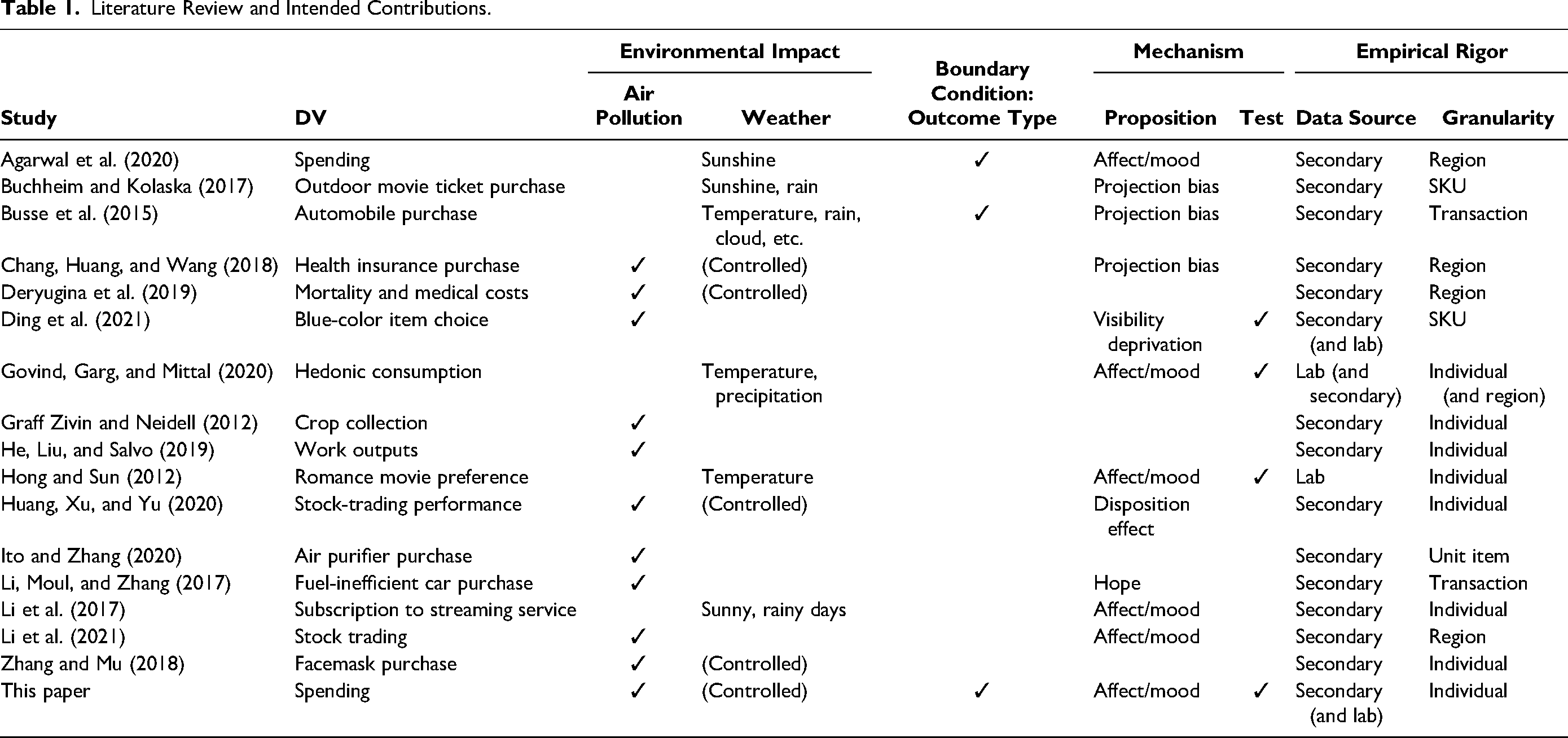
Second, air pollution represents a unique environmental factor that is distinct from generic weather events for its comprehensive (and often detrimental) influence on human cognition and emotions. From the consumer research perspective, air pollution can be treated as a marketing stimulus, while hardly controllable, that is leveraged by understanding of the boundary conditions under which its effect is most pronounced. By exploring these boundary conditions and underlying mechanisms behind air pollution's impact on consumer spending, we seek to provide a more complete picture of consumer behavior in relation to an environmental factor. To the best of our knowledge, this work is the first to elucidate the direct and heterogeneous association between air pollution and consumer spending behavior.
Finally, this article benefits from extensively using both observational and experimental data to support a causal inference about the problem of interest. Our main findings are consistent across empirical studies that warrant high external and internal validity. While the data do not allow us to make a conclusive statement, we also consider the potential explanations. Our converging evidence points to mood regulation as the leading hypothesis, which connects our article with emotion research (Garg, Wansink, and Inman 2007; Govind, Garg, and Mittal 2020).
Our analysis of credit card transaction and air quality reading data using fixed-effects panel regression shows the positive effect of air pollution on consumer spending. Moreover, we find that the increased spending is prominent for hedonic categories where the nature of consumption can help reduce the negative feelings. These results provide indirect support to mood regulation as the underlying mechanism. We also replicate the field results in a controlled experiment and formally test the process evidence.
This study provides valuable insights for industry practitioners, broadly encompassing promotion and advertising strategies and corporate social responsibility initiatives to enhance brand image. Our findings suggest that retailers can develop responsive marketing tactics to fluctuations in air quality, such as adaptable in-store promotions and digital marketing efforts that focus on hedonic consumption and comfort. Additionally, aligning with corporate social responsibility, companies have opportunities to launch wellness campaigns, introduce eco-friendly hedonic products, and educate consumers about environmentally conscious decision-making. These strategies not only cater to consumer preferences during periods of poor air quality but also reinforce a commitment to sustainability and responsible consumerism.
We also offer insights for policy makers in the context of environmental regulation and public awareness. Our study demonstrates the link between deteriorating air quality and increased spending on hedonic consumption, highlighting the importance of integrating air quality considerations into consumer behavior discussions. Policy makers can use these findings to develop public awareness campaigns that connect air quality with daily consumer choices, emphasizing how environmental health impacts overall well-being and economic stability. Additionally, our findings could enhance public education programs by clarifying the impact of air quality on consumer lifestyle and spending choices, promoting more environmentally conscious alternatives. Going forward, this research paves the way for collaborations with the retail and manufacturing industries to foster a sustainability paradigm. Such partnerships could then facilitate more responsible consumption by emphasizing the experiential benefits of sustainable products and fun aspects of eco-friendly practices.
The interviews we conducted with a policy making institution and the retail industry provide further support for our research question. The National Institute of Environmental Research of South Korea indicated that air quality information has not been used internally to assess routine economic activities; it has been treated solely as an environmental indicator. Similarly, a general retail company had not considered organizing marketing events specifically in consideration of air quality changes, aside from its usual seasonal promotions. Additionally, there was a consensus from the interviews that a better understanding of the economic impact of air pollution on consumers would be highly beneficial for developing marketing strategies and sustainability initiatives, particularly in the context of the increasing severity of air pollution.
At a higher level, we advocate for the execution of marketing strategies with a strong focus on sustainability, aiming to balance business profits with societal values. Therefore, we believe this article represents an initial yet important step toward understanding consumer behavior in the face of escalating environmental challenges and practicing more responsible marketing for a better world (Chandy et al. 2021).
Empirical Background
Data
Air pollution and weather variables
We obtain the air quality index (AQI) from archival reports provided by the Korean Ministry of Environment. It has broad application in previous research (e.g., Huang, Xu, and Yu 2020; Li et al. 2021) for its comprehensive nature compared with a single pollutant index, while major components of air pollution may be different by country. AQI is determined by a piecewise linear function of particulate matter (PM10, PM2.5), ground-level ozone (O3), nitrogen dioxide (NO2), carbon dioxide (CO2), and sulfur dioxide (SO2). 1 We observe the AQI at daily frequency for each city (sigungu). 2 Within the range between 0 and 500, a higher AQI represents greater levels of air pollution. Figure 1 illustrates the nonnegligible presence of air pollution (AQI > 100) from July 2017 to June 2019, while daily fluctuations of air quality remain largely unpredictable (see also Figure A3, Web Appendix A).
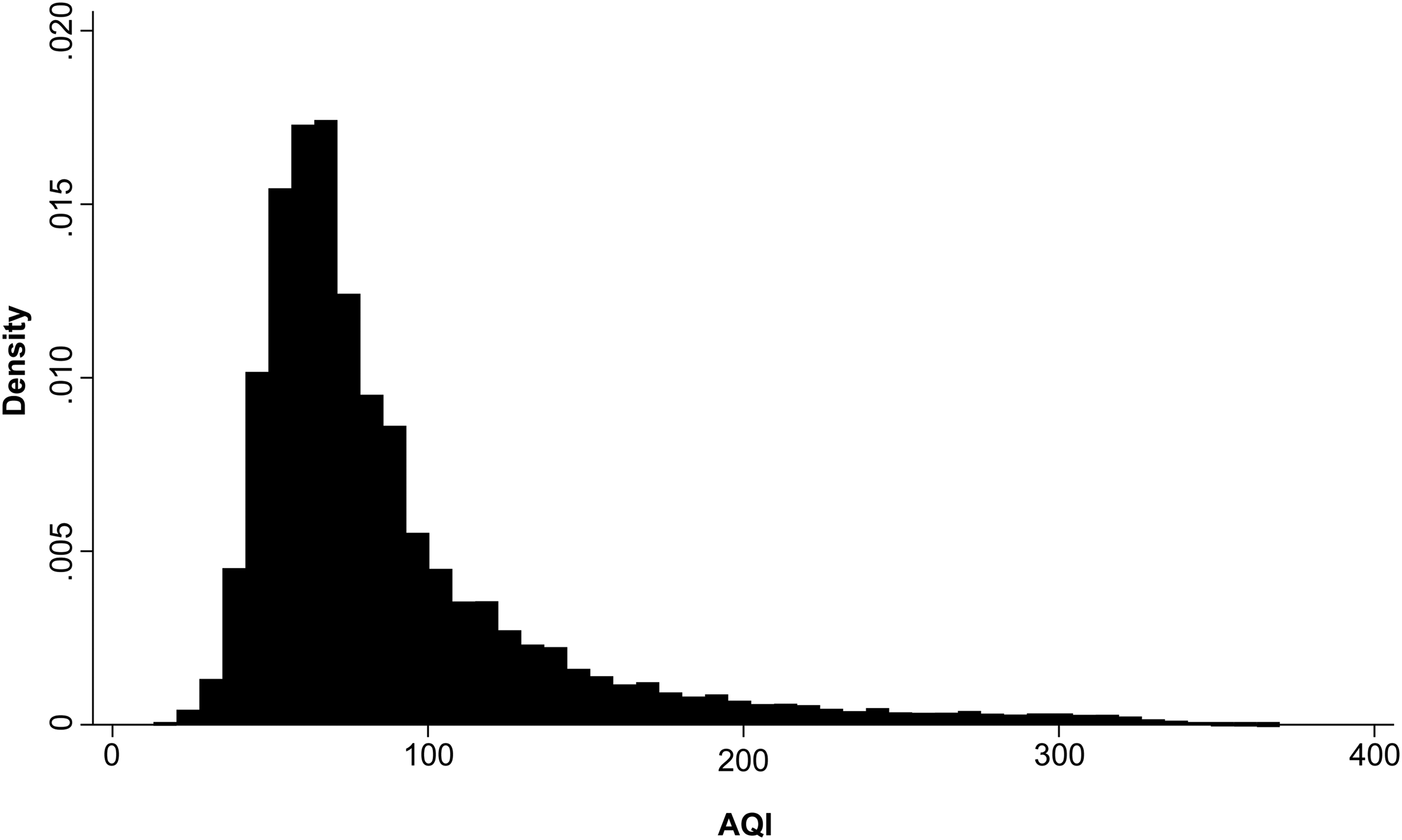
Distribution of Air Quality Index.
We also collect data on temperature (average), humidity (average), precipitations (total), wind speed (maximum), and wind direction (mode). The weather data resource is publicly available at the daily level for each province (sido). The air quality and local weather information are easily accessible by web search or on mobile apps in South Korea.
Consumer spending
Our spending data come from a large credit card company in South Korea, which is a market leader with 36 million customers (70% of the total population) as of the end of 2019. The company provided the unique panel data on more than four million individual-level transactions from July 2017 to June 2019 for a randomly sampled panel of 3,199 consumers who live in Seoul and are disproportionately male (85%) and between 20 and 30 years old. 3 For each transaction, we know spending amounts, time stamp, point of sale (i.e., city), and spending category, following the company's merchant category codes that classify 210 subcategories into ten substantive categories (e.g., entertainment, food and refreshments; see Table A1, Web Appendix A, for the classification). For ease of exposition, all monetary values are converted to U.S. dollars.
South Korea has one of the world's highest penetration rates of credit and debit cards, where credit card spending accounted for 69.1% of consumer expenditure in 2019. 4 Specifically, credit card payments in South Korea totaled 717 trillion KRW—approximately $644 billion (GlobalData 2019), making it one of the most common payment methods for consumer expenditure (Argus Advisory 2022). Credit card transaction data also has advantages over survey data (Fehr et al. 2017) or product-specific demand (Ding et al. 2021). First, its administrative and comprehensive nature minimizes selection or response bias, which might occur in self-reported survey data. Second, credit card spending encompasses a wide range of categories and hence enables a study of a comprehensive impact of air pollution on daily consumer spending behavior and, more importantly, its heterogeneous effects across different spending categories.
Final data set
The credit card transaction and environmental variables are merged by location (i.e., city) and time (i.e., day), and we construct the final data set at the individual-category-city-daily level for two reasons. 5 First, our variables of interest (e.g., spending, mood) are better explained at the consumer level. Second, an integrated model with category-level variation allows us to estimate the differential effect of air pollution by spending category in a systematic fashion.
This research focuses on in-store transactions that represent a substantial portion of daily consumer spending. 6 Online transactions are not included because our data do not allow us to identify exact locations at which consumers make online transaction (8.1% of the entire transactions). We also remove transactions unrelated to daily spending, such as bill payments, insurance, or tuition (1.3% of the entire transactions). The preprocessing of our data results in a final sample size of 2,954,507 observations.
Descriptive Evidence
Table 2 summarizes our data. We find that consumer spending has positive and significant yet subtle correlations with air quality and other environmental variables except wind directions (i.e., Northwester), which entails a more careful examination. The correlation of the AQI with local weather variables is also significant as similar to previous studies (e.g., Huang, Xu, and Yu 2020).
Descriptive Statistics.
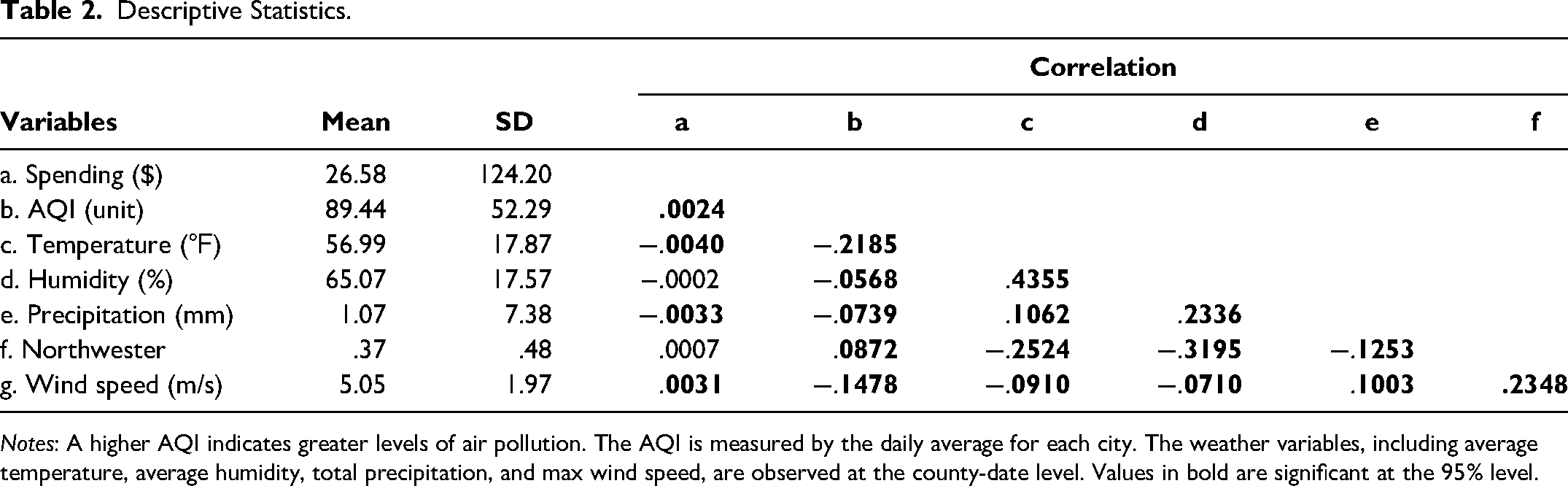
Notes: A higher AQI indicates greater levels of air pollution. The AQI is measured by the daily average for each city. The weather variables, including average temperature, average humidity, total precipitation, and max wind speed, are observed at the county-date level. Values in bold are significant at the 95% level.
Figure 2 also provides illustrative evidence for the positive correlation between consumer spending and air pollution. An increase in air pollution is associated with higher spending on average in Panel A. The monotonic increase is also consistent across regions when we decompose the data by cities with higher- and lower-than-average of spending (in Panel B) or AQI (in Panel C); however, this initial evidence clearly does not control for idiosyncratic economic patterns across individuals, locations, or seasonality.
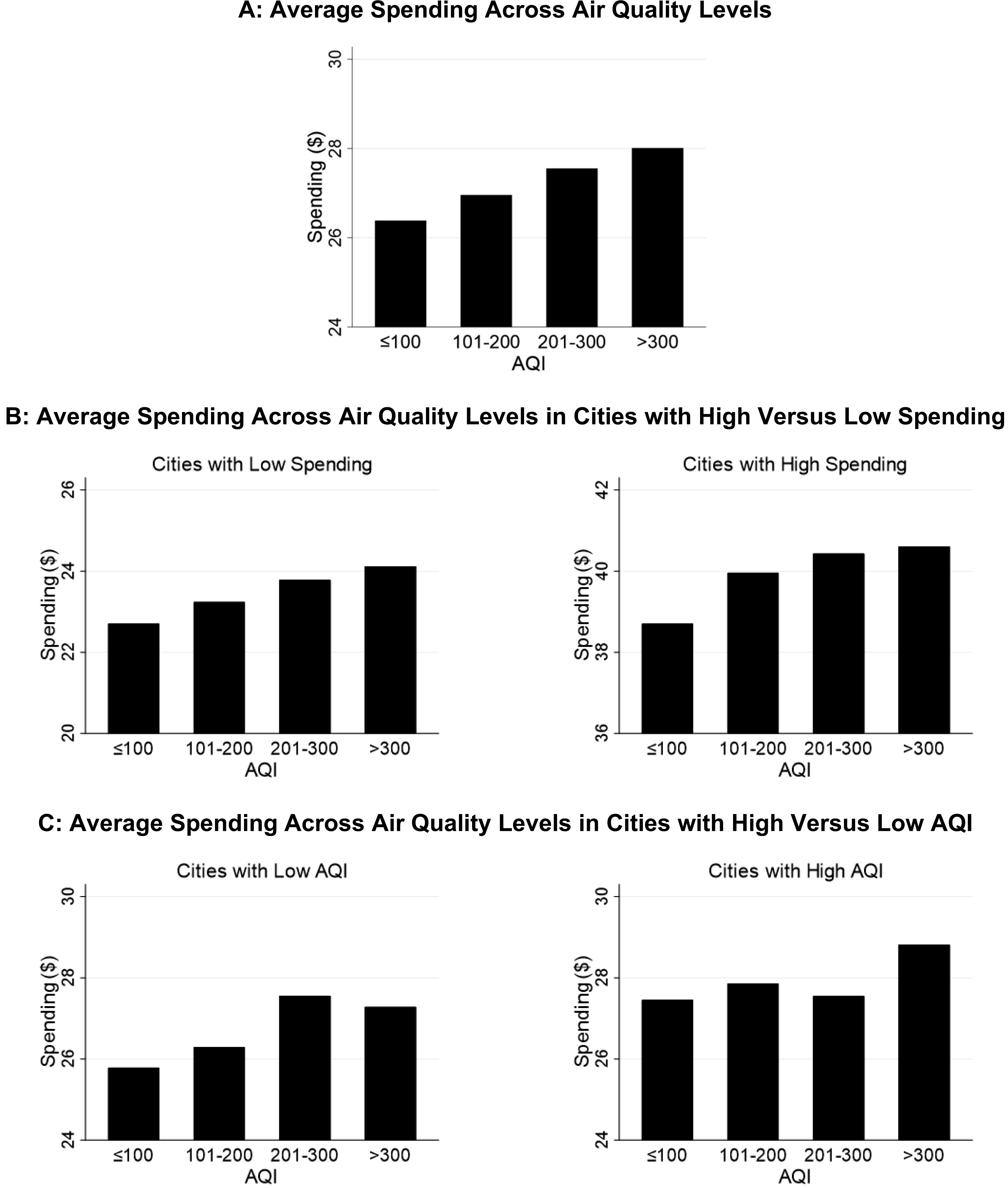
Model-Free Evidence.
Analysis and Results
Identification Strategy
Model specification
We develop a fixed-effects panel regression to identify the impact of air pollution on consumer spending. The baseline model is specified as follows:
Instrumental variable
Our model inference assumes exogeneity between consumer spending and air pollution—an environmental variable that, in principle, humans cannot control. However, it is critical to address endogeneity that arises from omitted variables, measurement errors, or correlations between air quality and the error term of our spending model, which potentially biases the causal effect of air pollution on consumer spending. 7 To minimize such endogeneity biases, we use a control function approach introducing instrumental variables (IVs) to our econometric framework (Papies, Ebbes, and Van Heerde 2017; Petrin and Train 2010). Specifically, we regress our endogenous variable on IVs, obtain residuals, and include them in Equation 1 as a control variable (Petrin and Train 2010; Wooldridge 2010, 2015). We use bootstrapped standard errors (with 1,000 resamples) because estimated values from auxiliary regression are plugged in as control function terms in place of actual values (Papies, Ebbes, and Van Heerde 2017; Petrin and Train 2010; Wooldridge 2015).
A sound instrument must be correlated with an endogenous regressor (i.e., air quality) but independent of the outcome variable (i.e., consumer spending). Following previous research on air pollution and socioeconomic outcomes, such as mortality (Deryugina et al. 2019) and labor productivity (He, Liu, and Salvo 2019), we rely on wind direction and wind speed as a nonlocal source of exogeneity. The specification of our first-stage model is described as follows:
We confirm that the instruments have few to no correlations with the dependent variable (spending; all less than .01) but stronger correlations with the endogenous regressor (AQI; up to .19). Our first-stage estimation also presents significant effects of the instruments on AQI (see Web Appendix B for the first-stage results). Lastly, we perform an F-test of the excluded instruments and reject the null hypothesis of weak instruments at 99% level.
Effect on Consumer Spending
Table 3 illustrates the direct impact of air quality on consumer spending. The results of our model estimation reveal a significant and positive effect of AQI (β = .0242), showing that an increase in air pollution is associated with higher daily spending. The estimate suggests an about 2.45% increase in daily spending for the deterioration of air quality by 100 (index) units, which amounts to $.65 per consumer at the mean level of spending in the data, or around $2,082 in total for our entire 3,198 samples. 8 Its economic significance becomes particularly impactful if projected to usual (retail) transactions in unpredictable daily air quality fluctuations for a quarter of every year at least, leading to an even larger financial accumulation. 9
Impact of Air Pollution on Consumer Spending.
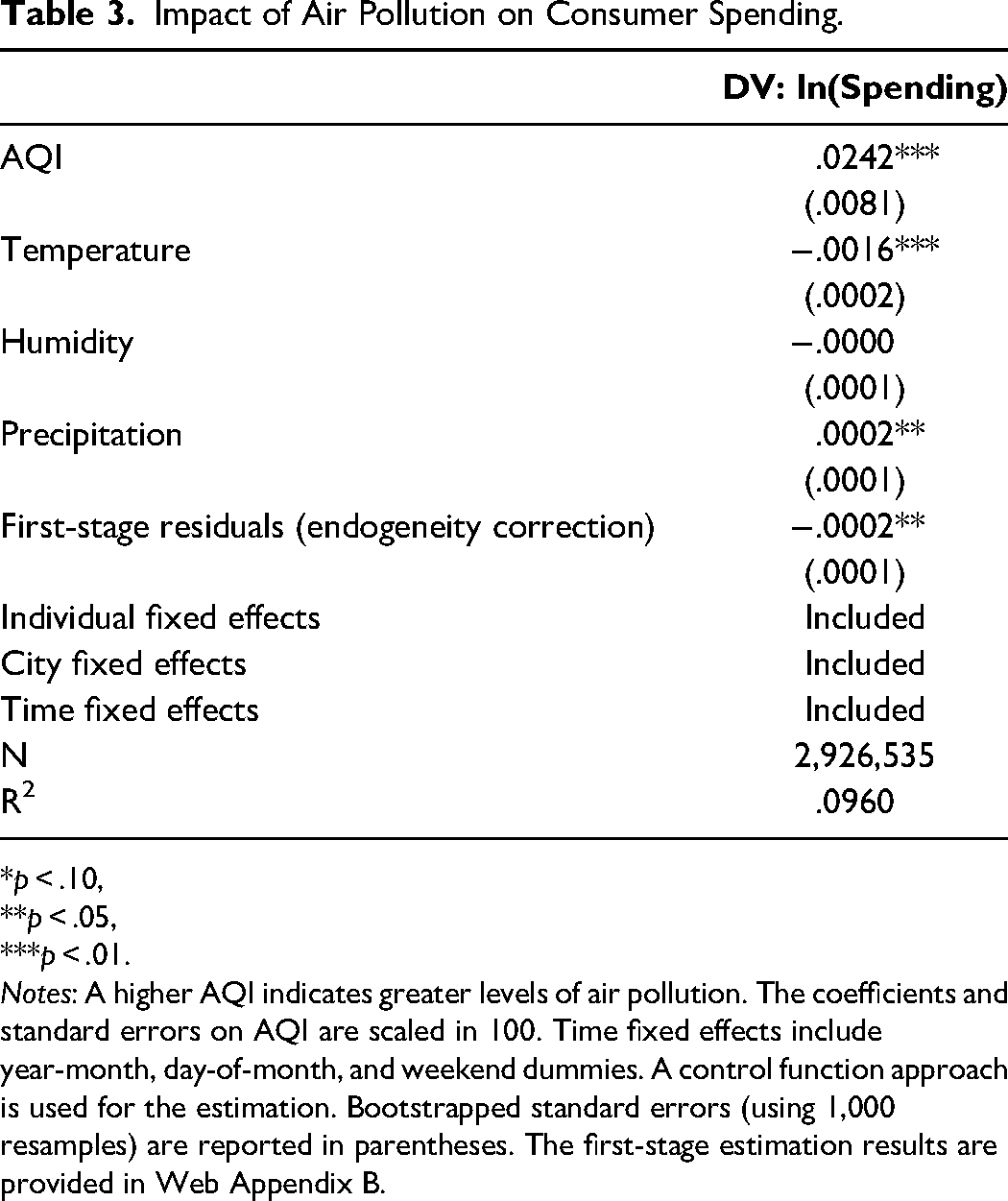
*p < .10, **p < .05, ***p < .01.
Notes: A higher AQI indicates greater levels of air pollution. The coefficients and standard errors on AQI are scaled in 100. Time fixed effects include year-month, day-of-month, and weekend dummies. A control function approach is used for the estimation. Bootstrapped standard errors (using 1,000 resamples) are reported in parentheses. The first-stage estimation results are provided in Web Appendix B.
Effect by Spending Characteristics
Our main analysis shows an average positive effect of air pollution on consumer spending. However, considering the wide spectrum of consumer spending, we investigate whether this effect varies across different spending categories. To obtain a comprehensive understanding of how consumer spending changes with air pollution, we conduct an interaction analysis. In doing so, we focus on the hedonic and utilitarian perspective as a key lens to understand consumer spending. The hedonic and utilitarian perspective, widely applied in prior literature to interpret consumer behavior (e.g., Li et al. 2020; Longoni and Cian 2022), emphasizes brand attitudes and consumption driven by affective and functional motives (Voss, Spangenberg, and Grohmann 2003). Specifically, hedonic consumption draws on an experiential and emotional value with enjoyable, fun, and pleasurable components (Dhar and Wertenbroch 2000). By contrast, utilitarian consumption pertains more to an instrumental need with goal-oriented characteristics (Babin, Darden, and Griffin 1994).
The hedonic and utilitarian perspective offers at least two advantages to enhance our insights into consumer spending. First, its theoretical underpinning based on social psychology concerns both affective and functional dimensions, providing an opportunity to explore behavioral motivations underlying the phenomenon of interest. In addition, the hedonic and utilitarian perspective allows for customer-centric thinking by quantifying unique consumption characteristics, which enables a large-scale examination of spending on various categories to make a generalizable statement about consumer behavior.
Measurement of spending (category) characteristics
Since consumption is not always hedonic or utilitarian but a combination of both, Voss, Spangenberg, and Grohmann (2003) devise a unique scale to distinguish between the two, which captures the strength of both hedonic and utilitarian (HEDUT) attributes for each subject from exogenous sources (e.g., survey data). The scale has also established wide applications in marketing research (e.g., Kushwaha and Shankar 2013; Li et al. 2020). For each of the ten substantive spending classes (aggregated from the raw 210 subcategories by the credit card company's classification scheme), we collect data on the HEDUT scale items from Prolific (N = 58) and compute the mean composite scores of the hedonic and utilitarian attributes. 10
Table 4 summarizes our HEDUT scores for each spending category. While certain categories have larger utilitarian scores (e.g., automobile and fuel, education), others have greater hedonic values (e.g., accommodation and leisure activities, amusement, entertainment). Our HEDUT scores ensure convergent validity, divergent validity, and reliability (see Web Appendix C for details).
Summary HEDUT Scores of Spending Category.
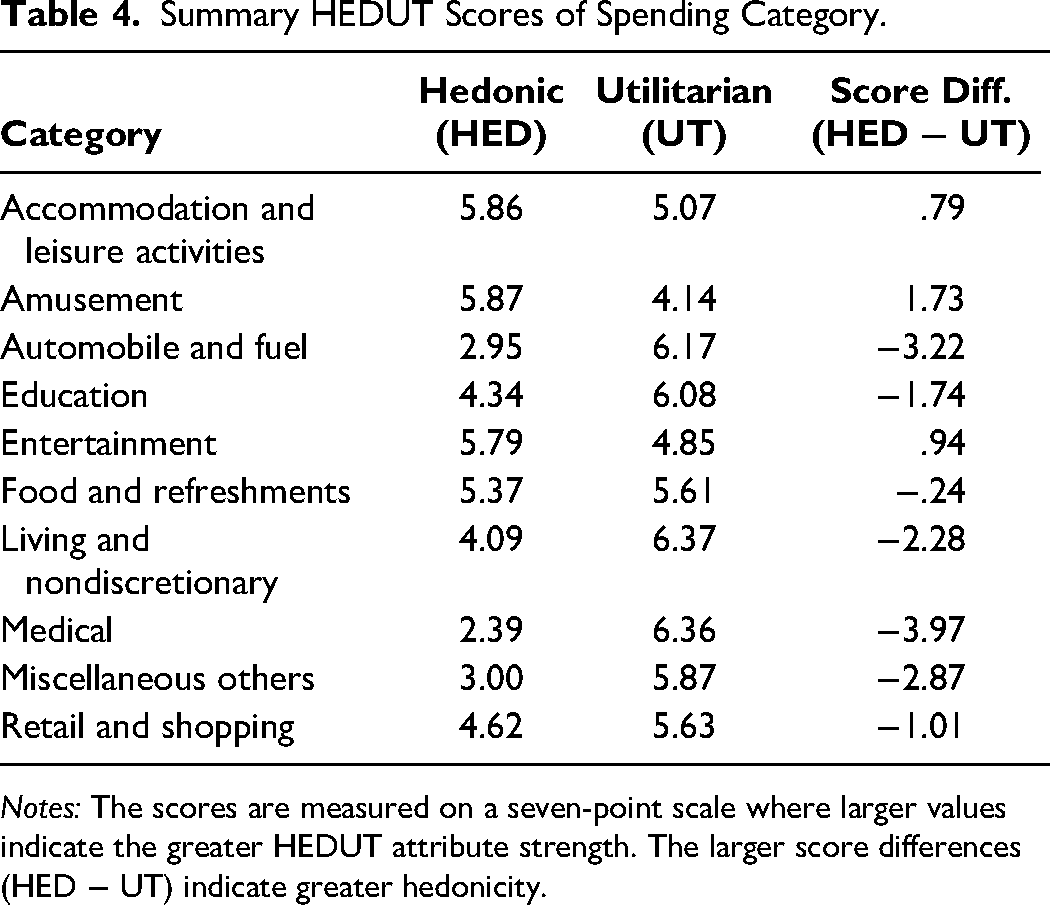
Notes: The scores are measured on a seven-point scale where larger values indicate the greater HEDUT attribute strength. The larger score differences (HED − UT) indicate greater hedonicity.
Interaction analysis and results
Using the unique classification measure, we examine a differential effect of air pollution by spending category in the following model:
Table 5 shows a significant and positive interaction between the AQI and HEDUT scores (β3 = .0091), implying that the elevated spending with higher air pollution is pronounced for categories with greater hedonic benefits. The coefficient on the lower-order term of AQI becomes insignificant, suggesting that the positive effect of air pollution on daily consumer spending could be explained primarily by hedonic pursuit. The positive coefficient on HEDUTc describes a tendency to spend more on hedonic consumption. Collectively, the results of moderation provide indirect evidence to what potentially drives our key findings.
Differential Effect by Spending Category.
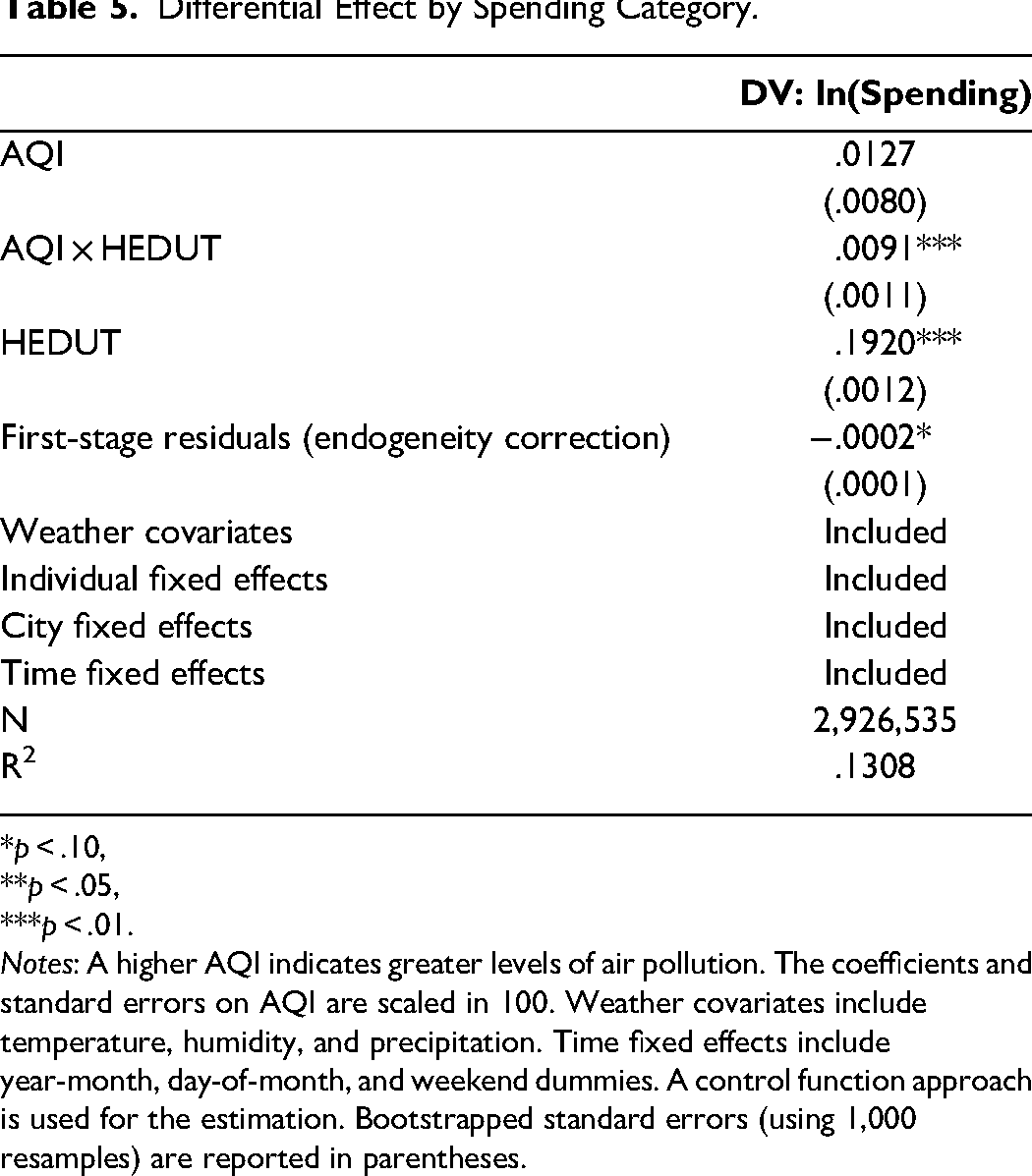
*p < .10, **p < .05, ***p < .01.
Notes: A higher AQI indicates greater levels of air pollution. The coefficients and standard errors on AQI are scaled in 100. Weather covariates include temperature, humidity, and precipitation. Time fixed effects include year-month, day-of-month, and weekend dummies. A control function approach is used for the estimation. Bootstrapped standard errors (using 1,000 resamples) are reported in parentheses.
According to the model estimates, we describe how the effect is moderated by hedonic strength. Figure 3 shows the effect of air pollution on consumer spending on the y-axis (β1 + β3) and the strength of hedonic benefits with spending categories on the x-axis, captured in the mean-centered difference between hedonic and utilitarian (HEDUT) scores where its range refers to the extent of HEDUTc in the data (see also Equation 3). We find that the positive effect is significant when it pertains to categories with more hedonic values (i.e., HEDUTc > 0).
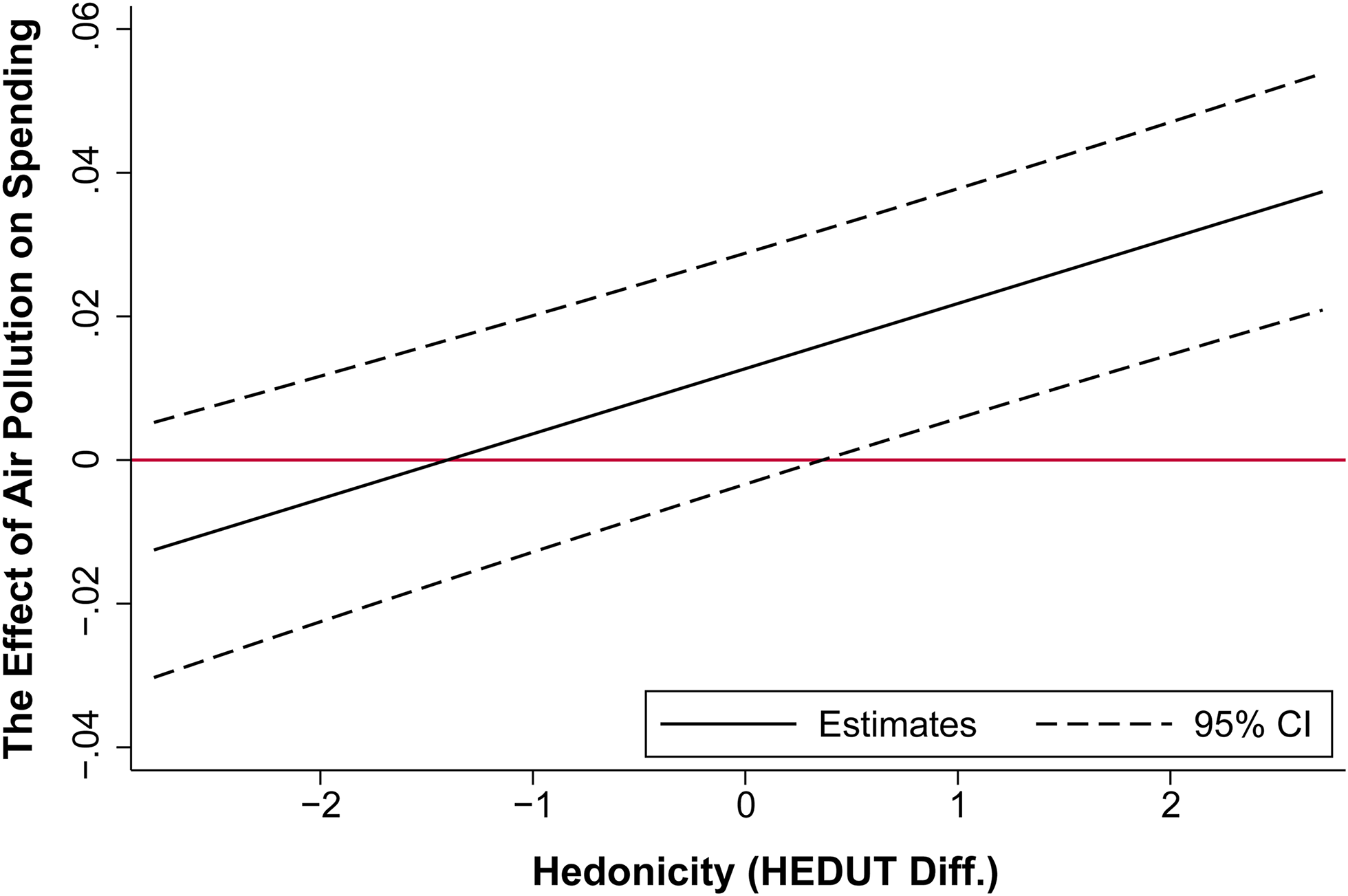
Effect of Air Pollution Moderated by Hedonicity.
Additional Analyses
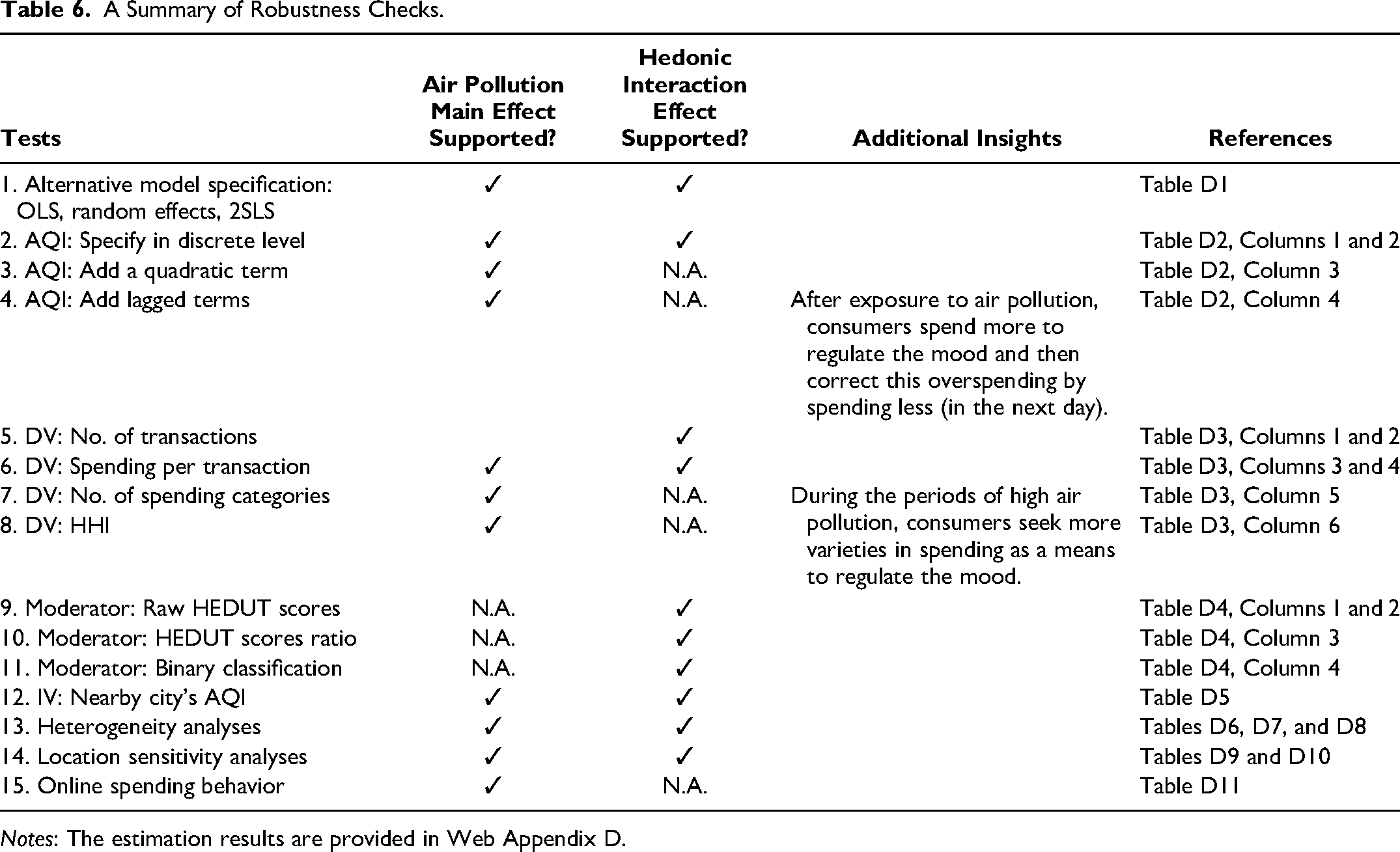
We conduct additional analyses to consolidate our findings and discuss potential explanations. Table 6 summarizes our robustness checks and additional takeaways (see also Web Appendix D for the estimation results).
A Summary of Robustness Checks.
Notes: The estimation results are provided in Web Appendix D.
Robustness Checks
Alternative model specification
We confirm the robustness of our main findings on the assumption that concentration of air pollution is strongly exogenous to consumer spending, allowing us to specify ordinary least squares (OLS) estimation without endogeneity correction. Additionally, we attempt two-stage least squares (2SLS) estimation, in which predicted values of the AQI from the first stage (see Equation 2) are used to replace our endogenous variable(s) in the second stage (see Equation 1). As in the control function approach, we employ bootstrapped standard errors to adjust a variance structure. Lastly, we use random effects to allow for individual-level heterogeneity in our main control function framework. All these alternative model specifications provide consistent results (see Web Appendix Table D1).
Alternative specification of air pollution
Air pollution might have differential effects according to its growing severity. For example, the guidelines of the Korean Ministry of Environment categorize AQI into four discrete levels with health implications: good (AQI ≤ 50), moderate (50 < AQI ≤ 100), unhealthy (100 < AQI ≤ 250), and very unhealthy (AQI ≥ 250). Similarly, a continuous measure of AQI can be replaced with discrete air quality levels, where the baseline is an AQI of 100 or less (i.e., below air pollution levels). We find a monotonic (yet potentially exponential) increase in consumer spending with higher levels of air pollution and its salience in hedonic categories (in Columns 1 and 2, Web Appendix Table D2). On the contrary, our extended model using a quadratic term of AQI does not support its nonlinear effect (in Column 3, Table D2). Lastly, we include a lagged value of AQI to see whether the effect of air pollution goes beyond the day. Interestingly, its lag effect shows a reversed sign (in Column 4, Table D2), implying that in the following day of exposure to air pollution, consumers correct for overspending. 12 Consistent with our premise, however, a parameter test shows a net positive effect resulting from the positive contemporaneous effect and the negative lag effect of AQI.
Alternative dependent variables
Exploring alternative dependent variables could provide additional insights into the impact of air pollution on consumer behavior. First, we decompose total spending by the number of transactions and per-transaction spending, which describes purchase frequency and incidental expenditure, respectively. Web Appendix Table D3 suggests that, while not leading to more frequent transactions (in Column 1), air pollution boosts per-transaction spending (in Column 3). The implication is that the observed increase of total spending with air pollution is attributable to an incidental spending increase. Their predominant association with hedonic categories is consistent for both outcomes (in Columns 2 and 4, Table D3).
Given our main findings of increased spending on hedonic categories with higher levels of air pollution, prior research suggests that hedonic opportunities may be obtained from variety-seeking (Dhar and Wertenbroch 2000; Garg, Inman, and Mittal 2005) as much as it helps reduce minor unpleasant mood (Kahn 1995; McAlister and Pessemier 1982). In this regard, air quality might be associated with consumers' choice of various categories in spending behavior. We devise two proxy measures that operationalize variety-seeking: the number of spending subcategories and the Herfindahl–Hirschman index (HHI) of subcategory spending. 13 The former indicates the absolute count of subcategory choices, and the latter captures the relative extent to which consumers allocate spending to subcategories. Web Appendix Table D3 shows that an increase in AQI leads to a larger number of spending subcategories (in Column 5) and the smaller HHI index (in Column 6), both implying more variety-seeking. Therefore, the results are consistent with our theory that consumers pursue hedonic benefits during the periods of high air pollution.
Alternative application of the moderator
While our moderator is formulated as a score difference of the hedonic and utilitarian (HEDUT) values that measures the relative hedonic strength for each spending category, we alternatively operationalize the moderator using the raw HED and UT scores. First, each attribute score is included as the moderator yet in separate models to avoid multicollinearity. The increased spending for categories with greater hedonic benefits remains consistent, as shown in the positive interaction of AQI with the HED score and the negative interaction of AQI with the UT score (in Columns 1 and 2, Table D4).
A gradation of hedonicity can also be computed as a ratio of the HED to UT scores, where a larger value indicates greater hedonic (over utilitarian) attributes. The positive interaction of AQI with the HED/UT ratio remains consistent (in Column 3, Table D4). Lastly, we classify spending categories as either hedonic or utilitarian, according to the relative size of the HEDUT scores within each spending category. If a HED score is larger than a UT score for one category, we consider it to be hedonic, and otherwise, utilitarian. The binary classification identifies “Accommodation and leisure,” “Amusement,” and “Entertainment” categories as hedonic and the remainders as utilitarian. The results show that the positive effect of air pollution on spending is more significant for hedonic categories (in Column 4, Table D4), consistently suggesting that our findings are prominently driven by hedonic pursuit.
Alternative instrumental variable
While our empirical results rely on a valid instrument creating exogenous variations in air pollution, previous literature also proposes reasonable instruments in specific contexts, including wind direction against mortality and medical costs (Deryugina et al. 2019); thermal inversion and wind changes against labor productivity (He, Liu, and Salvo 2019); traffic congestion against infant health (Knittel, Miller, and Sanders 2016); and green areas, manufacturing facilities, and the number of cars on the road against hospital admissions (Lagravinese et al. 2014). Unfortunately, many of them were not applicable to this study because of unavailable information (e.g., thermal inversion) or lack of granularity (e.g., manufacturing facilities, traffic congestion, and green areas are observed yearly compared with our unit of observation at daily level).
We thus develop an original instrument to capture a nonlocal source of air pollution, namely, a combination of wind direction and air quality (index) of nearby cities from which the wind blows to the focal city. The specification of our first-stage model is rewritten as follows:
Heterogeneity analyses
We run a series of heterogeneity analyses using demographic characteristics: gender and age. First, our key variables are interacted with a female dummy variable (15% of our panels). Web Appendix Table D6 shows that the positive effect of air pollution on consumer spending could reduce for women; however, they pursue more hedonic benefits when air quality is poorer, the trend consistent with increased hedonic consumption for the weather-induced unpleasant mood, as illustrated in prior research (Govind, Garg, and Mittal 2020).
Since the age information is made available to us on an ordinal scale (21–25, 26–30, etc.), we treat these age groups as ordinal, with lower values representing younger populations. Their interactions with our key variables show that the positive effect of air pollution on spending could be smaller in the older groups, while there is an insignificant age difference for hedonic pursuit when air pollution is worse (Web Appendix Table D7).
We further explore heterogeneous effects using individuals’ past shopping patterns. Identifying consumers as big spenders if their first-month spending is greater than the median, and small spenders otherwise, our interaction results show that the positive effect of air pollution could decrease for big spenders, while there is insignificant difference between heavy and light spenders in hedonic pursuit when air quality is poorer (Web Appendix Table D8). It is also important to note that, across these heterogeneity analyses, our main findings of increased spending with higher air pollution and its prominence in hedonic categories remain qualitatively consistent.
Sensitivity tests
We performed various sensitivity analyses to ensure consistent results. Consumers might travel to other provinces or big cities for purchases, which raises concerns about potential shifts in consumer spending. We run two sensitivity tests to explore this possibility. First, we add an indicator variable (= 1 if a transaction takes place outside Seoul) to identify those transactions potentially made in traveling. The interactions with our key variables reveal that our substantive results do not change (Web Appendix Table D9). Second, we repeat our main analysis using data from the Seoul area only (which includes 25 cities or Sigungu). As with the first test, our results remain consistent (Web Appendix Table D10). Thus, we find no notable difference in AQI sensitivity to spending during travel.
We also run a naive analysis of online spending with respect to air quality. Since our credit card data observes a third-party location for an online transaction, we turn to the panel's home address for a proxy location under the assumption that the transaction takes place at home. Despite the incomplete information, analyzing exclusively online transactions or including those in the main analysis does not change our premises (Web Appendix Table D11).
Potential Explanations
Our empirical analyses provide converging evidence of the increased consumer spending with higher air pollution and its prominence in hedonic categories. In this section, we present theoretical arguments and empirical extensions to explore potential mechanisms.
Mood regulation
Since air pollution triggers emotional distress as well as health concerns and cognitive problems (Evans and Jacobs 1981; Lu 2020), an incidental unpleasant mood could explain consumers’ economic response (e.g., spending) to air pollution. Traditionally, consumers are driven not only to maintain the current mood when they feel good but also to move toward a more positive affect state when they feel bad (Isen and Simmonds 1978). In turn, consumers in a negative mood tend to engage in more proactive actions—for example, increasing consumption or spending more—to repair their mood (i.e., mood regulation; Andrade 2005). This mood regulative motivation then occurs to the extent that consumers anticipate mood-changing consequences (Lerner, Small, and Loewenstein 2004; Zillmann 1988).
Previous research suggests that mood regulation opportunities are principally available in affect-laden categories of spending. Hedonic consumption, for example, is characterized by pleasure-seeking and experiential benefits and depends on individuals' emotions and feelings (Chitturi, Raghunathan, and Mahajan 2008; Dhar and Wertenbroch 2000). Moreover, prior literature has consistent evidence to the causal link between negative mood and hedonic consumption, such as gift cards redeemable at chocolatiers or department stores (Govind, Garg, and Mittal 2020), fattening snacks (Garg, Wansink, and Inman 2007; Tice, Bratslavsky, and Baumeister 2001), and tobacco or alcohol (Ferdinand, Blüm, and Verhulst 2001). Specifically, consuming unhealthy or vice products offers hedonic benefits and allows an immediate opportunity for mood regulation (Tice, Bratslavsky, and Baumeister 2001). Similarly, consumers in a negative mood perceive hedonic attributes as mood-lifting and thus consume more snacks (Garg, Wansink, and Inman 2007). Closer to our interest, Govind, Garg, and Mittal (2020) evidence an increase in hedonic consumption mitigating the negative affect under bad weather.
These arguments pertain to our problem on the assumption that air pollution evokes an incidental negative mood in consumers. 15 If true, we reason that via the mood regulation process, the observed increase in consumer spending with higher air pollution should be dominant for hedonic categories. Notably, our evidence is consistent with this logic, as Table 5 shows, providing empirical support to the mood explanation of our key findings. 16
Greater economic activities or unobserved variables
It is possible that the areas with poorer air quality are more populated and developed, where consumers are likely to spend more. Similarly, greater economic activities in a certain area could simultaneously lead to higher spending and an increased concentration of air pollution due to those economic activities (e.g., transportation). However, such a nonrandom assignment of air quality arising from unobserved geographic characteristics is of minimal issue here. 17 Our IV analysis with various city and time fixed effects accounts for seasonal trends and geographic patterns of the economy and minimizes endogeneity arising from unobservable variables that simultaneously influence air pollution and consumer spending. Since wind is irrelevant to greater local economic activities associated with consumer spending, our results are less likely to be driven by such an unobservable factor.
Supply-side explanation
One might be concerned that the results may have a supply-side explanation reflecting managers’ strategies to attract consumers (e.g., providing discounts or promotions) in anticipation of reduced visits on polluted days. We present the following arguments that counter this explanation. First, the ambient nature of air quality makes it hard for businesses to prepare for polluted days in advance. Comparing historical data from public one-day-ahead forecasts with the actual observed air quality, we find relatively low predictive validity of these forecasts (see Web Appendix E for details). Moreover, we built our own AQI predictive model that mimics managers’ anticipation of air quality based on the observation of various environmental factors prior to the target day. The predicted AQI, in principle, would be the strongest driver of managers’ strategic moves in response to air pollution, as same-day responses are less feasible due to the time constraints. If managers’ strategic reactions are the main explanation behind our findings, we would observe a positive and significant correlation between the predicted AQI and consumer spending. However, this proposition is not supported because Table E1 shows its insignificant effect (see Web Appendix E).
Second, our data indicate that hourly fluctuations of air quality (index) can be significant (with the AQI difference between daily highs and lows equal to 83 on average). Using hour-level data, our analysis also replicates the positive effect of air pollution on consumer spending (in Column 1, Web Appendix Table E2). In turn, we reason that hourly fluctuations in spending with air quality levels would be difficult to attribute to managers’ reactions simply because of the response time needed for businesses to adjust marketing tactics.
Finally, we check whether SKU-level retail prices change with same-day air pollution. Since our credit card transactions data do not have SKU-level information, we rely on a separate data set provided by an online retailer in South Korea. Analyzing 21,887 daily transactions of cosmetic and health care products from March to April in 2017, we find no sign of selling-price fluctuations with air pollution, whether the air pollution is actual or predicted. 18 Thus, we conclude that the increase of consumer spending with air pollution is unlikely to be driven by the supply side.
Compensatory consumption
It is possible that consumers deprived of seeing a blue sky on polluted days will develop the psychology of compensation, materialized by an increased demand for blue-colored products or similar (Ding et al. 2021). If compensation for poor visibility is the main explanation, the increased spending with air pollution should be salient in the daytime, when visibility is more distinguishable, than in the nighttime. However, our analysis does not support this claim. Web Appendix Table E2 shows that an hourly positive effect of air pollution is more prominent later in the day (Column 2), casting doubt on the compensatory consumption hypothesis. In contrast, the results indirectly support the mood regulation process to the extent that consumers have more opportunity for hedonic consumption, such as leisure activities or refreshments, that is popular during the nighttime.
Avoidance and indoor activity
One might question whether consumers avoid outdoor environments on polluted days. For example, attendance at open-air facilities declines after a smog alert is issued, although such avoidance behavior may disappear on the following days as the cost of curtailing outdoor activities increases with continued air pollution (Graff Zivin and Neidell 2009). Once observing poor air quality consumers might spend more time inside, such as at malls, retail stores, or restaurants, and in turn spend more money. Although our in-store data do not allow for direct hypothesis testing, we can examine if the effect of bad weather (e.g., heavy rain, extreme temperature, high humidity) brings consumers to an indoor environment just as air pollution could. Using our local weather variables for the HEDUT interactions, Web Appendix Table E3 suggests that the weather effects are not consistent with our main findings with air pollution. Specifically, given that lower temperature, higher humidity, or heavier rain could have brought consumers inside, their interaction patterns are qualitatively opposite to what air pollution shows. In this regard, we find a difference between air pollution and bad weather and argue that avoidance and indoor activity does not explain our main findings.
Experimental Study
After consideration of potential explanations regarding the increase in consumer spending with greater levels of air pollution, our leading hypothesis is that consumers treat spending as a means of mood regulation. We provide further support to this proposition in an experimental setup.
Design
We conduct a 2 (air quality: polluted vs. fresh) × 2 (consumption type: hedonic vs. utilitarian) between-subjects study. Two hundred two participants from across the United States (14.9% women; mean age of 31 years) were recruited using Prolific and compensated monetarily for their participation, whose current residence was filtered to the 15 most polluted U.S. states based on their relatively high exposure to air pollution. 19 Participants were randomly assigned to one of the four experimental groups, in which they completed a survey in the following sequence: (1) scenario reading and articulation task (manipulation), (2) a need for positive affect (mediator), (3) willingness to spend (dependent variable), and (4) manipulation checks and demographic items.
Participants were told to imagine themselves checking a mobile app that provides air quality information with real-time sky views. The first between-subject factor, air quality, was manipulated in the app interface that presents either a polluted or fresh air condition, holding other weather conditions constant (see Figure F1, Web Appendix F, for details). 20 After the priming reinforcement in which participants were asked to describe their feelings about the previously exposed air quality in their own language (Lerner and Keltner 2001), we measured the need for positive affect (“I need more positive/pleasant/good feelings”; α = .98; Huang et al. 2019). Respondents in both consumption conditions were then asked to imagine that they were considering a purchase (hedonic condition: a book for entertainment and relaxation, bread for dessert and delight, coffee with rich aroma and robust flavor, or a dish to enjoy at a fine dining restaurant for a treat; utilitarian condition: a book for study and self-improvement, bread for a diet to keep oneself full, coffee providing caffeine to stay focused, or a dish to consume at the office for overtime work). Participants in both conditions were asked to indicate their willingness to spend (WTS) between $0 and $100 for each purchase, with the total amount potentially reaching $400. They also rated their avoidance intention (going out/staying indoors; α = .94), state impulsivity (self-controlled/capable of practicing willpower; α = .95; Puri 1996), cognitive depletion (focused/capable of absorbing information; α = .89; Puri 1996), and mortality salience (“My worry about death is overwhelming”/“I keep thinking about how short life really is”; α = .91; Ferraro, Shiv, and Bettman 2005), after completing manipulation checks on their feelings about an air quality view (good/positive/bad/negative; α = .97), perceived air quality (α = .98), and product-wise hedonicity (α = .89). All items were measured on a nine-point scale. Respondents’ age, gender, education, and income levels were collected.
Results
We first confirm that perceived air quality is significantly poor in the air pollution (vs. fresh air) condition (Mpolluted = 7.62 vs. Mfresh = 2.50; t(200) = 24.36, p < .01). Our affect scores also show that participants experienced greater unpleasant feelings with air pollution (Mpolluted = 2.62 vs. Mfresh = 7.43; t(200) = 19.87, p < .01). Hedonicity ratings are greater in the hedonic (vs. utilitarian) condition (Mhedonic = 7.56 vs. Mutilitarian = 5.28; t(200) = 9.82, p < .01). In this regard, our manipulations are supported.
We use a sum of WTS across retail item purchases as the DV. Consistent with our field evidence, the analysis of variance on WTS shows a significant two-way interaction between air pollution and consumption type (F(1, 198) = 3.91, p < .05; see Figure 4). We also find a positive effect of air pollution on WTS (Mpolluted = $84.07 vs. Mfresh = $67.69; t(200) = 2.06, p < .05). A planned contrast examining the two-way interaction describes that for hedonic consumption, WTS is greater with air pollution than in fresh air (Mpolluted = $107.28 vs. Mfresh = $76.18; F(1, 198) = 8.37, p < .01). However, this pattern does not emerge for utilitarian consumption (Mpolluted = $60.40 vs. Mfresh = $59.37; F(1, 198) = .01, p > .10).
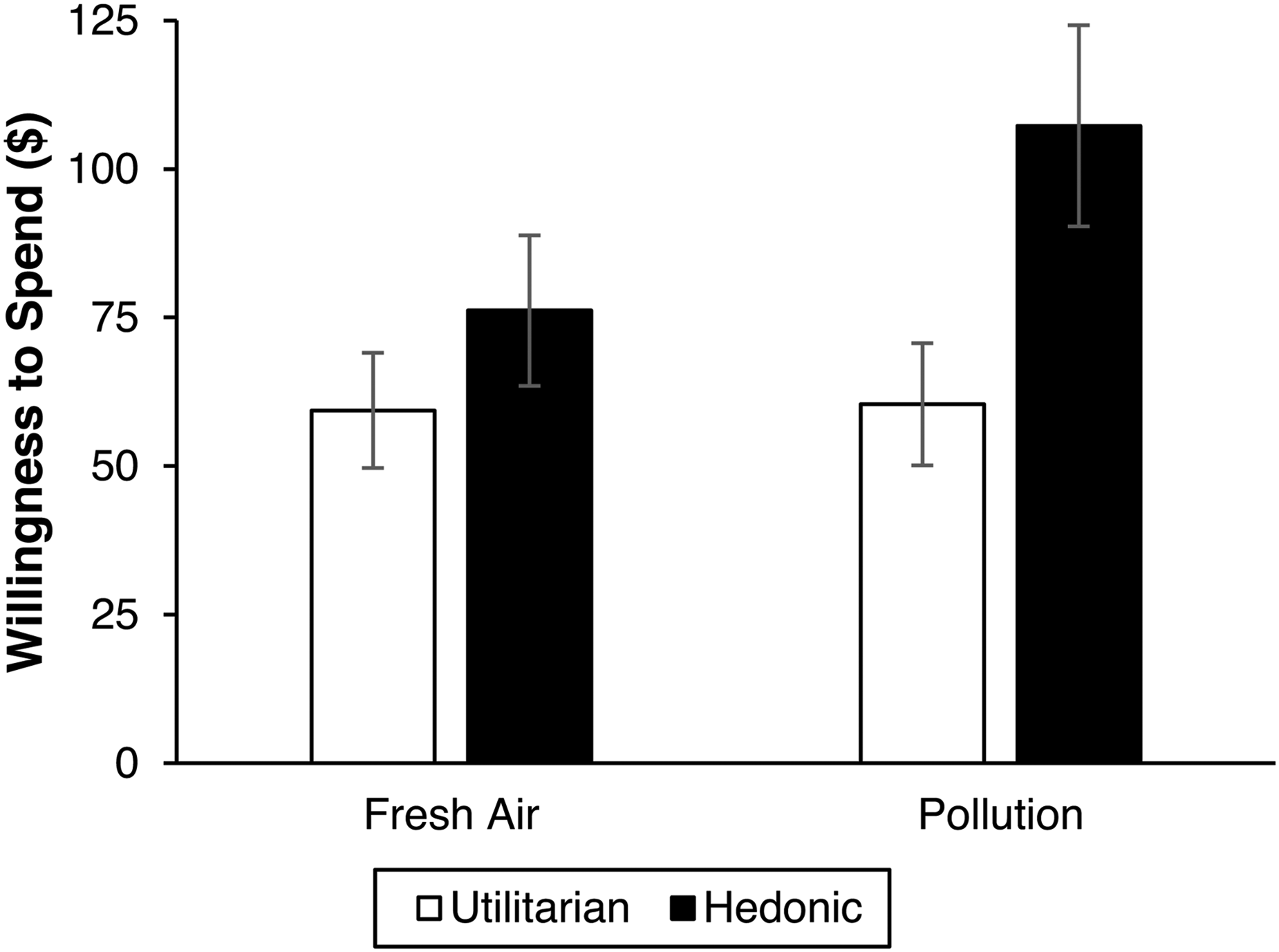
Mean Difference of Willingness to Spend (WTS).
More importantly, we examine the moderated mediation to explain the increased WTS for hedonic consumption with poor air quality. 21 We expected that the process would be mediated by the need for positive affect—that is, mood regulation. To obtain the results shown in Figure 5, we implemented a statistical method “Model 15” from the PROCESS analytical tool (Hayes 2017) with 5,000 bootstrap resamples. First, we show that air pollution increases need for positive affect (β = 3.02, SE = .26, t = 11.84, p < .01). A significant interaction arises between need for positive affect and hedonic consumption (β = 14.61, SE = 4.03, t = 3.63, p < .01), but then the direct interaction between air pollution and hedonic consumption becomes insignificant (β = −15.07, SE = 18.94, t = −.80, p > .10). Next, the conditional indirect effect is significant only in hedonic consumption (β = 39.14, SE = 9.41, 95% CI = [19.18, 56.68]) but not in utilitarian consumption (β = −5.03, SE = 7.20, 95% CI = [−18.70, 9.43]). The index of moderated mediation is statistically significant, with the difference between conditional indirect effects of the hedonic and utilitarian conditions (index = 44.17, SE = 11.87, 95% CI = [20.09, 66.85]).
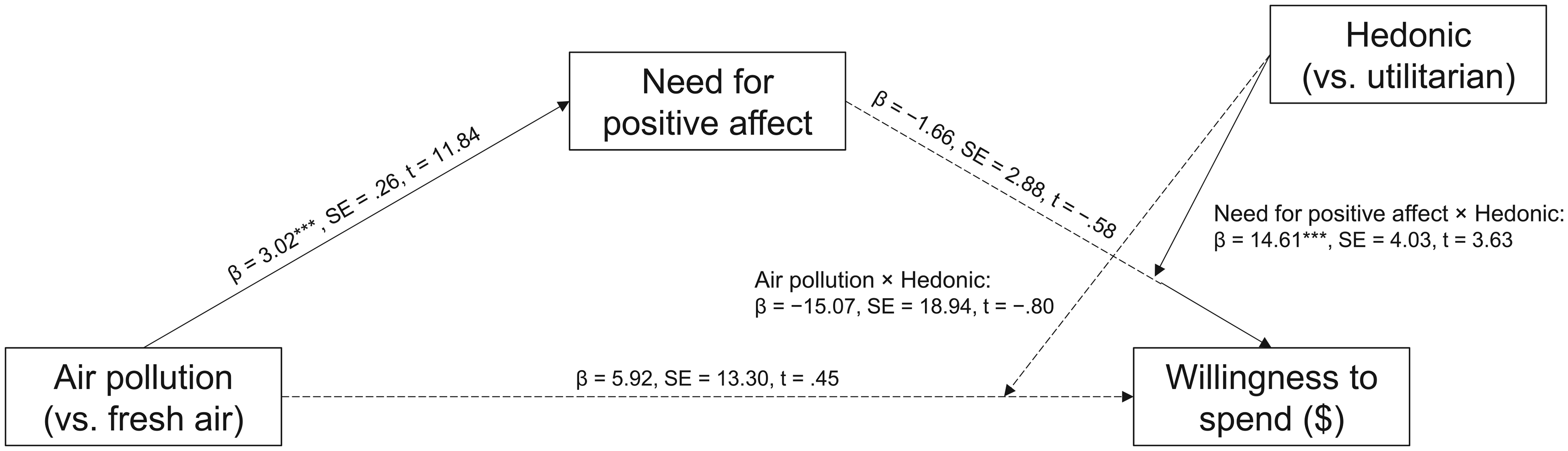
Moderated Mediation Path Diagram.
Finally, we test alternative explanations using the scale measures we collected to capture the related constructs: self-control, cognitive malfunctions, mortality salience, and avoidance intentions. First, state impulsivity might occur to the extent that air pollution depletes one's self-control resources (Fehr et al. 2017), which in turn drives impulse buying. Second, lower cognitive abilities on polluted days could bias decision-making (Huang, Xu, and Yu 2020). Third, mortality salience would lead to indulgent behavior (Ferraro, Shiv, and Bettman 2005). Lastly, avoidance of air pollution (and staying inside) may provide more chances for shopping (even through the internet). Although each could increase spending, we confirm that none of those constructs performs the same mediation process as the need for positive affect. Similarly, controlling for them as covariates provides no evidence of other mediation paths in parallel with the need for positive effect (see Table F1, Web Appendix F, for their correlations).
Implications for Stakeholders
Air pollution is widely recognized for its significant social costs, including negative health impacts, environmental degradation, economic burdens on health care systems, and reduced quality of life. This research identifies an increase in consumer spending on hedonic consumption as one of the economic effects of air pollution. This section explores whether increased hedonic spending should be viewed as a negative or positive implication of air pollution for retailers, policy makers, and consumers, highlighting both challenges and benefits.
Insight for Retailers
There are several ways in which retailers can benefit from an increase in consumer spending for hedonic categories. We broadly define managerial implications for this group of stakeholders as (1) promotion and advertising and (2) corporate social responsibility and brand image building.
An increase in demand linked to air quality fluctuations presents an opportunity for retailers to develop tailored marketing strategies. For example, Keller, Deleersnyder, and Gedenk (2019) find that a price promotion offered around a noteworthy event generates a stronger sales response than at nonevent times. Likewise, Li et al. (2017) report an increase in advertising responsiveness under certain weather conditions. Thus, we argue that, as a demand shifter, the AQI effect can be integrated into marketing activities in a similar fashion. For example, retailers can leverage displays or signage catering to hedonic consumption and comfort, or in-store events, such as a hobby workshop or a wellness product demonstration, planned in advance but ready to set up and deploy as soon as the rise in air pollution is noted from the AQI tracking. They can also adjust the store ambiance (e.g., music, decorations) to serve current customer preferences more proactively.
Another option is to prepare a point-of-sale promotion during periods of high air pollution, such as instant markdowns or special offers on mood-lifting items or bundles that include hedonic varieties of increased demand. Retailers may want to provide sales promotions to counteract an anticipated shrinkage in spending the day following higher air pollution (to correct for overspending) or from big spenders (who are less likely to spend after exposure to pollution), drawing from our empirical extensions (see also the “Robustness Checks” section). 22
It is also important to note that given the ambient nature of air quality, marketing strategies leveraging our results should be capable of quick and effective deployment over a short planning horizon. In this regard, digital marketing tactics such as online ads, social media, or customized content might be particularly helpful. Examples include localized display or search ads for products offering enjoyment and comfort, such as gourmet snacks, entertainment gadgets, wellness products, or feel-good promotions on social media, and customized content, such as timely emails advertising leisure activities.
Equally important are retailer activities to improve corporate social responsibility and brand image. For example, a company may want to launch a campaign that emphasizes the importance of self-care to address the effect of air pollution on individual well-being, in partnership with health care and wellness experts to generate content and resources that help consumers navigate stress and health concerns related to air quality. This campaign will tie into the idea that indulging in hedonic products responsibly is part of self-care during significant air quality drops.
Another opportunity is to develop a line of hedonic goods and services that are environmentally sustainable, including organic luxury comfort foods or eco-friendly leisure activities. This initiative aligns with the increased demand for such items during periods of high air pollution and reinforces the company's commitment to sustainability.
Finally, a company can initiate a public awareness campaign that educates consumers about decision-making with environmental factors, explaining how air quality affects their spending. The campaign may also suggest avenues to make more environmentally conscious choices without sacrificing the desire for indulgence, thus promoting responsible consumerism.
Impact on Policy Makers and Consumers
This research is also valuable to policy makers in designing environmental and socioeconomic regulations. First, our main findings of increased spending due to deteriorating air quality raise public awareness about a major environmental crisis and its consequences for daily life, making the issue more relevant and urgent. Accordingly, policy making institutions can develop campaigns that associate air quality with everyday consumer choices and illuminate how environmental health contributes to individual well-being and economic stability.
Similarly, the results of increased spending might incur social costs for the general public, such as overconsumption of pleasure-seeking categories. Insights from this research should help consumers to be cautious of their continual and habitual consumption of hedonic goods and services during periods of higher air pollution, while policy makers can promote healthier and more environmentally conscious alternatives. More broadly, our study has implications for household economies, suggesting that pollution-induced incidental spending, particularly overspending, may result in the accumulation of revolving debt.
Finally, this research suggests an opportunity for industry collaboration involving retailers and manufacturers. Joint campaigns will support the development of sustainable practices, providing incentives for consumers to engage in more responsible consumption (e.g., emphasizing the benefits of sustainable products) and environmentally friendly practices (e.g., highlighting benefits of eco-friendly transportation).
Conclusion and Future Research
Analyzing credit card transactions and air quality readings data in South Korea, this article demonstrates a nonnegligible increase in daily spending for deterioration of air quality. We also show that this correlation is pronouncedly observed in hedonic categories, suggesting mood management as the underlying explanation. Our findings are supported in a controlled experiment to reinforce a causal relationship and test the postulated mechanism.
A growing concern about environmental changes calls for significant attention to the research and practice of sustainability in business management (Chandy et al. 2019). This research makes three contributions toward this paradigm. First, we document a direct link between air pollution and consumer spending to complement a nascent stream of research on socioeconomic implications of air pollution. Relatedly, we identify air quality as a unique variable influencing consumer behavior and revisit the significance of an environmental factor in marketing practice and research. Finally, we delve into boundary conditions and mechanisms behind the impact of air pollution on spending, with extensive analyses of the field and lab data jointly addressing empirical challenges and providing theoretical underpinnings.
This article is not without limitations. First, we acknowledge potential limitations in the transaction data. Although credit cards account for a substantial amount of consumer expenditure in South Korea, measurement errors could arise from different sources, such as consumers’ multihoming in credit card usage or unobservable transactions made by other payment tools. Despite our efforts to mitigate such concerns in various robustness tests, unavailability of population-level data is a limitation that merits further investigation if suitable resources become available.
Second, our results do not speak about offline and online demand substitutions in exposure to air pollution. The key finding of increased spending with higher air pollution is consistently observed when we consider online transactions in a robustness check, implying a more conservative estimate given the information made available to us. Nevertheless, exploring potential demand shifts is an interesting avenue for future research.
Importantly, one can obtain data on individual-level details (e.g., socioeconomic status), transaction-level details (e.g., SKU information), or marketing levers (e.g., promotion, advertising) and generate additional valuable insights. While our additional analyses provide interesting results that include variety-seeking behavior, demographic heterogeneity, supply-side changes, and hourly patterns of the impact, we call for empirical or theoretical studies on these topics. For example, Jeong, Lee, and Gopal (2022) examine how retail promotions interplay with air pollution to affect online and offline cosmetics purchases. Regarding hourly patterns of the impact, Francis et al. (2021) suggest that one's willpower to resist the temptations of indulgent and unhealthy consumption diminishes later during the day, which might offer a preliminary explanation to our results of the larger effects during the nighttime. We leave these questions to follow-up work.
Lastly, conforming to the regulatory requirements of research with human participants, our controlled experiment does not reflect real-world air pollution. An explicit exposure to hypothetical air pollution in an online experiment may not reproduce the exact cognitive process despite the advantage of strong internal validity enabled by randomization. While a natural experiment may be an alternative, conducting a one-shot study poses a challenge in distinguishing between location- or individual-specific factors and our proposed effect, given the subtle association observed in the analysis of our observational data. We encourage more extensive study involving multiple waves of experiments using natural fluctuations of AQI with a panel of survey participants in a repeated manner.
There may be several other remaining questions. Websites and mobile apps have made air quality updates available in real time, and some even provide push notifications. It would be worthwhile to explore whether proactively checking air quality or purely relying on public alerts makes a difference in consumer behavior. Given that air pollution is a global threat, evidence from cross-national studies will also add to confidence and insights for practitioners and consumers worldwide, and we provide consistent results from South Korea and the United States. We hope this research paves the way toward a better understanding of consumer behavior in the face of escalating environmental unsustainability.
Supplemental Material
sj-pdf-1-jmx-10.1177_00222429241282998 - Supplemental material for The Impact of Air Pollution on Consumer Spending
Supplemental material, sj-pdf-1-jmx-10.1177_00222429241282998 for The Impact of Air Pollution on Consumer Spending by Sanghwa Kim and Michael Trusov in Journal of Marketing
Footnotes
Acknowledgments
The authors are indebted to P.K. Kannan for his continued support and valuable input on this paper. They also thank Rosie Ferraro, Jie Zhang, and Guido Kuersteiner, who served on the dissertation committee for the first author, and the Marketing faculty at the University of Maryland for excellent suggestions and comments. The first author is grateful to the seminar audiences at McMaster University, Erasmus University Rotterdam, Singapore Management University, Bocconi University, NEOMA Business School, Binghamton University, Stevens Institute of Technology, the ISMS Marketing Science Conference, the Workshop on Information Systems and Economics, and the Marketing Academic Research Colloquium for constructive discussions and Yeohong Yoon for generously sharing the data used in this work. The authors sincerely appreciate the insightful guidance and feedback provided by the JM review team.
Coeditor
Shrihari Sridhar
Associate Editor
Xin (Shane) Wang
Declaration of Conflicting Interests
The authors declared no potential conflicts of interest with respect to the research, authorship, and/or publication of this article.
Funding
The author(s) disclosed receipt of the following financial support for the research, authorship, and/or publication of this article: This work was supported by the INFORMS Society for Marketing Science (ISMS) through the ISMS Doctoral Dissertation Early Stage Research Grants.

Notes
References
Supplementary Material
Please find the following supplemental material available below.
For Open Access articles published under a Creative Commons License, all supplemental material carries the same license as the article it is associated with.
For non-Open Access articles published, all supplemental material carries a non-exclusive license, and permission requests for re-use of supplemental material or any part of supplemental material shall be sent directly to the copyright owner as specified in the copyright notice associated with the article.
