



Abstract
Many charitable projects have started using online crowdfunding platforms to raise donations. The rise of these platforms as fundraising vehicles has been partially driven by easy access to a large pool of potential donors without the significant marketing costs that commonly accompany traditional fundraising. However, such a low cost of entry also results in a significant “crowding” of projects, making it difficult for donors to decide which projects to donate to. Thus, a charitable project encounters a fundamental marketing challenge of standing out from other projects when conventional techniques like advertising and promotion are limited. In this article, the authors posit that a project can credibly signal its quality via a strategy of “self-donation,” whereby the project steward donates to their own project. The empirical setting is an online education crowdfunding platform. By examining millions of donations, the authors find that self-donations improve the donation pace, contributed amount, and funding success. The findings show that the self-donation strategy works only when a self-donation is visible to potential donors and is especially effective at the early stage of the funding cycle or when project stewards are inexperienced, where the projects face significant uncertainty. The authors find evidence for self-donation as a quality signal through various observable proxies like impact letters to donors and corporate matching. Overall, the findings are consistent with a signaling mechanism that allows the separation of high-quality projects from lower-quality ones.
In 2023, Americans contributed a record $557.16 billion to education, religion, human services, public health, and many other areas (Giving USA 2024). Beyond the substantial scale of donations, charities form a vast network of organizations employing millions to carry out their missions and fundraising (Axelrod, Towey, and Bailey 2021). The substantial economic impact of charitable giving has spurred research across many academic disciplines, including marketing (e.g., Esterzon, Lemmens, and Van den Bergh 2023; Kim, Gupta, and Lee 2021; Yin, Li, and Singh 2020). Traditional charity marketing uses tools like celebrity events, galas, naming rights, public service announcements, and advertisements. However, the substantial costs involved in these efforts, along with affluent individuals making significant pledges, have led to the industry being labeled a “charitable-industrial complex” (Buffett 2013).
Against this backdrop of traditional fundraising, online crowdfunding platforms like GoFundMe have emerged as a more “democratic” approach to soliciting donations. Over the past decade, these platforms have empowered even small charitable projects to access large pools of donors, allowing individuals and charities to share their stories and meet fundraising goals quickly (Kuppuswamy and Bayus 2018a). The direct connection crowdfunding platforms provide with potential donors eliminates the need for expensive marketing investments (Hussain 2021).
However, the accessibility of these platforms comes with a drawback. With low entry costs, numerous projects vie for funding, resulting in significant crowding. This presents a conundrum for donors: How can they identify high-quality projects aligning with their charitable giving goals? While crowdfunding platforms facilitate project access to donor pools, they simultaneously complicate the task for donors to identify quality projects. Consequently, high-quality projects need to employ effective strategies to distinguish themselves from low-quality ones, ultimately strengthening their fundraising capabilities.
The crowdfunding context, however, lacks traditional marketing tools like promotions and advertising. This limits charitable projects’ ability to signal quality to potential donors and encourage contributions. As a result, substantial research studying crowdfunding has focused on prosocial motivations, social processes, and social structures (e.g., Herd, Mallapragada, and Narayan 2022; Zhang and Liu 2012) and how these might impact potential donors. We complement these important works and posit that a project can credibly signal quality via a strategy of “self-donation,” where the project steward contributes to their own project, incurring a direct cost. This practice is permitted on various crowdfunding platforms, such as Seed&Spark, enabling creators to engage audiences without financial rewards from their own projects (Seed&Spark 2024). Such self-donations are common on crowdfunding platforms such as DonorsChoose, where project stewards do not receive financial rewards from their own projects. 1
The concept of self-donation extends beyond crowdfunding, mirroring observed behaviors in many other contexts. Celebrities often publicly donate to demonstrate confidence in charities and attract contributions from others (Lovemoney 2021; Us Weekly 2023). Similarly, political leaders and financial figures engage in visible behaviors, like taking COVID-19 vaccines or endorsing investment in special purpose acquisition companies (SPACs), to influence public perception and encourage emulation (Bekiempis 2020; PYMNTS 2021). These visible behaviors, perceived as “costly,” are credible in convincing others to mimic them. 2
In the crowdfunding landscape, a nonrefundable self-donation incurs an obvious monetary cost for the project steward. Leveraging the economics of signaling, we argue that this strategy is credible, enabling differentiation between low- and high-quality projects. The self-donation signals the project's quality to donors by involving a direct cost for the project steward, thereby conveying confidence and influencing other donors’ contribution decisions.
To empirically test the signaling efficacy of self-donations, we use a comprehensive dataset from the online education crowdfunding platform DonorsChoose. Our findings, based on millions of donations, reveal that self-donations accelerate the donation speed and increase overall contributions, leading to greater success in fundraising efforts. Furthermore, consistent with predictions from costly signaling, larger self-donations prove more effective in achieving these outcomes. In addition, anonymously made self-donations show muted signaling efficacy, affirming our proposed mechanism. Our research also indicates that self-donation is particularly impactful in the early stages of the funding cycle or when project stewards lack experience, where the projects face significant uncertainty. Further analysis demonstrates that projects involving self-donation are more likely to send impact letters to donors, providing additional, albeit indirect, evidence supporting our assumption of the correlation between quality and self-donation. Importantly, our observed effects persist independently of other explanations explored in previous literature, such as herding and social pressure.
In summary, our study contributes to the literature on charitable giving by establishing the signaling value of self-donation in online charity crowdfunding. Unlike well-established philanthropic organizations, project stewards in our context need to prove their credibility to potential donors. Furthermore, our research contributes to the marketing literature on signaling, which has been rich in theory but somewhat lacking in empirical studies (see Kirmani and Rao [2000] for a review of marketing applications). We show that self-donation serves as a novel signaling mechanism that helps resolve information asymmetry, which adds to the recent literature on strategies to mitigate asymmetric information (e.g., Kuppuswamy and Bayus 2018b; Ordanini et al. 2011).
In terms of substantive contribution, we add to the growing literature on donation-based crowdfunding. Similar to other types of crowdfunding (e.g., debt-, reward-, and equity-based), donation-based crowdfunding faces significant informational issues in virtual marketplaces. Previous research has highlighted the influence of project steward demographics (e.g., gender; see Munz, Jung, and Alter 2020) and project characteristics (e.g., asked donation amount [Meer 2014]; needs fulfilled [Zhou, Gill, and Liu 2022]) on donor contributions. Other studies have explored the offline effects of educational crowdfunding, revealing positive impacts on student outcomes (Gao, Lin, and Wu 2021; Keppler, Li, and Wu 2022). We contribute to this research by positing that project stewards can effectively signal quality to potential donors through self-contribution. This insight has implications for donation-based crowdfunding platforms and underscores the importance of considering such signaling behavior when recommending quality projects to potential donors. Furthermore, our findings on the significance of self-donation frequency, recency, and amount provide managerial guidance to project stewards in shaping effective self-donation strategies.
Theoretical Development
In online charitable crowdfunding, three key players are donors, project stewards (in our case, teachers), and beneficiaries (students), with the platform matching donors and teachers for the benefit of students. 3 To understand the player motivations in our context, we consider the goals of donors and project stewards as we focus on the impact of steward actions that may serve as signals to donors.
What Motivates Donors?
Social scientists have extensively studied donor motivations for contributing to charitable projects. The literature identifies four main motivations: (1) social prestige, which is associated with visibility and rewards like naming rights (Harbaugh 1998); (2) social pressure, which is influenced by the actions of others, especially within one's ingroup (Andreoni, Rao, and Trachtman 2017; DellaVigna, List, and Malmendier 2012); (3) warm glow, driven by self-signaling and a desire for personal satisfaction (Andreoni 1998; Bénabou and Tirole 2006); and (4) altruism, which focuses on the positive impact of providing a public good (Bergstrom, Blume, and Varian 1986). These motivations are not necessarily mutually exclusive and can coexist within individuals in a given context.
The typically small, asynchronous contributions from diverse geographical areas make prestige and social pressure less likely motivators in crowdfunded donations. Hence, warm glow and altruism are more plausible motivations for observed donation behaviors. Furthermore, the transparency provided by decentralized crowdsourcing platforms enables donors to track project progress and the impact of their funding, which likely motivates altruism among donors. This aligns with prosocial motives identified in reward-based crowdfunding (Dai and Zhang 2019).
What Drives Social Impact?
Philanthropic donations are driven by social impact. In the context of online education crowdfunding, directing resources to students in greater need and focusing on projects with tangible outcomes in students’ lives are likely to amplify social impact. In addition, “equity-focused” projects that reach traditionally underserved communities are likely to be more appealing to donors for their potential to reduce the barriers to equality (Polonsky and Grau 2008).
Given that a single steward typically oversees crowdsourced projects, the steward quality becomes the critical factor influencing the project's social impact. For example, while the extent of the need for resources in a school matters, it does not guarantee that a project's ultimate impact will be high. The decisive factor is likely how well the steward (i.e., the managing teacher) executes the project. This quality of project execution depends on the steward's dedication and commitment to a project, among other things. Stewards who make a significant impact are likely hardworking, empathetic, compassionate, and communicative, with a deep belief in such projects to positively impact beneficiaries (Brimhall 2019). We use the omnibus term “quality” to refer to such impactful characteristics. 4 Unfortunately, donors have limited information about steward qualities in crowdsourced fundraising, leading to a classic adverse selection problem (Akerlof 1970) and suggesting the potential use of signaling to address it.
Signaling via Self-Donations
When buyers lack knowledge about a product's quality, signaling plays a crucial role. Sellers could employ visible, costly actions, like a generous warranty, to credibly convey quality (Kirmani and Rao 2000). From the seller's side, the usefulness of a signal requires three conditions: (1) quality is uncertain and cannot be directly conveyed; (2) signaling is sufficiently costly, incentivizing higher quality and enabling separation of high and low types; and (3) despite signaling costs, a high-quality seller benefits from using it. These conditions, known as unobservability, incentive compatibility, and individual rationality, are well-established theoretically. Yet the empirical studies remain scarce partly due to the unobservability of the quality. 5
In our context, signaling usage shares similarities but also differs from typical for-profit scenarios. 6 As in a standard buyer–seller signaling game, stewards (teachers) act as sellers pitching student projects to donors (buyers). Unlike profit-oriented settings where sellers pursue profit and buyers focus on surplus, both stewards and donors prioritize social impact here. Donors, assumed altruistic, 7 derive satisfaction from higher social impact. The dedication of project stewards, referred to as “quality,” influences outcomes. All else being equal, donors prefer higher-quality stewards for their potential to achieve greater social impact. Furthermore, we assume that more dedicated stewards are also more motivated to secure project funding. This assumption is intuitively appealing, as higher project social impact heightens a steward's satisfaction with successful funding. 8
This brings us to the possibility of a novel signaling approach in the absence of conventional methods like advertising or warranties. We posit that a project can credibly signal quality via a strategy of self-donation, whereby the project steward donates to their own project. The nonrefundable nature of this donation incurs a cost, enhancing its credibility as a signaling tool. In other words, the self-donation strategy signals project quality to donors by incurring a direct cost for the project steward. Conversely, a less dedicated steward, not too concerned with social impact and project funding, is less likely to adopt such a costly signaling method. Therefore, the costlier the signal, the more effective it becomes.
Signaling, by definition, involves unobserved quality. Although we cannot directly observe the quality of project stewards, we can identify correlated proxies. For example, committed stewards are likely to meticulously craft their project descriptions, providing cues to their quality. In addition, postproject behavior may provide further clues. Literature on dictator games suggests that individuals endowed with money and high altruism tend to generously distribute money, demonstrating traits like fairness, equity, and reciprocity (Eckel and Grossman 1996; Henrich et al. 2001). In our context, all project stewards have the option to write an impact letter expressing gratitude and detailing the donation's impact. Providing such a letter is voluntary yet involves significant effort without immediate benefits. Traits associated with higher giving levels in dictator games likely align with individuals dedicated to projects in our context. Thus, we can indirectly infer quality from the correlates of self-donation and the writing of an impact letter.
Finally, a signal is more effective when quality uncertainty is high. The signaling impact of self-donation tends to be more positive in situations with higher uncertainty about a project's quality. Hence, we anticipate a stronger signaling impact of self-donation for less experienced project stewards and projects in the early fundraising stages, both of which are associated with higher uncertainty.
To provide preliminary validation of the signaling role of self-donations, we conducted a pilot survey with project stewards on DonorsChoose. Among the 18 stewards who responded, 11 reported self-donating and provided detailed explanations through free-form text responses. While motivations for these self-donations varied, three main themes emerged, supporting our thesis: (1) stewards believed that self-donations affected donor behavior; (2) more committed stewards were more likely to donate; and (3) stewards recognized the importance of timing, indicating that earlier donations could build momentum. 9 Overall, the qualitative feedback from project stewards closely aligns with our theory.
The preceding discussion leads to several testable hypotheses:
(a) Self-donation acts as a signal. Specifically, a self-donation leads to faster donations and higher donations. Moreover, the efficacy of signals is higher when the signal is costlier; that is, higher self-donations improve donation speed and amounts. (b) The efficacy of signals is higher when the quality uncertainty is higher. Thus, self-donations are more effective at the beginning of the fundraising period (vs. later in the fundraising period).
(a) Self-donations lead to a greater likelihood of a project getting funded. Furthermore, the higher the self-donation, the higher the likelihood of funding. (b) The efficacy of signals is higher when the quality uncertainty is higher. Specifically, self-donations are more effective for teachers with less experience in fundraising on the platform. (c) Ex post behavior of stewards with self-donation exhibits a greater willingness to acknowledge the donors. Specifically, donors with self-donations are more likely to write impact letters thanking donors and providing details of the project impact.
Although we propose self-donation as a signal of the project steward quality and our pilot study confirms this, we acknowledge other motivations for self-donation, such as leveraging corporate matching donations or feeling the urgency to complete the project. We, therefore, control for multiple other factors in the ensuing analysis.
Context and Data
Our data come from DonorsChoose, one of the largest online education crowdfunding platforms in the United States. Catering to K–12 public school educators, it enables them to solicit donations for classroom needs and school activities. It also facilitates donor access to projects aligning with their preferences by measures such as categorizing projects based on location and specific needs. By February 2024, DonorsChoose had raised about $1.6 billion from over six million donors for 870,054 teachers in 90,138 schools, and 88% of U.S. public schools had at least one teacher request on the platform (DonorsChoose 2024). Web Appendix A provides an example of a DonorsChoose project.
The project page on the platform provides details such as donation purpose, requested amount, materials, and student demographics. Donors can choose to disclose or hide personal information when contributing. Teachers creating projects also have the option to donate. Our data show a rising trend in the percentage of projects with teachers opting for self-donation over time and with experience (Web Appendix B, Figures WB1 and WB2). Most donations and self-donations occur during the early project stages (Web Appendix B, Figures WB3 and WB4). As donors gain experience over time, they increasingly allocate a larger portion of their donations to projects where teachers make self-donations (Web Appendix B, Figure WB5).
Like many crowdfunding platforms, DonorsChoose follows an “all-or-nothing” funding rule. If the total amount raised falls short of the requested amount by the deadline (usually within four months), donors have the option to either select another project to support or allocate the donation to the original teacher for their next classroom project. For fully funded projects, the platform purchases the requested materials and delivers them to the teacher's school (thus, the teacher has no direct access to the funds raised). Excess funds can be used for additional material upon a teacher's request.
Data
DonorsChoose collects data internally from user registration, project submissions, donations, and platform searches and gathers information about schools and districts from public sources such as the National Center for Education Statistics. Our dataset spans from September 2004 to September 2016, covering 465,530 projects by 99,583 teachers and more than three million donations after outlier removal. 10 Of these, 96,044 teachers made 265,021 self-donations, contributing to 205,032 projects with at least one self-donation. Among the total projects, 403,820 were fully funded, with 182,626 involving teachers’ self-donations, primarily for academic resources like books and supplies. Additional details can be found in Table WB1 in Web Appendix B.
Variables
At the donation level, we examine whether self-donations accelerate donation speed, measured as the time interval (in hours) between consecutive contributions for the same project (i.e., hours to next donation). This velocity measure proxies the underlying interest donors have in a project. The speed of receiving funding is a crucial metric studied in prior research. For example, the focal dependent variable in Dai and Zhang (2019) is hours elapsed from X% to Y% of the project’s funding goal, measuring how long each project took to reach a fraction of the fundraising target (p. 504). In addition, our data indicate that projects with shorter time intervals between donations are correlated with successful funding (see Figure 1). More practically speaking, securing timely funding is particularly vital for a successful school year in education crowdfunding, especially at the commencement of the school year and after holiday breaks. 11 The primary independent variable is a binary outcome titled self-donation. We also analyze the donation-level data using another important dependent variable: the amount of the next donation. These donation-level measures enable us to pin down the effects of self-donation and uncover the nuances of how self-donation impacts the overall funding outcome. In contrast, the aggregate analyses at the project level, though important, do not illuminate the contributions of the donation cycle stage, amount, and underlying mechanism to the project's success. Similar transaction-level analyses are often used in the literature to investigate how potential mechanisms, such as herding (e.g., Kim et al. 2020; Zhang and Liu 2012), prosocial behaviors (e.g., Dai and Zhang 2019), and deadline effects in crowdfunding (e.g., Kuppuswamy and Bayus 2018b) affect potential funders’ behaviors.
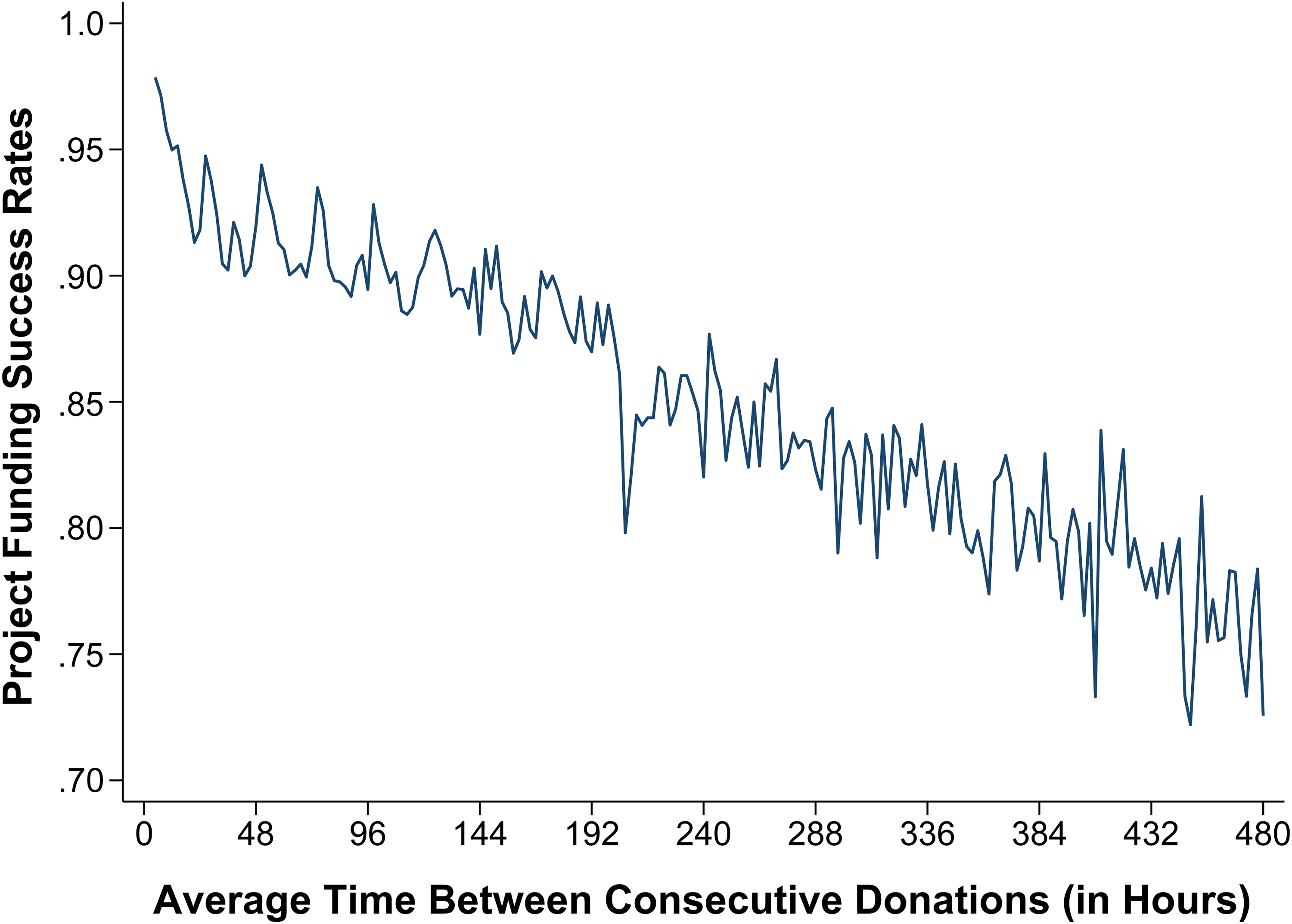
Average Time Interval Between Donations and Project Funding Success Rates.
At the project level, we study the impact of self-donation on fundraising outcomes and project impact. We use whether a project is fully funded as the key outcome metric. Following successful funding, a teacher's submission of an impact letter serves as a proxy measure for project impact (i.e., project quality). The primary independent variable is a binary indicator, termed “having self-donation,” denoting whether the teacher donated to their project. Additionally, when a teacher contributes to their own project, we consider self-donation characteristics: total number of teacher donations (frequency), time in hours from project start to the first self-donation (recency), and total self-donation amount, inspired by RFM (recency, frequency, monetary) analysis in database marketing (Fader, Hardie, and Lee 2005).
To control for other factors impacting outcomes, we include information at five levels:
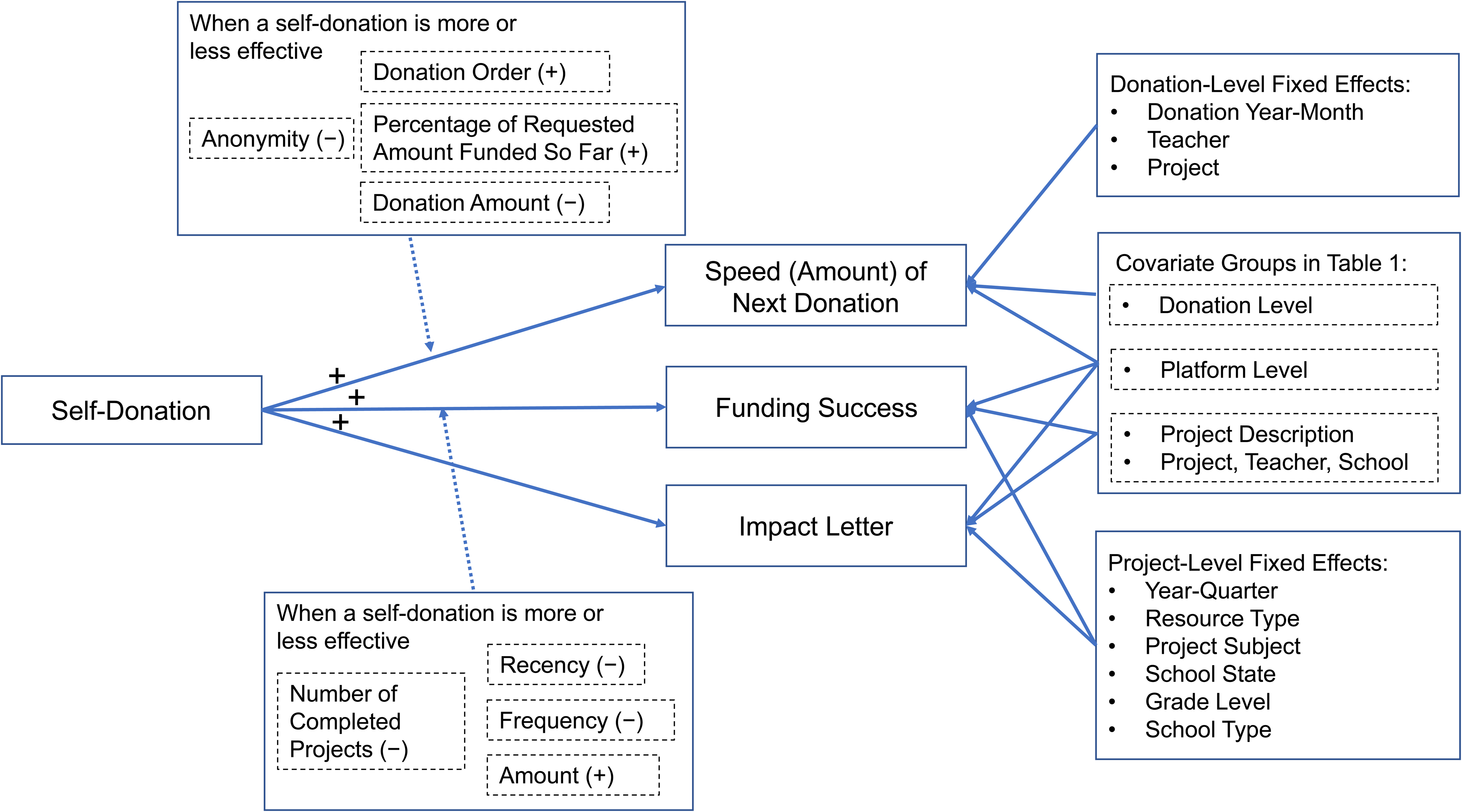
Table 1 provides the definitions and descriptive statistics for all variables.
Variable Definitions and Descriptive Statistics.
Empirical Analysis and Results
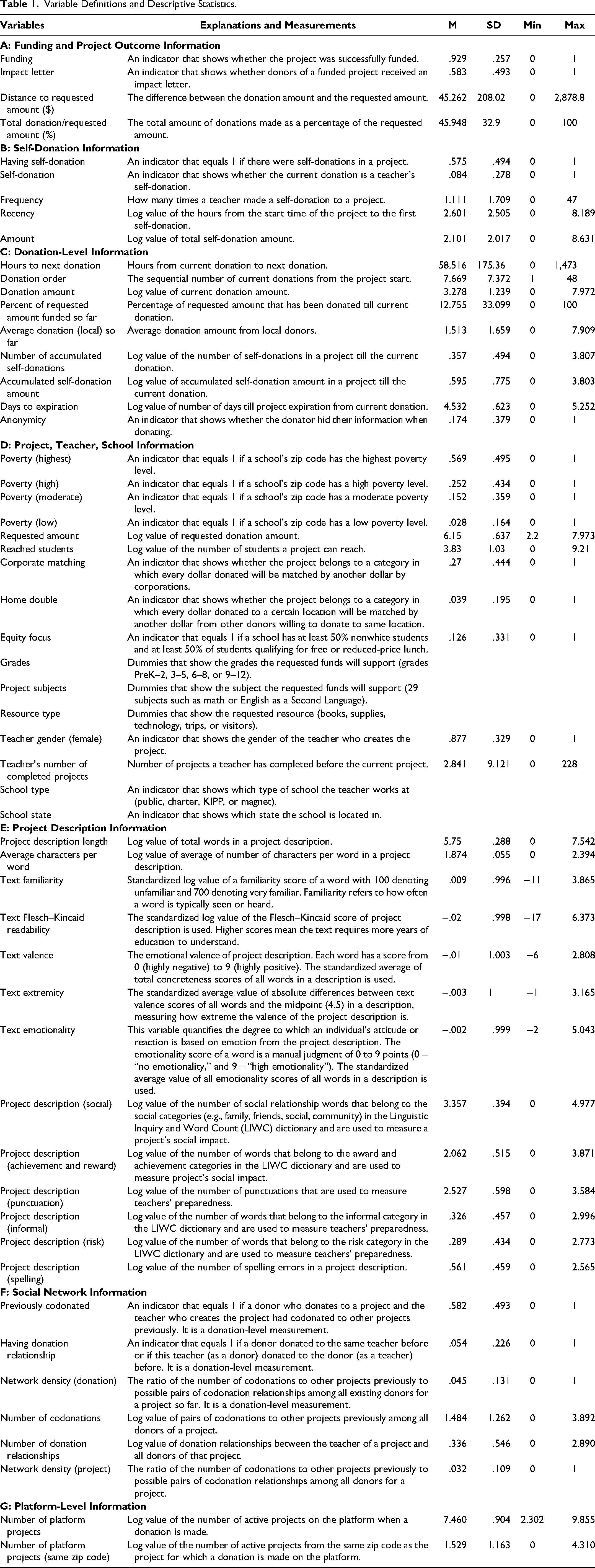
We first provide model-free evidence for our hypotheses and then use regression models to analyze the impact of self-donations at the donation and project levels. Figure 2 summarizes our roadmap. At the donation level, we investigate the effects of self-donations on the time interval to the next donation, exploring the mechanisms through empirical evidence and donation visibility analysis. To further support our proposed mechanism, we address alternative explanations, scrutinizing the effects of the order of a self-donation, amount, and percentage of the requested amount raised on the inflow of donations. We use the amount of next donation as an alternative dependent variable. At the project level, we examine the effects of self-donations on funding success and the moderating role of teacher experience, with results verified against alternative explanations. Additionally, we explore the impact of self-donation patterns (frequency, recency, and amount) on funding success and assess project quality via the availability of impact letters and other proxies.
Empirical Analysis Framework.
Model-Free Evidence
Figure 3 illustrates the impact of self-donation at both the donation and project levels. At the donation level, Figure 3, Panel A, shows that teacher self-donation generally shortens the time to the next donation, supporting H1a. Figure 3, Panel B, indicates that early stages, marked by considerable uncertainty, witness slower donations, but self-donations are more impactful in encouraging faster contributions, aligning with H1b.
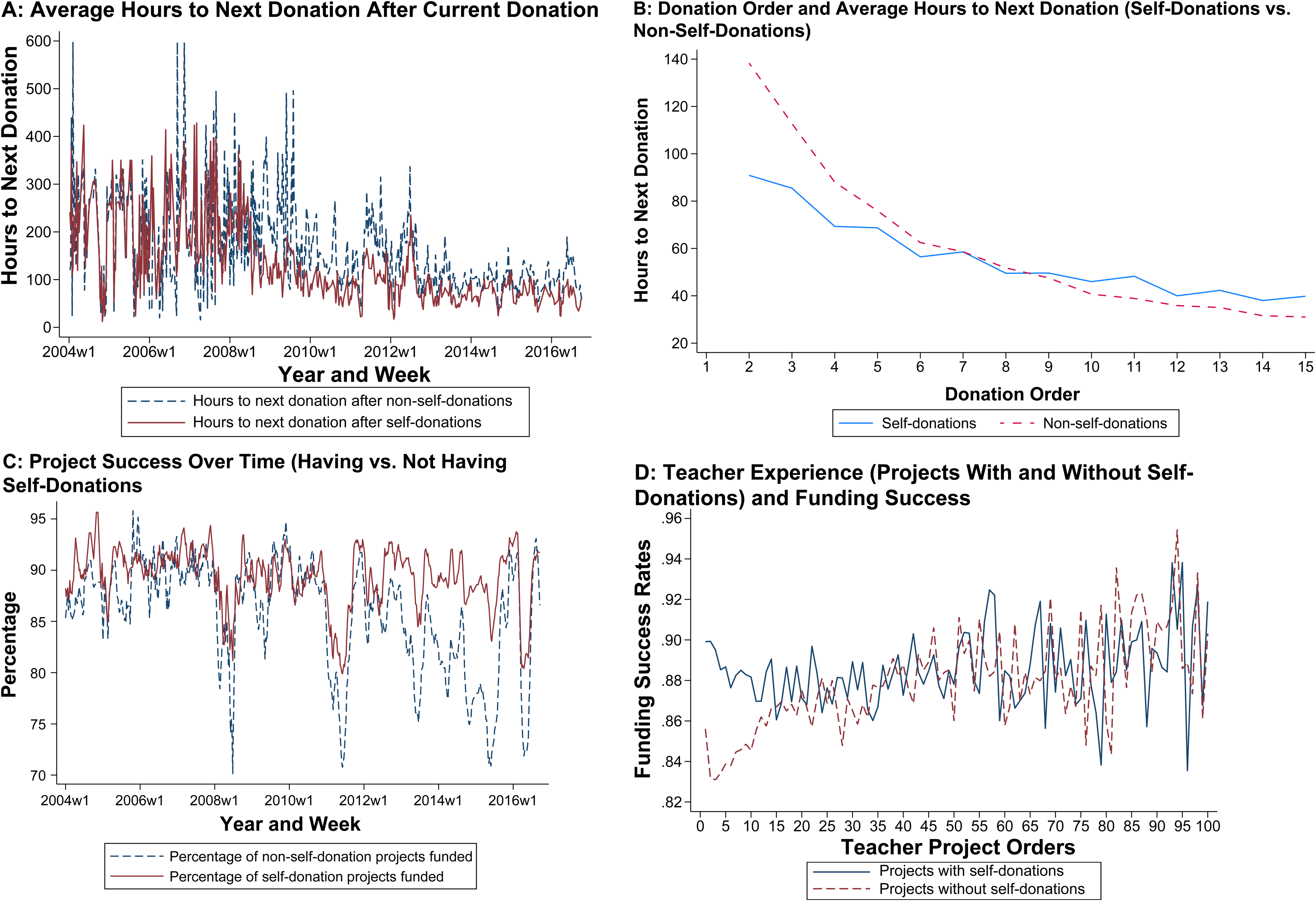
Impact of Self-Donations on Donation- and Project-Level Outcomes.
At the project level, Figure 3, Panel C, shows that projects with (any) self-donation have significantly higher funding success rates than those without. This effect is particularly evident in projects led by “inexperienced” stewards (i.e., those with fewer completed projects), as seen in Figure 3, Panel D. These patterns are consistent with H2a and H2b. Finally, teachers who self-donate are almost twice as likely to send impact letters as those who do not (.546 vs. .293, p < .01), supporting H2c.
While model-free evidence provides face validity to our hypotheses, formal tests are necessary to rigorously evaluate whether a teacher's self-donation signals a commitment to donors in the face of other alternative explanations.
Self-Donations and Donation-Level Effects
Identification assumption and validation
With 465,530 projects and about 3.15 million observations, 12 averaging 7 donations per project, many projects receive self-donations from their stewards at some point during their life cycle. In a sample of around 265,000 observations where the previous donation is a self-donation, we compare the time to the next donation with that of the remaining 2.88 million observations without self-donation. This enables us to assess the likelihood of nonsteward donors contributing sooner after encountering a self-donation. The model, with a project fixed effect, compares the time to a project’s next donation following a self-donation with the time to the project’s next donation after each of the other (average 6) non-self-donations observed for the project, with the effect then averaged across all projects.
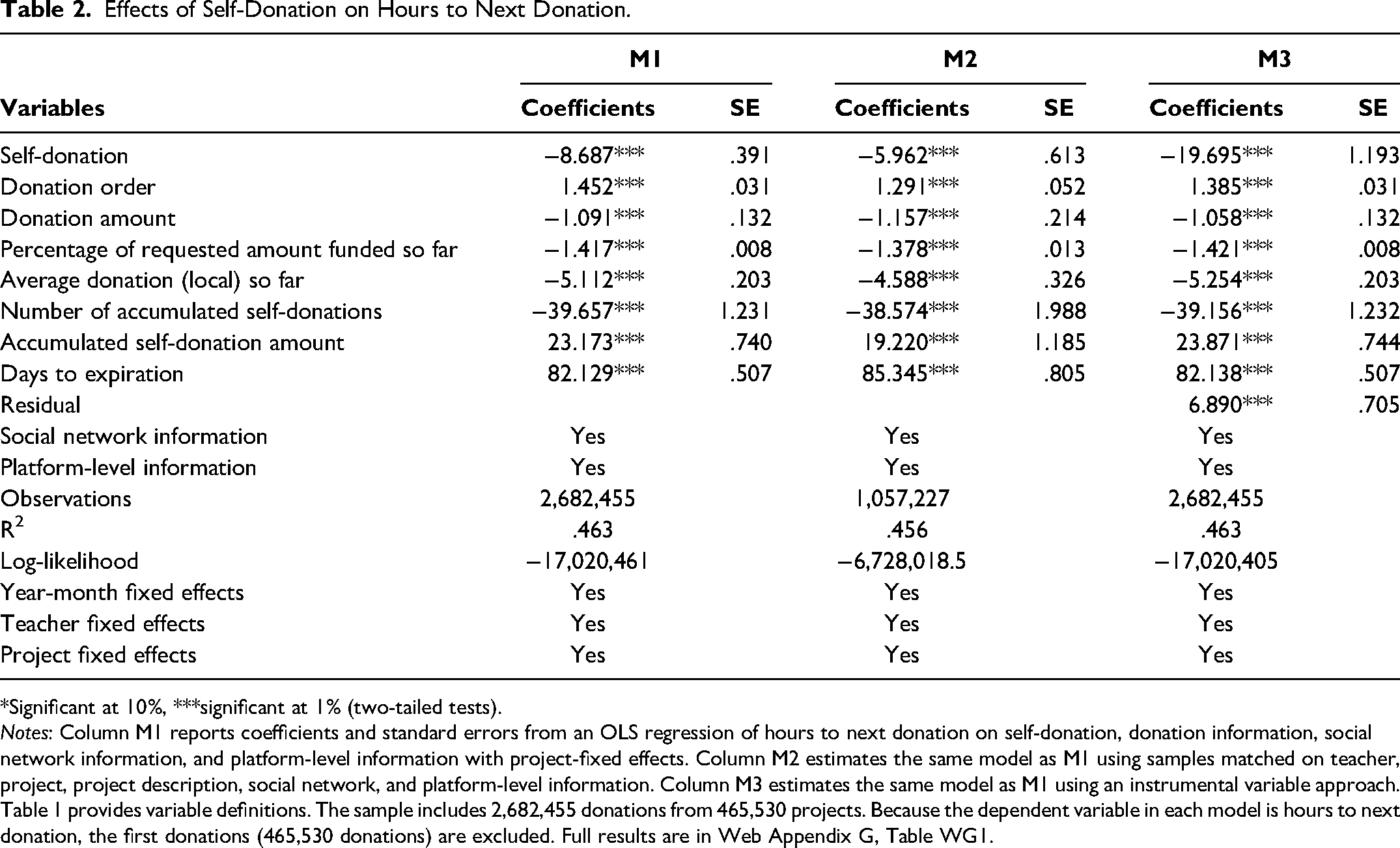
Effects of Self-Donation on Hours to Next Donation.
*Significant at 10%, ***significant at 1% (two-tailed tests).
Notes: Column M1 reports coefficients and standard errors from an OLS regression of hours to next donation on self-donation, donation information, social network information, and platform-level information with project-fixed effects. Column M2 estimates the same model as M1 using samples matched on teacher, project, project description, social network, and platform-level information. Column M3 estimates the same model as M1 using an instrumental variable approach. Table 1 provides variable definitions. The sample includes 2,682,455 donations from 465,530 projects. Because the dependent variable in each model is hours to next donation, the first donations (465,530 donations) are excluded. Full results are in Web Appendix G, Table WG1.
Our identifying assumption for the effect of self-donations is the randomness of donor arrivals. Under this assumption, given a previous donation, potential donors are randomly assigned to one of the two quasi-experimental groups: those observing a previous self-donation (treatment) and those encountering a non-self-donation (control). To verify this assumption of random donor arrival, we collect and analyze data from multiple sources (Google Trends, Similarweb, and Semrush) for web traffic to the focal website. We find no significant changes in traffic to the DonorsChoose website before and after each self-donation. This result supports the random arrival assumption. The details of this identification-related analysis are available in Web Appendix B-2. In addition, we address concerns about timing and unobservables influencing stewards’ self-donation and donor decisions by controlling for time-related factors (donation order, percentage of the requested amount funded so far, year-month fixed effects) and employing matching and instrumental variable approaches.
Main analysis
To examine the effects of self-donation, we regress the time interval to the next donation on whether the current donation is a self-donation while controlling for donation, project, teacher, social network, and platform-level information.
13
We estimate the following ordinary least squares (OLS) model with fixed effects for projects (and teachers):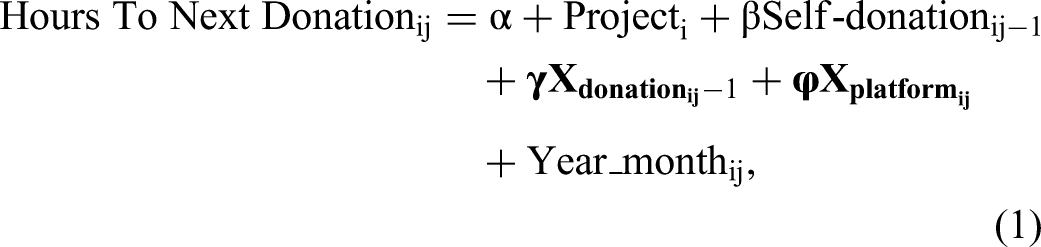
In addition to the main model (M1) based on Equation 1, we bolster the robustness of our findings through two additional analyses: (1) using a sample matched on teacher, school, project, project description, and platform information to address selection concerns (M2); and (2) implementing an instrumental variable approach to address endogeneity issues (M3). The propensity score matching approach (De Haan et al. 2018) in M2 is commonly used to address selection concerns such as ours, where teacher, project, and other differences could potentially drive self-donations. Technical details of the implementation are provided in Web Appendix C-1. M3 directly addresses the potential endogeneity of the self-donation variable by using the number of successful projects from other teachers in the same school with self-donations in the past three months as the instrumental variable. 14 We posit that this instrument is valid for the following reasons. First, teachers want their projects to succeed, and they are likely to follow the strategy of other successful projects from teachers with whom they may interact. Therefore, if teachers observe greater success in projects with self-donation within the same school, they become more likely to self-donate. Also, it seems unlikely that the behaviors of other teachers in their past projects will affect the current donors’ donation propensity to donate to the current project. This intuitive reasoning is supported by a series of empirical tests (see the full details in Web Appendix C-2).
Table 2 reports the results from all three analyses. Across all three models, the coefficients of self-donation are negative and statistically significant at the .01 level. Consistent with H1a, a self-donation significantly reduces the time interval for the next donation under the complete set of fixed effects (M1 in Table 2) (−8.687, p < .01). Given the average time to the next donation of about 58.52 hours, a self-donation, on average, reduces this time by about 15%, a nontrivial and economically significant improvement in donation speed.
Evidence for mechanism
As detailed in the “Theoretical Development” section, project stewards can credibly signal quality to donors through costly self-donations because donors, primarily driven by altruism, care for the social impact of their donations. Our empirical data support donors’ social impact (i.e., altruism) motive. For example, Figure WB3 in Web Appendix B shows a higher influx of contributions early in the funding cycle, contradicting the notion of a “warm glow” induced by the joy of completion, which would lead to more end-cycle donations. Moreover, our data reveal that nearly 80% of donations originate from outside the project's zip code, and over 47% of projects receive no local donations within their zip code. This undermines the assumption that local donors’ self-interest, driven by a desire to support their children's classes or local schools, drives donations.
To address concerns about unobserved factors influencing observed donation behavior, we exploit the visibility of self-donations on the DonorsChoose platform. Donors can make anonymous contributions, concealing their identities, but we possess information about whether an anonymous donation originates from a project steward. This enables us to test our signaling effect. In our data, approximately 13.88% of teachers who self-donate choose to remain anonymous, constituting about 20.49% of total self-donations. The variation in self-donation visibility (visible vs. anonymous) enables us to verify whether self-donations influence potential donors’ decisions. If donors perceive self-donations as a signal of quality, visible self-donations should more significantly expedite donations. Thus, the pace of contributions due to self-donations reported in Table 2 will be faster for visible self-donations (vs. for anonymous self-donations). 15
To verify this, we regress time intervals to the next donation from donors on whether the current donation is anonymous, if it is a self-donation, and their interaction, along with various controls used in M1 in Table 2. We cluster errors at the project level. The results, reported in Web Appendix C, Table WC8, show that anonymous self-donations largely neutralize the accelerating effects of self-donations (self-donation = −9.626, p < .01; anonymity × self-donation = 10.924, p < .01). This indicates that self-donations can expedite subsequent donations only when visible. Indeed, from the marginal effects summarized in the Web Appendix C, Table WC9, we observe no difference in the time to the next donation between anonymous self-donations and anonymous donations from other donors (p = .214). In contrast, visible self-donations lead to faster subsequent donations by an average of 9.626 hours (p < .01). Overall, the results in Web Appendix C-3 corroborate our central thesis on the signaling role of self-donations. 16 Additional analysis in Web Appendix C-3 suggests that the choice between visibility and anonymity is likely driven by personal characteristics rather than strategic motives, affirming the robustness of our findings.
Alternative explanations
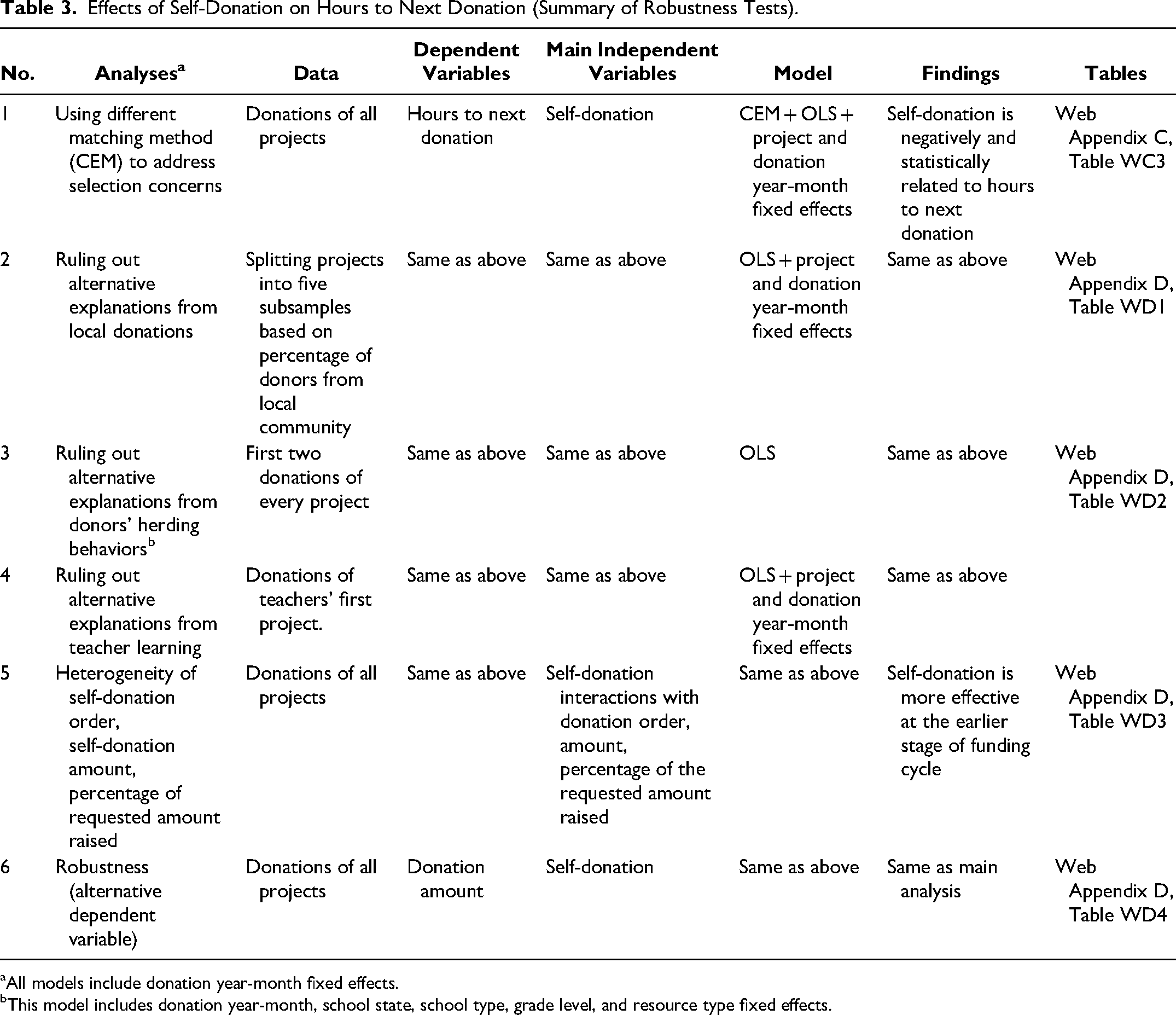
We conducted a series of analyses to rule out alternative explanations, summarized in Table 3 and detailed in Web Appendix D. First, we used coarsened exact matching (CEM) to create a different matched sample to verify the robustness of our matching procedure (Blackwell et al. 2009; Iacus, King, and Porro 2012). Second, we examined the influence of social pressure by including only projects with no local donations, addressing concerns about donors knowing the teacher personally. Third, we addressed the concerns about herding behavior in crowdfunding (Dai and Zhang 2019; Zhang and Liu 2012) by analyzing only the first two donations of each project. Finally, we investigated the potential confounding effects of teacher learning from previous crowdfunding experiences (Xu and Ni 2022) by focusing on donations from teachers’ first projects on DonorsChoose. Our analyses show that our results are robust to all these alternative specifications.
Effects of Self-Donation on Hours to Next Donation (Summary of Robustness Tests).
All models include donation year-month fixed effects.
This model includes donation year-month, school state, school type, grade level, and resource type fixed effects.
Heterogeneity analysis
Next, we examine the heterogeneous effects of order of self-donation, amount, and percentage of the requested amount raised on the inflow of donations. The results in Web Appendix D, Table WD3, show that the self-donation effects are more pronounced in the earlier stage (lower donation order and lower percentage of requested amount raised). This is consistent with H1b, indicating greater signaling influence in uncertain contexts, particularly in the early fundraising cycle. In addition, the signaling effect is stronger with higher self-donation cost (self-donation × donation amount = −8.897, p < .01), which supports H1a. We also find some evidence for herding behavior since the estimate of the percentage of the requested amount funded so far is negative and statistically significant (−1.451, p < .01), which we discussed briefly in the previous section.
Alternative dependent variable
In addition to using the time interval to the next donation as our primary dependent variable, we analyze donation-level data based on the amount received in the next donation (next donation amount). The results presented in Web Appendix D, Table WD4, mirror those in Table 2 but with this new dependent variable and show that self-donations not only expedite the next donation but also increase its amount.
Self-Donations and Fundraising Success
Main analysis
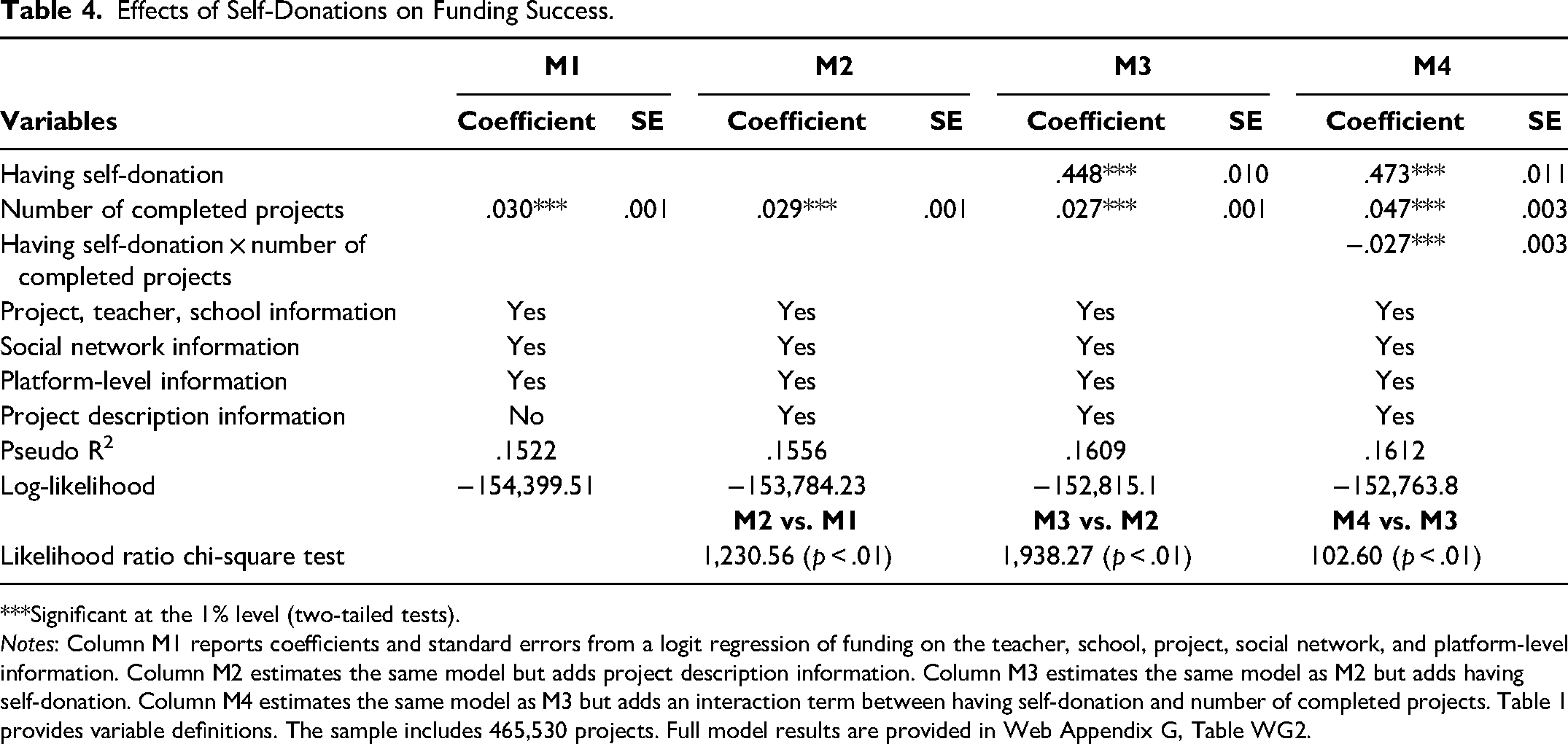
We assess the impact of self-donation on funding success using project-level data across three model specifications. We progressively include factors that influence donor decisions. The dependent variable, funding, is binary, and we control for time using project posting year and quarter (see Table 4). Model 1 (M1) controls for school features (e.g., poverty level, equity focus status, school type), teacher characteristics (i.e., the gender of the teacher and the number of projects the teacher has completed), social network (e.g., network density and codonation relationship between teachers and donors), and project information (e.g., matching donations, academic subjects, requested resource types, requested donation amount, and the number of students that the project is intended to reach) but excludes project description and self-donation information. Model 2 (M2) expands M1 to incorporate soft information from project descriptions, including basic text characteristics (e.g., length and the average characters per word), quantitative scores for linguistic styles (e.g., familiarity, concreteness, readability, valence, extremity, emotionality, and spelling errors), and texts indicating teachers’ preparedness and projects’ potential social impact. 17 Model 3 (M3) adds a dummy for teacher self-donation to examine its effect after controlling for social impact and teachers’ preparedness.
Effects of Self-Donations on Funding Success.
***Significant at the 1% level (two-tailed tests).
Notes: Column M1 reports coefficients and standard errors from a logit regression of funding on the teacher, school, project, social network, and platform-level information. Column M2 estimates the same model but adds project description information. Column M3 estimates the same model as M2 but adds having self-donation. Column M4 estimates the same model as M3 but adds an interaction term between having self-donation and number of completed projects. Table 1 provides variable definitions. The sample includes 465,530 projects. Full model results are provided in Web Appendix G, Table WG2.
Specifically, we ran the following logistic regression model:
Results on fundraising success
The results are presented in Table 4. In line with H2a, self-donation strongly increases the probability of funding success, as indicated by M3. In other words, projects with contributions from project stewards are more likely to meet their funding goals (.448, p < .01 in M3). The log-likelihood ratio test between M3 and M2 is statistically significant (χ2 = 1,938.27, p < .01), indicating the significance of self-donation in predicting funding success.
Furthermore, projects emphasizing social impact, as revealed by a higher number of words on rewards and achievements, have a higher likelihood of successful funding. Similarly, projects receiving matched donations from corporations or supporting schools in the highest-poverty zip codes and equity-focused projects are more likely to receive funding. These findings on the proxies for social impact provide additional evidence for donors’ motives driven by social impact considerations.
To further investigate who benefits most from self-donation, we analyze the role of teacher experience in fundraising at DonorsChoose. The theory suggests that signaling benefits arise in contexts of uncertainty about the signal sender's quality. If a teacher has a track record of successful fundraising, the uncertainty about the teacher’s ability and commitment to a project diminishes. We include an interaction term between the teacher's number of completed projects and having self-donation (M4 in Table 4) to test this. As predicted, the results reveal a positive and significant effect of the teacher's number of completed projects on fundraising success, indicating that experience matters and donors favor projects initiated by experienced teachers. However, more pertinent to our theory, the interaction between this variable and the self-donation indicator is negative and significant. This suggests that for a more experienced teacher, the signaling role of self-donation is attenuated, consistent with H2b.
As in the donation-level analysis, we perform robustness checks, including addressing selection concerns, social pressure, and teacher learning, and using alternative dependent variables (see Web Appendix E).
Role of self-donation frequency, recency, and amount
Given that a teacher could self-donate to the same project multiple times, we further examine how self-donation patterns, including frequency (the number of self-donations in a project), recency (hours elapsed from the project starting time to the first self-donation), and amount (the log-transformed total self-donation amount in a project), influence funding success. Our results, available in Web Appendix E-5, reveal that infrequent, higher-amount self-donations made early in the project fundraising process are more effective in securing funding, consistent with H2a and H2b. Therefore, given a fixed donation budget, project stewards can send the strongest signal and maximize the impact of self-donation on the funding success of their projects by making a single large self-donation right after posting the project. These findings are robust to the different versions of the dependent variable, as shown in Web Appendix E, Table WE5.
Are the Projects with Self-Donation of Higher Quality?
Our initial exploration finds a positive correlation between the presence of achievement and reward words in project descriptions, along with corporate matching—two potential indicators of greater project social impact—and self-donation (t = 42.105, p < .01, and t = 30.294, p < .01, respectively). However, direct testing of the effect of project quality is not feasible in our context as projects are not (ex post) rated. Instead, we explore indirect evidence through the behavior of sending impact letters, as discussed in detail in the “Theoretical Development” section (see an example of an impact letter in Web Appendix F). 18
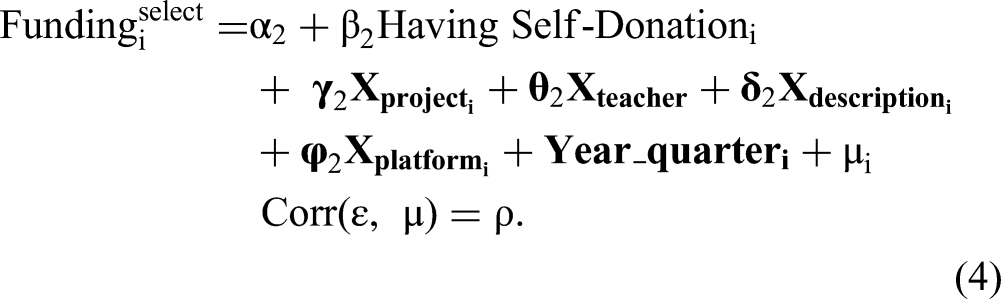
When testing this conjecture, selection bias is a concern due to the observation of impact letters solely for successful projects, which could potentially bias our estimates. We employ a heckprobit model to address this, correcting for nonrandom assignments (Greene 2012; Heckman 1976; Van de Ven and Van Praag 1981). Specifically, we estimate the following equations: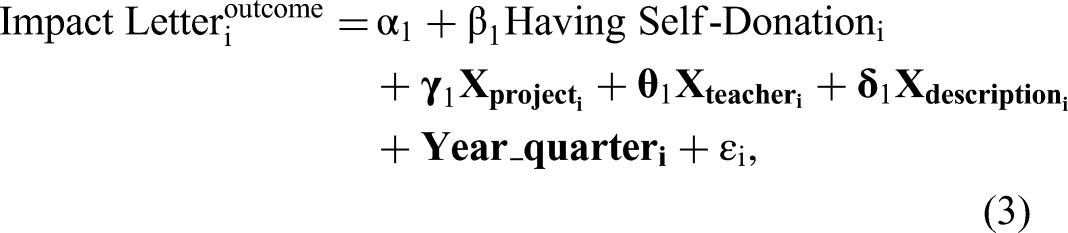
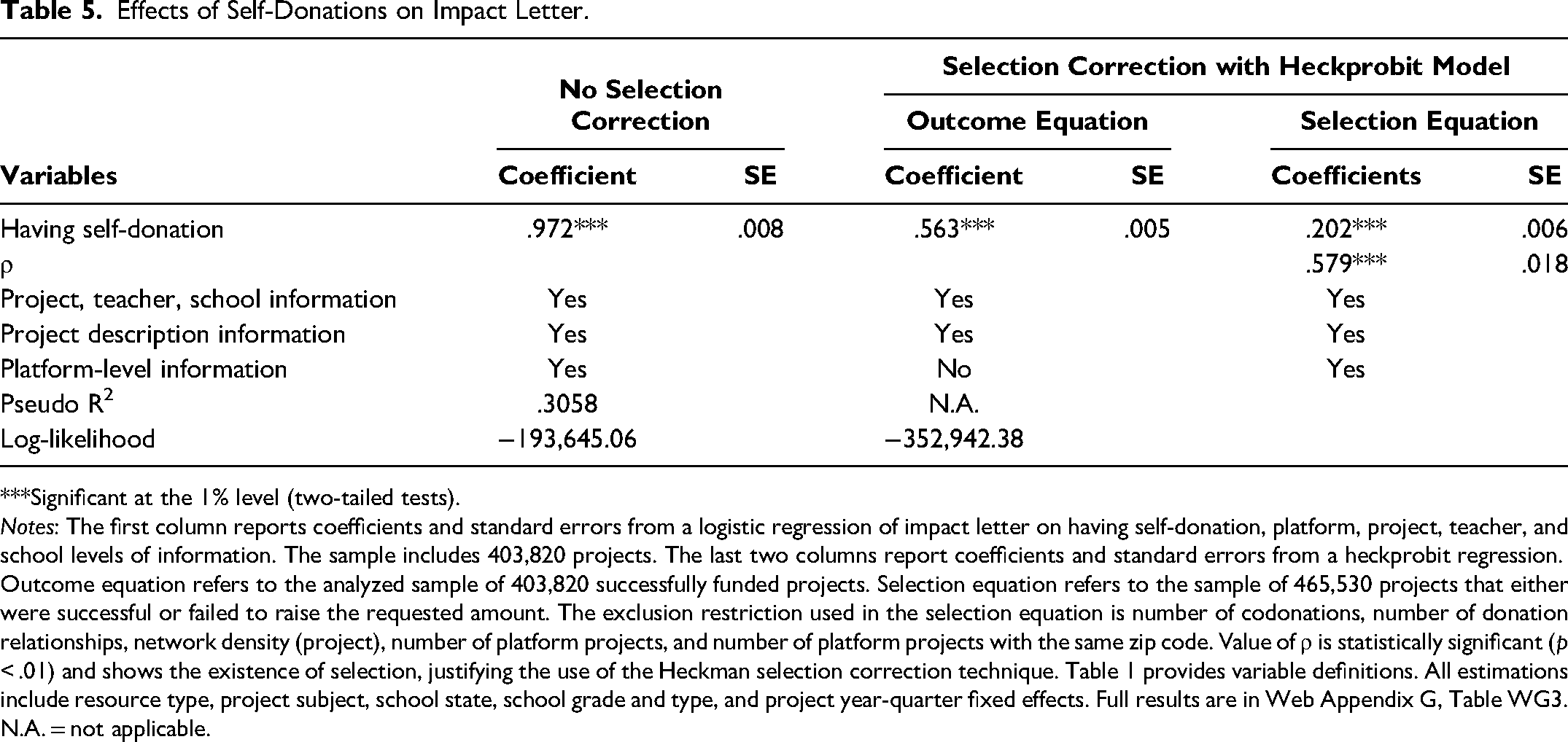
Effects of Self-Donations on Impact Letter.
***Significant at the 1% level (two-tailed tests).
Notes: The first column reports coefficients and standard errors from a logistic regression of impact letter on having self-donation, platform, project, teacher, and school levels of information. The sample includes 403,820 projects. The last two columns report coefficients and standard errors from a heckprobit regression. Outcome equation refers to the analyzed sample of 403,820 successfully funded projects. Selection equation refers to the sample of 465,530 projects that either were successful or failed to raise the requested amount. The exclusion restriction used in the selection equation is number of codonations, number of donation relationships, network density (project), number of platform projects, and number of platform projects with the same zip code. Value of ρ is statistically significant (p < .01) and shows the existence of selection, justifying the use of the Heckman selection correction technique. Table 1 provides variable definitions. All estimations include resource type, project subject, school state, school grade and type, and project year-quarter fixed effects. Full results are in Web Appendix G, Table WG3. N.A. = not applicable.
Concluding Remarks
The emergence of crowdfunding platforms presents an exciting novel opportunity for charities, particularly smaller ones without resources for traditional marketing. Yet, the low entry costs attract numerous projects competing for funds. Limited information about these projects and their stewards complicates the donors’ ability to identify high-quality projects. Consequently, while crowdfunding platforms make it easier for projects to access donor pools, they also make it harder for potential donors to identify quality projects aligned with their charitable objectives.
Theoretical Contributions
In this study, we theorize that a project could credibly signal quality via a strategy of self-donation—a project steward’s donation to their own project. By examining millions of donations on DonorsChoose, a leading charitable crowdfunding platform for K–12 public schools, we find that self-donations accelerate the pace of donations and increase the donation amounts from other donors, leading to greater fundraising success. Thus, our research contributes to the signaling literature by establishing self-donation as a novel signaling mechanism in crowdfunding. We also find that the positive effects of self-donations on other donors are amplified in earlier project stages. This article further joins recent efforts to empirically validate signaling mechanisms, which are crucial for understanding various marketing policies (like warranties and money burning via advertising). However, empirical studies validating the signaling role of these policies remain somewhat scarce. Our research provides robust empirical evidence for a new signaling practice with significant fundraising implications for nonprofit organizations.
Our study also has important implications for crowdfunding research. Enhancing funding success is a central theme across all major types of crowdfunding (i.e., debt-, donation-, equity-, and reward-based crowdfunding). While many studies focus on static factors determined before the fundraising process, such as gender (Munz, Jung, and Alter 2020), locations (Lin and Viswanathan 2016), reward structure (Shi 2018), price (Meer 2014), and text descriptions (Netzer, Lemaire, and Herzenstein 2019), recent research is shifting toward dynamic factors available during the fundraising process. For example, herding (Fan, Gao, and Steinhart 2020) has been identified as influencing individual decisions. Our study complements this line of inquiry by showing that stewards’ individual self-donation decisions can be an effective fundraising tool, especially under high uncertainty. This has not been documented in the existing literature.
Our study also contributes to the literature on charity fundraising, which primarily focuses on the fundraising efforts of charity organizations with reputation capital. Such efforts are less applicable in contexts where fundraisers are unknown individuals or small charities facing substantial quality uncertainty. Our study enriches this line of research by showing how individuals can gain donor trust through their actions without massive spending. Our findings complement research on online fundraising, which highlights the roles of online social networks, storytelling, and transparency in influencing donation behavior (Adena and Huck 2020; Robiady, Windasari, and Nita 2021).
Finally, this research has connections to the leadership literature (e.g., Brimhall 2019) by showing that self-donation, a public act of self-sacrifice, can credibly convey project quality. Unlike prior studies relying on survey data prone to self-serving biases, our empirical tests examine actual donation behavior, offering robust evidence for our proposed mechanism. Our findings shed light on exemplary behaviors used in many business contexts, illuminating how self-sacrificial actions may inspire others.
Managerial Implications
Our study provides direct managerial implications for both online and offline charity fundraising. Our findings suggest that individuals raising funds, such as teachers on platforms like DonorsChoose or charity fundraisers, should put their “skin in the game” and make donations to their projects to signal project quality effectively. The visibility of these self-donations is crucial for our proposed signaling mechanism to work, cautioning against “selflessly” making anonymous self-donations. Fundraisers should also be aware that the effect of self-donations will weaken as they gain more experience and reputation capital. In addition, the frequency, recency, and amount of self-donations should be carefully planned to maximize their impact on fundraising success. Ideally, a single self-donation at the project's outset can optimize its funding prospects, given the fundraiser's budget constraints.
Our findings also have implications for online fundraising platforms such as DonorsChoose, GoFundMe, Kiva, Indiegogo, and others. When project stewards do not directly benefit from the donations collected, such as fundraising for humanitarian causes, platforms should allow self-donations. This enables donors to identify high-quality projects, improving the matching efficiency of the platforms. When recommending projects to donors, platforms should also consider project stewards’ self-donation behavior. In addition, platforms may highlight project self-donations on the project landing page and encourage self-donations during the donation process to increase the project funding rate. While some platforms, like Indiegogo, prohibit self-donations due to concerns about misleading funding success, our research suggests that well-managed early-stage self-contributions can facilitate platform transactions.
The implications of our findings extend beyond charitable contexts. For example, managers can motivate employees by emphasizing “self-sacrifice,” such as dedicating significant time to a project in a shared workspace, to complement traditional tools like individual incentives. Executives can show confidence in their companies by purchasing stocks voluntarily. Political candidates can influence voters by self-funding part of their campaigns. Similarly, companies can enhance consumer perceptions by making monetary pledges, like donating a portion of revenues or profits to charity.
Limitations and Future Research
One limitation of our study is the absence of a direct measure of project quality. Instead, we use impact letters and project characteristics as imperfect proxies. However, this challenge is common in any empirical signaling research, where direct measures are typically lacking due to the very nature of unobserved quality. In addition, project stewards may have nonaltruistic motives, as early or generous self-donations can enhance perceived prestige, especially within a crowdfunding setting. Comparisons with peers in the same school or locality may also influence prestige. Furthermore, project success may have downstream positive career growth implications.
Last, our finding comes from a relatively simple context where fundraisers do not directly receive raised funds (i.e., DonorsChoose purchases requested materials specified in projects and sends them directly to teachers’ schools; teachers have no access to raised funds). The effects of self-donation may vary in more complex contexts where funds go directly to fundraisers, potentially raising concerns about moral hazard. Future research examining the impact of self-donations in other contexts can extend our theory. Future research may also study the dynamic interactions among donors during the donation process.
Supplemental Material
sj-pdf-1-jmx-10.1177_00222429241260687 - Supplemental material for Self-Donations and Charitable Contributions in Online Crowdfunding: An Empirical Analysis
Supplemental material, sj-pdf-1-jmx-10.1177_00222429241260687 for Self-Donations and Charitable Contributions in Online Crowdfunding: An Empirical Analysis by Zhuping Liu, Qiang Gao and Raghunath Singh Rao in Journal of Marketing
Footnotes
Acknowledgments
The authors would like to thank the JM review team for their constructive comments and clear guidance throughout the review process. The authors also thank Rex Du and Mahima Hada for their helpful comments and suggestions. In addition, the authors thank participants of the 2024 Production and Operations Management Society Annual Conference in Minneapolis for their valuable feedback.
Coeditor
Vanitha Swaminathan
Associate Editor
Pradeep Chintagunta
Declaration of Conflicting Interests
The author(s) declared no potential conflicts of interest with respect to the research, authorship, and/or publication of this article.
Funding
The author(s) received no financial support for the research, authorship, and/or publication of this article.

Notes
References
Supplementary Material
Please find the following supplemental material available below.
For Open Access articles published under a Creative Commons License, all supplemental material carries the same license as the article it is associated with.
For non-Open Access articles published, all supplemental material carries a non-exclusive license, and permission requests for re-use of supplemental material or any part of supplemental material shall be sent directly to the copyright owner as specified in the copyright notice associated with the article.
