



Abstract
Drawing from the concept of anemoia, the authors propose a new typology of nostalgia called vintage anemoia. Vintage anemoia encompasses consumers’ positive and nostalgic response to vintage cues, regardless of specific historical periods or individual lived experiences. Through a series of seven studies, the authors demonstrate that vintage typography, by evoking feelings of vintage anemoia, can enhance consumer perceptions of product safety. This effect has positive downstream consequences on key marketing outcomes, including brand attitude, purchase intention, and willingness to pay. Furthermore, the effect of vintage anemoia on product safety perceptions remains unaffected by whether product safety information indicates that a product is safe or unsafe. However, the effect diminishes when an explicit indexical cue (year of establishment) is utilized or when promoting futuristic products. The findings contribute to the existing body of knowledge in marketing and provide insights for marketers on leveraging vintage typography as a strategic tool for creating emotional connections with consumers and enhancing perceptions of product safety.
The use of nostalgia in marketing has become a prominent strategy employed by brands to elicit positive connections with the past and drive consumer response (Singh, Sharma, and Kumar 2021). This approach often takes the form of retro-marketing or retro-branding (Brown, Kozinets, and Sherry 2003), which involves revitalizing old marketing communications (e.g., jingles, brand logos, packaging) and seamlessly integrating them into contemporary contexts (Lasaleta and Loveland 2019; Pascal, Sprott, and Muehling 2002; Singh, Sharma, and Kumar 2021). Typography holds semantic meaning and symbolic associations that shape brand meaning, consumer brand memory, and perceptions (e.g., Celhay, Boysselle, and Cohen 2015; Hagtvedt 2011; McCarthy and Mothersbaugh 2002). While vintage products evoke positive consumer response through nostalgia (e.g., Keim and Wagner 2018), the potential of vintage typographical cues to induce nostalgia has only been suggested by scholars (e.g., Orth and Gal 2014).
The motivation for this study stems from recognizing the inherent potential of vintage typography in establishing associations with the past and invoking a sense of nostalgia through typographic symbolism. Existing typologies of nostalgia, such as personal (e.g., Stern 1992) and vicarious (e.g., Goulding 2001) forms, do not fully capture the consumer response to vintage cues. Drawing from the concept of anemoia (Koenig 2021), which refers to nostalgia for a time one has never experienced, we introduce “vintage anemoia,” a unique type of vicarious nostalgia, to describe consumers’ emotional connection to the past and appreciation for the aesthetics, fashion, styles, design, and cultural elements associated with vintage cues, irrespective of a specific historical period or individual lived experiences.
We explore the impact of vintage typography and vintage anemoia on consumer product safety perceptions. Links to the past have been associated with quality and craftmanship, as well as times when things were safer and more understandable (e.g., vintage goods; Barauskaitė, Gineikienė, and Fennis 2022; Sarial-Abi et al. 2017; Thompson, Pollio, and Locander 1994). Further, nostalgia serves as a regulatory resource that activates safety cues, providing the same physiological and calming response that makes people feel safe (e.g., Fleury et al. 2022; Sedikides and Wildschut 2018). Threats to safety can induce nostalgic responses, as well as provide a protective effect against negative situations (e.g., Brown, Kozinets, and Sherry 2003; Stern 1992). We propose that using vintage typography in marketing materials, by evoking feelings of vintage anemoia, can activate safety cues and increase perceptions of product safety.
We explored the effects of vintage typography and vintage anemoia on consumer product safety perceptions in seven studies, including one contextual field study. Results confirm that the influence of vintage typography (vs. control) on product safety perceptions and subsequent positive downstream consequences is explained by vintage anemoia. The effect manifested regardless of product safety information provided; however, it diminished when an explicit indexical cue was provided and when a futuristic product was promoted.
Overall, we seek to advance the understanding of the role of typography in marketing, specifically examining the implications of vintage typography and its potential to evoke emotional connections to the past and influence brand inferences. By introducing vintage anemoia, we aim to provide insights into the nostalgic appeal of vintage aesthetics. We seek to contribute to the existing body of knowledge in marketing and provide insights for marketers on leveraging vintage typography as a strategic tool for creating emotional connections and enhancing perceptions of product safety.
Conceptual Development and Hypotheses
Typography is one of the most important brand elements (Lelis et al. 2022). While the terms “typography,” “typeface,” and “font” are often used interchangeably (Cullen 2012), they refer to different elements of the visual representation of text. Typeface refers to a visually distinct type form (e.g., Arial), which can have multiple fonts representing variations in size and style (e.g., Arial Black 10 pt.). Typography encompasses both typeface and font, but also the visual arrangement, shaping, spacing, structure, and overall appearance of text to communicate meaning (e.g., Lelis et al. 2022; McCarthy and Mothersbaugh 2002).
We present an overview of empirical research examining the impact of typographic characteristics on semantic meaning in Table 1. This review consolidates typographic studies focusing on inferential outcomes and expands on the previous review by Schroll, Schnurr, and Grewal (2018) to include research conducted since 2015. This review emphasizes that typography carries a deeper significance beyond the direct interpretation of words, allowing brands to communicate implicit messages through symbolic associations.
Overview of Empirical Research on the Impact of Typographic Characteristics on Semantic Meaning: A Comprehensive Review from 2015 to the Present.

Vintage
“Vintage” represents a state of the past that cannot be replicated with modern products (Schibik, Strutton, and Thompson 2022). The term originates in winemaking and the French word “vendange,” referencing a wine's year and origin (Sarial-Abi et al. 2017; Schibik, Strutton, and Thompson 2022). Obtaining a comprehensive etymology of the term, however, is challenging (Niemeyer 2015). Vintage can refer to a period of manufacture, objects from the same era, or something of enduring interest and quality, particularly from a specific time (Cambridge n.d.; Collins n.d.; Merriam-Webster n.d.). Initially emphasizing quality and functionality, vintage now includes aesthetic appreciation and nostalgia (Niemeyer 2015).
In marketing, vintage products are described as objects from the past or preowned items from earlier eras, creating meaning for consumers through their historical associations (Lasaleta and Loveland 2019; Sarial-Abi et al. 2017). In fashion, vintage refers to items produced or worn during a specific period (Keim and Wagner 2018). Vintage is distinct from retro (new objects that reference the past or imitations of past styles; Lasaleta and Loveland 2019) and neo-retro, which reinterpret past styles with new elements (e.g., Brown, Kozinets, and Sherry 2003). In this article, vintage is conceptualized as “an object with characterizable features produced in a past, identifiable time of origin, or period.”
The definition of vintage typography lacks conceptual clarity but is often characterized by design styles of the late 19th and early 20th centuries. Celhay, Magnier, and Schoormans (2020) suggest that vintage typography refers to well-defined styles from the past, such as Art Deco or Art Nouveau. In contemporary understanding, vintage typography encompasses various eras and design styles, reflecting economic, cultural, and social history (Fussell 2020; Müller and Wiedemann 2017). We define vintage typography as typefaces with characterizable features produced in a past, identifiable time of origin.
Nostalgia and Vintage Anemoia
Research has established a strong association between vintage items and nostalgia (e.g., Brown, Kozinets, and Sherry 2003). Nostalgia, defined as a positive inclination toward the past (see Davis 1979; Holbrook and Schindler 1991), is closely intertwined with vintage items due to their existence in a bygone era (Sihvonen and Turunen 2016). Nostalgia, however, is conceptualized in various forms, including personal nostalgia (e.g., Stern 1992) and ad-evoked nostalgia (Pascal, Sprott, and Muehling 2002), which both rely on reflections of one's own experiences. Other forms describe nostalgia as an individual's learned emotion (Duffy, Hewer, and Wilson 2012) and include vicarious (e.g., Goulding 2001), communal (e.g., Davis 1979), historical (Stern 1992), and collective nostalgia (Baker and Kennedy 1994). Vicarious forms of nostalgia are associated with someone else's past (Wildschut et al. 2006), manifest from the shared and constructed memory of historical and societal events (Halbwachs 1950), and often triggered by stories or media that create a sense of continuity or belonging across generations (Sedikides and Wildschut 2018).
Both personal and vicarious nostalgia can be evoked by brands and marketing stimuli. Personal nostalgia can be associated with brands from an individual's own past, whereas vicarious nostalgia is learned from communities that have collectively experienced and shared those brands (Brown, Kozinets, and Sherry 2003; Pascal, Sprott, and Muehling 2002). The ability of nostalgic stimuli to evoke different types of nostalgia is argued to be influenced by their imagery and symbolism (Srivastava et al. 2023; Stern 1992).
Vintage items produce a connection to the past and possess a history predating the consumer's acquisition (Sarial-Abi et al. 2017). In fashion, nostalgia drives the purchase of vintage items (Duffy, Hewer, and Wilson 2012; Keim and Wagner 2018). Consumers without firsthand experience of an era may develop a sense of nostalgia toward such fashion, styles, or designs due to idealized or romanticized depictions of the past. We propose that this response is distinct from existing typologies of nostalgia, not reliant on reflections of one's own experience (such as personal nostalgia [Stern 1992] or ad-evoked nostalgia [Pascal, Sprott, and Muehling 2002]). Further, it does not draw on historical or collective memory (e.g., Baker and Kennedy 1994; Davis 1979), someone else's past (Wildschut et al. 2006), or stories and media to create continuity or belonging across generations (Sedikides and Wildschut 2018).
We propose that consumers can experience nostalgic feelings when exposed to vintage cues that represent a previous era's design and aesthetic. “Anemoia” (n., /an-uh-moya/), a term coined by Koenig (2021), is defined as nostalgia for a time one has never personally experienced. This term lays the foundation for a concept we introduce, “vintage anemoia,” which underscores how consumers can experience nostalgic sentiments when exposed to vintage cues that embody the design and aesthetics of past eras they personally have not experienced. Vintage anemoia describes a consumer's nostalgic response to vintage cues, irrespective of the specific historical period they reference or an individual's own lived experiences. It signifies a unique type of vicarious nostalgia marked by an emotional connection to the aesthetics, fashion, styles, design, and cultural elements of past eras. We posit that, through observing vintage cues, such as the distinctive elements of vintage typography, individuals not only experience associations with the past (see Schibik, Strutton, and Thompson 2022) but also develop a nostalgic appreciation for the romanticized and idealized aspects of this past. This appreciation stems from the emotions elicited by these vintage cues, rather than a direct connection to the specific historical context, thereby distinguishing vintage anemoia from traditional forms of personal or vicarious nostalgia (see Table 2).
Distinguishing Vintage Anemoia from Personal and Vicarious Forms of Nostalgia.

Vintage Anemoia and Product Safety
Nostalgia is connected to perceptions of safety, and a sense of security (e.g., Barauskaitė, Gineikienė, and Fennis 2022; Han and Newman 2022). When anxious or uncertain, people often turn to past experiences, or the past itself, to seek comfort and solace through nostalgia (Brown, Kozinets, and Sherry 2003; Pascal, Sprott, and Muehling 2002; Stern 1992). Nostalgia, as a psychological response, elicits comforting feelings associated with cozy, familiar, and safe times (Barauskaitė, Gineikienė, and Fennis 2022). Nostalgia not only triggers positive emotions but also activates safety cues, acting as a regulatory resource that enhances feelings of safety (Fleury et al. 2022). This calming physiological and emotional response is consistent with feeling safe (Sedikides and Wildschut 2018).
We propose that the connection between nostalgia, positive emotions, the activation of safety cues, and feelings of comfort and safety can reduce the perceived risk associated with product evaluation. That is, consumers experiencing vintage anemoia, brought about by the use of vintage typography in marketing materials, will perceive a product as safer. First, vintage anemoia is likely to generate positive emotions (Fleury et al. 2022). When consumers experience positive emotions while encountering a product, they are more likely to associate those positive feelings with the product itself (Griskevicius, Shiota, and Nowlis 2010) and, as a result, provide a more favorable safety evaluation. Second, vintage anemoia, as a form of nostalgia, activates safety cues (Fleury et al. 2022). These activated safety cues will become associated with the product (through associative priming, as outlined in associative network theory; Collins and Loftus 1975), leading to heightened perceptions of product safety. Last, consumers experiencing vintage anemoia will feel safe (Sedikides and Wildschut 2018) and have an increased sense of security (e.g., Lasaleta and Loveland 2019; Sarial-Abi et al. 2017; Thompson, Pollio, and Locander 1994). Therefore, they are less likely to perceive any risk associated with the product, further enhancing their safety perceptions. We propose:
Downstream Consequences of Vintage Typographic Symbolism
Typographic symbolism, the effect of typographic features on semantic associations, influences consumer attitudes and perceptions (McCarthy and Mothersbaugh 2002). For example, thin fonts create perceptions of product healthiness, in turn increasing downstream attitudinal judgments such as purchase intention (Karnal et al. 2016). Brand cues produce semantic associations and influence brand perceptions such as recall (Childers and Jass 2002) and brand attitudes (Pan and Schmitt 1996). For example, reductions in product safety perceptions reduce brand attitudes when text is spaciously arranged in a text logo (Gupta and Hagtvedt 2021). We propose that vintage typography, and in turn product safety perceptions through vintage anemoia, will lead to positive downstream brand consequences, specifically:
Product Safety Information
Symbolic associations and emotional responses can significantly impact consumer perceptions of products and brands, regardless of their inherent attributes (Fajardo, Zhang, and Tsiros 2016). We posit that vintage cues, in conjunction with vintage anemoia, play a pivotal role in influencing perceptions of product safety. However, it is important to investigate whether these cues and nostalgic feelings can continue to shape product safety perceptions, even when consumers possess explicit knowledge that a product could be unsafe.
Often regarded as a positive psychological response (e.g., Holbrook 1993), nostalgia emerges in response to adverse circumstances (e.g., adverse weather [Van Tilburg, Sedikides, and Wildschut 2018]; physiological threat [Barauskaitė, Gineikienė, and Fennis 2022; Xia, Wang, and Santana 2021]) and is relied on in response to adverse circumstances (Sedikides and Wildschut 2018). Nostalgia serves as a protective mechanism in response to various threats such as existential concerns, discomfort, and distress (e.g., Barauskaitė, Gineikienė, and Fennis 2022; Brown, Kozinets, and Sherry 2003; Han and Newman 2022; Lasaleta and Loveland 2019; Routledge et al. 2011; Sarial-Abi et al. 2017; Stern 1992). These findings suggest that nostalgia (vintage anemoia) may also be effective in mitigating the perceived harmful effects of an unsafe product.
Nostalgia activates safety cues and induces a sense of safety, characterized by a calming physiological and emotional response (Fleury et al. 2022; Sedikides and Wildschut 2018), and safety signals can reduce stress responses (Brosschot, Verkuil, and Thayer 2018). Therefore, perceptions of product safety, elicited by vintage anemoia, may have the potential to override immediate reactions to information that suggests a product is unsafe. This argument is further supported by research demonstrating that individuals tend to respond less defensively when nostalgic (Sedikides and Wildschut 2018). We hypothesize:
The Moderating Role of Indexical Cues
Indexicality encompasses cues that establish factual or spatiotemporal connections between an object and its context (Grayson and Martinec 2004). Marketers employ indexical cues to signal authenticity (De Kerviler, Heuvinck, and Gentina 2022), with the direct link between these cues and products or brands being crucial for successful advertising (Beverland, Lindgreen, and Vink 2008). Further, nostalgic brand packaging using indexical cues to establish a genuine historical connection to the past can reduce perceptions of persuasive intent (Orth and Gal 2014).
Advertising employing indirect indexical cues, such as images, colors, font, and typesetting, reinforces authenticity, whereas more explicit cues (e.g., “Born Authentic” for Wrangler) weaken authenticity claims (Beverland, Lindgreen, and Vink 2008). We focus on demonstrating that vintage typography, as an indirect indexical cue, elicits vintage anemoia. Therefore, it is important to understand the interaction between vintage typography and other indexical cues.
A brand's year of establishment, functioning as an explicit indexical cue, has been shown to signify a brand's heritage, positively influencing consumer brand attitudes (Orth and Gal 2014; Pizzi and Scarpi 2019). Our argument centers on the inclusion of the year of establishment in advertisements, whether historical (e.g., 1920) or modern (e.g., 2020), and its impact when lacking other contextual cues indicating the product's historical origin. First, employing vintage typography alone does not establish a direct factual or spatiotemporal link with the product's origin, and vintage anemoia arises through an aesthetic connection to the vintage typography regardless of a specific historical period or individual lived experiences. Providing an objective and explicit index cue, such as the year of establishment, associates the product with a specific time period, thereby diluting vintage anemoia. In other words, consumers will experience dissonance between the typography's nostalgic connotations and the actual temporal context, hindering vintage anemoia.
Second, indexical authenticity relies on a believable connection between a product and its historical or cultural context (Grayson and Martinec 2004). A brand's establishment year lacks indexical value unless accompanied by other cues (such as imagery or colors) signaling a connection to that year. Thus, merely stating a brand's year of establishment, in isolation, fails to establish a factual and spatiotemporal link between the product and that specific year when other cues in the advertisement do not align with that year. Without additional contextual cues or a verifiable connection between vintage typography and a specific establishment year, the authenticity of the brand's historical claims may be questioned. This can lead consumers to perceive the vintage aesthetics as superficial (Beverland, Lindgreen, and Vink 2008; Orth and Gal 2014), rather than as a genuine representation of the brand's heritage, ultimately hindering the positive impact of vintage typography on evoking vintage anemoia. Formally, we hypothesize:
The Moderating Role of Product Category
Our theory of vintage anemoia suggests that people experience a positive and nostalgic response to vintage cues, irrespective of reference period and lived experience. Central to this theory is a nostalgic appreciation for the aesthetics, fashion, styles, design, and cultural elements of the past. Previous studies have shown that product category, and associated product characteristics, can influence consumer response (e.g., Kushwaha and Shankar 2013; Yadav and Varadarajan 2005). Additionally, congruency between typeface and product is crucial to generate connotative meaning (Doyle and Bottomley 2006). Given that vintage anemoia relies on a nostalgic appreciation for vintage aesthetics of the past, we propose that the presence of futuristic products, such as self-driving cars, will shift consumers’ focus toward the future, inhibiting the nostalgic response to vintage cues; thus:
Empirical Overview
Figure 1 provides an overview of our research with seven studies. Study 1 aims to establish a connection between vintage typography and an increased perception of safety. Study 2a explores vintage anemoia's role in consumer response to vintage typography and product safety judgments. Study 2b examines halo effects on perceptions of product tastiness and innovativeness. Study 3 investigates broader marketing implications: brand attitudes, purchase intent, and willingness to pay. Study 4 shows the positive effect of vintage typography on product safety perception, regardless of safety information. Study 5 explores the influence of explicit indexical cues on vintage anemoia, while Study 6 reveals vintage typography's ineffectiveness for futuristic products. Vintage typography is operationalized across all studies as typeface with characterizable design features from the Victorian, Art Nouveau, Art Deco, and Bauhaus eras.

Conceptual Framework: The Influence of Vintage Typography on Product Safety.
Study 1: Vintage Typography and Safety Perceptions
Study 1 aims to establish a connection between the use of vintage typography and consumers’ perception of safety through a choice experiment. We predict that vintage typography will be perceived as safer, resulting in heightened choice.
Participants and Procedures
In this study 166 undergraduate marketing students (56.6% male, 43.4% female; Mage = 20.26 years, SD = 3.41) were presented with two mystery boxes (labeled “Mystery Box A” or “Mystery Box B”), one with vintage typography and one with control typography. 1 Inside the box was either a lanyard of flowers (lei) or rubber spiders and a rubber snake. An obscured hole was positioned in front of each box for participants to insert their hand (see Figure 2). Participants were told that one of the boxes contained something that could harm them (snake and spiders), and the other box contained something that would not harm them (lei). Participants were told to make a choice and insert their hand into one box. Two versions (control and vintage) were created for the box labels, and these, and the safe/unsafe contents, were randomly changed between participants to avoid bias.
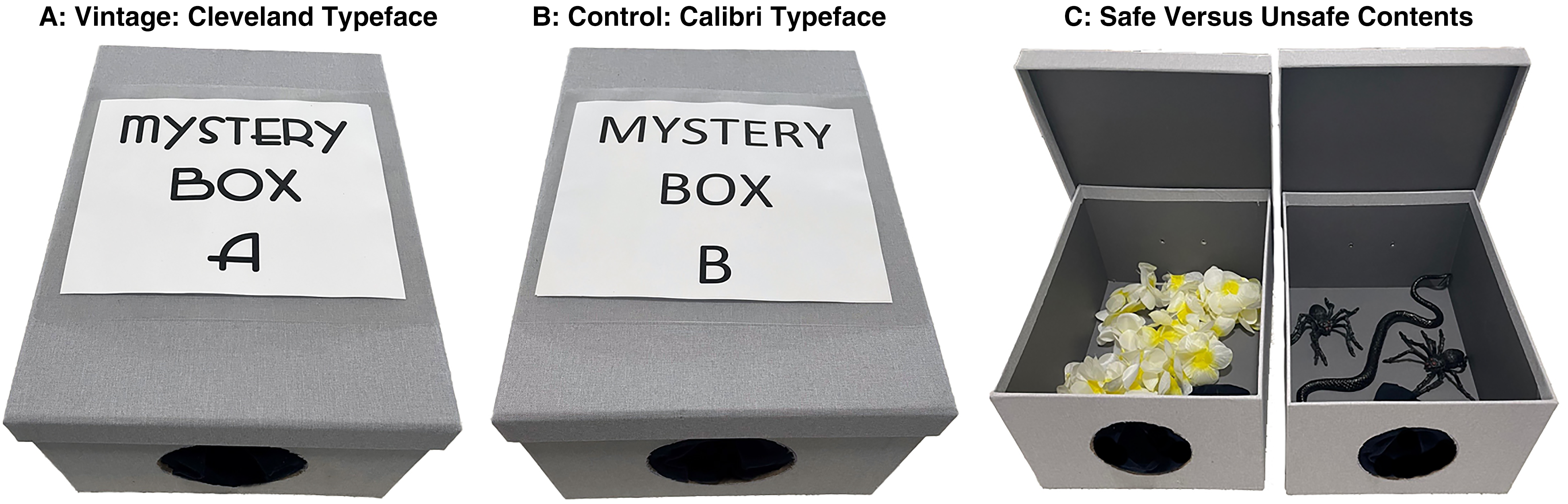
Study 1 Stimuli: Vintage Typography and Safety Perceptions.
Results and Discussion
A Wald test for one-sample proportions indicated that a significantly higher proportion of participants (58.4%) chose the box with the vintage typography (Z = 2.205, p = .027), compared with 41.6% who chose the control (95% CI = [.508, .657]). 2 Results from Study 1 show that when there is a known risk of something being unsafe, participants, on average, choose vintage typography as the safe choice.
Study 2a: Vintage Anemoia and Ruling Out Alternate Process Mechanisms
Study 2a tests whether the effect of vintage typography on perceptions of product safety can be explained by vintage anemoia (H1) and investigates alternative process mechanisms (perceived brand expertise and longevity). Perceived brand longevity positively influences evaluation (Eidelman, Pattershall, and Crandall 2010), and older brands are often associated with greater expertise (Erdem and Swait 2004). We predict that vintage anemoia mediates the relationship between the use of vintage typography and perceptions of product safety (H1), and not brand expertise or longevity.
Vintage Anemoia Scale
We created a measure for vintage anemoia due to the absence of an existing scale. Item selection was guided by literature, to capture nostalgic sentiments, such as aesthetic appreciation, interest, quality (Holbrook 1993), and positive emotions (Pascal, Sprott, and Muehling 2002). We excluded references to personal or vicarious nostalgia. To ensure alignment with our definition, three marketing academics reviewed ten items for face validity.
Subsequently the items were tested on a sample of 200 consumers (51.5% female, 48.5% male; Mage = 30.54 years, SD = 8.01). As a result of exploratory and confirmatory factor analysis, the set of items was reduced to seven, and a seven-item unidimensional scale was adopted. Results of confirmatory factor analysis indicated good model fit (χ2 = 18.45, d.f. = 13, p = .141, discrepancy divided by degree of freedom = 1.42, normed fit index = .977, nonnormed fit index = .989, goodness-of-fit index = .973, comparative fit index = .993, root mean square error of approximation = .046). The final items and coefficients were “Items produced in the past interest me” (.807), “The past represents the ‘good old days’” (.798), “Seeing items from the past makes me feel good” (.793), “Things were made to a better quality in the past” (.761), “I appreciate the beauty of things produced in the past” (.795), “I can recognize when items have been produced in the past” (.790), and “Seeing items from the past makes me nostalgic” (.871).
Participants and Procedures
In this study 160 Amazon Mechanical Turk (MTurk) workers (64.4% male, 35.6% female; Mage = 35.48 years, SD = 10.68) were randomly assigned to a two-condition (typography: vintage vs. control) between-subjects design. All participants were shown a fictitious bicycle brand name, Bilan (see Figure 3). Participants then completed the dependent variable, product safety perceptions, by rating the degree to which the brand's products were considered safe, on five seven-point scales (unsafe/safe, processed/organic, unnatural/natural, unwholesome/wholesome, impure/pure; Cronbach's α = .748). Next the mediator variable, vintage anemoia (Cronbach's α = .797), perceived brand expertise (Erdem and Swait 2004), and brand longevity (Pecot and Merchant 2022; Cronbach's α = .847; see Appendix for items) were assessed, and age and gender were obtained.

Study 2a Stimuli: Vintage Typography and Process Mechanisms.
Results and Discussion
Compared with control typography, analysis of variance (ANOVA) results indicated that vintage typography increased perceptions of product safety (F(1, 158) = 10.18, p = .002, η2 = .061; MVintage = 5.86, SD = .55; MControl = 5.49, SD = .87). 3 There was also a significant difference in vintage anemoia between the vintage and control typography conditions (F(1, 158) = 18.42, p < .001, η2 = .104; MVintage = 5.80, SD = .56; MControl = 5.33, SD = .80). Mediation analysis with 10,000 bootstrap samples (PROCESS Model 4; Hayes 2017) showed that the indirect effect of vintage anemoia on the relationship between vintage typography and product safety was significant (β = .178, 95% CI = [.039, .353]), whereas the indirect effect for brand expertise (β = .035, 95% CI = [−.009, .099]) and brand longevity (β = .045, 95% CI = [−.013, .138]) was not (see Figure 4).

Study 2a: Simple Mediation Analysis: Comparing Alternate Explanations.
Results indicated that vintage typography predicted vintage anemoia (β = .464. t = 4.29, p < .001) and vintage anemoia significantly predicted perceptions of product safety (β = .383. t = 4.98, p < .001). Simple mediation analysis showed that although both brand expertise (β = .202. t = 2.34, p = .021) and brand longevity (β = .211. t = 3.43, p < .001) increase perceptions of product safety, vintage typography does not influence brand expertise (β = .175. t = 1.61, p = .110) or brand longevity (β = .213. t = 1.46, p = .146). Vintage typography only influences vintage anemoia, which in turn explains product safety perceptions, supporting H1.
Study 2b: Ruling Out Halo Effects
Study 2b tests whether a brand logo with vintage typography exclusively influences perceptions of product safety, thereby eliminating the potential of a halo effect. Halo effects hold significant relevance in branding studies, as they involve a consumer's holistic brand assessment, leading to highly correlated ratings for individual attributes (Leuthesser, Kohli, and Harich 1995). Consequently, a consumer's evaluation of a set of attributes may be influenced by a single attribute (e.g., Tiffin and McCormick 1965). We predict that the brand logo with vintage typography will increase consumer perceptions of product safety through vintage anemoia, but not tastiness or innovativeness.
Participants and Procedures
In this study 140 MTurk workers (68.6% male, 31.4% female; Mage = 35.66 years, SD = 12.12) were randomly assigned to a two-condition (typography: vintage vs. control) between-subjects design. All participants were shown a brand logo for a fictitious vegetarian health food brand, Bilan (see Figure 5). Participants then completed the dependent variables, perceptions of product safety (Cronbach's α = .727), tastiness (Schnurr 2019; Cronbach's α = .781), and innovativeness (Kunz, Schmitt, and Meyer 2011; Cronbach's α = .852; see Appendix), and then the mediator, vintage anemoia (Cronbach's α = .849), followed by age and gender.

Study 2b Stimuli: Ruling Out the Halo Effect.
Results and Discussion
ANOVA results indicated that vintage typography increased perceptions of product safety (F(1, 138) = 10.93, p = .001, η2 = .073, MVintage = 5.81, SD = .62; MControl = 5.46, SD = .65), but not perceptions of tastiness (F(1, 138) = .10, p = .749, η2 = .001, MVintage = 5.29, SD = 1.00; MControl = 5.34, SD = .74) or innovativeness (F(1, 138) = .49, p = .487, η2 = .004, MVintage = 4.74, SD = .77; MControl = 4.65, SD = .82; see Table 3). 4
Descriptives: Vintage Typography and Semantic Associations.

Mediation analysis with 10,000 bootstrap samples (PROCESS Model 4) showed that the indirect effect of vintage anemoia on the relationship between vintage typography and product safety was significant (β = .226, 95% CI = [.081, .412]), but the indirect effect of vintage anemoia on tastiness (β = .011, 95% CI = [−.114, .132]) and innovativeness (β = .102, 95% CI = [−.041, .273]) was not significant. Replicating Study 2a, results indicated that vintage typography predicted vintage anemoia (β = .647, t = 5.09, p < .001) and vintage anemoia significantly predicted perceptions of product safety (β = .349, t = 5.42, p < .001; see Table 4).
Regression Results: Ruling Out Halo Effects.

However, there was no relationship between vintage anemoia and tastiness (β = .016, t = 1.65, p = .869) or between vintage anemoia and innovativeness (β = .158, t = 1.78, p = .078). Study 2b results indicated that the influence of vintage typography on vintage anemoia is specific to product safety judgments and not tastiness and innovativeness.
Study 3: Downstream Consequences
Study 3 tests whether the perception of product safety created by vintage anemoia has downstream consequences on brand attitude, purchase intention, and willingness to pay (H2).
Participants and Procedures
In this study 171 MTurk workers (53.8% male, 46.2% female; Mage = 34.78 years, SD = 10.95) were randomly assigned to a two-condition (typography: vintage vs. control) between-subjects design. All participants were shown product packaging for a fictitious paracetamol brand, Dotil (see Figure 6). Participants completed the dependent variables, attitude toward the brand (Cronbach's α = .861), purchase intention (Cronbach's α = .844), and willingness to pay, followed by the two mediators, perceptions of product safety (M2; Cronbach's α = .827) and vintage anemoia (M1; Cronbach's α = .832).

Study 3 Stimuli: Downstream Consequences of Vintage Typography.
Results and Discussion
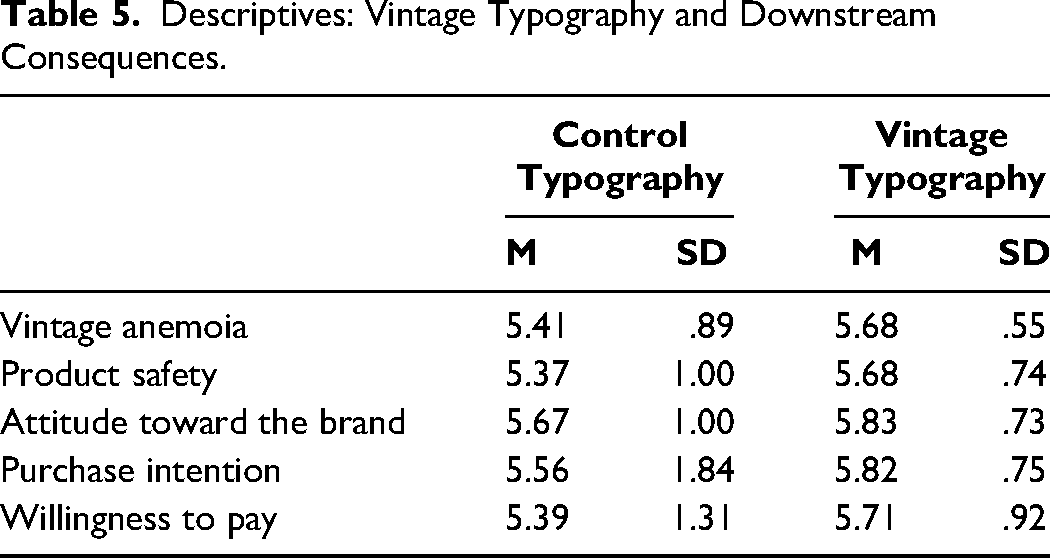
Replicating Study 2a and 2b, ANOVA results indicated that vintage typography increased perceptions of vintage anemoia (F(1, 168) = 5.62, p = .019, η2 = .032, MVintage = 5.68, SD = .55; MControl = 5.41, SD = .89) and product safety (F(1, 168) = 5.39, p = .021, η2 = .031, MVintage = 5.68, SD = .74; MControl = 5.37, SD = 1.00; see Table 5), with the effects of vintage typography on product safety perceptions explained by vintage anemoia (PROCESS Model 4; β = .244, 95% CI = [.053, .446]). 5
Descriptives: Vintage Typography and Downstream Consequences.
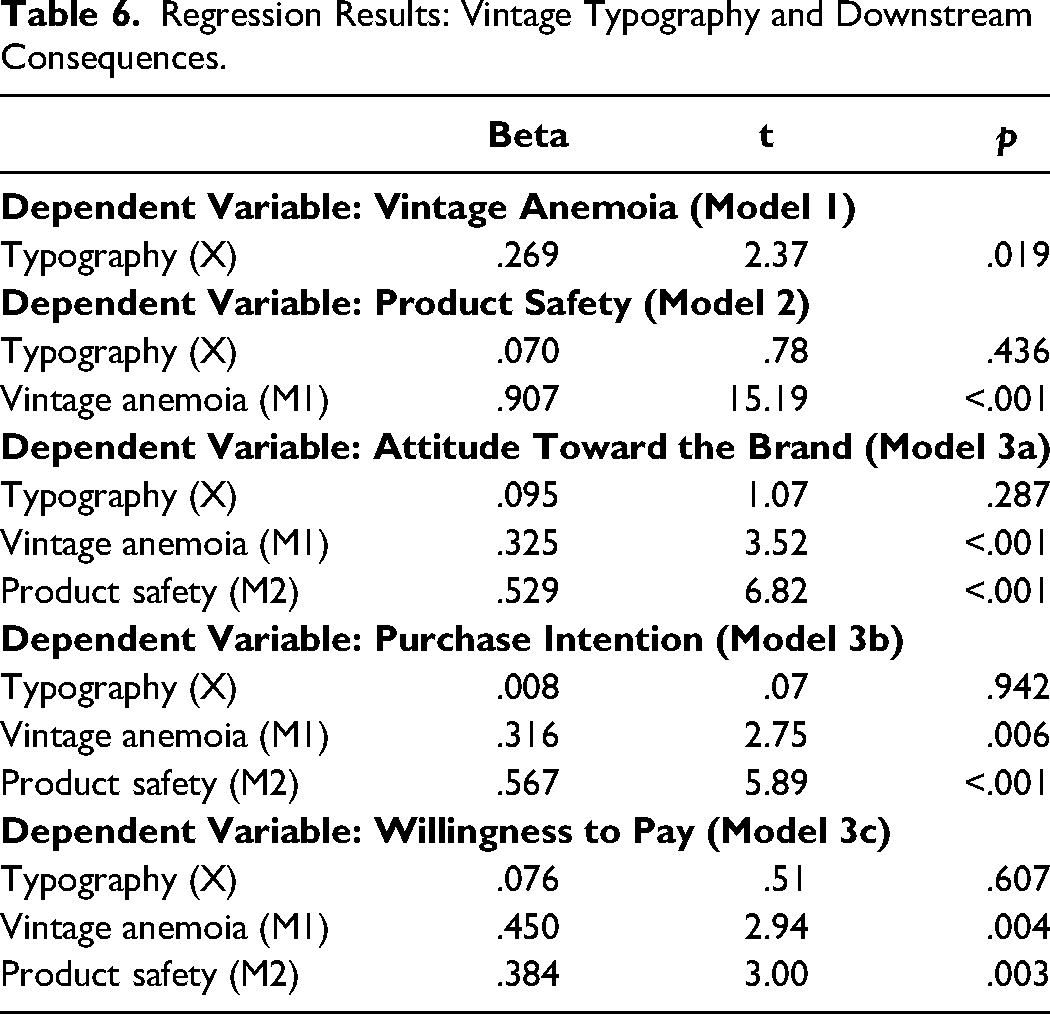
To examine downstream consequences, we conducted serial mediation analysis with 10,000 bootstrap samples (PROCESS Model 6). Consistent with H2, results showed that vintage typography was a significant predictor of vintage anemoia (β = .269, t = 2.37, p = .019), vintage anemoia was a significant predictor of product safety (β = .907, t = 15.19, p < .001), and product safety was a significant predictor of brand attitude (β = .529, t = 6.82, p < .001), purchase intention (β = .567, t = 5.89, p < .001), and willingness to pay (β = .384, t = 3.00, p = .003; see Table 6). Serial mediation was observed, whereby the influence of vintage anemoia on product safety perceptions explained the relationship between vintage typography and brand attitude (β = .129, 95% CI = [.023, .269]), purchase intention (β = .138, 95% CI = [.023, .304]), and willingness to pay (β = .094, 95% CI = [.002, .241]). To ensure the appropriate causal ordering of variables (Fairchild and McDaniel 2017), a reverse serial mediation model (PROCESS Model 6) was conducted with product safety (M1) and vintage anemoia (M2). Results indicated that serial mediation was not significant for brand attitude (β = −.096, 95% CI = [−.273, .081]), purchase intention (β = −.008, 95% CI = [−.228, .212]), or willingness to pay (β = .076, 95% CI = [−.216, .369]), further indicating that it is the influence of vintage anemoia on product safety perceptions that explains the effect of vintage typography on brand attitude, purchase intention, and willingness to pay.
Regression Results: Vintage Typography and Downstream Consequences.
Study 4: Product Safety Information
Study 4 examines whether vintage typography on product packaging and advertising copy influences consumer perceptions of safety, regardless of the actual product safety. We anticipate that vintage typography will enhance vintage anemoia, leading to increased safety perceptions and subsequent effects, irrespective of safety information provided (H3).
Participants and Procedures
In this study 614 MTurk workers (54% male, 44.5% female, .8% nonbinary, .7% prefer not to say; Mage = 35.02 years, SD = 10.45) were randomly assigned to one of six conditions for a 3 (safety information: no information vs. safe vs. unsafe) × 2 (typography: vintage vs. control) between-subjects design. We manipulated product safety by providing no information, information that the product was made of safe ingredients, or information that the product was made with unsafe ingredients. Participants were shown an advertisement for a fictitious cosmetics brand, Gimmel (see Figure 7), and then completed the dependent variables, attitude toward the brand (Cronbach's α = .921), purchase intention (Cronbach's α = .906), and willingness to pay, followed by the two mediators, perceptions of product safety (M2; Cronbach's α = .886) and vintage anemoia (M1; Cronbach's α = .900), age, and gender.

Study 4 Stimuli: Vintage Typography and Safety Information.
Manipulation Check
An ANOVA was performed to test the manipulation of product safety. Results showed a significant difference in safety perceptions across conditions (F(2, 611) = 20.39, p < .001, η2 = .063; MSafe = 5.92, SD = 1.02; MUnsafe = 5.15, SD = 1.50; MNoInformation = 5.61, SD = 1.08).
Results and Discussion
ANOVA results showed a significant interaction between typography and safety information (F(2, 608) = 4.07, p = .018, η2 = .018). Vintage typography increased perceptions of product safety regardless of product safety information (F(2, 608) = 15.92, p < .001, η2 = .050). As shown in Table 7, perceptions of product safety were higher in the vintage condition than in the control for no information (F(1, 608) = 4.49, p = .034, η2 = .007; MVintageNoInfo = 5.59, SD = .71; MControlNoInfo = 5.31, SD = 1.02), safe (F(1, 608) = 32.72, p < .001, η2 = .051; MVintageSafe = 6.17, SD = .61; MControlSafe = 5.39, SD = 1.07), and unsafe (F(1, 608) = 6.11, p = .014, η2 = .010; MVintageUnsafe = 5.45, SD = 1.10; MControlUnsafe = 5.11, SD = 1.18) conditions. 6 Pairwise comparisons showed that when vintage typography was utilized, there was no difference in perceptions of product safety between the no information and unsafe conditions (p = .271), though perceptions of product safety were increased when safe information versus no information (p < .001) and safe versus unsafe information was provided (p < .001). Those in the vintage condition who were provided safe information perceived the product to be safer than those who were provided no information; however, those in the vintage condition perceived the product to be just as safe when told unsafe information relative to the no information condition (see Table 8 for simple effects). Overall, safety information had no effect on perceptions of product safety in the control conditions (F(2, 608) = 2.11, p = .122, η2 = .007), though perceptions of product safety were significantly lower in the unsafe versus safe conditions when control typography was used (p = .046).
ANOVA Results: Vintage Typography and Safety Information.

Simple Effects of Typography and Product Safety Information.
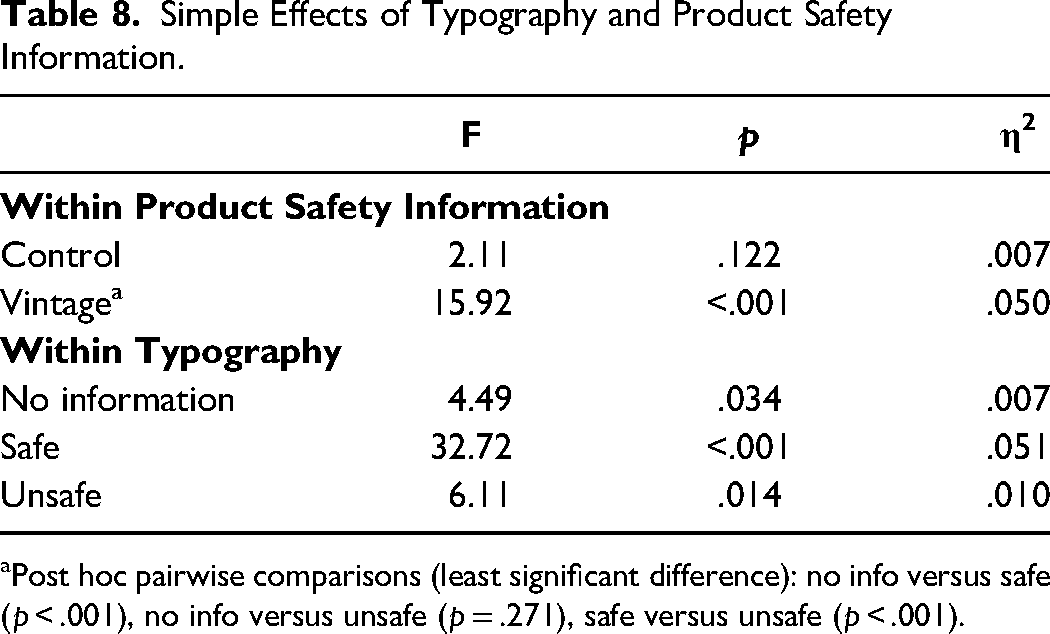
Post hoc pairwise comparisons (least significant difference): no info versus safe (p < .001), no info versus unsafe (p = .271), safe versus unsafe (p < .001).
Serial mediation analysis with 10,000 bootstrap samples (PROCESS Model 83) showed that the interaction between typography and the conditional effect of safe relative to no information (W1) significantly predicted vintage anemoia (β = .365, t = 2.069, p = .039), but not unsafe relative to no information (W2; β = −.066, t = −.376, p = .707). Vintage anemoia predicted product safety (β = .900, t = 34.636, p < .001), and product safety predicted brand attitude (β = .585, t = 14.450, p < .001), purchase intention (β = .682, t = 13.558, p < .001), and willingness to pay (β = .601, t = 9.963, p < .001; see Table 9).
Regression Results: Vintage Typography and Safety Information.

W1 is the relative conditional effect of safe compared with no safety information.
W2 is the relative conditional effect of unsafe compared with no safety information.
A moderated serial mediation effect was observed for brand attitude when considering safe information relative to no information (W1: β = .192, 95% CI = [.018, .398]), purchase intention (W1: β = .224, 95% CI = [.026, .438]), and willingness to pay (W1: β = .197, 95% CI = [.019, .408]). When the relative conditional effect of unsafe information compared with no information was considered, there was no moderated serial mediation effect for brand attitude (W2: β = −.035, 95% CI = [−.230, .162]), purchase intention (W2: β = −.040, 95% CI = [−.266, .180]), or willingness to pay (W2: β = −.035, 95% CI = [−.224, .166]); see Table 10 for indirect effects. Results from Study 4 indicate that vintage typography influences vintage anemoia and in turn increases product safety perceptions regardless of product safety information provided. When utilizing vintage typography, consumers perceive unsafe products as just as safe as when they are told no information at all.
Indirect Effects: Vintage Typography and Safety Information.

Notes: Indirect effect of vintage typography > vintage anemoia > product safety > brand attitude, purchase intention, and willingness to pay.
Study 5: The Attenuating Effect of Explicit Indexical Cues
Study 5 tests the moderating role of explicit indexical cues on our effect. We predict that the influence of vintage typography and vintage anemoia on product safety perceptions will attenuate when the year of establishment is provided (H4).
Participants and Procedures
In this study 604 MTurk workers (57.9% male, 40.6% female, 1.5% prefer not to say; Mage = 34.93 years, SD = 10.16) were randomly assigned to one of six conditions using a 2 (typography: vintage vs. control) × 3 (explicit cue: no information vs. 1920 vs. 2020) between-subjects design. Participants were shown an ad for a fictitious laundry detergent brand, Kloth (see Figure 8). Below each advertisement, participants either were told “The Kloth brand was established in the year 2020,” were told “The Kloth brand was established in the year 1920,” or had no year of establishment (control) information provided. Participants completed the dependent variables attitude toward the brand (Cronbach's α = .870), purchase intention (Cronbach's α = .869), and willingness to pay, in addition to perceptions of product safety (M2; Cronbach's α = .813), vintage anemoia (M1; Cronbach's α = .835), age, and gender.

Study 5 Stimuli: Vintage Typography and Explicit Indexical Cues.
Results and Discussion
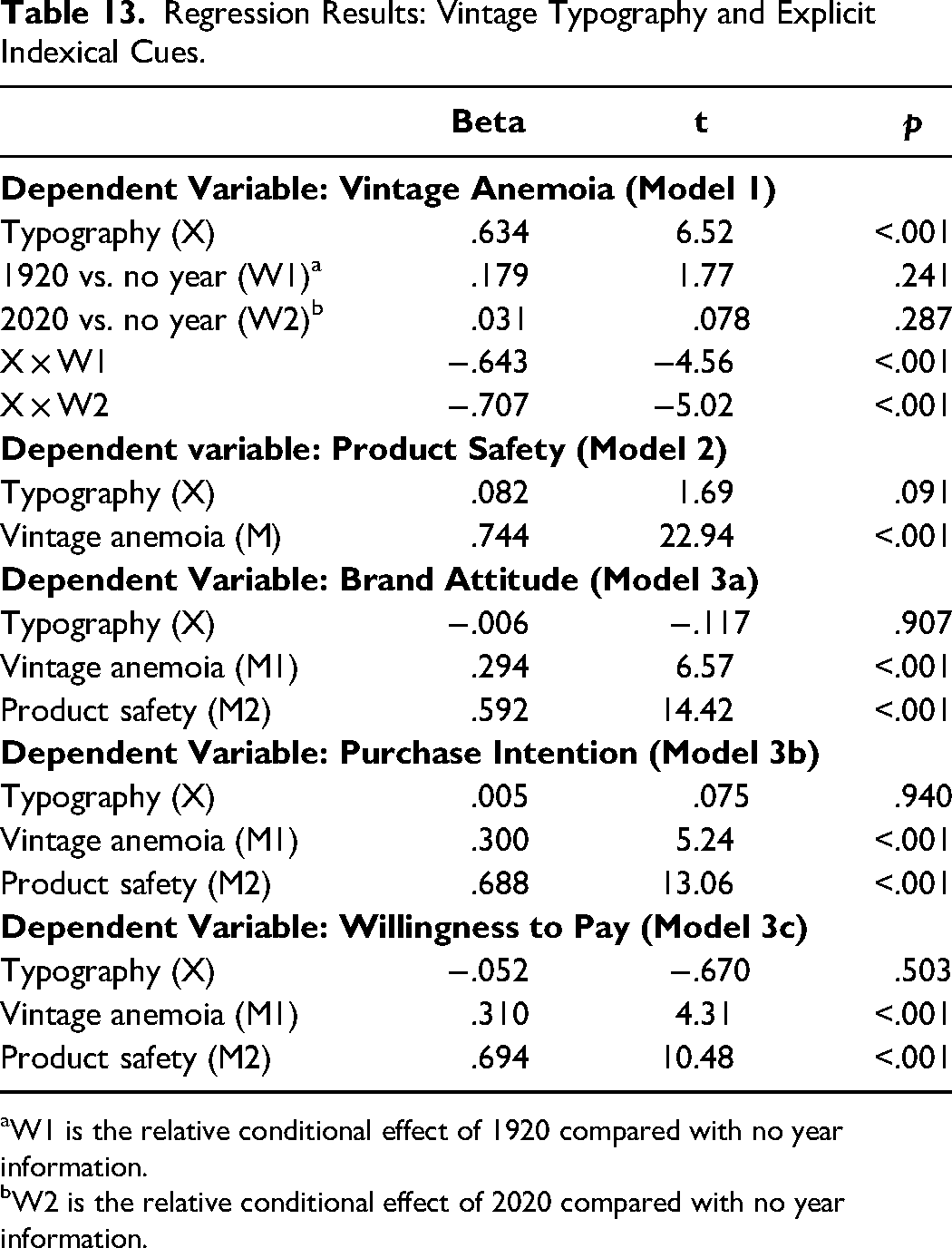
ANOVA results showed a significant interaction between typography and year established (F(2, 598) = 6.949, p < .001, η2 = .023; see Table 11). Pairwise comparisons indicated that the effect of vintage typography increased product safety perceptions only when no year of establishment information was provided (p < .001, η2 = .045; MVintageNoYear = 6.11, SD = .71; MControlNoYear = 5.56, SD = .77). When the brand was established in 1920 (p = .289, η2 = .002; MVintage1920 = 5.67, SD = .74; MControl1920 = 5.55, SD = .94) or 2020 (p = .985, η2 = .000; MVintage2020 = 5.56, SD = .71; MControl2020 = 5.57, SD = .85), typography had no effect on product safety perceptions (see Table 12 for simple effects). 7
ANOVA Results: Vintage Typography and Explicit Indexical Cues.

Simple Effects of Vintage Typography and Explicit Indexical Cues.

Post hoc pairwise comparisons (least significant difference): no year vs. 1920 (p < .001), no year vs. 2020 (p < .001), 1920 vs. 2020 (p = .311).
We conducted conditional serial mediation analysis with 10,000 bootstrap samples (PROCESS Model 83). 8 Results showed that the interactions between vintage typography and year of establishment significantly predicted vintage anemoia (W1: β = −.643, t = −4.56, p < .001; W2: β = −.707, t = −5.02, p < .001), vintage anemoia predicted product safety (β = .744, t = 22.94, p < .001), and product safety predicted brand attitude (β = .592, t = 14.42, p < .001, purchase intention (β = .688, t = 13.06, p < .001), and willingness to pay (β = .694, t = 10.48, p < .001; see Table 13).
Regression Results: Vintage Typography and Explicit Indexical Cues.
W1 is the relative conditional effect of 1920 compared with no year information.
W2 is the relative conditional effect of 2020 compared with no year information.
A moderated serial mediation effect was also observed for brand attitude (W1: β = −.283, 95% CI = [−.428, −.152]; W2: β = −.311, 95% CI = [−.473, −.173]), purchase intention (W1: β = −.329, 95% CI = [−.506, −.176]; W2: β = −.362, 95% CI = [−.548, −.204]), and willingness to pay (W1: β = −.332, 95% CI = [−.512, −.180]; W2: β = −.365, 95% CI = [−.562, −.202]). Vintage anemoia and subsequent product safety perceptions could only explain the effect of vintage typography on downstream consequences when no year of establishment was provided (see Table 14), supporting H4. Results from Study 5 indicate a bound of the vintage anemoia effect, such that vintage typography will not increase consumer perceptions of product safety when the year of establishment is made explicit.
Indirect Effects: Vintage Typography and Explicit Indexical Cues.

Notes: Indirect effect of vintage typography > vintage anemoia > product safety > brand attitude, purchase intention, and willingness to pay.
Study 6: The Moderating Role of Product Category
Study 6 tests whether product category influences the vintage anemoia effect. We predict that the influence of vintage typography and vintage anemoia on product safety perceptions will diminish when used to promote a futuristic product (H5).
Participants and Procedures
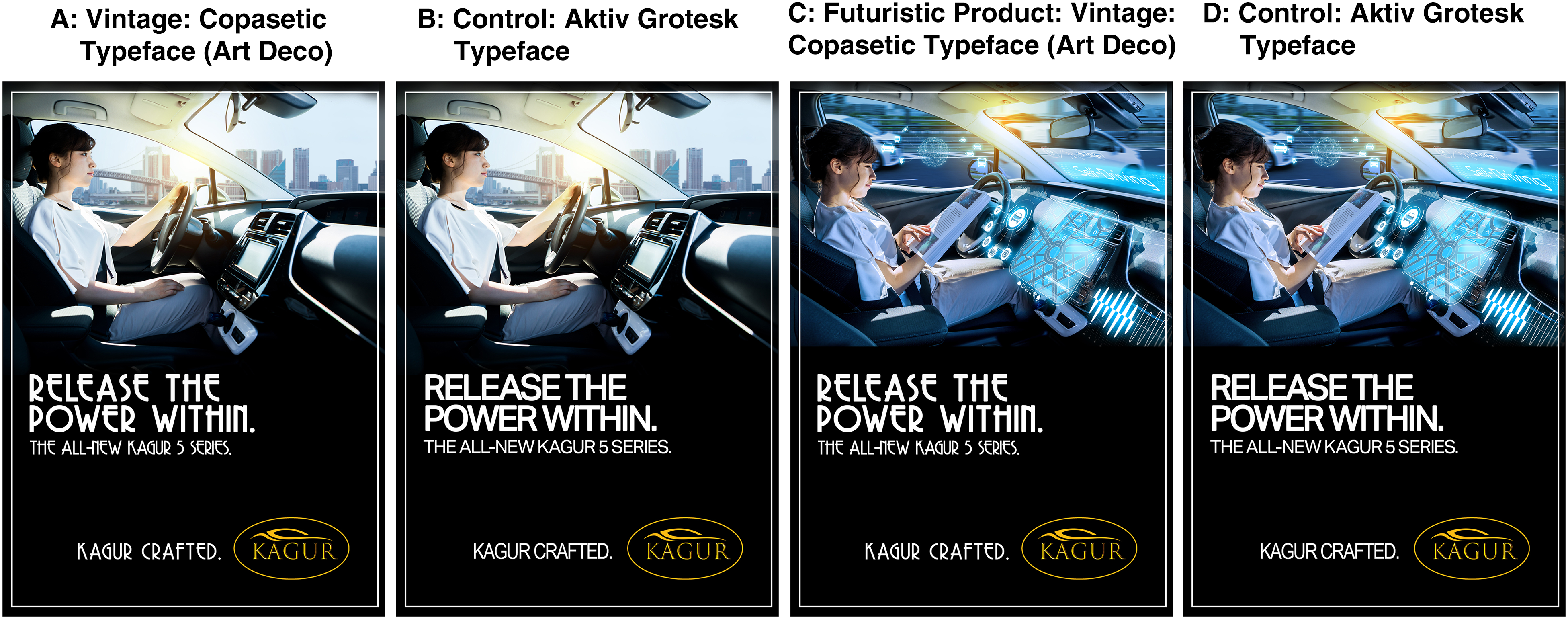
In this study 406 MTurk workers (55.7% male, 44.1% female, .2% prefer not to say; Mage = 35.00 years, SD = 10.23) were randomly assigned to one of four conditions for a 2 (typography: vintage vs. control) × 2 (product category: traditional vs. futuristic) between-subjects design. Participants were shown an advertisement for a fictitious car brand, Kagur. The traditional product was an ordinary car, while the futuristic product was a self-driving car (see Figure 9). Participants completed the dependent variables attitude toward the brand (Cronbach's α = .925), purchase intention (Cronbach's α = .918), and willingness to pay, followed by perceptions of product safety (M2, Cronbach's α = .878) and vintage anemoia (M1, Cronbach's α = .828). Age and gender were also obtained.
Study 6 Stimuli: Vintage Typography and Product Category.
Manipulation Check
An independent samples t-test was performed to ensure that the product category manipulation was successful. Participants rated the ad on a seven-point semantic differential scale (1 = “Not futuristic,” and 7 = “Futuristic”). Results showed there was a significant mean difference in product category perceptions between the traditional and futuristic conditions (t = −3.326, p < .001; MTraditional = 5.60, SD = .94; MFuturistic = 5.91, SD = .94).
Results and Discussion
ANOVA results indicated a significant interaction between typography and product category (F(1, 402) = 4.905, p = .027, η2 = .012). The effect of vintage typography was only significant for the traditional product category (F(1, 402) = 13.071, p < .001, η2 = .031, η2 = .001; MVintageTraditional = 5.99, SD = .67; MControlTraditional = 5.53, SD = .65). In the futuristic product category, vintage typography had no effect on product safety perceptions (F(1, 402) = .234, p = .629, η2 = .001; MVintageFuturistic = 5.27, SD = 1.13; MControlFuturistic = 5.21, SD = 1.04; see Table 15 for main effects). 9
ANOVA Results: Vintage Typography and Product Category.

We then conducted conditional serial mediation analysis with 10,000 bootstrap samples (PROCESS Model 83). Results showed that typography was a significant predictor of vintage anemoia (β = .567, t = 5.89, p < .001) as well as the interaction between typography and product category (β = −.322, t = −2.33, p = .020). Vintage anemoia was a significant predictor of product safety (β = .906, t = 19.26, p < .001), and product safety was a significant predictor of brand attitude (β = .656, t = 11.85, p < .001), purchase intention (β = .990, t = 16.25, p < .001), and willingness to pay (β = .744, t = 11.44, p < .001; see Table 16).
Regression Results: Vintage Typography and Product Category.

When we tested the conditional effect of product category, moderated serial mediation was observed for brand attitude (β = −.191, 95% CI = [−.384, −.027]), purchase intention (β = −.289, 95% CI = [−.561, −.040]), and willingness to pay (β = −.217, 95% CI = [−.419, −.037). The influence of vintage anemoia on product safety perceptions explained the relationship between vintage typography and brand attitude (β = .247, 95% CI = [.128, .394]), purchase intention (β = .373, 95% CI = [.207, .566]), and willingness to pay (β = .281, 95% CI = [.151, .430]) only for the traditional product category. By contrast, the influence of vintage anemoia on product safety perceptions did not explain the relationship between vintage typography and brand attitude (β = .056, 95% CI = [−.069, .183]), purchase intention (β = .085, 95% CI = [−.101, .276]), or willingness to pay (β = .064, 95% CI = [−.074, .211]) for the futuristic product, supporting H5. Results from Study 6 indicate that the influence of vintage typography on consumer attitudes toward the brand, purchase intention, and willingness to pay is explained by heightened perceptions of vintage anemoia, and in turn increased product safety perceptions, for traditional products but not for futuristic products.
General Discussion
Typography, though it may be perceived as a minor aspect in marketing and advertising, extends beyond aesthetics and plays a crucial role in shaping how people think, feel, evaluate brands, behave, and make choices. Recognizing and harnessing the potential of typography can substantially improve marketing and advertising strategies, ultimately influencing brand perception and consumer behavior.
Across seven studies we show that the utilization of vintage typography invokes feelings of vintage anemoia, leading to improved consumer perceptions of product safety. We first establish the connection between vintage typography and increased safety perceptions in Study 1. When participants were informed that two boxes might contain harmful contents, there was heightened preference for the box with vintage typography. Study 2a demonstrates that this effect is driven by a stronger nostalgic response to vintage cues in a marketing context (vintage anemoia) and rules out the competing mechanisms of brand longevity and brand expertise. Although increased perceptions of brand longevity and brand expertise increase perceptions of product safety, vintage typography does not influence perceptions of brand longevity or brand expertise, and these constructs could not explain the impact of vintage typography on perceptions of product safety. Study 2b demonstrates that our effect is specific to product safety by testing the effect on other product-related judgments. We rule out the halo effect, showing that vintage typography and vintage anemoia do not influence perceptions of product tastiness or innovativeness. Study 3 reveals the broader marketing implications of our effect by demonstrating positive downstream consequences on brand attitude, purchase intention, and willingness to pay.
The remaining studies enhance understanding of our effect and contextual factors that interfere with the nostalgic response to vintage typography. In Study 4 we showed that vintage typography counteracts and protects against the negative impact of unsafe product information. Although perceptions of product safety were highest for vintage typography when consumers were told the product was safe, they perceived the same level of product safety regardless of whether they were told the product was unsafe or received no product safety information at all. Last, the findings from Studies 5 and 6 show that our effect diminishes in scenarios where explicit indexical cues, such as year of establishment, are employed in the absence of other contextual cues pointing to the product's historical origin, and when promoting futuristic products. Consequently, these studies suggest that the effectiveness of vintage typography in evoking vintage anemoia and subsequent perceptions of product safety varies depending on the context within which it is utilized.
Theoretical Contributions
Our research contributes significantly to the field of typography and its role in marketing, particularly focusing on typographic symbolism, nostalgia, and indexical cues. First, we extend the existing literature on typefaces and their impact on marketing outcomes. We build on Schroll, Schnurr, and Grewal’s (2018) overview of typeface studies, expanding it to include research conducted from 2015 to the present. This updated perspective highlights the considerable influence that typographic choices have on consumer perceptions and behaviors in modern marketing contexts. We find that these choices have relevance in various other industries, including music (Venkatesan, Wang, and Spence 2020), coffee (De Sousa, Carvalho, and Pereira 2020), luxury hotels (Hwang et al. 2022), and political campaigns (Haenschen, Tamul, and Collier 2021).
Research in typography has often focused on overarching typographic characteristics, such as design dimensions (Henderson, Giese, and Cote 2004), font weight (e.g., Karnal et al. 2016), typeface curvature (e.g., Li, Zeng, and Zhou 2020; Velasco, Hyndman, and Spence 2018), or the distinction between handwritten and computerized typefaces (e.g., Schroll, Schnurr, and Grewal 2018). While these studies offer flexibility in selecting typefaces (Henderson, Giese, and Cote 2004), they do not consider the impact of typographic design styles and trends, such as vintage typography, on associations with products and brands.
We delve into unexplored territory by investigating the influence of vintage typography on consumer perceptions, attitudes, and behaviors. Unlike previous studies that speculated on the role of vintage typography in forming semantic associations (e.g., Unnava, Burnkrant, and Erevelles 1994), our work provides empirical evidence and sheds light on the underlying mechanisms involved. Specifically, we extend typographic research in marketing by demonstrating that consumers form associations based on typographic trends, particularly those associated with past cultural eras that have affected the design of packaging, logos, record sleeves, and posters throughout history (Müller and Wiedemann 2017). Moreover, our research highlights the intricate interplay between typography, emotions, and consumer responses in this context.
Unlike studies that explore broad aspects of typography, we demonstrate the precise mechanism behind the influence of vintage typography on product safety perceptions. In doing so, we extend the understanding of the influence of typography by demonstrating the emotional and nostalgic response it can evoke, through vintage anemoia. Last, our findings highlight the variability of the effectiveness of vintage typography across contexts. This suggests that recommendations for the use of typography should consider the specific context in which it is employed.
Vintage anemoia: a new typology of vicarious nostalgia
In our contribution to the nostalgia literature, we draw on the concept of anemoia, a term coined by Koenig (2021), which describes nostalgia for a time one has not personally experienced. The concept served as the foundation for our own concept, which we introduced as vintage anemoia. Vintage anemoia signifies how consumers can feel nostalgic when exposed to vintage cues that embody the design and aesthetics of past eras that they have not lived through. This notion captures the emotional connection that consumers have with fashion, styles, design, and cultural elements of the past that they did not directly experience. Importantly, we distinguish vintage anemoia from traditional personal or vicarious nostalgia, emphasizing the emotions evoked by vintage cues rather than a direct link to a specific historical context. Our findings also emphasize the role of visual elements, such as distinctive lettering styles and visual elements of vintage typography, in forming nostalgic sentiments.
The concept of vintage anemoia suggests that nostalgia can be triggered through emotional pathways that are distinct from traditional categories of personal and vicarious nostalgia. Our research, therefore, expands the typologies of nostalgia, enriching the theoretical framework that can lead to a deeper exploration of how design choices in branding and advertising can elicit specific emotional responses. By determining the role of aesthetics and design in triggering vintage anemoia, rather than personal memories or shared experiences, we challenge traditional notions of nostalgia and demonstrate, beyond conjecture, that nostalgia can transcend temporal boundaries.
Last, we expand understanding on the connection between nostalgia, positive emotions, and feelings of comfort and safety, demonstrating that vintage anemoia increases perceptions of product safety. This finding extends current understandings of the protective benefits of nostalgia to product evaluations, not previously explored in the literature.
Vintage typography as an indirect indexical cue
We contribute to indexicality literature, emphasizing the significance of indexical cues in shaping consumer perceptions. Building on Grayson and Martinec's (2004) framework, we confirm that indexical cues establish factual or spatiotemporal connections between products and their context. Vintage typography, an indirect indexical cue, influences vintage anemoia and product safety perceptions. However, this influence weakens when an explicit indexical cue, like year of establishment, is provided. This supports Beverland, Lindgreen, and Vink’s (2008) suggestion that indirect (vs. explicit) indexical cues, such as images and fonts, can be more effective in reinforcing authenticity claims. We reveal a nuanced relationship between indirect and explicit indexical cues. While explicit cues like the establishment year establish historical connections and brand heritage (Orth and Gal 2014; Pizzi and Scarpi 2019), they hinder vintage anemoia. This highlights that indirect cues, like vintage typography, are more effective when evoking vintage anemoia. Moreover, explicit cues, like year of establishment, lack indexical value without additional cues to establish a factual or spatiotemporal link with the founding year (Grayson and Martinec 2004).
Managerial Implications
Using vintage typography to promote perceptions of safety
We demonstrate that promoting a sense of vintage anemoia through the skillful implementation of vintage typography can significantly heighten consumers’ perception of product safety. Consequently, brands aspiring to establish a robust safety positioning or reinforce safety-related product attributes can gain a competitive advantage by incorporating vintage typography into their brand identity and visual communication.
Enhancing vintage anemoia in adverse circumstances
Vintage anemoia can serve as a protective mechanism against unsafe perceptions. By incorporating vintage aesthetics and triggering vintage anemoia, brands can alleviate consumers’ concerns and maintain positive perceptions of product safety. In various industries, including technology, food and beverage, beauty, automotive, home appliances, and furniture, incorporating vintage design elements in products and marketing efforts can help mitigate consumer concerns about safety issues such as malfunctions, privacy breaches, recalls, contamination, harmful ingredients, defects, and durability, ultimately improving perceptions of product safety.
Vintage typography will increase perceptions of product safety when a product is unsafe and, therefore, could create misconceptions regarding product safety, by diminishing the effect of warning labels and creating a false sense of safety for consumers. This could be problematic for brands if typography generates unintended meaning (Jura 2022). The use of vintage typography should be avoided for brands or products where its use could intentionally or unintendedly mislead consumers into thinking a product is safe when it is not.
Regulatory and legal constraints uphold product safety in product design (e.g., Bloch 1995) and product labeling (e.g., Kim, Kim, and Arora 2022). Brand managers, however, should use caution before employing vintage typography for products with mandatory warning labels (e.g., cleaning products, medication) or where consumer misuse or misguided product safety perceptions would decrease consumer vigilance and adherence to warnings.
Things to consider when adopting vintage typography
We demonstrate that certain factors diminish the influence of vintage typography: explicit indexical cues (e.g., year of establishment) used without other contextual visual cues or when promoting futuristic products. Marketers should consider alignment of vintage aesthetics with the desired nostalgic response by avoiding diverting attention away from the past or using vintage typography in contexts that weaken the association to vintage anemoia.
Figure 10 displays a decision tree designed for marketers to aid in their decision-making process regarding the use of vintage typography. By adhering to this decision tree, marketers can make well-informed decisions concerning the appropriateness of vintage typography for their branding and messaging, especially when considering factors such as product safety concerns, brand positioning, indexical cues, and product category.

Decision Tree for Marketers.
Limitations and Future Research Directions
The concept of vintage anemoia has emerged as a powerful tool for enhancing consumer product safety perceptions and influencing consumer attitudes and behaviors. To gain a deeper understanding of vintage cues and vintage anemoia, we propose several open questions for future research (see Table 17) that will help us explore this area further.
Areas of Future Research and Suggested Research Questions.

While our research focused on design styles from the Victorian, Art Nouveau, Art Deco, and Bauhaus design eras, vintage styling now includes a broader range of eras and design styles, such as seventies, punk, and grunge visual styles (Fussell 2020). Future research should investigate the symbolic associations of different typographic genres, including more recent eras like psychedelic and punk (Celhay, Magnier, and Schoormans 2020), to determine whether they evoke a similar nostalgic response as vintage cues from earlier periods. Additionally, research can investigate other vintage cues beyond typography and their effect on vintage anemoia.
We have distinguished vintage anemoia from traditional forms of personal and vicarious nostalgia. Future research can examine the emotional connection consumers have with past fashion, styles, design, and cultural elements they did not directly experience compared with those with a direct link to the historical context. Historical context, shaped by art, architecture, pop culture, technology, and sociopolitical landmarks, varies around the world and throughout history (Müller and Wiedemann 2017). Therefore, understanding cross-cultural effects is essential for utilizing vintage typography in diverse cultural contexts.
Demographic factors such as age (e.g., car) and/or gender (e.g., cosmetics) did affect perceptions of product safety, in some product categories. Although our findings held when controlling for these effects, further research is needed to deepen our understanding of how demographic characteristics influence consumers’ nostalgic response to vintage cues, particularly across product categories.
We primarily aimed to understand the immediate impact of vintage typography on perceptions and attitudes in response to marketing materials. Investigating the long-term effects of vintage typography on brand loyalty and whether a nostalgic response to vintage aesthetics creates enduring associations with a brand's identity would provide a more comprehensive understanding of the impact of vintage typography.
Our studies were conducted on products for which safety could be considered a determinant attribute (see Alpert 1971). We suggest that experiencing vintage anemoia will enhance perceptions of product safety, even for products where safety may not be the primary consideration. As consumers become increasingly mindful of ethical and sustainable production and environmental impacts, future research can explore the effects of vintage anemoia on consumer perceptions of sustainability and sustainable behaviors, such as secondhand shopping, upcycling, recycling, or waste reduction.
Vintage typography may also evoke semantic meanings related to other associations of the past, such as reliability, durability, simplicity, or ease of use. Future research could investigate the role of vintage cues in inducing vintage anemoia for digital technologies and platforms, as well as subsequent inferences regarding safety and ease of use. This investigation may extend beyond vintage typographical aesthetics to explore how social media filters, vintage-themed apps, vintage aesthetics in website design, or virtual reality experiences influence users’ perceptions.
Last, our findings suggest that nostalgia, through vintage anemoia, can mitigate the perceived harmful effects of an unsafe product. Scholars could investigate the effectiveness of vintage anemoia in addressing safety concerns in other negative contexts such as unsafe situations, threats, or perceived harm (e.g., crisis communication or product recalls). Additionally, questions remain regarding the legal and regulatory implications of using vintage aesthetics, including consumer adherence to warning labels for products with safety concerns, where the use of vintage typography may reduce consumer vigilance.
Footnotes
Appendix: Measures
Perceived brand expertise (Erdem and Swait 2004): This brand reminds me of someone who is competent and knows what they are doing; this brand has the ability to deliver what it promises (measured on seven-point Likert scales).
Perceived brand longevity (Pecot and Merchant 2022): This brand has history; this brand has existed for a long time; this brand is older than most food brands; this brand exudes a sense of longevity; this brand seems to have been founded a while ago (measured on seven-point Likert scales).
Tastiness (Schnurr 2019): Not at all tasty–very tasty; not delicious at all–very delicious; bad–good (measured on seven-point semantic differential scales).
Innovativeness (Kunz, Schmitt, and Meyer 2011): This brand is dynamic; this brand is very creative; this brand launches new products and creates market trends all the time; this brand is a pioneer in its category; this brand constantly generates new ideas; this brand has changed the market with its offers; this brand is an advanced forward-looking firm (measured on seven-point Likert scales).
Brand attitude (Mitchell and Olson 1981): Bad–good, dislike–like, uninteresting–interesting, unappealing–appealing, unfavorable–favorable (measured on seven-point semantic differential scales).
Purchase intention (Till and Busler 2000): Unlikely to buy–likely to buy, probably not buy–probably would buy, definitely would not buy–definitely would buy (measured on seven-point semantic differential scales).
Willingness to pay (Homburg, Koschate, and Hoyer 2005): Less than other brands–more than other brands (measured on a seven-point semantic differential scale.)
Coeditor
Cait Lamberton
Associate Editor
Rebecca Reczek
Declaration of Conflicting Interests
The authors declared no potential conflicts of interest with respect to the research, authorship, and/or publication of this article.
Funding
The authors disclosed receipt of the following financial support for the research, authorship, and/or publication of this article: This research was supported by the College of Human and Social Futures, University of Newcastle.
