



Abstract
Caffeine is the world's most popular stimulant and is consumed daily by a significant portion of the world's population through coffee, tea, soda, and energy drinks. Consumers often shop online and in physical stores immediately after or while consuming caffeine. This is further facilitated by the increasing prevalence of coffee shops and by the phenomenon of some retail stores having in-store coffee bars and offering complimentary caffeinated beverages. This research examines how caffeine consumption before shopping influences purchase behavior. The results of a series of experiments conducted in the field (at multiple retail stores across different countries) and in the lab show that consuming a caffeinated (vs. noncaffeinated) beverage before shopping enhances impulsivity in terms of more items purchased and higher spending. This effect is stronger for “high-hedonic” products and attenuated for “low-hedonic” products. These findings are important for managers to understand how a seemingly unrelated behavior (i.e., caffeine consumption) in and/or around the store affects spending. From a consumer perspective, although moderate amounts of caffeine consumption can have positive health benefits, there can be unintended negative financial consequences of caffeine intake on spending. Thus, consumers trying to control impulsive spending should avoid consuming caffeinated beverages before shopping.
Keywords
Consumers often shop online and in brick-and-mortar stores immediately after or while consuming caffeinated beverages, with this phenomenon being catalyzed by the ubiquitous presence of coffee shops and widespread availability of caffeinated beverages (Dolbec, Arsel, and Aboelenien 2022; Maynard 2019). This is further facilitated by the fact that some retail stores provide complimentary foods/beverages (Biswas et al. 2014) that might contain caffeine. For instance, New Seasons Market (grocery stores), Trader Joe's (grocery stores), Cumberland Farms (convenience stores), some Home Depot stores, and many Mercedes dealerships provide complimentary coffee that contains caffeine (Convenience Store News 2019). Other retailers house coffee bars where consumers can purchase coffee, tea, or other caffeinated drinks (Maynard 2019). For instance, many Target and Barnes & Noble stores have Starbucks outlets on-site, and stores such as Nordstrom and Polo Ralph Lauren have in-house coffee bars (Chopra 2016). Media reports suggest that large chain stores and small boutiques are using in-store coffee bars to differentiate themselves from online retailers (Anzilotti 2016).
Despite the prevalence of coffee consumption before shopping, there is no research insight as to how consuming coffee or other caffeinated beverages could influence purchase behavior. That is, how might drinking a caffeinated beverage (e.g., a cup of coffee) before shopping influence the number of items consumers purchase and their overall spending? We tested consumers’ intuitive beliefs about the effects of caffeine on spending by asking Prolific panelists (N = 101) whether they thought drinking a cup of regular coffee before shopping would increase, decrease, or not impact spending. A vast majority of the respondents (63.37%) indicated that drinking coffee would have no impact on their spending (for the study details, see Web Appendix A). A theoretical case can be made that because caffeine intake enhances alertness (Volkow et al. 2015), consuming coffee before a shopping trip would lead to more prudent shopping behavior. However, we conceptually argue and empirically demonstrate that, counter to consumer expectations and alertness-based predictions, caffeine intake increases spending and number of items purchased.
Understanding how and why caffeine consumption influences spending is important because caffeine is one of the most powerful psychoactive stimulants legally and widely available (Smith 2005; Strain, Mumford, and Silverman 1994; Winston, Hardwick, and Jaberi 2005). It is also the world's most popular stimulant (Rogers 2007) and is consumed daily by a large number of people worldwide. About 85% of Americans consume at least one caffeinated beverage every day (Mitchell et al. 2014). In the United States, the primary source of caffeine intake is coffee, followed by tea and soda (Drewnowski and Rehm 2016; Nawrot et al. 2003). Coffee and soda are also the primary sources of caffeine in North and Latin America, the Caribbean, and Europe, while in Africa and Asia, caffeine intake comes primarily from tea and soda (Reyes and Cornelis 2018). In essence, a high proportion of consumers around the world consume caffeine regularly (Peeling and Dawson 2007). In recent years, energy drinks with caffeine have also become popular among adolescents and adults (Vercammen, Koma, and Bleich 2019). In addition to coffee, tea, soda, and energy drinks, caffeine is also found in chocolate and in many over-the-counter and prescription medications (Nawrot et al. 2003).
Although studies in the medical sciences, biology, and physiology have examined different aspects of caffeine consumption (see, e.g., Fisone, Borgkvist, and Usiello 2004; Smith 2002), to the best of our knowledge, no research has explored how caffeine intake influences marketing-related outcomes, such as shopping behavior. The handful of studies in marketing that have used stimuli with caffeine content have focused on how consumption of these items induces expectations and placebo effects, along with the consequences on the performance of challenging tasks (for overviews of these studies, see Web Appendix B). Next, we make the conceptual case that caffeine intake is likely to lead to shopping impulsivity via induced arousal.
Theoretical Background
Caffeine Intake and Arousal
Intake of caffeine induces physiological reactions. Specifically, caffeine, as a powerful stimulant, releases dopamine in the prefrontal cortex of the brain, which excites the mind and the body (Fisone, Borgkvist, and Usiello 2004; Linnet et al. 2011; Nehlig 1999; Volkow et al. 2015). The stimulating effects of caffeine evolve from its ability to regulate projection neurons and dopamine in the brain (Fisone, Borgkvist, and Usiello 2004) and activate the central nervous system (Bolton and Null 1981). Caffeine acts as a stimulant and induces arousal primarily by blocking adenosine A2A receptors in the brain (Daly and Fredholm 1998; Smith et al. 2004). Adenosine acts as a neurotransmitter in the brain, where it is synthesized and released in greater quantities during states of sleepiness and fatigue (Adrien 2001). Blocking adenosine A2A receptors reduces sleep and sleepiness (Rétey et al. 2007). Thus, at a physiological level, caffeine induces arousal by reducing sleepiness. While a cup of regular coffee (or espresso) contains over 60 mg of caffeine, arousal can be induced by consuming around 25–30 mg of caffeine (Lieberman et al. 1987; Quinlan et al. 2000; Smit et al. 2006; see Table 1). The effects of caffeine materialize rather quickly, often within minutes of ingestion (Ryan, Hatfield, and Hofstetter 2002) and usually last for hours (Whitsett, Manion, and Christensen 1984).
Prior Study Findings for Effects of Caffeine on Energetic and Tense Arousal.

Given the stimulating properties of caffeine (Fisone, Borgkvist, and Usiello 2004), not surprisingly, several studies have shown that caffeine consumption enhances arousal (Huang et al. 2005; Peeling and Dawson 2007). Mahoney et al. (2011) found that caffeine intake elevates saliva cortisol and energetic arousal (i.e., feeling more energetic excitement). Caffeine intake has been robustly associated with an increase in skin conductance (Barry et al. 2005) and blood pressure (Hartley, Lovallo, and Whitsett 2004; Mort and Kruse 2008). In addition, consuming caffeine can induce momentary euphoria for many people (Smith et al. 2004).
As highlighted previously, several studies have robustly demonstrated that caffeine intake enhances arousal (Barry et al. 2005). Arousal is experienced as a state of activation and alertness that varies from extreme drowsiness to extreme excitement (Pham 1996; Sanbonmatsu and Kardes 1988). Arousal can be a positive hedonic state, such as when one feels active, energized, and excited. This type of arousal is referred to as “excitement arousal” (Gorn et al. 1997) and “energetic arousal” (Thayer 1986). Arousal can also be a negative hedonic state, such as when one experiences tension and nervousness. This type of arousal is referred to as “tension arousal” (Gorn et al. 1997) and “tense arousal” (Thayer 1986).
Several studies have demonstrated that consuming caffeine enhances energetic arousal with no effects (or even diminished effects) on tense arousal (Nehlig 2010; Quinlan et al. 2000; Smit and Rogers 2000, 2007). Table 1 highlights some prior study findings linking caffeine intake with energetic arousal. See Web Appendix C for more details.
As Table 1 shows, for caffeine in the 25–200 mg range (and even at 12.5 mg in one study), there are significant effects on energetic arousal but no effects on tense arousal. Only very high doses of caffeine intake (e.g., 300 mg) might enhance tense arousal for some people, such as those who have been sleep deprived (Nehlig 2010; Smit and Rogers 2007). In essence, studies have consistently demonstrated that consuming caffeine in the range of 25–200 mg enhances energetic arousal with practically no effects on tense arousal (Quinlan et al. 2000; Smit and Rogers 2007).
In this research, we examine effects of caffeine intake in the range of about 30 and 100 mg to ensure ecological validity, because most caffeinated beverage servings have caffeine content in this range (Lieberman et al. 1987; Quinlan et al. 2000; Smit et al. 2006). Accordingly, in the context of our research, we propose, consistent with the findings of prior research, that consuming caffeine will lead to higher energetic arousal. Next, we discuss how energetic arousal induced by consuming caffeine can influence shopping impulsivity, in terms of the number of items purchased and overall spending.
Caffeine Intake, Energetic Arousal, and Impulsivity
Energetic arousal, an induced state of feeling more energized and excited, tends to be cognitively disruptive and restricts attentional capacity (Bodenhausen, Kramer, and Süsser 1994; Mano 1994). Moreover, impulsive behavior occurs during high energetic states. Thus, energetic arousal is often associated with impulsivity (Dickman 2000).
Different research streams suggest that energetic arousal inhibits cognitive control and increases impulsivity. Cools, Schotte, and McNally (1992) found that higher arousal levels lead to overeating in restrained eaters under both positive and negative moods. Fedorikhin and Patrick (2010) demonstrated that elevated arousal leads to cognitive depletion, which decreases resistance to temptation. Sanbonmatsu and Kardes (1988) found that higher levels of arousal led to poorer cognitive processing of central cues and a higher level of heuristic processing of peripheral cues.
As mentioned previously, caffeine is a stimulant (Fisone, Borgkvist, and Usiello 2004; Linnet et al. 2011; Nehlig 1999). Interestingly, higher levels of stimulation tend to increase impulse purchases (Mattila and Wirtz 2008). Moreover, excitement, one of the components of energetic arousal, is associated with impulsive behavior (Rook and Gardner 1993).
This conceptual claim (that energetic arousal increases impulsivity) is also supported by neurological evidence. Studies in neurology demonstrate that caffeine consumption leads to the release of dopamine (Linnet et al. 2011). Increased dopamine levels lead to increased impulsive behavior and decreased self-control (Buckholtz et al. 2010; Mayack and Nag 2015). This is because higher levels of dopamine release decrease midbrain auto receptor availability, which, in turn, influences impulsivity levels (Buckholtz et al. 2010). Thus, energetic arousal increases impulsive behavior.
In the context of the present research, we predict that caffeine will induce a state of energetic arousal that will lead to higher shopping impulsivity. Impulsive shopping behavior is associated with a higher number of items purchased, as well as greater spending (Vohs and Faber 2007; Yoon and Kim 2016). Thus, we predict that the number of items purchased and total spending during a shopping episode will be higher after consumption of a caffeinated (vs. noncaffeinated) beverage, and this will be due to induced energetic arousal. Formally stated,
High-Hedonic Versus Low-Hedonic Products
We also propose that the effects of caffeine consumption predicted in H1 will be stronger for high-hedonic products than for low-hedonic products. This is because people are more prone to impulse buying in high-hedonic product categories (Kushwaha and Shankar 2013). That is, impulsive behaviors are more strongly associated with products that are higher on hedonic values (Ramanathan and Menon 2006; Yim et al. 2014). As discussed previously, if energetic arousal from caffeine consumption increases impulsivity, its effects are likely to be stronger for high-hedonic products than for low-hedonic products.
In addition, energetic arousal enhances the perception of hedonic product features and, in turn, increases purchase intentions (Voss, Spangenberg, and Grohmann 2003). Moreover, arousal motivates hedonic consumption (Babin, Darden, and Griffin 1994) and increases the allure of options that provide immediate pleasure (Fedorikhin and Patrick 2010). Not surprisingly, the effects of arousal are commonly demonstrated with high-hedonic products, such as buttery, salty popcorn (Cools, Schotte, and McNally 1992), chocolate candy (Fedorikhin and Patrick 2010), and luxury vacations (Wiggin, Reimann, and Jain 2019). It is also noteworthy that because caffeine intake tends to enhance sensation seeking and reward sensitivity behaviors (Penolazzi et al. 2012), this should further favor the selection of high-hedonic products. Thus, we propose that the effects of caffeinated (vs. noncaffeinated) beverage consumption on increased purchase levels would be stronger for high-hedonic product categories. Formally stated,
Overview of Studies
Study 1, a field study conducted at a home goods store, tested H1 and showed that drinking caffeinated (vs. decaffeinated) coffee before a shopping trip leads to an increased number of items purchased and higher spending. Study 2, a controlled experiment in a field setting at a department store, tested H1 and H2 and demonstrated a main effect of caffeine on spending, with the effect mediated by arousal. Study 3, a field experiment conducted at another home goods store, tested H1 and found that drinking caffeinated coffee (vs. decaffeinated coffee or water) before shopping leads to a higher number of items purchased and higher spending. This study also revealed, consistent with H3, that the effects of caffeine on purchases occur for high-hedonic product categories and are attenuated for low-hedonic product categories. Finally, Studies 4a and 4b examined this phenomenon in controlled lab settings and demonstrated that although there is an overall main effect of caffeine intake on the number of items chosen (H1), this effect is stronger (weaker) for high- (low-) hedonic products (H3). To ensure ecological validity, in Studies 1 and 4b, in the “caffeine” condition, participants were informed that they were consuming a caffeinated beverage. In Studies 2, 3, and 4a, participants were not told anything about caffeine content to rule out potential placebo effects.
In addition to the five studies reported in the main text, we also report two additional studies in the Web Appendix. One of these studies provides additional process evidence that, consistent with our conceptualization, the effect of caffeine on spending is mediated by energetic arousal, but not by tense arousal. The other study provides further indications that the effect of caffeine on purchasing behavior is stronger for high-hedonic (rather than low-hedonic) products. For the two Web Appendix studies, caffeine content was not mentioned. See Web Appendix D for additional details about our studies.
Across all of our studies, the sample size for each experimental condition is more than 40, in line with current norms (Etkin and Memmi 2021); in addition, all our studies were conducted in person. We operationalize the dependent variable of shopping impulsivity through the number of items purchased (or selected, as in the two lab studies) and total spending. Because the number of items and spending are nonscaled variables, following prior research with a nonscaled variable as the dependent variable, values for the number of items and spending that are more than four standard deviations from the mean are considered outliers and excluded from further analyses (Redden and Hoch 2009). This criterion resulted in a total of three outliers being excluded across all our studies (i.e., one each in Studies 3, 4a, and Study 4b). We also noted this exclusion criterion in a preregistration (for Study 4a). The excluded responses in Studies 3 and 4b have values over five standard deviations from the mean, and Study 4a had a value at just over four standard deviations. Thus, in the interest of transparency, for Study 4a, we also report the analyses with the full sample in the Web Appendix. For all our studies, we analyzed the data only after the entire study was concluded.
Study 1: Effects of Caffeine Intake on Purchases at Retail Store
Study 1 was a between-subjects field experiment with two manipulated conditions (beverage consumed: caffeinated espresso vs. decaffeinated espresso). This study was conducted at a store of a major retail chain in collaboration with the retail chain management. This store is located at the center of a major city in France and carries a variety of household goods, such as bed/bath linens, tableware, decor items, kitchen utensils and cookware, clothing, curtains and fabrics, small storage items, hangers, candles and scents, and artificial plants.
To manipulate caffeine intake, we set up an espresso station near the entrance of the store on the days of the study. See Web Appendix E for pictures of the store. The data were collected over four days across two different weeks. Two days of data collection took place in the first week, followed by a one-week gap and another two days in the third week. We set up the espresso station on two weekdays (Tuesdays and Thursdays) from 10:00
All customers arriving at the store were offered a complimentary 50 mL (about 1.7 oz) cup of a caffeinated (vs. decaffeinated) espresso. The caffeinated espresso had about 100 mg of caffeine. Approximately 500 customers were approached, almost evenly split across the two conditions. The acceptance rate (proportion of those being approached to those deciding to participate) was similar across the conditions. Everyone approached was willing to listen to us. The caffeinated beverage was prepared using Carte Noire's “Intense N 9” pod, while the decaffeinated beverage was prepared using Carte Noire's “Decaf” pod. A research team member prepared the espresso using a standard espresso machine. A plaque displayed at the station provided information about the caffeine content of the espresso (i.e., regular coffee vs. decaffeinated coffee).
Customers who accepted the complimentary espresso were intercepted as they exited the store (at the end of their shopping trip) and asked if they might be willing to show us their receipts. Because the store did not allow us to take photos of customer receipts (to ensure privacy), a research team member noted the number of items purchased and the total purchase amount. Volunteering consumers also filled out a short survey. We used an exploratory set of items to measure arousal. Since arousal has been associated with excitement, alertness, and nonsleepiness (Bakker et al. 2014; Mehrabian 1996), we measured it with three items: “How excited did you feel today when doing your shopping?” (1 = “not at all excited,” and 7 = “very excited”), “How alert did you feel today when doing your shopping?” (1 = “not at all alert,” and 7 = “very alert”), and “How sleepy do you feel right now?” (1 = “not at all sleepy,” and 7 = “very sleepy”) (reverse-coded). The Cronbach alpha for these three items is .55, which is considered in the “acceptable” range (Taber 2018). Overall mood was also captured with a single item measure: “How would you rate your current mood?” (1 = “very bad mood,” and 7 = “very good mood”).
All of the customers who accepted the complimentary beverage showed us their receipt and filled out the short survey. For couples making a single receipt purchase, we offered coffee to both but only captured the survey information from the person who was the active buyer. All of the couples visiting the store were of mixed genders, and in all of these cases, women were more involved with the shopping (whereas men mostly waited near the entrance). Thus, the women (from mixed-gender couples) filled out the survey. A total of 96 customers completed the survey (caffeine: 49, decaf: 47; Mage = 39 years; 83% female). The high proportion of women matched the customer profile at this store. All participants drank the entire (or almost the entire) espresso that was served to them.
Results
Main effects
Because the number of items sold is a count, a Poisson regression was conducted (Costello and Reczek 2020). The results of a Poisson log-linear regression model demonstrated that consumers who had caffeinated (vs. decaffeinated) espresso purchased a higher number of items (Mcaffeine = 2.16 vs. Mdecaf = 1.45; Wald χ2(1) = 6.70, p = .01). There was also a main effect of caffeine on total spending (Mcaffeine = €27.48, SD = €34.02 vs. Mdecaf = €14.82, SD = €17.81; F(1, 94) = 5.16, p = .025, η2 = .05). These results support H1. Also consistent with our expectations, consuming the caffeinated (vs. decaffeinated) beverage led to higher arousal (Mcaffeine = 4.81, SD = .86 vs. Mdecaf = 4.33, SD = .88; F(1, 94) = 7.17, p = .009, η2 = .07).
Mediation test
A test of mediation analysis using a bootstrapped samples (5,000) procedure (Hayes 2017) with SPSS PROCESS Model 4 showed an indirect effect of caffeine intake on the number of items purchased with the effect mediated by arousal (B = −.1815, SE = .1207, 95% confidence interval [CI95] = [−.5214, −.0120]), consistent with H2. The direct effect (with the mediator included in the model) was not significant (B = −.5349, SE = .4596, p = .25, CI95 = [−1.4477, .3778]). Arousal did not mediate the effects of caffeine on spending (B = −1.4006, SE = 1.3838, CI95 = [−4.0494, 1.5776]).
Alternative explanation related to overall mood
There was no main effect of caffeine on overall mood (Mcaffeine = 4.94, SD = 1.28 vs. Mdecaf = 5.09, SD = 1.27; F(1, 94) = .32, p = .58, η2 = .003). There was also no mediation effect of mood for the indirect effect of caffeine intake on the number of items purchased (B = .0199, SE = .0628, CI95 = [−.0722, .1898]).
Discussion
Study 1 indicates that consuming a caffeinated (vs. decaffeinated) beverage right before a shopping trip increases the number of items purchased and overall spending. These findings support H1. Moreover, the effect on the number of items purchased (but not spending) is mediated by arousal, as predicted in H2. In this study, the display plaques explicitly mentioned whether the coffee was caffeinated or decaffeinated. Although this ensured ecological validity, it is not clear if the effects were driven by the stimulating properties of caffeine or if placebo effects influenced the outcome. Accordingly, in our next set of studies (i.e., Studies 2–4a), we did not mention caffeine content.
Study 2: Process Evidence for the Effects of Caffeine on Spending
Study 2 replicated the key findings of Study 1 in a more controlled field setting and also measured energetic arousal using a more commonly used set of items.
Procedure
This study was conducted in a field setting at a retail store and had two between-subjects experimental conditions (consumption of caffeinated espresso vs. consumption of water). The experiment was carried out by student interviewers recruited from a marketing research class and supervised by two members of the research team.
The experiment took place in a large department store in a major city in Spain during afternoons and early evenings on different days selected at random. See Web Appendix F for pictures of the store. A cover story was used with participants being informed that the objective of the study was to assess their shopping experience in the store. In exchange for course credit, marketing research students recruited participants for the experiment. To facilitate finding voluntary participants, the students were instructed to recruit adult family members or friends. Each student recruited one to two people. Participants were assigned at random to either the “caffeine” or the “water” group and invited, in random order, on different days and at different times to a cafeteria next to the department store where the meeting with the interviewer and experimental briefing took place.
Once in the cafeteria, the participants were served a beverage. Participants in the “caffeine” group were served one cup of espresso (brand: Café Fortaleza) in a standard espresso cup. This had approximately 75 mg of caffeine. All participants drank the entire cup of espresso or nearly all of it. Participants in the control group received a bottle of mineral water (250 mL; brand: Font Vella) and a glass; all participants poured the water into the glass and drank from the glass. Subsequently, each participant was accompanied to the entrance of the department store and asked to spend two hours shopping or looking around without leaving the store, after which time they were to return to the main entrance and take a short survey.
The participants were requested not to consume any kind of food or drink in the department store. Moreover, to avoid the unintended effects caused by caffeine consumption prior to the experiment, participants were also informed beforehand that they would be invited for a drink during the meeting in the cafeteria and should abstain from having anything to drink before the meeting. To further check for this, we included a final question in the questionnaire asking whether the participants had consumed any caffeinated beverage, such as coffee, tea, cola, energy drinks, or hot chocolate within three hours prior to the experiment. Two participants, who had consumed a caffeinated drink in the three hours prior to the experiment, and one person, who was assigned to the “coffee” group, but did not want to drink coffee for health reasons, were removed from the sample. To compensate, we added three people to the caffeine group in a follow-up session to ensure the target sample of 90 participants.
Ninety female participants (coffee: 45, water: 45; Mage = 52 years) took part in the study. The sample in Study 2 was all female due to the unsuccessful recruitment of male volunteers for the two-hour shopping trip required for the experiment. The key dependent variable in this study is spending amount.
Measures
Spending was measured by the total amount of money spent during the two-hour shopping trip, as revealed by the receipts. That is, the interviewer recorded the total amount of money stated on the receipt. To address privacy concerns, the researcher did not take pictures of the receipt, and no information was captured regarding types of items or total items. Only the total amount of money printed on the receipt was manually recorded.
In Study 1, arousal was measured using an exploratory set of items based on Bakker et al. (2014). In Study 2, arousal was measured using items more commonly used in the marketing literature. Specifically, arousal (α = .84) was measured with three bipolar seven-point semantic differential scales (sleepy–wide awake, relaxed–stimulated, calm–excited). In addition, pleasure (α = .86) was measured with four bipolar seven-point semantic differential scales (unhappy–happy, annoyed–pleased, unsatisfied–satisfied, melancholic–contented). The measures for arousal and pleasure are based on items used by Krishna, Lwin, and Morrin (2010) and Mehrabian and Russell (1974). Studies 1 and 2 measured both arousal and pleasure, which is a common practice in the literature. The pleasure measure helps rule out a potential alternative explanation related to feeling good. Furthermore, while both energetic arousal and pleasure are positive states, the former is related to the degree to which a person feels stimulated, whereas the latter is the degree to which a person feels good (Menon and Kahn 2002). See Web Appendix G for the principal component factor analysis confirming the two-dimensional structure of the measures for arousal and pleasure. Finally, to examine whether coffee drinking habits might influence the effects, we assessed participants’ coffee drinking habits through their self-reported daily consumption of coffee (in terms of the number of cups of coffee consumed).
Results
Main effects
Consistent with H1, participants who had coffee (vs. water) had higher levels of spending (Mcaffeine = €69.91, SD = €62.82 vs. Mwater = €39.63, SD = €33.69; F(1, 88) = 8.12, p = .005, η2 = .08). An ANCOVA with coffee drinking habit as a covariate did not change the results (F(1, 87) = 8.18, p = .005, η2 = .09); however, see Web Appendix G for floodlight analyses showing stronger effects of caffeine on spending for people who have lower daily consumption of coffee. Coffee (vs. water) led to higher levels of arousal (Mcoffee = 5.21, SD = 1.15 vs. Mwater = 4.39, SD = 1.13; F(1, 88) = 11.67, p <.001, η2 = .12) and pleasure (Mcoffee = 5.56, SD = .90 vs. Mwater = 5.05, SD = .92; F(1, 88) = 6.95, p = .01, η2 = .07).
Tests of mediation for arousal and pleasure
A test of mediation analysis using a bootstrapped samples (5,000) procedure (Hayes 2017) with PROCESS Model 4 showed an indirect effect of caffeine on spending with the effect mediated by arousal (B = 6.44, SE = 3.91, CI95 = [.2381, 15.5922]). This demonstrates the mediation effects, consistent with H2, because the CI excludes zero. The direct effect was also significant (B = 23.84, SE = 11.19, CI95 = [1.5906, 46.0838]). There was no mediating effect of pleasure even at the 90% level (B = .75, SE = 3.29, CI90 = [−3.4845, 7.0209]).
Discussion
The results of this study again demonstrate that, consistent with H1, consuming a caffeinated beverage before a shopping trip leads to greater spending. See Web Appendix G for the floodlight analysis and Johnson–Neyman significance region of how this effect holds for people who consume up to 2.17 cups of coffee daily (which is 83.33% of participants) and is attenuated for those who consume higher amounts of coffee (16.67% of participants). This study also demonstrates the mediating effects of energetic arousal as predicted in H2. Web Appendix H presents the results of another study that replicates the findings of Study 2 using decaffeinated coffee instead of water as a control condition to rule out any potential placebo effects. The study in Web Appendix H also demonstrates how energetic arousal, but not tense arousal, drives the effects of caffeine on spending. Next, Study 3 tests H3 and examines how the effects of caffeine differ for high-hedonic versus low-hedonic products.
Study 3: Field Study Examining Caffeine Effects for High- Versus Low-Hedonic Products
Study 3 was conducted at an outlet of a major retail chain in collaboration with the retail chain's management. This store is located at the center of a major city in France and carries a variety of household goods. See Web Appendix I for pictures of this store. The store and the city of this study are different from that in Study 1.
This was a field experiment with three manipulated, between-subjects conditions corresponding to the beverage that shoppers were served at the beginning of their shopping trip (caffeinated espresso vs. decaffeinated espresso vs. water). The study was conducted in July 2020, right after stores in France were allowed to reopen after COVID-19-related closures. Consequently, for the cover story, all customers entering the store were greeted by a member of the research team and offered a beverage as a commemorative gesture to welcome them back to the store. Across all conditions, participants were told that we were interested in their evaluation of the store and their shopping experience as the store reopens.
A coffee station was set up near the entrance of the store from Monday through Saturday during business hours (i.e., between 10:00
Once customers received the complimentary beverage, they were informed that they could not circulate in the store with the beverage; this encouraged consumption at/near the welcome station. All participants drank the entire cup of espresso or nearly all of it. At this point, the member of the research team explained that near the point of exit, customers would be asked some questions to learn more about their shopping experience. The research team also noted the time the customer entered the store and the time of their exit from the store. The total amount of time spent at the store was similar across the three experimental conditions (Mcaffeine = 39.12 minutes vs. Mdecaf = 38.26 minutes vs. Mwater = 38.78 minutes; F(2, 142) = .06, p = .95).
To manipulate caffeine intake, customers received either a complimentary 50 mL cup of caffeinated (with caffeine content of about 100 mg) or decaffeinated espresso from brand Carte Noire prepared on a standard espresso machine, or a 330 mL Evian bottled water. We conducted a posttest with a between-subjects design where we asked participants, who were students at a business school in France (N = 48; Mage = 22 years; 54% female), to rate the taste (“How would you rate the taste of the coffee?”), aroma (“How would you rate the aroma of the coffee?”), and visual appearance (“How would you rate the visual appearance of the coffee?”) of the caffeinated and decaffeinated coffee (with all responses anchored at 1 = “very bad,” and 7 = “very good”). There were no significant differences between the caffeinated and decaffeinated coffee for taste (M = 4.17 vs. M = 4.0; F(1, 46) = .13, p = .72), aroma (M = 4.58 vs. M = 4.25; F(1, 46) = .78, p = .38), or visual appearance (M = 4.08 vs. M = 3.50; F(1, 46) = 2.05, p = .16).
The store was sensitive about protecting the privacy of its shoppers. Thus, we were not allowed to take pictures of the receipts. We were only allowed to note the total amount spent, the total number of items purchased, and the number of items in each of 11 product categories (i.e., bed/bath linens, tableware, decor items, kitchen utensils and cookware, clothing, curtains and fabrics, small storage items, hangers, office accessories, candle and scents, and artificial plants) that the store used. The store also allowed us to conduct a voluntary short survey in which shoppers indicated their caffeine consumption habit and demographics. Caffeine consumption habit was measured by asking participants how many cups of caffeinated beverages they consume per day. Five participants did not answer this question.
Every person who entered the store was approached. This led to 370 customers being approached, of which 146 shoppers accepted the complimentary beverage, with a similar beverage acceptance rate across conditions. That is, we did not notice any difference in the conversion rate (from being asked to agreeing to participate) across the three conditions. Everyone approached was willing to listen to us. None of the people approached asked us about the caffeine content of the beverage, and we did not mention anything related to caffeine. Everyone who accepted a beverage shared their receipt information at the end. As mentioned previously, we decided to exclude any outlier value that was more than four standard deviations from the mean (Redden and Hoch 2009). There was only one spending amount that met this criterion. Specifically, one shopper spent €141.62, which was more than five times the standard deviation from the mean of that condition (M = €11.40, SD = €25.10). Thus, we screened out this receipt. After this exclusion, the overall mean (for the entire sample) became €12.84 (SD = €22.82). The rest of the analyses are related to 145 shoppers (caffeinated condition: 58, decaffeinated condition: 46, water condition: 41; Mage = 41 years; 84% female). The high proportion of women matched the customer profile at this store. To further ensure that there were no inadvertent selection effects, we checked for average age and gender across the experimental conditions. Age (Mcaffeine = 41.97 years vs. Mdecaf = 38.43 years vs. Mwater = 42.24 years; F(2, 142) = 1.30, p = .28) and gender (Mcaffeine = 87.93% female vs. Mdecaf = 84.78% female vs. Mwater = 78.05% female; χ2(2) = 1.78, p = .41) were similar across the experimental conditions.
Results
Main effect on spending
Because the decaffeinated and water conditions had similar means (Mdecaf = €8.57, SD = 16.10 vs. Mwater = €9.61, SD = €17.15; F(1, 142) = .05, p = .83), as revealed by a planned contrast, we merged these two cells and labeled the combined cell as the “noncaffeinated” condition. The results of an analysis of variance (ANOVA) showed that consumption of a caffeinated (vs. noncaffeinated) beverage before a shopping trip led to greater spending (Mcaffeine = €18.52, SD = €29.15 vs. Mnoncaffeinated = €9.06, SD = €16.51; F(1, 143) = 6.19, p = .01, η2 = .04). These results support H1. We also conducted analyses treating the “decaffeinated” and “water” cells as separate conditions. There was an overall significant effect of the beverages on spending (F(2, 142) = 3.10, p = .05, η2 = .04). Planned contrasts reveal that the caffeinated condition led to greater spending than the decaffeinated condition (Mcaffeine = €18.52, SD = €29.15 vs. Mdecaf = €8.57, SD = 16.10; F(1, 142) = 5.01, p = .03) and the water condition (Mcaffeine = €18.52, SD = 29.15 vs. Mwater = €9.61, SD = €17.15; F(1, 142) = 3.77, p = .05). Next, we checked whether caffeine consumption habit affects the effects of caffeinated versus noncaffeinated beverages. The results of an ANCOVA, with caffeine consumption habit as a covariate, showed that the overall effect remained significant (F(1, 137) = 4.66, p = .03, η2 = .03). There was also no moderating effect of caffeine consumption habit (see Web Appendix I). However, the results of a floodlight analysis show the Johnson–Neyman significance region being at 2.13 and below. That is, the caffeine effect holds for people who consume up to 2.13 cups of coffee daily (which is 78.57% of participants) and is attenuated for those who consume more than this (21.43% of participants). See Web Appendix I for the floodlight and Johnson–Neyman analyses.
Effects on total number of items
Because the number of items purchased is a count, a Poisson log-linear regression model was used. Since there was no difference between the decaffeinated espresso and the water conditions for the number of items purchased (Wald χ2(1) = .02, p = .89), we merged these two cells to create the “noncaffeinated beverage” condition. The results of a Poisson log-linear regression model with the independent variable having two levels (caffeinated vs. noncaffeinated beverage) showed that consumers who had the caffeinated (vs. noncaffeinated) beverage at the beginning of the shopping trip purchased a greater number of items (Mcaffeine = 1.50 vs. Mnoncaffeinated = 1.08; Wald χ2(1) = 4.86, p = .03).
We also compared the values for the caffeinated beverage condition versus each of the two noncaffeinated beverage conditions. Consumers who had caffeinated espresso purchased a higher number of items, on average, than those who had the decaffeinated espresso (Mcaffeine = 1.50 vs. Mdecaf = 1.07; Wald χ2(1) = 3.67, p = .05) and marginally more when compared with the water condition (Mwater = 1.10; Wald χ2 (1) = 2.89, p = .09).
Effects on type of item (more vs. less hedonic) purchased
As mentioned previously, the store receipts provided information on the number of items in each product category. To analyze the effects for hedonic products, we conducted a classification study with volunteering students from a major business school in France located in a city where this store has a presence. Participants (N = 122; Mage = 20 years; 54% female) classified the 11 product categories as being relatively more versus less hedonic. We used the first four pictures from the store's website for each of the 11 categories and asked participants to rate them on a hedonic scale (1 = “not at all hedonic,” and 7 = “very hedonic”). We also provided a definition of hedonic (“hedonic products provide fun, pleasure, and fantasy”) consistent with the construct definition (Dhar and Wertenbroch 2000; Longoni and Cian 2022). See Web Appendix J for the details of this classification study, including the detailed statistics. We used the median of the scores to determine relatively more versus less hedonic product categories. For these 11 categories, the median hedonic score was for the “children's items” category (M = 3.52). We report separate analyses with the median item being coded as “high hedonic” and “low hedonic.” The pattern of results remains unchanged irrespective of how the median category is coded.
The results of a Poisson log-linear regression model showed that for the high-hedonic product categories (see Web Appendix J), there was an overall main effect (Wald χ2(2) = 10.31, p = .006). Follow-up tests indicated that the caffeinated beverage condition had a higher number of items purchased per receipt (M = .91 units) than the decaffeinated beverage condition (M = .43; Wald χ2(1) = 8.01, p = .005) or the water condition (M = .51; Wald χ2(1) = 5.04, p = .025). Because there was no statistical difference between the decaffeinated beverage and water conditions (Wald χ2(1) = .28, p = .60), we merged these two cells into the noncaffeinated beverage condition. A higher number of items from the high-hedonic product categories were purchased by shoppers who had the caffeinated (vs. noncaffeinated) beverage with the median item coded as “high hedonic” (Mcaffeine = 1.12 vs. Mnoncaffeinated = .47; Wald χ2(1) = 18.87, p < .001) and also when it was not coded as “high hedonic” (Mcaffeine = .91 vs. Mnoncaffeinated = .47; Wald χ2(1) = 10.14, p = .001). For the low-hedonic product category, these effects were attenuated when the median item was coded as “low hedonic” (Mcaffeine = .59 vs. Mnoncaffeinated = .61; Wald χ2(1) = .03, p = .86) and also when it was not (Mcaffeine = .38 vs. Mnoncaffeinated = .61; Wald χ2(1) = 3.49, p = .06). See Figure 1 for a graphical representation of the key results.

Caffeine Effects for High- and Low-Hedonic Products (Study 3).
We also ran a beverage (caffeinated vs. noncaffeinated) × product hedonic level (high vs. low) mixed-design Poisson regression model on number of items purchased, with the first factor (beverage) being between-subjects and the second factor (hedonic level) being within-subjects. There was a significant interaction effect (Wald χ2(1) = 6.34, p = .01).
While this analysis is based on receipt-level data, we also analyzed the data at the aggregate level based on the total number of units sold. Coding the items at/above (below) the median value as “high hedonic” (“low hedonic”) for the caffeine condition, a total of 87 items were sold (65 for “high hedonic” and 22 for “low hedonic”), 49 items were sold (20 for “high hedonic” and 29 for “low hedonic”) for the decaf condition, and 45 items were sold (21 for “high hedonic” and 24 for “low hedonic”) for the “water” condition. The count of high-hedonic items as a proportion of the total items was higher for the caffeinated beverage condition (74.71%) than the decaffeinated beverage condition (40.82%; χ2(1) = 15.37, p < .001) or the water condition (46.67%; χ2(1) = 10.28, p = .001). There was no difference between the decaf and water conditions (χ2(1) = .33, p = .57).
Merging the two noncaffeinated beverage cells, 94 items were sold (41 for “high hedonic” and 53 for “low hedonic”). Overall, the number of high-hedonic items as a proportion of the total items was higher for the caffeinated (vs. noncaffeinated) beverage condition (Proportioncaffeine = 74.71% vs. Proportionnoncaffeine = 43.62%; χ2(1) = 18.00, p < .001). The pattern of effects remained unchanged when coding the median item as low hedonic (Proportioncaffeine = 60.92% vs. Proportionnoncaffeine = 43.62%; χ2(1) = 5.42, p = .02).
Floodlight and Johnson–Neyman analyses with hedonic score value
The previous analyses use a median split for the hedonic measures based on the pretest scores. We also treated the total hedonic score (computed by multiplying the number of items by its pretest hedonic score) as a continuous measure and examined total spending as a function of the caffeine level and the total hedonic score. In line with our conceptualization, consuming a caffeinated (vs. noncaffeinated) beverage will lead to higher spending, and this difference should be greater for higher hedonic score values. We ran a floodlight analysis (with “caffeinated” coded as 1 and “noncaffeinated” coded as 2 for the independent variable and hedonic score as the continuous moderator), using a bootstrapped samples (5,000) procedure with PROCESS Model 1 (Hayes 2017). There was a significant interaction effect between the caffeine and hedonic score on total spending (B = −.9447, SE = .3525, CI95 = [−1.6417, −.2478]; F(1, 141) = 7.18, p = .008). Figure 2 plots the Johnson–Neyman significance region for the floodlight analysis. As we expected, the spending gap between caffeinated and noncaffeinated beverages is magnified for higher hedonic score values, as can be seen from the shaded area of Figure 2.
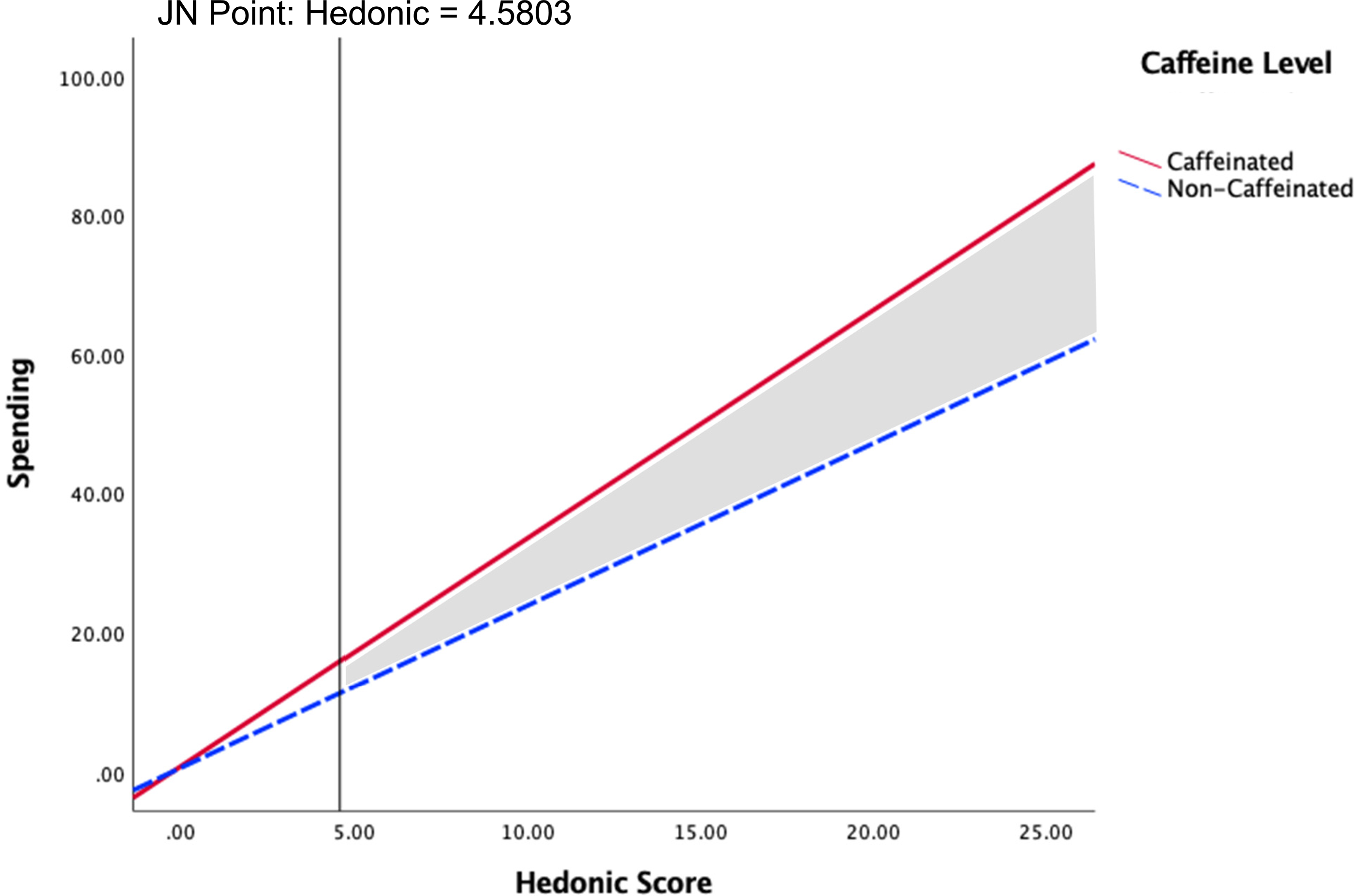
Johnson–Neyman Analysis of Total Spending as a Function of Caffeine Level (Caffeinated vs. Noncaffeinated) and Hedonic Score (Study 3).
We also conducted the Johnson–Neyman analysis with three levels of the independent variable (caffeinated coffee vs. decaf coffee vs. water) following the procedure outlined by Hayes and Montoya (2017). There was a significant interaction effect between caffeine and hedonic score on spending (B = −.9478, SE = .3548, CI95 = [−1.6494, −.2463]; F(1, 139) = 7.14, p = .009). Figure 3 plots the Johnson–Neyman significance region for the floodlight analysis. Again, the spending gap between caffeinated and noncaffeinated beverages is magnified for higher hedonic scores and attenuated for lower hedonic scores, as Figure 3 illustrates.

Johnson–Neyman Analysis of Total Spending as a Function of Caffeine Level (Caffeinated vs. Decaffeinated vs. Water) and Hedonic Score (Study 3).
Discussion
The results of this field study show that, consistent with H1, having a caffeinated (vs. noncaffeinated) beverage before a shopping trip leads to greater spending and more items purchased. Moreover, as predicted in H3, the effect of caffeine on shopping impulsivity is stronger for high-hedonic (vs. low-hedonic) products. Next, we examine the effects of caffeine consumption in controlled lab settings.
Study 4a: Caffeine Effects for High- Versus Low-Hedonic Products
Studies 1–3 (and the Web Appendix H study) were conducted in the field, which helped us capture actual customer shopping behaviors. These studies consistently showed that caffeine consumption before shopping enhanced the number of items purchased and the amount of money spent. Study 4a examined this phenomenon in a controlled lab setting and also manipulated the type of products (high hedonic vs. low hedonic) made available to participants.
Method
Study 4a was a 2 (beverage consumed: caffeinated coffee vs. water) × 2 (product set: high hedonic vs. low hedonic) between-subjects experiment. This study was preregistered (https://aspredicted.org/blind.php?x=N5P_2RB). The dependent variable is the number of items chosen during a simulated shopping episode. We expect an overall main effect of caffeine intake on the number of items purchased (consistent with H1), and we also expect that the effects of caffeine on the number of items purchased will be stronger for high-hedonic products and weaker for low-hedonic products (consistent with H3). We do not necessarily expect an interaction effect if the expected effect of caffeine on purchasing is in the same direction for high-hedonic and low-hedonic products. The dependent variable is the number of items selected for purchase.
We reached out to over 300 students (with zero overlap) enrolled across eight different classes at a major business school in France. A total of 209 students (coffee: 110, water: 99; Mage = 24 years; 66% female) volunteered to participate in this study. Although no extraneous incentives were provided, the study was later used as a learning tool for a marketing research session. Students arrived in a classroom specifically set up for the study, in groups of up to 20. To manipulate the first factor (caffeinated vs. noncaffeinated beverage), participants were given either a cup of caffeinated (about 100 mg caffeine) coffee (Lavazza Il Mattino brand) or a 500 mL water bottle (Cristaline brand). All labels were removed and no information was provided regarding caffeine content. All of the participants in a group received the same beverage. The order of beverages (coffee vs. water) was alternated across each session.
After participants drank all or almost all of the beverage, they were informed that they would have to wait for a few minutes before undertaking the next part of the study. They were allowed to do anything they wanted during this ten-minute waiting period. Most of the participants just chatted with each other during this time. We wanted to have a ten-minute gap between the beverage consumption and the shopping task to ensure that the effects of the caffeine had been activated. After the ten-minute period, participants were told to start and complete the survey provided. Once participants completed the survey, they were informed that a video containing the debriefing statement, explaining the purpose of the survey, would be available through their course website in a few days.
For the second factor (type of product: high vs. low hedonic), participants were given a screenshot of a set of products that were pretested (N = 66) to represent a high-hedonic product category or a low-hedonic product category. These screenshots were obtained by using the search terms “cadeau relaxation” (English translation: “relaxation gift”) and “carnet de notes et agendas” (English translation: “notebooks and diaries”) on Amazon's France-based website and capturing the images for the first 20 items displayed. In the pretest, participants rated the high-hedonic (vs. low-hedonic) product set to be significantly more hedonic (M = 5.02 vs. M = 2.42; t(65) = 11.19, p < .001). Figure 4 provides the images of the product sets. See Web Appendix K for larger images and additional details.

Images for High-Hedonic (Panel A) and Low-Hedonic (Panel B) Product Sets (Study 4a).
In the main study, participants were asked to take a look at the product set in their survey (which was either the high-hedonic mix or the low-hedonic mix) and then indicate the items they wished to purchase at that moment. The number of items selected was the dependent variable.
Results and Discussion
As per the exclusion criteria mentioned in the preregistration, responses that were over four standard deviations from the mean were to be excluded. This resulted in only one participant being excluded (who selected nine items). This led to a total of 208 participants. Because the value of nine was just above the Mean + 4 SD mark (of 8.98), we also conducted the analyses with this participant retained. In the interest of transparency, we report the analyses with the full sample in Web Appendix K. The pattern of results remains unchanged.
The results of a Poisson log-linear regression model show a significant main effect of the beverage with the number of items purchased being higher when coffee (vs. water) was consumed (Mcoffee = 2.75 vs. Mwater = 2.16; Wald χ2(1) = 7.08, p = .008). There was also a main effect of the type of product, with the purchase amount being higher for high-hedonic (vs. low-hedonic) products (Mhigh = 2.83 vs. Mlow = 2.08; Wald χ2(1) = 11.83, p = .001). The interaction effect was not significant (Wald χ2(1) = 1.86, p = .17), which is not surprising, as caffeine intake led to a directionally higher number of items for both the high-hedonic and the low-hedonic product categories, albeit to different degrees. Specifically, follow-up tests indicate that for high-hedonic products, coffee (vs. water) consumption led to a higher number of items selected (Mcoffee = 3.28 vs. Mwater = 2.33; Wald χ2(1) = 8.44, p = .004), with the effect attenuated for low-hedonic products (Mcoffee = 2.17 vs. Mwater = 1.98; Wald χ2(1) = .44, p = .51). Figure 5 graphically presents these results.

Caffeine Effects for High- and Low-Hedonic Products (Study 4a Results).
The findings of this study support H3 and demonstrate that although caffeine intake leads to an overall higher number of items selected, this effect is stronger for high-hedonic products and attenuated for low-hedonic products. Study 4b examines this further.
Study 4b: Role of the Perceived Hedonic Level of Product Mix
Whereas Study 4a used a between-subjects design to manipulate high- versus low-hedonic products, in Study 4b, we used the same product mix for everyone and examined how the effect of caffeine on purchasing is influenced by the perceived hedonic value of the product mix. In addition, whereas Studies 1–4a used coffee as the caffeinated beverage, we used tea in Study 4b.
Methods
This study had two between-subjects conditions (caffeinated vs. noncaffeinated beverage) and participants were undergraduate students at a major U.S. university. Participants saw a website image with a display of 24 items. This set of items was obtained by searching for “relaxing gifts” on Amazon's U.S. website and taking a screenshot of the first 24 items (see Figure 6). See Web Appendix L for pretest details and larger images.

Product Set Image (Study 4b).
We picked a product category that is perceived as relatively high hedonic because the effects of caffeine on purchasing are stronger for high-hedonic products, as revealed in Studies 3 and 4a. The key dependent variable was the number of items participants would purchase in this simulated shopping scenario. This was captured by asking, “Suppose you are shopping on this website right now. How many of the items featured above would you like to purchase?”
We next captured the perceived hedonic value of the assortment. Participants were told, “Next, we would like to know how hedonic you perceive the products featured on the website image.” They were then informed that “hedonic products provide fun, pleasure, and fantasy” (Dhar and Wertenbroch 2000). Participants were then asked, “Overall, how hedonic is the set of products pictured below?” (with the website image displayed below this question). Responses were anchored at 1 = “not at all hedonic,” and 7 = “very hedonic.” As we expected, the mean hedonic value of 4.53 was significantly higher than the scale mid-point of 4 (t(220) = 5.18, p < .001).
For the first factor (caffeinated vs. noncaffeinated beverage), for both beverage conditions, six squirts of Great Value–branded “Southern Sweet Tea” flavored drink enhancer was added to a gallon of water. Then in the “caffeinated” beverage condition, SToK-brand caffeinated shots (which are practically tasteless and odorless) were added. Each of these shots contains 40 mg of caffeine, and 34 of these were added to a gallon of water. Close to four U.S. fluid ounces were served in each cup, and each gallon of mixed beverage led to about 40 servings. As a result, each cup of caffeinated beverage had about 34 mg of caffeine. The beverages were served at room temperature for both conditions.
Participants arrived in the waiting area of a lab at their scheduled time. Research assistants served the beverages to the participants in the waiting area (which was outside the lab). Whereas in Studies 2–4a, participants were not told anything about the caffeine content, in this study, participants were told whether the beverage contained caffeine. No information was given about the amount of caffeine content.
After drinking the beverage, participants stayed in the waiting area for close to ten minutes. During this period, most participants just checked their cell phones. After the waiting period, participants were brought into the lab by the research assistants. The study was conducted on a Monday and a Wednesday, between around 1:30 and 3:30
Results
Main effects
The results of a Poisson log-linear regression model reveal a main effect of consuming a caffeinated (vs. noncaffeinated) beverage on the number of items chosen (Mcaffeine = 3.83 vs. Mnoncaffeinated = 3.27; Wald χ2(1) = 4.62, p = .03). There was no main effect of consuming a caffeinated (vs. noncaffeinated) beverage on the perceived hedonic value of the set of items displayed (Mcaffeine = 4.41 vs. Mnoncaffeinated = 4.70; F(1, 219) = 1.95, p = .16).
Effects of caffeine and perceived hedonic value
Including perceived hedonic values of the products as a covariate in the Poisson log-linear regression model makes the main effects of caffeine on the number of items chosen stronger (Wald χ2(1) = 7.90, p = .005). We ran a floodlight analysis using a bootstrapped samples (5,000) procedure with PROCESS Model 1 (Hayes 2017). Similar to Study 4a, there was no significant interaction effect between caffeine and the hedonic value on the number of items chosen (B = −.2893, SE = .2369, CI95 = [−.7562, .1776]). Consistent with our conceptualization, the effects of caffeine on the number of items chosen was stronger at higher perceived hedonic values. Specifically, the Johnson–Neyman significance region is at 4.4103 and higher (with 54.30% of the responses above this value and 45.70% of the responses below this value). Figure 7 presents the floodlight analysis of the conditional effects of caffeine on the number of items chosen at different values of perceived hedonic value with the shaded area as the region of significance.
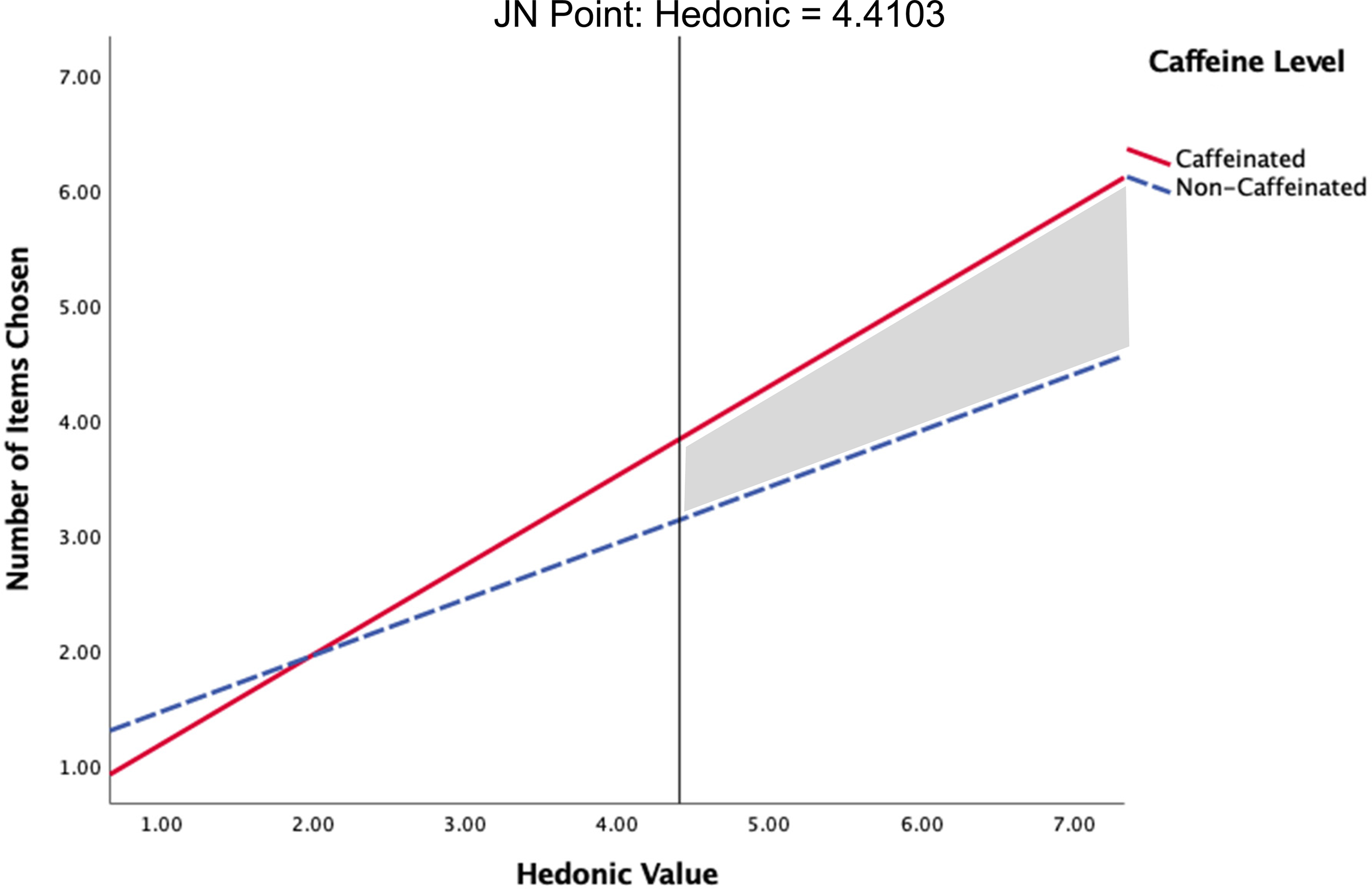
Number of Items Chosen as a Function of Caffeine Level and Hedonic Value (Study 4b).
Discussion
The results of this study replicate the effects observed in our other studies and demonstrate that a caffeinated (vs. noncaffeinated) beverage leads to a higher number of items selected. Moreover, the main effect of caffeine holds when the items are perceived to be high hedonic and is attenuated for participants who perceive the items to be low hedonic. This study also enhances the overall robustness of the phenomenon by examining the effects of caffeinated tea as a beverage (while our other studies used coffee).
Some important similarities and differences should be noted between Study 3 and Studies 4a and 4b. Across all three of these studies, there was a significant main effect of caffeine on the number of items purchase and/or selected. However, the interaction effect pattern differed across the experiments. In Study 3, there was a significant interaction effect for the caffeine × hedonic categorization mixed-design model. In contrast, in Studies 4a and 4b, there was no significant interaction effect, because caffeine consumption led to a directionally higher number of items for both high-hedonic and low-hedonic products (in Study 4a), with the effect being significant for the former and attenuated for the latter. One critical difference at play here is the fact that Study 3 is a field study, whereas Studies 4a and 4b are lab studies. That is, the outcomes are more consequential in Study 3, which involved actual money spent for the purchases, while Studies 4a and 4b had hypothetical choices. Overall, while the main effects of caffeine are significant in all five studies, it is possible that the differential effects for high-hedonic versus low-hedonic products work at the margins only. That is, the main effects for caffeine might work for a wide range of hedonic values for products, and the effects weaken only for very low-hedonic products. We conducted an additional study with students from a U.S. university that again demonstrated that the effects of caffeine intake on purchasing behavior are relatively stronger for high-hedonic (than low-hedonic) products. This additional study is reported in Web Appendix M.
General Discussion
The findings from a series of studies conducted at retail stores and in the lab indicate that consuming a caffeinated (vs. noncaffeinated) beverage before shopping leads to higher shopping impulsivity in terms of a higher number of items purchased and greater spending. In essence, caffeine consumption enhances energetic arousal, which, in turn, leads to impulsivity during the shopping trip. In addition, the effects of caffeine on shopping impulsivity are stronger for high-hedonic (vs. low-hedonic) products. Furthermore, the effects of caffeine on spending hold for people who drink approximately two cups of coffee (or less) daily and are attenuated for heavy coffee drinkers (see Web Appendices G and I). It should be noted that the effect of caffeine on shopping impulsivity is a robust phenomenon, with independent teams of researchers finding similar patterns of the effects across multiple retail stores in different countries (France and Spain). Studies with university students in France and the United States replicate these effects.
The findings of this research contribute to our knowledge of how a stimulant like caffeine influences consumer purchasing behavior. To the best of our knowledge, this is the first research to examine the effects of caffeine intake on shopping and marketing-related outcomes. This research also adds to the vast literature outside the marketing domain on the effects of caffeine and other stimulants. We contribute to this stream by demonstrating how consuming a caffeinated beverage enhances energetic arousal, which, in turn, leads to shopping impulsivity in terms of the number of items purchased and overall spending. These findings have both conceptual and practical implications.
With retail stores often offering complimentary foods/beverages and consumers consuming caffeinated beverages before shopping (e.g., at a coffee bar before entering a store or drinking coffee before/while shopping online from home), it is important to understand how such consumption might influence shopping behaviors. Thus, examining the effects of caffeine intake on shopping has relevance for marketing practices and for consumer behavior.
Managerial, Consumer, and Regulatory Implications
The findings of this research demonstrate a managerially important consequence of caffeine consumption in terms of the effects on shopping behavior. Specifically, having a caffeinated beverage at the beginning of a shopping trip leads to higher impulsivity, whereby consumers purchase a higher number of items and spend more. This finding is important for marketers in terms of how a seemingly unrelated behavior of caffeine consumption can influence consumers’ spending amounts. As mentioned previously, many retail outlets have coffee bars and restaurants (e.g., Nordstrom, Target), while others offer complimentary samples to shoppers (e.g., Trader Joe's). Interestingly, the “Mercedes Me” store, a car dealership showroom concept implemented by Mercedes-Benz, is based on a “Bistro-Bar-Lounge-Showroom” in which coffee is served to customers. According to Mercedes's marketing managers, this particular showroom concept has increased sales notably (Pander 2014). While we are not claiming that caffeine consumption alone led to this phenomenon, it is potentially a contributing factor.
Overall, retailers can benefit financially if shoppers consume caffeine before or during shopping. With ubiquitous availability of coffee and other caffeinated beverages, it is quite likely that many shoppers are having significant caffeine intake at the time of their shopping. This in turn can lead to greater impulsivity and, thus, a higher degree of spending. The findings of our research also suggest that the effects of caffeine on spending are stronger for high-hedonic products. This is relevant information for retailers to factor in to determine the appropriate product mix (i.e., proportion of hedonic products) depending on whether their customers have the opportunity to consume caffeine (e.g., at an in-store coffee bar) before shopping.
Although consumers’ caffeine intake clearly benefits retailers, consumers should be informed of the unintended consequences of consuming caffeine, perhaps through media coverage, and they should decide whether consuming caffeine before shopping is appropriate. Regulators can also educate consumers about the potential effects of caffeine on spending. This is especially relevant since, over time, unplanned spending can lead to undesirable outcomes for consumers, such as financial distress.
While there can be negative consequences of caffeine consumption on impulse spending, we should also highlight some positive aspects of caffeine intake. Recent studies suggest that moderate amounts of caffeine consumption can have positive health benefits, especially for the heart (Stevens et al. 2021). Moreover, from a marketer's perspective, along with caffeine's effects on purchasing behavior, caffeine might also make for a more pleasant shopping experience due to the higher level of energetic arousal, which is a positive hedonic state.
Future Research Directions
In our research, we examined the effects of actual caffeine intake on spending. Are there effects when consumers encounter the ambient scent of coffee without actually drinking it (Madzharov et al. 2018)? We also examined the effects of caffeine on purchasing, an important marketing-related variable. Can caffeine also influence other marketing-related outcomes, such as attitude or loyalty toward a store?
We showed how caffeine intake leads to higher spending, which is potentially a negative outcome for consumers in terms of unplanned spending and financial well-being. However, moderate amounts of caffeine intake can have positive health benefits (Bolton and Null 1981; Stevens et al. 2021). Research is needed to explore the potential positive effects of caffeine on consumer behavior. For example, can caffeine consumption lead to more mindful judgments in some contexts? Given that caffeine can enhance memory and attention (Bolton and Null 1981), will it lead to greater focus and recall of product attributes? Can caffeine enhance attention to advertising messages?
In our studies, participants were given moderate to low amounts of caffeine, keeping in mind ecological validity issues. However, from a theoretical standpoint, how might a very high amount of caffeine intake affect spending? Since very high amounts of caffeine intake can lead to tense arousal for some people (Nehlig 2010), it is possible that a very high amount of caffeine consumption before shopping can lead to lower spending.
Our observed main effects for caffeine on shopping can be extended in several directions. For example, can arousing elements in ambience (e.g., loud music) moderate the effects of caffeine on shopping behavior? Very high levels of arousal, perhaps induced through a combination of caffeine intake and ambient elements, can backfire in terms of purchases. Caffeine-induced energetic arousal can also potentially influence reactions to store ambience (such as preference for different ambient scents). What if someone drinks coffee along with some other food? For example, what if the coffee is paired with an indulgent item (e.g., a chocolate cake)? There are several relevant and interesting different directions for future research involving caffeine and other variables.
Although caffeine has sometimes been compared with other addictive stimulants, such as amphetamines and cocaine, the former differs from the latter in terms of physiological reactions (Nehlig 1999; Winston, Hardwick, and Jaberi 2005). As a result, shopping behavior after consuming these classical drugs of misuse (e.g., cocaine, amphetamines) is likely to be different than after consuming a psychomotor stimulant such as caffeine. In addition, whereas caffeine intake induces energetic arousal, intake of these other drugs strongly impairs cognition. At the same time, similar to caffeine, the intake of amphetamines and opiates leads to impulsivity and loss of self-control (Ersche and Sahakian 2007). These are important areas of future research, especially because many people regularly use drugs like amphetamines, opiates, and cocaine (Hafner 2016). Unfortunately, there is little research in the marketing literature that examines how these drugs might influence consumer behavior. There is scope for very interesting and relevant work in these domains.
Given the uncharted territory of examining caffeine effects in the marketing domain, there is opportunity for significant additional work on caffeine effects in marketing contexts. This is especially important because some of the most popular beverages worldwide, such as coffee, tea, and soda, tend to have significant caffeine content. Thus, it is important to understand how the intake of caffeine, through daily consumption of these popular beverages, can affect different marketing-related outcomes. We hope our research will spur further work in this domain.
Supplemental Material
sj-pdf-1-jmx-10.1177_00222429221109247 - Supplemental material for Caffeine’s Effects on Consumer Spending
Supplemental material, sj-pdf-1-jmx-10.1177_00222429221109247 for Caffeine’s Effects on Consumer Spending by Dipayan Biswas, Patrick Hartmann, Martin Eisend, Courtney Szocs, Bruna Jochims, Vanessa Apaolaza, Erik Hermann, Cristina M. López and Adilson Borges in Journal of Marketing
Footnotes
Acknowledgments
The authors thank the JM review team for excellent comments. They also thank Timothy Heath and Maura Scott for helpful suggestions.
Author Note
Patrick Hartmann, Martin Eisend, Courtney Szocs, Bruna Jochims, Vanessa Apaolaza, and Adilson Borges contributed equally.
Associate Editor
Martin Schreier
Declaration of Conflicting Interests
The author(s) declared no potential conflicts of interest with respect to the research, authorship, and/or publication of this article.
Funding
The author(s) disclosed receipt of the following financial support for the research, authorship, and/or publication of this article: This work was supported by the Frank Harvey Endowed Professorship, Piccadilly Inc. Business Partnership Professorship, Basque Government, Spanish Government, and European Regional Development Fund, FESIDE Foundation (grant number GIC 15/128; IT-952-16, ECO2016-76348-R, AEI/FEDER, UE, FE 16-1).

References
Supplementary Material
Please find the following supplemental material available below.
For Open Access articles published under a Creative Commons License, all supplemental material carries the same license as the article it is associated with.
For non-Open Access articles published, all supplemental material carries a non-exclusive license, and permission requests for re-use of supplemental material or any part of supplemental material shall be sent directly to the copyright owner as specified in the copyright notice associated with the article.
