



Abstract
How markets evolve is a perennial and important question in business. Building on a large qualitative data set on the coffee market comprising primary and secondary interviews, archival data, and fieldwork, the authors introduce a novel theoretical mechanism—practice expansion—to explain how ongoing institutional complexity fosters market evolution. To theorize practice expansion, the authors combine institutional logics with resource partitioning and introduce a two-by-two typology of firms evolving in markets: craft versus commercial and generalist versus specialist. The authors’ analysis, grounded in this typology, identifies three mechanisms that explain practice expansion (elaboration, translation, and transformation). The authors then show how practice expansion contributes to market evolution by increasing product diversity, broadening skills and knowledge, and enriching the market meaning system. The novel theory introduced in this article contributes to extant work by theorizing market evolution as resulting from practice expansion and by broadening our understanding of the types of firms and their interactions important to that evolution. The novel theory also points to important strategy implications for how different types of firms can contribute to and benefit from the identified evolutionary patterns and ongoing institutional complexity.
Keywords
In many markets, such as barbering, beer, butchering, chocolate, cocktails, coffee, cuisine, denim, fashion, motorcycles, and tattoos, firms’ strategies are governed by commercial and craft institutional logics (Kroezen and Heugens 2018; Ocejo 2010; Sennett 2008). By “institutional logic,” we refer to “the socially constructed, historical pattern of material practices, assumptions, values, beliefs, and rules” that prescribe how an organization should act (Thornton and Ocasio 1999, p. 804). The commercial and craft logics provide incompatible prescriptions and competing demands for firms—a market environment scholars qualify as institutionally complex (Greenwood et al. 2011). On the one hand, the commercial logic orients firm efforts toward the pursuit of profits and scale (Dolbec et al. 2022). On the other, the craft logic orients firm efforts toward aesthetic engagement (Kroezen and Heugens 2018). Institutional complexity is a source of tensions and challenges for firms, and previous work endeavors to explain how firms can manage these (Dolbec et al. 2022; Ertimur and Coskuner-Balli 2015). Yet in markets such as the ones we have mentioned, ongoing institutional complexity can also be a source of change and innovation. However, extant work has not examined how ongoing institutional complexity can foster market evolution.
To address this gap, we analyze changes in the coffee market since the early 2000s and develop a novel theory of market evolution. We document transformative dynamics spurred by interactions between firms reflecting commercial and craft logics using a large qualitative data set. Our analysis finds that craft and commercial logics can be embraced by either generalist (i.e., a firm that pursues a broad target) or specialist (i.e., a firm that pursues a narrow target) firms, producing a two-by-two typology that offers a unique window into the types of interactions occurring between these types of firms. Leveraging this typology, we theorize three mechanisms to explain transformative market dynamics—elaboration, translation, and transformation activities—that we refer to in aggregate as “practice expansion.” We then show how practice expansion leads to key market outcomes in the forms of increased product diversity, broadened skills and knowledge, and an enriched market meaning system.
We contribute to extant work in several ways. First, our novel typology of firms introduces more explanatory power to the study of market evolution. This typology is valuable because it suggests the possibility that the four types of firms, which vary in their goals and targets, may influence one another in important ways. Second, the interactions between firms that we identify offer new insights into how market evolution might unfold as innovations are introduced and adapted by firms that reflect different institutional logics and pursue different targets. Last, in contrast to work on product innovation, we focus on firms’ practices and introduce the novel overarching mechanism of practice expansion to explain market evolution. Practice expansion is proposed as a process distributed across firms over time, where firms of a certain type modify practices, and firms of other types adapt changes in practices to address their respective logics and targets.
We begin by contextualizing our research with a brief review of the evolution of the coffee market since the early 1990s. We then explain that previous work does not address how institutional complexity can foster market evolution and that existing theories of market evolution cannot fully account for the evolution of the coffee market in recent decades. Next, we introduce practice theory and key concepts from resource partitioning theory to situate our analysis. After describing our method, we present our findings. First, we exemplify how the craft and commercial logics inform the actions of firms in the coffee market. Then, we offer a two-by-two typology of firms by intersecting the craft and commercial logics with specialist and generalist orientations and leverage this typology to theorize how practices expand following elaboration, translation, and transformation mechanisms. We demonstrate how practice expansion contributes to the three key market outcomes. We conclude our findings with a summary case that brings together our theoretical insights. Last, we discuss theoretical contributions and managerial implications.
The Evolution of the Coffee Market
Flashback to the early 1990s: annual coffee consumption was steadily declining, dropping from approximately 35 gallons per person in 1970 to 25 gallons per person in 1990 (Buzby and Haley 2007). The industry experienced years of consolidation (Pendergrast 2010). People mostly consumed drip and instant coffee. This period, colloquially referred to as the first wave, saw static market shares and diminishing coffee consumption despite massive investments in advertising campaigns (Pendergrast 2010). By the early 1990s, an upscale coffee market was brewing. The large firms that dominated the market—Kraft General Foods (Maxwell House) and Procter & Gamble (Folgers), which had a combined market share of 65%—mostly ignored the entrance of specialists into the market (Pendergrast 2010).
Starbucks rose within this upscale segment and drove the market throughout the 1990s. This period is colloquially referred to as the second wave. Starbucks translated the Italian coffee experience to fit North American tastes and “transformed gourmet coffee from a yuppie status symbol into a mainstream consumer good” (Thompson and Arsel 2004, p. 631). The company captured mainstream consumers and grew from 84 coffee shops in 1991 to 425 in 1994 and 8,836 in 2006 (https://www.starbucks.com/about-us/). By the mid-2000s, however, sales had declined, and the share price of the company dropped by more than 50%. Starbucks’ market-driving role stalled.
What should have happened next is unclear. We might expect that Starbucks’ stalled role would slow the evolution of the mostly consolidated coffee market because of weaker innovation investments, fewer entrants, or consumers’ lack of renewed interest in existing products. However, throughout the 2000s, 2010s, and 2020s, the market continued to expand following its next evolutionary leg—the third wave.
To explain the evolutionary dynamics associated with third wave coffee and offer a new view on market evolution, we integrate the literature on institutional complexity with concepts from resource partitioning and practice theory, which we review next.
Institutional Complexity and the Evolution of the Coffee Market
The evolutionary dynamics of third wave coffee are characterized by ongoing institutional complexity—competing logics that coexist in a market over time (Ertimur and Coskuner-Balli 2015; Purdy and Gray 2009). Initially dominated by the commercial logic, the coffee market saw the emergence and growth of the craft logic, manifested as the entry of tens of thousands of craft firms in the market. The entry of craft firms heightened institutional complexity and led to the coexistence of the commercial and craft logics. For example, the number of specialty coffee shops in the United States grew from 1,650 in 1991 to about 10,000 in 1998 and 31,490 in 2015 (Specialty Coffee Association of America [SCAA] 2015, 2016). Specialty coffee is now more than half of the $48 billion retail value of the U.S. market (SCAA 2015).
In markets such as the one for coffee, the craft logic organizes firms’ efforts toward aesthetic engagement (Kroezen and Heugens 2018) driven by deep expertise, commitment, and aspiration to quality (Sennett 2008). The craft logic can be found in many markets, such as those for barbering, beer, butchering, chocolate, cocktails, coffee, cuisine, denim, fashion, motorcycles, and tattoos (Kroezen and Heugens 2018; Ocejo 2010; Sennett 2008). For example, in the beer market, the craft logic orients brewing as a “creative enterprise [and] a form of artistic expression” in which brewers produce “beers with unique taste and [educate their] audience to [the] appreciate product” (Kroezen and Heugens 2018, pp. 1000, 1002). Craft firms focus on peer recognition, which is mostly removed from customer demands and is based on reflexive engagement with production practices (Bourdieu 1996).
The craft logic diverges from the commercial logic, which orients firms’ efforts toward the pursuit of profits (Dolbec and Fischer 2015; Dolbec et al. 2022). For example, in the beer market, commercial firms are sales-driven and aim for consistent, large-scale, and profitable production (Kroezen and Heugens 2018). Commercial firms produce customer-oriented and mass-marketed goods that convert cultural recognition into profits (Bourdieu 1996). Our emergent theory explains how tensions between firms reflecting different logics can fuel market evolution.
Although institutional complexity has received much interest (Greenwood et al. 2011), research has yet to inform the processes through which it contributes to market evolution. Rather, it has focused on explaining either how firms manage competing logics or how logics in markets evolve, both of which we describe next.
The first stream of work operates at the organizational level and examines how firms manage the tensions inherent in institutional complexity (Greenwood et al. 2011) or take advantage of them to bolster their competitive positioning (Dolbec et al. 2022; Ertimur and Coskuner-Balli 2015). A key insight from such work is how firms can concentrate on a single logic or span competing logics by isolating them (e.g., within business units) or creating hybrids (e.g., hybrid organizational forms or strategies). For example, Ertimur and Coskuner-Balli (2015) inform how firms can choose to concentrate on a single logic (brand specialist) or to couple logics (brand generalist) to position themselves in an institutionally complex market. Although informative, such work concentrates on the activities of single firms and does not address the dynamics among diverse firms that can foster market evolution.
The second stream of work operates at the market level and focuses on how a new logic replaces or coexists with a previously dominant one (Dolbec and Fischer 2015; Dunn and Jones 2010; Purdy and Gray 2009; Thornton and Ocasio 1999). New logics emerge following external shocks, such as the oil crisis in the U.S. electric power industry (Sine and David 2003), or internal contradictions, such as contestations between professionals (Dunn and Jones 2010). Such events create opportunities for a shift in logics, especially when supported by entrepreneurial actors with a desire to change a market. Transformations can also emerge from the engaged and interested work of actors who have no such change agenda (Dolbec and Fischer 2015). As for the maintenance of ongoing institutional complexity, Purdy and Gray (2009) propose that it can follow specific market characteristics, such as divergent goals and the presence of multiple pools of resources. What is missing from this second research stream is how specific market evolution dynamics may result from the interactions among firms reflecting distinctive logics.
Our research extends these traditions by investigating how institutional complexity results in specific dynamics that foster market evolution. We next briefly discuss other existing theories of market evolution, their limitations in explaining the evolution of the coffee market, and how our emergent theory differs.
Can Existing Theories Explain the Evolution of the Coffee Market?
Work on resource partitioning, market driving, or product innovation can partly explain some developments of the coffee market. Each of the three approaches to theorizing market evolution, however, has blind spots that preclude a thorough and comprehensive understanding of the transformations of the coffee market during the third wave, and none of the approaches offer insights related to how ongoing institutional complexity can foster market evolution. We next discuss key differences between these approaches and our emergent theory (see Table 1).
Comparison of Four Research Streams on Market Evolution.
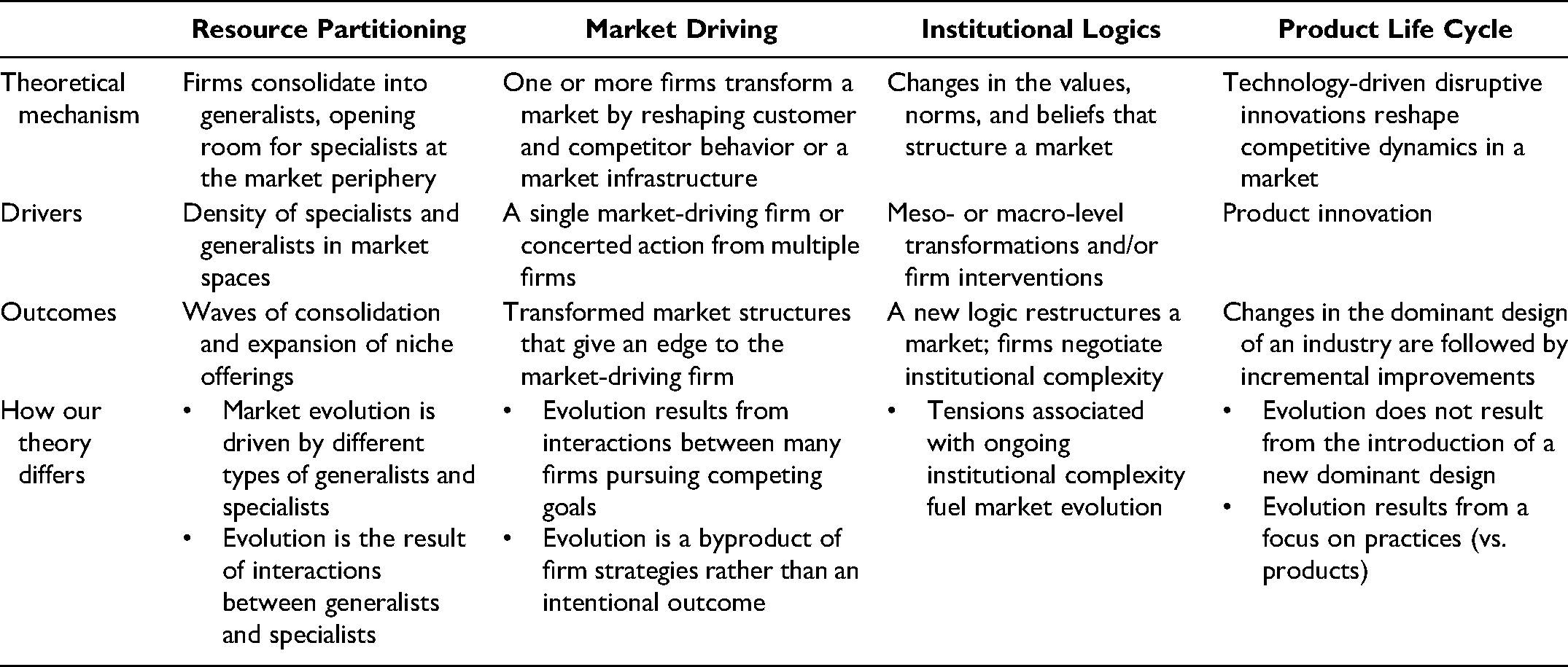
Work in resource partitioning would predict the emergence and growth of specialist firms following high market concentration, such as craft coffee firms during the second and third waves (Carroll and Swaminathan 2000). However, this approach has typically conflated commercial firms with a generalist orientation and craft firms with a specialist orientation (Carroll and Swaminathan 2000; Ertimur and Coskuner-Balli 2015). On the contrary, our analysis shows that commercial firms can be specialists and craft firms can be generalists. In addition, resource partitioning conceptualizes specialists and generalists as operating in mostly independent market spaces (Ertimur and Coskuner-Balli 2015), which hinders an examination of firm interactions and how they can contribute to market evolution. By contrast, our emergent theory focuses on how interactions between specialists and generalists contributed to market evolution during the third wave.
Research on market driving concentrates on efforts by a single firm or group of firms aligned in their vision to transform a market as the evolutionary mechanism. For coffee, Starbucks played a market-shaping role during the second wave (Humphreys and Carpenter 2018; Maciel and Fischer 2020). This approach falls short of informing how the actions of firms pursuing competing goals can transform a market without the strategic intent to do so, as occurred during the third wave.
Last, a large body of work on product and industry life cycles and product innovation explains how markets evolve through incremental or disruptive transformations of end products (Sood and Tellis 2005). This work shows how technological disruption can lead to the development of new standards that govern a market (i.e., a new dominant design) but underexplains other avenues for market evolution, such as craft. Since this body of work focuses on product innovation, it also downplays changes in competences and meanings, which we position as key drivers of market evolution and theoretically important given their centrality for consumption (Holt 1998).
A Practice Perspective on Institutional Complexity and Market Evolution
We adopt a practice theory perspective to study how institutional complexity contributes to market evolution. “Practices” are patterns of action commonly understood and shared across people. They provide templates that guide people's actions. As a result, practices organize what makes sense for people to do and how to do it in both consumption and production. Practices comprise three interacting elements: materials (e.g., products, equipment, objects, tools), competences (e.g., know-how, skills), and meanings (e.g., categories, symbols) (see Shove, Pantzar, and Watson 2012). Practices can be put into action, or performed, in different ways. For example, a Starbucks employee, a professional barista, and a neophyte consumer perform the practice of making coffee differently, but all recognize that they are making coffee. 1
Logics inform how practices are performed by people and firms (Ertimur and Coskuner-Balli 2015). For example, making coffee to pursue high profitability (the commercial logic) is different from making coffee to pursue quality and artistic expression (the craft logic). A Dunkin’ employee making coffee for the morning crowd or a professional barista aiming to make the perfect pourover for a coffee enthusiast will assemble different material elements with different levels of skills and know-how, informed by and reflecting different meanings (e.g., an affordable coffee to wake up vs. a coffee to be savored).
A practice perspective is useful for understanding how institutional complexity can foster market evolution for several reasons. First, it provides a theoretical perspective and vocabulary to examine how and why firms in the same market perform the same practices differently and how these different performances influence one another. Second, practice theory provides an analytical framework for how institutional complexity can contribute to market evolution. In our work, we explain market evolution through a specific type of change in practices: practice expansion.
“Practice expansion” refers to increases in (1) the range of practice elements (e.g., new products such as coffee pods, new competence associated with latte art), (2) heterogeneity in the priority of practice elements during performances by different actors (e.g., the relative importance of weighing coffee beans or choosing the right grind size), and/or (3) relationships between practice elements (e.g., the strength of the relationship between grind size and extraction method) (see Shove, Pantzar, and Watson 2012). Practice expansion results in a greater repertoire of possible performances (e.g., when the practice of coffee-making expands, people have more ways of making coffee). Therefore, a practice perspective is useful for understanding market evolution because it provides an overarching mechanism to explain changes in products (material elements), skills and knowledge (competences), and the market meaning system (meanings), which are part of practices and, consequently, increase in diversity as practices expand. We summarize key terms in Table 2.
Key Terms and Definitions.

Method
Our theory emerges from an analysis of the coffee market based on a large qualitative data set composed of archival data, primary and secondary interviews, and participant observations. Our data cover different roles in the coffee market, including farmers, roasters, baristas, and coffee shop owners. We conducted 14 primary interviews, which lasted 40 minutes to 4 hours, with these actors. During the interviews, we discussed the interviewees’ everyday coffee performances, their concerns and opinions about the market, and their perceptions of competitors. We also observed performances during 12 industry and consumer events, such as competitions, conferences, and cuppings, where we took field notes and photographs.
Our archival data set is composed of four types of data: secondary interviews with market actors, articles from the general and specialized coffee press, podcasts on coffee, and research reports from coffee organizations and market research firms. First, we gathered interviews with 42 market actors, such as coffee farmers and roasters, baristas, consultants, buyers and importers, and other actors involved in the commercialization of coffee, that were previously published in traditional media such as Barista Magazine and podcasts on the coffee market. We gathered several interviews per role to provide more complete coverage of the views of these actors. Podcast interviews were transcribed in their entirety. Second, we gathered articles from the press for the 2000–2020 period. We searched Factiva for articles in the general press containing the phrases “specialty coffee” or “third wave coffee” in the title or the lead paragraph. Third, we collected data from coffee events and talks. Fourth, to fully understand the workings of coffee shops and the coffee industry, we listened to two coffee podcasts: Cat & Cloud and The Coffee Podcast. We did not transcribe all podcast episodes in their entirety; instead, we took notes that covered relevant episode sections. In addition, we identified and fully transcribed 19 episodes that clearly addressed our research questions. Fifth, we gathered additional data on specific practices or actors as our findings emerged. For example, during the creation of our typology, we collected additional data on types of firms, such as commercial specialists and craft generalists. We also explicitly searched for articles and videos associated with key products and practices, such as coffee pods and pourover, and we gathered data from a wide range of publications, such as coffee-specific blogs and online magazines, as well as general interest media. Last, to better evaluate the key market outcomes, we gathered reports from market research firms, governmental and nongovernmental organizations, and trade associations. We summarize our data set in Table 3 and include a list of references for our archival data in Web Appendix A.
Data Sources.

All pages reported are single-spaced, Times New Roman, 12-point font.
Our data analysis was undertaken concomitantly with data collection. We moved back and forth among data collection, analysis, and theorization, which is a standard procedure in qualitative research (Belk, Fischer, and Kozinets 2012). We coded the data openly and generated themes as they emerged. We also generated theoretically informed codes to develop our findings (Dolbec, Fischer, and Canniford 2021).
An Emergent Theory of Market Evolution
Our emergent theory addresses how ongoing institutional complexity fosters market evolution. We first describe how the craft and commercial logics operate in the coffee market and introduce a two-by-two typology of firms arising from the intersection of the craft and commercial logics with the specialist and general orientations from resource partitioning. To situate the core market evolutionary mechanism of practice expansion, we then empirically demonstrate how craft and commercial firms with narrow or broad targets perform coffee practices differently.
Next, our analysis identifies three mechanisms through which the practices that compose the coffee market expand. “Elaboration” refers to modifications to a practice by the same type of firm. It expands a practice by developing performances that reflect the goals, assumptions, and beliefs of a specific logic and address the preferences of a given target. “Translation” refers to adaptations of a practice to address a different target market (i.e., narrow or broad) between firms that reflect the same logic. It expands a practice to cater to different consumer preferences. “Transformation” refers to adaptations to a practice to reflect a different logic (e.g., craft or commercial). It expands a practice by adapting performances to align with different goals, assumptions, and beliefs. These mechanisms unfold over time, as craft and commercial firms continuously elaborate, translate, and transform practices. Our findings explain how practice expansion leads to three key market outcomes—increased product diversity, broadened skills and knowledge, and an enriched market system—as the material, competence, and meaning elements of practices are developed and adapted. We conclude our findings with the example of the expansion of the practice of pourover to show how the interplay of the three mechanisms of practice expansion leads to the three market outcomes and fosters market evolution over time. We provide several other examples of the expansion of coffee practices in Web Appendix B.
Commercial and Craft Logics in the Coffee Market
In the coffee market, the craft logic's governing prescription of aesthetic engagement orchestrates performances toward achieving coffee's sensory potential based on its unique taste characteristics. Performing aesthetic engagement demands knowledge and skills. Craft practitioners, therefore, seek to develop their expertise (Bhide 2008; Parrish 2020). For example, they use institutional materials that support aesthetic engagement, such as the SCAA’s sensory lexicon, which “identifies 110 flavor, aroma, and texture attributes present in coffee, and provides references for measuring their intensity” (World Coffee Research 2021). They also engage in training and education, and the SCAA trains more than 50,000 practitioners every year on topics such as barista and sensory skills (https://education.sca.coffee). Material elements such as coffee machines support aesthetically engaged performances, and craft firms develop highly adapted objects accordingly, such as customizable grinders for espresso and specialized kettles for pourover. Material elements are tightly linked with competences. For example, when making coffee, craft practitioners match objects and doings, such as considering the characteristics of coffee beans (e.g., origin, variety) to choose a specific brewing method to deliver a desired flavor profile. Meanings are often associated with taste and expertise, such as the cultural narrative about the barista as a craft artisan and coffee connoisseur who aims to create the perfect-tasting coffee.
By contrast, the commercial logic's governing prescription of profitability orchestrates efficient performances that respond to market demands profitably. Profitability is pursued by standardizing performances to maximize profit margins, boost productivity, and reduce reliance on expert practitioners, whose labor is not only expensive but also difficult to replace. Standardizing performances ensures that the skills and knowledge required to perform practices are minimal and can easily be codified and learned within a few hours. Practitioners are supported by material elements that replace competences, thereby ensuring speed and replicability of performances across employees. For example, coffee performances are dominated by machines that reduce reliance on craftspersonship, such as McDonald's “two-step brewing machines” (CBC 2016) and Tim Hortons’ one-press-button machine (Binstock 2011). These machines enable firms to serve drinks branded as “specialty beverages” (CBC 2016) while meeting “standards of service for speed” (Flavelle 2011). Performances do not need specialized expertise, as “handcrafted beverages [are], for the most part, mechanically produced goods put together by workers paid to smile and chat while plugging away at soulless McJobs” (Simon 2009, p. 47). Furthermore, meanings are divorced from performances and are instead created through marketing communications. They can be aligned with key product features (e.g., convenience, reliability, efficiency) or the larger cultural landscape (e.g., sustainability), or they can be co-opted from performances orchestrated by the craft logic (e.g., Second Cup [2019] advertises its coffees as “handcrafted” despite being machine produced).
Intersecting Institutional Logics and Resource Partitioning: Four Firm Types
Our findings indicate that the coffee market is populated by four types of firms. We introduce a two-by-two typology of firms with specialist or generalist orientations that reflect the craft or commercial logics. These ideal types are craft specialist, craft generalist, commercial specialist, and commercial generalist. We begin by describing the four types of firms and explain how these four types of firms interact to expand practices.
Our analysis shows that, independently, prior conceptualizations from both institutional logics and resource partitioning do not fully capture the different strategic approaches of firms in the coffee market. Instead, we find that craft firms can pursue a broad target and specialists can be commercial firms. Our findings thus complement existing work that has solely examined logics or targets or conflated them (Carroll and Swaminathan 2000; Ertimur and Coskuner-Balli 2015). Web Appendix C offers evidence of these types of firms existing in other markets.
Craft specialists
Craft specialists aim at aesthetically engaged performances that cater to narrow and homogeneous consumer preferences. Take, for example, the following quote from a coffee shop owner we interviewed: For me, [I wanted] a coffee that others did not have…. Everything we do here. I did not want just a good coffee; I wanted a great coffee that personally touched me…. Now, that might not be the perspective of everybody; not everybody likes this coffee. And they will not come here, but this is not the idea….The idea is not to please everybody…. What I practice and what I want to practice, it’s the craft.
This coffee shop owner's target is not broadly defined; rather, he serves a coffee that reflects his vision, and he is comfortable with it not pleasing everyone. Craft specialists are aesthetically engaged, and making coffee is “pursuing something [they are] passionate about … [it] is not about the money, it is about the work” (Brones and Hargrove 2015, pp. 27, 89). The sophistication of their performances—weighing coffee beans, timing espresso shots, and performing latte art when making a coffee drink—reflects their aesthetic engagement and targeting of coffee connoisseurs but competes with the profitability prescription of the commercial logic by impeding efficiency. As a review in the New York Times (Botha 2008) mentions, “In the time that it takes [the craft barista] to create the small espresso drink, any diligent employee at a Starbucks would probably have served up two cappuccinos, an iced mocha and an Americano.”
Commercial specialists
Commercial specialists aim to maximize profitability through performances that cater to narrow and homogeneous consumer preferences. Starbucks Reserve Bars is an example. The menu forgoes the traditional Starbucks offerings and instead mimics what is found at craft coffee shops, such as a rotation of coffee beans and a selection of brewing techniques. Their target is thus more narrowly defined than traditional Starbucks coffee shops, but also differs from those of craft coffee shops: “people who want to seem discerning in their coffee choices—perhaps even impress a friend with their knowledge of the difference between a latte and flat white—while not being forced to enter the snooty world of specialty coffee” (Weissman 2018). Yet, compared with craft coffee shops, Reserve Bars are not aesthetically engaged in coffee-making. “Instead of going full-blown specialty coffee … which requires … the expertise of knowledgeable baristas … Starbucks is … creating simulacra of these [craft] drinks” (Weissman 2018). Rather than pursuing aesthetic engagement, the move to “higher-end coffee … is aimed at refreshing its brand, which has been facing increasing competition from specialty roasters … encouraged in part by the outsize sales performance of the company's first such shop” (Jargon 2016). Performances are thus focused on profitability, and “Starbucks [Reserve] could be accused, justifiably … of caring more about the marketing spectacle … than about the quality and character of the coffee that [it] produces” (Davids and Sarley 2015).
Craft generalists
Craft generalists aim for aesthetically engaged performances that cater to broad and heterogeneous consumer preferences. Coffee Friends (pseudonym), a third wave coffee shop where we conducted fieldwork, is an example. The owner explained that she was desperately searching for a place where “you could study, with good coffee” (emphasis added) before opening her coffee shop. Thus, rather than exclusively targeting coffee connoisseurs, her goal is “to help people discover coffee” while offering “a lot of space, Wi-Fi, a conference room, and electrical plugs everywhere” for any consumer to hang out, work, and study. She therefore defines her target as broadly as possible. Nonetheless, she aesthetically engages with coffee-making practices. To do so, she trained as a barista, participates in specialty coffee events, and maintains close relationships with craft actors, such as local micro-roasters, who support her project. For example, when opening the coffee shop, our interviewee said she “trusted coffee specialists,” such as a micro-roaster who helped set up her coffee shop to support aesthetically engaged performances (e.g., choosing the right grinder and espresso machine, devising coffee recipes for specific beans, and creating an espresso blend unique to her coffee shop).
Commercial generalists
Commercial generalists aim to maximize profitability through performances that cater to broad and heterogeneous consumer preferences. Examples include the types of coffee shops most consumers are familiar with, such as Dunkin’ and McCafé. Such shops are not focused on serving well-crafted coffee but instead typically follow a volume strategy in which profits rely on a high volume of sales of coffee or other products. The target of these firms is thus as broadly defined as possible. For example, Bloomberg describes McDonald's revamp of the McCafé brand: McDonald’s, losing ground in its battle for coffee drinkers, is planning to shake up its McCafé brand—part of a bid to challenge Starbucks and Dunkin’ Donuts…. “We’re really excited about the McCafé brand and what it can do to complement our food offerings…. The new McCafé campaign will include special deals, more seasonal beverages and increased marketing of the chain’s coffee rewards program” [said Kristy Cunningham, U.S. senior vice-president of strategy and insights]…. Though McCafé generates $4 billion annually in U.S. sales, it could better cater to customer needs, Cunningham said…. McDonald’s still plans to emphasize its price advantage over Starbucks…. The company is planning a $1 US drip coffee and $2 US small specialty-beverage deal for the first quarter of next year. (Patton 2016)
Rather than aesthetically engaging with coffee-making practices like craft generalists, McDonald’s performances are oriented toward reactiveness to its competition, profitability, market share gains, and low-cost products for the broad target of coffee drinkers.
Explaining Practice Expansion
Using our two-by-two typology, our analysis uncovers three mechanisms (practice elaboration, practice translation, and practice transformation) that lead to practice expansion. Importantly, these mechanisms do not operate sequentially. Rather, the four types of firms concurrently elaborate, translate, and transform a wide array of practices as they make sense of and adapt each other's performances. Practice expansion is thus a process distributed across firms over time, in which firms push forward and adapt practices to address their respective logics and targets. In this regard, our theoretical insights align with work on market evolution from practice diffusion (Akaka, Schau, and Vargo 2022) and distributed innovation (Martin and Schouten 2014). Since our argument is that the ongoing institutional complexity associated with the growth of the craft logic drove the evolution of the coffee market during the third wave, we concentrate on explaining how the craft logic contributes to expanding practices. Figure 1 illustrates the mechanisms and their relationships with the types of firms, while Table 4 provides a summary of this findings section.

Firm interactions and mechanisms of practice expansion.
Findings Summary of Practice Elaboration, Translation, and Transformation.

Practice elaboration
“Practice elaboration” refers to modifications of a practice between firms following the same logic and addressing the same target (e.g., craft specialists). Elaborations expand a practice by developing performances that address the preferences of a given target and reflect the goals, assumptions, and beliefs of a specific logic. We demonstrate this using the expansion of latte-making at the World Barista Championship (WBC).
The WBC is a worldwide competition where baristas from more than 60 countries compete on a 15-minute routine in which they serve a total of 12 drinks (4 espressos, 4 milk beverages, and 4 signature drinks) to five judges (WBC 2021). To qualify for the WBC, baristas need to win regional and national competitions, many of which take place in front of an audience of coffee enthusiasts and are streamed online. Thus, hundreds of routines are performed every year by baristas around the world who elaborate coffee-making practices to wow judges and outshine their competition. The WBC is streamed online, and the winning routines are watched by millions around the world (e.g., 2.6 million views for the 2018 WBC).
Since its inception, the championship has expanded many coffee-making practices through innovations in material elements, competences, and meanings and their interrelationships. Comments on the winning routine of Jooyeon Jeon, the 2019 World Barista Champion, by a coffee critic exemplify elaboration in her routine: Jeon [the 2019 champion] chose to focus on how carbohydrates, specifically mono- and polysaccharides, affect the flavor balance [in] a routine…. For her signature beverage, Jeon went full science experiment … extracting polysaccharides from her Sidra coffee, a flavorless compound … that she would go on to break down into disaccharides with the introduction of malt, producing more glucose and therefore more sweetness. To this Jeon added an oligosaccharide in the form of starch and a monosaccharide via a blackberry reduction. These all get combined with chilled Sidra espresso, thereby reincorporat[ing] the carbohydrates that disappear during roasting. (Cadwalader 2019)
This excerpt emphasizes a highly sophisticated and aesthetically engaged performance that elaborates latte-making to satisfy a narrow target of coffee connoisseurs. Jeon's play on mono- and polysaccharides develops new competences associated with the relationship between ingredients and introduces novel material elements (e.g., anaerobically fermented coffee beans combined with freeze-distilled milk) that expand possibilities for future performances.
Other examples of elaboration by competitors during the World Barista Championship include the introduction of single-origin coffee beans by James Hoffman in 2007, the Mahlkonig EK43 grinder by Matt Perger in 2013, and washed carbonic macerated coffee beans by Saša Šestić in 2015. Craft specialists now consider single-origin beans and the Mahlkonig EK43 grinder go-to material elements when brewing coffee (Prestridge 2015; Sprudge 2013), and carbonic maceration is more popular (Poole 2021). In short, product diversity has increased. Other competitions have had similar impacts on how craft specialists brew coffee. For example, competitors elaborated brewing coffee with an Aeropress for the World AeroPress Championship, “dramatically changing … coffee recipes” by introducing a wider range of water temperatures at which to brew coffee, different ways to filter water and influence water composition, different coffee extraction levels, and the novel doing of adding water directly to a coffee by “bypassing” filtering (Guevara 2018). These new doings became codified and diffused in the market. Overall, elaboration expands practices and future possible performances.
Elaboration occurs when firms of the same type modify performances, thereby expanding how they can perform practices, such as the elaboration of coffee-making practices by craft specialists at the WBC. In institutionally complex markets, however, firms elaborate practices in ways that reflect their logic and to address a target. Such elaborations by one type of firm may not fit the logic or target of another type of firm. To align with their goal or targets, firms of one type must adapt elaborations from firms of a different type, which further contributes to practice expansion. We next discuss two mechanisms—practice translation and practice transformation—through which firms do so.
Practice translation
“Practice translation” refers to adaptations of a practice to address a different target market (i.e., narrow or broad) between firms that reflect the same logic. When a practice is adapted by specialists (from generalists) to appeal to a narrower target, we term this “specializing translation.” When a practice is adapted by generalists (from specialists) to appeal to a broader target, we term this “generalizing translation.” We exemplify practice translation by discussing cold-brewing, which craft specialists adapted from craft generalists. We first present the practice as performed by a craft generalist and then explain its translation by craft specialists to fit the preferences of their narrower target.
Stumptown Coffee
2
was one of the first craft generalists to release ready-to-drink (RTD) cold-brewed coffee (Wang 2011). Stumptown performed cold-brewing by aesthetically engaging with the practice: they “start with the highest quality coffee, cold brew it without heat for over 12 hours, then [use] a double filtration process to procure the end result” and create desired taste qualities, such as “a complex, smooth and full-bodied brew with low-acid and a chocolate finish” (Stumptown n.d.). By removing the acidity of coffee, cold-brewing creates a sweeter and fruitier flavor that is ideal for the wide range of consumer preferences targeted by this craft generalist. However, the removal of acidity, the key characteristic resulting from the brewing method, is also the reason craft specialists initially shunned cold-brewing, as the New York Times (Strand 2017) reports, Cold brew has a poor reputation in some coffee circles…. Cold brew’s selling point—its absence of acidity—is a flaw. The best coffees in the world, the ones grown at high altitudes, command higher prices specifically because of their complex acidity: Brightness is a virtue. Why give up one of the defining characteristics of a great coffee?
Moreover, to better connect with mainstream consumers, craft generalists minimized mentions of hard-to-understand coffee farming and roasting information, such as coffee variety or processing technique. Coffee Review (Davids 2018), in its review of 24 RTD cold brews, explained that “generally … the specific identity of the green coffees that contributed character and quality to the beverages in the cans … was backgrounded. Way backgrounded … origin was either not mentioned on the can or bottle, or noted only generally.”
The lack of attention to key practice elements, such as material characteristics (e.g., coffee origin) or competence-related information (e.g., tasting notes), was problematic for craft specialists, as it failed to answer the expectations of coffee connoisseurs (i.e., their niche target).
Craft specialists consequently translated cold-brewing to address their narrower target. Heather Perry, two-time U.S. barista champion and chief executive officer of craft specialist Klatch, explains that they did so to extract “more than just chocolate [flavors] out of our [cold brew] coffee—we want those same delicious flavors that are in our hot Kenyas and Ethiopias” (Westerman 2020). Their translation of cold-brewing heightened the tasting experience by bringing out coffee's acidic flavors, catering to the preferences of coffee aficionados. Klatch roaster and Brewers Cup competitor Jenn Hwang explains her performance of cold-brewing: Using the BrewBomb drip method keeps a constant flow for consistent results and enhances the flavor, and we flush with nitrogen for freshness…. We chose this Ethiopian Washed Guji Anasora because it reminded us of the Ethiopia Gedeb that won America’s Best Cold Brew a few years back. When we cupped and bought this … we knew we had to try it as a cold brew. (Westerman 2020)
These craft specialists translated cold-brewing by paying closer attention to the brewing method and tightening the link between the brewing method and a central material element (i.e., the BrewBomb drip method and a single-origin Ethiopian). Their adaptations led to a performance that created a product with acidic flavors that addressed their narrower targets. Many other craft specialists also added information related to craft farming practices to packages. For example, Collage Coffee's Cold Brew Asfaw Maru Ethiopia includes the producer (Asfaw Maru), region (Yirgacheffe), and tasting notes (“grape, blueberry, chocolate, herb”), further addressing the aesthetically oriented preferences of their target.
In summary, craft generalists developed cold brew drinks in the RTD category, increasing product diversity, but category growth would have been limited if only craft generalists had participated in it. For instance, as the category was developing, Euromonitor (2018a) identified a “backlash from third wave drinkers [because] cold brew [by craft generalists] flattens the taste by removing beneficial acids and leads to a generic brew.” However, specializing translation, spurred by the tension between craft specialists and generalists, contributed to further increasing product diversity. Specifically, adapting the practice of cold-brewing to cater to their target, craft specialists introduced new products that showcased the acidic flavors desired by coffee connoisseurs. A year later, cold brew was the main driver of growth in the RTD category, and “the taste and quality of the coffee itself [had] become one of the top priorities” (Euromonitor 2019b).
Practice transformation
“Practice transformation” refers to adaptations of a practice to reflect a different logic. Transformation expands a practice by adapting performances to align with different goals, assumptions, and beliefs. “Crafting transformation” occurs when a practice is adapted by craft firms for aesthetic engagement, whereas “commercializing transformation” takes place when a practice is adapted by commercial firms for profitability.
To exemplify crafting transformation, we first analyze how craft firms transformed Starbucks’ well-known Pumpkin Spice Latte. Perhaps the best-known flavored milk drink from Starbucks, the Pumpkin Spice Latte is an “espresso and milk [drink] highlighted by flavor notes of pumpkin, cinnamon, nutmeg, and clove … topped with whipped cream and real pumpkin pie spices” (https://www.starbucks.com/menu/product/2123106/hot). Starbucks baristas follow a standardized recipe to properly combine the spices, syrups, coffee, and milk.
Craft firms transformed the making of the pumpkin spice latte (i.e., they transformed latte-making) to fit their goal of aesthetic engagement. A craft generalist we interviewed explains how they added and modified material elements and combined them with new ways of doing, transforming the making of pumpkin spice into an aesthetically oriented performance: For example, we make our own pumpkin spice in the fall, but we make it with real pumpkin, homemade spices that we developed so that it would match our [micro-roasted house blend] coffee…. It is extremely frustrating to make, it takes a long time, I burned myself I don’t know how many times, but people love it.
In this quote, the coffee shop owner highlights new practice elements such as competences (making and curating pumpkin spices in-house) and a strengthened relationship between elements (matching the taste of the spices to the micro-roasted house coffee blend). This is one of many examples of craft coffee shops from Baltimore to Durham to Portland (Cohen 2021; The Local Arrow 2021; Menkes 2020) that have transformed Starbucks’ Pumpkin Spice Latte to reflect their aesthetic engagement with practice performances.
By contrast, commercializing transformation adapts performances to focus on improving profitability. Take, for example, how commercial firms transformed craft coffee-making performances to answer changing consumer preferences. Craft firms educated consumers, which raised expectations regarding coffee quality and led to consumers desiring “premium, coffee shop-like options [such as] handcrafted espresso drinks” (Euromonitor 2019b). Commercial firms responded to shifts in consumer preferences by transforming practices. For example, they appropriated craft performances by automating them. To do so, commercial firms such as Cracker Barrel (Euromonitor 2019a), McDonald's (CBC 2016), and Tim Hortons (Binstock 2011) developed proprietary coffee-making machines to simulate “handcrafted” coffee drinks. These machines replace coffee-making competences with pushing a button. Automation improves efficiency and minimizes the need for coffee-making expertise, which enables commercial firms to employ minimally skilled, low-paid workers as “baristas” while serving coffee drinks that mimic craft ones. However, the minimization of the reliance on competences limits the potential for aesthetic engagement with practices.
Commercial firms also combine different material elements than craft firms during the making of handcrafted coffee drinks, such as automating machines with less expensive coffee, which improves margins. Transparent Trade Coffee found that the median green price per pound paid by surveyed craft firms between 2016 and 2018 was $3.00 (Specialty Coffee Transaction Guide 2018). By comparison, the reported green price paid by Starbucks in 2014 was $1.72 (Transparent Trade Coffee 2015). Starbucks and craft firms charge similar prices for their lattes, but automation and the use of less expensive coffee allow Starbucks to address evolving consumer preferences while maintaining high profit margins. We next discuss how practice expansion contributes to the three key market outcomes.
Firm Interactions and Key Market Outcomes
Our analysis explains how practice expansion results in three key market outcomes that contribute to market evolution: increased product diversity, broadened skills and knowledge, and enriched market meanings. We exemplify each outcome and explain its contribution to market evolution. Although we present these outcomes individually, they often happen simultaneously as a practice expands. For example, the elaboration of pod coffee-making by commercial firms led to more diverse products (e.g., pod capsules, single-serve coffee makers), the broadening of skills and knowledge (e.g., how to brew pod coffee), and the enrichment of market meanings (e.g., conveniently making a coffee by pushing a button). The crafting transformation of the practice had similar outcomes (e.g., products and meanings: specialty coffee pods that are considered “craft”). We expand on each outcome next.
Increased product diversity
The development of material elements by firms expanding practices increases product diversity in at least two ways: new products that are created to support practice expansion and new products that result from expanded practices.
Practice expansion opens opportunities for the creation of products that support performances. For example, expansion by craft firms opens opportunities for new products that catalyze aesthetic engagement with practices, such as a new category of kettles—swan-neck kettles—that emerged to allow craft baristas maximum control over water flow when performing the expanded practice of pourover-making. Strand (2011) explains, The narrow spout [of swan-neck kettles] produces a thin, precise stream, and the handle brings your hand into a naturally balanced position—instead of flooding the filter and letting it drip, you deliver a measured amount of water over a period of several minutes [as a result] the coffee tastes different. The flavors can be distinctive and bright, even sweet.
Swan-neck kettles were not widely available in the late 2000s, but “that all changed in the fall of 2010 [when] Williams-Sonoma started to carry a selection of specialty brewing equipment and accessories from Hario” to address the preferences of connoisseur coffee consumers increasingly interested in pourover-making (Strand 2011). Today, there are hundreds of swan-neck kettles with different price points, shapes, and designs.
New products also result from expanded practices, which increases product diversity, such as greater options for lattes following the introduction of material elements and competences with the expansion of latte-making. Examples include the transformation of the pumpkin spice latte by craft firms and the elaboration of latte-making by commercial firms, which added syrups to create flavored lattes (e.g., Starbucks’ Unicorn and Sugar Cookie Oat Frappuccino). In both cases, practice expansion increased product diversity.
Broadened skills and knowledge
The development of competences by firms expanding practices broadens skills and knowledge in the market. For example, latte art–making emerged in the United States in the 1980s and 1990s with the introduction of the heart and rosetta patterns (Bonné 2003; Schomer 1994; see Figure 2). Between the 1990s and the 2010s, latte art–making expanded greatly, as represented by increasingly complex latte art (see Figure 2), exemplifying the development of skills and knowledge on how to froth milk and pour and etch it to create different patterns in coffees. Two techniques of latte art were developed as the practice expanded: free pouring, which consists of creating a pattern during the pour, and etching, which consists of creating a pattern after the pour (see Figure 2). Both techniques have grown increasingly sophisticated. We focus on craft and commercial variants to explain how the expansion of latte art–making broadened skills and knowledge.

Examples of increasingly complex latte art.
Our fieldwork indicates that the involvement of craft specialist coffee shops in latte art–making features the free pouring of some of the more difficult patterns, such as a swan (see Figure 2). Some even position their brand on their latte art skills, such as Lee Kang-Bin's C. Through Café, whose recreation of Van Gogh’s The Starry Night through etching (shown in Figure 2) can take ten minutes to complete (Muhammad and Taher 2018). Craft generalists translate the performance of the practice to fit their broader target by concentrating on simpler patterns, such as a heart or a tulip, which enables them to serve a high volume of customers and privilege customer service by reducing the time devoted to latte art while still engaging with the practice (Barista Training Academy 2021). As a result of translation between craft firms, practitioners developed the skills and knowledge associated with the expanding practice of latte art–making and diffused the practice across craft coffee shops. Today, latte art “has become an essential part of the [craft] specialty coffee world. We don’t just appreciate it; we expect it” (Perfect Daily Grind 2016).
The transformation of latte art–making points to barriers in the relationship between material elements and competences experienced by practitioners during performances. These barriers orient transformative efforts. For example, many commercial coffee shops have yet to transform latte art–making. The demands of latte art–making in terms of time, material elements, and skills required are difficult to align with commercial firms’ goal of profitability. As a result, at coffee shops such as Starbucks, latte art relies on the individual efforts of employees (Starbucks 2016), which are hindered by the material arrangement, as described by this post on Reddit on “Better latte art… at a Starbucks?… Our standard is 2% [milk], our pitcher spouts are wide and our crema is nonexistent” (all of which impede latte art; nyoomachine 2016). A different transformative avenue of commercial coffee shops that palliates the lack of skills of employees and restrictions in material arrangements is to etch designs with chocolate powder using ready-made stencils, which simplifies latte art performances by replacing skills with an object (see Figure 2). In both cases, commercial firms have expanded and further diffused latte art–making by devising solutions to perform it when material arrangements are inadequate or employees lack the required skills and knowledge.
Enriched market meaning system
The development of meanings by firms expanding practices enriches the market meaning system. By “market meaning system,” we refer to “concepts [that are] assigned meanings by a community of interpreters [e.g., coffee consumers and firms] through contrasts with other comparable concepts [which] forms a system … of meanings” (Holt 1997, p. 328).
Practice expansion by craft firms led to the development of a craft vocabulary, with meanings such as “craft,” “handcrafted,” “artisanal,” “connoisseur,” “coffee snob,” and “complex coffee” entering the market meaning system (see Figure 3; Web Appendix E provides methodological details for this analysis). Translation efforts contributed to the diffusion of meanings by adapting them to align with broader targets. For example, the professionalization of baristas that accompanied their aesthetic engagement with practices and display of masterful performances (Parrish 2020) contributed to the creation and diffusion of meanings such as “professional barista,” “coffee connoisseur,” and “handcrafted coffee” (for an evolution of these terms over the years, see Figure 3). As craft baristas professionalized, they and the coffee shops they worked at became associated with snobbery due to gatekeeping behaviors, exemplified by parodies in cultural work (e.g., Portlandia's “The Coffee Manifesto”), which led to the growth of meanings such as “coffee snob.” These cultural caricatures could have devalued craft performances (Arsel and Thompson 2011) and limited the diffusion of craft meanings to a target broader than coffee connoisseurs, but they did not. Rather, craft generalists translated what it means to be a professional barista by “reject[ing] … not the quality of the coffee itself [but] the sense of elitism that surrounds some high-end coffee” (Euromonitor 2018b). Craft generalists adapted the cultural script associated with being a barista to soften the perceived identity of the craft barista as a snob gatekeeper to appeal to mainstream consumers. For example, a coffee shop owner we interviewed explained how she trained baristas to “serve everybody” and drew from the cultural vocabulary associated with the TV show Friends to instill a sense of “welcoming and friendliness” at her coffee shop. The translation of meanings associated with craft specialists, we argue, promulgated baristas’ professionalization and the growth of craft coffee beyond coffee connoisseurs.

Evolution of craft meanings in the coffee market, 1990–2020.
Commercializing transformations also contributed to the diffusion of craft meanings by adapting them to the commercial logic. For example, commercial firms co-opt craft meanings that show potential for profitability, such as Second Cup's (2019) “This Is Handcrafted” campaign, which draws from craft meanings to valorize commercial performances and the resulting products but does not aesthetically engage with performances. Other commercial firms, such as Dunkin’, Starbucks, and Nespresso, have similarly co-opted the meaning “handcrafted” (we provide evidence of marketing materials from these brands in Web Appendix D).
The enrichment of the market meaning system is exemplified in Figure 3, which traces the evolution of keywords associated with craft performances as represented in all media covered by Factiva for the 1990 to 2020 period. We note that the emergence and diffusion of these terms align with the timeline of the emergence and growth of the craft logic in coffee, lending further support to our argument that institutional complexity contributes to practice expansion and key market outcomes such as the enrichment of the market meaning system.
Practice Expansion and Market Evolution
We conclude our findings by bringing together the practice expansion mechanisms and key market outcomes within the example of the expansion of pourover-making. In this concluding example, we highlight how the entry and growth of the craft logic to the coffee market led to the transformation of pourover-making by craft firms to reflect their goals, assumptions, and beliefs and how their elaboration and translation efforts further expanded the practice. Our analysis then shows how interactions between craft and commercial firms continued practice expansion as commercial firms transformed the practice for use at scale. In both types of practice expansion, we identify key market outcomes. Importantly, although we narratively explain the evolution of pourover-making over time, we do not suggest that elaboration, translation, and transformation are necessarily chronologically sequenced. Rather, practices expand through firms’ parallel and distributed efforts. We provide additional examples in Web Appendix B.
Practice Elaboration and Translation by Craft Firms
Pourover-making is the pouring of hot water over coffee grounds through a filter placed above a cup. In the early 2000s, craft specialists rediscovered this originally simple coffee-making practice, which has existed for at least 100 years. For craft practitioners, pourover-making “values deliberation, flavor, and quality, treating coffee as something to be savored … the pourover is all about control … using a scale to measure coffee grounds and water, a measure of exactitude meant to ensure the ideal ratio and, therefore, the ideal taste” (Pilsch 2016).
Over time, craft firms transformed, elaborated, and translated pourover-making by aesthetically engaging with the practice and adapting performances to their respective targets. They developed competences and introduced material elements. Instead of simply pouring hot water over coffee grounds, they broke down the pouring of water into a specific number of pours, done within specific time intervals, to deliver a specific amount of water based on a specific quantity of coffee. The doing of pouring changed, and new meanings emerged. For example, the first pour became known as “blooming” coffee, and to ensure even water distribution, emphasis was given to pouring in “slow and steady spirals” (Stumptown 2021). To assist with pouring, craft firms introduced scales, timers, and specialized swan-neck kettles. Craft specialists adapt recipes to each specific coffee bean to display the bean's unique flavor profile based on farming and roasting performances, and coffee roasters often share recipes specific to their coffees. For example, we received the following suggestion from a roaster to achieve an ideal taste with their Red Bourbon bean: “20 g/320 ml in about 3:10/15 min” divided into “4 pours: 50 g, 100 g, 100 g, 70 g.” Generalizing translation efforts led to the codification of custom recipes into a standard one that provides most of the taste benefits associated with pourover without delving into the creation of a unique recipe for each coffee (i.e., pouring 50 g of water onto approximately 15 g of coffee five times within three minutes), associated with other standards on how to combine material elements (e.g., a 1:17 coffee-to-water weight ratio).
How did this practice expansion by craft firms influence market outcomes? Craft firms’ efforts increased product diversity, broadened skills and knowledge, and enriched the market meaning system. The craft expansion of pourover-making led to new products specifically designed to support aesthetically oriented performances, such as swan-neck kettles, coffee filters, drippers, and sifters. For skills and knowledge, craft firms created new recipes to match specific beans and roasting profiles and experimented with flow patterns, water temperatures, and pourover products to find the ideal match of objects and doings. They documented the when, why, how, and what of pourover in thousands of articles, blog posts, courses, and books. The market meaning system was also enriched. Originally a simple way of making coffee, pourover-making became the benchmark practice for brewing a perfect cup of coffee (Boydell 2019), a meaning diffused through YouTube videos with millions of views such as “Everything You’ve Ever Wanted to Know About Coffee” and “Vice Journey to Coffee Mecca: Munchies Presents LA Coffee.” Pourover-making performances by craft practitioners also contributed to the professionalization of baristas as skilled artisans who possess the expertise to properly brew coffee and who readily know how to make such decisions (see also Parrish 2020). More generally, the practice became a ubiquitous performance at craft coffee shops (Boydell 2019).
Last, the expansion of pourover-making arguably led to more precise coffee-making, which had consequences throughout value chain practices. For example, the tailoring of pourover recipes to specific beans helped bring out the flavors associated with specific farming regions, coffee varietals, and coffee processing techniques, which contributed to valorizing craft farming practices and supporting premium pricing for coffee beans. A 340 g craft coffee bag averages $15 but can cost upwards of $100, and prices partly depend on farming performances (e.g., a nano-lot, anaerobically processed coffee is sold at a higher price than an average coffee; see, e.g., Davids 2019).
Practice Transformation by Commercial Firms
By 2010, commercial firms such as Starbucks started to perform pourover-making. However, rather than performing it to bring out specific coffee flavors like craft actors, Starbucks transformed the practice to offer baristas “a way … to serve a quick, fresh cup of decaf or bold coffee when there’s not a pot already brewed…. For Starbucks, the pour-over will be about the efficiency of making a quick single cup of coffee rather than the theater of the pour” (Allison 2010).
In other words, Starbucks transformed pourover-making to align with their goals of profitability, which further expanded the practice. Starbucks did so by adapting the material elements used during performances and their priorities and relationships. For example, it created a standard recipe for all types of beans and removed the scales and timers typically used during craft performances. In a Reddit forum, an assistant store manager at a Starbucks explains pourover-making as follows; the description is in stark contrast to craft performances that rely on custom recipes and the barista's expertise to achieve an ideal-tasting coffee: To brew a pour over, you grind one spoodle [a hybrid spoon–ladle] worth (at least) of their preferred roast on [a] paper filter. Some stores (like mine) grind a container of it in the AM for the day. Ask and see what your store does! Then, using the cone filter, you scoop the grounds…. Obviously, place the cup under the cone. Your store should have a silver container that looks like a mini watering can. Fill that to the appropriate size line, then pour it all in a spiral motion, in one pour … Just wait a few minutes and you’ll have a fresh cup! (depressoroast 2018)
How did this practice transformation by craft firms influence market outcomes? Starbucks transformed pourover-making by emphasizing efficiency and adapting practice elements, such as doing away with using a tailored recipe and grinding coffee beans immediately before making a pourover. Its transformation circulated the practice to new segments of consumers who did not possess high expertise and for whom craft work might have appeared inaccessible. Product diversity also increased as other commercial firms, such as Ratio Eight and Bodum, capitalized on the interest in pourover by creating automated pourover machines for consumers who want to perform the practice at home without the need to develop the expertise necessary to do so according to craft principles.
Discussion
We introduce an emergent theory that explains how ongoing institutional complexity shapes the interactions among different types of firms, whose elaboration, translation, and transformation expand practices, thereby increasing product diversity, broadening skills and knowledge, and enriching the market meaning system. We next expand on the theoretical and managerial implications of our theory and findings.
Theoretical Implications
Our emergent theory contributes to the literature on market evolution. First, we show how ongoing institutional complexity acts as a central driver of market evolution, which complements existing work focused on the emergence of institutional complexity or the management of competing prescriptions by firms (Ertimur and Coskuner-Balli 2015).
Second, by intersecting the specialist and generalist orientations from resource partitioning with institutional logics, we broaden our understanding of the types of firms that contribute to market evolution. While resource partitioning mostly concentrates on independent firm positioning and resulting strategies (e.g., niche positioning), our analysis shows that it is the interactions between types of firms with varying goals and targets that foster market evolution. We also provide greater nuance for types of firms. Previous work often conflates generalists with the commercial logic and specialists with the craft logic and does not distinguish craft firms pursuing a broad target from commercial firms pursuing a narrow target (Carroll and Swaminathan 2000; Ertimur and Coskuner-Balli 2015). By contrast, we explain how these types of firms differ in their strategic approaches and performances.
Third, we explain how interactions between types of firms pursuing different goals and targets contribute to transforming a market without firms intentionally striving to do so. This differs from research on market driving, which concentrates on the market-shaping actions of a single firm or peer firms that collaborate on a shared objective (Humphreys and Carpenter 2018; Maciel and Fischer 2020).
Fourth, we introduce an overarching mechanism—practice expansion—to explain how and why product diversity increases, skills and knowledge broaden, and market meanings are enriched. This differs from previous work that examines product innovation and transformations of end products. In addition, rather than technological disruption, our analysis shows how the interactions of firms reflecting craft goals, values, and assumptions with commercial ones drive market evolution. As a reminder, the distinctions between our theoretical insights to explaining market evolution and existing ones are summarized in Table 1.
Managerial Implications
Our theoretical insights identify strategies for different types of firms in an institutionally complex market where the craft logic is present. As summarized in Figure 4, these strategies include considerations related to the three practice elements (material elements, competences, and meanings) and the three practice expansion mechanisms (elaboration, translation, and transformation). Although not exhaustive, these strategies point to the value of our emergent theory to managerial thinking (for additional support, see Web Appendix F).

Summary of strategic recommendations.
Strategic guidelines for craft specialists
Craft specialists’ strategies tailor practice elements to their pursuit of a narrow target and aesthetically engaged performances. For practice materiality, craft specialists can elaborate or transform products to perfect aesthetic performances. For example, KRUVE, a Canadian firm specializing in products that amplify coffee flavors and the sensory experience of coffee (https://www.kruveinc.com/), pursued this route with its coffee sieve. Coffee grind uniformity is key to an aesthetically oriented coffee-making performance. KRUVE developed a coffee sieve that uniformizes coffee grind to a specific range in microns, arguably providing a better-tasting espresso.
For practice competences, firms can invest in the development of employees’ expertise. To do so, craft specialists could train employees to develop their skills and knowledge to support aesthetic engagement, such as knowing how to create novel recipes for specific coffee beans (vs. standardized coffee recipes, an approach more likely to be successful for commercial firms). For example, craft specialist coffee shop Espresso Vivace reportedly trains its baristas for months before allowing them to serve espressos to clients (Bonné 2003).
For practice meanings, firms can capitalize on craft meanings to target connoisseurs. To do so, firms can tailor service interactions with cultural, material, and social cues that evoke meanings that convey and demand consumer expertise. For example, neophyte coffee consumers often perceive craft specialist coffee shops as hard to navigate because service interactions demand a high level of coffee skills and knowledge and the service environment presents a material arrangement that does not fit their novice preferences (e.g., no sugar is offered).
Strategic guidelines for commercial specialists
Commercial specialists’ strategies tailor practice elements to their pursuit of a narrow target and profitability. For practice materiality, commercial specialists can develop automating products that simplify performances. For example, products such as the Jura A1 fully automate espresso-making and cappuccino-making. This expensive machine grinds, tamps, brews, and froths milk at the push of a button, allowing consumers to easily perform coffee-making at home, no matter their involvement in coffee and levels of skills and knowledge.
For practice competences, firms can develop scripts for employees that transform craft performances by reducing required skills and knowledge. For example, service interactions at Nespresso cafes target novice aspirational consumers (Khamis 2012). In craft coffee shops, baristas can answer complex questions about coffee varieties or espresso techniques. At Nespresso, such knowledge is unnecessary to address the demands of its narrow target. While craft firms might help consumers taste the specific flavors unique to coffee beans to rank coffees (i.e., cupping), at Nespresso boutiques, “coffee specialists” help novice aspirational consumers “taste two coffees side-by-side in order to better understand their taste preferences” (Nespresso 2017). The cultural script of cupping is replicated, but the end goal is transformed. Rather than highlighting coffee characteristics, cupping helps sell coffee that aligns best with a consumer's preferences, which requires little coffee expertise from coffee specialists.
Last, for practice meanings, firms can transform craft meanings by co-opting them to appeal to novice aspirational consumers. For example, Nespresso advertises its Bianco Leggero pods as “inspired by the baristas of Brooklyn” and draws from craft roasting practice elements such as a “light roast” (https://www.nespresso.com/es/en/order/capsules/vertuo/bianco-leggero).
Strategic guidelines for craft generalists
Craft generalists’ strategies tailor practice elements to their pursuit of a broad target and aesthetically engaged performances. For practice materiality, craft generalists can translate craft specialists’ performances into automating products. Whereas commercial specialists use automation to simplify performances, the goal of automation by craft generalists is to precisely replicate craft performances to free time for other aspects of service delivery important for managing a broad target. An example of such a product is the PourSteady, a “busy barista's best friend [that] lets the machine handle the pouring and the measuring while you make sure the grind is right and your customers are well taken care of” (https://poursteady.com/about/). The PourSteady received praise for its ability to mimic the doings associated with a pourover that can be relegated to a machine while retaining a level of control for baristas to undertake tasks that demand expertise (e.g., choosing the right grind and brew ratio for a specific bean; Cruger 2020).
For practice competences, firms can tailor service delivery to consumer expertise. While we recommend that craft specialists use craft meanings to target connoisseurs, craft generalists should train employees to adapt competence-related scripts depending on their consumers’ level of expertise. For example, craft generalists should simplify knowledge for novice consumers but converse expertly with knowledgeable ones.
For practice meanings, firms can integrate commercial meanings such as accessibility and efficiency to make craft products and practices more approachable for their broad target. For example, a coffee shop where we conducted our fieldwork targets the student crowd and freelance workers rather than solely coffee connoisseurs. It does so by emphasizing proximity to public transit, a large space with many available seats, electric outlets, fast Wi-Fi, and the possibility of booking a conference room instead of solely positioning itself on the quality of its coffee, which is still brewed to craft standards.
Strategic guidelines for commercial generalists
Commercial generalists’ strategies tailor practice elements to their pursuit of a broad target and profitability. For practice materiality, commercial generalists can develop automating products that facilitate efficiency and profitability, which contrasts with automation by craft generalists (to replicate craft performances) or commercial specialists (to simplify performances). For example, bean-to-cup coffee machines found at convenience stores such as 7-Eleven, Kwik Trip, RaceTrac, Sheetz, and Wawa allow a higher price per cup while eliminating work for employees who no longer have to brew coffee, thus saving time for store teams (Odesser-Torpey 2018).
For practice competences, firms can simplify the customer experience to maximize productivity. Fast-food and coffee chains, for example, streamlined menus (e.g., Starbucks’ “express locations” [Little 2015]) and developed solutions to accelerate the speed of transactions (e.g., Dunkin’s app that allows for pre-ordering and online payment).
For practice meanings, firms can emphasize affordability, convenience, and/or simplicity when communicating with consumers. For example, an award-winning series of ads for McDonald's used slogans such as “You don’t need a glossary to read our menu” and “Coffee smells better when you don’t pay through the nose” (Leo Burnett 2018), contrasting its simple and affordable products with the complex and expensive ones of craft firms.
Generalizability and Future Research Avenues
Institutional logics exist across markets. The ubiquity of the commercial and craft logics supports the strong generalizability of our emergent theory to other markets. We further propose that practice expansion should occur in any institutionally complex market, as firms will push forward and adapt practices to address their respective logics and targets, thereby contributing to increasing product diversity, broadening skills and knowledge, and enriching the market meaning system. While we focus on competing logics, future research could inform whether and how complementary logics contribute to alternative dynamics of practice expansion and market evolution.
Our managerial recommendations suggest strategic guidelines for firms to capitalize on ongoing institutional complexity productively. It is also possible that the actions of some firms to take advantage of institutional complexity will hinder other firms. For example, the co-optation of meanings can potentially lead to the devaluation of market meanings or the cultural caricaturization of a group of consumers (Arsel and Thompson 2011). Future research could inquire about the possible negative consequences of practice expansion for firms.
Last, we see potential in building on our theoretical insights to examine how consumers become more involved in markets. Our interviews and secondary data suggest that commercial generalists are the entry point of most consumers in a market. As consumers develop their expertise, they seem to move to commercial specialists or craft generalists and sometimes to craft specialists. Investigating the different journeys consumers take should provide opportunities for marketers to deepen consumer involvement and move consumers to premium segments.
Supplemental Material
sj-pdf-1-jmx-10.1177_00222429221093624 - Supplemental material for A Practice Perspective on Market Evolution: How Craft and Commercial Coffee Firms Expand Practices and Develop Markets
Supplemental material, sj-pdf-1-jmx-10.1177_00222429221093624 for A Practice Perspective on Market Evolution: How Craft and Commercial Coffee Firms Expand Practices and Develop Markets by Pierre-Yann Dolbec, Zeynep Arsel and Aya Aboelenien in Journal of Marketing
Footnotes
Acknowledgments
The authors thank Julien Cayla, Eileen Fischer, Markus Giesler, Ahir Gopaldas, Jan B. Heide, Ashlee Humphreys, Robert V. Kozinets, Marie-Agnès Parmentier, and Andrew Smith, as well as the JM review team, for their invaluable support and constructive feedback.
Associate Editor
Kent Grayson
Declaration of Conflicting Interests
The author(s) declared no potential conflicts of interest with respect to the research, authorship, and/or publication of this article.
Funding
The author(s) disclosed receipt of the following financial support for the research, authorship, and/or publication of this article: This work was supported by the Concordia University, Social Sciences and Humanities Research Council of Canada, (grant number 30007669, 435-2018-1535).

Notes
References
Supplementary Material
Please find the following supplemental material available below.
For Open Access articles published under a Creative Commons License, all supplemental material carries the same license as the article it is associated with.
For non-Open Access articles published, all supplemental material carries a non-exclusive license, and permission requests for re-use of supplemental material or any part of supplemental material shall be sent directly to the copyright owner as specified in the copyright notice associated with the article.
