




Abstract
A core assumption across many disciplines is that producers enter market exchange relationships for economic reasons. This research examines an overlooked factor; namely, the socioemotional benefits of selling the fruits of one's labor. Specifically, the authors find that individuals selling their products interpret sales as a signal from the market that serves as a source of self-validation, thus increasing their happiness above and beyond any monetary rewards from those sales. This effect highlights an information asymmetry that is opposite to what is found in traditional signaling theory. That is, the authors find that customers have information about product quality that they signal to the producer, validating the producer's skill level. Furthermore, the sales-as-signal effect is moderated by characteristics of the purchase transaction that determine the signal strength of sales: The effect is attenuated when product choice does not reflect a deliberate decision and is amplified when buyers incur higher monetary costs. In addition, sales have a stronger effect on happiness than alternative, nonmonetary forms of market signals such as likes. Finally, the sales-as-signal effect is more pronounced when individuals sell their self-made (vs. other-made) products and affects individuals’ happiness beyond the happiness gained from producing.
Digital platforms such as Etsy or Amazon Handmade have made it easy for individuals to sell their self-made products to other individuals. Commercial activities that were previously limited to economically marginal contexts such as flea markets have become big business. Although each individual producer's commercial activity might be small, the sheer number of such producers adds an important new source of competitive pressure for traditional firms in many industries, including clothing, food, and home furnishings. For example, in 2020, Etsy had around 4.4 million sellers and 82 million buyers, leading to a total transaction value of around $10 billion (Statista 2021).
Existing research has investigated the psychological and behavioral consequences of engaging in self-production. In short, people like the fruits of their labor and value products they produce themselves more than comparable products made by others (Franke, Schreier, and Kaiser 2010; Norton, Mochon, and Ariely 2012). The higher valuation of self-made products stems from the sense of accomplishment, pride, and competence that individuals experience when they successfully self-design or assemble a product (Dahl and Moreau 2007; Mochon, Norton, and Ariely 2012). Prior research has focused on individuals engaging in self-production with the objective of consuming the product themselves or giving it as a gift (Moreau, Bonney, and Herd 2011), but it provides little insight into the increasingly common situation in which individuals make products with the objective of selling them to “the market”; that is, to unknown others.
A common assumption in marketing, economics, and entrepreneurship is that producers participate in market exchanges for economic reasons (Friedman 1970; Shane and Venkataraman 2000). Despite this disciplinary emphasis on economic motives, it seems possible that individuals produce and subsequently sell products also for noneconomic reasons. Research in organizational behavior (Grant 2007), economics (Ariely, Kamenica, and Prelec 2008), and entrepreneurship (Shir, Nikolaev, and Wincent 2019) has drawn attention to the socioemotional motivations of producing, but little attention has been paid specifically to the noneconomic benefits of selling the fruits of one’s labor. Drawing on survey data from the field as well as a series of experiments, we document a sales-as-signal effect: Selling their self-made products increases individual producers’ happiness above and beyond any monetary implications from these sales. This effect occurs because individual producers interpret the number of products sold as a market signal that validates their skills and competencies as producers.
Our research makes several contributions. First, in demonstrating the socioemotional consequences of selling one's creations, we introduce a novel perspective on the value of sales. We propose that above and beyond their importance as a source of monetary income, sales can also have socioemotional value by providing a source of self-validation. Economic theory generally conceptualizes supply-side agents as profit-maximizers, such that “managers of a firm make those choices that maximize the sum of current and future profits” (Dutta and Radner 1999, p. 769). Consequently, one would expect that the value individual producers derive from selling their products is a function of the money they make from these sales. However, we demonstrate that the value individual producers gain from sales cannot be solely defined in economic terms. Instead, individual producers also gain considerable happiness via feelings of self-validation from selling their products. We thus provide evidence for the importance of the noneconomic value of participating in market exchanges.
Second, our findings contribute to the literature examining individuals’ valuation of their self-made products (Franke, Schreier, and Kaiser 2010; Moreau, Bonney, and Herd 2011; Norton, Mochon, and Ariely 2012). Whereas existing research has shown that individual producers feel competent and proud from successfully designing or assembling a product, our work examines the psychological consequences of selling self-made products and not of merely producing those products. We demonstrate that having actual buyers purchase one's self-made products functions as an external confirmation that the individual producer is competent and capable of creating a high-quality, marketable product, which fuels one's happiness beyond the happiness derived from production.
Third, we offer a novel perspective on the role of signals in market exchanges by conceptualizing sales as a signal from the market. Research in economics, marketing, and management has typically conceptualized marketplace signals as actions taken by sellers to convey information about unobservable product qualities to buyers (Boulding and Kirmani 1993; Connelly et al. 2011; Kirmani and Rao 2000). Thus, signals are traditionally sent by sellers and interpreted by buyers. In contrast, we propose that sellers interpret the act of purchasing a product as a signal from the buyer that validates the seller's skills and competencies as producer. Furthermore, whereas signals are usually conceptualized as intentional actions meant to benefit the sender (Connelly et al. 2011), we propose that sending this type of signal to the seller is often incidental to buyers’ core motivation to buy, which lies in their consumption goals, and that the signal does not directly benefit the sender but rather the receiver of the signal. Moreover, traditional signaling research assumes that sellers know the quality of their product and that buyers are uncertain. Our work indicates that sellers are, to some extent, uncertain about their own product and thus about their competencies as a producer. Our work indicates that buyers have information about product quality that reduces sellers’ uncertainty. Therefore, we propose that individual producers interpret sales as a signal from their buyers that serves as a source of self-validation.
Fourth, our findings broaden the discussion on the societal role of market exchanges, a topic of intense interest among marketing scholars and practitioners (Chandy et al. 2021). We add to this discussion on how marketing can help create a better world by drawing attention to the way selling might provide a positive source of meaning and happiness for individuals. Just like the social costs of marketing have often been underestimated, we argue that some important benefits have been neglected as well. Specifically, successfully marketing their products is a source of self-validation and happiness for producers.
Theory
Benefits of Selling Self-Made Products
What benefits do individuals derive from selling their self-made products? Why do they continue to populate online marketplace platforms? The principal and most obvious benefit that people derive from selling their products is money. But can monetary incentives alone explain the increasing popularity of online marketplaces? We propose that learning a customer bought their products increases individual producers’ happiness above and beyond the monetary implications of these sales.
Specifically, we argue that sales validate one's skills and competencies as a producer. We found preliminary support for this notion in an exploratory qualitative study conducted as part of a master's thesis supervised by one of the authors (Vandendael 2014). In ten in-depth interviews with Etsy sellers and nonobtrusive observations of Etsy's online discussion forums (see Web Appendix A [WA-A]), several informants highlighted that selling their products makes them happy; for example, “creating something that I like and others like enough to spend their hard-earned money on, is bliss” (Informant #7 from Etsy forum), and “it's so flattering when people choose to buy your creations” (#61, forum). The narratives suggest that the happiness derived from selling is not necessarily rooted in economic reasons but in one's perceived self-worth as a producer; for example, “Etsy allows me to rediscover my worth” (#31, forum). Describing a producer friend, one of our informants (#4, interview) stated, “for Jeani, I think it is the fact that she is making something someone thinks is worthy of buying. You know, paying some money for and it's like an accolade of her creative talent.” Interestingly, the narratives suggest that the increased self-worth derived from selling motivates people to continue producing their own products; for example, “a sale…usually motivates me to make more, since it makes me feel as though my items are appreciated.” In summary, our preliminary qualitative insights point to the possibility that sales make individual producers happy not only because of the monetary gains but also because sales more fundamentally validate their skills and competencies as a producer.
The Sales-as-Signal Effect
We argue that sales function as a signal from the marketplace that boosts individual sellers’ self-validation. Signaling theory was developed in information economics to study market interactions under conditions of information asymmetry between sellers and buyers (Spence 1974). It generally assumes that sellers are aware of the quality of their goods but buyers are not. To distinguish low-quality sellers from high-quality sellers, buyers must detect and interpret the signals sent by sellers. Prices, advertising, brands, and different types of firm actions can constitute signals (Connelly et al. 2011; Kihlstrom and Riordan 1984; Kirmani and Rao 2000). Moreover, signaling theory and its applications in marketing usually presume that the signal originates from a seller and is received by a buyer. 1 In our research, we propose that sales constitute a signal that is sent by buyers (with or without buyers’ intention to actually signal something) and that validates the seller's competencies as a producer. Thus, in this context, there is an information asymmetry in the opposite direction from traditional signaling theory: It is the buyer who has information that reduces the seller's uncertainty (about the seller's skills and competencies about the producer).
Feelings of competence, which often result from others’ validation of one's skills, are a central motivation for people to engage in creative tasks (Dahl and Moreau 2007) and greatly affect how satisfied individuals are with their work (Richer, Blanchard, and Vallerand 2002). Crucially, feeling competent is a fundamental psychological need among humans, and its fulfillment strongly determines individuals’ intrinsic motivation, life satisfaction, and mental health (Ryan and Deci 2000; Talley et al. 2012). Deci and Ryan (2000, p. 231) even argue that the need to feel competent “must be satisfied for long-term psychological health.” We thus propose that being validated as a competent producer through sales increases individual producers’ happiness.
In summary, we predict a sales-as-signal effect: Sales increase individual producers’ happiness, even when controlling for the effect of monetary gains. This is because producers interpret sales as a positive signal from the market that validates them as competent producers. Formally:
Moderators of the Sales-as-Signal Effect
The strength of a signal is determined by the extent to which receivers interpret the signal as credible (Boulding and Kirmani 1993). Signals are perceived as more credible the more they are able to provide information about products’ unobservable quality (Busenitz, Fiet, and Moesel 2005; Connelly et al. 2011) and the higher the costs and associated risk in sending a signal (Basuroy, Desai, and Talukdar 2006; Kirmani and Rao 2000). Accordingly, we predict that the strength of the sales signal will depend on at least two characteristics of the purchase transaction: (1) the extent to which the product choice reflects a deliberate decision and (2) the monetary cost involved in purchasing the product. We decided to focus on these two moderators because they provide an internally valid test of our proposed underlying process (self-validation) and provide actionable implications for the management of online marketplaces.
Deliberateness of the product choice
Sales should more credibly inform individual producers about their competencies the more the sales are a direct consequence of the quality of individual producers’ products (Busenitz, Fiet, and Moesel 2005; Connelly et al. 2011). Thus, the sales-as-signal effect should be stronger the more the buyer is seen as making a deliberate decision to acquire the product. That is, sales should be self-validating when the buyer intentionally chooses a producer's product, but much less so when the product was selected in a way that does not reflect the buyer's preference for a specific product. Examples of the latter include a chef's choice item on a menu, a surprise wine box subscription, the specific vegetables offered by a community-supported agriculture farm co-op, a “mystery car” car rental option, a sneak preview at a movie theatre, or a sweepstakes in which it is not clear in advance which participant will receive which prize. We hypothesize that, above and beyond the monetary rewards from sales, individual producers will feel greater self-validation, and thus happiness, the more the purchase appears to be the result of a buyer's deliberate decision.
Cost of the purchase
If signal credibility is a function of signal cost (Basuroy, Desai, and Talukdar 2006; Kirmani and Rao 2000), varying the cost of buying a product should alter the strength of the sales-as-signal effect. The higher the costs involved in purchasing a product, the more credibly the sales signal should inform individual producers about their competencies as a producer—even if the higher costs do not translate into higher monetary rewards for the individual producer (such as when the buyer bears higher shipping costs). We hypothesize that individual producers will feel higher levels of self-validation, and thus happiness, when the buyer incurs higher monetary costs, even when the higher monetary costs do not lead to higher monetary income for the individual producer.
Sales Versus Other Forms of Market Signals
Sales are not the only signals consumers might send. In addition to buying products, consumers may also signal quality through noneconomic signals, such as writing a review or liking a product or company on social media. One might argue that such noneconomic signals might have a stronger self-validating effect than sales because the noneconomic signals are sent intentionally (vs. being a usually unintentional by-product of the decision to buy). However, we propose that sales would be a more credible signal because they may be seen as more informative about the product's unobservable quality for several reasons.
First, other forms of signals such as online reviews have been criticized for being unable to reveal a product's actual quality (Langhe, Fernbach, and Lichtenstein 2016), and public displays of support for a cause on social media (e.g., Facebook likes) are often unreliable indicators of one's willingness to support the cause when doing so is costly (Kristofferson, White, and Peloza 2014). Thus, noneconomic signals such as likes may be seen as “cheap talk.” In contrast, customers should decide to purchase a product only if they really deem the product to be of high, or at least sufficiently high, quality (Dodds, Monroe, and Grewal 1991). Second, selling products may evoke the specific norms that are associated with an exchange domain rather than a relational domain. In an exchange domain, the normative signal of value may be sales rather than more relational signals such as likes.
2
In this domain, having buyers purchase one's product might be the “ultimate” form of appreciation of an individual's competencies as a producer. Thus, sales may more credibly inform individual producers about their skills and competencies compared with other common forms of market signals such as likes, even when the cost to the customer of sales and likes are kept the same. We hypothesize that individual producers will feel greater self-validation, and thus happiness, from sales than from noneconomic signals, even when sales do not lead to higher monetary rewards to the seller than noneconomic signals (and even when monetary cost to the customer is kept constant).
Happiness from Selling Self-Made Versus Other-Made Products
We further propose that individuals derive greater happiness from sales when selling self-made products as opposed to selling products made by someone else. Our hypothesis is that the effect of sales of self-produced goods on happiness is, to an important extent, driven by validation of the producer's skills and competencies as a producer. Of course, selling self-made products might also validate individual producers’ skills as a seller; that is, successful sales may be interpreted as a signal that the seller of self-produced products is a competent marketer rather than a competent producer. However, unlike selling one's self-made products, selling products made by others cannot validate one's skill as a producer. Thus, the effect of sales on happiness should be larger for self-produced than for other-produced products.
Overview of Studies
We tested our propositions in eight studies (N = 4,970). Study 1 and a supplementary study provide an initial exploration of our main hypothesis that sales increase individual producers’ happiness above and beyond the monetary rewards from these sales (H1). In Study 1, we surveyed actual producers selling their self-made products (e.g., on Etsy). We find a positive relationship between sales and individual producers’ happiness, controlling for the monetary implications of sales. In a supplementary study, we replicated this finding experimentally using a recall task among a sample of actual producers.
In Studies 2–6, we provide further evidence for the core sales-as-signal effect, explore the underlying mechanism, examine boundary conditions, and investigate the incremental effects of sales among different samples of producers. Studies 2 and 3 show that the sales-as-signal effect is driven by feelings of self-validation (H2). These studies also show that the strength of the sales-as-signal effect depends on (1) the extent to which the product choice reflects a deliberate decision (H3) and (2) the monetary cost involved for the consumer in purchasing the product (H4). Study 4 and a supplementary study demonstrate that sales increase individual producers’ happiness more than receiving likes (H5). Study 5 shows that the effect of sales on happiness is stronger when individuals sell self-made products than when they sell products made by others (H6). Finally, Study 6 shows that the sales-as-signal effect is different from the mere happiness individuals gain from producing. Study 6 also shows that trying to sell one's self-produced products can backfire when low sales become a signal of low competency.
Study 1
Study 1 provides an initial exploration of our core prediction that selling their products increases producers’ happiness over and above any monetary rewards from those sales. We do so through a field survey of actual producers selling their self-made products online.
Method
To engage this special and difficult-to-recruit population (individual producers), we worked with the administrators of eight Facebook groups of producers of handmade goods to promote our survey. As an incentive to participate, each participant received a $5 Amazon voucher (see WA-B1 for detailed study materials). After agreeing to a data protection disclaimer, we told participants that the aim of the study was to gather knowledge about their life as producers of handmade goods. To increase the comparability of the responses, we asked participants to think about the last four weeks when answering the questions.
The survey first captured our dependent variable, participants’ satisfaction and happiness with their life as a producer of handmade products, which we measured with two items (r = .61; see survey scales in Table 1). We measured our key independent variable, one's current sales (i.e., the number of products sold), using two variables. First, we assessed the sales volume by asking participants to indicate the total number of items sold in the past four weeks. Second, we assessed sales growth by capturing how many items a given producer sold in the last four weeks compared to the average number of items sold per month in the last six months. The comparative nature of the measure is important because it is the within-person variance that most strongly predicts one's happiness at any given point in time (Senik 2009).
Survey Scales (Study 1).
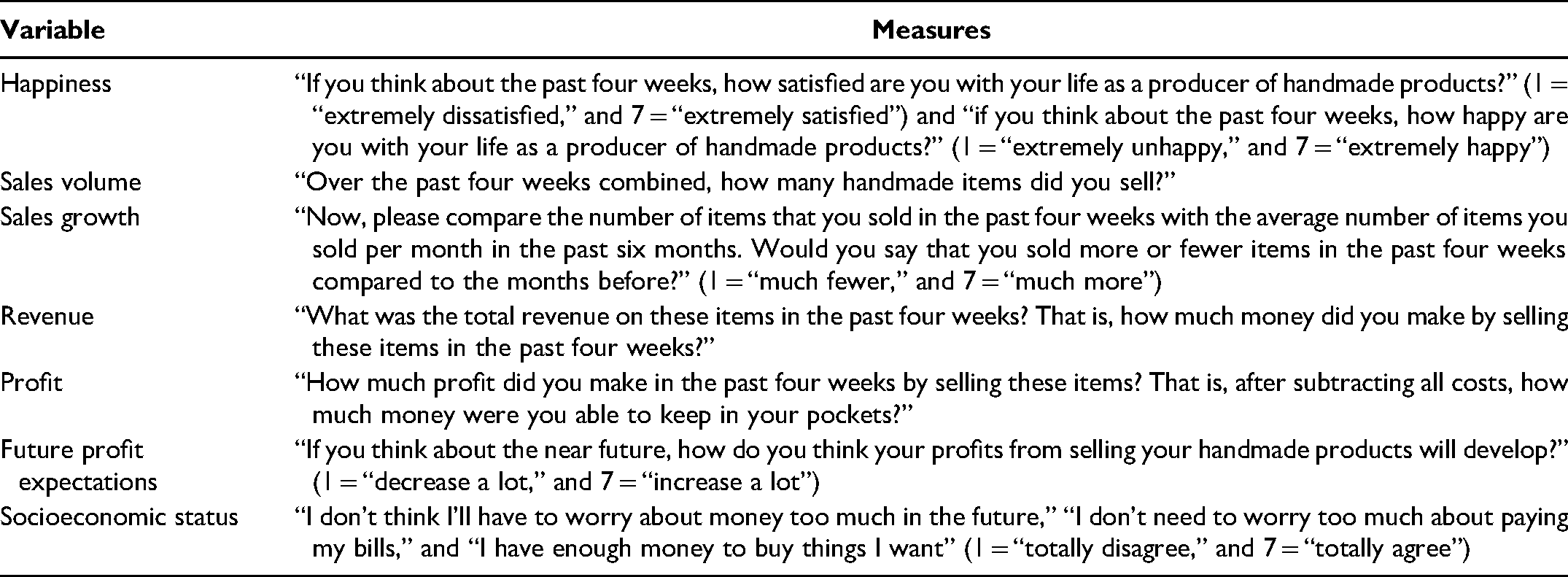
We included the following control variables to empirically isolate the sales-as-signal effect from a series of alternative explanations. We captured the direct monetary implications of sales by asking for the respective revenue and profit (in USD) in the said time period. 3 Although these measures are important for assessing our hypothesis (i.e., to control for any monetary implications of selling), they do not account for any future profit expectations. For example, one could argue that a positive sales trend in the current period might be (perceived to be) diagnostic of future sales and thus profit developments. Thus, a given happiness level at a given point in time might be due to future profit expectations based on the comparative number of items sold. To account for this alternative explanation, we asked participants how they expected their future profits to develop.
Ordinary Least Squares Regressions on Happiness (Study 1).
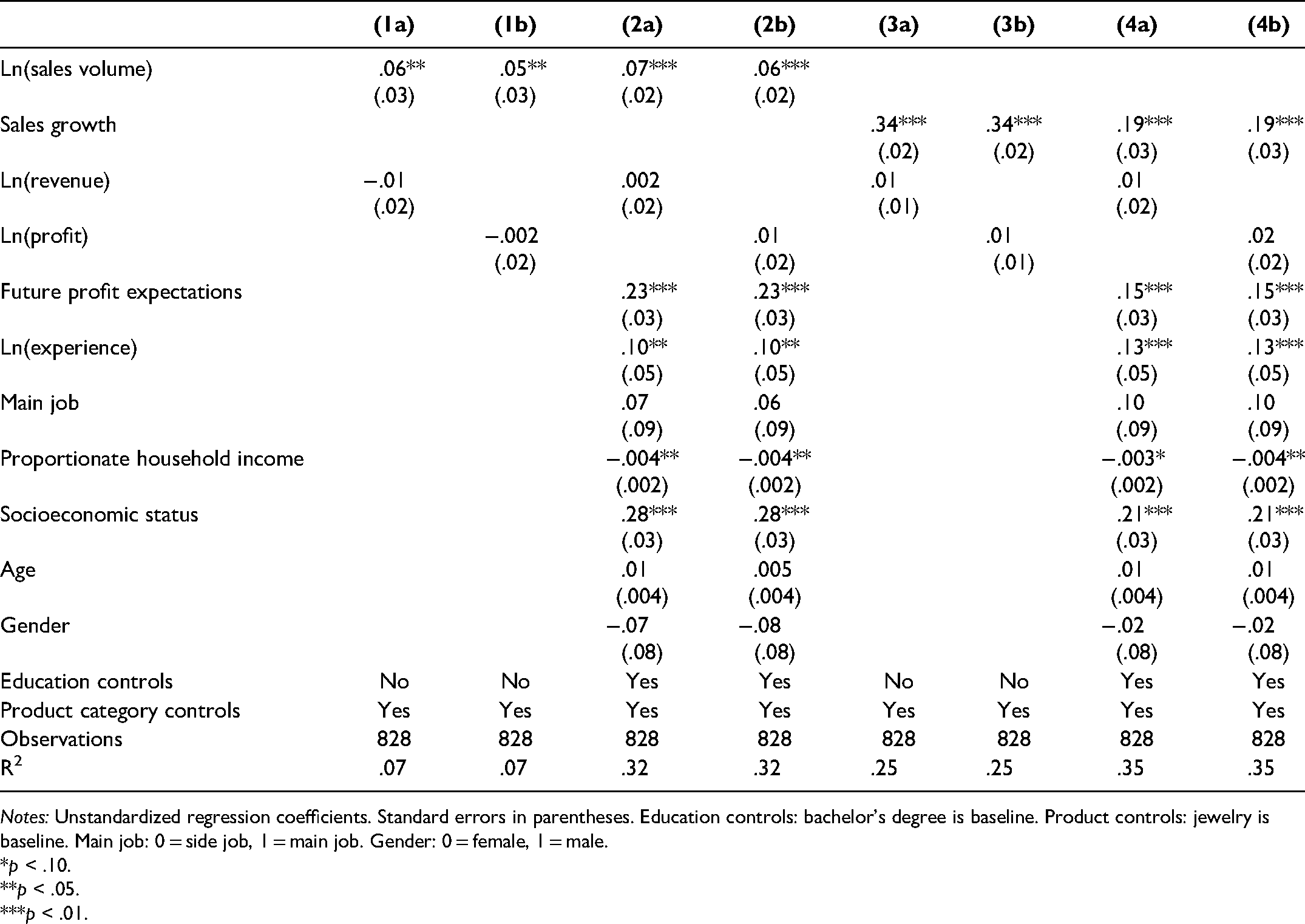
Notes: Unstandardized regression coefficients. Standard errors in parentheses. Education controls: bachelor's degree is baseline. Product controls: jewelry is baseline. Main job: 0 = side job, 1 = main job. Gender: 0 = female, 1 = male.
*p < .10.
**p < .05.
***p < .01.
In addition, we captured a series of control variables with regard to the business type and the producer. We captured the product domain(s) by asking what type(s) of products they sell (see WA-B2). We further asked participants about their experience as a producer (how long they have been selling their products [in months]), whether selling these products is their main or side job (0 = “side job,” and 1 = “main job”), and how much the income from selling these products contributes to their total household income (in %). To assess each individual producer's socioeconomic status, we used a three-item scale (α = .82; Griskevicius et al. 2011). Finally, participants indicated their gender (0 = “female,” and 1 = “male”), age (in years), country of residence (0 = “United States,” and 1 = “other”), relationship status (0 = “single,” 1 = “committed relationship,” 2 = “married,” and 3 = “widowed”), and highest degree of education (see WA-B3). No further measures were taken.
Sample Description
The sample consisted of 828 individual producers (Mage = 35.22 years, SD = 8.43, 61.0% female; 90.6% U.S. residents). We successfully recruited a diverse sample of producers. Participants differed widely in their experience selling their products (M = 56.89 months, SD = 40.59, range: 0 to 360.00), revenue and profit (revenue: Mdn = US$4,100.00, M = US$44,904.99, SD = US$81,115.39, range: US$0 to US$520,000.00; profit: Mdn = US$2,000.00, M = US$14,545.44, SD = US$27,234.03, range: US$0 to US$350,000.00), percentage of household income from selling (M = 54.94%, SD = 34.51%, range: 0% to 100%), and types of products produced (see WA-B4). Because several of our open-ended measures were highly skewed (sales volume, revenue, profit, and experience), we log-transformed those variables (for descriptive statistics and interconstruct correlations, see WA-B5).
Results
We tested the sales-as-signal effect by estimating a series of ordinary least squares (OLS) regression models accounting for different sets of control variables. Columns 1a and 1b in Table 2 report the results of regression models in which one's happiness as a producer, our dependent variable, is regressed on sales volume while controlling for product type(s) and for the economic implications of sales (in terms of either revenue or profit). We find that sales volume is indeed positively and significantly related to one's happiness, controlling for economic implications (Column 1a: b = .06, SE = .03, p = .02; Column 1b: b = .05, SE = .03, p = .04). This effect persists, and even gets a bit stronger, after adding all further control variables (see Column 2a: b = .07, SE = .02, p < .01; Column 2b: b = .06, SE = .02, p < .01).
We ran the same models using sales growth as the independent variable, with consistent results. Columns 3a and 3b in Table 2 show that sales growth is positively and significantly related to producers’ happiness when controlling for product domain(s) and producers’ revenue (b = .34, SE = .02, p < .01) or profit (b = .34, SE = .02, p < .01). The effect remains positive and significant when adding all further control variables (see Column 4a: b = .19, SE = .03, p < .01; Column 4b: b = .19, SE = .03, p < .01).
Discussion
Using a survey of actual producers, we find real-world evidence for the sales-as-signal effect (H1): individual producers draw happiness from selling their self-made products above and beyond the money they make from these sales.
In a supplementary study (see Study 1S in WA-C), we examined whether the observed relationship between sales and happiness, controlling for monetary considerations, holds in a more controlled setting with random assignment. We tested this using actual producers from the Australian marketplace madeit.com.au (n = 169) by making them recall a period of time in which they sold more (vs. fewer) products than normal and asking them about their happiness as a producer at that point in time. The results of this experiment replicate the main finding of Study 1. Consistent with our theorizing, we find that individual producers are happier at periods of time in which they sell more (vs. fewer) products even when controlling for the profit they made from these sales. In addition, the effect is robust to another potential happiness driver: future profit expectations.
Study 2
Study 2 aims to provide a behavioral test of causality for the effect of sales on happiness through feelings of self-validation (H2). We did this by conducting a two-stage behavioral experiment in which we first asked participants to actually produce their own products and then manipulated at a later stage whether their products were sold.
Another aim of Study 2 was to investigate how the extent of deliberateness of product choice moderates the sales-as-signal effect. We theorize that sales credibly inform individuals about their skills and competencies as producers to the extent that they provide information about the quality of the producers’ products (H3). When sales do not reflect a deliberate decision, for example when a product is chosen at random, they are less informative about the buyer's product quality perceptions and thus the sales-as-signal effect should be reduced.
Method
We invited 1,700 American workers from Amazon Mechanical Turk (MTurk) in two waves 4 to participate in a two-stage study. We recruited participants interested and skilled in drawing. The experiment employed a 2 (sales: product sold vs. product not sold) × 2 (choice: deliberate vs. random) between-participants design. We informed all participants that, to enrich life in times of crisis, a researcher was delegated by the university's program director to organize an exhibition of comics that symbolize the defeat of the coronavirus (SARS-CoV-2). We told participants that their task would be to draw a picture of a superhero conquering the coronavirus, that all drawings would be shown to potential customers (i.e., faculty and administrative staff at the university) who could purchase one drawing for $1.50, and that all purchased drawings would be exhibited. To ensure that participants only submitted their original work, we told participants to sign their hand-drawn picture with their MTurk ID. Finally, we told participants that they would receive a second survey about one week later that would inform them about whether their drawing was sold. Importantly, to keep the monetary rewards constant, we truthfully told participants that all participants would receive $1.50 as a compensation for their work—irrespective of whether their drawing was sold. We received 417 valid drawings (see Figure 1 for a selection of drawings; invalid submissions included blank submissions, pictures that were unrelated to the task, and unsigned submissions).

Examples of drawings of superheroes defeating the coronavirus (Study 2).
Approximately one week later, we invited workers who had submitted valid drawings to participate in the second part of this study, which included our manipulations. A total of 347 workers accepted this invitation (Mage = 33.39 years, SD = 11.15, 53.0% female). We first reminded all participants that the researcher showed all drawings to potential customers (i.e., faculty and administrative staff at the university), who could purchase one drawing for $1.50. In addition, participants were reminded that all artists would receive $1.50 as compensation for their work, irrespective of whether their drawing was sold. Then, participants either read that each customer who decided to purchase a drawing selected the one they wanted (deliberate choice) or that each customer who decided to purchase a drawing received one selected at random (random choice). In addition, participants read that their specific drawing either was or was not sold (see WA-D for study materials). Participants then indicated their level of happiness as a producer on two seven-point items (“extremely unhappy/extremely happy,” “extremely dissatisfied/extremely satisfied”; r = .87) and their feelings of self-validation on three seven-point items (“not at all skilled/extremely skilled,” “not at all competent/extremely competent,” and “not at all talented/extremely talented”; α = .95). 5 Finally, participants completed two attention checks (“was your drawing sold?”; “yes, my drawing was sold/no, my drawing was not sold”; “how did the purchase of drawings happen?”; based on customers’ deliberate/random choice [the ‘random selector' picked the drawing]/I cannot remember) 6 and indicated their age and gender.
Results
Happiness
A 2 × 2 ANOVA on happiness reveals a significant main effect of sales (Msold = 6.03, SD = 1.47 vs. Mnot_sold = 3.67, SD = 1.27; F(1, 343) = 263.27, p < .001) and a nonsignificant main effect of product choice (Mdeliberate = 4.81, SD = 1.91 vs. Mrandom = 4.93, SD = 1.70; F(1, 343) = .65, p = .42). Importantly, we also obtained the expected significant interaction effect (F(1, 343) = 11.20, p = .001; see Figure 2, Panel A). Planned contrasts reveal that when the product choice was deliberate, the effect of sales on happiness was significantly stronger (Msold = 6.21, SD = 1.17 vs. Mnot_sold = 3.37, SD = 1.38; F(1, 343) = 194.37, p < .001) than when the product choice was random (Msold = 5.84, SD = 1.34 vs. Mnot_sold = 3.98, SD = 1.50; F(1, 343) = 81.75, p < .001).
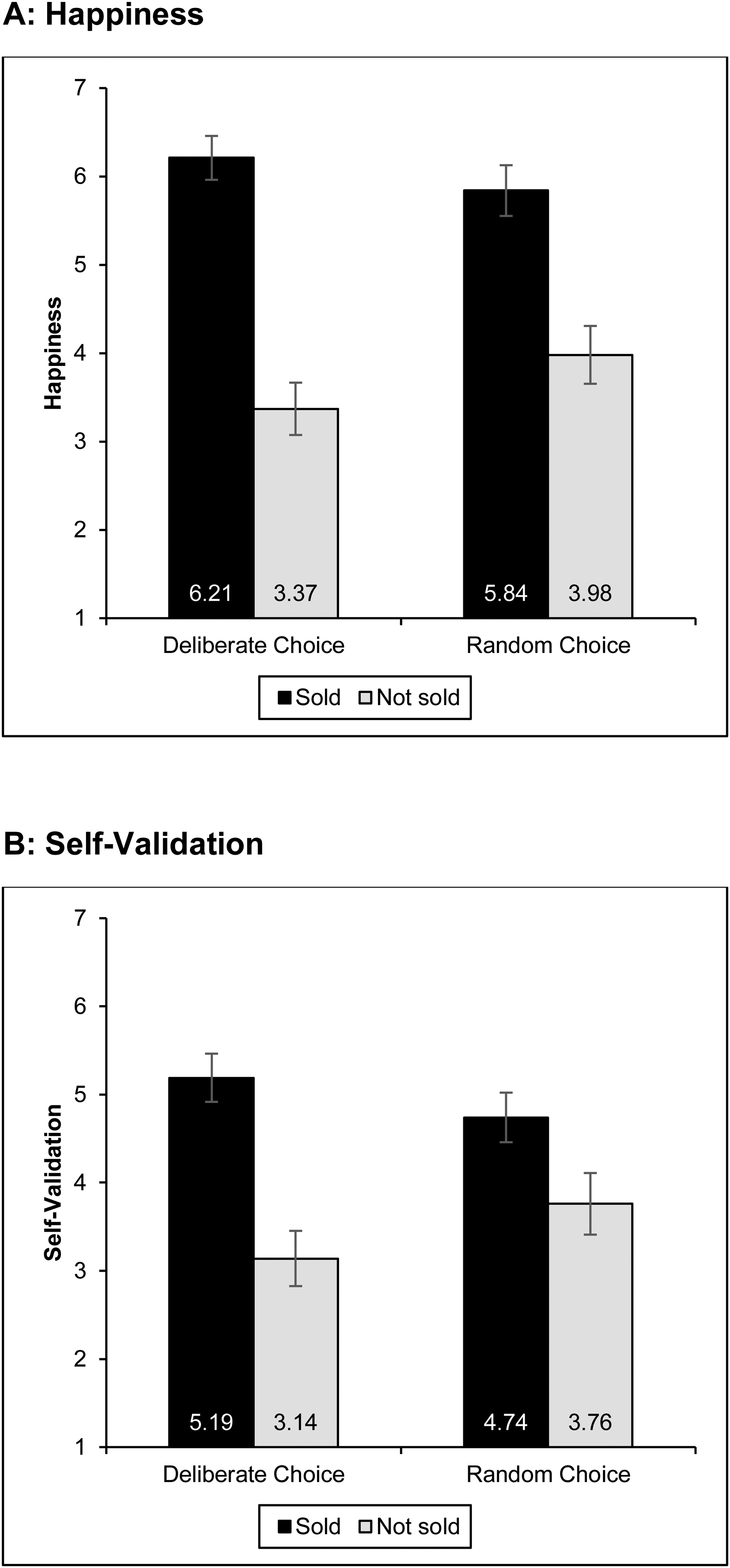
Happiness and self-validation as a function of product choice and sales (Study 3).
In addition, we find that participants whose products were sold were happier when the focal decision was deliberate versus random (Mdeliberate = 6.21, SD = 1.17 vs. Mrandom = 5.84, SD = 1.34; F(1, 343) = 8.50, p = .004). Interestingly, for participants who learned that their products were not sold, happiness was marginally higher when the focal decision was random rather than deliberate (Mdeliberate = 3.37, SD = 1.38 vs. Mrandom = 3.98, SD = 1.50; F(1, 343) = 3.28, p = .07).
Self-validation
A 2 × 2 analysis of variance (ANOVA) on self-validation reveals a significant main effect of sales (Msold = 4.97, SD = 1.32 vs. Mnot_sold = 3.44, SD = 1.55; F(1, 343) = 99.45, p < .001) and a nonsignificant main effect of product choice (Mdeliberate = 4.17, SD = 1.71 vs. Mrandom = 4.26, SD = 1.53; F(1, 343) = .34, p = .56). Importantly, we also obtained a significant interaction effect (F(1, 343) = 12.23, p = .001; see Figure 2, Panel B). Planned contrasts reveal that when the product choice was deliberate, the effect of sales on self-validation was significantly stronger (Msold = 5.19, SD = 1.29 vs. Mnot_sold = 3.14, SD = 1.46; F(1, 343) = 92.04, p < .001) than when the product choice was random (Msold = 4.74, SD = 1.31 vs. Mnot_sold = 3.76, SD = 1.60; F(1, 343) = 20.67, p < .001).
In addition, we find evidence that participants whose products were sold reported higher feelings of self-validation when the product choice was deliberate (Mdeliberate = 5.19, SD = 1.29 vs. Mrandom = 4.74, SD = 1.31; F(1, 343) = 8.18, p = .004), whereas participants whose products were not sold reported higher feelings of self-validation when the product choice was random (Mdeliberate = 3.14, SD = 1.46 vs. Mrandom = 4.74, SD = 1.31; F(1, 343) = 4.32, p = .04). Although not the focus of our theorizing, the latter difference further validates our signaling framework, as it indicates that a negative sales signal is more detrimental to feelings of self-validation when it is more easily interpreted as a reflection of one's competencies.
Moderated mediation
A moderated mediation analysis (Hayes 2013, Model 7, n = 5,000) with sales (0 = not sold, 1 = sold) as the independent variable, product choice (0 = deliberate, 1 = random) as the moderator, self-validation as the mediator, and happiness as the dependent variable produces a significant index of moderated mediation (b = −.48, SE = .16, CI95% = [−.81, −.19]). Supporting our prediction, the effect of sales on happiness through feelings of self-validation was significantly stronger when the product choice was deliberate (b = .93, SE = .15, CI95% = [.66, 1.23]) versus random (b = .45, SE = .11, CI95% = [.23, .67]).
Discussion
Using a multiwave experimental paradigm involving actual production, Study 2 provides causal evidence in support of our primary prediction that, above and beyond the monetary reward, sales increase producers’ happiness via elevated feelings of self-validation (H2). In addition, the results are consistent with our theorizing that sales have a stronger impact on individual producers’ self-validation when product choice is more deliberate (H3).
Although significantly smaller (as hypothesized), we also find a residual effect of sales on happiness and, to a lesser extent, self-validation when products were sold but selected at random. This finding is beyond the scope of our hypotheses, so we can only speculate about why even a random sale might make producers happy. One possibility is a process identified by Marx (1844/1993; see also Van Osselaer et al. 2020) in his Comments on James Mill. Marx's discussion of what it is like to produce as a human being (rather than being a cog in a machine), suggests that producing something that is used and enjoyed by another person provides important enjoyment of life and, to some extent, affirms the producer's unique competency as a person. Thus, the mere fact that another person has acquired one's product, even if the exact product choice was made at random, may provide some basic sense of self-validation and happiness in turn.
Study 3
Study 3 investigates another moderator of the sales-as-signal effect: the monetary cost involved in purchasing the product. We theorize that sales credibly inform individuals about their skills and competencies as a producer to the extent that the acquisition of the product is costly to the customer (H4). In this study, we manipulated the monetary cost of sales by varying the shipping cost that a buyer needed to pay to acquire the product. We predicted that, although the financial gain from the sale is constant (the buyer bears the shipping costs), individual producers would be happier when the buyer accepts paying higher (vs. lower) shipping costs. As in the previous study, we again tested whether the increase in happiness can be explained by feelings of self-validation (H2).
Method
With the help of hobbii.com, an online shop that sells knitting kits and supplies, we recruited 1,230 recreational knitters (Mage = 53.38 years, SD = 12.26, 99.4% female). The company promoted a link to our study in their weekly newsletter, which was received by German-speaking customers (and which yielded a response of N = 818) as well as customers from the United States (N = 412). As an incentive to participate, we raffled ten gift cards to the company's online shop worth $30 each.
The experiment employed a between-participants design with three conditions (sales: baseline vs. higher cost vs. lower cost). We asked all participants to imagine marketing their self-made knitted accessories on an online platform. Specifically, as we ran this study in June and participants came from Europe and the United States, we asked participants to assume they currently produce and sell summer beanies (i.e., beanies that are made from thin, lightweight material). Next, participants read that they received an email from a customer in New Zealand asking about winter beanies. Participants then read that they were able to offer their self-made winter beanies for $30.00. Finally, participants either read that the customer from New Zealand did not respond to this offer (baseline), decided to purchase the beanie for $30.00 plus $20.90 shipping costs (higher cost), or decided to purchase the beanie for $30.00 plus $2.90 shipping costs (lower cost; for study materials, see WA-E1).
Participants then indicated their level of happiness (r = .87) and feelings of self-validation (α = .93) on the same scales as in Study 2. To account for alternative mechanisms, participants indicated how much profit they made with the customer from New Zealand (1 = “none,” and 7 = “a lot”) and how they thought their profit from selling products would develop in the near future (1 = “decrease a lot,” and 7 = “increase a lot”). Participants further completed the following attention check: “Did the customer from New Zealand buy your beanie?” (yes/no). Participants in the lower cost and higher cost conditions additionally completed the following attention check: “How much did it cost to ship the beanie to New Zealand?” ($2.90/$20.90). 7 Finally, participants indicated their gender and age. 8
Results
Happiness
A one-way ANOVA with happiness as the dependent variable produces a significant effect (F(2, 1,227) = 406.52, p < .001). Follow-up contrasts reveal that, compared to the baseline condition in which the customer from New Zealand did not purchase the product (M = 3.13, SD = 1.10), participants were happier when the customer from New Zealand decided to purchase the product (higher shipping cost: M = 5.90, SD = 1.38; t(1,227) = 27.93, p < .001; lower shipping cost: M = 5.03, SD = 1.72; t(1,227) = 19.03, p < .001). More importantly, participants reported significantly higher levels of happiness when the buyer paid higher versus lower shipping costs (t(1,227) = 8.79, p < .001).
Self-validation
A one-way ANOVA with feelings of self-validation as the dependent variable produces a significant effect (F(2, 1,227) = 160.52, p < .001). Follow-up contrasts reveal that, compared with the baseline condition (M = 4.09, SD = 1.27), participants reported greater self-validation when the customer from New Zealand decided to purchase the product (higher shipping cost: M = 5.46, SD = .98; t(1,227) = 17.43, p < .001; lower shipping cost: M = 5.07, SD = 1.12; t(1,227) = 12.38, p < .001). In support of our theorizing, we further find significantly higher feelings of self-validation in the case of higher (vs. lower) shipping costs (t(1,227) = 4.98, p < .001).
Mediation
We conducted mediation analyses (Hayes 2013, Model 4, n = 5,000) with our multicategorical independent variable, happiness as the dependent variable, and self-validation as the mediator. We find positive and significant indirect effects on happiness through self-validation when comparing (1) the higher shipping cost condition with the baseline condition (b = .78, SE = .07, CI95% = [.65, .91]), (2) the lower shipping cost condition with the baseline condition (b = .55, SE = .06, CI95% = [.45, .67]), and (3) the higher shipping cost condition with the lower shipping cost condition (b = .22, SE = .05, CI95% = [.14, .31]). These results are robust to the inclusion of current profits and future profit expectations as covariates (for detailed results, see WA-E2).
Discussion
Study 3 further corroborates our theorizing by showing that the extent to which sales provide self-validation, over and above monetary outcomes for the producer, depends on the monetary cost of the sales signal. In particular, participants reported greater self-validation and thus happiness when the buyer accepted to pay higher (vs. lower) shipping costs (H4).
Study 4
Study 4 compares the effect of sales with that of a noneconomic signal. We focus on comparing sales with likes, which are arguably the most common form of market signals on electronic platforms such as Etsy. Comparing the effects of sales and likes is also important from a practical point of view because the seller dashboards of prominent online platforms tend to display sales and likes (or related forms of noneconomic signals such as favorites) concurrently, raising the question of how these different forms of signals impact individual producers’ happiness. We hypothesize that individual producers experience greater self-validation and thus more happiness from sales than from likes, even above and beyond the monetary rewards from these sales (H5). We tested this by conducting another two-stage behavioral experiment in which we first asked participants to actually produce products and then manipulated at a later stage whether their products were either acquired or liked by customers. To test whether the happiness advantage of sales over likes goes beyond their cost difference to the customer, Study 4 kept cost to the customer (along with the monetary outcomes for the producer) constant across signals.
Method
We invited 1,000 American workers on Prolific to participate in a two-stage study in which we asked them to demonstrate their writing skills. The experiment employed a 2 (signal: sales vs. likes) × 2 (number: high vs. low) between-participants design. All participants were told that their task would be to create a positive slogan for a “post-COVID” event that would be taking place at our university. We told participants that we would print each slogan on a poster and exhibit each poster at the event like a gallery exhibition. Furthermore, participants were told that all guests of the event would pay an entrance fee of $1.50 to cover costs and that, in return, each guest would receive a token. In the sales condition, we told participants that guests could use this token to purchase a poster of their choice and that each poster could only be purchased once. In the likes condition, we told participants that guests could use this token to like a poster of their choice by pinning the token on the poster and that each poster could only be liked once. Next, we asked all participants (those in both the sales and likes conditions) to create their slogan by finishing the following sentence: “When Corona is over….”
Two weeks later, we invited those who had submitted valid slogans (N = 1,000) to participate in the second part of the study, yielding 843 participants (Mage = 34.70 years, SD = 12.63, 48.2% female). A chi-squared test revealed that participation in the second part of the study did not depend on whether participants were assigned to the sales or the likes condition in the first part (χ2(1) = .11, p = .75). First, we thanked all participants for submitting their slogan and reminded them that all slogans were printed on posters exhibited at the “post-COVID” event, at which guests could either purchase (sales condition) or like (likes condition) a poster of their choice. In addition, we reminded participants that each poster could only be purchased/liked once. Next, participants in the sales condition were either told that one (high sales) or no (low sales) customer(s) bought the poster with their slogan on it, while participants in the likes condition were either told that that one (high likes) or no (low likes) customer(s) liked the poster with their slogan on it. Next, all participants indicated their level of happiness (r = .91) and their feelings of self-validation (α = .96) on the same scales as in the previous studies. Finally, participants responded to an attention check (“how many guests [purchased/liked] the poster with your slogan on it?”; “no (0) guest [bought/liked] the poster with my slogan on it/one (1) guest [bought/liked] the poster with my slogan on it”) 9 and indicated their gender and age (for study materials, see WA-F).
Results
Happiness
A 2 × 2 ANOVA on happiness produces significant main effects of signal (Msales = 4.43, SD = 1.64 vs. Mlikes = 4.21, SD = 1.60; F(1, 839) = 7.28, p = .007) and number (Mhigh = 5.37, SD = 1.27 vs. Mlow = 3.28, SD = 1.20; F(1, 839) = 610.80, p < .001). More importantly, we obtained the predicted signal by number interaction (F(1, 839) = 9.23, p = .002; see Figure 3, Panel A). Planned contrasts reveal that the effect of the sales signal was significantly stronger (Mhigh = 5.61, SD = 1.17 vs. Mlow = 3.27, SD = 1.11; F(1, 839) = 386.45, p < .001) than the effect of the likes signal (Mhigh = 5.13, SD = 1.32 vs. Mlow = 3.30, SD = 1.29; F(1, 839) = 234.11, p < .001). In addition, we find that participants whose poster was sold were happier than participants whose poster was liked (F(1, 839) = 16.36, p < .001). We detected no such differences between participants whose poster was not sold versus not liked (F(1, 839) = .06, p = .81).
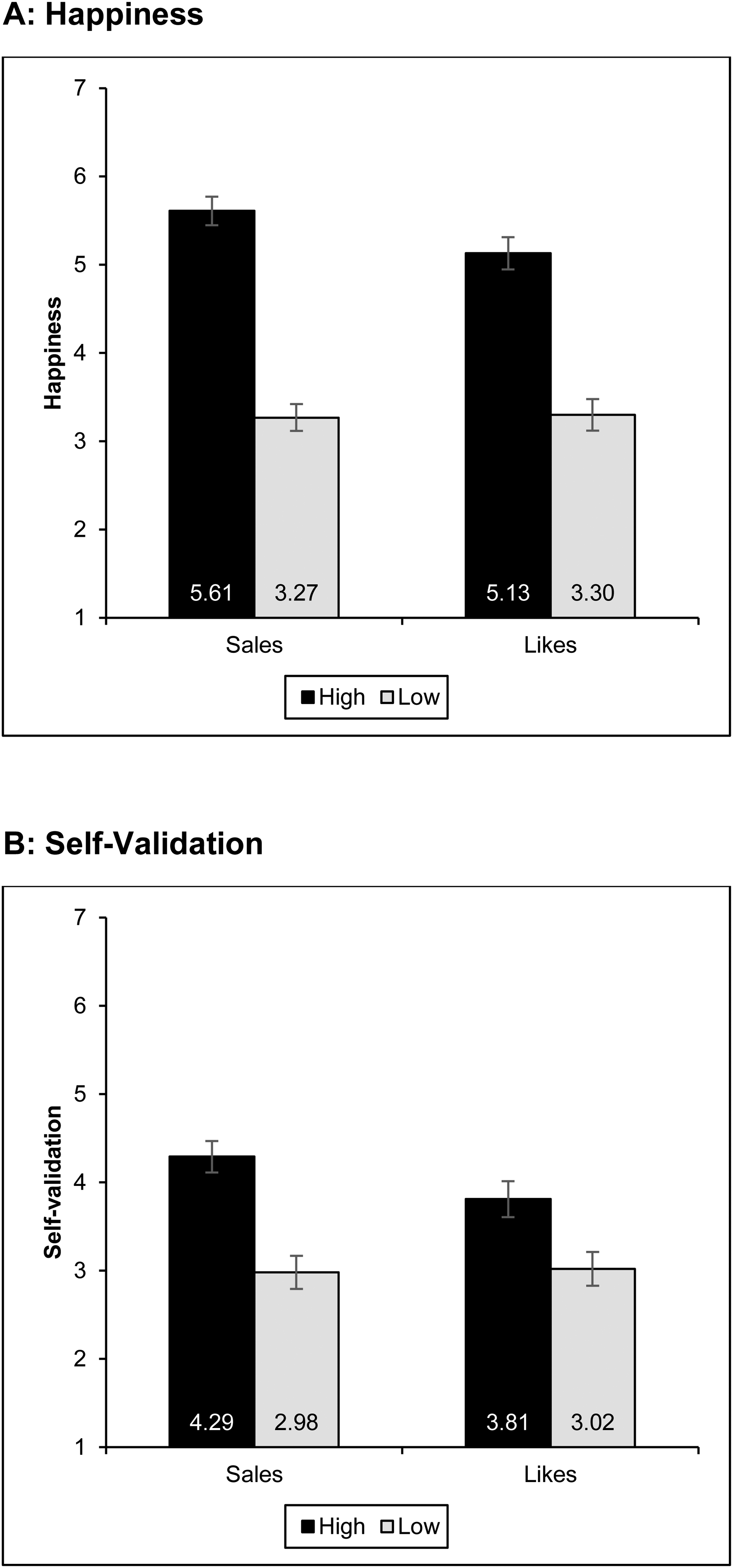
Happiness and self-validation as a function of signal and value (Study 4).
Self-validation
A similar 2 × 2 ANOVA on feelings of self-validation produces a significant main effect of signal (Msales = 3.62, SD = 1.48 vs. Mlikes = 3.41, SD = 1.50; F(1, 839) = 5.44, p = .02) and a significant main effect of number (Mhigh = 4.05, SD = 1.40 vs. Mlow = 3.00, SD = 1.38; F(1, 839) = 121.20, p < .001). This main effect was qualified by a significant interaction effect (F(1, 839) = 7.36, p = .007; see Figure 3, Panel B), demonstrating that the effect of the sales signal was significantly stronger (Mhigh = 4.29, SD = 1.29 vs. Mlow = 2.98, SD = 1.37; F(1, 839) = 94.48, p < .001) than the effect of the likes signal (Mhigh = 3.81, SD = 1.47 vs. Mlow = 3.02, SD = 1.39; F(1, 839) = 34.29, p < .001). In addition, participants whose poster was sold felt more validated than participants whose poster was liked (F(1, 839) = 12.66, p < .001). Feelings of self-validation did not differ between participants whose poster was not sold versus not liked (F(1, 839) = .07, p = .79).
Moderated mediation
A moderated mediation analysis (Hayes 2013, Model 7, n = 5,000 bootstraps) with number (0 = low, 1 = high) as the independent variable, signal (0 = likes, 1 = sales) as the moderator, self-validation as the mediator, and happiness as the dependent variable produces a significant index of moderated mediation (b = .25, SE = .09, CI95% = [.07, .44]). As expected, the mediating effect through self-validation on happiness was stronger when participants’ posters were sold versus not sold (b = .63, SE = .08, CI95% = [.48, .78]) than when participants’ posters were liked versus not liked (b = .38, SE = .07, CI95% = [.25, .51]).
Discussion
Study 4 compared the effects of sales and likes regarding their impact on individual producers’ feelings of self-validation and happiness as a producer (H5). In support of our theorizing, we find that sales produce stronger effects on happiness and self-validation than likes, even when the associated monetary costs were kept constant between conditions. In a supplementary study (see Study 4S in WA-G), we tested the effects of sales and likes when presenting information about sales and likes simultaneously (mimicking the situation on online platforms such as Etsy) among a sample of recreational knitters (n = 161). Holding the monetary rewards to the producer (but not the costs to the customer) from sales and likes constant, we again find that sales make individual producers happier than likes and that this effect is driven by feelings of self-validation.
Study 5
Study 5 tests whether the magnitude of the sales-as-signal effect depends on whether individuals sell their self-made products or products that were made by someone else. We tested this by varying sales of products that were self-produced versus produced by someone else. Although selling more versus fewer products should increase individuals’ happiness in both situations, we predict an incremental increase in happiness from selling self-made products (H6).
Method
Participants included 1,008 U.S. consumers recruited from MTurk (Mage = 39.81 years, SD = 12.41, 47.6% female). The experiment employed a 2 (sales: high vs. low) × 2 (product: self-made vs. other-made) between-participants design. All participants imagined selling muffins at a local food market. The muffins were either made by themselves (self-made condition) or by someone else (other-made condition). To keep the monetary rewards constant across conditions, we told participants that the organizers of the food market receive all sales revenue from people selling products at the market for the first time (which is how the food market finances itself). We further informed participants that there are no other costs involved in being able to sell products at the food market. Thus, across conditions, the monetary reward from potential sales was zero. Below this description, participants responded to an attention check verifying they understood that revenue from their first-time sales would go to the food market. Next, participants either read that they made (self-made condition) or received (other-made condition) a total of 50 muffins to sell and that they sold either 36 (high sales condition) or six (low sales condition) of them at the food market.
After reading this information, participants indicated their level of happiness on the same scale as in the previous studies (r = .92). Next, participants completed two more attention checks (“which of the following statements is correct?”; “at the food market, I sold muffins that were made by someone else/at the food market, I sold muffins that I made myself”; “how many muffins were sold at the food market?”; 6/36). 10 Finally, participants indicated their gender and age (for complete study materials, see WA-H).
Results
A 2 × 2 ANOVA on happiness reveals the expected significant main effect of sales (Mhigh_sales = 4.53, SD = 1.54 vs. Mlow_sales = 2.59, SD = 1.49; F(1, 1,004) = 418.73, p < .001) and a nonsignificant main effect of product (Mself-made = 3.58, SD = 1.83 vs. Mother-made = 3.55, SD = 1.78; F(1, 1,004) = .18, p = .67). Importantly, we also obtained a significant interaction effect (F(1, 1,004) = 19.65, p < .001; see Figure 4). As hypothesized, planned contrasts reveal that the effect of sales on happiness was significantly stronger when participants sold their self-made muffins (Mhigh_sales = 4.77, SD = 1.42 vs. Mlow_sales = 2.41, SD = 1.37; F(1, 1,004) = 310.54, p < .001) than when participants sold muffins made by someone else (Mhigh_sales = 4.31, SD = 1.62 vs. Mlow_sales = 2.79, SD = 1.59; F(1, 1,004) = 128.21, p < .001).
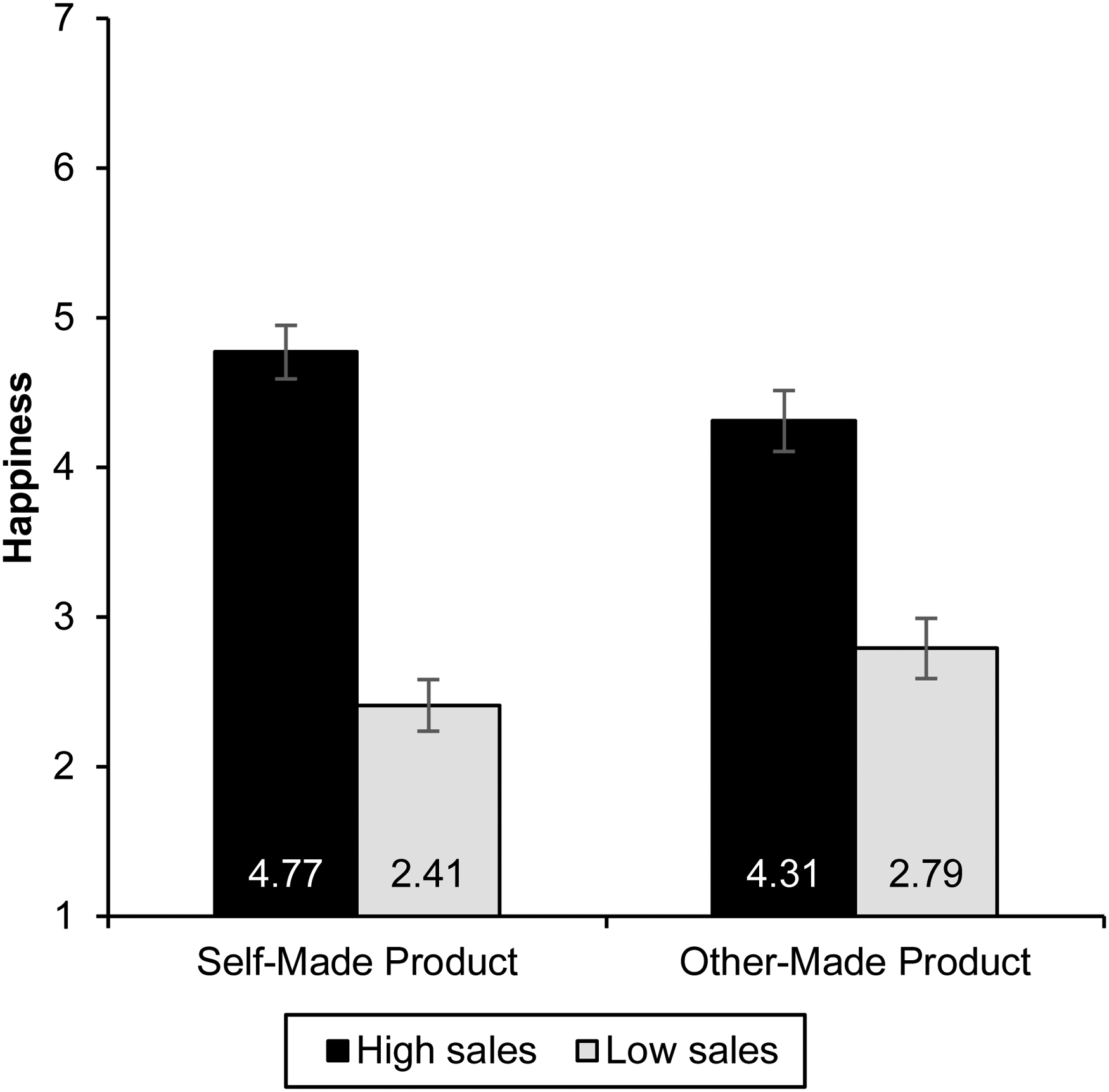
Happiness as a function of product and sales (Study 5).
Importantly, we find that participants who sold more muffins were happier when they made the muffins themselves versus someone else making the muffins (Mself-made = 4.77, SD = 1.42 vs. Mother-made = 4.31, SD = 1.62; F(1, 1,004) = 11.85, p = .001). In contrast, participants who sold fewer muffins were happier when the muffins were made by someone else versus by themselves (Mself-made = 2.41, SD = 1.37 vs. Mother-made = 2.79, SD = 1.59; F(1, 1,004) = 8.00, p = .005).
Discussion
The results of Study 5 complement the previous studies by demonstrating that sales have a stronger effect on individuals’ happiness when individuals sell their self-made products than when they sell products that were made by someone else (H6). This finding provides additional evidence that the effect of selling self-produced products on happiness is driven by the effect of sales on self-validation as a competent producer, and it rules out the alternative explanation that the effect is driven solely by the effect of sales on self-validation as a competent seller or marketer.
Study 6
Study 6 further tests whether selling their self-made products has any incremental effects on producers’ happiness compared with merely producing products. Because sales function as a credible signal regarding producers’ skills and competencies, we expect that sales affect individual producers’ self-validation and thus happiness beyond individual producers’ self-validation and happiness derived from production. We tested this with another two-stage behavioral experiment in which we again asked participants to produce their own products and manipulated at a later stage whether their products were sold. In addition, we added a control condition in which participants’ products were not offered for sale, and we assessed participants’ feelings of self-validation and happiness derived from both production and selling. Doing so allowed us to assess any increase in self-validation and happiness as a result of a successful sale or any backfiring effect in the case of no sales, compared with the baseline of “not going to the market” to begin with.
Method
We invited 500 U.S. consumers on Prolific to participate in a two-stage study in which we asked them to demonstrate their writing skills. In the study description, all participants were informed that we would ask them to generate a slogan followed by a short survey and that they would receive a second survey in about two weeks. The experiment employed a 2 (stage: production vs. selling) × 3 (sales: control vs. product sold vs. product not sold) mixed design with stage as the within-subjects factor and sales as the between-subjects factor. In the production stage, we told all participants that their task would be to create a positive slogan one could print on a T-shirt that describes what they will do when the COVID crisis is over. Participants in the sales conditions were additionally told that all slogans from this study would be offered to our university community and that, if a given slogan finds a customer, that slogan will be printed on a T-shirt for that customer. We further informed participants in the sales conditions that each slogan will only be printed on a T-shirt once and that the price the customer will pay for the T-shirt will equal the cost incurred in having it produced. We also told participants in the sales conditions that the second survey would inform them about whether the T-shirt with their slogan had been purchased by a customer. Next, we asked all participants (those in the control and in the two sales conditions) to create their slogan by finishing the following sentence: “When Corona is over….” After creating their slogan, all participants indicated their level of happiness (r = .78) and their feelings of self-validation (α = .96) on the same scales used in the previous studies. Finally, we reminded all participants that they would receive a second survey in about two weeks.
Two weeks later, we invited participants who had submitted valid slogans (N = 499) to participate in the second part of the study. A total of 384 participants accepted this invitation (Mage = 31.56, SD = 10.51, 45.6% female). 11 First, we thanked all participants for submitting their T-shirt slogan two weeks earlier. Participants in the sales conditions were additionally reminded that all slogans were offered to our university community and that the T-shirt with their slogan on it could only be purchased once. Next, we informed participants in the sales conditions that their T-shirt was either sold or not. Finally, all participants indicated their level of happiness (r = .85) and their feelings of self-validation (α = .97) on the same scales as in the production stage, as well as their gender and age (for study materials, see WA-I).
Results
Happiness
A 2 × 3 mixed ANOVA on happiness with stage (production vs. selling) as the within-subject factor and sales (control vs. product sold vs. product not sold) as the between-subjects factor reveals the expected significant stage by sales interaction (F(2, 381) = 127.47, p < .001; see Figure 5, Panel A). Participants’ happiness did not differ across the sales conditions in the production stage (Mcontrol = 5.19, SD = 1.12 vs. Msold = 5.17, SD = 1.21 vs. Mnot_sold = 5.39, SD = 1.15; F(2, 381) = 1.34, p = .26). In contrast, participants’ happiness significantly differed across the sales conditions in the selling stage (F(2, 381) = 157.63, p < .001). As expected, participants were happier when a T-shirt with their slogan on it was sold (M = 5.87, SD = 1.02) than when a T-shirt with their slogan on it was not sold (M = 3.37, SD = 1.17; t(381) = 17.47, p < .001). Compared with the control condition (M = 4.97, SD = 1.21), participants were happier when a T-shirt with their slogan on it was sold (t(381) = 6.26, p < .001) and less happy when a T-shirt with their slogan on it was not sold (t(381) = −11.40, p < .001).
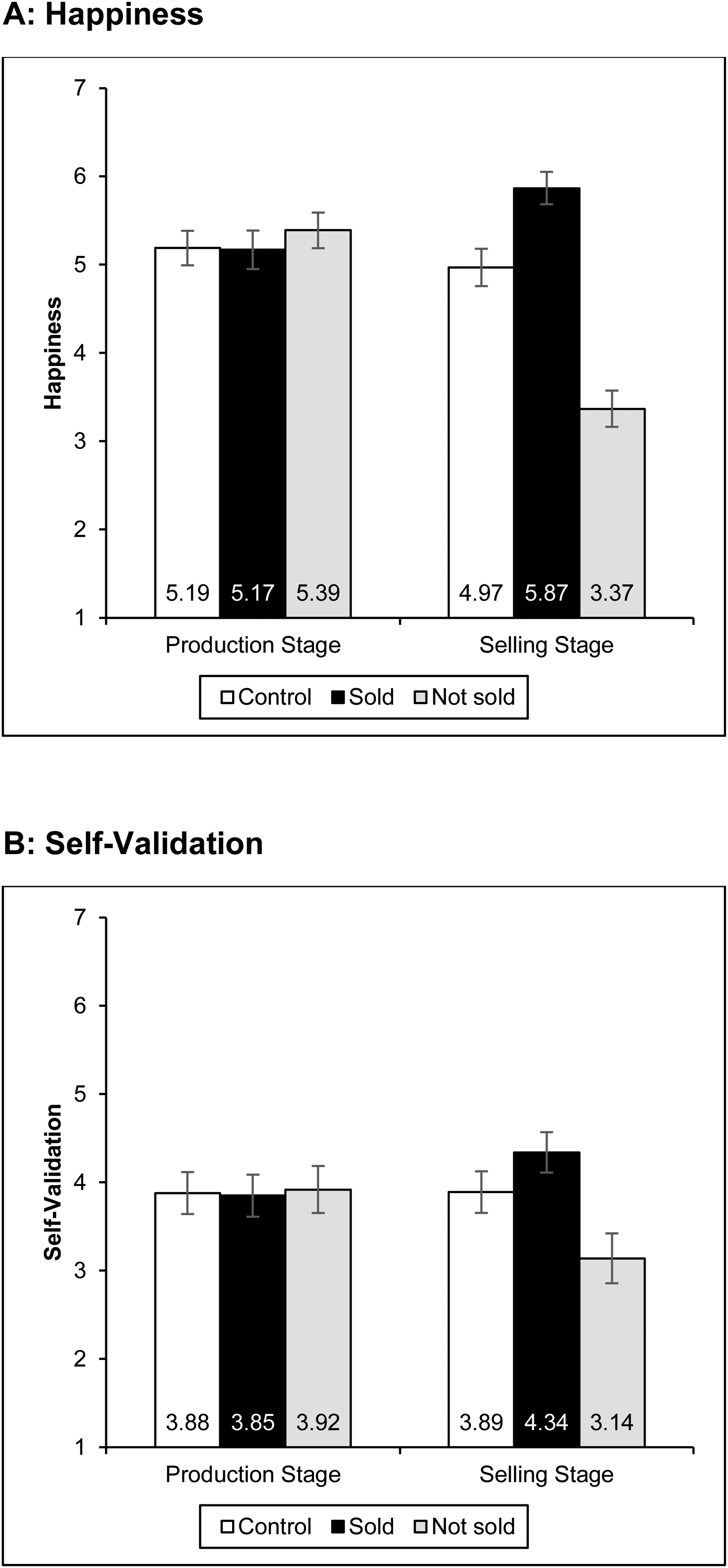
Happiness (left) and self-validation (right) as a function of stage and sales (Study 6).
Comparing participants’ happiness across the two stages reveals that, in the product sold condition, participants were happier in the selling stage (M = 5.87, SD = 1.02) than in the production stage (M = 5.17, SD = 1.21; F(1, 381) = 30.93, p < .001). In the product not sold condition, participants were less happy in the selling stage (M = 3.37, SD = 1.17) than in the production stage (M = 5.39, SD = 1.15; F(1, 381) = 279.11, p < .001). In the control condition, participants were marginally less happy in the selling stage (M = 4.97, SD = 1.21) than in the production stage (M = 5.19, SD = 1.12; F(1, 381) = 3.38, p = .07). The main effect of stage was also significant (Mselling = 4.72, SD = 1.53 vs. Mproduction = 5.25, SD = 1.58; F(1, 381) = 53.90, p < .001).
Self-validation
A similar 2 × 3 mixed ANOVA on self-validation reveals a significant stage by sales interaction (F(2, 381) = 28.33, p < .001; see Figure 5, Panel B). In the production stage, participants’ feelings of self-validation did not differ across the sales conditions (Mcontrol = 3.88, SD = 1.36 vs. Msold = 3.85, SD = 1.32 vs. Mnot_sold = 3.92, SD = 1.52; F(2, 381) = .09, p = .91). In contrast, participants’ feelings of self-validation significantly differed across the sales conditions in the selling stage (F(2, 381) = 23.71, p < .001). As expected, participants felt more validated when a T-shirt with their slogan on it was sold (M = 4.35, SD = 1.27) than when a T-shirt with their slogan on it was not sold (M = 3.14, SD = 1.61; t(381) = 6.80, p < .001). Compared to the control condition (M = 3.89, SD = 1.35), participants felt more validated when a T-shirt with their slogan on it was sold (t(381) = 2.56, p = .01) and less validated when a T-shirt with their slogan on it was not sold (t(381) = −4.31, p < .001).
In the product sold condition, participants felt more validated in the selling stage (M = 4.35, SD = 1.27) than in the production stage (M = 3.85, SD = 1.32; F(1, 381) = 16.47, p < .001). In the product not sold condition, participants felt less validated in the selling stage (M = 3.14, SD = 1.61) than in the production stage (M = 3.92, SD = 1.52; F(1, 381) = 42.19, p < .001). In the control condition, participants’ feelings of self-validation did not differ between the selling stage (M = 3.89, SD = 1.35) and the production stage (M = 3.88, SD = 1.36; F(1, 381) = .01, p = .92). The main effect of stage was not significant (F(1, 381) = 1.61, p = .21).
Mediation
We conducted two mediation analyses (Hayes 2013; Model 4, n = 5,000 bootstraps) to test whether feelings of self-validation can explain the effect of our sales manipulation on happiness. We first looked at participants’ ratings of happiness and self-validation obtained in the selling stage. We thus entered sales as the independent variable, self-validation in the selling stage as the mediator, and happiness in the selling stage as the dependent variable into the regression. This analysis produced positive indirect effects when comparing the product sold with the product not sold condition (b = .45, SE = .09, CI95% = [.29, .64]) and the control condition (b = .17, SE = .07, CI95% = [.05, .31]), and it produced a negative indirect effect when comparing the product not sold condition with the control condition (b = −.28, SE = .08, CI95% = [−.45, −.14]).
We next examined whether relative differences in happiness between the selling stage and the production stage can be explained by relative differences in self-validation between the selling stage and the production stage. To do so, we calculated difference scores between happiness and self-validation ratings in the selling stage and the production stage. The respective regression analyses (Hayes 2013; Model 4, n = 5,000 bootstraps) produced positive indirect effects when comparing the product sold with the product not sold condition (b = .55, SE = .10, CI95% = [.36, .76]) and the control condition (b = .21, SE = .08, CI95% = [.07, .37]), and it produced a negative indirect effect when comparing the product not sold condition with the control condition (b = −.34, SE = .08, CI95% = [−.51, −.19]).
Discussion
By including a preselling baseline measure as well as a no-selling control condition, the results of Study 6 confirm there is a positive incremental effect of selling self-produced products on happiness. They also show, however, that marketing self-produced products can have a downside as well. Specifically, there is a happiness penalty to pay when products fail to sell, as the absence of sales leads to negative self-validation; that is, failing to sell products sends a negative signal about one's skills and competencies as a producer, reducing happiness. Thus, deciding to offer their self-made products for sale can enhance but also diminish individuals’ happiness.
General Discussion
This research investigates the socioemotional benefits of selling self-made products. Eight studies provide evidence for a sales-as-signal effect: individual producers derive happiness from selling their products above and beyond the money they make from these sales (all studies). This is because sales validate their skills and competencies as a producer (Studies 2–4 and 6). In addition, Study 2 shows that the sales-as-signal effect is more pronounced when the choice mechanism that precedes the purchase is more versus less deliberate. Study 3 demonstrates that the increase in happiness from sales is higher when the buyer incurs higher (vs. lower) monetary costs in purchasing the product, even when this higher cost does not translate into higher financial return for the individual producer. Study 4 demonstrates that individual producers gain more happiness from sales than from receiving likes. Finally, Studies 5 and 6 show that individuals derive greater happiness from high sales of self-made products than from high sales of products that were made by someone else (Study 5) and that individuals show increases in happiness from pre- to post-selling but show decreases in happiness after (vs. before) failing to sell (Study 6). The studies (N = 4,970) span a variety of methodological approaches, designs, and procedures, and they feature different participant populations across three continents and producer communities.
Contributions to Theory
Our research makes a number of theoretical contributions. First, previous research has extensively studied the psychological and behavioral consequences of engaging in self-production (e.g., Franke, Schreier, and Kaiser 2010; Norton, Mochon, and Ariely 2012). This line of research has, however, focused on studying production for oneself or for gift giving. Our work goes a step further and examines a context in which individuals produce for the market; that is, with the aim of selling their creations to others. Our contribution thus lies in shedding light on the psychological consequences of participating in market exchanges. Our findings suggest that sales provide individual producers with a sense of self-validation and, in turn, happiness. We find that selling self-made products affects individuals’ happiness beyond the happiness derived from producing the products.
Second, we introduce a new perspective on the value of sales. Most models of producer behavior assume that producers are driven solely by a profit-maximization motive (Friedman 1970; Shane and Venkataraman 2000). Our findings caution against taking a reductionist view of sales by demonstrating that selling one's self-made products can also have important socioemotional value, as sales provide individual producers with self-validation regarding their skills and competencies as a producer. Thus, models of producer behavior may benefit from including the self-validation motive documented in this research.
Third, in developing our theory, we conceptualized sales as a signal from buyers. This approach is different from the process investigated by existing research on signaling in marketing and management that conceptualizes signals as actions taken by sellers, who have low uncertainty about the product, to reduce uncertainty about product qualities for buyers (Boulding and Kirmani 1993; Connelly et al. 2011; Kirmani and Rao 2000). In our research, we find that sales constitute a signal that is sent by buyers and received by sellers. Moreover, our work suggests that sellers, even of self-produced products, actually do have uncertainty about their own products’ qualities that is reduced by quality information from buyers. Thus, the traditional roles about who has information and who is uncertain are to some extent reversed. There may be less information asymmetry than is often assumed, and quality information may be exchanged in both directions. Furthermore, signals are traditionally conceptualized as intentional actions performed by the sender that in turn benefit the sender (Connelly et al. 2011). Our account, in contrast, suggests that sending a signal can be a more or less incidental by-product (of a purchase) rather than an intentional signal and that the signal benefits the receiver of the signal (i.e., individual producer) by increasing self-validation. In addition, we demonstrate that the strength of a signal depends not only on the signal's costliness but also on its diagnosticity. For example, even when likes and sales are equally costly for the customer, sales may be seen as a more reliable indicator of product quality and producer skill. Likewise, a buyer’s deliberate choice to purchase an item makes the sale of that item more diagnostic of producer skill than a sale that involves a buyer randomly picking a specific product. Thus, we believe that the present work offers a novel perspective on signaling.
Finally, our research informs the ongoing debate within the marketing discipline regarding the implications of marketing for society (Chandy et al. 2021). The backdrop of this debate involves widespread concern about the pernicious aspects of a consumer society (Klein 2009), the negative environmental externalities of market exchanges (Kotler 2011), and the potentially exploitative nature of common marketing practices (Sunstein 2016). We find that marketing one's products can actually have an important positive effect by providing individual producers with a significant happiness benefit through self-validation. We thus demonstrate how studying a classic marketing topic from a “better world” perspective can yield novel insights about marketing's potential to improve people's well-being. Moreover, marketing scholars studying the implications of marketing on society frequently focus on activities undertaken by marketers at large corporations, and more research is needed to uncover the societal impact of marketing beyond these contexts (Chandy et al. 2021). Answering this call, we study the socioemotional benefits of individual producers participating in market exchanges. Our work also demonstrates the value of taking a behavioral approach to the study of supply-side behaviors. Despite calls for behavioral marketing research to broaden its focus beyond consumers (MacInnis et al. 2020; Wertenbroch 2015), virtually all research by behavioral marketing scholars currently focuses on consumer behavior. We provide an example of how researchers can tackle important marketing phenomena on the supply side with a behavioral lens.
Practical Implications
In addition to these theoretical contributions, our work also provides several practical implications, especially for online marketplaces that focus on producers selling self-made products. First, the finding that sales can increase individual producers’ happiness could be leveraged in, for example, the recruitment of prospective sellers by highlighting the socioemotional benefits of selling their products (e.g., “Be a pro. Sell your tote bags on Etsy!”). Online marketplaces could also highlight socioemotional benefits to existing sellers to maintain motivation and retention. This could be done, for example, by stressing that customers recognize sellers’ expertise by paying good money to buy their products (e.g., “They voted with their wallets to tell you you’re a pro”).
In addition, our findings yield recommendations for the design of seller dashboards. Study 4 demonstrates that knowing how many people bought their products makes individual producers happier than knowing how many people liked their products. Study 3 suggests that showing how much customers paid might increase motivation, and thus production volume per seller and seller retention, beyond the amount of money the seller made. Therefore, we recommend designing seller dashboards so that the number of people who have made purchases and the average amount paid by customers (including shipping and other fees) are more prominent, rather than highlighting likes or aggregate revenue as is common in such dashboards.
Finally, Study 2 shows that sales make individual producers happier when they know that buyers deliberately chose their products (vs. being chosen at random). This finding could be leveraged, for example, by encouraging buyers to leave a comment indicating why they chose that seller's product over other available product choices or by highlighting that customers decided to buy the focal producer's product despite having many other options.
Future Research Opportunities
Self-validation as a seller
We hope that our findings will motivate other researchers to explore the under-researched topic of individual producers’ motivations, beyond monetary considerations. Specifically, we identify several opportunities for future research. Our findings indicate that the sales-as-signal effect is strongly driven by individual producers’ gain in self-validation as a competent producer (e.g., in Studies 2, 4, and 6 sales increased individual producers’ happiness even when their self-made products were sold by someone else). This focus on self-validation as a producer was motivated by the fact that sellers on platforms such as Etsy typically spend more than half of their time designing and making their products and only about 10% of their time with marketing and promotion activities (Etsy 2019). However, to successfully sell their products, many individual producers not only engage in skilled production activities but also in skilled promotion- or selling-related activities, such as taking pictures of their offerings, pricing their products, maintaining their online appearance, and engaging in advertising on social media platforms. Therefore, sales might, at least for some people and in some contexts, also be an important source of happiness by validating individual producers’ skills as a promoter or seller. Study 5 indeed shows that sales also increase the happiness of individuals selling products made by someone else above and beyond the monetary rewards from sales—though to a lesser extent compared to individuals selling their self-made products. Empirically examining the self-validation processes involved in selling would be a worthwhile future research direction. Likewise, while the entrepreneurship literature documents that financial success is related to entrepreneurs’ satisfaction (Dijkhuizen et al. 2018; Przepiorka 2017), future research could investigate whether entrepreneurial success (e.g., firm growth, increase in funding) has a causal effect on entrepreneurs’ happiness beyond the related financial gains. In sum, our work provides a fruitful foundation for investigating the socioemotional benefits of participating in market exchanges across business contexts.
Moderators of the sales-as-signal effect
Characteristics of the purchase transaction
Our studies investigated two characteristics of the purchase transaction—the deliberateness of the product choice and the monetary cost of buying—that moderate the strength of the sales signal. However, other important moderators of the sales-as-signal effect likely exist, and future research should expand the nomological network in which the sales-as-signal effect is situated. For example, the strength of the sales signal might depend on the expertise of the buyer. Compared to novices, experts are more capable of assessing products’ quality (Alba and Hutchinson 1987). Having one's products bought by an expert in the respective product category should thus more credibly inform individual producers about their competencies as a producer than having one's products bought by a novice. Similarly, the number of buyers might affect how strongly individual producers perceive sales to correspond to the quality of their products. Would 40 buyers purchasing one product each provide more self-validation than four buyers purchasing ten items each?
Besides the direct monetary cost associated with buying a product (Study 3), the sales-as-signal effect might also depend on the relative cost that buyers incur when purchasing a product. We would expect the effect of sales to be stronger when a buyer has a smaller (vs. larger) budget to spend. Likewise, relative price might also play a role, as the same cost might be a stronger signal of expertise when that cost is high compared to other products in the category than when that same cost is low compared to other products in the category. Finally, although customers accepting a high price should increase the strength of the sales signal, individual producers accepting higher prices might reach a point where they feel that customers are being treated unfairly (such as when customers have to pay extraordinarily high shipping costs) or that the prices might cause customers to refrain from making repeat purchases. Do concerns about fairness and relationship-building reduce the happiness individual producers gain from selling products at exorbitant prices?
Characteristics of the individual producer
One could also argue that the strength of the sales-as-signal effect depends on certain characteristics of individual producers. We used the data obtained in Study 1 to test whether the effect of sales on happiness is moderated by any of the captured control variables. Only one statistically significant interaction emerged for both measures of our independent variable (i.e., sales volume and sales growth): a positive interaction effect between sales and producers’ socioeconomic status (ps < .01; see WA-J1). This suggests that the effect of sales on happiness is stronger for producers that have a higher socioeconomic status—in other words, producers who feel financially secure. We also used the data obtained in Study 1S to examine whether the effect of sales on happiness is moderated by any of the captured control variables. Moderation analyses produce nonsignificant interaction effects between (1) sales and producers’ experience and (2) sales and socioeconomic status (ps > .20; see WA-J2). Thus, although the moderation analyses of Study 1 suggest that the sales-as-signal effect is stronger for producers that have a relatively higher (vs. lower) socioeconomic status, we did not observe such an interaction effect in Study 1S. Therefore, future research might more closely look at the role socioeconomic status plays in the sales-as-signal effect.
The strength of the sales-as-signal effect might also depend on individual producers’ own evaluations of their products—that is, how competent individuals feel in producing their products might alter how happy they feel as a result of selling those products. We used the data of Study 6 to test this. A moderation analysis produces a nonsignificant interaction between sales (higher vs. lower) and self-validation from production on happiness from sales (p = .98; see WA-J3). This suggests that the positive effect of sales on happiness does not depend on producers’ presales perception of their products. We encourage future researchers to look deeper into these, and possibly other, potential moderators of the sales-as-signal effect.
Conclusion
Traditional producer behavior models assume that producers’ behavior is driven by the monetary rewards from selling their wares and that there is an information asymmetry that favors producers. In other words, these models assume producers have information about the quality of their products that (prospective) customers do not, leading producers to signal product quality to customers. This research shows that producers derive happiness from selling their wares that goes above and beyond any monetary rewards. It shows that there is also an information asymmetry in the other direction: Customers possess information about the skill level of the producer that they signal by purchasing the producer's products. This provides a feeling of self-validation to the producer, increasing their happiness. To understand the behavior of producers, it is critical to broaden our scope from purely monetary to self-validation benefits and from assuming a one-directional flow of quality information to a two-directional flow, with at least some quality signals being sent from customers to producers.
Supplemental Material
sj-pdf-1-jmx-10.1177_00222429211064263 - Supplemental material for Sales and Self: The Noneconomic Value of Selling the Fruits of One's Labor
Supplemental material, sj-pdf-1-jmx-10.1177_00222429211064263 for Sales and Self: The Noneconomic Value of Selling the Fruits of One's Labor by Benedikt Schnurr, Christoph Fuchs, Elisa Maira, Stefano Puntoni, Martin Schreier and Stijn M.J. van Osselaer in Journal of Marketing
Footnotes
Authors' Note
The authors thank Anouk Vandendael for conducting the qualitative study and Karen Petersen, Louise McCauley, and Silvia Cuesta for helping us collect data.
Contribution Note
The second, third, fourth, fifth, and sixth authors contributed equally to the paper and are listed in alphabetical order.
Associate Editor
Cait Lamberton
Declaration of Conflicting Interests
The author(s) declared no potential conflicts of interest with respect to the research, authorship, and/or publication of this article.
Funding
The author(s) received no financial support for the research, authorship and/or publication of this article.

Notes
References
Supplementary Material
Please find the following supplemental material available below.
For Open Access articles published under a Creative Commons License, all supplemental material carries the same license as the article it is associated with.
For non-Open Access articles published, all supplemental material carries a non-exclusive license, and permission requests for re-use of supplemental material or any part of supplemental material shall be sent directly to the copyright owner as specified in the copyright notice associated with the article.
