



Abstract
This research demonstrates that the physical properties of shopping carts influence purchasing and spending. Prior research on ergonomics indicates that standard shopping carts, which are pushed via a horizontal handlebar, are likely to activate arm extensor muscles. Prior research on arm muscle activation, in turn, suggests that arm extensor activation may elicit less purchasing than arm flexor activation. The authors thus deduce that standard shopping carts may be suboptimal for stimulating purchases. The authors predicted that shopping carts with parallel handles (such as on a wheelbarrow or “walker”) would instead activate the flexor muscles and thus increase purchasing. An electromyography study revealed that both horizontal and vertical handles more strongly activate the extensor muscles of the upper arm (triceps), whereas parallel handles more strongly activate the flexor muscles (biceps). In a field experiment, parallel-handle shopping carts significantly and substantially increased sales across a broad range of categories, including both vice and virtue products. Finally, in a simulated shopping experiment, parallel handles increased purchasing and spending beyond both horizontal and vertical handles. These results were not attributable to the novelty of the shopping cart itself, participants’ mood, or purely ergonomic factors.
According to recent customer surveys, as much as 76% of all purchase decisions are made in-store (POPAI 2014). Critically, such in-store decisions are highly flexible (Gilbride, Inman, and Stilley 2015; Inman, Winer, and Ferraro 2009) and sensitive to retailers’ tactics for stimulating shoppers (Hui et al. 2013). Retail managers have several marketing tools at their disposal. For instance, in-store promotions (Ramanathan and Dhar 2010), store layout (Park, Iyer, and Smith 1989), and store atmosphere (Baker et al. 2002; Kaltcheva and Weitz 2006) can all affect “basket size” (i.e., the number of purchases on a given shopping occasion). Another tool that may influence shopping, but has received little attention by marketing researchers, is the shopping cart. Shopping carts can be tracked to examine in-store travel behaviors (e.g., Larson, Bradlow, and Fader 2005) and product searches (Seiler and Pinna 2017), revealing, for instance, that shoppers who park their carts more often during their trip (Wagner et al. 2014) ultimately make more purchases. Similarly, “smart” carts that provide real-time feedback to shoppers on the total cost of their purchases can entice shoppers to max out their budgets (Van Ittersum et al. 2013). Table 1 briefly summarizes the prior consumer research on shopping carts.
Consumer Research on Shopping Carts.

The present research provides the first investigation of how the physical properties of shopping carts influence basket size. Research in the field of ergonomics has documented that the orientation of handles affects muscle activation while grasping and pushing (Di Domizio and Keir 2010; Mogk and Keir 2003). Separately, research in psychology has shown that muscle activation affects attitudes (Cacioppo, Priester, and Berntson 1993) and hypothetical product choices (Streicher and Estes 2016b; Van den Bergh, Schmitt, and Warlop 2011). Together, these findings yield a surprising hypothesis with tangible implications for consumers and retail managers: standard shopping carts, which shoppers push via a horizontal handlebar, are suboptimal for stimulating purchases. We test and support this hypothesis in one consequential field experiment and two controlled laboratory experiments.
Conceptual Background
In this section, we first review studies from psychology showing that muscle activation affects attitudes, motivation, and attention. We then briefly describe basic findings in ergonomics research that handle orientation affects muscle activation, yielding the conclusion that standard shopping carts are suboptimal for purchasing. Next, we describe a novel shopping cart that theoretically may stimulate purchasing behaviors.
Muscle Activation Affects Attitudes, Motivation, and Attention
Perhaps surprisingly, activating the arm muscles can affect attitudes, cognitions, and behaviors. Bringing the forearm toward the upper arm activates the flexor muscles (i.e., biceps), whereas extending the forearm away from the upper arm activates the extensor muscles (i.e., triceps). These flexor and extensor muscles comprise an antagonistic system: contracting the biceps inhibits the triceps, and vice versa.
Flexor and extensor activation can affect attitudes. In a seminal study, Cacioppo, Priester, and Berntson (1993) had participants press their palms either upward against the underside of a table (arm flexion) or downward against the topside of the table (arm extension). They showed that neutral symbols (i.e., unfamiliar Chinese ideographs) were evaluated more positively with arm flexion than with arm extension (see also Priester, Cacioppo, and Petty 1996). Although this effect can be reversed under certain conditions (e.g., Markman and Brendl 2005), generally speaking, evaluating a stimulus with flexed or extended arms respectively increases or decreases evaluations (e.g., Centerbar and Clore 2006; Cretenet and Dru 2004).
This effect is due to evaluative coding (e.g., Eder and Rothermund 2008; Laham et al. 2015). The rationale is that, from one's embodied experience in the world, arm flexion becomes associated with positive evaluations and arm extension becomes associated with negative evaluations. These associations arise from the fact that arm flexion is often used to bring objects (or foods) toward the body and to secure or ingest them, whereas arm extension is often used to remove or expel objects away from the body. Consequently, flexion becomes associated with appetitive stimuli and positive evaluations, whereas extension is associated with aversive stimuli and negative evaluations (Cacioppo, Priester, and Berntson 1993; Förster and Strack 1997; Priester, Cacioppo, and Petty 1996).
Muscle activation also affects motivation and attention. Regarding motivation, arm flexion generally facilitates an approach-oriented motivation aimed at attaining gains, whereas arm extension facilitates an avoidance-oriented motivation to prevent losses (Förster et al. 2001; Förster, Higgins, and Idson 1998). Regarding attention, relative to arm extension, arm flexion broadens the scope of both perceptual and conceptual attention (Förster et al. 2006). Flexion broadens perceptual attention by decreasing the cognitive costs of switching attention between different elements of a stimulus, thereby promoting attentional flexibility (Calcott and Berkman 2014). Flexion also broadens conceptual attention by inducing more flexible categorization, in that atypical exemplars are more likely to be included in a category (Friedman and Förster 2000).
Given that arm muscle activation affects attitudes and cognition, it could influence shoppers’ product evaluations and choices too. Van den Bergh, Schmitt, and Warlop (2011) had participants choose between “vice” products (e.g., a chocolate bar) and “virtue” products (e.g., an apple), critically, with their arms either flexed or extended. They found that arm flexion increased the choice of vices over virtues, suggesting that flexion increases the desire for instant gratification. Streicher and Estes (2016b) had participants move a shopping cart with their arms either flexed or extended before making hypothetical product purchases. They showed that, relative to arm extension, arm flexion generally increased the number of products chosen (for both vices and virtues). Thus, prior evidence suggests that muscle activation can shift shoppers’ preferences and influence their hypothetical purchases. Next, we consider how shopping carts can influence muscle activation.
The Anatomy and Physiology of Shopping Carts
In 1936, retail grocer Sylvan Goldman revolutionized shopping. Inspired by the design of a folding chair, Goldman invented a rolling basket carrier for customers to use in his shops. The carrier consisted of a folding frame that held two removable baskets, one above the other. Ten years later, inventor Orla Watson introduced two key innovations that render his design recognizable as the standard shopping cart available in shops worldwide today. Rather than placing removable baskets into a frame, the baskets were attached permanently to the frame, creating a cart. And rather than folding, each cart “nested” neatly inside the back of another, saving retailers time and space on the shop floor (Cochoy 2009; Grandclement 2006).
Still today, just as it was then, the standard shopping cart (see Figure 1, Panel A) is pushed via a horizontally oriented handlebar. Research in ergonomics has revealed that the design of handles, especially their orientation, has important effects on muscle activation, push force, and cart use (e.g., Argubi-Wollesen et al. 2017). Pushing is generally an extensor action, and indeed, pushing horizontal handles activates the extensor muscles and deactivates the flexor muscles (Kao et al. 2015), especially with the overhand grip (Di Domizio and Keir 2010) that shoppers use on the horizontal handlebar of a standard shopping cart.

Shopping carts with horizontal, vertical, or parallel handles.
Thus, pushing the standard shopping cart naturally activates the extensor muscles (Di Domizio and Keir 2010), and activating the extensor muscles induces fewer purchases than activating the flexor muscles (Streicher and Estes 2016b). The standard shopping cart, then, appears to be suboptimal for stimulating purchasing. Might there be an alternative handle design that more effectively stimulates purchasing?
Despite the ubiquity of horizontal-handle shopping carts in the global marketplace, alternative handle designs do exist and, in some cases, are already in use. One such design that has recently emerged in some limited settings is a cart with vertically oriented handles (see Figure 1, Panel B). In fact, such vertical handles require less sustained force to push a cart forward than horizontal handles (Jansen et al. 2002), suggesting that they are easier to push. More generally, however, pushing vertical and horizontal handles both strongly activate extensor muscles (Di Domizio and Keir 2010; Kao et al. 2015). Physiologically speaking, then, there is no reason to believe that vertical handles will stimulate purchasing.
To understand why, consider the fundamental similarity of horizontal and vertical handles: In terms of planes of motion, the horizontal handlebar and vertical handles are both in the shopper's frontal plane, perpendicular to the sagittal plane in which the shopper and cart move forward. In other words, the angle between the handle and the direction of the push force is 90° in both cases. Consequently, the shopper pushes directly against both handle orientations to move the cart forward. This is efficient for pushing, but not for purchasing, because both of these perpendicularly oriented handles naturally activate the extensor muscles (Di Domizio and Keir 2010; Kao et al. 2015).
We aimed instead to develop a shopping cart with handles that would naturally activate the flexor muscles. We reasoned that two key physical properties of the handle could facilitate and accentuate flexor activation. First and foremost, because perpendicular handles (e.g., horizontal, vertical) naturally activate the extensor muscles (Di Domizio and Keir 2010; Kao et al. 2015), we eschewed perpendicular handles in favor of parallel handles, which are oriented parallel to the direction of the push force. That is, the handles point forward in the sagittal plane rather than across the body (horizontally or vertically) in the frontal plane. Because parallel handles point in the direction of motion, rather than at a 90° angle to it, maximal push force is weaker (Seo, Armstrong, and Young 2010). We reasoned that this may be due to decreased activation of the extensors, which are typically activated while pushing.
Second, we also altered the placement of the handles. Rather than placing them near elbow-height for the average shopper, we placed the handles slightly lower (about 10 cm) than the standard horizontal handlebar. The anatomical consequence of this lower handle placement is that shoppers must extend their elbows straighter to grasp the handles. When the elbow is relatively more extended, bicep flexion is easier than tricep extension (Doheny et al. 2008). Moreover, tricep extension would be an extremely inefficient way to move the cart forward, because the push force would be directed into the ground near the back wheels of the cart. In contrast, when the handles are relatively low, bicep flexion naturally nudges the cart forward. The result of implementing these physical modifications is illustrated in Figure 1, Panel C. Anatomically and physiologically, these parallel handles resemble those on a rollator (i.e., “walker”) or wheelbarrow.
Consultations with Corporate Stakeholders
In attempt to increase the impact of our research (see MacInnis et al. 2020), after designing and prototyping this alternative shopping cart with parallel handles, we consulted with (1) the Head of Corporate Innovation and the Head Product Manager at one of the world's largest shopping cart manufacturers and (2) the Chief Executive Officer of a large European supermarket retailer. These consultations yielded four primary insights. First, although the cart manufacturers perceived a lack of demand among retailers for innovative cart designs, the retailer instead viewed a unique cart design—and especially handle design—as a potential point of differentiation and source of brand equity. Second, the cart manufacturers indicated that handle design is currently based on purely ergonomics and aesthetics. Third, the cart manufacturers confirmed that they had never considered producing parallel handles, nor had they ever seen shopping carts with parallel handles on the market. Finally, the cart manufacturers and the supermarket retailer all expressed surprise that handle design could stimulate sales. In summary, among these industry collaborators at least, there appears to be an unfulfilled demand for innovative cart designs, and the parallel handles were novel and their predicted effect on sales was nonobvious. For further details and insights from those consultations, see Web Appendix A.
Hypotheses
In this research, we consider the horizontal handles of standard shopping carts to be the benchmark against which the parallel-handle cart will be evaluated, due to the horizontal handles’ predominance in the marketplace. Prior research indicates that pushing perpendicular handles (e.g., horizontal, vertical) activates the extensor muscles more than the flexors (Di Domizio and Keir 2010; Kao et al. 2015). Although that extensor activation was observed in the forearms, we expected perpendicular handles to also activate the triceps of the upper arm. As explained previously, however, we predicted that parallel handles would instead activate the flexor muscles more than the extensors.
If parallel handles do activate the flexors, and flexor activation increases purchasing (Streicher and Estes 2016b), then parallel handles should increase purchasing.
Table 1 highlights the novel contributions of this research. Streicher and Estes (2016b) had participants push a standard shopping cart (i.e., horizontal handlebar) with either the typical overhand grip, which activates the extensors, or an underhand grip, which activates the flexors (Di Domizio and Keir 2010; Kao et al. 2015). They did not manipulate handle orientation as we do here, but they did find that activating the flexors via an underhand grip increased hypothetical purchasing. Critically, however, shoppers rarely if ever push a cart with an underhand grip. Horizontal handles naturally induce pushing with an overhand grip, so Streicher and Estes’s manipulation of muscle activation is simply not feasible in the marketplace. A second limitation is that Streicher and Estes used a hypothetical purchasing scenario, so it remains unclear whether their result would also occur when real money is at stake. In the present studies, we improve ecological validity by developing a shopping cart with novel handles that activate the flexor muscles in a manner that is more practical for actual shopping, and we improve external validity by reporting a field experiment in which real shoppers made actual purchases with their own money.
As in Streicher and Estes (2016b), we measure purchasing in terms of both quantity (i.e., the total number of products purchased) and spending (i.e., the total cost of all purchased products). In addition, however, we also measure purchase variety (i.e., the total number of unique products purchased), which will reveal how exactly handle orientation affects purchasing. Parallel handles could increase the number of duplicate purchases (e.g., two bottles of Evian), which increases quantity but not variety. That is, parallel handles might simply induce shoppers to stock up on more of the same products. Alternatively or additionally, parallel handles might induce shoppers to purchase more different products. For instance, buying one bottle of Evian and one bottle of Coke would increase not only purchase quantity but also variety. Thus, although quantity and variety are likely correlated, they are distinct measures that may diverge systematically. No prior research has linked handle orientation to variety seeking (see Table 1), but as described previously, arm flexion broadens attention both perceptually (Calcott and Berkman 2014) and conceptually (Förster et al. 2006). In terms of shopping then, shoppers with activated flexors may view and/or consider more different products. Thus, we predicted that parallel handles would increase not only purchase quantity and spending but also variety.
Overview of Studies
In our research, we aimed to strike a balance between rigor and relevance (Lehmann, McAlister, and Staelin 2011). To test our hypothesis in an ecologically valid manner, we designed and prototyped a novel shopping cart with parallel handgrips (Figure 1, Panel C). We then used this shopping cart in one consequential field experiment and two controlled laboratory experiments. In Study 1, real shoppers spent their own money shopping with either horizontal or parallel handles, and those shoppers purchased and spent more with parallel handles than with the standard horizontal handlebar. Having obtained the predicted effect, we next tested our physiological explanation of it. In Study 2, we used electromyography (EMG) to record participants’ biceps (flexor) and triceps (extensor) activation while they pushed shopping carts with horizontal, vertical, or parallel handles. As we predicted, the horizontal and vertical handles activated the triceps, whereas the parallel handles more strongly activated the biceps.
Notably, our parallel-handle shopping cart differs from standard shopping carts in only a single respect: the handles. Nonetheless, this salient difference renders our shopping cart novel, and consequently, the increased purchasing with this parallel-handle shopping cart in Study 1 could simply be due to novelty. That is, the mere novelty of the parallel handles may somehow spur purchasing, such as via increased involvement (Swinyard 1993), rather than arising from muscle activation per se. Study 3 addresses this concern with a simulated shopping task. Participants pushed a shopping cart with horizontal, vertical, or parallel handles while making hypothetical purchases. Critically, the vertical and parallel handles are both novel to shoppers. Therefore, if the effect were due to novelty, then vertical handles should also increase purchasing beyond the horizontal handles. However, we found that only the parallel handles increased purchasing, presumably because only they activated the flexor muscles.
Study 1: Field Experiment
Study 1 tested whether a shopping cart with parallel handles increases purchasing in a grocery store. We conducted a field experiment using two types of shopping carts in a typical European supermarket over the course of three weekdays. When a shopper entered the area to retrieve a shopping cart, they were given either a standard cart with a horizontal handlebar (Figure 1, Panel A) or an experimental cart with parallel handles (Figure 1, Panel C). Unbeknownst to the shoppers, when they checked out and paid for their purchases, the cashier surreptitiously recorded whether they had shopped with a horizontal- or a parallel-handle cart. In addition to sales data (i.e., spending) from the full sample of 2,359 shoppers over the three days, we also created a matched sample of 388 of those shoppers 1 to examine purchases in specific categories, and we additionally conducted exit interviews with 228 shoppers to assess psychographic and cart-related control measures (e.g., participant mood, cart ergonomics).
Methods
Setting
We conducted the experiment in a 1,000 m2 supermarket in a European city with a population of approximately 130,000. The study was conducted from approximately 9
Participants: full sample
During the designated study period, a total of 2,359 shoppers completed purchases. For these participants (the “full sample” hereinafter), the supermarket provided scanner data collected at checkout. We report results from this full sample in Web Appendix B. Next, we report results from two subsamples of shoppers.
Participants: matched sample
To examine the categories of products that shoppers purchased, we selected a matched sample of 388 parallel- and horizontal-handle shoppers, and we retrieved and coded their scanner data. This sample included all 194 shoppers who shopped with parallel handles and 194 time-matched shoppers who shopped with a horizontal handlebar. For each parallel-handle shopper, we sampled a horizontal-handle shopper who checked out immediately before or afterward.
Participants: exit sample
To test whether any observed difference in purchasing between horizontal- and parallel-handle shoppers might have been due to psychographic or cart-related factors, we also intercepted 228 customers (M = 55 years; 62% female) after they returned their shopping cart, and we administered a brief questionnaire with a few basic control measures (the “exit sample” hereinafter). Because the retailer was particularly interested in the parallel-handle carts, we agreed to oversample this group (n = 145) relative to the horizontal-handle group (n = 83).
Shopping carts
The horizontal-handle carts were the usual size and form of those typically seen in supermarkets, with a horizontal handlebar (Figure 1, Panel A). The parallel-handle carts were identical except the horizontal handlebar was removed and replaced by two parallel handles (Figure 1, Panel C). The parallel-handle cart was developed and patented by the second author. Ten parallel-handle carts were intermixed with the horizontal-handle carts at the entrance to the shop. Note that many more horizontal-handle carts were available than the ten parallel-handle carts, resulting in unequal sample sizes in the full sample, as explained next.
Main procedure
The supermarket entrance was designed such that shopping carts were located immediately at the entrance, in a separate area that required shoppers to deviate slightly from the direct path into the shop. The baskets, in contrast, were located past the cart area and in the direct path into the shop. Consequently, immediately upon entering the shop, shoppers committed themselves to either using a cart (n = 1,379) or not (n = 980). On average, there were 57 cart shoppers per hour. To handle this shopper volume, two experimenters (i.e., research assistants) were stationed in the shopping cart area, and when a shopper entered the area, an experimenter distributed either a horizontal- or a parallel-handle cart to the shopper. All cart shoppers accepted the cart that was offered to them (whether horizontal or parallel), and then they proceeded to shop without further monitoring by the experimenters. Unbeknownst to the shoppers, however, their cart type was later recorded electronically by the cashier at checkout. 2
Due to practical constraints, assignment of shoppers to conditions was pseudo-random and unequal. The experimenters attempted to assign shoppers to the two cart conditions on an approximately alternating basis, and this was achieved during periods when relatively fewer shoppers arrived. However, when a moderate or large number of shoppers arrived in a short period of time, all ten parallel-handle carts were sometimes in use simultaneously. At those times, all newly arriving shoppers in the cart area were given horizontal-handle carts. Consequently, throughout the course of the study, there were many more horizontal-handle shoppers (n = 1,185) than parallel-handle shoppers (n = 194).
Exit sample procedure
Following the main procedure described previously, a subsample of 228 cart shoppers completed a series of control measures. If any difference was observed in purchasing, we wanted to test whether it could be due to cart-related factors other than muscle activation. We therefore measured participants’ perception of the cart ergonomics (“How comfortable was the cart to push?”; 1 = “not comfortable at all,” and 7 = “very comfortable”), the cart's attractiveness (“How attractive do you find the shopping cart you were using?”; 1 = “not attractive at all,” and 7 = “very attractive”), and its hedonic quality (“Shopping with this cart is fun!”; 1 = “do not agree,” and 7 = “totally agree”). We also measured participants’ mood (“How do you feel at the moment?”; 1 = “very bad,” and 7 = “very good”). This control was important because positive mood is associated with increased purchasing (Babin and Darden 1996). Finally, participants indicated their age and gender and reported how much they had spent shopping.
Data and analyses
All data from all studies reported herein are available at the Open Science Framework. 3 Neither age nor gender differed significantly across conditions in any study reported herein. In all studies, we identify extreme outliers on the basis of interquartile ranges (Tukey 1977): Extreme outliers are data points below Q1 − 3(Q3 − Q1) or above Q3 + 3(Q3 − Q1). To minimize alteration of the data, we replace those outliers with the most extreme nonoutlier among the observed data (i.e., Winsorizing; Hastings et al. 1947). Outliers were rare, and their inclusion or exclusion had no effect on the significance of our main results. As expected, the purchasing measures were substantially skewed. We therefore added a constant of 1 to all values, then log-transformed them to reduce skew. However, we report the original, untransformed values in all tables and figures. We dummy-coded handle orientation (0 = horizontal, 1 = parallel) and analyzed the data via ordinary least squares regression.
Results
Here, we report results from the matched sample and the exit sample. For results from the full sample of 2,359 shoppers, including basket shoppers, see Web Appendix B. Results from all three sets of analyses were highly convergent.
General effects
From shoppers’ digital receipts, we created three measures of purchasing: quantity (i.e., the total number of products purchased), variety (i.e., the number of unique products purchased), and spending (i.e., the total cost of all purchased products). 4 For instance, a shopper who purchases two bottles of Evian and one KitKat has a purchase quantity of three but a variety of two, because the second Evian is not unique. Results from the time-matched sample are summarized in Table 2 and illustrated in Figure 2, Panels A–D. As we predicted, the parallel handles elicited significantly more purchases (β = .24, t = 4.82, p < .001), with greater variety (β = .24, t = 4.95, p < .001) and higher spending (β = .25, t = 5.05, p < .001).

General effects of handle orientation on purchase quantity, variety, and spending in Study 1 (matched sample) and Study 3, and category-specific effects on purchase quantity in Study 1 (matched sample).
Purchasing Results of the Matched Sample in Study 1.

***p < .001.
Notes: “Quantity” indicates the total number of products purchased, “variety” is the number of unique products purchased, and “spending” is the total cost (in €). Standard deviations are in parentheses.
Category-specific effects
We also coded the matched-sample shoppers’ receipts for purchase quantities within some specific product categories of theoretical interest. Of interest from prior research is the distinction between “vice” products (e.g., a chocolate bar) and “virtue” products (e.g., an apple). Whereas Van den Bergh, Schmitt, and Warlop (2011) found that arm flexion selectively increased choice of vice products, Streicher and Estes (2016b) found that arm flexion increased hypothetical purchasing of both vice and virtue products. To test whether parallel handles increased vice and/or virtue purchases here, we combined sweets (e.g., chocolates, cookies), high-calorie snacks (e.g., peanuts, chips), and alcoholic beverages into a class of “vices,” and we combined organic foods, personal hygiene products (e.g., toothpaste), and household cleaning products (e.g., dishwashing soap) into a class of “virtues.”
Because purchase quantities within these categories were heavily skewed and overdispersed (i.e., variance > mean), rather than log-transforming them, we used negative binomial regression with a log link function and an estimated dispersion parameter. 5 Relative to the horizontal handlebar, the parallel handles increased purchases of both vices (Bexp = 1.38, χ2 = 5.53, p < .05) and virtues (Bexp = 1.64, χ2 = 10.04, p < .01), as shown in Figure 2, Panel D. Also of theoretical interest is a category of products that are, in a way, antithetical to variety seeking: We examined the category of stockpile products (basic ingredients, e.g., flour, pasta and rice, canned and jarred foods, toilet paper and paper towels), which typically are not considered variety-seeking items. In fact, parallel handles did not increase purchase quantities of such stockpile products (Bexp = 1.13, χ2 = .69, p = .41). This finding (Figure 2, Panel D) supports the assumption that parallel handles may specifically induce variety seeking among shoppers.
Exit sample
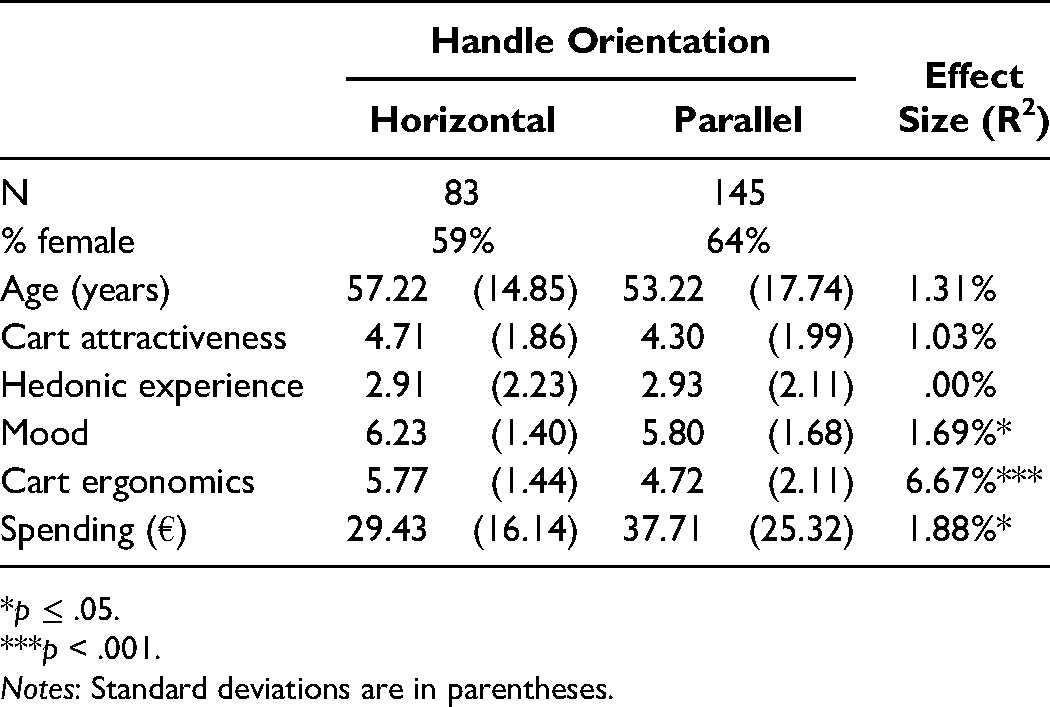
Table 3 summarizes sample characteristics, control measures, and spending of the exit sample. Handle orientation did not affect perceptions of cart attractiveness (p = .13) or hedonic shopping experience (p = .95). However, horizontal-handle shoppers reported slightly better mood than parallel-handle shoppers (β = −.13, t = 1.97, p = .050), and they also evaluated the cart ergonomics more favorably (β = −.26, t = 4.02, p < .001). Neither mood nor ergonomics predicted spending, though (both ps > .69), and parallel handles elicited significantly higher spending than horizontal handles regardless of whether mood and ergonomics were included as control factors (β = .14, t = 2.03, p < .05) or not (β = .14, t = 2.08, p < .05).
Sample Characteristics, Control Measures, and Spending of the Exit Sample in Study 1.
*p ≤ .05.
***p < .001.
Notes: Standard deviations are in parentheses.
Discussion
In comparison to the standard shopping cart with a horizontal handlebar, the parallel handles induced more purchasing, with greater variety and higher cost. Parallel handles increased purchasing of both vice and virtue products, but not stockpile products, which are antithetical to variety seeking. These effects were not attributable to shoppers’ mood or to the cart's ergonomics, as (1) the parallel handles were perceived to be less ergonomically comfortable than the horizontal handlebar, and (2) the effect of handle orientation remained significant after we statistically controlled for both mood and ergonomics.
Study 2: Muscle Activation (EMG)
We argue that the increased purchasing and spending with parallel handles observed in Study 1 was due to activation of the flexor muscles. Whereas horizontal handles naturally activate the extensor muscles, parallel handles naturally activate the flexors, which in turn is known to improve attitudes toward objects (Laham et al. 2015). Study 2 tested this physiological explanation. Using EMG, we recorded participants’ bicep (flexor) and tricep (extensor) activation while they pushed shopping carts with handles of various orientations. In addition to the horizontal handlebar and parallel handles used in Study 1, we also included vertical handles (see Figure 1, Panel B). Including a cart with vertical handles was practically important because a limited number of retail outlets have recently introduced such shopping carts. Because pushing handles that are perpendicular to the direction of motion activates the extensor muscles of the forearm (Di Domizio and Keir 2010; Kao et al. 2015), we predicted that the horizontal and vertical handles would both also activate the extensor muscles of the upper arm (i.e., triceps). In contrast, because grasping our parallel handles requires extending the elbows straighter, and because relatively extended elbows produce greater force from flexor muscles than from extensors (Doheny et al. 2008), we predicted that the parallel handles would more strongly activate the flexors (i.e., biceps).
Methods
Participants
Twenty-three members of the university community (mean age: 30 years; 44% female), recruited on the campus of a European university, participated voluntarily. This sample is larger than most EMG studies of this type, which often use smaller samples because EMG measurements are highly sensitive and reliable. For instance, of the EMG studies cited in this article, the average N was 11. As is standard in EMG studies, the experiment design was fully within-participants.
EMG equipment
We used a Noraxon Ultium wireless EMG system (Velamed GmbH, Cologne, Germany) with a maximum sampling rate of 4,000 Hz. This system consists of myoelectrode sensors that record and wirelessly transmit muscle activation measurements to a receiver, which processes the signals via specialized software (MyoResearch 3).
Shopping carts
See Figure 1.
Procedure
Participants first were prepped for EMG recording. The experimenter marked the location of the biceps brachii and triceps brachii on the participant's dominant arm, and the designated skin areas were shaved, slightly abraded, and disinfected. Two self-adhesive electrodes with transmitters were then attached to the skin surface, one in each designated area (i.e., biceps and triceps).
The experimental procedure consisted of one methodological validation task and two shopping-related tasks, described next.
Classic paradigm (methodological validation)
We first validated our measurement of bicep and tricep activation, using the classic paradigm developed by Cacioppo, Priester, and Berntson (1993). On flexion trials, participants were seated at a table and instructed to bend their elbow at approximately 90°, place their palm facing upward against the underside of the table, and press upward gently for five seconds. After a brief self-timed break, they repeated this flexion task a second time. On extension trials, participants instead placed their arm straight outward (elbow = 180°) with the palm facing downward against the topside of the table, and pressed downward gently for five seconds. After a self-timed break, they repeated this extension task. These classic flexion and extension trials allowed us to test whether the electrodes were recording properly, before proceeding to the main tasks.
Controlled pushing
In our Study 3 (reported subsequently), we examined simulated shopping in a highly controlled laboratory setting. Specifically, participants gently pushed a shopping cart front-first against a wall, while hypothetically purchasing products shown on a computer display. To test whether different shopping cart handles differentially activate the flexor and extensor muscles in that controlled task, we included it in the present experiment (without any hypothetical purchasing). Participants gently pushed all three shopping carts—with a horizontal handlebar, vertical handles, or parallel handles—against a wall for five seconds. We illustrated this procedure in Figure 3, Panels A–C. After a brief self-timed break, participants repeated this controlled pushing task with each of the three shopping carts (i.e., 3 carts × 2 pushes = 6 trials).
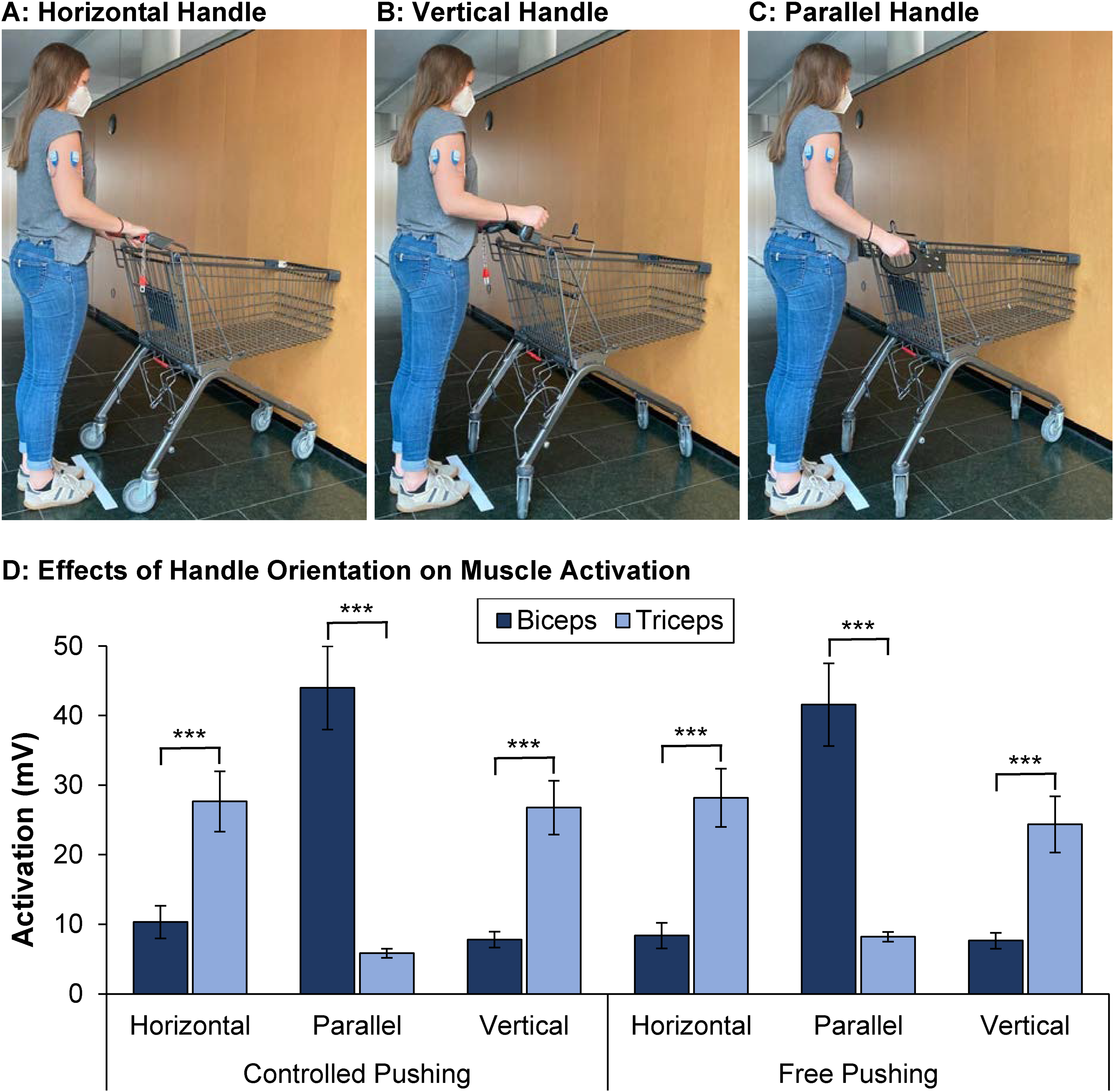
Horizontal-, vertical-, and parallel-handle conditions of the controlled pushing task (EMG electrodes shown on the arm), and effects of handle orientation on muscle activation in Study 2.
Free pushing
To examine flexor and extensor activation under more realistic shopping conditions, we also had participants maneuver each of the three shopping carts through a figure-eight-shaped course that was approximately 20 meters long. We marked a starting/ending point on the floor, and we marked points 5 and 10 meters away in a straight line. Participants pushed each shopping cart from the starting point in a figure-eight path by passing on alternating sides of the two markers, making a 180° turn around the second marker, and then passing on alternating sides again while returning to the end point. The shopping cart was loaded with 18 kg of bottled water, and walking speed was controlled via a digital metronome placed in the cart. Participants completed this figure-eight course twice with each of the three shopping carts (i.e., 3 carts × 2 runs = 6 trials).
Data and analyses
Each trial of the controlled pushing task lasted five seconds, and participants completed two trials with each shopping cart. For data analysis, we averaged the muscle activation (measured in microvolts [mV]) across the ten seconds of controlled pushing (5 seconds × 2 trials) with each shopping cart, separately for the biceps and triceps. Each trial of the free pushing task lasted approximately 25 seconds, and we again averaged the activation across the two trials with each cart. As is standard in EMG studies, we rectified the data and applied high- and low-pass filters prior to analysis. Across the course of a trial, the EMG signal oscillates in both positive and negative directions. Rectification is taking the absolute value of the signal, so that 0 indicates no activation of the given muscle and positive values indicate the extent of activation. The high- and low-pass filters then smooth the signal by removing extreme peaks and valleys.
Results
Results are summarized in Table 4 and illustrated in Figure 3, Panel D.
Muscle Activation Results (Microvolts) in Study 2.

***p < .001.
Notes: Standard deviations are in parentheses.
Classic paradigm
A 2 (trial type: flexion, extension) × 2 (muscle: biceps, triceps) repeated-measures analysis of variance (ANOVA) on muscle activation in Cacioppo, Priester, and Berntson’s (1993) classic paradigm (see Table 4) indicated significant main effects of both trial type (F(1, 22) = 15.65, p < .001, η2 = .42) and muscle (F(1, 22) = 18.66, p < .001, η2 = .46). More importantly, the expected interaction was also significant (F(1, 22) = 53.86, p < .001, η2 = .71). Whereas the flexion trials more strongly activated the biceps (t(22) = 6.35, p < .001, η2 = .65), the extension trials more strongly activated the triceps (t(22) = 8.30, p < .001, η2 = .76). These results validate our methods and measures.
Controlled pushing
A 2 (muscle: biceps, triceps) × 3 (handle orientation: horizontal, vertical, parallel) repeated-measures ANOVA on muscle activation in the controlled pushing task indicated no main effect of muscle (p = .77) but a main effect of handle orientation (F(2, 44) = 4.66, p < .05, η2 = 0.18). More importantly, the predicted interaction was significant (F(2, 44) = 37.90, p < .001, η2 = .63). Whereas the horizontal handlebar (t(22) = 4.24, p < .001, η2 = .45) and the vertical handles (t(22) = 5.02, p < .001, η2 = .53) more strongly activated the triceps, the parallel handles more strongly activated the biceps (t(22) = 6.25, p < .001, η2 = .64). See Figure 3, Panel D.
Free pushing
A 2 (muscle) × 3 (handle orientation) ANOVA in the free pushing task revealed no effect of muscle (p = .48) but a main effect of handle orientation (F(2, 44) = 10.49, p < .001, η2 = .32). More importantly, the predicted interaction was significant (F(2, 44) = 32.93, p < .001, η2 = .60). Whereas the horizontal handlebar (t(22) = 5.54, p < .001, η2 = .58) and the vertical handles (t(22) = 4.57, p < .001, η2 = .49) more strongly activated the triceps, the parallel handles more strongly activated the biceps (t(22) = 5.70, p < .001, η2 = .60).
Discussion
Traditional shopping carts with a horizontal handlebar and novel shopping carts with vertical handles both activate the triceps, whereas novel shopping carts with parallel handles instead activate the biceps. This finding supports our theoretical explanation that parallel handles increase purchasing (Study 1) by selectively activating the flexor muscles (Study 2), which in turn induces approach motivation (Förster, Higgins, and Idson 1998) and improves attitudes (Laham et al. 2015). Notably, the controlled and free pushing tasks yielded highly similar patterns of muscle activation. Because controlled pushing activates the same muscles and to approximately the same extent as free pushing, while also being easier to implement and control, in Study 3 we combined controlled pushing with hypothetical shopping.
Study 3: Simulated Shopping
We have argued that the greater purchasing with parallel handles (Study 1) is due to activation of the flexor muscles (Study 2). However, the horizontal and parallel handles used in Study 1 differed not only in handle orientation but also in novelty. Because participants in Study 1 had no prior experience shopping with parallel handles, the novelty of that shopping cart may have induced shoppers to purchase and spend more than they otherwise would have. Study 3 disentangles these two factors by additionally including a shopping cart with vertical handles, as in Study 2. Critically, the vertical and parallel handles are both novel, but the vertical handles activate the extensor muscles whereas the parallel handles activate the flexors (see Figure 3, Panel D). So if the greater purchasing with parallel handles is due to novelty, then vertical and parallel handles should elicit comparable levels of purchasing. Alternatively, if the increased purchasing is due to muscle activation, then parallel handles should elicit more purchasing than both horizontal and vertical handles.
To test this novelty explanation of the effect, Study 3 used the controlled pushing task introduced in Study 2, while participants also completed a hypothetical purchasing task (see Figure 4, Panels A and B). Participants pushed a shopping cart with either horizontal, vertical, or parallel handles (manipulated between participants) while viewing a series of products from a variety of categories (e.g., beverages, office supplies). Each product appeared with a price, and participants simply indicated how many of each product they would like to purchase at the given price. Because only the parallel handles activate the flexor muscles (Study 2), we predicted that parallel handles would increase hypothetical purchasing and spending relative to both horizontal and vertical handles. We also measured the ergonomics of the various handle orientations and participants’ mood.

Simulated shopping task (parallel-handle condition shown), example product display, and category-specific effects of handle orientation on hypothetical purchase quantity in Study 3.
Method
Participants
One hundred forty-one participants (mean age: 24 years; 55% female), recruited on the campus of a European university, were randomly assigned to one of three between-participant conditions (i.e., horizontal, vertical, or parallel handles).
Shopping carts
See Figure 1.
Products
Stimuli were images of 44 common supermarket products (see Web Appendix C) spanning six categories: frozen foods (6 products), beverages (8), sweets and high-calorie snacks (8), dairy (8), cleaning and hygiene (10), and office supplies (4). We created 12 product displays, each containing 2–4 products (M = 3.6 products per display), with all products in each display being in the same product category. Each product was presented with a picture, a verbal label (e.g., Snickers), and a price (e.g., €.49). To stimulate hypothetical purchases, we presented all products with slightly discounted prices relative to local supermarket prices. Figure 4, Panel B, shows an example display, and the full set of displays is available at the Open Science Framework (see footnote 3).
Procedure
The procedure was designed to simulate relevant aspects of brick-and-mortar shopping; namely, participants were asked to push a shopping cart while choosing products from an assortment. One of the three carts was placed directly against a wall (i.e., front first), and a 21-inch computer monitor was placed on a table immediately adjacent to the cart, displaying products. Participants assigned to the horizontal, vertical, and parallel carts respectively gripped either the horizontal handlebar, the vertical handles, or the parallel handles. Participants gently pushed the cart against the wall, and viewed the 12 product displays on the monitor, one display at a time (see Figure 4, Panel A). For each product display, participants indicated aloud to the experimenter how many of each product they would like to purchase at the given price.
After the simulated shopping task, participants completed a free pushing task. They pushed the cart (loaded with 15 kg of bottled water) five meters to a designated turning point and back (i.e., ten meters total, including a 180° turn). Participants then evaluated the cart ergonomics in terms of both grip force (three items: “How comfortable was the cart to grasp?,” “How easy was it to grasp the cart?,” and “How good or bad is the cart's overall feel?”) and push force (three items: “How comfortable was the cart to push?,” “How easy was it to maneuver the cart?,” and “How good or bad is the cart's overall handling?”). The six ergonomics items were evaluated on a seven-point scale ranging from −3 to +3, where negative scores and positive scores respectively indicate worse and better ergonomics. Finally, participants reported their mood on Allen and Janiszewski’s (1989) four-item scale (“At this moment, I am feeling …” −3 = “bad,” “unpleasant,” “negative,” “sad,” and +3 = “good,” “pleasant,” “positive,” “happy”).
Data and analyses
We averaged the four mood items (Cronbach’s α = .90), and principal components analysis indicated that all six ergonomics items loaded onto a single factor, so we also averaged them as well (α = .86). Data were again analyzed via linear regression, as in Study 1, with vertical and parallel handle orientations dummy coded.
Results
Control measures
Table 5 shows sample characteristics and control measures. Mood did not differ across groups (p = .94), but the three shopping carts differed in ergonomics (F(2, 138) = 3.20, p < .05). The vertical handles were significantly more ergonomic than the horizontal handlebar (β = .27, t = 2.65, p < .01) and marginally more ergonomic than the parallel handles (β = .19, t = 1.84, p = .07).
Sample Characteristics, Control Measures, and Purchasing Results in Study 3.

*p < .05.
**p < .01.
Notes: Mood and cart ergonomics were originally measured on a scale from −3 to +3. However, to facilitate comparison with Study 1, we convert those scores to a 1 to 7 scale here. Standard deviations are in parentheses. To facilitate comparison with Study 1, the R2 shown here compares the horizontal and parallel conditions.
Hypothetical purchasing
Purchasing results are summarized in Table 5 and Figure 2. Handle orientation significantly affected hypothetical purchasing and spending. Replicating Study 1, the parallel handles elicited significantly more hypothetical purchases (β = .25, t = 2.49, p < .05), with greater variety (β = .26, t = 2.55, p < .05) and higher spending (β = .31, t = 3.11, p < .01) than the horizontal handlebar. Also as we hypothesized, the parallel handles elicited significantly more purchases (β = .37, t = 3.82, p < .001), with greater variety (β = .33, t = 3.32, p < .001) and higher spending (β = .40, t = 4.13, p < .001) than the vertical handles. The horizontal and vertical handles did not differ significantly from one another in purchase quantity, variety, or spending (all ps > .37). Results were unaffected by including or excluding participants’ mood and cart ergonomics as covariates. Figure 4, Panel C, shows hypothetical purchase quantities within each of the six product categories. As in Study 1, the parallel handles increased purchases of not only vice products such as sweets and snacks but also virtue products such as cleaning and hygiene products (for details, see Web Appendix D).
Replication study
Comparison of the vertical and parallel handles was particularly important for testing whether novelty can explain the effect. We therefore report a close replication of Study 3, with only the vertical- and parallel-handle conditions (N = 100), in Web Appendix E. In this replication study, there was no difference in cart ergonomics (p = .96). However, the hypothetical purchasing results closely replicated those reported previously: the parallel handles elicited significantly more hypothetical purchase quantities (β = .30, t = 3.08, p < .01), with greater variety (β = .37, t = 3.91, p < .001) and higher spending (β = .25, t = 2.50, p < .05). Thus, the difference in purchasing between parallel and vertical handles was reliable, and the higher purchasing and spending with parallel handles does not appear attributable to novelty.
Discussion
In a simulated shopping task, participants hypothetically purchased and spent more with parallel handles than with perpendicular handles (i.e., horizontal, vertical). This effect was not attributable to the novelty of the cart, as the vertical handles were also novel, yet they failed to increase purchasing beyond the standard horizontal handlebar. Nor was the effect attributable to the ergonomics of pushing the cart or to participants’ mood.
Ergonomics: Combined Analysis
The results on our measures of cart ergonomics varied across studies. The horizontal handlebar was judged more ergonomic than the parallel handles in Study 1 but not in Study 3, and the vertical handles were judged more ergonomic than the parallel handles in Study 3 but not in the replication study. To provide a more reliable interpretation of this measure, we combined the ergonomics data from the three studies (note: the data of Study 3 were converted to the 1–7 scale used in the other studies). Although ergonomics judgments were significantly above the scale midpoint for each of the three handles (all ps < .001), the handle orientations differed significantly in ergonomics (F(2, 466) = 10.12, p < .001). The parallel handles (n = 243, M = 4.97, SD = 1.80) were less ergonomic than both the horizontal handlebar (n = 130, M = 5.65, SD = 1.28; β = .20, t = 3.86, p < .001) and the vertical handles (n = 96, M = 5.53, SD = 1.11; β = .16, t = 2.88, p < .01). Thus, across studies, perpendicular handles (i.e., horizontal, vertical) were more ergonomic than parallel handles.
General Discussion
Standard shopping carts are pushed via a horizontal handlebar. Given that pushing a horizontal handlebar activates arm extensor muscles (Di Domizio and Keir 2010) and arm extensor activation induces less hypothetical purchasing than arm flexor activation (Streicher and Estes 2016b), we deduced that standard shopping carts may be suboptimal for stimulating purchases. We predicted that shopping carts with parallel handles would instead activate the flexor muscles and thus increase purchasing. We consulted with shopping cart manufacturers and retail managers, developed and prototyped a novel shopping cart with parallel handles, and tested our predictions in one field experiment and two lab experiments. In Study 1, supermarket shoppers purchased more products and spent more of their own money when shopping with a parallel-handle cart than with a standard horizontal handlebar. This effect was observed across a broad range of product categories, including both vices (e.g., unhealthy snacks) and virtues (e.g., cleaning supplies), but not stockpile products (e.g., pasta). Study 2 demonstrated that whereas perpendicular handles (i.e., horizontal, vertical) activate the extensor muscles (i.e., triceps), parallel handles instead activate the flexor muscles (i.e., biceps). Finally, in a simulated shopping scenario, Study 3 demonstrated that parallel handles induce more purchasing and spending than not only horizontal handles but also vertical handles. In the course of our studies, we also tested and excluded three alternative explanations. The effect was not due to participants’ mood (Studies 1 and 3), the cart’s ergonomic properties (Studies 1 and 3), or novelty of the cart (Study 3).
Academic Contributions
This research provides several theoretical contributions. First and foremost, we demonstrate an effect of shopping cart design on purchasing and spending. Prior studies have examined how shopping carts affect shopping behavior (see Table 1), such as “smartcarts” that influence spending by informing shoppers of their total costs as they shop (Van Ittersum et al. 2013). However, the present study is the first to examine the physical properties of the shopping cart itself as a marketing tool for stimulating purchases. We show that the orientation of the handles on a shopping cart affects purchasing and spending.
Second, this research reveals the physiological process underlying the effect of handle orientation on purchasing. Prior research in ergonomics showed that pushing horizontal and vertical handles activates the extensor muscles of the forearms (Di Domizio and Keir 2010; Kao et al. 2015), and our research confirms that horizontal and vertical handles also activate the extensor of the upper arm (i.e., the triceps). But more importantly, the present research shows that pushing parallel handles instead activates the biceps. That is, we demonstrated for the first time that parallel handles uniquely activate the flexors. So given that flexor activation increases purchasing (Streicher and Estes 2016b), parallel handles increase purchasing.
A third academic contribution is that this research also reveals the generality of the effect across product categories. Some prior research found that arm flexion specifically increases the choice of vice products over virtue products, such as choosing an apple over a chocolate bar, suggesting that arm flexion may induce a desire for instant gratification (Van den Bergh, Schmitt, and Warlop 2011). However, other research found that, when not forced to choose between vice and virtue products, arm flexion increased hypothetical purchasing of both vices and virtues (Streicher and Estes 2016b). The present research similarly revealed a generalized effect on both vice and virtue purchases. The increase in virtue purchases casts doubt onto whether the effect is due to instant gratification, because virtue products are about constraint, not gratification.
If the effect is not due to a desire for instant gratification, then what psychological process may underlie the effect? Prior research suggests that this effect is likely due to evaluative and motivational factors (for a review, see Laham et al. [2015] and Streicher and Estes [2016b]). Many psychological studies have shown that arm flexion induces approach-oriented motivation toward gains (Förster, Higgins, and Idson 1998), broadens attention (Calcott and Berkman 2014) and categorization (Förster et al. 2006), and improves attitudes toward objects (Cacioppo, Priester, and Berntson 1993). In the context of brick-and-mortar shopping, those findings suggest that pushing a shopping cart with parallel handles may stimulate shoppers to broaden their product exposure and consideration sets, improve their attitudes toward products, and/or motivate them to purchase. In this research we have provided a physiological explanation of how handle orientation affects muscle activation, which in turn affects purchasing. Nevertheless, this physiological explanation is consistent with psychological explanations in terms of motivation, attention, and attitudes.
Indeed, although our studies were not specifically designed to test psychological processes, our findings do suggest that parallel handles may increase variety seeking. As described previously, arm flexion induces approach motivation and broadens both perceptual and conceptual attention. This led us to predict that flexion would increase purchase variety, as shoppers may expose themselves to more products and consider more options, while also experiencing motivation to approach and acquire them. To be clear, purchase quantity and variety are naturally correlated—more variety entails more purchases—but they are distinct measures that may diverge systematically. For instance, if parallel handles simply induced more purchases of the same products, that would manifest as an effect on quantity but not variety. The present studies instead demonstrate that parallel handles induce more purchases of different products (i.e., variety). In addition, a particularly interesting product category in this regard is stockpile products (e.g., pasta, rice, toilet paper), which may be considered antithetical to variety. We found increased purchasing of nearly all product categories, but not of stockpile products. Thus, the effect occurred on purchase variety but not in nonvariety products (i.e., stockpile), suggesting that parallel handles may induce variety seeking among shoppers. However, further research is needed to test this claim more directly.
Consumer Welfare
This research has implications for consumer welfare. Currently, carts with a horizontal handlebar are the only ones available in most retail outlets, and in our studies, shoppers purchased fewer products and spent less money when using those standard carts. For the majority of shoppers, who face a constant battle against overspending and overconsumption, these standard shopping carts thus may act as a welcome and unexpected restraint on buying and spending. However, the use of alternative shopping carts in the marketplace is on the rise, such as carts with vertical handles (see also the “sanitary handles” in Web Appendix F). Our results suggest that, regardless of the handle design, shoppers with a budget should try to maintain an extension posture while shopping. Such consumers are also advised to utilize other well-known methods for constraining their purchases, such as shopping with a list (see Block and Morwitz 1999) and a mental budget (Stilley, Inman, and Wakefield 2010a, b).
However, for those shoppers without budget constraints, adopting a flexion posture would appear to allow shopping and purchasing without artificial constraints from the shopping cart itself. Simply stated, arm extension may be better for “window shopping” in which consumers browse without purchasing (see Taylor 2017), whereas arm flexion may be better for “retail therapy” in which consumers make purchases in order to generate happiness (see Atalay and Meloy 2011; Rick, Pereira, and Burson 2014). Flexion may also benefit shoppers who want to minimize their number of shopping trips, as the increased purchasing may preempt smaller fill-in trips (e.g., Stilley, Inman, and Wakefield 2010a, b). More generally, our research suggests that consumers could benefit from recognizing and regulating the potential impact that shopping devices can have on their consumption, and we hope that our research and other studies like it can educate consumers about their vulnerabilities in the marketplace.
Pushing shopping carts also has physiological effects. First, parallel handles, such as those on rollators (i.e., “walkers”) for the elderly and the mobility-impaired, reduce leg muscle exertion and can improve stability while walking (Suica et al. 2016). This indicates that parallel-handle carts would be particularly advantageous for such consumers. Second, pushing a cart creates load forces on the hand and forearm. Pushing horizontal handles tends to induce wrist extension, whereby the topside of the hand bends slightly backward toward the forearm. In contrast, parallel handles are more likely to induce ulnar deviation, whereby the hand tilts slightly downward and away from the body. With prolonged exposure, wrist extension and ulnar deviation are both associated with increased risk of carpal tunnel syndrome (You, Smith, and Rempel 2014). Thus, extensive gripping and pushing of shopping carts could harm shoppers’ physical health, but the potential impact of handle orientation is currently unclear. Of course, the occasional shopping trip is unlikely to present any such physical risk. However, high-impact shoppers are advised to follow recommended practices such as those developed by the National Institute for Occupational Safety and Health (www.cdc.gov/niosh).
Managerial Implications
The primary aim of this research was to introduce a novel intervention to address a substantive marketing question (see MacInnis et al. 2020). Retail managers often use in-store marketing actions to influence shoppers’ purchasing decisions (Gilbride, Inman, and Stilley 2015; Inman, Winer, and Ferraro 2009). The shopping cart is a ubiquitous but overlooked in-store tool with directly tangible economic consequences. Our results suggest that the shopping carts currently available in nearly every large retail outlet are suboptimal for stimulating sales. Of course, shopping carts with a horizontal handlebar do facilitate purchasing relative to a handheld basket (see Web Appendix B), simply by virtue of providing more space and requiring less effort to transport products throughout the shop. Relative to parallel-handle carts, however, those standard shopping carts appear to underperform in sales and, thus, profitability. Similarly, a few retail outlets have recently introduced shopping carts with vertical handles (Figure 1, Panel B). Such vertical handles may be more comfortable than a horizontal handlebar (Lin, McGorry, and Chang 2012), but our results indicate that those handles also stimulate relatively limited purchasing (Study 3), presumably because they also activate the extensor muscles (Study 2).
If one's goal is to maximize sales and/or profits, our results suggest the use of shopping carts with parallel handles that induce muscle flexion. In fact, parallel handles increased sales of a very broad range of product-types, from fresh produce to sweets, indicating that parallel-handle carts may stimulate sales not only in large retail outlets that stock a wide variety of product categories but also in specialty shops that stock relatively few product categories.
A related finding is that there appears to be a trade-off in shopping cart functions. Our interviews with corporate stakeholders revealed that contemporary shopping carts are designed with shoppers’ ergonomic comfort as a priority. However, our studies show that optimizing ergonomics may come at the cost of sales. We found that perpendicular handles were indeed more ergonomically comfortable than parallel handles, yet, the parallel handles induced more purchasing and spending than the perpendicular handles. Thus, it appears that retail managers face a trade-off when choosing the shopping carts to offer their customers: more comfortable carts may be less profitable. This finding suggests that cart manufacturers and retail managers may benefit from decreasing their focus on ergonomics and instead realizing the potential for cart designs to stimulate sales.
It must be noted, however, that other metrics (e.g., customer satisfaction) and the long-term consequences (e.g., repeat patronage) of shopping with parallel handles are currently unknown. Thus, we view our results as providing only one piece of a much larger managerial puzzle, and we caution against implementing our findings in-store without first investigating possible effects on other important customer outcomes. We next consider some of those other possible outcomes, as well as additional factors that may be important.
Limitations and Future Research Agenda
This research has several important limitations that also reveal interesting directions for further research. Table 6 presents a prospective research agenda, with specific research questions organized into ergonomic, psychological, and managerial factors. We have already discussed some ergonomic factors, such as (1) physical stability among elderly and mobility-impaired shoppers, and (2) arm health among frequent shoppers and with heavy loads. Another ergonomic factor is comfort. Although shoppers judged the parallel-handle cart to be less comfortable, we suspect that this may be due to the cart's unfamiliarity. Indeed, because shoppers have a lifetime of experience pushing carts with a horizontal handlebar, the cart with parallel handles requires shoppers to change their long-held routines. As Garcia, Bardhi, and Friedrich (2007) explain, such marketing innovations incur a psychological switching cost, and although consumers initially tend to resist such innovations, with sufficient exposure that resistance may be overcome. Thus, it remains to be tested whether shoppers will eventually become accustomed to this handle design.
Agenda for further research.

An important limitation of our research is the paucity of psychological information about the process underlying the effect and about the shoppers in our studies (see Table 6). We believe that shoppers’ motivational orientation may partially explain the effect of handle design on purchasing. Given our evidence that parallel and perpendicular handles respectively activate the flexor and extensor muscles, and given that flexor and extensor activation respectively induce approach and avoidance motivation (Förster, Higgins, and Idson 1998), parallel and perpendicular handles respectively may activate approach and avoidance motivation. A related hypothesis is that handle orientation may affect exploratory shopping behaviors (Streicher, Estes, and Büttner 2021). In other words, given that flexor activation broadens visual and conceptual attention (Calcott and Berkman 2014; Förster et al. 2006), parallel handles may increase purchasing and spending by increasing consumers’ exploration of and exposure to the store's assortment. Our finding that parallel handles induced more variety seeking than perpendicular handles supports this hypothesis of exploratory shopping. A third psychological hypothesis is that the effect of handle orientation on purchasing may be especially large among shoppers high in the need for touch (Peck and Childers 2003), or high in haptic sensitivity. Indeed, such haptically sensitive shoppers are especially susceptible to other haptic effects, such as tactile priming of product choice (Streicher and Estes 2016a).
This research also has important limitations, and directions for further research, in the managerial domain (Table 6). What types of purchases and what types of shoppers are most likely to exhibit the effect? For instance, intuitively it seems likely that handle orientation especially affects unplanned purchases (e.g., Grewal et al. 2020; Streicher, Estes, and Büttner 2021), because shopping carts are used only at the point of purchase. This hypothesis is also consistent with our theorizing about variety seeking and exploratory shopping, both of which should affect unplanned purchasing more than planned purchases. In contrast, consumers who shop with constraints such as a shopping list or a mental budget are presumably less susceptible to this effect (see Grewal et al. 2020), as shoppers often utilize those constraints specifically to reduce their unplanned purchasing. Similarly, shoppers’ use of mobile devices, such as phones and handheld scanners (Grewal et al. 2020), may also relate to this effect. For instance, mobile phone use generally increases purchasing by distracting shoppers and extending their shopping trips (Grewal et al. 2018). Notably, mobile phones also constrain shoppers’ arm posture and muscle activation, as holding a phone near one's face requires arm flexion. Thus, by activating consumption associations and goals (e.g., Van den Bergh, Schmitt, and Warlop 2011), arm flexion may also contribute to the positive effect of mobile phone use on purchasing. Another managerial concern, as discussed previously, are the effects of handle orientation on other outcomes such as customer satisfaction and repeat patronage. The lower ergonomic comfort of the parallel handles could hinder those longer-term outcomes. Or alternatively, if shoppers quickly adapt to parallel handles (Garcia, Bardhi, and Friedrich 2007), satisfaction and repeat patronage could be unharmed. To be sure, the research questions identified in Table 6 are merely a few of the ergonomic, psychological, and managerial issues in need of further research, and we believe that pursuing such a research agenda would be theoretically informative and practically important.
Finally, a theoretical limitation is that the present studies do not include a comparison condition in which no arm muscles are activated. Some prior studies have compared flexor and extensor activation with a neutral condition in which neither muscle system is activated, to determine whether flexion increases the given behavior and/or extension decreases it. Because our studies focused on shopping carts, however, they lack this theoretically neutral condition. That is, each handle orientation activated either the flexors (i.e., parallel handles) or the extensors (i.e., perpendicular handles). Consequently, our results reveal that parallel handles elicit more purchasing and spending than perpendicular handles, but they do not reveal whether parallel handles increase purchasing relative to a theoretically neutral condition with no arm muscle activation, nor whether perpendicular handles decrease purchasing relative to that theoretical comparison. However, prior studies indicate that flexion and extension may have asymmetric effects on behavior. For instance, Streicher and Estes (2016b) found that flexion elicited more hypothetical purchases than a neutral condition (i.e., without muscle activation), whereas extension did not differ from that neutral condition. Thus, it appears that flexor activation generally increases the given behavior, more so than extensor activation decreasing it (see also Calcott and Berkman 2014; Förster et al. 2006; Friedman and Förster 2000, 2002). In terms of the present studies, then, it appears more likely that parallel handles increased purchasing rather than horizontal handles decreasing it. We sincerely hope that by addressing these and other limitations of the present research, more effective retail practices can be established to benefit both consumers and retailers.
Footnotes
Acknowledgments
The authors thank Peter Paul Mölk (MPREIS Warenvertriebs GmbH) for enabling and supporting the field study, Peter Federolf (Neurophysiology Research Group, University of Innsbruck) for enabling and supporting the electromyography study, and Maité Calisti, Lina Graf, and Marco Vouk for their invaluable service as research assistants.
Author Contributions
The authors contributed equally to this research.
Notes
References
Supplementary Material
Please find the following supplemental material available below.
For Open Access articles published under a Creative Commons License, all supplemental material carries the same license as the article it is associated with.
For non-Open Access articles published, all supplemental material carries a non-exclusive license, and permission requests for re-use of supplemental material or any part of supplemental material shall be sent directly to the copyright owner as specified in the copyright notice associated with the article.
