



Abstract
Consumption can provide a feeling of groundedness or being emotionally rooted. This can occur when products connect consumers to their physical (place), social (people), and historic (past) environment. The authors introduce the concept of groundedness to the literature and show that it increases consumer choice; happiness; and feelings of safety, strength, and stability. Following these consequential outcomes, the authors demonstrate how marketers can provide consumers with a feeling of groundedness through product designs, distribution channels, and marketing communications. They also show how marketers might segment the market using observable proxies for consumers’ need for groundedness, such as high computer use, high socioeconomic status, or life changes brought on by the COVID-19 pandemic. Taken together, the findings show that groundedness is a powerful concept providing a comprehensive explanation for a variety of consumer trends, including the popularity of local, artisanal, and nostalgic products. It seems that in times of digitization, urbanization, and global challenges, the need to feel grounded has become particularly acute.
To be rooted is perhaps the most important and least recognized need of the human soul.
We believe that many consumers have a need to feel grounded, which we define as a feeling of emotional rootedness. This feeling emanates from connections to one’s physical, social, and historic environment and provides a sense of strength, safety, and stability. Although the concept has received scant attention in prior marketing, consumer behavior, and social psychology research, the feeling of groundedness appears to be a familiar one among lay consumers. For example, we might feel grounded when returning to our birthplace, sitting at our grandparents’ kitchen table while enjoying a pie made with apples from their backyard tree and according to a recipe passed down for generations. Similarly, we may have experienced feeling grounded when shopping at the local farmers market or foraging a basket of mushrooms from a nearby forest.
We argue that there are at least three conceptually separable (but in practice often intertwined) sources of feelings of groundedness: connectedness to place, people, and/or past. Collectively, connections to place, people, and past engender feelings of groundedness by “rooting” us in our physical, social, and historic sphere. These connections may be established through many different objects, activities, and types of interactions. In this article, we focus on the role of products in providing customers with a connection to place, people, and past.
Indeed, numerous marketplace examples illustrate increasing consumer demand for products that presumably make them feel more connected and thus grounded: Spearheading a renaissance of artisan, indie, and craft production, for example, locally rooted (micro)breweries have gained substantial market share in recent years. In 2019, craft beer accounted for 13.6% of total beer volume sales—a number that had increased by 4% even as overall U.S. beer volume sales had decreased by 2% (Brewers’ Association 2020). Similarly, sales estimates of local food increased from US$6.1 billion in 2012 to US$8.7 billion in 2015 (Low et al. 2015; U.S. Department of Agriculture 2016) and farmers markets—which afford a connection to the land and to the people behind the food—are on the rise. In 2014, there were 8,268 farmers markets across the United States: a growth of 180% since 2006 (Low et al. 2015). Beyond the food industry, online marketplaces such as Etsy connect consumers to handcrafted products and to the craftspeople that sell them. Impressively, Etsy reported 81.9 million users and US$10.3 billion gross merchandise sales worldwide in 2020 (Etsy 2021).
This trend in demand for local, personal, and traditional products is surprising when considered against the backdrop of globalization, digitization, and modern society’s penchant for technology and innovation. Marketers have begun to capitalize on these shifts in demand—for example, by stocking and promoting local products, encouraging contact with the people who make the products, and highlighting traditional ingredients or production methods. We have recently also observed marketers referring to the concept of groundedness. The Austrian grocery chain BILLA ran a national advertising campaign in fall 2020 referring to the farmers behind their products as “The people who make us grounded” (“Wer uns erdet”).
In light of these trends, we contend that products can metaphorically connect us to place, people, and past, and thereby make us feel grounded. For brevity, we hereinafter refer to products that can make consumers feel grounded as “grounding products.” We argue that the ability of products to provide a feeling of groundedness will make them more attractive to consumers. We further propose that feeling grounded may contribute to consumer well-being. Groundedness—understood as a feeling of deep-rootedness, having a strong foundation, and being securely anchored—gives consumers feelings of safety, strength, and stability as well as confidence that they can withstand adversity. As such, feelings of groundedness might provide consumers with a sense of happiness, thus adding to their overall well-being.
This work makes several contributions. First, it introduces the feeling of groundedness as a driver of consumer behavior and consumer welfare. Second, it provides an overarching theoretical explanation for a variety of major consumer trends, such as the desire for local, craft, and traditional products. Third, it highlights that consumers experience a feeling of groundedness when products connect consumers to their physical (place), social (people), and historic (past) environment. Fourth, the studies offer various actionable marketing implications for products aimed at helping consumers connect to place, people, and past.
Groundedness
Groundedness in the Literature
As a personal characteristic, to be “grounded” is a common concept in everyday parlance, easily found in any dictionary. In contrast to everyday parlance, we found groundedness to be a fairly novel and underresearched construct in the literature. There are few direct references to groundedness in the marketing, consumer behavior, or social psychology literature streams. The mentions we did find in other literature (e.g., psychotherapy, environmental or educational psychology) are relatively obscure, only loosely related, or speculative (for an overview of relevant research, see Web Appendix A). For example, educational psychologist McAndrew (1998) writes about “rootedness” and develops a measure of rootedness for college students. However, McAndrew’s explanation of rootedness is limited to location. Similarly, environmental psychologists (e.g., Mayer and Frantz 2004; Nisbet and Zelenski 2013) have studied connectedness to nature, which is also a more limited construct. We found a more closely related conception of groundedness in a psychotherapy doctoral dissertation, where Ndi (2014, pp. 82–83) describes rootedness in terms of “the personal, social, environmental, and economic anchoring that sees us through tough times. Within rootedness, there is a sense of togetherness, a combination of personal identity and group identity, past and present, and people and places.”
In philosophy, Weil (1952, p. 43) points to the importance of being rooted. She notes: A human being has roots by virtue of his real, active, and natural participation in the life of a community, which preserves in living shape certain particular treasures of the past and certain particular expectations of the future. This participation is a natural one, in the sense that it is automatically brought about by place, conditions of birth, profession, and social surroundings.
Fromm (1976) likewise writes about rootedness in terms of the need to establish roots and feel at home in the world, while Steiner (2005) refers to a connection to the land as a source of well-being that is undermined by technological forces that separate people from their roots in nature.
In marketing, Thompson and Coskuner-Balli (2007) examine rootedness in the context of community-supported agriculture (CSA), arguing that by connecting consumers to the land and producers, CSA membership may help consumers reconnect to their “material, historical, and spiritual roots” (p. 141). Arnould and Price (2000) also touch on some of the elements, antecedents, and consequences of groundedness, such as community and traditions.
In summary, we believe the idea of groundedness has not been formally developed as a concept, nor have the full scope of the construct and its implications for consumer behavior and marketing been identified. We aim to fill this gap in the literature.
The Construct of Groundedness
We argue that many consumers have a need to feel grounded, which we define as a feeling of emotional rootedness. The feeling of groundedness results from being metaphorically embedded in one’s physical, social, and historical environment. Like the roots of a tree or the foundation of a house, a feeling of groundedness connects a person to their “terroir” (where the French word terroir not only refers to the land per se but also includes its cultural history and human capital [Rozin and Wolf 2008]). Consistent with relevant dictionary definitions—which include being mentally and emotionally stable or firmly established 1 —we argue that the feeling of groundedness provides a solid foundation that imparts a sense of strength, safety, stability, and confidence that one can withstand adversity.
Connection to place
Consistent with the idea of “spreading one’s roots into the ground,” and the literal translation of terroir as “land” or “soil” (Rozin and Wolf 2008), the feeling of groundedness can be obtained from a connection to a physical environment or place. This connection can be physical in the literal sense, as when working with actual, tangible objects that originate in the local environment, or when immersing in the natural environment itself. We find examples of such immersion in, and connection to, the natural sphere in the East Asian tradition of shinrin yoku, or forest bathing (Hansen, Jones, and Tocchini 2017), and the Nordic cultures’ idea of outdoor life (Friluftsliv), which, according to Gelter (2010, p. 3), provides “a biological, social, aesthetic, spiritual and philosophical experience of closeness to a place, the landscape, and the more-than-human world; an experience most urban people today lack.” In the same vein, connection to place may be experienced when directly drawing from the earth, as popularly pursued in urban gardening and farming. Indeed, one of Thompson and Coskuner-Balli’s (2007, pp. 140–41) informants states, “That’s what farming actually is [a connection to the earth].… You are working with the living world. It’s the connection you give people to the farm.” In addition to a physical connection, consumers can also connect to place in a more symbolic sense. They may do so, for example, by consuming locally produced goods, such as a beer from a nearby brewery. Establishing a connection to one’s place to feel grounded may have become especially important as a consequence of migration and mobility. For example, a consumer who has recently been relocated to a certain town may particularly desire to consume products local to that town, thus enabling them to build a connection to that place.
Connection to people
Feelings of groundedness can also arise from a connection to one’s social environment. Just as the meaning of terroir also includes its human capital (Rozin and Wolf 2008), the idea of a “place” that provides groundedness, such as home, is often strongly shaped by the people and community associated with that place.
In the social psychology literature, the human need for connectedness or belongingness to other people (Baumeister and Leary 1995) has been well established. Running counter to that need is the phenomenon of modern-day alienation (Marx [1844] 2007). The concept has been revived by marketing scholars to describe alienation of the consumer from the marketplace (Allison 1978), and from a product’s producer (Van Osselaer et al. 2020). Along the same lines, Arnould and Price (2000) observe postmodern consumers’ feelings of personal meaninglessness and loss of moorings brought on by globalization and technology, while stressing the importance of identity, home, and community as antidotes to these feelings.
Although the strongest route to groundedness via people might be connecting to one’s closest social surroundings (e.g., one’s family), we also see customers trying to reestablish a connection to people by means of certain product choices. Both online and offline, consumers may obtain groundedness by buying directly from the producer. At a farmers market, consumers may buy eggs directly from the person who fed the chickens and collected their eggs. On Etsy, online shoppers can order a breakfast mug from the very person who designed and shaped the piece with their own hands; the shopper might even be able to communicate directly with that person and learn how they developed their passion for handicraft. Either way, this enables the customer to get “closer to the creator” (Smith, Newman, and Dhar 2016). On the business side, many firms, big and small, try to facilitate connections between customers and the people behind their products: for example, featuring individual producers on the packaging, indicating the name and address of food suppliers, or communicating via the company’s founder or chief executive officer (Fuchs et al. 2019).
Connection to past
The human environment, or terroir, also includes a historical dimension (Rozin and Wolf 2008). We suggest that feelings of groundedness can also be experienced based on a connection to the past. The past provides a foundation of memories, traditions, and cultural values for individuals to be grounded in.
Examples from the marketing literature illustrate how consumption behavior establishes a connection to the past and begets feelings of groundedness. In Thompson and Coskuner-Balli (2007), some respondent quotes suggest that community-supported farms provide not merely a connection with their local physical environment and the people around them but also a symbolic connection to past generations within one’s own family (e.g., a connection to ancestors who were farmers). Ulver-Sneistrup, Askegaard, and Kristensen (2011), who investigated Nordic consumers’ food consumption motives, state that “in the end, it is the caring food-producer who can bring the ubiquitous brand consumption back to where we were before industrialism” (p. 230). Similarly, Autio et al. (2013) find that visits to local farmers markets allow consumers to “reconnect with their agrarian roots” (p. 567), searching for “food that is embedded in their personal and shared social histories” (p. 564). In the consumer product domain, we see a resurgence of historic brands such as Converse (Loveland, Smeesters, and Mandel 2010) and observe companies helping consumers get connected to, or grounded in, the past. For example, firms may purposefully manufacture according to traditional and artisanal methods, such as making things by hand (Fuchs, Schreier, and Van Osselaer 2015), or return to using older, often more “natural” materials and ingredients.
Building on this conceptualization, our first prediction is as follows:
How Groundedness Is Distinct from Related Constructs
Products that connect consumers to place, people, and past frequently differ from other products in more aspects than their affordance of feelings of groundedness. For example, a local, traditional product is probably also more authentic (Newman and Dhar 2014; Nunes, Ordanini, and Giambastiani 2021). Likewise, products that connect to place, people, and past could be deemed higher quality or costlier to produce. They may be more unique (Maly and Varis 2016), or perceived as made with love (Fuchs, Schreier, and Van Osselaer 2015). Consumers may feel a stronger brand attachment to such products (Thomson, MacInnis, and Park 2005). These products may also provide a greater sense of human contact (Schroll, Schnurr, and Grewal 2018), brand experience (Brakus, Schmitt, and Zarantonello 2009), brand community (e.g., McAlexander, Schouten, and Koenig 2002), and sense of nostalgia (Davis 1979). Products that provide a feeling of groundedness may also evoke a feeling of being true to oneself (i.e., self-authenticity or existential authenticity; e.g., Arnould and Price 2000; Gino, Norton, and Ariely 2010), a feeling of knowing who one is (self-identity), a general sense of belonging (Baumeister and Leary 1995) that is not about feeling grounded and deep-rooted, or a general sense of meaning in life (Heine, Proulx, and Vohs 2006; Sarial-Abi et al. 2017; Steger et al. 2006)—all of which could increase one’s well-being.
While these related constructs are relevant, we argue that they play different conceptual roles than groundedness. First, some constructs—such as product authenticity, product quality, or product uniqueness—are characteristics of products. They logically cannot cast doubt about the existence of groundedness, which is a feeling about the self.
Second, other alternative constructs could be classified not as characteristics of brands but as feelings about brands. For example, brand attachment is a feeling of connection to a brand. In some situations, feeling connected to a brand might be a consequence of a brand’s relationship to a place, people, or the past that a consumer longs to feel a connection with. For example, a consumer may be more likely to feel attached to a wine brand from their own region (or to their favorite laptop brand, which may have nothing to do with feeling connected to place, people, or past). However, this feeling of brand attachment is not a feeling about the self. Thus, it cannot be the same as the feeling of groundedness.
A third category of constructs relates to connectedness but is focused on only one of the three sources. For example, nostalgia, as “a sentimental longing or wistful affection for a period in the past,” 2 is related to the past but not necessarily people or place. Likewise, these constructs might be alternative explanations for one of the antecedents of groundedness but not groundedness itself. In addition, nostalgia describes a state of longing or affection, but it does not stipulate that this longing has been satisfied by an actual connection to the past. Thus, nostalgia is conceptually more closely related to the need for groundedness than to actually feeling grounded.
Finally, there are some constructs involving feelings about the self that might be driven by similar antecedents or generate similar consequences as the feeling of groundedness; these include feeling true to oneself (i.e., self-authenticity), a sense of belonging that does not involve a feeling of deep-rootedness, a sense of self-identity, and a general sense of meaning in life. Our studies will assess these alternative constructs to groundedness.
Framework
Figure 1 depicts our conceptual framework. At the core of this framework and as summarized in H1 is that there are at least three immediate sources of groundedness: connection to the physical environment, or to place; connection to the social environment, or to people; and connection to the historical environment, or to the past. Figure 1 further depicts our hypotheses about the consequences of the feeling of groundedness; in particular, we consider product attractiveness (H2) and consumer well-being (H3) as important outcome variables. We then examine ways in which marketers can leverage groundedness on the basis of marketing-mix elements (H4) and consumer characteristics (H5).

Conceptual framework.
How Groundedness Affects Consumer Choice
In our predictions about downstream effects of groundedness, we hypothesize that groundedness increases product attractiveness and, thus, affects consumer choice. In particular, we suggest that products providing a connection to place, people, and past beget feelings of groundedness for the customer and may therefore be more attractive than their competitors that do not. We thus predict that customers will prefer these products and have stronger intent to purchase and higher willingness to pay (WTP). More formally,
How Groundedness Affects Consumer Well-Being
Beyond marketplace outcomes, we hypothesize in our predictions that groundedness increases consumer well-being. In particular, we suggest that feeling grounded provides consumers with a sense of strength, stability, safety, and confidence in one’s ability to withstand adversity. As such, feelings of groundedness might provide consumers with a sense of happiness, thus adding to their well-being. We find conceptual support for these predictions in the descriptions of Ndi (2014) and Thompson and Coskuner-Balli (2007). Ndi (2014, p. 82) refers to rootedness as providing “a sense of balance, belonging, and fitting to one’s place.” Further specifying the elements of well-being afforded by groundedness, Ndi (p. 59) says that rootedness is “the ultimate feeling that provides stability, harmony, and happiness among people and their community,” whereas a lack of rootedness leaves a person with a sense of meaninglessness, disconnectedness, emptiness, vulnerability, and unhappiness. Building on Steiner’s (2005) work in biodynamics, Thompson and Coskuner-Balli (2007, p. 140) also suggest that emotional connections to one’s environment “are a primordial source of spiritual sustenance and a foundation of social and personal well-being and, conversely, that psychological and societal unrest are precipitated by technological forces that separate humanity from its roots in nature.” Research on constructs related to groundedness also provides indirect, suggestive evidence for our proposition that groundedness increases consumers’ well-being. Mayer and Frantz (2004), for example, find that connectedness to nature is positively correlated with subjective well-being. We predict the following:
How Marketers Can Leverage Groundedness
Marketing-mix strategies
Marketers can use several marketing-mix variables that help connect consumers to place, people, and past and thus make them feel grounded. Marketers can promote the location where the product is made or ingredients are sourced, engage in storytelling about the history of the brand, or introduce the people who produce the products (Fuchs et al. 2019; Van Osselaer et al. 2020). Marketers can design products in a local or traditional style; use local, ethnic, or traditional ingredients; or employ traditional production processes (e.g., in “indie” products). Marketers can also adjust their channels of distribution to help customers connect to place, people, and past. For example, farms and small producers can use farmers markets (vs. supermarkets) that connect consumers with place, people, and past. Retailers can employ traditional store designs or focus their assortments on more traditional products. We propose the following:
Consumer segmentation strategies
We expect that consumers differ in how important feelings of groundedness are to them. That is, the level of need for connection with place, people, and past, and thus, for groundedness, varies across consumers. We examine three reasons why the need for groundedness might be heightened in certain consumer segments. First, the need for groundedness should be particularly strong when consumers’ life and work make it difficult to establish and maintain strong connections with place, people, and past. We suggest that living in large cities (which are often inhabited by people who did not grow up there, are characterized by social anonymity, and tend to showcase modernity) is a predictor of need for groundedness. With regard to work, we expect that performing mostly computerized work, confined to the limits of one’s desktop, puts a distance between individuals and other people as well as the physical environment. We consequently argue that computerized work is associated with a stronger need for groundedness.
Second, we propose that the need for groundedness is stronger when consumers’ foundations are shaken or connections with place, people, and past are severed or under pressure. We expect this to have been the case, for example, during the COVID-19 pandemic, a global event that indeed disrupted many people’s lives. Accordingly, those who the pandemic had more strongly put in a state of flux should have experienced a higher need for groundedness.
Third, we suggest that the need for groundedness will be more prominent for consumers whose more basic needs are satisfied. Respective proxies such as consumers’ socioeconomic status (SES) should thus be correlated with their felt need for groundedness. We predict the following:
Overview of Studies
With a view to robustness and generalizability, we test our predictions in eight experiments and one consumer survey, based on a variety of samples and data collection techniques (students in behavioral labs at universities, online platforms, and professional market research panels, both in the United States and in Europe). For managerial usability, our study paradigms include both consequential outcome measures as well as marketing-relevant factors that can be manipulated or measured. Study 1 provides evidence that groundedness increases product attractiveness in real economic terms using an incentive-compatible measure of WTP. Studies 2a–c show that groundedness has explanatory value above and beyond alternative constructs. These studies also explore how a product’s affordance of groundedness depends on the closeness of the consumer’s connection to the provenance of the product or the producer of the product. Studies 3 and 4 provide concrete implications for marketing practice by manipulating product design and assortment, showing how demand for traditional versus innovative products is affected by consumers’ current need for groundedness, and exploring proxies that might allow managers to assess said need. In Studies 5a and 5b we focus on psychological effects on consumers. Study 5a shows that groundedness has a positive effect on consumer happiness, whereas Study 5b examines the effect of a grounding product on one’s feelings of strength, stability, and safety.
Study 1: Groundedness and Product Attractiveness
Study 1 tests the effect of groundedness on product attractiveness (H2). We do so in a study paradigm that aims to showcase the managerial relevance of the focal effect. Specifically, we exposed participants of a consumer panel to a more grounding “indie” brand of soap versus a less grounding industrial brand and took an incentive-compatible measure of participants’ WTP for each product. We separately tested the extent to which the two brands provide a connection to place, people, and past (see Web Appendix B). We also measured a moderator—importance of the product category to the consumer—to provide further insight into the process and strengthen internal validity (e.g., to alleviate any concerns about demand effects). We reasoned that the self-related benefit of groundedness afforded by indie (vs. industrial) brands should be more pronounced when the product category is more central to the self (i.e., more important to the consumer).
Method
An age- and gender-representative sample of 311 Austrian consumers from a professional market research panel participated for monetary compensation (Mage = 41.8 years; 50.2% female; for instructions and stimuli of this and all following studies, see Web Appendices B–F). All participants were exposed to a color picture and verbal description for two bars of soap. An almond-scented soap made by Firm A was always presented on the left. An olive-scented soap from Firm B was always presented on the right. We manipulated which firm was described as indie (“makes high-quality products that are produced in a small and independent craft business”) versus industrial (“makes high-quality products that are industrially produced at scale in a large factory”). 3 Participants indicated their WTP for a bar of soap from both companies separately using an incentive-compatible elicitation method (dual-lottery Becker–DeGroot–Marschak procedure; e.g., Fuchs, Schreier, and Van Osselaer 2015). This method provides an incentive-compatible measure of what the product is worth to participants.
Next, participants indicated which soap provided relatively stronger feelings of groundedness by rating agreement with the following two statements (translated from the original German): “When I think of this firm’s soap … I feel deep-rooted and firmly anchored (‘grounded’)” and “I can firmly feel my feet on the ground.” Participants also indicated how well a graphic depicting a human form with branches for arms and a deep, wide root system instead of legs (see Figure 1) represented their emotional state. The three items were measured on a seven-point scale (1 = “true for Firm B,” and 7 = “true for Firm A”) and were averaged to create a groundedness index (α = .87). 4 We captured the importance of the underlying product category to the consumer with a three-item measure (e.g., “The product category ‘soap’ is very important to me”). All measurement items used in this and subsequent studies, as well as their reliability statistics, are listed in Web Appendices B–F. Unless indicated differently, items are measured on seven-point scales (where “strongly disagree/does not describe my feelings at all/not true of me at all/true for Brand B,” etc. is coded as 1, and “strongly agree/describes my feelings very well/very true of me/true for Brand A,” etc. is coded as 7).
Results and Discussion
We ran a repeated-measures analysis of variance (ANOVA) with consumers’ WTP in euros as the repeated-measures factor and our indie versus industrial counterbalancing manipulation as the between-subjects factor (for complete results, see Web Appendix B). We find the expected interaction effect (F(1, 309) = 174.51, p < .001). Follow-up contrast analyses show that participants are willing to pay more for the soap of Firm A if that product is portrayed as an indie (Mindie = €3.29) versus as an industrial (Mindustrial = €1.91; F(1, 309) = 37.47, p < .001) brand. Likewise, the soap of Firm B is valued more when Firm B is described as an indie (vs. industrial) company (Mindie = €3.12, Mindustrial = €2.11; F(1, 309) = 20.67, p < .001)—a notable 60% increase in value. For moderation and mediation analyses, we calculated the intraindividual delta WTP (WTPFirm A − WTPFirm B: MFirm A indie = €1.18, MFirm A industrial = −€1.21; F(1, 309) = 174.51, p < .001).
An ANOVA on the groundedness measure indicates a significant effect: when Firm A is described as indie, participants more strongly declare that Firm A makes them feel grounded (MFirm A indie = 5.15) compared with when Firm A is described as industrial (MFirm A industrial = 2.92; F(1, 309) = 269.58, p < .001). Mediation analysis (Hayes 2013, Model 4, 10,000 bootstrap samples) shows that the WTP effect is mediated by feelings of groundedness (indirect effect = 1.24, 95% confidence interval [CI95%]: [.87, 1.67]). A moderation analysis (Hayes 2013, Model 1) with the delta WTP measure as dependent variable confirms the hypothesis that the indie premium increases as the category importance increases (p < .001; for details, see Web Appendix B). Finally, a moderated mediation analysis (Hayes 2013, Model 8) shows that this interaction effect is mediated by groundedness: the indirect effect of indie versus industrial on delta WTP through feelings of groundedness is always significant but stronger at high versus low levels of category importance (indirect effect16th percentile = .79, CI95%: [.51, 1.12]; indirect effect50th percentile = 1.13, CI95%: [.77, 1.55]; indirect effect84th percentile = 1.54, CI95%: [1.04, 2.16]; index of moderated mediation = .21, CI95%: [.11, .34]).
Study 1 finds that products making a connection to the past, to people, and to a place make consumers feel more grounded, which increases their WTP. Thus, the result in Study 1 supports H2. The effect is managerially relevant: the more grounding product yielded a notable 60% increase in WTP. In addition, Study 1 shows that the effect is moderated by the importance of the product category. The pattern of moderated mediation, where the indie versus industrial nature of the brand is less important to feelings of groundedness when the product is less important to the consumer’s identity, provides further evidence for our process.
A limitation of Study 1 is that indie versus industrial products may differ in more aspects than their ability to provide a feeling of groundedness. For example, an indie brand might provide higher value to consumers by being perceived as more authentic (Newman and Dhar 2014) and more unique (Maly and Varis 2016) than an industrial brand. Further, the description of the indie brand and its production method might give consumers a greater sense of love (Fuchs, Schreier, and Van Osselaer 2015), human contact (Schroll, Schnurr, and Grewal 2018), attachment (Thomson, MacInnis, and Park 2005), brand experience (Brakus, Schmitt, and Zarantonello 2009), and brand community (e.g., McAlexander, Schouten, and Koenig 2002). Or the indie brand might simply be higher quality and costlier to produce. Our mediation and moderated mediation provide initial evidence for the proposed groundedness process, suggesting that these alternative processes are not the only drivers of the effects on WTP. We explicitly address these alternative explanations in Study 2.
Study 2: Connectedness to Place or People, Groundedness, and Product Attractiveness
One major element of our theory is that the feeling of groundedness afforded by a product results from the connection that product provides to place, people, and past (H1). If products are indeed connectors between customers and their place, people, and past, we should be able to affect groundedness—and product attractiveness (H2)—not just by manipulating the place, people, or past of the product as we did in Study 1 but also by manipulating the place, people, or past of the customer. Thus, in Study 2a, we keep brands and products constant and manipulate how much groundedness a brand is able to provide as a function of a customer characteristic (i.e., customer location), rather than a product characteristic.
Study 2a
Method
We asked 172 students (Mage = 21.9 years; 79.7% female) at a Northeastern U.S. university (n = 89, for a gift voucher and cookies) and an Austrian university (n = 83, for course credit) to imagine that they had just moved to either Karlstad or Umeå in Sweden. We then asked them to choose (using a three-item measure, e.g., “Which of the two craft beers do you choose?”) which of two real Swedish craft beer brands, Good Guys Brew from Karlstad and Beer Studio from Umeå, they would purchase on their first night out. Next, participants reported which of the two brands they perceived would make them feel more grounded (“In the situation described, this brand would make me feel deep-rooted,” “This brand would make me feel well-grounded,” and “In a metaphorical sense: Which of the two craft beers would rather make you feel as illustrated by the following picture?” [showing the picture of a human/tree form with deep roots]; α = .90). All items in this study were captured on seven-point scales where one anchor was the beer from Karlstad and the other anchor the beer from Umeå. We counterbalanced which beer was shown on the left- versus right-hand side. Before the participant location manipulation, we also asked participants to rate the two brands on a relative scale regarding nine product characteristics that might make either product more attractive. Because these were product characteristics that should not have been influenced by the participant’s location, and because they were measured before the location manipulation, they did not—and could not—explain our results (for results regarding the control variables in this and all subsequent studies, see Web Appendices C–F). At the end of the study, we captured some information about the participants’ relation to beer and to Sweden (e.g., “Have you ever been to Sweden?,” “How much do you like beer in general?”). 5
Results and discussion
A one-way ANOVA shows that participants who moved to Karlstad prefer the Karlstad-based beer significantly more than those who moved to Umeå (MKarlstad = 4.80, MUmeå = 4.14; F(1, 170) = 6.70, p = .010). Similarly, the Karlstad-based beer provides relatively more groundedness to participants who moved to Karlstad versus Umeå (MKarlstad = 4.29, MUmeå = 3.79; F(1, 170) = 5.77, p = .017). Groundedness mediates the effect of residence location on preference (indirect effect = .40, CI95%: [.07, .74]; Hayes 2013, Model 4). For each of the nine alternative constructs, the focal indirect effect via groundedness remains significant when we include the alternative construct as a rival mediator.
Study 2a shows that groundedness drives product attractiveness (H2) when we keep products constant but manipulate the place of the customer. This study highlights that the groundedness effect depends not only on the features of the product but also on the situation of the customer. Managerially, the study shows that local brands are particularly grounding and thus attractive to local consumers. Study 2a manipulated how participants relate to a place that is connected to a focal product, and thus how much groundedness it affords them. Unlike Study 2a, Study 2b capitalizes on participants’ existing relationship to a place. Study 2b further addresses alternative constructs to groundedness by measuring them after the focal manipulation.
Study 2b
Method
The week before Christmas, we asked 1,306 Austrian students from a university in Vienna (Mage = 22.8 years; 55.4% female; compensated by a lottery for an iPhone 11 and five €10 gift vouchers, prescreened for having grown up in Austria but outside Vienna and for celebrating Christmas) to imagine they were celebrating Christmas in Vienna this year and looking to buy a Christmas tree at a local market. We then varied between-subjects whether the market’s Christmas trees originated from the state the participant grew up in or from a randomly selected other Austrian state. The trees were thus not connected to participants’ current place (i.e., where they were studying and buying the tree) but to either the place where they grew up or a third location in Austria. Then, we assessed purchase intent for the Christmas tree using four items (e.g., “I would very much like to buy a Christmas tree at this market”). We next captured feelings of groundedness from purchasing a Christmas tree at that market, using the same three items as in Study 2a. Finally, participants completed two-item measures of alternative constructs (the product’s authenticity, uniqueness, quality, love, production costs, sense of human contact, brand experience, feeling of belonging to a brand community, and attachment). In addition, we measured participants’ desire to support the producer as a possible alternative explanation. Due to this study’s use of multiple items for each construct, we were able to ascertain that groundedness is empirically distinct from the other constructs captured (purchase intent and alternative constructs) using the Fornell and Larcker (1981) criterion. We performed the same tests in all subsequent studies with multi-item measures of our dependent variables (see Web Appendices C–F).
Results and discussion
Participants are more intent on buying a Christmas tree from the focal market if it is from their own state (Mown place = 5.35) versus another state in the same country (Mother place = 4.95; F(1, 1,304) = 24.27, p < .001). Further, when the trees originate from participants’ own state, participants experience stronger feelings of groundedness than when the trees are from another state (Mown place = 3.39, Mother place = 3.15; F(1, 1,304) = 8.43, p = .004), which is in line with H1. We do not find significant differences between conditions with regard to the alternative explanations captured (ps > .087). Differences in perceived production costs (Mown place = 4.17, Mother place = 4.30; F(1, 1,304) = 2.92, p = .088) are marginally significant but run in the opposite direction of the dependent variable. Thus, they are unable to explain our results. Consistent with H2, a mediation model (Hayes 2013, Model 4) shows that groundedness mediates the treatment effect on purchase intent (indirect effect = .11, CI95% [.03, .18]). For each of the ten alternative constructs, the focal indirect effect via groundedness remains significant when we include the alternative construct as a rival mediator.
Studies 2a and 2b show that a product that connects a consumer to a place they relate to (a city they move to, the state they are from) makes them feel more grounded and is more attractive than a product originating from a specified place they do not relate to (another city or state in the same country). One pertinent question is how much that feeling of groundedness depends on the closeness of the connection to place, people, and past. While the more grounding option in Studies 2a and 2b connects customers to their own (“my”) current or past place, the indie brand utilized in Study 1 merely provided a connection to “a” place (and “the” people who made it and “the” past, respectively). Our view is that, ceteris paribus, the depth of groundedness gradually increases with the closeness of the connection. The closer the personal relationship of the customer to the place, people, and past represented by the product, the stronger the connection and thus feelings of groundedness established via the product. We test this prediction in the context of a customer connecting to the people dimension next.
Study 2c
Study 2c addresses whether differences in closeness indeed matter—that is, whether they afford different levels of feelings of groundedness when compared directly. Beyond that, the study isolates connection to people as a potential driver of groundedness (H1).
Method
Two hundred U.K. crowd workers on Prolific (Mage = 33.8 years; 55.0% female; for monetary compensation) were asked to indicate their feelings of groundedness associated with the use of a coffee mug (using the same measure as in Studies 2a and 2b). To sample different levels of personal closeness along the proposed continuum, the producer of the mug was manipulated to be either “an artisan that is personally close to you (e.g., a close friend, relative, partner, etc.)” or “an artisan that is a distant acquaintance of yours (e.g., a colleague from work, a neighbor, a friend of a friend, etc.).” We measured perceived connection to people through the mug using three items (e.g., “Drinking from this mug, I somehow feel a connection to ‘my people’”). We used the same control measures as in Study 2b (except for the motivation to provide financial support by purchasing a product, given that there was no purchase in this study).
Results and discussion
First, the pattern of results for groundedness and connection to people supports our theorizing about a continuum of closeness and, thus, groundedness: perceived connection to people is significantly higher when the artisan producer is a close other versus when they are merely an acquaintance (Mclose = 4.34, Mdistant = 3.75; F(1, 198) = 6.63, p = .011). The same is true for feelings of groundedness: participants experience stronger feelings of groundedness when considering the coffee mug produced by an artisan that is a close other versus one that is merely a distant acquaintance (Mclose = 4.14, Mdistant = 3.29; F(1, 198) = 14.78, p < .001). Further, a mediation model (Hayes 2013, Model 4) shows that producer closeness mediates the effect on groundedness (indirect effect = .42, CI95%: [.09, .75]). Importantly, for each of the nine alternative constructs, the focal indirect effect via groundedness remains significant when we include the alternative construct as a rival mediator.
Thus, Study 2c shows that being personally closer to one of the sources of groundedness enables consumers to experience stronger feelings of groundedness. More precisely, groundedness is a function of how close the consumer’s relationship is to the product’s place, people (e.g., the product’s producer), or past. As for different routes to groundedness, the study shows that a product’s people dimension alone (e.g., its producer) can boost groundedness via a stronger perceived connection to people established by the product. Managerially, the findings are important because marketers can choose the extent to which they highlight the closeness or similarity between customers and producers. In addition, the study highlights that managers may need to search for personally relevant and close sources of groundedness from the perspective of a given target customer.
The next set of studies investigates how the groundedness effect can be leveraged via marketing-mix elements (Studies 3a and 3b) and which types of customers have a particularly high need for groundedness (Studies 3a and 4).
Study 3: Marketing Mix, Connectedness to Past, Groundedness, and Product Attractiveness
Study 3a focuses on connections to past as a source of groundedness (H1) by manipulating product design (H4). We also examine how the effect of groundedness on product attractiveness (H2) varies across consumers by capturing their chronic need to connect to the past (the higher this need, the stronger the groundedness effect should become). Study 3b manipulates consumers’ state need for groundedness and addresses category management considerations by testing how consumers’ need for groundedness impacts the preference for traditional versus innovative products.
Study 3a
Method
We showed 223 students in the behavioral laboratory of a large European university (Mage = 23.9 years; 65.5% female; for monetary compensation or course credit) two sets of cutlery (from Brand A and Brand B) side by side, stipulating that they were of comparable price and quality. We manipulated product design to provide more versus less connection to the past by using a more traditional versus modern product design. We manipulated which set of cutlery was presented on the left- versus right-hand side (i.e., as Brand A vs. B). Using adapted versions of the measures in Studies 1 and 2, we asked participants to indicate which of the two brands they would rather purchase, which would make them feel more grounded, and which evoked a stronger connection to the past. Need to connect to the past as a chronic consumer trait—our moderator—was measured in terms of agreement with three items (e.g., “I generally try to see if I can somehow satisfy my desire to [metaphorically] ‘connect to the past’”). 6
Results and discussion
Our manipulation proved effective: Participants more strongly associate Brand A ( = 7, Brand B = 1) with a connection to the past when Brand A cutlery had a traditional design (MBrand_A_traditional = 5.49, MBrand_A_modern = 1.97; F(1, 221) = 405.25, p < .001). As expected (H4), we find a significant effect on groundedness—Brand A is perceived to provide more groundedness (relative to Brand B) when Brand A features traditional design (MBrand_A_traditional = 4.39, MBrand_A_modern = 3.65; F(1, 221) = 18.50, p < .001). For product preference, we find an overall preference for the modern cutlery (MBrand_A_traditional = 3.69, MBrand_A_modern = 4.48; F(1, 221) = 9.01, p = .003; of course, the fact that traditional products provide a stronger sense of groundedness does not preclude that many people might still prefer a specific set of modern cutlery over a specific set of traditional cutlery, or modern designs over traditional ones in general). More importantly, and as expected (H2), we find a positive effect of groundedness on product preference (b = .61, p < .001), and a positive indirect effect (Hayes 2013, Model 4) of traditional (vs. modern) design on preference through groundedness (indirect effect = .55, CI95%: [.27, .89]). As one would expect, preference becomes even stronger for the modern cutlery when the groundedness path is controlled for (estimated MBrand_A_traditional = 3.40, estimated MBrand_A_Modern = 4.74).
As anticipated, we find that one’s general need to connect to the past significantly moderates purchase preference (p < .001; Hayes 2013, Model 1). Thus, participants with a low need to connect to the past have a more pronounced preference for the modern cutlery; conversely, participants with a high need to connect to the past show a preference for the traditional cutlery (e.g., at need to connect to past = 1, conditional effect = −2.53, CI95%: [−3.58, −1.48]; at need to connect to the past = 7, conditional effect = 1.29, CI95%: [.002, 2.57]). A moderated mediation analysis (Hayes 2013, Model 58; see Web Appendix D) shows that traditional design affords a stronger feeling of groundedness, and that groundedness becomes a more important driver of preference as general need to connect to the past increases. In fact, at very low levels of general need to connect to the past, a product’s ability to provide feelings of groundedness no longer significantly impacts product preference (e.g., at need to connect to the past = 1, conditional effect = .33, CI95%: [−.05, .71]).
In summary, Study 3a shows that by varying a marketing-mix element (product design) to be more traditional (vs. modern), marketers can affect customer preference via feelings of groundedness. This is because the marketing-mix element directly caters to a source of groundedness (H4).
Study 3b
Study 3b investigates preference for traditional versus innovative products as a direct function of consumers’ current need for groundedness and manipulates this need. We also perform a test of how the relative interest in different product categories—traditional versus innovative—is affected by different levels of need for groundedness, pointing to potential boundary conditions of the groundedness effect.
Method
Two hundred crowd workers on Prolific (Mage = 33.4 years; 54.0% female) from the United Kingdom took part in this study for monetary compensation. Participants filled out two ostensibly unrelated surveys. The first manipulated participants’ current need for groundedness. Participants in the high-need condition read, “Research has shown that feelings of groundedness can be positive or negative depending on the context and situation we are in.” They were then asked to describe a recent situation where feeling grounded was desirable to them because “you metaphorically felt your roots were too loose and weak with respect to your connection to a place, to people, and the past.” Conversely, participants in the low-need condition read, “Research has shown that feelings of groundedness can be negative or positive,” and were asked to describe a situation where groundedness was undesirable to them because “you metaphorically felt your roots were too dense and strong.” After completing the writing task and reporting their current need for groundedness on a version of our three-item groundedness scale, participants were thanked and told they would be forwarded to another study. Here, participants were introduced to two different online stores, presented side by side: one specializing in “the best traditional products” and one specializing in “the best innovative products.” We then asked participants to indicate which of the stores they would prefer to shop at on a seven-point scale, with Store A and Store B as anchors. We alternated which of the stores (A vs. B) was presented as traditional versus innovative in our stimuli. We subsequently reversed the Store A versus B preference scores for half the data set, so that the innovative store preference was always anchored at 1 and the traditional store preference was always anchored at 7.
Results and discussion
Our manipulation was effective: participants who wrote about a situation where their need for groundedness was high reported experiencing a higher need for groundedness (M = 5.25) than those who wrote about a situation where need for groundedness was low (M = 4.11; F(1, 198) = 41.19, p < .001). In terms of shopping preferences, participants in the high-need-for-groundedness condition showed a stronger preference for the online store with traditional (vs. innovative) products (M = 4.00) than those in the low-need-for-groundedness condition (M = 3.47; F(1, 198) = 4.17, p = .043).
Thus, and in line with H4, Study 3b shows that relative interest in purchasing traditional products is higher in situations and contexts where consumers’ need for groundedness is high. In situations and contexts where groundedness is less sought after, innovative products become relatively more interesting.
Study 4: Consumer Characteristics and Need for Groundedness
Studies 3a and 3b suggest that groundedness is not equally attractive and relevant to all consumers in all situations. For segmentation purposes, it is important to know which consumers are more likely to have a strong enduring need for groundedness. As predicted in H5, we argue that the feeling of groundedness is more important to consumers when their work and life (e.g., computerized desktop work, living in a large city) do not provide a strong connection to place, people, and past; when certain life events (e.g., the COVID-19 crisis) shake their foundation; or when their basic needs are already sufficiently met (e.g., when they have higher SES). In Study 4, we use a survey to measure these consumer characteristics, along with need for groundedness and preference for products that connect to place, people, and past. The study was conducted in spring 2020, at the beginning of the COVID-19 pandemic and first lockdown. This enabled us to assess the impact of a disruptive life event on the need for groundedness.
Method
An age- and gender-representative sample from a U.S. consumer panel completed this survey for monetary compensation (N = 325; Mage = 45.5 years; 51.1% female). We first measured product preference and need for groundedness: preference for products connected to one’s place, people, and past were measured (in random order) using three items each (e.g., “I like to purchase products that connect me to ‘my place’ [‘my people’/‘my past’], i.e., my physical [social/historic] environment”). We merged these into one global index of purchase interest. Need for groundedness was measured using a version of our three-item scale, adapted to measure general need for groundedness (e.g., “In general, I want to feel deep-rooted”). We next captured a series of demographic and lifestyle variables.
To assess a potential lack of connection to people, place, and past in consumers’ work and social lives, we captured three variables. First, we asked respondents about the type of area they live in (1 = “in the countryside,” and 7 = “in a big city”). We hypothesized that living in large cities (which are often inhabited by people who did not grow up there, are characterized by social anonymity, and tend to showcase modernity) is a predictor of need for groundedness. Second, we assessed participants’ desktop work using two items (e.g., “During the week [e.g., when being at work] … I primarily work at the computer”). We expected a positive relationship between desktop work and need for groundedness, because a disproportionate amount of computerized work (while confined to one’s desktop) separates individuals from other people as well as the physical environment. A similar logic might apply to people whose job is characterized as “work of the head” (i.e., work that contains many abstract tasks), as opposed to people who perform manual labor (“work of the hands”) or work in social jobs (“work of the heart”; Goodhart 2020). Respondents accordingly indicated which of these three categories their current or most recent job fell into.
Next, to assess a potential link between need for groundedness and a disruptive major life event, we examined perceived impact of the COVID-19 crisis on the consumer’s life. We assessed this with a single item (“Due to the current Corona [COVID-19] crisis, I feel that my life is in a state of major change”). Last, we theorized that the need for groundedness should become more prominent when basic needs such as food and shelter are not a concern. Therefore, we tested whether higher SES (measured on a three-item scale [e.g., “I have enough money to buy things I want”]) might be an effective proxy for one’s need for groundedness. No other measures were taken.
Results and Discussion
First, and as expected, we find a significant and positive correlation between one’s need for groundedness and purchase intent for products connecting to place, people, and past (r = .57, p < .001). Second, we analyzed the correlations of all proposed indicators with the need for groundedness. In particular, need for groundedness correlates positively with desktop work (r = .26, p < .001), SES (r = .30, p < .001), change experienced as a result of COVID-19 (r = .12, p = .030), and living in a big city rather than the countryside (r = .10, p = .079), but correlates negatively with performing work of the hands (r = −.11, p = .040; for a complete correlation table of this study; see Web Appendix E).
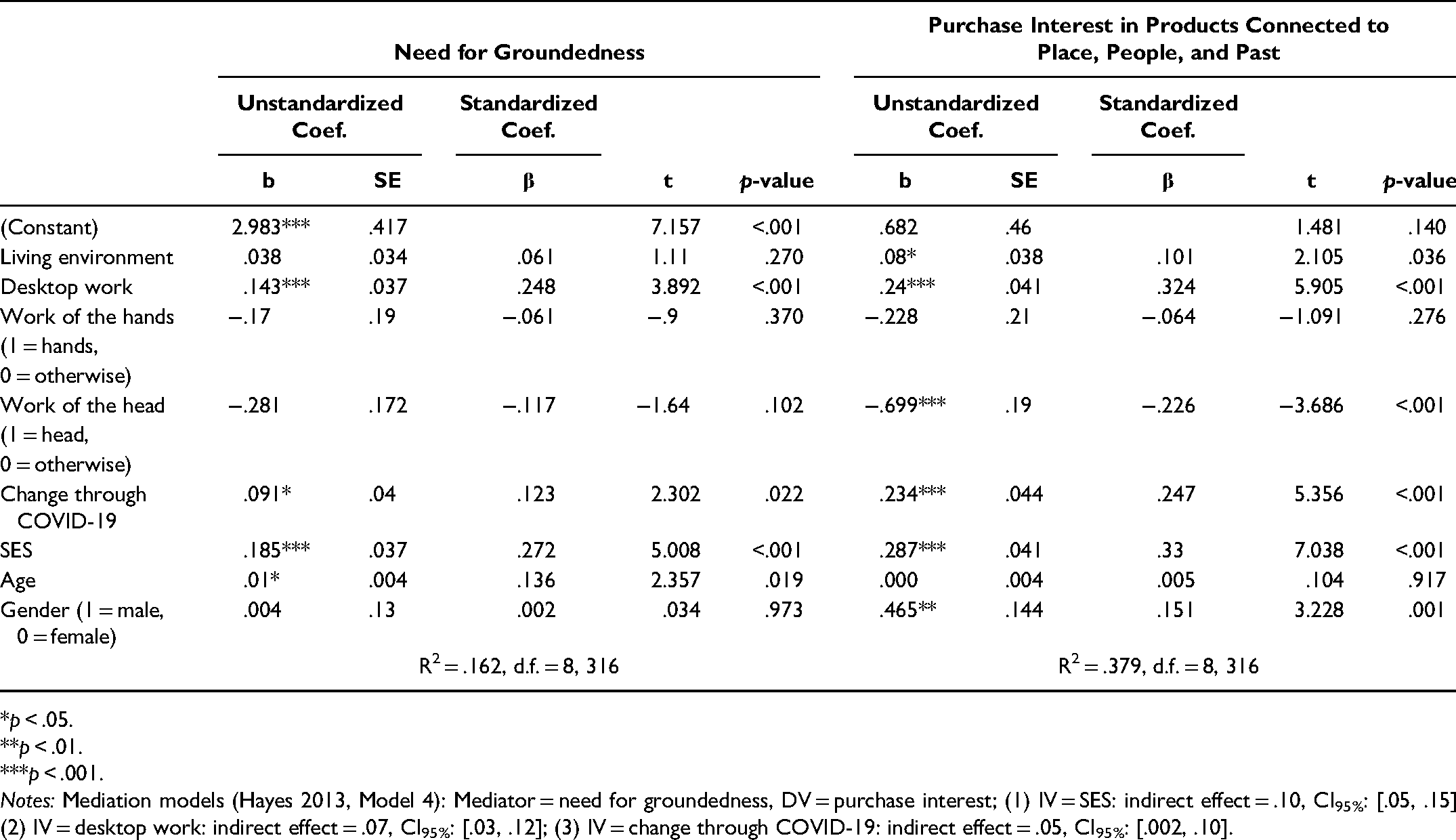
Third, we ran multivariate ordinary least squares (OLS) regressions with all predictor variables on both need for groundedness and purchase intent. For those variables that emerged as significant predictors for both the need for groundedness and purchase intent, we examined whether the need for groundedness mediates the respective effects on purchase intent while entering all other variables as covariates. For conciseness, we report only significant results hereinafter (see Table 1 for details).
Multivariate OLS Regression Models (Study 4).
*p < .05.
**p < .01.
***p < .001.
Notes: Mediation models (Hayes 2013, Model 4): Mediator = need for groundedness, DV = purchase interest; (1) IV = SES: indirect effect = .10, CI95%: [.05, .15]; (2) IV = desktop work: indirect effect = .07, CI95%: [.03, .12]; (3) IV = change through COVID-19: indirect effect = .05, CI95%: [.002, .10].
The multivariate OLS models showed that three predictors remain significant for both the need for groundedness (NG) and purchase intent (PI) when simultaneously including all variables in the model: (1) desktop work (NG: b = .14, SE = .04, t(316) = 3.89, p < .001; PI: b = .24, SE = .04, t(316) = 5.91, p < .001), (2) SES (NG: b = .19, SE = .04, t(316) = 5.01, p < .001; PI: b = .29, SE = .04, t(316) = 7.04, p < .001), and (3) change related to COVID-19 (NG: b = .09, SE = .04, t(316) = 2.30, p = .022; PI: b = .23, SE = .04, t(316) = 5.36, p < .001). Need for groundedness mediates the effect of all three variables on purchase intent (in line with H2; see Table 1 and Web Appendix E).
Our “work of the head” dummy was not significant in the multivariate OLS model. We conclude that the “work of the head/heart/hands” measure was probably too rough and thus unable to adequately detect the important nuances in job characteristics that affect the need for groundedness. We were also surprised that one’s living environment did not emerge as a significant predictor for need for groundedness in the multivariate OLS model. A closer look at the data reveals, however, that a disproportionately large number (29.2%) of respondents in our sample indicated living in big cities (i.e., chose the endpoint of the scale). When dichotomizing the measure (i.e., living in big city vs. not), we find the predicted positive effect: people living in a big city have a heightened need for groundedness (see Web Appendix E).
In summary, Study 4 finds that a higher need for groundedness is apparent in consumer profiles characterized by larger societal trends: living in big cities (urbanization), doing desktop work at the computer (digitization), and undergoing major change (such as during the COVID-19 pandemic). Further, groundedness seems to be more relevant for high-SES consumers.
Thus far, we have provided a cohesive picture of groundedness in terms of both triggers (H1) and market-relevant outcomes (H2), as well as ways for marketers to leverage groundedness (H4, H5). In the final two studies, we examine the implications of groundedness for consumers’ psychological well-being (H3).
Study 5: Connectedness, Groundedness, and Consumer Well-Being
To test our hypothesis that feeling grounded increases consumers’ subjective well-being (H3), Study 5a measures happiness as a consequence of attaining groundedness. We also test another managerial manipulation: channel type (H4). Study 5b expands into a broader range of psychological outcomes; as outlined in our conceptual framework, the feeling of groundedness should provide consumers with a sense of strength, stability, safety, and self-confidence. We test these outcomes in the context of using locally grown ingredients and also investigate alternative constructs to groundedness, such as self-authenticity, meaning in life, or sense of identity.
Study 5a
Method
We randomly assigned 190 Austrian students (Mage = 22.5 years; 50.5% female; lab-based, for monetary compensation) to think about shopping at a supermarket or local farmers market. We then asked about their feelings of groundedness; happiness; and being connected to place, people, and past. Happiness was measured using three items (e.g., “In the situation just described, how happy would you feel?”). Feelings of groundedness were measured using our three-item measure. Connection to place, people, and past were captured separately using three items each (e.g., “Having been in the supermarket [to the farmers market] makes me feel connected to my physical/social/historic environment”). The order of the dependent measures (happiness, groundedness), as well as the order of the item blocks capturing connection to place, people, and past, were counterbalanced. Perceived quality and price were measured as control variables.
Results and discussion
Channel type has a significant effect on groundedness and happiness. Participants who thought about shopping at the farmers market reported feeling significantly more grounded (Mfarmersmarket = 4.66 vs. Msupermarket = 3.80; F(1, 188) = 18.19, p < .001) and happier (Mfarmersmarket = 5.32 vs. Msupermarket = 4.87; F(1, 188) = 7.94, p = .005). Consistent with our theorizing (H4), shopping at the farmers market leads to significantly higher perceived connection to place (Mfarmersmarket = 4.96 vs. Msupermarket = 4.03; F(1,188) = 15.74, p < .001), people (Mfarmersmarket = 4.58 vs. Msupermarket = 3.45; F(1, 188) = 24.60, p < .001), and past (Mfarmersmarket = 3.73 vs. Msupermarket = 2.52; F(1, 188) = 25.47, p < .001). We also find support for serial mediation such that the effect of channel on happiness is mediated, in series, by connection to place, people, and past, and groundedness (for mediation results, see Web Appendix F). All effects remain robust when we enter quality and price as covariates.
Study 5a thus supports our prediction that the feeling of groundedness increases consumers’ subjective well-being (H3) while providing converging evidence for H1. Finally, the manipulation of distribution channel (H4) offers an actionable strategy for marketers to leverage groundedness.
In our last study, we employ the context of locally grown ingredients to test a broader range of psychological outcomes of groundedness. We also test the explanatory value of groundedness against alternative constructs that are self-related, such as feelings of self-authenticity or meaning in life.
Study 5b
Method
Three hundred four students from a major European university completed Study 5b’s online study for course credit. We excluded 12 participants for failing our reading check, leaving us with a final data set of 292 participants (Mage = 22.3 years; 69.5% female). Participants were asked to think about making apple pie on a Saturday; specifically, a pie with Boskoop apples—their favorite pie-making variety. In addition, they were told that these apples were from either an orchard only 12 kilometers from their home or an orchard 1,200 kilometers from their home. Participants then completed a short survey that measured five downstream psychological outcomes of groundedness using a five-item scale: “I feel truly safe as a person,” “I experience a feeling of inner strength,” “I feel truly stable,” “I have a strong feeling of basic trust and confidence in myself,” and “I feel that nothing can stir me up” (α = .89). Afterward, we measured feelings of groundedness using our three-item measure. Finally, participants completed four multi-item measures intended to capture alternative explanations (self-authenticity [e.g., “I feel out of touch with the ‘real me’”], meaning in life [e.g., “I have a good sense of what makes my life meaningful”], self-identity [e.g., “I have the feeling that I know who I am”], feeling of belonging [e.g., “I have a feeling of belonging”]).
Results and discussion
Participants who considered making apple pie with apples grown close to home scored significantly higher in terms of experiencing the related psychological downstream consequences than those using apples grown far away (Mlocal = 5.08, Mnonlocal = 4.61; F(1, 290) = 12.22, p = .001). Thus, the apple pie made with local products boosted participants’ personal feelings of strength, safety, and stability (for effects on the individual dependent variable items, see Web Appendix F). They also reported significantly stronger feelings of groundedness (Mlocal = 4.65, Mnonlocal = 4.06; F(1, 290) = 15.20, p < .001). A mediation model (Hayes 2013, Model 4) shows that the downstream consequences are mediated by feelings of groundedness (indirect effect = .27, CI95%: [.13, .44]). Importantly, the indirect effect via feelings of groundedness on the downstream consequences holds when we add, one at a time, each of the four alternative explanations as a rival mediator.
Study 5b thus confirms positive psychological downstream effects of groundedness (H3) tested in the realm of local products. Products grown closer to the consumer—that is, products that are more strongly connected to one’s place—make consumers feel not only more grounded but also stronger, safer, and more stable.
General Discussion
In this research, we have provided systematic evidence that products can provide consumers with feelings of groundedness by giving them a sense of connection to place, people, and past. We do so across nine studies (eight experiments and one survey), both online and in the lab, using different populations (business students, crowd workers on Amazon Mechanical Turk and Prolific, and members of commercial, representative panels) across two continents (total N > 3,000). We have tested our theory for robustness across a variety of product domains, including both disposable and durable consumer goods (food, care products, seasonal products, and tableware), using real brands to strengthen external validity as well as highly controlled stimuli for internal validity. We have provided process evidence via mediation, moderation, and moderated mediation.
Theoretical Implications
This work introduces feelings of groundedness to the marketing literature by identifying these feelings as an important construct for marketing research and systematically examining it as a driver of consumer behavior. While references to groundedness and related constructs can be found in philosophy (e.g., Weil 1952), different domains of psychology (e.g., McAndrew 1998), and psychotherapy (Ndi 2014), the concept of groundedness is new to experimental research in marketing, consumer behavior, and mainstream psychology. Existing research in consumer culture theory has given passing treatment to concepts such as “rooted connections” (Thompson and Coskuner-Balli 2007) and has definitely been inspirational to this work. However, it has neither discussed nor empirically explored the full concept of groundedness with its antecedents, proxies, boundary conditions, and consequences, which we have aimed to do here.
We also contribute to the growing literature on consumer well-being. Weil (1952, p. 43) proposes that “every human being needs to have multiple roots. It is necessary for him to draw well-nigh the whole of his moral, intellectual, and spiritual life by way of the environment of which he forms a natural part.” Our work indeed shows that groundedness is related to happiness and a sense of strength, stability, and safety; thus, we propose groundedness as a novel antecedent of these outcomes.
We also theorized about three sources of feelings of groundedness: connections to place, people, and past. Although the three sources are often empirically intertwined, we show that they are theoretically distinct and powerful in fueling consumers’ feelings of groundedness. Our analysis further provides rich insight on the nature of these connections by showing that the extent to which products provide feelings of groundedness is a graded function of closeness. That is, a product provides stronger feelings of groundedness when the product’s place, people, or past is closer to the consumer. Finally, by identifying the role of groundedness and its sources, we offer an overarching theoretical explanation for major current consumer trends, such as buying local products (connected to place), produced by people we relate to (connected to people), and according to traditional production methods (connected to the past).
Marketing Implications
Feelings of groundedness are worthy of managers’ attention because these feelings have important downstream consequences as shown across our studies. In particular, feelings of groundedness impact consumers’ brand preference and WTP. In Study 1, for example, consumers were willing to pay a price premium of about 60% for the product that provided more groundedness.
Our work also provides actionable implications for product and brand management: we give concrete approaches regarding how firms can elicit groundedness by showing consumers their product’s connection to place, people, and past. For example, our results in Studies 1, 2a, and 2b show how presenting a product as artisanal or highlighting the local origin of a product can provide feelings of groundedness. In Studies 3a and 3b, we have shown that managers can utilize other marketing-mix elements such as product design or retail assortment and configure them (e.g., as more traditional instead of modern) to provide a stronger connection to the past. Similarly, Study 5a shows that a marketer’s choice of distribution channel (e.g., farmers market) has an impact on feelings of groundedness.
In terms of customer targeting, we have pointed out when and for whom groundedness is more important. In particular, we have shown that traditional (vs. innovative) products benefit from situational differences in the need for groundedness (Study 3b). On the level of individual differences, in Study 3a, only consumers with a high chronic need to connect to the past preferred the more traditional cutlery design. Our representative survey (Study 4) further showed a higher need for groundedness among consumers who are particularly affected by large global trends or major disruptive events. These global trends (e.g., digitization, urbanization) and major life events (e.g., the COVID-19 pandemic) make it harder for consumers to feel connected to people, place, and past. From a groundedness perspective, it is not surprising that during the safety- and stability-threatening COVID-19 pandemic, customers returned to the familiar grocery brands consumed with their families while growing up (Chaudhuri 2020). There are probably multiple drivers for this behavior, but it is likely that consumers chose these products, at least in part, because of the connections to place, people, and past—and thus feeling of groundedness—they provide.
Limitations and Future Research
This is the first series of experimental studies investigating feelings of groundedness. As such, many questions remain for future research. With regard to antecedents, for example, we have focused on products as means for consumers to experience feelings of groundedness. However, anecdotal evidence suggests that there are other ways for consumers to feel more connected to place, people, and past and, consequently, more grounded: for example, through services such as genealogy websites, cooking classes, lectures on local history, or yoga and meditation classes providing “grounding” exercises.
The scope of Study 4 has allowed us to identify an initial set of indicators for who has a higher need for groundedness and why, but it is clear there will be additional consumer characteristics and lifestyle variables helpful to marketers in identifying relevant customer segments. For example, people who travel frequently for work and have little chance to connect to their current physical environment may seize opportunities to (re)-connect to place—such as through a local craft beer—to feel more grounded. Likewise, pandemics such as COVID-19 are not the only type of events that can shake a person’s foundation. Stressful life events such as separation or loss, starting a new job, or moving homes may cause a higher need to feel grounded. Similarly, the need for groundedness may be subject to seasonal variations. Preliminary insights from our own qualitative explorations suggest that individuals’ need for groundedness may be particularly high during the holiday season and other festive occasions, such as Christmas, Thanksgiving, Ramadan, and one’s own birthday. Apart from that, interestingly, the need for groundedness appears to be higher during the colder seasons. We believe a more thorough testing of these hypotheses seems promising and would likely have important implications. If the initial signals are correct, for example, studies of scanner or panel data should reveal variations in the demand for products that connect to place, people, and past across the year.
Finally, we have only begun to examine boundary conditions. For example, it seems possible that in some situations strong roots not only provide strength and stability but could also constrain movement, thus giving consumers the feeling of being “stuck” and unable to escape their roots. Imagine growing up on a farm, surrounded by one’s family, and doing things day after day in the same way they have traditionally been done by previous generations. A person in this situation will likely feel grounded but might also feel more motivated to break free, move away, or challenge the status quo. If such is the case, too much groundedness might even backfire. Future research might thus enrich the present investigation by focusing on potential downsides of groundedness.
Conclusion
This research introduced feelings of groundedness as a relevant construct for marketing research and consumer behavior. We have demonstrated its importance to marketers by documenting that it increases product attractiveness and that it can be manipulated through a variety of marketing-mix strategies and used for targeting consumer segments prone to a lack of groundedness. We also have shown that groundedness is important to consumer well-being, pointing to important consumer welfare and policy implications. We expect that the importance of this topic to consumers and marketers will only increase as digitization, urbanization, and global migration continue to challenge consumers’ connections to place, people, and past.
Footnotes
Acknowledgments
The authors thank Sarah Lim, Arnaud Monnier, and WULABS for their help in data collection, and Shreyans Goenka, Nathan Warren, and audiences at the Munich Symposium on Alienation and Meaning in Production and Consumption, EMAC Doctoral Colloquium Glasgow, SCP Conference Savannah, Cornell University, ESADE, WU Vienna, and University of Minnesota for helpful comments.
Associate Editor
Dhruv Grewal
Declaration of Conflicting Interests
The author(s) declared no potential conflicts of interest with respect to the research, authorship, and/or publication of this article.
Funding
The author(s) disclosed receipt of the following financial support for the research, authorship, and/or publication of this article: We are grateful for funding from the Austrian Federal Ministry for Education, Science, and Research through the HRSM scheme.

Notes
References
Supplementary Material
Please find the following supplemental material available below.
For Open Access articles published under a Creative Commons License, all supplemental material carries the same license as the article it is associated with.
For non-Open Access articles published, all supplemental material carries a non-exclusive license, and permission requests for re-use of supplemental material or any part of supplemental material shall be sent directly to the copyright owner as specified in the copyright notice associated with the article.
