




Abstract
Grounded in sociological agency theory, the authors study the role of the faculty research incentive system in the academic research conducted at business schools and business school health. The authors surveyed 234 marketing professors and completed 22 interviews with 14 (associate) deans and 8 external institution stakeholders. They find that research quantity contributes to the research health of the school, but not to other aspects of business school health. The r-quality of research (i.e., rigor) contributes more strongly to the research health of the school than research quantity. The q-quality (i.e., practical importance) of research does not contribute to the research health of the school but does contribute positively to teaching health and several other dimensions of business school health. The authors conclude that faculty research incentives are misaligned: (1) when monitoring research faculty, the number of publications receives too much weight, while creativity, literacy, relevance, and awards receive too little weight; and (2) faculty feel that they are insufficiently compensated for their research, while (associate) deans feel they are compensated too much for their research. These incentive misalignments are largest in schools that perform the worst on research (r- and q-) quality. The authors explore how business schools and faculty can remedy these misalignments.
Keywords
Business schools consider academic research by their faculty as one of the main pillars in their business model and allocate a large part of their resources to it (e.g., faculty time, labs, research budgets). At the same time, prior research across fields, including marketing, has heavily debated whether the academic research that business school professors conduct adds value to the business schools that employ them (see Table 1 1 ).
Selected Papers on the Role of Academic Research in Business Schools.

a We constrained the selection of articles in Table 1 to those published in journals on the UTD list.
b We collected the number of Google Scholar citations for the listed papers on February 1, 2021.
c While many papers cover multiple dimensions, we attempted to define the focus of the respective papers rather narrowly. The four dimensions we categorize papers on are (1) “consequences of research for business schools,” which includes papers that explicitly take a business school perspective (as contrasted to a field perspective); (2) “practical importance of research,” which includes papers that address threats to q-quality (e.g., the gap between academia and practice) from the perspective of academics; (3) “adoption of research by practice,” which includes papers that address the limited application of academic research, from the perspective of practitioners; and (4) “rigor of research,” which includes papers that address threats to r-quality (e.g., low replicability of studies, low rigor and scientific integrity of research).
d We included these articles published in journals outside the UTD list as an exception to the rule, because of their strong impact.
On the positive side, academic research may enhance a professor’s relevant knowledge base, which can be transferred to students and motivate them to study the subject (Mitra and Golder 2008). Academic research may also signal teaching quality to high-quality prospective students (Besancenot, Faria, and Vranceanu 2009). Business school faculty or deans may also advocate certain schools on the basis of their academic research performance, thus affecting school choices and driving high-quality students and faculty to research-intensive schools (Mitra and Golder 2008). On the negative side, scholars have lamented the lack of practical importance of business school research (e.g., Jaworski 2011; Lilien 2011; Roberts, Kayande, and Stremersch 2014; Stremersch 2021). In addition, science fraud cases in business schools have called into question the integrity and rigor of academic research in management (Bettis 2012).
Prior literature has hinted that the faculty research incentive system of business schools, composed of monitoring and compensation instruments, may be responsible for the main concerns on rigor (formally, r-quality) and practical importance (formally, q-quality) that are voiced about business school research (Lehmann, McAlister, and Staelin 2011; Lilien 2011; Reibstein, Day, and Wind 2009; Vermeulen 2005). The purpose of this article is to examine the effects of the faculty research incentive system on the execution of the research task by faculty and, thereby, on a holistic set of business school outcomes, which, following prior work in the educational literature (e.g., Hoy, Tarter, and Kottkamp 1991), we conceptualize as “business school health.” Business school health is the extent to which a business school performs well (1) at the technical level (i.e., research and teaching), (2) at the institutional level (i.e., external support and institutional integrity), and (3) at the managerial level (i.e., leadership support, administrative support, and resource support). We define all key terms in Table 2.
Key Construct Definitions and Representative Papers.

Notes: For a complete set of construct definitions and corresponding operationalizations, see Table W1 in the Web Appendix, section W2.
This research offers two main contributions. First, many articles take a scholarly field perspective rather than a business school perspective. Exceptions (Bennis and O’Toole 2005; Mitra and Golder 2008; Pfeffer and Fong 2002; Trieschmann et al. 2000) focus on specific business school outcomes (e.g., master of business administration [MBA] ranking) or specific research metrics (e.g., number of publications) and often contradict each other, with some being very negative and others being more positive. This article also takes a business school perspective, but it offers more elaboration on faculty research incentives, faculty research task, and business school outcomes (i.e., business school health) than prior research. Second, prior work suggesting that the faculty research incentive system is one of the main culprits for today’s state of affairs (see, e.g., Lilien 2011; Reibstein, Day, and Wind 2009; Vermeulen 2005) did not theoretically conceptualize this faculty research incentive system or offer empirical evidence of its misalignment. This article does both.
We theoretically ground our hypotheses in sociological agency theory (Shapiro 2005). We provide empirical evidence from (1) a survey of 234 marketing professors in business schools across 20 countries (response rate of 62.6%), (2) qualitative interviews with 14 (associate) deans of 13 business schools in the United States and Europe, and (3) qualitative interviews with 8 external stakeholders representing external institutions of marketing scholarship (e.g., the American Marketing Association) and marketing practice at large multinational firms.
Our main conclusions are as follows. Research task incentives are badly designed, on average. Among monitoring instruments, we find that business schools, on average, overweight number of publications in faculty evaluations while creativity, literacy, relevance to nonacademics, and awards (in order of importance) receive too little weight. Among compensation instruments, we find, on average, that faculty feel they are insufficiently compensated, whereas (associate) deans feel that faculty are compensated too much for their research. We find that badly designed incentive systems are more prevalent in schools that perform below the median on research quality—that is, r-quality (i.e., rigor) and q-quality (i.e., practical importance). We do not find such a relationship between badly designed research incentives and research quantity.
Regarding the research task of the faculty, we find that research quantity contributes to business school research health but not to other aspects of business school health. The r-quality of research contributes more strongly to business school research health than research quantity and q-quality of research. The q-quality of research does not contribute to business school research health but does contribute positively to business school teaching health as well as several other dimensions of business school health, such as external support (by alumni and donors) and institutional integrity.
Our findings have important implications for business schools and research faculty. First, business schools need to develop better research metrics to monitor the academic research of their faculty. Second, business schools need to improve alignment with their faculty on compensation. Third, business schools need to improve the quality (especially q-quality) of their faculty’s research. We provide specific suggestions how business schools can follow up on each of these three main implications.
Faculty Research in Business Schools: A Sociological Agency Framework
We develop a sociological agency framework on business school research (see Figure 1), in which we distinguish four elements: (1) constituents (e.g., principal, agents, institutions), (2) incentive instruments 2 the principal uses to motivate the agent (e.g., publication metrics), (3) the task of the agent (e.g., research), and (4) desirable outcomes for the principal (e.g., business school health).
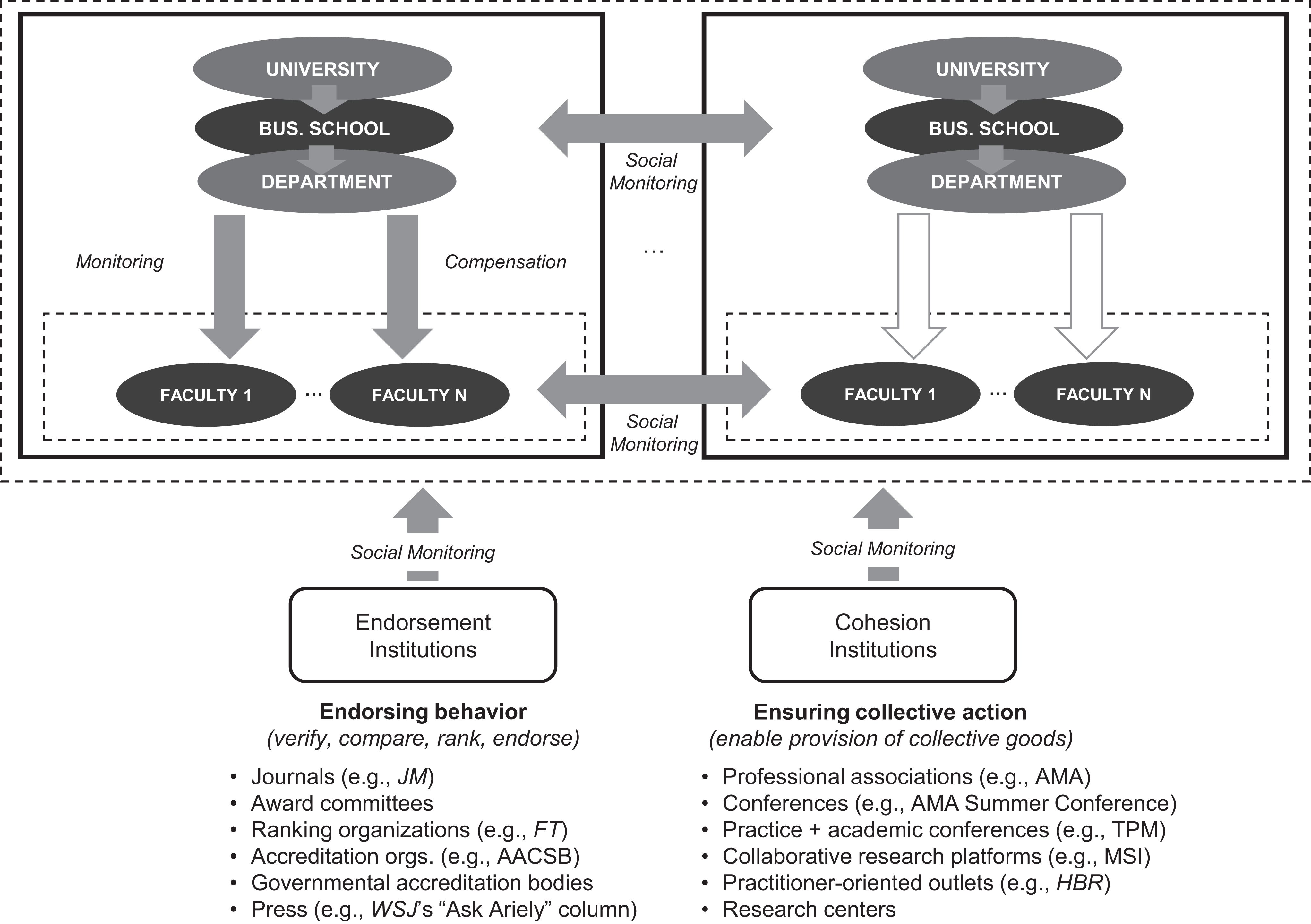
A sociological agency theory perspective on academic research in business schools.
Constituents: Principal, Agents, and Institutions
The business school is a “collective principal,” comprising a chain of delegation in a system of peers, akin to complex administrative structures often found in international organizations (e.g., Nielson and Tierney 2003). Business schools typically operate within a university, which oversees the school’s incentive system (exceptions exist, e.g., INSEAD) and are divided into disciplinary units or departments, each of which influences the school’s incentive system (see top of Figure 1). The agent in our framework is a research or tenure-track faculty member. The business school incentivizes the research of agents by monitoring and compensating the faculty member’s research task.
External institutions are organizations outside the governance of the business school that play an essential role in social monitoring because principal–agent relationships are “enacted in a broader social context and buffeted by outside forces” (Shapiro 2005, p. 269). 3 Building on Ahuja and Yayavaram (2011), we discern two external institutions of special relevance 4 : (1) endorsement institutions and (2) cohesion institutions (see the bottom of Figure 1; for a primer and nonexhaustive list of these institutions in the marketing field, see section W1 in the Web Appendix).
Endorsement institutions verify information about agents, conduct analyses to compare or rank agents, and endorse agents. Examples of such institutions in marketing that endorse faculty are premier journals that publish their research (e.g., the Journal of Marketing) or associations (e.g., the American Marketing Association [AMA]) that have a variety of awards for research. Cohesion institutions ensure collective action by enabling the provision of collective goods. Collaborative research platforms, such as the Marketing Science Institute (MSI) or Institute for the Study of Business Markets (ISBM), are good examples of such cohesion institutions (note that institutions can provide endorsement as well as cohesion, as is the case for the AMA).
Incentives: Monitoring and Compensation Instruments
Principals use monitoring instruments to measure an agent’s effort or outcomes (Joseph and Thevaranjan 1998), of which the following are relevant for business school research (e.g., Lightfield 1971): (1) number of publications, (2) number of citations, (3) peer recognition, (4) awards, (5) relevance to nonacademics, (6) literacy, 5 and (7) creativity. Compensation instruments are the rewards, pecuniary and nonpecuniary, that principals use to align the actions of agents with their own objectives, of which the following are relevant for business school research (e.g., Gomez-Mejia and Balkin 1992): (1) salary, (2) performance-based salary increases, (3) publication bonuses paid as salary supplements, 6 (4) research budgets, (5) publication bonuses paid as supplementary research budget, 7 (6) academic freedom, and (7) reduced teaching loads.
Task: Faculty Research
The faculty research task is to produce research of sufficient quantity (“doing enough research”) and quality (“doing research that is good enough”). Research quantity relates to the total volume of research produced by a scholar (e.g., Lightfield 1971). For research quality, we distinguish “r-quality” from “q-quality” (Ellison 2002). Academic research is of high r-quality (i.e., rigorous) if it adheres to “objective, scientific standards” (Bennis and O’Toole 2005, p. 99), which means that “the various elements of a theory are consistent, that potential propositions or hypotheses are logically derived, that data collection is unbiased, measures are representative and reliable, and so on” (Vermeulen 2007, p. 755). Academic research is of high q-quality (i.e., practically important) if it provides insights that “practitioners find useful for understanding their own organizations and situations better than before” (Vermeulen 2007, p. 755).
Outcome: Business School Health
Building on the classic work of Parsons (1951) and Hoy, Tarter, and Kottkamp (1991), we define a healthy business school as a business school that performs well at three levels: (1) the technical level, (2) the institutional level, and (3) the managerial level. At the technical level, a healthy business school has high research health (i.e., research faculty are seen as leading in their respective fields, publish regularly in leading journals, and assume academic leadership positions) and high teaching health (i.e., the school offers an excellent learning environment with high standards for teaching). At the institutional level, a healthy business school has high external support (i.e., very good relationships with alumni and donors, who commit substantial resources to the school) and high institutional integrity (i.e., faculty and students uphold the highest standards of integrity). At the managerial level, a healthy business school has strong leadership support (i.e., a high-quality leadership team and clear faculty performance standards), strong administrative support (i.e., professional administrative staff that is supportive to faculty, students, and visitors), and strong resource support (i.e., adequate facilities and resources to help faculty effectively perform their work).
Hypothesis Development
Next, we develop our hypotheses, starting with the effects of incentive instruments on the research task of the faculty, 8 after which we turn to the effects of the research task on business school health (for a graphical overview, see Figure 2).

The effect of the faculty research incentive system on the research task of the faculty and business school health.
Incentive Instruments and the Research Task of the Faculty
According to agency theory (e.g., Holmstrom and Milgrom 1991), incentive instruments increase an agent’s motivation by raising the marginal cost of bad performance (through monitoring) and/or the marginal reward of good performance (through compensation). Higher motivation, in turn, leads the agent to work harder and to perform better on their task. However, there are multiple reasons to expect the effect of incentive instruments on the research task of professors in business schools to be more nuanced.
Incentive instruments may be improperly weighted and deviate from what both agents and principals see as the optimal incentive system, because optimal incentives are typically costly to design and implement (Joseph and Thevaranjan 1998). For instance, often, quality is more expensive to monitor than quantity (Holmstrom and Milgrom 1991). In the context of business schools, an increasing number of automated scientometric tools make the monitoring of research quantity inexpensive, while the monitoring of research quality remains expensive for multiple reasons: (1) it is more difficult to objectify quality than to objectify quantity, (2) it is more difficult to compare research quality across domains than to compare research quantity across domains, and (3) senior business school administrators may have been detached from high-quality research activities themselves for a long time. Consequently, business schools may design incentive systems that overweight research quantity, possibly at the expense of research quality.
Incentive systems that overweight quantity may lead faculty to become extrinsically motivated to publish as many papers as possible, possibly leading them to ignore quality (Holmstrom and Milgrom 1991) or to engage in undesirable practices to game the metrics rather than optimize the task itself. An example is “salami publishing” (i.e., trying to squeeze as many papers as possible out of a research project). Therefore, we expect improperly weighted incentive instruments to increase the quantity of faculty’s research.
However, such an increase in quantity may come at the expense of a decrease in (r- and q-) quality of the faculty’s research. Badly designed incentive systems reduce the intrinsic motivation of the agent because agents in badly designed incentive systems may feel underappreciated, which impairs self-esteem, or externally pressured, which impairs self-determination (Frey and Jegen 2001). Impaired self-esteem reduces agents’ persistence in difficult tasks (McFarlin, Baumeister, and Blascovich 1984), which is critical to improve or sustain r-quality (Akerlof 2020; Ellison 2002). Impaired self-determination reduces creativity (Amabile 1998), which is an important precursor to q-quality (Stewart 2020). For instance, Bradlow (2008, p. 5) argues that “home run” papers “pose new questions that we had never thought to ask” or “allow us to see existing problems and solutions from a new perspective.” Therefore, we hypothesize:
The Research Task of the Faculty and Business School Health
Next, we postulate the effects of the research task of the faculty on research health and teaching health as well as on external support and institutional integrity. We do not develop ex ante expectations for the managerial level of business school health. 9
The research task of the faculty and research health of the business school
Scholars who publish a high research quantity (controlling for quality) have higher visibility than scholars who publish a low research quantity (Stremersch, Verniers, and Verhoef 2007). Scholars who frequently “survive” peer review also demonstrate to others they know “what is needed, correct, and valued” by the research system (Lehmann, McAlister, and Staelin 2011, p. 156) and typically attract more collaborations, increasing their belongingness to the academic community. Higher visibility and belongingness increase the extent to which a scholar attains academic leadership. Therefore, we hypothesize:
For research quality, the effect on research health may be more nuanced; we expect increases in r-quality of faculty’s research to contribute more strongly to research health of a business school than increases in q-quality of faculty’s research. Agarwal and Ohyama (2013) show that scholars acclaim stronger reputational rewards to basic than to applied science because basic research requires a higher level of scientific ability than applied research. Basic research is typically higher in rigor than applied research, which, in turn, is typically higher in practical importance (Tushman and O’Reilly 2007). Akerlof (2020) calls this the “hardness bias,” which he also attributes to the greater agreement among scholars on r-quality than on q-quality. In turn, the greater reputational rewards faculty may derive from increments in r-quality, as compared with increments in q-quality, fuel opportunities to take up leadership roles in journals and in the academic research community (Ellison 2002). Therefore:
The research task of the faculty and teaching health of the business school
Research quantity may have two opposite effects on teaching health. On the one hand, a high volume of research may give faculty members a broader knowledge base in their teaching subjects, increasing their ability to set high teaching standards and to motivate students’ interest in the subject (Mitra and Golder 2008). On the other hand, research and teaching activities compete for faculty time. Assuming a time constraint, the more research faculty allocates time to writing papers, the less they allocate time to preparing classes, creating teaching materials, and meeting with students. Besancenot, Faria, and Vranceanu (2009) analytically show that increasing research output may deteriorate teaching quality. Therefore, we formulate two alternative hypotheses:
Faculty members who produce research high in q-quality typically immerse themselves in real-world managerial practice through consulting, case writing, or executive education (Vermeulen 2007). Such immersion, in turn, increases a faculty member’s usage of concrete concepts, which are easier to understand than abstract concepts (Trope and Liberman 2010). In contrast, high r-quality faculty tends to abstract from contextual details to focus on the key underlying properties of a situation or problem (Lehmann, McAlister, and Staelin 2011). Moreover, the strong theoretical and methodological grounding of high r-quality faculty may lead them to underestimate that abstract concepts may not be obvious to less informed audiences. Therefore, we expect faculty who produce research high in q-quality (high in r-quality) to use more concrete (more abstract) concepts when teaching students. Teaching in concrete rather than abstract language is more effective because it enhances student comprehension and memory retention (Sadoski, Goetz, and Fritz 1993), which, in turn, may ensure high teaching standards. Therefore, we hypothesize:
The research task of the faculty and external support to the business school
We expect increases in research quantity to contribute less to external sponsors’ (i.e., alumni and donors) willingness to donate their time or money to the school than increases in research (r- and q-) quality. Using self-reported data from alumni, Mael and Ashforth (1992) show that donors’ self-esteem increases more when they donate to a high-prestige than to a low-prestige school. The production of high-quality research is a more important driver of the prestige of an academic institution than the production of a high quantity of research (Cole and Cole 1967), for two main reasons.
First, a rare favorable outcome (e.g., publishing a “home run” paper) conveys more information about an individual’s ability than being able to achieve several less favorable outcomes (Shugan and Mitra 2009). Thus, research quality is more significant than research quantity in eliciting recognition through awards, appointments to prestigious academic departments, and overall prestige among national and international peers (Cole and Cole 1967).
Second, the awards and accolades bestowed to high-quality scholars serve as signals of appreciation and recognition by external experts. Mael and Ashforth (1992) argue that academic institutions can symbolically manage such quality signals as “identity anchors” that increase the salience of the institution among alumni and donors and, ultimately, their willingness to support the institution. Accordingly, we hypothesize:
The research task of the faculty and institutional integrity of the business school
Faculty who conduct research high in r-quality are more likely to adopt and disseminate the latest scientific guidelines that heavily endorse research integrity (Nosek et al. 2015) and, in turn, may develop a stronger overall “moral muscle” that transcends domains (Baumeister and Exline 1999) than faculty who conduct research low in r-quality. Faculty with a stronger moral muscle may more effectively disseminate ethical values to students. Therefore, we hypothesize:
We do not have theoretical expectations regarding the effects of research quantity and q-quality on a business school’s institutional integrity. We explore such effects empirically.
Other effects
We control for several other effects in our empirical tests. First, we empirically explore the effects of the research task of the faculty on the managerial level of business school health, for which we did not posit ex ante expectations. Second, we allow for correlated error terms when we estimate the effects of the research task of the faculty on the different dimensions of business school health. In this manner, we accommodate for the existence of feedback loops that we conceive in two main ways (see right-to-left arrows at the top of Figure 2): (1) business school health may influence the faculty in the execution of their research task and (2) the faculty’s execution of the research task may lead to adjustments in monitoring and compensation.
Empirical Studies
In this section, we provide empirical evidence from surveying marketing faculty members and interviewing (associate) deans of business schools and external stakeholders.
Study 1: A Large-Scale Survey of Marketing Research Faculty at Business Schools
Data collection
We invited 374 marketing academics across 168 business schools to respond to our survey; 234 responded (62.6%). Of these, 182 (77.8%) respondents work at research-intensive schools (i.e., schools where tenure criteria are mainly research focused) and 149 of the respondents (63.7%) work at business schools that are ranked in the Top 100 Financial Times (FT) Global MBA ranking. For further details on survey sampling, questionnaire structure, analysis, and results, see section W2 in the Web Appendix and visit www.frisbuss.com. 10
Measurement
Regarding the faculty research incentive system, we asked respondents if, at their school, each of the seven monitoring instruments we study receives far too little weight (−2), too little weight (−1), just the right weight (0), too much weight (+1), or far too much weight (+2). Regarding compensation, we asked respondents whether they felt research faculty at their school receive far too little (−2), too little (−1), just the right level (0), too much (+1), or far too much (+2) of each of the seven compensation instruments we study.
Regarding the research task of the faculty, we asked respondents whether the performance of research faculty at their business school in each of the three dimensions of the research task (i.e., research quantity, r-quality, and q-quality of research) was “very low,” “low,” “moderate,” “high,” or “very high.”
To measure business school health, we created a 21-item scale (see Table 3) by adapting earlier measures of Hoy, Tarter, and Kottkamp (1991) to the business school context. We conducted a principal component analysis with varimax rotation on this scale. The scree plot suggested a seven-component structure with all items loading on their expected theoretical dimensions. 11 The seven components accounted for 82.6% of the total variance, with the largest component accounting for 12.7% of the total variance. All loadings were greater than the recommended threshold of .60, with the lowest being .73 (see Table 3). Next, we conducted a seven-factor confirmatory factor analysis (CFA; χ2 = 251.08, p < .01, d.f. = 168). The fit indices for this model meet the recommended standards (comparative fit index [CFI] = .98, nonnormed fit index [NNFI] = .97, root mean square error of approximation [RMSEA] = .05, square root mean residual [SRMR] = .04). 12
Business School Health Scale Items and Factor Loadings.

a Loadings from a principal component analysis with varimax rotation on the full set of 21 items without predetermined factors. Each item had its highest loading in its theorized factor, which we report here.
b Standardized loadings obtained from a confirmatory factor analysis with items preloaded on the seven business school health dimensions.
Notes: CR = composite reliability (Bagozzi and Yi 1988); AVE = average variance extracted (Fornell and Larcker 1981).
Overall, our business school health scale exhibits good psychometric properties. All seven dimensions show composite reliabilities above the recommended threshold of .70 (Bagozzi and Yi 1988), the smallest being .80 (see Table 3). All factor loadings were positive, highly significant (minimum z-value was 18.95; all p-values below .01), and at least ten times as large as the standard errors establishing convergent validity (Gerbing and Anderson 1988). For all pairs of business school health dimensions, the square root of the average variance extracted for both dimensions was greater than their correlation, which demonstrates acceptable discriminant validity (Fornell and Larcker 1981). We averaged respondents’ answers across each set of three items for each business school health dimension to produce seven summated scales.
Common method variance (CMV) bias
We addressed CMV ex ante by (1) promising confidentiality to respondents (Podsakoff et al. 2003), (2) using well-defined response labels that varied across questions (Rindfleisch et al. 2008), and (3) asking respondents to evaluate their business school’s performance rather than their own performance, triggering high involvement and informant reliability (Homburg et al. 2012). Ex post, we found that (1) the largest factor in our principal component analysis accounted for only 12.7% of the variance explained, and (2) a single-factor CFA model fits the data worse than our hypothesized model (CFI = .49, NNFI = .43, RMSEA = .20, SRMR = .12). Both findings are inconsistent with severe CMV.
Results: incentive instruments and the research task of the faculty
Figure 3 shows the average value (μ) for each incentive instrument. The asterisks depict whether this value is significantly different from 0; 0 indicates that the weight given to that instrument is “just right.” On average, Figure 3 shows that business schools’ research incentive systems are badly designed.
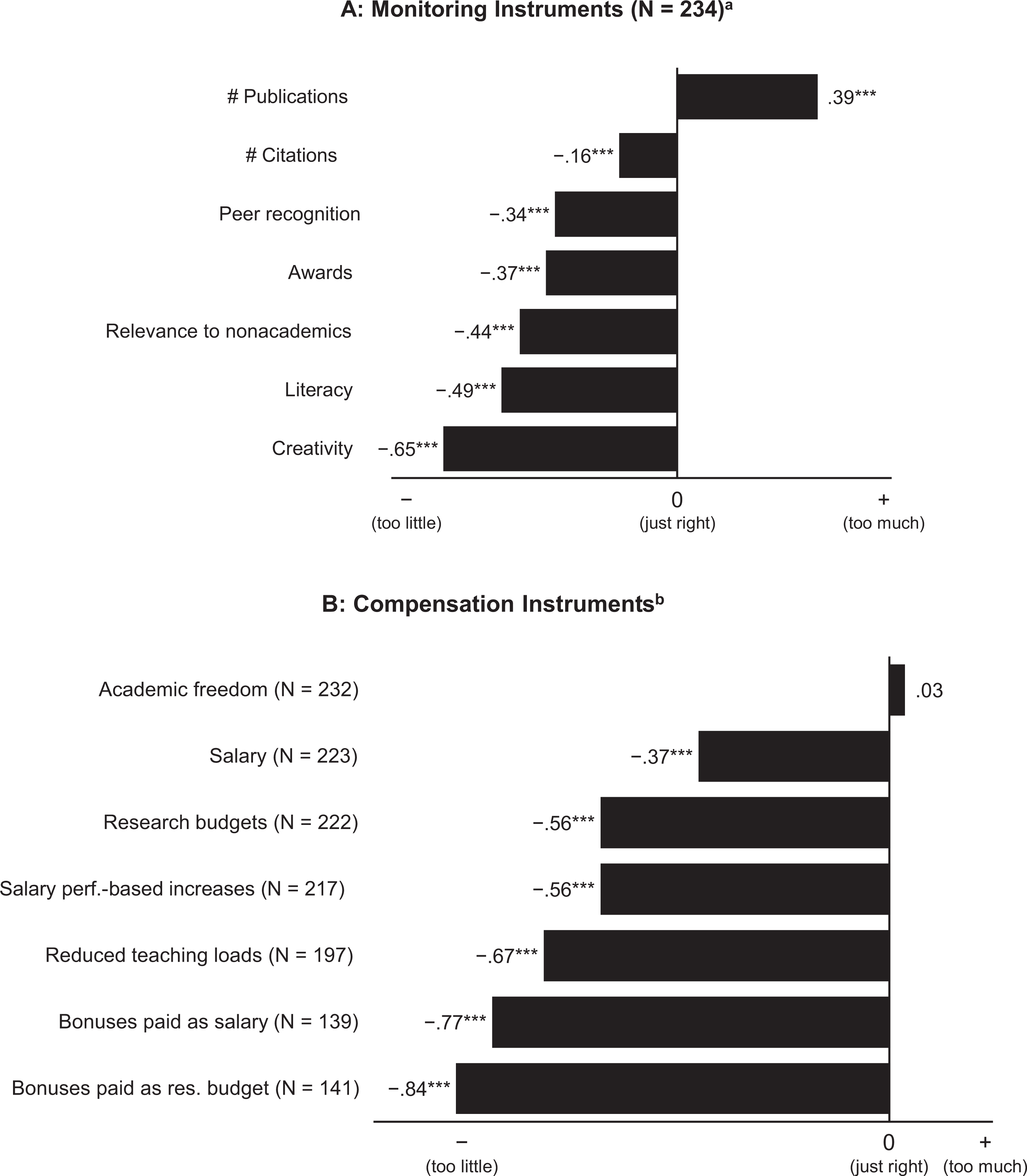
Misalignment of incentive instruments.
Of the monitoring instruments (Figure 3, Panel A), we find that the “number of publications” receives too much weight (μ = .39; t = 6.88, p < .01). All other monitoring instruments receive too little weight, especially so for (in order) (1) creativity (μ = −.65; t = −12.95, p < .01), (2) literacy (μ = −.49; t = −10.05, p < .01), and (3) relevance to nonacademics (μ = −.44; t = −8.58, p < .01).
Of the compensation instruments (Figure 3, Panel B), we find that respondents consider research faculty at their school to be insufficiently compensated, except for the academic freedom they get, especially so for (in order) (1) bonuses paid as research budget (μ = −.84; t = −10.34, p < .01), (2) bonuses paid as salary (μ = −.77; t = −9.47, p < .01), and (3) reduced teaching loads (μ = −.67; t = −10.36, p < .01).
To test H1, we first generated a 2 × 2 matrix according to a median split of respondents as below median or above median in terms of the performance on research quantity and r-quality of their business school (Figure 4, Panel A). Then, for each respondent, we computed the mean absolute deviation (MAD) from 0, aggregated across all seven monitoring and compensation instruments. 13 We then averaged these individual scores to obtain MADM and MADC for each of the cells in the 2 × 2 matrix.

Misalignment of incentive instruments: variation according to research quantity and r-quality and q-quality.
We ran two one-way analyses of variance of the MADM and MADC by respondents across the four cells in Figure 4, Panel A. Fisher–Hayter post hoc tests 14 show that there are no significant differences in the extent to which incentive instruments are properly weighted (i.e., MADM and MADC) in schools with above-median versus below-median research quantity (see Web Appendix, section W2). Thus, we are not able to confirm H1a.
Consistent with H1b, Fisher–Hayter post hoc analyses show that in schools with above-median r-quality (i.e., upper cells in Figure 4, Panel A), monitoring instruments are more properly weighted (i.e., lower MADM) than in schools with below-median r-quality (i.e., lower cells), an effect that is significant both at low levels of research quantity (p < .05) and at high levels of research quantity (p < .01). Compensation instruments are more properly weighted (i.e., lower MADC) in schools with above-median r-quality (i.e., upper cells) than in schools with below-median r-quality (i.e., lower cells), an effect that is significant at the 10% level at low levels of research quantity (p < .10) and approaches significance at high levels of research quantity (p = .14).
We used the same approach to generate a 2 × 2 matrix according to a median split on research quantity and q-quality (Figure 4, Panel B). We then ran two one-way analyses of variance of the MADM and MADC by respondents across the four cells in Figure 4, Panel B. Consistent with H1c, Fisher–Hayter post hoc analyses show that in schools with above-median q-quality (i.e., upper cells in Figure 4, Panel B), monitoring instruments are more properly weighted (i.e., lower MADM) than in schools with below-median q-quality (i.e., lower cells), an effect that is significant at low levels of research quantity (p < .05) but not at high levels of research quantity (p = .18). We do not find such a contrast for compensation instruments (MADC).
Results: the research task of the faculty and business school health
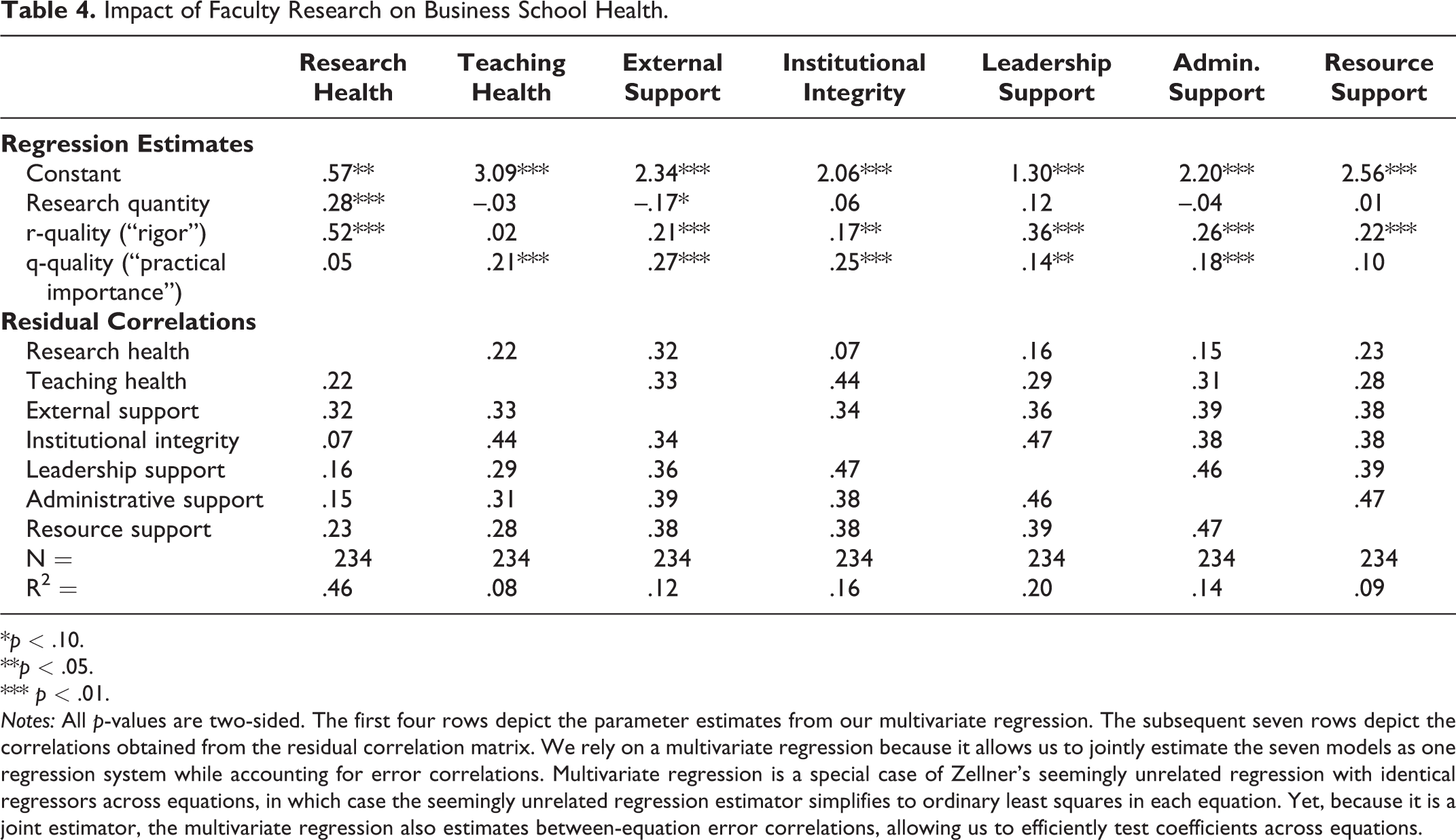
To test H2–H7, we estimated a multivariate regression system of the seven dimensions of business school health on the three dimensions of the research task (research quantity, r-quality, and q-quality), with correlated error terms across the seven equations (see the Web Appendix, section W2). The Lagrange multiplier test proposed by Breusch and Pagan confirms that the covariance matrix between error terms is not diagonal (χ2(21) = 573.8, p < .01). The fit of the model is satisfactory. The R2-statistic is highest for research health (.46), which befits the primary focus of our investigation.
We depict our results in Table 4. The first four rows show the parameter estimates of research task on business school health, whereas the subsequent seven rows show the residual correlations among the different business school health dimensions. Confirming H2, we find that higher research quantity is associated with higher research health (β = .28; p < .01). We also find that the higher the r-quality of faculty research, the higher the research health of a business school (β = .52, p < .01). In contrast, q-quality has no significant effect on research health (β = .05; p = .32). A Wald test rejected the null hypothesis that the parameters for r- and q-quality are equal (F = 10.11, p < .01), thereby confirming H3.
Impact of Faculty Research on Business School Health.
*p < .10.
**p < .05.
*** p < .01.
Notes: All p-values are two-sided. The first four rows depict the parameter estimates from our multivariate regression. The subsequent seven rows depict the correlations obtained from the residual correlation matrix. We rely on a multivariate regression because it allows us to jointly estimate the seven models as one regression system while accounting for error correlations. Multivariate regression is a special case of Zellner’s seemingly unrelated regression with identical regressors across equations, in which case the seemingly unrelated regression estimator simplifies to ordinary least squares in each equation. Yet, because it is a joint estimator, the multivariate regression also estimates between-equation error correlations, allowing us to efficiently test coefficients across equations.
Confirming neither H4a nor H4b, we find that a higher research quantity does not have a significant effect on teaching health (β = −.03, p = .67). We also find that a higher q-quality of faculty research is associated with higher teaching health of a business school (β = .21, p < .01), whereas higher r-quality is not (β = .02, p = .69). A Wald test rejected the null hypothesis that the parameters for r- and q-quality are equal (F = 4.53, p < .05), thereby confirming H5.
Confirming H6, we find that research quantity may negatively affect external support (β = −.17, p < .10), while higher levels of r-quality (β = .21, p < .01) and of q-quality (β = .27, p < .01) positively affect external support. A Wald test showed that the coefficients for r-quality and q-quality are not significantly different from one another (F = .28, p = .59).
Confirming H7, we find a positive effect of r-quality (β = .17, p < .05) on institutional integrity. We find no significant effect of research quantity on institutional integrity (β = .06, p = .44) and a positive and significant effect of q-quality on institutional integrity (β = .25, p < .01).
As to other effects, we observe that schools with high r-quality research have strong leadership support (β = .36, p < .01), strong administrative support (β = .26, p < .01), and strong resource support (β = .22, p < .01). Schools with high q-quality research have strong leadership support (β = .14, p < .05), administrative support (β = .18, p < .01), and resource support (β = .10, p = .12). We do not find any association between research quantity and leadership support (β = .12, p = .18), administrative support (β = −.04, p = .64), or resource support (β = .01, p = .91).
Study 2: In-Depth Interviews with (Associate) Deans and External Stakeholders
Next, we report on the interviews we conducted with (associate) deans and with representatives of external institutions. These interviews took 35 minutes on average and yielded a total of 164 pages of single-spaced transcripts.
Interviews with (associate) deans
We conducted phone interviews with seven deans (four former and three current) and seven associate deans (two former and five current) at 13 business schools in the United States and Europe (for more information, see section W3 in the Web Appendix), who are good informants (Homburg et al. 2012). We opted for a “phenomenological” approach that is in-depth but nondirective in nature (Thompson, Locander, and Pollio 1989). We audio-recorded the interviews (except for two who did not give permission), which were subsequently transcribed by a research assistant and double-checked by one of the authors for accuracy. Our interviews led to the following insights.
First, virtually all (associate) deans we interviewed expressed that there is an overreliance on effortless metrics (especially counting number of publications, but also number of citations) often at the expense of more effortful metrics such as creativity, literacy, and relevance to nonacademics. Of the 14 (associate) deans we interviewed, 11 recognized this overreliance on effortless metrics, and 9 explicitly mentioned they saw this trend as problematic for business schools, as highlighted by the following quotes: I definitely have seen just what I feel is an overreliance on the cohort table and the numbers. And I feel that that was something that I have kind of raised but I do not feel that I necessarily had any impact in terms of trying to say this is just one piece of information. (Former vice-dean for faculty at a U.S. FT Top 25 school) When I started in 2000–2001, it was about the quality of the journals and what the outside reviewers said. So initially, there was very light weight put on citation counts, and then over time, it started to increase a bit and then we got a couple of people elected to the promotion and tenure committee who were like, “We don’t even have to look at quality, we can tell from the citation counts whether these things are any good or not.” (Former dean at a U.S. FT Top 30 school) [Awards] should weigh a lot even when compared with contemporary productivity metrics, but in all honesty, contemporary productivity metrics are some of the most overused metrics to gauge academics. (Current dean of research at a non-U.S. FT Top 75 school) My frustration is, when I’m drawing on a department chair for information, I get counts such as they had 27 publications, 4 in premier outlets, and this was the citation count. (Current dean at a large U.S. public school) I remember when Google Scholar first came out, there was a lot of skepticism about it…but that has definitely been adopted as the norm. And I think the ease of checking it and following it has caused a drift toward weighing it more heavily. (Former dean at a U.S. FT Top 15 school) Are we just giving up on our ability to be doing all the heavy work? I think we are relying too much on the ease of numbers. (Current dean at a U.S. FT Top 75 school) I personally view it [a growing reliance on counting] as a very negative trend because people start gaming the citation count. (Current dean at a U.S. FT top 100 school) Now that we have metrics and now that people are scored on those metrics, I think that the system does—it shouldn’t, but it does—put a greater emphasis on those numbers and less on, for example, creativity. (Current vice-dean at a U.S. FT Top 10 school) People come with their hands out all the time. I do not get it. It is just wrong. And I think we get paid really well. We have been historically. And we get things that other university faculty just do not get, like guaranteed summers. I mean, talk to someone in public health, right? It has become an absurdity to me, and it’s very unsustainable. (Current dean at an FT Top 75 school) The financial incentives that exist right now in the field are, to a certain extent, disturbing the market. I think the financing model of the top 100 business schools in the U.S. sooner or later will explode.…It is a crisis waiting to happen. (Current dean of research at a non-U.S. FT Top 75 school) Nowadays, it is too hard to get faculty to do things, so you start compensating, paying for everything. (Current dean at a large U.S. public school) We do not have bonuses for publications, and I do not find those a good idea; they may trigger perverse behaviors. (Current vice-dean at a public non-U.S. business school) I think that, at least among our faculty, if a bonus were paid directly for a paper, it would make faculty feel like coin operated. And I think that would lead to a culture impact that would not serve us. (Former dean at a U.S. FT Top 15 school) Basic science tries to understand how the world works, applied science tries to develop applications. I believe that management research is now 99% “basic” and only 1% “applied.” (Current vice-dean at a public non-U.S. business school) We like to see people who hit a home run, like, “this is a really good paper.”…There’s a lot of acceptance of low productivity rates if the quality of the home runs is there. (Former deputy dean at a U.S. FT Top 30 school) I feel increasingly frustrated by the extent to which we talk to other academics and we do work that is not addressing the issues and questions that are really most pressing in the world of business or the world more broadly, and that we could be a lot more relevant and we could be speaking to practice a lot more. (Former vice-dean for faculty at a U.S. FT Top 25 school) At some level, most of the work that I see that goes on doesn’t connect to management.…Sometimes the research is so technical that it’s not acceptable to a broader audience. (Former deputy dean at a U.S. FT top 30 school) When I look at what’s in the journals, it strikes me that most of it is pretty irrelevant to what’s going on in the world. So, I think that’s a huge issue. (Former dean at a U.S. FT Top 30 school) We have a management department…and I think at this point, there’s maybe two people in there who could be teaching exec ed. And that is where your leadership people should be…and they just can’t do it. At some level, we may kick ourselves out of business. (Current dean at a U.S. FT Top 75 school) It seems every marketer wants to be a social scientist and wants to stop selling cookies. I mean, there are a lot of marketing scholars that fundamentally do not study marketing topics anymore and just look at topics that are generic social science research topics. (Current dean of research at a non-U.S. FT Top 75 school)
Interviews with external stakeholders
We conducted phone interviews with eight external stakeholders including (1) current or past leaders at five external institutions of marketing scholarship (e.g., MSI); and (2) senior marketing practitioners at three large multinational firms (the former global chief marketing officer of a large multinational technology corporation, the current chief executive officer [CEO], and an executive vice president [EVP] at two of the world’s largest market research firms), who are or have been involved with these external institutions.
The interviews with external stakeholders yielded the following key insights. First, consistent with our theorizing, interviewees expressed that business schools track endorsement institutions’ monitoring of their faculty. As a former chair-elect of the AMA Board of Directors pointed out: [The] AMA aims to promote the creation of cutting-edge marketing content both through the journals and through the awards inside the Foundation. Faculty go back and list those awards on their annual reviews and use that as part of their argument for where they should stand inside their institution. MSI’s Young Scholars program helps juniors develop a strong cohort. They get more invited to talks, it gets them the opportunities to be recruited, and it starts research collaborations. (Former executive director of MSI) I think institutions such as MSI or the ISBM can facilitate research that has both academic rigor and has got practical merit. (Former director of a cohesion institution that bridges academia and practice) At every conference, we have a panel of practitioners and a practitioner speaker. And people like that. (Cofounder of a cohesion institution that bridges academia and practice) What I found interesting about the “7 Big Problems in Marketing” work at the AMA is that we were really trying to get at which problems practitioners today are facing, or that we see coming,…and those were defined kind of collectively between academics and practitioners. (Former global chief marketing officer of a large multinational technology corporation) In my last trip [to an MSI meeting], in San Francisco right before COVID-19, there was a cocktail [hour] where we had various academics explaining their research with whiteboards; we could walk out and talk about their research, et cetera.…It was really interesting. (Current EVP at one of the world’s largest market research firms) [Academic research in business schools] feels like a small set of people speaking to each other about something that nobody cares about. I may be a little harsh here, but it is often not applicable to the kind of problems I see. (Current senior executive at a cohesion institution that bridges academia and practice) I think there is a stereotype we have on our side is that academic research is “out of touch” with reality. (Current EVP at one of the world’s largest market research firms) Academic research is highly differentiating but not necessarily as relevant.…And obviously, the two things are easily at odds.…If you are highly relevant, you are not “different.” And I think that’s the challenge. Does academic research want to be more relevant? Or does it want to maintain its differentiation? Because while it clearly is rigorous, it is largely unassailable, I would say, to the business community. (Current CEO at a leading market research firm in the United States) Most of my peers in the business functions [marketing, strategy, and corporate reputation] would only look at academic research if it was sort of quoted in the context of another business story. Our analytics folks will definitely go deeper into academic papers, specifically if it’s helping them. (Current CEO at a leading market research firm in the United States)
Discussion: Implications and Limitations
Implications
Our results have three main implications for business schools and the research faculty they employ. In these implications, we embed several conjectures that can provide fertile ground for future research to provide empirical testing.
Implication 1: business schools need to develop better research metrics
Research monitoring instruments in business schools are, on average, badly designed. Low-effort metrics, such as the number of publications, receive too much weight in faculty evaluation, whereas effortful metrics such as creativity, literacy, relevance to nonacademic audiences, and awards receive too little weight. Business schools with badly designed monitoring instruments perform worse on (r- and q-) quality of research than business schools with well-designed monitoring instruments. Business schools need to develop better research metrics. Business schools that take this message to heart could consider multiple pathways.
First, business schools could devote more effort to otherwise low-effort metrics to make them more informative. For instance, schools can correct aggregate publication counts for journal status. Journal of Consumer Research, Journal of Marketing, Journal of Marketing Research, and Marketing Science are journals that publish, on average, higher-quality articles than other journals in marketing (according to the UTD list, which is the most stringent list on quality). Alternatively, schools could correct aggregate citation counts for (1) whether a scholar’s highly cited papers were original contributions in premier journals or review articles in secondary journals, (2) whether a scholar’s articles are consistently in the top 20% cited papers or bottom 20% cited papers of a journal, (3) whether a scholar’s top five or top ten cited articles were published in premier or secondary journals, and (4) whether a scholar’s work is mainly cited by papers in premier or secondary journals.
Second, business schools could consider low-effort metrics such as the number of publications or citations only as a starting point for faculty evaluation rather than an end point. For instance, for citations, it would be meaningful to rank a professor’s work according to Web of Science citations, after which the five highest-ranked articles are assigned for reading to a committee, which assesses the r- and q-quality of the respective five papers after reading them. Ideally, these committees would provide thorough evaluations of the work, rather than a mere summary. One (associate) dean also told us about the practice of assigning discussants on specific papers of a candidate up for a promotion and tenure (P&T) evaluation to stimulate reading and evaluation. Instead of scientometrically picking the best three to five papers for reading, schools could also ask the candidate to pick three to five of their best papers and ensure that evaluators read and discuss those papers.
Third, business schools could add creativity and literacy of scholarly work to the evaluation process, piggybacking on recent work enabling their reliable and valid measurement. 16 Business schools could also improve creativity training and coaching of doctoral students and young faculty (Stewart 2020). Innovation management as a field has shown that creativity, ideation, idea development, are all processes that can be trained with tools; doctoral students and young faculty could be trained on such tools (for examples of such tools, see www.frisbuss.com).
Fourth, business schools could make the system of reference letters used for P&T decisions more effective by (1) providing a cohort list to which the candidate should be compared, (2) making evaluation criteria such as creativity and literacy explicit, and (3) involving a more heterogeneous set of letter writers. To prevent gaming of cohort lists, schools could decide on a universal set of reference schools, such as the 10–20 schools that perform similarly or a little better on the FT overall or UTD research rankings. The cohort for a specific candidate in a P&T process could consist of two types of faculty members of the reference schools: (1) all research faculty with a similar “time since doctoral degree” (e.g., ±1–2 years) and (2) all faculty of the same rank for which the candidate is considered who received their doctorate no more than five years prior to the candidate. To source letter writers, business schools could (1) source academic experts from the entire discipline across silos, instead of purely from the silo to which the candidate belongs and (2) allow nonacademics (e.g., alumni, students, professionals) to write letters, as we observed in one school we studied where a typical P&T package could have up to 50 letters.
Implication 2: business schools need to improve alignment with their faculty on compensation
Faculty members feel undercompensated, whereas several (associate) deans feel they are overcompensated for the research they do. Business schools where faculty feel more appropriately compensated perform better on r-quality of research than business schools where faculty feel less appropriately compensated. Business schools that aim to improve the alignment with their faculty on compensation can do so in multiple ways.
First, business schools could give faculty a better understanding of the entire organization, its operations, and its finances. Some schools have a well-developed habit of organizing faculty meetings where they transparently cover all aspects of the school’s business. In one of the business schools we studied, faculty meetings periodically cover the school’s income statement, sales forecasts, and balance sheet to increase faculty’s understanding of the economics of the school. Other schools do not share—or purposefully hide—financials, which prohibits the faculty from seeing their salary and contribution in the context of the bigger picture.
Second, business schools could showcase what staff, administrators, (associate) deans, and other senior faculty do on a day-to-day basis to improve the school’s health. We have seen “a day in the life of…” presentations by deans to give faculty a better idea of what kinds of internal and external pressures they are facing. Transparency on such direct contributions to the health of the school may put the research accomplishments of a research faculty member (such as another Journal of Marketing or Journal of Marketing Research publication being freshly accepted) into perspective.
Third, business schools could promote teamwork and collaboration among faculty within the same school, fostering a high-commitment environment. Such collaborations may stimulate the faculty’s emotional identification with the school. While considering such promotion, schools also need to put checks in place against undesirable practices, such as forcing people into collaborations, free-riding in collaborations, or junior faculty trading in coauthorships for political or teaching support, often from senior faculty, among others.
Fourth, business schools could increase the leverage over faculty to ensure that their research faculty meet the outside world also from a compensation perspective. Specifically, we believe that business school professors would benefit from practicing in their professional area just as medical school professors benefit from seeing patients or law professors benefit from assisting in writing and enforcing legislation, practicing law, or performing expert witness services. Outside activity by professors would also give them an outside valuation on their time. Such external valuation could (1) bring the compensation demanded from the school more in line with actual valuation by external stakeholders and (2) complement the pecuniary reward from the school, lowering the faculty’s dependency on the school’s paycheck.
Implication 3: business schools need to improve the quality (especially q-quality) of their faculty’s research
Research r-quality is a stronger driver of business school research health than research quantity. Compared with research quantity, research r- and q-quality are stronger drivers of business school health dimensions other than business school research health. Research quantity can even negatively affect external support. The (associate) deans report that the business schools they lead have made more progress on r-quality than on q-quality and that they are concerned about a further decline in q-quality in recent years. This viewpoint is shared by the external stakeholders we interviewed. Business schools that want to improve the r-quality and/or q-quality of their faculty’s research can do so in multiple ways.
First, business schools could focus audits of their research activities more on quality than on quantity. Business schools that want to increase r-quality could investigate whether their metrics sufficiently reward quality, whether they allocate research money sufficiently based on quality, and whether its faculty is sufficiently represented on the Editorial Review Boards of the best journals in the field. Business schools that want to increase q-quality could investigate whether the school sufficiently stimulates consulting by faculty high in r-quality (as recommended in Roberts, Kayande, and Stremersch [2014] and Stremersch [2021]), whether research centers fundamentally engage with practice or are mostly “lipstick on a pig” (as one our interviewed associate deans put it), whether research faculty high in r-quality teach in executive MBA or open and custom programs (which provide more socialization with practice than undergraduate or daytime MBA programs), and whether the portfolio of research faculty profiles is balanced sufficiently both on r-quality and q-quality. 17
Second, business schools could consider complementing internal audits (e.g., of a multidepartment committee chaired by the research dean) with external audits by a panel of outside faculty with outstanding research records, preferably on both r- and q-quality, and with a good understanding of business school health. For schools that have not done a research audit for a while, these findings and suggestions could stimulate them to organize such audits. For schools that already perform such audits regularly, our findings indicate that the aforementioned topics should make such audits more impactful and focused on today’s major challenges of business schools.
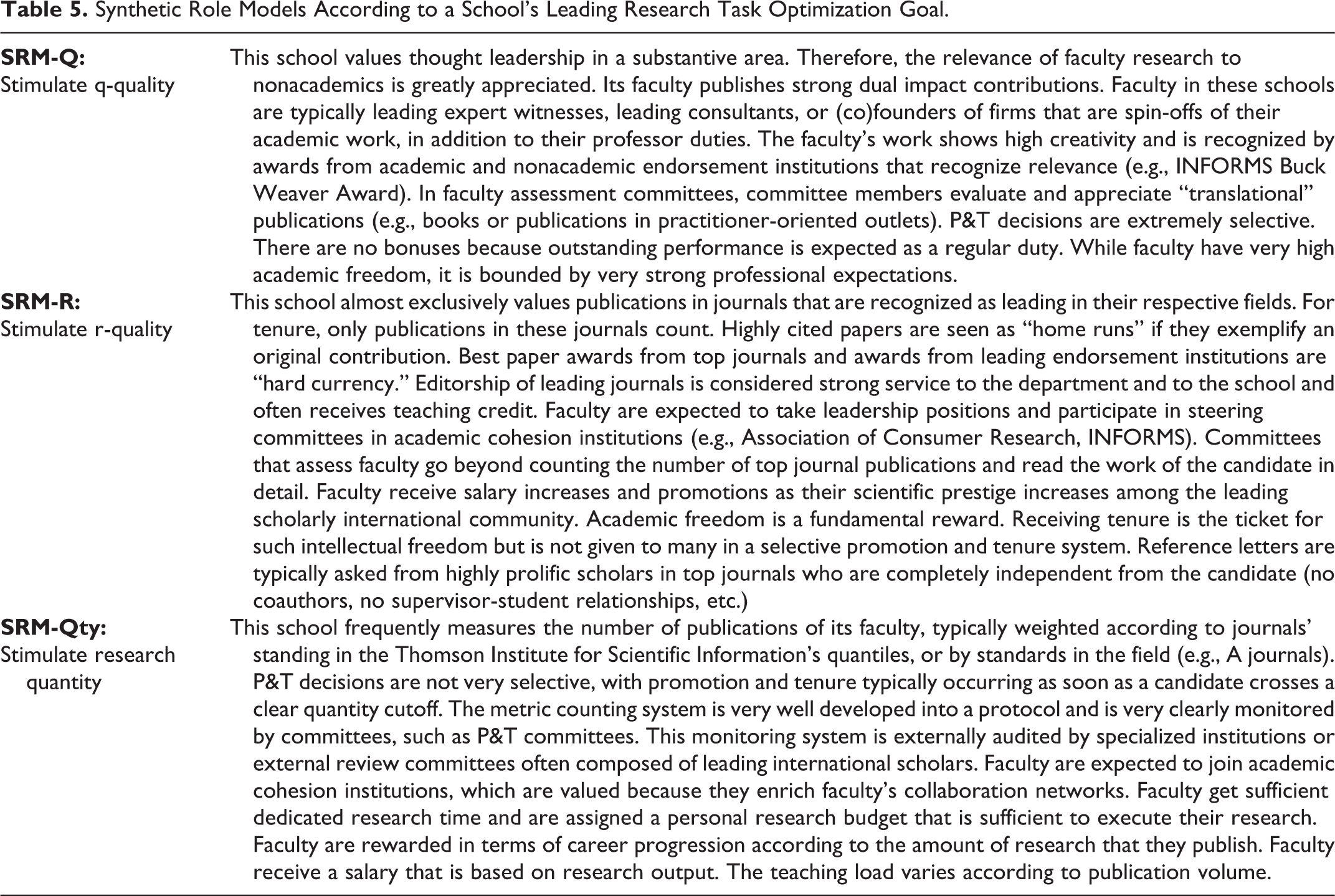
Third, business schools could benchmark their experiences with those of successful business schools, or role models, which can serve as yardsticks for improving their research faculty incentive systems. Role models help clarify an “aspiration gap” (i.e., the difference between a level of performance that one aspires to achieve and the level of performance that one already has). Moreover, different business schools have different aspiration levels and thus place different weights across different dimensions of the research task they want to optimize. Thus, each business school should benchmark its faculty research incentive system with that of a weighted combination of other business schools chosen to generate a “synthetic role model” that closely resembles the performance that the school aspires on research quantity, r-quality, and q-quality. As an illustration of the usage of these “synthetic role models,” we present, in Table 5, three stylized synthetic role models that may serve as inspiration for schools aiming to increase their performance in research quantity (SRM-Qty), r-quality (SRM-R), or q-quality (SRM-Q).
Synthetic Role Models According to a School’s Leading Research Task Optimization Goal.
Fourth, faculty could consciously strengthen the cohesion institutions that support the promotion of socialization with practitioners (e.g., AMA, MSI, Theory + Practice in Marketing) and business schools could encourage and support such efforts. Within such cohesion institutions, faculty could stimulate action that increases q-quality of research of high r-quality. For instance, institutions such as MSI could give fewer, larger grants, possibly assigning a corporate sponsor to steer such larger grants, or grant funding only to research teams that combine academics and practitioners. Under its present organizational structure (the senior leadership team being fully composed solely of practitioners), the AMA has failed to make the connection between academics and practitioners (as noted by the representative from the AMA we interviewed). Business school marketing faculty could aid in building a new model within the AMA.
Limitations
Several limitations of this article may give rise to future research. First, our empirical evidence is self-reported from a survey with research faculty, interviews with (associate) deans and interviews with representatives of external institutions. While self-reports enable us to cover a broad set of topics, each of the relationships we establish could potentially fuel secondary data research. Several secondary data studies (e.g., Mitra and Golder 2008; Pfeffer and Fong 2002) have examined the effect of research on teaching, but none have examined the effect of research on other business school health dimensions, such as external support or institutional integrity, all of which could be gauged by secondary data also (e.g., endowment statistics, online chatter of student communities). Future research should also better examine other constituents’ perceptions of business school health (e.g., students, recruiters, donors, alumni).
Second, our conceptual derivation and empirical evidence only limitedly exposes the causal mechanisms at work. In fact, we have been prudent throughout the article to clearly identify instances where our data permits us only to offer logical conjectures and to claim correlation rather than causation. Thus, future research that goes from correlation to causation would be very fruitful; it could also document more precisely the nature of the feedback mechanisms that we introduced. Future research could also more elaborately document the behavioral mechanisms in place that lead business schools to excessively monitor numbers and insufficiently monitor creativity or literacy. One can conceive behavioral experiments with academic assessors on research metrics, how people use them, and under which conditions decisions can be (de)biased.
Third, we explored the variance in incentive misalignment across schools on a limited number of school descriptors. Research could easily expand on a larger set of school descriptors. For instance, do the effects we study depend on whether the school offers executive education, where the school is located (United States vs. international), whether the school is private or public, or how high the tuition fees are that it is charging?
Fourth, we took a step beyond our empirical inquiry to conceptualize what business schools could do to positively affect the present state of affairs. Some of the recommendations we gave seem easy to implement, whereas others are more difficult and would benefit from a more elaborate conceptualization than the length and scope of this article allow. For instance, how can business schools create a stronger sense of common purpose among its faculty such that the faculty is less self-interest seeking? Alternatively, how can business schools favor more reading and less counting? How can they better monitor creativity and literacy? The latter question can also fuel scientometric research to address some of the alternative metrics we suggest.
Despite these limitations, we feel that we have made a significant contribution to understanding the role of faculty research in business school health. At the very least, we hope that we have sparked a dialogue to get more (marketing) faculty and business school administrators to rethink how academic research can make business schools healthier.
Supplemental Material
Supplemental Material, sj-docx-1-jmx-10.1177_00222429211001050 - Faculty Research Incentives and Business School Health: A New Perspective from and for Marketing
Supplemental Material, sj-docx-1-jmx-10.1177_00222429211001050 for Faculty Research Incentives and Business School Health: A New Perspective from and for Marketing by Stefan Stremersch, Russell S. Winer and Nuno Camacho in Journal of Marketing
Footnotes
Acknowledgments
The authors acknowledge the comments provided by Vijay Hariharan, Eitan Muller, John Roberts, Roland Rust, Rick Staelin, Jan-Benedict Steenkamp, and Julian Villanueva. The usual disclaimer applies.
Associate Editor
Leigh McAlister
Declaration of Conflicting Interests
The author(s) declared no potential conflicts of interest with respect to the research, authorship, and/or publication of this article.
Funding
The author(s) disclosed receipt of the following financial support for the research, authorship, and/or publication of this article: The authors received financial support for this research from Erasmus School of Economics (Erasmus University Rotterdam) and Stern School of Business (New York University).

Notes
References
Supplementary Material
Please find the following supplemental material available below.
For Open Access articles published under a Creative Commons License, all supplemental material carries the same license as the article it is associated with.
For non-Open Access articles published, all supplemental material carries a non-exclusive license, and permission requests for re-use of supplemental material or any part of supplemental material shall be sent directly to the copyright owner as specified in the copyright notice associated with the article.
