




Abstract
Can low-cost marketing tools that are used to enhance business performance also contribute to creating a better world? The authors investigate the role of online social media tools in alleviating customer (farmer) uncertainty and promoting the adoption of a new eco-friendly pesticide in rural China via a randomized controlled field experiment. The key finding is that even for a new product such as a pesticide, a low-cost social media support platform can effectively promote adoption. A combination of information from peers and from the firm on the platform facilitates learning about product features and alleviates uncertainty associated with product quality and appropriate product usage. Nevertheless, at the trial stage of the funnel, the platform underperforms the firm’s customized one-on-one support because available information does not resolve uncertainty in supplier credibility and product authenticity. Having an influencer on the platform, albeit not an expert on this product, vouching for its credibility helps resolve this funnel-holdup problem. From a theoretical perspective, this paper provides suggestive evidence for referent influence and credibility signaling on social media platforms and consequences for new product trial. The authors also provide direct empirical evidence on how information facilitates learning, a phenomenon typically assumed to be present in studies estimating learning models.
Keywords
For decades, pesticides have been applied to protect crops and livestock from pest infestations, to increase crop yields, and to improve food production (Alexandratos and Bruinsma 2012). However, pesticide use has also raised serious concerns about food safety, environmental protection, and sprayers’ health (see Web Appendix W1). Every year, 200,000 people die because of toxic pesticides (Science and Technology News 2017), and the U.S. Environmental Protection Agency (2018) has classified 68 pesticides as potential carcinogens. Promoting the use of safe and green new pesticide technologies is critical to ecological security.
However, “getting a new idea adopted, even when it has obvious advantages, is difficult” (Rogers 2003, p.1). In this study, we investigate how low-cost, online marketing tools can create a greener and healthier world by promoting the diffusion of a new pesticide technology in rural China. By implementing a field experiment including 34 villages and more than 700 farmers, we seek to understand whether a low-cost approach, based on a widely available social media platform, can be used to alleviate a major deterrent that hinders the adoption of a new technology: customer uncertainty.
Customers, especially those in emerging markets and in rural areas, face several types of uncertainty. These include uncertainty regarding (1) the authenticity of the new product and supplier credibility (Hada, Grewal, and Lilien 2014) given previous experiences with unscrupulous “fly-by-night” operators (e.g., the fake seed problem in China [ China Daily 2014] and India [ The Economic Times 2017]); (2) the “objective” quality of the product or the “match value” of the product to the potential user (e.g., Erdem and Keane 1996); and (3) how best to use or apply the technology to get the best outcomes from it (Evenson and Westphal 1995; Hanna, Mullainathan, and Schwartzstein 2014). The traditional marketing literature has focused on how uncertainty is resolved vis-à-vis the second of these issues, since the first is usually not a concern and the third is usually not an issue in most categories studied. 1 One unique feature of our paper is that the technology and context we consider involve all three types of uncertainty.
The previous literature has explored several approaches to providing information to prospective users in rural markets so as to resolve their uncertainties. These approaches include self-experimentation and external information obtained either via social interaction with peers or from firms or governmental organizations (Conley and Udry 2010). 2 Although recent literature has highlighted the role of online social media in consumer product adoption (e.g., Godes and Mayzlin 2004; Trusov, Bucklin, and Pauwels 2009), its use as a support platform has not been explored in the literature in a business-to-business (B2B) setting in rural markets. 3 In such support platforms, consumers interact with each other online, and these interactions are supplemented by “broadcast” information whereby the firm addresses issues raised by consumers on the platform.
In the context of online social media, the literature has examined the roles of influencers in consumer marketing (e.g., Goldenberg et al. 2009; Gong et al. 2017; Katona, Zubcsek, and Sarvary 2011) and opinion leaders in business marketing (Hada, Grewal, and Lilien 2014; Iyengar, Van den Bulte, and Valente 2011; Nair, Manchanda, and Bhatia 2010). A second unique feature of our study is that we measure the additional impact on adoption, if any, of complementing the social media platform with an influencer.
Quantifying the impact of an influencer, however, is not straightforward when the technology is new and so there are no “expert” users of the technology who can serve as opinion leaders or early adopters to promote the product. Instead, we examine the role of eminent village personalities as influencers whose opinions are valued across a broad set of topics, even if they lack expertise specific to our product. This is a third unique aspect of the current study. To evaluate the cost–benefit trade-offs of using such platforms, we also compare the effects with (1) the results of a more traditional, firm-initiated one-on-one support approach (Cohen, Agrawal, and Agrawal 2006) and (2) the results when the consumer tries to resolve uncertainties via self-experimentation.
The diffusion of pesticides involves both trial and ultimate adoption of the product. Further, the nature of the uncertainties facing potential users can be different in different stages. For example, while product authenticity and supplier credibility may be critical to get a user to try a product, ultimate adoption is unlikely unless the user can understand how best to use the product to obtain the greatest benefit from adopting it. A fourth distinguishing feature of our study is that we consider multiple behavioral outcomes along the adoption funnel: trial in the initial stages after introduction, cumulative trial behavior, and ultimate adoption.
We use a randomized controlled trial to measure the causal effects of marketing tools in changing behaviors (for a review, see De Janvry, Sadoulet, and Suri [2017]; see also Banerjee and Duflo [2011]). We launched a trial program in three rural areas in two provinces in China, lasting 16 months from April 2017 to August 2018. First, we conducted field research to understand users’ production processes with the new technology, the obstacles encountered, and how users make decisions given limited access to information and other constraints. With this knowledge, we designed a field experiment to quantify the effects of alternative information sources and marketing tools in the adoption process.
Our results reveal the following: (1) The social media platforms (both with and without an influencer) result in significantly higher adoption rates than the baseline self-experimentation condition. (2) However, when the platform is complemented by an influencer, adoption rates are significantly higher than when not using one. (3) The source of this difference lies in the differential trial rates across groups rather than in adoption rates conditional on trial. (4) The higher trial rates can be attributed to the influencer’s early encouragement to try the product. (5) Traditional marketing with personalized one-on-one telephone support yields similar cumulative trial and adoption rates as the influencer-complemented social media platform. (6) However, personalized telephone support has a 35% lower return on investment (ROI) due to its higher associated costs. Thus, from a cost–benefit perspective, the social media support platform with an influencer is able to deliver comparable performance at a lower cost in our context.
Looking at the volume and nature of posts on the social media platforms, we find that the differential impact of the influencer in the early trial period is consistent with trust building to eliminate uncertainty regarding the product and supplier (French, Raven, and Cartwright 1959; Kraft-Todd et al. 2018), rather than social learning about product features from noninfluencers. Further, by directly measuring the extent of learning about the various product features by those who tried the product across both social media conditions, we find comparable learning outcomes across the two conditions. Nevertheless, for certain features of the product, learning falls short of that achieved with personalized one-on-one telephone support by the firm. These results suggest that the information on the platforms facilitates learning by potential adopters, thereby providing direct evidence of the learning mechanism (Ching, Erdem, and Keane 2013) often assumed in the marketing literature.
Our research contributes to the existing marketing discipline in the following ways. First, we show that low-cost social media tools can indeed facilitate adoption but also have some limitations. While our primary focus is on social media tools, we empirically compare and contrast the causal effects of multiple interventions on influencing adoption behavior in a controlled B2B environment. In contrast, previous literature has typically addressed one specific marketing tool, mostly in business-to-consumer (B2C) categories. Second, we disentangle the effect of a new type of influencer, the eminent village personality, from the effect of the social media platform by using a randomized controlled trial; we also provide suggestive evidence on the mechanism behind its influence. Third, our research is an early attempt to examine the marketing of eco-friendly products in developing areas. By bringing together these contributions, we believe, our research points to ways in which marketing can have a positive impact on the world around us.
Conceptual Underpinnings and Relevant Literature
Uncertainties and Barriers to Adoption
From our interviews, we learned that when farmers are first exposed to a new technology, they need to decide whether to try it (we provide more insights in the field study in Web Appendix W2). At this stage, they face (1) uncertainty about the authenticity of the product and credibility of the supplier, and (2) uncertainty about the product’s quality and its match value for their specific situations. These uncertainties are likely to hinder trial. If they decide to try the product, they need to make a decision on how to use the technology, a decision typical in B2B markets (e.g., Hada, Grewal, and Lilien 2014). At this stage, they face (3) uncertainty about how best to use the product most efficiently to get the maximum “bang for the buck.” Their decisions on how to use the new technology will also affect their learning regarding product quality. In the final stage, according to the perceived value of the new product, customers decide whether to adopt the new product.
Resolving uncertainties and preventing misuse are therefore key to helping customers navigate the purchase funnel in B2B markets. These aims could be achieved by acquiring useful information. Normally, customers have three ways to obtain information about a new technology: through self-experimentation, from external sources including the innovating firm’s support, or through social interactions with peers (Bollinger and Gillingham 2012; e.g., Conley and Udry 2010). Consequently, understanding how these different types of information affect trial, learning, and adoption behavior is critical.
Information from Usage and from Marketing Channels to Resolve Uncertainties
Self-experimentation and usage
Self-experimentation is, for those users who overcome the perceived risks and try a product, the most common way prospective customers learn about a new technology. Even experienced users, however, are often unable to use a technology appropriately, which, in turn, limits their ability to appreciate a product’s true quality. When using a technology, users face a slew of potential factors that might affect production and so cannot attend to all of them: their attention is limited while the number of potentially important variables is large (Kahneman 1973). Therefore, they can only pay attention to those variables they think are important, and they may ignore variables that are truly important to the production outcome (i.e., selective attention; Hanna, Mullainathan, and Schwartzstein 2014). In our case, the pesticide solution needs to be of the right consistency (not too much or too little added water), the holes of the sprayer should be as small as possible for better atomization results, and other factors. While self-experimentation is a useful benchmark, without the above knowledge, learning can be incomplete.
External information from a social media platform
In emerging markets, information transmission is usually conveyed by in-person communication, such as discussion with neighbors (e.g., Conley and Udry 2010; Yamauchi 2007) or training with agricultural extension agents (e.g., Bindlish and Evenson 1997; Birkhaeuser, Evenson, and Feder 1991). Such methods are labor and resource intensive. Information transmission via word of mouth takes time, leading to delayed adoption (Bollinger et al. 2019). Smartphone-based social media platforms provide a low-cost solution to enable peer effects by moving social interactions online, relaxing restrictions on time and distance required by face-to-face communication. This type of platform can also facilitate firm-customer communication through a “broadcast” function in the sense that every message posted in the online platform can be received by all its members at the same time. In this article, we propose using an online social media support platform to facilitate adoption.
External information from an online influencer
In conjunction with the social media support platform, another marketing intervention we consider is the online influencer. The idea of influencers as catalysts in innovation diffusion has been a key idea in marketing (e.g., Coleman, Katz, and Menzel 1957; Rogers 2003). Empirical studies have provided evidence on the role of influencers (e.g., Godes and Mayzlin 2009; Goldenberg et al. 2009; Iyengar, Van den Bulte, and Valente 2011; Libai, Muller, and Peres 2013; Nair, Manchanda, and Bhatia 2010). Traditionally, influencers or opinion leaders are functionally defined as people who transmit new information about a product or idea to a group (Burt 1999). For example, physicians who prescribe a new drug share usage experiences of the drug with their colleagues (Coleman, Katz, and Menzel 1957).
However, the technology in our context is completely new to the market, so none of the prospective users know about its existence, let alone have any experience or knowledge in using it. So, in this article, we explore the role of individuals that we refer to as “eminent village personalities.” These influencers have two distinguishing characteristics. First, in the initial stages of the diffusion process, they do not possess any more information about the new product than the other prospective users have. The second characteristic is that notwithstanding their lack of unique knowledge regarding this particular product, their opinions on a variety of topics are nevertheless respected by the prospective users. In our fieldwork, we find that these influencers typically hold some village management responsibilities. This is consistent with observations of village leaders in developing countries who are frequently opinion leaders for a variety of topics, such as health, agriculture, and education (Rogers 2003). Eminent village personalities in our context bear some similarity to “market mavens” (Feick and Price 1987), who possess awareness and information on new products not only in a specific category but also across categories.
Behavioral Predictions: Trial Stage
Bearden and Shimp (1982, p. 1) note that a consumer’s “willingness to try new products and evaluations of these products are related inversely to the amount of perceived risk.” With our new technology, farmers face uncertainty regarding the credibility of the supplier or authenticity of the product, the risk of poor performance, and potential crop damage. 4 In trying to lower this risk, consumers look at information that is intrinsic to the product, such as its attributes and functions. However, given the newness of our technology, such features are not informative; further, the supplier organization is unknown to the consumer. In such circumstances, the user seeks external information to provide risk reduction (Olson and Jacoby 1972). At the pretrial stage, external information made available through our marketing interventions entirely entails communications from an influencer or an individual in the social network. Therefore, the likelihood of trial will depend on such interpersonal communications.
Role of influencers
With influencers, the mechanism underlying the effect on trial, if any, could come from a variety of sources. 5 The first of these is referent influence, or, as French, Raven, and Cartwright (1959) note, the belief that users want to be like the influencer and will be successful in doing so by behaving or believing as the influencer does. Second, according to cultural evolutionary theory, credibility-enhancing displays (Henrich 2009) demonstrate that the action of encouragement itself can enhance product credibility and encourage followers’ cooperation. Even if the encouragement is not related to product features, it is credibility enhancing because dissemination of encouragement through the social media platform is costly to influencers: if the new product fails, the reputation of the influencers will be hurt. In the absence of the influencer, it will be more difficult to resolve the uncertainty regarding authenticity and product quality.
Role of peers
Peer effects occur when trial by peers, conveyed on the platform, may affect one’s own utility from trial (e.g., Banerjee 1992) as users may gain a sense of belonging and conformity by mimicking others’ activities (e.g., Bikhchandani, Hirshleifer, and Welch 1998). Alternatively, if peers provide information regarding product features, this information might also encourage others to try the product by resolving uncertainty related to product authenticity and quality, and consequently motivate trial.
Behavioral Predictions: Adoption Stage
To adopt the product, a key consideration for potential consumers is the perception of value (e.g., Gale and Wood 1994). Since the new technology is priced on par with pesticides currently on the market, price per se is unlikely to hinder adoption. The main route to resolving uncertainty related to quality and usage prior to adoption is learning. In the absence of any marketing interventions, part of the uncertainty might be resolved by learning through self-experimentation (e.g., Erdem and Keane 1996)—if the farmers experience positive outcomes after trial, they might be more inclined to adopt the new technology. Such learning may be incomplete because a negative outcome may stem not from the poor quality or match value of the product but from incorrect usage. This is the third uncertainty discussed earlier.
Learning models (for a review, see Ching, Erdem, and Keane [2013]) assume that users pay attention to their key production input variables and to the data from their experiences and those of others. Information obtained from each usage occasion provides a (noisy) signal of the true quality or match value of the product, so users ultimately are able to achieve their “productivity frontier,” that is, extract the most from their production inputs (in our case, the new pesticide) once learning is complete (Hanna, Mullainathan, and Schwartzstein 2014). However, the productivity frontier is not guaranteed with a new technology, 6 as some part of the knowledge associated with applying the technology is tacit, meaning that it is “not feasibly embedded and neither codifiable nor readily transferable” (referred to as technological tacitness; Evenson and Westphal 1995). If prospective customers cannot appreciate the true benefit of the new technology, they will abandon the product even after trial. Users on social media platforms can, however, learn from several sources. First, they can learn from communications from the firm (much like in traditional B2B one-on-one marketing). On the social media platform without an influencer, social learning (Mobius and Rosenblat 2014) is also possible. The influencer per se, lacking the specific expertise required at this stage, may not be able to provide additional inputs beyond those associated with social learning.
Context and Experimental Design
The Use of Pesticides in China and the New Technology
In this study, we focus on a new nanotechnology-based pesticide formulation (for short, the nano-pesticide) invented by scientists in a nanotechnology research lab in China. This new technology has two main advantages over conventional pesticides: (1) it is environmentally friendly and safe for users since it does not use toxic organic solvents, and (2) its efficiency of application is improved. The new pesticide can be used in the same way as traditional pesticides with no requirement for extra application instruments, such as water barrels and sprayers, lowering the users’ switching costs. While the efficacy and safety of the nano-pesticide have been established by many national and international third-party double-blind lab and field tests, the question facing the developers was whether farmers would actually try and then adopt the technology. Thus, while the pesticide awaited approvals from the government, the lab (hereinafter termed the “firm”) was interested in studying low-cost ways of reaching its customers—the farmers.
Trial Program
In association with the firm, we launched a trial program that ran from April 2017 to August 2018. The aim was to recruit approximately 1,000 farming households, provide them with free samples of the new pesticide, and get them to try and then adopt (i.e., order at the market price) the new technology. The program included two pilot studies and one field experiment. The first pilot study was conducted from April 2017 to February 2018 in the Wuzhishan area of Hainan province, and the second one was conducted from April to June 2018 in Zhijiang, Hubei province. We recruited 352 farmers from 15 villages for the pilot studies. The pilot studies helped achieve three goals. First, they helped us understand individual farmers’ production practices and potential problems encountered while using the new pesticide. From these findings, we designed standardized guidelines for providing customized instructions on using the new technology to address specific questions such as how to adjust important input dimensions if the pest control outcome was not satisfactory, how to customize the application method for certain crop species (e.g., rice, vegetables, cotton), and so forth. Second, as our experimental treatments involved social media support (and personalized telephone assistance for comparison), adequate training for service providers with systematic and standardized protocols was critical. Third, especially for the second pilot study, we replicated our experimental procedure in a place similar to the location of the real experiment but geographically far away. This helped us test for feasibility in the local environment; it also enhanced external validity in terms of repeatability of the program design and implementation. The main field experiment was conducted from June to August 2018 in Zaoyang and involved 34 villages and 702 farmers (one farmer per household).
Design of the Experiment
Figure 1 shows the two levels of marketing interventions. The first level is the communication medium deployed to reach potential adopters: the social media support platform, the firm’s traditional one-on-one personalized customer support by telephone, and the self-experimentation control group. The second level involves the deployment of eminent village personalities in the online environment. The sources of information corresponding to each treatment are shown in Table 1.

Experimental design.
Information Sources by Treatments.

Notes: Y = yes; N = no.
Social media platform
For villages in our two social media treatments (one with influencers and one without), we formed an independent online discussion group/platform on WeChat for each village. Only farmers in the same village were invited to the village’s discussion group. On the online platform, people can discuss any topic they want, not necessarily only related to the new pesticide. They can raise questions about the new pesticide or agriculture in general, to be answered either by other farmers in the same discussion group or by the firm (represented by the researchers). Any information provided on the platform (i.e., from farmers and the firm) is available to all its members. Information on farmers’ trial and adoption decisions were collected via follow-up surveys (described later).
Online influencers
In around half of the social media treatment villages, we introduced eminent village personalities as influencers. Consistent with research in this area (e.g., Miller and Mobarak 2014; Nair, Manchanda, and Bhatia 2010), they were nominated by prospective users in the social network rather than appointed by the researchers. Influencers chosen usually had some responsibility related to village management. In Web Appendix W3, we provide a description of the influencers. Of the eight influencers, five are village officers or party secretaries, two are village women’s directors, and three are directors of plant protection stations. Those positions hold responsibilities for villagers’ daily lives and welfare, such as agricultural production, poverty reduction, birth control, and heath care. Eminent village personalities are respected by farmers because of their positions and professional credentials. However, they do not have expertise with our new product per se.
In the initial week of the experiment, we encouraged the influencers to post messages to motivate other farmers on their platforms to try the new pesticide. Although they were not required to, we expected these influencers to respond (albeit differentially) to our encouragement as they are relatively more advanced in their social networks and their village management duties entail helping farmers achieve better outcomes. Further, they might view this participation as a way of exercising thought leadership in the peer community. Thus, we believed that these eminent village personalities would view their roles as part of providing advice to members of the community on a variety of topics. Consequently, we did not provide them with any monetary incentives. 7
One challenge facing researchers is how to establish a causal relationship between influencers and the adoption process. Most existent marketing research studying effects of influencers use observational (i.e., nonexperimental) data, where the effect of influencers is confounded with the effect of networks. Therefore, we decided to take an experimental approach instead. Our experimental design is inspired by peer encouragement designs, as in Eckles, Kizilcec, and Bakshy (2016), Aral and Walker (2012), and Banerjee et al. (2013). In peer encouragement designs, peers are randomly assigned to an encouragement behavior, which can increase or decrease the chances of those peers engaging in specific behaviors. One can then observe how this encouragement induces endogenous behavior in the network and, consequently, measure how peer effects influence outcomes. Compared with using observational data, running experiments such as peer encouragement designs can effectively avoid the presence of confounding due to homophily and common external causes (e.g., Manski 1993; Shalizi and Thomas 2011). In our context, we introduce influencers as an encouragement to induce endogenous online social interactions and, consequently, trial and adoption decisions for the new technology. Importantly, we have two other conditions that help us isolate the effects of the influencers: a condition with the social network but without the influencer and another with neither. Together, these three conditions make our experiment unique while allowing us to isolate the effects of the various interventions.
Firm-initiated customized support
One-on-one support was provided to farmers by telephone during follow-up surveys starting two weeks after the start of the trial (this group received no interventions till then). In each survey, the support personnel reminded those who had not tried the product to do so and learned how the farmers were using the pesticide, to address any questions or concerns. All the information provided follows standardized instruction guidelines (see Table W4–1 in Web Appendix W4). Only the contacted farmers received customized instructions. This approach is expensive to implement because it involves two-way communication in which each farmer has the opportunity to engage with the service provider. Since the first interaction occurs during the first follow-up survey, we do not expect farmers in this treatment condition to be different from those in the control group (self-experimentation only) at the time of the first survey in terms of trial behavior.
The Agricultural Environment and Experimental Setup
Three specific features of the agricultural environment and farmer behavior have implications for the design and implementation of our field experiment. In our field experiment, we focused on farmers living in the same growing region to mitigate concerns regarding the impact of spatial heterogeneity on agricultural practice (e.g., Carter, Laajaj, and Yang 2014; Suri 2011). Next, we required that all research tasks and information collection be completed within the same planting season to mitigate the effects of seasonality and unpredictable weather patterns (De Janvry, Sadoulet, and Suri 2017). Third, our observational period was in line with the pest control cycle since being too late or too early could significantly affect a farmer’s willingness to try or adopt a pesticide.
To investigate the impact of social media via a randomized controlled trial and to avoid contamination across treatment units, we needed to use independent, naturally formed, and geographically separated social networks, such as villages, as our observational units. Fortunately, Zaoyang is a large agricultural area with approximately 160 agriculture-based villages. With the endorsement of the local (official) agricultural department, we selected 34 villages that are similar in terms of geographical features, production conditions, income levels, culture, language, and other factors. Farmers in these areas plant rice as their main crop and face the same schedule for seeding, irrigation, pest control, and harvesting.
On the first day, the experiment began with an information session. Since a requirement of the village (government) officers was that all farmers in the village should have the opportunity to participate in the study, an announcement of the information session was made on the village’s public address system the day before the session in all villages in this study. Village officers were not privy to any information regarding the specific treatment group that the village was in. Consequently, we do not face an issue of differential selection into the treatment groups. By focusing on those who then showed interest, the experiment helps control for heterogeneity along unobserved dimensions, such as the effort that users are willing to put into the new technology (De Janvry, Sadoulet, and Suri 2017). Between 14 and 30 farmers showed up in each village to attend the information session conducted by the researchers. During the information session, the researchers gave a 15-minute introduction on the features of the new pesticide technology, including background information and the basic application methods. Participants were required to fill out a baseline survey to collect information on their demographics and farming practices. Extended surveys were then administered to a subset of farmers (described subsequently). See Figure W4-2 in the Web Appendix for a visual illustration of the research process.
After the baseline survey, free samples of the new pesticide, sufficient for 1,333 square meters of crops or vegetables, were distributed. Farmers in villages assigned to the two social media treatments were then invited to join a social media discussion group formed for their specific village by scanning a QR code using WeChat. During the information session of a village in the social media with influencers treatment condition, we asked farmers to nominate one person as the group leader (the eminent village personality) in the discussion group. The next two months were the observation period. We conducted three follow-up surveys every two weeks to collect information on each farmer’s production inputs, outcomes if they tried the new pesticide, satisfaction levels, and so forth. During the last follow-up survey, researchers asked farmers whether they were willing to adopt this new technology, offering them an opportunity to order the product at the market price. We asked the farmers who decided to order it to put down 20% of the price of their order as collateral and provide their government-issued personal identification numbers. Since the pesticide could only be used in the next planting season, putting down a partial payment in advance can be seen as a strong commitment toward future use.
Data Description
Of the 702 farmers, we omitted 59 from our final sample for the following reasons: (1) farmers decided to work in cities and did not farm that year, (2) farmers left the wrong contact numbers and were untraceable, or (3) farmers listed identical contact information. This left us with 643 farmers as individual units in our sample.
We also observe communications on WeChat, the social media platform. During the study period, farmers in the two social media treatments could freely communicate on their villages’ social media discussion groups. Messages posted included photos or videos of pesticide application and other types of discussions: asking questions, describing usage experiences, replying to others’ questions or comments, and sharing instructions given by the firm (for examples, see Figures W4–3 and W4–4 in the Web Appendix W4). To collect this type of information, we downloaded all messages posted on each village’s WeChat group. We then manually categorized those messages into one of the following: (1) information format (e.g., video, audio, text, emoji); (2) information content reflected in seven different topics (e.g., new pesticide and trial program related, agricultural, nonagricultural); and (3) sentiment conveyed in a message: positive (e.g., praise for the product), neutral, negative (e.g., complaints).
Table W5-1 in the Web Appendix provides descriptive statistics of the main characteristics of the farmers. Approximately 66% of farmers in the main sample are men. The average farmer in the study was approximately 51 years old, had a middle school education, and has two family members who farm. The average percentage of farmers who own more than 3.3 acres of arable land is around 40%, in line with the trend of transforming from small-farm planters to larger planters in rural China (Schuman 2018). Approximately 20% of farmers are or used to be village officials. In Web Appendix Table W5-2, we provide balance checks across treatments and the control group. As illustrated there, only 4 of the 36 comparisons we consider are significant, which could be due to chance.
For the eminent village personalities, we found that the average age is approximately 46 years, indicating that they are younger than the average farmer in our sample (approximately 51 years). In addition, they are better educated (high school or above) than the average farmer (middle school to high school). In terms of other characteristics, such as the number of family members who farm and size of farmland, the influencers are similar to the entire sample (see Web Appendix W3).
A unique feature of our interventions is the use of social media platforms and the ability to study the nature of online interactions. Before we present our main findings, we first describe the volume, topics, and valence of the online conversations. Figure 2, Panel A, shows the evolution of social interactions on the social media platforms of villages in the two social media treatment platforms. We find that social media with influencers creates more messages than social media alone in terms of both the total number of messages (M = 136.2, SD = 39.0 vs. M = 68.0, SD = 38.8) and messages per person (M = 7.4, SD = 3.2 vs. M = 4.3, SD = 1.1; p < .01). In addition, we check to see whether the influencers are creating the bulk of the comments on the social media platform and find that the average percentage of messages created by them is just 8.8% (SD = 3.8%), which means that most of the discussion is being generated by other prospective users.

Changes of online social interactions over time.
Summary statistics of message topics are in Table 2. We find that farmers in the social media with influencers treatment are more willing to post evidence regarding their application of the pesticides than are farmers in social media alone treatment (see the first row). The former group of farmers is more active in discussing the new technology and topics related to the trial program (see the second through the sixth rows) than their counterparts in the social media alone treatment. Also, in the social media alone treatment, more of the posted messages concern topics unrelated to the new pesticide, such as news and jokes. A similar pattern may also be found over time in Figure 2, Panels B and C. This indicates that the eminent village personalities helped create an online discussion environment that fosters more active and relevant online social interactions. Finally, we also categorize the valence of the content of the posts. We found that the proportion of positive messages created in the social media with influencers treatment is .063, whereas that for the social media alone treatment is .012 (p < .10). Moreover, there is no difference between the two social media treatments in terms of neutral and negative messages.
Summary Statistics for Topics Discussed in the Online Conversations.

Notes: We classified the various conversations into seven main topic areas. This table describes each of these topics and also provides descriptive statistics regarding each one.
Findings
The focus on social networks as the units of analysis constrained our ability to work with a large number of villages. We recognize that the small sample size (34 villages) makes identifying significant effects difficult. Even so, as we show next, we obtain statistically significant results as reflected in different parametric and nonparametric tests. In this section, we present results on our key behavioral outcomes: trial and adoption behaviors. In the next section we discuss the possible mechanisms behind the influence of different marketing interventions.
Trial and Adoption Behaviors: Village-Level Analysis
Table 3 shows regression results for dependent variables defined as the village-level (1) early (during the first two weeks) and final or cumulative (during all eight weeks) trial rates (proportions of sample farmers trying), (2) adoption rates (after eight weeks; proportions adopting), and (3) conditional adoption rates (ratio of adopters to triers). The independent variables are indicators for the various marketing interventions. The base condition is the self-experimentation control group. The differences across treatment groups are critical in our analysis. However, standard asymptotic tests can over-reject when the number of clusters is small (5 to 30). Hence, we adopt the cluster bootstrap-t procedure (see bottom panel of Table 3), which can provide asymptotic refinement (Cameron, Gelbach, and Miller 2008).
Effects of Marketing Treatments on Trial and Adoption Behaviors (Group-Level Analysis).

*p < .1.
**p < .05.
***p < .01.
Notes: This table provides regression results for each of our outcome measures as dependent variables regressed on the treatment dummies. Constant represents the value for the control group. Robust standard errors are in parentheses.
In the second column of Table 3, the dependent variable is the early trial rate. We find that the social media platform that includes an influencer shows the highest mean early trial rate across villages. This indicates that when everyone is unfamiliar with the new technology, an eminent village personality can have a significant positive influence on trial behavior, overcoming uncertainty over authenticity and supplier credibility. We also see that the social media alone treatment does not outperform the control group, the self-experimentation condition. Since we provide the firm’s identical online support in the form of “broadcast” messages (e.g., welcome message and reminders) during the first two weeks on every village’s social media platform, such information by itself may not be powerful enough to overcome farmers’ uncertainties. Note that the firm-initiated one-on-one customer support was only launched right after the second week of the experiment (during and after the first follow-up survey), meaning that there was no difference between the firm’s one-on-one support treatment and the control group, as expected without any external information sources.
The third column shows results when the cumulative trial rates are the dependent variables. Interestingly, we find that social media with influencers again outperforms the social media alone treatment and the control group, with the social media alone treatment not showing a statistically significant difference from the control group. This confirms the previous finding that the social media platform alone cannot foster peer effects as expected, shaping our understanding of online social influence in the absence of other ways to overcome uncertainty regarding product authenticity and supplier credibility. The performance of the firm’s one-on-one support treatment demonstrates the persuasive role of personalized firm-initiated support in overcoming the uncertainty regarding authenticity.
The fourth column uses the adoption rate as the dependent variable. Marketing interventions that use social media platforms, regardless of the presence of influencers, outperform the self-experimentation (and any offline social interactions) control condition. Further, the social media with influencers treatment shows a significantly higher adoption rate than the social media alone treatment. Nevertheless, these findings indicate potential learning effects from using the social media support platform on the final adoption behaviors of farmers. In addition, since all the marketing interventions involve some external support from the firm, this could also reflect the usefulness of the firm’s assistance for B2B customers. Finally, the firm-initiated one-on-one support does as well as social media with influencers in terms of adoption.
From the last column, we see that all marketing interventions show significant effects in improving the adoption rate among farmers who tried the new technology (termed the conditional adoption rate for brevity in the following text), suggesting the presence of some forms of learning. Furthermore, the conditional adoption rates of the three marketing treatments are not significantly different from each other. This implies that once farmers in the social media alone treatment try the pesticide, the additional external information available significantly influences their adoption rate. Given their trial rate similar to that of the control group, this implies that some external information is required even after trial to convince farmers to adopt. 8
Robustness checks
We conducted a number of robustness checks of our findings. The first is that we used as dependent variables the raw numbers of farmers who tried and adopted the pesticide instead of using village-level proportions. The benefit of doing this is that it prevents the potential influence of heavier trial and adoption rates in villages with fewer sample farmers from biasing our results. Table W6–1 in Web Appendix W6 shows the results. We find that all the key differences are significant and consistent with the previous analysis. Next, to further assess statistical significance, we conducted a permutation test, a nonparametric method, as in Bloom et al. (2013). Different from the traditional tests, which rely on asymptotic arguments along the cross-sectional dimension (here, the number of villages) to justify the normal approximation, permutation tests do not rely on asymptotic approximations. They are based on the fact that order statistics are sufficient and complete to produce critical values for test statistics. Since the comparisons between treatment groups and the control group are obviously significant even in asymptotic tests, we present only the results of the differences across various treatments from permutation tests in Table W6–2 in Web Appendix W6. We also provide a detailed illustration of this test in Web Appendix W6. We see that all the differences across treatment groups are significant, as in the previous regression analysis.
Trial and Adoption Behaviors: Individual-Level Analysis
The literature involving social networks and adoption often leverages individual-level data despite the likely correlation in decisions across members of the network. Such studies include Miller and Mobarak (2014), BenYishay and Mobarak (2014), Beaman et al. (2016), and Banerjee et al. (2013). Most of these studies perform individual level analyses based on a conditional independence assumption: that is, conditional on being in each treatment group (and all the factors influencing trial and adoption therein), any unobservable factors influencing the individuals’ decisions are independent across individuals. Thus, the treatment dummy encompasses those unobserved factors influencing behavior that might induce correlations across individuals. Under this rather strict assumption, we can run individual-level (logit) analyses by controlling for covariates and clustering standard errors. We present these results, which replicate our findings from the group-level analysis, in Table W6–3 in Web Appendix W6.
Customer heterogeneity and adoption behavior
At the time of our baseline data collection, in addition to that survey, we were able to collect additional information from about 75% of our sample farmers. It was not possible to collect these data from all of them because the village officers imposed constraints on how long we could talk to them depending on the time of day that the specific farmer was interviewed (the officers did not want the farmers distracted from productive work). Thus participation in the extended survey can be assumed to be at random, and we verified this by comparing their characteristics to the full sample. A list of these variables and the specific questions are in Web Appendix W7.
In this section, we use the additional variables as covariates and moderators to study how customer heterogeneity affects adoption or moderate the effects of different marketing interventions on adoption. 9 Given space constraints, we focus here on the outcome that ultimately is of most interest, that is, adoption (see Web Appendix Table W6–4). Overall, in terms of model fit, including these variables seems to be adding no incremental explanatory power, looking at either the Akaike information criterion or the Bayesian information criterion. The main effects of most of the additional variables are estimated imprecisely and are not statistically different from zero under conventional levels. However, there is one exception: we find that users with larger farms are more likely to adopt the new technology than smaller farmers are. Further, our moderation analyses reveal a few patterns. First, the variable “farmers think the most important factor influencing their pesticide purchase decision is price” has a negative interaction with the social media treatments, suggesting that people who are more price sensitive will benefit less from the social media treatments (than the control group). Further, the interactions between the three treatments and the dummy “farmers think the most important factor influencing their pesticide purchase decision is user safety or health hazard” are positive and statistically significant for all marketing treatments. This, along with the negative main effect (indicating that those for whom health issues are important are least likely to adopt), suggests that all our marketing interventions are able to overcome the baseline lower level of adoption by such farmers. Finally, older farmers benefit significantly more from the firm’s one-on-one customized assistance through the telephone than younger farmers; that is, the traditional communication method does better in assisting older customers.
Mechanisms
In this section we provide some suggestive evidence for the potential mechanisms that might underlie our findings. Since the evidence is correlational, we cannot make causal claims. Nevertheless, we feel that the information provides insight into what might be going on.
Trial Behavior
During the first two weeks of the experiment, we find that the social media with influencers treatment outperforms the social media alone treatment. What might be the mechanism underlying this difference? One explanation is that the influencers build trust and enhance credibility through referent influence by providing words of encouragement and mentioning their own usage (French, Raven, and Cartwright 1959; Henrich 2009; Merton and Merton 1968). An alternative explanation is effective online social learning, whereby peers (noninfluencers) provide information on their own trial and usage experience and directly affect a farmer’s knowledge about the new product (Conley and Udry 2010).
Online word of mouth and trial behavior
For suggestive evidence on online social learning, we look at what happened on the social media platform. First, we observe that influencers posted encouraging messages online (see Table W8–1 in Web Appendix W8) in the initial stage of the intervention (e.g., the influencer from a village posted, “Hello, my farmer friends! Recently the weather is good for pest control. Please use the new pesticide from…. Don’t forget to post your application photos”). On average, while influencers posted 4.4 encouraging messages in the first two weeks, five influencers posted 2.4 messages regarding their own trial. Further, Table 4 shows a summary of messages generated by farmers (excluding influencers) during the first two weeks (before the first survey) and the other weeks of the experiment. We categorize messages into three types based on their content. The first type contains messages directly related to description of effectiveness of the new pesticide, the second one contains all the other messages related to the new pesticide and the trial program, and the third one contains messages on unrelated topics. We find that during the first two weeks of our experiment, few messages address the new pesticide or the trial program. The total average number of messages per village is less than three, and there is no significant difference between the social media with influencers treatment and the social media alone treatment. Meanwhile, the number of messages related to product efficacy is even smaller. Thus, online social learning (Mobius and Rosenblat 2014) from peers (noninfluencers) is less likely to drive early trial behavior through enhancing the knowledge base of the new technology.
Descriptive Statistics of Messages Posted by Noninfluencer Farmers on Social Media.
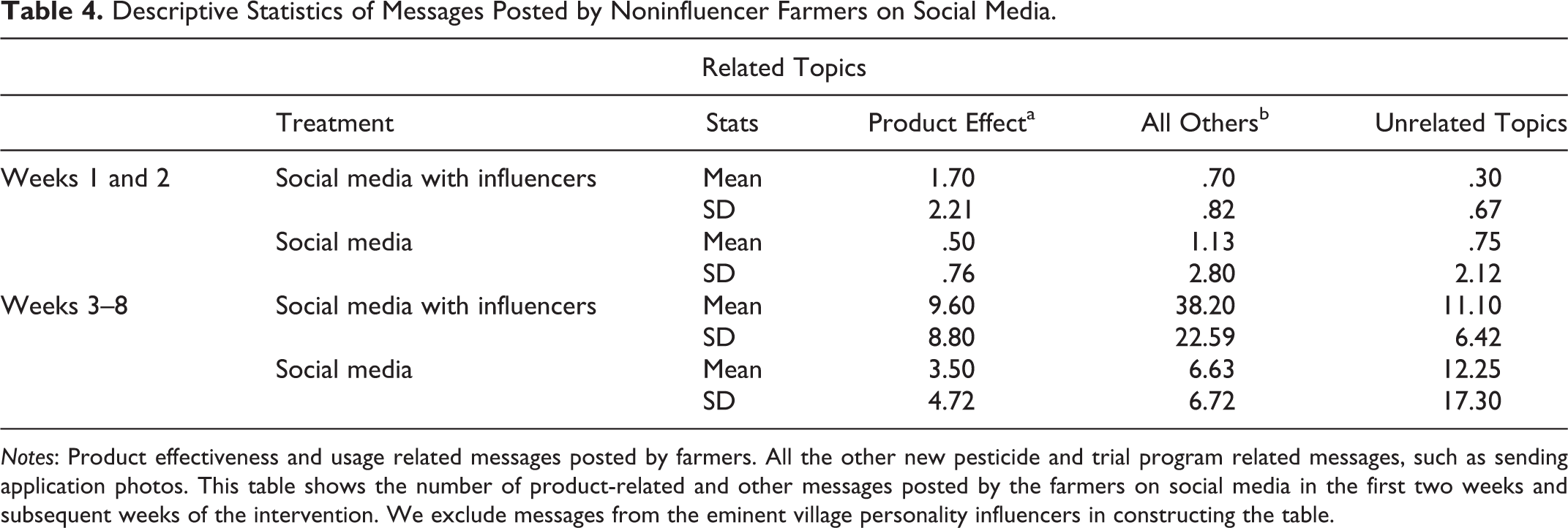
Notes: Product effectiveness and usage related messages posted by farmers. All the other new pesticide and trial program related messages, such as sending application photos. This table shows the number of product-related and other messages posted by the farmers on social media in the first two weeks and subsequent weeks of the intervention. We exclude messages from the eminent village personality influencers in constructing the table.
Taking these findings together, we see that the difference between the two conditions is not in terms of the online behavior of noninfluencers but in the social media with influencers treatment, reflecting encouragement and usage messages by the influencers. We take this as suggestive of the impact of eminent village personalities on initial trial behavior through trust building for the new technology, the supplier, and the trial program, thereby alleviating the first type of uncertainty referred to earlier in the paper. To show the correlation more formally, we estimated a logit model of noninfluencer villagers’ early trial decisions (1 when a farmer tries the product, 0 otherwise) with the number of encouraging messages, whether the messages include the influencer’s usage experiences, and other controls in the social media with influencers condition (see Table W8–2 in Web Appendix W8). We find that encouragement reflecting usage experience has a strong and significant positive correlation with early trial behavior.
From the third week on, the volume of the new technology-related discussions increased rapidly (see both Table 4 and Figure 2, Panel B). At the same time, the risk mitigation effect of the influencers diminished, as they posted fewer encouraging messages (see Table W8–1 in Web Appendix W8). To show some correlational evidence between trial behaviors and online activities, we look at the decisions of noninfluencer farmers to try the pesticide during the eight-week duration in the two social media support conditions as a function of the number of pesticide-related messages posted by noninfluencers. We find that the number of pesticide-related messages has a positive and statistically significant correlation with cumulative trial, but only in the social media with influencers condition (see Table W8–3 in Web Appendix W8).
The role of eminent village personalities and social media platform on trial behavior
These results suggest that the eminent village personalities facilitate diffusion in two ways. First, they can directly motivate the initial use of a new technology by mitigating risk in the early stages by engendering trust. Second, they act as catalysts for online social interactions by others, thereby indirectly influencing the diffusion process. We conjecture that the early trials due to influencer engagement results in these triers’ contributing to online word of mouth. As the interactions among prospective users continue to evolve and propagate by themselves, those online interactions motivate more people to try the product. This larger base of users who have tried and experienced the product ultimately results in adoption and diffusion of the new technology. At the same time, for farmers who have already tried the pesticide, the presence of eminent village personalities appears to have no direct effect on final adoption behavior, as information at this stage comes from peers or from the firm’s broadcast information. Indicative evidence for this can be seen in the similar conditional adoption rates across the two social media treatment conditions.
Traditional one-on-one customer service and trial behavior
For the one-on-one customized telephone support condition, using the logs maintained by the support staff, we categorized the calls’ focus as product-related, risk-related (harm to crops or product authenticity), or price- and purchase-related. At the end of the first two weeks (when the first set of calls occurred), a majority of the calls (61%) were related to risk, followed by product (38%). However, in subsequent weeks, the calls shifted to product-related issues (83%). Importantly, a logit analysis of individual trial on call duration (and controlling for demographics; that is, older farmers need longer call durations) shows a strong positive correlation between duration and trial behavior. In this case, using the terminology of French, Raven, and Cartwright (1959), it appears that the firm’s expert influence facilitates trial by the farmers.
Adoption Behavior and Learning Outcomes
In our conceptual underpinnings section, we noted that adoption requires farmers to resolve their uncertainties regarding quality and usage. In other words, they need to learn about the product’s characteristics, such as effectiveness and harm to crops, and about its usage. To this end, in the final survey we asked farmers who tried the new pesticide to evaluate the benefits of the new technology and usefulness of the trial program. We asked the following questions: (1) “Comparing the new pesticide with the one you used before, do you think the new technology shows better results in: (i) pest control effectiveness, (ii) harm to crops, and (iii) pesticide usage reduction,” and (2) “Do you agree/disagree with the following statement: the trial program helped me obtain useful information and knowledge about the new technology.” Answers to both questions were measured on five-point scales, where 1 = “Strongly disagree” and 5 = “Strongly agree.” This approach of measuring learning outcomes directly is a unique feature of our article, as most learning papers infer that learning occurred from trial/adoption outcomes (see Ching, Erdem, and Keane 2013, for a discussion).
We first calculate a treatment-level “satisfaction” measure as the proportion of farmers who provided a rating of 4 = “Agree” or 5 = “Strongly agree.” Table 5 shows these results. We see that the learning measures are highest for the social media with influencers treatment (and the one-on-one support treatment) for the product features of “effectiveness of pest control” and “pesticide usage reduction.” The product attribute “harm to crops” is harder to define, compared with the other two product attributes. Interestingly, we found that the firm’s one-on-one support is more effective in promoting understanding and satisfaction for this more opaque attribute, indicating the superior nature of personal interactions between the firm and prospective users in communicating vague product features. The last two columns are related to the overall evaluation of the usefulness of the program. They show that the social media treatments outperform the control group, which is consistent with the results we observed in the previous sections. The traditional marketing approach also performs well.
Farmers’ Beliefs on Superiority of The New Pesticide Compared to Traditional Pesticides along Four Attributes: Evidence of Learning.

*p < .1.
**p < .05.
***p < .01.
Notes: This table reports farmers’ responses regarding various attributes of the pesticides and their agreement with whether the new pesticide is superior on these attributes. Numbers represent the proportions agreeing or strongly agreeing to the new pesticide’s superiority.
To correlate the marketing interventions more formally with measured knowledge and learning about the new pesticide’s attributes, Table 6 shows the results of an individual-level ordered logit regression (given the five-point measurement scales described earlier) with village-level clustered standard errors. Our sample focuses on farmers who tried the new technology during the experiment, and so our results should be interpreted with some caution since the farmers who tried it did so as a consequence of receiving different treatments. The dependent variables are the measures on beliefs (learning) regarding the three product benefits. In Models 1 and 3, where the dependent variables are learning measures on product effectiveness and usage reduction, all three marketing interventions have significantly higher results than the control group, meaning that the lower-cost social media tools help improve understanding of product efficacy and usage amount. Harm to crops is the most difficult product feature to learn in our context. Among the three marketing interventions, one-on-one support on the telephone is strongly correlated with improving learning outcomes for all attributes. We also find that individuals who have served as village officials are more likely to have a higher evaluation of product effectiveness and a reduction in usage amount, indicating some heterogeneity in appreciating the new technology.
Effects of Marketing Treatments on Farmers’ Beliefs About the New Pesticide (Individual-Level Ordered Logit).

*p < .1.
**p < .05.
***p < .01.
Notes: This table presents results from an ordered logit analysis with farmer-level data where the dependent measure is the agreement on a five-point scale with whether the new pesticide is superior to existing pesticides along the three attributes of interest. Robust standard errors are in parentheses.
We also analyzed whether learning about product features mediated the effects of marketing interventions on adoption. Such an analysis is often used to investigate underlying behavioral mechanisms but is not common with survey data (for an exception, see Bollinger et al. 2019). A caveat in interpreting such an analysis is that it is not causal in nature. Further, the analysis conditions on trial, which is another potential limitation. By implementing a bootstrapping procedure described by Imai, Keele, and Tingley (2010), we found that learning about product efficacy mediated the effects of the three interventions on adoption. For the learning about crop damage prevention, we found no significant effects for the social media with influencers treatment and the social media alone treatment, whereas the effect of the firm’s one-on-one support on adoption is mediated by this learning measure. Finally, the measure for usage reduction mediated the effects of all the three interventions on adoption, providing further support for our explanation that learning about product features might underlie our effects. These findings provide suggestive empirical evidence that learning was facilitated by our social media interventions, which could then have led to adoption by the farmers. Web Appendix W8 provides a detailed description of the analysis.
Cost Analysis and Economic Good
In emerging markets, the public sector or nongovernmental organizations play a major role in promoting innovations such as new farming technologies and cures for a variety of illnesses. For these organizations, social welfare is the primary goal rather than the earning of profits. Therefore, sustainability has been hard to achieve with such public programs (Kremer and Miguel 2007). However, for private-sector organizations that strive to promote socially beneficial new products and create a better world, business sustainability and profitability are also paramount. Therefore, adopting the perspective of a company, we compare the costs of the different marketing interventions. To estimate the real-world scenario, we paid our research assistants who served as the firm’s representatives in all three marketing interventions more than the market wage that the firm would have paid had it done the implementation. This way, we believe we paint a conservative picture of the costs associated with the various interventions. We calculate the ROI as total revenue (calculated on the basis of the market price) earned from each treatment minus its corresponding costs then divided by those costs. We find that social media with influencers is the most cost-efficient treatment, with the highest ROI value (3.45), followed by the social media alone treatment (2.45). In this instance, we did not need to pay the influencers; however, this may not be true in other contexts. Although the traditional marketing approach is effective in promoting trial behavior and learning performance, it is the most expensive (ROI = 1.91) among the three marketing interventions. In general, marketing interventions brought an averaged increase in adoption rate by 30%, compared with the control group. This may lead to a total increase of productivity by 6% and reduction in production costs of pesticides by 20% (both twice as large as for the control group). In the long run, the potential benefit to the environment and to people’s health brought about by the new green pesticide technology is large. A detailed description of the cost analysis can be found in Web Appendix W9.
Discussion
Many technologies, even those with obvious advantages, have not been widely adopted in developing and emerging markets, where they are urgently needed. Specifically, we investigated how to deploy online social media tools to alleviate customer uncertainty and to promote the adoption of a new nontoxic and eco-friendly pesticide in China. We contribute to the marketing literature in several unique ways. First, we consider three types of uncertainty facing potential adopters. These include (1) the authenticity of the new product and the supplier’s credibility, (2) the “objective” quality or the “match value” of the product, and (3) how best to use or apply the technology in order to get the best outcomes from it. Second, we consider multiple behavioral outcomes along the adoption funnel, including trial in the initial stages after introduction, subsequent trial behavior, and ultimate adoption. Finally, we examine the role of a new type of influencer, eminent village personalities, whose opinions, like those of market mavens, are valued across a broad set of topics even if they lack expertise specific to the new product. Together, our research provides new insights on B2B marketing and on ways in which marketers can help create a “better world.”
A key insight is that even in a rural setting of an erstwhile emerging market, social media influencers can offer an effective way of promoting the adoption of a “better” new B2B product. Influencers play a key role in dispelling concerns regarding the credibility of the new product early in the adoption cycle, a function critical for the eventual success of that medium. Ultimately, the combination of information sources on the platform promotes learning about the features of the new product and alleviates uncertainty associated with product quality and how best to use the new product in order to achieve the best outcomes from it. At the same time, the study also points to why the social media support platform by itself falls short of the performance of traditional B2B one-on-one marketing support in the purchase funnel.
Implications for Practitioners
We highlight three important implications for practitioners. First, social media can provide effective, low-cost means of reaching, communicating with, and convincing potential adopters of new technologies in otherwise difficult-to-reach markets that are nevertheless crucial for long-term success. Second, when promoting a new product in these markets, firms need to take into account the entire purchase funnel rather than focusing on just one specific action, such as trial or final purchase behavior. Indeed, a critical stumbling block is early in the process, where potential consumers may not engage because of concerns about the product’s and the firm’s credibility. Third, businesses, especially in the technology sector, have embraced the use of field experiments to guide their thinking and decision making about various marketing levers that might be used to grow their businesses. Our study provides evidence that even in rural environments, experiments might be a valuable tool for practitioners. Our experiment, conducted in collaboration with local governments, demonstrates how practitioners seeking better world outcomes can avoid higher-cost marketing interventions in favor of low-cost and readily available tools.
Our findings provide insights for managers and policy makers who aim to leverage marketing for doing good in the world. To do good, marketers need to convince consumers to adopt products that are good. Important barriers to such adoption are the uncertainties associated with the product and the inability to learn about the features and benefits of the product. We addressed these issues by understanding the entire process of adoption. When a product is brand new to the world, encouraging trial behavior among prospective users is key. During this stage, overcoming uncertainty about the new product’s authenticity is paramount. We document that an influencer, albeit one not familiar with the new technology, works well in an online social media environment to encourage followers to try the new product. At the same time, traditional firm-initiated customized service and support has a significant effect in motivating trial behavior. Both of these approaches also lead to improved outcomes in the adoption stage but via different routes. On the social media platform, the information exchanged between the triers and the information provided via broadcast by the firm promote learning about specific benefits of the product as well as the best ways to use it. The more traditional marketing approach also accomplishes these objectives but via one-on-one communication between the firm and the potential customer. For marketing to do good, it also needs to do it at scale to have a wider impact. The social media platform with an influencer wins out here because it is more cost-effective than one-on-one marketing by the firm.
Our results also suggest that practitioners should think carefully about how to use social media most efficiently. Although research has documented its use for changing consumer behavior as it is a compelling marketing tool, it is not a panacea, and it requires careful management. Specifically, at the trial stage of the funnel we see the platform underperforming because it cannot, by itself, resolve uncertainty regarding supplier credibility and product authenticity. The lesson to be learned is that creating an online social media platform does not guarantee peer effects as desired. We also offer a solution to this funnel-holdup problem that ultimately propels diffusion of a new product or a new idea: an influencer who can vouch for the credibility of the product, and who tries the product and reports the trial on the platform. The influencers do not need to have expertise specific to the new product. They just need to be eminent persons in the offline world, such as village officers or women’s directors in our context, whose opinions are respected and well perceived by others. We find that the presence of an influencer on the platform, relative to not having one, creates an online environment that fosters more product-relevant discussions among participants. Those discussions on products then motivate learning about the new product. In the absence of the online discussion emanating from trial, we are unlikely to find the level of success as in our experiment. 10 Thus, influencers who are well known only in an offline context can nevertheless help promote adoption through online tools. Without the presence of an influencer, a social media platform is only beneficial to people who are intrinsically more interested in trying the new product.
Implications for Researchers
We provide three key implications for researchers. French, Raven, and Cartwright (1959) among others, have described the different types of power that influence others, such as legitimate, reward, coercive, referent, expert, and information. From a theoretical perspective, our findings provide suggestive evidence for referent influence as the route through which the influencer plays a role in the adoption process. Different from the traditional view in marketing literature that influencers need to have relevant expertise about the new product in order to exert their influence, our findings point out that personalities who are eminent in offline contexts, although not having expertise or knowledge specific to the new product, can also have influence in promoting adoption through online tools. Such an effect is consistent with credibility signaling on social media and its consequences for new product trial. In situations with a large number of new products entering the market, we view this finding as potentially generalizable beyond our current context. Future research can further endeavor to establish the causal link in a more systematic manner.
A second implication of our findings is that we now have direct empirical evidence on how information on social media platforms facilitates learning and how this learning might potentially be a route to new product adoption. Although previous research has embraced the idea that resolving uncertainty via learning is key to product adoption and use, little direct evidence existed on the mechanism. Going further, our research also underscores the potential limitations of different information mechanisms to resolve the uncertainty. By measuring how learning occurs under each information mechanism for the different attributes or benefits associated with the new product, our research highlights the importance of understanding the linkage between information sources and their ability to resolve uncertainty. Our results point to the social media platform (even with an influencer) as not being able to fully communicate all the product features. Specifically, on the important dimension of crop damage, these interventions performed no better than the control. A key takeaway for researchers is to try to understand the specific barriers to learning associated with the social media platform and approaches to overcoming them. Alternatively, a hybrid approach in which the social media platform identifies specific users who need to receive the firm’s one-on-one intervention may be useful to pursue. Understanding the efficacy and cost-effectiveness of such approaches may be a worthwhile future research endeavor.
A third implication is more methodological in nature. While time-consuming and resource heavy, field experiments enable quantitative marketing researchers to obtain mechanism-related insights that are otherwise difficult to obtain using only observational data. Such insights can then feed into building richer theoretical models of behavior. Given the importance of understanding behavior and the role of marketing in it, we encourage researchers to invest effort in the field and conduct more groundwork while engaging in such studies. The real world is too complicated to understand by just digging into existing data. “Through the accumulation of a set of small steps, each well thought out, carefully tested, and judiciously implemented” (Banerjee and Duflo 2011, p. 15), we hope marketing can do better at doing good. We are excited at the possibility that field experiments testing a variety of different marketing tools can help fight poverty, disease, and pollution and contribute to the development of economies the world over.
Supplemental Material
Supplemental Material, sj-docx-1-jmx-10.1177_0022242920985784 - Social Media, Influencers, and Adoption of an Eco-Friendly Product: Field Experiment Evidence from Rural China
Supplemental Material, sj-docx-1-jmx-10.1177_0022242920985784 for Social Media, Influencers, and Adoption of an Eco-Friendly Product: Field Experiment Evidence from Rural China by Wanqing Zhang, Pradeep K. Chintagunta and Manohar U. Kalwani in Journal of Marketing
Footnotes
Acknowledgments
The authors have benefited from the advice of Chris Udry, Chris Moorman, Rajesh Chandy, Sachin Gupta, Oleg Urminsky, Abby Sussman, Sanjog Misra, Sridhar Narayanan, Ying Xie, Tesary Lin, and Fei Lin as well as seminar and class participants at Purdue University, Cass Business School, Northwestern University, University of Arizona, University of Hawaii, Peking University, Renmin University, University of Sydney, Tsinghua International Graduate School at Shenzhen, INFORMS Marketing Science Conferences in Rome and at Duke University, and the China India Insights Conference. They are grateful to the JM review team for their insights, comments, and suggestions. The data used in this paper were collected by a team of researchers in China to whom we are grateful. We thank the Zhijiang and Zaoyang agricultural departments for their full support. Financial support from Purdue University and the Kilts Center for Marketing at the Booth School of Business is gratefully acknowledged. The authors are, of course, responsible for errors or omissions.
Associate Editor
Jacob Goldenberg
Declaration of Conflicting Interests
The author(s) declared no potential conflicts of interest with respect to the research, authorship, and/or publication of this article.
Funding
The author(s) received no external financial support for the research, authorship, and/or publication of this article other than from the institutions they belong to.

Notes
References
Supplementary Material
Please find the following supplemental material available below.
For Open Access articles published under a Creative Commons License, all supplemental material carries the same license as the article it is associated with.
For non-Open Access articles published, all supplemental material carries a non-exclusive license, and permission requests for re-use of supplemental material or any part of supplemental material shall be sent directly to the copyright owner as specified in the copyright notice associated with the article.
