




Abstract
To fight obesity and educate consumers on how the human body functions, health education and marketing materials often highlight the importance of adopting a cognitive approach to food. One strategy employed to promote this approach is to portray humans as machines. Five studies (and three replication and follow-up studies) using different human-as-machine stimuli (internal body composition, face, appearance, and physical movement) revealed divergent effects of human-as-machine representations. While these stimuli promoted healthier choices among consumers who were high in eating self-efficacy, they backfired among consumers who were low in eating self-efficacy (measured in Studies 1 and 3–5; manipulated in Study 2). This reversal happened because portraying humans as machines activated consumers’ expectation of adopting a cognitive, machine-like approach to food (Studies 3 and 4)—an expectation that was too difficult to meet for those with low (vs. high) eating self-efficacy. We tested a solution to accompany human-as-machine stimuli in the field (Study 5): we externally enhanced how easy and doable it was for consumers low in eating self-efficacy to adopt a cognitive approach to food, which effectively attenuated the backfire effect on their lunch choices at a cafeteria.
Keywords
More than two-thirds of adults and one-third of preschoolers in the United States are overweight or obese (Centers for Disease Control and Prevention 2016); similar rates exist in many other countries worldwide (World Health Organization 2016). To combat obesity, governments, marketers, and consumer welfare organizations invest a substantial amount of resources to encourage consumers to make food choices in a cognitive manner and to use their head instead of their heart (e.g., “Eat to fuel your body, not to feed your emotions”). These cognitive, head-based approaches to food such as reading nutrition labels and computing calories are believed to be optimal health strategies (Food and Agriculture Organization 2004; World Health Organization 2016). Accordingly, major health interventions and programs have invested a lot of resources into promoting cognitive approaches that are analytical, rule-focused, and free of emotions (Gerrior, Juan, and Basiotis 2006; Kozup, Creyer, and Burton 2003; Parker and Lehmann 2014; Reyna et al. 2009).
One popular strategy employed to promote a cognitive approach to food is to portray humans as machines and to depict human body parts using mechanistic components. A wide variety of examples can be found in the recent campaigns by the American Heart Association, the Centers for Disease Control and Prevention, Men’s Health Week, and GBCHealth (for a list of recent health campaigns using human-as-machine stimuli, see Web Appendix 1). These materials are aimed to leverage people’s existing associations about machines—that machines make decisions using their head (cognition) and not their heart (emotion)—to help consumers approach food in a more cognitive, machine-like manner, with the goal of encouraging healthier choices. National Geographic’s series “The Incredible Human Machine” even describes unhealthy behaviors as (human) “errors” in the maintenance of our bodily machine.
Similarly, companies and marketers have started using human-as-machine representations. For instance, Centrum asks consumers to “power the human machine” with healthy food supplements. Nestlé encourages indulgence as the “human” (vs. a machine-like) thing to do; their tagline “Working like a machine? Have a Kit Kat” motivates consumers to be more like humans and have a chocolate bar—a choice that rational machines would not make (for additional examples by Snickers, Red Bull, Anheuser-Busch, and others, see Web Appendix 1).
Furthermore, consumers experience human-as-machine representations not only in targeted advertisements but also in everyday life. With rapid improvements in technology, virtual telepresence systems show people as human faces with mechanistic bodies, human enhancement technologies (e.g., augmented reality goggles, transcranial simulation headbands) represent humans as more machine-like, and artificial intelligence software further blurs the line between humans and machines (Castelo, Schmitt, and Sarvary 2019; Longoni, Bonezzi, and Morewedge 2019; Luo et al. 2020). These technological advances are entering the retail and restaurant sectors (O’Reilly 2017) and are driving consumption decisions.
Despite the existence of human-as-machine representations in public policy, education, food marketing, and consumers’ daily lives, research has yet to systematically examine how consumers react to such representations. The previous examples suggest a possible lay belief among practitioners that by making humans look more like machines, people would choose food in a cognitive manner and thus make healthier choices. How accurate is this lay belief? We aim to answer three questions in this research: (1) Does representing humans as machines indeed encourage healthier choices? (2) Might there be heterogeneity in how consumers respond to these stimuli? (3) What psychological processes drive these effects?
To achieve this aim, we spotlight an important individual difference variable: consumers’ eating self-efficacy (i.e., confidence in one’s own ability to choose healthy food; also referred to as healthy eating efficacy, healthy diet efficacy, and dieting self-efficacy; Armitage and Connor 1999; Stotland, Zuroff, and Roy 1991). We theorize that, contrary to practitioners’ lay beliefs, human-as-machine representations could create divergent effects on consumers’ food choices, depending on a person’s chronic level of eating self-efficacy.
This hypothesized divergent effect is driven by the following process: (1) being exposed to human-as-machine stimuli brings to mind the expectation that one should behave more machine-like (i.e., adopting a cognitive, head-based approach to food); (2) importantly, this expectation can be motivating (i.e., leading to healthier choices) only if consumers believe that they can meet it. While consumers with high levels of eating self-efficacy believe in their abilities to choose food in a cognitive, machine-like manner (and thus would be motivated to fulfill this expectation), consumers with low levels of eating self-efficacy tend to struggle with a cognitive approach to food. As a result, this latter and more vulnerable consumer segment would anticipate failure in fulfilling this expectation, leading them to contradict it and choose unhealthier options (Brehm 1966; Brehm and Brehm 1981; Byrne and Hart 2009; Reynolds-Tylus 2019). Because low levels of eating self-efficacy have been linked to overweight and obesity (Friedman and Brownell 1995), the very segment that the human-as-machine marketing communication aims to educate is the one that does not benefit from this approach, revealing a critical dark side of these representations on consumers’ well-being.
A Cognitive, Machine-Like Approach to Food
Obesity has been considered one of the most critical global crises in the twenty-first century, with detrimental health consequences to individuals as well as serious economic costs collectively (World Health Organization 2016). As a result of this, governments, policy makers, nongovernmental organizations, and marketers have developed a variety of materials and programs to encourage consumers to make healthier food choices. One key trend in these materials and programs is to push toward a more cognitive approach to food (Gerrior, Juan, and Basiotis 2006; Kozup, Creyer, and Burton 2003; Parker and Lehmann 2014; Reyna et al. 2009); for instance, to encourage consumers to choose food with their head and not their heart (e.g., “H.A.L.T. before eating,” in which H.A.L.T. stands for hungry, angry, lonely, and tired) and to highlight the importance of nutrition labels and calorie tracking (World Health Organization 2016). The rise of artificial intelligence–based technologies and devices in the health industry (Puntoni et al. 2020) further promotes the notion that health-related decisions (such as food choices) should be based on analytics and that considering humans’ unique characteristics and emotions might hinder optimal decision making (Longoni, Bonezzi, and Morewedge 2019).
In line with this general push toward a cognitive approach to food, one popular strategy is to portray humans as machines and depict human body parts using mechanistic components (see Web Appendix 1). This process of altering humans’ physical dimensions to make humans look more like machines is conceptualized as mechanistic dehumanization (Haslam 2006; Haslam and Loughnan 2014) and can be treated as a reverse process to anthropomorphism (i.e., making objects/machines look more like humans; Aggarwal and McGill 2007; Epley, Waytz, and Cacioppo 2007). While anthropomorphism has received considerable attention in the marketing literature (Aggarwal and McGill 2007; Landwehr, McGill, and Herrmann 2011), dehumanization is mostly studied in psychology with a focus on intergroup relations and threat as a top-down, motivated bias that affects how in-group members may compare out-group members to objects/machines (Gray, Gray, and Wegner 2007; Haslam and Loughnan 2014; Leyens et al. 2000; Waytz et al. 2010).
More recent work has begun to acknowledge that perceptions of machine-likeness in humans can also be driven by a bottom-up process, such as through an exposure to a visual cue (without specific intergroup conflicts or biases). For instance, facial configurations (e.g., width-to-height ratio [Deska, Lloyd, and Hugenberg 2018]; see also Hugenberg et al. 2016; Looser and Wheatley 2010) or movement speed (Heptulla Chatterjee, Freyd, and Shiffrar 1996; Shiffrar and Freyd 1990) can influence how machine-like a human is perceived. Our work builds on these recent findings by (1) exploring other dimensions that can shift how humans are perceived (i.e., changing the body composition and appearance); (2) homing in on the impact of representing humans as machines on food choices that consumers make daily, beyond the traditional context of intergroup relations and threat; and (3) further theorizing the driving role of consumers’ idiosyncratic differences in eating self-efficacy. Importantly, we argue that being exposed to human-as-machine representations, with more machine-like (1) internal body composition, (2) face, (3) appearance, and (4) physical movement, can affect consumers’ choices because it changes their expectation of how they should behave when it comes to food.
An Expectation to Choose Food Like the “Tin Man” Would
We posit that being exposed to human-as-machine representations changes not only consumers’ perceptions but also their expectations of how they should behave. This is because alterations of physical features elicit schemas (either of humans or machines) and prompt individuals to apply normative behavioral expectations accordingly (Aggarwal and McGill 2007, 2012; Kim and Kramer 2015; Kim and McGill 2011). For instance, machines that look more human-like (e.g., anthropomorphized computers) are expected to interact like humans, such as by making small talk (Cassell and Bickmore 2000), and anthropomorphized automobiles are trusted more (Waytz, Heafner, and Epley 2014). In contrast, when humans are portrayed as machines, this brings to mind the expectation that one should behave like a machine. If a runner is portrayed as a machine, one expects them to be a strong entity without “human weakness” (Gleyse 2013; Hoberman 2001). Patients who are perceived as machines are expected to experience less “human” pain, which would allow doctors to maintain their professional distance and objectivity (Haque and Waytz 2012; Kumar et al. 2014).
While humans can surely hold a variety of schemas and expectations about machines, one of the most prominent schemas, we conjecture, is that machines rely solely on their “head” (cognition), as they lack a human heart (emotion); in contrast, emotion and cognition are both fundamental elements of humans’ decision making (Cian, Krishna, and Schwarz 2015). These associations are formed from early childhood and are continuously reinforced through common language usage and mass media. For instance, in The Wizard of Oz, all that the Tin Man wants is a human heart. Data, Star Trek’s android character, wants to let go of rationality to experience human emotions. Likewise, when a human possesses machine-like features, such as Iron Man (Tony Stark), he struggles with the effects of becoming too rational and losing human emotionality.
To empirically verify consumers’ existing schema that machines rely on their head (cognition) and not their heart (emotion), we conducted a pilot study and asked 305 U.S.-based adults and students (46.6% female; Mage = 36.08 years), on three seven-point scales, to indicate the extent to which they consider machines’ decisions and humans’ decisions to be based on emotion (1 = “emotional, nonanalytical, warm”) compared with cognition (7 = “unemotional, analytical, cold”; Haslam 2006; Haslam et al. 2005; Cronbach’s alpha = .92). Results verified that people believed that machines’ decisions were more cognitive and head-based (M = 6.35, SD = .84) than humans’ decisions (M = 3.34, SD = 1.26; t(303) = 24.87, p < .001, d = 2.82). We also included the classic Heart Versus Mind Scale (Shiv and Fedorikhin 1999; Cronbach’s alpha = .94) and found that these two sets of scales were highly correlated (r(303) = .85, p < .001) and provided consistent results: machines’ decisions were perceived as being based more on thoughts, cognition, and the head (M = 4.57, SD = 1.20) than humans’ decisions (M = 2.00, SD = 1.35; t(303) = 17.20, p < .001, d = 1.97).
We posit that this popular association that machines rely on their head (cognition) can activate an expectation for one’s own behaviors because the human-as-machine stimuli either explicitly or implicitly establish a connection between humans and machines. By visually transforming humans’ body composition, appearance, and movement characteristics into machines, the human-as-machine stimuli bring to mind schemas about machines (e.g., a cognition-driven decision approach) and activate an expectation that these schemas should apply to humans, much the way anthropomorphism—by portraying objects as humans—activates an expectation that human schemas should apply to the focal objects (Aggarwal and McGill 2007, 2012; Kim and Kramer 2015; Kim and McGill 2011).
In summary, we posit that when humans are portrayed as machines in health or food marketing, it activates an expectation that one should behave like a machine, relying on one’s head (cognitive) instead of the heart (emotion) when choosing food. Importantly, we argue that this expectation can lead to more complicated consequences than originally anticipated: the effect depends on consumers’ chronic level of eating self-efficacy.
The Driving Role of Self-Efficacy in Eating Behavior
Having an expectation of making cognitive, machine-like food choices can motivate healthier choices only if consumers believe that the expected behavior is doable (Atkinson 1957; Liberman and Förster 2008; Oettingen et al. 2004). Specifically, when facing an expectation, consumers go through an evaluation process, in which they assess their abilities to successfully meet the expectation (e.g., using their past behaviors as a proxy; Bandura 1991). This evaluation process thus involves predicting future outcomes to determine one’s choices and behaviors. If consumers believe that they can meet the expectation, they then anticipate success in fulfilling it (Bandura 1991; Bandura and Cervone 1983), which operates as a positive motivator, facilitating the engagement of behaviors that will help meet the expectation (Bandura 1997; Bandura and Schunk 1981; Liberman and Förster 2008).
In contrast, if consumers believe that they cannot meet the activated expectation (e.g., because their past performances were unsuccessful), they instead anticipate failure in fulfilling it (Bandura 1991; Bandura and Cervone 1983). The anticipation of failure, critically, serves as a negative motivator (Bandura 1991; Bandura and Cervone 1983), leading to disengagement (Huang and Zhang 2011; Locke and Latham 2002) and often opposite behaviors. Two lines of research suggest that a backfire effect—going against the activated expectation to choose unhealthier food—would likely occur in this case. First, anticipating failure can trigger aggression toward the self and reactance against the activated standard or expectation (Brehm 1966; Brehm and Brehm 1981). Because an impossible standard/expectation induces feelings of impairment regarding one’s abilities, people would opt to reestablish their freedom by behaving “in the way they want” (and not in the way they are expected to; Reynolds-Tylus 2019). In the context of health, this would result in a backfire or boomerang effect that goes against the communicated message (Byrne and Hart 2009; Reynolds-Tylus 2019). Second, and more specific to the food domain, knowing that one will fall short of an internal or external expectation leads to an unflattering and aversive evaluation of the self, which is often accompanied by negative emotions and emotional distress (Baumeister 1997; Heatherton, Herman, and Polivy 1991). Dietary disinhibition and overeating can then occur as a way to escape from these unpleasant states (Mills et al. 2002; Seddon and Berry 1996; Strauss, Doyle, and Kreipe 1994). Feeling unable to meet the body-shape expectations activated by a super-thin magazine model, for instance, led women to unhealthy overeating to make themselves feel better (Klesse et al. 2012).
Many traits can affect how consumers respond to the expectation of making cognitive, machine-like food choices. We propose that consumers’ chronic level of eating self-efficacy constitutes one critical trait. Self-efficacy is broadly defined as belief in one’s ability to achieve a particular outcome or goal (Bandura 1997). Eating self-efficacy, accordingly, refers to a consumer’s belief in his or her specific ability to choose healthy food (Armitage and Connor 1999; Stotland, Zuroff, and Roy 1991).
More importantly, eating self-efficacy is linked to several eating habits essential to a cognitive, machine-like approach to food. Consumers high (vs. low) in eating self-efficacy are less likely to succumb to emotional eating (Costanzo et al. 2001; Toray and Cooley 1997) or to use food to respond to negative emotional events (e.g., an argument with family; Stich, Knäuper, and Tint 2009) and anxiety (Clark et al. 1991; Glynn and Ruderman 1986). While consumers low in eating self-efficacy use food to deal with boredom (Glynn and Ruderman 1986), those high in eating self-efficacy have less difficulty staying focused on the functional (cognitive) aspect of food. Similarly, consumers high (vs. low) in eating self-efficacy do better with analytics-based consumption, such as estimating portion size (Knäuper 2013), evaluating caloric needs (Stotland, Zuroff, and Roy 1991), and calculating nutritional values (Wilson-Barlow, Hollins, and Clopton 2014).
Because existing habits and past behaviors are the basis for assessing one’s ability to meet an expectation (Bandura 1991), it is likely that consumers chronically high in eating self-efficacy would consider a cognitive, machine-like approach to food an easy expectation to meet, whereas the same standard would seem extremely difficult or impossible for consumers low in eating self-efficacy. We empirically verified this in another pilot study: Consumers high (vs. low) in eating self-efficacy indeed felt more (vs. less) able to make food decisions in a cognitive, machine-like manner (for method and results of the pilot study, see Web Appendix 2).
In summary, we propose the following three hypotheses:
Figure 1 illustrates our conceptual model.

Overview of the model and hypotheses.
Overview of Studies
We conducted five studies (and three replication and follow-up studies) with a variety of incentive-aligned food choices and multiple human-as-machine stimuli. Study 1 (and two replications) and Study 2 tested our key hypothesis: human-as-machine representations led to healthy or unhealthy food choices depending on consumers’ level of eating self-efficacy (H1). We measured consumers’ chronic level of eating self-efficacy in Study 1 and directly manipulated eating self-efficacy in Study 2.
Studies 3 and 4 (and a follow-up study) tested the proposed mechanisms through moderated mediation analyses: exposure to human-as-machine stimuli activated an expectation to approach food in a cognitive, machine-like manner in all consumers (H2). Activating this expectation led to divergent effects: whereas consumers high in eating self-efficacy made healthier food choices, consumers low in eating self-efficacy went against the expectation and made unhealthier choices (H3). Studies 3 and 4 also ruled out alternative accounts such as perception of food (as a source of pleasure or energy), hunger, people’s beliefs about what they could digest, emotionality, and perception of humans’ competence.
Finally, Study 5 explored a theory-based solution in the field by accompanying human-as-machine stimulus with a message that made consumers feel that they could meet the expectation to make food choices in a cognitive, head-based manner. The intervention message successfully attenuated the backfire effect on lunch choices at a cafeteria and enabled an effective use of human-as-machine stimuli to facilitate healthier choices for all.
Study 1: Human-as-Machine Body Stimuli and Food Choices
Study 1 tested our key proposition, that human-as-machine representations would facilitate healthier choices among consumers high in eating self-efficacy but would backfire and result in unhealthier choices among consumers low in eating self-efficacy (H1). To set a baseline of what people choose without exposure to any stimulus related to humans or machines, we also included a control condition in which participants viewed a neutral visual.
Method
Participants
Three hundred U.K.-based adults (64.0% female; Mage = 36.70 years) recruited from Prolific Academic participated in this study. The study used a 3 (stimulus: human as machine vs. human vs. control) × 1 (eating self-efficacy [measured as a continuous variable]) between-subjects design. For this and all following studies, target sample sizes were determined in advance of data collection on the basis of participant availability, study design, and collection method (Simmons, Nelson, and Simonsohn 2011). Herein, we report all data exclusions, manipulations, and measures; all stimuli can be found in Web Appendix 3, and all data sets are available upon request.
Stimulus design and pretest
Inspired by health marketing stimuli used in the real world (see Web Appendix 1) and following procedures from anthropomorphism research (McGill 1998), we created human-as-machine stimuli by altering an image of the human digestive system (i.e., the internal body composition) in this study. In the human-as-machine condition, the digestive system was illustrated as a machine; in the human condition, the digestive system was illustrated as human organs. For the stimulus pretest, we also included a third human condition, a human upper body with no organs showing, to ensure that showing human organs in the human condition did not make the image seem less human (for all stimuli, see Web Appendix 3).
In the stimulus pretest, we measured human versus machine perception using scales from the anthropomorphism literature (Aggarwal and McGill 2007; Kim and McGill 2017; Romero and Craig 2017). Participants rated one of the images on three seven-point Likert scales (“The human [body]…” 1 = “looks like a machine,” and 7 = “looks like a human”; 1 = “does not look alive at all,” and 7 = “looks very alive”; 1 = “contains mainly machine-like features,” and 7 = “contains mainly human-like features”). For comprehensiveness, we also included classic measures of dehumanization (“The human [body] is represented as unemotional, cold, rigid, fungible (lacking individuality), superficial, passive, inert (lifeless)”; 1 = “strongly disagree,” and 7 = “strongly agree”; Haslam 2006). The results verified that the digestive system presented as a machine was indeed perceived as more machine-like on the human–machine continuum (M = 3.54, SD = 1.81) than the digestive system presented as human organs (M = 5.18, SD = 1.24; t(64) = 5.51, p < .001, d = 1.36) and the human upper-body condition (M = 5.08, SD = 1.41; t(64) = 4.82, p < .001, d = 1.19); the latter two groups did not differ (t(64) = .31, p = .759, d = .08). Results were similar for the reverse-coded dehumanization scale (for results and scale correlations, see Web Appendix 3). Drawing on the pretest results, we used the images of the two digestive systems (without the upper body) in the main study to test the hypothesized effect.
Procedure
In the main study, participants were told that they would view different visuals and representations of the human body and that they would share their honest thoughts and opinions about them. After completing a bot check, they saw one of the two images from the pretest (digestive system presented as a machine vs. as human organs). Following the procedures in prior literature (Gino, Kouchaki, and Galinsky 2015; Smith et al. 2008), we had participants describe the digestive system in 100 words on basis of the image they saw to reinforce the manipulation and ensure attention to the stimulus. We also included a pure (no human and no machine) control condition, in which participants saw a map and were asked to describe the directions from home to their workplace in 100 words. The control condition ensured a similar amount of writing effort with no specific relation to either machine or human, allowing us to isolate the direction of changes in participants’ food choices. Participants responded to two filler questions to reduce demand effects (for the variety of filler questions used in this and the following surveys, see Web Appendix 4).
To capture food choices, all participants were told at the end of this survey that, in addition to their regular compensation, they would be entered into a lottery for $9 worth of food coupons. They were asked to choose three snack items (each in a $3 portion size) out of a selection of ten and were promised the coupons for the three items they chose (incentive-compatible). For each snack item, participants read information on ingredients and caloric content per package. The calorie content of these ten items ranged from 30 calories (mini peeled carrots) to 250 calories (Snickers bar; for snack choices used, see Web Appendix 5). Participants selected three items and received a confirmation that they were now entered into the lottery.
Participants then proceeded to another set of filler questions before responding to the four-item eating self-efficacy scale by Armitage and Connor (1999; e.g., “I believe I have the ability to eat a low-fat diet in the next month,” 1 = “definitely do not,” and 7 = “definitely do”; “If it were entirely up to me, I am confident that I would be able to eat a healthy diet in the next month,” 1 = “strongly disagree,” and 7 = “strongly agree”; Cronbach’s alpha = .91; for the full scale, see the Appendix). Before exiting the study, participants entered demographic information and reported any suspicions or questions they had. All participants were debriefed and entered a lottery to receive $9 additional payment (the monetary value of the coupons).
Results and Discussion
None of the participants raised any suspicions or questions. We summed the calorie content of the three snack items the participants chose as a proxy for how healthy their food choices were, as prior literature has shown that consumers use calorie information to assess the healthiness of food items (Chernev and Chandon 2010). To ensure that this was indeed the case, we also conducted a posttest on the health perception of these ten snacks (for posttest results of the snacks, see Web Appendix 5). Replacing the sum of calories with the sum of health scores from the posttest as the dependent measure revealed consistent results.
We conducted a regression analysis with stimulus (human as machine vs. human vs. control), eating self-efficacy (continuous measure), and their interaction as predictors, with age and gender serving as control variables (Model 1, Hayes 2013). In this and all following studies, we included age and gender as covariates because both have been shown to affect how people feel about machines (Bartneck et al. 2007; Nomura, Kanda, and Suzuki 2006) as well as how they make food choices (Ares and Gámbaro 2007). Analyses without these variables revealed consistent patterns in all studies. We report results without age and gender in Web Appendix 6 for comprehensiveness.
The model revealed a main effect of eating self-efficacy (β = −45.22, SE = 8.86; t = −5.11, p < .001); people with higher eating self-efficacy chose lower-calorie snacks. The model also revealed two main effects of stimulus (human as machine vs. control: β = 270.48, SE = 71.50; t = 3.78, p < .001; human as machine vs. human: β = 205.09, SE = 81.32; t = 2.52, p < .001); the human-as-machine stimulus led participants to choose higher-calorie snacks compared with the other two conditions. With regard to control variables, results revealed that female participants chose lower-calorie snacks than male participants (β = −32.37, SE = 14.19; t = −2.28, p = .023). Age did not have an effect. More importantly, we found two significant stimulus × eating self-efficacy interactions, one between the human-as-machine condition and the human condition (β = −36.84, SE = 14.19; t = −2.66, p = .008) and another between the human-as-machine condition and the control condition (β = −50.32, SE = 12.56; t = −4.01, p < .001).
Further spotlight analyses on eating self-efficacy (M = 5.62, SD = 1.27) illustrated that among those with high eating self-efficacy (1 SD above the mean [+1 SD] = 6.89), the effect of the human-as-machine stimulus was facilitative such that participants chose lower-calorie snacks in the human-as-machine condition (M = 475.40) than in the control condition (M = 551.41; β = −76.01, SE = 23.89; t = −3.18, p = .002) or the human condition (M = 523.92; β = −48.52, SE = 23.03; t = −2.11, p = .036); the human and control condition did not differ (β = −27.48, SE = 24.56; t = −1.12, p = .264). In contrast, the human-as-machine stimulus backfired among participants with low eating self-efficacy (1 SD below the mean [−1 SD] = 4.35), such that they chose higher-calorie snacks after viewing the human-as-machine stimulus (M = 590.28) than after viewing either the control stimulus (M = 538.44; β = 51.84, SE = 22.46; t = 2.31, p = .022) or the human stimulus (M = 545.22; β = 45.05, SE = 25.54; t = 1.76, p = .079); the human and control conditions did not differ (β = 6.78, SE = 24.34; t = .28, p = .781; see Figure 2).
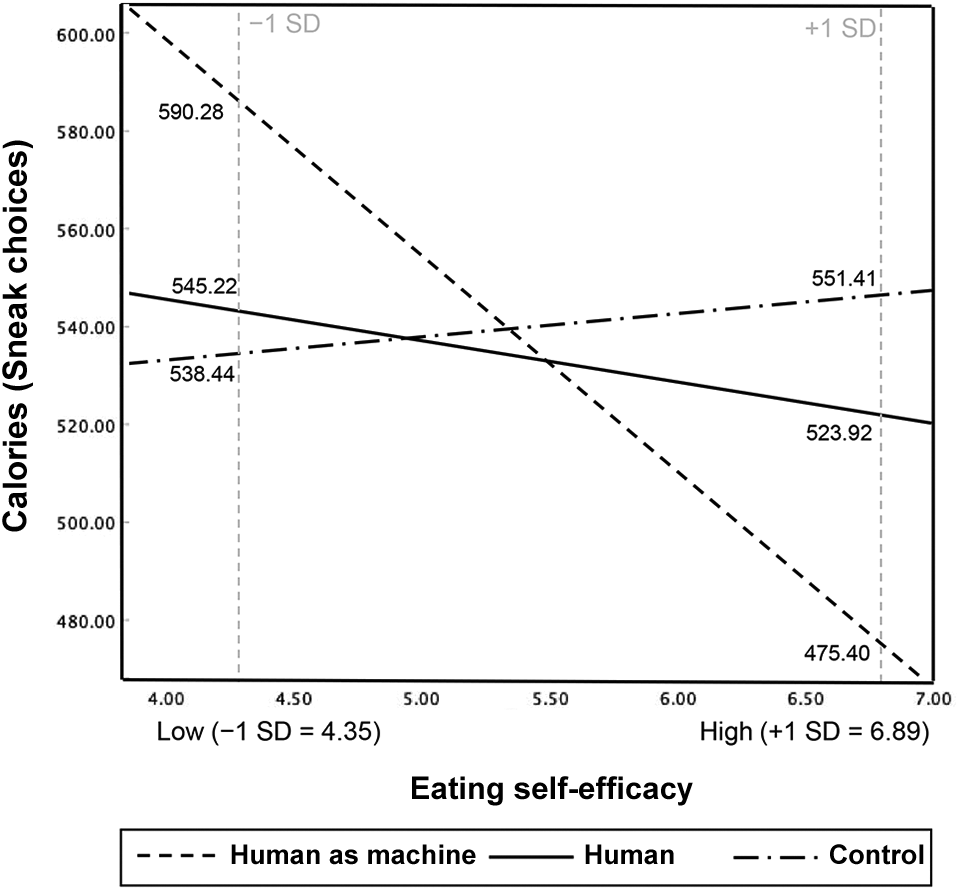
The effect of stimulus on snack choices for consumers low versus high in eating self-efficacy: measured (Study 1).
We further replicated these results in two follow-up studies with a different eating self-efficacy scale to increase generalizability. Self-efficacy and behavioral control are conceptually similar and often used interchangeably (Bui, Droms, and Craciun 2014). Accordingly, we adopted a measure from the behavioral control literature and used five items of Moorman and Matulich’s (1993) scale that directly assessed eating self-efficacy; sample items included “It’s easy for me to reduce my sodium intake” and “It’s easy to eat fresh fruits and vegetables regularly” (1 = “strongly disagree,” and 7 = “strongly agree”; Cronbach’s alpha = .74). In the first follow-up study, mirroring Study 1, we captured participants’ chronic level of eating self-efficacy at the very end of the survey session so that its measurement would not contaminate participants’ interpretation of the stimuli or their food choices. In the second follow-up study, we measured participants’ chronic level of eating self-efficacy first, then added filler items, and then exposed participants to the human-as-machine stimuli to account for any demand effects. For the method and results of these studies, see Web Appendix 7.
The results of Study 1 and the two replications provide support for the divergent effects of portraying the human body as a machine (H1), revealing a critical dark side of such representation. While consumers with a high level of eating self-efficacy reacted positively to this stimulus and made healthier choices, consumers with a low level of eating self-efficacy made worse food choices upon exposure to human-as-machine representations.
Study 2: Directly Manipulating Eating Self-Efficacy
Study 2 served two objectives. First, we tested a different human-as-machine stimulus to enhance the generalizability of the support for H1: the face, which is often used in anthropomorphism research (Kim and McGill 2011; Landwehr, McGill, and Herrmann 2011) and has been a keen focus of previous dehumanization research (e.g., Deska, Lloyd, and Hugenberg 2018). We added machine-like features to a human face and tested the effect of this stimulus on food choices. This also ensured that the observed divergent effects would occur without a visual of the digestion system. Second, we directly manipulated individuals’ perceived level of eating self-efficacy to rule out any other dispositional differences between these two types of consumers as alternative accounts.
Method
Participants
Two hundred three undergraduate students (43.8% female; Mage = 20.32 years) came into the lab of a large Dutch university to participate in this study in exchange for study credits. The study used a 2 (stimulus: human as machine vs. human) × 2 (eating self-efficacy: high vs. low) between-subjects design.
Stimulus design and pretest
Following the procedures in Study 1, participants in the pretest were randomly assigned to one of two conditions. In the human-as-machine condition, participants saw a human face with machine-like features. In the human condition, participants viewed the same human face without machine-like features. In both conditions, participants saw either a male or female face. The pretest, which used the same two machine-likeness and dehumanization scales as in Study 1’s pretest (Aggarwal and McGill 2007; Haslam 2006; Kim and McGill 2017; Romero and Craig 2017), was successful. Those who saw the human-as-machine face evaluated the face as more machine-like than those who saw the human face (for stimuli pretest details and results, see Web Appendix 3).
Procedure
In the main study, participants were told that there were multiple different surveys in the study and that they would complete all of them in order. They first went through a general survey about themselves, which incorporated an eating self-efficacy manipulation that we developed based on work by Bandura and Jourden (1991) and Ben-Ami et al. (2014). Participants answered a set of questions regarding their current eating habits (e.g., “How many of your meals in an average week include red meat,” “How many of your weekly meals are likely high in sodium [because they are canned, packaged, or take-out options]”). They were then informed that a score was calculated based on their answer to these questions, reflecting how capable they were of eating healthily; participants were randomly assigned to see that they were classified as “very capable” (high eating self-efficacy) or “having difficulties” (low eating self-efficacy). For the manipulation, see Web Appendix 8.
After completing the eating self-efficacy manipulation, participants entered the second study, in which we randomly exposed them to either the human-as-machine face or the human face. Participants were not asked to write 100 words about the stimuli in this study, to further ensure that the observed effects could occur without mandatory reflection.
Finally, participants were asked to choose three snacks (each in a $3 portion size) out of a selection of ten, as in Study 1. We further included both eating self-efficacy scales as manipulation checks: the scale used in Study 1 (Armitage and Connor 1999; Cronbach’s alpha = .92) and the scale used in the two replications (Moorman and Matulich 1993; Cronbach’s alpha = .64). The manipulation was successful (for results, see Web Appendix 8).
The session ended with demographic information and a probe for suspicion and questions. All participants entered a lottery for $9 additional payment. Because we informed some participants that they were not eating healthily, we included an extensive debrief and ensured that all participants read and understood that the score was arbitrary and unrelated to their actual behavior. We also allowed them to withdraw their data from analysis if desired (out of 203 undergraduate students, 7 opted to not be included, leaving a final sample of 196).
Results and Discussion
We conducted an analysis of covariance with stimulus (human as machine vs. human), eating self-efficacy (high vs. low), and their interaction as predictors, and age and gender as covariates. We again found a main effect of eating self-efficacy: participants who believed they were low in eating self-efficacy chose higher-calorie snacks (M = 475.88, SD = 139.96) than those who believed that they had high eating self-efficacy (M = 420.00, SD = 134.61; F(1, 190) = 7.63, p = .006, η2 = .039). There was no main effect of stimulus, age, or gender in this study. Consistent with Study 1, we again observed the hypothesized stimulus × eating self-efficacy interaction (F(1, 190) = 5.15, p = .024, η2 = .026).
Further contrast analysis revealed that among the participants who were led to perceive high eating self-efficacy, the caloric content of the snacks chosen was similar between the human-as-machine face condition (M = 404.25, SD = 132.74) and the human face condition (M = 434.23, SD = 135.98; t(97) = 1.11, p = .270, d = .22). In contrast, those who were led to perceive low eating self-efficacy chose snacks significantly higher in calories when they saw the human-as-machine face (M = 505.77, SD = 139.04) than when they saw the human face (M = 441.33, SD = 134.38; t(95) = 2.32, p = .023, d = .47) (see Figure 3).
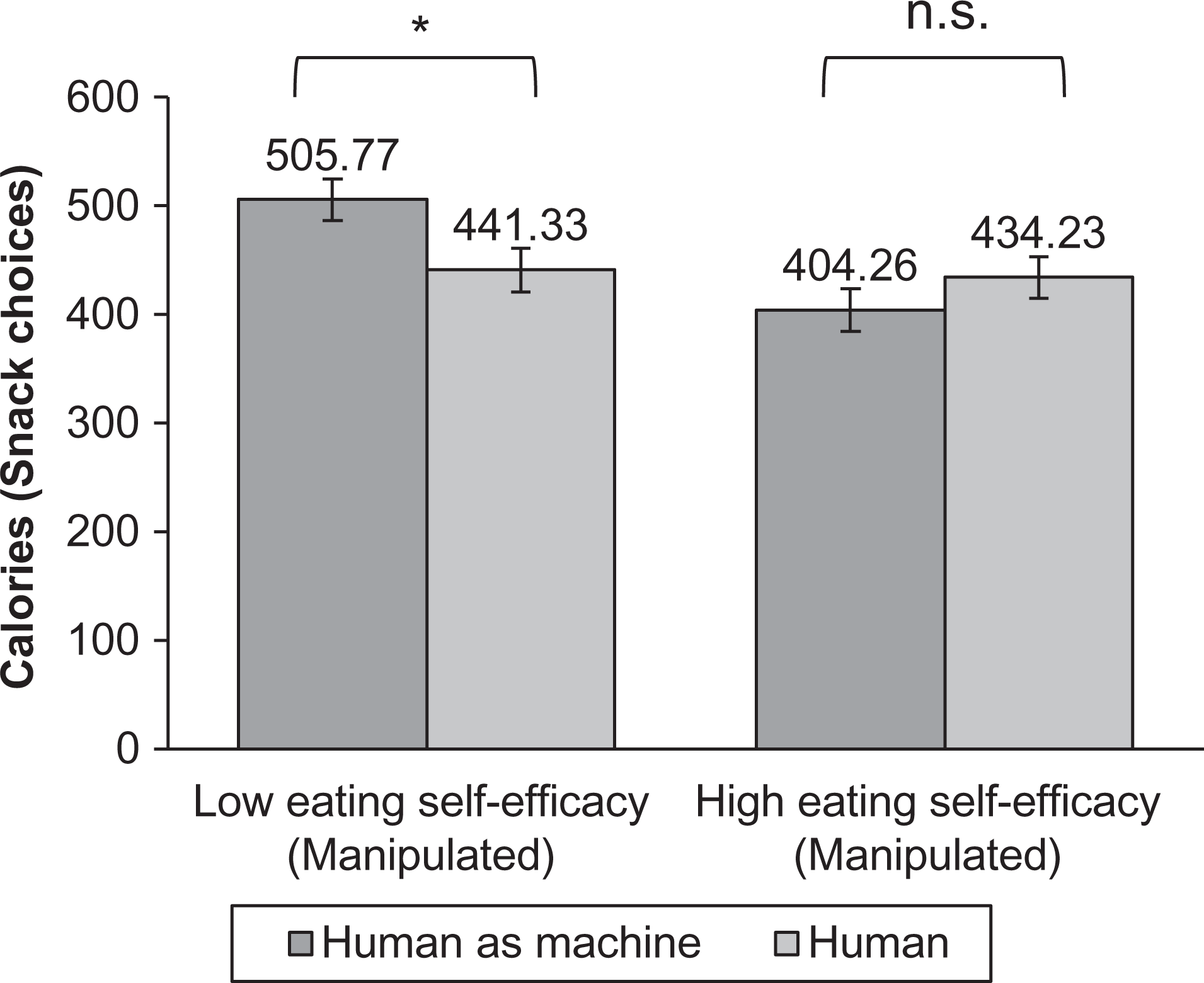
The effect of stimulus on snack choices for consumers low versus high in eating self-efficacy: manipulated (Study 2).
Unlike Study 1 and the two replications, those who were manipulated to have a high level of eating self-efficacy did not make healthier choices upon exposure to the human-as-machine stimuli. Because we did not observe this pattern in any of our other studies, we discuss this discrepancy in the “General Discussion” section. Overall, Study 2 used another type of human-as-machine stimulus—a machine-like human face—and directly manipulated people’s perceived level of eating self-efficacy; we found that while the results differed among those who were led to perceive high eating self-efficacy, the backfire effect was replicated for those who were led to perceive themselves as bad at eating healthily.
We hypothesized that viewing the human-as-machine stimulus leads to divergent effects depending on consumers’ levels of eating self-efficacy because (1) the stimulus brings to mind an expectation to choose food in a cognitive, machine-like manner, and (2) this expectation motivates consumers with high eating self-efficacy (who feel capable of meeting the expectation) to make healthier choices but conversely leads consumers with low eating self-efficacy (who feel incapable of meeting the expectation) to act against it, resulting in unhealthier choices. In Study 3, we used the same human-as-machine stimulus as in Study 1 to capture the activated expectation; in Study 4, we used another type of human-as-machine stimulus to triangulate the proposed role of expectation. Both studies further rule out multiple alternative accounts, including the perception of food as a source of pleasure or energy, hunger, people’s beliefs about what they could digest, emotionality, and perception of humans’ competence.
Study 3: The Role of Expectation
Study 3 served multiple purposes. First, we used a moderated mediation approach to provide support for the role of expectation—namely, that exposure to a human-as-machine stimulus creates an expectation that one should adopt a cognitive, machine-like approach to food in all participants (H2), and that this expectation leads to divergent food choices on the basis of participants’ chronic levels of eating self-efficacy (H3).
Second, we wanted to rule out several food-related alternative accounts, such as the human-as-machine representations changing how hungry participants felt and what they believed their body could digest. We also wanted to ensure that our stimuli did not affect how the participants thought about food (as a source of pleasure or energy). Therefore, we measured these alternative accounts for moderated mediation analyses and used a different set of food choices that varied in health perceptions but not in calorie content to further underscore that it was indeed “unhealthy” food choices, rather than high-energy food choices (which often correlate with high calories), that led to the observed divergent effects.
Third, we aimed to underscore the importance of seeing a human-as-machine representation, and not just a general prime of machine, to activate the expectation for how humans should behave when choosing food. Thus, we added a machine-only condition without relating it to humans to explore this possibility.
Method
Participants
Two hundred ninety-five undergraduate students (47.8% female; Mage = 20.46 years) participated in this lab study for study credits at a large Dutch university. The study used a 3 (stimulus: human as machine vs. machine only vs. human) × 1 (eating self-efficacy [measured as a continuous variable]) between-subjects design.
Procedure
Following the procedures in previous studies, participants in the main study first viewed one of the stimuli of Study 1 (the digestive system: human as machine vs. human), or a machine-only stimulus (with no visual reference to the human body; see Web Appendix 3). We again had participants describe the digestive system in 100 words based on the image they saw, to reinforce the manipulation and ensure attention to the stimulus (Gino, Kouchaki, and Galinsky 2015; Smith et al. 2008). In addition to ensuring attention, this approach also enabled us to register the amount of time spent on writing (Kellogg 1987), to assess whether any condition evoked greater effort than others (which could lead to unhealthier choices because of perceived reward entitlement; Racine et al. 2019). Participants answered a filler question to further minimize the possibility of a demand effect.
Afterward, participants were told that for their participation, they could choose one snack to bring home and viewed four snack options available for that day’s session: an energy bar, a yogurt, a chocolate bar, and a bag of chips (for snack choices, see Web Appendix 5). Based on our posttest (n = 107; 67.3% female; Mage = 27.05 years), the first two snacks were perceived as similarly healthy, whereas the latter two were similarly unhealthy; calorie content was exactly the same across these snacks (for the posttest, see Web Appendix 5). Using a different set of snack options further enhanced the generalizability of our findings.
To cleanly capture the role of expectation, participants then went through another filler task and continued to the next part of the study. We were particularly interested in assessing whether (1) exposure to human-as-machine stimulus that did not specifically mention food or eating would activate an expectation about how food choices should be made, and (2) participants applied the activated expectation to themselves and not just to humans in general. Thus, we asked the participants to report their perceived expectation of adopting a cognitive, machine-like approach to food on three seven-point Likert scales (Haslam 2006; Haslam et al. 2005; 1 = “strongly disagree,” and 7 = “strongly agree”; Cronbach’s alpha = .71): “I feel that I am expected to make my food choices…” “unemotional,” “analytical,” and “cold.” Participants were also asked to judge the function of food (pleasure or energy), their body’s ability to digest a variety of food (Cronbach’s alpha = .85), and their current hunger level (for all scales, see the Appendix). All scales of potential process variables were presented in random order.
The session ended with demographic information and the eating self-efficacy scale used in Studies 1 and 2 (Armitage and Connor 1999; Cronbach’s alpha = .95) and a probe for suspicion and questions. All participants received a snack when exiting the lab.
Results and Discussion
Food choice
None of the participants raised any suspicion or questions about the study. Because all snack options contained the same amount of calories, we coded the choice of healthy snack as 0 and unhealthy snack as 1 to be consistent with previous studies (i.e., higher values represented unhealthier choices) and submitted this binary dependent variable to an analysis with stimulus (human as machine vs. machine only vs. human), eating self-efficacy, and their interactions as predictors and age and gender as control variables (Model 1, Hayes 2013). Similar to previous studies, results revealed a main effect of eating self-efficacy: Those high in eating self-efficacy were more likely to choose a healthy snack (β = −1.48, SE = .31; Z = −4.74, p < .001). We observed two main effects of stimulus (human as machine vs. machine only: β = 8.67, SE = 2.00; Z = 4.34, p < .001; human as machine vs. human: β = 9.40, SE = 1.90, Z = 4.97, p < .001). Gender had a main effect (as in Study 1, female participants chose healthier snacks; β = −.69, SE = .28; Z = −2.46, p = .014), but age did not have an effect. More importantly, the model revealed two hypothesized stimulus × eating self-efficacy interactions on snack choice, one between the human-as-machine and the machine-only conditions (β = −1.64, SE = .36; Z = −4.53, p < .001) and one between the human-as-machine and human conditions (β = −1.76, SE = .35; Z = −5.07, p < .001).
Further spotlight analyses on eating self-efficacy (M = 5.35, SD = 1.45) illustrated that among those with high eating self-efficacy (+1 SD = 6.80), the effect of the human-as-machine stimulus was facilitative such that participants chose healthier snacks in the human-as-machine condition than in the machine-only condition (β = −2.46, SE = .60; Z = −4.10, p < .001) or in the human condition (β = −2.54, SE = .61; Z = −4.17, p < .001).
In contrast, the human-as-machine stimulus again backfired among participants with low levels of eating self-efficacy (−1 SD = 3.90), such that they chose unhealthier snacks after viewing the human-as-machine stimulus than in the machine-only condition (β = 2.27, SE = .66; Z = 3.46, p = .001) or the human condition (β = 2.53, SE = .62; Z = 4.13, p < .001). The machine-only condition did not differ from the human condition for either group of consumers, indicating that mere exposure to a machine (without any visual reference to humans) did not affect food choices.
Expectation and alternative accounts
We conducted the same analyses on expectation. The model revealed only a main effect of stimulus, such that all participants in the human-as-machine condition experienced a higher expectation to choose food in a cognitive, machine-like manner, compared with the machine-only condition (β = 1.92, SE = .74; t = 2.61, p = .009) and the human condition (β = 3.26, SE = .61; t = 5.30, p < .001). The latter two conditions did not differ, suggesting that mere exposure to a machine (without any visual reference to humans) did not affect participants’ expectation to adopt a machine-like approach to food. There was no effect of eating self-efficacy or interaction with stimuli.
We performed the same analyses on the alternative accounts (function of food, digestion capability, and hunger). These analyses revealed no differences between the three stimuli, eating self-efficacy, and no interaction effects (see full results in Web Appendix 6).
From stimulus to expectation to food choice
We proceeded to conduct a bias-corrected moderated mediation analysis (Model 15, Hayes 2013): the stimulus predicted the perceived expectation of adopting a machine-like approach to food, and individuals’ eating self-efficacy moderated the effect of this expectation on food choice, with age and gender serving as control variables. Results without control variables again revealed consistent effects and are reported in Web Appendix 6 for completeness.
The results supported our predictions. The first part of the model showed that viewing the human-as-machine stimulus heightened the expectation to adopt a cognitive, machine-like approach to food compared with the machine-only condition (β = 1.36, SE = .17; t = 7.90, p < .001) and the human condition (β = 2.27, SE = .17; t = 13.21, p < .001).
The second part of the model showed that for food choices, there were two direct effects of stimulus (human as machine vs. machine only: β = 6.37, SE = 2.17; Z = 2.93, p = .003; human as machine vs. human: β = 4.59, SE = 2.34; Z = 1.96, p = .050), and two interactions with eating self-efficacy, respectively (β = −1.20, SE = .39; Z = −3.07, p = .002; β = −.86, SE = .43; Z = −2.00, p = .046). Expectation also significantly affected food choices (β = 1.98, SE = .58; Z = 3.39, p = .001).
Importantly, whether expectation led to healthier or unhealthier choices depended on individuals’ level of eating self-efficacy, as captured by a significant expectation × eating self-efficacy interaction in the full model (β = −.38, SE = .11; Z = −3.54, p < .001). The conditional indirect effects for eating self-efficacy (M = 5.35, SD = 1.45) between the human-as-machine versus machine-only conditions showed that a heightened expectation of adopting a machine-like approach to food led to healthier choices for those high in eating self-efficacy (+1 SD = 6.80; β = −.78, 95% confidence interval [CI] = [−1.50, −.29]) but led to unhealthier choices for those low in eating self-efficacy (−1 SD = 3.90; β = .70, SE = .36; 95% CI = [.13, 1.55]; index of moderated mediation: β = −.51, SE = .19; 95% CI = [−.98, −.29]). The same applied for the human-as-machine versus human conditions: a heightened expectation led to healthier choices for those high in eating self-efficacy (+1 SD = 6.80; β = −1.29, 95% CI = [−2.49, −.47]) but unhealthier choices for those low in eating self-efficacy (−1 SD = 3.90; β = 1.17, SE = .36; 95% CI = [.20, 2.59]; index of moderated mediation: β = −.85, SE = .19; 95% CI = [−1.63, −.38]).
We again conducted the same moderated mediation analyses with the alternative account variables (function of food, digestion capability, and hunger) as the mediator. There were no effects of stimulus on either of these variables, nor were there any significant (moderated) mediation effects (we report the results in Web Appendix 6).
In addition to these analyses, we also compared how long participants spent writing about the stimulus they saw in each condition. A regression analysis with time spent on writing as the outcome variable, stimulus (human as machine vs. machine only vs. human), eating self-efficacy, and their interaction as predictors and age and gender as control variables (Model 1, Hayes 2013) revealed that there was no effect of stimulus, eating self-efficacy, or their interactions.
Employing a moderated mediation approach, we demonstrated that exposure to a human-as-machine stimulus led to a heightened expectation to adopt a cognitive, machine-like approach for all individuals, irrespective of their level of eating self-efficacy. The effect of expectation on food choice, however, was moderated by eating self-efficacy—it motivated those high in eating self-efficacy to make healthier choices but backfired among those low in eating self-efficacy. Priming machine alone did not lead to these effects, suggesting that consumers apply the expectation of making food choices in a cognitive, machine-like way to themselves only if the visual represented a human as a machine. Seeing a machine-only visual did not trigger an expectation for how humans should behave, just as seeing a human-only visual did not trigger expectations for how humans may need to behave differently. The observed effects also cannot be explained by altered food perceptions, hunger, or digestive capability.
Study 4: Triangulating the Role of Expectation Using Human-as-Machine Appearance Plus Movement Stimuli
Study 4 provided additional evidence on the proposed role of expectation (H2) and the divergent consequences it produces on food choices (H3) with yet another human-as-machine stimulus—altering human appearance and physical movement. Specifically, we used a virtual telepresence machine, which is gaining popularity in consumers’ daily lives and in business interactions, to design our stimulus (see Web Appendix 3). As mentioned previously, these types of technological advances will soon be used in the retail sector and in restaurants (O’Reilly 2017), where food choices are often made. The chosen stimulus therefore has high relevance for practice and further expands the scope of our examination beyond the body’s internal composition and face.
Furthermore, we focused on food-related alternative accounts in Study 3 but acknowledge that exposure to human-as-machine stimuli could alter one’s level of emotionality or the perception of how competent humans in general are (vs. machines). We therefore wanted to measure and rule out these possibilities. Finally, to further enhance generalizability, we used another food choice in this study: yogurts that varied in calories, sugar, and fat.
Method
Participants
Three hundred three U.K.-based adults (67.0% female; Mage = 38.26 years) participated in the study through Prolific Academic. This study constituted a 2 (stimulus: human as machine vs. human) × 1 (eating self-efficacy [measured as a continuous variable]) between-subjects design.
Stimulus design and pretest
In this study, we created a different human-as-machine stimulus by altering appearance and physical movement (Aggarwal and McGill 2012; Graham and Poulin-Dubois 1999; Morewedge, Preston, and Wegner 2007). In the human-as-machine condition, the appearance was illustrated as a robotic skeleton and a human face, just as seen in virtual telepresence machines; in the human condition, the appearance was illustrated in a regular human form (see Web Appendix 3; we included different genders to enhance generalizability). To incorporate the dimension of physical movement, we then showed participants a video clip of this person (in either a human-as-machine form or a human form) moving through an apartment for 45 seconds. In the human-as-machine condition, the movement was choppy/mechanistic; in the human condition, the movement was smooth/fluent (adopted from Tremoulet and Feldman [2000]).
The pretest, using the same two scales as in previous studies’ pretests, was successful. The human-as-machine stimulus was perceived as more machine-like than the human stimulus (for stimuli pretest details and results, see Web Appendix 3).
Procedure
Following the procedures in previous studies, participants first viewed one of the stimuli (human as machine or human, randomly assigned to a female or male version of the stimulus irrespective of their own gender) and watched the 45-second clip of this person moving through an apartment. Similar to the procedures in Study 2, participants were not asked to write 100 words about the stimuli, to further ensure that the observed effects could occur without mandatory reflection. Participants answered a filler question and then proceeded to enter their food choices.
Participants read a short introduction about a new yogurt company. They were told that the researchers had agreed to conduct a market study for this company to assess students’ preferences for yogurts. They were then asked to choose one out of nine yogurts that they would like to receive and try. Yogurts differed in their level of healthiness, indicated by caloric, sugar, and fat content, ranging from 80 calories to 256 calories, with an increase of 22 calories between each choice and the next-higher-calorie choice (for the yogurt choices, see Web Appendix 5). To ensure that higher-calorie yogurts were indeed perceived as less healthy, we again conducted a posttest on the health perceptions of these yogurt options. As in prior studies, replacing calorie count with the health score from the posttest as the dependent measure revealed consistent results (for the posttest, see Web Appendix 5).
After selecting their choice of yogurt, participants were asked to report their perceived expectation of adopting a cognitive, machine-like approach to food as in Study 3 (Haslam 2006; Haslam et al. 2005; Cronbach’s alpha = .71). Although the stimuli in Study 3 did not specifically mention food or eating, they utilized digestive system visuals, which could activate thoughts related to food. In this study, the human-as-machine stimulus was not related to the digestive system, food, or eating, further underscoring that even a stimulus that was unrelated to digestion/food could activate an expectation about how food choices should be made. We also asked participants to respond to statements about their emotionality (Cronbach’s alpha = .77) and perception of human competence (Cronbach’s alpha = .59) to rule out these alternative accounts; see Appendix for full scales. All scales were presented in random order. The survey ended with demographic information, the eating self-efficacy scale (Armitage and Connor 1999; Cronbach’s alpha = .93), and a suspicion probe.
Results and Discussion
Food choice
None of the participants raised any suspicion or questions about the study. We submitted yogurt choice (1 = “healthiest option,” and 9 = “unhealthiest option”) as the dependent variable to an analysis with stimulus (human as machine vs. human), eating self-efficacy (continuous measure), and their interaction as predictors and age and gender as covariates (Model 1, Hayes 2013). Similar to prior studies, results revealed a main effect of eating self-efficacy: those high in eating self-efficacy chose lower-calorie yogurts (β = −.42, SE = .10; t = −4.27, p < .001). We again observed a main effect of stimulus (human as machine vs. human: β = 2.68, SE = .55; t = 4.86, p < .001). We also found a main effect of age, with older participants choosing healthier yogurts (β = −.03, t = −2.48, p = .014), and no gender effect. More important, the model again revealed the hypothesized stimulus × eating self-efficacy interaction on yogurt choice (β = −.49, SE = .10; t = −5.00, p < .001).
Further spotlight analyses on eating self-efficacy (M = 5.39, SD = 1.42) illustrated that the effect of the human-as-machine stimulus was again facilitative among those with high eating self-efficacy (+1 SD = 6.81): they chose healthier yogurts (M = 3.30) in the human-as-machine condition than in the human condition (M = 4.63; β = −.67, SE = .20; t = −3.38, p = .001). In contrast, the human-as-machine stimulus again backfired among participants with low levels of eating self-efficacy (−1 SD = 3.97): they chose less healthy yogurts (M = 5.88) in the human-as-machine condition than in the human condition (M = 4.44; β = .72, SE = .14; t = 3.65, p < .001).
Expectation and alternative accounts
We conducted the same analyses on expectation as in Study 3. As we hypothesized, we observed only a main effect of stimulus: participants in the human-as-machine condition experienced a higher expectation to choose food in a machine-like manner, compared with the human condition (β = 1.40, SE = .26; t = 5.32, p < .001). There was no effect of eating self-efficacy or interaction. We again conducted the same analyses on the alternative accounts (emotionality, perceived human competence), which revealed no differences between the two stimuli, eating self-efficacy, or any interaction (we report the results in Web Appendix 6).
From stimulus to expectation to food choice
We proceeded to conduct a bias-corrected moderated mediation analysis (Model 15; Hayes 2013) as in Study 3. Results replicated the findings in Study 3: the first part of the model showed that viewing the human-as-machine stimulus heightened the expectation to adopt a cognitive, machine-like approach to food (β = 1.28, SE = .67; t = 19.17, p < .001), irrespective of age and gender. The second part of the model showed that for food choices, there was an effect of both eating self-efficacy (β = −.76, SE = .40; t = −1.93, p = .055) and expectation (β = 1.66, SE = .54; t = 3.09, p = .002).
Most importantly, whether expectation led to healthier or unhealthier choices again depended on eating self-efficacy, as captured by a significant Expectation × Eating self-efficacy interaction in the full model (β = −.30, SE = .10; t = −3.10, p = .002). The conditional indirect effects for eating self-efficacy (M = 5.39, SD = 1.42) again showed that a heightened expectation of adopting a machine-like approach to food led to significantly healthier choices for those high in eating self-efficacy (+1 SD = 6.81; β = −.50, SE = .21; 95% CI = [−.91, −.06]) but conversely led to unhealthier choices for those low in eating self-efficacy (−1 SD = 3.97; β = .59, SE = .24; 95% CI = [.01, 1.09]; index of moderated mediation: β = −.38, SE = .13; 95% CI = [−.64, −.14]). Conducting the same moderated mediation analyses with the alternative account variables (emotionality and perception of human competence) as the mediator revealed no effects of stimulus or any (moderated) mediation effects.
So far, we have documented across three types of stimuli (internal body composition, face, and appearance and movement), three types of food choices, and a diverse group of participants from different countries that human-as-machine representations led to healthier food choices for consumers high in eating self-efficacy but backfired for consumers low in eating self-efficacy. We also provided evidence that these divergent effects were driven by an activated expectation to choose food in a cognitive, machine-like manner, which resulted in divergent food choices. In a follow-up study (Web Appendix 9), we replicated the moderated mediation results in this study and further measured whether participants anticipated success or failure in meeting the activated expectation. The results verified that whereas participants high in eating self-efficacy anticipated success in meeting the expectation and thus chose healthier options, those low in eating self-efficacy anticipated failure in meeting the expectation, which led to the backfire effect.
The final study tested a theory-driven solution: if the backfire effect occurred because consumers low in eating self-efficacy found the expectation of adopting a cognitive, machine-like approach to food too difficult to meet, then by making consumers feel that they can meet this expectation, the backfire effect should be attenuated. Testing this possibility provides not only additional support for the role of expectation but also a viable solution for marketers, educators, and policy makers; instead of withdrawing human-as-machine stimuli altogether or excluding specific consumer segments from these communications, interested parties can accompany a human-as-machine stimulus with an intervention message that makes everyone feel that they can meet the activated expectation.
Study 5: A Theory-Driven Intervention in the Field
In Study 5, we distributed flyers showing a human-as-machine representation (the digestive system stimulus used in Studies 1 and 3) to customers at a university-based cafeteria before they purchased lunch. Half of the flyers were accompanied by a message that aimed to make the activated expectation more doable, and half were not. This study further enhanced the external validity of our findings and its generalizability (from snack choices to lunch entrée choices), while testing a mechanism-driven solution.
Method
Intervention
We designed the intervention with the goal of making consumers who are low in eating self-efficacy believe that they can meet the expectation of adopting a cognitive, machine-like approach to food, without harming those high in eating self-efficacy. Specifically, in the intervention condition, an additional message stating “You CAN choose your food today with your head (not your heart)” was printed right under the human-as-machine visual (for the flyer, see Web Appendix 3). We informed participants that a head-based approach to food is easy and doable (instead of blatantly stating that a “cognitive” or “machine-like” approach is easy and doable) as this message is short, simple to process, and applicable for practical use. To ensure that adding this message indeed made the expectation activated by the human-as-machine stimulus seem more doable, we conducted a posttest. The posttest verified that when viewing the human-as-machine stimulus with the intervention message, participants indeed perceived it less difficult and more doable to meet the expectation of adopting a head-based, cognitive approach to food; see Web Appendix 3.
Procedure
In the field study, which took place from January 13 to February 7, 2020, at a university-based cafeteria, research assistants approached customers before they entered the cafeteria and inquired about their interest in participating in a study in exchange for $7.00 (for pictures of the study’s setup, see Web Appendix 3). Three hundred thirty-three customers (67.6% female; Mage = 41.07 years) participated. All customers were exposed to the human-as-machine stimulus (as the goal was to test the effectiveness of the intervention message); the study employed a 2 (intervention: yes vs. no) × 1 (eating self-efficacy [measured as a continuous variable]) between-subjects design.
Customers who were willing to participate received a survey about a flyer. Under the cover story that the school was testing different flyers for effectiveness and wanted to ensure that the flyers were relevant to the customers and had good printing quality, all participating customers were asked to review a flyer with a human-as-machine visual printed at the center (the digestive system stimulus used in Studies 1 and 3). The flyer either had an additional intervention message “You CAN choose your food today with your head (not your heart)” printed under the human-as-machine visual or did not have this message. The survey about the flyer included a few design-related questions (e.g., on color and clarity of the flyer), as well as questions on mood, hunger level, age, gender, and occupation/field of study. All customers listed the last three digits of their phone number and their initials (which served to link the surveys). Customers received $2 for this survey and proceeded to buy their lunch at the cafeteria. This cafeteria offered a wide variety of entrée choices, including a salad and soup bar, international bowls, pizza, burgers, sandwiches, and a grill station.
Right after customers purchased lunch and paid, they were invited to participate in the second part of this study to receive another $5, totaling $7. All customers who took the first survey participated in the second part. Research assistants took a picture of the lunch that the customers had just purchased while the customers completed the second survey. The second survey included a few questions about the lunch purchased, the overall impression of the cafeteria, the two eating self-efficacy scales (Armitage and Connor 1999; Moorman and Matulich 1993), and phone number digits and initials to match their responses.
Results and Discussion
We asked two research assistants (blind to the hypotheses) to assess the healthiness of the lunch choices (1 = “very healthy,” and 5 = “not at all healthy”) based on the pictures. We averaged their scores (intercoder reliability was high; r = .72, p < .001) and then conducted a regression analysis with stimulus (human as machine without intervention message vs. with intervention message), eating self-efficacy (Armitage and Connor 1999), and their interaction as predictors and age and gender as control variables (Model 1, Hayes 2013). The model revealed a main effect of stimulus (β = −2.05, SE = .39; t = −5.25, p < .001). There was no direct effect of eating self-efficacy, age, or gender. More importantly, we found a significant stimulus × eating self-efficacy interaction (β = .31, SE = .07; t = 4.66, p < .001).
Further spotlight analyses (M = 5.78, SD = .94) showed that the intervention helped consumers low in eating self-efficacy (−1 SD = 4.84); they made healthier lunch choices when exposed to the human-as-machine stimulus with the intervention (M = 2.24) than without the intervention (M = 3.33; β = −.55, SE = .09, t = −6.12, p < .001). As we expected, there was no effect of the message (Mno int. = 2.73 vs. Mint. = 2.81) among those high in eating self-efficacy (+1 SD = 6.72; β = .04, SE = .09; t = .44, p = .657); they already felt that meeting the activated expectation was easy (see Figure 4).
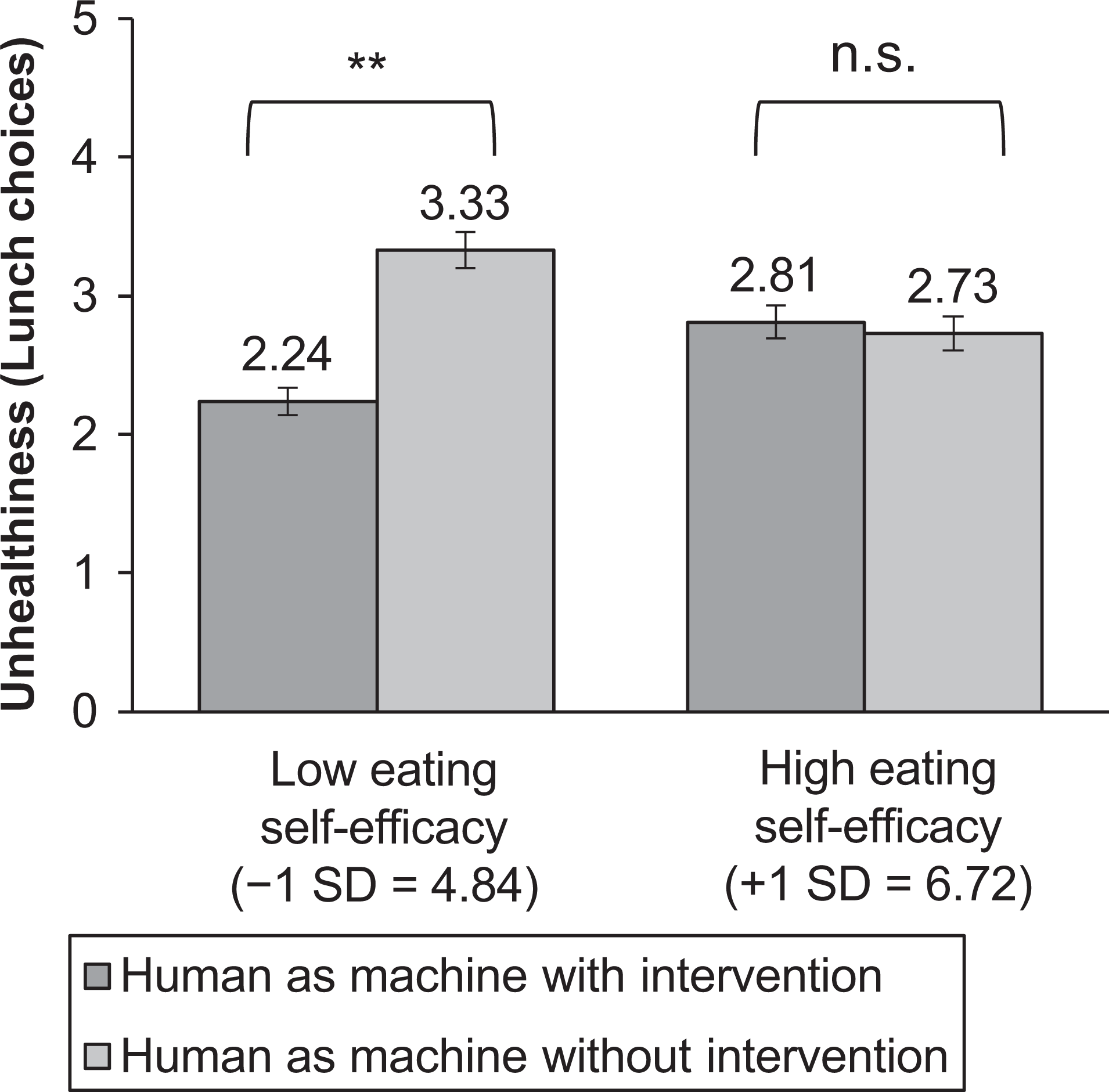
The effect of stimulus and intervention message on lunch choice (Study 5).
We repeated these analyses with the alternative eating self-efficacy scale by Moorman and Matulich (1993), as tested in the two replications of Study 1 and in Study 2. The two eating self-efficacy scales were again correlated (r(333) = .40, p < .001), and results were consistent in both direction and significance (see Web Appendix 6).
Study 5 provided additional evidence for the proposed mechanism—that the divergent effects occurred because the consumers low (vs. high) in eating self-efficacy felt that it was difficult to meet the expectation of adopting a cognitive, machine-like approach to food. Most importantly, it also offers an effective solution for policy makers, educators, and marketers: by adding a message that makes a cognitive approach to food easier and more doable, the human-as-machine stimulus can lead to healthier choices for all consumers.
General Discussion
In an effort to fight obesity and educate consumers on how the human body functions, health marketing and education materials frequently portray humans as machines and encourage consumers to act more “machine-like.” They use slogans like “Fuel your body, not your emotions,” or visuals that literally present humans as machines (see Web Appendix 1).
In this work, we put this belief to a test and used a variety of human-as-machine representations inspired by anthropomorphism research, health education, marketing practice, and recent technological advancements. We uncovered critical divergent effects of exposure to human-as-machine representations—it was facilitative for consumers high in eating self-efficacy but backfired among consumers low in eating self-efficacy (Studies 1–5). We further showed that this divergent effect happened because exposure to human-as-machine stimuli activated the expectation that one should adopt a cognitive, machine-like approach to food (Studies 3 and 4), which would be difficult to meet for consumers low in eating self-efficacy. Importantly, this backfire effect was alleviated when human-as-machine stimuli were accompanied with an intervention message that made consumers feel that they could meet the expectation of adopting a cognitive, head-based approach to food (Study 5).
Theoretical Contributions
Eating self-efficacy
Our work echoes the growing interest in studying the push for a cognitive approach to food in consumer behavior research (Kozup, Creyer, and Burton 2003; Krishnamurthy and Prokopec 2010). We documented how using human-as-machine stimuli to promote this approach can create divergent effects on food choices, depending on consumers’ chronic level of eating self-efficacy. Importantly, we further captured the underlying mechanisms accounting for these divergent responses: exposure to human-as-machine stimuli activates an expectation to adopt a cognitive, machine-like approach to food. Whereas this expectation is motivating to consumers high in eating self-efficacy, it backfires among those low in eating self-efficacy. Results of Studies 3–5 thus underscore the importance of this trait as the antecedent for how consumers would respond to an expectation about food consumption, resulting in expectation-aligned behaviors (Bandura and Cervone, 1983; Ozer and Bandura 1990).
Our work thus provides important insights and inspires future research regarding the rich psychologies of consumers of different levels of eating self-efficacy. While consumers high in eating self-efficacy already make healthier food choices than those low in eating self-efficacy (i.e., a significant main effect in Studies 1–4, directional in Study 5), consumers high in eating self-efficacy could still benefit from human-as-machine stimuli and make healthier choices (in all studies except for Study 2, in which eating self-efficacy was manipulated).
One possibility for the inconsistent results could be related to our eating self-efficacy manipulation. While the specific treatment used to manipulate eating self-efficacy in Study 2—social comparison—can be powerful and pervasive (Vartanian et al. 2015), the feeling that one is currently ahead of others can conversely license one to indulge (Huang, Lin, and Zhang 2019). If this occurs, it may cancel the originally positive effect of human-as-machine stimuli among these consumers. We encourage future research to explore how balancing/ licensing may interact with eating self-efficacy perceptions to affect food choices.
Another possibility could be that the manipulation of high eating self-efficacy did not induce sufficiently high self-perception on eating self-efficacy. In the original scale development (Armitage and Connor 1999), the sample mean of eating self-efficacy was 4.53 (SD = 1.45); more recent research using this measure (Naughton, McCarthy, and McCarthy 2015) found a sample mean of 5.22 (SD = .89). A close examination of the means in all our studies using this scale (from 5.35 to 5.78) revealed an aggregate mean of 5.25 (SD = 1.35), which was consistent with prior literature. However, the manipulation check of the high-eating-self-efficacy condition in Study 2 only produced a mean of 5.01 (see Table 1). We further conducted a meta-analysis aggregating the eating self-efficacy scores across all studies that used this efficacy scale and had a continuous food-choice dependent variable (i.e., Studies 1, 2, 4, and follow-up); the threshold analysis of this aggregate data set revealed that the human-as-machine (vs. human) stimuli backfired for consumers with eating self-efficacy scores between 1.00 and 5.37 and were facilitative for consumers with eating self-efficacy scores between 6.07 to 7.00. Thus, the high-eating-self-efficacy condition in Study 2 may not be sufficiently high to produce a significant positive effect. We encourage future research to explore other ways to shift people’s perception of eating self-efficacy.
Regions of Significance for the Effect of Stimulus on Food Choice for Different Levels of Eating Self-Efficacy.

Notes: N.A. = not applicable.
For consumers low in eating self-efficacy, prior research has shown that these consumers have difficulties with eating rationally, unemotionally, and analytically (Clark et al. 1991; Costanzo et al. 2001; Glynn and Ruderman 1986; Knäuper 2013; Stotland, Zuroff, and Roy 1991; Toray and Cooley 1997; Wilson-Barlow, Hollins, and Clopton 2014). Our work suggests that these past experiences could lead consumers low in eating self-efficacy to act against human-as-machine stimuli and counter the expectation of adopting a cognitive, machine-like approach to food. Importantly, by adding an intervention message that made the expectation seem easier to meet (Study 5), we were able to attenuate the previously observed backfire effect. This field study not only provides a relevant solution for practitioners but also complements work on the importance of setting achievable expectations in inducing health-related behavioral change (Bandura 1991; Klesse et al. 2012).
We chose to focus on eating self-efficacy because it is one of the most frequently used constructs in health behavior theories (Glanz and Bishop 2010). Still, future research should explore the robustness of these effects using other related constructs, such as health behavioral control (Bui, Droms, and Craciun 2014), eating self-control (Dzhogleva and Lamberton 2014; Haws, Davis, and Dholakia 2016), emotional eating (Van Strien et al. 1986), and overall self-regulation (Vohs and Heatherton 2000). Finally, we note that consumers’ past and current fitness levels, health conditions, and whether they are on a diet affect how they perceive their eating self-efficacy. Although we did not measure these habits and physical conditions in our studies, we encourage future research to take these variables into consideration when studying eating self-efficacy and healthy eating.
Anthropomorphism and dehumanization
This research introduces the concept of mechanistic dehumanization—visually representing humans as machines—to the consumer behavior literature as a reverse process of anthropomorphism (Aggarwal and McGill 2007; Epley, Waytz, and Cacioppo 2007). Our findings echo those in anthropomorphism research that demonstrate that changes along the human–machine continuum prompt specific behavioral expectations (Aggarwal and McGill 2012; Kim and Kramer 2015; Kim and McGill 2011). We found that when humans are portrayed as machines, it activates an expectation that one should behave in a machine-like way.
For dehumanization research, our work expands prior studies on dehumanization to underscore its relevance for consumer behavior research in three ways. First, while prior work in dehumanization has focused primarily on how changes in facial features and movements influence how humans are perceived on the human–machine continuum (Deska, Almaraz, and Hugenberg 2017; Deska, Lloyd, and Hugenberg 2018; Hugenberg et al. 2016; Looser and Wheatley 2010), our work tested other dimensions such as altering internal body composition and appearance. Our findings offer a rich set of stimuli for future work on dehumanization and marketing while bringing dehumanization literature closer to consumers’ everyday lives. Second, we explored an important downstream consequence that is highly relevant for consumers and marketers and underscored how human-as-machine stimuli could activate unique expectations in the context of food, leading to both positive and negative effects on consumers’ real-world choices. Third, we shed light on the importance of idiosyncratic differences. While previous research promotes the idea that feeling like a human is desirable and valuable for all individuals (Goldenberg et al. 2001; Haslam et al. 2005), we found that dehumanization stimuli can generate divergent effects.
Importantly, the direction of changes along the human–machine continuum warrants further investigation. When encountering a stimulus, individuals first make a binary choice to classify a stimulus as either a “human” or “nonhuman” (Mathur and Reichling 2016). Drawing on this first-level assessment, they generate expectations (e.g., dehumanized humans should be more rational, anthropomorphized machines more emotional). In all our studies, we informed participants that they were evaluating a human (body, face, physical movements). As a result, our stimuli depict humans portrayed as machines. However, the line between humans and machines becomes blurrier, and many physical features convey conflicting signals (Ferrey, Burleigh, and Fenske 2015; Gray, Gray, and Wegner 2007). Future research should investigate the boundary at which a human or a machine is categorized as such and explore other dehumanization types. Examples include marketing messages with mechanical voices and artificial intelligence software that blurs the line between humans and machines (Luo et al. 2020; Puntoni et al. 2020).
Furthermore, researchers should examine the impact of human-as-machine representations on other types of food decisions as well as decisions in other domains. We focused on food choices (snack choices in Studies 1–4 and lunch purchases in Study 5) because of the relevance of human-as-machine representations in this context and the importance of uncovering unintended risks in this domain, but we believe that the documented effects and mechanisms could occur in other domains (e.g., financial, medical, and social decisions).
Finally, demographic and cultural differences should be further considered. Age and gender affect how people feel about machines (Bartneck et al. 2007; Nomura, Kanda, and Suzuki 2006) and how they make food choices (Ares and Gámbaro 2007). In our studies, we did not find consistent effects of these variables. While this could result from the natural variance in our samples (i.e., students vs. Prolific Academic population), we believe that future research is warranted. The same speculation applies to different cultures, which vary in the expectations they hold about machines (e.g., Asian vs. Western cultures; Kaplan 2004; Kitano 2006). Culture also affects specific food-related expectations. While we showed that exposure to human-as-machine representations did not change whether food was construed as a source of energy or pleasure among participants from Western culture (Study 3), it is possible that the observed effects would differ in cultures that associate food with pleasure (Rozin et al. 1999) or in contexts in which a cognitive, machine-like approach to food is not expected (e.g., buying a gift for someone, bringing food/snacks to a social gathering).
Practical Implications
Important nonacademic stakeholder groups will find value in this research. Many stakeholders encourage consumers to make food choices in a cognitive (and less emotional) manner to battle the rise of obesity. We used stimuli available in the real world (digestive system illustrations used in health marketing, face morphing available in mobile apps, and teleconferencing agents used in business meetings and retail) and showed that while consumers indeed felt expected to adopt a more cognitive, machine-like approach to food, this expectation can backfire. Our results thus ring a cautionary bell for nonprofit organizations, policy makers, educators, and for-profit health marketers: a strategy used with good intentions of educating consumers and improving their health can have an unintended dark side that hurts a vulnerable segment of consumers. Our work thus echoes the insights from prior research, such that (1) confronting consumers with expectations on how they should behave can be risky if it is not aligned with their abilities, and (2) influencers should carefully tailor their content for target audiences (e.g., Pechmann and Catlin 2016).
There is hope, though, because the backfire effect documented in this research can be attenuated by altering the perception of one’s relative level of eating self-efficacy (Study 2) and by reassuring consumers that meeting the expectation to make cognitive, head-based food choices is doable (Study 5). Our research thus provides practical solutions to help circumvent the backfire effect for various stakeholders who plan to use human-as-machine stimuli to encourage healthy eating. Finally, understanding the potential processes that cause indulgent food choices is also crucial for consumers, especially as human-as-machine stimuli become more prevalent in the lives of consumers around the world.
Appendix: Scales
Eating Self-Efficacy (Armitage and Connor 1999)
The following statements are related to your lifestyle and your behavior concerning your health. Please state to what extent you agree with the following statements. I believe I have the ability to eat a healthy diet in the next month (1 = “definitely do not,” and 7 = “definitely do”). To what extent do you see yourself as being capable of eating a healthy diet in the next month? (1 = “very unlikely,” and 7 = “very likely”). How confident are you that you will be able to eat a healthy diet in the next month? (1 = “very unsure,” and 7 = “very sure”). If it were entirely up to me, I am confident that I would be able to eat a healthy diet in the next month. (1 = “strongly disagree,” and 7 = “strongly agree”).
For the purpose of this research, we replaced Armitage and Connor’s (1999) wording of “low fat diet” with “healthy diet.”
Eating Self-Efficacy (Adopted from Moorman and Matulich 1993)
Items rated on 1 = “strongly disagree,” and 7 = “strongly agree.” It’s easy to cut back on snacks and treats. It’s easy to eat fresh fruits and vegetables regularly. I find it hard to moderate my red meat consumption. (reverse-coded) It’s easy to minimize the additives I consume. It’s easy for me to reduce my sodium intake.
These five items from the original scale assessed participants’ eating self-efficacy (other items pertained to general health behaviors and thus were not included to create the composite measure).
Scales: Food-Related Alternative Accounts (Study 3)
Function of Food (Cramer and Antonides 2011)
The main function of food is [to]…(1 = “provide pleasure/fun,” and 7 = “satisfy hunger”).
It is important that food…(1 = strongly agree, and 7 = “strongly disagree”) Has a good taste. Has a pleasant appearance. Provides energy. Improves one’s performance.
Digestion Capability (1 = “strongly disagree,” and 7 = “strongly agree”)
I feel that my body can easily digest the food I consume.
I feel that my body is prepared to digest a variety of food items easily.
I feel that my body has no problem digesting what I choose to eat.
Hunger
How hungry do you feel at the moment? (1 = “not at all,” and 7 = “very much”)
Scales: Other Alternative Accounts (Study 4)
Emotionality (1 = “not at all,” and 7 = “very much”)
How emotional did you feel when you looked at this image?
How emotional did you feel when you made your food choice?
How much was your food choice based on emotions/feelings?
Human Competence (1 = “not at all,” and 7 = “very much”)
How competent are humans in general?
How competent are humans in making good food choices?
Supplemental Material
Supplemental Material, sj-pdf-1-jmx-10.1177_0022242920974986 - Portraying Humans as Machines to Promote Health: Unintended Risks, Mechanisms, and Solutions
Supplemental Material, sj-pdf-1-jmx-10.1177_0022242920974986 for Portraying Humans as Machines to Promote Health: Unintended Risks, Mechanisms, and Solutions by Andrea Weihrauch and Szu-Chi Huang in Journal of Marketing
Footnotes
Acknowledgments
We would like to thank Stanford Residential & Dining Enterprises, in particular William Montagne, Kimberly Risso, Ghislaine Challamel, and Jackie Bertoldo for their help with the setting up and data collection, and Eric Montell, Michael Gratz, and Dr Shirley Everett for their support on this project.
Associate Editor
Kelly Haws
Declaration of Conflicting Interests
The author(s) declared no potential conflicts of interest with respect to the research, authorship, and/or publication of this article.
Funding
The author(s) received no financial support for the research, authorship, and/or publication of this article.

References
Supplementary Material
Please find the following supplemental material available below.
For Open Access articles published under a Creative Commons License, all supplemental material carries the same license as the article it is associated with.
For non-Open Access articles published, all supplemental material carries a non-exclusive license, and permission requests for re-use of supplemental material or any part of supplemental material shall be sent directly to the copyright owner as specified in the copyright notice associated with the article.
