




Abstract
Customer experience management research is increasingly concerned with the long-term evolution of customer experience journeys across multiple service cycles. A dominant smooth journey model makes customers’ lives easier, with a cyclical pattern of predictable experiences that builds customer loyalty over time, also known as a loyalty loop. An alternate sticky journey model makes customers’ lives exciting, with a cyclical pattern of unpredictable experiences that increases customer involvement over time, conceptualized here as an involvement spiral. Whereas the smooth journey model is ideal for instrumental services that facilitate jobs to be done, the sticky journey model is ideal for recreational services that facilitate never-ending adventures. To match the flow of each journey type, firms are advised to encourage purchases during the initial service cycles of smooth journeys, or subsequent service cycles of sticky journeys. In multiservice systems, firms can sustain customer journeys by interlinking loyalty loops and involvement spirals. The article concludes with new journey-centered questions for customer experience management research, as well as branding research, consumer culture theory, consumer psychology, and transformative service research.
Keywords
Customer experience management (CXM) research is increasingly concerned with the long-term evolution of customer experience journeys across multiple service cycles (Bolton et al. 2014; Homburg, Jozić, and Kuehnl 2017; Lemon and Verhoef 2016). Much of this research suggests that firms should make customer journeys as “consistent and predictable” as possible (Frow and Payne 2007; Hyken 2009, p. 55; Kuehnl, Jozić, and Homburg 2019). Firms are advised to invest in “streamlining” techniques (Edelman and Singer 2015, p. 90), such as simplification, personalization, and contextualization. These streamlining techniques are intended to enroll customers into an “ongoing cycle” of retrigger, repurchase, and reconsumption experiences (Court et al. 2009, p. 101), known as a “loyalty loop” (p. 102). In time, this loop can feel seamless, like “sliding down a greased chute” (Fleming 2016, p. 227). Given the emphasis on consistency, effortlessness, and predictability, we call this approach to customer journey design the “smooth” journey model. This approach is mostly derived from research on instrumental services, such as banking (e.g., Citibank), pharmacies (e.g., MedPlus), and transportation (e.g., Amtrak).
However, many firms today offer a dramatically different kind of customer journey, one that intentionally features inconsistency, effortfulness, and unpredictability to keep customers excited (Alter 2017; Eyal 2014; Lopatto 2018). For example, CrossFit, a group fitness service, offers customers “constantly varied” workouts (Glassman 2002) in which “the excitement never seems to wear off” (Peacock 2013, p. 4). Pokémon Go, an augmented reality game, keeps players wandering through real-world locations to catch randomly spawning virtual creatures (Barrett 2018). Tinder, a geosocial dating app, facilitates a dating journey “filled with adventure, unknowns, and endless possibilities” called the #swipelife (Tinder 2018, p. 3). The press refers to such customer journeys as “sticky” to emphasize that customers cannot seem to pull away, and even when they do pull away, they are eager to return for more (Lynley 2016, p. 7; Miller 2011; Reich 2014). Simply put, sticky journeys are exciting journeys that customers yearn to continue. Despite the rising popularity of sticky journeys, CXM researchers have yet to question the assumptions of the smooth journey model or to develop an alternate conceptual model. Redressing these oversights is important because CXM research is too quickly converging on the smooth journey model, without recognizing legitimate alternatives.
In this article, we make three contributions to CXM research on customer journey design. Our first contribution is to challenge the dominance of the smooth journey model. This model advises firms to enroll customers into a loyalty loop of predictable experiences, such as Citibank transactions, MedPlus refills, and Amtrak trips, regardless of the service category. Such predictable experiences offer customers convenience, ease, and satisfaction, but also risk losing customer attention in competitive markets.
Our second contribution is to empirically develop an alternate sticky journey model, premised on the excitement of unpredictable experiences. Beyond CrossFit workouts, Pokémon Go walkabouts, and Tinder dating adventures, other examples of such experiences include those of Blue Apron meal kits, dramatic HBO serials, Instagram image feeds, Spotify music streams, and trendy Zara fashions. At the heart of the emergent sticky journey model is the notion of an “involvement spiral”—a roller coaster ride of thrilling and challenging experiences that motivates increasing experiential involvement over time.
Our third contribution is to address practical CXM concerns at the nexus of the two journey models, including which model to select, when to encourage purchases, and how to sustain journeys. We advise firms to employ the smooth journey model in instrumental service categories, wherein customers have jobs to be done, and the sticky journey model in recreational service categories, wherein customers seek never-ending adventures. We also advise firms to encourage purchases at different times within each journey type: during the initial service cycles of smooth journeys, when customers are motivated to make complex decisions, and during the subsequent service cycles of sticky journeys, when customers are already caught up in involvement spirals. Finally, we trace six possible ways of interlinking loyalty loops and involvement spirals to sustain customer journeys in multiservice systems. For example, firms could spark involvement spirals from existing loyalty loops. Overall, this article challenges the dominance of the smooth journey model, offers an alternate sticky journey model, and encourages new ways of thinking about customer experience journeys.
The Customer Experience Journey
The concept of customer experience is generally defined as a customer’s multidimensional—cognitive, emotional, sensorial, behavioral, and relational—responses to a firm’s service (Schmitt 1999). Building on the notion of customer experience, the concept of customer experience journey (or customer journey) is typically defined as the ongoing customer experience across the phases of a service cycle (Følstad and Kvale 2018). These phases are variously demarcated in the CXM literature as “pre-purchase, purchase, and post-purchase situations” (Homburg, Jozić, and Kuehnl 2017, p. 384); “pre-core, core, and post-core service encounters” (Voorhees et al. 2017, p. 270); and “search, purchase, experience, and reflect [phases]” (Dellaert 2019, p. 243). However, exclusively focusing on phases within a service cycle is too myopic for CXM practitioners if they hope to have customers returning for several service cycles (Bolton et al. 2014; Nakata et al. 2019; Zomerdijk and Voss 2010).
To overcome this myopia, recent CXM literature has expanded the scope of the customer journey concept—from the relatively short-term customer experience of a single service cycle to the relatively long-term customer experience across multiple service cycles (Kranzbühler et al. 2018). This literature emphasizes that the customer experience during the first service cycle is different from the customer experience during repeat service cycles (Court et al. 2009), necessitating distinct conceptualizations of journey patterns during initial and subsequent service cycles. Moreover, the customer experience during each subsequent service cycle tends to build on the experiences of prior service cycles (De Keyser et al. 2015). In other words, the customer journey across multiple service cycles is not repetitive but iterative (Lemon and Verhoef 2016). Finally, when journeys near the end, the journey pattern across the final few service cycles may also be different from those in prior service cycles (Court et al. 2017), necessitating distinct conceptualizations of termination trajectories.
In summary, recent CXM literature advises customer journey researchers to look beyond the short-term customer experience of a single service cycle to the long-term journey patterns across initial, subsequent, and terminating service cycles. In this way, recent CXM literature is renewing the originally intended scope of the customer journey concept (Følstad and Kvale 2018). Thus far, this literature has developed around an interconnected set of conceptual axioms that we frame as the smooth journey model.
The Smooth Journey Model
The Initial Service Cycle in the Smooth Journey Model
The initial service cycle of customer experience journeys is widely understood as a highly deliberate, multiphase, customer decision-making process, motivated by internal and external triggers (Court et al. 2009; Hamilton et al. 2020; Spenner and Freeman 2012). Firms compete for customer attention during every phase of this process: (1) the initial consideration of multiple brands, (2) the active evaluation of those brands, (3) the moment of purchase, and (4) the consumption experience. To win market share during these four key phases, firms are advised to provide customers with “decision support,” including (1) brand advertising and content marketing during the initial consideration phase, (2) interactive website tools for the active evaluation phase, (3) in-store advertising and special offers at the moment of purchase, and (4) informative packaging and service updates to enhance the consumption experience. Winning customers over during these four phases increases the likelihood that customers will return to the firm for future purchases when retriggered.
Subsequent Service Cycles in the Smooth Journey Model
Following the initial service cycle, firms are advised to streamline the customer journey (Edelman and Singer 2015) by (1) eliminating unnecessary steps (or simplification), (2) anticipating customer preferences (or personalization), and (3) providing just-in-time support (or contextualization). Such streamlining techniques facilitate predictable as well as convenient, easy, and satisfying customer experiences (Fleming 2016; Hyken 2018; Kuehnl, Jozić, and Homburg 2019). Even more importantly, these techniques enroll customers into a routinized or automated cycle of retrigger, repurchase, and reconsumption experiences known as a loyalty loop. The loyalty loop is named as such to emphasize that customer loyalty builds every time the service meets customer expectations (Court et al. 2009). In the best-case scenario, the brand becomes a trusted provider, and the customer in turn becomes a brand advocate (Leboff 2014).
Termination Trajectories in the Smooth Journey Model
Loyalty loops are generally visualized as infinite cycles (Court et al. 2009). However, loyalty loops can come to an end following loyalty-weakening incidents, such as when the brand delivers poor service or when a competing brand offers a better service (Fleming 2016). Following such incidents, customers tend to follow one of two patterns. Whereas “switchers” reenter the deliberate decision-making process and choose an alternate brand, “vulnerable repurchasers” tentatively consider competing brands but end up repurchasing the incumbent brand for the time being (Court et al. 2017, p. 66).
Toward an Alternate Sticky Journey Model
Underlying the smooth journey model is a taken-for-granted assumption that firms should try to make customers’ lives easier by creating consistent and predictable experiences (Court et al. 2009; Edelman and Singer 2015; Hyken 2018). This assumption has a long history in marketing thought. For example, service research has long argued that predictability across service encounters is “integral to consumer satisfaction” because it “increases cognitive control, minimizes risk, and reduces cognitive effort” (Surprenant and Solomon 1987, pp. 88–89). More recently, CXM research argues that touchpoint cohesion, consistency, and context sensitivity “reduce the amount of time and effort customers must invest in living through a customer journey” (Kuehnl, Jozić, and Homburg 2019, p. 556). Given this history, one can better appreciate why the smooth journey model assumes that customers always value predictable experiences.
However, customers sometimes value unpredictable experiences. For example, entertainment research shows that dramatic serials with unpredictable plotlines (e.g., Game of Thrones) motivate binge-watching, whereas dramatic procedurals with predictable structures (e.g., Law & Order) are less captivating (Mittell 2006). Likewise, gambling research shows that unpredictable reward schedules are much more exciting than predictable ones (Schüll 2014). The “intermittent wins” of unpredictable reward schedules can produce “states of arousal” like a “drug-induced high” (Blaszczynski and Nower 2002, p. 491), motivating gamblers to keep on gambling and some gamblers to become addicted (Schüll 2014). Similarly, gaming research shows that unpredictable gameplay outcomes can be simultaneously “enjoyable,” “frustrating,” and thought-provoking (Iacovides et al. 2015, p. 221), within and beyond playtime, “keep[ing] players returning to the game” (Calleja 2011, p. 40). Today’s video games (e.g., World of Warcraft) are even stickier than prior generations because of their greater unpredictability (Alter 2017). The combination of expansive virtual worlds, massively multiplayer capacities, and evolving game objectives escalates the unpredictability as well as the excitement. Finally, consumer research on desire (Belk, Ger, and Askegaard 2003), extraordinary experiences (Arnould and Price 1993), and repetitive decisions (Shen, Hsee, and Talloen 2019) also show that customers are much more likely to persist on a journey when they are not entirely sure what comes next. One reason is that the suspense is itself exhilarating (Eyal 2014). Another reason is that the need for resolution is strong (Shen, Hsee, and Talloen 2019).
In summary, multiple fields of research indicate that predictable experiences satisfy customer expectations but also risk losing their attention. Meanwhile, unpredictable experiences keep customers excited and yearning for more but also risk fostering addictions. To put these insights in CXM terms: high (low) customer experience predictability facilitates smooth (sticky) customer experience journeys.
Methods
Research Contexts
The aim of this study is to develop a conceptual model of sticky journeys, including service design principles on the firm side and customer journey patterns on the customer side. To achieve our aim, we examine three brand contexts: CrossFit, Pokémon Go, and Tinder. Each of these brands features customer experience unpredictability as a core service attribute. Furthermore, each of these brands is well-known for being especially sticky in its respective service category (Lynley 2016; Miller 2011; Reich 2014). Together, the brands offer a mix of journey formats that help develop a generalizable model of sticky journeys. CrossFit journeys are largely offline, Tinder journeys are largely online, and Pokémon Go journeys are both.
CrossFit is a group fitness regimen founded by Greg Glassman in 2000. The signature “constantly varied” workouts include gymnastics, weightlifting, and bodyweight exercises in well-equipped indoor-outdoor servicescapes called “boxes.” Athletes are encouraged to strive toward increasingly higher levels of fitness, measured in terms such as reps, weight, and time (CrossFit 2019). CrossFit is a multi-billion-dollar brand (Ozanian 2015), growing from 13 affiliates in 2005 to more than 15,000 affiliates worldwide in 2019 (CrossFit 2019).
Pokémon Go is an augmented reality mobile video game released by Niantic in 2016. Drawing on Google Maps data and the global positioning system, the app reveals a dynamic virtual reality world in players’ own local surroundings. Players hunt for virtual fictional creatures (Pokémon) that appear unpredictably and marshal those creatures in subsequent gameplay activities such as battles and raids (Niantic 2019). Pokémon Go was the fastest mobile app to reach $1 billion in revenue (Nelson 2017), and “more cumulative time is spent playing Pokémon Go than any other [mobile] game” (Barrett 2018, p. 3).
Tinder is an online dating app launched by Hatch Labs in 2012. Based on user locations and preferences, Tinder presents users with a seemingly infinite supply of other users’ profiles. Tinder users can swipe right on profiles to express interest, swipe left to express disinterest, swipe up to express high interest, and chat with “matches” (i.e., users who have expressed mutual interest; Tinder 2019). Tinder is among the highest-grossing nongaming apps worldwide (Sydow 2019) and “the most-used dating app in the UK and the US” (Hern 2019, p. 1).
Data Collection
The first author collected the data using an ethnographic combination of experiencing via participant observation, enquiring via in-depth interviews, and examining via archival research (Wolcott 2008). The majority of this data collection occurred in the United Kingdom between 2016 and 2019. Some data were also collected in North America and continental Europe.
Experiencing
To experience the stickiness of the services directly, the first author exercised at three different CrossFit boxes, played Pokémon Go to a moderate level of proficiency, and swiped through dozens of Tinder profiles. On his Tinder profile, the first author displayed his real name, university affiliation, and research intent. Communications were focused on the research project. Tinder users who expressed other interests were unmatched to avoid confusion (Kozinets 2015). Field notes about these immersive activities amounted to 185 single-spaced pages. All descriptions of the three services in this article are based on these observations, except where otherwise noted.
Enquiring
Using social networking and snowball sampling, the first author recruited 40 informants who have customer experience with one or more of the three services. Five informants also have provider-side experience at CrossFit as owners or coaches, and four informants also have gaming or technology expertise. These nine informants are more likely than other informants to use industry jargon in their stories, but their journeys in a customer role are similar to those of other informants. Of a total of 43 distinct customer journeys culled from the interviews, 13 journeys pertain to CrossFit, 19 to Pokémon Go, and 11 to Tinder. At the time of the interview, some informants had just begun using the services a few weeks prior, while others had been customers for several years. Eleven of the 43 journeys included discernible termination trajectories. The informants are mostly white and middle class but vary in terms of age (16–59 years) and gender (18 female, 22 male). Interviews were conducted in person or by telephone, ranging from 30 to 172 minutes (83 minutes on average). Interviews were loosely structured around five areas of inquiry: (1) the informant’s everyday experiences with the focal service (e.g., how the service enters and exits their day); (2) their long-term journey with the service (e.g., how they got started, what keeps them interested, when they lose interest); (3) their experiences with competing services, if any; (4) their recollections of significant moments or time periods; and (5) the life contexts surrounding these service experiences. The audio-recorded interviews yielded 1,464 single-spaced pages of transcribed text. Informants that are quoted in this article are renamed for confidentiality and their quotes are edited for clarity. Quotes from foreign language speakers are translated into English.
Examining
Using keyword searches and a custom Google feed, the first author collected publicly available materials about the three services, including websites, press releases, industry reports, and news articles, from mainstream media (e.g., The Guardian) as well as niche media (e.g., Wired). These data include announcements of service updates and upcoming events, newsworthy customer experiences, and industry leader perspectives. In total, the archival data set amounts to over 200 documents, about 20 of which are cited in this article.
Data Interpretation
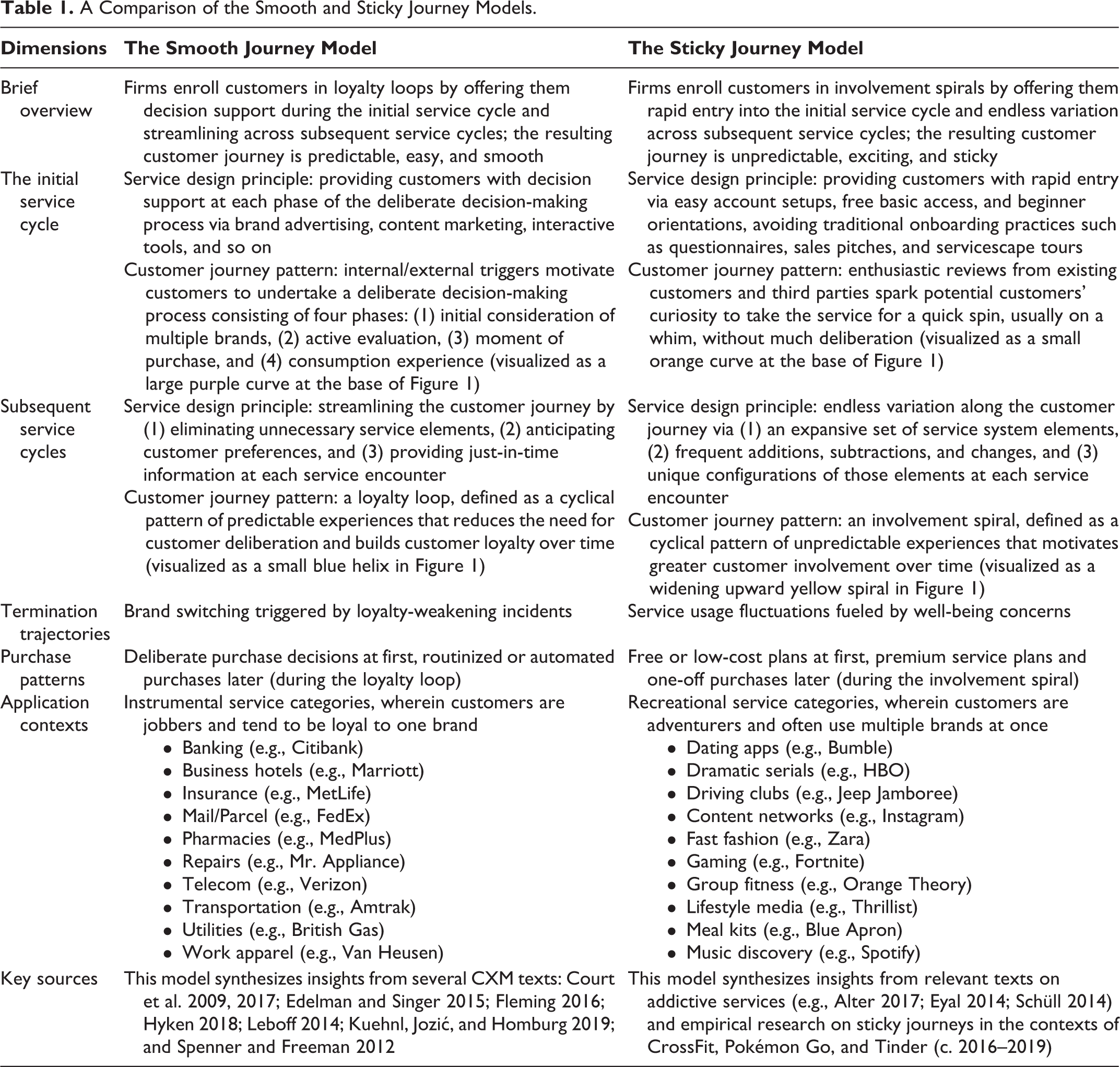
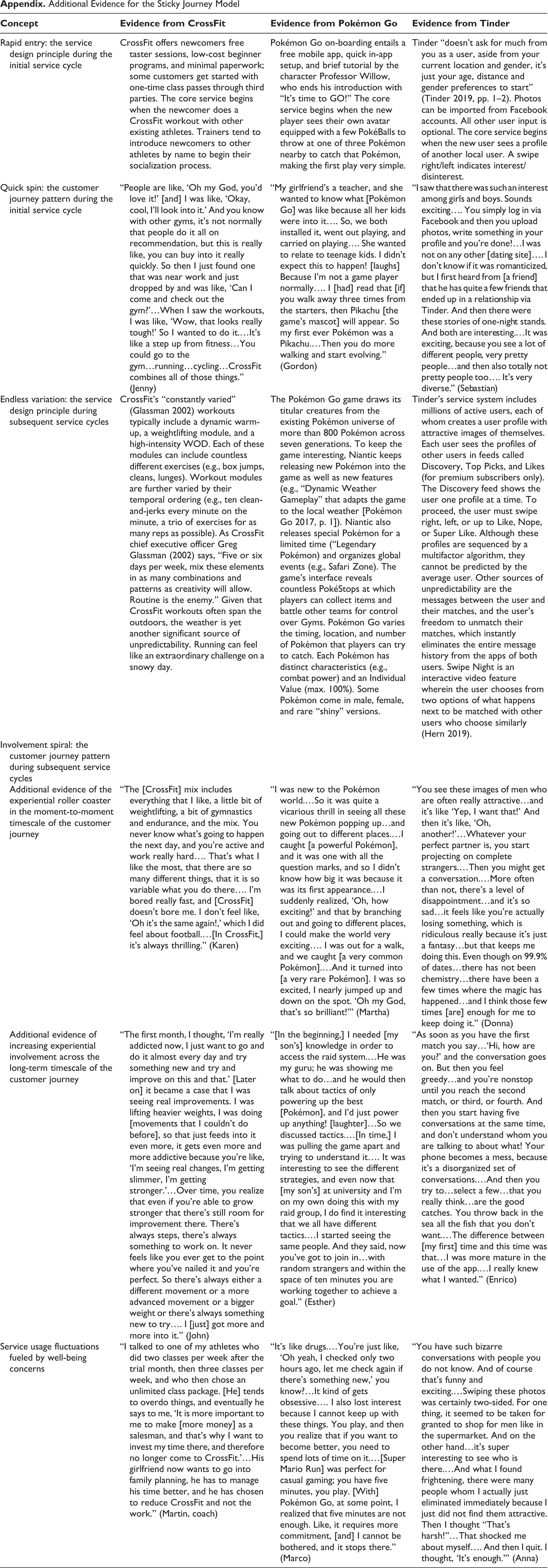
Our interpretive process consisted of three iterative activities: making constant comparisons across our informants’ lived experiences to discern common patterns; creating memos of our preliminary insights to debate within the research team; and tacking back and forth between the existing literature and our emerging understanding to crystallize our theoretical insights (Arnold and Fischer 1994). We drew on different types of data to discern firm-side and customer-side insights. Specifically, we drew on firm-side fieldnotes and archival materials to discern the service design principles, and customer-side fieldnotes and interview transcripts to discern the corresponding customer journey patterns. To trace the evolution of sticky journeys, we compared journey patterns in the initial, subsequent, and terminating service cycles of customer journeys across the three research contexts (see the Appendix). As is often the case in interpretive research, no single informant provides a complete view of the phenomenon. Rather, that complete view emerges from a critical mass of empirical snapshots. We terminated our interpretive process at theoretical saturation, when new rounds of data interpretation did not meaningfully alter the emergent model. For an overview of the extant and emergent journey models, see Table 1 and Figure 1.
A Comparison of the Smooth and Sticky Journey Models.

A visualization of the smooth and sticky journey models.
The Sticky Journey Model
The Initial Service Cycle in the Sticky Journey Model
Rapid entry: the service design principle in the initial service cycle
Firms nurture smooth and sticky journeys differently. At the beginning of smooth journeys, firms support the customer’s deliberate decision-making process with considerable decision support. By contrast, at the beginning of sticky journeys, firms attempt to eliminate customer decision making altogether by giving customers immediate access to the service. As our informants reveal subsequently, their CrossFit, Pokémon Go, and Tinder journeys tend to begin on a whim, motivated by the promise of fun. Accordingly, the most appropriate firm action at this juncture is to give potential customers a taste of the excitement to come, as soon as their curiosity is sparked.
Many CrossFit boxes, for example, offer newcomers a free beginner class, followed by an affordable beginner plan (e.g., a low-cost one-month membership). Unlike traditional gyms, CrossFit gyms do not greet newcomers with gym tours, salesperson interactions, or a complex menu of service plans, which necessitate deliberate decision making. Pokémon Go’s virtual moderator, Professor Willow, orients new players via a rapid sequence of fun and easy steps. Players learn the game’s mission via short-text snaps, customize their avatar with a few clicks, and catch a trial Pokémon with a couple of swipes. Unlike dating services that begin with extensive questionnaires (e.g., eHarmony), Tinder only asks new users for their gender, distance, and age preferences (Tinder 2019). Users can import photos into their Tinder profiles from Facebook and begin swiping through potential matches immediately. As commentators have noted, “Tinder’s most revolutionary aspects were to nix the web[sites] and questionnaires” (Reich 2014, p. 2).
We conceptualize these speedy onboarding techniques as the service design principle of “rapid entry.” This conceptualization highlights the expediency with which firms facilitate the beginnings of sticky journeys. As soon as potential customers visit a service entry point, firms rapidly offer exciting service experiences. Conspicuously absent are the tedious entry practices of most service industries (e.g., complex menus of purchase options, extensive questionnaires, servicescape tours). If customers cannot experience the excitement of a service quickly, easily, and for free, they may turn their attention to something else that is more immediately accessible. (For additional examples of the rapid entry principle, see the Appendix.)
Quick spin: the customer journey pattern in the initial service cycle
The initial customer experiences in smooth and sticky journeys are remarkably different. Smooth journeys begin with a highly deliberate, multiphase decision-making process. Prior to our research, we expected that sticky journeys would also begin with some sort of decision making. However, contrary to our expectations, we find almost no deliberate decision-making process among our informants. As Dora, a Tinder user puts it, “I didn’t do proper research.” Instead, most of our informants begin their journeys on a whim, after receiving enthusiastic reviews, or observing customers enjoying themselves. [My Bootcamp instructor] said to me: “CrossFit, that’s something you’ll like.”…And then a neighbor told me she had started at [a local box] and invited me to come by and give it a try.…I went with her and did a couple of regular workouts. Then I attended a beginner’s introduction…which was great, answered a couple of questions, and then we were thrown into it!” (Karen, CrossFit athlete) My brother tells me, “You walk around the city. And you pick up Pokémon.” I’m like, “That is amazing. I definitely want to do that.”…I walked around London for the whole afternoon and I was, like, “I’ve never seen that statue before! I live five minutes away!…Thank you Pokémon Go for that interaction with my environment.” (Aron, Pokémon Go player) When Tinder first came out, I was still in a relationship, so I never really played it, but I saw my mates play it, and I thought the idea of it was amazing in the sense that you literally just swipe, “Yeah, I think she’s hot!” or “No, not for me!” And then if you did get a match out of it, I think that’s hilarious, but I wasn’t able to [try Tinder at that time].…When I became single…I was like, “All right, let’s see what the hype’s about…. This is definitely a game changer!” (Charles, Tinder user)
We conceptualize the initial service cycle of sticky journeys as a “quick spin” to emphasize not only the lack of deliberate decision making but also the rapid transitions from observed excitement to anticipated excitement to realized excitement. Although customers intend to try the service briefly, once they experience the exciting service firsthand, they have so much fun that they are often swept up into subsequent service cycles, again without much deliberation. In other words, what starts out as a “test drive” turns into a “joy ride” that turns into a “road trip.” (For additional examples of quick spins, see the Appendix.)
Subsequent Service Cycles in the Sticky Journey Model
Endless variation: the service design principle during subsequent service cycles
Service design principles diverge even further in the subsequent service cycles of smooth and sticky journeys. The smooth journey model advises firms to streamline the customer journey such that subsequent service cycles are as consistent, easy, and predictable as possible. In stark contrast, CrossFit, Pokémon Go, and Tinder focus on providing customers with infinitely variable configurations of a core service experience. Delivering such “endless variation” along the customer journey depends on at least three concrete service design features: (1) the expansiveness of the service system, (2) the open-endedness of the service system, and (3) the uniqueness of each service encounter.
One essential design feature is a highly expansive set of service system elements. For example, CrossFit workouts combine innumerable exercises from global athletic traditions (e.g., handstands, muscle-ups, power squats) in a blended indoor-outdoor gym equipped with considerable workout gear (e.g., jump ropes, kettlebells, pull-up bars). Similarly, the Pokémon Go game includes hundreds of Pokémon; elaborate reward structures, including coins, medals, and points; and countless real-world locations, where players can collect game-relevant items (“PokéStops”) and battle rival teams (“Gyms”). Thanks to Tinder’s rapid growth to millions of active daily users (Lapowsky 2014), the app presents users with a virtually infinite supply of potential matches, and once matched, users can exchange unlimited private messages.
A second essential design feature is openness to the addition, subtraction, and transformation of firm-owned, customer-owned, and external service elements. For example, CrossFit boxes design novel workouts daily, coaches add their own flair, and athletes exercise with various partners at different skill levels. Meanwhile, Pokémon Go keeps adding new creatures, features, and events, some of which are time-limited (e.g., Halloween Pokémon events), environment-based (e.g., the dynamic weather gameplay system), and community-dependent (e.g., group raids). Tinder too regularly introduces exciting new features (e.g., Top Picks, Swipe Night, Tinder Gold). Moreover, Tinder’s pool of active daily users is constantly changing as new users join the app and existing users take a break.
A third essential design feature is the service system’s capacity to perpetuate unpredictable service experiences, even for seasoned customers, by foregrounding a unique configuration of service elements for the customer at every service encounter. For example, every CrossFit workout is a unique mix of aerobic/anaerobic, individual/partner, and indoor/outdoor exercises in varied temporal configurations. Every Pokémon Go walkabout is a unique mix of gameplay activities such as catching varied Pokémon, battling opposing teams, and conducting group raids. Every Tinder session is a unique mix of swiping through new profiles, advancing conversations with matches, and planning off-platform dates. In this manner, no two CrossFit workouts, Pokémon Go walkabouts, or Tinder sessions are ever the same (Bosker 2017; Fry 2013; Lynley 2016). (For additional examples of the endless variation principle, see the Appendix.)
Involvement spiral: the customer journey pattern during subsequent service cycles
In the smooth journey model, the customer journey pattern during subsequent service cycles is a cyclical pattern of predictable experiences that increases customer loyalty over time, thus the name loyalty loop. By contrast, the customer journey pattern during subsequent service cycles of CrossFit, Pokémon Go, and Tinder is a cyclical pattern of unpredictable experiences that increases customer involvement over time. We conceptualize this pattern as an involvement spiral (see Figure 1). From a conceptual standpoint, the involvement spiral has two noteworthy patterns, one in the moment-to-moment timescale of the customer journey, the other in the long-term timescale of multiple service cycles.
In the moment-to-moment timescale of the customer journey, the involvement spiral entails a variegated pattern of thrilling and challenging experiences that we describe as an “experiential roller coaster.” Such an unpredictable pattern of positive and negative experiences, including emotions of anticipation, dread, amazement, disappointment, and enjoyment, keeps customers in a state of high psychological arousal; in their highly aroused state, customers become highly attuned to the multidimensional intricacies of service experiences (Arnould and Price 1993; Blaszczynski and Nower 2002; Calleja 2011).
In the long-term timescale of multiple service cycles, the involvement spiral entails an upward trend in customer involvement that we describe as increasing “experiential involvement.” Here, our composite notion of experiential involvement refers to customer involvement (i.e., interest, excitement, and investment) in the customer experience (i.e., the cognitive, emotional, sensorial, behavioral, and relational responses to a service) (Schmitt 1999; Wild, Kuiken, and Schopflocher 1995; Zaichkowsky 1985). Increasing experiential involvement does not imply that customers spend more time on the service each day. Rather, it implies that customers become more deeply invested in the multidimensional intricacies of their service experiences. With each successive cycle of the customer journey, customers also acquire new service-relevant competencies, including new insights, mindsets, and skills (Alter 2017; Celsi, Rose, and Leigh 1993; Eyal 2014). Given the centrality of the involvement spiral to the sticky journey model, we next empirically illustrate this journey pattern in each of our three service contexts.
The involvement spiral at CrossFit
CrossFit’s core service is a one-hour group-training class. The prototypical class includes a warm-up, a weightlifting segment, and a workout of the day (WOD). The warm-up is customized daily for the segments that follow. Warm-ups include static stretches (e.g., the hip-flexor stretch), dynamic stretches (e.g., the side shuffle), and other creative activities (e.g., push-ups to the beat of a pop song). Next, the weight-lifting segment might combine multiple exercises or focus on one compound exercise (e.g., the clean-and-jerk). The target number of rounds and repetitions are posted on a large screen, but athletes scale the weights to their current abilities. Coaches often encourage athletes to beat their own personal record. Finally, the WOD is the fastest-paced segment of the class. A WOD can include not only weight-lifting movements but also gymnastics and bodyweight exercises (e.g., pull-ups, rope climbs, lunges) and metabolic conditioning (e.g., running, biking, rowing). Overall, CrossFit classes can feel easier or harder depending on a host of factors such as the athlete’s current abilities, the competitiveness among attendees, or even the weather conditions. Some CrossFit boxes post the workouts online the night before, and some athletes take a peek at those workouts in advance to jump-start their excitement. Other athletes, like Alan, take pleasure in the suspense of not knowing what comes next.
What makes you want to go to CrossFit again?
It’s the un-knowing of what you’re going to do that night, because you’re not really supposed to know…. You go to the gym the night before, you do a horrible workout, but you love it…. It makes no sense, because why would you love something that’s horrible?…But you’ve worked up a sweat because it’s horrible. And then you’re like, “Well, I’m going to book [a class], because if I know what it’s going to be tonight, I won’t turn up,” and that’s why, that’s the beauty of it, because you don’t know, so you’ve got to go to find out. It’s like a present. If you get a present, if they just tell you, you’re not going to be excited…[but] if it’s a surprise, then when you open it, you’re excited. You’re amazed by what you’ve got. And that is literally the beauty of just going to a CrossFit class, because every day, you’re like, “I’m going to go tonight” because you are so excited to see what the workout is. It could be amazing, it could be bad, but you still get excited.…It’s like swings and roundabouts really.
Alan’s words nicely illustrate why the endless variety of CrossFit classes can feel like an experiential roller coaster. There are moments of anticipation (“it’s the un-knowing”), surprise (“it’s like a present”), and reflection (“but you love it”). Classes can be “amazing” or “horrible,” but regardless, they always get one “excited.” Simply stated, the journey is a mix of positive and negative moments (“it’s like swings and roundabouts”). We use the conceptual metaphor of the experiential roller coaster to describe the moment-to-moment experience of the sticky journey because it encompasses the full spectrum of experiential dynamics: the “peaks” of pleasurable experiences, the “valleys” of painful experiences, the “climbs” toward peaks, the “dives” into valleys, and the ever-present suspense about what’s around the next turn.
At the same time, a sticky journey is no mindless roller coaster; rather, it is one that continually shifts customer attention to the many possible connections between the service experience and one’s own life goals. In this manner, a sticky journey invites greater experiential involvement over time. For example, many CrossFit informants speak of developing greater physical and psychological mastery through CrossFit’s workouts. If you are not good at something, it takes a lot for you to dedicate your time to want to be better at it. And I think CrossFit is the only [fitness regime] that has made me do that. I hate squatting, I hate doing anything like that. And I am forced to do it at CrossFit…[and] that’s really good for my hips and my back, and as I get older, that movement is really important.…When you are like, “I don’t know what I’m doing, I don’t know what this activity is?,” watching [other CrossFit athletes] do it sort of helped me remember the technique, so I was like, “Okay, so when I need to squat, for example, I should be getting that low.”…The more you watch…the better you’ll be. (Jenny, CrossFit athlete)
The involvement spiral at Pokémon Go
Pokémon Go has an elaborate game structure, including 40 game levels; rewards such as bronze, silver, and gold medals; and different point allocations for different in-game actions. Pokémon tend to appear unpredictably and for brief time spans, thus motivating the gamer to catch them immediately. The game’s tagline, “Gotta catch ‘em all,” refers to the goal of catching every type of Pokémon by throwing PokéBalls at them. Commentators have noted that “each capture session…each walk a player goes on…is unique” (Lynley 2016, p. 4). Although players can perform select game actions without walking around (e.g., reviving fainted Pokémon), most game actions require walking or other modes of travel. Collectively, these various triggers, actions, and rewards during each Pokémon Go service cycle (or walkabout) generates considerable excitement for players. When I went out with my daughter, and we go, “Oh, there’s an egg about to hatch.” And we gather round and look at it and go, “Oh no, it’s a [common Pokémon]!” [laughs]. And then, we get excited about another one! It’s the medals. I have walked 1,502 kilometers.…[There’s] a lot of unique goals and different routes you can go through. [Niantic] keeps releasing new features…. They have Pokémon only released in certain countries, so when I’m in America, I’m catching American Pokémon. It’s quite exciting.…Some are incredibly difficult to find, and you get very excited when you find one. And some are legendary. The legendary ones you couldn’t find anywhere…. It’s really exciting cause it’s time-limited, so if you want to complete your Pokédex…you’ve got to get [the released Legendary Pokémon]…. You’ve got to find a Gym that’s got one.…You’ve got to take part in a raid. The raids themselves are time-limited. And you can’t win a raid unless you’ve got about ten people there. (Ruth, Pokémon Go player)
Further analysis of the Pokémon Go data set reveals that informants’ journeys also evince increasing experiential involvement across multiple walkabouts. I walked past a PokéStop…[and] I was like “Oh, let me try and catch [a Pokémon], see what happens,” and before I knew it I was catching them and then trying to figure out which ones were better to catch and which numbers were good…and learning that stuff. I went back to work after the summer and there were lots of PokéStops and [other players] wanted to get walking so that they could hatch the eggs. I thought, “I walk a lot while I’m at work, I go from one building to the other and back again.” So when I’m out…I can have it on…. Every night when I get home, [my son] would check how much I’d walked and which Pokémons I’d got. I found myself using it more and more…. Because there are still challenges in Pokémon Go, because new Pokémon appear, because there’s rare ones, or trying to get one to the maximum level, that stuff, it gets me interested…. I’m not done with this, there are Pokémon to get, there are achievements to achieve, medals to get. (Daniel, Pokémon Go player)
The involvement spiral at Tinder
Departing from traditional matchmaking services that connect customers based on compatibility questionnaires (Finkel et al. 2012), Tinder thrusts users into an “open” stream of fellow users’ profiles (Tinder 2019). Anna, a Tinder user, describes the resulting experience: “Tall men, small men, fat men, thin men, poor [men], rich [men], doctors, gardeners, and everything! You really see a big cross-section of society. And that was super exciting!” Tinder also includes a messaging stream for matched users to get to know one another, schedule off-platform dates, and keep in touch for as long as there is mutual interest. These two main streams of user interaction generate Tinder’s experiential roller coaster. I was going back home, and instead of sleeping, I was spending an hour, and I was saying, “Okay, it will be the next one that I might like, it will be the next one,” but no, it wasn’t.…In the morning, if someone liked my profile, if I was finding it interesting, I would say “Hello, good morning,” stuff like that, and then I would try to initiate a discussion…. It was really addictive. In the morning, I might lose, like, 10–15 minutes to see what’s happening, who liked me.…Sometimes the application shows you profiles first, and then, if the other person likes you, it will appear in your profile as a match. But there were times that I would like someone, and he had liked me first, so I will talk with them straight away. That was when I would text someone more often. (Sophia, Tinder user)
As informants keep swiping through profiles, communicating with matches, and going on dates, their experiential involvement increases, albeit without any explicit reward structure. Unlike Pokémon Go, Tinder does not award points for successful plays, and unlike CrossFit, Tinder does not chart performance metrics on scoreboards. After all, “‘success’ in online dating can mean many things to many people” (Reich 2014, p. 3). Even so, the Tinder journey does have an implicit reward structure: the quantity and quality of one’s matches, chats, and dates, which users interpret subjectively. Many informants also express personally meaningful developments, such as a growing self-awareness about their own relational desires and an increasing ability to understand and respond to matches. [The] fruits from Tinder come out only with constant use…. At the beginning, I would invest more time chatting with some specific people, while now, I’m much more direct. Also, because it’s a matter of numbers, in the sense that after a while, you get more matches. You basically spend less time on average with every person…. My philosophy is chat a little bit, and if you see that there is some kind of common ground and chemistry that you can feel at the very beginning, just by texting someone, then my next proposal is “Okay, let’s meet!”…How people reply, how people write you, you can really get an idea, more or less, of the kind of person it is. There are people who are very funny and start making jokes, or tell you something different, or something more clever, while other conversations [are] more standard, boring ones. (Roberto, Tinder user)
Termination Trajectories in the Sticky Journey Model
Smooth journeys are generally visualized as infinite loyalty loops. However, in reality, smooth journeys can and do come to an end. Loyalty-weakening incidents, such as poor service experiences and attractive competitor offerings, can trigger customers to reenter the deliberate decision-making process and switch to a new brand. Sticky journeys, by contrast, tend to terminate with service usage fluctuations fueled by well-being concerns. Sometimes, sticky journeys also terminate for brand-specific reasons.
Service usage fluctuations fueled by well-being concerns
We observe that some of our informants begin to question whether to continue their sticky journeys when those journeys start to feel addictive in the pathological sense of the term (i.e., the service discernibly conflicts with the customer’s own sense of well-being; Sussman, Lisha, and Griffiths 2011). In these instances, informants tend to withdraw from the service, either gradually or suddenly. Often, they repatronize the service, then withdraw again. Christine’s dissonance about continuing her CrossFit journey stems from its overly enthusiastic culture. I did it quite intensively until Christmas.…And then I did it a bit less. Somehow, I could not motivate myself to go as often.…But for four months, really intense, and then three months…not quite so intense. Then, when I went home, I actually stopped it.…What rather scared me is the fanaticism that many have…. I thought, “Okay, that’s not my world, as far as I’m concerned.”…It’s very important to me to become fit and stay fit, but only to a certain level. (Christine, former CrossFit athlete) Downloaded it, walked around, saw the historical sites that are within it, the PokéStops, it tells you little things about what might be on the street. Loved it, did it for four or five hours and deleted it, because…I will do this way, way too much…. I definitely need to consume fewer video games. (Aron, former Pokémon Go player) It’s very addictive.…I would spend a lot of time…. It was like…an addictive game, so in order to stop using it, at some point, I just deleted it, and it worked fine.…If I don’t want to do something, I’m trying to not have Sirens around me. (Sophia, former Tinder user) I’d always want to keep training and training, but I think with experience, I’ve learned to say…“Just take a week, let your body recover a little bit.” And our coach is quite good at saying, “If you’re tired…then take the week off. It’s not going to do any harm and, if anything, you’ll benefit from it.” (John, current CrossFit athlete)
Brand-specific termination trajectories
Sticky journeys also fluctuate or terminate for brand-specific reasons (e.g., physical injuries at CrossFit, boredom with Pokémon Go, relationship status changes in Tinder). In the context of CrossFit, athletes can get injured while participating in high-intensity workouts. For example, Olivia recalls being “surrounded by individuals who were a hell of a lot fitter than me…looking at them as my role models and icons, going, ‘I can do that if I want to.’” However, her journey came to a sudden stop: “I did too much too soon.…And then, as a result, I got injured.…I fell off the rig and broke my elbow.” Two years after this “breaking point,” she resumed CrossFit. In the media, controversy over the “cultish” nature of CrossFit focuses on such “overuse injuries [that] are not uncommon among CrossFitters” (Fry 2013, p. 2). Many in the industry are “wary” of the fitness regime because of its “risk of injury and drop out” (Denoris, in Fry 2013, p. 2).
In the context of Pokémon Go, boredom is a common theme. For example, Aron says, “I’ve put enough hours into this, every egg that hatches is the same, every Pokémon I find is the same, I’m bored.” Timothy too stops playing for several months because the journey eventually loses its appeal: “I walked a 100 kilometers to get a [specific Pokémon]. And it was not even a good Pokémon.…That was a chore, and that did feel boring.…I was like, ‘No, I don’t have to do this,’ and so I stopped.” Informants’ waning interest in the first year of the game’s launch corresponds with Niantic’s delay in effectively deploying endless variation across the customer journey, ironically due to the overwhelming success of the game. As chief executive officer John Hanke noted, “We had to redirect a substantial portion of the engineering team to [work on] infrastructure versus features.…I’d say we’re about six months behind where we thought we would be” (Webster 2017, p. 2). When Niantic launched Generation 2, some of our informants enthusiastically returned to the game. As Jill says, “[Niantic] introduced Generation 2 at just the right moment for me, because it piqued my interest again!”
In the context of Tinder, journeys terminate when users wish to settle down with one partner, and then do not find one despite significant effort, or do find one. Former Tinder user Enrico withdrew from Tinder for each of these two reasons. After many “dead [end] conversations” with matches, “[I] felt disengaged with the application, as I was not achieving anything in particular,” and “at some point I decided to uninstall the application.” However, Enrico rejoins Tinder about 18 months later, when his friends encourage him to “go on Tinder and try to have fun.” This time, being “more mature in the use of the application,” and having “fate” on his side, he matches with someone that he falls in love with, prompting another uninstallation of the app: “since things were almost done, I also decided to uninstall Tinder.”
Theoretical Implications
Challenging the Dominance of the Smooth Journey Model
Prior CXM research on customer journey design is too quickly converging around the smooth journey model, without adequately interrogating its underlying assumptions. The smooth journey model is certainly useful but only in terms of maximizing hyperrational factors such as consistency, effortlessness, and predictability. As our findings highlight, customers also sometimes yearn for the excitement of unpredictable journeys, if only to temporarily escape their otherwise hyperrational lives. Accordingly, in this article, we have developed an alternate journey model that is premised on the excitement of unpredictability. This model explains how firms can design sticky journeys that customers yearn to continue. Each of the two models advocates for a unique set of service design principles and customer journey patterns (see Table 1). In essence, the smooth journey model helps customers to make an informed decision, then fall into a comforting, trust-building routine (i.e., a loyalty loop). By contrast, the sticky journey model yanks customers onto an experiential roller coaster ride that increases customers’ experiential involvement over time (i.e., an involvement spiral).
A caveat for CXM researchers is that both journey models are ideal types (i.e., tidy abstractions of messy realities; Weber 1904 [1949]). Real-world customer journeys are never wholly predictable nor wholly unpredictable. Most services facilitate a mix of predictable and unpredictable experiences. What distinguishes the two journey models is the relative emphasis on high versus low customer experience predictability. Furthermore, all journeys are interrupted and interwoven in customers’ everyday lives. No journey unfolds in isolation from all others. These caveats aside, journey models are valuable as “cultural mindsets” for coordinating CXM activities across organizational stakeholders (Homburg, Jozić, and Kuehnl 2017, p. 385). Figure 1 can help customer experience officers (CXOs) coordinate all customer-facing departments in a firm toward a shared vision of the customer journey. If that vision is a sticky journey, then the notion of an involvement spiral can help CXOs to emphasize the importance of (1) keeping customer experiences unpredictable in the moment-to-moment timescale, and (2) increasing customer opportunities for experiential involvement across successive service cycles.
Connecting Sticky Journeys to Other Marketing Concepts
The emergent concept of sticky journeys is related to several existing marketing concepts (see Table 2). Among these concepts, customer involvement (Zaichkowsky 1985) is the most central to understanding sticky journeys. As sticky journeys evolve, customers become increasingly involved in the service experience. Given that involvement is a decades-old construct with several variants (e.g., product, brand, and purchase involvement; Beatty, Kahle, and Homer 1988), we emphasize that experiential involvement is the most appropriate concept for our model as well as CXM research at large. As journeys evolve, customers may also become more engaged in the sense that they begin to contribute direct and indirect value to the firm. However, such customer engagement (Pansari and Kumar 2017) is not necessary for journeys to be sticky. Journey stickiness can be distinguished from customer loyalty in both behavioral and affective terms. When customers regularly consume one brand in a service category, out of a sense of commitment, that repatronage is best conceptualized as loyalty (Oliver 1999). However, when customers frequently return to a service, out of a sense of excitement, that repatronage may be better conceptualized as stickiness, which does not imply brand exclusivity.
Sticky Journeys and Related Marketing Concepts.
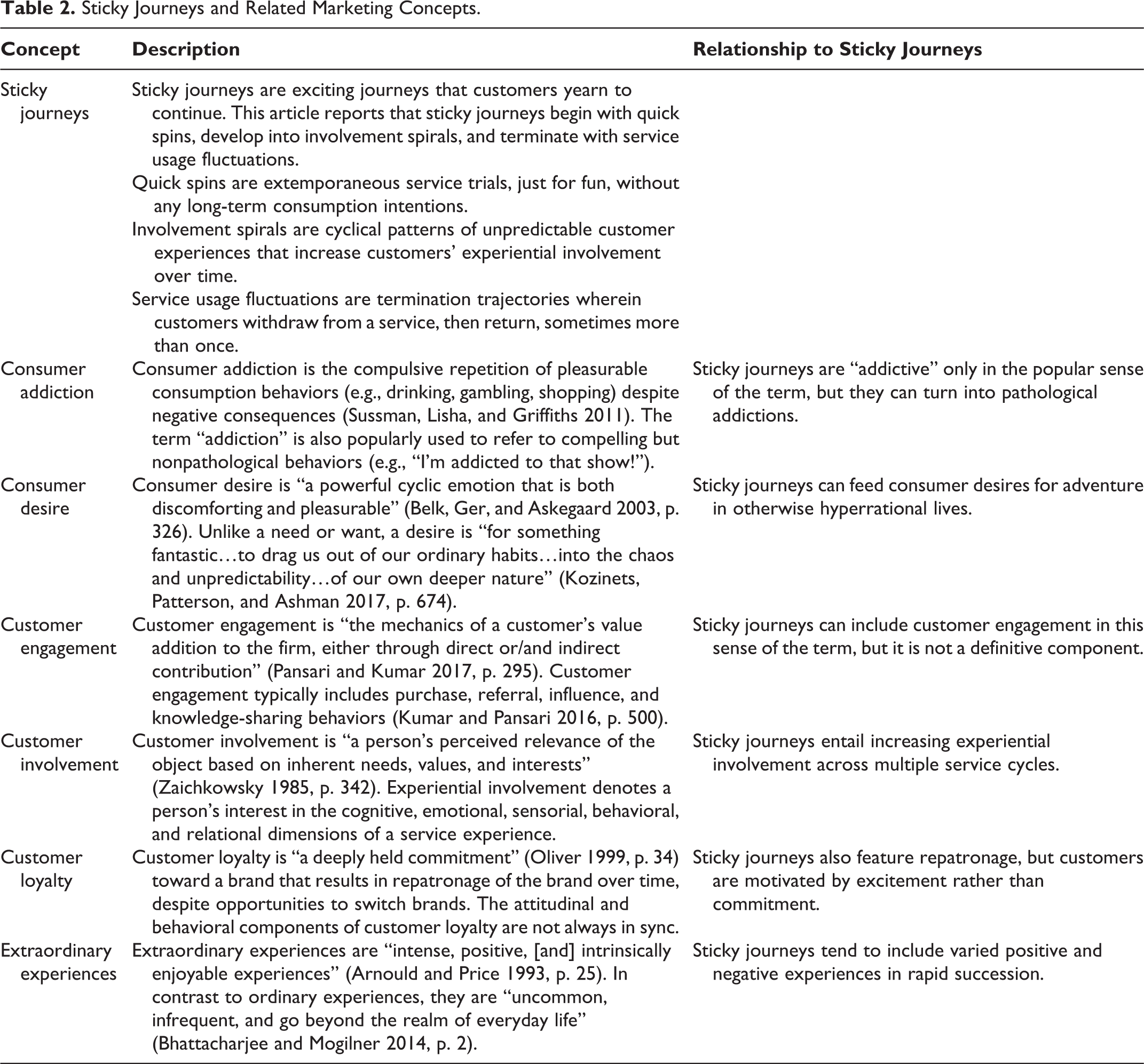
Consumer desire is a type of consumer motivation that is much more energetic, passionate, and urgent than need or want (Belk, Ger, and Askegaard 2003). Our study indicates that customers do not need or want their sticky journeys to continue but urgently desire such continuity. However, when sticky journeys become compulsive or pathological, they may be better conceptualized as consumer addiction (Sussman, Lisha, and Griffiths 2011). Finally, extraordinary experiences are highly positive and infrequent experiences (Arnould and Price 1993). Sticky journeys, by contrast, entail a variegated pattern of positive and negative experiences in quick succession. All of these interrelated marketing concepts point to customer interests in something more than efficient service experiences, but that ‘something more’ varies across these seven concepts. Only the concept of sticky journeys denotes a cyclical pattern of unpredictable customer experiences, with increasing experiential involvement, that customers yearn to continue.
Practical Implications
The CXM literature generally advises firms to design smooth journeys. With the rising popularity of sticky journeys, three new practical questions arise: (1) How should CXM practitioners choose between the smooth and sticky journey models? (2) Within each journey type, when should firms encourage purchases—during the initial or subsequent service cycles? (3) How can firms interlink loyalty loops and involvement spirals to sustain customer journeys in multiservice systems?
How to Choose Between the Smooth and Sticky Journey Models
The strategic choice between the two journey models boils down to whether the service is more instrumental or recreational in nature. In instrumental service categories, customers are like “jobbers,” trying to get their tasks done as efficiently as possible; thus, the smooth journey model is a perfect fit. In recreational service categories, customers are more like “adventurers,” looking for thrills, challenges, and fun times; thus, the sticky journey model is a better fit.
Smooth journeys are ideal for instrumental service categories
Examples of instrumental service categories include business hotels (e.g., Courtyard by Marriott), insurance (e.g., Progressive), and transportation (e.g., Amtrak). Customer journeys in these service categories are like “jobs to be done” (Christensen et al. 2016, p. 54). There are tiresome evaluation tasks (e.g., Are buses, subways, or trains the best transportation option for my commute?), difficult purchase decisions (e.g., Should I buy a cheaper nonrefundable ticket or a pricier refundable one?), and potentially significant consequences (e.g., delays, exhaustion, fees). Jobbers are generally willing to deliberate through the initial service cycle, but they expect subsequent service cycles to be easier. To win these jobbers, firms must provide superior decision support during the initial service cycle, then streamline subsequent service cycles into easy loyalty loops.
Sticky journeys are ideal for recreational service categories
Examples of recreational service categories include driving clubs (e.g., Jeep Jamboree USA), lifestyle media (e.g., Thrillist), and content-sharing networks (e.g., Instagram). Customer journeys in these service categories are more like adventures than jobs. A vaguely defined hunger for excitement leads to a series of unexpected twists and turns, and a sense of purpose keeps the customer moving forward, overcoming challenges in the process (Scott, Cayla, and Cova 2017). Our research suggests that customers often consider such adventures on a whim, so firms must invest in rapid entry mechanisms, especially when the entry hurdles are significant. For example, instead of limiting Jamborees to Jeep owners, Jeep Jamboree USA could rent out Jeeps to potential Jeep owners who wish to join the driving adventures. Our research also suggests that customers will only continue their adventure if it remains exciting, so firms must also invest in endless variation mechanisms. For example, Jeep Jamboree USA keeps changing its adventure sites, from the Catskill Mountains of New York to the Death Valley of California. Thrillist has a global team of freelancers to cover the ever-changing nightlife of super cities (e.g., London, New York City, Paris). Instagram intentionally exposes users to new, personally relevant influencers (e.g., Jivamukti yoginis, Latinx actors, Turkish wrestlers) to keep customers scrolling.
When to Encourage Purchases in Smooth and Sticky Journeys
Firms today offer customers a variety of free, affordable, and expensive service access options, as well as one-off purchase opportunities. Free service at the outset of customer journeys can take the form of free sample sessions (CrossFit), free basic services (Tinder), or even free full services (Pokémon Go). Thereafter, some firms offer customers relatively affordable time-limited options, such as one-time passes (e.g., CrossFit’s drop-in passes), package deals (ten-class passes), and short-term service plans (e.g., three-month plans). Most firms also offer monthly subscription plans, some of which are tiered (e.g., Tinder’s Plus and Gold plans). Finally, some firms also offer customers one-off purchase opportunities (e.g., Pokémon Go raid passes). Firms that provide unlimited full service access for free (e.g., Niantic) rely on these one-off sales to generate revenue. All of these options can work with smooth or sticky journeys. However, to match the distinctive flow of each journey type, firms are advised to encourage purchases at different times within each journey type (see Figure 1).
Encourage purchases during the initial cycle of smooth journeys
Firms aiming to facilitate smooth journeys tend to showcase their complex menu of purchase options during the initial service cycle. For example, Verizon, a telecom service provider, promotes several possible phone plans on its website. One reason is that customers approach instrumental service categories with the mindset of a job to be done (Christensen et al. 2016), and they are highly motivated to conduct a deliberate decision-making process. Another reason is that once customers complete that process, they do not want to be bothered by difficult choices again (Fleming 2016). From a customer’s point of view, the value of a loyalty loop is to minimize the cognitively demanding labor of deliberate decision making. Accordingly, firms should avoid the common practice of promoting upgrades during a loyalty loop (e.g., advertising a new phone plan to existing Verizon customers). When firms do so, they run the risk of triggering customers to reconsider their prior decisions and switch providers altogether (Court et al. 2017).
Encourage purchases during the subsequent cycles of sticky journeys
Firms aiming to facilitate sticky journeys should avoid presenting customers with complex menus of purchase options at the outset. One reason is that such menus are antithetical to the promise of fun, and they immediately dampen customers’ excitement to try the service. Another reason to wait until well after the quick spin is that customers are most likely to make substantial purchases when they are already caught up in the involvement spiral. That said, firms must be patient. Each sticky journey is a unique adventure, so each customer will advance at their own pace. Firms such as CrossFit and Tinder recognize that customers feel ready to commit to premium plans at different times. Accordingly, these firms tend to enroll all newcomers into a free or affordable beginner plan, with little pressure to upgrade that plan until customers themselves seek premium plans. These firms also recognize the indirect value of nonpaying, low-paying, and short-term customers. Unlike instrumental services, recreational services thrive on having a sizable number of active customers within the servicescape at all times. For example, CrossFit thrives on a fleeting sense of hypercommunity, which requires a mix of core and peripheral community members to show up for workouts. Likewise, playing Pokémon Go is much more exciting alongside and against other players (Barrett 2018). Tinder, too, can only offer its users hundreds of potential matches if there are indeed hundreds of other users. As these examples indicate, recreational services often need a critical mass and steady turnover of users, regardless of whether those users are paying customers. For these reasons, recreational service firms (e.g., Grindr, Spotify, TikTok) often need angel investors, crowdfunding, and venture capital to survive the early years, when their revenue streams are limited.
How to Sustain Customer Journeys in Multiservice Systems
Many large firms operate multiservice systems that include instrumental and recreational services. These firms must not only design the first loyalty loop or involvement spiral, but also sustain the customer journey beyond that existing loyalty loop or involvement spiral (see Figure 2). Firms that have customers simultaneously enrolled in multiple loyalty loops and involvement spirals are at less risk of losing their customers.

Sustaining customer journeys in multiservice systems.
Sustaining the customer journey beyond an existing loyalty loop
When a firm already has customers enrolled in one loyalty loop, CXM practitioners can expand on that loyalty loop using three possible journey expansion pathways. To illustrate these pathways, we discuss a prototypical customer at quick service chains (e.g., Dunkin’, Pret a Manger, Starbucks). This customer purchases the same type of coffee every morning using the firm’s app, thus getting her “energize me” job done efficiently. In CXM terms, the customer is locked into a loyalty loop.
One way to expand on the existing loyalty loop is to trigger an adjacent loyalty loop (see Figure 2, Panel A). For example, on a special occasion such as the customer’s birthday, the chain could reward the customer a free breakfast sandwich of her own choosing for the next three service encounters. In this manner, the customer is invited to enter a new deliberate decision-making process about which sandwich might best suit her breakfast needs. When the free offer ends, this tactic could result in the customer regularly purchasing a breakfast sandwich with her coffee, to get the “energize me” job done even better.
Another way to expand on an existing loyalty loop is to spark an involvement spiral (see Figure 2, Panel B). For example, instead of rewarding the customer with a self-selected breakfast sandwich on her birthday, the chain could surprise her with a varied food offering at each of the next three service encounters (e.g., a cranberry scone, a cheese sampler, a fruit salad). When this birthday treat ends, the customer’s involvement with the chain’s food offerings may be sufficiently elevated to motivate her own exploratory purchases. Alternatively, the chain could reward the customer a free short-term subscription to a partner’s recreational service (e.g., Hulu, Netflix, Spotify). Such interfirm alliances can create value for both firms (Homburg, Jozić, and Kuehnl 2017). For the quick service chain, providing such rewards can strengthen the customer’s loyalty. For the streaming service, these short-term subscriptions, framed as rewards, can spark involvement spirals, unlike direct mail offers, which are often ignored.
Yet another way to expand on an existing loyalty loop is to escalate that loop with spiraling logic for a brief period of time (see Figure 2, Panel C). For example, the chain could reward its loyal customer any beverage on the house for the next three service encounters. In this scenario, the customer may upgrade her orders to more premium beverages each morning (e.g., a caramel macchiato, a nitro cold brew, a pumpkin spice latte). Alternatively, the chain could provide the customer with surprise beverages, with the order label placed on the underside of the cup, to foster the excitement of “blind tasting” (Ghoshal et al. 2014). Exposure to the chain’s premium beverages could motivate the customer to permanently upgrade her loyalty loop, to get the “energize me” job done with a dash of self-indulgence.
Sustaining the customer journey beyond an existing involvement spiral
When a firm already has customers caught up in one involvement spiral, CXM practitioners can expand on that involvement spiral using three journey expansion pathways. To illustrate these pathways, we discuss a common marketing problem at group fitness services (e.g., CrossFit, Orange Theory, SoulCycle): once-enthusiastic athletes are coming in less often.
The first way to expand on an involvement spiral that is losing momentum is to spark a new one (see Figure 2, Panel D). At CrossFit, for example, the most enthusiastic athletes eventually reach a level of fitness at which the regular classes are no longer much of a challenge. At this juncture, CrossFit coaches invite those members to special classes for advanced athletes, such as Barbell Club and Strongman. As these new classes have significantly different structures, memberships, and challenges, athletes can be understood as entering a new involvement spiral. Eventually, some of these athletes may go on to compete at the CrossFit Games and related competitions, sparking new involvement spirals once again.
The second way to expand on an involvement spiral is to trigger an adjacent loyalty loop (see Figure 2, Panel E). For example, some CrossFit boxes include smoothie bars. While the athletes primarily come to CrossFit for the involvement spiral of varied workouts, some members may also become locked into loyalty loops of smoothie purchases on their way out. In this manner, customers accomplish the job of “workout recovery” efficiently. If these add-on services offer unique value (e.g., organic fruits, paleo sweeteners, vegan proteins), some members might also swing by the CrossFit box just for the smoothie. In CXM terms, a parallel involvement spiral and loyalty loop in the same multiservice system can keep customers returning for one or the other journey pattern.
The third way to sustain a customer journey when a customer’s interest is waning is to stabilize the involvement spiral into a loyalty loop (see Figure 2, Panel F). This pathway is especially relevant when the customer is switching from an adventurer mindset to a jobber mindset. For example, some CrossFit athletes eventually tire of the ethos of relentlessly challenging themselves. However, rather than quitting, these athletes convert their upwardly spiraling journey into a stable cyclical one, “just [to] keep a certain level of fitness” (Emily, a CrossFit athlete). A CXM lesson to be derived from these mindset-switching athletes is that involvement spirals can sometimes be stabilized into loyalty loops, if that is what the customer wants.
Conclusion
This article has made three contributions to CXM research. First, it has challenged the dominance of the smooth journey model. Second, it has offered an alternate sticky journey model. Third, it has addressed practical concerns at the nexus of the two journey models. In closing, this article also opens up several new avenues for future research on customer journeys (see Table 3). Chief among these avenues is examining new and different types of customer journeys. No one customer journey design is optimal under all circumstances. Accordingly, we hope that this article inspires CXM researchers to keep exploring the fascinating variety of customer journeys in the contemporary marketplace.
Sample Avenues for Future Research.

Footnotes
Appendix. Additional Evidence for the Sticky Journey Model
|
|
|
|
|
|---|---|---|---|
| Rapid entry: the service design principle during the initial service cycle | CrossFit offers newcomers free taster sessions, low-cost beginner programs, and minimal paperwork; some customers get started with one-time class passes through third parties. The core service begins when the newcomer does a CrossFit workout with other existing athletes. Trainers tend to introduce newcomers to other athletes by name to begin their socialization process. | Pokémon Go on-boarding entails a free mobile app, quick in-app setup, and brief tutorial by the character Professor Willow, who ends his introduction with “It’s time to GO!” The core service begins when the new player sees their own avatar equipped with a few PokéBalls to throw at one of three Pokémon nearby to catch that Pokémon, making the first play very simple. | Tinder “doesn’t ask for much from you as a user, aside from your current location and gender, it’s just your age, distance and gender preferences to start” (Tinder 2019, pp. 1–2). Photos can be imported from Facebook accounts. All other user input is optional. The core service begins when the new user sees a profile of another local user. A swipe right/left indicates interest/disinterest. |
| Quick spin: the customer journey pattern during the initial service cycle | “People are like, ‘Oh my God, you’d love it!’ [and] I was like, ‘Okay, cool, I’ll look into it.’ And you know with other gyms, it’s not normally that people do it all on recommendation, but this is really like, you can buy into it really quickly. So then I just found one that was near work and just dropped by and was like, ‘Can I come and check out the gym?’…When I saw the workouts, I was like, ‘Wow, that looks really tough!’ So I wanted to do it.…It’s like a step up from fitness…You could go to the gym…running…cycling…CrossFit combines all of those things.” (Jenny) | “My girlfriend’s a teacher, and she wanted to know what [Pokémon Go] was like because all her kids were into it…. So, we both installed it, went out playing, and carried on playing…. She wanted to relate to teenage kids. I didn’t expect this to happen! [laughs] Because I’m not a game player normally…. I [had] read that [if] you walk away three times from the starters, then Pikachu [the game’s mascot] will appear. So my first ever Pokémon was a Pikachu.…Then you do more walking and start evolving.” (Gordon) | “I saw that there was such an interest among girls and boys. Sounds exciting…. You simply log in via Facebook and then you upload photos, write something in your profile and you’re done!…I was not on any other [dating site]…. I don’t know if it was romanticized, but I first heard from [a friend] that he has quite a few friends that ended up in a relationship via Tinder. And then there were these stories of one-night stands. And both are interesting.…It was exciting, because you see a lot of different people, very pretty people…and then also totally not pretty people too…. It’s very diverse.” (Sebastian) |
| Endless variation: the service design principle during subsequent service cycles | CrossFit’s “constantly varied” (Glassman 2002) workouts typically include a dynamic warm-up, a weightlifting module, and a high-intensity WOD. Each of these modules can include countless different exercises (e.g., box jumps, cleans, lunges). Workout modules are further varied by their temporal ordering (e.g., ten clean-and-jerks every minute on the minute, a trio of exercises for as many reps as possible). As CrossFit chief executive officer Greg Glassman (2002) says, “Five or six days per week, mix these elements in as many combinations and patterns as creativity will allow. Routine is the enemy.” Given that CrossFit workouts often span the outdoors, the weather is yet another significant source of unpredictability. Running can feel like an extraordinary challenge on a snowy day. | The Pokémon Go game draws its titular creatures from the existing Pokémon universe of more than 800 Pokémon across seven generations. To keep the game interesting, Niantic keeps releasing new Pokémon into the game as well as new features (e.g., “Dynamic Weather Gameplay” that adapts the game to the local weather [Pokémon Go 2017, p. 1]). Niantic also releases special Pokémon for a limited time (“Legendary Pokémon) and organizes global events (e.g., Safari Zone). The game’s interface reveals countless PokéStops at which players can collect items and battle other teams for control over Gyms. Pokémon Go varies the timing, location, and number of Pokémon that players can try to catch. Each Pokémon has distinct characteristics (e.g., combat power) and an Individual Value (max. 100%). Some Pokémon come in male, female, and rare “shiny” versions. | Tinder’s service system includes millions of active users, each of whom creates a user profile with attractive images of themselves. Each user sees the profiles of other users in feeds called Discovery, Top Picks, and Likes (for premium subscribers only). The Discovery feed shows the user one profile at a time. To proceed, the user must swipe right, left, or up to Like, Nope, or Super Like. Although these profiles are sequenced by a multifactor algorithm, they cannot be predicted by the average user. Other sources of unpredictability are the messages between the user and their matches, and the user’s freedom to unmatch their matches, which instantly eliminates the entire message history from the apps of both users. Swipe Night is an interactive video feature wherein the user chooses from two options of what happens next to be matched with other users who choose similarly (Hern 2019). |
| Involvement spiral: the customer journey pattern during subsequent service cycles | |||
| Additional evidence of the experiential roller coaster in the moment-to-moment timescale of the customer journey | “The [CrossFit] mix includes everything that I like, a little bit of weightlifting, a bit of gymnastics and endurance, and the mix. You never know what’s going to happen the next day, and you’re active and work really hard…. That’s what I like the most, that there are so many different things, that it is so variable what you do there…. I’m bored really fast, and [CrossFit] doesn’t bore me. I don’t feel like, ‘Oh it’s the same again!,’ which I did feel about football.…[In CrossFit,] it’s always thrilling.” (Karen) | “I was new to the Pokémon world.…So it was quite a vicarious thrill in seeing all these new Pokémon popping up…and going out to different places.…I caught [a powerful Pokémon], and it was one with all the question marks, and so I didn’t know how big it was because it was its first appearance.…I suddenly realized, ‘Oh, how exciting!’ and that by branching out and going to different places, I could make the world very exciting…. I was out for a walk, and we caught [a very common Pokémon].…And it turned into [a very rare Pokémon]. I was so excited, I nearly jumped up and down on the spot. ‘Oh my God, that’s so brilliant!’” (Martha) | “You see these images of men who are often really attractive…and it’s like ‘Yep, I want that!’ And then it’s like, ‘Oh, another!’…Whatever your perfect partner is, you start projecting on complete strangers.…Then you might get a conversation.…More often than not, there’s a level of disappointment…and it’s so sad…it feels like you’re actually losing something, which is ridiculous really because it’s just a fantasy…but that keeps me doing this. Even though on 99.9% of dates…there has not been chemistry…there have been a few times where the magic has happened…and I think those few times [are] enough for me to keep doing it.” (Donna) |
| Additional evidence of increasing experiential involvement across the long-term timescale of the customer journey | “The first month, I thought, ‘I’m really addicted now, I just want to go and do it almost every day and try something new and try and improve on this and that.’ [Later on] it became a case that I was seeing real improvements. I was lifting heavier weights, I was doing [movements that I couldn’t do before], so that just feeds into it even more, it gets even more and more addictive because you’re like, ‘I’m seeing real changes, I’m getting slimmer, I’m getting stronger.’…Over time, you realize that even if you’re able to grow stronger that there’s still room for improvement there. There’s always steps, there’s always something to work on. It never feels like you ever get to the point where you’ve nailed it and you’re perfect. So there’s always either a different movement or a more advanced movement or a bigger weight or there’s always something new to try…. I [just] got more and more into it.” (John) | “[In the beginning,] I needed [my son’s] knowledge in order to access the raid system.…He was my guru; he was showing me what to do…and he would then talk about tactics of only powering up the best [Pokémon], and I’d just power up anything! [laughter]…So we discussed tactics.…[In time,] I was pulling the game apart and trying to understand it…. It was interesting to see the different strategies, and even now that [my son’s] at university and I’m on my own doing this with my raid group, I do find it interesting that we all have different tactics.…I started seeing the same people. And they said, now you’ve got to join in…with random strangers and within the space of ten minutes you are working together to achieve a goal.” (Esther) | “As soon as you have the first match you say…‘Hi, how are you?’ and the conversation goes on. But then you feel greedy…and you’re nonstop until you reach the second match, or third, or fourth. And then you start having five conversations at the same time, and don’t understand whom you are talking to about what! Your phone becomes a mess, because it’s a disorganized set of conversations.…And then you try to…select a few…that you really think…are the good catches. You throw back in the sea all the fish that you don’t want.…The difference between [my first] time and this time was that…I was more mature in the use of the app.…I really knew what I wanted.” (Enrico) |
| Service usage fluctuations fueled by well-being concerns | “I talked to one of my athletes who did two classes per week after the trial month, then three classes per week, and who then chose an unlimited class package. [He] tends to overdo things, and eventually he says to me, ‘It is more important to me to make [more money] as a salesman, and that’s why I want to invest my time there, and therefore no longer come to CrossFit.’…His girlfriend now wants to go into family planning, he has to manage his time better, and he has chosen to reduce CrossFit and not the work.” (Martin, coach) | “It’s like drugs.…You’re just like, ‘Oh yeah, I checked only two hours ago, let me check again if there’s something new,’ you know?…It kind of gets obsessive…. I also lost interest because I cannot keep up with these things. You play, and then you realize that if you want to become better, you need to spend lots of time on it.…[Super Mario Run] was perfect for casual gaming; you have five minutes, you play. [With] Pokémon Go, at some point, I realized that five minutes are not enough. Like, it requires more commitment, [and] I cannot be bothered, and it stops there.” (Marco) | “You have such bizarre conversations with people you do not know. And of course that’s funny and exciting.…Swiping these photos was certainly two-sided. For one thing, it seemed to be taken for granted to shop for men like in the supermarket. And on the other hand…it’s super interesting to see who is there.…And what I found frightening, there were many people whom I actually just eliminated immediately because I just did not find them attractive. Then I thought “That’s harsh!”…That shocked me about myself…. And then I quit. I thought, ‘It’s enough.’” (Anna) |
Acknowledgments
This article is based on the first author’s dissertation research. For their helpful input at various stages of this research project, the authors would like to thank Brian Byrne, Daniel Hunt, Hanna Bahemia, Hoori Rafieian, Lerzan Aksoy, Matanja Siebert, Pierre-Yann Dolbec, Sharon Beatty, Shilpa Madan, Tana Licsandru, and Travis Oh. The authors are also grateful to the JM review team for their thoughtful guidance throughout the review process.
Associate Editor
Amber Epp
Declaration of Conflicting Interests
The author(s) declared no potential conflicts of interest with respect to the research, authorship, and/or publication of this article.
Funding
The author(s) disclosed receipt of the following financial support for the research, authorship, and/or publication of this article: The second author thanks the Gabelli School of Business at Fordham University for summer research support (2017–2019). The fourth author thanks FCT, the Portuguese Foundation for Science and Technology (UIDB/03182/2020).
