




Abstract
High school mathematics can have a direct impact on the academic, health, and financial outcomes of students. To understand how to better support students experiencing mathematics difficulty (MD) in Grades 9, 10, 11, and 12 (i.e., high school), we conducted a synthesis of 21 studies in which author teams investigated the efficacy of a mathematics intervention across a total sample of 197 students. Overall, 15 studies demonstrated positive outcomes, with four studies demonstrating no effects and two studies demonstrating mixed results. We identified several instructional strategies used across multiple studies: explicit instruction, use of technology, focus on vocabulary, use of representations, and word-problem instruction. In most studies, researchers used single case designs, and most of the mathematics content focused on early algebraic standards. As such, there is a need for more mathematics intervention research at the high school level.
High school mathematics can represent an academic, financial, and health gateway into adulthood (Rickles et al., 2018). Students who fail Algebra I in Grade 9 are less likely to graduate on time and more likely to drop out of high school (Ham & Walker, 1999; Heppen et al., 2016; Rickles et al., 2018). Individuals who do not complete high school lose, on average, $133,700 in potential earnings during their lifetimes (Alliance for Excellent Education, 2011) and are 24 times more likely to experience adverse life events (e.g., poor health, being arrested, living on government welfare) than individuals who complete high school (Lansford et al., 2016). Beyond high school, students who complete Algebra II in high school are twice as likely to graduate from college (Gaertner et al., 2014). To support students with the successful completion of mathematics courses, as mathematics is a critical gateway in and beyond high school, research documents the need for strategic, systematic, explicit instruction (e.g., Doabler et al., 2012; Doabler & Fien, 2013; Fuchs et al., 2010; Gersten et al., 2005) to support students who experience MD. Despite increasing research in mathematics intervention, along with the potential short- and long-term implications of high school mathematics, little is known about the effects of such interventions at the high school level and how they support students with MD.
After elementary school, the mathematics achievement gap grows wider for students with MD (Judge & Watson, 2011; Shalev et al., 2005). In 2022, data from the United States (U.S.) National Assessment of Educational Progress (NAEP) reported that 36% of 4th-grade students achieved at or above the proficiency level in mathematics, compared to 26% of 8th-grade students and 24% of 12th-grade students (Nation’s Report Card, 2022). Two important trends emerge from these data. First, the majority of students in the U.S. did not meet minimum levels of mathematics proficiency and could be described as experiencing MD. Second, based on data from 2009 to 2022, the mathematics achievement gap between elementary and high school students widened each year, particularly for students with MD. In this study, we refer to students with MD as students who either have a specific learning disability (LD) in mathematics or students who do not have a formal disability diagnosis, yet experience persistent, below-average mathematics performance (see Rojo et al., 2024; Stevens et al., 2018). This synthesis highlights students with an MD in high school, which we interpret as Grades 9, 10, 11, and 12, or students ages 14 to 19 years old.
In the past 10 years, NAEP data highlight significant differences in the mathematics achievement between students with and without MD across all achievement categories (i.e., below Basic, at or above Basic, at or above Proficient, and at Advanced; Nation’s Report Card, 2022). NAEP data also indicate that the mathematics achievement declines between elementary and high school for students with MD. What remains less clear are the specific challenges students with MD face at the high school level, which may result in a decline in mathematics proficiency. We focus on some of the challenges specifically facing high school-age students with MD in the following section to bring attention to the uniqueness of this population.
Challenges of Mathematics for High School Students
Across disability categories, students’ mathematical achievement increases through elementary school and begins to plateau around age 13 (Wei et al., 2013). Although a longitudinal analysis from Wei and colleagues (2013) did not suggest that secondary-age students (Grades 6 to 12) cannot improve when given access to mathematics intervention, less research explicitly targets how to improve the mathematics outcomes for secondary-age students with MD, compared to elementary-age students (Rojo et al., 2024; Stevens et al., 2018). Even less research exists on how to improve the mathematics outcomes for high school students with MD, though students in high school continue to experience MD. As students move into high school, not only do the mathematical concepts become more advanced, but students must rely on foundational mathematics skills to be successful with more challenging material. Students with MD may continue to struggle with early numeracy concepts (e.g., fluency with whole numbers) while trying to tackle algebra, which could impede their progress in accessing higher-level mathematics concepts and reasoning (National Mathematics Advisory Panel, 2008). As an example, Calhoon et al. (2007) measured the computation performance of high school students with MD. Their results suggested that most high school students had fact fluency similar to that of second- or third-grade students, but exhibited limited fluency with multi-digit whole numbers, fractions, and decimals. Dennis and Gratton-Fisher (2020) noted a similar trend, in which high school students with MD demonstrated mathematics scores equivalent to those of students in Grades 2 through 5. For high school students with MD, if they experience skill gaps, they must continue to work toward grade-level expectations. This tension between catching students up and keeping students on schedule can be challenging for both students and teachers.
Beyond a discrepancy in foundational mathematics skills, MD at the secondary level could be attributed to an increase in the complexity of mathematical topics (Myers et al., 2021) or the increase in the number of abstract mathematical concepts (Witzel, 2016). Outside of class content, MD in high school could also be influenced by differences in working memory, short-term memory, or visual-spatial skill (Abreu-Mendoza et al., 2018; Swanson, 2012), which can impact their ability to generalize and acquire new mathematical skills. Besides difficulty learning concepts, high school students with MD have difficulty applying their background knowledge to mathematics concepts in their courses (Powell et al., 2013). Overall, if students do not already have a solid foundation in mathematical concepts from elementary school, then they may have difficulty learning more advanced concepts as they move into middle and high school (Myers et al., 2021). These difficulties, both learning new material and applying their background knowledge, especially for students with MD, can continue to impact them for the remainder of their mathematical careers in school.
Outside of the classroom, high school students differ from middle schoolers, not just in age, but often in their level of responsibility. These added responsibilities may include part-time employment, additional household chores, caring for younger siblings, and increased extracurricular involvement at school, all of which can divert time and attention away from academics. For students with MD, not only is the distance between their own mathematics achievement and that of their peers greater than it was in middle school (Wei et al., 2013), but the additional distractions of adolescence may also further burden students if they need intensive mathematics intervention in or outside of school.
High school-age students with MD may experience several difficulties, including gaps in mathematics knowledge, challenges with working memory, and the stress of compounding difficulty within mathematics courses. Despite these difficulties, little research exists that focuses solely on supporting high school students with MD in high school-level mathematics classrooms. To better understand how to support the instructional needs unique to this population, it is critical to examine the outcomes of interventions explicitly implemented with high school students with MD.
Previous Syntheses on Secondary Mathematics Intervention
Given the presence and persistence of MD across grade levels (Bryant & Bryant, 2017; Morgan et al., 2009; Nelson & Powell, 2018) and the increasing achievement gaps over time, high-quality, research-validated interventions are needed to address the mathematics achievement needs of high school students. To understand evidence across the K-12 setting, authors of several previous syntheses examined the potential impacts of specific mathematics content interventions (e.g., geometry or the use of manipulatives) on the mathematics outcomes for students with MD. Although numerous syntheses targeted the effects of word-problem interventions (Lein et al., 2020; Xin & Jitendra, 1999; Zhang & Xin, 2012; Zheng et al., 2013), little specific content revealed how to best support high school students in this area. Similarly, syntheses exploring fluency (Burns et al., 2010), fractions (Hwang et al., 2019; Shin & Bryant, 2015), the use of manipulatives in mathematics interventions (J. Park et al., 2022), or interventions specific to geometry (Liu et al., 2021) targeted the K-12 student population overall, but they did not draw specific conclusions on how to support high schoolers with MD specifically.
In a meta-analysis targeting the impacts of mathematics interventions from Grades 4 through 12, Stevens et al. (2018) estimated an overall effect size across studies of 0.49. Of the studies in their meta-analysis, only 8 of 25 (32%) focused on students in Grades 9 through 12. In their moderator analysis, students’ grade level (i.e., elementary compared to secondary) was not a significant predictor of intervention efficacy. The authors also revealed that interventions specifically focused on fractions significantly improved students’ outcomes compared to interventions focusing on operations. Regarding dosage, interventions with more than 15 hours of intervention produced stronger student outcomes. Although their meta-analysis targeted broad mathematics interventions utilizing group designs, the study authors did not identify any studies that specifically targeted statistics or probability, measurement or data use, geometry, or algebraic expressions and equations. This gap in research is problematic, as all the aforementioned skills are necessary for success in high school mathematics courses. Furthermore, studies that included secondary-age students were grouped together in the moderator analysis, with no examination of intervention effects just at the high school level.
Though previous syntheses included students in Grades 9 through 12 alongside other grade levels, syntheses examining the impact of interventions on secondary-age students with MD have not addressed issues specific to high school students with a sufficient degree of specificity. In a review of mathematics interventions for students with LD in Grades 6 through 12, Marita and Hord (2017) identified several beneficial strategies for students with and without LD. Beneficial strategies included explicit instruction of problem-solving processes, the use of think-alouds, and the provision of visual supports. Of the 12 studies included in the review, including group and single case design (SCD), none focused exclusively on students in Grades 9 through 12. Three studies (25%) included students in Grade 9, and just two (17%) included students in Grades 10 through 12. Marita and Hord (2017) acknowledged that individualized supports became less available as students get older, and their review did not identify any studies explicitly focused on these oldest students (i.e., 11th and 12th grade). They named this lack of high school studies as a cause for concern and identified a need for additional high school mathematics interventions.
Jitendra et al. (2018) conducted a meta-analysis of group design studies using mathematical interventions for secondary students with MD. A total of 6 studies, out of 20 (30%), focused exclusively on grades 9 through 12. This meta-analysis expanded upon previous syntheses by including grade level as a moderator rather than examining all secondary students’ data as a single category. The authors identified three key findings. First, students with MD benefited from well-designed mathematics interventions that combined strategies to address student needs and improve performance. Second, students with MD demonstrated increased performance when they received well-designed interventions for more than 10 hours compared to interventions lasting 10 hours or less. Finally, they did not find significant differences between: (a) large and small group instruction, (b) general education and special education locations for intervention, or (c) middle school and high school outcomes. Overall, authors identified that grade level did not significantly moderate study effects (p = .48), and that the effects for studies conducted with high school students were lower than those of middle school students (g = 0.23 compared to g = 0.44).
Lee et al. (2020) explored the intervention features of 12 studies (both SCD and group design studies) targeting the algebraic concepts and skills for secondary-age students with LD. Studies with positive outcomes for students utilized multiple representations of a problem, specific sequencing of problems with multiple examples, manipulatives (virtual and concrete), and explicit instruction. No included studies specifically examined the conceptual (i.e., placement on a number line) or operational (i.e., operations with fractions) understanding of rational number sense.
Bone et al. (2021) similarly included secondary-age students in their systematic review of evidence-based, instructional algebra interventions for students with LD. These authors built upon previous reviews by applying the Council for Exceptional Children (CEC) quality indicators and practice standards (Cook et al., 2014) to each included study. Of the 19 studies, which included both group and SCD, six (32%) featured high school students exclusively. Though they did not find any instructional practices that met all CEC criteria to be considered evidence-based, they identified five practices they categorized as potentially evidence-based. Although these practices yielded positive results, they were not evaluated across enough studies to assess their impact. Approaches identified as potentially evidence-based were the Concrete-Representational-Abstract framework (CRA; Bouck et al., 2018), the use of virtual and concrete manipulatives (Satsangi et al., 2016), problem-solving instruction using videos (Bottge et al., 2007), schema-based word-problem instruction (Jitendra et al., 2002), and peer-assisted learning (Calhoon & Fuchs, 2003).
In a similar review of algebra-focused interventions for students in Grades 6 through 12, Morin and Agrawal (2022) identified research-validated practices that included CRA, virtual manipulatives, explicit instruction, self-regulated strategy development, and sequence of instruction. Out of their 11 included studies, including both group and SCD, only four (36%) focused exclusively on high school students.
Lastly, Myers et al. (2021) synthesized studies that targeted improving the mathematics outcomes for secondary-age students (Grades 6 through 12) with MD. These authors built upon previous meta-analyses by comparing the effects of interventions across mathematics content domains. They did not indicate which studies focused on high school students. Using only group, experimental design studies, Myers and colleagues organized the interventions into five categories: (a) technologically-based interventions, (b) schema-based word-problem instruction, (c) interventions with visual representations, (d) cognitive-based instruction, and (e) other. Overall, cognitive-based interventions yielded the largest effect size (g = 0.83), followed by technology-based interventions (g = 0.50), and visual representations (g = 0.45).
Although these previous syntheses addressed some of the broad needs of secondary-age students with MD, it is necessary to further examine high school students with MD specifically. Of the three meta-analyses described in this section (Jitendra et al., 2018; Myers et al., 2021; Stevens et al., 2018), both Stevens and colleagues (2018) and Jitendra and colleagues (2018) included grade level as a moderator. However, only Jitendra et al. (2018) examined middle school and high school data separately to explore differing impacts on students. The included syntheses and reviews (Bone et al., 2021; Lee et al., 2020; Marita & Hord, 2017; Morin & Agrawal, 2022) focused on the impacts of mathematics interventions on secondary-age students broadly without specifically accounting for the unique impacts of intervention outcomes for high school students. To date, no identified synthesis has focused explicitly on available mathematics interventions for high school-age students, while accounting for students with LD in mathematics as well as students with MD in their included populations. This gap in the research is of concern, particularly given that over three-fourths of 12th-grade students do not demonstrate a minimum level of mathematics proficiency (Nation’s Report Card, 2022), and that high school mathematics represents a crucial bridge on the path to adulthood in terms of health, financial, and educational well-being. These data indicate that many high school students would likely benefit from mathematics intervention, yet no identified synthesis has specifically targeted the impacts of mathematics interventions for this population. To learn how to better support high school students with MD, we must examine what works for this population.
Additionally, few syntheses or meta-analyses have included SCD in their inclusion criteria. It is necessary to examine high school mathematics interventions within a SCD context to further explore gaps in the literature, intervention specificity, and contextual differences that exist within this branch of research. Syntheses of mathematics interventions that included SCD at the secondary level suggest that SCD studies may contribute a meaningful number of studies within research for secondary-age students (i.e., Bone et al., 2021; Lee et al., 2020; Marita & Hord, 2017; Morin & Agrawal, 2022). As research itself is limited in the secondary level, we believe that it is vital to include SCD studies to examine all available mathematics interventions at the high school level. Limited research targeting high school students with MD specifically, coupled with the knowledge that mathematics achievement for students with MD continues to decline from 8th grade to 12th grade, highlights the need for a review of high school mathematics intervention studies.
Research-Validated Instructional Strategies Used Within Mathematics Intervention
Beyond determining the efficacy of high school mathematics interventions for students with MD, we conducted this synthesis to provide general recommendations for educators about which instructional strategies they may want to embed within their mathematics intervention efforts. Based on our review of previous syntheses, we identified five research-validated instructional strategies, and we coded for these strategies within our synthesis. In the following paragraphs, we describe each strategy and the research that supports its inclusion within our coding scheme.
Explicit Instruction
Explicit instruction (sometimes referred to as systematic or direct instruction; Fuchs et al., 2021; Stockard et al., 2018) is instruction that includes educator modeling (e.g., a think-aloud) to show students how to work through a problem step-by-step (Hughes et al., 2017). This modeling is accompanied by numerous practice opportunities for students, with teacher feedback (Doabler & Fien, 2013). Many syntheses focused on students with MD have identified explicit instruction as a strategy used within mathematics intervention (Baker et al., 2002; Chodura et al., 2015; Dennis et al., 2016; Ennis & Losinski, 2019; Hwang et al., 2019; Larviere et al., 2024; Powell et al., 2021; Stevens et al., 2018). Further, a recent Institute of Education Sciences (IES) practice guide about mathematics intervention identified explicit instruction as one of six recommended practices (Fuchs et al., 2021).
Use of Technology
Recent syntheses have identified the use of technology as another research-validated instructional strategy (Dennis et al., 2016; Hwang et al., 2019; Larviere et al., 2024; Myers et al., 2021). The use of technology involves instruction that is provided via technology (e.g., tablet or software) or with technology (e.g., virtual mathematics manipulatives) to practice mathematics. With technology becoming ubiquitous in schools, more technology-based interventions are likely to be used by educators to support the learning of students (Benavides-Varela et al., 2020).
Focus on Vocabulary
A focus on vocabulary entails instruction that includes an explicit focus on mathematics vocabulary terms (e.g., numerator, coefficient, product) and their definitions. In the IES mathematics intervention practice guide, Fuchs et al. (2021) identified a focus on vocabulary as one of six recommended practices. Furthermore, vocabulary has been described as a research-validated instructional strategy in other syntheses (Larviere et al., 2024; Powell et al., 2021). This is likely because students with MD often demonstrate difficulty with the vocabulary of mathematics and because mathematics vocabulary is related to overall mathematics performance (Lin et al., 2021).
Use of Representations
In the IES mathematics intervention practice guide, Fuchs et al. (2021) identified two recommended practices related to representations: use of representations and use of a number line. Representations are hands-on manipulatives, drawings, graphic organizers, number lines, or virtual manipulatives that help students understand the concepts and procedures of mathematics. Many recent syntheses have identified representations as an important strategy to use within mathematics intervention (Bone et al., 2021; Bouck et al., 2018; Hwang et al., 2019; Jitendra et al., 2018; Myers et al., 2021; Peltier et al., 2020; Powell et al., 2021).
Word-Problem Instruction
Word-problem instruction is that which is focused explicitly on teaching students how to set up and solve text-based word problems, which is how students often demonstrate their mathematics performance (Powell et al., 2022). Students with MD often demonstrate difficulty with word-problem-solving (Kingsdorf & Krawec, 2014). The recent IES practice guide (Fuchs et al., 2021) and recent syntheses related to students with MD have identified word-problem instruction as a research-validated instructional strategy (Bone et al., 2021; Hwang & Riccomini, 2016; Larviere et al., 2024; Lein et al., 2020; Myers et al., 2021).
Current Study and Research Questions
The objective of the present synthesis is to examine the effects of mathematics interventions, delivered at the high school level (i.e., Grades 9 through 12), for students with MD. No identified synthesis targets mathematics interventions specifically for high school students with MD. As students experience a decline in mathematics performance between elementary and high school (Nation’s Report Card, 2022), yet mathematics in high school serves as an economic, health, and educational gateway into adulthood (Rickles et al., 2018), it is critical to explore what works for this population of students. This synthesis will expand on current syntheses addressing the impacts of mathematics intervention on secondary-age students with MD and identify research-validated instructional strategies used within many of the mathematics interventions for high school students with MD specifically. With this research, we asked the following research questions:
Method
Operational Definitions
For the purposes of this synthesis, we defined students with mathematics difficulty (MD) as students who either: (a) scored ≤35th percentile on a mathematics assessment (see Jitendra et al., 2018; Mazzocco, 2007), or (b) students with a specific learning disability (LD) in mathematics whose schools, or the study authors, identified them as eligible for special education services under the category of LD in mathematics calculation or problem-solving. Students with LD may have received special education instruction in a mathematics classroom or have an Individualized Education Program (IEP) goal in an area of mathematics. Mathematics intervention referred to targeted mathematics instruction delivered to individuals or small groups of students identified as requiring support beyond business-as-usual (BAU) instruction to improve their mathematics performance.
Search Procedures
We conducted a comprehensive electronic search, from the year 2000 to December of 2023, of six databases: Academic Search Complete, Education Source, Educational Administration Abstracts, Educational Resources Information Clearinghouse (ERIC), PsycINFO, and ProQuest Dissertations and Theses. Results were limited to peer-reviewed journals and dissertations. We began our search in the year 2000 with the publication of the National Council of Teachers of Mathematics (NCTM) Mathematics Curriculum Standards (National Council of Teachers of Mathematics, 2000), which served as an influential update to previous standards for schools in the United States. We used four search lines: (a) population search terms (“learning dis*” OR “learning diff*” OR “learning problems” OR “mild intellectual dis*” OR “math* disabilit*” OR “math* disorder*” OR “math difficult*” OR dyscalculia OR “at risk” OR “special education” OR “under performing” OR “below average” OR “under achieving” OR disadvantaged), (b) mathematics search terms (math OR mathematic* OR geometr* OR algebr* OR arithmetic* OR calculus), (c) intervention search terms (intervention OR training OR modification OR treatment OR therapy OR strategy OR strategies OR practice OR approach* OR technique OR activities OR “behav* support*” OR instruction*), and (d) grade- or age-level search terms (“high school” OR secondary OR adolescent* OR 9th grade OR 10th grade OR 11th grade OR 12th grade OR ninth OR tenth OR eleventh OR twelfth OR “14 year old*” OR “15 year old*” OR “16 year old*” OR “17 year old*” OR “18 year old*”).
The electronic search yielded 3,541 abstracts for screening. Following deduplication, the authors screened 3,204 abstracts, including 907 dissertations. To establish inter-rater reliability, the authors screened 10% (320 records) of the deduplicated abstracts and achieved 98.8% agreement. Abstract screening excluded 2,974 records, leaving 230 records to be screened at the full-text level. The authors independently screened 10% (23 records) and established full-text reliability at 100%. Through the full-text review, 21 manuscripts met the inclusion criteria for this synthesis, including eight dissertations. Following the database screening, the authors took additional measures to identify studies for the synthesis. First, we conducted an ancestral search of reference lists for our synthesis corpus and identified no additional studies. Second, the authors completed a table of contents hand search, resulting in no unknown studies, from January 2019 to December 2023 in the following journals: Exceptional Children, Journal of Learning Disabilities, The Journal of Special Education, Learning Disabilities Quarterly, Learning Disabilities Research and Practice, and Remedial and Special Education. Finally, a reviewer of an earlier version of this manuscript alerted us to a published version of a dissertation study originally included in our search (Billman et al., 2023). Therefore, we used the published study in lieu of the dissertation study. Figure 1 displays a PRISMA diagram detailing the search process.
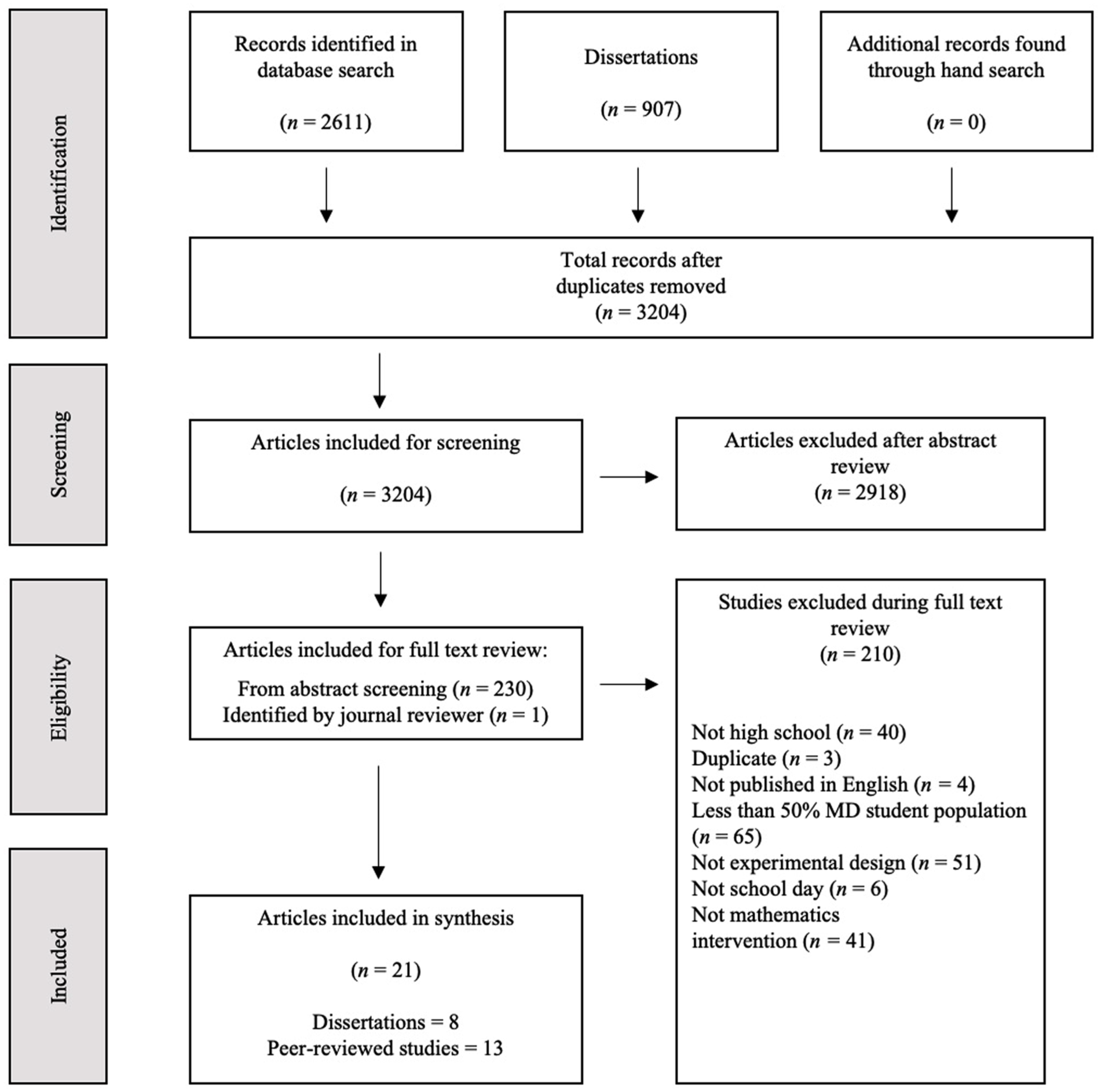
PRISMA Diagram of Search for Studies on Mathematics Interventions.
Inclusion Criteria
The authors included studies for this synthesis that met the following criteria:
At least 50% of participants were identified with MD, or the reported data was disaggregated by disability.
All participants were high school students in Grades 9, 10, 11, or 12.
The study employed an experimental design, including quasi-experimental, randomized controlled trial, or SCD.
The published study was available in English.
The study occurred within school day hours at a typical school.
The study evaluated the effects of high school, grade-level standards mathematics interventions on mathematics outcomes.
We excluded studies that included participants in any grade other than 9, 10, 11, or 12, as well as studies that included participants with autism spectrum disorders or intellectual disabilities who received center-based or vocational-based mathematics instruction. We also excluded studies comparing students with MD in the treatment group to students without MD in the control group and studies measuring only strategy use, self-regulation, mathematics feelings/perceptions, mathematics anxiety, or the use of mathematics accommodations.
Coding Procedures
Coding Manual
The authors developed the codebook and two coding forms, one for group design studies (based on recommended guidelines from Cooper et al., 2019) and one for SCD (using recommended guidelines from Horner et al., 2005), to extract and document information on each study. Authors coded studies for the following information: (a) participant demographic information (e.g., gender, grade level[s], special populations status), (b) study characteristics (e.g., study design, research question[s]), (c) intervention characteristics (e.g., number of sessions, intervention duration, outcome measure[s]) and instructional strategies (e.g., use of explicit instruction, representations), (d) study outcomes (e.g., measure outcomes, descriptive statistics for calculating effect sizes, limitations), and (e) quality indicators for group and SCD studies as outlined by CEC (see CEC, 2014 for all items). For the coding on instructional strategies, we relied on practice guides (e.g., Fuchs et al., 2021) and previous synthesis (e.g., Jitendra et al., 2018; Stevens et al., 2018) to generate definitions and descriptions for instructional strategies noted as important for students with MD, and we coded for the use of these different strategies. See the introduction for more information about the inclusion of specific instructional strategies, including their definitions.
Coding and Establishing Reliability
The authors discussed and clarified all coding terms, definitions, and items before independently coding studies. To establish initial reliability, each author coded one SCD study and one group design study, then met to discuss discrepancies. The quality indicators, as outlined by CEC (2014), were coded as either yes, if the item was included in the study, or no, if the item was not included. The authors achieved an initial reliability of 89.7% on the group design study and a 91.5% on the SCD study. Reliability was calculated by dividing the total number of coder agreements by the sum of agreements plus disagreements, multiplied by 100. After establishing initial reliability on a group design and SCD study, all studies were double coded for all variables. The authors achieved an overall reliability of 91.9% (range: 85.07%–98.8%) across studies. Group design studies had an overall reliability of 91.02% and SCD studies had an overall reliability of 92.25%. All discrepancies were resolved through discussion during regularly scheduled author meetings.
Calculation of Effect Sizes
To make intervention comparisons across studies, the authors extracted information on effect sizes (e.g., number of participants or group means) that were reported by study authors to calculate individual study effects. Due to the variety of SCDs included in the synthesis, and to be able to draw conclusions across all SCD studies, Tau-U effect sizes were calculated for each SCD study. To calculate Tau-U, we used WebPlotDigitizer (Rohatgi, 2022) to extract the raw data from study graphs. All data were transferred to an online, Tau-U calculator from Single Case Research (Vannest et al., 2016). Using the Tau-U calculator, study effects were calculated and weighed based on participant(s) or condition(s). An overall effect size for included SCD studies could not be computed due to the variety of SCD studies included in the synthesis. To calculate group design effect sizes, we first calculated the standardized mean difference (SMD; Cooper et al., 2019) for each outcome when adequate information was reported by the study authors. Based on the What Works Clearinghouse (WWC, 2020) recommendation, we then applied the small sample bias correction to retrieve Hedges’ g values (Hedges & Olkin, 1985) and calculated subsequent p values. Due to the limited number of studies and effect sizes, further comparative analyses were not completed across studies.
Results
Characteristics of Studies
Tables 1 and 2 summarize the key characteristics of the 21 studies included in this synthesis, which were published across 22 years (2001–2023) and comprised of eight dissertations. Of the included studies, 14 (67%) utilized a SCD with a range of 2 to 10 participants, while the group design studies included a range of 11 to 45 participants. Participants across all studies ranged between Grades 9 through 12, with only four studies containing participants from Grade 12. The content of the interventions included algebra, fractions, linear equations (graphing and solving), rate of change, geometry, ratios and proportions, mathematics vocabulary, and problem-solving. Intervention dosage ranged from less than 1 hour to 52 hours, with 52% of studies including 10 or fewer sessions (range: 1 to 30 sessions). Additionally, 81% of studies lasted 5 weeks or fewer in total.
Characteristics of Mathematics Intervention Studies.
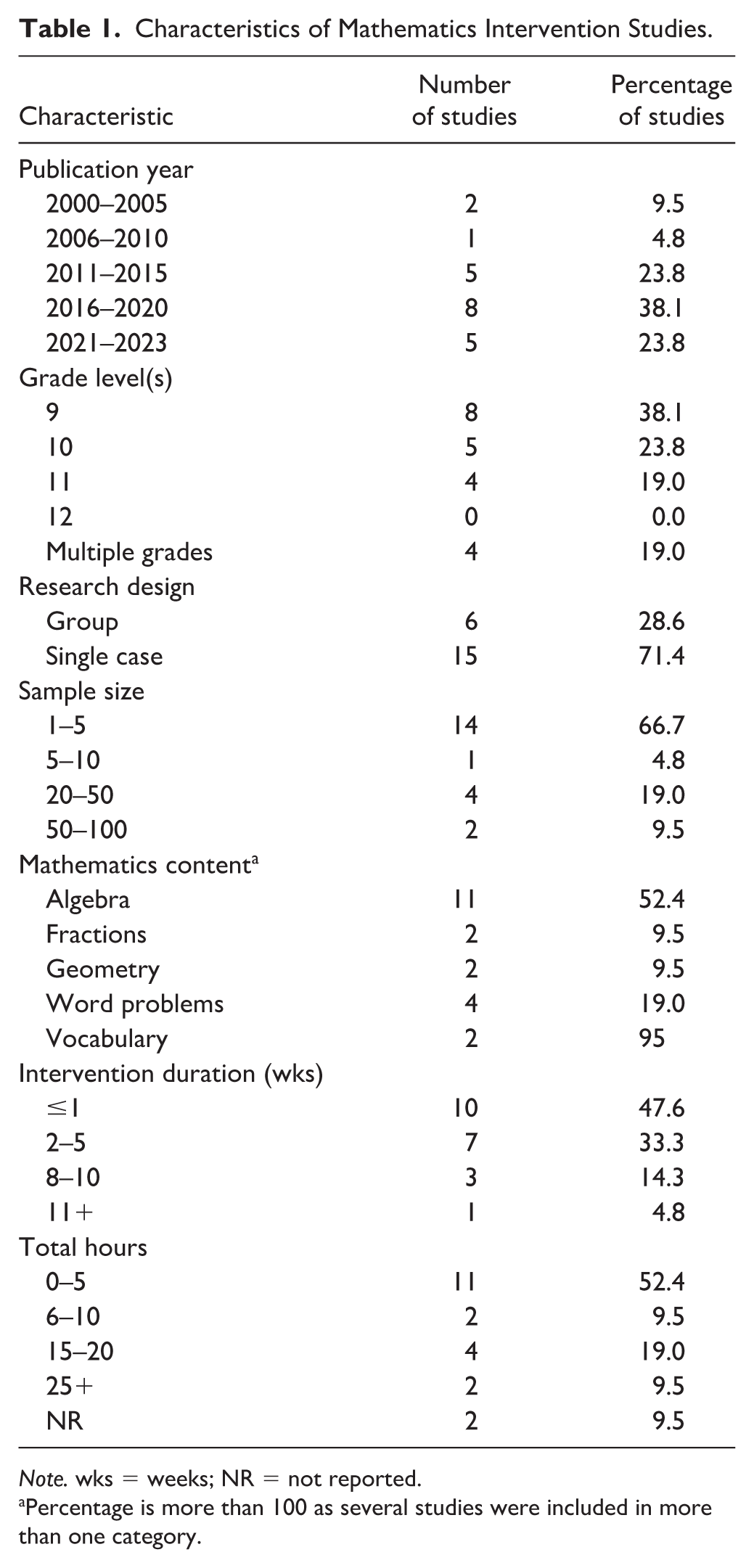
Note. wks = weeks; NR = not reported.
Percentage is more than 100 as several studies were included in more than one category.
Descriptions of Mathematics Intervention Studies.
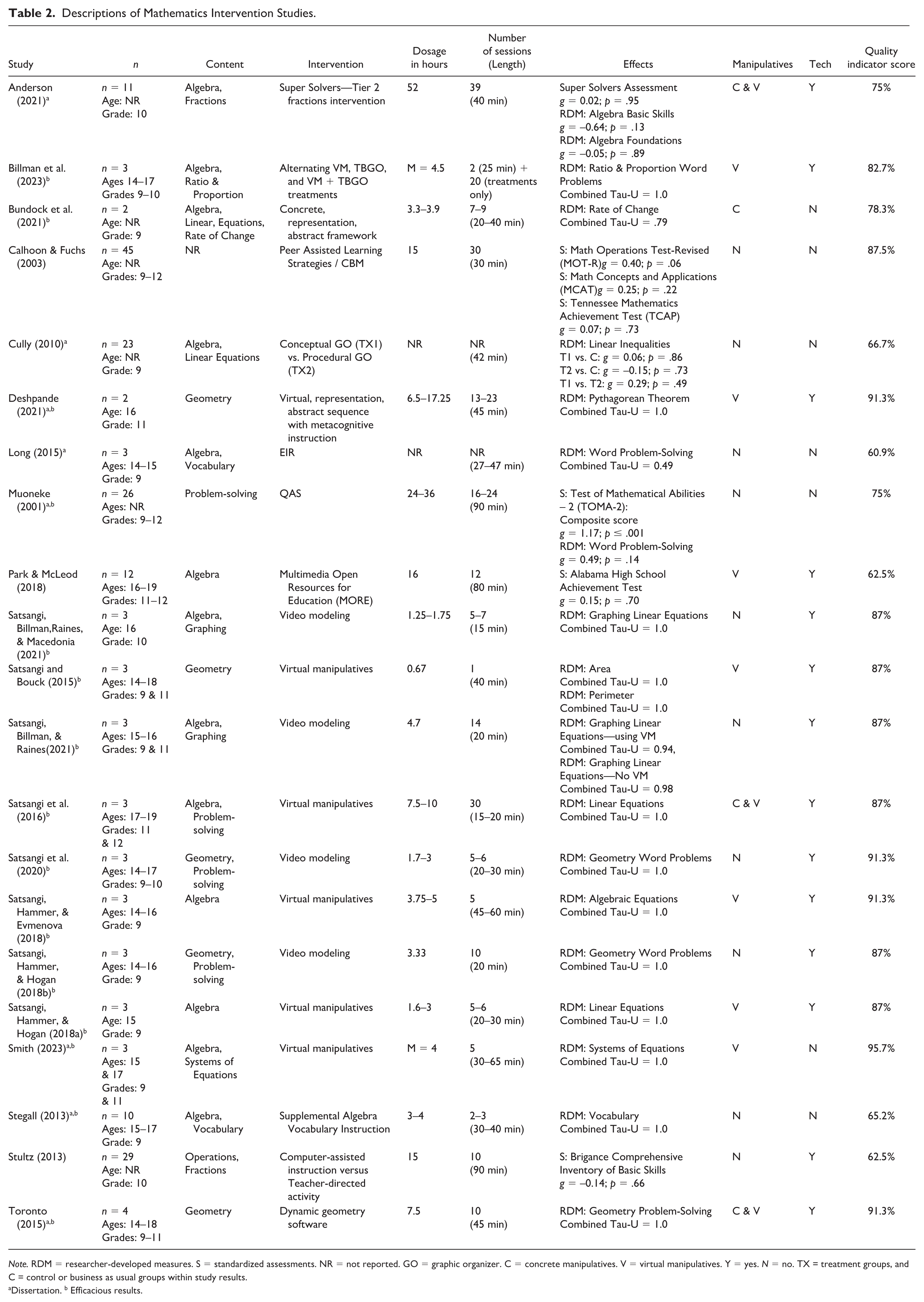
Note. RDM = researcher-developed measures. S = standardized assessments. NR = not reported. GO = graphic organizer. C = concrete manipulatives. V = virtual manipulatives. Y = yes. N = no. TX = treatment groups, and C = control or business as usual groups within study results.
Dissertation. b Efficacious results.
Impact of Interventions
Across the 21 studies, 15 (71%) demonstrated positive outcomes, two studies (10%) showed mixed results, and four studies (19%) had no intervention effects. We identified positive group designs as studies with a p value for comparisons of less than .05 and for SCD as a Tau-U value of greater than .40 (Parker et al., 2011) with supportive visual analysis. For the two studies with mixed results (Calhoon & Fuchs, 2003; Muoneke, 2001), the authors implemented multiple measures with the students, which led to mixed results (i.e., significant or meaningful growth on at least one posttest measure, but not all posttest measures). In the study by Calhoon and Fuchs (2003), students demonstrated meaningful growth on a standardized proximal measure of computation (g = 0.40) but not on the standardized distal measures of mathematics (g = 0.25 and 0.07), though g = 0.25 may be meaningful growth for a secondary-age student. Muoneke (2001) identified significant results on a standardized measure of mathematics (g = 1.17) but not on a researcher-created measure of word-problem-solving (g = 0.49). For the four studies without intervention effects (i.e., participants did not show significant or meaningful growth in response to the intervention; Anderson, 2021; Cully, 2010; S. Park & McLeod, 2018; Stultz, 2013), with effect sizes ranging from −0.64 to 0.29.
For group design studies, the range of intervention effects was −0.64 to 1.17, and the SCD Tau-U effects ranged from 0.49 to 1.0. To assess the impacts of the interventions, studies utilized researcher-developed measures, commercially available measures, or a combination of both. All SCD studies utilized researcher-developed measures, while the group design studies used commercially available measures or a combination of both. Table 2 further outlines individual study details, such as the number of sessions, effect size(s), type of assessment used, and the use of manipulatives or technology.
Across content areas, the impacts of the mathematics interventions varied. Of the eight studies targeting algebra content, including linear equations, six (75%) demonstrated positive outcomes. The remaining two studies had no significant differences between groups. Three studies examined the impact of interventions on ratios, proportions, and/or fractions. Of these, two (67%) resulted in significant improvement, and one showed no significant differences between groups. Of the two included studies targeting mathematics vocabulary, one (50%) demonstrated efficacious results. All four of the studies focused on problem-solving outcomes (100%), and all three of the studies focused on geometry (100%) demonstrated improved performance across participants.
Instructional Strategies From Efficacious Interventions
To further draw conclusions between study results and methodologies, the results from the 15 studies with efficacious results are grouped into the following themes, which represent research-validated instructional strategies used during the interventions: (a) explicit instruction, (b) use of technology, (c) focus on vocabulary, (d) use of representations, and (e) word-problem instruction. We focused on these instructional strategies as they have been identified in previous reviews as critical instructional components for instruction for students with MD. See the introduction for details about each instructional strategy. We extracted these instructional strategies by reviewing our coding document and determining which instructional strategies were described in more than one-third of studies.
Explicit Instruction
We defined explicit instruction as instruction that was systematic in its approach, with teacher modeling (e.g., think-alouds) about working through a problem step-by-step with embedded practice for students. All 15 efficacious studies (100%) used explicit instruction to help students understand mathematics concepts and procedures. For example, Bundock et al. (2021) provided a brief review followed by teacher modeling, guided practice, and independent practice. One important aspect of explicit instruction is feedback. Deshpande (2021) described teacher modeling with an advanced organizer followed by guided and independent practice with corrective feedback (when necessary) and affirmative feedback. In some studies, the explicit instruction was provided face-to-face (e.g., Smith, 2023; Toronto, 2015); in other studies, the explicit instruction was provided via video modeling (e.g., Satsangi, Billman, Raines, & Macedonia, 2021; Satsangi et al., 2020).
Use of Technology
Technology included the use of software, videos, computers, or tablets as part of the mathematics intervention. Of the efficacious studies, 12 studies (80%) used technology. Some of these studies used technology because they asked students to work with virtual manipulatives (Deshpande, 2021; Satsangi & Bouck, 2015; Satsangi et al., 2016; Satsangi, Hammer, & Evmenova, 2018; Satsangi, Hammer, & Hogan, 2018a; Smith, 2023; Toronto, 2015). Billman et al. (2023) used virtual manipulatives and games through an app. In several of the Satsangi and colleagues studies, students watched video models (Satsangi, Billman, & Raines, 2021; Satsangi, Billman, Raines, & Macedonia, 2021; Satsangi et al., 2020; Satsangi, Hammer, & Hogan, 2018b).
Focus on Vocabulary
We categorized authors as focusing on vocabulary when they described teaching, previewing, or reviewing vocabulary terms and definitions. In the efficacious studies, 10 studies (66%) focused on vocabulary. As examples, Smith (2023) and Toronto (2015) provided students with definitions of key terms; Billman et al. (2023) introduced terms and asked students to write a definition for each vocabulary term. Deshpande (2021) provided students with a vocabulary glossary graphic organizer in which students described vocabulary terms, then provided definitions, examples, and pictures. Long (2015) integrated vocabulary instruction within a graphic organizer. In several studies conducted by Satsangi and colleagues, the researchers highlighted key vocabulary terms or reviewed key terms through video modeling. In Stegall (2013), vocabulary was the primary focus of the study.
Use of Representations
We defined representations as concrete, pictorial, or virtual tools used during intervention to help students understand mathematics content. Across the efficacious studies, 10 of the studies (66%) used representations, but the types of representations varied widely. In several studies, students had the opportunity to see and use concrete (i.e., hands-on tools), such as interlocking centimeter cubes (Bundock et al., 2021), balance scales and chips (Satsangi et al., 2016), or angles (Toronto, 2015). We noted that authors used pictorial tools, such as graphic organizers (Billman et al., 2023; Deshpande, 2021; Stegall, 2013) or diagrams, tables, and graphs (Bundock et al., 2021). Finally, quite a few studies asked students to interact with mathematics via virtual manipulatives. Deshpande (2021) used Gizmos virtual manipulatives (Explore Learning, 2025). In contrast, Satsangi and Bouck (2015), Satsangi, Hammer, and Hogan (2018a), Satsangi, Hammer, and Evmenova (2018), and Satsangi et al. (2016) used virtual manipulatives from the National Library of Virtual Manipulatives (Utah State University, 2025). Smith (2023) used virtual algebra tiles, and Toronto (2015) used Geometer’s sketchpad (Keycurriculum, n.d.).
Word-Problem Instruction
One other component that we regularly noted in the mathematics interventions was the use of problem-solving instruction, which was featured in seven (47%) of the efficacious studies. We defined problem-solving as a specific focus on word problems. In Anderson (2021), the focus was on fraction word problems, whereas Billman et al. (2023) focused on proportion word problems. Satsangi et al. (2020) and Satsangi, Hammer, and Hogan (2018b) both focused on geometry word problems. Smith (2023) helped students with word problems featuring systems of equations. Several author teams used word-problem attack strategies to help students set up and solve word problems. Bundock et al. (2021) used PODCheck, which helped students solve word problems through mathematics writing (Propose, Outline, Describe, and Check). Deshpande (2021) used R-U-STAR (Read the problem, Underline the unknown, Search for important information, Translate to a visual, Answer, and Review). Another attack strategy included QAS (Question and Action Strategy; Muoneke, 2001).
Study Quality
Study quality for each study was calculated by dividing the quality indicators that were included in a study by the total number of items, then multiplying by 100. Overall, study quality, as outlined by the Council for Exceptional Children (CEC, 2014), ranged from 60.9% to 95.7% with an overall average of 80.9% across studies. The average study quality was higher for the 15 SCD studies (84.6%) compared to the group design studies (71.5%). Neither SCD nor group design studies were likely to report implementation fidelity related to intervention dosage or details of the intervention agent delivering the intervention, including necessary training to deliver the intervention. Group design studies were not likely to report on overall or differential attrition, nor were they likely to adequately describe the demographic details of participants.
Discussion
Our primary goal in conducting this synthesis was to understand the effects of the research about mathematics interventions for students with MD at Grades 9, 10, 11, and 12, as research for high school-age students with MD is vastly underrepresented compared to mathematics research for elementary or middle school students. When preparing to conduct this synthesis, we surveyed the literature and identified no previous reviews, syntheses, or meta-analyses exclusively focused on high school mathematics interventions for students with MD. That is one unique contribution of this synthesis. Second, we wanted to help both researchers and educators understand the efficacious instructional components within each of the interventions to aid with the development of future interventions or the implementation of instruction in the high school setting. In this way, educators and researchers could use this information about instructional components to embed such components into any existing mathematics intervention efforts at the high school level.
Characteristics of Studies
We identified 21 studies implemented across Grades 9, 10, 11, and 12 in which researchers or educators provided supplemental mathematics intervention to students experiencing MD. For the 21 studies, researchers in two-thirds of the studies used SCD, while one-third employed a group design. We included eight dissertations in the analysis. When comparing this high school synthesis to those focused on middle school or middle and high school, this comparison between the number of group design and SCD studies was similar to other syntheses that targeted secondary-age students and included SCD studies in their analysis (e.g., Powell et al., 2021). The high percentage of SCD in our synthesis, and aforementioned syntheses, may indicate that this type of experimental design is preferred in secondary settings, perhaps due to ease of logistical implementation, compared to group designs. Furthermore, by including dissertations in our corpus, we added literature to this knowledge base that was not often included in previously published syntheses or meta-analytic works.
In total, we identified 197 students with MD who participated across the 21 studies. The number of participants in this study is fewer than in other syntheses that examined the impacts of mathematics intervention on secondary-age students (e.g., Bone et al., 2021; Jitendra et al., 2018; Powell et al., 2021). However, as 71% of the studies included in this synthesis had 10 or fewer participants, this outcome was to be expected. Past syntheses that included elementary-age students in their analysis had more total participants with MD (e.g., Stevens et al., 2018), as well as syntheses that included middle school students (e.g., Bone et al., 2021). The vast difference in the number of total participants with MD in this synthesis, compared to syntheses that targeted or included middle school students, highlights the disproportionate amount of research being conducted in mathematics intervention in high school settings. When research was conducted in a high school setting, it often employed SCD and included fewer participants.
The content of the interventions varied widely from study to study, with content across several domains of mathematics, including rational numbers, algebra, geometry, graphing equations, rate of change, as well as interventions focused on mathematics vocabulary and word-problem-solving. Compared to past syntheses specifically targeting secondary-age students (e.g., middle school students in Powell et al., 2021), the content of the 21 studies focused more on algebra concepts (e.g., solving multi-step equations, calculating and graphing rate of change, or systems of equations), compared to geometry, fractions, or word-problem-solving. The lack of upper-high school mathematics standards (e.g., precalculus concepts such as the unit circle) suggests room for growth in high school mathematics intervention research. The frequency of algebra interventions included in this synthesis may also suggest that high school students continued to struggle with foundational algebra concepts, which are often introduced in middle school and continued in early high school.
Although intervention dosage was extensively varied, the majority of studies lasted less than 10 sessions and less than 5 weeks. As a majority of studies in this synthesis were SCD, it is reasonable that intervention duration and dosages were lower than those in other syntheses, which included more studies with group designs (e.g., Jitendra et al., 2018; Stevens et al., 2018). As over two-thirds of studies in this synthesis demonstrated positive outcomes for the participants (i.e., participants showed growth in response to the intervention), it is of note that interventions targeting specific mathematics standards for high school learners may not require lengthy duration nor intensive dosage. However, this advice should be interpreted cautiously, given that authors assessed most outcomes on measures that were very proximal to the content of the intervention, a topic we discuss in the following paragraph.
To assess the effects of the interventions, studies utilized researcher-developed measures, commercially available measures, or a combination of both. All SCD studies utilized researcher-developed measures. Group design studies used commercially available measures or a combination of both. This finding is similar to Jitendra and colleagues’ (2018) meta-analysis of secondary students. Researcher-developed, proximal measures are essential for understanding whether students learned the content of the intervention (Clemens & Fuchs, 2022). Results and effect sizes from these proximal measures, however, may not be comparable to those from commercially available and more distal measures. As suggested by Clemens and Fuchs (2022), the use of multiple measures, both proximal and distal, would be essential for understanding the true efficacy of an intervention.
Impact of Interventions
For group design studies, the range of intervention effects was −0.64 to 1.17, with SCD Tau-U effects ranging from 0.49 to 1.0. In the meta-analysis of secondary mathematics interventions (i.e., Grades 4 through 12) by Stevens et al. (2018), the authors described the effect sizes for their 25 studies as ranging from −0.66 to 4.65, with an average effect size of 0.49. In Jitendra and colleagues’ (2018) meta-analysis of secondary mathematics interventions (i.e., Grades 6 through 12), they identified an effect size of 0.37 with effect sizes ranging from −1.10 to 1.83. In both meta-analyses, the authors identified non-significant effects, and we noted four studies with non-significant effects and two studies with mixed effects. On average, Jitendra et al. (2018) and Stevens et al. (2018) described a significant impact of mathematics intervention on student outcomes, and we do the same, but with the exclusive focus on interventions for students with MD in Grades 9 through 12.
Lastly, it is important to note that this synthesis includes SCD studies, which not only made up a majority of the research base for high school-age students with MD but were also not included in Jitendra et al. (2018) or Stevens et al. (2018). This distinction is noteworthy as it highlights the value that the present synthesis can add to the research and practitioner community actively working with high school students with MD. The inclusion of SCD studies, as mentioned previously, may additionally indicate that researchers can consider using SCD as a pathway to conduct research at the high school level. As there is a shortage of mathematics research at the high school level, compared to that of elementary or middle school, this synthesis highlights that high school students with MD can experience the effects of impactful research through high-quality SCD interventions.
Instructional Strategies
Of the instructional strategies used in the efficacious studies, we noted several of the same strategies identified in previous systematic reviews, syntheses, and meta-analyses. For example, previous syntheses that targeted secondary-age students (i.e., Bone et al., 2021; Jitendra et al., 2018; Powell et al., 2021) noted explicit instruction as a key instructional component of included interventions. All studies included in this synthesis used elements of explicit instruction in their interventions, thus suggesting that explicit instruction is a crucial intervention component for older learners with MD. The use of technology followed explicit instruction, with 80% of our efficacious studies including a technological component. Technology was also included in several reviews for middle school learners (i.e., Bone et al., 2021; Powell et al., 2021), suggesting that it may be an impactful intervention component for secondary-age students with MD overall.
Some key differences emerged between previous syntheses, which focused more on middle school students, and our synthesis of high school mathematics interventions. For instance, Powell et al. (2021) identified the use of language within mathematics instruction in 32%, or 19 out of 59, of their studies, while 66% of our efficacious studies included mathematics vocabulary instruction. Vocabulary instruction, or the inclusion of mathematics language, was not noted in other previously published syntheses for secondary students, yet it may be a critical piece to unlocking results for older learners with MD. This difference may not only highlight a distinction between high school and middle school interventions but also note the importance of explicit mathematics vocabulary instruction for high school students. As mathematical concepts build upon themselves across years, and mathematical complexity increases rapidly from Grades 9 to 12, this distinction in the research indicates that more attention may need to be placed on vocabulary instruction for high school students with MD. Another distinction of note is the change in word-problem-solving at the high school level. Only 47% of our studies included word-problem instruction, while Jitendra et al. (2018) and Powell et al. (2021) both named its importance in intervention for middle school learners. As word-problem instruction is integrated with mathematics language, educators should continue to practice using mathematics language within word problems.
Implications for Practice
We identified five instructional strategies educators should consider when designing and implementing mathematics interventions for students experiencing MD at the high school level. Our first recommendation is for educators to teach explicitly (or use technology that teaches explicitly). This means that educators and technology should model how to do mathematics problems, often by showing a problem step-by-step. Students should engage in many practice opportunities, perhaps through a combination of guided practice and independent practice. Explicit instruction also involves appropriate feedback. Based on our synthesis, we identified several other components of explicit instruction that may be important to include when designing mathematics interventions for high school students. These components include providing a brief review (Bundock et al., 2021; Muoneke, 2001), presenting an advanced organizer (Deshpande, 2021), or providing a task analysis with details about each step of a problem (Smith, 2023). These components can support students in acquiring new material or helping students with knowledge gaps.
We also suggest that, when appropriate, educators use technology to deliver or support mathematics intervention. One method for technology use could be through virtual manipulatives, which we will discuss later in this section. Another method for using technology was to create video models that students could watch to see how to solve a mathematics problem step-by-step. A benefit of video models is that they can be rewatched when students need a reminder of how to do a problem. They can also be easily created by educators and tailored for specific problems, thus allowing for opportunities of differentiated learning. Finally, another method for the use of technology is technology-based programs, which will likely become more prevalent over the next decade.
A third implication for practice is focusing on the vocabulary of mathematics. Over half of the studies highlighted vocabulary in some way. Some of this was brief, like an introduction of important vocabulary terms, or more involved, like the use of a graphic organizer to help students explore a term, its definition, examples, and pictures of the term. As described by Lin et al. (2021), mathematics vocabulary is moderately correlated with mathematics performance, particularly for word-problem-solving. As all students, especially at the high school level, demonstrate mathematics knowledge through word-problem-solving, it may be particularly important for educators to focus on explicit instruction of mathematics vocabulary.
Fourth, educators should consider using multiple representations when teaching mathematics intervention. Hands-on tools may be helpful as well as pictorial representations. Sometimes pictorial representations mirror hands-on tools (e.g., pictures of fraction tiles compared to hands-on fraction tiles), whereas other pictorial representations (e.g., graphic organizers) may not have a concrete counterpart. Another representation educators may consider using includes virtual manipulatives. Over the last few years, more virtual manipulatives have become more readily available through websites and apps—many of which are free. Although not used as much as concrete (i.e., hands-on manipulatives), virtual manipulatives have shown to be important for improvement of mathematics outcomes (Peltier et al., 2020).
Finally, educators may want to consider a focus on problem-solving instruction. Problem-solving is essential for demonstrating mathematical competence; therefore, educators should ensure students experiencing MD receive adequate instruction and practice related to solving word problems and real-life problems. In our study, we identified several studies that introduced word-problem attack strategies as a generalized process for helping students work through a word problem. For example, PODCheck and R-U-STAR could be used. Both of these are related to Polya’s word-problem steps of understand, plan, solve, and check. Any organization with an approach to setting up and solving word problems is likely to benefit students.
The overall use of evidence-based practices in upper-level mathematics is crucial for several reasons. First, as students are likely to face upper-level mathematics on college-entrance exams (e.g., the SAT; College Board, 2024), providing students with high-quality instruction in upper-level mathematics helps to support students on important standardized assessments, which are often linked to post-secondary entry and scholarship opportunities. Second, although high school graduation requirements may differ by state, many post-secondary institutions require upper-level mathematics for entrance, including entrance to several professional degree programs (National Association for College Admission Counseling, 2024). As researchers, we must rise to the occasion to provide teachers with evidence-based tools to support their high-school-age students with MD in such coursework.
Implications for Research
There are several implications for research that we believe are pertinent to the research community. First, and most noteworthy, we identified a disproportionately low number of studies conducted in high school settings with high school mathematics standards, compared to elementary or middle schools. At the middle school level, Powell and colleagues (2021) identified 72 studies, and at the elementary level, Rojo et al. (2024) identified 155 studies. These stark differences highlight the considerable discrepant gap in mathematics intervention research between grade-level bands. As high school mathematics is a gateway into adulthood (Rickles et al., 2018), and the mathematics opportunity gap only widens with age (Nation’s Report Card, 2022), placing additional resources and time into high school populations is not only necessary, but also equitable to support the livelihood of high school students with MD.
Second, a majority of studies utilized SCD methodology, and roughly one-third of our studies came from one research team (see Limitations section). Although there are many benefits to SCD studies (Peltier et al., 2020), such methodology does not always lend itself to the realities of typical high school mathematics classrooms and the support systems (e.g., multi-tiered system of support) put in place in high schools. We urge the mathematics research community to conduct more group design studies under real-world conditions at the high school level to better understand what works for students with MD under more typical settings. We also offer the use of SCD for more opportunities for research within high school, as we continue to learn about how to support high school students with MD.
Third, there was a notable lack of upper-level mathematics instruction in the interventions. We identified no pre-calculus, calculus, Algebra II, or statistics interventions. Although building foundational skills in algebra is necessary, upper-level mathematics should be researched to continue to support the widening opportunity gap of mathematics knowledge for older students with MD.
Limitations
There are several noted limitations of this synthesis. First, because of the limited number of studies included, it was challenging to draw substantive conclusions, for both practitioners and researchers. Although we made several recommendations for both communities, further, specific analyses are unable to be offered. Furthermore, the diversity of SCD studies included meant that we could only use Tau-U to draw comparable effects across studies, rather than meta-analyze our studies into one effect size. Second, as most of our included studies were SCD studies, many interventions were both short in duration and concentrated on one finite mathematics skill. Although this type of research allowed us to draw conclusions on many mathematics skills, it is unclear how the effects of many interventions maintain overtime or translate to other mathematics content.
Third, 43% of our 21 studies came from the Satsangi and colleagues author team (Billman et al., 2023; Satsangi, Billman, & Raines, 2021; Satsangi, Billman, Raines, & Macedonia, 2021; Satsangi & Bouck, 2015; Satsangi et al., 2016; Satsangi et al., 2020; Satsangi, Hammer, & Evmenova, 2018; Satsangi, Hammer, & Hogan, 2018a; Satsangi, Hammer, & Hogan, 2018b). The SCD research from this team utilized manipulatives and video modeling for students across Grades 9 through 12. As these studies make up more than one-third of our synthesis, they may have resulted in an over-representation of the use of manipulatives and video modeling within high school interventions.
Conclusion
With this synthesis, we learned that many high school mathematics interventions lead to improved mathematics outcomes for students with MD. However, we only identified 21 studies in which author teams implemented mathematics intervention at the high school level. Of these studies, one-third were conducted by the same author team, and all studies focused on early high school mathematics content. Therefore, our primary conclusion is a call to action, emphasizing that much more research needs to be conducted on mathematics interventions for high school students with MD to meet the needs of these students.
Footnotes
Declaration of Conflicting Interests
The authors declared no potential conflicts of interest with respect to the research, authorship, and/or publication of this article.
Funding
This research was supported in part by the U.S. Department of Education’s Office of Special Education Programs, through Grant H325H190003, and in part by the Office of Special Education Programs, through the Personnel Development to Improve Services and Results for Children with Disabilities Grant. The opinions expressed are those of the authors and do not represent the views of the U.S. Department of Education.
