



Abstract
This study examined whether there are differences between Israeli students with learning disabilities (LD) and their typically developing peers with regard to their 21st-century skills according to their self-report and whether the differences between the two groups are greater in postsecondary education than in high school—an aim that had not been examined in depth in previous research. Findings suggest that overall (beyond type of learner), in most skills, postsecondary education students reported higher scores than high school students on questionnaires designed for self-assessment of 21st-century skills. Second, students with LD exhibited lower scores in most 21st-century skills than their peers. Third, a comparison of the gaps in 21st-century skills between students with LD and their peers in each of the examined educational settings (i.e., high school vs postsecondary education) revealed that some of the gaps expand over the years, resulting in differences in additional skills. Results are discussed in the context of educational environment and its role in cultivating 21st-century skills and preparing students for integration into the labor market.
Differences in 21st-Century Skills
To effectively navigate the dynamic changes in today’s world and to compete in our technologically driven, information-age economy, individuals must possess a fundamental set of core skills known as 21st-century skills (Ball et al., 2016; Kelley et al., 2019). One of the essential 21st-century skills, literacy, enables individuals to communicate effectively in spoken and written language and to access, analyze, and use information from a variety of sources (Allen & van der Velden, 2012; Olaniran, 2020). Literacy skills are crucial for success in various fields, including education, business, and technology. However, when individuals accumulate literacy gaps, they may fail to develop advanced academic skills in high school and later on in their postsecondary studies (Graesser et al., 2022; Heckman, 2006; Lee & Burkam, 2002; Perfetti, 1988; Stanovich, 1988; von Hippel & Hamrock, 2019), a situation which, in turn, might jeopardize their ability to acquire other essential skills needed for their future academic and professional success.
Students with learning disabilities (LD) may struggle to acquire basic literacy skills and fall behind their peers (D’Intino, 2017; Wolf, 2001). The differences in ability between students with LD and their peers become greater over time and tend to perpetuate themselves (Matthew effect, see Stanovich, 1988). This issue is particularly concerning because a solid foundation in literacy skills is closely linked to the acquisition of other 21st-century skills. As a result, literacy gaps between learners can impact the development of other skills that may not have an apparent connection to literacy, such as communication, teamwork, and self-esteem. Furthermore, students who exhibit a low level of 21st-century skills in high school might continue to struggle while developing these skills in college, enlarging the gaps between them and their peers over the years. These increasingly wide gaps risk successful integration of students with LD into the labor market. Indeed, studies conducted on students with LD show that this population is at risk of failing academically and dropping out of college or university (Connor, 2012; Hamblet, 2014; Horton, 2015; Johnson et al., 2007; Kim & Aquino, 2017; Kochhar-Bryant et al., 2009; Newman et al., 2011; Polk, 2021; Walsh, 2003).
Despite the critical importance of 21st-century skills for learners with LD, none of the previous studies examined the differences in these skills between students with LD and their typically developing peers in high school and during their bachelor’s degree studies. In this study, we examined whether and to what extent such differences appear at these two significant stages of students’ academic development according to their self-report. Comparing 21st-century skills among students in both educational systems allows us to learn not only about differences between students with LD and their typically developing peers but also to verify whether those gaps if they exist, are wider in postsecondary education than in high school. Results can shed light on the role of educational institutions in preparing students with LD for the skills needed for their integration into society. Because students with LD are at risk of failing to develop proper academic skills (Johnson et al., 2007; Kim & Aquino, 2017; Polk, 2021), we postulated that they would exhibit difficulties in acquiring 21st-century skills in general. This hypothesis was based on research showing that academic literacy skills can often predict success in other areas as well (Allen & van der Velden, 2012).
Developing 21st-Century Skills
Twenty-first-century skills are defined as a set of fundamental core skills that individuals should develop to cope with the world’s dynamic changes that characterize the 21st-century (Ball et al., 2016; Kelley et al., 2019). The National Research Council (NRC; 2012) reviewed existing research results and consulted with leading international experts in various fields to establish a conceptual framework for the term “21st-century skills” and related aspects. The council identified three clusters of skills: cognitive, intrapersonal, and interpersonal relationships. These clusters encompass both content and procedural knowledge that can be applied in new situations and help to cope with rapid and unexpected changes and the natural uncertainties of everyday life. Indeed, the NRC’s review of research in the field revealed that these three clusters of skills predict academic achievement and success in the labor market.
Each of the three 21st clusters includes a wide range of skills. The cognitive cluster includes cognitive processes and learning strategies, information literacy, critical thinking, problem-solving, decision-making, and cognitive management. The intrapersonal skills cluster consists of intellectual openness, professional integrity and diligence, and positive self-image. Finally, the interpersonal relationship cluster includes skills such as teamwork, leadership, and collaboration (NRC, 2012; Pellegrino & Hilton, 2012).
These skills cannot be fully developed without proper educational support. However, a concern has been raised regarding the ability of educational systems to equip students with the needed skills for their successful future integration into society and educators’ awareness of the need for these skills (Cevik & Senturk, 2019; Stephan & Dieker, 2022). The results of an Organisation for Economic Co-operation and Development (OECD) survey reveal that many youths did not reach an adequate level of 21st-century skills in some countries (Martin, 2018). To prevent a low level of readiness in 21st-century skills and to better prepare young individuals for the upcoming changes in the labor market, educational programs targeted at cultivating such skills are needed throughout their lifespan (Cevik & Senturk, 2019; Martin, 2018). That is, acquiring 21st-century skills is a long developmental process that does not happen abruptly during studies in postsecondary education. The seeds are planted much earlier, at a younger age (Chalkiadaki, 2018; Sumardi et al., 2020), even during early childhood education (Martin, 2018), yet in these years, disturbing gaps between children from different social backgrounds already appear in language, emergent literacy, and numeracy (Sylva et al., 2020).
Identifying individuals’ 21st-century skills, evaluating their level, and building the pedagogies that support their inclusion in various educational settings can bring about positive change in students’ skill level in different areas (Kennedy & Sundberg, 2020). Therefore, it is critical to identify populations at risk of developing proper skills for assorted reasons related to their backgrounds (Martin, 2018). Because students with LD are at great risk, examining their level of 21st-century skills and determining which skills are more in need of support can provide valuable information for educators and policy makers with regard to future curriculum design. Although there was an attempt to explore some aspects of this issue in younger populations with LD (Alesi et al., 2012; Cockcroft & Hartgill, 2004; Severino, 2020), very little has been done among the older population that is supposed to be integrated into the labor market in the near future. In this study, we attempt to examine 21st-century skills in students with LD and their typically developing peers according to their self-report while comparing students in high school and postsecondary education.
Learning Disabilities, Academic Performance, and 21st-Century Skills
DSM-5 considers specific learning disability as a type of neurodevelopmental disorder that impedes the ability to use specific academic skills such as reading, writing, or arithmetic that serve as the grounds for academic learning in various domains. The unexpected severe difficulty is understood to be a cross-cultural and chronic condition that typically continues into adulthood (American Psychiatric Association, 2022). Students with LD perform significantly below the age norms in academic achievement (Grigorenko et al., 2020). The origin of the difficulty cannot be attributed to other personal disorders such as sensory or motor disorders, nor to external factors such as the home environment (D’Intino, 2017; Grigorenko et al., 2020). The difficulty is usually reflected in specific processes rather than global intellectual disability, and the cognitive components associated with the disability are dimensional and normally distributed in the general population. Thus, examining the learning process in typical students can shed light on the same process among students with LD and vice versa (Grigorenko et al., 2020).
Students with LD often exhibit lower academic performance than their typically developing peers in various literacy aspects such as reading and writing (D’Intino, 2017; Graham et al., 2017; Gregg, 2007; Kaldenberg et al., 2015; Lackaye & Margalit, 2006; Wolf, 2001; Zeng et al., 2018). Some of them also find numeracy and digital literacy challenging (Patterson, 2022; Stephan & Dieker, 2022) and report emotional difficulties that accompany their learning (i.e., loneliness, depression, or anxiety) (Al-Yagon, 2012; Al-Yagon & Margalit, 2016; Heiman & Olenik-Shemesh, 2020 ; Idan & Margalit, 2014). They have little faith in their ability to accomplish designated goals (self-efficacy) (Alesi et al., 2012; Ben-Naim et al., 2017; Gans et al., 2003; Horton, 2015; Idan & Margalit, 2014; Johnson et al., 2007; Walsh, 2003) and show poor social skills (Johnson et al., 2007; Sahebgharan Fard et al., 2023; Wagner et al., 2005). Other difficulties may appear in time management, organization, a sense of satisfaction with academic studies (Fleming et al., 2018; Krumrei-Mancuso et al., 2013), and self-esteem (Alesi et al., 2012; Musetti et al., 2019) or self-concept as learners (Ben-Naim et al., 2017; Gans et al., 2003; Yakut & Akgul, 2023). Difficulties in these areas make it less likely that students with LD will attend college (Connor, 2012; Hamblet, 2014; Horton, 2015; Johnson et al., 2007; Kim & Aquino, 2017; Kochhar-Bryant et al., 2009; Newman et al., 2011; Polk, 2021; Smedema et al., 2015; Walsh, 2003) and put them at risk of dropout from higher academic studies. Thus, due to the critical role of higher education in preparing the young population for the labor market (Fleming et al., 2018), students with LD are at risk for unemployment (Johnson et al., 2007; Patterson, 2022; Stephan & Dieker, 2022; Theobald et al., 2019; Wagner et al., 2005), job dissatisfaction, and job instability (Fleming et al., 2018).
The educational environment can play an essential role in minimizing these risks and providing the learners with tools for coping with the disability, preparing them for successful integration into the labor market (Fleming et al., 2018). According to the multi-component holistic approach, educational support can be one of the protective factors that moderate the disability and the difficulties that are associated with it. This approach suggests that the disability is subject to change throughout one’s life due to personal features and environmental support (Klassen et al., 2013; Margalit, 2003). Thus, some cognitive, psychological, and career development skills should be developed in students with LD before their transition to employment in adult life (see, for example, Horton, 2015; Kim & Aquino, 2017; LD Resources Foundation, 2020; Nancarrow, 2007). Following this line of thought, Johnson et al. (2007) and Kim and Aquino (2017) suggested that interventions that aim at developing 21st-century skills gradually and systematically in students with LD in high school and in higher education, before the transition to adult life, can dramatically increase their chances of integrating productively into society and finding significant and stable employment. Aspects such as self-determination, responsibility, independence, interdependence, networking, action, communication, and work ethic should be at the center of this type of intervention (Johnson et al., 2007; Kim & Aquino, 2017). Nonetheless, to build or design interventional programs tailored to the needs of students with LD, we have to expand our knowledge and understanding of the gaps between students with LD and their peers in each of the 21st-century skills.
The Current Study
The lifelong nature of learning disability highlights the importance of investigating this group of students to better understand the challenges they face as adolescents and young adults, including the transition to postsecondary education and work environments (Al-Yagon & Margalit, 2016). In this context, we sought to clarify the state of 21st-century skills in students with LD. For this purpose, we adapted the NRC (2012) and Pellegrino and Hilton (2012) definition of 21st-century skills and examined a set of eight skills among high school and postsecondary education students with and without LD. These skills were chosen due to their important role in predicting future academic success and social-economic integration (NRC, 2012; Pellegrino & Hilton, 2012). As mentioned earlier, the skills can be divided into three clusters: (a) cognitive skills: cognitive process and thinking strategies, knowledge, and creativity; (b) intrapersonal skills: intellectual openness, professional integrity and diligence, and positive self-image; and (c) interpersonal skills: teamwork/collaboration and leadership. Examining these skills in two types of educational settings will enable us to examine whether differences in 21st-century skills between students with LD and their peers that appear in high school extend to postsecondary education.
Although the period of transition from high school to college is potentially difficult for all students, it can be especially problematic for students with LD. While some academic support is available to them during elementary and high school in the form of academic counseling, help with goal-setting, and learning support such as small group tutoring, the amount of support is considerably reduced as soon as students start college, putting them at academic risk (Fleming et al., 2018). It is not just their academic studies that are threatened, because the lack of support may cause difficulty in acquiring a set of important 21st-century skills, jeopardizing their lifelong development. This support could be particularly crucial in the Israeli context, where students typically begin their postsecondary education studies later compared with students in other countries due to their military service obligation. According to the Security Service Law, all Israeli citizens (with certain exceptions), regardless of gender, are required to fulfill a mandatory service period in the military and remain on call for reserve duties (Cohen, 2009; Livio, 2012). Israeli men serve for 32 months, while women serve for 24 months. After their military service, many of them take an additional break before embarking on their postsecondary education. As a result, students encounter a gap between completing high school and commencing postsecondary education. The time gap between high school and postsecondary education studies harms the continuity of studies and, as previously shown (Showers & Kinsman, 2017), can be an extra barrier to the academic success of students with LD.
Despite the importance of gaining information about the level of 21st-century skills in students with LD, research in this area is scarce. In fact, studies examining the population with LD in higher education, in general, are limited (Connor, 2012; Fleming et al., 2018; Hadley & Archer, 2017; Hamblet, 2014; Kimball et al., 2016; Polk, 2021), illuminating the need to investigate this population to better guarantee its future integration into society.
The outcomes of this study will shed light on the skills that require the most support in students with LD, providing the opportunity to expand and deepen our understanding of this at-risk population—an understanding that might have long-term implications. Thus, we addressed the following research questions.
Method
Participants
The participants were 1443 Israeli high school (mean age = 16.49, SD = 1.49) and undergraduate students (mean age = 32.30, SD = 9.67), of whom 21% were individuals with LD and the rest were typical developing students. Twenty percent of the high school and 23% of the postsecondary education students were individuals with LD. Overall, 60% of the participants were female (55% in high school and 65% in postsecondary education) and 1% of the participants chose the option “other” as their gender. The rest of the participants were male. The majority of the participants were native Hebrew speakers (1114); the rest spoke Hebrew as their second language.
The students were classified as typical or disabled according to their self-report. That is, students with LD had been previously diagnosed by a specialist as having one or more learning disabilities. The participants with LD were individuals who had been diagnosed as having learning disabilities due to difficulties in one or more of the following academic domains: reading, writing, and math. In both groups, individuals were recruited on a voluntary basis. High school participants were recruited from 10 schools all over Israel (south, central, and northern Israel). Postsecondary education participants attended 15 academic colleges and six universities for bachelor’s studies or technological training. Students who reported having other disabilities such as physical or sensory issues were excluded from the research (n = 6; one student had a deficit in hearing, one was visually impaired, two reported having a physical disability, one reported having autism, and one reported having specific language impairment).
Research Tools
The questionnaire was delivered to the participants in Hebrew, the language of instruction in most high schools and institutions of higher education in Israel. The questionnaire included a set of personal and demographic questions (five questions) and a set of 65 questions examining eight 21st-century skills. In the demographic part, participants were asked to provide information regarding age, learning disability, gender, mother tongue, and the name of the educational institution. Data were collected throughout the 2021–2022 year. Mother tongue was examined since students who do not learn in their mother tongue face a greater academic challenge than their peers who learn in their first language. They need to overcome language difficulties to successfully handle academic demands (Farukh & Vulchanova, 2016; Schleppegrell & O’Hallaron, 2011). All in all, personal background data can serve to identify additional risk factors for failure to acquire 21st-century skills in LD group.
In an attempt to examine all eight skills presented in the literature review, a set of questions about 21st-century skills was constructed for the purpose of this study, based on several questionnaires that were used in earlier studies. The need to create such a questionnaire arises from the sparse research examining the full set of 21st-century skills among one group of participants.
21st Century Skills
The 21st-century skills were examined using a three-part questionnaire which includes the following set of skills: (a) cognitive skills (21 items), including cognitive process and thinking strategies, knowledge, and creativity; (b) intrapersonal skills (30 items), that is, intellectual openness, professional integrity and diligence, and positive self-image; and (c) interpersonal skills (14 items): teamwork and collaboration and leadership. Participants were asked to rate, on a scale of 1 to 5 or 1 to 7 (according to the scale used in the original questionnaire), the degree of agreement with each of the presented items (1 = strongly disagree and 5 or 7 = highly agree). In the sections that follow, we describe each of the above-presented sets of skills. The questionnaire was translated by using a back-translation procedure. During this process, the questionnaire was first translated to Hebrew and then back to English (the questionnaire’s original language) by two experts in the field, to maintain translation accuracy. The Cronbach values in this study were α = .92 for total cognitive skills, α = .86 for total intrapersonal skills, and α = .89 for total Interpersonal skills.
Cognitive Skills
This set of items was developed by Kelley and colleagues (2019) and included the following aspects: cognitive process and thinking strategies (11 items), with a reliability of .88 in the original questionnaire and .91 in this study (e.g., “I am confident in my ability to gather relevant and sufficient information from different sources”); knowledge, that is, literacy and information technology (five items), with a reliability of .75 in the original questionnaire and .82 in this study (e.g., “I am confident in my ability to present all information clearly, concisely, and logically”); and creativity (five items), with a reliability of .75 in the original questionnaire and .82 in this study (e.g., “I am confident in my ability to elaborate and improve on ideas”). All three were significantly correlated with each other: cognitive process and thinking strategies and knowledge r = .48, p < .001; cognitive process and thinking strategies and creativity r = .57, p < .001; and knowledge and creativity r = .56, p < .001.
Intrapersonal Skills
The set of intrapersonal skills examines three aspects. The first is intellectual openness (10 items), developed by Kashdan and colleagues (2009), with a reliability of .85 in the original questionnaire and .87 in this study (e.g., “I view challenging situations as an opportunity to grow and learn”). The second is professional integrity and diligence (10 items), developed by Miller and colleagues (2002), with a reliability of .80 in the original questionnaire and .73 in this study (e.g., “One should always take responsibility for one’s actions”). The third set examines positive self-image (10 items), developed by Rosenberg (1965), with a reliability of .92 in the original questionnaire and .89 in this study (e.g., “On the whole, I am satisfied with myself”). All three were significantly correlated with each other: intellectual openness and professional integrity and diligence r = .14, p < .001; intellectual openness and positive self-image r = .22, p < .001; and professional integrity and diligence and positive self-image r = .29, p < .001.
Interpersonal Skills
The set of interpersonal skills examines teamwork and collaboration (nine items) and was developed by Kelley and colleagues (2019), with a reliability of .83 in the original questionnaire and .87 in this study for this subscale (e.g., “I am confident in my ability to acknowledge and respect other perspectives”). The second aspect of the interpersonal skill, leadership (five items), was developed by Ball and colleagues (2016), with a reliability of .77 in the original questionnaire and .81 in this study (e.g., “I lead others to accomplish a goal”). The correlation between these two parts in this study was r = .55, p < .001. A full description, examples, and reliability of each skill are provided in the Online Appendix.
Procedure
The research was approved by the ethics committee of the academic institution with which the researchers are affiliated. In addition, approval was received from the Ministry of Education to deliver the surveys among high school students. Data were collected for a year and a half, between March 2021 and September 2022. We randomly turned to high schools and postsecondary education institutions all over Israel, and those that volunteered to take part in the study received an online questionnaire link. The link was sent to participants’ mobile phones by the school principals, or the college or university authorities, inviting them to contribute anonymously and voluntarily to the research. The questionnaire had no time limit, and the participants were introduced to the general purpose of the study—to examine the readiness of students in Israel for 21st-century skills that are needed for life and employment. They were notified that their contribution would help clarify the challenges schools and institutions of higher learning face in preparing their students for the needs of the 21st-century. Students were asked to fill out the questionnaire according to their own perceptions and understanding, with no right or wrong answers, after filling out a consent form. Completing the questionnaire took approximately 20 minutes. Participants were able to withdraw from filling out the questionnaire at any given time. Due to research regulations in educational institutions (privacy and confidentiality), we could not obtain data regarding the number of students that actually got the survey to evaluate responsiveness.
Statistical Analysis
Analyses were conducted with SPSS ver. 24. The first hypothesis was tested by several sets of multiple linear regression analyses; in each set, we measured the main effect of type of learner (TL), the main effect of educational status (high school or college/university), and the interaction of the type of learner (LD or non-LD) × educational status (high school or college/university). The second hypothesis was examined by using eleven series of the differences-in-differences (diff-in-diff) model. This method is applied to sets of group means in cases when certain groups were exposed to some variable while others were not. Examining the gap between mean differences of the type of learner (LD or non-LD) within each group of educational status (high school or college/university) allowed us to estimate if the gap grew larger or diminished during the transition from high school to higher education. Diff-in-diff analysis was conducted to estimate the possible effect of time (as reflected in educational status groups: high school vs college/university) on the 21st-century skills of students with LD by comparing the changes in skill scores over time between students with LD and their typical learner peers.
Results
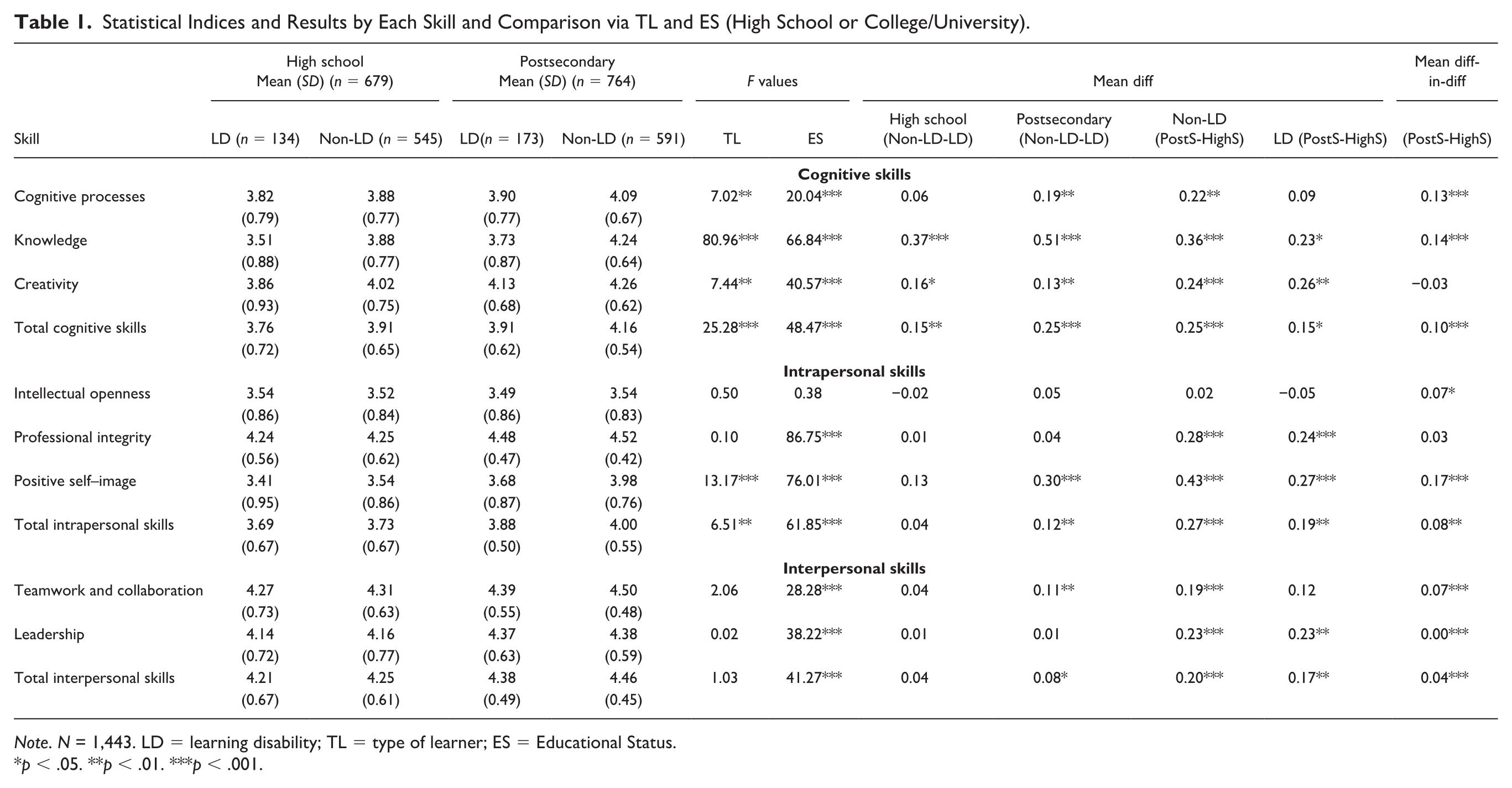
Table 1 presents the groups and statistical indices and results of the research in three clusters of 21st-century skills. The first column presents the 21st-century skills, including their clusters and subfactors. The second to fifth columns present, respectively, the calculated indices (mean and standard deviation) of the dependent variables (DV—the skill scores) among the research groups. The sixth and the seventh columns present, respectively, in each of the eight 21st-century skills, the F values and the significance level of TL (students with and without LD) and the educational status (high school or postsecondary education). The eighth to the eleventh columns present, respectively, the mean difference between the type of learner (LD and non-LD) in high school and postsecondary education, and the mean difference between the educational status groups (postsecondary education—high school) in students with and without LD. The last column shows the differences between the two mean differences (diff-in-diff) within each group of educational status, with and without learning disability.
Statistical Indices and Results by Each Skill and Comparison via TL and ES (High School or College/University).
Note. N = 1,443. LD = learning disability; TL = type of learner; ES = Educational Status.
p < .05. **p < .01. ***p < .001.
Table 1 shows a lower average score in most skills among high school students with LD compared with the scores of their peers (except for intellectual openness) and a lower average score in all skills among postsecondary students within LD compared with the scores of their peers. In addition, the F values of the main effects of type of learner and educational status with regard to 21st-century skills are also represented; no significant interaction effects were found with regard to the examined skills.
Discussion
The main aim of this study was to examine 21st-century skills among students with and without LD in high school and postsecondary school, according to their self-report, to shed light on the differences between the groups in different educational settings. Overall (beyond type of learner), postsecondary education students earned higher scores in most 21st-century skills compared with high school students. Second, students with LD reported significantly lower scores in all cognitive skills and in self-image compared with their typical peers. Third, the gaps in 21st-century skills between students with LD and their peers were wider in most skills in postsecondary education than in high school.
In general, current findings regarding typical learners showing that students exhibit better 21st-century skills in postsecondary education than in high school suggest that these students have a better chance of integrating successfully into society (Graesser et al., 2022; Krassel & Sørensen, 2015; Stephan & Dieker, 2022). As has been previously found, postsecondary education serves an important role in predicting young people’s career and economic development, income, and socioeconomic status (SES) in the OECD countries (Krassel & Sørensen, 2015; Lacour & Tissington, 2011; Patterson, 2022; Showers & Kinsman, 2017; Theobald et al., 2019). Statistical data collected in Israel support this notion and show a positive correlation between graduating from academic studies and future earning capacity and socio-economic status (Ayalon, 2008; Brodet, 2004; Davidovitch & Soen, 2005; Haimovich & Ben-Shahar, 2004), highlighting the critical role of colleges and universities in preparing young adults for the demands of the labor market. However, as previously mentioned, current findings should be viewed with caution due to the Israeli context, in which learning in postsecondary education starts at an older age than in other countries due to mandatory military service. Since military service includes participating in some courses as part of the preparation for the young recruits’ positions, it is reasonable to assume that such preparation also contributes to developing some of the 21st-century skills. Moreover, older students might be more focused and mature and thus can make better educational choices and return to studies in postsecondary education with higher motivation which supports their learning (Frenette, 2022). While a break from academic studies after high school may benefit the general population, for individuals with LD, it can negatively affect success in postsecondary education, posing a significant barrier to degree attainment (Showers & Kinsman, 2017). The break in the continuity of studies between high school and postsecondary education might require LD students to put in more effort than others in refreshing their knowledge and skills to gain the desired academic outcomes. They may experience regression in their academic and cognitive skills during the break and find it challenging to reintegrate into an academic setting and adjust to the demands of postsecondary education after completing military service. One should also bear in mind that individuals’ personal resilience, available support networks, and access to learning opportunities during the break period might be correlated to the level of the impact of the military service break on their decision to continue learning in postsecondary education and their chances of success in their studies. Thus, it is hard to isolate the contribution of this period of time from that of higher academic studies. Understanding the relationship between the “military service gap” and enrollment and success in postsecondary education should therefore be a subject for future investigation.
Despite current results pointing to the critical role of the educational system in providing the young population with needed 21st-century skills, the population with LD seems to be left behind, exhibiting lower scores in most examined skills than their peers in both high school and secondary education. These findings point to the failure of educational institutions to properly support this population, which constitutes between 5% and 15% (Grigorenko et al., 2020) or even about 20% of the general population according to some researchers (Horton, 2015; Johnson et al., 2007). Note that by definition this population has a normal level of intelligence (Grigorenko et al., 2020) and thus can further develop these skills when provided with the proper learning strategies and support that can serve as a protective net (Fleming et al., 2018; Klassen et al., 2013; Margalit, 2003). It is possible that their learning difficulties, which are mostly reflected in difficulties in building an adequate literacy infrastructure, accumulate over the years, pointing to a Matthew effect that not only perpetuates itself but might also transfer to additional areas, putting at risk the development of other essential skills (Heckman, 2006; Lee & Burkam, 2002; Perfetti, 1988; Stanovich, 1988; von Hippel & Hamrock, 2019), 21st-century skills among them. The low level of 21st-century skills reported by students with LD in this study, in both high school and postsecondary education, supports this claim. Moreover, the gaps in 21st-century skills between students with LD and their typical learner peers were larger in postsecondary education than in high school. It is possible that the difficulties that high school students with LD experience in some literacy aspects, as part of the set of cognitive skills, put them at risk of further developing other important 21st-century skills in postsecondary education. While students with LD reported a lower level of 21st-century skills in high school in two out of the eight examined aspects, in postsecondary education, they reported lower levels in most of the skills (five of eight) than typical learners. In this context, we can postulate that, throughout the years, a Matthew effect was transferred to other areas far beyond literacy. Without suitable instruction and learning conditions in postsecondary education, the students with LD accumulated gaps in other 21st-century skills as well. One can only assume that the problem may be even wider than we think and include other aspects that were not included in this study. Since LD is a chronic condition, students’ futures are vague unless some interventional and preventative steps are taken to change the state of students with LD in various educational settings.
This low level of essential skills puts students with LD at risk of graduating from postsecondary education and developing future professional skills for successful integration into the labor market. They seem to be missing the set of fundamental core skills needed to cope with the dynamic changes that characterize the world in the 21st-century. However, despite these results, note that the current research is not a longitudinal study but rather a cross-sectional comparison study that examines two different groups of participants at a particular time point. As such it does not follow changes in participants’ 21st-century skills over time and does not allow us to establish trends in the long run. Moreover, as mentioned by Protopapas and colleagues (2016), the testability of the Matthew effect in such a study is problematic because other variables that cannot be measured might be related to the group differences in 21st-century skills.
Nonetheless, examining the set of eight skills enables us to deepen our understanding regarding the skills in which students with LD require more support. As suggested by Martin (2018), identifying populations at risk of developing proper skills for assorted reasons related to their backgrounds should be a major educational aim. The participants with LD in the current research seem to need a more supportive environment to develop their cognitive skills, including cognitive processes and thinking strategies, knowledge, and creativity. In the realm of intrapersonal skills, they also need to strengthen their self-image. This should be done before their entrance to postsecondary education to minimize the risk of academic failure and dropout and to prevent the skills gap from increasing. As mentioned by Fleming and colleagues (2018) and Stephan and Dieker (2022), educational systems have an essential role in preparing these young people for the labor market. However, the reader should bear in mind that to design the proper support for students with LD, it is necessary to have a better understanding of the challenges they are facing as adolescents and young adults, including the transition to postsecondary education (Al-Yagon & Margalit, 2016).
Despite their low level of ability in most 21st-century skills, students with LD reported a similar level of intellectual openness, professional integrity, and leadership to that of their peers at high school and postsecondary education. What distinguishes these skills from the rest? According to the definition of LD, difficulties can appear in one or more academic aspects involved in oral language, written language, and math (D’Intino, 2017; Grigorenko et al., 2020). It is possible that skills such as intellectual openness and professional integrity are less academic in nature and thus are less dependent on academic functions that are often deficient in learners with LD. It might also explain why the accumulating gaps from high school to postsecondary education are mostly found in the cognitive set of skills and in low self-image that results from struggling with academic skills.
Due to the relatively large sample in this study, current results point to a worrisome problem in the ways the education system treats or supports students with LD. This issue should also be examined among a younger population to grasp the severity of the gaps between the groups of learners. However, since the Israeli postsecondary education students examined in this study are relatively older than those who often study worldwide for a BA degree, results should be treated with caution when discussing other groups beyond the particular group of students examined in this study. Future comparative studies should also be conducted in other countries to further support and strengthen current findings, thereby gaining a more nuanced understanding of 21st-century skills in various cultural contexts (Graesser et al., 2022). Large mean-age differences between groups of students studying for a BA degree might add other variables that can impact their educational environment. For example, former experiences such as work or pre-academic studies might be correlated with individuals’ awareness of their abilities. Thus, the way postsecondary education students perceive their 21st-century skills might differ across countries. By conducting such research and showing similar outcomes, the results of this study could be generalized to a broader population with greater confidence.
In summary, we sought to learn about the state of students with LD in high school and postsecondary education with regard to a set of eight 21st-century skills. The gaps in self-reported skill scores between the two groups of learners (LD vs their peers) were compared in each of the educational settings, that is, high school and college/university. This research provided us with the opportunity to illuminate the challenges students with LD are faced with—challenges that put them at risk for successful integration into society. Results indicate that some domains, mainly the cognitive set of skills, should certainly be strengthened in this population to better guarantee its future. This approach supports multi-component holistic theories of learning disability that perceive the disability as dynamic and subject to change over an individual’s lifespan due to personal and environmental features. That is, educational support can moderate learning difficulties and achievement outcomes (Klassen et al., 2013; Margalit, 2003); therefore, might help to cope with the challenge concealed in Matthew effect and the cumulative gaps. Such measures are worthy of implementation in postsecondary education to prevent students with LD from enlarging the gaps between them and their peers over the years and minimize their chances of dropping out. Educational support should not only focus on exam modification according to diagnostic reports, as often done in postsecondary education systems but also on instructional methods and learning strategies as an intrinsic part of their academic studies. Focusing merely on modifications for exams provides them only with the opportunity to succeed at the current particular challenge they are faced with. It does not support the development of learning tools that can be used in a broader context, in other situations in the future.
Another supportive possibility that might be also useful in dealing with Matthew effect in the realm of 21st-century skills is to focus directly on the identification of the underdeveloped skills among students with LD and cultivate those skills. As concluded by Johnson and colleagues (2007) and Kim and Aquino (2017), gradual and systematic 21st-century skills intervention programs designed and delivered to students with LD before the transition to adult life can dramatically increase their chances of integrating productively into the labor market and society. Following Lytra and Drigas’s (2021) suggestion, it might be worthwhile to consider developing metacognitive skills among learners with LD. That is, to help them consolidate their knowledge regarding their cognitive abilities and self-regulation of behaviors (Pappas et al., 2018). With this knowledge and awareness, students are given tools to control how they learn, develop action steps to enhance the learning process, and assess their understanding. These skills can be adapted and applied in new situations and are an important part of the skills of the 21st century. By recognizing their weaknesses and learning strategies to compensate for cognitive deficits, students with LD can better cope with adapting to changes in various life contexts. Developing metacognitive skills can be achieved successfully through collaborative activities focused on everyday meaningful problems (project-based learning). This approach becomes more effective when it includes knowledge from science, technology, engineering, mathematics, and art (Lytra & Drigas, 2021), and has been found to be efficient in promoting 21st-century skills, such as critical thinking, problem-solving, and communication skills, in students with LD (Flynn, 2014; Lytra & Drigas, 2021). Such considerations should be taken into account by educators and policy makers in future curriculum design for students with LD. Raising educators’ awareness to LD students’ difficulties and risks in acquiring 21st-century skills is also needed, as well as training in identifying the challenges of their learners and the various instructional strategies that can be used to support them.
Similar to Chalkiadaki (2018), we believe that cultivating 21st-century skills should be perceived as a lifelong process that starts at a younger age, in particular with at-risk populations. Finally, one should bear in mind that the skills examined in this study might not be fully separated and that each domain doesn’t develop in isolated “laboratory conditions” but rather has reciprocal relations with the development of other domains—an important issue that should be considered for future research.
Limitations
Despite the importance of current findings in identifying the differences in 21st-century skills between students with LD and their peers in critical educational settings, some limitations should be taken into consideration when evaluating our results and for future research planning. First, some environmental demographic aspects that were not examined in this research, such as SES background, can also explain differences within the group of students with LD, helping us to understand these students’ specific difficulties and the changes that must be made in educational systems to support instruction and use of 21st-century skills. Second, the type of disability should also be considered in future research since some disabilities might be more challenging than others and thus have a different impact on the acquisition of 21st-century skills. Third, the prevalence of students LD reported in this study and in Israel in general, is relatively high compared with what is reported in the literature (Grigorenko et al., 2020; Zablotsky et al., 2019). Thus, we should consider the possibility that some students might not have a learning disability and have been mistakenly diagnosed as such. Moreover, the reader should bear in mind that current results rely on self-reported data. While self-reported data can be useful in reaching a large group of participants, findings may be influenced by participants’ own subjective perceptions that may not accurately reflect their actual level of performance in a particular skill. This might be even more frequent among students with LD, who often tend to underestimate their abilities and perceive themselves poorly (Ben-Naim et al., 2017; Horton, 2015; Idan & Margalit, 2014). Fourth, details regarding the military service, community service, or certificate studies of the participants can also be of use in understanding their role in 21st-century skills. Future research focusing on cross-country comparison of 21st-century skills can help in clarifying universal and specific features of the role of educational systems in this process.
Supplemental Material
sj-docx-1-ldx-10.1177_00222194231211947 – Supplemental material for Perpetuating the Gaps: 21st-Century Skills in Students With Learning Disabilities and Their Typically Developing Peers
Supplemental material, sj-docx-1-ldx-10.1177_00222194231211947 for Perpetuating the Gaps: 21st-Century Skills in Students With Learning Disabilities and Their Typically Developing Peers by Vered Vaknin-Nusbaum and Israel Rachevski in Journal of Learning Disabilities
Footnotes
Declaration of Conflicting Interests
The author(s) declared no potential conflicts of interest with respect to the research, authorship, and/or publication of this article.
Funding
The author(s) received no financial support for the research, authorship, and/or publication of this article.

References
Supplementary Material
Please find the following supplemental material available below.
For Open Access articles published under a Creative Commons License, all supplemental material carries the same license as the article it is associated with.
For non-Open Access articles published, all supplemental material carries a non-exclusive license, and permission requests for re-use of supplemental material or any part of supplemental material shall be sent directly to the copyright owner as specified in the copyright notice associated with the article.
