




Abstract
This article introduces the special issue, bringing together research on psychosocial workplace hazards (PSWH) which engages industrial relations (IR) perspectives. This is important as PSWH are increasingly studied and regulated, with new regulatory frameworks creating opportunity and necessity for IR perspectives to engage with PSWH. These hazards are intimately related to power relations between employers, workers and the broader society within which they interact, a topic of longstanding investigation within IR. To date, PSWH research has largely occurred in the work, health and safety (WHS) field, reflecting a broader historical separation between WHS and IR in scholarship and practice. While WHS literature outlines the significance of psychosocial hazards as a public health issue, and proposes solutions for their mitigation, we argue that IR framing, and indeed IR frames of reference, can better explain the existence and promote mitigation of PSWH. In this SI the seven papers provide insights into the history of PSWH study; impact of work conditions on restructuring and PSWH; applying the Pressure, Disorganisation and Regulatory Failure (PDR) model in research on sexual harassment; organisational conditions that contribute to the health risks associated with the work, psychosocial hazards women workers experience due to menstruation in developing countries and union strategies for managing workload of union employees.
Keywords
Introduction
The isolation. The lack of benefits. The monotony. The underemployment. Your resources, your skills, your intelligence are not integrated…the hopelessness, just the stagnation. The fact there's never any increase in cerebral activity…It's really lonely…
- Helen, temporary clerical worker. (Yates, 2022: 67)
The noise, oh it's tremendous. You open your mouth and you’re liable to get a mouthful of sparks… You dream, you think of things you’ve done. When you dream, it reduces the chances of friction with the foreman or with the next guy… [The assembly line] don’t stop. It just goes and goes and goes…Repetition is such that if you were to think about the job itself, you’d slowly go out of your mind…I don’t like the pressure, the intimidation …Because you’re nothing more than a machine…
- Phil, spot welder, assembly plant. (Terkel, 1974: 222–223)
Psychosocial Workplace Hazards (PSWH) are increasingly studied and regulated component of work. Issues such as work intensity, fatigue, adverse environmental conditions, low levels of control, poor leadership practices, inappropriate and unreasonable behaviour, monotony, isolation, low recognition and reward, and insecure work have persisted in working life, as evidenced by the above vignettes from American workers from the 1970s and 2000s. While the language used to describe these phenomena is unlikely to have explicitly identified d PSWH, workers were often aware of the harm being caused to them.
The International Labour Organization (ILO) defines psychosocial work factors as the ‘interactions between and among work environment, job content, organizational conditions and workers’ capacities, needs, culture, personal extra-job considerations that may, through perceptions and experience, influence health, work performance and job satisfaction’ (ILO, 2016: 2). PSWH are aspects of ‘work design and the organization and management of work, and their social and environmental contexts, which have the potential for causing psychological, social or physical harm’ (Cox et al., 2000: 14) and are a persistent part of working life.
There is a growing literature on the economic costs of workplace stress, PSH and work, health and safety (WHS) more generally (Hassard et al., 2018; Loh and Dollard, 2023; Knox and Bohle, this SI; Faulkiner and Belzer, 2019). Indeed, behind the international and national proclamations and legislation that promote safe workplaces is recognition of the costs of failure to mitigate workplace OH&S risks including PSWH. In Australia, work-related stress has been estimated to cost between $294.5 M and 5.3BN (AUD) a year (Hassard et al., 2018). Researchers in other jurisdictions have also come up with estimates in the hundreds of millions or billions of dollars annually (Hassard et al., 2018), while Dollard and Neser (2013: 123) have argued that ‘worker health is good for the economy’. Comparing data from 31 European countries, they found a ‘significant and positive’ relationship between worker self-reported health and GDP: ‘After controlling for other variables worker health explained 13% of the variance in GDP’. The same study found union density to be ‘significantly indirectly positively related to worker health’. At the extreme end, PSWH contribute to work-related suicide. LaMontagne et al. (2024: 682) estimate 10.5% of 3775 Australian suicide deaths over a 7-year period to be work-related, with estimates at 13% in New Zealand (Magill, 2024), 12% in Japan (Yamauchi et al., 2017: 23) and 13.5% in the USA (Peek-Asa et al., 2021). The real numbers may be even higher, given that case-based approaches are likely to under-emphasise ongoing exposure to PSWH (LaMontagne, 2023).
PSWH are linked not only to mental distress but can contribute to physical illness including cardiovascular disease and musculoskeletal disorders (Taibi et al., 2021). Further, this can infiltrate work processes, as, for example, pressure to work fast is a psychosocial hazard, but also contributes to physical safety incidents and occupational injuries (Quinlan and Underhill, 2021; Swaen et al., 2004). This can also have a compounding effect, where the presence of multiple PSWHs predict increasing occupational injuries, safety incidents and resultantly increased time off (Port and Blackwood, Forthcoming; Johannessen et al., 2015; Kim et al., 2009).
The recent introduction of PSWH regulations across Australian jurisdictions and elsewhere is significant for industrial relations (IR) scholarship as PSWH are intimately related to power relations between employers and employees, within the context of broader social workplace relations. PSWH, when viewed through an IR lens, are drawn from spheres of contestation reflecting different perspectives and interests in the workplace (Dunlop, 1958), including work demands and concepts such as ‘clarity’, ‘control’ and ‘support’. These variations in perspectives are underscored by survey data, for instance one US survey found 71% of employers with frontline employees report supporting workplace mental health very or very well compared to only 27% of employee respondents (Coe et al., 2021).
These power dynamics are central to the IR scholarship, yet existing scholarship centred in the WHS discipline have largely presented PSWH in a positivist manner. Inversely, IR Scholars have often viewed power and contestation outside of the domain of WHS, for instance where workplace issues such as workload and work intensification are studied, they are treated as working conditions and not as safety hazards. In this introduction we explain these trends by referring to the persistent siloing of IR and WHS, both in theory and practice. We argue for the importance of locating PSWH within an IR analytical framework, while calling on IR scholars to pay greater attention to the literature on PSWH in other fields. While this literature may come from a different starting point, its insights and empirical details can enrich discussions that IR scholars should be having.
This regulatory intervention to incorporate PSWH into safety issues at work more broadly presents an opportunity for greater integration of IR and WHS scholarship. This special issue capitalises on this opportunity to re-integrate IR and WHS approaches to PSWH. The six papers contained in this SI address PSWH using IR frames by focussing on the history, contextual case studies, organisational cultures and models for IR-PSWH research. With regulation explicitly expanding the domain of workplace safety to incorporate PSWH, an impetus has been created for greater interrogation of the power relations within and around work, a subject with a long history of analysis for radical pluralist and radical IR scholarship. This, coupled with the institutional power now granted to those who seek to enforce psychosocial safety at work, creates opportunities to increase and assert power at work.
PSWH have long been part of work and workplaces, and this special issue provides an opportunity to explore PSWH within the IR domain. In contextualising this collection, we seek to answer the following questions:
Why hasn’t IR literature focussed on PSWHs? Why should it, and why now? How does the WHS literature treat workplace psychosocial hazards, what can we learn from it, and how might IR scholars engage with it?
The rest of this article examines these questions by first introducing the relevance of IR frames of reference to workplace safety, then analysing the siloing of IR and WHS in both practice and theory. We point to the contribution made by the papers in this special issue, as well as the need for wider empirical and theoretical investigation of these issues, as well as fruitful directions for future research.
PSWH, frames of reference and IR
IR scholarship has long dealt with contestation using the concept of frames of reference, which came to the fore in British IR policymaking in the mid-twentieth century (Fox, 1979). Frames of reference are useful in explaining the trajectory of workplace safety, as they demarcate where issues are resolved, and whose perspectives are legitimate. Where unitarist accounts see decision making as being management's domain, neo-pluralist approaches have seen scope for the type of reforms which have prompted this special issue. Radical pluralists and Marxist approaches, however, see safety at work as the manifestation of broader power imbalances in society and all approaches command different regulation and action to resolve the harm of PSWH at work.
Unitarist accounts see decision making as management's domain, and accords with WHS scholarships’ positivist approach (see below) and the dominance of psychological approaches within safety science. Often quantitative in nature and featuring many meta-reviews, this literature examines the individual and organisational level and its interaction (e.g. Taibi et al., 2021; Sun et al., 2021; Oakman et al., 2022). Unitarist approaches also underpin WHS practice, with many organisations apply a unitarist approach to IR and WHS, downplaying conflict and excluding unions. Worker participation in WHS issues, to the extent it takes place, occurs on management's terms (subject to state regulatory requirements around representation, reporting, enforcement) and is fundamentally supported by a business case. The shifting of WHS into the unitarist domain of managerial prerogative meant that organisational psychology and the judiciary became the domains in which safety questions were answered (Sheldon and Gregson, 2021). Separated from arbitration and conciliation settings, this led to an obfuscation of the pluralist origins of Robens-style rulemaking (James and Walters, 2022).
Pluralism, which sees organisations as aggregations different groups with both common and conflicting interests, has been the hallmark of IR institutions through the twentieth century. Pluralist IR scholarship itself has evolved as the political, economic and institutional context as IR has changed. In the mid-twentieth century pluralist research was interested in resolving questions of labour disorder through minimising strikes and low productivity in exchange for improved working conditions (Heery, 2016; Cradden, 2014). However, subsequent neo-liberalising work reforms, weakening trade unions and decreasing overt industrial conflict led pluralist scholarship to shift focus to charting many of the difficulties for workers under modern work regimes, such as questions of precarity or declining job quality (Heery, 2016), all of which can create or exacerbate PSWH. The health risks underscored by neo-liberalised work regimes, as we touch on in this special issue, creates a renewed opportunity for pluralist IR scholarship to re-integrate with safety through the regulation of PSWH as well as ‘the industrial activities that may relate to enforcement of these new rules’ (Quinlan, this SI).
A radical/Marxist approach situates psychosocial hazards in wider capitalist social relations. As Quinlan (1980, 39–40) argues: Workers sell their lives along with their labour power. Historically, intervention by the state has modified some hazards and created the impression that health is not a question of class struggle. Nevertheless, the conflict remains. Ultimately, the state has always collaborated with employers if it appeared legislation might threaten the viability of industry.
This frame of reference views the interests of workers and capital as fundamentally counterposed (Hyman, 1975). The nature of the capitalist system means there will always be conflict between employers and employees (Marx and Engels, 2005 (1848): 40) and that state regulation underpins and supports capital accumulation. This is significant in the context of WHS as Quinlan (1980: 38) continues: Union leaderships have largely accepted this situation and sought to negotiate the best deal for injured workers rather than attacking the root causes of illness…The most effective challenge to this has occurred when well organized groups of workers have vigorously contested managerial prerogatives with regard to work organization rather than relying on inadequate laws.
This points to the divergent, if overlapping, interests, between trade union officials and trade union members, a point highlighted by Marxist IR scholars such as Bramble (1993, 2008), Darlington and Upchurch (2012) and Vassiley (2024), though contested by others (see e.g. McIlroy, 2014). A radical perspective rejects worker reliance on the state to resolve issues of worker safety as futile, and sees improvements in workplace safety as a part of class struggle at the point of production.
Safety at work, including PSWH, is contentious as it necessarily impinges on areas which management claim as being within managerial prerogative. This is a salient issue for those who subscribe to all three frames of reference, and in turn these frames are important in understanding why IR became siloed from WHS, and how IR might engage with PSWH.
The siloing of IR and PSWH
In the Anglophone world, WHS has persistently been separated from other IR issues. Australia provides a valuable example of this siloing, as the IR system provides employees with statutory minimum standards and a minimum wage, a system of industry-level awards acting as a safety net. Disputes are, ultimately, resolved by the Fair Work Commission, the industrial tribunal, set up under federal legislation (Peetz, 2018). Running parallel to this is what might be termed the ‘work health and safety system’. This includes worker's compensation, where workers are awarded payment after suffering physical or psychological injury linked to the workplace, and the WHS regulatory bodies at both state and federal levels (Stewart and Bray, 2020). Even though PSWH relate clearly to industrial issues, such as working hours, shift rotations and absenteeism, there remains very little overlap between these two different systems.
The sharp demarcation of IR and WHS in practice (and scholarship as discussed below) occurs even though WHS has been an issue of industrial significance for as long as work itself. In Australia, battles over issues such as working hours have been a key mobilising issue for workers going back to the 1800s (Quinlan, 2023a). Worker and union action has forced change and state intervention. As early as 1854 the growth of union organisation and strikes by miners in Newcastle ‘led to the first recognisable health and safety act being introduced in New South Wales in 1854’ (ACTU, n.d.), but legislation remained a relatively incoherent patchwork for over a century.
In the 1970s, Australian unions focussed increasingly on WHS, campaigning for physical hazards to be mitigated, as well as for meal and rest breaks (ACTU, n.d.). Militant worker movements and the Robens report being tabled in the United Kingdom led to a more coherent WHS legislation regime being introduced. This included legally mandated workplace representatives who could take up WHS issues with management, a phenomenon which took place across a range of countries globally. In the United Kingdom for instance, trade unions were given the ability to appoint such representatives (James and Walters, 2022: 69). This brought about a greater overlap between IR and WHS in practice. Nevertheless, the domains of IR and WSH continued to be pulled apart by State forces, where IR commissioners did not seek to encroach on safety – viewing work practices, staffing levels, shift patterns and so on as the domain of managerial prerogative – as it might be seen as overreach (Quinlan, 1980).
At the grassroots level however, powerful sections of unionised workers did impinge upon managerial prerogative, gaining significant influence around psychosocial factors such as staffing levels, job insecurity and autonomy. One standout example of this is the Pilbara iron ore industry in Western Australia (Vassiley, 2025). Such grassroots control also impinged on union officials’ negotiating role. This is salient for the history of the governance of safety in Australia, as Australia's arbitration and conciliation system had deemed WHS management as a legitimate exercise of managerial prerogative, and, as such, sat squarely in the unitarist domain. Unions were able to bring safety risks into collective bargaining, and therefore pluralist rulemaking, by ‘monetising health risks’ when bargaining for pay and condition, but this remained an issue outside the domain of industrial tribunals and commissions.
The separation of the IR regulatory regime from issues of WHS, and the reluctance of The Commission to expand its domain on the other domain, has in become entrenched over time. This was exacerbated by neoliberal, unitarist workplace relations, where issues which were core to safety were ceded to managerial prerogative. As Quinlan (2023b: 5) writes in this SI: In Australia the arbitration/award system – though by no means perfect – forced employers to negotiate, curbed piecework and set legally enforceable minimum standards for workers, including those with relatively little bargaining power. Between the 1980s and 2010 a succession of governments … seriously degraded the arbitration system.
The legislative response to PSWH has evolved in the past two decades. In part, this stemmed from increasing data on the costs of, and the business case for addressing, PSWH (Hassard et al., 2018). In recognition of the incidence, costs and growth in PSWH, governments have introduced labour laws and established regulatory authorities to promote workplace safety that includes reducing PSWH. Within Australia it is the state governments that have responsibility for ensuring workplace safety. Each state has a regulatory authority (e.g. Worksafe NSW) with responsibility for PSWH, including by suggesting courses of action to address the hazards. For example, the Western Australian Code of Practice: Psychosocial Hazards in the Workplace (Government of Western Australia, 2022). Table 1, lists 20 such hazards and their descriptions.
WA code – list of psychosocial hazards.
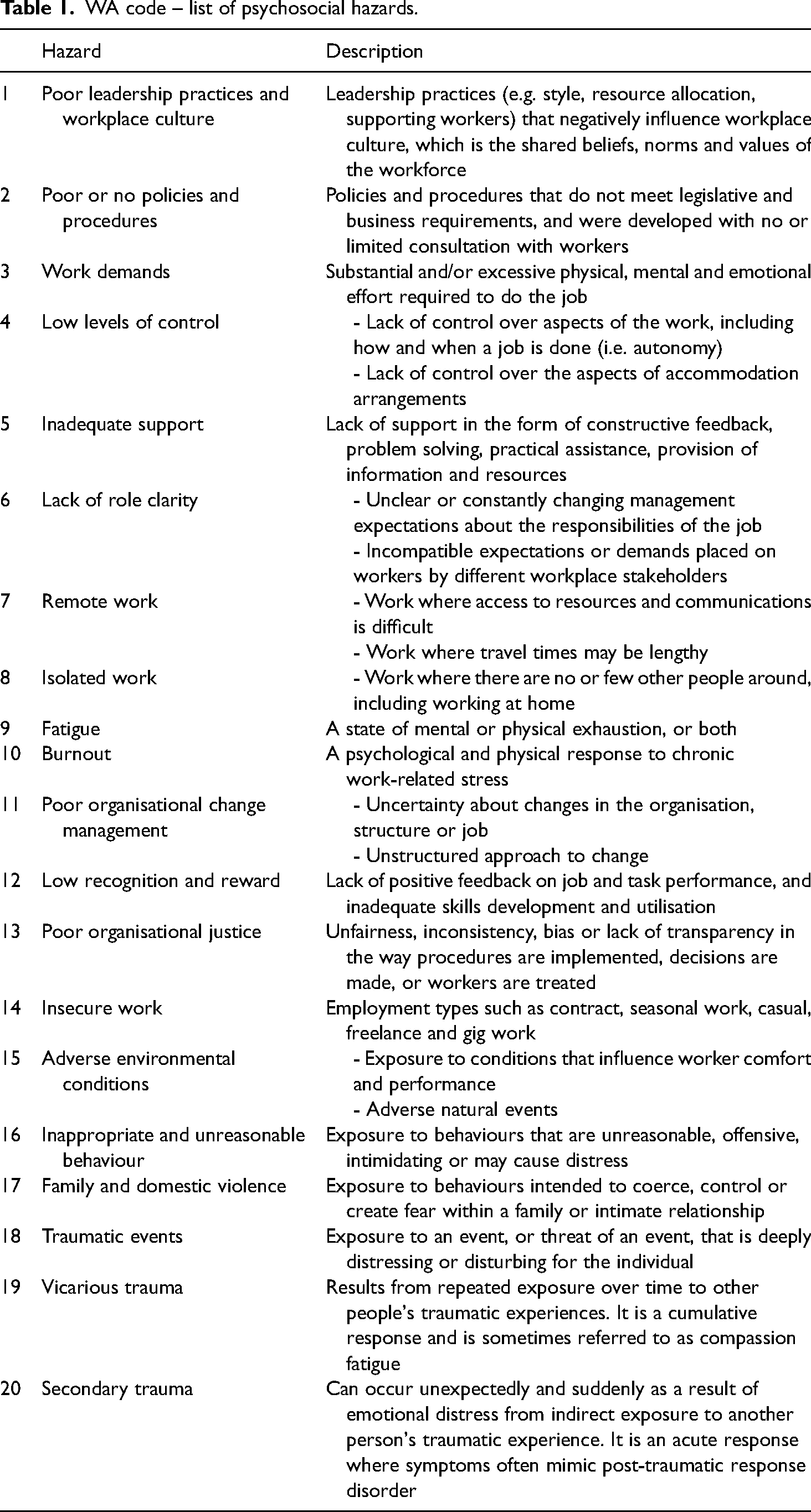
The aim of classification systems is not to be exhaustive, but rather to create awareness about the range of factors and conditions that can potentially impact on WHS. This is significant as it moves beyond issues of individual physiology.
The list of potential PSWH is not static with new risks emerging as the demands of jobs, the workplace and work changes in response to such developments as new technology. Table 1 recounts several consequences of PSWH such as trauma, stress, isolation, loneliness, exclusion, confusion and fatigue. There are potential sources of the hazards identified that range from poor management to insecure employment arrangements, discrimination and the absence of a regulatory framework to support worker safety. There are similar classification systems that identify specific hazards found in the literature and across state jurisdictions in Australia (see Quinlan, this SI).
From these lofty ambitions, the regulatory approach to PSWH has been largely reactive; confined to symptoms; and restricted to the formal workplace (see Quinlan, this SI). A case in point being workplace sexual harassment as a PSWH that has predominantly relied on ‘practical reasonable measures’, individual claims of employer's ‘vicarious liability’ and a narrow definition of worker. In the wake of calls across worker organisations and civil society a proactive positive duty of care has been introduced to prevent workplace sexual harassment (Dayaram, 2022). Indeed – this accords with unitarist ideology as if these areas are part of managerial prerogative, managers should be held accountable for their actions if they cause harm.
Despite the siloing of IR and WHS, Australian regulation does create opportunities to expand understandings of PSWH beyond job design or individual ‘vicarious liability’. This again opens up not only the capacity for strategic engagement by unions to ‘police’ PSWH but also engagement with IR scholarship focusing on the labour process and workers’ conditions. These have been long-considered, though some would argue insufficiently (Quinlan and Bohle, 2014), but rarely with an emphasis on workplace safety. The reforms increase the opportunity for unions to engage with safety directly, creating the opportunity for changes to IR in practice, and also for IR scholars to consider the merits of changing union strategy, itself a lynchpin of IR research.
PSWH in the literature outside IR
Scholarship too has seen siloing between IR and WHS. Research on psychosocial workplace hazards is found largely in journals in the WHS field, and not in IR ones. Of Researchgate's top 10 cited and read journal sources on PSWH for the period 2018 to 2023, none were found in IR, and the field was dominated by nursing, safety science, psychology, ergonomics and epidemiology. The first and third cited articles were found in journals linked to public health and workplace risk assessment (Beck and Lenhardt, 2019). Rugulies (2019), came closest to an IR research approach, publishing in the Scandinavian Journal of Work, Environment, and Health, which concluded that the psychosocial work environment is an ‘intermediate step’ between individual workplaces and broader economic, social and political structures. 1
WHS research examines workplace issues yet does not share assumptions common to mainstream IR scholarship. Instead, it draws from approaches which can be considered unitarist, taking a positivist epistemological approach. This approach has allowed for great clarity in the measurement of safety and understanding causal relationships between certain work behaviours and material safety outcomes, but retains unitarist assumptions that workers are individual subjects of management's actions rather than as collective agents with divergent interests. 2
A series of models are used in WHS scholarship to analyse PSWH. The job demands-resources model (Demerouti et al., 2001) used to analyse psychosocial hazards continues to be popular across literature in psychology, work health and safety and human resource management journals (see e.g. Lesener et al., 2019; Mazzetti et al., 2023; Grover et al., 2018). Yet as Quinlan (this SI, p. 9) argues, the value of this model is weakened by its lack of attention to the broader IR and societal context outside the workplace, areas that IR deal with more effectively. Quinlan (this SI) argues that the older Demand-Control (Karasek, 1979) and Effort/Reward imbalance (ERI) model (Siegrist, 2010) are more sensitive to IR concerns with their nod to power imbalances at a workplace level in the case of the demand-control model and a recognition of factors outside the workplace such as job insecurity in the case of the ERI model.
Psychosocial safety climate (PSC) is a highly significant – bordering on overwhelming – concern of this literature. This concept was developed by Dollard and Bakker (2010). Its four main aspects are: (1) ‘[S]enior management support and commitment to psychological health through involvement and committment … evident when senior management take quick and decisive action to address and correct issues that affect psychological health. (2) The ‘priority the management give to employee psychological health and safety versus productivity goals… (3) Organizational communication.’ (4) ‘Organizational participation and involvement, concerns participation and consultation regarding stress prevention that involves all levels of the organisation, and the integration of stakeholders including employees, unions and health and safety representatives’ (Dollard et al., 2017). Dollard (2012: 1783) has outlined that PSC ‘reflects the management value position and philosophy about work stress, and management priority of regard for the psychological health of workers versus production imperatives of the organization’. As such, ‘…PSC is a lead indicator of psychosocial hazards – “a cause of the causes” – and work stress and is a crucial organizational level target for primary stress intervention’.
There are now hundreds of publications on psychosocial safety climate, with a large increase from 2018 (Idris, 2023). These are mostly empirical studies (for an example, see Potter et al. this SI) and validate the utility of the concept of PSC. Potter et al. (2024b: 10) demonstrate ‘a clear relationship between a suite of national policy approaches and the mental health protection at the enterprise level’ in a global study. Within these policy approaches, ‘having national legislation is the most critical impetus for workplace action’. The study also found trade union density to be significant in supporting workplace mental health, but lacked the political ambition to make reforms to increase density across the IR system.
While this separation between IR and WHS persisted, a focus on safety and IR has come from a third position, by considering the labour standards in global supply chains (Raj-Reichert, 2013). This literature emerged out of the offshoring of work from the Global North to South, particularly in the late twentieth century as trade barriers were brought down, creating a downgrading of labour standards which undermined unions in both high- and low-wage countries and created conditions that had the potential to exacerbate safety risks while hiding them from consumers through geography (Lambert, 2014).
However, high-profile cases such as Nike sweatshops in Indonesia, the Rana Plaza disaster and worker suicides as protest at Foxconn campuses highlight the physical hazards and PSWH that workers in these jobs experienced (Donaghey and Reinecke, 2018; Merk, 2015; Ngai and Chan, 2012).
The 2013 Rana Plaza disaster, where a building housing five garment factories collapsed, killing over 1000 workers brought international notoriety to Bangladesh's apparel processing sector. This highlighted the poor WHS conditions and absent regulation present in the sector and led to legislative action and WHS enforcement within the sector, together with the development of international codes around fair work conditions on the apparel from factories that was destined for markets in the Global North. While traditional WHS conditions supporting a safe workplace were improved, the hidden hazards associated with menstruation and its exploitation to support control of the dominant female labour force remain, as shown by Naznin and Thornthwaite (this SI).
Within economic geography scholarship, in particular Global Production Network literature (Coe and Hess, 2013) and supply chain literatures (Barrenitos, 2013), labour standards became a prominent issue, often brought into the discourse of ‘social upgrading’, looking at whether the location of an economic activity in an area improved the lives of those who worked and lived in that area (Barrientos et al., 2011). There has always been scope for dialogue between these arenas, and IR has a contribution to make by understanding the institutional forces through which global pressures to upgrade or downgrade safety issues get mediated at the workplace scale.
Interestingly, Idris (2023) has shown, in a survey of the literature, that PSC scores for developing countries tend to be higher. This is counterintuitive, given that working conditions, safety standards and worker voice tend to be lower in these countries. Idris (2023) suggests that this may be due to both less awareness, and lower expectations of acceptable behaviours at work in developed countries. Idris (2023) identifies a lack of attention to PSWH in Asia, both in academia and by regulators, citing ‘the lack of strong policies and regulations…[and] the lack of union power’ as barriers to addressing them. An in-depth literature review on workplace violence and harassment reveals that much of the existing research is shaped by perspectives from Western, Educated, Industrialized, Rich, and Democratic (WEIRD) countries (Goel et al., Forthcoming; Field et al., 2021). These studies underscore the value of an IR approach, highlighting both regulatory and monitoring mechanisms within specific country contexts. They advocate for Asian researchers to adapt definitions and constructs to better reflect their regional contexts. At the same time, the findings emphasise the challenges of quantifying subjective experiences in social science surveys, underscoring the inherent limitations of such methodologies.
Why the IR literature has marginalised PSWH
In the main, IR research has not to date has not addressed the topic of PSWH. Quinlan and Bohle (2014: 4) write this about insecure work, but the point holds more broadly: Over the past 20 years, literally hundreds of studies have examined the OHS effects of downsizing/job insecurity, outsourcing/subcontracting and the growth of temporary (including seasonal) work arrangements in a large number of countries…there is overwhelming evidence these changes to work organisation are associated with a significant deterioration in OHS outcomes (including injury rates, exposure to hazardous substances, disease, mental health and work/family balance). Only a miniscule fraction of this research has been published in or even referred to within IR journals. This review finds that SWC [substantive working conditions] (such as wages and OHS) were the primary focus of only 20 percent of articles. More detailed analysis revealed systematic analysis of SWC in 23 percent. We argue that to renew itself as a discipline and a major contributor to policy debates over work employment, IR must engage more directly with changes in SWC.
More generally, WHS is a mobilising issue that is ‘under-recognised’ in IR and labour history scholarship (Quinlan, 2023a). Quinlan's database on worker mobilisation counts the number of times that issues are raised by worker organisations in Australia from 1801 to 1900. Throughout this entire period, ‘health and safety’, ‘hours of work’ and job security (classed as ‘jobs’) consistently rank highly, alongside wages (Quinlan and Maxwell-Stewart, 2023: 14–15). Such issues continue to feature heavily in industrial disputes, though aren’t always explicitly analysed as safety issues. In November 2024, for example, Woolworths distribution workers in Victoria were took industrial action against a highly standardised performance management programme (Missen, 2024).
IR research retains a focus on institutions, largely at the national level. Certainly in Australian IR research in recent decades, institutions and the IR parties – the state, employers and unions – are emphasised, reflecting the pluralist domination of the field. While exploring these actors’ roles, policies and interventions at a macro-level helps in understanding aggregate effects of regulation, strategy and policymaking, some of the individual effects can be overlooked. For example, in 2021 this journal's annual review had articles on the following topics: the labour market; women and work; unions and collective bargaining; employer associations; industrial legislation and, major court and tribunal decisions, all of which emphasise the importance of institutions in both understanding and policy.
Nevertheless, there is an ongoing research agenda and body of work to base IR scholarship on, as there are those who have broken down the barriers between IR and WHS. For example, Quinlan and Bohle's (2004) Pressure, Disorganisation and Regulatory Failure (PDR) model draws on IR concepts. Economic and financial pressures, disorganisation (e.g. poor training, ineffective communication) and regulatory failure are causal factors shaping poor occupational safety and health (OSH) outcomes for insecure and other workers and can be used to predict and explain WHS outcomes. Despite the model's relevance, relatively few studies have utilised it. By contrast, Ten Pathways (Quinlan, 2014), which is more related to physical hazards and serious accidents/disasters, has been more widely adopted by WHS researchers (e.g. Jenke et al., 2022). This model outlines 10 causal pathways to fatal incidents, a number of which relate strongly to IR.
Quinlan, in this SI, refers to the exceptions (i.e. research using the PDR model). These include Bohle et al.'s (2017) research on hotel cleaners – which found direct positive associations between bullying, and disorganisation and regulatory failure, and direct positive association between intention to leave, and financial pressure and bullying – and European studies finding adverse WHS effects of precarious work (Strauss-Raats, 2019; Pilbeam et al., 2020). In a qualitative study of temporary agency workers, Underhill and Quinlan (2011) use the PDR model to explain these workers’ heightened vulnerability. Interview data found a reluctance for temporary workers to become health and safety representatives or shop stewards (union delegates), and union officials being constrained by their temporary worker members wanting to remain anonymous when reporting grievances (Underhill and Quinlan, 2011: 411–412). In this SI, Knox and Bohle argue for the application of the PDR model in research on sexual harassment.
Walters (2011) emphasises the nature and importance of worker representation for mitigating psychosocial hazards. This is grounded in an analysis of work health and safety representation as it applied to physical hazards. He finds ‘that many of the features of current restructuring of work that present problems for traditional model of worker representation are the same ones that lead to the increased prevalence of psychosocial risks at the workplace’ (Walters, 2011). These include the decline in union strength, downsizing and consequent work intensification, a proportionate decline in full-time permanent employment and outsourcing and ‘elaborate national/international supply chains’ (Walters, 2011). Walters sees an important role for health and safety representatives at the workplace level and for ‘joined up thinking’ by trade unions, that is, integrating approaches to psychosocial hazards and industrial issues (Walters, 2011).
Underhill and Quinlan (2024), examine recent Australian IR regulation for precarious workers. The article describes environments in road transport, food delivery and farm work involving psychosocial hazards such as high work demands, low levels of control, fatigue, poor organisational justice and (of course) insecure work. They argue that legislative changes requiring labour hire workers be paid the same as host workers, and increased rights for casual workers and those in the gig economy can ‘play a critical role in addressing at least some of the underlying reasons why precarious work undermines OHS’.
These issues are both safety issues and industrial issues, and changes in the regulations (which explicitly engage PSWH) as well as the nature of work create something of an institutional space to connect pluralist and radical IR explicitly with safety. By understanding the power dynamics of competing interest groups at the workplace, and the broader social relations in which work is housed, PSWH can be better identified and mitigated. Reciprocally, PSWH regulation has created an opportunity for IR actors and scholars to both identify, and better interrogate, the link between traditional issues of IR scholarship, looking at rules at work and IR institutions, and the safe functioning of workplaces.
The structure of the SI
Quinlan provides an extensive overview of the field. His article provides a historical outline of the data, causes, policies and analytical frameworks linked to the study of PSH. The dominant analytical frameworks for studying PSWH – the Job Demands and Resources Model, and other key models are assessed. The absence of an extended analysis of IR research on PSWH is highlighted, despite the long history of PSWH and of formal WHS regulations. Quinlan notes how psychology has dominated the analysis of PSWH, but the approach is largely ahistorical and removed from underlying contextual conditions that contribute to PSWH. He goes on to critique the regulation of PSWH in advanced economies, noting the dominance of a few systems and the limitations of the regulatory approach in terms of scope and identification of underlying factors contributing to PSH. Finally, the paper discusses how IR scholarship can contribute to the analysis of PSWH and inform public policy responses to PSWH. As Quinlan states, ‘Using or combining existing models, or developing a new model, would be a worthwhile task for IR scholars with a potentially valuable contribution to psychosocial hazard researchers in other fields. The resulting evidence should provide better understandings of how changes in IR affect health and the interventions (work reorganisation, IR policy and legislative changes) that will eliminate/minimise psychosocial hazards’.
Restructuring of Australian universities has been persistent largely in response to public policy and regulatory changes governing universities, and part of a process of managerialism driven by rankings and the pursuit of profits. Potter et al. analyse the impact of workplace restructuring on surviving staff at Australian universities for the period 2018–2021. Using a national survey, and across three points in time, the study provides a quantitative estimation of the impact of restructuring on surviving staff. Using the Psychological Safety Climate framework (Dollard and Bakker, 2010), a measure of the PSC is developed to assess the risks associated with university restructuring. The purpose of the study is to highlight that ‘restructuring is a strategic management option. The study suggests that organisational conditions contribute to the likelihood of restructuring and to the poor psychological health of surviving workers. “Overall”, low PSC has detrimental consequences when accompanied by high levels of restructuring. This is consistent with the theoretical proposition that restructuring is less likely in workplaces with a high PSC as psychosocial safety would be prioritised over productivity so there would be less inclination to restructure for economic reasons only’.
Manner et al. investigate the health and wellbeing of UK contact centre workers pre- and post-COVID-19. Prior research has established that contact workers are subject to stress and anxiety, customer abuse, surveillance, heavy workloads, algorithmic management and physical problems associated with the sedentary nature of the work (Kazi et al., 2014). In turn contact workers are at risk from high blood pressure and diabetes (Dempsey et al., 2020). Given the presence of mental and physical risks associated with contact work, Manner and colleagues investigated the organisational conditions that contributed to the health risks associated with the work. The study was based on Schein's (1990) model of organisational culture that assesses organisational culture at three levels – artefacts which are the physical work environment; espoused beliefs – the formal statement of organisational values; and basic assumptions – the actual behaviours and decisions of management. Through semi-structured interviews with call centre managers the study examined the perceived changes in organisational culture as a result of COVID-19. The study found that the structural shift to organisational operations resulted in a shift in organisational culture to recognising potential health hazards present in contact centres and implementing remedial measures to address these risks. That is, espoused beliefs changed. Working from home arrangements afforded several benefits. However, there remained a gap between espoused beliefs and organisational behaviour, as there remained a gap between the potential costs of staff health programmes and the impact on productivity.
Knox and Bohle examine sexual harassment in Australian workplaces. Sexual harassment is ubiquitous and imposes extensive personal, organisational and community costs (Deloitte Access Economics, 2019). Sexual harassment is a major source of PSWH (Worksafe Queensland, 2023). While the analysis and understanding of the reasons for, processes and consequences of workplace sexual harassment has increased, as has the regulatory response, the challenges in reducing the incidence remain. The article reviews the regulatory framework in Australia, outlines the impact of workplace sexual harassment, and critically reviews theoretical frameworks used to explain sexual harassment. Highlighting the contribution of the Pressure, Disorganisation and Regulatory Failure (PDR) model (Quinlan and Bohle, 2004) in explaining sexual harassment, the authors finally outline a research agenda for developing a closer examination of the relationship between PDR and sexual harassment. The review of the literature and the examination of the factors associated with the PDR model inform the conclusions that ‘existing evidence suggesting the PDR variables are potentially important antecedents of sexual harassment, and also highlighted the value of deeper examination of the role of work organisation factors more generally. We hypothesise that financial and reward pressures (e.g. low and irregular income or contingent work), high levels of workplace disorganisation (e.g. inadequate training or poor communication) or regulatory failure (e.g. discouragement of sexual harassment reporting or ineffective enforcement) directly contribute to sexual harassment’.
Naznin and Thornthwaite address the under-researched PSWH linked to menstruation. Until recently, it has largely been absent in the Global North's WHS research and public health programs. It is absent in the research and policy program for the Global South. This article is a timely contribution to an under-researched and important public health issue globally, and especially in the developing economy context of Bangladesh, where women workers dominate the apparel processing sector. The purpose of the paper by Nazin and Thornthwaite is to detail the PSWH experienced of menstruating workers, to highlight the incidence of the PSWHs among menstruating workers, and to discuss potential programs and policies for reducing the menstruating associated PSWHs in the context of the Bangladeshi apparel sector. Through the application of a labour process framework the authors highlight how women workers in the apparel sector are located at the bottom of global fashion supply chains and the stigma and vulnerability that is attached to menstruation is systematically used to maintain control over the female workforce to meet production and cost objectives. The authors undertook a qualitative research approach to data collection through structured interviews and focus group interviews with garment workers and key industry stakeholders such as trade unions and employer representatives. Follow-up interviews provided depth and validation to the research process. From the primary data collection, it emerged that menstruation was a source of bullying and harassment, access to bathroom facilities was used as a method of control, and there was an absence of access to menstrual products. This leads the authors to their important contribution, namely “women’s timely access to facilities and menstrual products is curtailed and/or is accompanied by fear, humiliation, and a heightened apprehension of physical and psychological ill health,” and in this way menstruation is used to control and manage a compliant workforce. The authors consider remedial measures to address the workplace PSWHs linked to menstruation. These include legislative, training, education, and global supply chain safe work codes. Beyond the Bangladeshi apparel sector, the article has research and policy relevance to all sectors in the Global South where women are at risk in the context of limited regulation and an absence of recognition of the PSWHs associated with menstruation.
The study by Lefrançois and Trottier presents a case study of a specific psychosocial work hazard, that of work overload, namely the intensification of work and the extension of work tasks. The focus is on the experience of union counsellors (organisers) in Quebec, Canada, who are responsible for performing multiple tasks, for unions including organising, recruitment, and supporting union officials and union members. Counsellors are critical to the effectiveness of trade unions, and without strategies to mitigate PSWH unions face challenges in recruiting and retaining counsellors. Burnout, exhaustion, long hours and heavy workloads are the norm for counsellors. In Quebec the regulatory OHS regime requires that unions must protect union members from PSW risks in the workplace and as an employer of union officials, such as counsellors, protect the mental health of union employees. Through a mixed methods case study that included interviews and a survey, the study aimed to identify the determinants of work overload and identify potential programmes for the prevention of work overload. The analysis identified specific tasks that intensified work overload and found that the adverse consequences of overload were linked to the gender, age, career stage and the work life conditions of the counsellors. Factors contributing to overload included the time required to complete assignments, the distances covered from a home office to unionised workplaces, the number of assignments, unexpected assignments and the relationship with assigned local unions. The article sets out individual strategies that counsellors could adopt to manage work overload, and collective and workplace strategies that could reduce overload. The contribution is that it as a case study of the experience of and determinants of work overload, it addresses a key PSWH found across all organisations and occupations, and it reminds us that unions, as employers, have to ensure that they can retain and protect strategic employees from PSWH if they are to effectively represent their membership.
Working from home increased dramatically from the start of the pandemic. With high proportions of the workforce maintaining this arrangement, usually on a hybrid basis, industrial relations and work, health and safety issues continue. Vassiley et al. present research on the experience of New South Wales workers working from home in early 2021. They find that many, though not all, interviewees worked longer hours and increased their work intensity, as well as experiencing an unwelcome blurring of the work and home spheres. Work extensification and intensification were bound up in the relationship of trust between worker and manager. The authors explain this by way of the ‘autonomy paradox’ (Huws et al., 1996: 84) where ‘…employees who experience a high degree of autonomy often intensify their work practices and find it difficult to disconnect from work’ (Metselaar et al., 2022: 16), arguing that this is central to the nature of remote work in the current industrial relations climate… Workers’ increased autonomy shapes not only their own experience of work, but also management's strategy for gaining output. The odious nature of obtrusive surveillance … should not be cause to dismiss the hazard of work intensification caused by the autonomy paradox. Measuring performance by outputs from labour undertaken away from the office rather than time spent at a desk (inputs) is a replacement form of control. In an era of low worker voice, and given the individual nature of much knowledge work, psychosocial hazards related to workload, work-life conflict and social isolation are likely to remain significant.
The article problematises the categorisation of an employee's autonomy as positive in psychosocial work environment research, as this autonomy could be linked to work overload and the blurring of home and work.
Further research
There is a need for further international and comparative analysis linking regulatory systems to the incidence of PWSH. This is especially relevant in those industries that are identified with high PSWH such as public health, as it presents an opportunity to identify both best practice and structural factors which are shared across borders. In the SI there is reference to the risks and psychological health findings internationally across the university sector (see Potter et al. this SI). This should also involve moving the research and regulatory discussion beyond advanced economies.
In addition to needing to study work in these understudied locations, there is a need to move beyond the focus on the application of the regulatory system in advanced economies, the focus on formal and informal employment arrangements needs to be expanded (Anwar and Graham, 2021; Ayentimi et al., 2023). Workers in ‘new’ forms of work, such as gig workers or those workers with informal work arrangements, are often outside of the protective regulatory arrangements and, therefore, change the type and impacts of PSWH. In terms of less developed economies, 61% of the global labour are employed in informal work arrangements (ILO, 2018), and are often more exposed to PSWH. New and emerging working arrangements such as working from home occasioned by the COVID-19 pandemic are also necessary objects of research (see Vassiley et al. this SI) as they have the capacity both to mitigate or exacerbate PSWH. The scope of IR scholarship to both capture and explain these under-reported both aspects of under-reporting is a critical reason for this special issue, but the problem is not resolved in these pages.
Insecure work – a psychosocial hazard in its own right – continues to be an important area for research. Additionally, several other hazards, such as unpredictable hours, lack of control over work and participation in decision-making, and harassment and bullying (hazard 7) are either intrinsic to insecure employment or common in it. The chair of the 2022 Australian Senate inquiry into job insecurity stated ‘This evidence demonstrates job insecurity is not just an industrial or workplace issue, it is a public health issue’ (p. xiv). While this not the subject of the inquiry, much of the content of submissions dealt with health, driving this comment. There are opportunities for IR scholarship which engages with this precarity to incorporate what it means for PSWH as well as other WSH consequences.
The experience of blue-collar workers also warrants further attention. To take one example, Fly-In-Fly-Out (FIFO) workers in mining face hazards such as isolation, exhaustion, and sexual harassment. The severe issues around mental distress and suicide experienced by these workers led to extensive research, as well as parliamentary enquiries (e.g. Bowers et al., 2018; Clifford, 2009; Education and Health Standing Committee, WA Legislative Assembly, 2015; Gardner et al., 2018; Parker et al., 2018), yet these investigations seldom consider IR (Vassiley, 2020).
As suggested by Potter et al. in this SI, it is important to conduct longitudinal studies that allow specific events such as re-structuring or policies to be evaluated in terms of their impact on PSH. Not only can the consequences by tracked and traced, it is also possible to obtain understanding of the distribution of PSWH. Given work reflects and reinforces the social structures in which it is housed, it would also be useful to examine gig work on class, racial, gendered and geographical lines, as well as other demographic dimensions pertinent to PSWH, particularly where certain groups are especially vulnerable to hazards, such as sexual harassment (Knox and Bohle, this SI). Continuing this focus on time, there is also scope to consider the role of IR actors in effecting, and then implementing, these institutional changes as well as their articulation with workplace level activities.
As suggested by Manner et al. in their study of UK contact centres in this SI, there is a need to examine organisational and managerial behaviour towards health risk mitigation. An examination of the gap between espoused beliefs and actual behaviour within organisations that proclaim beliefs and programmes that recognise PSWH is important. As in the authors’ paper, these organisations may have risk mitigation programmes, but face organisational barriers to their effective implementation.
While there is, of course, scope for wider empirical examination of PSWH at work, there are also more structural and theoretical concerns. In a context where union density and influence globally are falling, fundamental questions must be asked about the regulations in which PSWH are housed, particularly in Robens systems. James and Walters (2022), in the United Kingdom, have suggested that the much-heralded Robens report may have been fatally flawed from the beginning. They argue that the concept of shared worker-employer interest in health and the ‘generalised and non-prescriptive form of duties’ imposed under the Act – the premises of the Robens regulatory changes – may have led the ‘corporate capture’ of WHS (James and Walters, 2022: 33). These solutions were housed in a pluralist ideology at a time of high union power, however as work relations neoliberalised and union strength declined these pluralist presumptions ‘become increasingly inappropriate in a world of work that has undergone profound structural change’ (James and Walters, 2022: 2). The creation of specific (rather than generalised and non-prescriptive) regulation for PSWH on one level demonstrates the inability of the framework to cope with the contemporary world of work. This creates the impetus for IR scholarship, itself already deeply engaged in the consequences of neoliberalising work relations outside of the safety domain (Heery, 2016), to assess whether recent reforms considering PSWH are sufficient in a wider regulatory framework which itself may no longer be fit for purpose.
Conclusion
Work and workplaces are undergoing continuous change because of developments in technology, periodic crisis, and in the labour force. There are new ways of working such as gig work (at least in form – third party contracting is far from new), crises such as the COVID-19 pandemic which resulted in enforced working from home arrangements, demographic workforce changes resulting in extended retirement, increased women's workforce participation, and a multigenerational workforce. Mobile phones, apps, artificial intelligence, and cloud computing have impacted on work, working arrangements and the workforce. The pace of technological change has had a dramatic impact on work, workplace skills and the structure of the workforce. Such dramatic structural shifts not only generate new jobs and the demand for new skills, but also displaces jobs, skills and results in workforce re-structuring. Safety science approaches can take us some distance, but not all the way to identifying and mitigating these risks. There is a need to draw on IR frameworks and scholarship to create a holistic picture, and for policy makers to engage these positions.
In the process there is anxiety, insecurity and new PSWHs emerging. While the new technologies have the potential to displace dangerous work in construction, manufacturing and mining, the process has resulted in new hazards emerging around increased surveillance, reduced autonomy and the disappearance of the spatial barriers that separated work from home and thus leading work–family management challenges (see Manners et al., and Potter et al. in this SI). Here the literature has highlighted how in the context of technological change and new forms of working such as gig work, a range of PSH emerge that are outside of existing regulatory frameworks (Dayaram and Burgess, 2021). On this, the emergence of gig work and the identification of PSH associated with algorithmic control, ambiguous work arrangements and insecure employment have been identified (McDonnell et al., 2021). Similarly, enforced homeworking arrangements associated with the COVID-19 crisis resulting in emerging PSH at home that resulted in regulatory responses (see Potter et al., Manners et al. in this SI).
Psychosocial workplace hazards are as old as work itself. They are a significant public health issue, as we have shown. Yet, they are not static. Given that PSWH are intimately related to IR, and are being drawn into the institutional landscape through new regulation, we call for greater intervention by IR scholars into this space, both drawing from literature outside the discipline, and adding something to it. This special issue has, we hope, made a start.
Footnotes
Acknowledgements
The authors would like to acknowledge the support of the Association of Industrial Relations Academics of Australia and New Zealand, who were the main sponsor of a symposium on Workplace Psychosocial Hazards and Employment Relations Frameworks in 2022 which provided the impetus for much of this special issue. Co-sponsors were Edith Cowan University, Curtin University, University of Western Australia and UnionsWA.
Declaration of conflicting interests
The authors declared no potential conflicts of interest with respect to the research, authorship, and/or publication of this article.
Funding
The authors received no financial support for the research, authorship, and/or publication of this article.
