




Abstract
While there are qualitative discussions of the history of worker co-operatives in Australia, there have been no substantial quantitative long-term studies of their development. The development of the Visual Historical Atlas of Australian Co-operatives allows long-term analysis to be undertaken of Australian worker co-operatives. This paper will examine the definitional and theoretical issues surrounding worker co-operatives before proceeding to a discussion of the development of the Atlas and the general insights it provides into the history of worker co-operatives in Australia. The paper will then examine in more detail specific periods of Australian co-operative history to provide a more detailed explanation of the fluctuating fortunes of worker co-operatives in Australia. It notes that recent development of the Earthworker co-operative in Victoria provides a pathway for the future of worker co-operatives in Australia.
Introduction
While there are qualitative discussions of the history of worker co-operatives in Australia (Albanese and Jensen, 2015), there have been no substantial quantitative studies such as that of Jones (1984) who analysed 784 US worker co-operatives between 1840 and 1979. The development of the visual data exploration environment (visual database) called the Visual Historical Atlas of Australian Co-operatives (henceforth known as the Visual Atlas) allows long-term analysis like that of Jones to be undertaken of worker co-operatives in Australia. This paper will examine the definitional and theoretical issues surrounding worker co-operatives before proceeding to a discussion of the development of the Visual Atlas and the general insights it provides into the history of worker co-operatives in Australia. The paper will examine in more detail specific periods of Australian co-operative history to provide a more detailed explanation of the fluctuating fortunes of worker co-operatives in Australia.
Worker co-operatives
The co-operative is a Member Owned Business (MOB) as opposed to an Investor Owned Business (IOB) or state enterprise. Members either work for the co-operative as in the case of a worker co-operative or consume goods and services such as groceries as in the case of a consumer co-operative, or grain storage facilities as in the case of an agricultural co-operative. Co-operatives as MOBs have been defined by a set of principles. The origins of these principles lie in the formation of the Rochdale consumer co-operative model in 1844 and they are currently determined by the International Co-operative Alliance (ICA), the peak international body of co-operatives. The ICA (2024) broadly defines a co-operative as “an autonomous association of persons united voluntarily to meet their common economic, social and cultural needs and aspirations, through a jointly owned and democratically controlled enterprise.” It further notes that “co-operatives are based on the values of self-help, self-responsibility, democracy, equality, equity and solidarity.” IOBs are distinct from co-operatives with the focus of the former being on a good money return to investors and the latter being on services to members and their communities. IOBs are generally listed on stock exchanges and their shares are traded in an open market. Voting is not based on one vote per member but in proportion to the number of shares that you own, which means the larger shareholders have a greater influence than smaller shareholders in an IOB (Patmore et al., 2024: 9).
Worker co-operatives provide a direct way for workers to control their production and shape the economy. While there is no generally accepted definition of worker co-operatives, there are a few characteristics on which most researchers would agree. The enterprise is autonomous, and workers can become members of the enterprise usually through nominal holdings of share capital. There are formal provisions that exist for the direct and indirect participation of worker members in all management levels of the enterprise. Workers receive a share of the income after the payment of material costs, and the co-operative principle of one vote for each member applies. However, there are variations in the model. Membership in traditional French worker co-operatives is not confined to current workers. In the UK, the term producer co-operative is also used when discussing worker co-operatives. Wilson et al. (2013: 44) define producer co-operatives as “a producer/industrial organization owned at least partly by the workforce, which shared the profits of the organization after meeting essential commitments like interest on loans, wages and other costs.” The link between ownership and employment can break down if the co-operative hires non-member staff to meet increased demand for its output. For example, the Mondragon Co-operative system has expanded internationally but it does not offer membership rights to workers in other countries so the number of member workers has fallen from 90% in 1990 to 38% in 2009 (Birchall, 2011: 175; Markey et al., 2010: 249). As Birchall (2011: 175) has noted: “It seems that Mondragon may after all be deforming into a kind of worker capitalism.”
The literature highlights concern about the longevity of worker co-operatives. A key example is the Webb and Webb (1914: 21), who were more sympathetic to consumer co-operatives, and argued that worker co-operatives tended to degenerate into non-participatory organisations due to the inability of workers to exercise self-discipline regarding production quality and output. Workers, in their observation, did not understand the product market and were resistant to changing work practices to meet changing markets. If worker co-operatives were successful, then worker-owners may be reluctant to dilute their equity by hiring new workers as labour rather than recruiting new members. The literature generally highlights a danger that members with large amounts of capital and entrepreneurial ability will demutualise the co-operative and convert it into a capitalist enterprise to maximise their financial returns. Allowing workers to own the company rather than specific shares or requiring large majorities in any decision to demutualise the co-operative could minimise any tendency towards demutualisation. Sometimes workers may convert an existing capitalist firm in a financial crisis into a worker co-operative to continue production but are unable to reverse the problems that led to the crisis in the first place (Markey et al., 2010: 251).
One of the other important issues for worker co-operatives is raising capital. Workers may put all their own limited wealth into the co-operative and prefer immediate rewards to investing any surplus into investment or reserves to offset fluctuations in demand. Vanek (1975: 446–450) argued that this “underinvestment effect” was a major reason for the comparative failure of the worker co-operative compared to the capitalist firm. Traditional financial lenders such as banks may also be reluctant to invest in worker co-operatives due to a lack of familiarity or sympathy with worker co-operatives. This is particularly the case where workers have turned an ailing capitalist firm into a worker co-operative to ensure continued employment (Markey et al., 2010: 251–252).
Trade unions have been generally hostile and suspicious of worker co-operatives. There is a concern that worker-owners may see little need for trade unions to represent their interests in an organisation that they own, particularly in the case of smaller worker co-operatives. Trade unions may also see worker co-operatives as legitimising and even strengthening the capitalist power by fragmenting worker opposition to capital. Conservative commentators who view worker co-operatives as a substitute for trade unions do not help these concerns. However, during periods of unemployment trade unions and their political allies can be more sympathetic to worker co-operatives as a means of saving jobs (Cornforth, 1982; Paton, 1991: 30–32). The alliance between the United Steelworkers and Mondragon in 2009 to establish the Mondragon co-operative model in the Canadian and US manufacturing industries to create jobs and sustain industrial communities is an example of this trade union interest in worker co-operatives (Seda-Irizarry, 2011: 378).
Despite the interest in issues relating to worker co-operatives such as the relationship with trade unions, historical studies of worker co-operatives in fields such as industrial relations and labour history in Australia remain underdeveloped. Albanese and Jensen (2015) have provided a brief qualitative history of Australian worker co-operatives, while Patmore et al. (2024) have included worker co-operatives as part of a long-term quantitative study of Australian co-operatives. These studies highlighted fluctuations of interest in worker co-operatives in Australia and this paper further develops this argument for the 1980s and more recent times. Labour historians have generally focused on specific periods. Markey (1985), who explored NSW in the 1890s, recognised the then vagueness of the term “co-operation” and examined the relationship between trade unions and producer co-operatives. Burgmann et al. (2012) examined worker control and worker co-operatives during the 1970s, while Jensen and Webb (2019) analysed the specific case study of C-Mac Industries. Beyond industrial relations and labour history, there are studies by other scholars who have examined worker's co-operatives in Australia during the 1980s and the early 1990s, when there was a relatively heightened public policy interest in worker co-operatives as a solution to unemployment (Halladay & Peile, 1989, 1991; Webb, 1987: 36–39). While worker co-operatives have been seen as a potential solution for the challenges that workers face in a gig economy (Sarina & Riley, 2018), the lack of interest in the history of worker co-operatives in industrial relations literature highlights its focus on employment relations in capitalist and state-owned enterprises.
This lack of interest in the history of worker co-operatives is further highlighted by the virtual absence of substantial long-term quantitative studies of worker co-operatives internationally (Kaswan, 2017). There are dated studies by Aldrich and Stern (1983) and Jones (1984). Aldrich and Stone found only 595 producer co-operatives in the USA from 1835–1935 and argued that worker co-operatives “were better suited for industries which remained local, labour intensive and market responsive” (Aldrich and Stern, 1983: 401). They argued that the decline of craft status and the rise of impersonal administrative hierarchies fuelled their growth during the 1880s and 1930s. Jones analysed 784 US worker co-operatives between 1840 and 1979 and noticed upsurges of interest in worker co-operatives in the USA corresponded with periods of economic depression in the 1880s and 1930s when workers formed co-operatives to sustain employment. He emphasised the significant role that trade unions and the state play in fostering the development of worker co-operatives. The growth in the 1880s is associated with the organising of worker co-operatives by the Knights of Labour and in the 1930s reflects the formation of self-help co-operatives by workers to alleviate the hardships of the Great Depression. From 1931 to 1938 more than half a million families affiliated with 600 self-help organisations in 36 states, of which 250 were worker co-operatives. These co-operatives received almost $5 million in funding from state and federal governments for their production activities. In California, these self-help co-operatives were involved in a broad range of activities, including baking, canning, lumbering, and soap making. With the cessation of state aid in California on 1 January 1938, the Californian self-help co-operatives found it difficult to continue, and many seem to have disappeared before the end of the Second World War (Patmore, 2013: 153–154). This study builds on Jones (1984) and Patmore et al. (2024) with new qualitative sources and data from the Visual Historical Atlas of Australian Co-operatives, to provide further insights into the history of worker co-operatives in Australia.
The Visual Historical Atlas of Australian Co-operatives (VHAAC)
The VHAAC (Co-operatives Research Group, 2024; Patmore et al., 2020) or the Visual Atlas for short, provides the comprehensive research data for this study. The Visual Atlas is a long-term historical research tool with data from 1827 to the present, developed by the authors with funding originally from the Australian Research Council. Its inception was inspired by the idea of building an online visual data exploration previously used for the development of the National Atlas of Productive Aging (National Seniors Australia, 2011) and parallels deep-time Australian research undertaken by Quinlan (2018) on worker mobilisation.
VHAAC is a visual analytics environment, which enables visual data exploration over time and across different dimensions. These dimensions are not predefined but are selected, combined and re-combined interactively by the researchers during their data exploration. An example of a complex data exploration made possible by VHAAC is the so-called “time machine” that enables the researchers to visualise how worker co-operatives changed over time (from year to year) along chosen dimensions such as size, location or industry type through graphics such as used in this article. Therefore, VHAAC is used as a complex, multi-dimensional and visual “research data infrastructure” which is navigated by the researchers exploring all forms of co-operatives in Australia in an interactive way, guided by the research question(s) they are aiming to answer.
The Visual Atlas draws upon and integrates data from a range of reputable sources. There is no comparable long-term data for other types of businesses in Australia. It is the first to use the Australian National Library Trove newspaper database to harvest historical data to provide a long-term picture of the development of a co-operative business model, particularly for the nineteenth century. The general data relating to the development of Australia co-operatives are collected by the researchers from a variety of sources including the limited surviving historical records of various state and national bodies relating to the movement. Additional data were derived from various public sources such as newspapers, particularly at a community level, published co-operative histories, detailed case studies, parliamentary papers and debates, and material sent to the various Registrars of Co-operative Societies. One challenge for examining Australian co-operatives, including worker co-operatives, is the absence of a consistent and complete series of data, for example, on the membership, turnover, assets and market share of specific co-operatives. The last detailed published data on individual NSW co-operatives, for example, was in 1950. To compensate for and overcome these limitations, where possible missing data was extracted from historical sources such as co-operative annual returns to the various Registrars, annual reports and newspapers. The data are strongest regarding the formation and demise of co-operatives and their geographical locations (Patmore et al., 2024: 47, 50).
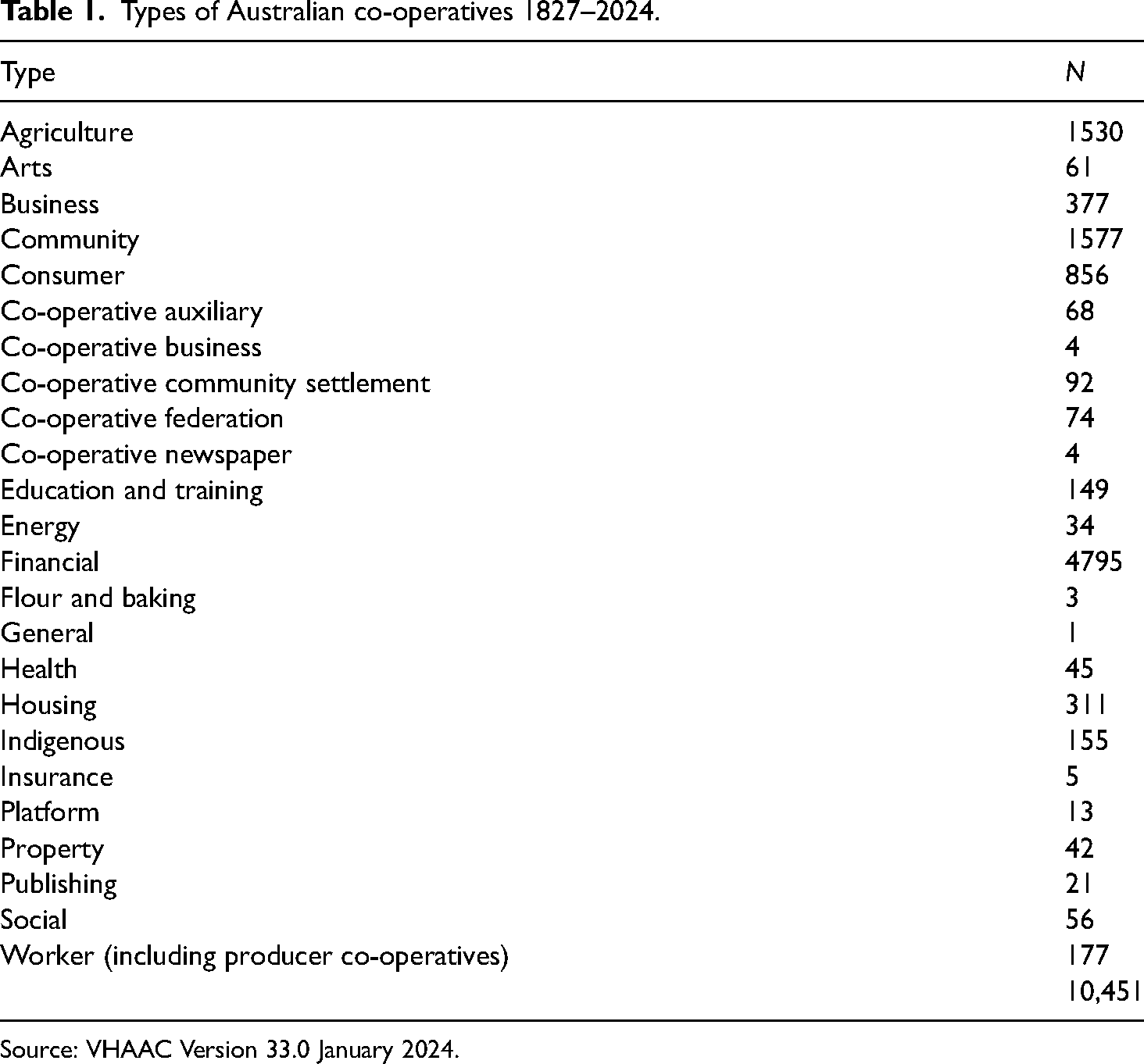
The Visual Atlas researchers developed a typology to classify Australian co-operatives which recognises the diversity of Australian co-operatives and the development of different types of co-operatives over time. As Table 1 indicates co-operatives are identified by their main type of activity. Four types of co-operatives—financial, agricultural, consumer and community—have dominated the Australian co-operative landscape. Worker co-operatives, including producer co-operatives, are only a small feature of the Australian co-operative landscape, constituting less than 2% of the co-operatives in the Visual Atlas. Their type in the Atlas excludes Indigenous or social co-operatives. Indigenous co-operatives arose out of a distinct movement in Australia and generally provide a range of cultural, social and economic services to their communities. The NEAT Constructions Co-operative, which operated in Victoria from 1988 to 2013, provided services by Indigenous home builders and renovators. Social co-operatives have developed since the 1960s, particularly in Italy, to meet deficiencies by both the state and the private sector in delivering social services. Their decision-making process is democratically driven with the simultaneous participation of a variety of members including users of the services, workers, volunteers, financing members and various legal entities. Revenue is derived from supplying services to both the state and private firms. Examples of activities include employment services and current Australian examples are the Hunter Labour Co-operative in NSW and the Nundah Community Enterprises Co-operative in Queensland. There are examples of social co-operatives transforming into worker co-operatives such as The Blue Mountains Work Service Group, which began as a social co-operative providing work for unemployed youth but was restructured as a worker co-operative in 1982 (Patmore and Balnave, 2018: 11). 1
Types of Australian co-operatives 1827–2024.
Source: VHAAC Version 33.0 January 2024.
The Visual Atlas provides a range of insights into the history of Australian co-operatives. As Figure 1 highlights, there was a growth in interest in co-operatives from the 1820s with the peak occurring in 1981, and a rapid decline in 1982 relating to the state amalgamation of terminating Co-operative Building Societies in NSW. There were notable waves of interest from 1882 to 1894, 1916 to 1924, 1943–1950 and 1953–1972. These periods of growth relate to times of political and social unrest arising from economic downturns and the disruption of war but also coincided with the post-war prosperity following the Second World War. During the post-war period, state governments also promoted co-operatives through an active Co-operative Registrar in NSW and specific co-operative legislation in Queensland in 1947 and Victoria in 1953 (Lewis, 2006: 130–131). 2
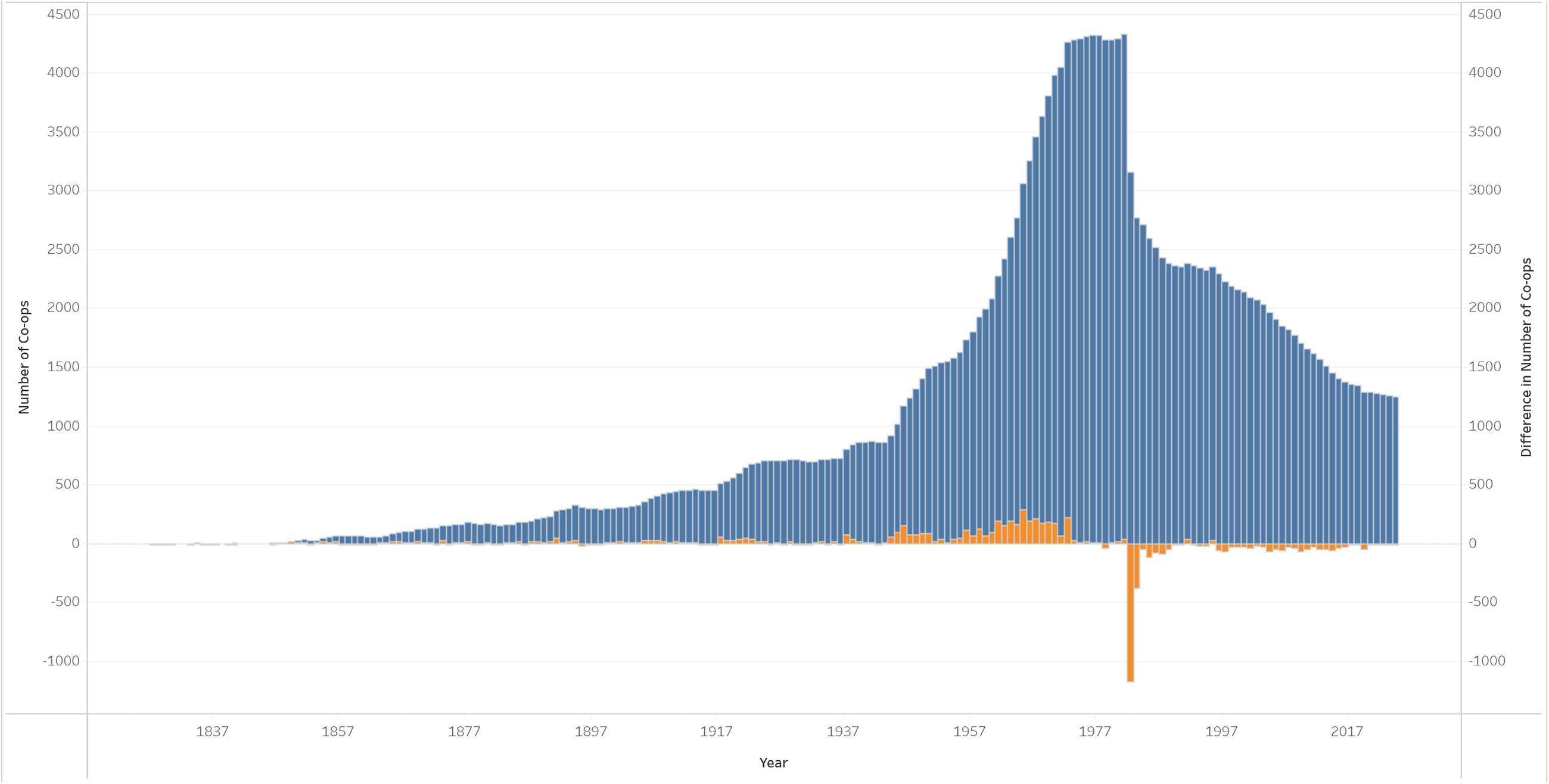
Co-operatives in Australia 1827–2024.
As Figure 2 indicates, worker co-operatives (including producer co-operatives) have had periods of major upsurges in activity. There was growth during the economic and social upheaval of the 1890s Depression and its aftermath, with workers setting up co-operative enterprises to maintain employment, particularly in the wake of industrial disputes. Worker co-operatives had a limited impact in Australia as workers focused on trade unions and political activity through the Labor Party to achieve improvements in their standard of living (Albanese & Jensen, 2015: 105). There were minor increases of interest in worker co-operatives following the upheavals of the two world wars. From the 1970s, there was a major upsurge in worker co-operatives that were encouraged especially by the NSW and Victorian Labor governments as worker buyouts of companies to save jobs with the end of the post-war boom and the greater exposure of Australian manufacturing to increasing international competition (Albanese and Jensen, 2015: 105). Worker co-operatives peaked in the late 1980s but have had renewed interest in the wake of the GFC in the late 2000s.
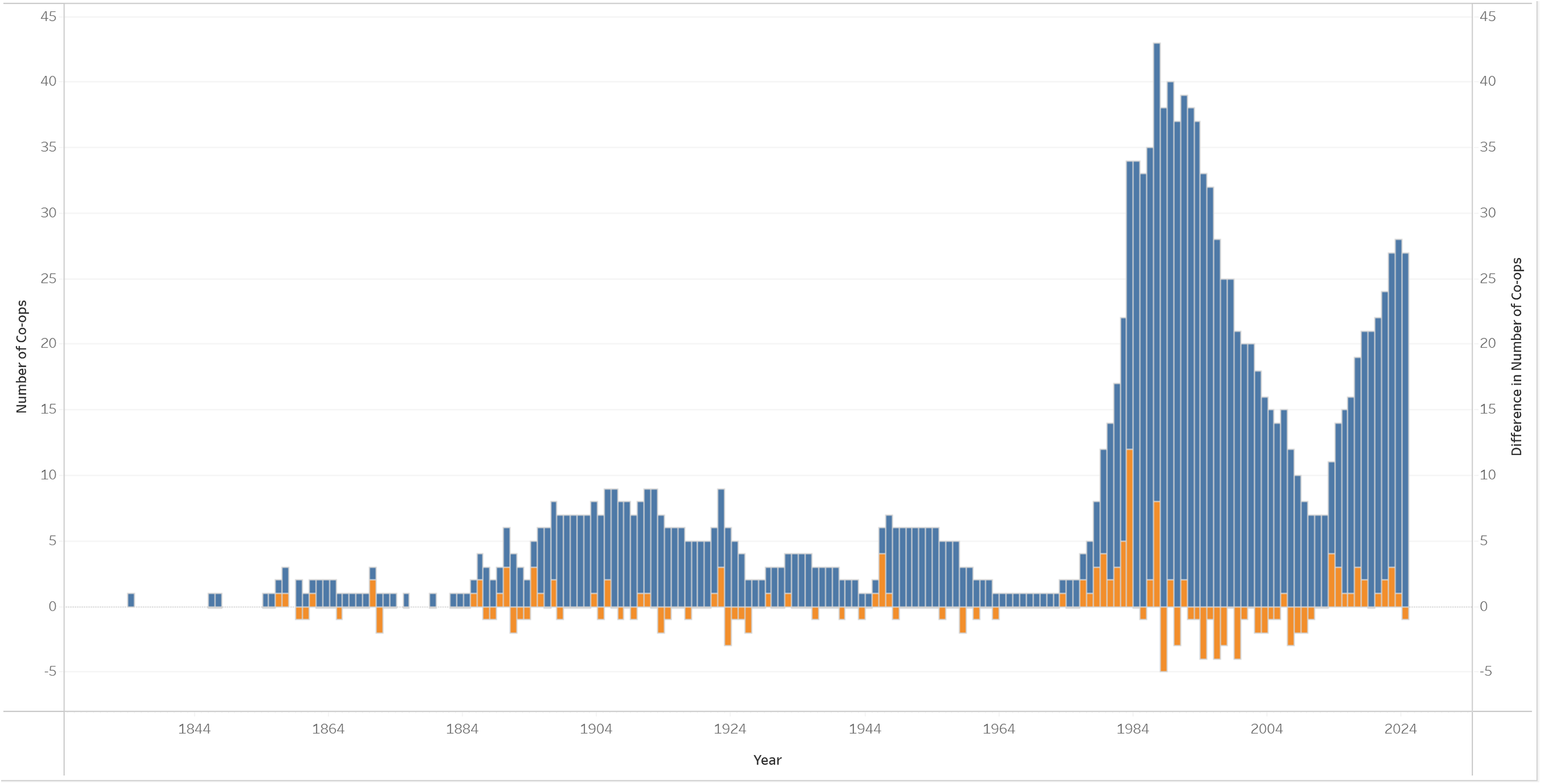
Worker and producer co-operatives in Australia 1834–2024.
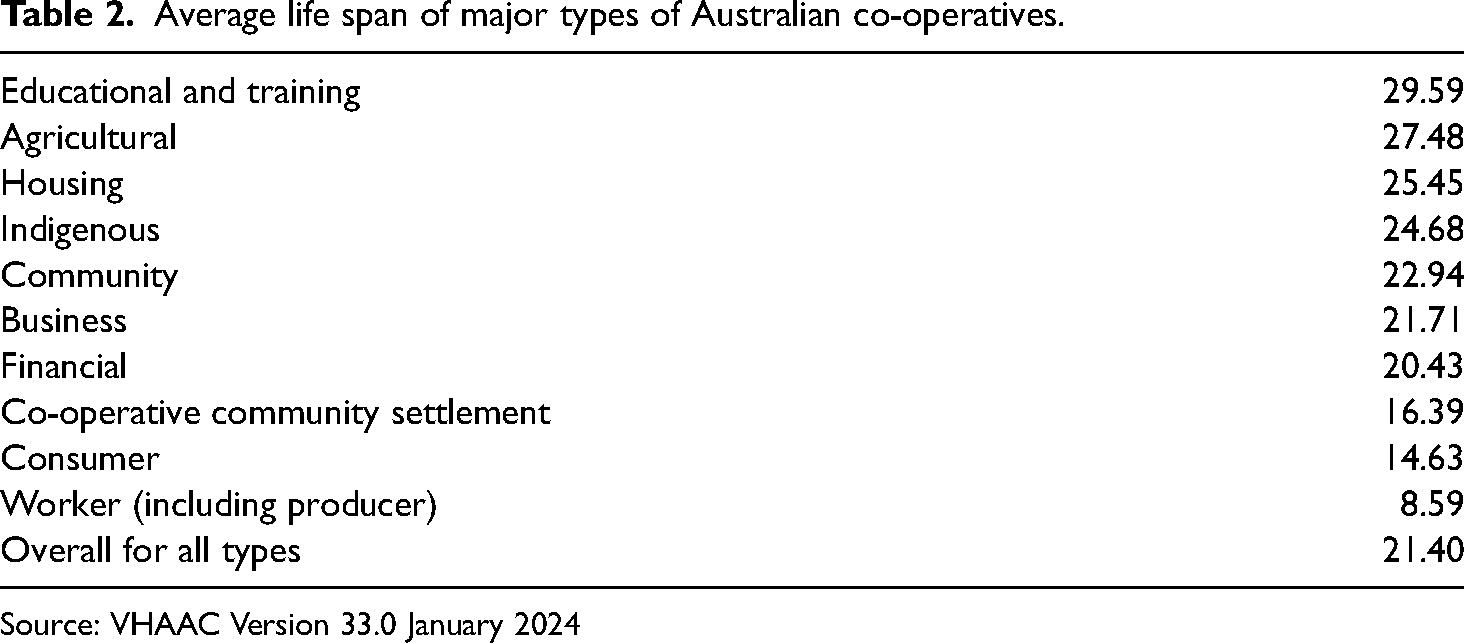
As Table 2 indicates, the average overall life span of Australian co-operatives is 21.4 years. Worker co-operatives (including production co-operatives) have the shortest life with 8.59 years. The short-term nature of worker co-operatives may reflect a tendency in Australia to form them as a means of providing employment in a period of unemployment or in a workplace that was already facing financial problems. The ability to raise sufficient capital for investment and expansion was also an issue. There are also examples of successful worker co-operatives demutualising to allow workers to realise their capital gain (Albanese and Jensen, 2015: 105–106; Markey, 1985: 57–58).
Average life span of major types of Australian co-operatives.
Source: VHAAC Version 33.0 January 2024
Worker co-operatives before 1860
Worker and producer co-operatives in Australia pre-date the gold rush. There was an interest in the ideas of early co-operators such as Robert Owen in the Australian press from the 1820s. The early worker co-operatives tended to be formed in industries which had relatively low capital investment requirements and where labour was a significant component of production costs such as building and printing. While there are difficulties with distinguishing between early friendly societies, trade unions and co-operatives, there was a Coachmakers Co-operative Society in Sydney in 1834. 3 There was also a short-lived Operative Wood Sawyers Yard in Sydney in July 1847, when sawyers were undertaking industrial action. Tailors established a co-operative in Melbourne in July 1846 in response to an employer lockout. It quickly demutualised with two members prominent in the management of the co-operative taking it over (Patmore et al., 2024: 68, 73; Quinlan, 2018: 213).
The economic dislocation of the gold rushes further fuelled the formation of worker co-operatives in Victorian gold mining and printing. Twenty-eight members of the Victorian Typographical Association in Melbourne purchased The Age newspaper from 1 January 1855 from Francis Cook and Co. Each worker put in £25 of their own money and each week contributed nearly all their wages to the co-operative. They moved to purchase the paper as its rival, The Argus, cut printers’ wages and printers struck in January 1855. They ran The Age for 18 months as a co-operative. David Blair, a former supporter of Chartism and editor, promoted co-operation to its readers. There were disagreements among the members, who sold the co-operative to an ironmonger, James McEwen with a loss of £10,000. McEwen then transferred ownership to Ebenezer Syme, a co-editor of the paper, on pre-arranged terms (Patmore et al., 2024: 74). 4 During 1856–1857, gold miners organised at least three co-operatives on the Victoria goldfields according to data drawn from the Visual Atlas. They sought to pool their capital to purchase more sophisticated mining equipment as gold panning became less economically feasible. 5
There was significant co-operative activity in the Melbourne building industry. The building industry was in decline after the peak of the gold rushes and there were falling wages. Forty stonemasons, with the approval of their union, formed a co-operative association in 1859 to take contracts for masons’ work. The association paid current wages to its members and divided the surplus amongst them. One of its first contracts was the erection of Pentridge Prison for a cost of £47,000. The success of the first group led union members to form two other groups. There was disagreement within the co-operative over the quantity of work to be undertaken by each member and conflict with the union over piecework which most of the co-operative members supported. This led to an open conflict between the union and the co-operative which weakened the union, which had only 50 members by 1863. Carpenters tried to form similar co-operatives to the masons with little or no success (Coghlan, 1969: 1036–1037). 6
There was a move to form a producer's co-operative for printers in Sydney in 1854 fuelled by general worker discontent over prices and wages with uncertainty in labour market due to the influx of population associated with the gold rushes. There were strikes at the Government Printing Office and The Empire newspaper. The printers at The Empire refused to work unless they were paid in accordance with the London practice of a higher rate for certain types of work. Henry Parkes, owner and later a NSW Premier, successfully prosecuted the workers and imported printing compositors from India to reduce his wages bill. Meetings of workers in June and July 1854 agreed to set up the Australian Co-operative Newspaper Company to produce The Operative, which would encourage co-operation and worker organisation. Speakers were aware of co-operatives in England, France and Ireland noting The Sun newspaper in London. There were 5000 shares of £1 each with no shareholder having more than 10 shares. Shareholders could put down a deposit of 10 shillings per share and then pay the rest in instalments of 5 shillings per month. There was interest in the co-operative beyond Sydney with Melbourne workers applying for shares. While there were difficulties raising the projected capital for the co-operative, the first issue of the weekly The Operative was published on 7 October 1854 with articles on “coolie” immigration and friendly societies. By November 1854, The Operative, however, was in trouble with a public meeting called to save the paper from closure, but the newspaper failed (Irving, 2006: 211–212). 7
1860–1890
The Australian economy expanded after the gold rushes. The wealth generated by the gold rushes laid the foundations of a ‘long boom’ from 1860 to 1890. Butlin (1987: 133) estimated that the Gross Domestic Product (GDP) increased from £64.5 million in 1861 to £206.3 million in 1891 (1911 constant prices). However, economic growth started declining in the 1880s and there were minor recessions in 1863, 1871, 1879 and 1886. Economic conditions also varied between the colonies. While Victoria experienced a recession from 1863 to 1866, there was an economic boom in Queensland. In SA the ‘long boom’ ended in 1882, with emigration exceeding immigration continuously from 1885 to 1889 (Patmore, 1991: 43).
The period also saw an expansion of trade unionism beyond skilled trades. Unionism spread to coalminers, metal miners, transport workers, factory employees, pastoral workers, retail assistants, clerks and supervisory staff. Coalminers in the Hunter Valley of NSW lived in communities centred around their place of work and faced dangerous working conditions. Many were British immigrants and brought with them organisational skills from the militant coalfields of Northumberland, Durham and Scotland. Unions co-operated through the formation of trades and labour councils and the inauguration of Intercolonial Trade Union Congresses in Sydney in 1879 with five more before 1890. Tradesmen’s unions played a major role in organising them, but the 1889 Hobart Conference explicitly incorporated the term labour in its title to break down the division between tradesmen and labourers. By 1889, the labour movements in all colonies except WA sent delegates. The Congresses provided a forum for the discussion of a wide range of issues including the 8-hour day, immigration, education and the representation of labour in parliament. While there was interest in co-operatives, with discussion on the topic at Intercolonial Congresses, the labour movement's interest in worker or producer co-operatives waned from the 1860s as unions were able to improve wages and conditions through negotiation with employers and industrial action during periods of relative prosperity. There were also concerns about the financial viability of producer co-operatives, which had failed in the UK coal mining and engineering, and their potential conflict with union conditions. By 1890–1891, it is estimated that the percentage of trade unionists in the workforce was 20.9% in NSW and 23.2% in Victoria (Patmore & Balnave, 2018: 77; Patmore et al., 2024: 84–85).
Coalminers in the Borehole consumer co-operative in the Lower Hunter Valley extended the idea of the co-operatives to coalmining with the formation of the Co-operative Coal Company in 1861. 8 The co-operative arose out of an industrial dispute when miners refused to accept a 20% cut in hewing rates and was a union enterprise. There was also a belief that the co-operative could be a long-term solution to labour conflict. A syndicate of 15 miners, including James Fletcher, the president of the local Miner's Union, was formed and secured 1500 acres of land, with 6000 shares at £5 each to capitalise the project with the venture financed by profits from the mine. 9 Workers set their own hewing rates with production targets being determined democratically at meetings between managers and miners. There was a continual problem of obtaining sufficient capital to run the mine, with miners reluctant to invest their earnings in the mine, and due to other businesses which “sabotaged” the project by interrupting supplies and transport. The mine eventually became insolvent with debts of £12,000 and was wound up in May 1869 and sold to a private company (Patmore and Balnave, 2018: 65). As late as 1891, unionists in NSW referred to the failure of the mine “as evidence of co-operation's inadequacies” (Lewis, 1992: 10).
Despite this, there were at least 17 other worker and producer co-operatives formed during the long boom, according to data drawn from the Visual Atlas. There were five in NSW, nine in Victoria and three in SA. One significant surge of interest occurred in Victoria in 1890 when four co-operatives were formed against a background of industrial unrest. Striking workers, for example, established The Brunswick Brickmakers Co-operative in 1890 with the assistance of the Melbourne Trades Hall Council. Skilled workers generally formed these co-operatives in building, footwear, the metal trades and butchering during the long boom following industrial disputes. There were co-operatives formed by Melbourne actors in 1870 and coal handlers in Sydney in 1886–1887 (Patmore et al., 2024: 92).
Two significant examples of worker co-operatives were the Lithgow Co-operative Association in NSW and the Melbourne Boot and Shoe Makers Co-operative in Victoria. The Lithgow co-operative operated the local ironworks in the wake of financial difficulties from 1882 to 1886. The co-operative provided employment for an average of 160–180 workers, but the work was of an intermittent nature. It rolled iron rails and made other iron products under contract for the Eskbank Iron Company, which the co-operative had a major dispute with over wages in 1883–1884. The co-operative ended when ironmaker William Sandford leased the works in November 1886 (McKillop, 2006: 71–78, 82). The Bootmakers Co-operative arose in the wake of a major industrial dispute and was registered under the Victorian Industrial and Provident Societies Act in April 1885. The Victorian Operative Bootmakers Union financially supported it through a £100 loan. The Equitable Co-operative Society sourced its footwear from the Bootmakers Co-operative factory in Fitzroy. The co-operative faced financial difficulties with creditors being called in October 1888 and tenders being sought for its equipment in June 1890 (Patmore et al., 2024: 92–93).
1890–1914
Worker co-operatives faced fluctuating fortunes between 1890–1914. The poor performance of the Australian economy during the 1890s and the early years of the twentieth century challenged the confidence of the long boom. There was a severe depression in the 1890s, with bank closures, wage cuts, unemployment and underemployment. Macarthy (1967: 67–72) estimated that unemployment peaked at 28.3% in Victoria in 1893. Depending upon the choice of price deflators, the decline in per capita GDP from 1891 to 1895 varies from 6.2% to 20.06%. Disputes such as the 1890 Maritime Strike, which was the largest confrontation between unions and employers in 19th-century Australia, the pastoral disputes of 1891 and 1894, and the 1892 Broken Hill strike disrupted the economy and heightened tensions between capital and labour. While there was a brief return to prosperity in 1900–1901, drought prolonged the stagnation of the economy until 1906. These problems highlighted the sensitivity of the domestic economy to fluctuations in the price of export staples such as wool. Average real income did not reach the peak level of the 1880s until 1909. There were also regional and industry variations. A major gold rush from 1894 to 1901 fuelled economic expansion in WA. The gold rush and the abolition of internal tariffs by the federation helped expand the Australian manufacturing sector, diverting resources away from the drought-ridden pastoral sector (Madsen, 2015: 30–31; Patmore, 1991: 74, 101).
As Figure 3 highlights, while there was of surge of interest in worker and producer co-operatives from 1890 to 1914 relative to earlier periods, the Visual Atlas data indicates that they contributed very little to the overall growth of Australian co-operatives during this period, with the highest known number being nine in 1905–1906 and 1911–1912. After a peak in 1890, there was a decline in worker and producer co-operatives as the Depression deepened. While there was growth after 1893 with peaks in 1897, 1903, 1905–1906 and 1911–1912, there was a further decline by 1914. There were at least 35 worker and producer co-operatives formed in this period with boot-making being a significant industry with at least eight co-operatives. There were also five co-operatives that provided general labour services and four in coalmining, and at least two co-operatives that specifically targeted female employees. Except for Tasmania, they were found in all states, with at least 18 in Victoria and 10 in NSW. One of the issues in this period is distinguishing between union enterprises that have co-operative in their title and co-operatives that have features such as worker ownership and profit sharing. Union enterprises are not included in the Atlas.
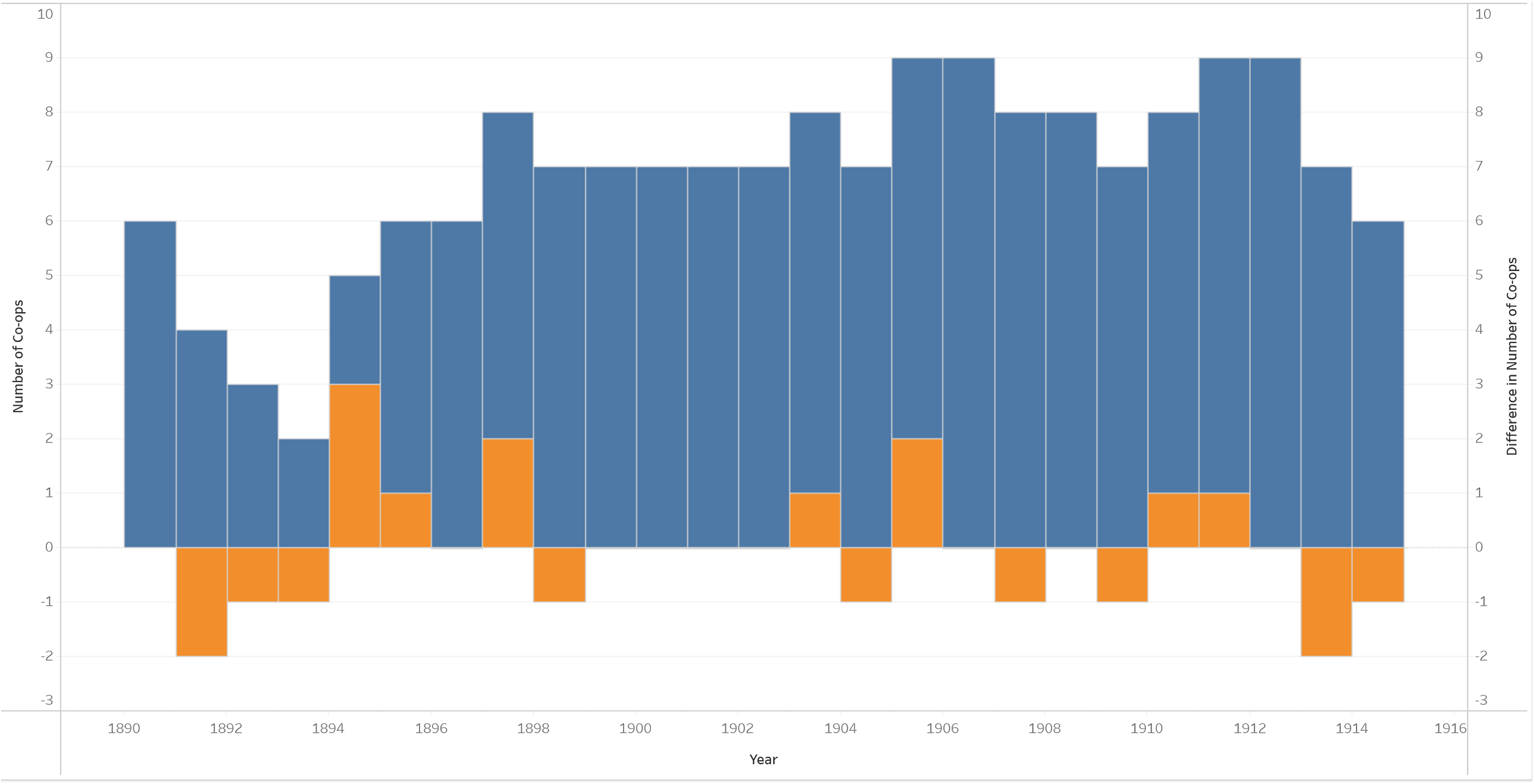
Worker and producer co-operatives in Australia 1890–1914.
There were changing attitudes by trade unions towards worker and producer co-operatives. Markey (1985) notes a shift in the early 1890s in NSW unions away from co-operation as a form of industrial partnership towards worker co-operative enterprises against the background of the 1890s Depression and strike defeats with support for a variety of different schemes in industries such as building, baking and laundries, with the latter focussing on female employees. These occurred particularly in the wake of industrial disputes with the general support of the Sydney Trades and Labour Council, later renamed the Sydney District Council of the Australian Labour Federation. The schemes were also viewed as a means of resolving unemployment. These schemes generally failed or were short-lived with the lack of capital being a major issue. There was a momentum of interest in these schemes until 1895, but after 1897 there was little talk of co-operation as unions shifted their focus towards parliamentarianism and industrial regulation. There were similar trends in Victoria. An example of a producer co-operative was the Union Bootmakers’ Co-operative Society, which was formed in Melbourne with union assistance after a strike in 1895 and was still active in 1897. 10 There was a series of lectures at the Melbourne Trades Hall between 1901 and 1903 on co-operation but McKay (1946: 29) notes that interest waned after 1906 as unions pursued alternative strategies with an improving economy.
Despite this waning interest, unions were not the only inspiration for co-operative enterprises and some worker co-operatives had a notable impact. Middle-class and wealthy activists in NSW formed the Women's Co-operative Silk-Growing and Industrial Co-operative in 1893 to address female unemployment and increase the women's work ethic (Markey, 1980: 102–103). The co-operative received government and business support but the farm to supply the silk faced drought and the co-operative was wound up in 1901. 11 The Victorian Tocsin Printing and Publishing Co-operative, formed in 1897, was owned and maintained by workers and unions. Its publication Tocsin played a significant role in promoting political action by the labour movement. While its focus was state socialism, in the first few years of its existence it allocated a considerable amount of space to the advocacy of co-operatives. The co-operative sold Tocsin in 1906 to the proprietors of Labor Call, the publication of the Victorian Labor Party, but the co-operative continued until it was wound up in 1942 (McKay, 1946: 28–29). 12 Timber workers formed the South West Timber Hewers’ Co-operative Society (SWTHCS) in WA in 1905. The WA Government provided the land and railway materials, including a locomotive, funded by a loan to the co-operative to allow the transportation of the timber. The SWTHCS named one of their communities Holyoake in honour of the UK co-operator (Patmore et al., 2024: 108).
A lull: 1914–1975
As Figure 4 highlights, there was little interest in worker co-operatives from the outbreak of the First World War to the end of the post-Second World war economic boom compared to the previous period, according to data from the Visual Atlas. There were at least 14 worker co-operatives in Australia with activity in all states except SA and Tasmania with eight in NSW and three in WA from 1914 to 1945. While the First World War initially dampened interest in worker co-operatives, there was a peak in 1922 following the War with nine operating. The WA Workers’ Co-operative Society, a worker co-operative, arose from a painters’ strike in 1919 but did not survive the post-war recession of the early 1920s. The WA Government purchased the SWTHCS's timber mill in 1920 and the co-operative's registration was cancelled in 1922. There was a drop in activity in the mid-1920s but a small peak in the 1930s Depression, when it is estimated that per capita GDP fell between 5.8 and 15.8% between 1929 and 1933 and unemployment approached its peak at 20% in 1932, with four operating from 1932 to 1935. Workers established a co-operative to keep a textile mill open at Bowenfels near Lithgow, NSW in September 1931. There was opposition by the Australian Textile Workers Union to the mill being worked on a co-operative basis as there were concerns that award wages and conditions would be undermined. The workers took a lease from 1932 to 1937, with workers sacrificing 1 month's salary to purchase shares. The mill's subsequent success was such that when the lease expired private operators outbid the workers for the lease's renewal. Unlike the USA, there was no state financial assistance for self-help co-operatives, despite some Australian interest in these co-operatives, particularly in the mining sector (Madsen, 2015: 31, 35; Patmore et al., 2020: 5). 13
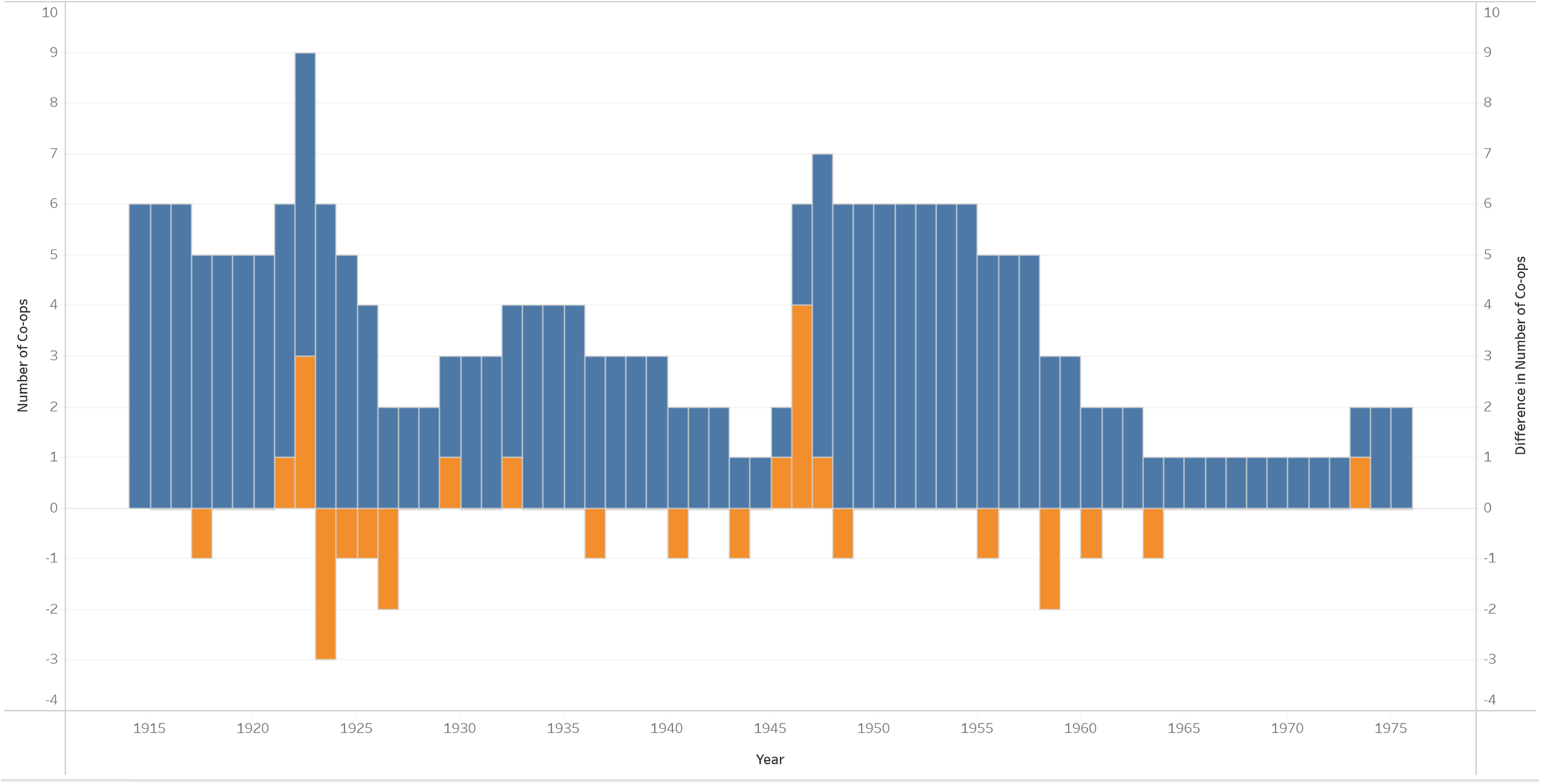
Worker and producer co-operatives in Australia 1914–1975.
There was little interest in worker co-operatives during the prosperity following the Second World War according to Figure 4. There were as few as nine worker co-operatives during this period. Returning military personnel with trade skills formed at least three worker co-operatives in the immediate post-war period. From 1946 to 1957 members of the Australian Co-operative Theatre, Sydney, whose founders included actor Peter Finch and operated the Mercury Theatre, received a share of the profits or takings. There was a short-lived Brisbane co-operative café during the 1950s and as the post-war boom ended women machinists faced with redundancy in a glove factory at Whyalla, SA, formed a short-lived co-operative in 1973 to run the factory (Burgmann et al., 2012: 108–111; Milne, 2004: 78–79; Patmore et al., 2024: 162).
The peak and decline: 1975–2009
From 1975 to 2009 the Australian economy went from an economic downturn to a growing economy. The economy faced persistent inflation and rising unemployment until the early 1990s with the economy contracting in 1982–1983. Unemployment reached a peak of 9.6% in 1984. There was a share market crash in October 1987 and interest rates for owner-occupied homes peaked at 17.25% at St George Building Society in Sydney by 1990 and unemployment reached a peak of 11% in 1993. After 1992, the Australian economy experienced continued growth with the annual average growth per capita GDP rising from 1.7% in 1984–1994 to 2.5% in 1994–2004. While the contribution of financial and business services to GDP continued to grow, agriculture and manufacturing continued to decline over the period. There were also major shifts in Australia's trading partners with the People's Republic of China (PRC)'s share growing from 1.3% of Australia's merchandise trade in 1977 to 14.3% in 2007, while Japan's share fell from 26.9% to 14.3%. The share of other East Asian countries grew from 8.5% to 29.5% over the same period. The trading relationship with major European countries and the USA declined as a share of merchandise trade. Net immigration remained an important feature of Australian population growth fluctuating over the period with a minimum of 21,000 in 1976 and a maximum of 300,000 in 2009 with a growing share of immigrants from Asia (Attard, 2023; Butlin et al., 2015: 568; Patmore et al., 2024: 170–171; Pomfret, 2014: 407–409).
Against the background of the sluggish Australian economy of the 1980s and early 1990s, a political climate evolved that favoured privatisation and deregulation to make the Australian economy more globally competitive. The Hawke-Keating Federal Labor Governments from 1983 to 1996 were willing to dump Keynesianism and social democratic policies, which were viewed as discredited by the collapse of the post-war boom, as they needed to establish their economic credentials as a responsible party of change and modernisation following the apparent economic mismanagement of the Whitlam federal Labor Government. They embraced pre-Keynesian neo-classical economics as part of their drive to modernise Australia. Hawke also initially advocated supply-side solutions to unemployment including the encouragement of redundant workers to establish worker co-operatives to buy out failing businesses as an alternative to the dole (Patmore and Coates, 2005: 129–130; Pixley, 1990: 4–5).
There was renewed interest in worker co-operatives following the end of the post-war boom. However, while there was a broader discussion of industrial democracy in Australia, this focused on initiatives such as joint consultation, job enrichment and employee share ownership plans (ESOPs), rather than worker co-operatives (Markey and Patmore, 2009). Mathews (1983, 1987), a federal Labor parliamentarian from 1972–1975 and later Victorian Labor Government Minister during the 1980s, promoted the Mondragon group of co-operatives in Spain through the Fabian Society as a way of addressing Australia's economic decline relative to other countries. He later published a significant book (Mathews, 1999) calling for “distributism,” where ownership was widely based rather than concentrated with the state or a wealthy few, while questioning demutualisation and drawing upon the Mondragon and Antigonish experiences. Mondragon was promoted by a wide range of Australian co-operatives including Indigenous co-operatives, as early as 1972, and the Co-operative Federation of Queensland, which distributed video cassettes to its members on Mondragon in 1984. Matthews (1993) was sceptical about alternatives such as ESOPs, “which if handled badly, however, can do no more than rip money off employees and put their savings at a risk if the company takes a nose dive,” and questioned the claims for ESOPs about increased productivity. There was also interest in developments in the UK where local co-operative development agencies helped a growth in worker co-operatives from 300 in 1979 to 1400 in 1987 (Jensen, 1988: 35). 14 Alan Greig, from the Work Co-operative Unit, Department of Youth and Community Services, went to the UK in 1979–1980 on behalf of the NSW Government to explore these ideas. He later went to Europe in 1986 to look at worker co-operatives in France, Spain and the UK. 15
There were initiatives in NSW and Victoria that viewed co-operatives as a means of resolving high unemployment rather than as a long-term strategy of co-operative development. The NSW Labor Government launched a Work Co-operative Program in 1978 to generate employment opportunities for unemployed youth (Jamrozik and Beck, 1981, 19–23). The Program changed in July 1981 with the granting of $300,000 to a fund for the development of the worker co-operatives, 16 which was administered by the Co-operative Federation of NSW, and the establishment in 1982 of the Common Ownership Development Agency, which focussed on worker co-operatives but gave priority to “groups/businesses which show a potential to grow and provide more employment.” 17 The NSW Registry of Co-operatives, however, by 1984 viewed the Program as a failure. There were problems with the NSW co-operative legislation that did not recognise worker co-operatives until 1992, so a common ownership company based on Mondragon was developed for worker co-operatives registering under the Companies Act. There were also concerns within the Left of the Labor Party that the Program was too focused on “private enterprise” and there needed to be greater trade union involvement. The responsible Minister, Frank Walker, commissioned a report from the Transnational Co-operative, a labour movement research centre, that reinforced these concerns. The NSW Labor Government tried again with the Worker Enterprise Corporation (WEC) in 1986 to assist skilled workers to work co-operatively and convert failing enterprises into co-operatives through a Worker Co-operative Program with funding from a Co-operative Development Trust Fund. There was union representation on the WEC and co-operatives seeking assistance through the WEC were to establish contacts with unions, encourage employees to join unions and recognise award wages and conditions. The existing common owned companies declined representation on the WEC and incorporated the Association for Employee Ownership in Australia in November 1986, which promoted worker ownership, including worker co-operatives and ESOPs. While it was estimated in 1987 that 340 jobs had been created or saved by the WEC, only six of the enterprises survived by 1993. A Liberal National Party Coalition Government elected in 1988 withdrew support for the Program (Carruthers, 1981: 16; Jensen, 1988: 67, 70–71; Lewis, 2006: 409; Mathews, 1983: 13–14; NSW Ministerial Council, 1988: 60–63; Transnational Co-Operative, 1984). 18
There were similar initiatives in Victoria initially by a Liberal Government. Several social co-operatives were established in 1980 to promote employment with funding based on “social aspirations” rather than “clearly articulated business principles.” 19 The Government then created a similar employment program to NSW in April 1981 called the Co-operative Development Program (CDP), which mainly focused on social co-operatives where control was divided between worker members and local community members to create job opportunities. There were some social co-operatives, such as the Loch Ard Producers Co-operative in Warrnambool, that tried to transform into worker co-operatives. There was a small number of worker-initiated co-operatives such as the Public Images Co-operative in Williamstown, which mainly focussed on painting public murals and operated from 1981 to 1986. The Cain Labor Government elected in March 1982 continued the CDP, but the Co-operative Federation of Victoria was critical of the CDP's bureaucratic control and administrative delays, which caused cash-flow problems for the co-operatives funded under the scheme, and the CDP lingered on until 1986 (Griffiths, 2003; Mathews, 1983, 14). 20
While some unions, like the Amalgamated Metal Workers Union (AMWU), supported worker co-operatives to save jobs, there were concerns that co-operatives could undermine workers’ wages and conditions to survive. There were some worker co-operatives such as All Graphics, a printer in Sydney, where 12 workers had contributed $5000 each to establish the co-operative, which had an anti-union culture. Workers, despite union support to save their jobs, rejected in November 1986 the conversion of a plant of the White Goods manufacturer Rank Industries in the Sydney suburb of Blacktown into a worker co-operative, to obtain their full redundancy pay for Christmas rather than contribute to the buy-out, lacking the confidence in their own ability to save the company. There was also opposition from middle managers and competing companies (Jensen, 1988, 60, 153; Sams, 1986). 21
As Figure 5 highlights worker co-operatives surged during this period reaching a historic highpoint. The interest in worker co-operatives spurred growth from two in 1975 to a peak of 43 in 1987, but after that declined to eight by 2009 according to data in the Visual Atlas. Of the 83 worker co-operatives that operated during this period, they were primarily found in NSW (61%) and Victoria (24%). While they were mainly in manufacturing, which faced reduced levels of protection and increasing international competition, they were in other industries such as building and theatrical arts.
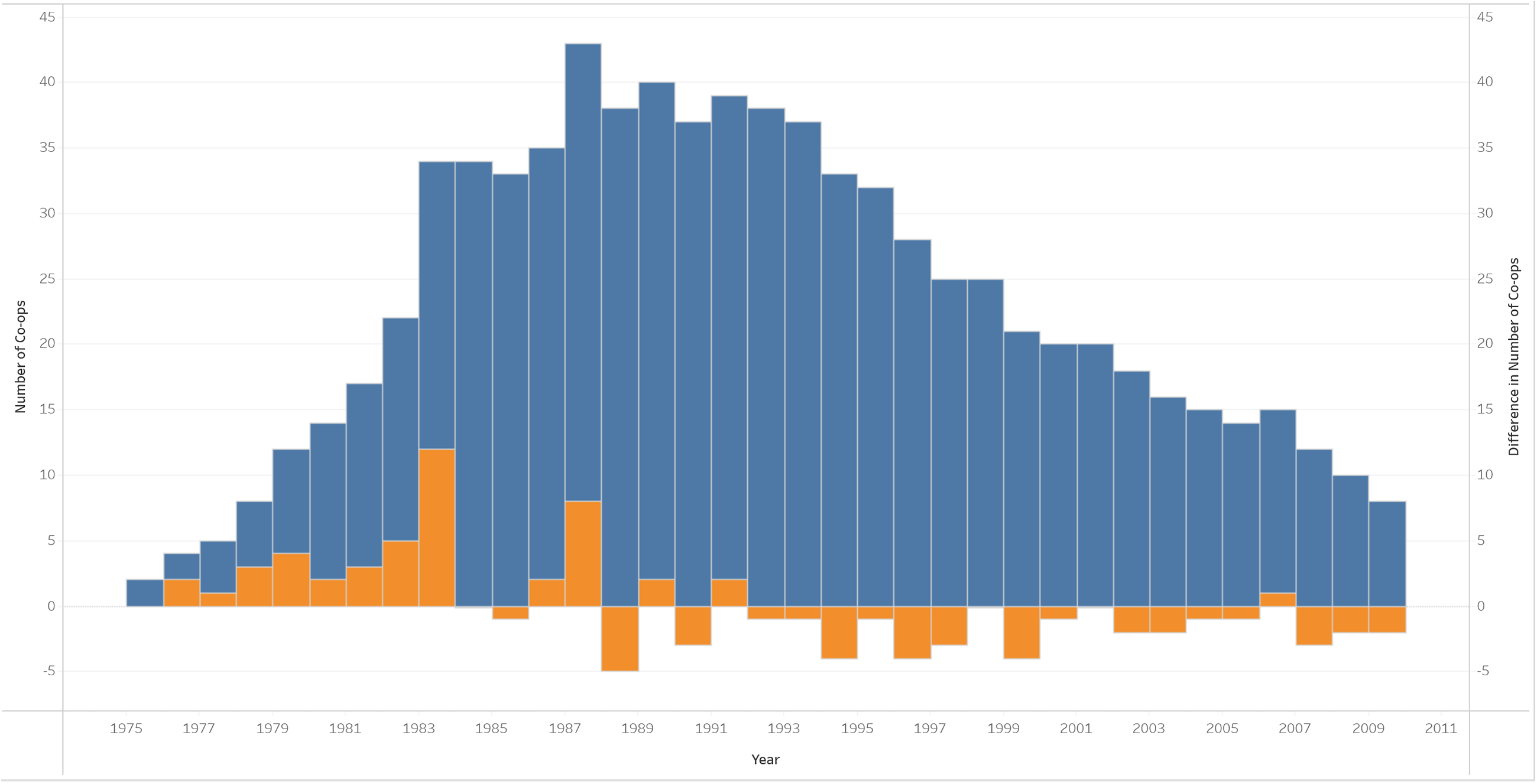
Worker and producer co-operatives in Australia 1975–2009.
There are some detailed data provided for NSW in 1988 by the NSW Ministerial Council on the Future Directions for Co-operatives (1988: 169–171). Excluding one co-operative which would be defined as a social co-operative in the Visual Atlas, there were 21 worker co-operatives operating in NSW as common ownership companies. There were nine engaged in manufacturing, including three in printing, and one in the building industry. Five were engaged in retailing, including two restaurants. The rest were a landscape design agency, a college for teaching English as a second language, a computer software developer, two electronic repair services and a music rehearsal room hire service. Except for five, three of which were in or near Coffs Harbour on the NSW North Coast, all were in the Sydney Metropolitan area. There were small-scale businesses. Of the 19 reporting members, there was an average of eight members with three only having four members and the largest having 25 members. While there appears to be an overlapping of reporting of member and employee numbers, there were at four co-operatives where the number of employees exceeded the number of members.
An example of a worker co-operative that directly benefited from the WEC in NSW, was Keloron Pty. Ltd, which traded as The Electronic Service Centre, in the Sydney suburb of Fairfield. It was formed as a co-operative following the retrenchment of the entire technical staff of a major communications company in August 1986. The retrenched employees approached the WEC Program, which helped them establish themselves as a co-operative specialising in the maintenance and repair of video, television and sound equipment. It began trading in new premises in January 1987 and by 1988 had five members and six employees. Keloron survived until 2003 when it was in liquidation (NSW Ministerial Council, 1988: 170; Worker Co-operative Program, 1987: 14). 22
As the economy deteriorated in the early 1990s there were examples of workers setting up co-operatives to save their jobs. Workers at Abrasiflex, a grinding wheels manufacturer in Warragamba, NSW, facing retrenchment, bought the company and set up a co-operative in 1991. Despite some initial success, they faced capital shortages, a costly legal case concerning an employee dismissal and a lack of management expertise. The co-operative faced liquidation and was deregistered in 2002. 23
There was an example during this period of an umbrella co-operative that encouraged the formation of worker co-operatives and worker co-operatives being formed to meet environmental concerns by engaging in recycling. The short-lived Brunswick Co-operative in Victoria in the early 1980s, which received funding from the CDP, housed and co-ordinated other short-lived worker co-operatives such as the Brunswick Printing Co-operative. The surviving Resource Work Co-operative was registered in Tasmania in January 1993 as a worker co-operative and recycles materials for household and building use (Griffiths, 2004; Resource Work Co-operative, 2024). 24
Developments since 2009
Since 2009, the Australian economy faced two major economic challenges—the GFC and the impact of COVID-19. The GFC began in the USA in 2007 and quickly spread to other economies due to the growing integration of trade and finance in the world economy. The Australian economy was less affected than other economies, with its low debt and deficit-to-GDP ratios. Australian banks had very little exposure to the USA housing market and banks due to the profitability of domestic lending. Subprime and other high-risk loans were only a small share of lending in Australia partly due to the lending standards imposed by APRA. The Australian economy was also protected by its large resource exports to the PRC, whose economy responded quickly after the GFC due to an expansionary fiscal policy. From the second half of 2008, the Rudd federal Labor Government quickly took several steps to protect the Australian economy by guaranteeing bank deposits up to a million dollars and introducing stimulus packages, of which nearly 30% were cash handouts to households and was estimated to have boosted Australian economic growth by 2% in 2009. There were also funds directed towards infrastructure projects and construction. The Reserve Bank of Australia (RBA) reduced interest rates to stimulate the economy. The rate of economic growth did slow significantly, and unemployment rose sharply from 4.1% in February 2008 to 5.8% in August 2009 before declining to 5.3% in February 2010. While the health and social services sectors gained jobs, there were job losses in the manufacturing, construction and retail sectors and a substitution of casual and part-time for full-time jobs. Although the Australian economy avoided recession, it grew at half the pace after on a per capita basis compared to the pre-GFC years. Per capita GDP grew at an average of approximately 1% between 2011 and 2018, compared to an average of over 2% in the 5 years preceding the GFC (Chesters, 2023; Keating, 2015: 451; Makin, 2019: 16; Patmore et al., 2024: 195–196).
While Australia fared well compared to other countries during the GFC, the economic dislocation generally shook confidence in the market-driven model of capitalism that underlay Neo-liberalism and encouraged consideration of alternative business models to IOB such as co-operatives. The federal Labour government established a short-lived and unsuccessful Australian Employment Buyout Centre (AEBC) with a jobs fund to encourage employees to save jobs by partial or complete employee buyouts. There was an increased awareness of co-operatives in Australia through the UN International Year of Co-operatives in 2012 and the subsequent formation in 2013 of the Business Council of Co-operatives and Mutuals, which is an effective national organisation for the sector by raising its profile and political lobbying to remove legislative discrimination against co-operatives that favoured other business models (Australian Employment Buyout Centre, n.d.; Battilani & Schröter, 2012: 155; Patmore & Balnave, 2024: 152–155).
Australia's avoidance of recession since the early 1990s ended with the onset of the COVID-19 pandemic in 2020. The Morrison federal Liberal National Party Coalition Government in March 2020 responded to the pandemic by closing the borders to people seeking to enter Australia and with state governments introducing domestic social distancing practices that included the closure of non-essential businesses. The Government also introduced several fiscal measures to ensure the maintenance of income. The RBA reduced interest rates to a record low of 0.25% to stimulate the economy. There were significant effects for the higher education sector which relied heavily on international students, and the hospitality sector, which saw a decline in tourism and the closure of businesses. The pandemic also disrupted supply chains and unemployment rose from 5.2% in March 2020 to a high of 7.4% in June 2020. Australia entered recession as growth was negative in the first two quarters of 2020 but there was an economic recovery in the second half of 2020, which reflected a flattening of the COVID-19 infection curve, government economic stimulus policies and the opening of the economy. During 2021–2022 state COVID restrictions were lifted, with WA ending its restrictions in November 2022, and international border restrictions were lifted in July 2022 (Lim et al., 2021: 5–6; Patmore et al., 2024: 195–196).
Against the background of these economic developments and an increased awareness of co-operatives, Figure 6 highlights there was a growth in the number of worker co-operatives. They grew from at least eight in 2009, with a slight decline to at least seven in 2010–2012, to at least 28 in 2022 and 2023. There are examples of employee buyouts of existing businesses and start-up worker co-operatives. C-Mac Industries in Girraween, NSW, was registered as a co-operative in 2017 after the former owner, Robert McMaster, facing retirement, decided to hand over the business to his employees. The family business, which was a manufacturer of custom-designed equipment, had been operating since 1962 and had grown to 47 employees with a turnover of $4.5 million per annum. McMaster was influenced by his Christian beliefs and obtained the assistance of Anthony Jensen, academic and long-time advocate of worker co-operatives, to assist mutualisation. A proposal by the AEBC to form an ESOP was unsuccessful as the business did not generate a sufficient cash flow to make the required payments to the ESOP trust, which was the purchaser of the business (Jensen and Webb, 2019: 136–137; McMaster, 2019: xv–xvi; McMaster, 2021).
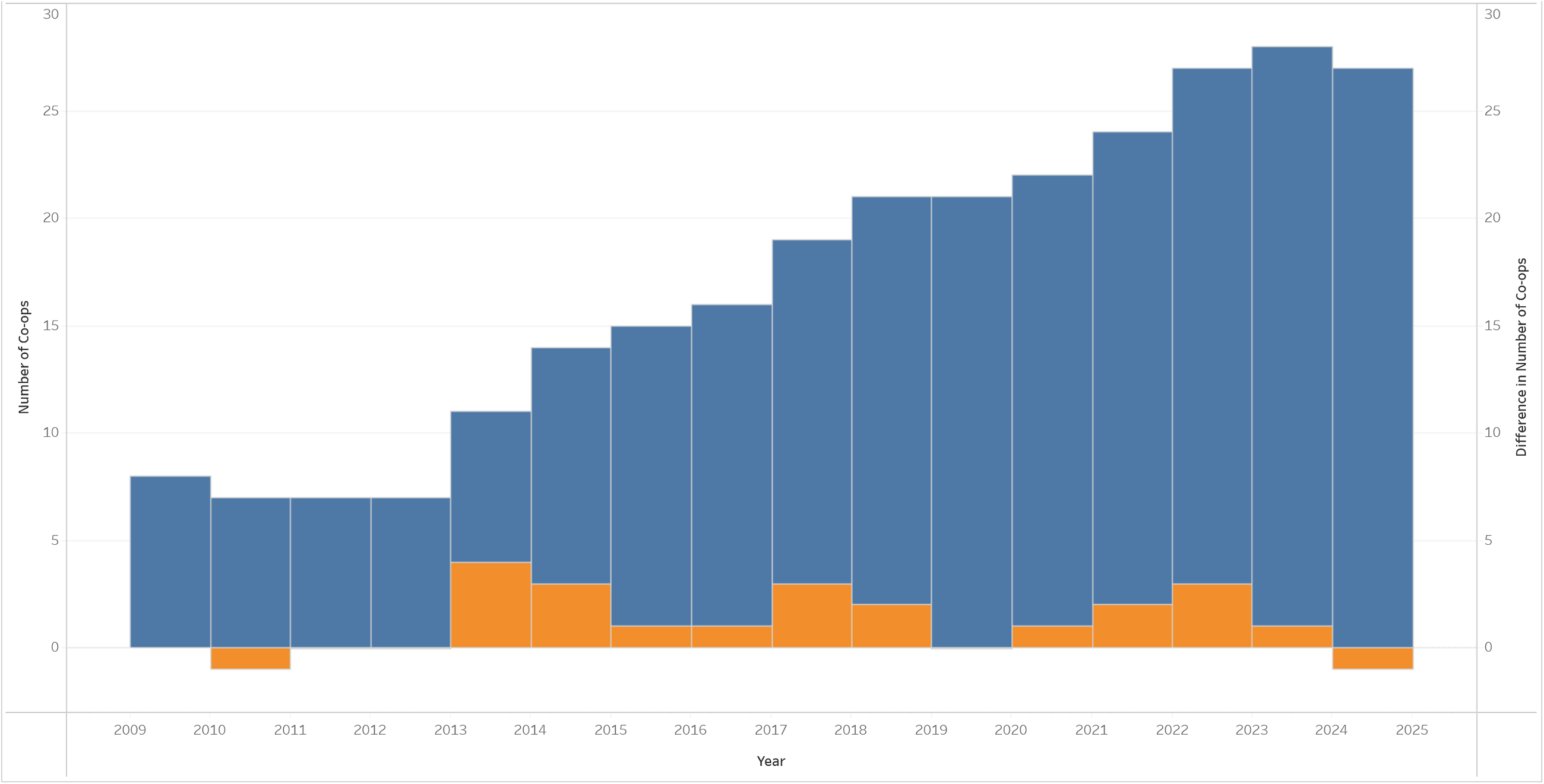
Worker and producer co-operatives in Australia 2009–2024.
An important auxiliary co-operative promoting worker co-operatives is the Earthworker Co-operative in Victoria, which was registered in 2011. It arose from an effort by trade unions and environmental groups to find a space to discuss job creation and the environment. It encourages worker co-operatives based on sustainable manufacturing. There were a range of influences including the green bans of the Builders Labourers Federation, Mondragon and the Cleveland Model in the USA, which links green business practices, local economic development and fair labour practices for co-operative members. The Earthworker Co-operative has established the Earthworker Energy Manufacturing Co-operative in the Latrobe Valley and the Redgum Cleaning Co-operative in Melbourne, with the former encouraging the move to renewable sources of energy and the latter providing green cleaning services. The Earthworker Co-operative also launched the Earthworker Construction Co-operative, which was registered in November 2022, and the Earthworker Smart Energy Co-operative. These co-operatives were generally small with 10 or fewer members. Earthworker is an active promoter of other types of co-operatives. It is an owner, alongside other member-based organisations, particularly unions, of CoPower, an electricity retailer operating in the National Electricity Market (Earth Worker, 2018, Earth Worker, 2023; Earthworker Construction Co-operative, 2023). 25
While Job-Keeper helped some worker co-operatives such as Earthworker Energy Manufacturing Co-operative, other worker co-operatives ran into difficulties with the COVID-19 pandemic. C-Mac Industries had faced internal conflict between management and the board of directors, worker compensation liabilities, a loss of tax incentives and a ransomware attack that disrupted operations for a month. While there was an increase in orders with the onset of COVID-19 as the international supply chain was disrupted for clients, C-Mac Industries found it difficult to obtain finance to fund an expansion to meet increased demand. Following liquidation, its registration was cancelled in September 2022. Redgum Cleaning Co-operative decided to wind up its business in 2023, citing staff shortages, increased costs and cancellations during the COVID-19 pandemic, while paying union rates in a competitive industry (McMaster, 2021; NSW Fair Trading, 2023; Redgum Cleaning Co-operative, 2023). 26
Conclusion
While there has been interest in issues relating to worker co-operatives such as longevity and capital raising, there have been few attempts to plot their long-term development. The paper, which draws upon new Visual Atlas data and qualitative sources, reinforces Jones's argument about the important role of the state and trade unions in the development of worker co-operatives particularly as a solution to unemployment. As the paper highlights, worker co-operatives have been in Australia since the early 1830s but are not a significant part of the Australian co-operative movement and have the lowest lifespan compared to other co-operatives. While the Visual Atlas has data on worker co-operatives for all states and territories except the ACT, they are mainly found in NSW and Victoria. They tend to be primarily found in manufacturing but have also been present in a wide range of industries including mining, building and the performing arts.
Prior to the Second World War, worker co-operatives were generally an outcome of an industrial dispute, where workers sought independence from their employer. A growth of interest coincided with the depths of the 1890s Depression, where they were seen by the labour movement as a short-term means of resolving unemployment. There was growing scepticism in the labour movement about the value of worker co-operatives during this period. This scepticism continued during the 1930s Depression, where in contrast to the USA, there was minimal interest in worker co-operatives.
The most recent significant surges of interest in worker co-operatives were from 1975, peaking in 1987, and to a lesser extent since 2012. Both these periods coincided with periods of economic upheaval, the end of the post-Second War economic boom and the GFC, as workers sought to retain employment in manufacturing particularly. Overseas influences were important in Australia such as the Mondragon Co-operative in Spain. During the 1980s key unions such as the AMWU and the State Labor Governments in NSW and Victoria promoted these ideas as a solution to unemployment. Overall, the paper argues that worker co-operatives did not become a more significant part of the Australian co-operative movement because they have been seen as a short-term solution to unemployment rather than a long-term means to securing economic democracy in the Australian workplace. However, the Earthworker Co-operative, with emphasis on building a network of worker co-operatives and providing a link with current concerns about Climate Change provides a promising path for the future.
Footnotes
Declaration of conflicting interests
The authors declared no potential conflicts of interest with respect to the research, authorship and/or publication of this article.
Funding
The authors disclosed receipt of the following financial support for the research, authorship and/or publication of this article. This work was supported by the Australian Research Council (grant number DP170100573).
