



Abstract
This paper analyses authoritarian innovations in the industrial relations arena in Mexico since 2018. Historically, corporatist ties with union elites allowed the government to control labour at the workplace level and resist substantive labour reforms at the national level through ‘ghost unions’ and ‘protection contracts’. Since the election of Andrés Manuel López Obrador of the left-oriented MORENA party, the government has implemented labour reforms and a reformed trade and investment treaty with the US and Canada that includes stronger labour provisions. These changes opened new possibilities for independent, democratic, and strong unionism and thus the potential for worker empowerment. Yet authoritarian innovations embedded in the national and regional reforms have limited labour's power. These meso-level mechanisms include: state bureaucratic control over union formation, collective bargaining and the right to strike; 2 state support for incumbent union control over worker voting processes; and exclusion of sectors from access to redress under an inter-state trade and investment treaty (USMCA). The authors explore this argument through case studies involving agriculture, auto parts, and maquiladora workers in three regions of Mexico.
Keywords
Introduction
Reforms of national laws and regional trade rules since 2018 mark a turning point in labour relations in Mexico and North America. For nearly a century, an authoritarian, innovative system of labour control delivered votes and labour peace to the state and employers in exchange for political power for position-holders of ‘official’, state-aligned, unions (Collier and Collier, 1991; La Botz, 1999; Middlebrook, 1995). Since the 1930s, officials of the state and corporatist unions sustained labour control with a robust set of authoritarian innovations (Curato and Fossati, 2020). This pattern continued even as new political parties achieved the presidency since 2000 (Bensusán and Middlebrook, 2013). While contributing to economic growth and robust purchasing power of workers in prioritised sectors from the 1950s into the 1970s, the system increasingly deepened an unjust labour peace and delivered flexible labour by creating and using bureaucratic procedures embedded in ostensibly democratic institutions (Bensusán, 2020; Bensusán and Cook, 2015; Middlebrook, 1995; Morgenbesser, 2020). Emblematic of the system of control has been employer-protection contracts, signed between official union affiliates and employers to block democratic union organising and collective bargaining (Bensusán, 2007; La Botz, 1999).
Since 2018, national and regional trade and investment reforms of the labour regime have created the potential for democratisation while leaving the difficult task of uprooting the entrenched system of labour control to rank-and-file workers. First, the newly elected, left-oriented party MORENA (Movimiento Regeneración Nacional) enacted labour reforms that required workers to vote on which union will represent them, who should be their union officials, and whether they find acceptable their collective contracts. The reforms also shifted union and collective contract registration from politically established boards to an agency of the Labour Secretariat, the Federal Centre, and labour conflict resolution from the executive to the judiciary branch. The MORENA administration oversaw a process of collective contract legitimation, requiring up-or-down votes on existing collective contracts by covered workers. Second, the re-negotiation of NAFTA (North American Free Trade Agreement) into the United States Mexico Canada Agreement (USMCA) increased sanctioning power on states, by extending the treaty's dispute resolution process to labour standards, and on individual firms, through a facility-specific Rapid Response Labour Mechanism (RRLM).
This article explores why the reforms have produced decidedly mixed outcomes. We find that national reforms decreased employer-protection contracts. Workers have replaced official unions with their own independent and democratic unions in at least 14 workplaces, and incumbent unions submitted to the legitimation process only 23% of their contracts, 85% of which the national state considered to be employer-protection contracts (Hernández, 2021). Yet, we also find that official unions have demonstrated substantial ongoing power, indicated by their retention of the majority of collective contracts nationwide and a mere 2% of contracts voted down through the legitimation process (Centro, n.d.). The RRLM has facilitated organising in 13 cases, yet its use failed to prevent one of the employers’ involved from laying off all recently unionised workers and is limited to select sectors.
In this article, we examine the opportunities and limits of the labour regime reforms since 2018 with the concept of authoritarian innovations, the meso-level practices that weaken workers’ democratic participation at workplace, national and regional levels (Curato and Fossati, 2020; Ford and Gillan, 2024). The mixed outcomes of recent labour reforms in Mexico reflect the contested character of labour regimes. Pressure to reform had built from internal and external actors for years (Bensusán, 2020), during which time political parties most interested in the status quo, the PRI and PAN, dominated the national congress. The MORENA government enacted and implemented democratic reforms negotiated by these parties in a national and regional context of weakened union and strengthened employer political power (Ocampo Merlo, 2022). Underlying the political dynamics is strong employer labour flexibility, which protection contracts secured (Bensusán and Middlebrook, 2013: 28; Kay, 2015). The negotiated reforms created opportunities for worker-led unions to improve terms and conditions of employment through collective bargaining, yet authoritarian innovations embedded in the reforms reflect labour's weak position in their negotiation and have limited workers’ advances since.
Three case studies are presented to illustrate this dynamic use of authoritarian innovations for labour control in Mexico. In the export agribusiness sector of Baja California, national procedures ceding control over contract legitimation to incumbent unions and regional exclusion of the sector from the RRLM have impeded independent, democratic union collective bargaining. In the auto-parts sector of Coahuila, government control of workers’ exercise of strike rights and derogation of labour law enforcement to state-level political and judicial institutions enabled an employer and official union to halt workers’ campaigns for strike and collective bargaining rights. In the light manufacturing sector of Tamaulipas, bureaucratic delays in union registration facilitated employers and official unions to reassert control over workers divided by a prior authoritarian innovation that disempowered the main regional union.
The multi-case approach facilitates an explanation of the observed mixed outcomes of labour reforms in Mexico and further development of the authoritarian innovations concept. Varied by sector, local power formation and worker strategies, the cases underscore contestation of the labour regime at multiple levels of governance. Within the macro-context of national- and regional-level democratic reforms, meso-level implementation procedures retain concentrated power in the state, where established influence of employers and official unions challenges the ability of workers to maximise gains by using the reforms. The cases demonstrate three state-led authoritarian innovations: bureaucratic control over union, collective bargaining and strike rights, exclusion of sectors from access to redress under an inter-state trade and investment treaty and ceding control over worker contract votes to incumbent unions. Beyond the case studies identified in this paper, identifying these authoritarian innovations suggests that workers will be more likely to advance their interests through independent union collective bargaining when they are covered by a regional complaint system such as the RRLM, the national state enforces labour laws despite subnational resistance, and national and regional mechanisms are applied to protect collective bargaining and strike rights in addition to rights to unionise.
This examination of the labour regime in Mexico adds three contributions to the concept of authoritarian innovations. First, it points to adaptability of authoritarian innovations for labour control across contexts, including democratic political systems, building on the notion of ‘flexible authoritarianism’ (Hamilton and Kim, 2004). Second, it draws attention to contestation over systems of control even within authoritarian regimes, contextualising the prior observation that the democratic character of any institution is continuously constructed (Pepinsky, 2020). Third, it shows variation in authoritarian innovations across levels of governance – private governance between employers and workers and public governance at regional, national, and state levels– reflecting the interaction between economic and political power observed elsewhere (Caraway and Ford, 2017). The article proceeds with presentations of our analytical framework, methodology, historical review of key authoritarian innovations in Mexico, case studies, discussion, and concluding observations.
Framework and argument
As explained in the introduction to this issue, authoritarian innovations are ‘new governance practices that weaken or subvert unions’ genuine democratic participation in the workplace, in labour institutions and in the broader polity’ (Ford and Gillan, 2024). Their authoritarian character refers to their facilitation of concentrated power in states, aimed to protect their model of capital accumulation (Ford et al., 2021). They are innovative because they appear democratic, making them less blatant than other forms of labour control such as the arrest of unionists or the closure of a union office (Curato and Fossati, 2020; Ford et al., 2021). To study authoritarian innovations, Curato and Fossati (2020: 1008) emphasise the need for meso-level approaches that take us ‘beyond the behaviour of a single individual but less than the state's structure.’ They add that authoritarian practices ‘can be initiated by the party in power, the political opposition, (un)civil society groups, or parties that succeeded authoritarian regimes’ (Curato and Fossati, 2020: 1009). These practices are evident in Mexico.
This analytical concept helps to understand employment relations dynamics in Mexico since 2018. The Mexican state maintains a representative democratic political system, is not typically pursuing labour control through overt repression, and has enacted a series of labour reforms that aim to increase state legitimacy while also defending its model of capital accumulation, most notably through global supply chains facilitated by the USMCA (Cypher and Crossa, 2021; Ocampo Merlo 2022). 1 Simultaneously, (un)civil society groups –notably official unions that had been built up and sustained by a legacy of state corporatism (La Botz, 1999; Middlebrook, 1995) – play an important role in current patterns of authoritarian innovations. A meso-level regional and sectoral approach illuminates the authoritarian innovations embedded in recent, democratic-oriented labour reforms that explain the limited gains of workers since their enactment.
As noted above, Mexico was a paradigmatic case of ‘state corporatism’, in which the state controlled and tightly regulated labour unions and employer associations, for most of the 20th century (La Botz, 1999; Middlebrook, 1995; Schmitter, 1974). The legacy of state-led labour control lingered into the 21st century despite the national electoral defeat of the corporatist political party, PRI, in 2000 (Bensusán and Middlebrook, 2013; Zapata, 1993). New state actors at the national and state levels – in the interest of employers and export-oriented economic growth – maintained labour control through continued relations with corporatist labour unions and control over state institutions.
The election of MORENA in 2018 and the subsequent national labour law reforms and strengthening of labour standard enforcement in the USMCA were seen as watershed moments that might finally break a century of state control over labour. Indeed, several large, democratic unions have grown. 2 Yet the reforms also allowed some state actors to exercise control over labour in alliance with employers and corporatist unions. These variations reflect contestation over state policy and its implementation (Bensusán and Middlebrook, 2013; Ocampo Merlo, 2022). Indeed, we find that state and inter-state institutions (i.e. USMCA) are spaces in which competing interests debate, leverage and negotiate state policies with mixed outcomes for labour, corroborating prior conceptualisations of the role of states in labour relations (Hyman, 2008).
These are highly dynamic processes, as interests may evolve over time and often appear contradictory. For example, the AMLO government opened the door to independent unions to gain power in workplaces through collective bargaining legitimisation votes and union formation petitions, projecting progressive, democratic reform. However, AMLO also faces pressure to demonstrate sufficient labour control to appease and attract domestic and foreign investors (Cypher and Crossa, 2021). Seen from this optic, powerful, democratic, independent unions poised to strike to increase wages and benefits would be perceived as threatening the model of accumulation. This contestation was also present in the negotiations around the USMCA. Economic interests sought to deepen trade relations with Mexico based on sustained low wages while US labour organisations leveraged political openings for stronger labour standard enforcement in the trade and investment treaty (Bensusán, 2020). Their struggle resulted in an agreement that expanded trade relations, putting downward pressure on labour, and strengthened labour dispute settlement processes.
In this paper, we argue that the reforms of the national and regional labour regimes opened space for democratic transformation of labour relations and, through political contestation, created space for three meso-level authoritarian innovations. The aforementioned reforms increased worker control over unions and access to due process for exercising their rights. National reforms moved union and collective contract registration to the Labour Secretariat's Federal Centre for Conciliation and Labour Registration (Federal Centre) and labour conflict resolution to the judicial branch. Previously, decisions made by conciliation and arbitration boards facilitated employer-protection contracts (Bensusán and Alcalde, 2013). And regional reform extended USMCA dispute resolution procedures to labour standards and created the RRLM. Yet the cases presented herein expose authoritarian innovations in implementing procedures: national state discretion over timing, federal or state jurisdiction and standards applied for union and strike approval processes; incumbent unions’ rights to organise, self-monitor, and file results of collective contract legitimation elections; and exclusion from coverage under the RRLM of non-prioritised sectors, denying or limiting agriculture and service workers, among others, use of the mechanism (Figure 1).
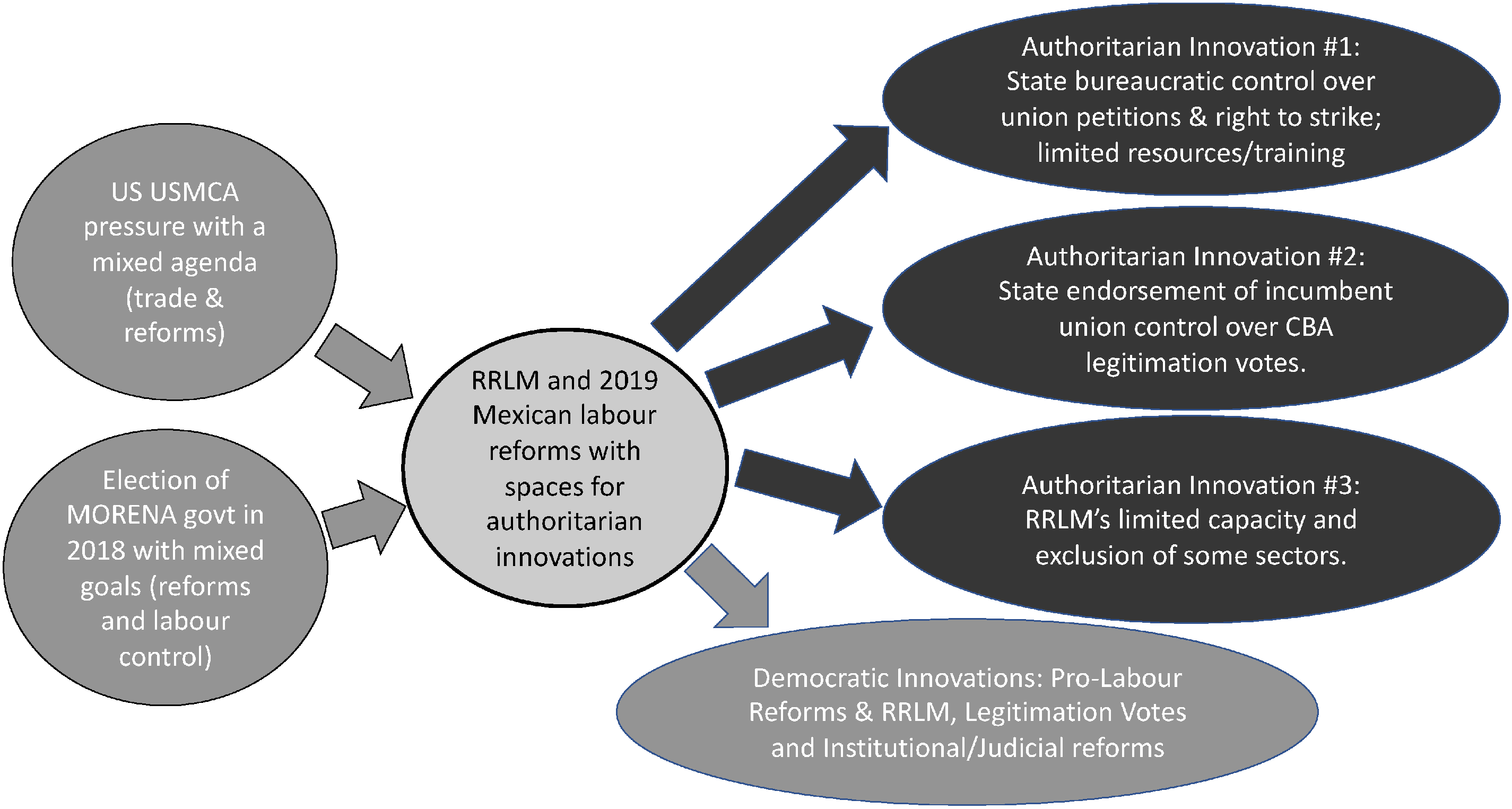
Contested labour reforms and authoritarian innovations.
Given the authority to administer contract legitimisation votes, incumbent unions have used this power to manipulate outcomes to their favour. Management has often coordinated with incumbent unions, by providing them access to workers at work and encouraging workers to support the incumbents. Independent unions have strategically pushed back, leveraging the RRLM, a possibility not afforded to workers in excluded sectors (e.g., agriculture). Despite access to the RRLM, discretionary delays and denials of strike rights have impeded independent union collective bargaining.
The framework illustrates the dynamics of authoritarian innovations, with macro-level reforms opening democratic space and meso-level practices shrinking it. As with all critical realist analysis (Edwards, 2005), our analysis draws on cases presented in one country context, Mexico, where we anticipate significant variation in outcomes based on local power structures, economic sectors, and union strategies. More broadly, the framework suggests that workers are more likely to improve terms and conditions of work through union collective bargaining when covered by robust procedures to remediate rights violations, such as the RRLM, and national states enforce unionisation, collective bargaining, and strike rights despite local resistance, including from incumbent forces such as official unions in Mexico. Through this wider lens, the framework illustrates patterns of meso-level authoritarian innovations reflected in other case studies presented in this special issue. For example, national reforms in Vietnam simultaneously reduced state control over labour unions and limited worker power by facilitating employer-controlled ‘worker committees’ (Anner, 2017). In the US-Central America-Dominican Republic Free Trade Agreement, inclusion of labour standards in the agreement provided workers’ access to the agreement's dispute resolution procedures while an embedded authoritarian innovation – an unattainable threshold for workers to use the procedures – resulted in the failure to address egregious rights violations in Guatemala (Compa et al., 2018).
Methodology
This paper uses multi-case theory-building approach to explore recent labour law and trade reforms in Mexico and what they indicate about how authoritarian innovations emerge and function (Eisenhardt, 2021). Applying a critical realist lens (Edwards, 2005), we studied the process of labour reform implementation in different contexts (Eisenhardt, 2021). Mexico has a federal system with multiple political parties in control across states and municipalities of the country, diverse export-oriented sectors and varied union histories, strategies, and dynamics. We selected cases across this varied context that provide different perspectives on the mixed results of recent labour law reforms: independent unionisation in the export agribusiness hub of San Quintín in the State of Baja California, use of the RRLM in the auto-parts sector in Piedras Negras, Coahuila and assertion of political power by independent unions in the maquiladoras (assembly plants) in Matamoros, Tamaulipas have all achieved limited gains for workers. In Coahuila, we analyse the case of the firm VU Manufacturas, where the dynamics of the sector, sub-national politics and labour reforms intersect. Figure 2 shows the geographic, sectoral and political variation across the three cases.
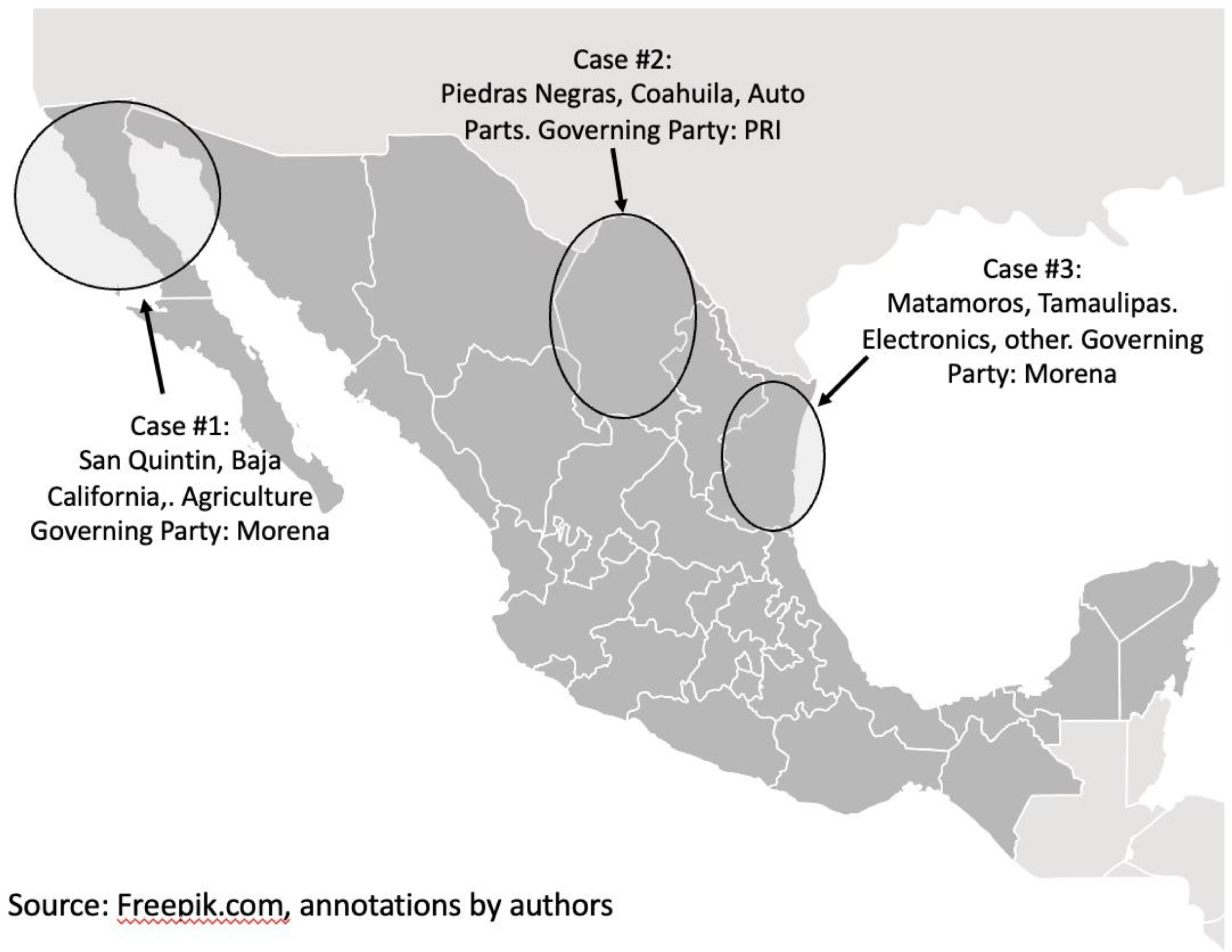
Case selection based on region, economic sector and state government control.
We use a mixed methods research strategy. Primary data is from fieldwork in San Quintin between 2019 and 2021, Coahuila from 2022 and 2023 and Matamoros between 2019 and 2023. We conducted a total of 110 interviews with workers, union, management and state actors. In San Quintín, 67 semi-structured interviews were conducted: 41 with workers contacted through snowball sampling and 6 workers-union activists, 5 managers, 3 state officials, 7 community activists, and 6 academics contacted directly by the researcher. In Coahuila, 18 interviews were conducted with workers contacted with support of the local labour organisation Women Workers’ Border Committee (Comité Fronterizo de Obreras). In Matamoros, 25 interviews were conducted on the dynamics of past and current labour campaigns with current worker activists, prior worker activists, state officials, and union leaders in 2019–2020. We also organised several focus group discussions with workers for each case study: in San Quintín with three groups of women workers and six discussions with workers actively organising unions, all at workers’ homes during after-work hours, in Coahuila with four groups of workers organising a union at their homes after work hours, and in Matamoros with two groups, one with company managers, state officials, and local journalists and another with a leader and activists of the union SNITIS. Participatory observation, including attendance of weekly union meetings and member recruitment actions in San Quintin, facilitation of workshops on supply chains for workers in Coahuila, and observation of the collective bargaining process in Matamoros, provided additional primary data. Supplementary secondary sources included a review of relevant empirical studies and data from the Mexican Institute of Social Security, Agriculture Secretary, Labour Secretary, National Institute of Statistics and Geography, Federal Centre for Labour Mediation and Registration, organisational social media sites and the US Trade Representative (USTR) and Labour Department.
Evolution of authoritarian innovations in labour governance in Mexico
The history of Mexico's national labour regime is characterised by contested state assertion of labour control through corporatism adapted to changing economic priorities. Recent labour reforms rupture and continue this legacy. The national state consolidated power over labour with the simultaneous implementation of democratic reforms, such as agrarian reform in the 1930s, purchasing-power protection in the 1950s, and wage increases in the 1960s-1970s (Middlebrook, 1995). Combined with import substitution industrialisation, prioritisation of strategic sectors (e.g., oil, mining, and automotive), and active wage policy, the corporatist system contributed to wage growth for many by positioning official unions to align wages and productivity, especially from the 1950s through the 1970s (Bensusán, 2020).
‘Official’, state-sanctioned unions were a core component of the state corporatism (Collier and Collier, 1991; Schmitter, 1974). The Federal Labour Law (Ley Federal de Trabajo, LFT) and its administrative rules established control over union registration, collective bargaining and striking in subnational conciliation and arbitration boards granted high discretion (Bensusán and Middlebrook, 2013: 34). Rules that might protect workers’ rights in practice disconnected union leaders from members. 3 The system reduced workers’ associational power, the ability to act collectively (Rhomberg and Lopez, 2021). It also weakened labour's structural power and disruptive capacity (Piven, 2008), tying official union leaders’ influence to their political relationships. 4 Workers regularly contested the system, for example, by forming national industrial unions in the 1940s and independent unions based on internal democracy in the 1970s (Middlebrook, 1995).
Changes in the model of accumulation, beginning in the late 1970s and 1980s, demanded changes from workers and unions. The state's adoption of a neoliberal, export-led development model restructured unionism. The state privatised labour-intensive sectors, shifted support from domestic to export production, liberalised trade and investment, devalued its currency and implemented austerity (Bennett and Sharpe, 1985; Toussaint, 2005), policies reinforced by NAFTA (Weisbrot et al., 2014). In the process, unions disappeared or shrank in membership. After the state suppressed an initial strike response (Middlebrook, 1995), it pushed unions and employers to sign ‘economic solidarity pacts’ to control costs, reducing unions’ ability to negotiate wage increases. International business competitiveness pushed workers’ rights out of political conceptions of ‘national well-being’ (Ortega and Solis de Alba, 1999: 117).
The first non-PRI administration since the 1920s began in 2000 with the election of the business-oriented National Action Party (PAN). 5 PAN reorganised state-union relations by formalising job flexibility for employers’ benefit and realigning state privileges for official unions that collaborated in controlling labour. Local affiliates of the ‘official unions’ and independent unions continued to assert themselves, including by using the International Labour Organization supervisory system, 6 but did not achieve significant gains for workers, reflecting labour's weakened bargaining power.
Labour law reforms materialised in the 2010s after decades of attempts (Bensusán and Middlebrook, 2013). Under a second PAN administration, the legislature reformed the Federal Labour Law (LFT) proscribing separation exclusion clauses and increasing worker access to registered unions and collective contracts. Pressure from labour throughout North America led to the strengthening of labour dispute mechanisms in the USMCA (Bensusán, 2020). While a PRI administration signed the USMCA, implementation fell to the successor, MORENA administration.
2018–2023: national and regional labour regulation reform and times of authoritarian innovations
The labour administration of AMLO has been a mixture of policies to increase union democracy and bureaucratic limitations on this objective. AMLO approved a new labour code as part of implementation of a new system of labour justice. Reform of union regulations added requirements that workers vote on their unions, union leaders and collective contracts. Subsequent reforms ended conciliation and arbitration boards, which were under the executive branch, and moved labour conflict management duties to the judiciary, led nationally by the Federal Centre for Conciliation and Labour Registration. Another reform created the legitimation process, under which all collective contracts would need to be voted up or down by workers between May 2020 and May 2023 or expire. 7 In cases of rejected contracts, a union seeking to negotiate a new contract would need to obtain a certificate of representation by showing its support from at least 30% of workers through a vote if more than one union claimed to represent the workers.
The national reforms created openings for democratic unionism with the potential to empower workers. And the legitimation process did call for employers to provide a copy of the existing collective contract and a location for the legitimation vote, with many workers seeing their collective contract for the first time. However, their implementing procedures also created space for authoritarian innovations. Workers elected unions of their choice at six workplaces, yet incumbent unions registered 27,336 contracts as legitimated (Centro, n.d.). Thus, in the vast majority of legitimation processes, incumbent unions consolidated their control. This was possible because, under the protocols for the legitimation process, the existing unions organised the votes, selected a government inspector or chose and hired a notary public to verify them, and submitted the results to the newly established Federal Centre. Furthermore, the new judicial oversight of union collective bargaining was established in the context of generations of lawyers without adequate training on unionism and collective bargaining.
Reforms of regional labour rules accompanied the national reforms. In 2020, USMCA replaced the ‘labour side agreement’ in NAFTA with a Labour Chapter (23). 8 The Dispute Settlement Chapter (31) includes the United States-Mexico Facility-Specific Rapid Response Labour Mechanism (Annex 31-A). 9 The Annex specifies, ‘The Mechanism shall apply whenever a Party (the ‘complainant Party’) has a good faith basis belief that workers at a Covered Facility are being denied the right of free association and collective bargaining […]’ (Chapter 31, Annex 31-A.2, emphasis ours). It continues, ‘If the respondent Party chooses to conduct its review, it shall report in writing the results of the review and any remediation to the complainant Party at the end of the 45-day period’ (Article 31-A.4.4).
The RRLM allows the US government to suspend the trade rights of individual companies operating in Mexico upon finding merit in complaints of company interference in workers’ freedom of association and collective bargaining rights. This includes denial of preferential tariff rates followed by denied entry of a firm's products or services (Polaski, 2022). Thus, the RRLM has provided powerful leverage for workers attempting to organise and bargain in Mexico. In the process, it also provides legitimacy to the Mexican government as well as the US as states seeking to defend workers’ rights.
However, due to its selective scope, the RRLM opens the door for authoritarian innovations. Workers producing goods for the domestic economy (which account for 59% of economic activity) are not covered by the RRLM. The RRLM establishes manufacturing and mining as ‘priority sectors’. 10 At this writing, the United States and Mexico have successfully cooperated to address labour rights violations at the Mexican facilities in seventeen cases. 11 In most cases, this facilitated independent union organising and bargaining. But, as the Piedras Negras and Matamoros cases demonstrate, the use of the RRLM does not always guarantee success.
Three case studies
In the following section, we explore implementation of the recent reforms of Mexico's labour laws and the USMCA through three case studies that vary by industry and subnational context. The first study focuses on the collective contract legitimation process and lack of access to remediation through the RRLM in the export agribusiness sector of the municipality of San Quintín. In the second, we study the use of the newly established national procedures for union formation and collective bargaining and of the RRLM by workers at an auto-parts company in Piedras Negras. The third analyses effects of the new labour regime under national law and the USMCA on union development and collective bargaining in light manufacturing in Matamoros. The cases illuminate the operation of authoritarian innovations at the meso-level. They expose dimensions of the reforms that have simultaneously strengthened and weakened workers’ exercise of rights, depending on the strategic interactions of the workers themselves, unions, employers and government officials in each context.
To develop the case studies, we triangulated primary data from our interviews, focus group discussions and direct observations and secondary data from publicly available datasets. 12 In the subsequent presentation of the cases, information that is not explicitly cited is from interviews and observations by the authors.
Case study #1, Agricultural workers, San Quintín: workers’ struggle for rights in export agribusiness, where authoritarian labour control reigns despite recent reforms
Workers’ struggle for rights in the export agribusiness enclave of San Quintín highlights the Mexican and US states’ ambivalence toward workers’ rights, manifest in exemptions from labour laws and under-enforcement of applicable laws in commercial agriculture. The structuring of the enclave systematically weakened workers’ bargaining power. Far from intervening to shift the balance of power, recent reforms reinforced employer domination. The most recent authoritarian innovations in agribusiness are the Mexican government's ceding of control over the collective contract legitimation process to entrenched employer-protection unions and employers and the US and Mexican governments’ exempting the sector from USMCA RRLM coverage.
Three national state policies impeding workers’ rights supported the creation of the San Quintín enclave. First, the federal government excluded farmworkers from rights under national labour and social security laws by creating the legal concept of ‘day labourer’. Since the government clarified in 2012 that workers contracted for more than 26 weeks are entitled to full coverage, denial of these rights has continued for most workers (Fischer-Daly, 2023: 68–69). Second, the government has permitted employer-protection contracts. Employers organised into associations and signed employer-protection contracts with affiliates of national federations, primarily the Confederation of Mexican Workers (La Confederación de Trabajadores de México, CTM) and Regional Confederation of Mexican Workers (Confederación Regional Obrera Mexicana, CROM), in response to worker collective action in the 1980s (Bensusán and Cruz, 2019; Velasco et al., 2014). Workers seeking to exercise freedom of association and collective bargaining rights in San Quintín agribusiness have since been blocked by these federation's employer-protection contracts. The third is under-enforcement of labour laws. Export agribusiness began in San Quintín without a state labour law enforcement presence (Velasco et al., 2014: 238), and despite establishing official offices, enforcement remains lax (Fischer-Daly, 2023: 76).
Workers contested this labour regime, and the state, employer, and employer-protection union responses underscore its overtly authoritarian character. Tens of thousands of workers occupied the trans-peninsular highway throughout San Quintín starting 17 March 2015, the largest strike in the history of agribusiness in Mexico. Workers had petitioned the government to address their concerns and received no response. Wages had stagnated while living costs rose for more than a decade (Fischer-Daly, 2023: 79). The national police arrived in riot gear, arrested strikers, and shut off radio, mobile phone and internet services. Subsequently, national police raided a community known for justice activism with armoured vehicles and riot gear and assaulted people (SEGOB, 2017). Meanwhile, employers dismissed enough workers to lead some to conclude, ‘They fired everyone who participated’ (quoted in Fischer-Daly, 2023: 81). Workers gained state registration of their newly created union, the Independent National Democratic Union of Agricultural Day Labourers (Sindicato Independiente Nacional Democrático de Jornaleros Agrícolas, SINDJA), wage increases, and increased employer contributions to legal benefit systems. Years after the strike, employer-protection contracts continue to block collective bargaining, most workers lack legal benefits, and wages have again stagnated (Fischer-Daly, 2023: 68–69).
Reforms of the national labour law and regional trade and investment treaty offered opportunities to expand industrial democracy to the agribusiness sector. Instead, the Mexican and US governments embedded authoritarian innovations in the reforms that sustained its authoritarian labour regime. They broadcast understanding of the levels of worker exploitation, use of protection contracts and retaliation against workers for organising in the sector yet enacted policies sustaining this status quo. Both governments regularly publish reports on the sector's dynamics; for example, the Mexican federal government detailed worker, employer and state actions during the 2015 strike (SEGOB, 2017). Within the partially democratising reforms, their choices for the national collective labour contract legitimation process and USMCA RRLM reinforced the denial of workers’ rights in the sector.
The collective labour contract legitimation procedures permitted incumbent unions to organise voting on the contracts, hire a notary public of their choosing to monitor voting and submit ballot counts, facilitating sham votes. In the majority of cases, where incumbents were signatories to employer-protection contracts, these procedures facilitated sham legitimation votes. This design determined results in San Quintín's agribusiness sector, where incumbent unions were successful in the legitimation of all contracts (see Table 1).
Collective labour contract legitimations by incumbent unions in San Quintín agribusiness.
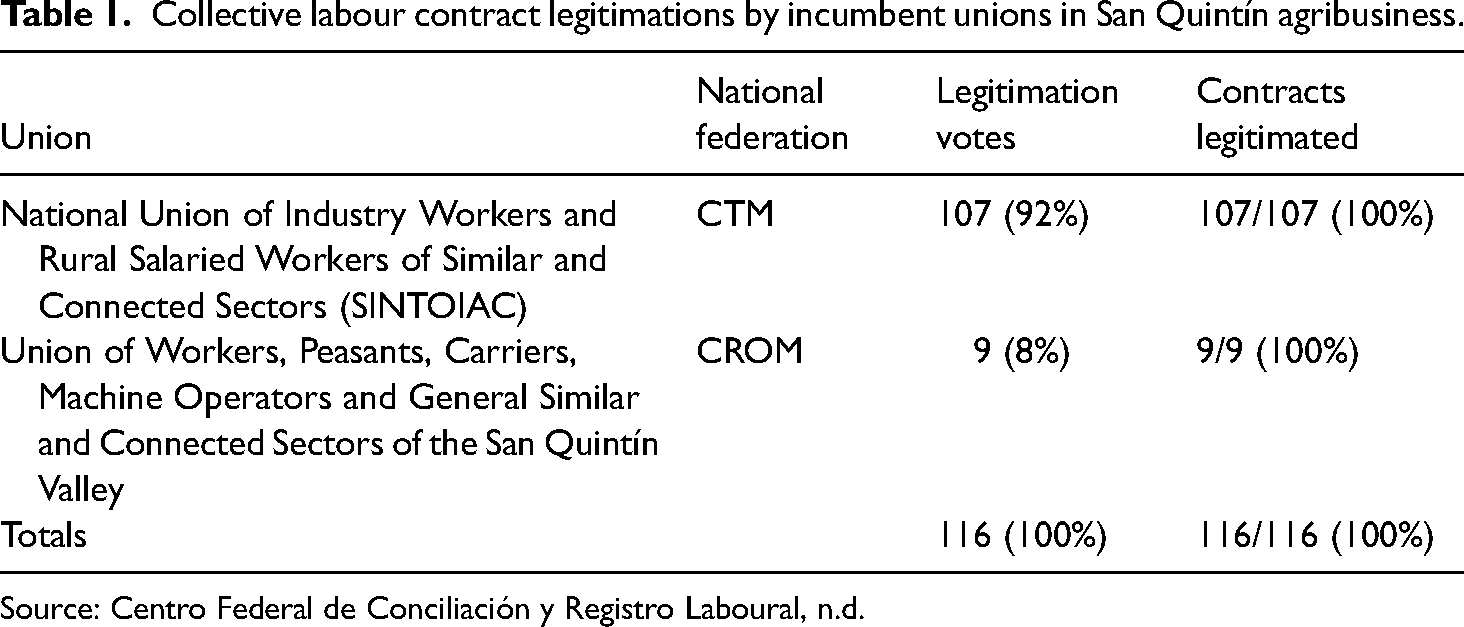
Two specific cases suggest how this outcome was achieved. At Rancho Nuevo, workers saw a list of eligible voters for the legitimation vote that included fewer than half of them and contacted the union SINDJA for support. SINDJA explained the legitimation process and helped workers to expand the list and obtain a copy of the contract, which the workers had never seen before. Workers voted with confidence that they organised a strong majority to reject the employer-protection contract, despite supervisors encouraging ‘yes’ votes. SINTOIAC-CTM held the vote, checked the box of supervision with a notary public, and submitted a result of legitimation – 287 yes, 106 no votes, accepted by the Federal Centre (Centro Federal, n.d.). Workers declined to file a complaint, fearing retaliation and lacking confidence in the government, given lack of labour law enforcement for decades.
Workers at Dos Mares began affiliating with SINDJA after learning about the legitimation process. Yet threats of violence halted their exercise of freedom of association. Photos taken by the workers show thugs armed, hooded, standing in the back of pickup trucks and encircling the rows of berries where workers laboured. SINTOIAC-CTM's contract protecting Dos Mares management was legitimated, 133 yes, 11 no votes (Centro Federal, n.d.). Whether the legitimation of the employer-protection contract at Dos Mares resulted from fraud or intimidation of workers into voting for it remains unclear due to lack of access to redress.
Had the US and Mexican governments included all export sectors in the RRLM, these workers could have used it, indicating increased democratic access to remediation of rights violations. This may have resulted in new contract legitimation votes overseen by the Federal Centre and independent observers, but the restriction of the RRLM to priority sectors denied such access. Further highlighting the contradictions within the reforms, the agribusiness workers could file a complaint that the Mexican government has not upheld its treaty commitments as established in the USMCA Labour Chapter. While the process requires more time than the RRLM, it presents the possibility of pressuring the Mexican and US governments to uphold commitments to labour rights in the neglected agribusiness sector.
Case study #2, Auto-part workers in Piedras Negras: workers’ use of new labour rights enforcement mechanisms exposes their authoritarian innovations
In the auto industry, a focal point of the US and Mexican governments’ reforms, workers’ struggle at a parts factory on the Mexican side of the border exposed the authoritarian innovation of state discretion in union, collective bargaining and strike permissions built into the new labour regime. At VU Manufacturas, workers fought to establish an independent union and collective bargaining by using the newly reformed national labour law and the RRLM. In response, their employer disregarded their collective bargaining rights, dismissed them and relocated production with impunity.
VU Manufacturas is a subsidiary of US-based VU that produces soft trim products (e.g., console covers) for sales to first-tier suppliers of automotive brands, including Marelli, Moriroku, and Adient. It is located in Piedras Negras, which has offered low-wage operations to manufacturers since employers and politicians in Coahuila instituted the employer-protection union system. During Mexico's era of rapid industrialisation and union emergence at the turn of the 20th century, workers in Coahuila formed the national labour federation CROM and unions in the mining and railroad sectors (Quintero Ramírez, 2005). The federal Border Industrialisation Program helped shift economic activity from domestic toward export orientation, attracting manufacturing firms. To sustain low labour costs, the export-assembly industry managed labour relations in Coahuila with employer-protection contracts with CTM-affiliates and support from PRI politicians since the 1980s. Signalling the labour regime, a major industrial park of Piedras Negras, La Amistad, advertised ‘Welcome, No Unions’.
When workers began organising an independent union at VU in 2022, management called on the Coahuila State Federation of the CTM to block them. CTM holds approximately 90% of collective contracts in the state according to workers (author interviews, 2023), 420 according to Coahuila-CTM secretary general Tereso Medina (El Pulso Laboural, 2023). Indicative of official union involvement in the legislative and labour law enforcement systems, Medina is also a federal legislator with the PRI and secretary of the state-level Labour Commission.
Low wages, dangerous conditions and work intensification sparked workers’ campaign at VU. The company used a 5-tier pay scale, with tiers ranging from USD 14.47 to USD 17.36 per day in 2022, when the minimum daily wage was USD 14.46. Workers were recruited to work four, 12-hour shifts with three rest days each week but instead found themselves working seven days per week to make ends meet. Workers did not receive annual bonuses to which they are entitled under federal labour law. They work with chemicals, minimal personal protective equipment and no toxicological information from the employer. In the summer months, they endure dangerous heat as temperatures climb above 40 degrees Celsius (104 degrees Fahrenheit) outside, hotter on the non-airconditioned factory floor. Workers began organising a union at VU and affiliated with the newly established Mexican Workers Union League (Liga Sindical Obrera Mexicana, LSOM), a national union, in 2021.
The company responded with resistance. Initially, factory manager Marcos Salinas told the CTM that VU owners did not want any union, then he called back seeking CTM's protection (El Sol de México, 2022). Workers soon encountered CTM representatives at VU and began hearing from Salinas that they should support the CTM. Management withheld bonuses and furloughed workers supporting LSOM, actions the workers interpreted as retaliation.
Workers used the newly reformed national labour laws and RRLM to advance their campaign. Under new national requirements that workers elect their unions, the Federal Labour Centre scheduled an election for workers to choose between the two unions contesting for collective bargaining rights at VU, LSOM and Coahuila-CTM. While workers organised for LSOM representation, management granted preferential access to workers to the CTM. The LSOM filed a petition to the US government to investigate employer interference in freedom of association rights under the RRLM. Finding merit, the US government suspended VU's exporting rights to the United States until finding the case remediated (USTR, 2022). The Mexican government reviewed the case and supervised the union representation election.
Workers elected the LSOM union on 31 August 2022, 62% voting for LSOM and 37% for the CTM. Workers celebrated their victory. Jovanna García, who started at Manufacturas VU in early 2022, proclaimed, ‘It's important to emphasise that companies don’t have the right to decide for workers their union; it's the worker who makes that decision. Let's go for the change!’ (Feliz Leon and DiMaggio, 2022).
With their new union representative, workers focused on their first collective contract. The LSOM submitted a contract proposal to VU Manufacturas in November 2022, seeking wage increases, shift breaks, payment of a holiday bonus, and ventilation on the factory floor. After initial silence, management agreed to meet with LSOM, but sent lawyers who lacked decision-making authority. Meanwhile, CTM representatives continued the pressure, telling workers at the factory that they would end up without work if they did not switch allegiance to their organisation. Months passed without signals of good faith bargaining from management, which the workers interpreted as an effort to erode their will enough to impose an employer-protection contract with the Coahuila-CTM.
The LSOM submitted a second complaint under the RRLM, and the US and Mexican governments found merit in their complaint. The USTR (2023) again suspended the company's trade rights, summarising: ‘The United States is concerned that this apparent Denial of Rights has negatively affected the ongoing collective bargaining process between the Company and LSOM.’ The Secretaries of Labour and Economy of Mexico noted ‘presumed acts of union discrimination by the company that have obstructed good faith negotiation of a new collective contract’ (Laureles, 2023). The two governments opened an investigation, determined the company had violated rights covered by the USCMA, and began oversight of a six-month remediation plan.
Demonstrating the implications of the authoritarian innovation of state discretion over workers’ rights, VU management avoided collective bargaining with LSOM. First, management ran the bureaucratic clock. Under Mexican law, a union must sign a collective contract within six months of recognition as the legal representative of workers; thereafter, another union may contest the certificate of representation in a new union election. Without state holding them to the timeline, management delayed beyond the six-month deadline, creating the opportunity for CTM to contest the LSOM's representation of VU's workers.
Second, VU used the national requirement that unions obtain state permission to legally strike for a contract. A state-sanctioned strike would have extended the timeline for a first contract and pressured management to negotiate. Here, the PRI-CTM political machine in Coahuila was decisive. When management did not show up for mediation meetings it convened, the Federal Centre ceded the decision over the LSOM's right to strike to the Coahuila Labour Tribunal. The Tribunal denied LSOM's strike rights, surprising no one given the PRI-CTM's power in the state.
Third, discretion within the RRLM provided impunity to VU owners and management. The RRLM procedures threatened sanctions against VU Manufacturas. VU owners and VU Manufacturas managers closed that factory in Piedras Negras, laid off of more than 400 workers and fired two union leaders, denying them severance. The US-based owners of VU and Mexico-based managers of its production ceased renting the factory building in Piedras Negras and moved equipment to another, from which they could continue exports.
The firm owners’ and managers’ actions revealed how an authoritarian innovation, state discretion over labour law enforcement, can function. The RRLM covers individual facilities, enabling targeted enforcement of freedom of association and collective bargaining protections established in the USMCA. Yet the RRLM is silent on the responsibilities of the firm owners and managers who, in practice, choose to respect or not the rights of the workers they hire. Had a worker violated the property-rights regime by taking fabric from VU factory in Piedras Negras for personal use, government sanctions would have held the worker accountable. When VU management violated the labour-rights regime by interfering in the LSOM's union activities, the US and Mexican governments limited the threat of sanctions to the facility, permitting its owners and managers to move, avoid accountability, and continue business. The limited application of the RRLM to facilities as such provided the firm owners and managers the flexibility to wield corporate structures as shields of immunity. In a classic spatial fix, they relocated away from workers’ pressure; in an organisational fix, they restructured around the RRLM.
Case study #3, Matamoros: the long history between innovation and authoritarian practices
The labour situation in maquilas in Matamoros demonstrates other ways authoritarian innovations within Mexico's reformed labour regime have operated. In 2019, 60,000 workers mobilised a strike in the city, subsequently elected an independent union and secured better collective contracts. The movement was known as Movement 20/32, referring to demands for 20% wage increases and 32,000-peso bonuses. 13 Although wages were increased, discretion in implementing labour laws manifest in the use of bureaucratic minutia and delays that shifted momentum from the independent workers’ movement back to employers and official unions.
The main union in Matamoros, the Sindicato de Jornaleros y Obreros Industriales y de la Industria Maquiladora (SJOIIM), shows variation within the national federations. SJOIIM registered in 1932 as a multi-sectoral union, affiliated to the CTM in the 1940s, and maintained local autonomy, negotiating contracts that benefited workers. In the 1990s, the SJOIIM secured the highest wages and benefits in the borderland maquila sector. These included 40-h work weeks, annual bonuses and cost-of-living wage adjustments (Quintero Ramírez, 2023a). At the start of 2023, SJOIIM had 45,000 members.
In an authoritarian innovation predating the current reform era, the Mexican state used tripartite wage-control pacts to limit the gains of the SJOIIM and support exports. After state authorities jailed the SJOIIM leader for refusing to abide by the state system of wage and labour control, the union moderated its wage demands in exchange for offsetting increases in annual bonuses and negotiated lower wages and benefits in contracts with new workplaces (Alvarado, 1993 and Quintero, 1997). The lower-tier contracts created division within SJOIIM membership. Into the division stepped state-level politicians and the CTM. In 1992, they created a competitor union committed to delivering the flexibility that employers demanded, the Sindicato Industrial en Plantas Maquiladoras, Ensambladoras de Matamoros (SITPME).
National state derogation of key decisions to state officials continued since the 2018 reforms. The SJOIIM pursued implementation of the wage increases announced early on by the AMLO administration, yet state-level officials responded that such wage increases were restricted to minimum-wage workers. Frustrated workers aligned with labour lawyer Susana Prieto, who had coordinated a labour mobilisation in 2013–2014 in Ciudad Juárez. With Prieto's support, more than 45,000 workers covered by SJOIIM contracts went on strike, secured the wage and bonus demands that earned them the 20/32 Movement moniker and established the independent union Sindicato Nacional Independiente de Trabajadores de Industrias y Servicios (SNITIS). Prieto then helped 15,000 workers covered by STIPME contracts to secure the same compensation increases. The state-level governor jailed Prieto in apparent retaliation.
During the four years since, SNITIS's mobilising capacity began declining. Workers belonging to SJOIIM achieved their demands and returned to work. State-level crackdowns on unions for representing workers’ interests disciplined workers against collective action, creating conditions for leaders to pursue political solutions. Within SNITIS, efforts to establish democratic practices appeared limited, with leadership evidently disconnected from the movement activists and rank-and-file workers, (Differ et al., 2022) Citing the apparent lack of internal democracy, a group of workers rebelled to terminate control of the union by lawyer Susana Prieto. However, her supporters ratified her, indicating that new and older practices may coexist and produce ambiguous results: support for, and control of, workers, (Quintero, 2023b).
When SNITIS petitioned for a union representation election at auto-parts manufacturer Tridonex, it took four years. The union’s first petition predated the end of state-level conciliation and arbitration board in Matamoros, which rejected it on claims of missing data. Once the Federal Centre was established SNITIS petitioned again, won an election in 2021, but did not receive its representation certificate, required for collective bargaining, until 2023.
The long delay occurred despite the union's filing a complaint under the RRLM in May 2021. The Mexican government's remediation plan included requirements that the company provide severance and backpay to 154 fired workers, commit to neutrality in future union elections and permit training for employees on freedom of association and collective bargaining rights by the labour secretariat. Thereafter, SNITIS won the union recognition vote with 87% support in February 2022. However, Tridonex management and the Federal Centre delayed providing the union with the representation certificate at the company until July 2023.
In Matamoros, the labour law reforms have contributed to wage gains for workers. The impact of the reforms on union democratisation is, at this writing, unclear. After prior use of wage boards and outright suppression divided labour, the 20/32 Movement revitalised collective action, and a new, independent union, SNITIS, emerged. Since the recent labour reforms, the ability of state-level officials to retaliate against union activists and delay union registrations weakened independent unions. With collective action partially successful, partially countered by state-level interventions, internal consolidation of decision-making in SNITIS may be intended to increase political influence, yet it leaves the union susceptible to the corporatist pacts of old.
Discussion
Over the last five years in Mexico, reforms of national and cross-border labour regimes increased the potential for workers’ democratic participation while authoritarian innovations embedded in them risk sabotaging such democratic progress. National reforms established workers’ rights to elect union representation, officials, and collective contracts and shifted conflict resolution from the more political executive branch to the more bureaucratic judiciary – potentially reducing risk of employers and their allies capturing the process. 14 Cross-border reforms increased workers’ access to sanctions-based remedial action for violations of their rights by states and employers by extending coverage of the USMCA dispute settlement procedures to labour standards and adding the facility specific RRLM to those procedures. Yet three authoritarian innovations have simultaneously decreased workers’ capacity to exercise rights: state discretion over union formation, collective bargaining, and striking; granting control over contract legitimation votes to incumbent unions; and excluding sectors from remediation mechanisms. These are examples of authoritarian innovations as conceptualised by Curato and Fossati (2020), voluntary decisions shaped by a historical context that have reduced workers’ ability to hold employer and state actors accountable.
The three case studies demonstrate the operation of these authoritarian innovations, which simultaneously increase and decrease workers’ capacity to exercise rights. The national reform mandating workers’ election of union representation enabled workers in the auto-parts sector of Coahuila to elect the first independent union, LSOM, in a state dominated by an employer-protection, official union, the CTM and its supporting political party, the PRI. The cross-border establishment of the RRLM provided LSOM the leverage of filing a complaint that threatened state sanctions against the employer, VU, for its resistance to union collective bargaining. Yet VU nevertheless evaded negotiating. The Federal Centre ceded jurisdiction over LSOM's strike rights to the state-level court, which provided no legal reasoning in denying the union's right to strike. The Mexican and US governments decided not to sanction VU's owners and managers. While the politics behind them remain opaque, the policy decisions establishing state discretion over a registered union's exercise of constitutionally established strike rights and not hold company owners and managers accountable for violating labour standards of the USMCA-RRLM are authoritarian innovations.
Similarly, wide scope for state officials to protect workers’ rights or not and under what timeline has shaped union formation in the manufacturing sector of Tamaulipas. Use of state power to divide labour repeated itself, first with state-level officials handicapping SJOIIM, facilitating the insertion of SITPME, and since recent reforms, with jailing of Prieto and procedural delays of SNITIS's efforts to represent workers. Neither Federal Centre nor RRLM interventions checked state-level actors. While evident centralisation of power in SNITIS may be written off as individual idiosyncrasies, the discretion wielded by state-level officials morphed incentive structures. Workers of the SJOIIM, the 20/32 Movement, then SNITIS experienced political interventions frustrating their collective exercise of legal rights. In this context, workers’ supporting a union leader's pursuit of political solutions may be strategic, even if one near-term result seems to have been reduced control over their union.
The case study in agriculture demonstrates the authoritarian innovations related to contract legitimation and access to remediation mechanisms. National reforms established the legitimation process, ostensibly providing farmworkers in Baja California a chance to vote out employer-protection contracts that had blocked their union and collective bargaining rights for decades. However, the state's granting of substantial control over the legitimation vote to incumbent unions enabled employer-protection unions to submit 100% of their contracts as legitimated, despite workers’ organising against them. Furthermore, the decision by the Mexican and US states to exclude agriculture from the RRLM denied the farmworkers’ access to remedial justice through the regional trade agreement, even as armed thugs patrolled their workplaces and intimidated them against choosing their union representative.
In addition to identifying authoritarian innovation examples, comparing the three cases illustrates where these forms of labour control operate. The cases corroborate Curato and Fossati's (2020) claim that contemporary authoritarian innovations commonly function at the meso-level. The comparison also highlights contradictions within the state. The substantive decisions debilitating democratic participation in Mexico are occurring in a contested state comprised of heterogeneous actors, resulting in the same institutions partially supporting and suppressing workers’ collective control over their labour. A key example is the instance of the Federal Centre passing the decision on a newly registered union's right to strike to a court in a state, Coahuila, known for political domination by an alliance of employers and employer-protection unions. National reforms aimed at insulating labour relations from raw politics revealed their inadequacy.
The cases suggest a main contradiction within the national and regional regime, the tension between the newly strengthened state protections of workers’ rights and the continuation of an economic model of low-cost exports from Mexico contributing to the profitability of multinational corporations based throughout North America. Even as the reform party, MORENA, advanced democratic practice through labour law reform, it accommodated capitalist demands for continuity of the export-led accumulation regime. Ceding prerogative to employer-protection unions and excluding sectors such as agriculture mark continuities in the export-led national development model pursued since the debt crises of the 1980s (Bensusán 2020; Velasco et al., 2014). The mechanisms for sustaining low workers’ bargaining power that underpins the macro-level model are, again, activated at the meso-level of the Federal Centre, state labour tribunals, procedural regulations of the legitimation process, and footnotes of the RRLM. Clearly, however, contradictions imply contingencies, meaning increased independent unions may gain political power to shape the implementation of labour law in the future.
The three cases suggest interactions between the macro- and meso-levels. The discretion established for federal officials to act or derogate decisions to state-level actors, discretion for US and Mexican officials to sanction or absolve an employer for violations of USMCA standards, and, starkly, exclusions of sectors from the RRLM and control over legitimation votes granted to incumbent unions determined outcomes. Without either state restriction of official unions or access to the RRLM, workers endure the status quo, blocked from exercising their rights in agribusiness in Baja California. The Federal Centre decision to not uphold LSOM's strike rights but cede decision-making to state-level officials known to be influenced by employers and their protecting unions halted workers’ progress in Piedras Negras, while the lack of sanctions against VU established the precedent of employers’ evasion of the RRLM. In Matamoros, delays by federal actors facilitated employers, official unions and state-level authorities to limit the gains from workers’ collective action.
Sectoral variation is also evident. Most of the new independent unions have emerged in export sectors with significant histories of union contestation in Mexico and transnational solidarity. The RRLM prioritisation of manufacturing, especially aerospace, auto and steel, reflects the political capacity of US unions representing workers in these sectors and their longstanding relationships with counterparts in Mexico. In contrast, sectors without large union representation in the United States or significant cross-national ties, such as agriculture and light manufacturing, have been underprioritised in the RRLM. In addition to the RRLM prioritisation, the difference in cross-national union strength manifests in workers’ capacities to use boomerang strategies (Keck and Sikkink, 1998). This was illustrated when the local power structures impeded workers in Baja California and Coahuila from collective bargaining as independent unions, pushing both unions to pursue support from allies outside of Mexico that could in turn put pressure on Mexican authorities. However, while the workers in the auto sector, in Coahuila, have been able to leverage union allies in the United States and Canada for support with complaint processes, the few and small unions in agriculture in the region are not positioned to provide the same level of support.
These dynamics underscore the contested character of labour regimes (Hyman, 2008). The corporatist regime contributed to growth and distribution, at least to workers in strategic sectors, under decades of relatively protected national markets (Bensusán, 2020). As the state restructured towards an export-dependent economic model, lowering and maintaining low labour costs entailed tightening of control over unions (Middlebrook, 1995). In the context of limited state support and employer demands for flexibility, official union leaders sought to maintain a semblance of power by accepting and promoting employer-protection contracts (Bensusán and Middlebrook, 2013). As pressure from internal and external forces increased (Bensusán, 2020), national governments dominated by politicians representing business and official unions negotiated reforms of national labour law and the regional trade and investment treaty (Cypher and Crossa, 2021; Ocampo Merlo, 2022). While the authoritarian innovations embedded in the reformed labour law and USMCA reflect the relatively weak political power of labour in recent decades, our research suggests that, under different conditions, a left-oriented government might implement them with stronger support for their democratic features. In particular, under conditions of a larger, unified, and progressive labour movement with stronger bargaining power, the national and regional reforms are likely to facilitate more outcomes favourable to workers, demonstrating the contingency inherent in labour regimes.
Conclusions
This paper analysed authoritarian innovations in the industrial relations arena in Mexico in the context of a long history of contested processes of state labour control. The election of a left-oriented MORENA party in 2018 opened the door to national labour reforms, institutional transformations, and the Facility-Specific Rapid Response Labour Mechanisms in the USMCA. Yet, as the paper argues, this did not result in an unambiguous growth of democratic and independent unions. Rather, this has been a highly conflictual process in which state actors worked with corporatist unions to reassert labour control through a series of authoritarian innovations: State discretion over union formation and the right to strike; state sanction of incumbent union control over worker voting on collective contracts; and the exclusion of whole sectors from access to redress under the USMCA. Three case studies – varied by sector, local power formation and worker strategies – illustrated how these innovations played out differently across sectors and regions of the country.
This exploration of authoritarian innovations in Mexico provides several insights for such studies elsewhere. First, we see the importance of sub-national politics dynamics, which is particularly relevant in federal systems where local power structures play a strong role. Second, rather than a monolithic state carefully planning how to control labour through authoritarian innovations, we find conflicting interests within the state and in the design of the USMCA labour and dispute resolution chapters. Varying political, business and labour interests all mobilised and lobbied to shape state policies to meet their goals, resulting in institutional design that provides space for both independent union growth and new forms of labour control. Third, the Mexican case reaffirms the importance of economic sectors. Authoritarian innovations look very different in agriculture, auto parts, and maquiladora sectors due to structural constraints and opportunities. Finally, the case reveals the contingent and contested processes of authoritarian and democratic innovations. Actors make choices, adjust strategies, and respond to challenges in distinct ways, reflecting their current levels of influence, resulting in variations in outcomes.
Footnotes
Author contributions
All authors have contributed equally.
Declaration of conflicting interests
The authors declared no potential conflicts of interest with respect to the research, authorship, and/or publication of this article.
Funding
The authors disclosed receipt of the following financial support for the research, authorship, and/or publication of this article: This work was supported by the Solidarity Center (grant number 104754).
