



Abstract
Flexible work is often heralded as a key solution to the work–family ‘juggle’, yet evidence of its effectiveness is mixed, and few studies consider how parents combine flexible work options to balance work and care. This study aimed to examine the interplay between formal (employer-provided) and informal (self-directed) flexible work arrangements and identify usage patterns that support parents’ management of the work–family interface. We examined data from 3669 coupled Australian parents collected in 2016–2017. Using latent class analysis, we identified three distinct patterns of total flexibility use (low, moderate and high). Parents who were low users had the poorest work–family experiences, reporting higher work-to-family conflict, lower work–family enrichment and less balance than moderate or high users. However, high users experienced higher family-to-work conflict, and greater flexibility uptake did not ease perceptions of time pressure. Overall, findings demonstrate that formal and informal flexibility is a beneficial resource for mothers and fathers.
Balancing the dual demands of paid work and raising children is a common challenge of contemporary parenthood (Pocock et al., 2013). One approach to help employed parents balance work and non-work responsibilities is flexible working arrangements – workplace practices that permit employees to have some control over work hours, pattern or location, such as flexitime and flexiplace (Fair Work Ombudsman, 2021). Flexible work practices and policies have become widespread as organisations recognise the benefits of supporting work–life balance, for both employees and employers (Workplace Gender Equality Agency, 2019). Several governments have introduced legislation that entitles all employees (e.g. Germany, UK) or employees with caring responsibilities (e.g. Australia) the right to request flexible work arrangements. More recently, government and organisational responses to the COVID-19 pandemic have thrown flexible work into the spotlight, with stay-at-home measures enforcing many employees to work remotely from home. Despite this emphasis on workplace flexibility, evidence to support its use for parents is mixed (Allen et al., 2013). Some work–family outcomes (i.e. work–family enrichment, time pressure) have received little empirical attention (French and Shockley, 2020), and few studies consider how parents use flexible work arrangements (provided by employers) in conjunction with informal work accommodations (self-directed strategies). Our prior research using data from a national sample of Australian parents found that informal work accommodations were widespread and regularly used by mothers and fathers, despite most parents also accessing formal flexible work provisions (Hokke et al., 2021). The present study sought to extend previous evidence and provide a more nuanced understanding of how parents use flexible work arrangements, guided by the following research questions: (i) How do parents use formal and informal flexible work options in combination?; (ii) Which patterns of use help or hinder mothers’ and fathers’ experience of the work–family interface?; and (iii) Which parents are at risk of poorer work–family experiences?
The current study
We focus our study on employed parents who comprise around two-fifths of the Australian labour force, and on parents who reside in couple households, the most common household type in Australia (Australian Bureau of Statistics, 2021), to address the following three objectives. First, we investigate how parents combine formal and informal flexibility to manage work and family demands. Our prior research (Hokke et al., 2021) examined parents’ use of these work arrangements separately, which then led us to query how parents use various flexible work options in combination. To address this aim, we sought a robust data-driven statistical approach and apply latent class analysis to identify distinct profiles of use of formal and informal work arrangements in a national sample of employed Australian parents. Latent class analysis is a probabilistic-based mixture modelling method used to detect latent (or unobserved) heterogeneity in samples and group individuals into homogeneous classes based on underlying patterns in the data (see Weller et al. (2020) for an overview). Compared to other ‘person-centred’ approaches such as cluster analysis, latent class analysis estimates class membership probabilities and provides several rigorous statistical tests to assess model fit (Porcu and Giambona, 2017).
Second, we ascertain which of the identified patterns or classes are most optimal for managing the work–family interface, evaluating between-class differences in parents’ experiences of work-to-family conflict, family-to-work conflict, work–family enrichment, work–family balance and time pressure. Third, we examine the demographic and employment characteristics that predict class membership, with variable selection informed by prior work–family research, to identify which mothers and fathers are at risk of poorer work–family experiences.
Literature review
Flexible work and the work–family interface
To date, most research considers flexibility in terms of ‘formal’ organisational policies provided by Human Resources or workplace practices implemented by unit managers (i.e. flexitime or flexiplace, also known as telework or remote work) (French and Shockley, 2020; Hokke et al., 2021). Such formal flexible arrangements are typically provided by employers to manage general, persistent work–family strain, and their use often requires employees to submit a written request for ongoing changes in work structure or demands (Hokke et al., 2021). We consider five key indicators of parents’ experience of the work–family interface that are commonly used to describe the ways people combine work and family domains (French and Shockley, 2020; Rose et al., 2013): work-to-family conflict, family-to-work conflict, work–family enrichment, work–family balance and time pressure.
Work–family conflict is a form of inter-role conflict where the demands of one domain interfere or compete with demands of the other domain, resulting in overload and strain (Greenhaus and Beutell, 1985; Marshall and Barnett, 1993). Work–family conflict is reported by one in three Australian parents (Lass, 2019; Strazdins et al., 2013) and is associated with poorer health consequences for mothers and fathers, and negative impacts for families and organisations (Amstad et al., 2011; Cooklin et al., 2016; Dinh et al., 2017). Work–family conflict is bidirectional and comprises family-to-work conflict, where family interferes with work, and work-to-family conflict, where work interferes with family (Allen et al., 2013). The relationship between flexibility and work–family conflict is inconsistent and complex. Some studies find employees with more flexibility (measured as schedule flexibility, flexitime or flexiplace) report less work-to-family conflict (Carlson et al., 2010; Hayman, 2010) including in meta-analyses (Allen et al., 2013; Byron, 2005), while others report no association (Clark et al., 2017) or an adverse association (Higgins et al., 2014; Kim et al., 2020). Research examining the relationship between flexibility and family-to-work conflict is also mixed (Allen et al., 2013; Byron, 2005; Hayman, 2010; Higgins et al., 2014). Notionally, flexible work arrangements provide employees with greater control over their work schedule and/or location. For example, flexitime can help ease time-based conflicts by scheduling work hours around childcare or school hours. Flexibility can serve as a boundary-spanning resource (Voydanoff, 2005a), enabling parents to allocate time, attention and energy in more autonomous and efficient ways. However, workplace flexibility may sometimes act as a boundary-spanning demand and increase work–family conflict (Allen et al., 2013; Kossek et al., 2006; Lapierre and Allen, 2006; Voydanoff, 2005a). For example, flexiplace removes the geographic separation between work and family and may facilitate boundary permeability across domains, potentially contributing to role blurring and strain.
Increasingly, researchers are recognising the positive effects of combining work and family roles. Work–family enrichment occurs when an accumulation of multiple roles enhances opportunities, rewards and resources transferable across or between roles, delivering benefits to individuals and their families (Greenhaus and Powell, 2006; Marshall and Barnett, 1993). For example, employment can provide social and financial resources which positively impact mental health and family functioning (McNall et al., 2010; Zhang et al., 2018). Or, social support from family members can increase job satisfaction and engagement (Chan et al., 2020). Work–family conflict and enrichment are distinct concepts that can co-occur, as employees may experience work–family gains and strains simultaneously (Greenhaus and Powell, 2006; Lapierre et al., 2018). Overall, literature supports a positive relationship between family–friendly organisational policies (including flexible work) and work–family enrichment (Carlson et al., 2010; Chen et al., 2018; Lapierre et al., 2018; McNall et al., 2010). Flexibility may increase work–family enrichment by enabling parents to devote more time to family responsibilities, participate more fully in family life, and enhance their performance in the parenting role (Greenhaus and Powell, 2006; Voydanoff, 2005a). A flexible work environment may also signal organisational family-friendly support, help individuals be more efficient and satisfied at work, and increase positive affect (French and Shockley, 2020; Lapierre et al., 2018).
Work–family balance is ubiquitous in mass media, yet has been conceptualised, defined and measured in various ways (Casper et al., 2018). Here, we consider work–family balance as the perception that work resources are sufficient to effectively manage work and family roles simultaneously (Voydanoff, 2005b). Balance is a global construct that captures an individual's overall evaluation of the interplay between work and family (Carlson et al., 2009; Casper et al., 2018). Work–family balance is positively related to well-being and job and family satisfaction, and adversely related to depression and anxiety (see Landolfi et al., 2020). Employees with schedule flexibility or perceived flexibility generally report greater work–family balance (Buchanan et al., 2020; Goni-Legaz and Ollo-Lopez, 2016), although working from home has been shown to negatively impact work–family balance satisfaction (Buchanan et al., 2020).
Time pressure (feeling rush or pressed for time) is a persistent concern for many parents and is central to the challenge of managing work and family commitments (Craig and Brown, 2017; Szollos, 2009). Excessive or competing demands of care and paid work can constrain people's time, while advances in technology and socio-cultural expectations to rush or simultaneously perform tasks can intensify experiences of time pressure (Strazdins et al., 2016). Living a time-balanced life promotes health and well-being, while time pressure can have negative effects on health, well-being and relationships (Ruppanner et al., 2019; Strazdins et al., 2016). Parents often use flexible work arrangements to improve time efficiency or time management, although few studies examine how flexibility relates to parents’ experience of time pressure. Flexible work options have been associated with lower time pressure for men and women (Darouei and Pluut, 2021; Rose and Hewitt, 2019), while others report no association between parents’ use of schedule flexibility and time pressure (Dunatchik et al., 2019). Other research suggests that attempts to merge work and home boundaries or multitask may increase time intensity and perceptions of time pressure (Rose, 2017; Thulin et al., 2019).
Examining formal and informal flexible work arrangements and the work–family interface
Less evidenced in the literature, yet also salient to parents’ management of work and family, are informal work accommodations to family (IWAF) (Behson, 2002; Hokke et al., 2021). These are the temporary, self-directed, ‘ad hoc’ adjustments employees make to usual work patterns to accommodate family responsibilities, such as performing family-related tasks at work (e.g. phone calls, paying bills) or working through breaks to leave work on time. While some IWAFs may require discretionary approval by a supervisor, their use is generally unofficial or ‘invisible’ (Behson, 2002) in comparison to more formal arrangements described above. Literature about IWAFs is sparse, yet our prior research showed that most (64%) Australian parents regularly use a range of informal work accommodations to respond to family demands (Hokke et al., 2021). Greater IWAF use was associated with higher work–family conflict, for both mothers and fathers. Badawy and Schieman (2020) investigated the consequences of family-related contact at work and found more frequent contact over time was associated with greater family-to-work conflict, particularly for women and workers with greater caring responsibilities. As noted for formal flexibility, informal flexibility may increase multitasking, role boundary blurring and disruptions, and represent a stressor for parents (Hokke et al., 2021; Paulin et al., 2017). We are not aware of any studies that examine the use of informal work accommodations and parents’ experience of work–family enrichment, balance or time pressure. Further evidence is warranted to understand the interplay between formal organisational provisions and informal self-directed strategies, and identify which patterns of flexible work are most effective at improving parents’ work–family management.
Gendered and social patterning of flexible work and the work–family interface
Work and family arrangements, including flexible work, are gendered. Employed mothers report more family-to-work conflict than fathers are among the most time-pressured groups and are the least satisfied with work–family balance; largely due to the disproportionate amount of time women spend relative to men on housework and childcare (Buchanan et al., 2020; Craig and Brown, 2017; Pocock et al., 2013; Strazdins et al., 2016). Australian mothers are expected, by themselves and society, to tailor work around caring responsibilities (Baxter, 2014; Radcliffe and Cassell, 2015). It follows that more mothers use formal flexible work arrangements than fathers in Australia (Australian Bureau of Statistics, 2018a; Skinner et al., 2016) due to persistent gendered expectations in how families negotiate work and care, and because fathers anticipate or face more stigma in accessing flexibility (Coltrane et al., 2013).
The role of gender on the relationship between flexibility and the work–family interface is mixed, and few studies consider parenting status. Some report no difference by gender (Allen et al., 2013), whereas others find flexibility is associated with higher family-to-work conflict for mothers compared to fathers (Badawy and Schieman, 2020; Hammer et al., 2005). This could reflect employees with more flexible jobs bearing more of the responsibility for caregiving and housework, and thus reporting greater conflicts (Hilbrecht et al., 2008). Other research suggests women benefit more from flexible work schedules than men (Byron, 2005; Carlson et al., 2010), whereas flexible work location may be more useful for men (Clark et al., 2017; Kim et al., 2020). No gender effects have been found regarding flexibility and work–family enrichment (Carlson et al., 2010; Chen et al., 2018; Lapierre et al., 2018).
Social inequalities may also impact parents’ uptake of flexibility. International evidence suggests poorly remunerated jobs have the most ‘inflexible’ conditions (Perry-Jenkins et al., 2017; Williams et al., 2013). Higher-status workers (i.e. employees with higher educational attainment, supervisory roles) are more likely to work flexibly (Chung, 2019; Williams et al., 2013). Both informal and formal arrangements are used more frequently by workers with job autonomy and schedule control (Behson, 2002; Kossek et al., 2006; Thompson and Prottas, 2006); job characteristics that tend to cluster in skilled or professional occupations. Access to flexibility also differs by contract type, with flexible work typically entitled to those in more secure employment (i.e. permanent/ongoing or long fixed-term contracts) than temporary or casual workers (Fair Work Ombudsman, 2021). This suggests that socio-economic position, job status and skill may be important determinants of use. Inequalities in workplace flexibility may widen social, income and health inequalities and may place parents ‘at risk’ of poorer work–family experiences, yet this is poorly described in Australia.
Method
Study design and sample
Data were drawn from the ‘Families at Work’ study, an online nation-wide survey on the employment conditions and workplace supports used by employed Australian parents to manage work and family demands. The study was approved by (La Trobe University Human Research Ethics Committee, reference number S16-112). Study design and recruitment procedures are described elsewhere (Hokke et al., 2021). In brief, parents were recruited between August and November 2016 via Facebook. Facebook advertisements invited working parents to complete a 15-min online survey about ‘balancing work and family’. Parents were eligible if they were at least 18 years of age, residing in Australia, in paid employment and a parent of one or more children aged 18 years or younger. In total, n = 5197 parents consented to participate. The overall sample was compared with a national, population-based cohort and found to be broadly representative of working Australian parents, although parents with lower educational attainment and parents born outside Australia were under-represented (Hokke et al., 2021).
Participants were included in the current analyses if they were organisationally employed and coupled (married or de facto relationship). Self-employed (n = 472) and single parents (n = 694) were excluded, as were parents who did not identify as either a man or woman (n = 11). Participants with missing data on variables of interest were also excluded from main analyses (n = 351). The final sample therefore comprised 3669 organisationally-employed coupled parents with a dependent child.
Measures
Work arrangements
Flexible work arrangements were assessed using a six-item measure of common work–life balance strategies (e.g. ‘Flexible work hours / flexitime’, ‘Working from home / offsite / remote or telecommuting regularly’, ‘Job share’) (De Cieri et al., 2005; Hokk et al., 2021). Parents reported which arrangements they had used in the past 12 months to manage work and family demands. Counts were derived (range 0–6).
Informal work accommodations to family (IWAF) were assessed using an adapted 12-item scale developed by Behson (2002) and as previously reported (Hokke et al., 2021). Parents indicated how often they had done each of the 12 IWAF items on a 4-point scale. Examples of IWAFs include ‘Doing household-related tasks while at work (e.g. paying bills or arranging plans by phone)’ and ‘Working through breaks to leave work on time’. Responses were summed (range 12–48), with higher scores indicating greater frequency of IWAF behaviours (Cronbach's α=.77).
Work–family interface
Work-to-family conflict and family-to-work conflict were assessed using four items adapted from Marshall and Barnett (1993). Two items assessed work-to-family conflict (e.g. ‘Because of my work responsibilities, my family time is less enjoyable and more pressured’; r = .51, p < .001) and two items measured family-to-work conflict (e.g. ‘Because of my family responsibilities, my work time is less enjoyable and more pressured’; r = .50, p < .001). Parents rated their agreement from one ‘Strongly disagree’ to five ‘Strongly agree’. Responses were averaged (range 1–5), with higher scores indicating more conflict. The correlation between work-to-family conflict and family-to-work conflict was small to moderate (r = .32, p < .0001), suggesting these two composite measures are related but distinct, and supporting work–family conflict as a bidirectional phenomenon for parents.
Work–family enrichment was measured using six-items adapted from Marshall and Barnett (1993) assessing the benefits of combining parenting and employment (e.g. ‘Having both work and family responsibilities makes me a more well-rounded person’; α=.82). Items were scored on a 5-point Likert scale from one ‘Strongly disagree’ to five ‘Strongly agree’ and averaged, with higher scores indicating greater enrichment.
Work–family balance was assessed with a single study-specific item (‘Overall, my current job allows me to balance my work and family demands’). Parents rated their agreement from one ‘Strongly disagree’ to five ‘Strongly agree’.
Time pressure was measured using a single item (‘How often do you feel rushed or pressed for time’) on a 5-point Likert scale (Australian Bureau of Statistics, 2018b). A binary variable was derived to compare parents who ‘always’ or ‘often’ feed rushed or pressed for time, with parents who ‘sometimes’, ‘seldom’ or ‘never’ do.
Demographic and employment characteristics
The demographic, family and employment characteristics selected for inclusion were informed by prior literature (e.g. Byron (2005), Page et al. (2018), and as described above). Demographic and family characteristics included: gender (male, female), parent age (in years), household income type (dual income, single income), country of birth (born in Australia, born outside Australia), educational attainment (Year 12 or below, post-school qualification, tertiary qualification), number of children in the household and age of youngest child (infant, preschool, school). Socio-economic position was determined using the Index of Relative Socio-economic Disadvantage, a relative measure of socio-economic disadvantage by geographic area (Australian Bureau of Statistics, 2011). Scores were ranked and divided into quintiles.
Employment characteristics included weekly individual income before tax, occupation (manager or professional, trades or labourer, clerical or service worker, other), weekly work hours, employment contract (permanent ongoing, fixed-term, casual), shift work, partner's job flexibility (able to change start/finish times; yes, no) and partner's weekly work hours.
Analytic strategy
Analyses were performed in three steps. To investigate how parents combine formal and informal flexibility to manage work and family demands (Aim 1), latent class analysis was performed using MPlus version 8 (Muthén and Muthén, 1998–2012) and guided by recommendations in the literature (Weller et al., 2020), to identify groups (classes) of parents with similar patterns of use (using the six flexible work items and 12 IWAF items). This involved identifying the smallest number of classes starting with a parsimonious 1-class model and fitting successive models with increasing numbers of classes. Based on maximum likelihood estimation, model solutions were evaluated using Likelihood ratio statistic (L2), Bayesian Information Criterion (BIC) and Akaike Information Criterion (AIC) to determine the optimal number of classes. Better fitting models have lower L2, BIC and AIC values. We also examined entropy values and Vuong-Lo-Mendall-Rubin Likelihood Ratio Test (VLMR-LRT) across the successive models. Entropy is an index for assessing the precision of assigning latent class membership, with higher values indicating greater precisions of classification. Posterior probabilities were obtained for each case, indicating the probability of belonging to each class. The VLMR-LRT was used to test for significant differences between the models. In addition to the above model fit indices, model selection was guided by the interpretability, utility and parsimony of identified classes. Class membership was assigned to all participants and used in subsequent analyses.
Next, to determine whether there were differences in work-to-family conflict, family-to-work conflict, work–family enrichment and work–family balance between the identified classes representing the distinct patterns of work arrangements (Aim 2), a series of one-way ANCOVAs (SPSS version 25) controlling for relevant demographic and employment characteristics were conducted. Analyses were stratified by gender to enable meaningful interpretation of results, given the different work–family characteristics of Australian mothers and fathers. Examination of correlation coefficients confirmed the absence of multicollinearity between covariates. Post hoc analysis was performed with a Bonferroni adjustment. Differences in time pressure (binary variable) between classes were assessed using multivariable logistic regression.
To examine the demographic and employment characteristics that predict the probability of parents’ class membership (Aim 3), we tested multinomial logistic regression models separated by gender. Bivariate logistic regressions were performed to model the relationship between class membership and various characteristics separately, with significant predictors (p < .1) subsequently included in a multivariable model.
Sample characteristics of parents excluded from analyses due to missing data were compared to complete cases using univariate analyses. To handle missing data and as an additional sensitivity analysis, analyses for Aim 2 were repeated using multiple imputation by chained equations (Royston and White, 2011). The imputation model included all model variables, and the results of the analyses using multiple imputation were pooled across 20 parallel imputed datasets.
Results
Sample characteristics
Sample characteristics are presented in Table 1. Around two-thirds were mothers (67%, n = 2474). Most parents were born in Australia (81%), tertiary educated (68%) and in a dual-earner household (86%), with an average of two children per household. Half had a youngest child of school age (5–18 years), 41% had a youngest child of pre-school age (1–4 years) and 10% had an infant. The majority of parents worked in a managerial or professional occupation (72%) and in a permanent ongoing role (81%). Mothers worked on average (SD) 33.0 (11.9) hours per week, and fathers worked on average 45.3 (11.9) hours per week. Mothers were more likely than fathers to be in a dual-income household, tertiary educated and in a managerial or professional occupation, and fewer mothers worked shifts. Mothers reported higher family-to-work conflict than fathers, and a greater proportion of mothers felt rushed or pressed for time; yet mothers also reported higher work–family enrichment and balance than fathers.
Sample characteristics.
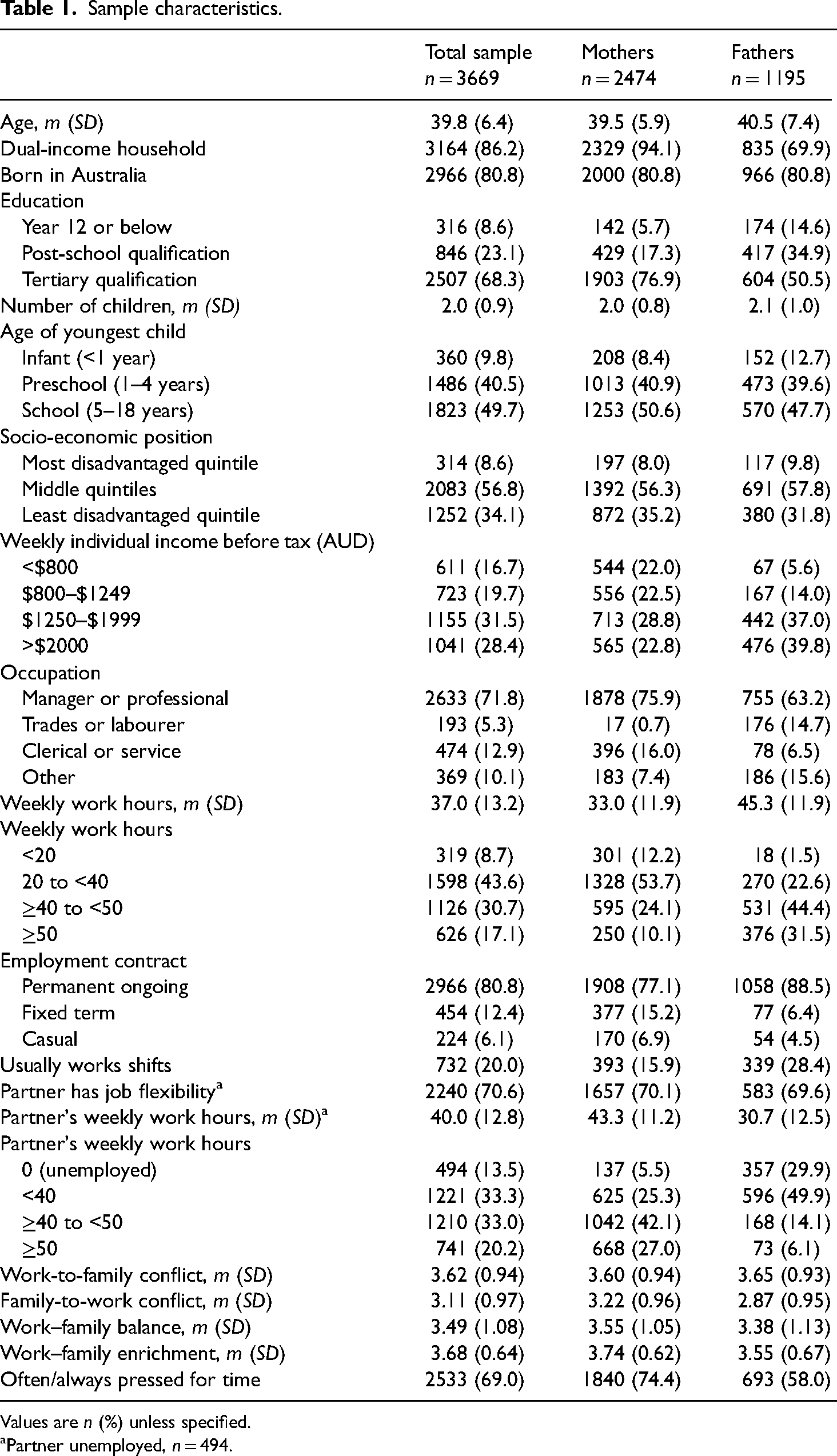
Values are n (%) unless specified.
Partner unemployed, n = 494.
Compared to those included in analyses (n = 3669), parents who were eligible but excluded due to missing data (n = 351) had less educational attainment and lower occupational status, and were more likely to be male and in a single-earner household (p < .001). No other differences in demographic or employment characteristics were found between parents with and without missing data.
Identifying classes of formal and informal flexible work use (Aim 1)
To understand how parents use formal and informal flexible work arrangements in combination, latent class models specifying one to five classes were estimated using work arrangement measures as indicators (Table 2). Although the model fit indices (L2, BIC, AIC) continued to decrease as class size increased, the 3-class model was selected as the final model after examining all tests of model fit and parsimony. Entropy values were highest for the 3- and 5-class models, and both models had significant VLMR-LRT values. However, the number of fathers in the smallest class in the 5-class model was below 5% of the sample (n = 54). In the 3-class model, the number of individuals in each class was adequate for analysis (smallest class size, 12%) and the average latent class posterior probabilities were high (Class 1 = .95; Class 2 = .91; Class 3 = .96), suggesting acceptable precision in assigning individual cases to their appropriate class. Therefore, the more interpretable 3-class model was chosen.
Model fit indices for latent class model.
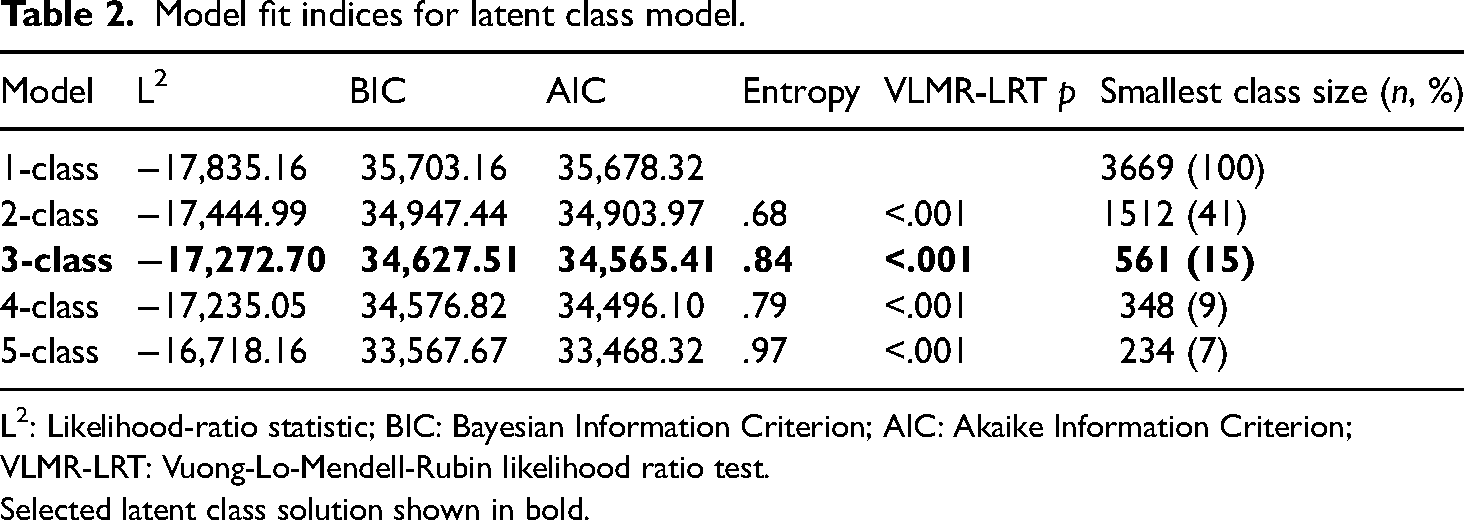
L2: Likelihood-ratio statistic; BIC: Bayesian Information Criterion; AIC: Akaike Information Criterion; VLMR-LRT: Vuong-Lo-Mendell-Rubin likelihood ratio test.
Selected latent class solution shown in bold.
The estimated means of work arrangements for each class, based on this optimal solution, are presented in Table 3. The first and largest class (n = 1,707, 46.5%) consisted of parents with the lowest usage of both work arrangement types. This group had on average used ‘half’ a formal flexible work arrangement in the previous 12 months and were labelled Low Use. The second class (n = 1,401, 38.2%) consisted of parents who reported using on average two flexible work arrangements and were moderate users of IWAFs; they were labelled Moderate Use. The third and smallest class (n = 561, 15.3%) consisted of parents who reported the highest use of both flexibility types. On average, they used four formal work arrangements in the previous 12 months, and were the most frequent IWAF users; this group were labelled High Use. Class size and estimated mean work arrangements were also determined for mothers and fathers, with the latent class analysis solution stratified by gender (Table 3). Fathers were more likely to report patterns of Low Use than mothers (χ2(2) = 33.23, p < .001).
Class size and mean work arrangements for the 3-class model solution, stratified by gender.
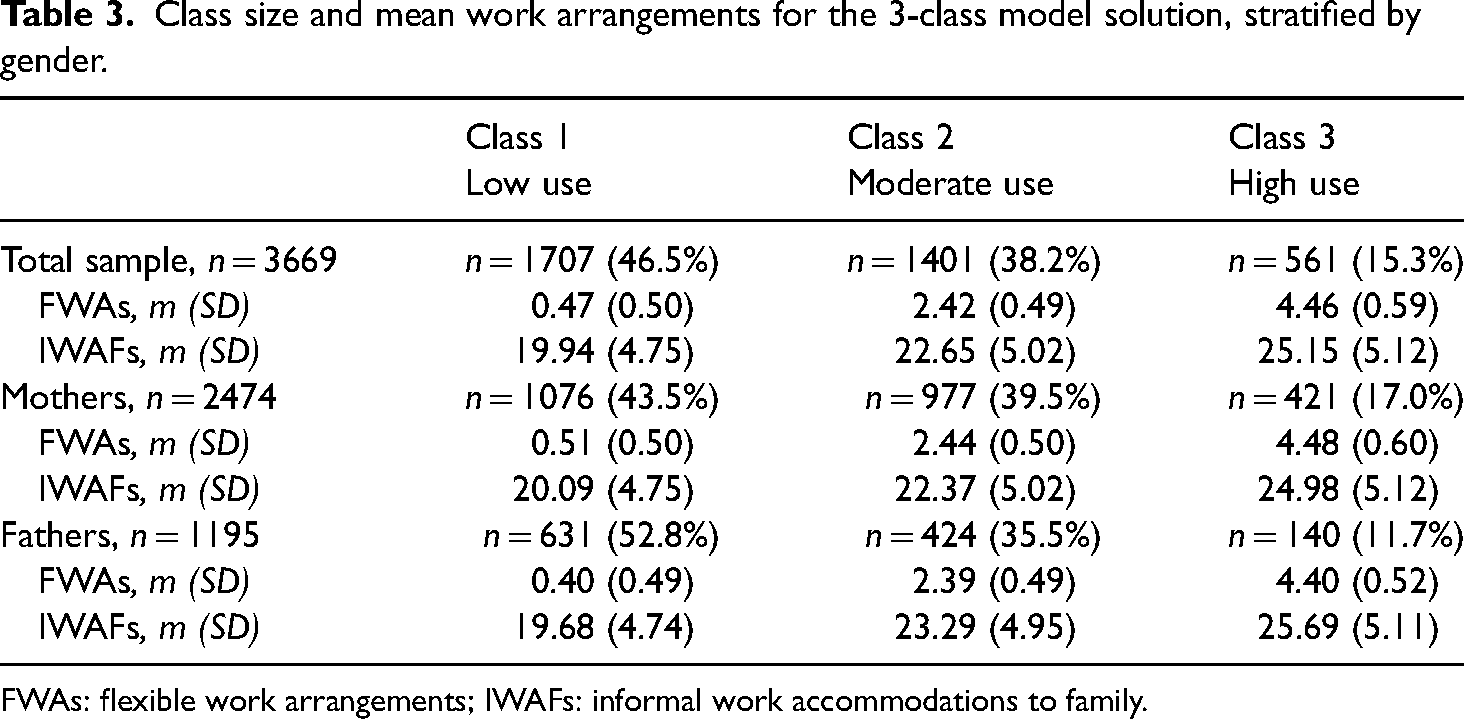
FWAs: flexible work arrangements; IWAFs: informal work accommodations to family.
Class membership and parents’ experience of the work–family interface (Aim 2)
Separate one-way ANCOVAs were conducted to determine if parents’ work-to-family conflict, family-to-work conflict, work–family enrichment and work–family balance differed by class membership, controlling for demographic and employment characteristics (Table 4). Overall, we observed a gradient effect whereby parents with High Use or Moderate Use of work arrangements reported better work–family outcomes than Low Use parents. For example, mothers with Low Use had higher work-to-family conflict, lower work–family enrichment and less work–family balance than mothers who had either Moderate Use or High Use. Similar patterns were observed for fathers: fathers with Low Use had greater work-to-family conflict and less work–family balance than Moderate Use or High Use fathers, and lower enrichment than fathers with High Use. However, mothers and fathers with High Use of work arrangements reported greater family-to-work conflict than those with Low Use or Moderate Use. Multivariable logistic regression was performed to assess parents’ time pressure by class membership, with no difference found for either gender (Table 4). For all ANCOVA models, the patterning of results from the multiple imputation sample did not differ from the main study sample (data available upon request), suggesting minimal risk of bias introduced by missing data.
Class membership and parents’ experience of the work–family interface.
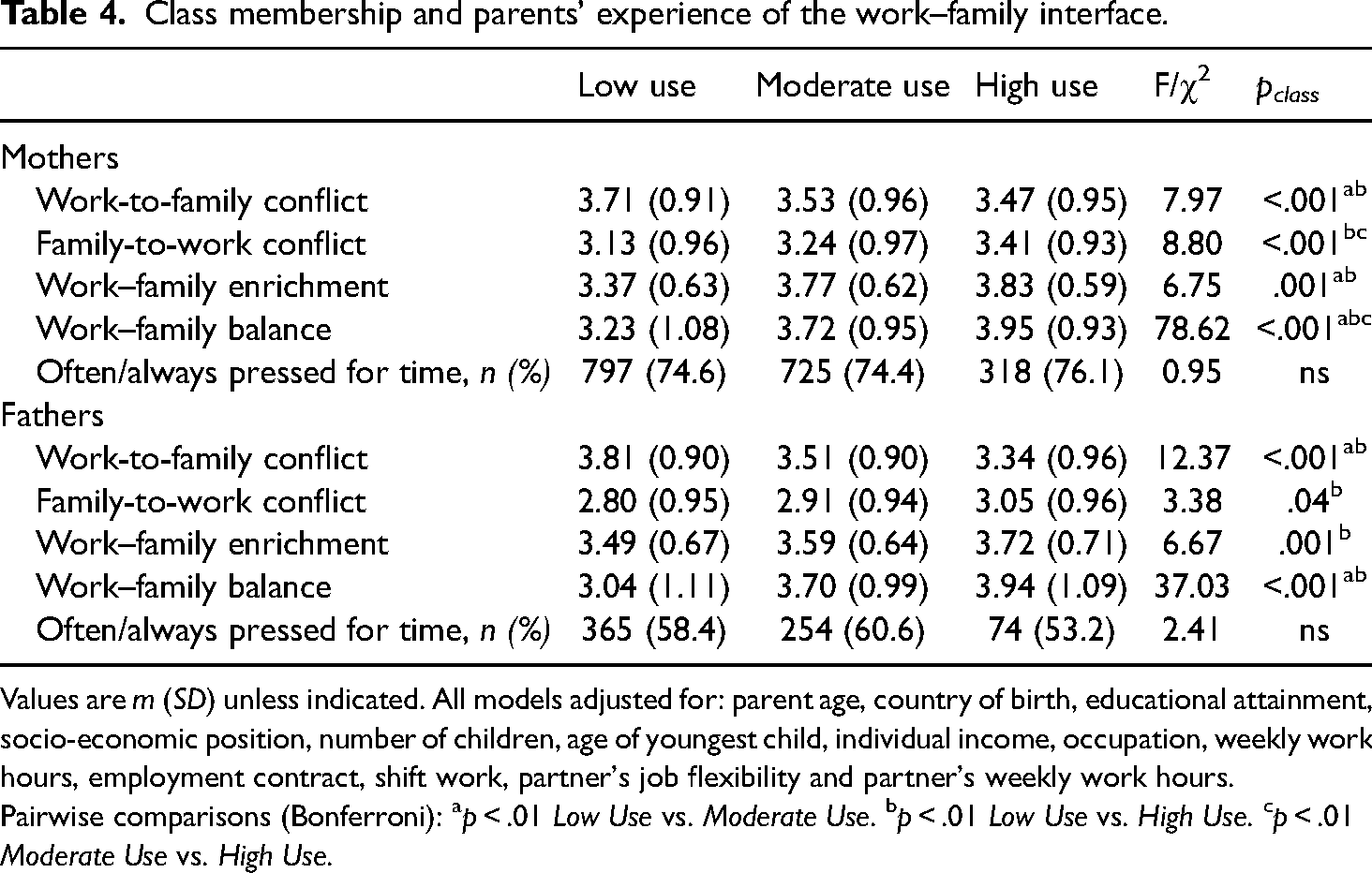
Values are m (SD) unless indicated. All models adjusted for: parent age, country of birth, educational attainment, socio-economic position, number of children, age of youngest child, individual income, occupation, weekly work hours, employment contract, shift work, partner's job flexibility and partner's weekly work hours.
Pairwise comparisons (Bonferroni): ap < .01 Low Use vs. Moderate Use. bp < .01 Low Use vs. High Use. cp < .01 Moderate Use vs. High Use.
Demographic and employment characteristics that predict class membership (Aim 3)
Multinomial logistic regression analysis was undertaken to model the relationship between parents’ class membership and demographic and employment characteristics, using High Use class as the reference group to identify parents at risk of poorer work–family experiences. Parameter estimates for mothers are presented in Table 5. Compared to mothers in the High Use class, mothers with Low Use were more likely to report lower individual income, live in more disadvantaged areas, have a youngest child of school age, work 50 or more hours per week and usually work shifts. Mothers in the Moderate Use class also differed to mothers in the High Use class, being more likely to report low individual income, live in more disadvantaged areas and usually work shifts. For example, mothers who earned less than AUD$2000 per week had 1.59–3.31 higher odds of being in the Low Use class than high income earners; and mothers who worked shifts had a 4.24 increase in odds of being a Low User and a 2.01 increase in odds of being a Moderate User than non-shift workers.
Predicting mothers’ class membership: parameter estimates of multinomial regression model.
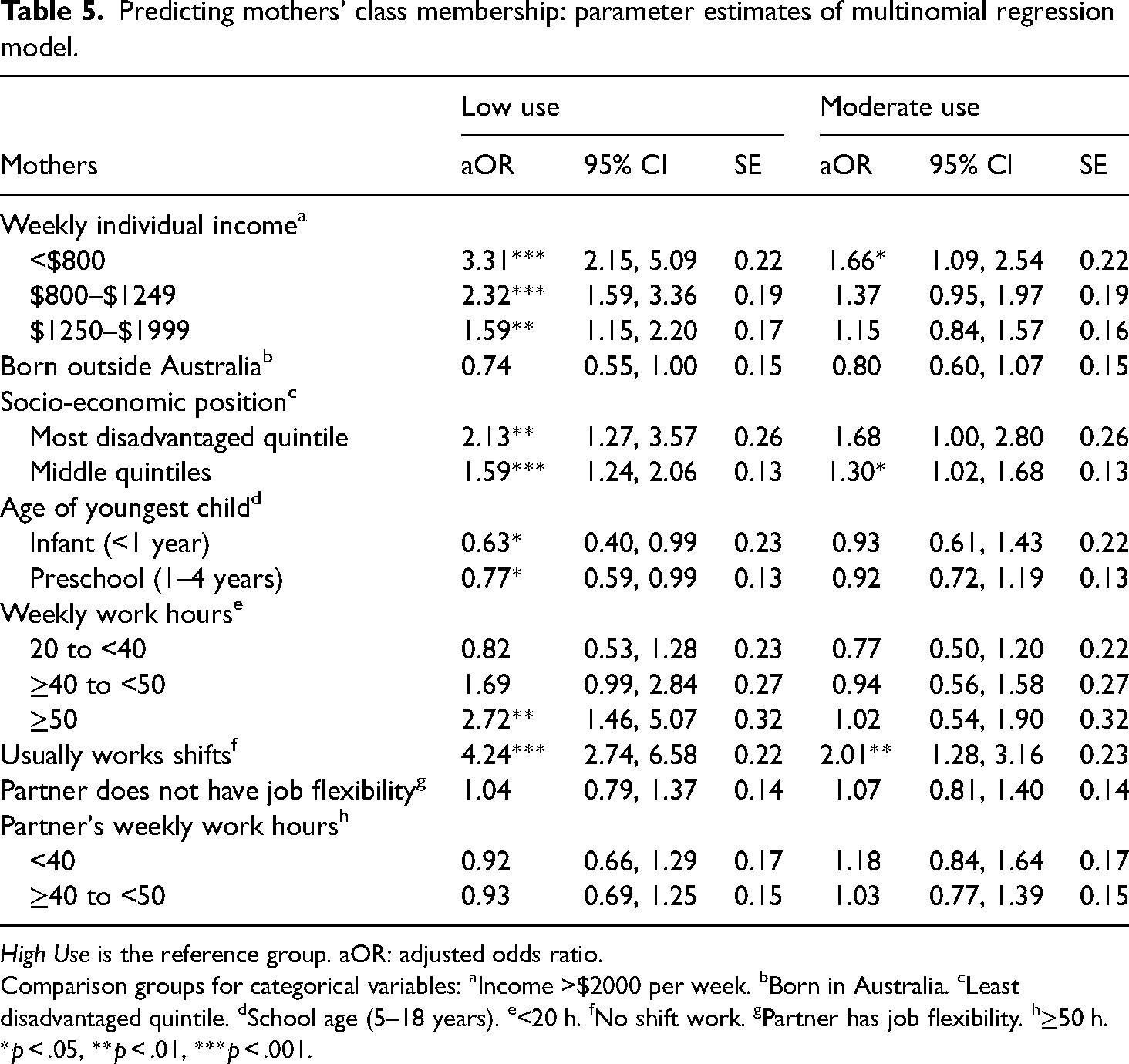
High Use is the reference group. aOR: adjusted odds ratio.
Comparison groups for categorical variables: aIncome >$2000 per week. bBorn in Australia. cLeast disadvantaged quintile. dSchool age (5–18 years). e<20 h. fNo shift work. gPartner has job flexibility. h≥50 h.
*p < .05, **p < .01, ***p < .001.
Parameter estimates of the demographic and employment characteristics predicting fathers’ class membership are presented in Table 6. Compared to fathers with High Use, fathers in the Low Use class were more likely to report lower individual income, work as a tradesperson or labourer, work 40 to 50 h per week compared to <40 h and usually work shifts. Fathers in the Low Use class were also more likely to have a partner who did not have flexibility in their start/finish times. For example, fathers in trades or labourer roles had a 3.63 increase in odds of being a Low User than fathers in professional roles; and fathers who worked shifts had 3.04 times the odds of being a Low User than non-shift workers. There were no differences in sample characteristics between fathers in the Moderate Use and High Use classes.
Predicting fathers’ class membership: parameter estimates of multinomial regression model.
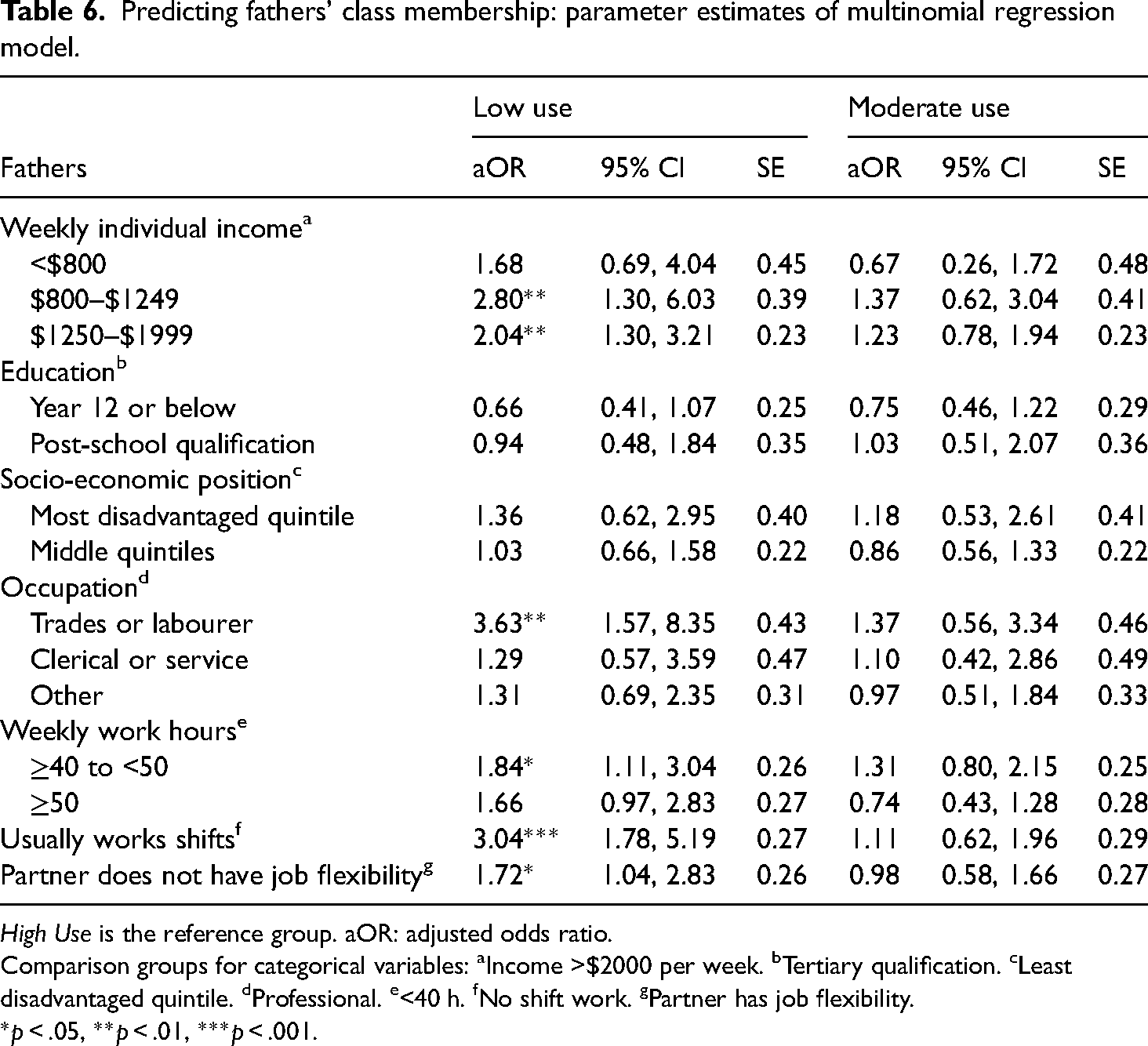
High Use is the reference group. aOR: adjusted odds ratio.
Comparison groups for categorical variables: aIncome >$2000 per week. bTertiary qualification. cLeast disadvantaged quintile. dProfessional. e<40 h. fNo shift work. gPartner has job flexibility.
*p < .05, **p < .01, ***p < .001.
Discussion
This study addresses gaps in knowledge regarding how parents use formal and informal flexible work arrangements and how these support parents’ work–family management. We applied a data-driven approach with a large, diverse national sample of employed Australian parents. We identified three distinct classes of total flexibility, with proportionate increases in frequency of use – low, moderate and high; as well as a social gradient in parents’ access to flexible work. Findings demonstrate that flexibility is a beneficial resource for parents overall: both mothers and fathers with moderate to high use reported more positive work–family experiences than mothers and fathers with low use, despite some detrimental effects for family-to-work conflict. Our findings highlight the interplay between employer-provided flexible work arrangements and self-directed informal work accommodations, and indicate that having multiple flexible work options supports parents to manage the work–family interface more effectively.
Aim 1 was to identify how parents use formal and informal flexibility in combination to balance work and care. Almost half of our sample were low flexibility users. This large group comprised parents who had used either none or one formal flexible work arrangement in the previous 12 months, and they used IWAFs the least frequently. In contrast, the smallest proportion of parents (15%) were high users. These parents used between four and six formal flexible work options and were the heaviest users of IWAFs. Moderate users comprised around a third of the sample, with flexible work mean scores between low and high users. Findings indicate that formal and informal flexibility use is concomitant. Parents whose employer supports, or permits, flexible work (such as flexitime and flexiplace) also have the autonomy and ability to make small, often invisible, adjustments in their day-to-day work to accommodate family (Behson, 2002; Hokke et al., 2021).
Aim 2 was to understand whether flexibility serves as a resource, or a demand, for parents’ management of work and family. Not surprisingly, parents with the lowest uptake of flexible work had the poorest experiences at the work–family interface. For both mothers and fathers, low users had higher work-to-family conflict, less work–family enrichment and worse work–family balance than parents who were moderate or high users, with mean scores for all three measures improving as flexibility use increased. Our findings support existing research where employees with a flexible work arrangement (often flexitime or flexiplace) report less work-to-family conflict, greater enrichment and more balance satisfaction than employees without flexibility (Allen et al., 2013; Goni-Legaz and Ollo-Lopez, 2016; Lapierre et al., 2018). We build on this literature and show that accessing multiple and varied flexible work options is beneficial for parents overall. Being able to draw from a suite of formal and informal flexible arrangements provides parents with control and autonomy to manage ongoing caring responsibilities and respond to specific daily caring demands (Allen et al., 2013). A flexible work environment is a boundary-spanning resource in this regard (Voydanoff, 2005a): greater flexibility at work enables parents to resolve conflicting family demands in various ways (temporal, spatial and/or behavioural) that optimise work and family role performance and satisfaction (Allen et al., 2014; Badawy and Schieman, 2020; Carlson et al., 2010). These benefits may also reflect a more inclusive, family-friendly organisational climate where family demands need not be invisible and parents feel genuinely supported by their supervisors to reconcile work and caring commitments (Dikkers et al., 2007).
While flexibility improved mothers’ and fathers’ work-to-family conflict, enrichment and balance, the opposite effect was found for family-to-work conflict. High flexibility users reported greater family-to-work conflict than low and moderate users, suggesting that utilising more formal and informal work arrangements contributes to parents’ perceptions of family interfering with work. Some flexible work arrangements may act as a stressor for parents through increased role-blurring and work disruption, as noted for telework (Lapierre and Allen, 2006; Schieman and Young, 2010; Tsen et al., 2021). Literature regarding informal flexibility is sparse, although greater IWAF use has been associated with higher family-to-work conflict (Behson, 2002) and work–family conflict (Hokke et al., 2021) in cross-sectional studies. Some informal arrangements may be particularly disruptive, especially when parents must abruptly respond to family demands. For example, family-related contact at work, a concept analogous to some IWAF behaviours, has been linked to higher family-to-work conflict over time (Badawy and Schieman, 2020). While taking care of family matters during the workday may be seen as desirable or necessary, sharing work and home demands across time, location and attention can increase parents’ work–family boundary permeability, role ‘contamination’ and multitasking (Badawy and Schieman, 2020; Paulin et al., 2017). It follows that parents who use more formal and informal flexible work options experience greater family-to-work conflict. Responding to family demands and ‘zigzagging’ between domains likely diminishes parents’ ability to fully engage in work, making work less enjoyable and more pressured (Harris and Haar, 2021).
Given our cross-sectional study, we acknowledge possible reverse or reciprocal relationships between flexibility and family-to-work conflict. Parents with greater family responsibilities may use more flexible work options as a coping strategy, although caring demands (i.e. youngest child age, number of children) seldom predicted flexibility use. Alternatively, greater organisational support for and access to flexibility may increase the amount of family responsibilities a coupled parent shoulders and intensify family-to-work conflict (Hammer et al., 2005).
This study is one of few to investigate the link between parents’ use of flexible work and time pressure. We found no difference in time pressure across the three flexibility classes. Our measure of time pressure may partly account for this. Compared to other work–family outcome measures under investigation, time pressure is a more general concept and is not often asked or framed in the context of work and/or family, including in this study. Nonetheless, time pressure is related to work–family balance and is an important indicator of time-based strains and pressures inherent in conflicts between work and family, ultimately linked to health (Rose et al., 2013). Our findings may indicate that using more flexible work options does not ease mothers’ or fathers’ perceptions of feeling rushed or pressed for time (Dunatchik et al., 2019). As noted for family-to-work conflict, juggling work and home tasks simultaneously or merging temporal boundaries may create additional forms of labour, increasing time intensity and reducing the quality of time experienced (Rose, 2017). While our flexibility measures included a range of formal and informal strategies and behaviours to increase time efficiency and management, we posit that these (unintended) negative consequences may counterbalance any intended gains.
Aim 3 was to identify which coupled parents are low flexibility users and therefore at risk of poorer work–family experiences. Our findings are consistent with extant research showing social inequalities in parents’ access to flexibility (Perry-Jenkins et al., 2017; Williams et al., 2013). Mothers and fathers with lower incomes were more likely to be low users than high users, as were mothers living in disadvantaged areas. Shift work and male-dominated trade and labourer occupations also predicted low use, indicating that white-collar jobs generally have more flexible work conditions (Chung, 2019; McNamara et al., 2012). Interestingly, fathers with low use were likely to have a partner without schedule flexibility, suggesting that inflexible jobs are a shared experience in some couple households. Flexibility use was higher among mothers with younger children as expected. This pattern was not reported among fathers, and fathers were more likely to be low users than mothers overall. Fathers working long hours were also unable to access family-friendly supports, further entrenching gender divisions in work and care (Maume, 2006; Radcliffe and Cassell, 2015).
We applied a gender lens to investigate similarities and differences in mothers’ and fathers’ experiences. Looking at the overall sample, mothers reported greater family-to-work conflict and time inadequacy than fathers and were more likely to be moderate or high flexibility users; consistent with the gendered patterning of work and care common among Australian coupled families (Baxter, 2014). Work-to-family conflict was similarly high between mothers and fathers, providing further evidence that fathers are vulnerable to work–family strains (Cooklin et al., 2016). Interestingly, mothers reported more work–family balance and greater enrichment than fathers, suggesting that mothers experience more gains, and more strains, in managing multiple roles. Despite these variations, we found little evidence of a gendered effect of flexibility at the work–family interface. Consistently, mothers and fathers showed comparable improvements in work-to-family conflict, balance and enrichment (and worsening in family-to-work conflict) as flexibility use increased across the three classes. We show that flexibility has benefits for both mothers and fathers and highlights the value of promoting and supporting men's uptake of flexible work.
Limitations
We acknowledge some limitations with our approach and sample. We used a cross-sectional study design, and causal directions and the long-term impact of flexibility cannot be established. While we contribute evidence from a large heterogenous sample of mothers and fathers from different organisations, occupations, industries and parenting stages, we used a convenience sample. Our recruitment advertisements may have attracted parents who were concerned about work–family strains, as indicated by relatively high levels of work–family conflict and greater socio-economic advantage than the general parent population (Hokke et al., 2021). This may limit the generalisability of study findings to more diverse parents than sampled here. Work–family interface indicators selected in this study represent defining features of parents’ work–family experiences within Australia and globally (French and Shockley, 2020). However, some measures were brief and may be less sensitive to variations in parents’ experiences of the work–family interface. While it was beyond scope to examine other indicators (e.g. work–family spillover and crossover, work–family fit, boundary integration and segmentation (Allen, 2013)), their relationship to workplace flexibility is also salient.
Future directions and considerations
We encourage further investigation of informal flexibility and the work and family contexts, and inequities, that influence its use to inform future policy and practice in Australia. Our findings suggest that high use of informal flexibility is an indicator of family-friendly workplace support. Limited access to informal flexibility may have significant implications for working parents, particularly considering the restructuring of family units, absence of extended family support and recent prominence of work location. Conversely, given the greater family-to-work conflict reported among high users, is there a threshold where too much informal flexibility is detrimental to employee engagement and productivity? Is one parent in a couple (likely mothers) performing more ‘zigzagging’ and shouldering more family disruption throughout the workday? Additional research is needed to further understand how informal arrangements impact parents’ well-being and productivity, how coupled parents share informal flexibility between them, and how workplaces can best support equitable and effective use.
As these data were collected in 2016, we consider our findings in the context of the COVID-19 pandemic. Emerging evidence indicates that government and organisational responses to the pandemic substantially heightened parents’ work–family conflict, role imbalance, stress and role boundary blurring, including while working from home, with a disproportionate burden of unpaid work falling on women (Bernhardt et al., 2022; Craig and Churchill, 2021; Graham et al., 2021; Yerkes et al., 2020). Prior to the pandemic, flexible work (including remote work) was typically a voluntary choice and agreed to by the employee and employer. While our data show that greater flexibility largely benefits the work–family interface, these gains are likely diminished and family-to-work strains are likely exacerbated in crisis situations such as COVID-19, where parenting responsibilities are heightened and choices in work location are removed. We expect that responses to the pandemic increased parents’ (particularly mothers’) use of IWAF behaviours and ‘zigzag’ working (Harris and Haar, 2021), contributing to tenuous demarcations between work and family domains. Nonetheless, it is likely that parents with more flexible jobs and ‘family-friendly’ organisational support would report better work–family experiences than parents who were unable to accommodate family demands, even if working from home.
The pandemic has raised important questions about the future of flexible work and ‘family-friendly’ workplaces in this new era of remote working and ‘visible’ caring (Allen and Orifici, 2021; Williamson and Pearce, 2022). Future research must investigate how the pandemic has shaped parents’ (in)ability to work flexibly, including the persistence of gender and social inequalities, and the long-term impacts on the work–family interface, employee and family well-being, and ultimately, productivity. Burgeoning research questions include: What was the impact of the pandemic on parents’ work–family conflict – were strains eased, sustained, increased – and who is vulnerable, or protected, over time? What does ‘family-friendly’ mean for working parents now? How can employers and workplace policy support flexible work in its various forms, given the new labour force stratification regarding hybrid and remote work (compared to front-line or service work)? The pandemic has provided opportunity to re-shape work–care regimes for working parents, and robust longitudinal evidence is needed on the job conditions and workplace factors that support work participation alongside parent and family well-being post-pandemic.
Conclusion
Overall, we show that workplace flexibility is a valuable resource in parents’ lives. Accessing multiple formal and informal flexible work options can improve mothers and fathers work–life experiences, particularly work-to-family conflict, enrichment and balance. Despite these protective effects, flexibility did not reduce parents’ perception of time pressure and may have intensified, or permitted, family demands to encroach on work. While accommodating family within the workday is likely beneficial to children and family members, our findings indicate that there is a cost for parents to work flexibly. Flexibility is not a universally effective workplace solution and flexible work practices should be utilised in conjunction with other family–friendly organisational resources and supports that sustain and promote employees to manage work–family demands.
Nonetheless, our findings highlight the salience of formal and informal flexible work strategies for parents and organisations. Similar positive effects were observed for mothers and fathers and we encourage uptake of flexible work arrangements for all parents, particularly fathers and socio-economically disadvantaged parents who are at risk of limited access and poorer work–family experiences. Findings provide impetus for workplaces to provide a range of flexible work options and supports that meet the varied needs of working parents, a significant cohort of the labour market. Ensuring employees feel supported to manage work and family responsibilities and have control over when, where and/or how they work will be critical as work evolves following the COVID-19 pandemic.
Footnotes
Acknowledgements
The authors would like to thank Jasmine Love for her help in preparing the manuscript, including editing and proofreading.
Declaration of conflicting interests
The authors declared no potential conflicts of interest with respect to the research, authorship, and/or publication of this article.
Funding
This work was supported by Transforming Human Societies Research Focus Area, La Trobe University and the Roberta Holmes Donation to La Trobe University. Dr Amanda Cooklin was supported by a Tracey Banivanua Mar Fellowship, La Trobe University and an Australian Research Council Future Fellowship (FT 200100209 2021–2025).
