



Abstract
Union leaders dedicate a significant amount of their time to unions, and in some cases, their entire life. Scholarly literature has made great progress in identifying the individual and mesolevel variables that explain how this type of union participation begins and continues. Yet it has paid little attention to the role played by the national industrial relations system in these processes. Drawing on the concept of “union career,” this article shows that the national regulations and the union power shape the characteristics and development of union leaders’ participation. Based on an in-depth interview program, a survey and a review of the press in Chile, it examines how neoliberal reforms implemented since 1979 changed the resources and opportunities available to workers to assume, manage, and maintain union positions.
Introduction
Union leaders dedicate a significant amount of their time, and in some cases, their entire life, to unions. As they undertake more complicated tasks, they gain skills that set them apart from the rank-and-file members and increase their influence over the union decisions. Who are these individuals, why do they participate in unions, how do they make sense of, and prepare for, their role? At a time when worker organizations are losing power in Western countries due to the global expansion of neoliberal policies and to increasing difficulties in organizing workers and engaging them in unpaid work for unions (Ebbinghaus and Visser, 1999; Gall and Fiorito, 2012; Wallerstein and Western, 2000), further research into these questions may be particularly instructive. By identifying the conditions for workers to increase their participation in unions and adopt positions of responsibility, scholars can help unions face these challenges.
In recent years, empirical studies on union leaders’ long-term participation have been scarce and geographically limited, which has impoverished the debate on this important issue (Gall and Fiorito, 2012:718; Kirton and Healy 2013:196; McKay et al., 2020:2). Moreover, as it will be argued, the existing literature has mostly focused on individual and mesolevel variables that promote union participation (Ambrosini et al., 2017; Fiorito et al., 2014; Guillaume and Pochic, 2011; Hu et al., 2018; Kirsch and Blaschke, 2014; Kirton and Healy, 2004; McKay et al., 2020; McPhee et al., 2014), paying little attention to the broader national institutional aspects that shape this process. Drawing on the concept of “union career” and a case study of three union leader generations conducted in Chile, this article aims to fill this gap in the literature. It will show the generational difference in union careers is strongly associated with the changes that the national industrial relations (IR) system has experienced in the past five decades. The Chilean case is particularly useful in identifying the links between union participation and these aspects of the IR system. Unlike European countries, the USA and Australia, where most of the empirical studies have been conducted, Chile underwent a radical transformation of the regulation of the collective labor rights after the military coup of 1973, when the authorities imposed a set of reforms that triggered the passing from a corporatist and politicized model to an extreme neoliberal model (Drake, 2003; Frank, 2004; Posner, 2018; Winn, 2004).
The article is structured as follows. First, the relevant literature on union participation is examined and the theoretical principles that guide the empirical analysis are explained. Second, the methodology is explained and a background of the Chilean IR system is provided. Third, the different generations of union leaders are described and finally, we discuss how IR systems influence the different union careers.
From the individual to the IR system: The conceptual framework
Traditional scholarly literature portrayed union participation as following a linear, vertical path. Union leaders were expected to climb from grassroots to more powerful positions in national or sectoral union structures, shifting from part-time volunteer to full-time professional (see, e.g. Ledwith et al., 1990). During the last decade, this view has been challenged by research more sensitive to gender, cultural, and generational differences. As these studies have shown, linear progression through the hierarchy or union pyramid is only one of the paths that individuals can follow. Personal development does not depend exclusively on reaching powerful positions within the union hierarchy, but rather it can be attained through other types of achievements, such as individual autonomy and balancing union activity with family (Kirton, 2006, 2018; Kirton and Healy, 2004). Union participation is a multidimensional phenomenon and a nonhierarchical path for individuals (Morin et al. 2021; McKay et al., 2020; Roitter et al., 2020).
Given the heterogeneity of union participation, how does the intense and long-term involvement of union leaders take place? Many studies have sought to answer this question, identifying numerous factors, mainly at the microlevel and mesolevel. Union activism is motivated by many reasons that have both ideological and instrumental dimensions, rational and emotional drivers, individual and collective conditions. For instance, recent research on individual-level characteristics has shown the positive influence of extroversion (McPhee et al., 2014), of perceived behavioral control (Fiorito et al., 2014; McPhee et al., 2014), of negative job satisfaction (Hu et al., 2018), of union loyalty (McKay et al., 2020), and of the perception of union instrumentality (Mellor and Golay, 2014; Morin et al., 2021). The degree of education has been revealed to be particularly relevant in explaining female union activism because of their major need for confidence in order to assume leadership positions in unfavorable settings (Blaschke, 2015).
However, research has recognized that individual characteristics are not enough to trigger and promote high-intensity and long-term union participation. Biographical and labor circumstances must provide the opportunities for personal motivations to be transformed into action. For example, in early stages of their career, union members might be more interested in their job performance and career opportunities and have less time to increase their participation in unions than in mid-career stages (McKay et al., 2020). Along the same lines, union participation may be constrained by a hostile industrial relations climate that creates insecurity (Hu et al., 2018; Kirton, 2018) or by an intensification of professional work (Gavin et al., 2022; Kirton, 2018). Additionally, research has demonstrated that women are less “biographical available for activism” in unions because of their family situation and the dominant culture that assigns care-giving tasks preferentially to women (Guillaume, 2018: 574).
Research has also pointed out the role of union practices and union support in fostering and maintaining union participation. Union members who increase their participation tend to be encouraged, trained, and sponsored by more experienced union leaders (see, e.g., Kaminski et al., 2000; Ledwith et al., 1990; Le Capitaine et al., 2013). Intensive and long-term participation becomes unlikely when this formal and informal union mentoring does not take place in the early stages of a union leader's career, especially for women (Dean and Perrett, 2020). Moreover, setting participation quotas, promoting union training and other intentional inclusion strategies might help women and other groups under-represented in unions to reach more powerful positions within these organizations (Ambrosini et al., 2017; Blaschke, 2015; Guillaume and Pochic, 2011; Kirsch and Blaschke, 2014; Kirton and Healy, 2004; Lundy, 1998). In the opposite direction, despite inclusive gender policies, union practices, and culture might be a barrier to a more intensive participation of women (Guillaume, 2018; Ledwith et al., 1990; Kirton, 2018; Martin, 2014). For instance, research has shown that the behavior of successful union leaders and informal selection practices might help gender inequality to persist (for a literature review, see Guillaume, 2018).
The generational change in union participation has been a major concern in recent research. These studies have shown new generations of workers are carriers of new values and motivations that transform their engagement and the demands of participation in unions (Cha et al., 2018; Smith et al., 2019; Vandaele, 2020). However, this generational change is portrayed as cultural and is not always associated with broader social traits. The common aspects of a generation's participation also derived from the fact their members engaged with unions at a similar moment, which indicates the line of unions at that point in history (i.e. their policies on members, strategies, etc.; Péchu, 2001).
Seeking a theoretical framework that encompasses all of the above aspects in order to explain the process by which an intense and long-term union participation develops, a group of scholars have introduced the concept of “union career” (see, e.g. Fillieule, 2001; Guillaume and Pochic, 2011; Kirton, 2006; Lundy, 1998; Yu, 2014). The term “career” was originally reserved for the progress made by an individual in his or her profession. Representatives of the Chicago School extended the meaning of this concept to include activities such as music, crime, or the consumption of marijuana (Becker, 1963; Hughes et al., 1984). They did so to highlight the fact that these activities can come to play a central role in the formation of an individual's identity, much like a profession. According to the supporters of this approach, applying the concept of career to union leader participation provides a framework for studying traditional linear progression through the union apparatus as well as nonhierarchical paths of union participation. Moreover, it helps in analyzing the relationship between the microdimensions, mesodimensions and macrodimensions of this process (Kirton, 2006: 48). In other words, this concept allows a simultaneous exploration of the personal process experienced by union leaders as they increase their participation in unions and of the broader social structures that make this progression possible.
As said above, the literature on union participation has made great progress in understanding how individual and organizational factors shape a union career. Less attention has been given to national IR variables like regulation and union power. In fact, cross-national comparisons of union participation have been rare. These studies mostly covered countries with similar union power and focus on differentiating organizational practices that they associated with ideological or sociohistorical macrolevel variables (Blaschke, 2015; Dean and Perrett, 2020; Healy and Kirton, 2013; Kirton and Healy, 2013).
This article aims to fill this gap and explores the links between union careers and the national IR system. Based mainly on collective bargaining models and union power, scholars have traditionally distinguished two opposite models of national IR systems. The first is the neocorporatist system that prevails in Nordic countries, continental Europe and in Latin American countries such as Argentina (Etchemendy, 2019). This model is characterized by the existence of centralized bargaining at the industry or national level, powerful and highly institutionalized unions, and employer associations (Kenworthy, 2003; Traxler et al., 2001). On the contrary, the neoliberal or pluralist IR system is distinguished by a structure of decentralized and company-level collective bargaining and by the predominance of multiple and fragmented labor unions and employer organizations, which usually compete for members (Kenworthy, 2003). It is normally associated with countries such as the USA, the UK, and Chile. While this typology has facilitated comparative studies, it has also disguised multiple variations within each model. As Kaufman (2004) pointed out, ultimately “(…) every country's industrial relations system is exceptional in the sense of having numerous unique practices and institutions” (p. 5). Kaufman's warning is particularly relevant to the study of the IR in developing countries such as Chile. While these countries may share the collective bargaining structure with more industrialized countries, they often have radical differences at other levels of regulation or the enforcement of rights. As will be shown, the very institutionalization of trade unions, which is taken for granted in more advanced countries, is challenged by certain rules and practices in the Chilean context.
For this reason, this study considers two dimensions of the national IR system: the State's IR regulations and union strength (i.e. union density and union fragmentation). The State regulation includes the laws defining the collective bargaining model and other IR aspects, such as union leader training and guarantees for fulfilling their role. Although the concept of the IR system is still under dispute and may consider other relevant forms of regulation affecting the relationship between the State, workers and employers, this article prioritizes the State's regulations because they play the key role of “medium and midwife in institution-building processes, particularly between parties with diverging interests (…)” (Müller-Jentsch, 2004: 28).
The article argues that the IR system shapes the decisions that workers make about their union career. This argument is associated with three other theoretical assumptions:
The influence of the IR system in a union career is not always direct, that is, in shaping workers’ individual decisions. This context may also affect union careers by constraining or favoring certain union practices that, in turn, affect workers’ individual decisions. The State's intervention and union power are not the only contextual factors affecting union careers. As current literature shows, individual decisions about union participation depend on multiple elements, from personal characteristics to broader institutions, such as generational sociocultural values. However, official norms or State's intervention may reinforce or diminish the action of these other elements. The IR system does not only constrain workers’ decisions about a union career. It is “dual” in nature (Giddens, 1984): it restricts these decisions, yet also gives them certain resources. The IR system may be understood to create “corridors” that give agents limited, yet varied, behavior options (Müller-Jentsch, 2004: 12).
Methodology
This article draws on data produced in a longitudinal study conducted between 2010 and 2022. The advantage of this type of study is that it allows us to analyze the changes and evolution experienced by the same individuals over time. However, as we will see, the data pose a challenge in terms of the possibility of accessing the information. Because of the passing of time, it is likely that some of the individuals in the first sample will no longer be able to participate due to various factors: no contact details, refusal, incapacity, or even death (Caïs et al., 2014).
The first stage of the study was designed to explore the relevant dimensions of the career of Chilean union leaders, among other aspects of union dynamics. In total, 28 union leaders participated in an in-depth interview program, which included at least two meetings with the research team. The group was composed of 6 women and 22 men of different ages who were members of the Executive Committee (Directiva sindical) of different union structures (plant-level union, federation, confederation, or central) (see Table 1). All of the participants had more than 6 years of experience and dedicated at least half of their time to union activities. The purpose of this sample was to consider the widest range of experiences possible. All the interviews were conducted in Santiago and were recorded and fully transcribed. A content analysis was performed following a sequential method. First, data was organized according to (a) the period of the career to which it refers (background, joining the union, and union participation development); (b) motivations, meaningful support and milestones in each phase. Second, the experience of participants in different union activist cohorts was systematically compared.
Data on the interviews with union leaders.
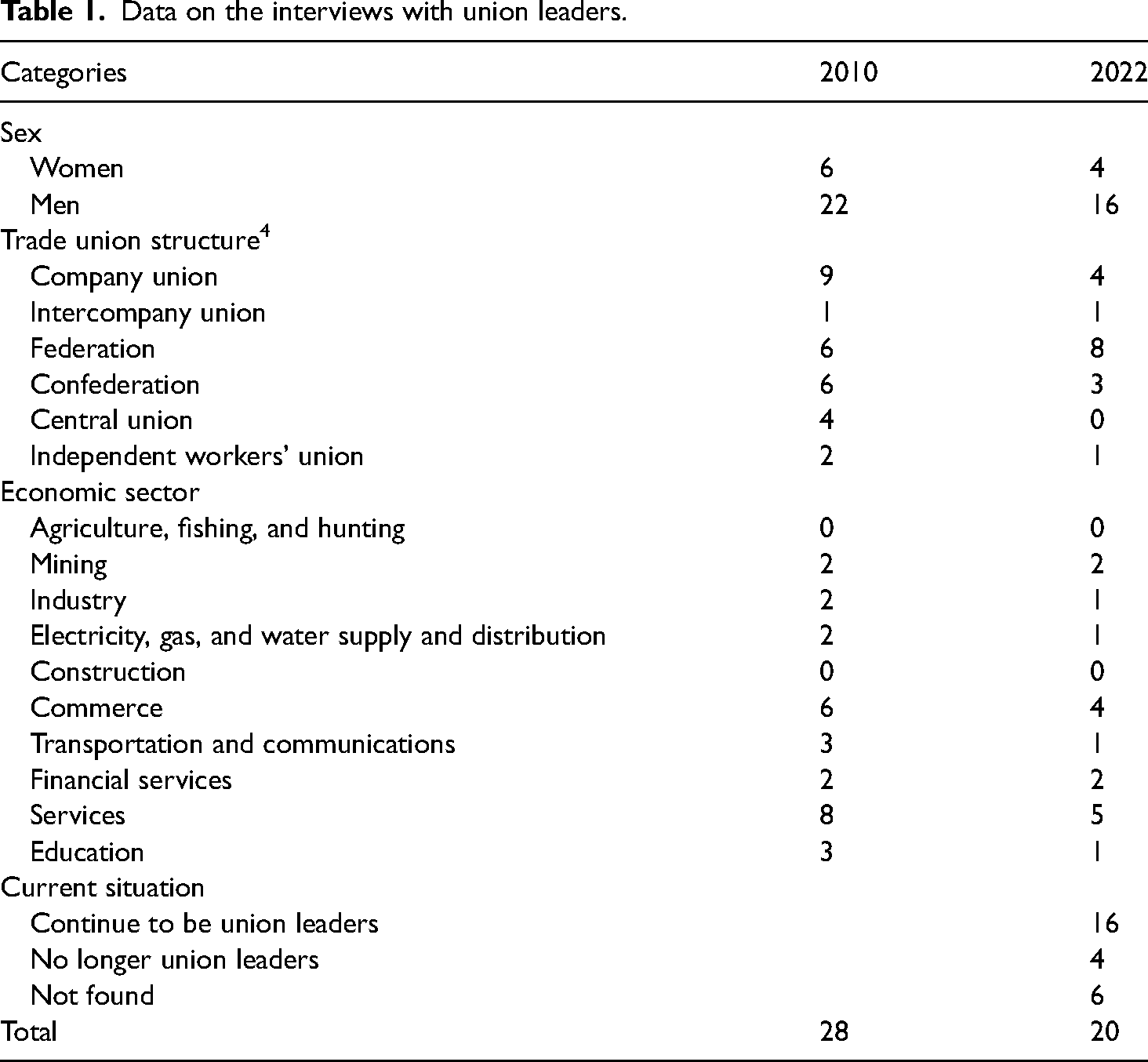
The second stage of the study was conducted in 2022 for the purpose of identifying the changes in the union participation of the union leaders who participated in the first study. In order to update the contact information, a public database on unions was reviewed (Dirección del Trabajo, 2022). Then, a survey was sent via mail to 20 of the original participants (two of them died between the two studies and six could not be found). In this survey, union leaders were asked if they continued to hold union leader positions, what type of support or guidance they had received in the past 10 years from different organizations (unions, federations, central unions, NGOs, Labor Bureau, political parties, etc.), and how much they valued such support. On the other hand, those who declared that they were no longer union leaders were asked to explain the reasons for leaving their positions, whether they were still affiliated to the same union and whether they intended to become leaders again. All were asked if they participated in other types of organizations (political parties, neighborhood councils, cultural and sports associations, etc.). A total of eight questionnaires were answered completely. Finally, a systematic review was made of the press to collect information on the careers of the different union leaders in the past 10 years. These were the 3 ways that the information was obtained on 20 of the union leaders interviewed the first time (see Table 1).
In order to respect the anonymity of union leaders, which was guaranteed to the participants, the names given in this article are fictitious.
Case study: The evolution of the IR system
The study was set in Chile as it has undergone a major transformation of the IR system in the past 50 years, going from a centralized model to a neoliberal model (Drake, 2003; Posner, 2018; Winn, 2004; Frank, 2004). The transformation started in 1973 with the military coup that ended the process underway before that in which unions had progressively gained power and increased their participation both in companies and the political arena (Drake, 2003). In 1979, a set of decrees known as the Labor Plan (Plan Laboral) established a new system of IR in which unions were supposed to play a minor role, without interfering with the revitalization of the economy (Winn, 2004).
While the restoration of democracy in 1990 re-institutionalized trade union activity at all levels, it did not bring about immediate, substantial changes to the rules imposed by the Plan. The reforms of 1991 and 2001 made limited adjustments to collective rights (Sehnbruch, 2006; Winn, 2004). They facilitated the organization of temporary workers and reduced the minimum quorum required to create a union in small businesses. They also improved the poor finances of unions by forcing nonunionized workers who benefited from collective bargaining agreements to pay union dues. However, these reforms did not lift the restriction of collective bargaining to the company level or eliminate the possibility of employers to replace workers during strikes, two of the innovations introduced by the Plan. In 2016, the government of Michelle Bachelet attempted to advance in these topics. However, the final 2017 labor reform (Ley 20940) only succeeded in partially eliminating the right of employers to replace workers during strikes. There are still ways that conflictive workers, including union leaders who leave their union position, can be fired because of “company needs,” which is ambiguous enough to make fighting it in court difficult (Gutiérrez Crocco, 2020). 1
The new IR system explains, in part, the fast weakening of Chilean unions during the 1990s. On the one hand, union density fell from 30% in 1973 to 15.1% in 2005. On the other hand, the Central Unitaria de Trabajadores (Unitary Confederation of Works, abbreviated as CUT in Spanish) made a set of national agreements with the main business associations and authorities that were dead letter (Sehnbruch, 2006). The situation changed slightly in the mid-2000s. Although only around 8% of private sector companies have unions (Dirección del Trabajo, 2019), global union density increased from 14.5% in 2006 to 20.2% in 2021 (Dirección del Trabajo, 2021). People's trust in these organizations also rose during this period (Pérez, 2020). The CUT has also adopted a more aggressive strategy, trying to distance itself from the center-left political parties. However, Chilean trade unionism continues to suffer from relevant structural problems, such as a strong fragmentation. Most of the unions are plant-level organizations unaffiliated with any higher union structure. Only 22% of this type of union participates in a federation, 15.7% participates in a confederation and 17.8% in a central union (Dirección del Trabajo, 2021). Sectoral and national social dialogues are still infrequent.
Given the difficulty of changing the laws because of the opposition by businesses and right-wing parties, the governments in the 2000s took other measures to promote union development. For instance, they strengthened the ability of the Dirección del Trabajo (DT) to assist unions and enforce labor laws in companies (Gutiérrez Crocco, 2020). Moreover, they increased the public funding of union training programs (Gutiérrez Crocco, 2020).
There is a significant lack of information on union leaders in Chile. From the available data, four trends can be underlined. First, most union leaders work at the company level. At the end of 2021, there were 49,923 union leaders in private and public sector organizations, 84% of whom were attached to grassroots unions, 13% to a federation and just 2% to a confederation (Dirección del Trabajo, 2022). Central union leaders number only 139. Second, the financial situation of unions is quite precarious since it depends mainly on the fees paid by their members and donations. Most union leaders are not paid for their work. A third trend is the under-representation of women in this group. The recent labor reform (Ley 20940, ORD. 1475) intends to overcome this gender gap by imposing a quota for women on union boards. Although their participation has been increasing, going from 25% of union positions held by women in 2014 to 33% in 2021, it is still significantly lower than the participation of men in these positions (67%; Dirección del Trabajo, 2021).
Findings
Considering the abovementioned changes, three generations of union leaders were distinguished in this study. The members of each generation share the fact that they joined unions at a similar moment in time characterized by a specific IR regulation and union strength. The interviews revealed that this baseline IR system marks the union careers of these generations, notably in the initial stages, that is, in the stages of socialization, activation, and training. Table 2 presents the three generations, the main characteristics of the baseline IR system, and the union careers.
Generational union careers.
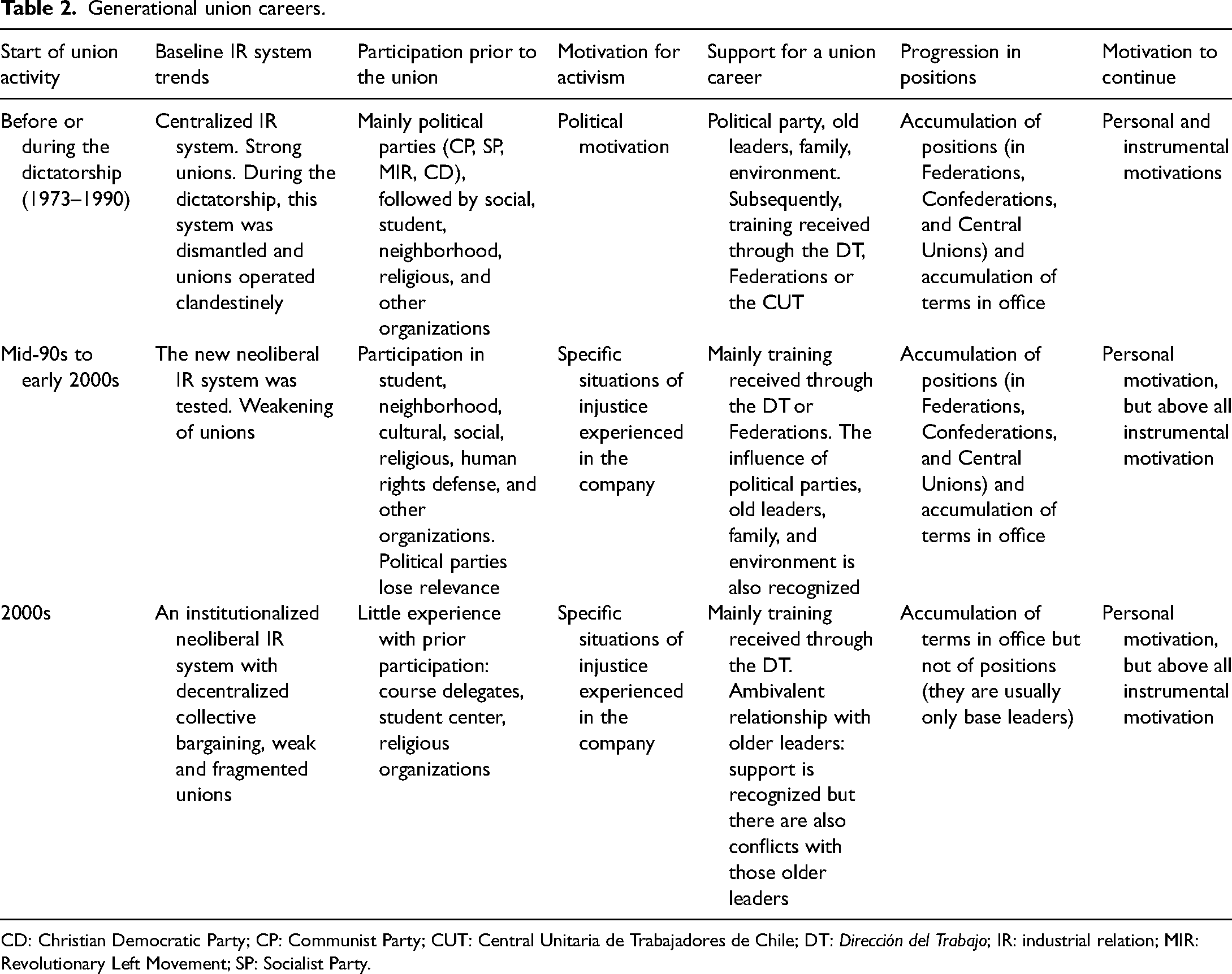
CD: Christian Democratic Party; CP: Communist Party; CUT: Central Unitaria de Trabajadores de Chile; DT: Dirección del Trabajo; IR: industrial relation; MIR: Revolutionary Left Movement; SP: Socialist Party.
For reasons of space, the two most “extreme” generations are described in detail below, in the understanding that the union career of the intermediate generation has hybrid features and combines elements of the other two.
The oldest generation
Union leaders born before 1960 are characterized by having lived the great changes occurring in Chile in the last few decades of the 20th century. Their union socialization took place in the context of a corporatist IR system, where unions were strong, were publicly visible and present in both the workplaces and the political arena. Many of them said they had direct and indirect family members who were participating in unions. They spoke of their childhood as an experience where activism and politics were part of everyday life. But even in the cases where there was no such family background, social organizations were very present in the surroundings, be it a union, political, neighborhood, or other organization. This is how Ramón, a union leader in the mining industry, spoke of it: “I’m from a mining town, yeah … I was born in Cabildo. I grew up in the Cerro Negro mine. Activity was between work and the union. My parents were not union leaders but mining was a very small thing … We were between the union and their work. So, I was raised in a very mining, very worker environment” (Ramón, a base and federation union leader in the mining industry).
The beginning of their union career is marked by the collapse of the corporatist IR system and of democracy after the 1973 coup d’état. A portion of the interviewees assumed a union role clandestinely while unions were prohibited. Another portion started their union activism later, at the end of the dictatorship, when unions were reinstated under the new rules imposed by the Labor Plan. But the new formal rules would operate normally after the return of democracy. In fact, despite the official legal guarantees, union activism continued to be highly risky during the 1980s because it was associated with the political opposition to the dictatorship. Many of the interviewees suffered the consequences of the political repression in the flesh. They were repressed, incarcerated, tortured, or had to live their life clandestinely. However, the union movement survived and was enriched by a sense of unity and its key role in the fight to return to a democracy.
The re-institutionalization of the union structures at the end of the dictatorship was crucial to the union career of this generation. Contrary to what would happen after the return to democracy, these union leaders were forced by the prevailing environment to assume more and greater responsibilities in the union apparatus: they were responsible for forming the unions, federations and confederations in which they are still members.
The overlapping of politics and unionism appears to be determining in the training of a majority of these leaders. These leaders said that to a greater extent, it is thanks to their participation in political parties that they acquired the tools and knowledge needed for union activity.
The case of female union leaders belonging to this generation is similar in many aspects to that of men. A distinctive element that can be identified is that parallel or prior to beginning union activity, female leaders participated in women-only groups or collectives, which, as they tell it, helped them gain trust in themselves and develop their leadership abilities. Identifying the union world as a profoundly macho world, they said that participating in those groups and collectives gave them the tools to carve out a spot for themselves in the union world.
Upon the return to a democracy, these leaders continued in their union positions, and held those positions for a considerable number of terms. Most of them—9 out of 12 union leaders—also began to assume positions in other levels of union organization: Federations, Confederations and Central Unions like the Workers United Center of Chile (Central Unitaria de Trabajadores de Chile, CUT), the National Workers Union of Chile (Unión Nacional de Trabajadores de Chile, UNT), or the Autonomous Central Union of Workers of Chile (Central Autónoma de Trabajadores y Trabajadoras de Chile, CAT). And this is without ceasing to be leaders in their company unions. In 2010, 3 of the 12 interviewed who had this profile had been in their positions for more than 10 years, 7 for more than 20 years, and 2 for more than 30 years. In 2022, 5 of these leaders continued to perform union work in the same unions, accumulating from 30 to 40 years of leadership (Dirección del Trabajo, 2022: Tracking Survey). 2
When inquiring into the reasons that led them to continue in their positions, both personal and instrumental reasons are seen. On the one hand, they said that they felt tied to their organizations. As we said, they often participated in creating or rebuilding their unions during the dictatorship. Their life and identity are marked by union leadership and they describe themselves as fully dedicated to that work. “For me, everything first came from the union that I joined and to which I owe a lot because I learned a lot there. There I learned to be professional (…) if I left I would miss it, it would be as they threw me out of the house, as if I would sit here to sleep and never wake up, and that is what I do not like, I like the activity I like being there.” (Miguel, a base federation and central union leader in the services sector) “What is the problem that we have with unionism today in Chile? The problem is that after forming a union, the leaders are later fired if they are not renewed and not reelected; that is the cannon ball so that a company can fire them in any situation …” (José, a base and federation union leader, in the industry sector)
That fact, moreover, has motivated several of these leaders to go back to school and even earn university degrees in business administration or law, driven by the idea of improving their union performance but also by the need to improve their employability in a setting in which the future is always perceived as uncertain.
However, although these union leaders held their positions over time, some changes were seen in the support that guided their union activity. For example, although the majority continued with their political affiliation, it was found that they distanced themselves from the parties or at least from the orientation that their parties adopted after the return to democracy. In this regard, several said that they focused more on union activity itself, leaving aside their political involvement. Moreover, all of those who answered the tracking survey in 2022 said that they had received no type of help or orientation from political parties in the past 10 years. On the other hand, since the return to democracy, the Labor Bureau began to be an important ally in playing the union role, either by providing guidance or inspecting companies.
The youngest generation
The case of the youngest generation born after 1970 is quite different from the first group. First of all, a significant portion of these leaders was born during the dictatorship, so they were still quite young at the time of the return to democracy. The environment in which they grew up was characterized by a very different baseline IR system than that of the previous generation. After a few adjustments, the neoliberal IR model was institutionalized and really operating. Unions do not have the public presence or visibility they had in the past and under the new labor laws, they have withdrawn at the company level. Unions are found in only a few companies, and they do not share a common political goal.
So, as a general rule, these union leaders have no family background of social or political activism and their childhood and youth were not described as a particularly politicized period. None of the interviewees belonging to this generation is or was affiliated in the past with a political party. In fact, they are quite critical about parties, particularly about union leaders who put their political affiliation ahead of the interests of workers. The young union leaders say that before becoming involved in union activity, they had very little prior experience participating in social organizations. Those who were involved in collective activities participated in organizations like churches, community groups, student centers, firehouses, boy scouts and girl scouts, but nothing linked to the political world. The 2022 survey showed that to this day, they still do not participate in any organization or association other than the union.
This generation started its union activity in the aughts. The motivations for this commitment fit well with the spirit of the new IR system. As they are separated from their political functions, unions are institutionally conceived as instrumental tools in improving working conditions in the workplace. Accordingly, interviewees in this generation affirm that they assumed union leadership roles for personal, not political, reasons, because of specific situations they experienced in the companies where they worked, such as changes in management that caused a loss of benefits or a deterioration in the working conditions of workers. In the words of Alejandra, a union leader in the bank sector, her reason to become a candidate for a position was the result of a situation she experienced in the bank where she worked, where little by little she began to feel that the working conditions were changing to foster competition between her and her fellow workers, which was affecting her mental health: “(…) whenever I needed to maintain my salary or my average sales, the bank changed the conditions, so I had to make even more of an effort and use more of my time and worry more about selling. I realized that with that pace of life, I was not going to be able to form a family, I was getting sick, in fact I got sick from stress, which I considered very unfair. What finally made the penny drop that made me try to change the world and my working situation, not only for me but also for my fellow workers, was because I saw my situation reflected in my fellow workers when I saw that we had reached a limit where I saw that I had to try to compete against them, which went against my principles because that meant that I had to seduce clients from them so that I could earn my income. So that was what triggered it and made me realize and made me stop and say ‘no, listen this is wrong, that is, I shouldn’t have to earn my commissions by deceit, by trying to deceive another.’ Therefore, when the candidacies for the union opened up, I applied to be a union leader.” (Alejandra, base and confederation union leader in the financial sector)
It is also interesting to confirm that there is an ambivalent relationship with the oldest leaders. Although it is acknowledged that in some cases, the older leaders from the same union, in the same business or from higher organizations are the ones who guide these new leaders in their union work, there is also often conflict with them. There are many situations in which these young leaders decided to form their own organization parallel to the existing union and dispute, in a certain way, the existing union's capacity to represent workers. This division is promoted by the IR system since the formation of unions does not require the intervention of a central union or a federation, and immunity from termination only applies leaders and not active participants. Employers themselves may sometimes also foster this division because they would prefer that worker representation be fragmented and weak. “When I began to feel labor problems was when I changed position and they changed my status from an employment contract to a service contract, which cannot legally be done, which I did not know. When I found out, which was years later, I asked the leaders if they could do something to fix this to be able to be rehired under an employment contract, and I would even waive the period that I had stopped receiving benefits because I was not a contract employee. And the answer was always the same: it can’t be done, it can’t be done, so I slowly got angry with that situation, that these leaders were doing nothing, and I started to create a sort of internal revolution where I tried to find the right people to begin a complete restructuring of the subject, or the most adequate people who would truly fight for your labor rights.” (Jaime, a base union leader in the telecommunications sector)
In the case of women, added to these difficulties is the lack of recognition and support in a world that continues to be perceived as “very macho.” In effect, the narrative of women leaders is on how they have had to deal with male leaders who perceive their power and representativeness as a threat. Even in very feminist labor sectors, like the retail sector, it is hard for women to carve out space in the union world. Moreover, in the case of these younger women, unlike what occurred with the previous generations, there were no “female” organizations that supported political formation and the acquisition of leadership tools. These female leaders are, to put it one way, much more alone and lack some of the support that their predecessors had.
However, although in many aspects the trajectory of these leaders is diametrically opposed to that of the leaders that we analyzed earlier, there is also one aspect in which they are alike. As with the oldest leaders, the younger ones also tend to remain in their positions for several terms. Of the 9 leaders who can be classified in this type of career, 3 had already been in office more than 7 years in their organizations in the year 2010. In the year 2022, 5 of those leaders continued to hold the same positions. In addition, four of them also began to hold positions in higher levels—mainly in union federations—without leaving their positions in the base unions (Dirección del Trabajo, 2022, Tracking Survey). 3
When asked about their motivations to remain in their positions, the most relevant seemed to be the fear of being fired because they would lose union immunity. Although there were also personal motivations and an attachment to their unions, what the leaders of this generation most emphasized was that if they left their positions, they would be fired and not only that, it would also be difficult for them to find another job because of their union history: “Look, if I am not elected in two more years, you can be sure that they are going to get rid of us (…) I don’t know: it is very difficult to change a culture of 30 years in 2 years, it is very difficult to change it (…) That's why I am saying that immunity would end for us and no store would want to have us because we have to go back to the stores. That is the issue (…) plus, you are also branded, as a leader you are branded because you will have to look for a job in another place and become a leader.” (Renato, base union leader in the services sector)
Discussion and conclusion
As the findings show, there are significant differences in the careers of the union leaders in the three generations studied. Some of those differences have been observed in other contexts and can be attributed to relatively global sociocultural changes. This is the case, for example, of the decreasing importance of political membership in the formation of new activists (e.g. Grasso et al., 2019; Kitanova, 2020). However, this investigation identifies some nuances in the intensity of these generational differences and other underexamined aspects that can be associated with the changes in the Chilean IR system over the last five decades.
The first of these aspects bears a relationship to the role of unions in the socialization, recruitment, and accompaniment of these leaders during the early years of their career. Unlike the reality of the leaders in the oldest generation, those in the youngest generations grew up in a context of little unionization where the presence of unions in companies was infrequent and the larger union structures had little power and influence over the workplace (Dirección del Trabajo, 2019). While unionization has decreased worldwide in the recent decades (Ebbinghaus and Visser, 1999), this decline in Chile has been accompanied by a radical reduction in the public visibility of unions because of the decentralized character of collective bargaining and the inexistence of a sustainable public policy of social dialogue (Bensusan, 2016; Gutiérrez Crocco, 2016; Julian Vejar, 2018). Moreover, the new generation of workers has faced a highly fragmented union movement where firm-level unions are forced by the institutional rules to compete with each other for resources, members, and influence (Gutiérrez Crocco, 2013, 2016; Pérez and Ocampo, 2022). This context likely explains why several of the interviewees in the new generation had no union benchmarks or union participation prior to their decision to create a union and become a leader. Nor were the interviewees recruited and mentored by leaders from other company unions or higher union structures. The situation is not much different for workers in this generation who became a union leader in companies where a union already existed. Although in these cases there was a prior union commitment, the decision to assume a more intense union participation was not encouraged by the union organization itself but rather came from the motivation of the person or a group of workers, often after a conflict with the older union leaders. Because of this same conflict, these new leaders have no union mentors and must look for support outside of the union world. These results show that contrary to what has been observed in studies in other contexts (Dean and Perrett, 2020; Kaminski et al., 2000; Ledwith et al., 1990; Le Capitaine et al., 2013), the formal and informal recruitment and mentoring policies of unions seem to play a minor role in the start of the union careers of the younger generation of leaders.
The characteristics of union training also demonstrate the weak control that unions have over the participation and career of their leaders. Unlike other contexts where the participation of outside entities in union training is weak because of the internal capacities of unions and the institutionalized nature of the programs that offer this service (Bridgford and Stirling, 1988; Föhrer and Erne, 2017; Kirton, 2017), in Chile, third-party intervention in union training has been accentuated and diversified in recent decades. In Chilean history, union organizations have rarely had autonomous schools of union formation as they lacked the financial and human resources to sustain training programs that endured over time. Nonetheless, as shown by the stories of the older generation of leaders, until the 90s, political parties and NGOs associated with them satisfied the demand for forming leaders. They offered technical and political training to workers in an alliance with, or separate from, unions, and clandestinely during the military dictatorship. After the return to democracy in 1990, the DT gained a more prominent place in the assistance and training of new leaders (Gutiérrez Crocco, 2020). As shown in the interviews, DT officials have been acting as informal mentors in many cases, and the DT is also offering more formal training via its website. All the labor reforms that have been implemented since the return to democracy have encouraged this situation in a certain way as the functions of the DT have significantly increased in the labor relations system and, therefore, the dependence of the union world on this administrative agency (Gutiérrez Crocco, 2020). Additionally, since 1999 the Chilean State has made a fund available for union training that allows universities, training centers and public and private institutes to offer Schools and other union training activities. The unions are the “beneficiaries” and they can sponsor these initiatives, but they are not involved in the design and implementation (Law 19,644 of 1999; Decree 7 of 2017). While leaders of the older generation that participated in these union training instances did so often to refresh their knowledge of certain matters, the younger generation of leaders enrolls in these programs with less prior preparation and greater expectations.
The degree of mobility of leaders also has varied from generation to generation and can be associated with the regulatory changes in the IR system. Coincident with literature, the investigation shows that intensifying participation does not necessarily imply a linear progression in positions from the base to the higher structures in the union pyramid (e.g. Kirton, 2006, 2018; Kirton and Healy, 2004). However, in the case of Chile, this not only has to do with the expectation of leaders but also with the opportunities and limitations imposed by the regulations. Pressured by the re-institutionalization of higher union structures after several years of prohibition, the older union leaders experienced a rapid rise, holding positions of power on the executive committees of federations, confederations, and the central union recently created in 1990. However, they maintain their positions in the workplace and those who continued to live, accumulated the different positions through today. This explains why the careers of the younger interviewees are flatter over a longer period of participation in company unions. The mobility of these leaders within the union organization is usually blocked by the previous generation and becomes possible only when the representatives of this latter generation die or retire or when the new leaders create their own federations or confederations.
As shown by the interviews, leaders continue perpetually in their union positions due to their commitment to the cause of workers. However, they also keep in their role due to their fear of being fired and unable to find a new job after losing the “immunity” they afforded them by law. This motivation holds good across the three generations of union leaders. The significant presence of anti-union practices justifies this fear (Dirección del Trabajo, 2019). Since the 1979 reforms, union activity has become a risky choice of profession. Employers have the right to fire members with no more justification than “company needs,” which is the reason currently used for ex-union leaders, according to the interviews. Moreover, contrary to what is seen in countries with more union-favorable legislation and a centralized collective bargaining system, in Chile, union leaders leaving their positions at the company level find it hard to secure employment when they rise through the union hierarchy to a federation or a confederation. Chilean national union organizations are small and have little financial resources. They employ a limited number of union leaders and are unable to offer a career opportunity for all the workers interested in (or forced into) dedicating their lives to unions. The meager development of the upper union structures is one of the effects of the current laws, which restrict collective bargaining to the company level and discourage the development of higher-level organizations. Scholars have observed that the concentration of power in organizations is a function of their legal recognition (Michels, 1915). In Chile, this trend is augmented by the little protection afforded union leaders and the scant opportunities for young workers to move up the union hierarchy.
Finally, the distance between union leaders and political parties may be also associated with the changes in the Chilean IR system. While the political distance of the youngest generation of activists has proven to be a global trend, this study shows that it also involves the older generation of Chilean union leaders after the 1990s. As the interviews show, at present, this latter generation also views political activism as separate from union activism. This perception fits well with the IR system because in practice, unions have little institutional resources to influence employers’ decisions beyond firms or to intervene in the political arena. In such a context, political activism logically appears to be instrumentally irrelevant. This does not imply that generational sociocultural trends play a less significant role in the political distancing of union leaders. The argument is rather that the Chilean regulations and the weakness of unions magnify and facilitate this situation.
Overall, these findings confirm the argument wielded by the defenders of the union career approach (Guillaume and Pochic, 2011; Kirton, 2006; Lundy, 1998; Yu, 2014). Union participation is a process that articulates the personal experiences of a union leader with broader social structures. However, this article complements this view, emphasizing that this process is anchored in a specific IR system. The process by which individuals commit to unions and gain power within them relies partly on personal choices and union choices, yet also on the external regulations and overall union conditions that define the opportunities and resources available to workers who take this path.
Along with its theoretical contribution, this article might be considered a call to trade unions. In a time where these organizations experience difficulties defending workers at the different levels, attracting and training young, committed union leaders might be key as they provide continuity, experience and an example for workers. This article underlines the responsibility that unions have to pursue this goal, despite the existing institutional barriers. As mentioned before, the influence of the IR system on a union career should not be considered deterministic. For instance, Chilean unions might increase their control over the careers of union leaders by creating a retirement job bank or by actively engaging in existing union training programs. By regaining control over these internal processes, Chilean unions might recover some power.
Footnotes
Declaration of conflicting interests
The authors declared no potential conflicts of interest with respect to the research, authorship, and/or publication of this article.
Funding
The authors disclosed receipt of the following financial support for the research, authorship, and/or publication of this article: This work was partially supported by the Fondo Nacional de Desarrollo Científico (ANID-Fondecyt Regular 1210338) and the Fondo de Financiamiento de Centros de Investigación en Áreas Prioritarias (ANID-FONDAP 15130009).
