



Abstract
In 2022, Australia's Labor Opposition pledged to reintroduce collective bargaining covering the whole Australian public service (APS) if elected. The elected Labor government is now implementing this ground-breaking reform. The APS has, since 1997, bargained at the agency level with no mandated common terms and conditions of employment applying across the service. This has led to pay dispersion and inequity, and fragmentation of the terms and conditions of employment. The current negotiations aim to rectify this situation. We argue that these reforms represent an ideological shift and a repudiation of New Public Management (NPM) towards a public value approach, which also incorporates being a model employer. We consider whether this refocusing will overcome the problems inherent in the system of bargaining practised under an NPM framework. We examine some of the most important items being negotiated at the time of writing, namely, wages, job security, flexible working, paid parental leave and paid family and domestic violence leave. We conclude that the new approach will overcome the legacy of the previous bargaining system to benefit individuals and the APS as a whole. We further conclude that this public value approach substantially fulfils the government's ideal of becoming a model employer.
Keywords
In this article, we focus on collective bargaining in the Australian public service (APS), which is experiencing a watershed moment. A new Labor government was elected in May 2022 with an ambitious public service reform agenda, which included a commitment to becoming a model employer (Gallagher, 2022). The centrepiece of this commitment is sector-wide bargaining (Albanese, 2022). We argue that this shift in favour of centralised bargaining is the most profound change to APS collective bargaining since enterprise bargaining commenced in 1997. We suggest that the Labor government's approach to bargaining represents an ideological shift from the principles of New Public Management (NPM) to public value. We conclude that centralised bargaining is the condition for achieving a public service that is characterised by public value, which is dependent on the APS becoming a model employer.
We commence our analysis by examining the legacy of NPM in APS bargaining and outline problems which resulted from this approach. We then briefly analyse the problems with APS bargaining inherited by the new Labor government. The 2023 bargaining round is then considered, and we argue that genuine, service-wide bargaining is taking place for the first time since the inception of enterprise bargaining in the APS. We next consider the emerging outcomes of bargaining with respect to wages and core conditions, which include reducing the pay disparities across agencies; flexible work; improvements to job security; and gender equitable provisions, namely parental leave, and family and domestic violence leave (FDVL). We also contribute to the literature on public value, applying concepts from this field to industrial relations – specifically, to collective bargaining in the APS.
Underpinning bargaining ideology – From New Public Management to public value
In Australia, until the 1980s, collective bargaining to secure pay rises and improved employment conditions largely occurred at the national level and was overseen by a federal tribunal. In the 1980s and early 1990s, a combination of economic downturn and increasing neoliberal ideology saw a shift from centralised bargaining to sector, then enterprise level (Buchanan and Callus, 1993). In the public sector, the increasing emergence and adoption of neoliberalism took the form of NPM, which aimed to make the public sector more like the private sector, with increased competition, efficiency, accountability, and adopting private sector management techniques (Bach and Kessler, 2009; Diefenbach, 2009; Hood, 1991). This was achieved, in part, by decentralisation to agencies and unit levels (Hood, 1991). In the APS, pay and terms and conditions of employment which had been regulated by a central Public Service Board were devolved to the agency level (Molloy, 2007). This was enabled through the introduction of the Public Service Act 1999 (Cth) (PS Act), which resulted in each agency head employing their own staff, on behalf of the Commonwealth (Molloy, 2007).
Rather than being efficient, agency level bargaining was costly and resource intensive. Bargaining was conducted by human resource practitioners in agencies, ‘most’ of whom did not possess the required knowledge and expertise to undertake negotiations (Podger and Williams, 2016: 18). Requiring each agency to engage in bargaining was inefficient, and also resource-intensive for unions (O’Donnell et al., 2011). APS agencies were either forced to ‘reinvent the wheel’ each time they negotiated, or engage in ‘photocopy bargaining’, where consultants contracted by agencies replicated agreements across agencies (O’Brien and O’Donnell, 2002: 110), thereby undermining the aim of bargaining being conducted at the enterprise level.
In 2023, however, we see a new approach to bargaining in the APS. The current bargaining round represents a move away from NPM towards a public value approach. While the notion and aims of public value are contested (O’Flynn, 2021), public value is based on a realisation that market solutions may be incompatible with the goals of the public sector and the notion of serving the public. Public value exceeds creating economic value, and also creates values through ‘producing and reproducing societal realities’ (Ritz et al., 2023: 531). These societal realities are constructed through how well a society functions, and how organisations contribute to this functioning. Societal realities are also constructed through an individual's perception of how well an organisation functions to produce public value. This, in turn, influences an individual's attitude and behaviour towards an organisation, including when making employment decisions (Ritz et al., 2023).
The current APS bargaining policy embodies public value, which includes being a model employer. This will improve organisational functioning through attracting and retaining suitable employees. The principles underpinning bargaining (APSC, 2023a) demonstrate a public value approach, through a stated commitment to unifying the APS (which will increase fairness and equity within a whole of government approach); attracting and retaining employees (which also incorporates sustainability); and also through implementing best practice processes (Bach and Kessler, 2021). We next briefly discuss these elements of public value.
First, engaging in APS-wide bargaining for common terms and conditions of employment represents a whole of government approach. This approach includes horizontal and vertical linkages between agencies, and applies to policy development and implementation (Christensen and Lægreid, 2007). It aims to overcome the fragmentation which resulted from NPM (Christensen and Lægreid, 2007), as responsibilities were devolved to agencies. The whole of government approach recentralises some functions in central agencies (i.e. agencies which have responsibility for specific matters across the whole of the public sector). The bargaining is being conducted by the Australian Public Service Commission (APSC), which is the central agency which oversees industrial relations and human resource management in the APS. The APSC has a much greater role in negotiating terms and conditions of employment compared to previous bargaining rounds, where it acted as an enforcer of the government's bargaining policies. We therefore see an APS-wide approach, underpinned by a recentralisation of direction within a central agency.
Second, public value encompasses sustainability, which includes ensuring public sector workforces are sustainable (Jørgensen and Bozeman, 2007). The government has framed the current APS negotiations in terms of the APS becoming a model employer to attract and retain employees through improving terms and conditions of employment (APSC, 2023b). This approach recognises that being an employer of choice contains notions of fairness and equity, which is also a tenet of public value (Bach and Kessler, 2021; Jurkiewicz and Mujkic, 2021). This commitment is stated in the bargaining policy as a commitment to reduce pay inequities and to also negotiate for gender equitable provisions, as we discuss below.
Third, in regard to process, public value accrues not only through consultation and representation (Stoker, 2006), but can also be co-created by stakeholders (Mazzucato and Ryan-Collins, 2022). Previous bargaining was highly circumscribed by the Australian government and limited union involvement. This round, however, is based on consultation and negotiation, which is also being shaped by unions being active participants. The government expressed a commitment to engage in genuine bargaining with unions (APSC, 2023a), which was welcomed by the Community and Public Sector Union (CPSU), the main union covering APS employees (CPSU, 2022a). The Australian Government consulted with APS employees in the development of the bargaining claim (APSC, 2023c). Bargaining processes are also discussed later. We next consider the problems created by previous bargaining processes to contextualise the shift to a public value approach.
Problems inherited by the new government
When the Albanese Labor government was elected in May 2022, it inherited an APS where each agency had entered into separate enterprise agreements, resulting in fragmented pay and conditions across the sector. Bargaining frameworks had been used since 1997 to underpin agency level bargaining by ensuring that agencies bargained according to the priorities of the Australian government, as the ultimate employer of APS employees. This included setting limits around wage increases and, since 2014, severely limiting improvements to terms and conditions of employment (O’Brien and O’Donnell, 2007; Roles and O’Donnell, 2013; Roles et al., 2022; Williamson et al., 2016).
Additionally, such frameworks were used to marginalise collective bargaining (Roles et al., 2022; Williamson et al., 2016), which virtually ceased in the APS in the last years of the previous Liberal/National Coalition government. Instead of bargaining, agencies increased wages through determinations made outside collective bargaining processes (Roles et al., 2022). In 2021, over 70% of APS employees had their salary set in a determination made under the PS Act (APSC, 2022a). Pay has only increased slightly over the last decade, and terms and conditions of employment contained in enterprise agreements have been frozen or gone backwards (Roles et al., 2022; The Senate Education and Employment References Committee, 2016).
To be a model employer, the Albanese government committed to reducing the fragmentation of pay and conditions and creating common core conditions across the APS (Gallagher, 2022). This will realise a possibility entertained by the former Labor government in 2011 to consider introducing certain APS-wide core conditions (Roles and O’Donnell, 2013). The Coalition government's win at the 2013 election ended that possibility for almost a decade (Roles et al., 2022; Williamson et al., 2016). However, following his victory in the 2022 election, Prime Minister Albanese implemented a pre-election commitment to ‘genuine service wide negotiations on pay and common conditions with agency specific conditions negotiated at the agency level’ (Albanese, 2022).
Genuine bargaining
As discussed earlier, a key tenet of adopting a public value approach and being a model employer is consultation and adopting best practice processes. Under the Labor government each individual APS agency will still enter into an enterprise agreement with their employees, as has been the case since 1997 (Molloy, 2007; Roles and O’Donnell, 2013; Roles et al., 2022; Williamson et al., 2016). However, the 2023 bargaining policy commits the government to bargaining ‘through fair and genuine negotiations between employers, employees and unions’ (APSC, 2023a: cl4). Each agency has appointed bargaining representatives for service-wide bargaining (2023a: cl 24–33), and is working with the APSC to ensure that the APSC, on behalf of agencies, fulfills statutory bargaining obligations.
Common terms and conditions of employment (Common Conditions) are being negotiated between the unions, employee bargaining representatives and the government to apply across the APS. The government proposes that agency enterprise agreements will be in two parts. The first part will comprise the service-wide Common Conditions. The second part will comprise agency-specific terms and conditions of employment dealing with a narrow and prescribed range of matters, such as allowances for specific operational requirements and agency specific rostering arrangements (APSC, 2023a: cl 44). This is a fundamental change to APS bargaining – for the first time since the introduction of enterprise bargaining, service-wide conditions of employment will be included in each agency's enterprise agreement. This will help to position the APS as a unified public service, and improve employee mobility and retention, particularly in instances of machinery of government changes.
An important consequence of service-wide bargaining is that unions and other employee bargaining representatives now bargain with the government directly over the Common Conditions. This eliminates a major frustration for all bargaining representatives under past government bargaining policies which gave power to the APSC to veto agreements on the grounds that they did not comply with government policy (Roles and O’Donnell, 2013; Roles et al., 2022; Williamson et al., 2016).
The government's approach in the 2023 bargaining round is to set a process for bargaining, rather than to prescribe how negotiations are to be conducted and which items could be subject to bargaining. This has removed prohibitions which have been contained in bargaining policies since 2014, colloquially known as the ‘no enhancements rule’ (for the most recent instance, see APSC, 2020: cl 50). This rule prevented agencies from negotiating enhancements to terms and conditions of employment, unless these enhancements were traded off against the removal of comparable entitlements (Roles et al., 2022). Caps on wage increases have also been abolished, along with other restrictions on redundancy provisions and the like. These matters can now be settled by negotiation.
Further, it is worth noting that whilst bargaining has formally been freed up by these changes, the APSC still retains its traditional role of watchdog over the bargaining process. The APSC must still approve proposed enterprise agreements before they can be put to a vote of employees (APSC, 2023a: cl 18), agencies must include the service-wide terms and conditions in their enterprise agreements (APSC, 2023a: cl 39), and agencies can only be exempted from the 2023 policy in ‘exceptional circumstances’ after an assessment by the APSC, and must obtain the support of their agency Minister and the approval of the Minister for the Public Service (cl 12–13). Similarly, the APSC can grant an exemption from the service-wide Common Conditions, but only in ‘exceptional circumstances’ (APSC, 2023a: cl 41). So whilst the door is slightly ajar for agencies to depart from either the bargaining policy or the service-wide conditions, such departures are largely prohibited. This tight control continues the approach of all governments since 1997.
Finally, ‘fair and genuine negotiations’ means much more than compliance with the Fair Work Act 2009 (Cth) (FW Act) good faith bargaining requirements and other minima, such as consultation and right of entry obligations (FW Act s228, 203 and Pt 3–4). Government policy makes it clear that agencies are required to go beyond these minimum requirements concerning consultation and union delegates’ rights, to the extent permitted by law (APSC, 2022b: cl 59–64).
Indeed, the government has consulted extensively with unions and APS employees at every step in the bargaining process. Agreed principles for the conduct of bargaining were released, following consultation, in November 2022 (APSC, 2022b). In March 2023, the Australian Government proposed a draft of the Common Conditions (APSC, 2023c). These included various forms of leave, flexible working arrangements, various allowances, delegates’ rights and dispute resolution clauses. Simultaneously, the CPSU released its bargaining claims, headlined by a 20% wage increase over 3 years and improvements to terms and conditions of employment (CPSU, undated(a)). Meetings between APSC bargaining representatives and the CPSU shortly followed (APSC, 2023d). The government aimed for the service-wide Common Conditions to be finalised by 31 July 2023, however negotiations are ongoing at the time of writing. Agencies are expected to negotiate agency-specific terms and conditions of employment in the second half of 2023.
The scale and transparency of the consultation is a refreshing departure from bargaining approaches adopted since 1997, which typically limited consultation, to the extent it took place, to the agency level. The commitment to genuine bargaining aligns with a public value approach, based on consultation with elected representatives.
Wages
We next consider wages, where the commitment to reducing pay inequities also evidences a public value approach and commitment to being a model employer, based on fairness and equity. In May 2023, the government announced a 10.5% pay offer over three years, front-loaded with a 4% increase in year one, and 3.5% and 3% in years two and three. Pay rises are to be underpinned by productivity growth (APSC, 2023a: Cl 4), which has been a requirement since 1997.
The CPSU's pay claim is for a 9% pay rise in the first year; 6% in the second year, and 5% in the third year (CPSU, undated(a)). The union's claim reflects members’ concerns, with over half of respondents to a union survey agreeing that a pay rise was needed to keep up with increases in the cost of living. Further, just over a quarter of members stated that a pay rise was needed to address the previous ‘wage freezes’ (CPSU, 2022b). APSC surveys have also identified pay as the most important issue to respondents (stated by 19% of respondents: APSC, 2023e).
In late May 2023, CPSU members rejected the government's pay offer (CPSU, undated(b)). Services Australia is the largest APS agency, employing 20% of the APS (APSC, 2022c). In July 2023, CPSU members in this agency voted in favour of taking protected industrial action in support of the union's pay claim (CiVS, 2023). In August 2023, CPSU members imposed a ‘strategic’ two week Auxiliary Code ban (CPSU, undated(c)). Auxiliary Codes are used by management to track the completion of certain tasks in Services Australia. The ban has two purposes. It will disrupt management's ability to monitor staff. Additionally, the FW Act's strike pay provisions will require management to either tolerate this action with either no financial penalty for the striking workers, or deduct a proportion of the workers’ pay, or not pay the workers at all and not accept any work from them (FW Act s 471). The latter option – not accepting any work – is unlikely to be palatable to the government. This means that the workers will be able to disrupt administrative systems, at significant cost to the employer to make the pay deductions and with little financial penalty for CPSU members (estimated by the CPSU as likely to be approximately 50 cents per day: CPSU undated(c)). It is likely that industrial action will be ramped up in Services Australia, and perhaps in other agencies, if the parties do not imminently resolve wage negotiations.
Pay equity
As noted earlier, the government has stated that it has a commitment to reduce pay fragmentation across the APS, resulting from a quarter of a century of decentralised bargaining. Agency level bargaining has, in particular, resulted in pay inequities. While the gender pay gap has been trending downwards since it was first reported in 2015, and is lower than the private sector, a gender pay gap still exists. As at 2021, the APS had a gender pay gap of 6.0% (APSC, 2022a). This is largely due to women being clustered at lower levels of the APS, although parity of women in senior positions has been achieved (APSC, 2022a, 2022c).
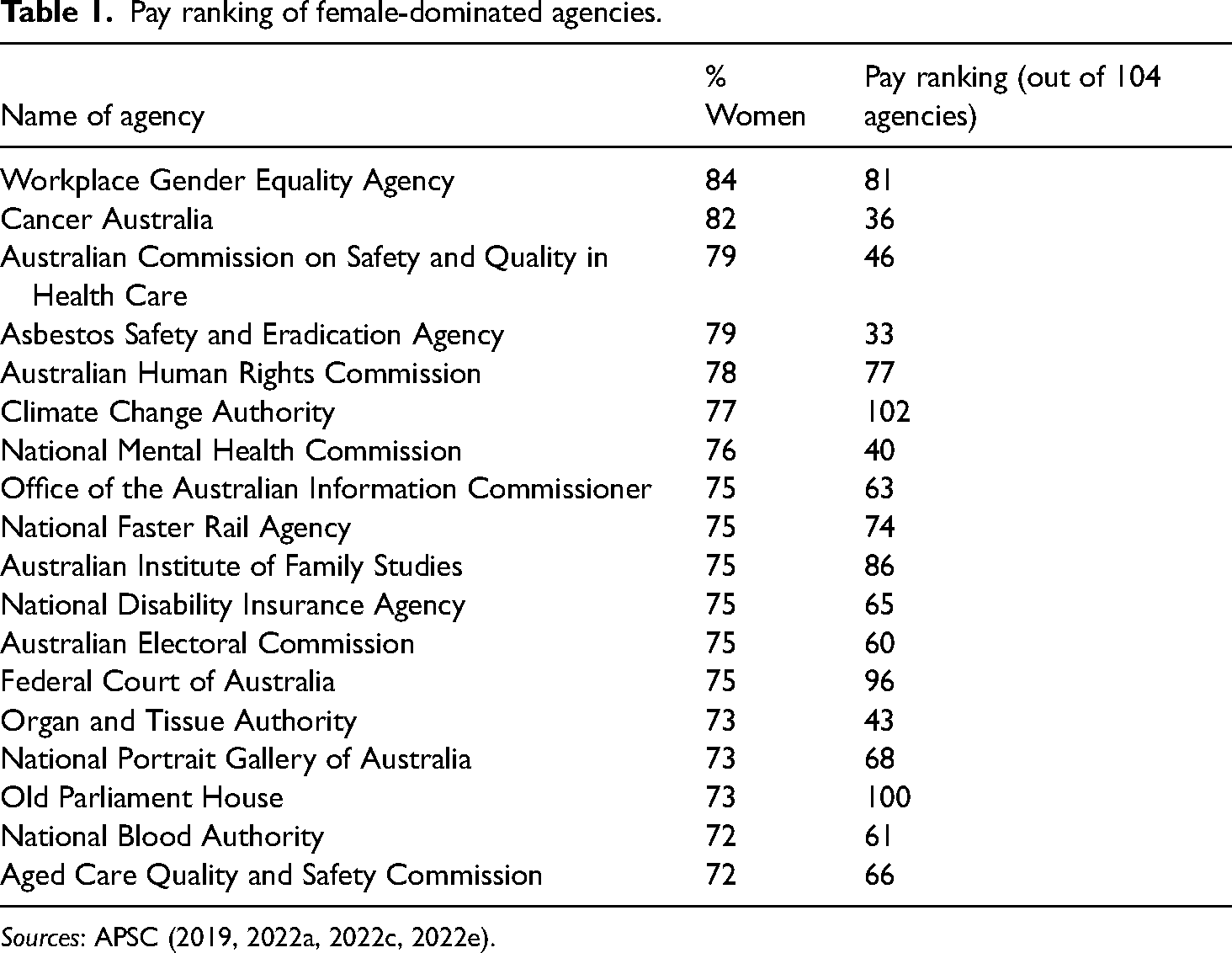
Pay inequity is also evident between agencies. In 2016, the CPSU found that pay gaps were occurring between service delivery and policy agencies (The Senate Education and Employment References Committee, 2016). Evidence also indicates that pay gaps are more pronounced in Indigenous agencies (The Senate Education and Employment References Committee, 2016). Using a minimum APS6 salary as a comparator (since a majority of employees are employed at this classification: APSC, 2022d), we compared salaries in female-dominated agencies and agencies responsible for Aboriginal and Torres Strait Islander policy and service delivery. We found that of the 20 most female-dominated agencies (where between 72% and 84% of employees identified as female), only a quarter of these were in the top half of agencies ranked on pay (see Table 1). Indigenous agencies were also in the bottom half of agencies ranked on pay, with one paying the lowest of the 104 APS agencies, and another in the bottom decile.
Pay ranking of female-dominated agencies.
Sources: APSC (2019, 2022a, 2022c, 2022e).
Both the CPSU and the government wish to create a mechanism to address pay disparities (APSC, 2023b; CPSU, undated(a)). Rectifying pay dispersion will not be easy or quick, partly because reducing salaries in agencies with high pay is not a viable option, and the government has stated that remedying pay dispersion may need to occur over several bargaining rounds (APSC, 2023b). The government has tabled a proposal to reduce the average pay disparity across classifications between agencies from 26% to 18% by increasing salaries in low paying agencies, in addition to any headline pay increases agreed across the APS (Bajkowski, 2023a). Analysts regard the proposal as ‘unambitious’, and it remains a sticking point between the parties at the time of writing (Bajkowski, 2023a).
Core conditions
As part of the quest for public value, terms and conditions of employment are being negotiated which are likely to make the APS a model employer. In this section, we examine the claims for job security, flexible working and specific gender equality provisions, namely paid parental leave, and FDVL.
Job security
Prior to the 2022 election, Labor pledged to address the issue of employment insecurity across the Australian workforce (Labor, undated). Since being elected, the government has taken steps to implement this commitment by enacting the Fair Work Amendment (Secure Jobs, Better Pay) Act 2022 (Cth) (SJBP Act). This is the first tranche in a two-pronged strategy to reduce job insecurity. The second tranche of legislation – dealing with labour hire and on-demand work – will be introduced into the Parliament in late 2023 (Bourke, 2023). The SJBP Act amends the FW Act's bargaining laws in a number of respects, along with laws affecting employment arrangements more broadly. The SJBP Act will be discussed later, but for now it is sufficient to observe that the issue of job insecurity is on the new government's radar across both the public and private sectors.
In regard to job security in the APS, the Labor government gave election commitments to conduct an employment audit. This would determine the scale and use of external contractors and consultants, to enable the employment of more APS workers directly and to take steps to create more secure jobs by converting non-ongoing employees to ongoing (i.e. permanent) employment where appropriate (Albanese, 2022). The employment audit was released in May 2023. Even prior to its release, the government flagged a greater reliance on direct employment. In its election policy, Labor pledged to ‘stop the excessive reliance and waste of public funds on contractors, consultants and labour hire companies for work that can be done more effectively by public servants’ (Albanese, 2022). These comments referred to an increased use under the previous Coalition government of outsourcing in public administration. One reason for this increased use of outsourcing was the Average Staffing Level (ASL) cap, introduced in the 2015–2016 budget to cap full-time equivalent numbers of public servants at or below the 2006–2007 ASL of 167,596 APS employees (Hamilton, 2022). On coming to power the Labor government abolished the ASL cap in its first budget, paving the way for APS staff to obtain direct APS employment (Hamilton, 2022).
Another key commitment is a reduction in the reliance on non-ongoing (i.e. temporary and casual) employment. The PS Act requires that the usual basis for engagement in the APS is as an ongoing employee, but over the past two decades a steady increase in non-ongoing employment has occurred (APSC, 2022d). However, we expect this trend to reverse. Amendments to the FW Act in 2021 defining casual employment and including the right to convert to permanent employment for some employees (FW Act s 15A and Pt 2–2, div 4A) should improve job security. So should an FWC decision in 2022 which held, among other things, that a casual employee could be converted to permanent employment even if no actual vacancy existed (FWC, 2022). Further, new Public Service Regulations 2023 and provisions introduced through the SJBP Act limiting the use of fixed term contracts to a period of generally no more than two years in duration, together with the APS requirement that the usual basis for employment is as an ongoing employee (PS Act 1999, s 10A(1)(b)), will likely lead to increases in permanent employment (PS Regs 2023, s 13; FW Act Pt 2–9, Div 5).
Flexible work
The provision of flexible working will assist the sustainability of the APS, as per a public value approach, and will also contribute to the APS becoming a model employer. Progress has been made in negotiations to make the APS a leader in the provision of flexible working. The Australian government recognises that in a COVID-normal environment, the APS is competing for employees with large private sector employers which offer flexible and hybrid working (APSC, 2023a).
In April 2023, the Secretaries Board – a body established under s 64 of the PS Act to take responsibility for ‘the stewardship of the APS’, released the Principles of Flexible Work in the APS (Secretaries Board, 2023). The Flexible Work Principles are ambitious and extend beyond the right to request flexible working arrangements set out in Pt 2–2 Div 4 of the FW Act (Secretaries Board, 2023). They state that flexibility ‘applies to every role in the APS’ with ‘different types of flexibility suitable for different roles’ (Secretaries Board, 2023). This is an ‘all roles flex’ or ‘flexible by default’ approach. All roles flex was adopted by some public sector jurisdictions in 2015 and 2016, and the APS also committed to this approach at this time (Williamson and Roles, 2023). However, there is no public evidence to suggest that APS agencies adopted this approach (Williamson and Roles, 2023). This recommitment then, is significant.
The Flexible Work Principles were duly considered in bargaining negotiations. In July 2023, the government and CPSU reached in-principle agreement to new flexible working arrangements which extend beyond the FW Act minima (APSC, 2023f). These enhanced arrangements give all employees the right to request flexible work arrangements, regardless of their period of service. Additionally, and as foreshadowed by the Flexible Work Principles, the new provisions adopt an ‘all roles flex approach’. This approach assumes that all roles can be done flexibly to some extent. Agencies are also required to be ‘biased’ towards granting the request to work flexibly, which will assist in overcoming managerial resistance (see e.g. Williamson et al., 2022).
The new flexible working provisions are complemented by a more expansive approach to working from home. Research conducted by the first author in 2021 based on a survey of almost 5000 APS employees found that over 90% of APS employees wanted to continue working from home to some extent (Williamson and Colley, 2022). However, 40% of respondents stated that their agencies imposed a cap on the number of days employees could do so, with the most common cap being 40% of their working time (i.e. two days a week for full-time employees). At the time of writing, the Australian Government had agreed to remove this arbitrary cap (APSC, 2023f). This is a significant concession, with media commentators suggesting that it was made as a trade off against the union's pay claim (Bajkowski, 2023b).
Gender equitable conditions
Progressing equity aligns with public value, and being a model employer. Negotiating for terms and conditions of employment which will progress gender equality is a notable feature of the 2023 negotiations. Both the Australian Government and the CPSU have expressed commitment to reduce the gender pay gap (APSC, 2022c; CPSU, undated(a)). Both parties are also committed to improving paid parental leave and paid FDVL (APSC, 2023a; CPSU, undated(a)). We discuss these two provisions below.
Paid parental leave
In late 2021, the previous Coalition government announced that the outdated Maternity Leave (Commonwealth Employees) Act 1973 Cth would be reviewed. The review aimed to examine whether current levels of support to new parents were adequate, whether the Act promoted gender equality, and whether or not the provisions were flexible (APSC, 2022f). The review report was released in June 2023 (APSC, 2023g). The Review recommends key changes to parental leave in the APS, including the introduction of six weeks pregnancy leave, and an increase on the quantum of paid parental leave. The Maternity Leave Act provided 12 weeks leave for birth mothers; the Review Report recommends 18 weeks be available to each parent – a significant increase. According to the Review, APS enterprise agreements provide an average amount of leave available to birth mothers of almost 17 weeks (APSC, 2023g). The average amount of leave provided to the secondary carer is just over three weeks. An increase to 18 weeks for each parent would make the APS a leader in this area amongst Australian public sectors.
The Review also recommends the abolition of the 12 months qualifying period to be eligible for paid parental leave. Best practice from the private sector shows that leading employers do not impose a qualifying period to access parental leave. If they do, it is only for the employee's probationary period (APSC, 2023g). Removal of the qualifying period also aligns this legislation with the agreed new right to request flexible working arrangements provision, where the 12 month qualifying period to make such requests has also been abolished.
The CPSU's claim is for paid parental, adoption and permanent care-giver leave of 26 weeks for each parent, to a total of 52 weeks. The claim is also for the leave to be taken flexibly over three years; and for an additional five year's unpaid parental leave (CPSU, undated(a)). The unpaid parental leave would count as service. This has wide-ranging implications, as, for example, an employee could access both paid and unpaid parental leave for five and a half years, work another four and a half years, and then be entitled to long service leave, which is available once permanent employees have worked in the APS for 10 years (as per the Long Service Leave (Commonwealth Employees Act) 1976 (Cth)). The government is unlikely to agree to this claim, and the parties are more likely to incorporate the Review's recommendations into the Common Conditions for the APS. The increased quantum of parental leave exceeds that offered by Australian State and Territory governments (APSC, 2023g), and will make the APS a leader in this area and model employer.
Family and domestic violence leave
The CPSU's claim includes 20 day's paid FDVL (CPSU, undated(a)). The proposed Common Conditions advanced by the Australian Government also includes this leave, however, no quantum has been specified. While this leave is essential for those experiencing FDV, it is unable to address the systemic causes of FDVL, which include gendered workplaces (Weatherall, 2022). Nevertheless, this form of leave further signifies that organisations have a role to play in addressing FDVL.
FDVL has been contentious in the APS, with previous Coalition governments historically not supporting this form of leave (Williamson et al., 2019). Labor has supported union attempts over the years to secure 10 days paid FDVL, and this has been a long-standing election commitment (Williamson et al., 2019). Upon being elected in 2022, the new Labor government introduced amendments to the FW Act to provide employees with 10 days FDVL (as per the Fair Work Amendment (Paid Family and Domestic Violence Leave) Act 2022). The definition of family and domestic violence was also extended to cover domestic violence perpetrated by members of the household, in addition to close relatives and current or former intimate partners. The government may not be amenable to increasing this form of leave for APS employees, having increased the quantum for employees covered by the FW Act.
Discussion and conclusions
The 2023 collective bargaining in the APS is remarkable for several reasons. It evidences a repudiation of NPM, towards a public value approach. The main element of public value being created is through making the APS a model employer, and this is being achieved through APS-wide bargaining and a centralised agreement. A new ‘societal reality’ is being developed (Ritz et al., 2023) for APS employees not only through increased pay and improved conditions of employment, but also through the process of negotiations, reliant on consultation and genuine bargaining, underpinned by principles of sustainability, fairness and equity. Being a model employer is often self-proclaimed (Lenagham and Eisner, 2002), however, we consider that the substance and process of negotiations substantially fulfils the government's aim to achieve this title.
We conclude that the 2023 service-wide bargaining round will overcome the problems inherent with the previous system of bargaining which adhered to NPM principles, notably, through the APS becoming a model employer. This is evidenced in three ways. First, the service-wide approach to bargaining, free of such restrictions as the ‘no enhancements rule’ and wage caps, is likely to be broadly welcomed by APS staff. Increased pay and improved terms and conditions of employment will assist in attracting and retaining staff in a tight labour market. Being a model employer is therefore key. Second, the bargaining round aims to reduce the fragmentation of pay and conditions, resulting from over a quarter of a century of NPM and decentralised bargaining. This signals a turn from neoliberalism, towards a public value approach which prioritises a whole of APS approach. Third, the 2023 bargaining round allows both sides to negotiate critical reforms around flexible work and gender equality – also essential elements of being a model employer.
Additionally, the sheer scope of the negotiations deserves comment. From 25 years of restricted bargaining to genuine negotiations on such a wide range of matters, underpinned by proposed complementary regulatory changes presents a new reality for APS employees. This sends a powerful message to the rest of the community about the importance of collective bargaining. At a time when bargaining has drastically declined in Australia (Stanford et al., 2022) the APS negotiations show the importance of this form of regulation. Public value is being created through increased efficiencies in bargaining due to re-centralisation, thereby creating economic value; it also highlights good process in line with being a model employer.
Finally, as well as documenting the 2023 APS bargaining, and analysing this within a public value framework, we also contribute to the public value literature. O’Flynn (2021) urges researchers to consider how public value can be operationalised for specific studies. Little – if any – research has been conducted on how collective bargaining can be analysed through a public value lens. Similarly, scholarship on industrial relations and public value is scant, and opportunities exist to apply the concepts of public value to this discipline. We have commenced this undertaking, and invite others to build on our work.
Footnotes
Declaration of conflicting interests
The authors declared no potential conflicts of interest with respect to the research, authorship, and/or publication of this article.
Funding
The authors received no financial support for the research, authorship, and/or publication of this article.
