



Abstract
Collective bargaining is the foundation for democracy in the workplace, and a mechanism for ensuring workers in Australia have improved working conditions whilst striving to reduce inequality. Collective bargaining offers potential to improve democratic workplace participation and socio-economic status of Aboriginal and Torres Strait Islander peoples, however, if done ineffectively can further entrench inequality. Aboriginal and Torres Strait Islander workplace issues need to be at the forefront of bargaining. In the Higher Education sector, collective agreements with universities cover the majority of employees and are negotiated by the National Tertiary Education Union (NTEU). The NTEU uses its bargaining power within the university sector to establish Aboriginal and Torres Strait Islander employment targets and other targeted provisions within enterprise agreements. These targets and other provisions aim to increase Aboriginal and Torres Strait Islander representation on campus, ensure fair and equitable working conditions and challenge entrenched inequality for Aboriginal and Torres Strait Islander workers within their universities. The NTEU has for over 20 years advocated for and won Aboriginal and Torres Strait Islander employment clauses in enterprise agreements. The National Aboriginal and Torres Strait Islander Policy Committee, under the direction of the Aboriginal and Torres Strait Islander members has pushed for these for the benefit of all Aboriginal and Torres Strait Islander peoples employed or yet to be employed in the higher education sector. The increase in Aboriginal and Torres Strait Islander employment in universities has and continues to be driven by NTEU.
Keywords
Introduction
Within higher education, there has been a concerted effort by the National Tertiary Education Union (NTEU) to increase the number of Aboriginal and Torres Strait Islander peoples employed within the sector. The NTEU is a specialised union for people working in the Australian tertiary education sector. It was formed in 1993 from the amalgamation of five individual unions (Federated Australian University Staff Association, Australian Colleges and Universities Staff Association, Union of Australian College Academics, University of Adelaide General Staff Association and Australian National University Administrative and Allied Officer's Association). With almost 30,000 members and an office on campuses at most universities in Australia, the NTEU represents academic and professional staff at universities, research institutes and private providers. The Union represents members’ professional and industrial interests on a national level and lobbies and liaises with governments and funding bodies, promoting a national profile for the Union and the tertiary education sector (National Tertiary Education Union, 2023c; Panchani, 2010).
The NTEU using its collective bargaining power has established Aboriginal and Torres Strait Islander employment targets and other cultural provisions within Australian university enterprise agreements (EAs), to help ‘close the gap’ on Aboriginal and Torres Strait Islander disadvantage. This works to ensure there are fair and equitable working conditions for Aboriginal and Torres Strait Islander workers within their university collective agreements.
What drives the NTEU to ensure Aboriginal and Torres Strait Islander employees in Australian universities to have fair and equitable working conditions? This article examines how the NTEU engages with its Aboriginal and Torres Strait Islander members to enable those members to have a say in what provisions their union bargains for on their behalf. The article encompasses an annual review of critical and historical developments that give essential perspectives and the core commitment the union has made to address the inequities faced by Aboriginal and Torres Strait Islander peoples. Given the extended period in which the NTEU has sought to use bargaining to address the long standing inequities, the article examines the period from Round 3 bargaining in 1998 to Round 8 bargaining in 2023.
Positioning myself within this research, I am the current Chair of the NTEU's National Aboriginal and Torres Strait Islander Policy Committee. I am a Garigal, Awabakal, Darug, Wiradyuri woman with strong connections to Country and an Aboriginal academic at the University of Queensland where I research and teach in the areas of Employment Relations and Closing the Gap on Aboriginal and Torres Strait Islander disadvantage in Employment and Education. I speak from my Aboriginal standpoint in this work, and my positioning highlights the way the NTEU's structure empowers Aboriginal and Torres Strait Islander members. I represent all Aboriginal and Torres Strait Islander members of the union; however, this representation is not of self, it is a collective representation, that is driven by a) the Aboriginal and Torres Strait Islander community that elected me, and the relationality that binds us as Aboriginal and Torres Strait Islander peoples (Kwaymullina, 2016) and b) the representative structure the NTEU has set up in consultation with its Aboriginal and Torres Strait Islander members as outlined below that allows for the self-determination of outcomes for our peoples.
Background
Enterprise bargaining was introduced in Australia under the Prices and Income Accord Mark VII by the Hawke Labor Government through legislation in 1993 (Brown, 2014), and commenced a shift away from compulsory conciliation and arbitration that had dominated employment relations in Australia for much of the twentieth century. Collective bargaining with its emphasis on the enterprise level represented a fundamental shift in the way wages and conditions were set in Australia. The aim, according to Macdonald et al. (2001), was to ‘reduce “rigidities” and enhance “flexibilities” by opening up more opportunities for wages and conditions to be determined by agreements at the level of the enterprise or workplace’ (p. 1). Flexibility of the industrial relations system has been central to the neo-liberal workplace restructuring agenda (Briskin, 2006). This new decentralised system of Industrial relations aimed to reduce multi-employer awards in favour of ‘single-enterprise agreements as the central mechanism for determining wages and conditions’ (Macdonald et al., 2001: 2). However, according to Hunter and Hawke (2002), despite this widespread industrial relations reform, very little consideration has been afforded to traditionally disadvantaged groups in the labour market, such as Aboriginal and Torres Strait Islander peoples.
Aboriginal and Torres Strait Islander peoples are acknowledged as one of the most disadvantaged group in Australia's industrial relations system, yet for the majority of workplaces, the ‘flexibility’ offered by collective bargaining through the decentralised industrial relations system for this group of disadvantaged employees is not being utilised (Buultjens, 1997; Hunter and Hawke, 2002; Hunter and Gray, 2013). Through collective bargaining, there is an opportunity to prioritise achieving labour market equality and improved work environments for Aboriginal and Torres Strait Islander peoples as with other marginalised groups (Briskin, 2006). Equity, according to Briskin (2006), is an essential element in effective bargaining. Equity bargaining is a process of negotiation where provisions (or clauses) are designed to specifically benefit specific groups and support equality (Crimmins, 2022). Collective bargaining is viewed as a more effective tool [than legislation] for a fundamental and progressive change, in both leading social and labour-market legislation and ensuring its effective implementation through the incorporation of clauses of special interest… (Briskin, 2006: 12)
Barton et al. (2021) notes that trade unions and collective bargaining are considered the main vehicles for ensuring equity in the workplace. They note that decentralised bargaining can favour inequity as ‘unions and collective bargaining are no longer meeting their responsibilities as instruments of social justice, protecting workers and promoting equity’ (p. 115). In addition, Buultjens (1997) notes that the process of enterprise bargaining could discriminate against more marginalised peoples in the workforce, such as Aboriginal and Torres Strait Islander peoples and could exacerbate the ‘deep-rooted and structural inequity’ that this group faces (p. 58).
Any consideration of Aboriginal and Torres Strait Islander peoples and trade unions needs to be placed in the context of ‘the historical experience of colonialism, and the racism that was a part of that process and that persists to this day’ (Fernandez and Silver, 2017: 2). Unions often played a role in the systemic and often deliberate exclusion of Indigenous peoples from waged work, within Australia and in other settler colonial states. Unions have, in general, been reluctant to engage with workers who are not white, male or heterosexual. However, the changing demographics of the labour force have forced unions to change the way and who they engage with (Fernandez and Silver, 2017).
In the past, Indigenous peoples have seen unions as just another colonial institution, engaged in practices at odds with and likely to undermine Indigenous cultures (Fernandez and Silver, 2017). Buultjens (1997) also suggests that the trade union movement has previously marginalised the position of Aboriginal and Torres Strait Islander peoples within the movement and ignored the specific interests of this group. Adding to this, Rea (2011: 8) points out that ‘the trade union movement has a patchy history of support for Indigenous political struggles and in advocating for Indigenous workers’. Therefore, being actively involved in the bargaining process and negotiating favourable outcomes would be very difficult, as unions would not be able to cater for the needs of Aboriginal and Torres Strait Islander peoples unless workplaces consisted mainly of this group. This was perhaps true in the past, however Australian unions have actively involved Aboriginal and Torres Strait Islander peoples within the union movement and in bargaining for over 20 years, especially in the higher education sector (Liddle and Frogley, 2021). Additionally, Hunter and Hawke (2002) noted that the flexibility offered by the decentralised system of enterprise bargaining seems to be important in workplaces with Aboriginal and Torres Strait Islander employees.
EAs provide the framework that outlines the terms and conditions for employees within an organisation, which includes pay, penalty rates, allowances, working hours, leave etc. and any other issues that are of concern in the employment relationship (Brown, 2014). Through EAs, significant improvements in wages and conditions can be obtained. Therefore, does collective bargaining offer the potential to improve democratic workplace participation and the socio-economic status of Aboriginal and Torres Strait Islander peoples? If so, is it underutilised due to the historical marginalisation of Aboriginal and Torres Strait Islander peoples in both unions and workplaces, and if it is done ineffectively, can it further entrench inequality and hinder the cultural values and obligations of this group? Much more attention is needed regarding Aboriginal and Torres Strait Islander issues and participation in collective bargaining.
Hunter and Gray (2013) noted that there has been a distinct increase in provisions for Aboriginal and Torres Strait Islander peoples in EAs since 1997, which is a positive development, however, these provisions tend to be in EAs for large workplaces with a large proportion of Aboriginal and Torres Strait Islander employees. ‘Indigenous friendly provisions’ in EAs can contribute to an organisation's commitment to Aboriginal and Torres Strait Islander employees, make allowance for differences in cultural needs, and potentially offer improved employment opportunities (Taylor et al., 2012). These ‘Indigenous friendly provisions’ according to Hunter and Gray (2013), have flexible work arrangements such as ‘cultural or ceremonial leave’, which aim to assist Aboriginal and Torres Strait Islander employees ‘remain employed when they face competing demands from the workplace as well as their family, community and cultural obligations’ (p. 7). Hunter and Gray (2013) acknowledged that while these ‘Indigenous friendly provisions’ are a positive development, they are most prevalent in workplaces where there is a sound business case to introduce these provisions, such as mining companies with Land Use Agreements or organisations with Reconciliation Action Plans (RAPs) (Marsh, 2013).
Indigenous peoples in settler colonial states internationally have had similar experiences with unions. Negative Indigenous experiences with unions are deeply rooted as ‘unions bear the imprint of settler colonialism’ (Camfield, 2019: 168). Assimilation policies, institutional racism, and the lack of ‘buy in’ around Indigenous issues from unions has had a significant influence in Indigenous peoples joining unions, and hence unions directing their efforts to the particular needs and interests of Indigenous peoples (Camfield, 2019; Fernandez and Silver, 2017; Locke, 2012). However, there is a critical shortage of research in this area from an Indigenous standpoint, with most studies framed from a colonial lens.
Fernandez and Silver (2017) acknowledged that it is only relatively recently that unions are starting to make gains for Indigenous peoples through collective bargaining, noting that public sector unions are leading the way as there is a propensity for Indigenous peoples to work in the public sector. Fernandez and Silver (2017: 8) state that If unions are to meet the legitimate needs of Indigenous workers and potential workers, they are going to have to earn their trust by confronting the realities of racism that have long been directed by non-Indigenous people and institutions at Indigenous peoples.
Aboriginal and Torres Strait Islander structure within the NTEU
The NTEU has a unique structure for Aboriginal and Torres Strait Islander peoples, in fact it is the only union in Australia that has elected Aboriginal and Torres Strait Islander members directing the union's policy and practices. Worldwide, there is only one other nationwide union that has similar structures for their Indigenous peoples, the Tertiary Education Union (TEU) in Aotearoa (New Zealand). The NTEU structure rose out of a commitment within the ‘10 Point Plan for a Post-Treaty Union’ adopted by the Gubba caucus (non-Indigenous) in 2002, when non-Indigenous activists and staff of the union recognised that the onus was on them to be active and vigilant in ensuring the rights of Aboriginal and Torres Strait Islander peoples within universities (National Tertiary Education Union, 2023c). Over time, the elected representation has expanded to the current structure – see Figure 1.
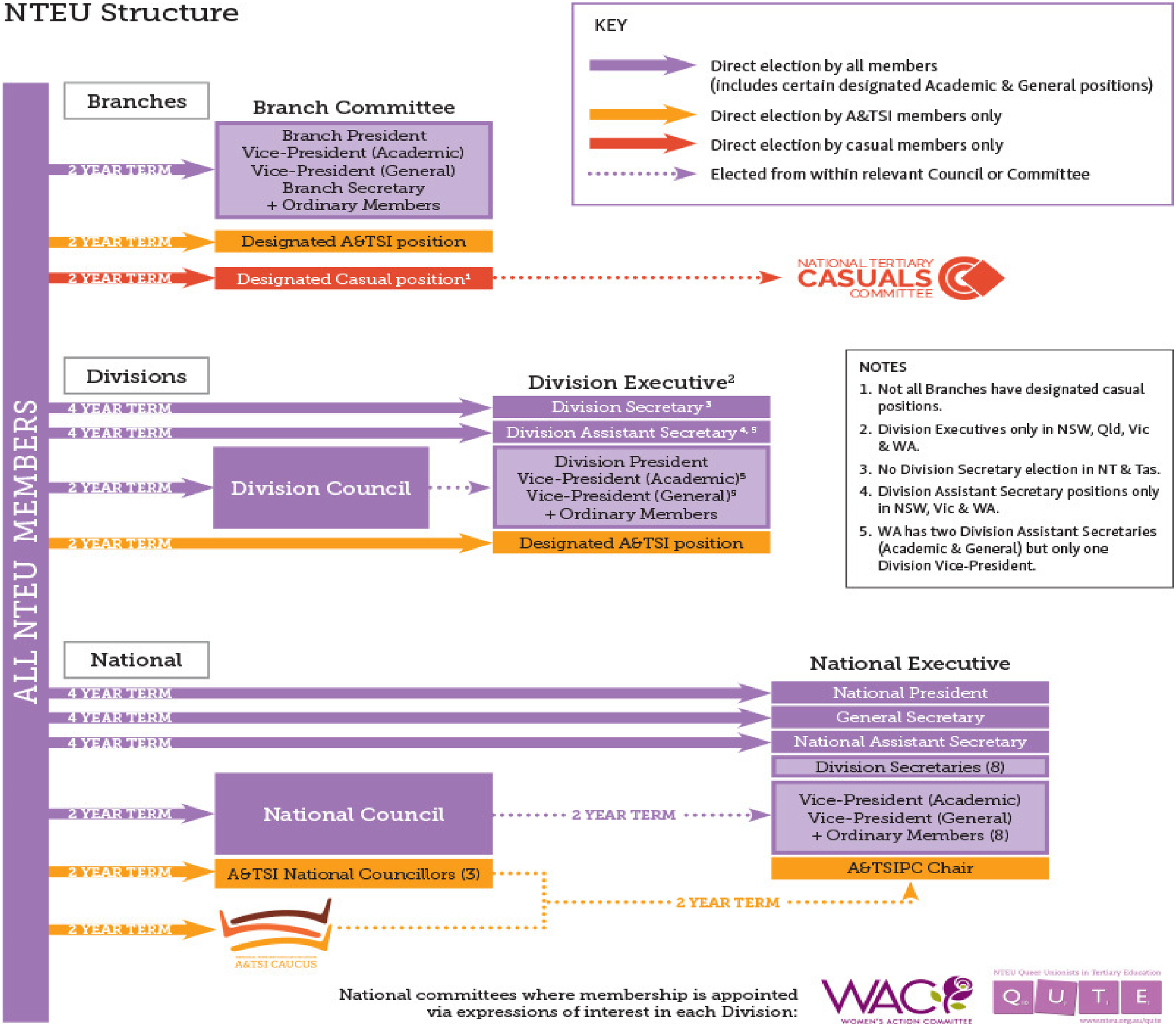
National Tertiary Education Union (NTEU) structure.
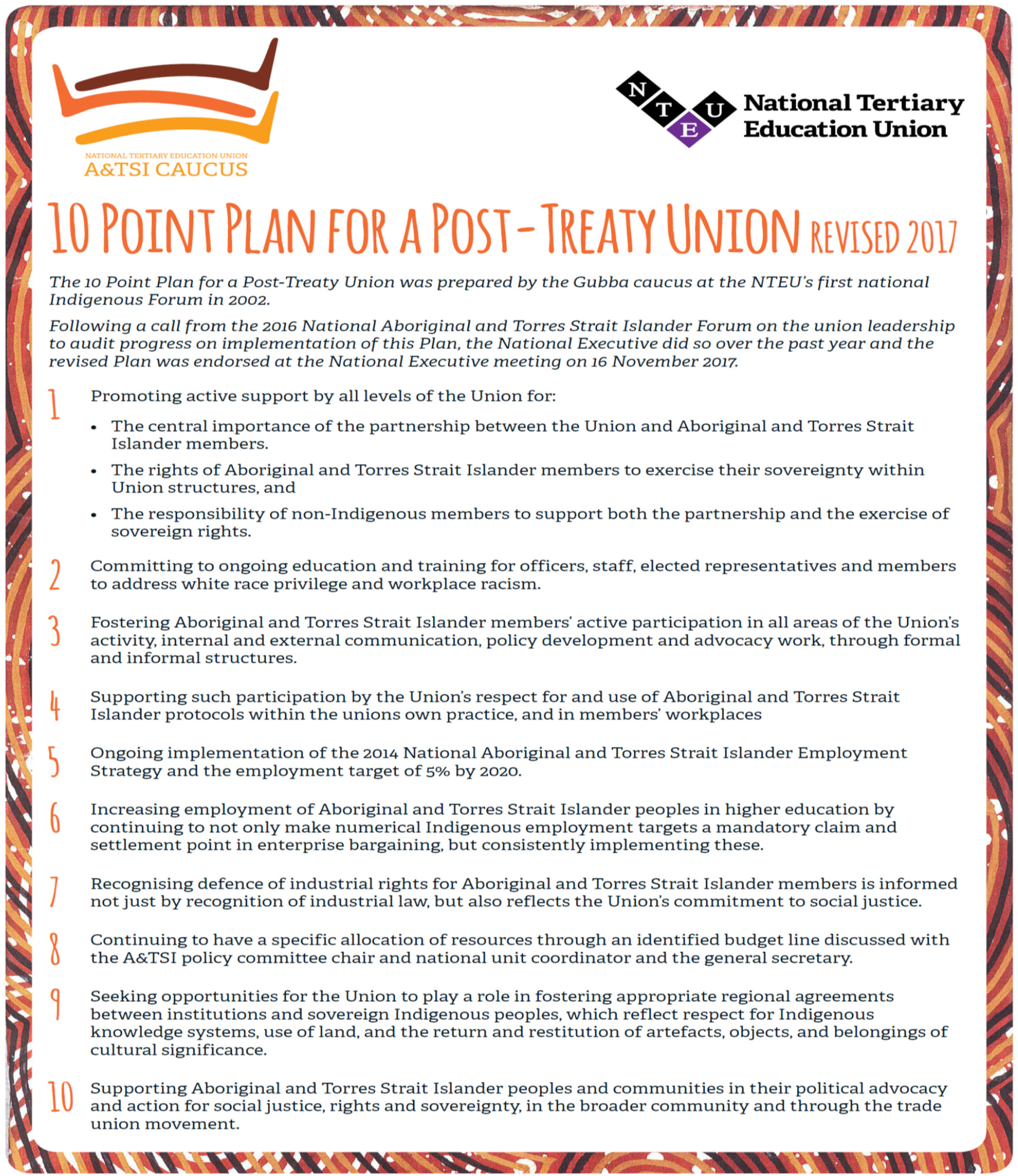
National Tertiary Education Union (NTEU) 10 Point Plan for a Post-Treaty Union.
At a university level, there is a designated elected Aboriginal and Torres Strait Islander position on every university branch committee. These elected representatives assist the branch on all matters concerning Aboriginal and Torres Strait Islander matters and members. At a Division level (State/Territory), there is a designated elected Aboriginal and Torres Strait Islander position on each Division Council/Division Executive. Division councils are the governing body at this level and make decisions that are more localised. Division councils are made up of Branch presidents and branch members that are National councillors. The Division Executive manages the business of the division and implements any decision made by the council. At a national level, there are three designated elected Aboriginal and Torres Strait Islander National Councillors who attend National council and represent the interests of Aboriginal and Torres Strait Islander peoples on the union’s highest governing body.
The Division and National councillors constitute the National Aboriginal and Torres Strait Islander Policy Committee and are elected from the National Aboriginal and Torres Strait Islander membership for a term of 2 years (National Tertiary Education Union, 2023c). The National Aboriginal and Torres Strait Islander Policy Committee meets six times per year.
The Chair and Deputy Chair of the National Aboriginal and Torres Strait Islander Policy Committee are elected from the membership of the National Aboriginal and Torres Strait Islander Policy Committee. The Chair, once elected, then holds a position on the National Executive of the union. The National Executive manages the business and all financial affairs of the union and are subject to any decisions or resolutions made by the National Council (National Tertiary Education Union, 2023a).
Under the NTEU rules, The National Aboriginal and Torres Strait Islander Policy Committee is responsible for advising all union bodies (branch, division and national) about the proper implementation of the union's policies in relation to Aboriginal and Torres Strait Islander peoples, and for the development of such policies for adoption by union bodies (National Tertiary Education Union, 2023a).
Additional representation of Aboriginal and Torres Strait Islander peoples within the NTEU includes two designated positions on the Women's Action Committee (WAC), one academic and one professional, who are actively involved in advancing Aboriginal and Torres Strait Islander women's issues within the union as well as engaging in broader union and community based events for women (National Tertiary Education Union, 2023a).
In addition to the elected positions within the union, the NTEU has designated identified Aboriginal and Torres Strait Islander staff that provide policy, advice and support on developing strategies for the union. The National Aboriginal and Torres Strait Islander team consists of; the National Director – Aboriginal and Torres Strait Islander Unit, Adam Frogley, and the National Organiser – Aboriginal and Torres Strait Unit, Celeste Liddle. This team is responsible for overseeing programs and policy relating to Aboriginal and Torres Strait Islander members and community as well as promoting Aboriginal and Torres Strait Islander equity on campus, publicity, advice and act as the first port call of call for the Aboriginal and Torres Strait Islander membership (National Tertiary Education Union, 2023b).
Each year, Aboriginal and Torres Strait Islander caucuses are held at a Division and National level. Division Aboriginal and Torres Strait Islander Forums have been held each year since 2004 (Wright, 2005). Representatives are made up of Branch and Division elected Aboriginal and Torres Strait Islander representatives as well as members. In addition, each year the NTEU holds a National Aboriginal and Torres Strait Islander Forum (The forum). Representatives at the forum are made up of Branch, Division and National Aboriginal and Torres Strait Islander elected representatives and members, staff, invited guests as well as non-indigenous union officials and staff. The forum has been held every year since 2002 and drives the policy and practice of the union.
The caucus was established after a group of Aboriginal and Torres Strait Islander members in around the year 2000 got together and facilitated a meeting through the then National President Carolyn Allport. From this initial meeting the NTEU National Indigenous Caucus was established and formalised fully by 2002 culminating in the first National NTEU Indigenous Forum (Mason, 2023; National Tertiary Education Union, 2023c).
At the NTEU National Indigenous Forum in 2002, the NTEU ‘gubba caucus’ (non-Indigenous caucus) was tasked with creating a plan for how the union would engage with Aboriginal and Torres Strait Islander members, peoples and their communities (National Tertiary Education Union, 2023c). From this the ‘10 Point Plan for a Post-Treaty Union’ was developed and adopted. The ‘10 Point Plan for a Post-Treaty Union’ is a foundation document for NTEU, detailing the core commitment of the Union to Aboriginal and Torres Strait Islander members, peoples and their communities, that seeks to address racism, discrimination, and inequalities faced by Aboriginal and Torres Strait Islander peoples, and to ensure that NTEU is a culturally safe and welcoming space (National Tertiary Education Union, 2023c) (see Figure 2).
In 2017, the NTEU National Executive endorsed a revised ‘10 Point Plan for a Post-Treaty union’, after the 2016 National Aboriginal and Torres Strait Islander Forum called on the Union leadership to audit the progress on the implementation of the 10 Point Plan. The National Executive undertook an audit in collaboration with Divisions and the revised plan was endorsed in 2017 (Rea, 2018). In presenting the revised ‘10 Point Plan for a Post-Treaty Union’ to the National Council, then President Jeannie Rea reiterated that ‘Aboriginal and Torres Strait Islander business is core union business’. Rea (2018) stated that In assessing progress on the original plan, it was pleasing to find that a fair proportion of the plan has been implemented and/or become part of Union business. The extent to which it has become core to the Union's culture and politics is more debatable … implementation of the revised plan lies firstly with the Nation leadership, but also at the Divisional level. (p. 50)
One of the points in the ‘10 Point Plan for a Post-Treaty Union’ was a focus on the NTEU employing Aboriginal and Torres Strait Islander staff. The NTEU developed an Aboriginal and Torres Strait Islander employment strategy which was adopted in 2014, committing the union to a 5% employment target (Rea, 2018), something the NTEU has bargained for at universities since 2000.
The ‘10 point Plan for a Post-Treaty Union’, the National Aboriginal and Torres Strait Islander Policy Committee and the National Aboriginal and Torres Strait Islander Unit through the priorities developed at the Division and National forums raise the profile of Aboriginal and Torres Strait Islander business within and across the union structure and drive the work of the union when it comes to collective bargaining and cultural clauses in university EAs.
The NTEU and collective bargaining
The NTEU using its bargaining power has established Aboriginal and Torres Strait Islander employment clauses within Australian university EAs, which aims to increase the employment opportunities for Aboriginal and Torres Strait Islander peoples on university campuses. In addition, the NTEU bargains for a range of employment conditions which aim to close the gap on Aboriginal and Torres Strait Islander disadvantage by ensuring that there are fair and equitable working conditions for Aboriginal and Torres Strait Islander workers within their university collective agreements (National Tertiary Education Union, 2023c).
The NTEU's National Aboriginal and Torres Strait Islander Claim was first introduced in Round 3 bargaining in 1998 (National Tertiary Education Union, 1999b). The introduction of Indigenous clauses in EAs in 2001 gave incentive to universities to increase the number of Aboriginal and Torres Strait Islander staff, in addition to providing meaningful employment opportunities for Aboriginal and Torres Strait Islander communities (Frogley, 2008a). Since 2001 and the inception of Aboriginal and Torres Strait Islander provisions in university EAs, there has been a sustained drive by the NTEU to ensure that employment opportunities for current and potential Aboriginal and Torres Strait Islander staff are created across all levels of the university structure (Frogley, 2013). This includes a commitment to lobby universities to include fair and equitable provisions relating to Aboriginal and Torres Strait Islander workers in university EAs.
The inaugural ‘Indigenous’ bargaining claim came in Round 3 in 1998 and called for the development and implementation of an Indigenous employment strategy, in conjunction with the NTEU that would foster Indigenous employment and participation at all levels of work activities in universities. In addition, the claim called for the introduction of Indigenous specific leave entitlements to participate in ceremonial activities and that Indigenous languages be recognised as job related skills where their use was required in universities (National Tertiary Education Union, 1999a).
Hunter and Gray (2013) noted that there has been a gradual increase in the proportion of EAs and federal awards with cultural or ceremonial leave, from around 2% in 1997 to 5% in 2013. In addition, since 1997, Hunter and Gray (2013: 10) noted that there ‘has also been a substantial increase in the proportion of workplaces and employees with Indigenous-specific provisions’. Between 1997 and 2013, they estimate the ‘proportion of federal agreements with these provisions increased from about 0.5% to just over 2%’.
The NTEU ‘Indigenous Employment Strategy and Associated Conditions of Employment’ was developed at a meeting of the Indigenous Enterprise Bargaining Working Group in 1999. The strategy built on earlier documents prepared by the NTEU Indigenous Tertiary Education Policy Committee, which was developed at the inaugural NTEU National Indigenous Members’ Forum held on 11–12 April 1999. The ‘Indigenous’ bargaining claim called for: The appointment of Pro Vice-Chancellor (Indigenous), the Indigenisation of Universities Indigenous Units/Centres, and university wide employment strategies, Indigenous representation on employment selection panels and other related conditions of employment (National Tertiary Education Union, 1999a).
The strategy was developed to be implemented in the following round of bargaining, Round 4, however, the strategy was affected by the dramatic changes to Australia's workplace relations landscape in 1996 with the election of the coalition government led by John Howard. The Workplace Relations Act 1996 (WRA) took a major step away from the traditional pluralist roots of Australian industrial relations with the introduction of Australian Workplace Agreements (AWAs) (Nguyen and Johns, 2008). The WRA saw a move ‘away from unions and collective bargaining, towards the creation of cooperative employer–worker relations, in the pursuit of “mutual gains” for both parties’ (Nguyen and Johns, 2008: 1), and sought to marginalize and exclude unions form negotiating terms and conditions of employment (Rosewarne, 2005).
Then in 2005, the Higher Education Workplace Relations Requirements (HEWRRs) legislation was introduced, imposing restrictions on the interactions between universities and the NTEU. With the introduction of HEWRRs, the Howard government engaged in a strategic assault on the NTEU aimed at attacking the organising authority of the union in higher education (Rosewarne, 2005). HEWRRs were introduced by the government to force universities to offer AWAs to all staff, to strip employment provisions out of EAs (such as Aboriginal and Torres Strait Islander employment targets) and to de-unionise staff representation. HEWRRs allowed for negotiations with non-unionised workers even where trade union representation existed. These ‘reforms’ were linked to 7.5% of a universities funding and all EAs had to be HEWRR compliant (Rosewarne, 2005).
The neo-liberal agenda of the Howard conservative government with the implementation of HEWRRs had a detrimental effect on Aboriginal and Torres Strait Islander bargaining claims and the clauses that could be inserted and implemented in EAs as there was a prohibition on fixing employment targets. HEWRRs effectively ensured that no ‘Indigenous friendly provisions’ could be inserted into EAs and provisions that were already in EAs could not be enforced. Hence Round 4 and 5 NTEU Aboriginal and Torres Strait Islander bargaining claims were diminished and looked very different to the claims of Round 3, which had called for all universities to develop and implement an Aboriginal and Torres Strait Islander employment strategy in conjunction with the NTEU which should redress racism, social injustice, exploitation and employment inequity (National Tertiary Education Union, 2003, 2007).
At the 2006 NTEU National Indigenous Forum, Aboriginal and Torres Strait Islander delegates discussed the inconsistent advice received from Federal departments given to universities around removing Indigenous employment clauses in EAs, as allegedly they did not comply with HEWRR legislation (Wright and Fryer, 2006). The Forum delegates voted to endorse a motion to continue to push for Indigenous employment strategies to be implemented in EAs and not into university policy (Wright and Fryer, 2006).
Despite the introduction of the WRA and HEWRRs, the NTEU through collective bargaining continued to negotiate for Indigenous employment strategies to be implemented into university EAs. At the NTEU National Aboriginal and Torres Strait Islander Forum in 2007, a motion was carried to investigate how the implementation of Indigenous clauses and strategies was progressing in universities, especially in light of the HEWRRs and WorkChoices (Frogley, 2008a).
A survey, conducted by the NTEU National Aboriginal and Torres Strait Islander Unit, looked into the current situation of Indigenous employment in Australian universities and examined the strategies employed by universities to implement Indigenous clauses in agreements (Frogley, 2008a). The survey found that ‘limited progress had been made due to the HEWRRs’ and ‘that less than half of all universities had Indigenous clauses and employment strategies in their Agreements’ (Frogley, 2008a: 32). The survey noted that since the introduction of clauses and strategies in EAs, Indigenous staff numbers had increased by 231 in the period from 2001 to 2005 (see Figure 3), however, HEWRRs and WorkChoices played ‘a significant role in reducing the effect of Indigenous clauses and Indigenous employment strategies’ (Frogley, 2008a: 32). Frogley (2008a) noted that ongoing evaluation and monitoring of the clauses was needed to ensure that universities were compliant ‘with the agreed clauses and targets … as many institutions simply have not fulfilled their obligations under the Collective Agreement or their Indigenous employment strategies’ (p. 32).
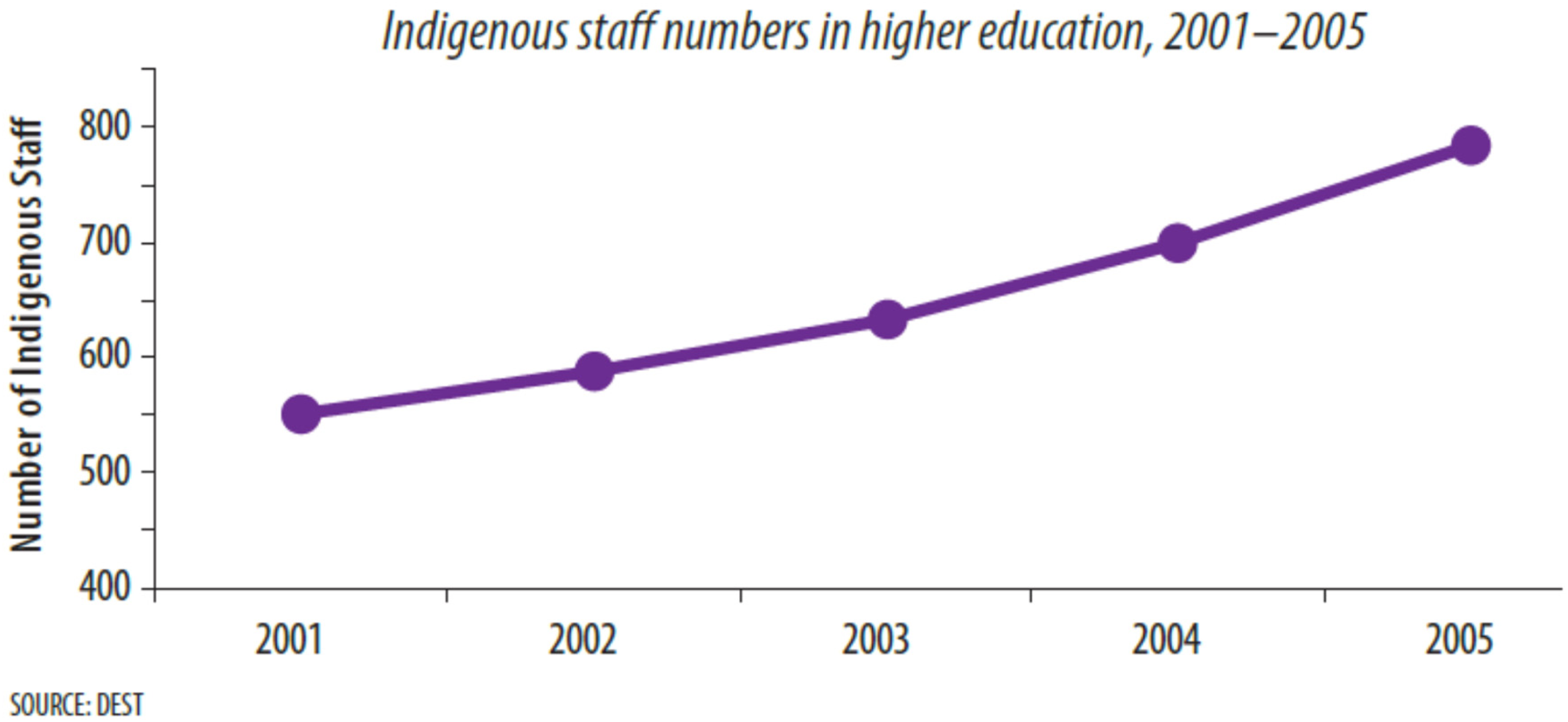
Number of Indigenous staff in higher education 2001–2005.
By the time of Round 6 bargaining, the Rudd Labor Government had been elected and in February 2008, the Workplace Relations Amendment Bill was introduced, dismantling some of the worst aspects of WorkChoices, including the removal of HEWRRs (McAlpine, 2008). Seeking to redress the effects of WorkChoices and HEWRRs, under the Labor government, the NTEU bargaining for Indigenous specific clauses in EAs for Round 6 was ramped up. The National Aboriginal and Torres Strait Islander caucus, through the National forum set claims they wanted to see included in enterprise bargaining for the entire university sector, such as the implementation of an institutional wide Indigenous employment strategies, including securing a numerical/percentage target for Indigenous employment, ensuring NTEU representation on Indigenous employment monitoring committees, the appointment of Senior Indigenous Staff, including a Pro-Vice Chancellor (Indigenous) and an Indigenous Employment Coordinator, the Indigenisation of universities Indigenous Unit/Centres, culturally appropriate selection and assessment panels for recruitment, cultural and ceremonial leave provisions, and Indigenous Language Allowances (Frogley, 2008b, 2009, 2011). The provision of equity clauses, such as these in enterprise agreements according to (Crimmins, 2022), actively promote equality within the workplace and sought to reduce the disadvantage faced by marginalised groups.
The NTEU Aboriginal and Torres Strait Islander caucus, through the National forum has been calling for Senior Indigenous Staff appointments since 1999, however it took until 2009 for the first Aboriginal person, Professor Steven Larkin, to be appointed to a senior executive position at an Australian university. Professor Larkin was appointed Pro Vice-Chancellor for Indigenous Leadership at Charles Darwin University.
During Round 6 bargaining, the Review of Higher Education Access and Outcomes for Aboriginal and Torres Strait Islander People: Final Report (Behrendt Review) was published. The review examined what could be done by ‘governments, universities, businesses, professions and communities to support all Aboriginal and Torres Strait Islander peoples to participate and succeed in higher education’ (Behrendt et al., 2012: xi). The review noted that Aboriginal and Torres Strait Islander peoples were significantly underrepresented in higher education and suggested ways to achieve parity, at a student and staff level. One recommendation from the report was to build a National Indigenous Higher Education Workforce Strategy that achieved Aboriginal and Torres Strait Islander employment parity (Behrendt et al., 2012). Another recommendation was that universities should develop strategies to recruit, support and retain Aboriginal and Torres Strait Islander employees to meet the parity targets, informed by the National Indigenous Higher Education Workforce Strategy.
The timing of the Behrendt Review and its recommendations assisted the NTEU to frame the employment targets within enterprise agreements in Round 6 as it called for a population parity target for the proportion of the university general and academic staff to be Aboriginal or Torres Strait Islander peoples (Behrendt et al., 2012), which aligned with what the NTEU had been bargaining for, for over a decade. As a result, Aboriginal and Torres Strait Islander clauses arising from nation-wide bargaining negotiations across Round 6 achieved greater employment opportunities for Aboriginal and Torres Strait Islander peoples, with numeric or percentage targets in almost all agreements, greater levels of member/staff input into the implementation and monitoring of the clause directives and improved specific entitlements, such as cultural/ceremonial leave and language allowance provisions (Frogley, 2016b).
Despite gaining increased provisions in university EAs for Aboriginal and Torres Strait Islander peoples, the release of university staffing statistics by the Department of Education showed that in 2015, for the first time since 2006, the number of Aboriginal and Torres Strait Islander peoples employed in the university sector had declined (see Figure 4) (Department of Education, 2015; Frogley, 2016a). One explanation for this decline, given by the NTEU, was that Recommendation 10 of the Behrendt review was misinterpreted by universities (Frogley, 2016a). Recommendation 10 states that ‘universities adopt a whole-of-university approach to Aboriginal and Torres Strait Islander student success so that faculties and mainstream support services have primary responsibility for supporting Aboriginal and Torres Strait Islander students, backed up by Indigenous Education Units’ (Behrendt et al., 2012: xix).
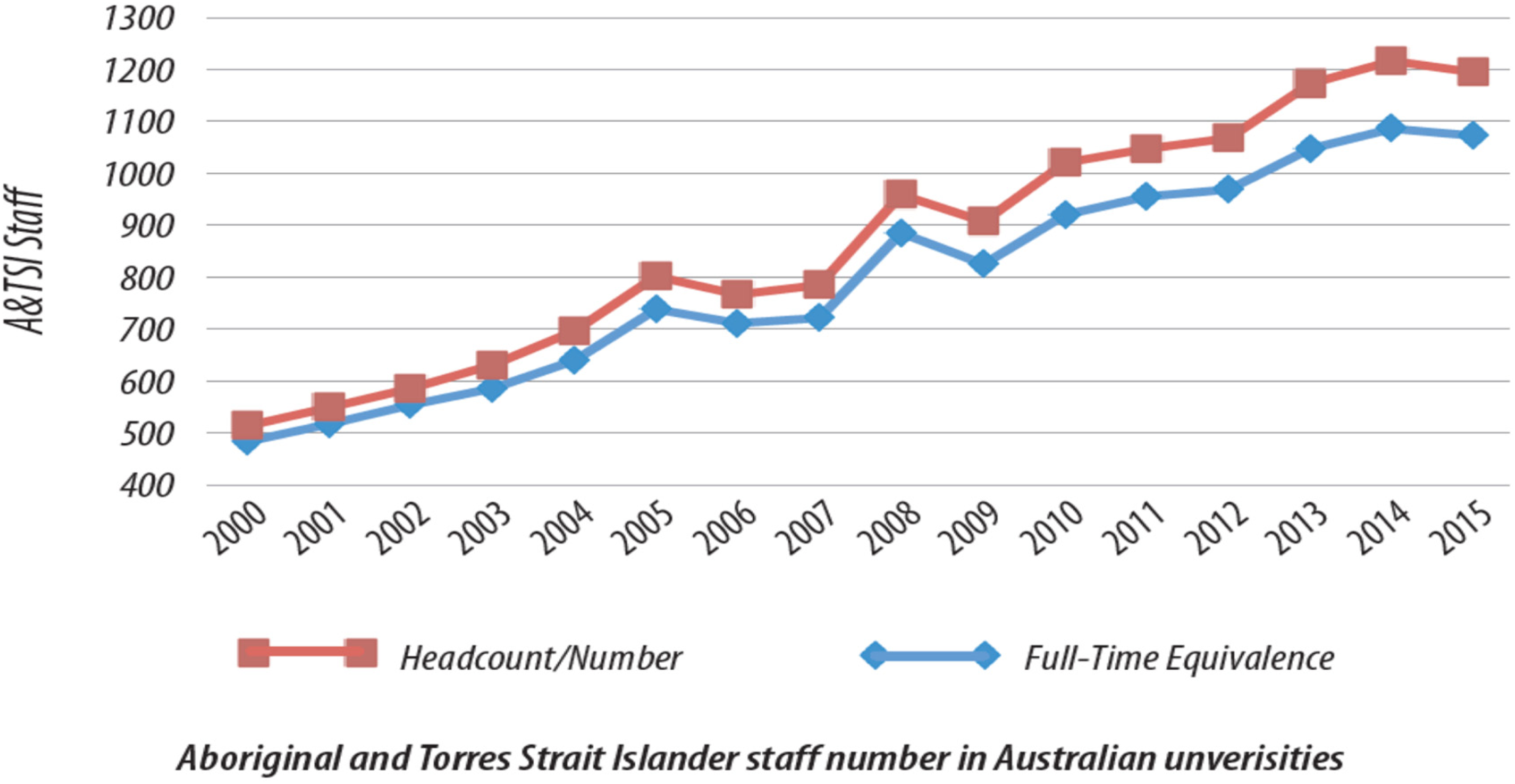
University Aboriginal and Torres Strait Islander staffing statistics – Department of Education (2015).
The goal of the recommendation, according to Frogley (2016a) was to ensure that the whole university took responsibility to ensure greater outcomes for both Aboriginal and Torres Strait Islander staff and students, however ‘many institutions have simply ignored the final part of the recommendation “backed up by Indigenous Education Units” and it would also appear that university management have only read (or selectively read) other recommendations; including Recommendation 11 where the importance of Indigenous Education Units is espoused’ (p. 12).
Frogley (2016a) goes on to explain that while recommendation 10 was misinterpreted, another reason for the decline in Aboriginal and Torres Strait Islander employment was the ‘mainstreaming agenda’ prevalent at a number of universities. These universities have either closed or attempted to close their Aboriginal and Torres Strait Islander Units/Centres, made staff redundant and ‘have absorbed and dispersed the work of the Unit across the rest of the university’ (p. 12), ensuring less employment opportunities for Aboriginal and Torres Strait Islander peoples, in addition to university restructures and redundancies. The explanation provided by Frogley (2016a) can be substantiated by the decline of general and professional staff numbers from 819 to 796 between 2014 and 2015. In 2015 Aboriginal and Torres Strait Islander staff in universities comprised of 1% of the total university staffing, well below population parity at the time of 2% (Department of Education, 2015; Frogley, 2016a).
In 2013, at the NTEU National Council, a motion was put forward from the Aboriginal and Torres Strait Islander caucus, through the National Aboriginal and Torres Strait Islander Policy Committee, that the NTEU should develop its own Aboriginal and Torres Strait Islander employment policy and strategy, recognising that Aboriginal and Torres Strait Islander staff numbers in the higher education sector had grown, along with NTEU membership density, and there was a need to provide more employment opportunities for Aboriginal and Torres Strait Islander peoples in the union. It also mirrored the enterprise bargaining claims the union had fought for over the years within universities (Liddle, 2013b). The motion was passed unanimously and since then the strategy has formed part of the guiding documents for the union. The formulation of the NTEU employment strategy has set a benchmark in the union movement, very few other unions in Australia have Aboriginal and Torres Strait Islander employment strategies.
At the 2017 National Forum, the Aboriginal and Torres Strait Islander caucus determined that Round 7 bargaining teams should negotiate or continue to negotiate for numeric targets in EAs (Frogley, 2018b). Round 7 bargaining coincided with the release of Universities Australia (UA) Indigenous Strategy 2017–2020. The strategy ‘was the first sector-wide initiative that brought all member universities together to achieve common goals to advance Aboriginal and Torres Strait Islander participation and success in higher education’ (Universities Australia, 2023). The strategy called for the inclusion of Indigenous higher education, research and employment to be a priority area in core policy documents, including institutional strategic plans and business plans (Universities Australia, 2017). Whilst the UA Indigenous Strategy was used to initially strengthen the claims by the NTEU to have employment targets in EAs, it soon became clear that universities would use the strategy in an attempt to remove targets from EAs and instead place them into policy documents. University management tried to significantly reduce or remove entirely, elements of the Aboriginal and Torres Strait Islander employment clauses from agreements including targets (Frogley, 2018b), a trend over the years where universities have attempted to remove targets from agreements and place them into policy or Reconciliation Action Plans (RAPs) (Liddle, 2013a). Frogley (2012) argues, however, that enforceable employment targets are placed in enterprise agreements for good reason, if they are in university policy documents, they can be reduced to tokenism or completely ignored.
The NTEU had previously raised a dispute with RMIT University in Victoria due to its failure to meet the commitments in the EA to increase Aboriginal and Torres Strait Islander employment. The outcome of raising this dispute meant that the university formalised its Indigenous employment policy and strategy, it significantly increased Indigenous employment, employed an Indigenous employment coordinator and fostered relationships with the local Aboriginal community. This was all achieved within 6–8 months of raising the dispute (Frogley, 2012). From and Aboriginal standpoint, it can be argued that this dispute could have been avoided if the university had achieved its stated commitment to Aboriginal and Torres Strait Islander employment, however it chose to make excuses such as ‘there are not suitably qualified Indigenous applicants’, a statement that is heard far too often, which has questionable factual base.
Measuring the success of collective bargaining
We are currently negotiating Round 8 EAs around the country, and again the NTEU has a log of claims around Aboriginal and Torres Strait Islander peoples and their employment. For over 20 years the NTEU has been fighting for the rights of Aboriginal and Torres Strait Islander peoples within the university sector. How successful has this been? At the end of Round 7 bargaining, 84% of enterprise agreements had Aboriginal and Torres Strait Islander employment targets (whether numeric or percentage), 81% of agreements incorporated cultural leave entitlements and 32% contained an Aboriginal and Torres Strait Islander language allowance, 26 universities have Senior Indigenous Leadership (DVC or PVC Indigenous) (Frogley, 2020). Translating this into success, data from Department of Education (2021), shows that 1743 Aboriginal and Torres Strait Islander peoples were employed by universities in 2020, equating to 1.34% of the workforce. When the NTEU started bargaining for employment clauses in 2000, there were 513, equating to .68%. Whilst there is still a long way to go to reach parity (3.1%), the growth in employment is encouraging and drives the work of the NTEU. Figure 5 shows the growth in Aboriginal and Torres Strait Islander employment over the various bargaining rounds.
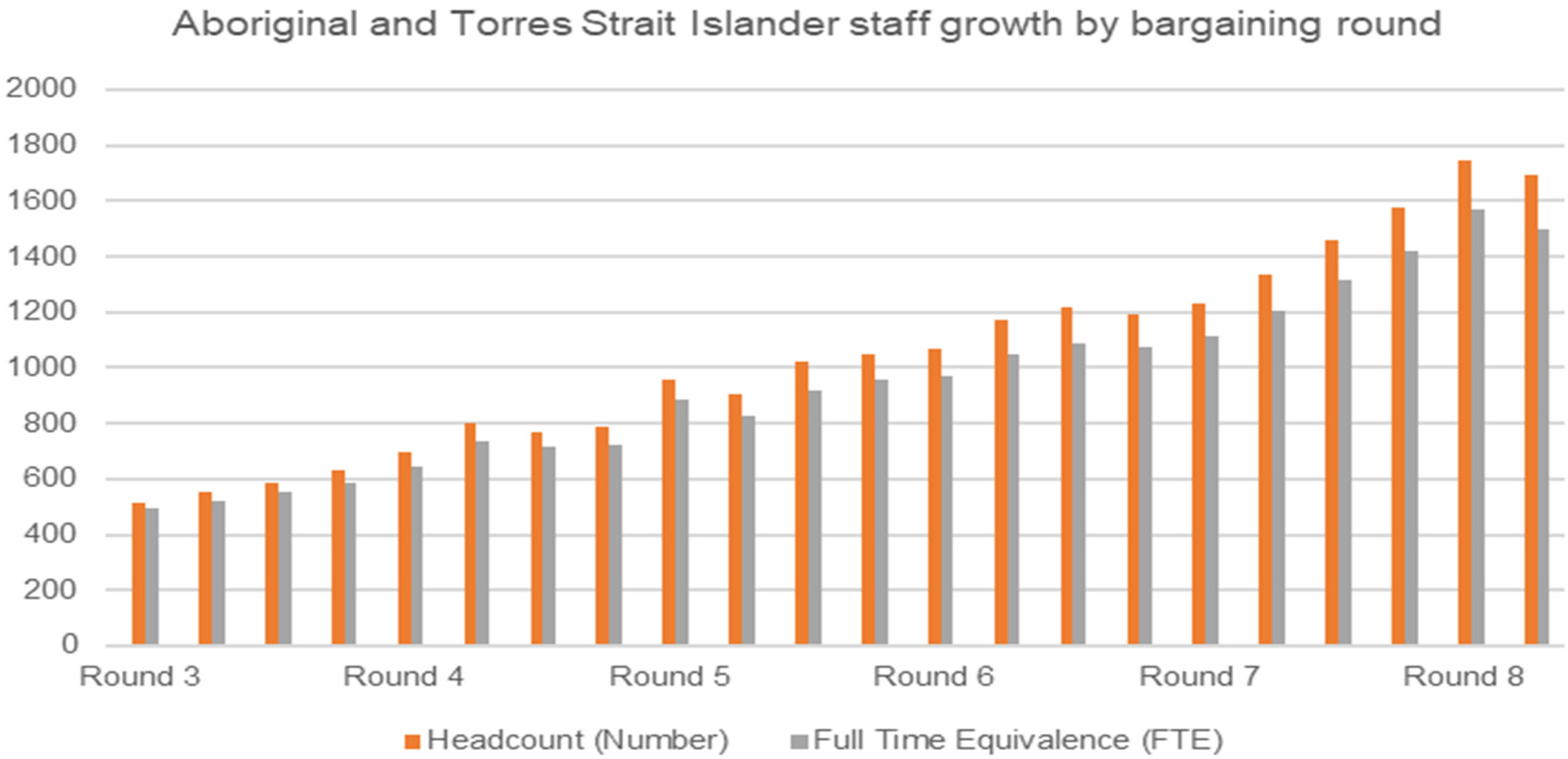
Aboriginal and Torres Strait Islander employment growth by bargaining round (Department of Education, 2021).
Cultural and Ceremonial leave provisions that have been fought for and won in EAs were instituted to recognise the cultural diversity of Aboriginal and Torres Strait Islander peoples in the university workforce. These entitlements offer additional paid leave to undertake the fundamental cultural obligations that our diverse communities need, such as men's and women's business, NAIDOC week, and other cultural festivals. There are many benefits to universities for offering such leave, like being acknowledged as an employer of choice for best practice in diversity measures. Provisions such as those that the NTEU bargain for in EAs increase the cultural diversity of a workplace and give a competitive advantage to employers (Frogley, 2018a; Leroy-Dyer, 2010, 2022; Leroy-Dyer and Menzel, 2023).
Undoubtedly, the Review of Higher Education Access and Outcomes for Aboriginal and Torres Strait Islander People: Final Report (2012) and Universities Australia's Indigenous Strategy (2017), mentioned previously, have had a role to play in the increase of Aboriginal and Torres Strait Islander employment. However, the role of the NTEU cannot be underestimated. The NTEU can be proud of what it has achieved, although there is always more to do.
In Round 8 bargaining, happening all around the country, the NTEU, under the direction of the Aboriginal and Torres Strait Islander membership, are bargaining to ensure that cultural load is recognised as a workplace issue and that workload provisions and compensation are recognised and acknowledged in EAs. Cultural load is additional work that is performed by Aboriginal and Torres Strait Islander peoples in the workplace, including extra ‘Indigenous related’ work demands, expectations to speak about or educate work colleagues about Aboriginal and Torres Strait Islander issues, Indigenisation of curriculum, or any other work undertaken above and beyond what is written in position descriptions. When such work is undertaken over and above normal remunerated duties, Aboriginal and Torres Strait Islander staff should be compensated (Dhamoon, 2020; Evans, 2021; Gafa, 2021).
Conclusion
Aboriginal and Torres Strait Islander peoples are the most disadvantaged group in Australia, with very little consideration having been afforded to this disadvantaged in the labour market. Through collective bargaining, equity in the labour market can be achieved for marginalised and disadvantaged groups. The NTEU has for over 20 years used its collective bargaining power to ensure fair and equitable working conditions in universities for Aboriginal and Torres Strait Islander peoples, which is afforded through the unique representative structure in the union, driven by its Treaty with Aboriginal and Torres Strait Islander members. Each round of bargaining since Round 3 in 1998–2000, the NTEU has put forward a log of claims around Aboriginal and Torres Strait Islander employment, culminating in every university EA having a clause around Aboriginal and Torres Strait Islander employment, whilst other Aboriginal and Torres Strait Islander provisions within each university EA vary. These other provisions include, for example, cultural leave, language allowance and senior Aboriginal and Torres Strait Islander leadership. Having inclusive and respectful cultural clauses in EAs enhance employment opportunities and assist to overcome Aboriginal and Torres Strait Islander disadvantage (Brown, 2014; Leroy-Dyer, 2022). These provisions are undeniably working in universities to increase representation of this marginalised and disadvantaged group.
This article has also highlighted how the state influences public sector union effectiveness, in this case through a neoliberal/conservative government that crippled initiatives using legislation to interfere with bargaining, such as the introduction of HEWRRs that effectively stripped ‘Indigenous friendly clauses’ from agreements. More importantly, the paper has highlighted experiments in Indigenous unionists’ activism that disrupts colonial practices in both work and in unions and that offer insights into what Indigenous unionism could look like. The work of the NTEU is unique in Australia; no other union can claim the similar success in collective bargaining for Aboriginal and Torres Strait Islander peoples. The unique structure of the NTEU, along with the ‘Ten Point Plan for a Post-Treaty Union’ ensures that everything the union does with and for its Aboriginal and Torres Strait Islander members is driven by those members and I am proud to be one of them.
Footnotes
Acknowledgments
This article was written on the unceded sovereign lands of the Gubbi Gubbi, Turrbal and Yuggera, Peoples. I pay my respect to their Elders past and present, and to all Aboriginal Peoples for whom these lands are significant. I also pay my respect to my Ancestors and Elders who have paved the way for me and to whom I am accountable to.
Declaration of conflicting interests
The author(s) declared no potential conflicts of interest with respect to the research, authorship, and/or publication of this article.
Funding
The author(s) received no financial support for the research, authorship, and/or publication of this article.
