



Abstract
This article examines unions’ role in mitigating the impact of COVID-19 on hotel workers in Siem Reap, Cambodia's most popular tourist destination. The article analyses the experiences of unionised and non-unionised hotel workers before and during the pandemic, drawing on data collected from one non-unionised and three unionised hotels. Data was collected through in-depth qualitative interviews with management, workers, workplace union officials, as well as with national federation leaders and government officials. Our analysis of that data revealed that unionised hotel workers received far better support from their employers and the government than non-unionised hotel workers, and that their unions played an important role in securing these benefits. This suggests that, in the absence of union power, international reputation was not enough to protect workers during COVID-19.
Introduction
There has been much talk of a global resurgence of labour activism during the COVID-19 pandemic, which revealed gaping holes in legislative protections for workers and laid bare the power imbalances in the workplace (Maffie, 2022). The pandemic's impact on employment was nowhere more evident than in the tourism sector, which was hard-hit by border closures and other COVID-19 prevention measures. Hotels around the world responded to plummeting occupancy rates by cutting staff costs. In the United States, for example, hotels simply stopped paying their workers. Anand Singh, a union organiser in San Francisco, reported that even in unionised hotels management ‘simply gave people layoff notices and said, “see you later”’ (Bacon, 2020: 102).
According to many in the labour movement, the employment crisis caused by the pandemic drove workers back into the arms of unions (Abrams, 2021). But how much protection can unions provide in such periods of crisis? As Vo-Thanh et al. (2022) conclude in their discussion of the Vietnam case, no union is strong enough to fully protect members from the devastating impact of COVID-19 in the tourism sector. However, the small number of studies that examined union influence in hotels during COVID-19 suggest that the presence of the union made some difference. Kim (2023), for example, found that unionised hotel workers in South Korea members were 1.9 times more likely than non-union members to keep their jobs during the pandemic. Similarly, in Canada, Lemieux et al. (2020) found that the those affected most by the pandemic were younger, precarious workers in industries most affected by shutdowns – including hotels – who were non-unionised.
This article assesses the extent to which unionised hotel workers were better protected than their non-unionised counterparts during COVID-19 in Siem Reap, Cambodia's premier tourist destination. Having discussed the literature on work and unionism in the hotel sector globally and outlined our research context and method, we provide a detailed assessment of the impact of the industry's collapse on wages and working conditions in four five-star hotels, three of which are unionised. Based on this analysis, we found that the presence of a union did, in fact, make a positive contribution to hotel workers’ welfare during COVID-19 – a finding that is quite striking in a country where unions have very little power at the national or workplace level. Our analysis also revealed that risk of reputational damage to internationally recognised hotel brands was a necessary but insufficient condition, and in fact it was the ability to establish strong workplace unions rather than international reputation per se that determined the extent to which hotel workers were protected during this time of crisis.
Work and unionism in the hotel sector
Around the world, hotel work is generally understood to be strenuous, tedious and poorly paid (Zientara et al., 2021). The irregular hours associated with hotel work also make it particularly un-family friendly (Baum, 2013). As a consequence, hotels in advanced economies like Canada, Spain and the United Kingdom rely heavily on immigrants or other marginalised groups of workers (Alcalde-González et al., 2021; Papadopoulos and Ioannou, 2022; Tufts, 2007; Zampoukos and Ioannides, 2015). The unattractiveness of hotel work is also reflected in high annual staff turnover rates, which in the United States sit at close to 74% (Haussman, 2016). 1
Working conditions in hospitality are little different in middle-income and emerging economies. However, hotel work – especially in front-of-house roles in four- and five-star international hotels – carries a very different value in these settings. In Malaysia, for example, Ahmad and Scott (2022) report that while hotels generally find it difficult to attract and retain qualified local workers, luxury hotels do not. The pull of opportunities to work in luxury international hotels is even greater in lower middle-income countries. In Cambodia, even back-of-house roles provide relatively good working conditions and a stable and secure source of income, even if wages are relatively low (Chum, 2014). This is true for other countries in this income bracket. For example, in India, the employee turnover rate in hotels in general is just 20%, with turnover in four- and five-star star hotels as low as 11–12% (Mohsin et al., 2013).
While there is a good understanding of work in hotels, the sector is relatively understudied from an industrial relations perspective. The extant literature suggests that union presence is a key factor driving the maintenance or improvement of wages and working conditions in hotels (Papadopoulos and Lyddon, 2020). Studies in advanced economies suggest that conditions tend to be better in unionised hotels. McNeill (2008), for example, notes that unionised hotel housekeepers in the United States were paid around double the average hourly earnings of non-unionised hotel housekeepers. Papadopoulos and Lyddon (2020: 99) found that Greek unions were not only important in the day-to-day representation of workers’ interests; they were also ‘able to resist deregulation’, in some cases entirely preventing the introduction of agency work. In the Australian context, Wilkinson et al. (2013) concluded that levels of joint decision-making between management and employees were higher in the two unionised hotels in their study, and highest in the hotel with the greatest union density.
It is important to note here that rates of unionisation vary markedly across the industry, as well as across different national contexts. In the United States, the unionisation rate among accommodation workers in 2020 was just 5.7%, down from over 10% in 2010 (US Bureau of Labor Statistics, 2021) – though unions maintain a presence in many of that country's ‘great hotels’ (Wood, 2020). By contrast, in Canada, the hotel sector remains significantly more unionised than the workforce as a whole. Tufts (2007) reports that in the Toronto Metropolitan area in 2003, only 20.1% of all workers – but 37.9% of accommodation workers – were unionised. Unionisation rates tend to be even lower in emerging economies, though in Indonesia, at least, they are higher in the hotels sector than in other white-collar occupations (Ford, 2009).
Once established, hotel unions have some definite advantages over unions in many blue-collar workplaces. Hotel union leaders are generally long-term employees, most often in relatively good front-of-house, clerical or even middle-management positions. Their knowledge and skills, along with hotel management's desire to retain highly skilled workers, increases these unions’ bargaining power. The mere presence of a hotel union does not guarantee that workers’ interests will be represented. As Baral (2018) found in Nepal, the benefits secured depend not only on the public profile of the hotel but also on unions’ bargaining capacity. However, the ability of hotel unions to advance their members’ interests depends on a broad range of factors, including the broader industrial relations and social security contexts. With regard to the former, in emerging economies, unionists struggle with either an anti-worker regulatory environment or are subject to employer attacks as a consequence of the lack of enforcement of ostensibly pro-worker labour legislation (Ford and Gillan, 2016). With regard to the latter, it is not unionisation per se, but rather the combination of social policy and unionism that determines outcomes, as Zuberi (2006) demonstrates with reference to Canada and the United States. Few emerging economies have robust social security systems that provide for income insurance or other kinds of supports for low- or even middle-income workers.
Finally, the size, reputation and visibility of the hotel may also prove to be influential. In much of Asia, luxury international hotels are considerably more likely than other hotels to be unionised (field observations, various years). Part of the reason for this is their visibility: although perhaps not as prominent as lead apparel brands, international hotel chains are sensitive to reputational risk with regard to labour standards, especially in hotels carrying their brand in emerging economies. While concerns about reputational risk do not guarantee good practices, for hotel chains based in the United States or Europe, at least, corporate social responsibility (CSR) programmes generally create space for the establishment of a union (Bartley and Egels Zandén, 2016). As noted below, hotel size and reputation certainly played a role in hotels’ responses to the impact of COVID-19 on their employees, but it was the presence or absence of a union that proved to be pivotal in protecting the job security and wages of hotel workers during the pandemic.
Context and method
Cambodia is a popular tourism destination, attracting 6,610,592 international tourists and generating USD 4.9 billion in 2019 (Ministry of Tourism, 2020). The industry is an important source of foreign exchange earnings, and an important source of employment, with registered tourist businesses alone providing some 630,000 jobs in 2019 (The Asia Foundation, 2021). This is a significant number in a country where the total number of people in employment in that year was 7.9 million (Ministry of Planning, 2019). Cambodia's best-known tourist attraction is the ancient temple complex of Angkor Wat, located in Siem Reap province. In 2019, the province's tourism industry generated USD 1.3 billion (Ministry of Tourism, 2019) and provided tourism-related employment for 27,119 people (Siem Reap Provincial Department of Tourism, 2022) – a figure that does not include the many workers in the informal sector who make their living from tourism. A significant proportion of Siem Reap's tourism workforce is employed in its 1090 hotels and guesthouses, most of which are locally owned (Interview with Provincial Department of Tourism Official, August 2022).
Between March 2022 and March 2023, we conducted a total of 135 semi-structured interviews for a broader study on the impact of COVID-19 on hotel and guesthouse workers. 2 This study focused on nine five-star hotels, five four-star hotels, five three-star hotels and 12 guesthouses. Seven of the five-star hotels were foreign-owned by European or Southeast Asian interests; one was a Cambodian-Thai joint venture; and one was locally owned. The four-star hotels were all Cambodian-owned, as were three of the three-star hotels. Of all the hotels in the study, just three were unionised, all three of which are affiliated with the Cambodian Tourism Service Workers Federation (CTSWF).
For the purposes of understanding the impact of union presence, we focused on three unionised hotels, all of them five-star (Table 1). These hotels are among the most prestigious in Siem Reap. The Raffles Grand Hotel d’Angkor is an historic luxury five-star hotel that first opened in 1932. Located in the Old French Quarter, just to the north of the centre of Siem Reap town, it has a total of 119 guestrooms, suites and villas. The Sofitel Angkor Phokeethra Golf & Spa Resort is located on the northern outskirts of town and has 238 rooms and 15 suites. The Park Hyatt Siem Reap, which is located in the heart of town not far from the town's legendary Pub Street, has 104 rooms and suites.
Targeted hotels.
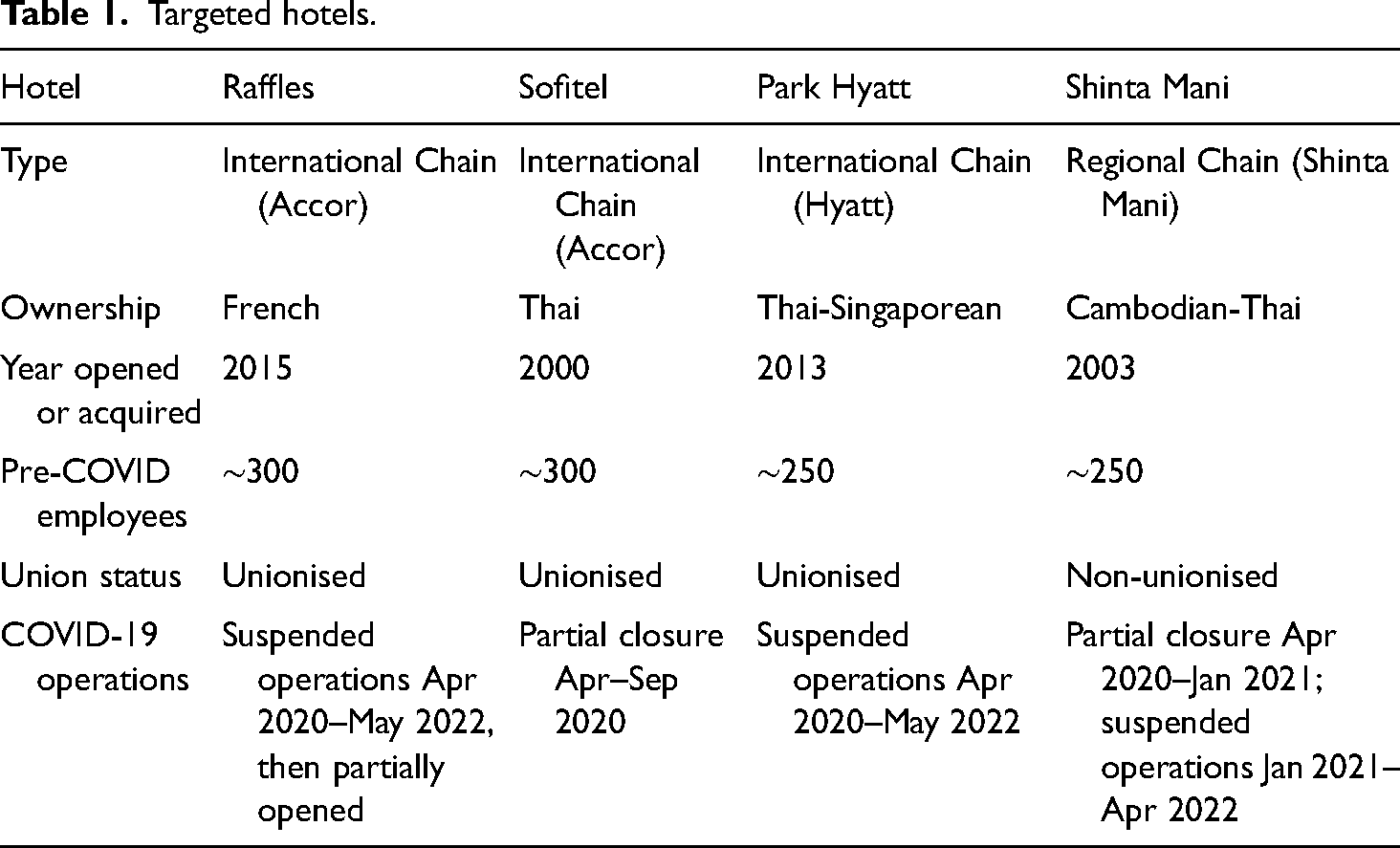
We selected the Shinta Mani Angkor as our non-unionised comparator because it provides the best working conditions of any of the non-unionised five-star hotels and was an organising target for the CTSWF prior to the pandemic. Shinta Mani is a relatively small five-star hotel also located in the Old French Quarter with 115 rooms in total, consisting of 39 regular rooms, 66 Bayon rooms and 10 villas. 3 It is owned by a Cambodian with Thai citizenship, who previously owned (and maintains a small share in) the Hotel de la Paix, which has since become the Park Hyatt. After receiving international recognition for his efforts to help train underprivileged Cambodians with world-class hospitality skills, the owner expanded Shinta Mani Angkor and opened another hotel in Cambodia's coastal region, with plans to open a third hotel in Nepal in August 2023 (Interview with Shinta Mani Operations Manager, July 2022). Selecting this hotel, rather than a non-unionised hotel with lesser conditions, allows us to focus in more closely on whether having a union makes a difference in an otherwise relatively similar context.
Of our total 135 interviews, six involved national and local officials from the Ministry of Tourism, the Ministry of Labour and Vocational Training (MoLVT), the National Social Protection Council and the Ministry of Social Affairs. Two additional interviews were conducted with representatives of the Apsara National Authority, the government body responsible for Angkor Wat. We also interviewed a representative of the Cambodian Tourism Association and four non-governmental organisations (NGOs) that supported workers during this period. Once of these NGOs was the Shinta Mani Foundation, which is closely linked to the Shinta Mani Angkor hotel. We conducted seven interviews with union officials, including the presidents of the CTSWF (interviewed on two separate occasions) and the CTWUF. The other four union interviews involved union officials in Siem Reap's three unionised hotels. Interviews were requested with management from several hotels but only two agreed. We were not successful in securing interviews with hotel management at any of the three unionised hotels, despite both direct approaches and approaches through the union. The remaining interviews were with 80 hotel and 33 guesthouse workers, whom we recruited through union contacts, direct approaches in public places like motorbike parking lots or food stalls, or through snowballing.
Summary of hotel-based interviewees.
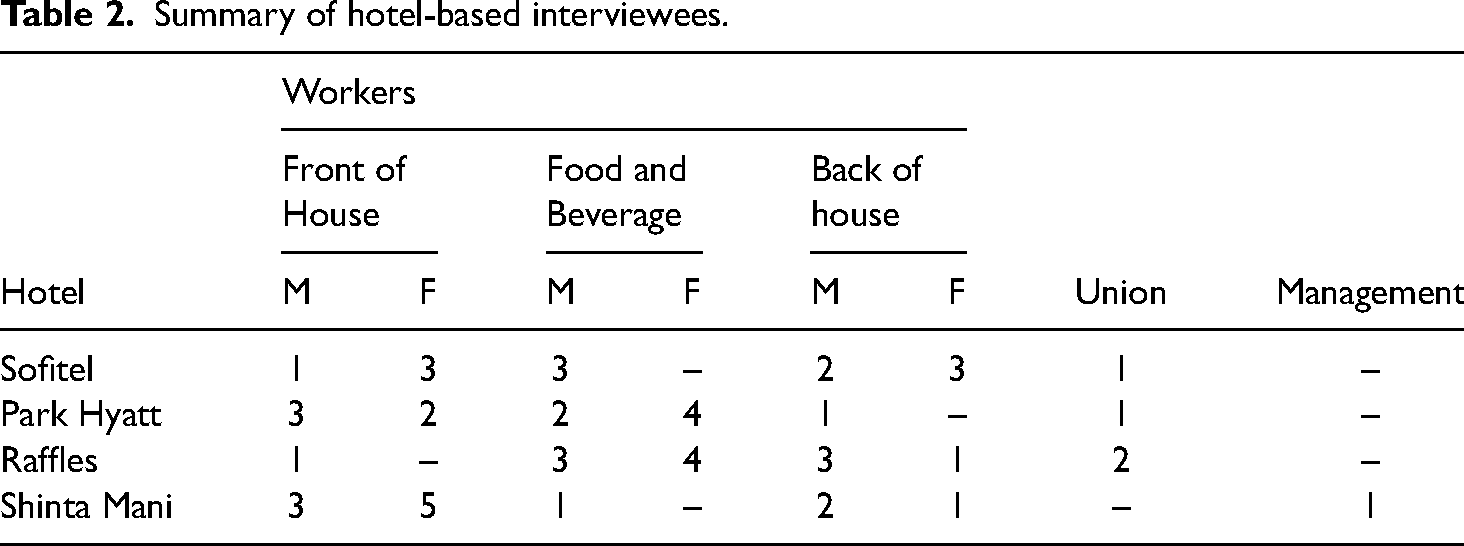
We processed this data using structured thematic coding. We began by drawing on our interview guide to establish a core set of key themes. We then conducted an iterative analysis of the data to identify additional themes that emerged during the interviews. We also analysed the collective bargaining agreements (CBAs) negotiated by the three hotel unions in 2019, which we used as a measure of their capacity to represent members’ interests. We supplemented this data with information from publicly available documentary sources, including government statistics. Although the broader literature on union responses to crisis underscores the broad range of potential measures, we concentrated here on job retention, income and severance benefits, which were the primary focus for hotel workers and their unions during this period in Cambodia.
Wages and conditions before the pandemic
In order to understand conditions in Siem Reap's five-star hotels prior to the pandemic, it is necessary to first understand the industrial relations context in which they operate. Cambodian labour law mandates that normal working hours cannot exceed 8 hours per day or 48 hours per week. Employees must consent to work overtime and employers must pay overtime at 150%, and 200% for overtime worked between 10:00 pm and 5:00 am. They are also entitled to a free meal or meal allowance of 2000 riels (USD 0.50) (MoLVT, 2014). Enterprises with at least eight employees are required by the labour law to arrange make contributions to the National Social Security Fund (NSSF). Under article 134 of the Cambodian labour law, any tips or service charges collected by employer must be fully distributed to workers (ILO, n.d.). While a 13-month salary payment is a common practice in Cambodia, it is not mandated by law. It is important to note that the government selectively implements labour legislation (Ford et al., 2021; Serrano and Nuon, 2018) and most businesses – including foreign-owned ones – fail to fully meet their legal obligations. This widely known fact was confirmed by the Head of Siem Reap's Provincial Labour Inspectorate, who told us that ‘no enterprise complies 100 percent with the labour and employment law’ (Interview, July 2022).
CSR policies versus reality
Our three unionised hotels are all part of an international chain. Two of the three – Raffles and the Sofitel – are affiliated with the Accor Group, based in France. Accor is a €35 billion per annum business, which provides jobs for around 270,000 workers around the world through its 40 luxury, premium, midscale and economy brands (Accor, 2018, 2023). Accor directly manages 2400 hotels, most of which it does not own, and provides services to an additional 2900 franchised hotels (Accor, 2023). The franchise model is a relatively recent addition, introduced in 2018, when Accor significantly reduced its asset pool (Accor, 2018).
Accor has a Code of Ethics and Corporate Social Responsibility, which sets out its approach to ‘management ethics, integrity and legal compliance’ but also its ‘responsibilities to our employees, society and the environment’ (Accor, 2023). As part of this code, it sets out a series of guidelines for interactions with workers. The omission of any mention of unions, collective bargaining or worker rights is significant, given its history of engagement with the international labour movement. Accor signed a Global Framework Agreement (GFA) with the International Union of Food, Agricultural, Hotel, Restaurant, Catering, Tobacco and Allied Workers’ Associations (IUF) in 1995, under which it undertook to recognise freedom of association, protect unionists against harm and discrimination (IUF and Accor, 1995) and a second in 2019 that focuses specifically on combatting sexual harassment (IUF and AccorInvest, 2019).
The third unionised hotel (Park Hyatt Siem Reap) is affiliated with the Hyatt Hotels Corporation, based in the United States. Hyatt Hotels also operates its hotels under ownership, management and franchise arrangements. Historically, it preferred management contracts to franchise arrangements, because they gave it more direct control (Niewiadomski, 2014). However, it too, has moved to an asset-light business model, divesting itself of less profitable properties and expanding its focus on management and franchise arrangements (Hyatt, 2019). As of 2021, Hyatt Hotels owned or leased 34 hotels, which it managed alongside another 460 properties and a further 546 hotels hold franchises with a Hyatt brand (Hyatt, 2021). 4 In that year, hotels carrying a Hyatt brand employed a total of 164,000 workers.
In the Hyatt Hotels Corporation Code of Business Conduct and Ethics, engagement with workers is mentioned in the section on human rights. Workers are urged to be on the alert for signs of sex and labour trafficking and managers to ensure that ‘employees receive proper compensation, breaks, and paid holidays or vacations’. They are also required to ‘[r]espect the rights of others to choose whether or not they want to be represented by a labor organization, subject to local laws’ (Hyatt, 2023). Reflecting the corporation's ties to the United States, which mandates labour rights reporting, Hyatt Hotels’ Annual Report notes that 20% the 44,000 workers directly employed by the corporation are members of a union, and that all of its unionised workers in the United States (23% of workers) are covered by a CBA (Hyatt, 2021).
But having a foreign owner or manager who understands global labour standards does not guarantee a union-friendly environment. For example, the primary reason for the establishment of a union at the Park Hyatt was the hostile approach of the General Manager appointed to oversee the hotel's transition into the Hyatt chain hotel. However, in Cambodia at least, association with an international hotel chain increases the likelihood of unionisation. The two tourism union federations have attempted to support union formation in local hotels, but to date their hotel affiliates are all associated with hotel chains based in Europe or the United States. When asked why this is the case, the CTWUF President said, in an assessment echoed by the CTSWF President (Interview, April 2022), that it is more ‘challenging and complicated’ to establish unions in locally owned hotels (Interview, March 2022). Conversely, however, not all Cambodian hotels linked to North American or European chains – including the chains described here – have unions, let alone CBAs. For example, the Sofitel in Phnom Penh does not have a CBA.
Wages and conditions
All four hotels had relatively good wages and working conditions before the pandemic. Wages at the Raffles are high for the sector, with a baseline starting salary for a regular worker of USD 150 per month. The hotel provides a wide range of benefits including annual leave and a 13-month salary (a form of leave loading), as well as sick leave and maternity leave. Service charges (set at 7%) on average allow workers to almost double their base salary – with workers in some customer-facing roles also receiving tips, which in the peak season can amount to several hundred dollars per month. The hotel also provides private health insurance in addition to the mandatory coverage under the NSSF. Workers have 9-hour shifts, which include a 1-hour break, and work 6 days a week. Workers also get one day off per week, but their day rotates once a month or upon the management's request. They also are entitled to have two meals at the hotel during their shift. Raffles is the only hotel among the four to pay most of its workers for overtime, though workers reported that sometimes they were only given the option of time off in lieu.
At USD 160 per month, the starting wage for regular workers at the Park Hyatt is even higher, making it an attractive choice for skilled hospitality workers. In addition to their basic salary, workers take home around USD 250 per month in service charges (also set at 7%). Full-time workers are only required to work five and a half days a week, compared to six days at the other three hotels. Like the Raffles and the Sofitel, the Park Hyatt provides access to regular days off, different kinds of leave, a 13-month salary and private health insurance, as well as two meals during their working day. However, while front of house workers are paid for overtime, food and beverage and back of house workers are not, although they are sometimes given time in lieu or a meal voucher.
The Sofitel has a much lower starting salary for regular staff, at only USD 110 per month. Overtime is generally not paid; instead, workers are given double time off in lieu during the quiet season. Despite this, worker informants told us that staff turnover was low. This, they said, was because the hotel provides attractive employee benefits including standard working hours, regular days off, different kinds of leave and a 13-month salary, a share of the 7% service charge (which on average doubles their basic salary), tips for some customer-facing roles, private insurance, bonuses and annual staff retreats. The hotel also provides two meals during work hours.
Conditions at Shinta Mani before the pandemic were superior to those at the Sofitel – and much better than conditions at other non-unionised five-star hotels in Siem Reap, with wages from USD 140 for regular workers, who also benefit from a 10% service charge that generates additional income of up to USD 300 per month (Interview with Shinta Mani Operations Manager, July 2022). Like workers at the unionised hotels, Shinta Mani's employees have a 9-hour shift, including a 1 hour break. They work 6 days a week and overtime attracts 1.5 time off in lieu. Shinta Mani Hotel also offers a good benefits package including leave entitlements, a 13-month salary and private insurance. All the Shinta Mani workers we interviewed have been employed there for 5 to 10 years. They told us that the hotel has provided them with a stable job and income, as well as opportunities to grow their skills base.
The benefits of unionisation
While wages and conditions were little different at the Shinta Mani, the presence of a hotel unions clearly benefited workers in the Raffles, Sofitel and Park Hyatt. Two of the three unions were forged in times of conflict, at Raffles following large-scale unilateral dismissals in the early 2000s, and at the Park Hyatt in response to workers’ unhappiness with new management practices after the hotel joined the Hyatt chain. Despite this, all three unions succeeded in establishing productive working relationships with management, and in negotiating CBAs. As documented below, the benefits brought by these CBAs, but also the broader benefits brought by unionisation, were unanimously acknowledged by the union members we interviewed.
The hotel unions
With the exception of Nagaworld, the Phnom Penh-based casino complex where ongoing strike action has attracted international attention (e.g. Gibbs, 2023), the Raffles hotels in Siem Reap and Phnom Penh have the highest-profile hospitality unions in Cambodia. Raffles workers came to international prominence courtesy of a large-scale strike involving both properties, which began in late December 2003. In the early stages of the strike, 97 workers were dismissed form the Phnom Penh property. When the strike resumed in April 2004, another 190 were dismissed from the Raffles Grand in Siem Reap. In total, dismissals accounted for half of the hotels’ workforce and all of its unionised workers (USAID, 2019). Management's response sparked a global campaign involving picketing outside Raffles’ flagship Singapore property and a boycott of Raffles hotels, supported even by the United States International Republican Institute (Adler and Woolcock, 2009; see also Brookes, 2019).
Prior to COVID-19, the Raffles Grand Hotel D’Angkor Employees Union (RGHDEU) had 194 members, accounting for approximately 90% of the hotel's long-term workforce. In late 2022, the number of union members had dropped to 125. Dues are set at USD 3 per month and are collected through a check-off system, with 50% remitted to the CTSWF. Raffles union officials are full-time hotel employees. With the exception of a modest per diem if they attend out-of-town meetings, they do not receive any financial support from the union. The hotel makes an office available and permits union meetings and training activities to be held on the hotel premises, and external trainers can participate with prior permission from management. The hotel also funds 300 hours paid leave per year for union administrative work and 30 days for outside union-related activities, to be shared among up to five union officials. While the union continues to have a challenging relationship with hotel management, its position is certainly stronger than it was in the mid-2000s. According to a union member employed on the front desk, ‘When the union was first created, management discriminated against union members and leadership. But after the union proved to them that we’re strong and united, they were more respectful. Nowadays, they value the union a lot more’ (Interview, April 2022).
The Sofitel Angkor Employees Union (SOEU) was established in 2003, three years after the hotel opened. Before the pandemic, the union had 310 members, covering 94% of the hotel's 330-strong workforce. In late 2022, members numbered 140. Each member pays monthly dues of USD 2, collected directly by the union, of which half is passed onto the federation. Like their counterparts at Raffles, Sofitel union officials are full-time hotel employees. They receive no stipend from the union, only a nominal per diem when traveling for union-related work. The hotel provides a union office, use of hotel facilities for meetings, and a shared allocation of 20 days paid leave per annum for outside union activity, but external parties are not permitted to engage with union members on hotel property.
The Sofitel CBA contains clauses guaranteeing freedom of association, the recognition of the union's most representative status and the right to strike, and a requirement that the union be consulted before any reduction in staffing. However, ordinary union members had mixed perspectives on the union's relationship with management. A majority nevertheless felt that the relationship was productive. In the words of one restaurant worker, ‘Management always makes time to listen and discuss with the union to resolve the problem and ensure the employees are satisfied with the solutions to prevent the issue from escalating into a conflict’ (Interview, March 2022). A housekeeper agreed with this assessment, noting that management and the union ‘have established steps/guidelines to solve problems’ (Interview, March 2022). A front desk worker cautioned, however, that many of the union's successes came only after it confronted management (Interview, October 2022).
The Park Hyatt Tourism Hotel Employees Union (PHTHEU) – the only union led by a woman – was established in 2015, three years after the hotel was acquired by Hyatt Hotels.
Before the pandemic, the Park Hyatt union had 166 members, covering 79% of the hotel workforce, and virtually 100% of the hotel's long-term workers. In late 2022, its membership sat at just 90. Members pay monthly dues of USD 2, which is collected directly from members. Half of the amount collected is remitted to the CTSWF. Park Hyatt union officials are full-time hotel employees. Like officials at the other two unionised hotels, they do not receive any compensation for union work besides a small per diem if travelling for union-related work. The hotel provides a union office and use of hotel facilities for meetings. Union officials are also entitled to a total of 30 days paid leave per annum for outside union activity. External parties may participate in union activities on hotel property with prior permission and, in practice, federation-level union officials come and go freely.
Worker activists at the Park Hyatt decided they needed a union to respond to the punitive approach adopted by the General Manager brought in to oversee the transition; however, with time, the union developed a relatively good working relationship with management. As at the Raffles and the Sofitel, however, this did not mean that the relationship was without conflict. A kitchen worker told us that ‘Anything the union requests requires a lot of time for negotiation. Hotel management doesn’t easily agree to the things the union proposes’ (Interview, April 2022). According to a front desk worker, a major challenge in this respect is the propensity of foreign hotels to rotate their management teams: ‘It's challenging to negotiate a CBA with them. If one GM [general manager] agrees to what the union proposes, the next GM may not agree to it. Then the union has to start from scratch again’ (Interview, April 2022).
The CBAs
In Cambodia, an important measure of union success is the presence of a CBA of any kind. Despite the fact that Cambodia has several thousand registered unions, there were only 478 registered CBAs as of 2014. Of these, only 18 had been negotiated by hotel unions (Serrano and Nuon, 2018). Where they do exist, most CBAs are very limited in coverage, at best reiterating employers’ obligations under the labour law. In this context, the fact that all three hotel unions have an established a bargaining relationship with management, and all three negotiated their most recent CBA in between 2017 and early 2020 is significant.
Even more remarkable is the fact that – although there were important variations in scope – all three CBAs included a number of provisions that were well in excess of legal requirements (Table 3).
CBA provisions that exceed legal requirements.
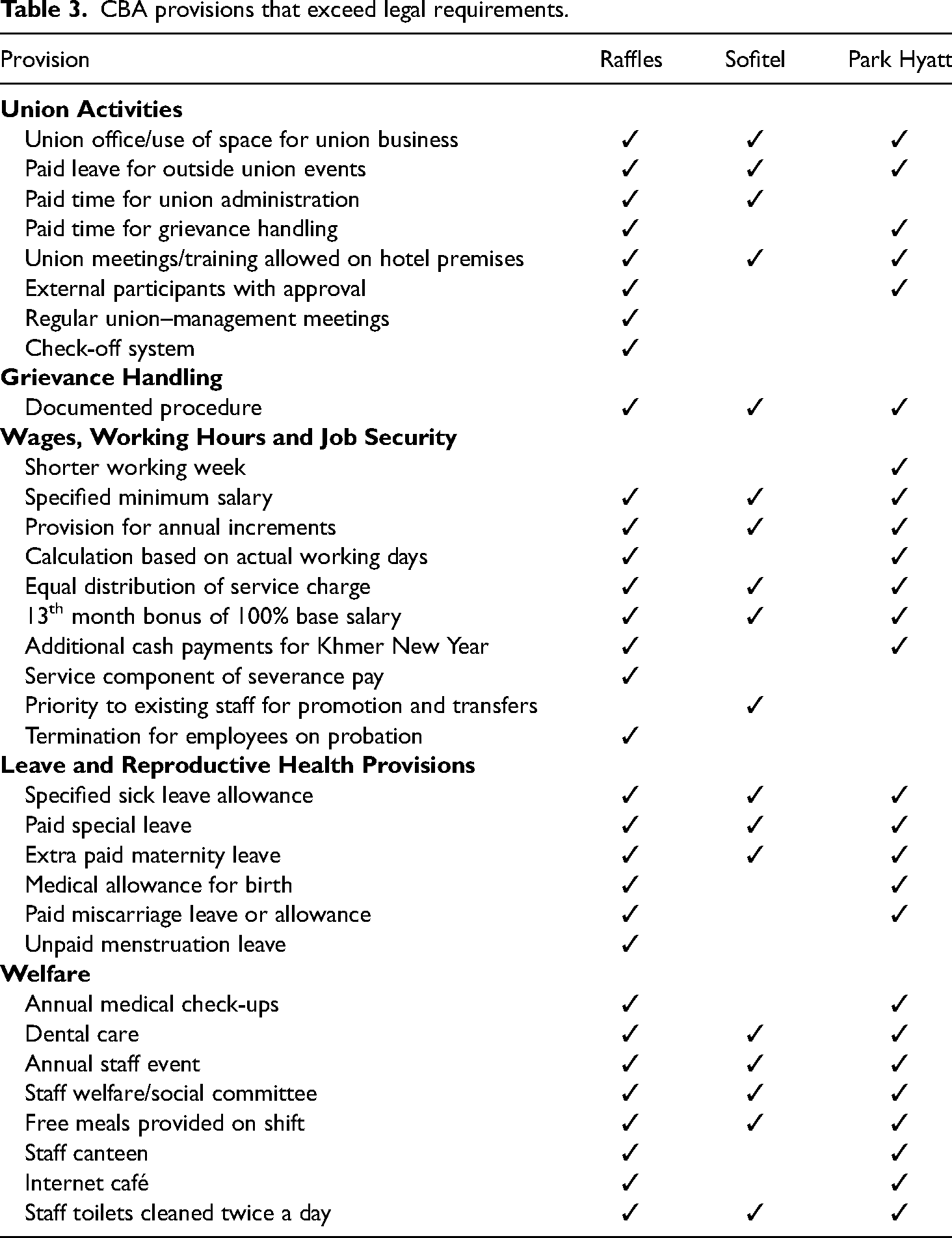
The most significant differences between these CBAs and conditions at Shinta Mani related to maternity leave, which Shinta Mani provides for the legal minimum of 90 days (albeit at 70% of the basic salary, where the law requires just 50%). The unionised hotels pay for longer periods and at higher rates of pay (100% at Raffles and the Sofitel and 80% at the Park Hyatt).
Worker perspectives
The 36 ordinary union members we spoke to across the three unionised hotels were unanimous in their assessment of the benefits of unionisation both before and during the pandemic. According to a housekeeper at the Sofitel: The union helps prevent labour exploitation at work and negotiates with the employer for fair benefits for employees. Without the union, the employer would take advantage of us. They don’t care about staff like us; they only care about their profits. So, the union is an important collective bargaining voice to promote transparency and justice in the workplace (Interview, March 2022).
An important function of the union, according to several workers, was to provide knowledge. According to another Raffles restaurant worker: Before I joined the union, I didn’t know anything about employment law and my rights as a worker, and I was often intimidated by the management. I didn’t want to continue being like a frog in a well. Joining the union enabled me to understand more about the benefits that we, as workers entitled to receive (Interview, April 2022).
Similarly, at the Park Hyatt, a front desk worker noted that ‘Employees appreciate the CBA very much and are now more knowledgeable about union work, employment law, and workers’ rights. The union can also help them solve problems and negotiate for fair benefits’ (Interview, April).
The unions have, moreover, delivered. According to another Raffles restaurant worker, ‘it ensures that we receive fair benefits from the hotel. Since we have the union, we’ve received benefits such as sick leave, service charges, insurance that covers health check-ups (Interview, April 2022). A front desk worker confirmed that the Raffles union had made a ‘huge difference’ to employee benefits, adding that these have included ‘other additional benefits that employees should receive, for example, about female employees’ well-being at work when breastfeeding their babies or when they are menstruating. Before the union existed, these issues were never brought up’ (Interview, April 2022). Workers at the Park Hyatt felt the same. According to a restaurant worker: The union is always there for us. It negotiated with the company to increase our salary rate, service charges, and other benefits. They also help employees with other issues including working hours, but also checking in with the employee who has family or personal problems, such as [being involved in a] traffic accident, sickness, financial problems and so on. I can’t imagine our workplace without the union (Interview, April 2022).
A Park Hyatt restaurant worker, meanwhile, reflected on the importance of being unionised for employment security: Before we had a union, the management fired staff very easily. Now that we have a union, they cannot fire staff for small mistakes. Now they have to ask for reasons and consult with the union before taking action (Interview, April).
Elaborating on the benefits of unionisation, a Sofitel front desk worker concluded that the union has ‘worked very hard to secure collective benefits for all of us’ (Interview, October 2022). A kitchenhand agreed that being unionised had made a big difference, noting that ‘The workplace environment is much better than before we have the union’ (Interview, April).
It is useful here also to reflect on the situation at Shinta Mani, our non-unionised hotel. According to the hotel's operations manager, ‘Our hotel never had any problems because we provide employees with everything required by labour and employment law. So employees don’t feel the need to have a union’ (Interview, July 2022). Ten of the Shinta Mani workers we spoke to agree with this assessment. However, two – both women in relatively senior front of house positions, who had been involved in a push to establish a union with the support of the CTSWF – disagreed. According to the first: A union would be more effective than the current staff association. It would help ensure the hotel complies with its own rules and policies, help us negotiate for fair benefits and help resolve any problems. The company doesn’t always offer all the benefits we are entitled to. And when the HR manager changes, they always change the rules. Also, sometimes workers are not right either. If we had a union, it would help to ensure fairness between both the workers and the employer (Interview, May 2022).
The second had previously worked at Raffles, and so had experience with a union. That experience had convinced her that unions are ‘good for workers. They’re like the mediator and guardians. They help protect workers’ rights, ensure fairness, and resolve any issues working at the workplace’ (Interview, October 2022). The benefits of having a union became only too clear to these workers during the COVID-19 pandemic.
Responses to COVID-19
COVID-19 had a devastating effect on Cambodia's hotels and guesthouses. Over the first two years of the pandemic, 30 tourism businesses, almost all of them hotels and guesthouses, notified the provincial government that they were closing permanently in Siem Reap alone. Another 451 Siem Reap-based tourism enterprises filed for full suspension, with a further 156, including 86 hotels, reporting substantially reduced operations, while many more did not register their status. Among the tourism businesses that remained open, 141 registered their employees with the MoLVT and the NSSF (Interview with Provincial Labour Inspectorate Head, July 2022).
To help tourism businesses recover from the disastrous impacts of COVID-19, the government introduced exemptions for revenue taxes and waste collection fees, a pause on tourism licensing fees, and the provision of low-interest loans of up to USD 400,000 to tourism business owners who needs financial support to recover their businesses. The bulk of these initiatives were implemented from the end of 2019 to the first quarter of 2023 (O’Connell and Chamnan, 2023). The government also encouraged tourism businesses to develop skills development programs for their own employees by providing financial support to them through the skills development fund (SDF) project, launched as part of the Action Plan for Recovery of Cambodia Tourism During and Post-COVID-19 (Ministry of Tourism, 2021). The government also implemented emergency cash payments to help tourism workers cope with their economic hardships (SokSiphana & Associates, 2021). However, the cash assistance program only targeted workers in hotels, guesthouses, travel agents and restaurants registered with the General Department of Taxation in the provinces of Phnom Penh, Siem Reap, Sihanoukville, Kampot and Kep. Unlike employers in the garment industry, hotel owners were not required to pay wages to furloughed workers accessing the government's cash assistance payment scheme, although the MoLVT issued an instruction letter encouraging employers to continue paying wages if they could afford it. All provisions in the Labour Code concerning compensation upon termination remained in effect, as did the requirement for employers to pay out annual leave when employees resign (MoLVT, 2018).
Employers
Despite government support, hotels struggled to manage the plunge in their occupancy rates. As in Malaysia (Ahmad and Scott, 2022) and Indonesia (Japutra and Situmorang, 2021), Cambodian hotels responded by cutting pay and benefits and imposing mandatory paid and unpaid leave. Some employers tried to avoid paying compensation to terminated employees, as well as misusing a provision that allows employers to withhold severance pay in cases where terminated employees have breached company policy. By suspending their employees indefinitely – and thus forcing them to resign to seek jobs elsewhere – employers could downsize without having to pay the full compensation package to which terminated workers are entitled while still maintaining nominal compliance. There were also cases where hotel owners filed for bankruptcy to avoid paying compensation to workers, then later reopened their businesses under a different name (Interview with Provincial Labour Inspectorate Head, July 2022).
Raffles immediately suspended its operations when the pandemic hit Siem Reap in April 2020 and kept its doors closed until May 2022. Management did not forcibly dismiss workers – in Cambodia, if workers resign, they are not entitled to receive the compensation available to them if terminated – but it offered compensation packages to encourage ‘voluntary’ resignations, consisting only of the last three months’ salary and termination and severance benefits. According to the President of the Raffles union: The company used a trick to force employees to resign. HR called employees to convince them to resign by saying the company would terminate them without any benefits if they didn’t resign now. Many people were convinced, and resigned. The hotel did not pay those employees the punitive damage fee they were entitled to (Interview, April 2022).
Other workers were furloughed. Their basic salaries were initially cut by 50%, and then by 80% from the beginning of 2021, an amount supplemented by the USD 40 per month emergency payment provided to garment and tourism workers during the pandemic. Accor provided a total of USD 600 in cash assistance to each worker over the course of that year. Under pressure from the union, the hotel also provided them with a 10-kg bag of rice and a pack of canned fish every month from the beginning of the pandemic. By virtue of their continuing employment, Raffles workers also maintained access to the NSSF. In general, workers were not required to report to work during the suspension period and were allowed to seek temporary jobs elsewhere, though not in other large hotels.
Sofitel closed between April and September 2020. During this period, the hotel closed for scheduled renovations. Sofitel reopened again in October 2020 but did not operate at full capacity. It also suspended some services, for example, spa and massage services. Management dealt with reduced staffing requirements by sacking workers on short-term contracts and encouraging workers on long-term contracts to ‘volunteer’ to resign with compensation. The salaries of the remaining workers were reduced to 50%, which they received alongside the government emergency cash payment. Sofitel employees also received a total of USD 600 in cash assistance from Accor in 2020 and 2021, as well as food aid from the hotel. Like workers at Raffles, furloughed workers maintained their access to coverage under the NSSF. Unlike Raffles employees, however, workers were required to report for duty ten days per month.
Park Hyatt took a slightly different approach, targeting some workers and encouraging them to resign with benefits (more limited than those provided by Sofitel) but letting those on limited-term contracts serve out their contract period. However, many workers on long-term contracts resigned over the course of its extended closure. During this period, employees in higher positions received 30% of their basic salary while regular staff received 50%. In addition, workers received the government emergency assistance payments and a one-off payment of USD 500 from the Hyatt Fund, as well as food aid and private insurance coverage from the hotel. While the hotel was closed, workers were required to report for duty twelve days a month.
Shinta Mani was opened with limited capacity from April 2020 to January 2021, then fully closed to April 2022, when it again began gradually opening more rooms. During the closure period, one or two workers were kept on standby per department to take care of the property, receiving 50% of their base salary. However, 80% of workers were suspended without pay. Workers who resigned during this period received termination and severance benefits if they had worked at the hotel for more than five years but were not given legally mandated payments for public holidays or annual leave. Workers who had been with the hotel for less than five years received no severance benefits. As at the unionised hotels, suspended workers continued to have access to coverage under the NSSF. They also received the government emergency assistance payments and a monthly food package from the hotel but no wage supplement. The Shinta Mani Foundation made funds available for small investment loans to employees who wanted to start a business during COVID-19. Some workers took advantage of the loan scheme, but many others were wary of going into further debt given in such a difficult economic climate.
The unions
The decimation of Siem Reap's tourism sector forced the hotel unions into crisis mode, with a laser focus on the desperate task of saving members’ jobs, securing financial support for furloughed workers, as well as compensation for workers who were terminated. They had to do this in a context where labour policy was constantly evolving, and lockdowns prevented union officials from organising face to face meetings (Interview with CTSWF President, April 2022).
The hotel unions tried to minimise dismissals, arguing instead for suspension with benefits, and re-employment of any dismissed workers following resumption of normal operations. The president of the Raffles union reported that most of their efforts were focused on employee benefits and terminations. In terms of benefits for continuing employees, the union successfully negotiated for the hotel to pay 50% of the basic salary to all suspended employees, and to provide food packages. When a new General Manager was brought in, he proposed to cut salaries to just 10% per month – worth just USD 30 for the lowest-paid staff. The union intervened and convinced management to double the rate to 20%. It also fought to secure benefits for workers whom the hotel tried to convince to resign. As the Raffles Union President explained, these wins were accompanied by some losses: The company was initially unwilling to provide compensation benefits to employees according to the law. But we negotiated with them to provide employees who resigned with the compensation they were entitled to including their termination and severance benefits, 13th-month salary, service charges, and notification fee. We negotiated hard for punitive damage payments, also, but the company refused on the grounds that the Ministry of Labour had instructed them not to pay them (Interview, April 2022).
In the case of the Sofitel, the need to protect members prompted a level of militancy not seen before the pandemic: Before COVID-19, there weren’t many disputes. But that changed. We negotiated with the hotel management to pay benefits we were entitled to receive by law, but they kept refusing. We had no choice but to file a lawsuit. Our complaint that made it all the way to the Arbitration Council, and then to the court. This wasn’t something I expected based on my more than ten years’ experience as a union leader (Interview with Sofitel Union President, September 2022).
The court case followed protracted negotiations, in which the union initially asked the company to pay their 13-month bonus at a reduced level of USD 100 each. Not wanting to escalate the problem, unionists reduced their request to USD 80 when the company refused. When this second claim was rejected, they filed their official complaint. They won the case, but the company still refused to execute the order from the Arbitration Council, proposing instead to reduce the amount to USD 50. Ultimately, the membership voted to accept management's offer. The union did manage to negotiate base salary payments and other assistance for workers during the hotel's six month-long closure suspension in 2020. Management's initial stance was that they could not provide support because of the impact of the pandemic on its budget, but ultimately agreed to pay 50%. The union also dealt with many individual disputes, mostly related to unlawful termination. These included one that they took to court with the help of a lawyer provided by the CTSWF.
The Park Hyatt union also negotiated with the hotel management to pay compensation to retrenched workers and provide ongoing employees with at least 50% salary during the pandemic. It secured a further cash payment of USD 20 per employee. Union officials also provided a list of workers who had been taken off the payroll, so that they could be prioritised during future hiring. Like the other hotel unions, it monitored the hotel's submission the paperwork required for employees to receive the government's emergency cash assistance payment and provided a small amount of cash and other assistance to members.
The union difference
In answer to the question at the heart of this study, it is clear that, while the hotel unions’ underlying strength and previous victories were not sufficient to fully protect job security and wages during COVID-19, they certainly did mitigate the pandemic's impact on workers. In Siem Reap, local and foreign-owned hotels large and small were equally blindsided by the onset of COVID-19. But although the hotel unions could not fully protect their members, the inability of non-unionised hotel workers to respond collectively to management's COVID-19 strategy meant that a wide gap emerged under the financial pressure of the pandemic. As a front desk worker at the Raffles observed, ‘Thousands of guesthouses and hotels in Siem Reap did not comply with labour law because they didn’t have a union. As a result, thousands of workers did not receive any help from the government’ (Interview, April 2022).
Our data reveal that unionised workers were more likely to keep their jobs and more likely to be able to access the cash emergency assistance package offered by the government, which required workplaces to be fully registered and to provide worker data and regular updates on the status of their operations. Efforts to maintain job security and some kind of income are not the only possible targets of union action in times of crisis – Tufts (2009), for example, documents unions’ engagement with employers and the tourism authority to provide affected members with support services, vocational training and job search assistance in Toronto during SARS – but they are an obvious priority in a context where unemployment benefits are not available and access to emergency cash assistance depended on staying employed.
Hotel unions’ capacity to fight for job security and partial wages at this difficult time was underpinned by their established and substantial bargaining relationships, evidenced not only by the presence of CBAs but the fact that those CBAs in some respects exceeded legal minimums – something that cannot be taken for granted in the Cambodian context. Ultimately, then, long years of organising and hard-won battles by union activists to secure an institutionalised presence and associational power in the workplace mattered more than reputational leverage or the company's commitment to socially responsible practices when it came to protecting workers’ rights in the context of COVID-19.
Our data also speaks to the impact of size, reputation and international visibility on the willingness of hotels to allow workers to unionise in the first place. In Cambodia, union organisers have attempted to target hotels outside the big international chains but to date those attempts have all failed. As noted in the literature, the presence of a union does not guarantee influence. But, without one, workers have little chance of engaging in structured forms of negotiation with management at any time, and even less so in times of crisis.
Both the Accor and Hyatt chains provided cash payments to workers during the pandemic. But the partial wages and additional forms of support for furloughed workers provided at Siem Reap's three unionised hotels were no gift from management, suggesting a high level of union independence. In the words of the Raffles Union President: The hotel would not offer employees anything if the union did not negotiate hard. Management told us that they’re not supposed to pay employees during the suspension. But they agreed to pay employees partial salaries because we negotiated (Interview, April 2022).
These victories were the consequence of an unusually high level of workplace institutionalisation, and therefore capacity to negotiate – which, in turn, made it possible for them to convince management to support workers during the pandemic.
Finally, it is important to note that this level of institutional leverage is particularly significant given Cambodia's strongly anti-union context. Union coverage was already very high in these workplaces, meaning that there was little room to capitalise on their victories to recruit more members internally. At the time the study ended, moreover, it was too soon to assess whether these victories helped the CTSWF or the CTWUF to organise other hotels but the potential benefits of invoking hotel unions’ pandemic-era successes in sectoral organising campaigns is very real. Moreover, the fact that hotel work (in luxury hotels at least) is considered ‘good’ work in Cambodia means that there is an opportunity to target the sector as part of an attempt to establish a stronger union presence beyond the country's garment factories.
Conclusion
COVID-19 has provided industrial relations scholars with a natural laboratory in which to test union influence. The hotel sector is by its very nature a particularly volatile sector (Butters, 2020), in which the fortunes of a specific tourist destination or specific hotel can quickly rise or fall. However, the unprecedented scale and depth of havoc wrought by the pandemic provides a very specific opportunity in which to examine the capacity of unions to protect workers’ interests in times of sector-wide crisis. This opportunity was particularly significant for sectors like hotels, where there have been relatively few rigorous studies that have systematically compared worker welfare at unionised and non-unionised hotels at any time, but particularly during times of crisis.
This study confirms that international reputational risk encourages hotels to make space for a union and, in times of crisis, to at least consider taking extra steps to support workers. Even more so, however, it demonstrates that long years of organising and hard-won battles by union activists to secure and institutionalised presence and associational power in the workplace ultimately mattered more than reputational leverage or the company's commitment to socially responsible practices when it came to protecting workers’ rights in the context of COVID-19. During the pandemic, the hotel unions we studied were able to convince management to substantially revise their strategy for managing staff costs. This stands in stark contrast to the Shinta Mani, which also has an international reputation for its social enterprise mission and had comparable wages and working conditions before the pandemic.
These findings have implications for our understanding of union influence in this under-studied sector, particularly in emerging economy contexts. On the one hand, they demonstrate that – for hotels at least – an association with a high-profile international chain based in Europe or North America not only makes unionisation more possible but also provides important leverage for hotel unions in times of crisis. On the other, however, they reveal that reputational risk alone is not enough: management in all three hotels initially planned not to pay furloughed workers. The fact that they ultimately did was the direct result of union intervention. In these cases, at least, then, the presence of a strong union made all the difference.
Footnotes
Declaration of conflicting interests
The authors declared no potential conflicts of interest with respect to the research, authorship, and/or publication of this article.
Funding
The authors disclosed receipt of the following financial support for the research, authorship, and/or publication of this article: This work was supported by the Asia Foundation/Australian Department of Foreign Affairs and Trade (grant number Ponlok Chomnes).
