



Abstract
This paper proposes a new framework for the analysis of collective labour dispute resolution. It begins by explaining why dominant conceptual frameworks in IR and labour law scholarship are insufficient on their own to capture the plurality of regulatory sources that bear upon collective labour dispute resolution. The authors then draw on theoretical insights from regulatory studies on the presence and interaction of multiple regulatory orders, and socio-legal scholarship on dispute resolution, to propose a framework that enables the investigation of both the formal and informal aspects of labour dispute resolution and their interplay. This framework disaggregates data collection and analysis into five components: (i) actors; (ii) nature of dispute; (iii) arenas and processes; (iv) interactions; and (v) outcomes. The framework is particularly tailored to, and based on evidence from, Southeast Asia, but may also have wider application beyond this region.
Keywords
Introduction
The existence of an effective system for the prevention and settlement of collective labour disputes is widely seen as a critical element of a robust industrial relations (IR) system (ITC-ILO, 2013). Largely for this reason, countries in Southeast Asia (and elsewhere) have adopted formal systems of collective labour dispute resolution that emulate the basic form and content of those found in Western industrialised economies (Cooney et al., 2002). Yet it is widely observed in IR and labour law scholarship that these systems have only had limited effectiveness (Cooney et al., 2002; Do, 2018; Ford and Gillan, 2016: 168). There is also a small but rich literature from a range of disciplines suggesting that rather than proceeding through statutory channels, in these countries collective labour disputes are often resolved by actors, institutions and processes, and according to norms, that lie outside the formal IR system (e.g., Nguyen, 2021; Lestari and Wijayanti, 2020). To date, these two sets of observations and bodies of literature have tended to run on parallel tracks. Our understanding of collective labour dispute resolution processes in Southeast Asia, and how ‘formal’ (state-based) and ‘informal’ (non-state based) regulatory actors, norms and processes interact, or the implications of these interactions for the design and operation of formal IR systems, remains very incomplete.
Yet recognising, collecting evidence of, and better understanding the multiplicity of regulatory orders that influence dispute resolution and how they interact may assist in meeting contemporary challenges in several ways (Sage and Woolcock, 2012). Knowledge of informal norms may help researchers better understand the operation of the formal system because informal rules often influence, and mediate, the operation of formal institutions in unexpected ways (Helmke and Levitsky, 2004: 726). Such knowledge may help explain institutional outcomes by furnishing insight into why formal laws and institutions are proving ineffective and/or marginalised in practice. It may be potentially used to ‘strengthen’ the impact of existing laws by enabling the design and adoption of innovative regulatory approaches that engage creatively with (rather than operate in willful blindness of) non-state orders. Such regulatory strategies may be ‘possibly more widely implemented, responsive and legitimate for the relevant community’ (Forsyth, 2017: 235). Finally, this knowledge may also be used to prospectively gauge the limitations of proposed regulatory strategies or institutions (i.e., how and why they may be undermined by other regulatory orders).
This paper seeks to broaden and advance labour law and IR scholarship by proposing an analytical framework that facilitates investigation of the presence and interaction of both formal and informal regulatory orders in the context of collective labour dispute resolution. The framework draws on theoretical insights from regulatory studies, including recognising a regulatory space lens that draws attention to the way in which regulatory power may be dispersed and fragmented between state and non-state actors, and recognising that various regulatory orders may co-exist and interact in complex ways. It also draws on socio-legal scholarship which emphasises the limitations of the conventional ‘dispute resolution pyramid’ and offers an alternative metaphor of the ‘dispute tree’ to account for the multiplicity of channels through which disputes may be pursued and resolved. It disaggregates, and elaborates upon, five components of the dispute resolution process: (i) actors; (ii) nature of dispute; (iii) arenas and processes; (iv) interactions; and (v) outcomes.
Although the analytical framework proposed can be applied to any given country context around the world, this paper draws on illustrative examples from the three most populous countries in Southeast Asia: Indonesia, the Philippines and Vietnam. 1 These countries are apt exemplars because of the presence of various regulatory dimensions to dispute resolution consistent with our analytical framework outlined above. Southeast Asia offers fertile terrain in which to examine the existence and interaction of formal and informal sources of regulation on labour dispute resolution because of the limited impact of formal labour law and this sub-region's ‘nomic din’ (Harding, 2001). Each of the three countries from which illustrative examples are drawn in this paper (Indonesia, the Philippines and Vietnam) has a formal system of labour law that is substantially comparable to counterparts in Western market economies. All have a system of contractual individual and collective labour relations, statutory minimum standards of employment, mechanisms for interaction between employers, employees and unions and processes for the resolution of individual and collective labour dispute resolution. These countries have also established IR institutions at the national and lower levels to administer these laws. Today, these systems purport to regulate the labour market comprehensively. Yet despite successive rounds of reform and local adaptation, labour law as it is generally understood continues to have only a limited impact on the world of work in these jurisdictions (Cooney et al., 2002; Do, 2018; Ford and Gillan, 2016: 168). In part, this is due to a large proportion of workers in Southeast Asia falling outside the scope and effectiveness of the formal system (ILO, 2018: 88). Further, even those workers that are eligible to access the formal dispute resolution processes often fail to do so for various reasons, ranging from worker choice to failure of relevant institutional mechanisms. Normative pluralism is also a defining feature of the region. Ethnic, religious and cultural diversity, along with colonial history and the more recent arrival of global norms and commercial practices, means the region is home to multiple sources of co-existing norms intervening in society in addition to state law (Tran, 2019: 165; Gillespie, 2014; Do, 2018).
The paper is divided into four further parts. Part 2 explains why we believe extant approaches in IR and labour law scholarship are inadequate on their own to enable us to identify state and non-state regulatory modalities influencing collective labour dispute resolution and to analyse the tensions and dynamics between formal and informal regulatory dimensions. In Part 3, we explain the conceptual underpinnings of our proposed framework. In Part 4, we present our analytical framework, disaggregating the dispute settlement process into four categories and proposing analytical questions for each. We conclude in Part 5 suggesting that our analytical framework will enhance comparative study of labour dispute resolution systems and inform policy and practice.
Before proceeding, it is important to clarify how we are using the terms ‘regulation’ and ‘collective labour disputes’ in this paper. Definitions of ‘regulation’ abound, with the term used to refer to anything from deliberate state rulemaking and enforcement to all forms of social control (Baldwin et al., 2010: 12). In this paper, we adopt a broad conception, understanding regulation to mean ‘influencing the flow of events’ (Parker and Braithwaite, 2005: 119). Regulation of collective labour dispute resolution thus refers to measures and interventions that influence and shape the trajectory or outcome of a collective labour dispute. Regulation in this sense encompasses sources and techniques that go far beyond the ‘state’ and ‘law’. 2 Conceptualisations of ‘formal’ and ‘informal’ regulation are discussed further in ‘A Framework for Analysis’ section. We define a collective labour dispute broadly, as ‘any dispute involving a group of workers and one or more employers.’ Collective mobilisation of workers in protest of proposed laws or policies (e.g., as seen recently in Indonesia in response to the enactment of the Omnibus Law on Job Creation in 2020) does not fall within the scope of analysis. Two further aspects of this simple definition merit elaboration.
First, a dispute is understood to have arisen at the point at which one party rejects a claim made by another party in whole or in part (Felstiner et al., 1980: 635–6). In other words, our analytical focus is on the trajectory of disputes once they have come into existence. Earlier stages of the dispute evolution process are not the focus of our analysis here, although we recognise that disputes are not ‘found’ but socially constructed (Felstiner et al., 1980). 3
Second, this simple definition entails going beyond the narrow legal focus on those disputes that arrive at the courthouse (or tribunal) door or that ‘fit’ within recognised legal categories to examine the broader social landscape of dispute regulation (Albiston et al., 2014: 106). For example, many labour law systems distinguish between collective rights-based disputes (i.e., arising from an alleged violation of or interpretation of an existing right or obligation in law, collective agreement or individual contract of employment) and collective interests-based disputes (i.e., disputes arising from differences over the determination of future rights and obligations). In practice, however, disputes may involve differences between the parties over both rights and interests and/or they may shift over time from one type of dispute to the other.
Conceptualising collective labour dispute regulation in labour law and IR
Collective labour disputes are widely accepted as an inevitable feature of market economies. Such disputes may arise because of workers taking collective action in the context of collective bargaining, or in response to threats to health and safety, perceived abuse of managerial prerogative or failure by employers to meet their legal obligations (Creighton et al., 2020; Kahn-Freund and Hepple, 1972). Where they arise, collective labour disputes may have significant consequences. For workers, disputes that escalate into industrial action (such as a strike) may result in loss of income and potentially loss of employment. Ongoing labour-management relations may suffer, as well as enterprise productivity through working time lost. Collective labour disputes may also give rise to broader societal conflicts, such as in cases where the impact of collective conflict is felt by consumers and communities (Euwema et al., 2019: 5). Workers’ collective action may also have important political ramifications and has historically been regarded as an important driver of social change and economic progress for working people (Hyman, 1989; Kelly, 2015).
For these reasons, collective labour disputes have long been a subject of state regulatory intervention, and of interest to labour law and IR scholars. Although recognising that these fields are far from synonymous, we address them together here as both are concerned with the rules, rule-making processes, institutions and behaviours of actors involved in governing the employment relationship, along with their social and economic outcomes (Wilkinson et al., 2018: 3; Sisson, 2010: 4). In this section, we explain why we believe it is necessary to look beyond existing approaches in labour law and IR to adequately capture the full regulatory dynamics of collective labour dispute resolution, particularly in the context of the Southeast Asian countries with which we are concerned. Although scholarship on collective labour disputes in these fields has tended to be fragmented (Avgar, 2020), we suggest that, broadly speaking, this scholarship is limited in its capacity to elucidate the regulation of collective labour disputes in Southeast Asia because the scholarship follows a structural, institutional approach to the study of collective labour dispute regulation, based on conditions which existed in industrialised countries at the time these fields of scholarship emerged and took root. The dominant foci of existing analysis – on traditional IR actors and processes as developed and applied overwhelmingly to Western industrialised countries – fails to capture important features of labour dispute resolution in late-industrialising nations such as those of Southeast Asia.
We begin our explanation of the limits of existing conceptual frameworks with a brief discussion of what is widely recognised to be among the most influential conceptual contributions to IR: Dunlop's (1958) IR systems model. 4 This model, proposed to guide the analysis of IR in national economies, conceives of an IR system as a distinct institutional domain comprising actors, contexts, a body of rules and a shared ideology that binds the system together. The three sets of actors included employers and their representatives, employees and their representatives and government and its agencies. Interactions between these actors generated two types of rules: procedural rules that governed their interactions (including procedures for collective bargaining and dispute resolution) and substantive rules that specified the terms of the employment relationship. The critical contexts that shaped the conduct of IR were the technological characteristics of the workplace; market and budgetary constraints; and the locus and distribution of power within the wider society. Finally, the actors shared a common ‘set of ideas and beliefs’ that helped ‘to bind together and integrate the system’ (Dunlop, 1958: 8).
Dunlop's systems theory operates at a level of abstraction that renders it of limited utility for our purposes of exploring the specific dynamics of collective labour dispute resolution. Although continuing to cast ‘a long shadow over IR’ (Heery, 2008: 69), Dunlop's framework has also been criticised on many grounds, a number of which are particularly relevant to this paper. The model offers a perspective informed by ‘the specific realities of the North American institutional framework in the postwar decades, together with an assumption that these would become the model elsewhere’ (Hyman, 2008: 258). It presumes a high level of systemic stability and minimises the possibility of conflict and contradictions. The model imposes strict boundaries on IR as a discrete sub-system of industrial society – demarcations that may lead to neglect of other factors and influences that regulate work (Heery, 2008: 70–71). It also fails to adequately recognise or account for strategic decision-making by actors (Kochan et al., 1984). Despite recognising the existence of informal rules, Dunlop's model also focuses overwhelmingly on the establishment and operation of formal rules (including those produced by collective bargaining) at the expense of informal conventions (Wilkinson and Wood, 2012: 374).
Ford and Gillan (2016) have underscored the limitations of systems approaches such as Dunlop's, developed in the context of industrialised liberal democracies, to explain employment relations in other contexts including Southeast Asia. Dunlop's notion of an ‘ideal-type liberal-pluralist industrial relations’ system in which actors share an ‘integrating ideology as a precondition of engagement’ is difficult to locate in countries ‘which have been characterised more by social exclusion and state and employer subordination of labour movements than pluralist social exchange’ (Ford and Gillan, 2016: 169). These institutionalist approaches fail to account for the significant gap between law and practice, and the extensive reliance by actors ‘on informal (uncodified) institutions such as unwritten norms, conventions or codes of behaviour’ which can ‘complement’ or ‘supersede’ formal institutions (Witt and Redding, 2013: 292).
If we shift our gaze from the systems level down to ‘international’ or ‘comparative’ studies of collective labour dispute resolution in IR and labour law, we find that much of the literature also adopts an institutionalist approach that tends to assume the existence and centrality of certain actors, processes and institutions within IR as a distinct institutional domain. Where scholars in labour law and IR have evinced an interest in cross-national variations in labour dispute resolution (e.g., Deakin, 2010: 323; Behrens et al., 2020: 313), these have largely focused on jurisdictions in the Global North. Those comparisons that extend to developing countries tend to compare the formal features of these subsystems and to draw on dominant approaches within the field to analyse and classify them. In IR, for example, comparative analysis of dispute resolution systems often focuses on the dominant IR pillars: the parties, the nature of the conflict, the formal process(es) of conflict resolution and the source and role of power in the system (Behrens et al., 2020: 315–6).
With respect to collective labour disputes and their resolution, these actors comprise employers and their associations, trade unions representing the collective interests of workers and institutions such as tribunals, courts or other industrial dispute resolution mechanisms, including private arbitration. Much scholarly attention has focused on formal processes and the systems in which they are embedded. This is particularly true of labour law, with a dominant line of inquiry being the design and operation of formal systems of collective dispute resolution to facilitate industrial peace. For example, examinations have extended to analyses of common legal mechanisms or hurdles for workers to access lawfully protected strike action and the desirability, legitimacy and design of those mechanisms (e.g., Creighton et al., 2020). There has also been growing interest in the use of Alternative Dispute Resolution (ADR): that is, procedures and mechanisms for conflict resolution that provide alternatives to litigation, although such forms of dispute resolution may also operate in conjunction with judicial processes (Roche and Teague, 2012: 447–8). 5 This includes the context of collective disputes (Euwema et al., 2019; Roche and Teague, 2012). Scholars of labour law and IR have also developed normative frameworks for comparing and evaluating the effectiveness of labour dispute resolution systems. For example, one line of research focuses on the extent to which they achieve three forms of justice: distributive, procedural and interactional (e.g., Blancero et al., 2010; Eigen and Litwin, 2014). Alternatively, evaluation may focus on efficiency, equity and voice (Budd and Colvin, 2008; Charlwood and Pollert, 2014) or on accessibility, efficiency, expertise, impartiality, fairness and its contribution to social change (Forsyth, 2012).
Where scholarly examination on collective labour disputes has extended beyond the Global North, this work has been largely descriptive and/or has followed the approaches and been engaged with the central concerns of the fields outlined above, with some exceptions (e.g., He and Su, 2019; Ford and Gillan, 2016: 173). This is particularly the case with comparative studies on Japan, South Korea and China, with the presence of large-scale commercial and industrial activity facilitating comparison with what has happened in the West. Labour law and IR scholarship on ADR have also focused overwhelmingly on practices in the Global North (e.g., Stone, 1996; Brown, 2014; Roche and Teague, 2012), although there has been some comparative analysis (e.g., Euwema et al., 2019).
While, particularly in recent years, both fields have recognised the existence and influential role played by other actors in dispute resolution (e.g., legal advisors, community unions) (Colvin and Avgar, 2018, 275, 279), there is as yet little sustained analysis of how these additional types of actor figure in collective labour dispute resolution and certainly no attempts to develop coherent conceptual frameworks for analysing the role of these actors. Yet, as we elaborate upon below, this focus on a narrow set of actors is problematic in a context, such as Southeast Asia, where the conventional IR actors may not perform the functions formally accorded to them. Moreover, it precludes appreciation and analysis of other actors that may wield authority and play important roles in resolving labour disputes.
Where they extend to consider ‘non-Western’ systems of collective labour dispute resolution (see further below), these descriptive and normative projects make an important contribution to understanding the regulation of collective labour disputes in Southeast Asia. Comprehensive accounts of the formal features of dispute resolution − the rights and obligations of parties; regulation of actors such as trade unions; regulation of collective bargaining and disputes; and the origins and evolution of the systems − are an essential piece of the puzzle. By examining law's scope and formal interpretation and identifying where legal uncertainties exist, labour law also hints at where space may be created, either intentionally or unintentionally, for other forms of regulation to develop (Mahy et al., 2019; Adams and Deakin, 2014). Further, labour law and IR scholarship on Asia also provide critical insights into the role of the state in labour law and IR, and on labour law's limited capacity to influence other normative systems (Ford and Gillan, 2016; Cooney and Mitchell, 2002: 247).
However, a preoccupation with formal rules and systems of collective labour dispute resolution fails to give much insight into how disputes are resolved in practice in countries where the priority officially allocated to the formal labour law system does not accord with its power in everyday life. 6 In Southeast Asia, state labour law norms and institutions appear to remain relatively weak in comparison to other forms of social ordering. A range of legal, regulatory and cultural factors have been identified to explain the relative marginalisation of formal labour law. Some of these explanations go to the role of law itself. In Vietnam, for example, scholars emphasise the persistence of instrumentalist conceptions of law inherent in Marxist-Leninist legal theory, in which law is perceived to be a political tool of the party-state (e.g., Do, 2018). In the Philippines, scholars highlight the contribution of state actors to law's ineffectiveness, particularly through the creation of conflicting regulations and policies as a means of protecting the interests of investors (e.g., Hutchison, 2016: 184). Law is also often described as enjoying limited cultural legitimacy in Southeast Asia compared to Western rule-of-law democracies, and as being marginalised in favour of other normative systems (Cooney and Mitchell, 2002: 262; Nguyen, 2020a: 188).
A final strand of literature potentially relevant in our search for an appropriate conceptual framework through which to analyse collective labour dispute resolution is IR scholarship on workplace conflicts. These studies offer promise for our purposes in the extent to which they have tended to adopt a broader understanding of dispute resolution processes, recognising that dispute resolution may occur at multiple levels and through multiple channels. There is now a rich body of literature concerned with developing theories to explain the various sources, types and forms of conflict at work (see, e.g., Gall and Hebdon, 2008). Some of these studies have extended to consider questions such as why parties choose to make use of one conflict resolution procedure over another; which procedures are most effective at resolving conflicts; and whether specific procedures produce outcomes that favour labour or management (Katz, 2020; Roche et al., 2014). However, these studies tend to focus on institutionalised channels for grievances (at various levels) and to focus exclusively on the roles of ‘conventional’ IR actors and IR strategies.
In summary, while there is a rich and varied literature on collective labour dispute resolution in IR and labour law, conceptual frameworks that do exist have been developed and applied largely in the context of western industrialised countries. Existing frameworks – at the systems level or below – presume the centrality of certain actors in collective dispute resolution, and the effective operation of formal processes including employer-provided mechanisms, collective bargaining and dispute resolution through tribunals. Although additional or alternative forms of actors, norms or processes are often recognised, this recognition is often cursory in nature and not integrated into coherent frameworks. Below, we attempt to develop a single conceptual framework through which to identify state and non-state regulatory modalities influencing collective labour dispute resolution. Importantly, this framework also elucidates the tensions and dynamics between formal and informal regulatory dimensions.
Regulatory pluralism in collective labour dispute resolution in Southeast Asia
In light of the limited attention paid to questions concerning the interaction of state and non-state forms of collective labour dispute resolution in labour law and IR, and the absence (to our knowledge) of any single theoretical approach that adequately elucidates the formal and informal aspects of collective labour dispute resolution, we have proceeded deductively to develop an analytical framework. This framework is informed by theoretical insights from socio-legal and regulatory studies: two distinct but overlapping sets of literature that have both engaged with issues around multiple normative orders and their interplay.
Regulatory spaces and pluralities
To capture adequately the multiplicity of regulatory sources bearing upon labour dispute resolution in Southeast Asia, our analytical framework draws on the concepts of regulatory space and regulatory (or legal) pluralism. Although both concepts have previously been drawn upon by labour law and IR scholars (e.g., Inversi et al., 2017; MacKenzie and Martínez Lucio, 2005), neither have been applied to the comparative study of collective labour dispute resolution.
Regulatory space is an analytical construct that challenges hierarchical notions of regulation and draws attention away from the state as the sole source of regulatory authority (Hancher and Moran, 1998: 271; Scott, 2001). The spatial image is key to this approach (Hancher and Moran, 1998: 153–154). Within any given regulatory space, regulatory power is dispersed and fragmented between various state and private actors (Scott, 2001: 2). The boundaries of the space, and the relative power of actors within it, are subject to contestation and negotiation between actors. Investigation of a regulatory space involves examining the scope of regulatory issues within the space, the identity and status of those who occupy it and the power relations between them (Hancher and Moran, 1998: 277).
Place and time matter to regulatory space analysis (Hancher and Moran, 1998: 55). The constellation of actors in a particular regulatory space, and the relations between them, is influenced by a range of historical, cultural and economic factors (Scott, 2001; Inversi et al., 2017: 294). National political cultures 7 and legal traditions (including culturally formed assumptions about the purpose and role of law) play an important role in determining the scope of a regulatory space and influencing who has access and on what terms and delimiting beliefs about what is possible within the space (Hancher and Moran, 1998: 155–6; Scott, 2001).
The application of a regulatory space lens to the study of collective labour dispute resolution in Southeast Asia is a challenge to common presumptions concerning the role of law in regulating these disputes and encourages attentiveness to a broader constellation of actors and institutions that may exercise (formal or informal) influence over their trajectories and outcomes. It helps delineate spaces for analysis, and to further understand the capacity of the formal regulators to influence the trajectory and outcome of disputes. It also encourages sensitivity to the ways in which different historical and cultural traditions, as well as current political and economic frameworks, play important roles in shaping what occurs within specific regulatory spaces (Hancher and Moran, 1998; Inversi et al., 2017).
Regulatory (or legal) pluralism offers a useful theoretical lens through which to identify, and understand the influence of, the multiple sources of regulation within a specific regulatory space. The co-existence of state and other systems of normative ordering has long been recognised in labour law and IR (Dunlop, 1958; Kahn-Freund, 1977), including in the realms of (most relevantly for this paper) collective bargaining (Arthurs, 1996). Regulatory orders may be formal: that is, be comprised of state institutions (courts, legislatures and bureaucracies) and state-enforced rules (constitutions, laws and regulations). In this paper, we describe this order as ‘law’. 8 But they can also be informal: that is, be ‘socially shared rules, usually unwritten, that are created, communicated and enforced outside of officially sanctioned channels’ (Helmke and Levitsky, 2004: 727). Informal regulation may have its source in religious norms, customs, community practices or unwritten, implicit conventions (such as entrenched business practices) that govern behaviour (Merry, 1988). 9
As noted in the introduction to this paper, Southeast Asian countries have all adopted formal frameworks and institutions that purport to regulate collective labour disputes. Indonesia has had formally institutionalised, specialised labour dispute resolution processes since 1951 following independence from the Dutch. The Philippines saw the introduction of compulsory arbitration of labour disputes via a Court of Industrial Relations in 1936 during the self-governing era of transition from American rule. Even Vietnam, despite retaining state socialist ideology and political control, adopted a market-oriented IR system with formal dispute resolution mechanisms governed by a Labour Code in 1994. All three national systems formally recognise and grant rights to similar types of actors (employers, workers and their respective representatives and the state) and establish processes through which collective disputes are to proceed (compulsory mediation, arbitration and judicial determination). All three systems recognise a right to strike, subject to certain restrictions and procedural requirements. 10
However, empirical studies of collective labour disputes in the region show that not only are collective labour disputes often resolved outside formal channels but also that ‘non-state’ norms exert an important influence. In Vietnam, for example, scholars have argued that, in response to public expectations that they act in accordance with values of empathy and compassion (tinh cam), Vietnamese officials at the provincial and district levels apply the law flexibly and respond to collective labour disputes in ways not anticipated by the formal collective labour dispute resolution system (Nguyen, 2021). Nguyen has shown how, in the case of a dispute at Texwell Vina in Đồng Nai Province, state authorities responded to demands by workers on their employer for unpaid bonuses, wages and superannuation benefits by providing gifts and financial aid, as well as assistance with new job opportunities (Nguyen, 2021). In Indonesia, it is quite common for workers to appeal directly to national and regional legislatures to assist in the resolution of collective labour disputes (Lestari and Wijayanti, 2020; Kammen, 1997: 343–7). Individual or small groups of legislators may then draw on their personal and political influence to call the disputing parties to special meetings, especially where employers have been evading the formal requirement to attend mediation sessions. This may succeed in resolving the dispute directly or the legislators may eventually push the dispute back to formal dispute resolution channels.
Regulatory pluralism emphasises not only the existence of multiple normative orders but also the significance of patterns of interaction and response between formal law and other normative orders (e.g., Engel 2009: 64). Research from a range of domains shows that the introduction of a new formal regulatory order rarely displaces pre-existing regulatory orders (Gillespie, 2014: 291). Rather, the formal order may co-exist and interact in complex ways with pre-existing orders (Gillespie, 2014). Political scientists and regulatory scholars have sought to theorise different forms of interaction between regulatory orders (Helmke and Levitsky, 2004; Eberlein et al., 2014). We draw on one of these taxonomies (that of Eberlein et al.) in our conceptual framework below.
Dispute resolution within plural regulatory orders
To examine empirically the existence and operation of formal and informal regulatory orders in the context of collective dispute resolution specifically, we draw on socio-legal scholarship on dispute processing. Albiston et al.'s (2014) metaphor of the dispute tree was developed in response to perceived limitations of the dominant ‘dispute pyramid’ (Felstiner et al., 1980; Miller and Sarat, 1980), which presumes that disputes progress through a single linear path and is focused on formal legal resolution and on legal remedies (as the pinnacle of the pyramid) (Albiston et al., 2014: 106).
Proposed to better capture the multiplicity of channels through which disputes may evolve in practice, the dispute tree metaphor conceives of dispute evolution as a tree with many branches emanating from a central trunk. Each of these branches represents a different path along with which a dispute may evolve. Some branches represent formal channels provided by the legal system, and others may represent settlement and forms of private ordering. Other branches may represent informal or ‘extralegal’ forms of social claiming, such as informal legal mobilisation and collective action. The tree imagery also reflects the living and evolving nature of disputes (Albiston et al., 2014: 108–9).
In the process of pursuing their claims, parties may choose among multiple branches (and multiple normative orders), either in sequence or simultaneously (Albiston et al., 2014: 106). As Galanter emphasises, pursuing a dispute through channels other than the formal one is generally not about disputants making an ad hoc regulatory regime for themselves, but rather more ‘an act of affiliation’ to an alternative normative order (Galanter, 1981: 23). They may also pursue their claim along with more than one branch simultaneously or sequentially. To return to the study of the collective dispute at Texwell mentioned above, Nguyen found that workers involved in the dispute often drew on multiple sources of norms, using legal language alongside appeals for compassion from the state and unions (Nguyen, 2021: 49). Another common example is the way in which parties may resolve their disputes outside formal structures and in accordance with extralegal normative orders, but under the ‘shadow of the law’ (i.e., the prospect of legal action and its likely outcome) (Mnookin and Kornhauser, 1979).
The final theoretical insight we draw upon to inform our analytical framework involves how disputants evaluate and prioritise competing regulatory orders (or to draw on the ‘dispute tree’ metaphor above, why some branches may be preferred and flourish over others). Regulatory scholars suggest that legitimacy perceptions play a key role in shaping regulatory interactions (Bernstein and Cashore, 2007; Black, 2008). Legitimacy here refers to ‘a generalised perception or assumption that the actions of an entity are desirable, proper or appropriate within some socially constructed system of norms, values, beliefs, and definitions’ (Suchman, 1995: 574). In drawing on the concept of legitimacy to explain dispute trajectories, we are inspired by the work of socio-legal scholar John Gillespie who has suggested that the concept (which he terms ‘legitimacy expectations’) provides ‘a promising means of comparing how disputants conceptualise the regulatory environment governing conflicts’ (Gillespie, 2017: 283). As Gillespie explains, legitimacy functions like an endowment that disputants confer upon the regulatory regimes that govern conflicts (Ibid). We elaborate on the role and forms of legitimacy below.
A framework for analysis
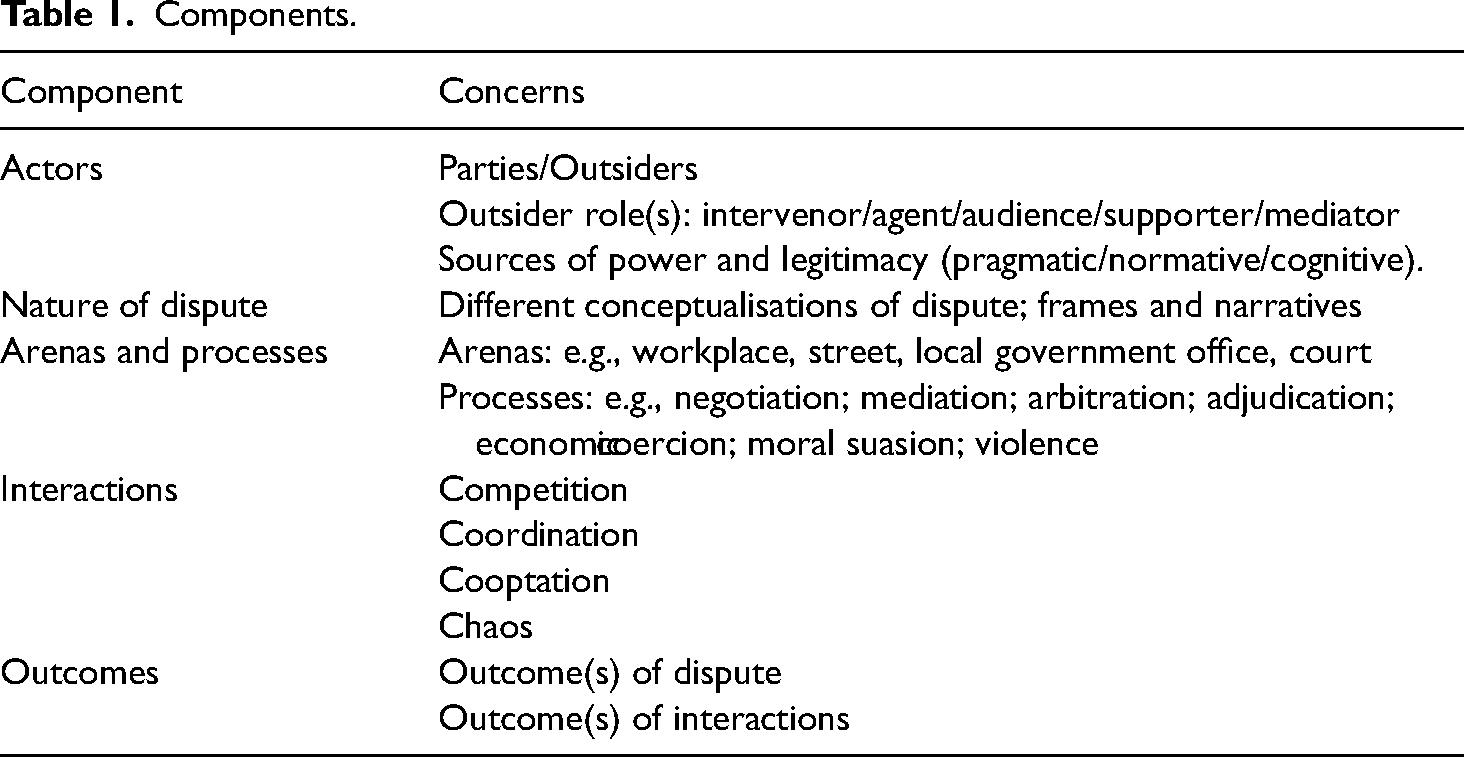
In this section, and drawing on the theoretical insights above, we introduce an analytical framework for mapping and understanding the regulation of collective labour disputes. This framework disaggregates the collective dispute process into five components: (i) actors; (ii) nature of dispute; (iii) arenas and processes; (iv) interactions; and (v) outcomes. For each of these components, we explicitly consider both formal and informal aspects of dispute resolution and identify questions for analysis. As we have developed this framework prior to our empirical investigation, we discuss our framework drawing on examples from ethnographic studies undertaken by other scholars in a range of disciplines. Table 1 summarises these components and suggested concerns.
Actors
Components.
Consistent with a regulatory space approach, we suggest researchers should be attentive to a broad range of actors that may be involved in a collective labour dispute's life cycle and to the roles that they play. We also suggest that attention should be paid to the sources of power and legitimacy enjoyed by the various actors in a dispute.
Most obviously, relevant actors will include the parties that have ‘named’ a dispute, such as workers, and the parties who have been ‘blamed’ by the claimants and are, therefore, on the other side of the dispute − most commonly employers. Certain characteristics of the parties (e.g., whether migrant workers; type of enterprise ownership) should also be considered in the context of scholarship suggesting that these characteristics may influence the evolution of disputes (Anner and Liu, 2016), and the extent to which the parties are integrated into state laws and legal institutions (Gillespie, 2014: 70). The positioning of firms in the global value chain may also influence the nature of dispute resolution, including the extent to which the formal system is used. In the Philippines, for example, a study by de la Cruz (2021) demonstrated the limited effectiveness of state actors over local firm NutriAsia, due to the firm's success in repressing strikes at its factories within a private ecozone. In contrast, it was more difficult for foreign-owned firm LakePower to maintain its global reputation if it shut down a strike by factory workers in a public ecozone. The imperative to maintain continuous production for a global supply chain also influenced the firm's willingness to resolve the dispute by accommodating worker demands during state-sponsored mediation.
Representative organisations such as trade unions and employer associations may act on behalf of their constituents in collective labour disputes, although we caution against any presumption that workers acting collectively are necessarily represented through unions or any formally recognised structure. Representatives may also include professional advisers such as legal practitioners and employment relations consultants.
Although the pluralist IR tradition would identify the state as a primary actor in collective labour dispute resolution, we caution against viewing the state as a coherent, unitary actor (Martínez Lucio and MacKenzie, 2017). There are of course many different ‘state’ actors in collective labour disputes: labour tribunals, labour administrations and their staff, along with other government agencies, legislators, task forces and bodies with official status. The nature of involvement by these actors may vary significantly. In some national systems, state actors have only limited or indirect involvement by way of establishing the ground rules for the system. However, in other systems, they may be important actors in dealing with specific work disputes (Behrens et al., 2020: 316). These actors may perform a variety of distinct roles in dispute resolution (see further below). In many Southeast Asian countries which have experienced periods of authoritarian government, the executive government also has a long history of intervening directly in collective labour disputes often through the use of military or police force (Ford, 1999; Hutchison, 2016).
We advocate for a nuanced conception of ‘state’ actors that recognises not only their diversity but also the multiplicity of (formal and informal) roles they may play. It is often presumed that state actors function within the bounds of, and according to, the official roles assigned to them (e.g., in legislation). However, in practice, the roles and boundaries of the state may be blurred or nebulous (Gillespie, 2017: 297). As the example of state responses to the collective labour dispute at Texwell Vina in Vietnam discussed briefly above suggests, state officials may also act in accordance with informal rules and expectations. Another brief example of the way in which state actors may engage in practices not initially anticipated by the formal system in Vietnam is found in the emergence of ad hoc strike task forces in the early 2000s. In efforts to manage ‘wildcat’ disputes, local authorities gradually developed their own mechanisms to handle unlawful strikes (Do, 2018: 297–8).
In addition to conceptual hazards associated with the use of a singular ‘state’ actor category, it is of course the case that disputants may turn not to trade unions and official employment relations institutions for assistance but to institutions and actors which are located outside the formal IR systems to help resolve disputes. For these reasons, we suggest that it may be fruitful to identify and analyse ‘outsiders’ (i.e., actors other than the parties themselves) in a dispute according to the roles they perform. These roles are varied and can be understood as lying on a continuum from active to passive. Specific actors may play different roles at various points in the dispute. They may also ‘slip’ back and forth between one outsider role and another. They may affect the narrowing or expansion and defusing or escalation of the dispute (Fitzgerald and Dickins, 1980: 698).
Fitzgerald and Dickins (1980: 695–8) identify four roles that may be played by outsiders in disputes: intervenor, agent, supporter and audience. Intervenors are actors who attempt to formulate or help the disputants to formulate an end or resolution to the dispute. Intervenors usually reach their decision after listening to the history of the dispute as recounted by at least one (but usually both) disputants or after ascertaining it for themselves. They may also rely upon an application of a relevant set of rules or norms, or on what the intervenors themselves regard as fair, or on what the disputants want. Intervenors may or may not occupy formal roles within the dispute resolution system. Intervenors, who may also be referred to as intermediaries, play a particularly relevant role in contexts in which different normative orders co-exist and/or there is ‘regulatory ambiguity’ (Howe, 2017; Gillespie, 2017). Socio-legal and regulatory governance literature have drawn attention to the way in which outsiders may mediate disputes by influencing how those with a grievance view their experience and their options for action (Felstiner et al., 1980; Edelman et al., 1993; Gleeson, 2009) and how parties understand what constitutes compliance with formal rules (Howe, 2017). Agents actively represent or act on behalf of a disputant. Supporters are people who form a supportive network around a disputant at some stage in the process but do not become directly involved in the dispute themselves. They often perform roles of encouragement, advice and referral. An audience is ‘an individual or group of people who witness, directly or indirectly, some phase of the disputing process and whose attitude, demeanor, or actions − actual or assumed, directly or indirectly observed − influence the development or management of the dispute by those directly involved’ (Fitzgerald and Dickins, 1980: 695).
Outsiders may perform various roles simultaneously or at different stages of the dispute. A labour court, for example, may act as an intervenor through the authoritative settlement of the dispute, but court personnel may also act as mediators to encourage the consensual settlement of a dispute.
Studies have identified a range of different outsiders that play influential roles in the resolution of collective labour disputes in Southeast Asia. In Indonesia and the Philippines, these may include workers’ rights non-governmental organisations (NGOs) (Ford, 2009: 6), prominent community-based figures (Warouw, 2006; Kelly, 2001) and religious and other community leaders. In Vietnam, these actors may include trade union and party officials acting outside their formal roles (Trinh, 2015). Tran (2007) has shown how official media arms of the state-sponsored labour unions act as intervenors (or intermediaries) by playing strategic mediating roles in response to workers’ collective action. They do this in a range of ways. They act as public forums through which workers’ grievances are exposed; facilitate conditions that compel central labor unions and the state to respond to workers’ concerns; and expedite the implementation of resolutions. Gillespie (2017, 294) has argued that the use of such intermediaries as an alternative to state-sponsored dispute resolution may be particularly significant in authoritarian settings. In sectors highly integrated into global value chains (such as garments), outsiders that play supporter or audience roles may include actors within transnational networks drawn upon by workers and unions. In Indonesia and the Philippines, for example, workers and trade unions in disputes with employers arising from the COVID-19 pandemic have drawn on the support of Global Union Federations, solidarity support organisations and the international media, as well as international apparel brands (Ford and Ward, 2021: 442; IndustriALL, 2021). In Vietnam, Do and van den Broek (2020: 1153–5) have shown how workers engaged in a dispute with management at a Korean-managed garment factory used a grievance hotline operated by European NGOs to draw in a European brand supplied by the factory. The brand's subsequent intervention played an influential role in resolving the dispute.
Consistent with perspectives from IR and regulatory governance, we suggest it is important to examine the various sources of power and/or legitimacy enjoyed by various actors in the system. We caution here against the automatic carrying over of presumptions that may inform the analysis of IR systems in the West, such as a presumption that, by virtue of state sovereignty, public agencies have substantial power, resources and legitimacy (Behrens et al., 2020: 316). As noted in Part 3 above, legitimacy claims may come in different forms. We suggest using the common triptych of pragmatic, normative and cognitive types of legitimacy claims as an initial starting point (Suchman, 1995; Bernstein and Cashore, 2007; Black, 2008).
Pragmatic legitimacy rests on self-interested calculations: a person or social group perceives that an institution or channel will serve its interests directly or indirectly. A party may choose to pursue its claim through a specific informal channel rather than the formal system, for example, because it is seen as offering the highest prospect of a rapid resolution of the dispute in that party's favour. By way of example, it has been argued that workers in Indonesia often choose to pursue collective disputes through informal channels because they distrust the judicial system (i.e., it is perceived to lack pragmatic legitimacy) (Suryomenggolo, 2018: 103). In Vietnam, it is also observed that workers choose to engage in unlawful strike action rather than follow statutory procedures because the former is regarded as the quickest and most effective way of prompting state intervention (Do, 2018). Normative (or moral) legitimacy rests on a judgement of the ‘right thing to do’: a person or social group perceives the goals and/or procedures of an institution or channel to be morally appropriate. For example, people may be more prepared to make claims if dispute resolution forums are considered procedurally just – a type of normative legitimacy (Gillespie, 2017: 283). Finally, cognitive legitimacy rests on assumptions that things could not be any other way: an institution or channel is accepted as necessary or inevitable (Suchman, 1995; Black, 2008). This includes, for example, political legitimacy in the sense of acceptance of a governance relationship, where commands ought to be obeyed (Bernstein and Cashore, 2007: 351). This triptych is dynamic and co-exists in most real-world settings (Suchman, 1995).
Nature of Dispute
Arenas and Processes
Different actors in a dispute may have different understandings of the nature of the conflict (Budd et al., 2020: 260) and hold different values and assumptions as to how it should be resolved. This component of the framework focuses on actors’ subjectivities: on what frames and narratives different actors use to understand the dispute; on who holds responsibility for the dispute; sense of legitimacy and appropriateness in pursuing the dispute; perceptions of what is an appropriate and legitimate course of action; etc. It also captures how actors (if at all) know about and understand the relevant law, as well as how they perceive this law and the legitimacy of formal procedures. This is likely to influence what strategies are pursued to resolve the dispute, in what arenas and through what processes (see below). In the context of labour disputes in Vietnam, for example, it has been suggested that people tend to rely on social networks and informal measures of dispute resolution that is more accessible, familiar and socially acceptable than the formal legal processes. Law is perceived to be less legitimate/incompatible with non-legal, moral conceptions of justice (Nguyen, 2020a). This line of questioning connects with legal consciousness scholarship (Nguyen, 2017), to the extent that it seeks to understand and evaluate external regulation from internal epistemic assumptions (Gillespie, 2014: 71).
This component of the analytical framework involves a mapping of the arenas and processes through which the labour dispute passes during its trajectory. To draw on the metaphor explained above, this component entails the mapping of the dispute tree. Parties to a dispute may pursue their claims in different arenas and through different processes at different points in their ‘life history’ (Fitzgerald and Dickins, 1980: 687). Outsiders may also cause a dispute to move into a certain arena or process. Consistent with theoretical insights drawn from regulatory pluralism and the dispute tree metaphor above, this mapping should capture both formal and informal branches. These various branches may be entirely separate, but they may also overlap and intertwine. This component has both an objective element (i.e., identifying the various branches) and a subjective element (understanding why some branches of the tree are used and others are not).
Arenas and processes may be distinguished from one another by a range of characteristics: by formality, accessibility, conception of what is relevant, decisional style and character of authority adhering to actors within the area (Fitzgerald and Dickins, 1980: 687). As well as practical considerations in accessing a particular arena and process (e.g., cost, geographical location), it is also proposed that this component includes the examination of the way in which pursuing a dispute in a specific arena or through a specific process may influence how the dispute is framed and the norms upon which negotiation and resolution takes place. As noted above, these norms may be formal (e.g., legal) but they may also be in the form of unwritten norms, conventions or codes of behaviour (Witt and Redding, 2013: 292).
Arenas in this context are physical ‘spaces’ such as workplaces, arbitration tribunals, courts or the streets. Processes refer to the method(s) through which the dispute is resolved. Formal processes include state-sanctioned or ‘official’ means of resolving disputes. In the labour context, this may include labour courts and employment tribunals, as well as officially sanctioned ADR processes such as mediation, conciliation, arbitration or a combination of these. Processes in this context also include procedures laid down in collective agreements. Analysis of the legal rules regulating collective labour disputes should also cover, to the extent relevant, those rules and procedures that bear upon the capacity of workers to organise collectively and pursue their interests.
Informal processes include the use of economic pressure that is not anticipated or permitted by the formal system (e.g., unlawful strikes), public protests, use of social media and the press to increase pressure on one party to the dispute, as well as possibly violence. In the case of Indonesia, for example, scholars have shown how workers have engaged in street protests and ‘grebek pabrik’ (‘factory raids’) in response to employers’ non-compliance with the law (Mufakhir, 2014; Suryomenggolo, 2018). The factory raids involve unions from nearby factories entering the premises, inspecting for labour law violations and then occupying the factory including sometimes taking management ‘hostage’. Suryomenggolo points out that trade unions can capitalise on their ‘organisational muscle’ through these alternative strategies and prompt government intervention in a way that is not possible through the formal system (Suryomenggolo, 2018: 104–5). In export processing zones in the Philippines, where union activity is strongly resisted by factory owners, unions have turned to supply chain organising as an alternative or complement to massed strikes and protests. This strategy requires local unions to draw on their networks with overseas unions and NGOs to engage the interest of the firms’ global customers in local labour disputes, compelling factory owners to improve the conditions of workers (Velasco, 2019: 88–92; 95).
Analysis of formal and informal processes should also include consideration of the values and objectives that underpin them. Formal processes governing collective employment disputes are not impartial or value-neutral. They are adopted by the state to achieve certain objectives (Rose and Busby, 2017: 675) such as the maintenance of social order, political legitimacy and/or the attraction of foreign investment (Cooney et al., 2002). Substantive rules and procedural requirements may operate to empower or privilege certain actors over others. Where laws enable discretionary judgement and/or political intervention (e.g., legal provisions empowering certain actors to declare certain strike action unlawful), attention should also be paid to how this discretion is customarily exercised.
Interactions
A distinctive feature of this analytical framework is its concern with interactions between formal and informal regulatory influences on dispute resolution. This component focuses on the pathways and mechanisms of interaction (if any). Such interaction may be intentional or unintentional. In theorising regulatory interactions, Eberlein and colleagues (2014: 11–12) have identified four forms of interaction between regulatory orders: competition; coordination; cooptation and chaos.
11
We propose using these categories as a starting point, although further categories may need to be developed deductively.
12
Within any given space, regulatory orders may compete for legitimacy and authority. This may be the case, for example, where laws are not enforced, which enables actors simply to ignore or violate them. Here, informal orders regulate conduct in a way that is incompatible with the formal system (Helmke and Levitsky, 2004: 729). The Vietnamese multi-sector taskforce is a good example of this type of interaction. These informal task forces initially emerged as a ‘fire-fighting’ response to unlawful strikes. Despite largely comprising officials of the state, these task forces were not initially performing any roles or functions anticipated by the formal labour law system. They thus appeared to initially operate to undermine or compete with the formal system by constituting a mechanism of resolution that was more accessible to workers and proved relatively effective when compared to formal institutions and channels. This competition was endorsed, albeit tacitly, by local regulators who were reluctant to penalise either law-breaking employers or workers (Do, 2018).
Different regulatory orders may act in coordination through processes such as emulation and mimesis or the conscious division of labour (Eberlein, 2014: 11). This coordination may be deliberate, or it may be simply that an informal order ‘complements’ a formal one, such as where it ‘fills in gaps’ by addressing contingencies not dealt with in the law or strengthen incentives to comply with formal rules (Helmke and Levitsky, 2004: 728). In Indonesia, the practice of workplace actors seeking unofficial ‘consultations’ with government mediators prior to, or separate from, official mediation processes would fit within this category of a complementary form of action (Susanti, 2018: 24).
One regulatory order may co-opt another, such as through convergence on norms and activities, ‘meta-regulation’, dominance or hegemony (Eberlein, 2014: 12). To return to the case of the Vietnamese multi-sector taskforce: through successive rounds of labour law reform, these taskforces have now been recognised and provided a formal role in the Labour Code (Do, 2018: 304–5). As a dispute resolution institution and process, therefore, these taskforces have gradually been co-opted by the formal system.
Finally, interaction may be chaotic. Regulatory orders may overlap, each claiming authority and intersecting with others on multiple issues, producing confusion, but with no identifiable pattern of interaction (Eberlein et al., 2014: 12). The creation of chaos by state actors via conflicting and overlapping regulations may be used to preserve the interests of investors while outwardly pursuing social equity (Hutchison, 2016: 184–5).
Outcomes
The final component of our proposed analytical framework involves the examination of outcomes at two distinct levels. At the level of specific disputes, we suggest the application of a basic typology of outcomes as ‘no agreement’, ‘compromise’ and ‘obtained whole claim’ (Miller and Sarat, 1980-81). Of course, not all disputes are ‘resolved’ and parties may not reach any agreement. However, in the IR context, the dispute is often ‘resolved’ in one way or another if the working relationship is to continue. This component addresses the interesting question as to what extent different regulatory orders may produce consistent or divergent outcomes (Helmke and Levitsky, 2004: 728).
Examination of outcomes should go beyond capturing the outcomes of disputes themselves, to consider the outcomes of any interaction between different normative orders and mechanisms drawn upon during the dispute's trajectory. For example, informal intermediaries that assume a prominent role in dispute resolution facilitate the resolution of disputes in the short term, but in the longer term they might undermine the legitimacy of the formal system (Gillespie, 2017). Similarly, in Vietnam, it is arguable that the tendency for wildcat strikes to result in workers’ demands being fulfilled (Do and van den Broek, 2020: 1159), while resolving disputes in the short term, only increases the propensity of workers to engage a useful weapon to attain workplace improvements.
Conclusion
The regulation of collective labour disputes has long been of scholarly interest across multiple disciplines. However, questions going to the interaction between formal and informal modes of regulation have remained at the margins of analysis. The centre of gravity in collective labour disputes scholarship has also long been Europe and US, meanwhile developing country contexts, where formal dispute resolution systems often remain marginalised in practice, have gained far less attention.
This article has engaged with the under-theorised and under-researched question of how plural regulatory sources in labour market regulation interact. It has sought to broaden the scope and increase the depth of comparative labour law and IR research by laying the foundation for a systematic analysis of the interaction between formal and informal rules in the context of collective labour dispute resolution. We have endeavoured to develop a conceptual framework by integrating insights from regulatory studies on the authority and interaction of normative order and socio-legal and regulatory scholarship on the construction and evolution of disputes.
We believe this framework will advance comparative study of collective labour dispute resolution processes by encouraging rich descriptions and analyses which reveal previously understudied dimensions of labour dispute resolution. Application of this framework in future research on collective dispute resolution may improve understanding of the socio-political and economic factors influencing how collective disputes are resolved, and the realities which need to be acknowledged in improving dispute resolution systems.
Importantly, the framework encourages researchers to be attentive to the ways in which plural normative orders may interact in practice and the implications of these interactions for the design and operation of the formal system. It may assist in informing legal and policy development in national contexts in which formal (largely imported) collective labour dispute resolution systems continue to lack traction in everyday life. It offers a way to conceptualise the role of informal norms within existing models of labour dispute resolution and facilitate policy responses that are more responsive to local conditions.
The analytical framework proposed in this paper is capable of being applied to any labour law system that provides the formal regulation of collective labour disputes, or potentially to individual labour dispute regulation, or indeed to any type of dispute. However, we have chosen to focus on collective labour disputes, and we have drawn heavily on examples from Southeast Asia for illustrative purposes. An important test for the usefulness of our framework will be whether it enhances our ability to identify, analyse and compare collective labour dispute resolution across jurisdictions in practice.
Footnotes
Declaration of conflicting interests
The author(s) declared no potential conflicts of interest with respect to the research, authorship, and/or publication of this article.
Funding
The author(s) disclosed receipt of the following financial support for the research, authorship, and/or publication of this article: This work was supported by the Australian Research Council, (grant number DP190100821).
