



Abstract
Temporary employment (TE) arrangements have become increasingly common in Canada among both high- and low-skilled workers. In this study, we examine the prevalence and earnings effects of TE across education levels with a specific focus on highly educated workers. We also examine the earnings effects of TE across the earnings distribution. We find that higher levels of schooling are negatively associated with the probability of TE. However, the earnings discounts for temporary work are significant and increase in magnitude for individuals with higher levels of educational attainment. For highly educated workers at the top end of the earnings distribution, the discount associated with being in a temporary job is large enough to substantially reduce, although not entirely negate, the sizeable earnings premiums associated with higher levels of education.
Introduction
The standard long-term employment relationship, with predictable hours, benefits and pensions has declined in prevalence in many parts of the world, including industrialized countries such as Canada (Zhang and Zuberi, 2017). While non-standard work has traditionally been associated with lower skilled workers in the secondary labour market (Lichtenstein and Mendenhall, 2002), increasingly high-skilled workers and professionals are also engaged in non-standard forms of work (ILO, 2016). Within non-standard work, temporary employment (TE) refers to arrangements where workers are employed for a predetermined period. Fixed-term contracts, project- or task-based contracts, seasonal and casual work are examples of TE. In Canada, TE contracts have become more prevalent over the past few decades (e.g. Busby and Muthukumaran, 2016; Statistics Canada, 2019a). 2.1 million Canadian workers were in temporary jobs in 2018, up from 1.4 million in 1998 (Statistics Canada, 2019b). The risk of TE contracts has also been found to be rising throughout Europe (Latner, 2022) and the US (Katz and Krueger, 2019).
The prevalence and impact of TE among workers is often assumed to diverge by skill level, with lower skilled workers being more likely to be in TE and also more likely to pay a heavy price for working in these positions (Laß and Wooden, 2019). For high-skilled workers, TE is expected to be less common, but may be seen as an opportunity to gain flexibility and freedom of individual career movement, often characterized as the ‘boundaryless career’ (Kost et al., 2020). TE, at both low and high skill levels, has been further enabled by the rise of technology powered platform work. Critics of platform work have examined how it might draw on a supply of disadvantaged workers such as immigrants, women and youth who may lack employment alternatives (e.g. Lam and Triandafylliou, 2021; van Doorn and Vijay 2021). With the rise of the platform economy, it becomes challenging to distinguish between forms of TE in large scale datasets.
In our analysis we cannot directly observe gig employment, therefore we focus broadly on full-time temporary work, which includes any form of work that is (i) full-time and (ii) non-permanent. We apply compensating wage differential (CWD) theory to examine the earnings premium (penalty) associated with full-time TE in the Canadian context. Traditionally applied to considerations of workplace safety and risk, CWD theory posits that jobs with unfavourable characteristics such as occupational risks, unpleasant working conditions or layoff possibilities should provide a wage premium in order to attract and retain workers (Gunderson, 2001; Rosen, 1986). Not only does a CWD help to attract and retain workers, but it also provides the market mechanisms to ‘ensure that employers incorporate the costs of risk into their production decisions and consumers incorporate the cost into their consumption decisions’ (Gunderson and Hyatt, 2001: 378). All else being equal, in competitive markets, employers are thereby incentivized to improve the conditions of employment in order to ensure both efficient levels of compensation and an appropriate allocation of workers. In practice, this means that employers can save money by redesigning work so that it is safer or more desirable to perform, thereby eliminating or reducing the additional payment required to attract and retain workers in more dangerous or undesirable jobs. Applying the theory of CWD to TE, workers in non-permanent positions should – in theory – receive a higher rate of pay in exchange for sacrificing job security and traditional employment benefits (Rosen, 1986).
Our research differs from prior studies on TE in two ways. First, we are particularly interested in empirically testing whether highly educated workers are indeed (more) less likely to be in TE and whether, as predicted by CWD, they enjoy an earnings premium for accepting TE relative to their counterparts in permanent jobs. Therefore, our analysis examines the likelihood of TE and the relationship between earnings and TE across education levels. Second, we investigate the earnings effects of having a temporary job across the earnings distribution using unconditional quantile regression. This allows us to explore whether TE arrangements affect high earning individuals differently than those in lower wage jobs. Taken together, these analyses paint a picture of the incidence and differential impact of TE for highly educated, professional workers relative to their less educated counterparts. Our findings challenge the notion that TE is a boon for high-skilled workers. Instead of benefiting from higher wages to compensate for the risk, uncertainty and lack of benefits often associated with TE, we find that highly educated workers in high wage jobs face an earnings disadvantage in TE relative to similar workers in full-time, permanent employment arrangements.
Previous research
Various factors have contributed to the proliferation of TE over the past several decades. Employers have increasingly made the strategic choice to hire more temporary workers, and workers in some instances have also chosen to engage in TE for a variety of reasons. In this section, we present an overview of the factors driving employers to engage in TE and discuss the effects of TE on workers.
Why do employers hire temporary workers?
There are at least three broad and often overlapping considerations driving employers’ decision to hire temporary workers. These are in turn influenced by the characteristics of the firm, such as size and industry, and the context, such as the number and practices of competitors, and the regulatory environment (ILO, 2016). First, employers may prefer the flexibility that TE offers to buffer against market fluctuations and other external shocks (Abraham and Taylor, 1996). By hiring temporary workers for peripheral jobs, employers can focus their energy and resources on their core competencies by retaining a small group of permanent employees with specialized institutional knowledge and skills (Quinn and Hilmer 1994; von Hippel et al., 1997). This often results in dual labour markets operating within the organization, with core jobs providing stability, high wages, benefits, training, and advancement opportunities while peripheral jobs are temporary with lower wages, no benefits, training or opportunity for advancement (Doeringer and Piore, 1971). Dividing the internal labour market into core and peripheral segments allows employers to pay the core workforce a higher wage rate and protect them from job loss during economic downturns. Empirical studies have found that employers do indeed use TE as a strategy to focus on core competencies and maintain flexibility (Kakabadse and Kakabadse, 2005; Rubery et al., 2002). King et al. (2017) find that the use of temporary workers by organizations can appear to be a ‘quick fix’ but there are risks to the company in terms of core employee turnover and future cycles of skill shortages. Employers that rely heavily on TE with only a small core of permanent workers may find themselves vulnerable to losing key skills if one or more of the core workers quit the organization. The use of temporary workers has accelerated with the restructuring of internal labour markets. Within the traditional model of internal labour markets, institutional mechanisms that coordinate and regulate the employment relationship such as labour unions and employment legislation play an influential role in setting the conditions of employment and advancement for core jobs (Lazear and Oyer, 2004). However, with the restructuring of organizations resulting in ‘fissured workplaces’ (Weil, 2014), the control and management of even core jobs is often no longer within the firm but subcontracted out to external agencies. This makes it often more difficult for labour unions to organize workers, in addition to adding greater complexity to the application of employment legislation to tripartite employment relationships. Thus, the ‘marketization’ of employment relations itself has exacerbated the reliance on TE within a range of industries (Grimshaw et al., 2001).
Employers may also use TE as a screening mechanism to evaluate workers’ potential productivity. Screening theory posits that because hiring managers are unable to observe job applicants’ skills, they utilize a variety of tools to determine their value and employability (Bolton and Dewatripont, 2004; Stiglitz, 1975). Screening tools may include interviews and pre-employment tests, as well as educational credentials, as it is often intuited that education can enhance productivity levels (Riley, 1976). There is evidence that some employers also use TE as a screening tool (Boockmann and Hagen, 2008; Hopp et al., 2016; Portugal and Varejao, 2009). Since it can help them observe workers’ performance on the job without the risk and cost associated with permanent employment, TE allows employers to determine whether the candidate has the necessary qualities and organizational fit to become a permanent employee (Nunez and Livanos, 2015).
Finally, employers may use TE to cut costs and avoid regulatory restrictions. Labour market deregulation of temporary work has enabled and accelerated employers’ strategy to rely on temporary labour, as the cost differential between temporary and permanent employees has grown over time (Gebel and Giesecke, 2011; Kahn, 2010). Employers tend to save money on wages (Fuller and Vosko, 2008; Ono and Sullivan, 2013), training (Finegold, 2005; Wiens-Tuers and Hill, 2002), social security and benefits costs (Houseman, 2001). They may also avoid legal liabilities such as severance payments (Masui, 2020) and unionization efforts through the extensive use of temporary workers (Hatton, 2014).
What are consequences of TE on workers?
For workers, TE may be associated with both positive and negative consequences when compared to holding a permanent job. One potential benefit of TE is that it may allow workers to have flexible scheduling and independent control over their work (Dawson et al., 2017), unlike within the standard employment relationship which is characterized by a singular employer's control. However, many researchers note that temporary work is often ‘involuntary’, in that workers are forced to accept temporary positions due to a lack of permanent job options (de Jong et al., 2009; Fang and McFail, 2008; Morris and Vekker, 2001). Flexible contract forms such as TE are also more likely to be imposed by employers, rather than sought by employees (Bessa and Tomlinson, 2017). Studies have highlighted the damaging effects of involuntary TE on workers and communities (see e.g. Allison et al., 2018).
According to dual labour market theory, temporary work arrangements are generally concentrated within the secondary labour market in which jobs are low paid, with few prospects for career advancement (Doeringer and Piore, 1971) while those in the primary segment are supported by higher pay, union representation, job security and advancement opportunities, which are features of the standard employment relationship (Urbaniec, 2022). The standard employment relationship thus shapes patterns of social stratification and standards of living for citizens (Fudge, 2017), yet researchers have acknowledged that even at the peak of its adoption, the standard employment relationship was not accessible to all workers (Vosko, 2011).
Proponents of dual labour market theory argue that the growth of TE contributes to the polarization of the labour market (Hirsch, 2016). Workers in temporary positions tend to receive lower wages and benefits than those doing equivalent tasks who work on open-ended work contracts (Booth et al., 2002; Comi and Grasseni, 2012; Fauser, 2020; Fuller and Stecy–Hildebrandt, 2015; Gash and McGinnity, 2007; Hagen, 2002; Mooi-Reci and Wooden, 2017). They also have fewer training opportunities (Forrier and Sels, 2003), and report lower levels of job satisfaction than permanent workers (Dawson et al., 2017; Green and Heywood, 2011). Temporary work arrangements have also been found to contribute to more inequality for disadvantaged groups such as immigrants, racial minorities, young workers and women (Bruno et al., 2014; Fuller and Vosko, 2008; Zhang and Zuberi, 2017).
TE, however, need not lead to negative career outcomes for all workers, particularly for highly skilled workers who typically have greater labour market mobility. Gebel (2010) notes that some highly skilled jobs might be temporary by nature (such as project-based work) but not low in terms of quality. TE may also facilitate career progression (Autor and Houseman, 2010). For high-skilled professionals, TE has been examined through the lens of the ‘new careers’ discourse which emphasizes the benefits of job flexibility and mobility (Arthur and Rousseau, 1996). Among highly skilled professionals the decision to take TE may be based on a desire for a ‘boundaryless career’ which prioritizes physical and psychological freedom to achieve independence and autonomy (de Vos and Soens, 2008; Hall, 2004; Inkson et al., 2012). Individuals with boundaryless career attitudes are likely to seek greater organizational mobility and may therefore prefer TE over permanent work arrangements (Lo Presti et al., 2018). Tomlinson et al. (2018) argue that socio-economic status and social categories shape the decision to pursue a flexible career. However, Budtz-Jørgensen et al. (2019) note that, rather than ‘boundaryless’, many modern careers are in fact ‘liminal’. That is, they lack clearly defined paths and are unfocused, which leaves workers in ‘social limbo’.
Some empirical studies show that highly skilled temporary workers use TE as a strategy to gain diverse skills (de Jong et al., 2009) or signal their potential to employers (Nunez and Livanos, 2015). Many workers use TE as a stepping-stone to permanent positions (Booth et al. 2002; Fang and McFail, 2008; Fuller and Stecy-Hildebrandt, 2015; Gash, 2008; Scherer, 2004). TE might also reduce unemployment for workers; individuals who otherwise would have difficulty finding employment can use TE as a pathway to permanent employment (Autor and Houseman, 2010). As employers increasingly choose to hire temporary workers, researchers have noted that the risks of job insecurity within TE may diminish, with jobseekers readily able to find a variety of other TE opportunities (Marler et al., 2002). Highly-skilled individuals in TE might recognize the contingent nature of TE and associated risks, but they can also leverage their skills in an entrepreneurial labour market by setting wage rates that reflect the demand for their talent (Kunda et al., 2002). There is some empirical evidence that temporary workers in high skill jobs may in fact enjoy a wage premium relative to their counterparts in open-ended employment arrangements (Laß and Wooden, 2019).
Theoretical framework
The theory of CWDs was originally conceived by Adam Smith, and posits that, other things being equal, jobs with undesirable features will command a higher wage rate (Smith, 1979) in order to compensate for the less desirable aspects of the work. Essentially, wage differentials should equalize the total monetary and nonmonetary advantages and disadvantages within a job (Rosen, 1986). Consider, for example, an employee who may prefer a lower salary in exchange for access to comprehensive extended benefits. Or an employee may seek out an opportunity with a given employer who pays a lower wage rate but offers an employer-sponsored retirement pension plan. In all cases, CWDs involve a trade-off between earnings on the one hand, and some other positive (negative) aspect of work on the other. The classic example of CWD looks at how ‘disagreeable’ job characteristics such as the risk of occupational injuries would be recompensed with a wage premium (Smith, 1979). Empirical tests of CWDs have focused on a range of job-related factors, including health and safety risks (e.g. Kniesner and Leeth, 1991), emotional labour demands (e.g. Glomb et al., 2004), geographic location (e.g. Braakmann, 2009), risk of layoff (Böckerman et al., 2011), availability of fringe benefits such as vacations and pensions (e.g. Amuedo–Dorantes and Mach, 2003) and work scheduling such as shift work (e.g. Lanfranchi et al., 2002).
In general, the empirical evidence on CWDs is mixed. A survey of the literature concludes: ‘tests of the theory of CWDs are inconclusive with respect to every job characteristic except risk of death’ (Borjas, 2013, Ch. 5: p. 222). While CWDs may offset the increased risk of unemployment within TE, Segal and Sullivan (1998) note that workers may be compensated for this risk through the accumulation of human capital instead. One possibility is that workers within the primary labour market, which includes high skill, high wage jobs, are compensated for unfavourable conditions such as the risk of unemployment, while workers in the secondary labour market receive little to no compensation for such undesirable features of the job (Daw and Hardie, 2012; Graham and Shakow, 1990). The present study seeks to test this possibility using Canadian data. Specifically, our analysis applies the CWD framework to examine whether highly educated workers and those in well-paid jobs are renumerated for temporary work arrangements.
Data and methodology
We use data from the public use microdata file (PUMF) of the Canadian Labour Force Survey (LFS) for the years 2000 to 2019 inclusive. The LFS is a cross-sectional monthly survey of private Canadian households across all ten provinces (Statistics Canada, 2016a). Data for the LFS is obtained by telephone interview conducted by a Statistics Canada employee within ten days of the reference week. Information about household members is obtained by proxy from the interviewee and the non-response rate is approximately 10% (Statistics Canada, 2016a: 25). Although the LFS is cross-sectional, it uses a rotating panel sampling design, meaning that the same respondents are included in the sample up to six times. Therefore, to avoid repeated measures of the same individuals, we use data from March and September only as these months are six months apart. Our sample is restricted to include employees with positive, non-missing hourly earnings who are between the ages of 20 to 64 years old. We exclude those who are unemployed, self-employed and/or currently attending school. Finally, the analysis is restricted to full-time employees, meaning those who work 30 or more hours per week at their main (or only) job (Statistics Canada, 2016a: 18). Our focus is on TE. The LFS definition of temporary work ‘is based on the intentions of the employer and the characteristics of the job, rather than the intentions of the employee. […] A permanent job is one that is expected to last as long as the employee wants it, given that business conditions permit’ (Statistics Canada, 2016a: 14). Temporary work is further sub-divided into work that is seasonal, term (contract), casual or any other form of non-permanent employment (Statistics Canada, 2016a: 14). Although it is possible in the LFS to differentiate between the various forms of temporary work noted above, for the purpose of this analysis, we consider temporary work all work that is not designated as permanent. Additionally, as we are focusing on employees only and we exclude those who are self-employed, we are also likely excluding those who may fall within a grey area of gig workers and/or dependent contractors. Microdata files such as the LFS are not well suited to measure the labour force outcomes of self-employed persons since, although an indicator of self-employment is provided within the dataset, the wages of self-employed persons are not (Statistics Canada, 2016a: 19).
We begin by using logistic regression to estimate the probability of having a fulltime, temporary job (conditional on being in full-time employment). The control variables included in the probability models are identical to those used in the earnings equations and described in detail below, however, excluding occupation and job tenure. Our empirical strategy involves estimating a series of OLS earnings equations regressing the natural logarithm of hourly earnings, adjusted for inflation, on a number of observable characteristics. In the LFS ‘respondents are asked to report their wage/salary before taxes and other deductions and include tips and commissions. […] Weekly/hourly wages/salary are calculated with usual paid work hours per week’ (Statistics Canada, 2016a: 19). The focal independent variable is a binary indicator of whether the respondent is employed full-time in a temporary job. As noted above, we combine the four forms of temporary work (seasonal, contract or term work, casual work and any other form of temporary work) into one broad measures of TE. The comparison group in our analysis are those who are employed in permanent, full-time jobs. We include six categories of educational attainment ranging from less than high school, the omitted reference group, to above a bachelor's degree. We also control for sex, age, marital status, presence of own children 12 years old or younger, living in an urban area, geographic region of residence as well as the month and year of data collection. The more saturated models (models 4 and 5) include variables indicating whether the respondent works in the public (versus private) sector, is covered by a collective agreement, holds more than one job, job tenure (months, grouped into three categories: short tenure of 12 months or less; medium tenure of 13–36 months and long tenure of 37 months or longer) and employer size. Our final specification, Model 5, also controls for ten occupational categories. 1
We are interested not only in the wages of temporary workers generally, but more specifically, we are concerned with estimating the earnings impact of TE across educational levels, with particular emphasis on highly educated workers. To this end, we include the interactions between having a temporary job and the various levels of educational attainment.
In addition to estimating the relationship between temporary work and earnings at the mean, we also explore the premium (penalty) associated with having a temporary job across the earnings distribution using an unconditional quantile regression methodology developed by Firpo et al. (2009). All estimations are weighted using the LFS final weight variable, rescaled to reflect the number of months of data used (i.e. 40 months of data, except when including occupational variables, which are missing for 2016 and as a result 38 months of data are used in this case since 2016 is omitted).
Results
Before turning to the results of our analysis, a few noteworthy points emerge from the summary statistics in Table 1. Among full-time employees, there is no difference in the distribution of males and females across temporary and permanent jobs; overall, 45% of fulltime employees are female. Temporary workers, however, do tend to be younger with a higher proportion of employees ages 20 to 29 years old having a temporary as opposed to a permanent job. Although the proportions are small, a greater number of temporary workers are also multiple job holders. The shares of workers covered by a collective agreement and employed in the public sector are greater among temporary jobholders as compared to those in permanent work. Perhaps most striking is the distribution of educational attainment comparing permanent and temporary jobholders. We find a slightly larger share of respondents with less than high school employed in temporary as opposed to permanent work at 11 and 9%, respectively. Among those with the highest level of education, we find that 10% of temporary workers and 8% of permanent workers have above a bachelors’ degree. Examining some initial data on earnings, we see that fulltime temporary workers earn, on average, $4.54 less per hour than their fulltime permanent counterparts. The earnings penalty associated with temporary work is observed despite working on average, a similar number of hours per week.
Select summary statistics (weighted) by FT permanent and FT temporary status.
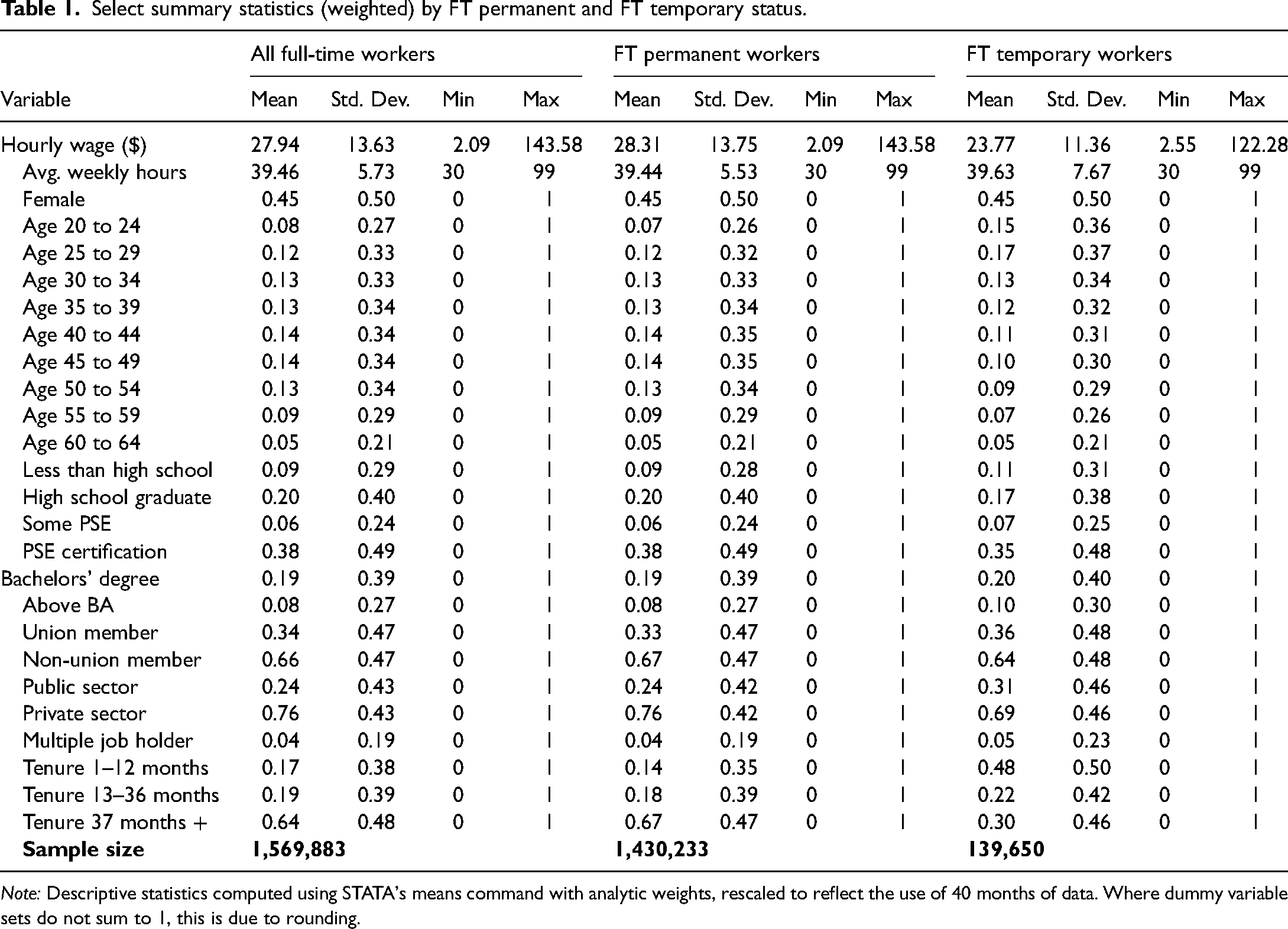
Note: Descriptive statistics computed using STATA's means command with analytic weights, rescaled to reflect the use of 40 months of data. Where dummy variable sets do not sum to 1, this is due to rounding.
We begin the analysis by first examining the incidences of TE. Table 2 shows the estimated probability of having a temporary job, conditional on being in fulltime employment and controlling for a number of observable characteristics described in the preceding section. Overall, roughly 8% of fulltime workers have a temporary job. Females and older workers are less likely to be in temporary work. The probability of having a temporary job is positively associated with the year of the survey, suggestive of a modest increase in the likelihood of temporary work over time. Higher levels of education are negatively related to the probability of having a temporary job.
Logistic regression probability of temporary work conditional on full-time employment.
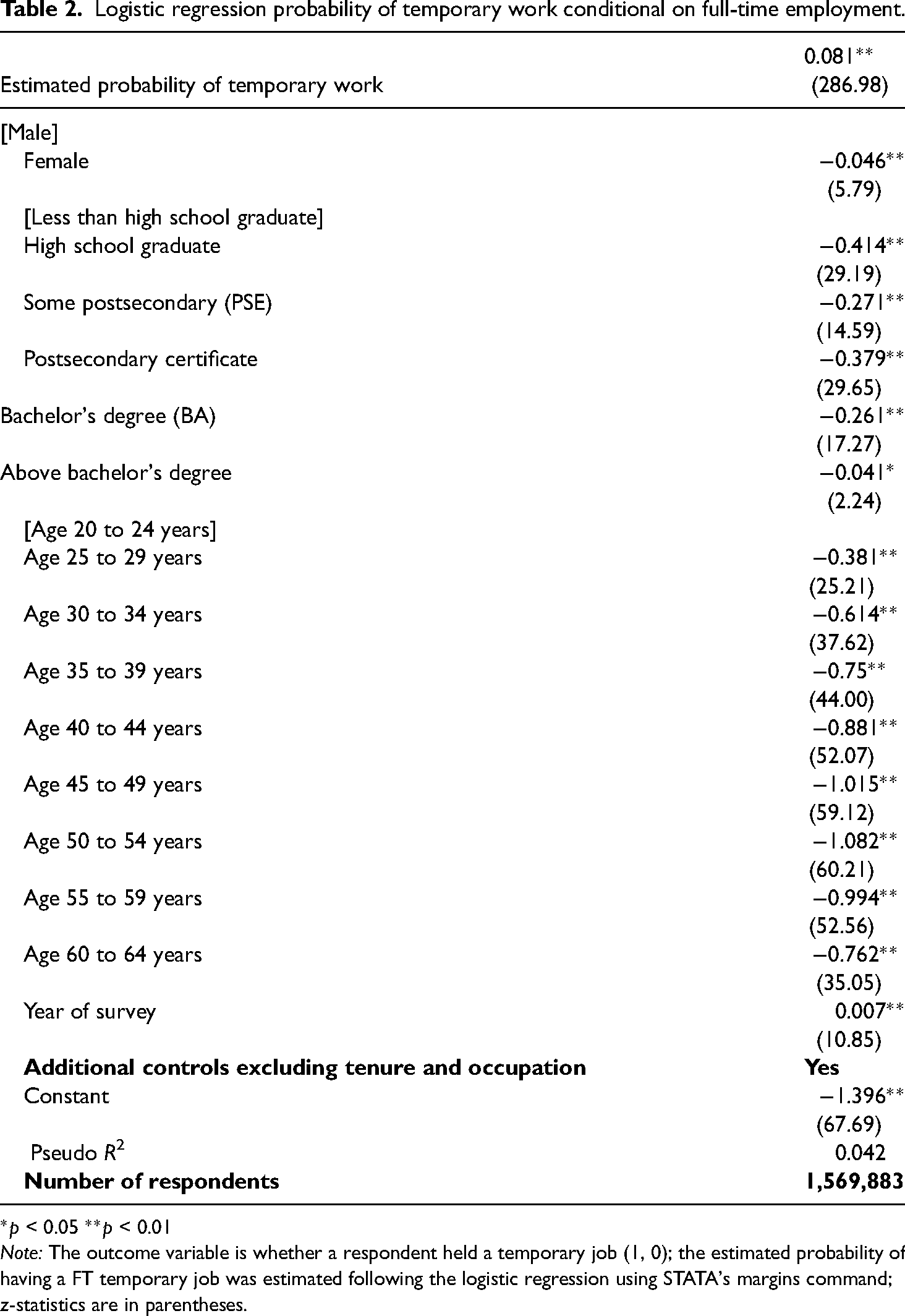
*p < 0.05 **p < 0.01
Note: The outcome variable is whether a respondent held a temporary job (1, 0); the estimated probability of having a FT temporary job was estimated following the logistic regression using STATA's margins command; z-statistics are in parentheses.
The results of the OLS earnings equations estimating the relationship between earnings and TE are shown in Table 3. Model 1 includes our key independent variable, having a fulltime temporary job, and controls for sex, level of educational attainment and year of survey. Noteworthy is the sizeable and significant earnings penalty of roughly 17% 2 associated with temporary work. Females also earn roughly 17.5% less than males 3 while all workers experienced annual wage growth of about 0.6% per year. As expected, all levels of educational attainment above ‘less than high school’ are associated with higher earnings and premiums increase with each successive level of education.
OLS earnings equations on Ln hourly earnings, all full-time workers
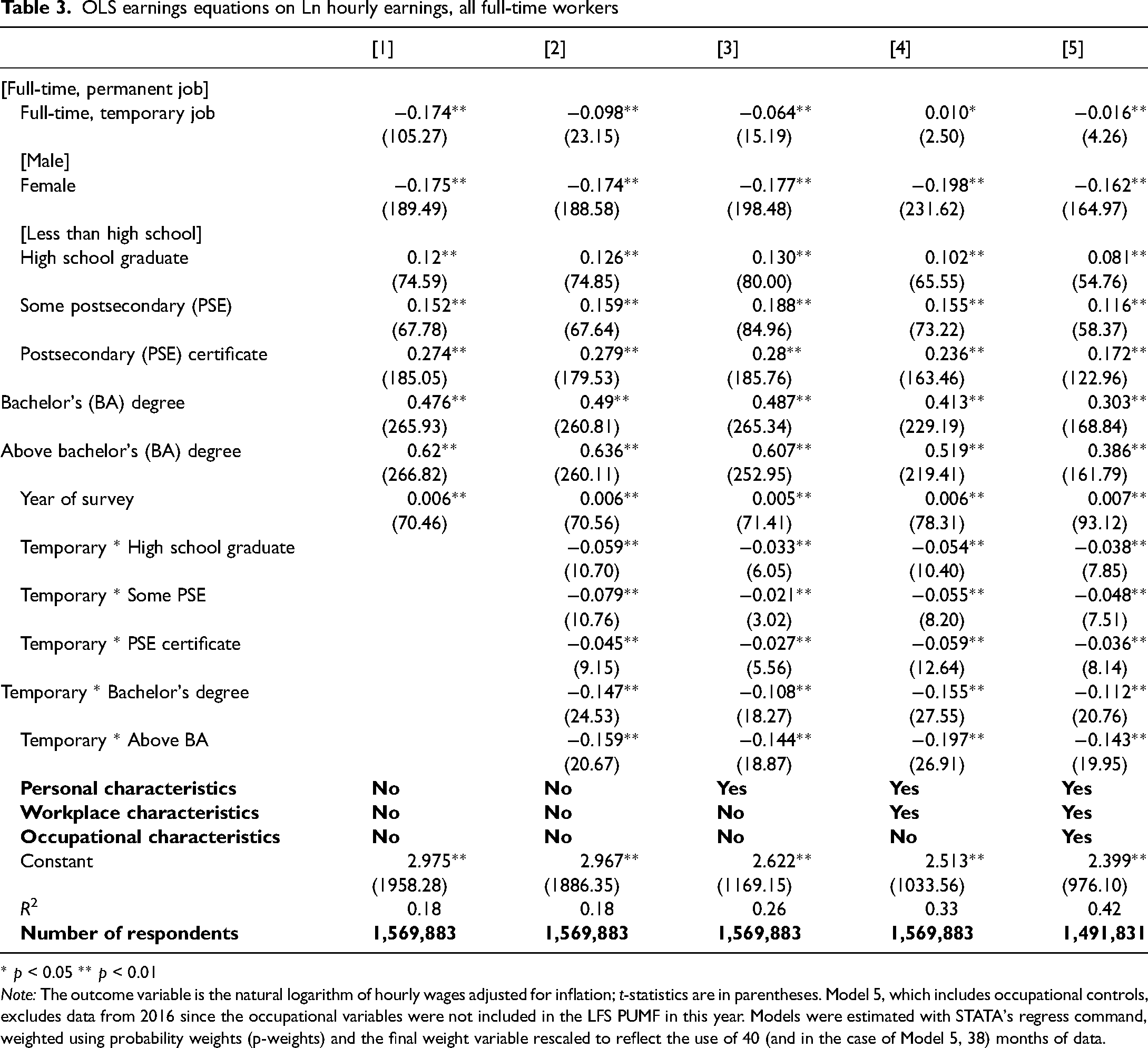
* p < 0.05 ** p < 0.01
Note: The outcome variable is the natural logarithm of hourly wages adjusted for inflation; t-statistics are in parentheses. Model 5, which includes occupational controls, excludes data from 2016 since the occupational variables were not included in the LFS PUMF in this year. Models were estimated with STATA's regress command, weighted using probability weights (p-weights) and the final weight variable rescaled to reflect the use of 40 (and in the case of Model 5, 38) months of data.
Model 2 builds on Model 1 by adding the interactions between having a temporary job and each level of educational attainment above less than high school. The negative association between temporary work and earnings remains statistically significant, but it is quantitatively smaller with the addition of the interaction terms. Most substantively, we find that each of the interactions between temporary work and level of education are statistically significant and negative. Furthermore, the earnings discount associated with temporary work is largest for the most highly educated employees. Models 3, 4 and 5 build on Model 2 by adding sets of control variables capturing personal, workplace and occupational characteristics, respectively. The results are qualitatively similar across all specifications. While the magnitude of the penalty associated with TE decreases with the addition of various control variables (even becoming a small, but marginally significant premium in Model 4), the interactions between temporary work and education are negative, sizable and statistically significant in all models.
The results of the unconditional (RIF) quantile regressions are displayed in Table 4. Beginning with the relationship between TE and earnings, we find that, controlling for observable characteristics (excluding occupation as we use Model 4 from Table 3), temporary work is associated with an earnings penalty at the bottom of the earnings distribution. Workers in temporary jobs at the 10th percentile earn nearly 11% less than their counterparts with a permanent job. At the median and above, however, temporary jobholders enjoy a small, but statistically significant earnings premium ranging from about 5–6.2% relative to their counterparts employed in permanent work. Throughout the distribution, higher levels of education are positively associated with earnings. Most interesting again are the interaction terms between temporary work and education. At the 10th percentile, the interactions between temporary work and postsecondary credentials are positive and statistically significant. Moving up the earnings distribution, however, all the interactions between temporary work and education are negative and statistically significant. Once again, we find the most educated workers experience the largest earnings discount associated with temporary work. Take, for example, respondents with a bachelor's degree at the 75th percentile of the earnings distribution. Those in full-time permanent work earn roughly 50% more than similarly employed respondents with less than high school. A temporary jobholder at the 75th percentile with a bachelor's degree, however, earns only about 23% more than a permanent jobholder with less than high school. (The interactions between education and temporary work cannot be interpreted independent of the coefficients on both the temporary work and education level dummy variables). The penalty for temporary work among the highly educated is even more pronounced for those with above a bachelor's degree and/or those at the 90th percentile. A permanent jobholder with a graduate degree at the top of the earnings distribution enjoys a roughly 66% earnings advantage over a similarly employed respondent with less than high school. A temporary jobholder with the same level of education at the 90th percentile earns only roughly 24% more than a permanent jobholder with less than high school. The discount associated with being in a temporary job is so large for educated workers, particularly at the top of the earnings distribution, that it eliminates nearly two-thirds of the premium associated with a graduate degree!
Unconditional RIF earnings equations on Ln hourly earnings, all full-time workers.
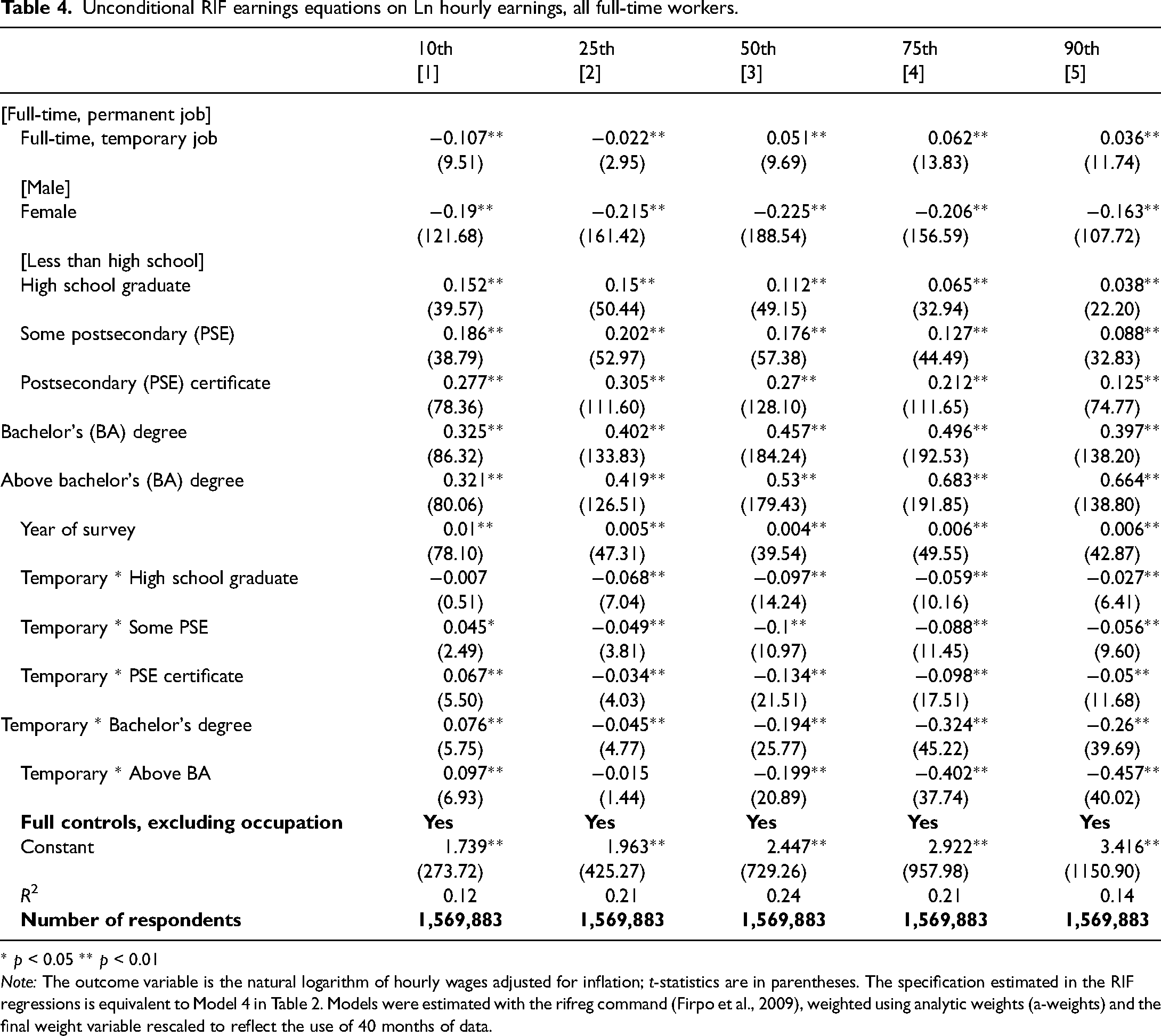
* p < 0.05 ** p < 0.01
Note: The outcome variable is the natural logarithm of hourly wages adjusted for inflation; t-statistics are in parentheses. The specification estimated in the RIF regressions is equivalent to Model 4 in Table 2. Models were estimated with the rifreg command (Firpo et al., 2009), weighted using analytic weights (a-weights) and the final weight variable rescaled to reflect the use of 40 months of data.
Discussion and conclusion
The findings of this study can be summarized quite succinctly: higher levels of schooling are negatively associated with the probability of TE. However, should educated workers have a temporary job, the earnings discounts are significant and increase in magnitude as one moves to higher levels of educational attainment as well as up the earnings distribution. The small premiums associated with temporary work estimated at and above the median for workers with less than high school education may reflect a CWD whereby employers offer higher earnings in exchange for a lack of job security as well as particular features of the work not captured by the control variables included in the model. Such trade-offs, however, are not observed among the highly educated neither at the mean (Table 3), nor anywhere else across the earnings distribution above the 25th percentile (Table 4). For highly educated workers, the earnings discount associated with being in a temporary job is large enough to substantially reduce, although not entirely negate, the sizeable earnings premiums associated with higher levels of education.
Before proceeding to the discussion of our key empirical findings, it is important to note several limitations of the present study which may inform future research on TE. Firstly, it bears emphasizing that our results are based on cross-sectional data, therefore, the relationship between TE and earnings is correlational and as such causality is not inferred. Secondly, the LFS contains a relatively limited number of variables relating work and worker characteristics and thus does not capture potentially important job attributes or nonpecuniary forms of compensation that may under (over) state temporary pay penalties (premia). Thirdly, we do not account for selection into temporary work (nor fulltime employment in and of itself). Indeed, it is plausible that workers either self-select or are hired into fulltime and/or temporary positions based on a host of unobservable and/or unmeasured characteristics that are also correlated with earnings thus biasing the wage differential estimates. This is potentially the most serious limitation as adjusting for selection may negate, or otherwise change, the wage premiums estimated herein. In practice, however, it is very difficult to empirically account for selection bias based on unobservable and/or unmeasured characteristics with the variables available in the LFS. Given this bias, caution should be maintained when interpreting the results. Finally, although we are using 20 years of LFS data and the positive correlation between survey year and probability of TE suggests a modest increase in temporary work over the two decades of our study, we do not formally consider the changes in TE nor corresponding wage penalties (premia) over time. Earlier iterations of the study did attempt to add interaction terms to the models to capture temporal effects, however, these additions raised concerns over multicollinearity and as such we abandoned that direction of analysis. We therefore leave the change in temporary earnings penalties (premia) over time as a topic of future research, ideally one that would employ longitudinal data.
The central objective of the present study was to evaluate temporary work in light of CWD theory, with a particular emphasis on highly educated workers. We predicted that, all else being equal, employees in temporary jobs would earn a premium trading job security for higher earnings as compared to those in permanent jobs. We do find evidence of this looking at results of the RIF regressions (Table 4) where the coefficients of the temporary work variable at and above the median are all positive and statistically significant. This suggests that for the reference worker (i.e. a male with less than high school education) employed in a full-time temporary job earns slightly more than his observationally equivalent counterpart employed in a fulltime permanent job. Therefore, in this case, as the theory would predict a CWD is observed.
In the case of the educated worker, however, our findings do not support the prediction of a CWD and in fact point to an opposite reality, namely that educated workers employed in full-time temporary work earn less than similarly educated workers with a fulltime permanent job. What's more, we note that the earnings disadvantages for temporary work increase with higher levels of education as well as when one moves up the earnings distribution such that the most highly educated workers (i.e. those with above a bachelor's degree) at the 90th percentile experiences the largest discount associated with temporary work. Stated another way, rather than finding a CWD, temporary work has the greatest opportunity cost for the most highly educated workers.
Our findings run contrary to the optimistic concept of the boundaryless career, suggesting that TE may not be beneficial for highly educated and skilled workers, at least not financially beneficial in the short term. The sizable earnings penalties associated with temporary work for the most highly educated workers may lead to a number of potential consequences for workers and employers.
On the one hand, workers and jobseekers’ concerns around TE are greatly mitigated if, as several studies have suggested, temporary work serves as a ‘stepping-stone’ to permanent employment (Booth et al. 2002; Fang and McFail, 2008; Fuller and Stecy-Hildebrandt, 2015; Gash, 2008; Scherer, 2004). This may be especially true for newly arrived immigrant workers trying to gain domestic work experience (Jahn and Rosholm, 2013), as well as young workers or persons changing occupations by giving them firsthand knowledge of various careers (i.e. Fuller, 2011: 157). Viewed through the lens of CWD theory, workers may willingly accept lower-paid temporary positions in exchange for the opportunity to develop relevant skills, access to professional networks, occupational ladders or internal labour markets (De Cuyper et al., 2011; Munchhausen 2008). Indeed, previous research has found that temporary work does not necessarily lead to future adverse career outcomes (De Cuyper et al., 2009; Sherer, 2004). Sherer (2004: 387) notes that ‘employment contracts of limited duration, however, despite being accompanied by higher career instability, do no harm to future occupational positions. Consequently, if anything serves as an entry portal, it is a fixed term contract’. Therefore, in this benign, even positive view of temporary work, although the earnings discounts associated with temporary work may be large, they are, after all, only temporary.
On the other hand, other studies have found a scarring effect of TE on income even after workers have attained a permanent job (Fuller and Stecy-Hildebrandt, 2015: 317). The authors go on to note ‘[…] the stigmatizing impact of temporary work largely lies in its association with instability, rather than temporary status per se’ (Fuller and Stecy-Hildebrandt, 2015: 317). Unlike the findings of the present analysis, Fuller and Stecy-Hildebrandt (2015) find relatively small differences in the monthly wages comparing temporary and permanent workers in fulltime positions, leading to the authors to conclude that temporary does not in and of itself inhibit skill development. Studying employment transitions, Fang and MacPhail (2008: 71) note ‘So while after 2 years, the majority of temporary workers will have made the transition to permanent work, many will have experienced high degrees of economic insecurity in the interim and some workers will not be able to make the transition’. Given that we find such large earnings penalties associated with temporary work, the concern is for those workers who would otherwise prefer a permanent job, but who remain trapped in a temporary contract. Future research might examine the factors associated with career immobility and mechanisms that render some jobseekers stuck in a cycle of temporary work. For these workers in particular, the inability to transition into a permanent job provides a powerful counterargument against the banality of TE. The sizable earnings discounts noted in our study provide particular urgency to this question.
For employers, the potential cost savings of temporary contracts or the use of non-permanent jobs as a screening tool to reduce hiring risk may be short sighted and potentially outweighed by concerns related to retention and replacement expenses. One report, for example, estimates the cost of turnover to be 33% of an employee's salary (Sears, 2017: 9) Furthermore, should employers decide that it is advantageous to employ temporary workers, are there ways that organizations might examine and improve the quality of such opportunities? One recent study, for example, found, unsurprisingly, that job quality was highest for open-ended contracts, followed by temporary agency work and lowest for fixed term contracts where the employer hired incumbents directly (Arranz et al., 2018: 222). Investments in job quality including training and development opportunities will have a reciprocally beneficial effect for both the incumbent as well as the organization (Burgess and Connell, 2006; Chambel and Sobral, 2011).
The results of the present study find support for CWD theory in its application to TE, but only for those with low levels of education at and above the median of the earnings distribution. Rather than finding a CWD, the results of this study find deep earnings discounts associated with fulltime temporary work among the most highly educated workers. Given the expansion of TE throughout the labour market, it is crucial for management researchers, practitioners and policy makers to take note of its scope and impact in order to design and implement measures to ensure the well-being of workers, organizations and society at large.
Footnotes
Acknowledgments
The data used in this study is owned by Statistics Canada. We accessed the Public Use Micro-data Files through the Data Liberation Initiative, of which our institution is a member. We thank the anonymous reviewers for their feedback. The views expressed herein as well as any/all errors remain the sole responsibility of the authors.
Declaration of conflicting interests
The author(s) declared no potential conflicts of interest with respect to the research, authorship, and/or publication of this article.
Funding
The author(s) received no financial support for the research, authorship, and/or publication of this article.
