




Abstract
While online platforms were initially applauded for improving services in a range of sectors, they are currently being criticized for ignoring laws and regulations. We analyse the evolution of Helpling – the largest domestic cleaning platform company in Europe – by focusing on the ways that Helpling has adapted its platform to regulations in five national contexts (France, Germany, Ireland, the Netherlands and the United Kingdom). Using data on changing Terms and Conditions, we show that Helpling initially tried to introduce a single business model across Europe, but quickly started to adapt to national regulatory contexts. Informed by arguments on ‘varieties of capitalism’ in Europe, we base our case study on a comparison of the different national trajectories pursued by Helpling.
Keywords
Introduction
Digitalization is a salient trend in the current economy transforming the ways we produce, trade and socialize in our society. One particular pervasive development is the introduction of digital platforms across different sectors. Platforms can be understood in a general sense as mediating social and economic interactions online, often by apps (Kenney and Zysman, 2016). Amongst the wide variety of online platforms, gig platforms stand out due to the particular regulatory questions they raise for governments and unions alike (ILO, 2021). We define the gig economy here as encompassing ‘ex ante specified, paid tasks carried out by independent contractors mediated by online platforms’ (Koutsimpogiorgos et al., 2020: 531). Such tasks may include taxi rides, food delivery, cleaning jobs, programming tasks, tutoring and babysitting – to name just the most prominent examples.
In contrast to traditional corporations, gig platforms do not employ their workforce, but rather connect gig workers as ‘independent contractors’ to clients. However, gig workers do not enjoy the freedom associated with independent contracting, because matching is performed by algorithms beyond their control, while worker performance is monitored by platform metrics and client reviews. Given the specific features of gig platforms, the main regulatory question in many countries revolves around the issue of proper employment classification of gig workers as independent contractors or employees (De Stefano, 2016). Specifically, in the European context, the employment status is often connected to access to social security and protection against precarious working conditions. Hence, the rise of the gig economy carries broader implications for society. As a response, governments have begun to take measures (particularly in the form of targeted legislation) in order to clarify the regulatory context of the gig economy. The proposal for a Directive on the rights of gig workers by the European Commission in December 2021 constitutes a recent and prominent example of these regulatory efforts, because the draft directive proposes to introduce a distinction between genuine freelancing work and bogus self-employment based on a set of criteria (European Commission, 2021).
Despite the significance of the various regulatory questions raised by the gig economy (De Stefano, 2016; Kaine and Josserand, 2019) and repeated calls for institutional analysis by scholars (Frenken et al., 2020; Healy et al., 2017; Mair and Reischauer, 2017), little empirical research has been done on how platform companies actually deal with regulations over time. As the first gig platforms were launched over than a decade ago, it is timely to start analysing the long-term dynamics of adaptation by platforms to the institutional environments they operate in. Despite the economies of scale that they would enjoy by standardizing their operation across countries, we expect that platform companies adapt their platform to the specific national institutional contexts viz. specific ‘Varieties of Capitalism’ (Hassel and Sieker, 2022; Thelen, 2018). Accordingly, our study focuses on how a multi-national platform company deals with different national institutional contexts.
More concretely, we ask the specific question of how gig platforms adapt to the regulatory risk of their gig workers being classified as employees. Empirically, we ground our arguments on analyses of Helpling, the leading platform for domestic cleaning services in Europe. Helpling is a particularly insightful case due to both the prevalence of undeclared labour in the domestic cleaning sector and the weak enforcement of regulations. Consequently, the platform may cause less disruption in this sector than their counterparts in the food delivery and taxi sector. This is particularly true as Helpling has, thus far, received little media or academic attention. More specifically, we study how Helpling has adapted its business model over an eight-year time span (2013–2020) in five national contexts (France, Germany, Ireland, the Netherlands and United Kingdom). To this end, we apply a longitudinal research design by collecting empirical data on the changes in the platform's Terms and Conditions (T&Cs). T&Cs constitute a set of rules that have to be accepted by its users (gig workers and clients), thereby creating a unique trilateral mode of governance (De Stefano, 2016). The systematic tracking of changes in Helpling's T&Cs, complemented by media analysis, allows us to depict the evolution of a single platform over time and across countries.
Platforms and institutions
Gig platforms define themselves as e-commerce companies delivering online intermediation services without bearing much responsibilities for gig workers, despite the uncertainties and difficulties that they experience in their work (Kaine and Josserand, 2019). Accordingly, gig platforms consider gig workers as independent contractors who themselves bear the risks and obligations associated with their own undertakings. A gig platform seeks to maximize the quality of the service offered in order to maximize its own revenues, while simultaneously seeking to maintain the status of an e-commerce platform and to avoid the classification of its gig workers as employees. These two goals may be conflicting, because assuring high-quality services generally requires a high degree of control over gig workers, which in itself can be interpreted as a relationship of subordination (employment). Assigning the status of independent contractors to gig workers, while exercising control over gig workers in practice, is indeed at the root of the social tensions and legal disputes in the gig economy (De Stefano, 2016; Healy et al., 2017; Kaine and Josserand, 2019; Prassl and Risak, 2015).
In institutional-theoretical terms, scholars have argued that the incompatibilities of gig work and existing labour institutions stem from the specific combination of corporation and market logics that gig platforms apply (Frenken et al., 2020; Meijerink et al., 2021). On the one hand, platforms allow gig workers to follow a market logic as they decide when to work, which gigs to accept and how to execute a gig. On the other hand, platforms employ human resource management techniques following a corporation logic: platforms exercise control of the workforce by digital surveillance of their actions, by asking clients to rate worker performance, by using algorithmic ranking of search results, and by banning ‘malfunctioning’ workers from platforms. It is the combination of market and corporation logics that results in ‘institutional complexity’ (Greenwood et al., 2011) stemming from the institutional reactions of various stakeholders including competition authorities, labour inspection agencies, unions and gig workers themselves (Frenken et al., 2020; Meijerink et al., 2021). Gig platforms, in turn, respond by adapting to this complex institutional environment in different ways, including lobbying, compromise or compliance (Ilsøe and Larsen, 2021).
National labour regulations as well as sectoral regulations often differ across countries. This may hamper the quick internationalization process through which platforms often seek to secure market share early on, as they may not be able to standardize their software and legal models across countries. In Europe, for example, there is a variety of labour and sectoral institutions leading to different points of institutional friction with gig platforms (Hassel and Sieker, 2022; Thelen, 2018). More specifically, most European labour markets exhibit a rather high degree of employment protection, thereby challenging the application of the ‘independent-contractor’ model of platform workers.
Empirical studies of gig platforms have highlighted these country differences in institutional frictions and regulatory responses. For example, stakeholders in Germany and Sweden responded quite differently to the entry of Uber, with different emerging coalitions and key regulatory concerns, eventually leading to different institutional outcomes (Thelen, 2018). While debates in Germany centred around the question of platform legality that led to Uber's ban, concerns about tax and social security contributions were central in the Swedish case, leading Uber to take on the status of a taxi company. Later, a ruling of the European Court classified Uber as a transportation provider, thereby paving the way for Uber's regulation in other EU countries as well (Aloisi, 2022). In the United States, by contrast, regulators tended to support and facilitate online taxi platforms (Adler, 2021; Tzur, 2019). Here, a specific, and favourable, regulation was introduced for gig platforms in the taxi sector outside the pre-existing regulations for traditional taxi companies.
Empirical work has further shown that gig platforms also pursue quite different strategies to adapt to their regulatory environment. Particularly in contexts where incumbent firms enjoy little legitimacy, gig platforms can leverage their popularity with users to quickly gain legitimacy with politicians and regulators through lobby and campaigns, and subsequently shape regulations in their favour (Uzunca et al., 2018). In other contexts, platforms may reach a comprise by balancing the interest of multiple actors through a new agreement, as it was the case with the introduction of the ‘quasi-employee’ status for food delivery riders in Korea (Lee, 2022) and with a company agreement negotiated by the Danish cleaning platform Hilfr and trade union 3F (Ilsøe and Larsen, 2021). And in yet other contexts, platforms fail to shape regulations in their favour: instead, they are forced to comply with the existing legal framework by adapting their business model to reduce institutional frictions – like in the case of Uber in the Netherlands (Pelzer et al., 2019) and the platform for temp work Chabber in Denmark (Ilsøe and Larsen, 2021). Compliance can nevertheless result in a sustained competitive advantage for platforms, as it resolves uncertainty over the legality of its operations and fosters more engagement between workers and clients, and with the general public (Ilsøe et al., 2020).
Apart from legal challenges, platforms may face opposition from trade unions, which see their independent-contractor model as a direct threat to the welfare of gig workers and the union's role in protecting the interests of employees. Taxi unions were among the first to raise concerns and take action when the swift worldwide expansion of Uber resulted into a direct hit on the livelihood of drivers. As the platform model expanded to more sectors such as delivery and domestic cleaning, some trade unions opened their ranks to gig workers and pressured platforms to adapt to the existing industrial relations model. In Denmark and Sweden, for example, trade unions used a mix of intervention methods, such as negative media campaigns and litigation in the attempt to push platforms into the existing collective bargaining frameworks (Ilsøe and Söderqvist, 2022). In Germany, IG Metall opened its membership to gig workers in 2016 and sponsored the creation of a Code of Conduct for online platforms (Vandaele, 2018). And in Italy, unions experimented with various forms of collaboration with other actors, including employer organizations and self-organized groups of riders (Gasparri and Tassinari, 2020).
From a theoretical point of view, the varying institutional responses to platforms in different national contexts can be related to the underlying institutional differences across countries. Such differences have been conceptualized before by the ‘Varieties of Capitalism’ literature (Hall and Soskice, 2001). In the context of our study focusing on Western Europe, two main ideal types have been identified. First, liberal market economies (LMEs) are characterized by weak labour market regulation, low levels of social security support, and little involvement of unions in the social dialogue (e.g. Ireland, the United Kingdom). Second, coordinated market economies (CMEs) are characterized by moderate state regulation, high levels of social security support, and a systematic involvement of strong unions in the social dialogue across all sectors (e.g. Germany, the Netherlands). Some countries, however, do not fit neatly into either of these categories. France, for example, is a country that still exhibits strong state regulation, high levels of social security, and strong involvement of the unions in the social dialogue within selected sectors. Therefore, France is typically regarded as a third variety of ‘state-enhanced’ capitalism in the varieties-of-capitalism literature (Schmidt, 2003).
Given these varieties of capitalism across Europe, one may expect different ways and degrees of adaptation by platforms to national institutions as they expand their operations across borders (Hassel and Sieker, 2022). Given the treatment of gig workers by platforms as independent contractors, platforms may see little need for adaptations in LMEs where labour market flexibility is institutionally supported by flexible contracts and universal welfare. By contrast, platforms may have more reasons to adapt their business model in CMEs countries as well as in state-interventionist countries because of their higher levels of labour protection and social security. That said, it should be noted that the literature on Varieties-of-Capitalism originates from the study of institutions in manufacturing sectors and how such institutions affect the competitive advantage in exports markets. Hence, the arguments based on manufacturing industries may not simply be carried over to the service sectors in which gig platforms operate, which include taxi, food delivery, domestic cleaning, baby sitting and odd jobs. In these service sectors, competition is local and unionization rates tend to be low. What is more, there tends to be a high prevalence of undeclared labour and weak enforcement of economy-wide and sectoral regulations (Thelen, 2018; Walker, 2020). Thus, in the empirical context of the gig economy, the Varieties-of-Capitalism framework can serve as a heuristic device rather than a predictive theory about the exact nature of institutional frictions and the platforms’ adaptation strategies. Indeed, we may observe patterns that are more complex than simple distinction between the ideal types of ‘liberal’ versus ‘coordinated’ versus ‘state-enhanced’ market economies.
Freedom versus control
To investigate how gig platforms reacted to the regulatory risk of their gig workers being classified as employees, we need to delve deeper into the legal aspects defining an employment relation. The existence of a longstanding subordination relationship between two individuals within the context of paid work is a necessary and sufficient condition for the establishment of an employment relationship (De Stefano, 2016). When asked to examine whether, or not, such a relationship exists, regulators and courts usually test the applicability of several (employment) conditions. Here, the T&Cs of a platform provide key information to this end (De Stefano, 2016), which we therefore use as the core empirical basis of our analyses below. Importantly, a platform's T&Cs are non-negotiable and provide the legal framework in which transactions take place between the three parties involved (i.e. gig workers, the platform and clients). Accordingly, it is through the T&Cs, which both gig workers and clients need to accept in order to get access to a platform's app, that a platform codifies the trilateral agreements between itself, gig workers and gig requesters.
Several scholars have identified conditions that may influence a regulator's classification of the labour relationship between the platform and its gig workers (De Stefano, 2016; De Stefano and Aloisi, 2018; Meijerink and Keegan, 2019; Weber et al., 2021). Importantly, a list of conditions cannot be strictly derived from current labour law, because the latter could not anticipate the particular configuration of freedom and control in gig work: gig workers are free to decide when to work, which gigs to accept and how to execute gigs, but are also subject to digital surveillance, client rating, algorithmic matching and even the risk of being banned from a platform. Hence, we distil the five conditions on which we focus in our analyses both from labour law jurisprudence on the classification of gig workers, and from the empirical realities of control over workers as examined in human resource studies. Each of these conditions may vary between the countries in which a platform operates, and the platform can adapt its T&Cs for each criterion over time. These five criteria are as follows.
(1) The classification of workers as independent contractors (2) Limiting the outsourcing of work (3) Pre-screening (4) Monopoly of transaction (5) Price setting
As explained, gig platforms tend to regard gig workers as independent contractors, sometimes called ‘freelancers’ or ‘partners’, rather than as their employees (De Stefano, 2016). This practice does not only reduce potential legal liabilities for platforms, but also all obligations deriving from the application of employment law. As De Stefano and Aloisi (2018: 17) point out: ‘In the European legal system, this private standard-setting may also affect the assessment of the employment status of workers’. The status of an independent contractor is established in the T&Cs by the sheer fact that a gig worker has to accept this status before getting access to the platform, in a ‘take it or leave it’ arrangement. The ambiguous wording used to define the relationship between a platform and its gig workers is chosen with the intention to avoid legal challenges (De Stefano and Aloisi, 2018).
An important indicator defining the nature of an employment relationship is the ability of the independent contractor to outsource work to third parties (De Stefano and Aloisi, 2018). The prohibition of outsourcing points to a relationship of authority between the platform and the gig worker, because genuine independent contracting is associated with the entrepreneurial freedom to outsource the task, for which one is hired, to a third person who then performs it in one's place. Since independent contractors often have a status similar to that of a legal entity rather than an employee, the ability to delegate a task within the context of their work is deemed essential in the course of executing services. Platforms may however want to make sure that a task allocated to a particular gig worker account is also executed by the person in question. This helps platforms to control quality and avoid that their clients have to deal with someone else than the gig worker whom they originally hired via the platform. To this end, the T&Cs of platforms may prohibit and sanction the unauthorized transfer of tasks from one gig worker to another. Importantly, this practice ‘ (…) may be used to prove the lack of autonomy of the contractual relationship’ (De Stefano and Aloisi, 2018: 20), thus increasing the risk for the platform that their relation with the gig worker is classified as an employee–employer relationship.
Performing interviews and requesting (work or educational) credentials is a quintessential part of every hiring process. Similar to traditional employers or temp agencies, platforms can also use pre-screening before allowing gig workers to offer their services (De Stefano and Aloisi, 2018). Pre-screening helps platforms to assess the service quality that can be expected, as well as the reliability and trustworthiness of workers (Meijerink and Keegan, 2019). However, platforms maintaining this practice increase the chances of being classified as an employer in the case of a legal dispute. On the other hand, platforms may prefer to use and include a pre-screening process in the T&Cs in order to codify the on-boarding process of gig workers upon platform registration.
Platforms act as intermediaries, facilitating transactions between gig workers and clients. They reduce the transaction costs involved in the matching and contracting between these parties. However, once a specific gig worker has worked for a particular client, the two parties may decide to continue their relationship outside the platform, saving commission fees by contracting directly, thus undermining the platform's intermediary role and its revenues stemming from commissions via transaction (Meijerink and Keegan, 2019). While such repeated transactions are hard to realize for gig workers and clients in case the job requires a real-time service (ride-hailing, food delivery, etc.), they are much easier to realize for tasks that are planned well in advance (such as cleaning or tutoring) (Weber et al., 2021). This phenomenon of ‘disintermediation’ is also more likely if each platform transaction entails an extra intermediation cost on either side. In this case, both clients and gig workers, after their first successful transaction, have an incentive to continue their collaboration outside a platform. To maintain their business, a platform may sanction direct transactions with previous clients, providing another example of how platforms limit the autonomy of gig workers (De Stefano and Aloisi, 2018). This practice therefore increases the risk for the platform to be classified as an employer.
The extent to which gig workers are able to set their own rates, rather than needing to accept the rate set by a platform, is an additional indicator of independent contracting (De Stefano, 2016). The freedom to set prices is indeed a key entrepreneurial freedom. Consequently, the lack of control over price setting is a strong indicator of an employment relationship between a platform and its gig workers, because the latter cannot exercise their entrepreneurial freedom to set prices on their own (De Stefano and Aloisi, 2018). Nevertheless, platforms may set prices, sometimes even ‘dynamically’, because control over prices is a way to calibrate supply and demand. What is more, fixed prices give clarity and certainty to clients. Hence, price setting may be part of a platform's T&Cs.
These five criteria have all been reiterated in different court cases over gig worker classification. For example, in the case of Uber vs Aslam in the United Kingdom, the Supreme Court critically assessed Uber's exclusive right to set the price for the service and the restrictions set by the platform on the communication between driver and client with the aim of preventing the establishment of a long-term relationship between the two. Both aspects were argued to constitute factors of an employment relationship (Supreme Court UK, 2021). Other courts in Italy, Spain, France and the Netherlands have reached similar conclusions and classified both Uber drivers and delivery workers as employees (Aloisi, 2022). Building on this jurisprudence, the recent proposal of an EU Directive on the rights of Platform Workers also covers some of these criteria. In particular, it recognizes the control over pricing, the restrictions to subcontracting and the restrictions on workers’ ability to build a client base beyond the platform as indicators of control which verifies the presumption of an employment relationship (European Commission, 2021).
Methods and materials
Helpling
To study how gig platforms adjust to national regulatory contexts, we analyse the evolution of the T&Cs of Helpling, which is the main online platform in the European domestic cleaning sector. Helpling also offers a particularly insightful case as domestic cleaning jobs are discrete tasks, generally performed by a single cleaner. In many countries, domestic cleaners are operating in the ill-defined institutional space between formality and informality (Flanagan, 2019; Hellgren, 2015). Becoming a cleaner does neither require any formal certification nor training, and is often done by female and migrant workers. Nevertheless, domestic cleaning is subject to national labour law as well as sectoral regulations, which vary across European countries.
Helpling began its operations in spring 2014 in Germany (O’Brien, 2014). The idea to create a platform for domestic cleaning services was copied from the Silicon-Valley start-up Homejoy, founded in 2010, which expanded to Canada in 2012 and to the United Kingdom, France and Germany in 2014, but ceased all operations in 2015. Homejoy's business model, operating solely with independent contractors, acted as a ‘blueprint’ for the development of Helpling's business model (DPA, 2014). Endowed with solid financial backing from its inception, Helpling managed to expand quickly across Europe and beyond (e.g. Brazil, Australia). Not all of those endeavours were similarly successful, witnessing the retreat from several markets (e.g. Austria, Brazil, Sweden). Currently, Helpling is active in 11 countries worldwide, mostly within Europe (www.helpling.com, visited 15 April 2022).
As for most gig platforms (De Stefano, 2016), Helpling establishes a triangular relationship between itself, private households in search for cleaning help and prospective cleaners. It considers itself to act solely as a mediator between clients and cleaners, without participating in the provision of the cleaning services. Clients and cleaners have to accept the ‘Terms and Conditions’ (in some cases referred to as the Terms of Use) when subscribing to the platform. A second contract, usually referred to as the ‘Cleaning Agreement’, is concluded between the user and cleaner. Payment is completed via the platform and includes a commission (in the form of a percentage of the price paid to the cleaner) to remunerate the platform's service.
Data collection
We use the platform's T&Cs, and their changes over time, as our main data source. We limit our analyses to all European countries in which Helpling is currently active (with the exception of Italy, for which the data available was extremely limited). Our country sample thus includes the cases of France, Germany, Ireland, the Netherlands and the United Kingdom. These cases were purposefully chosen following the original theory on Variety of Capitalisms which views the United Kingdom and Ireland as two typical LMEs, Germany and the Netherlands as typical CMEs (Hall and Soskice, 2001), and France as an example of a state-enhanced economy (Schmidt, 2003).
In order to access all previous versions of Helpling's T&Cs for each country, we used the Internet Archive (the so-called Wayback Machine), the most prominent and oldest repository of internet content. The Wayback Machine captures snapshots of websites and stores them in its database. The availability of snapshots depends on the number of visitors that a webpage receives within a given time-span: the higher the traffic, the higher the chances that a specific webpage (or parts thereof), are stored by the Wayback Machine. Given that visitor traffic on webpages is likely to increase after a webpage has been changed, one can assume that new versions of Helpling's T&Cs have been saved after the page had been modified. By accessing that part of the webpage which contains the T&Cs, and copy-pasting the URL into the Wayback Machine, we could locate previous T&C versions.
For each of the five countries under study, we analysed the content of all available T&C versions. Overall, we managed to retrieve 22 documents for the five country cases. Table 1 provides an overview. In all cases, the documents have a timestamp, marking the date when they became valid.
Overview of the Terms and Conditions retrieved via the Wayback Machine.
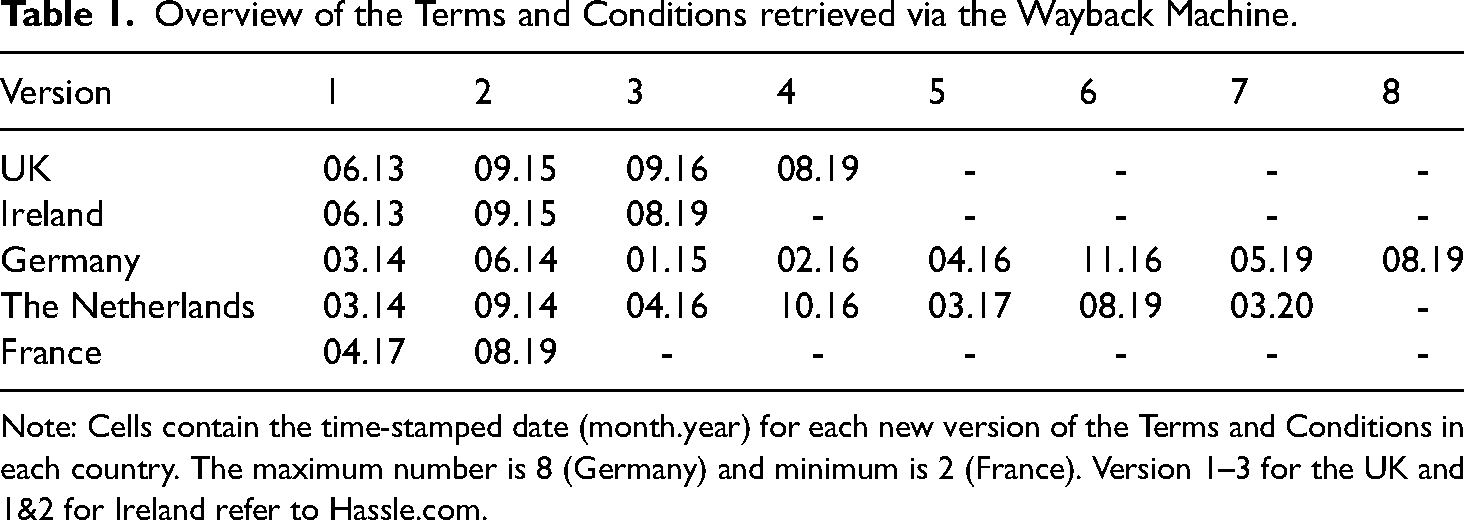
Note: Cells contain the time-stamped date (month.year) for each new version of the Terms and Conditions in each country. The maximum number is 8 (Germany) and minimum is 2 (France). Version 1–3 for the UK and 1&2 for Ireland refer to Hassle.com.
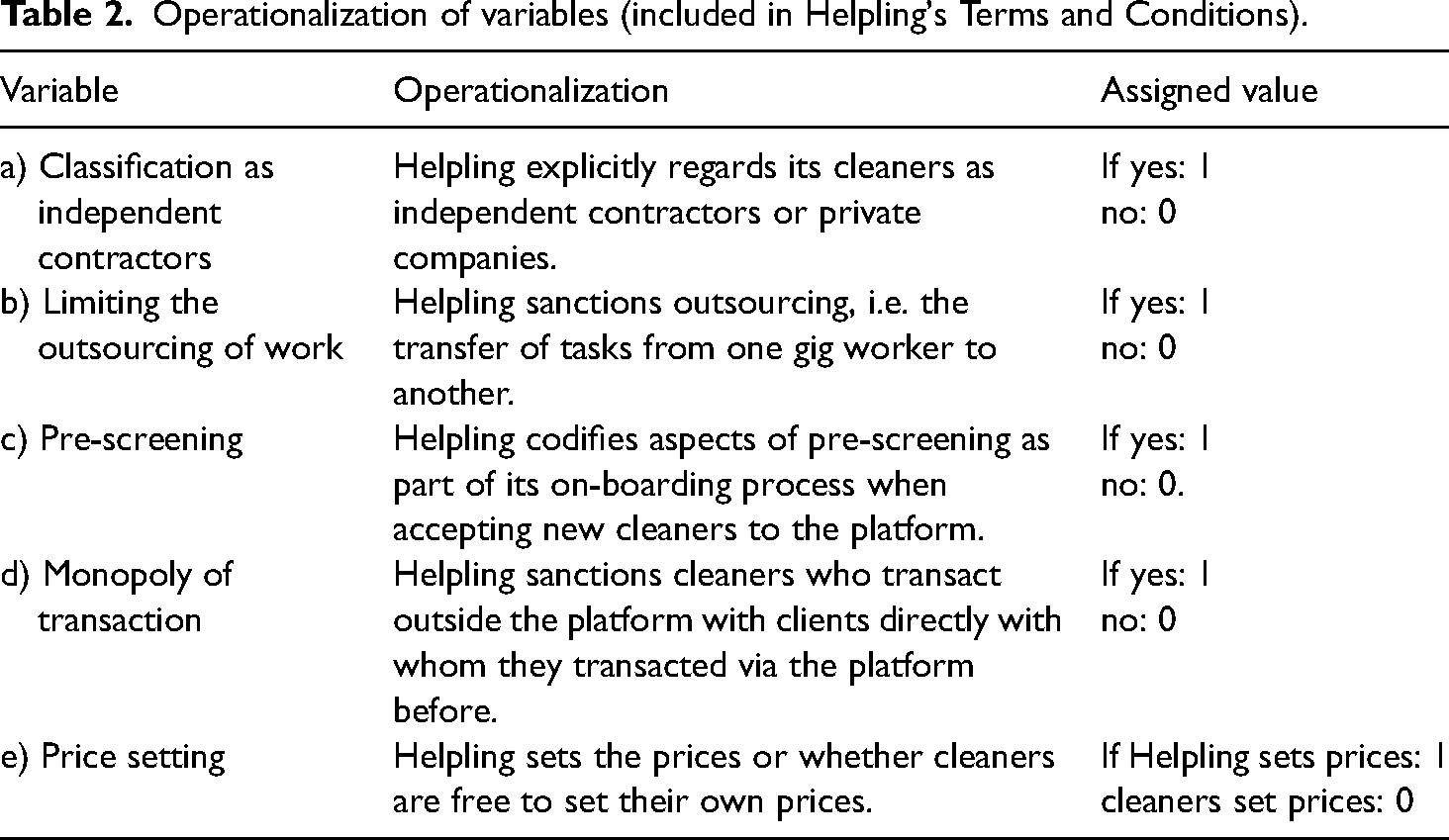
Starting from the earliest version for each country, we compared the contents of the different T&C versions over time and identified changes in both the contents and structure of the T&C text. We analysed each version of Helpling's T&Cs, locating those sections which could be more closely matched with the five aforementioned dimensions that are associated with the control of Helpling over its workers and the resulting risk of being classified as an employer. To do so, we first operationalized each of the five dimensions separately, as described in Table 2. Finally, we assigned a value for each dimension and country, with the value 1 if its presence was detected, and 0 in the case it was absent.
Operationalization of variables (included in Helpling's Terms and Conditions).
Media analysis
In order to triangulate and further interpret the findings emerging from the analysis of Helpling's T&Cs, in particular Helpling's adjustments of T&Cs in different country contexts, we analysed media articles about Helpling in the five countries under investigation (indicated by ‘art.’ below). To arrive at these articles, we used Lexis Nexis, which contains a broad selection of all major European newspapers, as well as a significant number of online web sources. For each country, we selected all articles from the Lexis Nexis database referring to Helpling. 1 The time period covered went from the moment in which Helpling started to operate in the respective country until October 2020.
For all five countries together, the search returned over 2000 articles, which we then reviewed in order to identify those where Helpling was the main topic. We furthermore excluded news items that mentioned Helpling without providing further information, or that merely repeated a previous article. We then performed a second review in order to identify those news items that provided insights into the five regulatory dimensions we identified before. This sampling process resulted into a final corpus of 68 articles: 35 for Germany, 21 for the Netherlands, 4 for France, 4 for the United Kingdom and 4 for Ireland. Clearly, Helpling attracted a lot of media attention in Germany and the Netherlands and little in the other countries (France, Ireland, United Kingdom). This can be understood as a first indication of the different evolutionary trajectories of Helpling in these countries, with the process in Germany and the Netherlands being particularly rich of conflicts (more on this below).
Results
Table 3 lists the features of Helpling's T&Cs for each country as well as the changes that were introduced until October 2020. For each modification, the T&C is indicated below. In two instances, a mutation was reversed at a later stage, so multiple T&Cs are listed.
Changes in T&C dimensions over time.
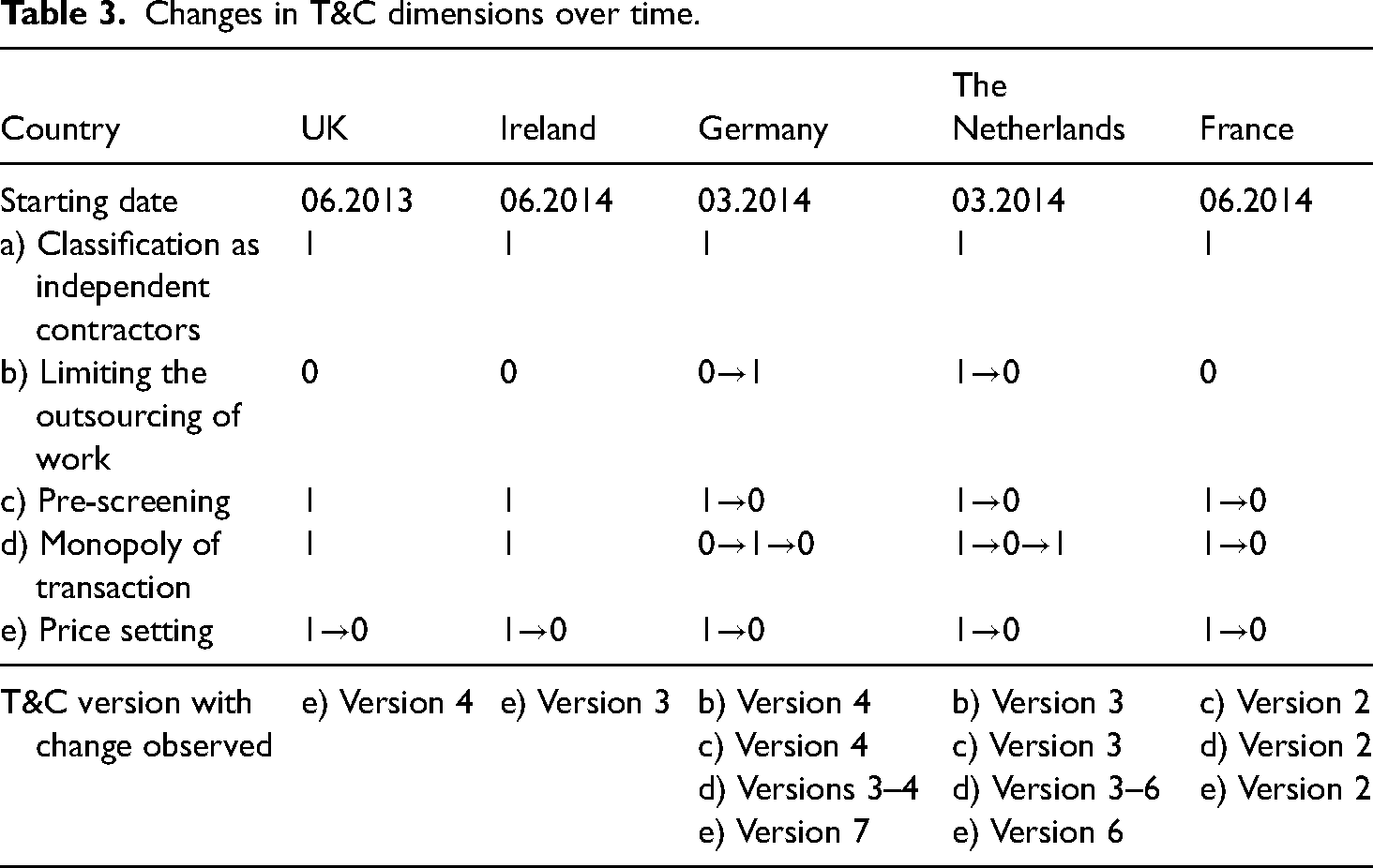
Two clear patterns emerge from comparing these T&C dimensions one by one. First, Helpling did not change the
Second, Helping abandoned its initial involvement in
Regarding the other three dimensions, the patterns across countries are more mixed.
Regarding the
Finally, regarding
The results shown in Table 3 furthermore indicate that Helpling pursued different trajectories in different national contexts. While the T&Cs in United Kingdom and Ireland changed very little and followed the exact same parallel paths, France, Germany and the Netherlands evolved in quite different directions during the period considered. In order to better understand this divergence, we take a closer look at the history of Helpling for each country individually (studying United Kingdom and Ireland together as the platform here pursued the same trajectory). We particularly focus on how Helpling identified business challenges and instances of institutional friction in relation to adaptations of their T&Cs.
United Kingdom and Ireland
Helpling entered the United Kingdom and Irish market by taking over the platform Hassle in July 2015, which was established in the United Kingdom in October 2013 and expanded in July 2014 to Ireland (IR4). At the time, the founder of Hassle, Alex Deplege, saw an opportunity for a large-scale service provider in a market dominated by word-of-mouth or very small cleaning agencies, by having cleaners provide a more customized cleaning service with higher quality (art. UK1, art. UK3). Furthermore, the founder claimed that the platform could have a broader positive societal impact by providing an opportunity for long-term unemployed to find jobs (art. UK1). The prices were fixed at 10 pounds per hour for London and 12 Euro per hour for Dublin, with the platform charging a 10% commission. And, despite the fact that they refer to two different countries, the T&C documents, and subsequently the platform's business model, are identical, up to the point where the documents in our dataset have been modified on the same dates and feature a highly similar content.
Two of the early problems hampering interactions on the Hassle platform were the lack of trust between clients and cleaners, as well as the over-supply of labour, leading cleaners to underbid each other, eventually dis-incentivizing them from continuing to work via the platform. In order to resolve these issues, Hassle introduced a hiring process which included an interview and background checks; and the platform set a fixed price guaranteeing a minimum income for the cleaners (UK1). Throughout the whole period that we study, Helpling continued to mention the intensive screening process – including interviews, proof of identity and the request of references – with the aim to ‘ensure suitability and quality of the service providers’ (see Versions 1-4). Helpling also prohibited cleaners to arrange gigs outside the context of the platform, and up to six months after they had stopped using the platform. This prohibition became even stricter in Version 4, when Helpling introduced a penalty of 500 pounds for that practice.
Neither the introduction of Hassle.com nor that of Helpling received particular media coverage. In sharp contrast to other countries, where Helpling was extensively discussed in the media (e.g. in Germany and the Netherlands), we find very few media reports on Helpling in the United Kingdom and Ireland. Characteristically, only one article was found that refers to the negative social consequences of Helpling's activities. The lack of media coverage is congruent with the stability of the main T&C features in the United Kingdom and Ireland, as institutional opposition was largely absent and unions showed little engagement with this particular platform. The only, and rather late, change made in 2019 allowed cleaners to set their own prices, which was introduced only after this change had already put into effect in France, Germany and the Netherlands. In short, operations of Helpling in the United Kingdom and Ireland were very stable in the course of the platform's history, suggesting little regulatory pressure towards the recognition of gig workers as employees within the context the liberal labour markets of the United Kingdom and Ireland.
Germany
Helpling entered the German market in April 2014 and it initially operated only in four major cities, namely Berlin, Hamburg, Munich and Cologne (art. G1). It set a fixed price of 12.90 Euro per hour, out of which the platform received a 20% commission for its intermediation services. Any further costs like insurance or social security were paid separately by the cleaner (art. G5). Despite the lack of an official employment relationship between the platform and the cleaners, access to the platform was restricted to a selected few. Prospective cleaners had to go through a two-stage application process which certified that they could work legally and efficiently. In the first stage, all prospective cleaners were asked to provide a valid business license (Gewerbeschein), proof of identity, a CV, and a police clearance certificate. Subsequently, they had to go through an interview followed by a ‘trial cleaning’, as a demonstration of their work skills (art. G3). About half of the prospective cleaners were screened-out during this phase, resulting in a smaller albeit competent pool of available cleaners (art. G2).
From the very beginning in 2014, Helpling presented itself as the alternative to informal labour which dominates the German domestic cleaning market. It was calculated that about 88% of all domestic cleaning work is unregistered (art. G33), resulting in 2.9 million cases of illegal work. Previous attempts by the German state to reduce that number, including a 20% tax return on household services and options for deregulated employment as a cleaner, were not successful. Helpling marketed itself as the best option for households to legally employ a reliable cleaner without having to go through the bureaucratic process of registering the cleaner oneself (G4).
In the first months of 2015, Helpling had experienced a rapid growth in activities, capital and size. According to its CEO, the platform was now active in 150 cities in 8 countries around the world and growing, while it made plans for hiring 100 more employees in addition to the 200 already employed (art. G12, art. G13). This was made possible through a series of successful funding rounds, which provided about 46.5 million Euro to the company (art. G12, art. G14). A large part of this money was invested in marketing campaigns, which, somewhat ironically, increased the visibility of their competitor's gig platforms as well (art. G12). In the meantime, four cleaners had sued the domestic cleaning platform Homejoy in the United States, contributing to the demise of the entire company worldwide, including in Germany. In mid-2015, with the main competitor off the market, Helpling consolidated its market leadership (art. G20). It is reasonable to assume that Homejoy's labour dispute made Helpling more sensitive towards the various issues related to the status of cleaners, even if this lawsuit had concerned a competitor and in the legal context of the United States. Furthermore, to explain its failure, Homejoy also emphasized the difficulty of maintaining the quality standards of its cleaners (Farr, 2015). The emphasis on quality confirms the early strategy of Helpling to strive for maximum control over its cleaners.
By the end of 2015, the rapid growth of Helpling turned into swift retreat. Despite the earlier massive influx of capital, the company was forced to leave some of the countries in Europe and the Americas, where it had previously expanded, and to fire a fifth of its personnel (art. G21). The re-focusing onto Germany led the platform to be more attentive to the German situation. Prices remained fixed but increased in some countries to almost 17 Euro (13.5 Euro after the commission) in order to better reflect the increased living costs in cities and to make the platform more attractive for cleaners (art. G23). Furthermore, Helpling (unsuccessfully) advocated the relaxation of those rules which had blocked asylum seekers from taking up employment until their application had been approved (art. G23). As a further response to those growing challenges, the platform instigated a number of changes of its business model, which can be witnessed in the fourth T&C version of February 2016. Critical aspects were altered in the attempt to make the hiring process more flexible, while maintaining a high quality of services.
The first change was the abolition of the two-stage application process for prospective cleaners as any reference to this was removed from the T&Cs. While it was still necessary for cleaners to provide some basic proof of identity, the rigorous testing and high-level screening process was eliminated. Given Helpling's financial challenges at the time, this change may have been a cost-reduction strategy, ‘outsourcing’ quality control to clients’ ratings. At the same time, there also was a clear move towards giving extra leeway to the gig workers in order to define their role in the transaction. Helpling's T&C statement is particularly noteworthy to this end, saying that ‘(s)ervice providers are free to have the work performed by their own employees or subcontractors’ (Version 3). And a few months later, Helpling attempted to claim the monopoly of transaction by introducing the following statement into the T&Cs: ‘Should Helpling become aware that a user and a service provider instead of a cleaning contract for independent services establishes an employment contract or the fulfilment of an order actually performs like an employment relationship, this constitutes a reason for extraordinary termination of the user contract without notice.’ (Version 3). Similar to previous cases, this phrase completely disappeared from the text in 2016. Taken together, all these measures reflect attempts by Helpling to improve their performance through a combination of cutting costs, expanding its worker base and getting a tighter grip on their behaviours.
Interestingly, these changes were initially met with little resistance from government authorities, possibly due to the unregulated nature of domestic cleaning and the failure of past political attempts to improve cleaners' work. What is more, around that time (in 2014), the German government was even contemplating the creation of its own state-sponsored cleaning platform with the aim of decreasing undeclared labour, an idea that was later silently abandoned as more and more gig platforms became active in Germany. As the German government was already thinking along the lines of a platform solution for the social issue of informal labour, Helping started calling for a market-based response, conveniently placing itself at the forefront. Against this background, the German government did not voice any strong opposition, despite the legal ambiguities inherent to Helpling's T&Cs.
On the other hand, trade unions and the cleaning industry were sceptical about the gig economy and its related dangers for workers’ rights resulting from the digitalization of work, with Helpling often used as a reference. For example, IG BAU – the trade union responsible for (amongst others) cleaning workers – referred to Helpling when discussing the negative effect of digitalization on the established employment relations (art. G8). Similarly, the industry association of cleaning companies in Germany criticized the platform for offering low wages, accusing Helpling of replacing undeclared work with pseudo self-employment (art. G9). In 2018, the head of the major union confederation DGB referred to Helpling and Uber when he called for social security contributions and collective agreements in order to avoid the creation of a digital precariat (art. G28). Nevertheless, any opposition from the social partners remained limited to nothing more than rhetorical arguments – without any further political or legal action taken against the platform.
Overall, Helpling thus encountered little resistance during its introduction and expansion in Germany. Against the backdrop of a mostly unregulated domestic cleaning market, the platform managed to successfully market itself as a radical solution to a longstanding problem. At the same time, the social partners adopted a more systemic and critical approach towards the gig economy, viewing it within the broader context of digitalization and liberalization of the labour market. As Helpling's operations were limited to the domestic cleaning market, which is already beyond the direct control of the social partners, the latter did not mobilize any significant opposition.
The Netherlands
Helpling entered the Dutch market in June 2014, against a backdrop of an informal domestic cleaning sector, high unemployment and tightening budgets for care services in the local administration (art. NL2). Shortly after its introduction, the platform expressed its intention to expand to the broader cleaning service sector, for example, the home care sector (art. NL2). FNV, the largest Dutch trade union confederation, was quick to raise concerns about the comparatively low salaries of gig workers and their restricted access to basic labour rights (art. NL1). Eventually, the platform was limited to domestic cleaning services.
Upon becoming active in the Netherlands, Helpling did not find an unregulated legal context. The main characteristic of the Dutch market for domestic cleaning services was the incorporation of the ‘Regeling Dienstverlening aan Huis’ (Regulations for Domestic Services), which was created with the aim of providing certain labour rights to domestic workers – similar to the third category of ‘worker’ in the United Kingdom – who would otherwise remain highly precarious. These regulations only apply in the case of individuals who work less than four days per week, and they include specific provisions regarding salary, holidays, holiday allowance, extra costs and sick pay. 3 Despite the existence of such a tailor-made regulatory instrument since 2007, its implementation was not deemed successful. Most cleaners and clients were unaware of this regulation and cleaners rarely declared their income to the tax authorities (Frenken et al., 2017). This failure, in combination with the lack of viable policy alternatives, such as the non-incorporation of the ILO Convention No. 189 and the lack of a government-supported subsidy scheme to hire formal cleaners, gave Helpling the opportunity to market itself as a legitimate business to the Dutch government – that is, as an innovative solution to persistent problems – by taking the existing Regulations for Domestic Services as the starting point for its T&Cs (art. NL3, art. NL7).
Helpling's T&Cs underwent substantial changes. Originally, in 2014, the platform applied the standard practice of controlling the quality of cleaners. It publicly explained the various ways in which Helpling wanted to ensure the quality of cleaners via pre-screening, the establishment of a monopoly of transaction, and the ban of cleaners with bad reviews. That was evident in both Helpling's public communication (art. NL3, art. NL4) and its T&Cs (Version 1, 2), where pre-screening was referred to as follows: ‘Helpling checks once in a personal conversation with the service provider his background, references and experience’.
Helpling initially also prohibited contacts with extant clients outside the platform (Version 1, 2), but also removed this restriction in 2016 (Version 3). Finally, as the Regulations for Domestic Cleaning view individual cleaners as a special type of independent contractors with certain protections, Helpling NL prohibited outsourcing to other parties (Version 1, 2), which contrasts with its practices in other countries, except Germany.
In 2016 though (Version 3), two years after the platform was introduced, many of those provisions that have limited cleaners in their freedom of how to execute their service, were eliminated from the T&Cs of Helpling NL. More specifically, the platform dropped any references to on-boarding interviews, prohibition of contacts outside the platform and the prohibition to outsource work to other parties (Version 3).
Despite its efforts to deflect any criticism around working conditions, the platform did not escape the attention of the largest union FNV. In January of 2018, following a lawsuit against Deliveroo, the trade union turned to Helpling. FNV claimed that the platform should be classified as an employer, a claim grounded inter alia in the fact that workers were not allowed to set their own prices (art. NL6) and to transact outside the platform (art. NL8). In addition, some labour law experts (art. NL8, art. NL10) and incumbent temp agencies (art. NL10, art. NL12) raised the issue of legality.
As a consequence, the question of wage setting and minimum wage became a point of concern that also translated into a change of Helpling's T&Cs in the Netherlands. Since 2016, the average hourly wage on the platform was around 11 to 12 Euro – after the platform had received its 20% commission, but before any taxes were paid. At the same time, the minimum wage in the Netherlands stood at almost 9 Euro. Although it would be well within its ability to allow even lower wages, Helpling consciously refrained from doing so and later (in 2019), as a reaction to the aforementioned Deliveroo-lawsuit by FNV, even abandoned price setting altogether as the first out of the five countries studied here. According to Helpling's executive, the core reason for no longer determining cleaning prices was that the platform would risk being engaged in a potentially dangerous political and PR feud with trade unions and political parties (Frenken et al., 2017). Such an event would not only lead the platform to be seen in a bad light, but it would also risk legal action and the potential of being subjected to unfavourable regulation as an employer. Accordingly, Helpling now allowed workers to set their own wages, whereby the platform continued to ensure a wage minimum, now of 16 Euro per hour. Furthermore, the platform also chose to incorporate the Domestic Cleaning Regulation into its regular cleaning activities.
A year later, in 2019, the union FNV won its lawsuit against Deliveroo, which forced the platform to hire its couriers as employees and to pay them within the context of the sectoral labour agreement (art. NL16). Emboldened by this development and the possibility to apply a similar rational to other platforms, FNV quickly filed a lawsuit against Helpling (art. NL17). In this case, however, the court ruled that domestic cleaners would fall within the scope of the Regulations of Domestic Services, implying that they would not be considered employees of the platform (art. NL18, art. 20). Nevertheless, because Helpling obtained a commission from its cleaners, the court placed Helpling into the category of a temp agency. The equally obvious and simple response by Helpling was to adjust is business model and to collect the commission from its clients rather than its cleaners (art. NL22) which, in turn, ensured that Helpling could continue to operate as a gig platform with independent contractors under the Regulations of Domestic Cleaning. Furthermore, the ruling allowed Helpling to reintroduce the prohibition of contact (monopoly of transaction), even introducing a fine of 500 Euro for any client who attempted to bypass the platform (Version 6).
In sum, Helpling was seen as a particularly disruptive force in the Netherlands, thus provoking strong reactions from the social partners which forced the platform to change its initial business model enshrined in its T&Cs in various ways.
France
The French version of Helpling presents yet a different context, which is rather deviant from any other country examined. Interestingly, Helpling FR acts as an intermediate not only between domestic cleaners and households, but also between households and professional cleaning companies which can take a variety of legal forms (e.g. SA, SAS, SARL, EURL or auto-entrepreneurs). This peculiarity can be understood by considering the pre-existing regulation in France, which provides households with tax benefits if they choose to hire professional cleaners. Nevertheless, a significant share of domestic cleaning remained informal in France. And, as in the case of Germany and the Netherlands, Helpling also framed its service in France as a way to solve the political issue of informality in the domestic cleaning sector (art. F1, art. F2).
The most significant implication of cooperating with a number of different legal entities is that work can either be subcontracted to another party, or performed by employees of those corporations, which are collectively referred to as ‘partners’. Furthermore, the latter are responsible to assure compliance with all the relevant regulations regarding fiscal and labour issues.
Importantly, though, this position of intermediation transformed in the course of time. In the first version of Helpling's T&Cs (of 2017), the platform assumed a more active role in the hiring process by pre-screening the certificates of some of the service providers and by setting prices (Version 1). Helpling also prohibited to transact with extant clients outside the platform (Version 1). Later, in 2019, all these provisions were retracted, thus maximizing the entrepreneurial freedoms of cleaners (Version 2). This again illustrates the importance for Helpling to only be perceived, and act as, a ‘marketplace’ between any cleaning ‘partner’ and client.
The retreat of Helpling France into a minimum role of intermediary is also apparent from its changing role in the proper declaration of income. In the first T&C version available, the platform took on the role of guaranteeing that partners were complying with their commitment to declare all relevant income to the platform, which subsequently informed the client. Later though, in 2019, the platform referred the responsibility of proper income declaration directly to the cleaning partners.
Contrary to the cases of Germany and the Netherlands, Helpling in France did not provoke much public debate nor specific responses from the social partners or the government. In this case, the platform chose to adapt to the existing institutional context of domestic cleaning work, further reinforcing both the platform and the institutions it adapted to.
Cross-country analysis
The country cases show that Helpling started out with T&Cs that were very similar across countries. Helpling's use of similar T&Cs across countries can be understood as typical for platform companies that seek rapid internationalization. However, over time, we find that Helpling substantially adjusted its T&Cs in different countries in different ways so as to adjust them to different national contexts.
Two specific observations can be made in this respect. First, while Helpling made only one change in the T&Cs in the United Kingdom and Ireland, it implemented three changes in France, Germany, and the Netherlands. What is more, Helpling made one further change in Germany and the Netherlands, which were later reversed. The cross-country comparison thereby provides evidence for the relative stability in the liberal market contexts of Ireland and the United Kingdom and a more turbulent evolution on the European continent.
Second, we observe that, over time, the variety in T&Cs across countries increased. In particular, we can see that the French and German T&Cs became more dissimilar from the United Kingdom and Irish model. The United Kingdom and Ireland retained the original Helpling model with the single exception that price setting was transferred to cleaners. In these countries, Helpling thus maintained a high degree of control over its workers despite their classification as independent contractors. In France and Germany, by contrast, Helpling altered its business models in multiple ways, following different trajectories but ending up with similar T&Cs in which the control over workers was removed so that cleaners were effectively treated as ‘true’ independent contractors. In the Netherlands, in turn, Helpling constitutes an in-between case, which is different from the United Kingdom and Ireland in only one aspect (no pre-screening interviews) and different from France in one other aspect (monopoly of transaction).
The clustering between the two main groups of platform business models, with the United Kingdom and Ireland on one side and Germany and France on the other can be mapped onto the original Varieties of Capitalism theory as laid down by Hall and Soskice (2001), similar to the comparative study on the platformization of the logistics sector in the United Kingdom and Germany (Hassel and Sieker, 2022). One key finding of our media analyses is that Helpling met little institutional friction or opposition by unions in the typical LMEs of the United Kingdom and Ireland. Acting within an institutional environment characterized by a high degree of labour-market flexibility and a low degree of worker protection, the platform faced little pressure to adjust its business model. Its introduction and evolution did not raise major public concern from the social partners or other actors, a fact also reflected by the very few media articles on Helpling. Subsequently, the lack of institutional friction allowed the platform to maintain the gig-economy model as originally invented in the United States, without facing the danger of being classified as an employer.
In France and Germany, the institutional framework led the platform to rethink its business model, adapting it in such a way as to decrease friction and increases institutional fit. In the case of France, Helpling's strategy was to adjust to an already established regulatory framework that had formalized domestic cleaning at the sector level through a tax benefit scheme for clients. Indeed, the resulting T&C modifications all involved changes that equalized the entrepreneurial freedoms of cleaners with those of professional cleaning companies. As the regulation was already in place and well institutionalized when Helpling entered the French market, the process of the platform's adaptation was rather straightforward with no specific involvement of trade unions and little public debate (also evidenced by the few media articles about Helpling). This finding shows that clear regulatory frameworks already in place, consonant with the notion of France as a state-enhanced market economy, notably affected Helpling's adaptation strategy.
Helpling also moved away from the initial T&Cs in Germany, as it did in France, but following a quite different trajectory. Contrary to the state-enhanced market economy in France, a sectoral regulatory framework was lacking in the coordinated market economy of Germany, which implied that the platform had to adapt its business model in an ad-hoc fashion. In Helpling's early days in Germany, adaptations were primarily motivated by the aim to improve the sluggish financial performance of the platform rather than by the aim to arrive at an institutional fit and a dialogue with the social partners. Later on, however, unions and industry associations increasingly raised concerns about low pay and the lack of social security, also reflected in the many media articles about Helpling Germany, prompting further changes to the platform. The latter dynamic can indeed be understood as a reflection of the underlying labour institutions that characterize Germany as a coordinated market economy, which has also been highlighted in previous work on other gig platforms in Germany (Funke and Picot, 2021).
The Dutch case, as a coordinated market economy, presents an insightful anomaly. While Helpling was severely criticized by the unions (art. NL8, art. NL16) and labour-market experts (art. NL8, art. NL10), and although the platform changed its T&Cs throughout the period observed, the final outcome of its T&Cs is very close to the original gig-platform model combining maximum control by the platform with maximum flexibility for workers prevalent in LMEs. The only difference to the United Kingdom and Ireland is that intensive pre-screening is no longer mentioned in the T&Cs of Helpling the Netherlands. Helpling's high control over cleaners in the Netherlands can be explained by the peculiar pre-existing Regulation for Domestic Services, through which a special category of independent contractors was created including with some social rights. This specific category is similar to the third category of ‘worker’ in the United Kingdom in that it provides a possibility to avoid classifying cleaners as regular employees or independent contractors. Using these specific regulations as a baseline, Helpling could thus create a more legitimate architecture in its T&Cs, along with a standard line of defence whenever the platform needed to react to public criticisms. In this way, Helpling the Netherlands could sustain the original gig-platform model as originally invented in the United States, despite repeated criticisms by unions and experts. This contradiction partially explains why, compared to other countries, one can observe such a strong reaction on the part of the Dutch unions. The existence of a special category, where domestic workers enjoy only minimum labour rights, effectively created an ‘enclave’ of liberalization within a context of domestic work. Social partners view this contradiction as a potential threat to their immediate interests, and if left un-controlled, to their institutional position. In an attempt to defend that position, the Dutch unions actively strived to undermine this position, seeking to enforce traditional labour market regulations within the cleaning sector – but with limited success thus far.
Taking together the cases of the Netherlands and France, our study shows that the national institutions characterizing a coordinated market economy like the Netherlands may, by themselves, have little predictive power explaining the institutional responses to gig economy platforms and the platform adaptations that follow. Rather, platforms seem to adapt to the more specific sectoral regulations that apply to the service sectors in which they operate, which may be flexible and enabling the platform model (as in the Netherlands), or strict and constraining the platform model (as was shown in the case of France).
Conclusion
The rapid proliferation of gig platforms in Europe has given rise to a major debate regarding their compatibility with existing labour market institutions. Platforms claim that the use of independent contractors is an innovative way of providing flexibility to both gig workers and clients. However, the control that platforms exercise inevitably bears a number of regulatory questions regarding pay, social security and working conditions. Our aim in this paper was to explore, in different national contexts, how the same gig platform responded to the regulatory frictions that emerged in five European countries. To that effect, we analysed the evolution of Europe's leading domestic cleaning platform, Helpling, by tracing the changes in its T&Cs that workers have to accept to get cleaning jobs via the platform.
Helpling's model aims to reconcile two conflicting logics: namely to provide high quality services through the enforcement of common standards over workers and close monitoring of their activities resulting in a high degree of control (corporation logic), while maintaining the status of independent contractors of gig workers by granting them the freedom to select their own gigs (market logic). In an effort to maintain this balance, the platform tweaked several aspects of its T&Cs related to the employment status of workers, but did so in different ways within the various countries it operated. When analysing these T&C modifications, our study shows that gig platforms are, by no means, immune to national regulations. On the contrary, we found that a platform may well adapt to the specific institutional constraints of national labour-market regulation. Our findings thus cast doubts on the notion that platforms, as a new organizational form, would operate in an ‘institutional void’ (Bothello et al., 2019; Elert and Henrekson, 2016). Our study instead shows that Helpling maintained the original gig model, combining maximum control with independent contracting, in those countries where the platform experienced little friction with existing laws and regulations (United Kingdom and Ireland). In other countries, it leveraged existing, yet malfunctioning regulations in its favour (the Netherlands), or adapted its T&Cs responding to union critiques (Germany). And in a country with strict sectoral regulations (France), Helpling actively adapted to the context already in place.
Ultimately, this is a strong indication that national governments and unions are not powerless in the face of platformization (Van Dijck et al., 2018). On the contrary, national and sectoral regulatory contexts can shape the international activities of platforms by influencing their national modus operandi. Yet, to date, the adaptations made by platforms have not solved the legal conundrum regarding the employment status of gig workers. Rather, platforms such as Helpling adapt their T&Cs tactically, precisely in order to preserve the status of independent contractors of their gig workers. In doing so, at least for now, platforms have successfully managed to preserve their status of e-commerce intermediary, thereby avoiding that gig workers are classified as their employees (McGaughey, 2018; Walker, 2020).
Understanding platform evolution thus requires a careful analysis of institutional contexts at both national and sectoral levels, as much as of the digital technologies and innovative business models that they employ. It is the constant interplay between platforms and institutions, and the mutual learning processes emerging from it, that shapes the phenomenon we call the ‘gig economy’.
Footnotes
Acknowledgements
Nikos Koutsimpogiorgos and Andrea M. Herrmann acknowledge funding from the Netherlands Organisation for Scientific Research (NWO), Vidi grant number 452-17-017. The authors declare no conflicts of interest. The authors would like to thank Kathleen Thelen, Jaap van Slageren, Adrian Toroslu and the participants of the Network F: Knowledge, Technology and Innovation SASE 2020 Virtual Conference, for their valuable comments, feedback and assistance in the production of this paper. All errors remain ours.
Declaration of conflicting interests
The authors declared no potential conflicts of interest with respect to the research, authorship, and/or publication of this article.
Funding
The authors disclosed receipt of the following financial support for the research, authorship, and/or publication of this article: This work was supported by the Nederlandse Organisatie voor Wetenschappelijk Onderzoek (grant number 452-17-017).

Notes
Biographical notes
Appendix