




Abstract
The “treadmill of production” economic system increasingly threatens to undermine the foundations of future human welfare. While urgent action is needed, conceptualisations of “the good life” (TGL) as the “imperial mode of living” (IML) of overconsumption are justifications upholding the system and driving forces behind the crises. German trade unions, which, as part of the historic bloc of the growth coalition, have tried to delay climate action in the name of jobs through “praising work”, have supported the hegemonic common sense of IML-TGL. This is an obstacle to environmental union organisation and progressive coalitions for social-ecological transformation. To investigate whether and to what extent divergent good sense counter-hegemonic narratives are present within German trade union discourses, we analyse the narratives of TGL and good work within the three biggest German unions – ver.di, IG Metall, and IG BCE – using Gramsci’s theory of common sense. We find that counter-narratives of TGL are present to different degrees within the unions and amongst interviewees. These can provide entry points for counter-hegemonic narratives of TGL and alliances with societal actors fighting for “solidary modes of living”, or a Good Life for All within planetary boundaries.
Keywords
Humanity is heading towards a breakdown of the support system upon which human societies and life are dependent – including the high likelihood of an ever-warming planet if the 1.5-degree limit of climate heating is crossed, which is now likely in the 2020s (Schröder and Storm, 2020; Steffen et al., 2015). Despite increasing efforts by environmental movements and multiple rounds of international climate negotiations, there has been little substantial political action. Consequentially, more than half of all global CO2 emissions generated since 1751 have been emitted since 1990 – when the very first Assessment Report of the Intergovernmental Panel on Climate Change (IPCC) was published – and emissions have continued to increase along with the number of IPCC reports (IEEP, 2020).
Environmental action has been framed in the past as an issue of tangential concern, relevant to ecologically minded groups, rather than tackling an existential threat (Foster, 2005; Lamb et al., 2020). This is because environmental crises challenge the foundation of the economic system and the current organisation of society – including the societal organisation of work (Hickel et al., 2021; Keyßer and Lenzen, 2021). Schnaiberg (1980) describes the economic system as a “treadmill of production”, powered by reinvestments of revenue that increase production, necessitating increased consumption. Increased consumption, in turn, depends on societal purchasing power, i.e., high employment-levels and wages. Consequentially, labour, state, and businesses all have prima facie interests upholding the treadmill and coalesce in a growth coalition perpetuating it. The outcome is the pursuit of economic growth at all ecological and social costs as a presumed foundation for societal peace and a good life (Gould et al., 2004; Schnaiberg, 1980). The growth consensus is, in Gramscian terms, hegemonic (Snir, 2016). Accordingly, climate change and related environmental crises have until recently been overlooked in employment relations – with the notable exception of environmental labour studies (Goods, 2017). Analysing the role of actors in the treadmill utilising a Gramscian framework allows a more nuanced understanding of the different channels through which the hegemony of the growth consensus is pursued or challenged by those actors, widening the analytical scope to include the role of everyday practices and sensemaking (Crehan, 2016). The role of organised labour in the treadmill – both as agents in the work process of production and as agents of the growth coalition – makes its analysis of paramount importance. As key “treadmill actors”, organised labour could slow down or even overturn the treadmill (Obach, 2004; Schnaiberg, 1980).
German unions, as key treadmill actors, have historically actively delayed climate action through protecting well-paid jobs in ecologically destructive industries, for example in the coal-mining industry (Kalt, 2021). Unions have only slowly begun to engage with the interrelated environmental and social crises. IG Metall, the country’s most powerful union, has, for example, been striving to find employee-friendly solutions to the restructuring of the economy, including in the automobile sector (IG Metall, 2021). These slowly emergent debates in the sphere of trade unions are intertwined with and engender unions’ visions of the future of work, and concurrently, what is understood as a worthwhile, dignified life – “the good life” (TGL) –that unions have been striving for since their emergence in the late 19th century. While meeting material needs is a key part of welfare, conceptualisations of TGL beyond material wealth were previously a key element of different workers’ movements (Schneidewind and Zahrnt, 2014). The hegemonic understanding of TGL, however, is built on the exploitation of resources, ecosystems, sinks and cheap labour in the Global South and is not generalisable without overshooting planetary boundaries. Brand and Wissen (2021) term it the “imperial mode of living” (IML). We analyse current conceptualisations of the future of work and TGL in the case of the three biggest German unions: IG Metall, ver.di, and IG BCE. In the German context, trade unions have considerable political influence, since the corporatist social partnership structure establishes unions as negotiation partners with extensive and well-secured business and union rights (Hyman, 2001; Mildenberger, 2020). At the same time, this social partnership orients German unions towards incremental rather than radical change in international comparison. In the past, corporatist structures have delayed climate action due to the “double representation” of fossil fuel interests in Germany via industrial unions and affiliated political parties (Mildenberger, 2020).
There are large differences between the three chosen unions in terms of their political backgrounds, orientation and membership. As the three biggest unions, they also have substantial political clout, presenting an apt case for comparing different narratives of unions that are relevant actors in the country’s transition to a sustainable economy. They represent the workers most affected by the transition away from coal mining (IG BCE), the turn away from the combustion engine affecting the German automobile industry (IG Metall), or have a mixed membership, including workers employed in sectors deemed important for a sustainable economy, such as healthcare (most notably ver.di). In Hyman’s (2001) classification, IG BCE (amongst others in the chemicals, pharmaceuticals, glass, mining, energy industries) can be considered a “market-focused” or business union; IG Metall (amongst others in the metal, electronics, steel, textiles, wood processing, auto mechanics, electricals, carpentry industries) both society-/class- and market-focused; ver.di (public service, health and care, social and education, transport, etc.) is considered society-/class-focused (Dribbusch and Birke, 2019; Silvia, 2013). The unions’ different characteristics facilitate further comparative understanding of unions’ positioning in the sustainability debate. Our research sets out to analyse conceptions of TGL and good work in German trade unions through the lens of Gramscian theory to understand reasons for continued support of the treadmill and potential for slowing it down. After introducing our theoretical framework with reference to the analysed unions, we conducted a narrative analysis based on the work of Roe (1994, 2007). We show how the prevalent common senses of TGL and good work embedded in the treadmill of production explain continued unsustainability as well as pointing out how and where narratives breaking out of the logic of the treadmill emerge.
Theoretical framework
The treadmill and “the good life:” common sense and the structuring of the unsustainable everyday
The insights of Antonio Gramsci provide a key to understanding how the “treadmill of production” (Schnaiberg, 1980) system is upheld despite increasingly visible environmental destruction and social contradictions, especially in the wake of neoliberal flexibilisation in the 1980s (Eversberg, 2019). Gramsci’s work, turning away from Marxist orthodoxy, helps to understand not only the material basis but also a cultural aspect to hegemony, which allows for better understanding of the continued support for the treadmill (Snir, 2016). 1 Hegemony arises from the manufactured, active consent of people via the ideology of “common sense” and the state-civil society nexus (Burawoy, 2012: 192; Gramsci, 2011). The ideology of common sense, “the spontaneous philosophy of the multitude which has to be made ideologically coherent", normalises and justifies historically unique and socially created power relations, oppression, and ways of living, as the “law of nature” (Crehan, 2011: 284, 276). Common sense is not necessarily expressed as an explicitly held belief system, “but may be in the form of implicit, self-evident consent” (Snir, 2016: 4). It is through quotidian, everyday practices that the capitalist logic comes to be naturalised, as it “provides a heterogeneous bundle of taken-for-granted understandings of how the world is that make up the basic landscape within which individuals are socialized and chart their individual life courses” (Crehan, 2011, 287). According to Gramscian analysis, the coalition of actors in the state-civil society nexus, including trade unions, constitute a “historic bloc”, which supports and reinforces the ideology of common sense (Burawoy, 2012: 192). The historic bloc in the service of the treadmill has been called the “growth coalition” (Schnaiberg, 1980: 205). As long as the coalition and the ideology of common sense are intact, hegemony persists (Bond et al., 2020).
Agreement amongst the historic bloc/growth coalition has helped to elevate the benefits of the treadmill system to societal common sense (Gould et al., 2004). Schnaiberg (1980) explains that labour, state and business have had different reasons for supporting the treadmill. “For capital, two major concerns are: (1) ensuring that expanded production will in fact be consumed by labor; and (2) ensuring that sufficient profits will result to protect the enterprise from competitors and permit future expansion. For labor, the concerns include: (1) the increased availability of jobs and wage income; and (2) an improvement in life conditions, including both consumer comforts and qualitative shifts in their social environment (better schools, health services, recreational facilities). For the state, production expansion implies: (1) an increased flow of revenues from the private sector (capital and labor taxes); and (2) an increased ability to satisfy the demands of both constituencies for economic and social programs.” (Schnaiberg, 1980: 211)
The common sense of the treadmill on behalf of the growth coalition has been built on 1) the cultivation and valorisation of consumer desire for an ever-increasing array of goods, promoting overconsumption as TGL; 2) the glorification of productivity and work; and 3) the side-lining or negation of the environmental and social contradictions of the treadmill.
Common-sense narratives of TGL as consumption have stabilised the treadmill while the consumption habits and modes of living of the Global North (and the elites in the Global South), have justified the treadmill system globally. This holds true not only for the wealthy, but includes average, globally affluent citizens (Wiedmann et al., 2020). Brand and Wissen (2012, 2021) conceptualise this as the “imperial mode of living” (IML), a narrative of TGL based on material affluence, dependent on the exploitation of humans, non-human animals, and natural resources, notably in the Global South (Brand and Wissen, 2012). Labour and trade unions have supported the common sense of consumption as TGL, in many cases protecting the treadmill against transformative sections within their own ranks as well as environmental movements (Schnaiberg, 1980: 203). Gould et al. (2004) and Schnaiberg (1980) criticise narrow, individual, consumption-focused solutions to the environmental crises, which do not challenge the treadmill. Challenging the treadmill will require non-elites to take direct or indirect political action as workers and citizens – not consumers (Gould et al., 2004: 303). Crucially, however, for this to be possible, a new positive shared vision of TGL beyond overconsumption – a “solidary mode of living” (Brand and Wissen, 2021) – is necessary (Kreinin, 2021). Therefore, rather than individualising responsibility for unsustainable consumption patterns, the question is rather how modes of living could be altered through societal imaginaries.
The common-sense narrative of TGL as consumption is coupled with the narrative of praising work (Komlosy, 2018: 33). The work process is the mediating link between society and the economy and the driver of the treadmill (Obach, 2004). The effects of work are ecologically damaging – average working hours have a strong positive correlation with carbon emissions, especially in manufacturing and industry (Fitzgerald et al., 2018; Hoffmann and Paulsen, 2020). This suggests the need to consider what type and quantity of work are necessary to promote human and environmental welfare: a consideration missing in the original treadmill theory (Hoffmann and Paulsen, 2020). The current unequal organisation of work in society (paid and unpaid) is harmful to societal and individual welfare – this makes the re-evaluation of societal organisation of work a question of liberation (Graeber, 2018; Hoffmann and Paulsen, 2020).
During the rise of environmental movements, the German unions sided with business and state, “praising work”, fighting for the “right to work” as the right to a good life of consumption, and bolstering workers’ purchasing power “to encourage rampant consumerism” (Komlosy, 2018: 33). This orientation, based also on the social partnership system in Germany, separated unions from, and placed them in opposition to, the more radical student and environmental movements of the 1970s. These movements argued for “overcoming work” and “transforming work” as societal goals, sufficiency rather than overconsumption, communal struggles rather than individualisation, and the reduction of working hours as an alternative to the treadmill (Komlosy, 2018: 33). Interestingly, this was in line with previous conceptions of TGL – facing challenges communally, reinstating the importance of community and life beyond work – that workers’ movements fought for at the start of the 20th century (Eversberg, 2019; Schneidewind and Zahrnt, 2014). The narrative of praising work thus helps normalise the treadmill system while hiding the social and environmental devastation inherent in the current forms of organising work.
The short-term material welfare of workers in the current system is entrenched with the aims of the treadmill, as many “working men and women across the planet find themselves in conditions of servitude at work” (White, 2019: 198). A strong union movement was key in fighting for improved living standards and a bigger share of the treadmill’s profit for workers in the post-war era. Since Schnaiberg (1980) first elaborated on the theory, the global hold of the treadmill has increased exponentially (Gould et al., 2004). Worker interests, on the other hand, have been displaced and marginalised due to (threats of) offshoring, the highly energy-and-materials-intensive replacement of human labour with technology, and the decline of the trade union movement due to assaults by capital and the state in the service of capital (Eversberg, 2019; Gould et al., 2004). The declining position of organised labour in the treadmill has overwhelmed unions with short-term crises and direct material challenges to workers’ welfare, making it difficult to focus on long-term crises and to politicise the environmental crises (Kreinin, 2021). Another complication for union environmentalism has been societally accepted narratives of climate delay. After initially denying the effects of the treadmill on the environment, actors in the growth coalition have supported different narratives of climate delay (Lamb et al., 2020) in the so-called “sustainable development historic bloc” (Bond et al., 2020: 3). Trade unions in Germany have also propagated the idea that green growth and technological fixes would be enough to stop the environmental crises, while keeping jobs and the material interests of the workers safe (Kalt, 2021).
These difficulties mean that unions have followed different approaches to dealing with the multiple crises of society. Some have sided with business and the common sense of the treadmill against the environment, others have tried to compromise and support technological-fix solutions without addressing the treadmill, to avoid conflict, and a few have challenged the environmental crises head-on and opted for a social movement framing that sees workers as citizens with wider societal responsibilities (Hampton, 2015; Kreinin, 2020, 2021).
Slowing the treadmill: The role of labour in the social-ecological transformation
While organised labour has been a key treadmill actor, labour’s role in the treadmill is more complex. Labour is its “weakest link”, offering the greatest possibility for redirecting the treadmill of production. The question is whether organised labour is capable of challenging it and how this may be brought about (Obach, 2004: 338).
According to Räthzel and Uzzel (2011), a union’s environmental orientation is influenced by outside institutional conditions, its membership heterogeneity/homogeneity, union identities and histories, as well as the sectors in which they operate. Unions’ power in taking up environmental concerns has been dependent on their capacity to resolve conflicts between the different groups of workers they organise (Jahn, 1988). Some homogeneous unions in high-impact sectors have avoided conflict in the short term by adhering to the common sense of the treadmill, narrowly focusing on aligning the interests of their members with economic goals and neglecting the long-term challenge of the environmental crises. Heterogeneous unions have found it more difficult to avoid the conflict of the environmental crises as they try to balance the concerns of environmentally aware members with members expecting higher income and consumption from their unions (Jahn, 1988). This is reflected in the case study at hand: the more homogeneous IG BCE has focused on economising the environmental crises, while ver.di, with a more heterogeneous membership divided on the issue, has had to contend with environmental questions and finding a balance. They have done so by promoting the narrative of environmental action while side-lining change to avoid internal political clashes (Prinz and Pegels, 2018). Industrial unions have been more likely to focus on technological-fix narratives, while unions with a history of political involvement have been more likely to use social movement framings (Räthzel and Uzzell, 2011). Accordingly, the more society-oriented IG Metall and ver.di have taken social movement framings, e.g. with IG Metall organising marches for the social-ecological transition, and the more market-oriented IG BCE has focused on technological and infrastructure improvements in their environmental discourses (Prinz and Pegels, 2018; Silvia, 2013).
Business-oriented unions in Hyman’s (2001) typology have, according to Hampton (2015), also borrowed the neoliberal pro-treadmill language of employers regarding the environment: competitiveness, employment, profitability, and carbon leakage. This is visible in the case of the market-oriented IG BCE, which has supported a jobs-first mentality and oriented its interest and narratives towards management– fighting for higher wages for already relatively secure members, excluding precarious temporary workers, focusing on deals with management, and clashing with environmental movements in the mining sector (Moss et al., 2015). IG BCE has weaponised the term “just transition” (Prinz and Pegels, 2018), using it to argue for workers’ continued high consumption rights in the sunset sectors, rather than environmental justice (Kalt, 2021). IG Metall, the market- and society-oriented union, has also often used the term to fight against job loss in the car sector due to the move to e-vehicles (IndustriAll, 2019; Prinz and Pegels, 2018). Like most union framings of a “just transition”, this is based on the technological fix framing, or fighting for a fairer, green treadmill, rather than challenging the treadmill in and of itself (Clarke and Lipsig-Mummé, 2020; Kreinin, 2020).
Few unions have taken a so-called class-/society- or social-ecological-transformation-oriented position on the environmental crises – the only position to challenge the treadmill and the causes of the environmental crises (Hampton, 2015; Kreinin, 2020, 2021; Räthzel and Uzzell, 2011; Stevis and Felli, 2015). Although ver.di, and to some extent IG Metall, can be considered a society-/class-focused union in Hyman’s (2001) typology, this has not directly translated into a society focus when it comes to the environment. IG Metall, the largest union in Germany, has achieved union renewal through “borrowing the rhetoric and techniques of social movement unionism from English-speaking countries”, and gaining members on the grassroots level, especially amongst young people (Silvia, 2013: 8). Nevertheless, this society focus has been more difficult to translate to environmental concerns, where the membership’s interests are more heterogeneous – leading to internal debate and clashes, as well as the need to keep the peace between different factions (Jahn, 1988; Prinz and Pegels, 2018). Like IG Metall, ver.di has also sought to extend its political power by appealing to grassroots and wider societal goals, but has likewise remained relatively decentralised with varying policies and foci through having to appeal to a heterogeneous and divided membership when it comes to environmental issues, as explained above (Keller, 2005; Silvia, 2013).
Unions’ difficulties in taking up positions oriented towards social-ecological transformation are partially explained by the strength of the ecomodernist growth coalition and the difficulties of challenging the treadmill, especially in labour’s weakened position. Additionally, this has been attributed to the failure of environmental movements themselves in standing up to ecomodernist climate delay narratives (Gould et al., 2004), moving beyond middle-class environmentalism (Barca, 2019; Hampton, 2015), and the failure to appeal to the material interests of workers (Jakopovich, 2009; Savage and Soron, 2011). Furthermore, the lack of a common, positive vision of the future past a greenwashed treadmill on the one side, and climate apocalypse on the other, has limited labour’s possibilities for action (White, 2019).
New positive visions of TGL – a “solidary mode of living” or the “good life for all” rather than the “imperial mode of living” (Brand and Wissen, 2021) – are needed to form a counter-hegemonic historic bloc, able to challenge societal practices and understandings that together make up common sense (Burawoy, 2012: 192). Common sense already carries certain elements that a transformation can rely on within itself (Snir, 2016, 4). These parts of common sense, in Gramsci’s original conception, “representing the practical experiences of the dominated classes” are termed “good sense” (Snir, 2016: 4). A coherent common-sense future narrative of TGL within planetary boundaries, the good-sense building block for counter-hegemony, is currently missing – yet commonly accepted visions of TGL as IML are undergoing change. Eversberg (2019: 103) contends that this might lead to a new common sense and transformation of the treadmill, whether from the right or left: “most of the visions of a better life currently being put forward express desires for a slower, calmer, less fragmented and communal way of life[…] At present, however, these visions of the good life are highly fragmentary, socially particular and torn by contradictions”. There has been an increase both in the narratives of overcoming work as well as societal narratives of transforming work. These include demands for relative gender equality in the household division of labour, a refocus on family life and mixed models of work, calls for using technology as a way to liberate labour instead of increasing exploitation, more creativity, self-actualisation, and co-determination in work, and the liberation of work itself (Komlosy, 2018: 42). Both discourses of overcoming and transforming work can thus be considered part of good sense, or counter-narratives to the dominant common sense (Komlosy, 2018).
Good-sense narratives of TGL within planetary boundaries based on "sufficiency", rather than maximising individual consumption, have a long history in environmental and indigenous movements and scholarship, many of which originate in the Global South (i.e. "Buen Vivir"/" a good life for all" (Acosta, 2020; Kothari et al., 2014, 2018; Villalba, 2013)). As Novy (2015: 8) explains: “The good life for all is not just about a shift in emphasis from having to being, but about a collective strategy of becoming and thus the development of the potential for a life as long, as creative, as healthy and as successful as possible for all. Such strategies differ from place to place and do not only require creativity and organisation but also collective action”.
In light of the necessity to build counter-hegemony with a broad alliance of actors striving for social-ecologically sustainable good-sense versions of TGL, it is of paramount interest to understand if and where unions’ TGL narratives provide entry points for forging alliances with environmental and climate movements, both in Germany and on the local level. Our research, therefore, sets out to advance understanding of the common sense present in union’s conception of the good life and good work as well as those aspects of good sense to be mobilised for a social-ecological transformation.
Methods and material
To analyse union narratives of the good life in documents and interviews, we follow a narrative analysis method based on Roe’s (1994, 2007) narrative policy analysis, a poststructuralist methodology for understanding the use of narratives in policy controversies. The study of competing narratives within unions according to the framework developed above allows us to assess how the current common-sense narrative of TGL is structured, where and how divergent narratives emerge, and to which extent those can provide entry points for counterhegemonic coalitions. In accordance with Gramscian scholarship and departing from poststructuralist ontologies, we do not understand narratives as the sole source of union actions - despite narratives being constructive to these (Rhodes, 2018). Simultaneously, however, we consider the emergence of strong narrative storylines (i.e. about the efficacy or virtue of certain modes of living) a prerequisite for policy change in those fields (Berg and Hukkinen, 2011; Roe, 1994). They are needed to gain, in Gramscian terms, “political hegemony”, which is a prerequisite for systemic change (Gramsci, 2011).
Roe (1994) uses the terms narrative and story interchangeably, while Berg and Hukkinen (2011) assert that stories have a beginning, middle and an end. Our operationalisation of the term builds on the first understanding, which also falls in line with the Gramscian conceptualisation of common sense as a heterogeneous landscape of meanings (Crehan, 2011). We systematically analysed the data using the software atlas.ti, proceeding inductively, starting with a keyword search and open coding before grouping the generated codes according to themes, and developing a unified code network. This allowed us to identify recurring themes, evolving patterns, and emerging narrative structures evoked in the debate around TGL, since full stories of TGL according to the definition by Berg and Hukkinen (2011) are rare in written text (Ciomaga, 2014: 495).
Our texts for analysis included both union documents (union delegate conference motions and protocols) and articles in national trade union magazines from 2015–2020. These different types of documents allowed us to account for different forms of union communication. The former concern long-term vision and political goals, developed and discussed by people active in union politics, while the latter are indicative of the way unions present themselves towards their rank-and-file members. The documents were accessed via member login for each of the unions. Table 1 above shows the aggregated number of documents. Ver.di does not provide PDF files of entire member magazines, therefore the number of documents is counted per article. This means that overall, more documents were analysed for ver.di, but fewer pages of text. We account for this by focusing on the proportion of certain narratives within union discourses rather than absolute number of mentions.
Documents used in the analysis.
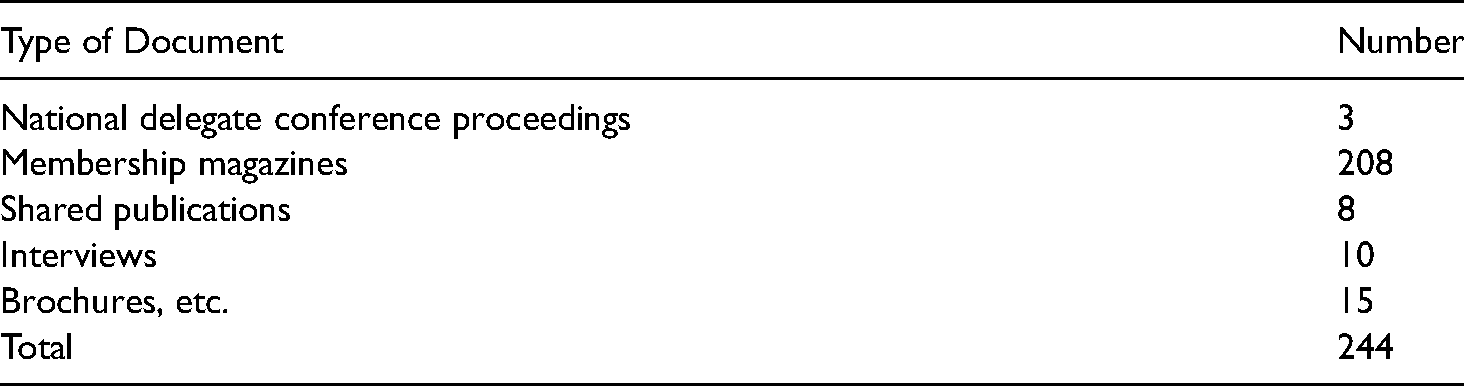
In addition to the document analysis, we conducted 10 interviews with trade union members in the three unions. The semi-structured interviews were conducted via Zoom or telephone due to the COVID-19 pandemic. They lasted between 30-50 minutes with questions grouped around union politics, TGL, and climate change. Interviews were conducted with 7 persons who are active in groups trying to advance climate policy within unions (“Gewerkschafter*innen für den Klimaschutz” and “United for Fight”) as well as three union members currently or previously working in the field of fossil or nuclear energy. The interviews, therefore, served to explore TGL narratives present within explicitly pro-climate factions of the unions, which are not part of official union discourses as presented in the documents. Second, we were able to explore narratives within the group of employees affected by industrial transformation. The interviews are a source to contextualise, corroborate, or challenge the findings of the document analysis and give background information on union members’ understanding of TGL. Of course, the limited number and focus on a specific group does not allow for generalised conclusions.
Empirical findings
In the first step of the analysis, we quantified code occurrences as well as co-occurrences of different codes by union and document type for the full dataset. The quantitative results allowed us to gain an understanding of the landscape of meanings composing the common-sense conceptualisation of good work and good life. These quantified findings are available in the supplementary material online. In the following section, we will highlight our qualitative findings, to show how the different narratives are structured before analysing them utilising the theoretical framework.
In accordance with the understanding of common sense as scattered and dispersed, the analysis of the union documents revealed no unitary narrative about TGL or the future of work in any of the unions. Rather, different narratives could be found within all three unions. In utilising the framework developed by Komlosy (2018), the relation between unions’ conceptualisations of good work and common sense becomes clear. Statements praising work serve to keep the treadmill of production going. This narrative is strongest in IG BCE. Narratives aimed at overcoming work, in contrast, challenge the status quo of work’s place in society. These show where Gramscian good sense is already present within unions and can be most often observed with ver. di. Statements related to transforming work, finally, cover a middle ground, depending on one’s envisaged transformation. These statements are found most often in each of the analysed unions (see figure A1 in the supplemental material). They show a shared understanding that some form of change in the world of work is desirable. However, the change envisioned differs considerably. The examples below are taken from national delegate conferences where unions take democratic decisions on their political platforms. They show the complex internal debates within unions – these can typically express a variety of views: “Numerous studies repeatedly show that working time is a central aspect of a good work-life balance. This requires a personnel policy that is even more oriented towards equal opportunities. We need new company concepts of flexible working hours and more working time sovereignty for different groups of employees.” (National Delegate Convention IG BCE, 2017, 31).
“In shaping the transformation, it is our goal to design good working times that fit the lives of employees. We also see working time policy as an important instrument for a new "Rationalisation Protection 4.0", especially with regard to the issues of job security and qualification.” (National Delegate Convention IG Metall, 2019, 965)
“The reduction of working hours with full wage and staff compensation promises more quality of life, time for friends, family and political participation. Moreover, this could create new jobs. […] Should the desired effect not be achieved, working time could be reduced to four hours a day.” (National Delegate Convention ver.di, 2019, 1347)
While IG BCE’s conception of change in general and working time in particular stays within a managerial framework and aims to improve the status quo, IG Metall uses the framework of transformation, centring job security and employee needs, directly connected to sustainable work. Ver.di's narratives surrounding the transformation of work, in turn, show the most radical departure from praising work and therefore potential to transform work beyond the treadmill (cf. figure A2 in supplemental material). In the interviews, good work was only discussed when brought up by the participants in reference to the three thematic blocs, which was the case for seven of the interviews. Good work was referenced by some participants as a part of union goals or the good life. These participants clearly stated that good work, sometimes coupled with transformational ideas, e.g., working time reduction, is something their union should strive for.
Narratives regarding the transformation of work were tightly intertwined with those of TGL. All analysed unions claim to fight for a good life for their members, with material security as the bottom line. The common-sense status is corroborated by the interviewees, who frequently mentioned the alleviation of existential worries through financial security and long-term employment as prerequisites for TGL. The second common denominator is ensuring adequate, accessible education. As the quotes above show, there is some divergence regarding the importance of work for a good life as an end and not means, which was more prominently put forward by IG BCE, in line with its market-focused outlook. Ver.di and IG Metall focused more on need-satisfaction for a good life, pointing towards adequate housing, health, environmental protection and mobility as the basis for TGL (cf. figure A3-A6 in the supplemental material), corresponding to their societal focus (Hyman, 2001). The narratives of IG Metall and ver.di, in contrast to the majority of those present with IG BCE, are compatible with growth-independent visions of TGL, built on guaranteeing needs satisfaction (O’Neill et al., 2018). Therefore, the unions’ political outlook is clearly structuring the narratives brought forward. At the same time, union membership does not directly translate into certain narratives. Both IG Metall and IG BCE represent workers affected by decarbonisation efforts yet take different stances. Contrary to the union documents, TGL is explicitly linked to environmental protection in nearly half of the interviews. Themes like solidarity or the importance of political work for personal well-being were brought up frequently, which is intuitive given that the sample includes only people who are politically active in some form, be it within their union or in other forms of activism.
Discussion
The above findings allow us to analyse how common-sense narratives of good work and TGL stabilise the hegemony of the treadmill of production and which good-sense narratives carry the potential for counter-hegemonic action. As explained in the previous section, narratives of TGL and good work in all unions display the common-sense narrative of a society in which well-paid, stable employment is the guarantor of a good life of material security. However, the way that this common sense is contextualised differs considerably. This is well illustrated by the two quotes below from membership magazines: “WE ARE DOING WELL. Usually we don’t like to say this in the trade unions, because we always also see where there are deficits in social justice. Because we know very well that by no means all people in our country live in luxury but work hard for their prosperity and have to master many challenges in everyday life.” (Kompakt, 03/2016, IG BCE:3)
At the congress “we will decide on the work program for the next four years. It is about the path to fair change. We have a blueprint for the future: We want a society that is social, ecological and democratic and that enables good work and a good life for everyone.” (Metallzeitung, 10/2019, IG Metall: 15)
These statements are taken from membership magazines rather than conference proceedings, which is not trivial. Magazines aimed at rank-and-file union members continuously communicate union positions and therefore allow for understanding how common-sense materialises. The statement of IG BCE is indicative of the union’s overall stance. It is the only one of the three actors analysed that mobilises the call for more income as an end in itself more often than as a means to achieve personal security, as is the case for IG Metall and ver.di. As the quote by IG BCE shows, the common-sense narrative relationship between a higher income and better quality of life is taken for granted – more income enables more consumption and thus a better life (Eversberg, 2019). For IG BCE, this narrative is corroborated by statements praising work (Komlosy, 2018), which are part of the hegemonic TGL storyline and most often found within this market-focused union. From the perspective of moving towards a good life within planetary boundaries, a focus on more income is not compatible with sustainability in affluent societies, like Germany (Wiedmann et al., 2020). In contrast, the narrative exemplified by the IG Metall quote, also found in ver.di, shows entry points for moving beyond the reliance on higher personal incomes to satisfy one’s needs for a good life. It illustrates how the union links TGL to non-income values: environmental protection and democracy. Those values can be seen as a form of Gramscian good sense entering the narrative. Overall, IG BCE is the union most clearly upholding the common-sense narrative underpinning the unsustainable quotidian of the treadmill of production as TGL. The findings also suggest that Hyman’s (2001) and Hampton’s (2015) classifications can be of use when analysing German trade union narratives, since the orientations of the unions (towards market, state, or class) also structure discussions of TGL.
Emergent good sense?
In contrast to IG BCE, both IG Metall and ver.di– the unions oriented towards class/society in Hyman’s (2001) typology – narratives are more nuanced, challenging the treadmill of common sense to a certain degree. Ver.di and IG Metall have a higher share of statements for overcoming work, which are most frequent in ver.di but overall still marginal. This correlates with both unions’ statements linking TGL to other aspects than personal income. Neither the narratives upholding the common-sense TGL storyline through praising work, nor the counter-hegemonic narrative of overcoming work, are dominant. The latter finding is congruent with our expectations, as trade unions are institutions whose main goal is to improve, not to abolish, paid labour. However, the limited presence of praising work indicates that the multiple crises of the treadmill system are becoming evident in new expressions of TGL, challenging the common sense of praising work and high personal income – more time with family, less stress, a slower pace of life (Eversberg, 2019; Komlosy, 2018).
The analysis of transforming work narratives is interesting in terms of hegemonic storylines of TGL. It allows an assessment of the extent to which they run counter to praising work, thus providing entry points for reconceptualising TGL beyond the treadmill system. Transforming work narratives were by far the most prevalent narratives around good work, signalling dissatisfaction with the current constellation of societal organisation: rising precarity, overwork, stress, insecurity, flexible working conditions, loss of community, the disappearing welfare state, as well as the climate crisis highlight problems with the treadmill (Eversberg, 2019; Gould et al., 2004). This observation is reflected in the co-occurring codes of transforming work, where reducing working time, achieving gender and racial justice, codetermination and autonomy at work, security, the minimum wage, and climate protection, are very prevalent. The critical question is to what extent these discussions facilitate a reconceptualisation of TGL and good work within planetary boundaries. Indeed, there is some focus on increasing production, or transforming work in line with productivity and global competition, rather than sustainability.
Other points, for example, the uptake of the discussion on working time, or linking good work with climate protection, as prevalent in the IG Metall quote at the beginning of the section, can be considered avenues for counter-hegemonic narratives. They not only signal dissatisfaction with the treadmill system but also include key elements of a TGL beyond growth. This dissatisfaction is visible in the high occurrence of the narrative of security. Lack of security and the need for more security in everyday life is a strong discussion point in all union texts, revealing the precarisation and flexibilisation of work, and insecurity as fundamental crises that limit TGL. Different security narratives were mentioned in conjunction with what constitutes “good work:” the need to transform work, guaranteeing different material needs (housing, education, mobility), and other topics linked to sustainable conceptions of TGL. However, there is a certain ambivalence to these narratives. Whether they aim for systemic change or to alleviate the worst effects of the treadmill varies even within the same union, as the statements by IG Metall below illustrate: “A lot is changing in our company: new IT, new work processes, new company structure. This change must be fair. No jobs must be destroyed. I want my daughter to have the chance to have a secure and good job. That's why I'm taking to the streets in Berlin.” (Metallzeitung, 06/2019, IG Metall: 15)
“People in companies are facing the changes in the world of work with uncertainty. The transformation from the combustion engine to electromobility endangers jobs. The digital transformation and decarbonisation pose a variety of challenges. A global shift in mobility, which promotes less private car ownership and other forms of mobility, is increasingly exacerbating these developments. (…) The most pressing questions are "Where will I stay? What will happen to me? What will I and my competence be worth in the future? How can I stay mobile, both in my private life and on my way to work? These are the questions that we as IG Metall face. We give people security and perspectives in the change of industrial work. We ensure a good future for all. Our socio-political task is to ensure that our colleagues do not lose out in the power struggle for distribution.” (Gewerkschaftstag, 2019, IG Metall: 353)
At the same time, statements related to competing narratives, aimed at needs satisfaction as the basis of TGL, are present in all unions. Education is very important, especially so in IG Metall. The need to ensure adequate education is referred to in discussions regarding transforming work and industrial transformation at large, where skills may become obsolete. Climate protection, albeit understood differently amongst the unions, is the second key element of TGL in all the trade union narratives, while solidarity is especially important in IG Metall. This is in line with the societal orientation of IG Metall and the strides the union has made in recruiting workers not included in collective agreements. This differentiates IG Metall from IG BCE, which bargains only on behalf of more securely employed workers (Dribbusch and Birke, 2019). Housing, mobility, and health needs are tied to a good life in trade union narratives, with health and healthcare being especially prominent. However, these statements often stay fragmentary and do not produce a clear narrative of the future envisaged. There are exceptions to this, such as the following IG Metall statement: “[We must] develop concepts for the future of mobility and to work towards their sustainable implementation. Transport policy needs a fundamental new direction if we want to combine climate protection and secure jobs(…)A change in people's mobility for different needs and requirements is necessary, but also in transport systems with an alternating mobility mix and in the development and production of new drive systems(…) Public local, long-distance and freight transport is an important additional alternative from an ecological and economic point of view and must be expanded. We need holistic mobility concepts.” (Gewerkschaftstag, 2019, IG Metall: 774)
However, even in this comparatively concrete narrative, the specific problem and key points for transformation remain somewhat vague, without providing an image of what a “fundamental new direction” should look like. These progressive, yet vague, narratives diverge from the current common sense, but fall short of challenging it, which is in line with the unions partaking in the sustainable development historic bloc (Bond et al., 2020). This is different for the comparatively less frequent narrative about housing put forward by ver.di: “Housing is a human right. The provision of housing is part of the provision of public services and is therefore a task of the state. Houses and flats are more than just a roof over our heads: they are the centre of our lives, offer us a social environment and give us opportunities to form a neighbourhood. As a rule, they are also a prerequisite for a job. The central task of housing policy must therefore be to provide decent and affordable housing for all people.” (Bundeskongress, 2019, ver.di:1032)
Here, the union develops a clear picture of the envisaged change. The turn towards public provision of housing, a departure from the common-sense TGL, provides an entry point for a vision of TGL beyond growth, based on meeting human needs (Wiedmann et al., 2020).
While these findings suggest that unions are undergoing change, there is, as expected, no unified counternarrative or good sense of TGL (Eversberg, 2019).
This is reflected by the interviewees. Although interviewees critique IML-TGL more radically than unions, accepting the urgent need for transformation, they do not develop a detailed imagery of TGL they would want to see, but rather express general ideas, e.g., “an open society […] and a liveable planet” (Interview 8), policies, or aspects they find important. For example, Interviewee 4 states: “You cannot tailor a city exclusively to consumption. And for that reason, for example, the quality of housing in the cities, the quality of public transport, yes, that space is also provided for bicycles and pedestrians […] are some of the most pressing problems, I think.”
Interviewee 3 is an exception: their “vision is a totally different one” with a detailed account of a society in which working time reduction, together with more appreciation of reproductive work and sufficiency-oriented lifestyles guarantee TGL for all.
Overall, there are cracks in the common sense of the treadmill and TGL-IML and various narratives around the need for transformation could be delineated. This points towards the contested role of organised labour in the current transition (Räthzel and Uzzell, 2011) despite the differences in the narratives depending on their orientation towards society/class (IG Metall, ver.di) or the market (IGBCE) (Hyman, 2001). There is no strong or coherent unitary good-sense counternarrative of TGL within planetary boundaries embracing sufficiency as a societal goal. There are, however, various avenues for strengthening good-sense narratives. In this context, the discussion on material needs satisfaction rather than increased incomes as prerequisite for TGL are notable. Public provisioning of goods such as education, housing, health, and mobility, are key to a successful social-ecological transformation and welfare on a heating planet (Schneidewind and Zahrnt, 2014; Wiedmann et al., 2020). Discussions around sufficiency as security and the long-term insecurity of the treadmill are another important avenue for promoting good-sense narratives – especially those challenging the common sense of the treadmill and IML-TGL by highlighting inherent contradictions and long-term insecurity arising from ecological destruction while framing sufficiency as security. However, security can have many meanings, which are far from progressive (e.g., Frontex framing refugees as a security threat “fortress Europe” must be defended against (Léonard and Kaunert, 2020)), which urges caution in the use of narratives of security, lest they empower right-wing, rather than progressive, challenges to the treadmill. The question of security is one that is already being taken up by trade unions themselves. This can be seen by the “social-ecological contract” for a post-growth economy within planetary boundaries, being discussed at the European Trade Union Institute (ETUI, 2021). This is effectively one good-sense narrative of sufficiency as security – a social-ecological contract promises to unite many struggles (inequality, crises of work, environmental crises), while broadening the discussion and re-establishing the role of the state in providing welfare.
Conclusion
The analysis of trade union documents and interviews shows the variance of the narratives on TGL and the declining support for the common sense of IML-TGL. Narratives of TGL are in flux (Eversberg, 2019). Statements challenging IML-TGL appear mainly in conjuncture with good work and its importance for TGL, most notably autonomy and working time, but also connected to family time, accessible housing, and climate action. Some of these narratives merely divert from IML-TGL and the treadmill. Others, especially prevalent in the society-/class-oriented IG Metall and ver.di and the interviews incorporate more radical critiques of the treadmill system, embracing transformational rather than transitional measures, carrying within the seeds of new good-sense narratives. All unions show a degree of ambivalence overall, as we did not find coherent good-sense narratives, but rather dispersed statements spelling out aspects of a counternarrative.
These findings suggest that German trade unions are heterogeneous – with large differences among unions, depending on whether they are market- (IG BCE), or society-/class-oriented (IG Metall and ver.di) (Hyman, 2001). Unions are also at a conjuncture. Given their importance in the German political arena and position in the historic bloc, this has implications for German climate policy (cf. Bond et al., 2020; Mildenberger, 2020). From a Gramscian perspective, the departure from the common-sense IML-TGL is not necessarily, however, a strong sign. Unions’ incorporation of narratives, originally employed by climate activists and scholars interested in social-ecological transformation, can be read as an instrument to stabilise hegemony by way of limited concessions to actors outside the historic bloc, possibly followed by reform, in order to keep the consent manufactured by the growth coalition. While new narratives are needed as the starting point that enables policy changes, good-sense narratives alone are clearly not enough for change, especially as the material interests of workers are currently tied to the treadmill as long as livelihoods are wage-dependent.
Our analysis shows entry points for alliances with civil society actors and their progress in advancing good-sense TGL narratives in the political arena. The security framing, highly prevalent among the analysed unions, is a concept that could facilitate further progressive alliances. A key point of convergence must be to bring the different crises of the treadmill together – inequality, climate breakdown, mental health, and health crises. Slowing the treadmill – reducing economic production, limiting economic growth in the Global North – is currently the safest way to reduce emissions, while allowing the Global South to provide for their material needs, and avoid the domino effect of continual warming (Hickel et al., 2021; Keyßer and Lenzen, 2021). Providing welfare outside the current treadmill system will require systemic economic and societal change, including tackling inequality, reducing working time, and moving away from praising work towards reconsidering what work is needed for societal welfare. The required societal transformation does not have to come at the expense of welfare – unless welfare is conceptualised as exponentially increasing overconsumption. Meeting everyone’s energy and material needs in a “solidary mode of living” and avoiding the worst climate scenarios is possible, if wealth is not hoarded by a few (Brand and Wissen, 2021; Brand-Correa and Steinberger, 2017; Millward-Hopkins et al., 2020). Promoting new positive good-sense societal narratives of TGL in line with scientific evidence is key in paving the way for positive change.
Supplemental Material
sj-docx-1-jir-10.1177_00221856221087413 - Supplemental material for Slowing the treadmill for a good life for All? German trade union narratives and social-ecological transformation
Supplemental material, sj-docx-1-jir-10.1177_00221856221087413 for Slowing the treadmill for a good life for All? German trade union narratives and social-ecological transformation by A. Katharina Keil and Halliki Kreinin in Journal of Industrial Relations
Footnotes
Acknowledgements
The authors thank Sophia Heyne for her support with interview transcription and coding and Taylor Rosemeyer for her help with editing.
Declaration of conflicting interests
The author(s) declared no potential conflicts of interest with respect to the research, authorship, and/or publication of this article.
Funding
The author(s) received no financial support for the research, authorship, and/or publication of this article.

Supplemental material
Supplemental material for this article is available online.
Notes
Biographical notes
References
Supplementary Material
Please find the following supplemental material available below.
For Open Access articles published under a Creative Commons License, all supplemental material carries the same license as the article it is associated with.
For non-Open Access articles published, all supplemental material carries a non-exclusive license, and permission requests for re-use of supplemental material or any part of supplemental material shall be sent directly to the copyright owner as specified in the copyright notice associated with the article.
