



Abstract
Using data from the Labour Research Department's Payline bank of collective agreements, and drawing on case studies of the (male-dominated) rail transport and (female-dominated) food retail sectors, this article analyses agreement on enhanced work–family benefits, focusing on maternity and paternity leave and pay, and Shared Parental Leave (SPL) and pay. The opportunity structure for bargaining, consisting of internal and external factors encouraging or facilitating union engagement with work–family measures, has developed unevenly in the British case, resulting in only a small number of agreements overall. Collectively agreed provision offers significant benefits mainly for maternity leave and pay. The analysis finds evidence of a dynamic of bargaining whereby those organisations with enhanced maternity pay continued to extend provision and to introduce new enhancements for fathers through paternity leave, but also identifies the limits of this dynamic due to complexity of policy design. The article argues that trade unions can coordinate bargaining strategy even in the absence of formal mechanisms for doing so, but that local strategy depends on the external opportunity structure at all levels.
Introduction
Work–family measures such as maternity, paternity and parental leave have become increasingly important in industrial relations scholarship (Rubery and Hebson, 2018; Williamson et al., 2019). However, this trend raises questions about the motivations and capacity of industrial relations actors, including the state, in promoting such measures.
In liberal market countries such as Australia, Canada and the UK, where previously governments resisted intervention in family well-being, parents’ leave policies were pursued after 2004 to support women's increasing labour market presence (Baird and O’Brien, 2015). However, successive extensions of rights were accompanied by conditions limiting their eligibility, and levels of income replacement remained low in international comparison (McKay et al., 2016; O’Brien et al, 2015). With the spread of contractual insecurity within the labour market, divisions have therefore increased between employees with statutory access to work–family benefits and those deprived of them, due to exclusionary eligibility criteria such as qualifying periods of service, or low levels of statutory pay.
The British model of industrial relations represents a compromise between legal rights and voluntarism, leaving collective bargaining to fill regulatory gaps and translate formal rights into practice (Colling and Dickens, 2001). Work–family policy relies heavily on voluntary action by employers (public and private sector) to enhance statutory leave and pay (Natali and Pavolini, 2014), which is actively encouraged by government (GEO, 2019). Enhanced leave does more than increase financial incentives for parents to take leave; it creates a culture of entitlement and therefore constitutes an important conversion factor (Den Dulk et al., 2012) enabling employees to take up in practice benefits which otherwise exist only formally (Koslowski and Kadar-Satat, 2019).
However, reliance on employer interventions in the British liberal model of employment regulation means that there is strong variability across sectors. According to the 2011 Workplace Employment Relations Survey (WERS), 22% of all public- and private-sector workplaces with at least some female staff offered additional maternity pay above statutory provision; 20% with some male staff offered better-than-statutory provision for paternity leave (Stokes and Wood, 2017). Recent smaller-scale surveys suggest that enhanced provision increased significantly in the last decade, particularly for maternity pay: a 2021 survey of 375 employers found that around two thirds offer enhanced maternity and paternity pay (Sharp, 2021a,b). Nevertheless, the private sector lags behind the public sector, and smaller companies behind large organisations.
Trade union action is therefore important in lobbying government for higher statutory benefits, and in using collective bargaining to secure enhanced provision (Den Dulk et al., 2012; Wiß, 2017). Trade union presence is correlated with positive managerial attitudes towards work–family benefits (Bryson and Forth, 2017) and the availability of workplace work–family benefits (Dex and Smith, 2002; Wiß, 2017), particularly with leave policies, compared to other work–family measures such as flexible working (Budd and Mumford, 2004, 2006). Yet significant differences are found between trade union engagement with work–family benefits across countries, sectors, and workplaces, which are not fully explained by levels of workforce or membership feminisation. Rather, feminisation forms part of a set of internal and external factors which together have been seen as making up an opportunity structure for trade unions to raise work–family issues (Baird et al., 2009; Gregory and Milner, 2009; Ravenswood and Markey, 2011; Williamson, 2012).
This article contributes to understanding of trade union practice and work–family policy by presenting findings from a union database of collective agreements and two sector case studies (rail transport and food retail, respectively male-dominated and female-dominated). First setting out the theoretical framework with reference to opportunity structures, the key components of the opportunity structure for British trade unions, and the methodology used, the article presents findings of analysis of agreements, and in conclusion discusses the significance of collective bargaining on enhanced work–family benefits for policy and practice today.
Theory: Trade unions and opportunity structures
In comparative European context, Dickens (1998) set out a framework of regulatory levels to explain factors enabling or inhibiting equality bargaining: the national economy, the labour market, public policy, and the organisational context (see also Williamson and Baird, 2014: 158-159). Following Dickens’ work, the concept of opportunity structures, drawing on social movement theory, has been used to identify the factors enabling or constraining collective bargaining on workplace gender equality, including work–family provision.
Internal factors, in particular feminisation of union representative and bargaining roles (sometimes referred to as ‘bargaining equity’: see Briskin, 2014; Dickens, 2000; Hart, 2002), have been consistently identified as a driver of union engagement with gender equality. However, although Heery's survey of union officers showed rising proportions of women in representative functions, from around 12% in the early 1990s to 20% in 2002, with 30% of those appointed in the previous 5 years women, other internal factors played a bigger role in determining officers’ commitment to equality goals (Heery, 2006: 464). At sectoral level, union policy and the degree to which equality priorities were coordinated across workplaces proved more significant in driving commitment to bargaining on such measures, and also providing material resources to support local activity (Rigby and O’Brien-Smith, 2010), whilst individual officers’ values were also thought to influence outcomes. Heery's work therefore emphasised union agency as a key variable.
Several studies observe trade unions’ lack of strategic approach to gender equality and their dependence on employers (Brochard and Letablier, 2017; Kirton, 2021). Nevertheless, although this is not always explicit, unions are seen in the opportunity structure approach as strategic actors responding to opportunities raised by policy, funding and management initiatives. Trade union strategy, loosely defined as a set of choices concerning the union-membership relationship and the union-employer relationship (Boxall and Haynes, 1997), is understood to mean the way in which, informed by internal factors, sectoral unions respond to the external opportunity structure in setting priorities and providing resources to negotiators at local level, and how unions at organisational level respond to employers in the bargaining process.
External components of the opportunity structure consist of the collective bargaining environment and the legislative framework of employment relations. The ‘hollowing-out’ of traditional pay bargaining in Britain, coupled with workforce feminisation, created the conditions for a shift towards the diffusion of ‘a new, progressive bargaining agenda, focused particularly on equality’ and diversity (Heery, 2006: 446). Local bargaining cultures, such as an explicit partnership approach, are thought to favour equality bargaining (Gregory and Milner, 2009; Heery, 2006). However, the extent of real partnership has been questioned by Rigby and O’Brien-Smith (2010), who argue that rather than being located on common ground between employers and unions, equality bargaining results from sufficient space between negotiating parties for unions to develop a distinctive employee-friendly agenda. In other cases, the shift to a ‘qualitative’ agenda may mean a trade-off reflecting pragmatic awareness of the difficulties of upholding the union pay premium in a vulnerable bargaining climate (Baird, 2003; Milner, 2016; Whitehouse, 2001); in such cases, equality bargaining represents a form of concession bargaining where the combination of higher wages, employee-friendly flexibility and strong family-friendly provision is unlikely.
Finally, legislation forms a key part of the opportunity structure, particularly for leave arrangements, distinct from working time arrangements (Rigby and O’Brien-Smith, 2010). The high success rate of union attempts to bargain on three areas of equality (equal pay, work–family measures and part-time working) was attributed by Heery (2006: 458) to officers’ capacity to use the law as a ‘lever’ to open negotiations with employers, such that negotiations ‘flowed from legal change’. Thus, whereas up to the early 2000s equality bargaining in the UK focused on flexible working time arrangements, in line with employer practice (Gregory and Milner, 2009; LRD, 2001), it later followed the legislative pattern of incremental change first in maternity, then in paternity, and in parental leave. However, the relationship between legislation and bargaining is difficult to disentangle.
In the Australian context, Baird and Murray (2014) referred to a ‘complex context effect’ whereby the introduction of paid parental leave in 2009 was accompanied by an increase in collective bargaining clauses on leave and a slight lengthening of leave entitlement in those agreements. Alongside the legislation, public debates about parental leave appeared to have acted as a stimulus for companies to take up the issue (see also Baird et al., 2021). However, the introduction of paid parental leave was mediated by existing patterns of bargaining, with a much stronger impact in the public than the private sector.
The interaction of these three sets of components in the opportunity structure – internal demographic and policy shifts, bargaining environment, and legislative interventions–influences outcomes, both quantitatively (trends in numbers of agreements) and qualitatively (the content of agreements in terms of their inclusiveness, remuneration level and duration). The relationship between them is complex and sectorally and organisationally contingent. Legislation is a strong driver of change, and in the absence of universal basic standards outcomes are likely to be both constrained quantitatively and highly variable qualitatively, even leading to negative outcomes in some cases (Baird, 2003), but the variability of agreements indicates that other factors relating to the bargaining process are at play.
Context: The changed opportunity structure for British trade unions
By 2010, women accounted for half the membership of Trades Union Congress-affiliated unions, and in 2014 they became the majority. Feminisation of representative and decision-making structures still lags behind membership but has intensified in recent years. In 2003, the TUC appointed its first female general secretary, and began to chart women's presence in union structures in bi-annual reports to Congress, following a rule change committing the TUC and affiliated unions to promote equality in all aspects of their work. Women were appointed in increasing numbers to leadership positions in the ten largest unions (Kirton, 2015). By September 2021, sixteen out of 49 affiliated unions were led by a woman (including the two largest unions, Unison and Unite), and senior management structures were more gender-balanced, with only the Fire Brigades Union and the Rail, Maritime and Transport union (both with male-dominated membership) having an all-male leadership (TUC, 2021a).
In most of the largest unions, over half of paid officers were women in 2016; in Unite, where the proportion of female officers was lower, at 29% it was proportional to membership (Kirton, 2019: 348). As women's presence has increased throughout union structures, so has the adoption of formal equality policies and appointment of equalities officers. 71% of affiliated unions had at least one dedicated equalities officer at national level in 2018 (TUC, 2018), but the size and status of equalities functions varies between unions. Unions also increasingly monitor their bargaining outcomes for equality objectives, with 50% regularly producing a formal report on equality outcomes (TUC, 2021b: 16). 58% of unions stated that they had a formal policy for negotiators dealing with women as an equality issue, and 50% had specific bargaining policy on work–family measures (TUC, 2021b: 29).
The external environment has also changed in the last two decades. The space for collective bargaining shrank in the 1980s and never recovered, despite the introduction of statutory union recognition procedures in 2000. Bargaining coverage was estimated at 26.9% in 2019 (OECD/AIAS, 2021) and is significantly higher in the public than the private sector. There are no mechanisms in the British case for extending the scope of application of private-sector agreements, such as award boards or legal clauses at sectoral or national level. Union density followed a similar trend, standing at 23.7% in 2020 (23.2% for female employees), and is estimated at 12.9% in the private sector (ONS, 2021).
In such circumstances, when trade unions are struggling to influence employers through collective bargaining, equality issues are likely to be crowded out by pay and job security. The TUC's 2016 Equality Audit reported that the bargaining agenda remains narrowly confined to pay, neglecting members’ demands for work–family and working time measures, and that worsening economic conditions have pushed such demands even further down the agenda (TUC, 2016). Moves to strengthen bargaining by a statutory union recognition procedure led, if anything, to a further narrowing of the bargaining agenda: only 7% of agreements made under this procedure dealt with work–family benefits (Moore and Tailby, 2015).
The 2020 Equality Audit, based on a survey conducted in 2018-2019, observed signs of a more favourable climate for equality bargaining, due to societal pressure from equality campaigners. However, unions in most sectors (particularly education and communications) reported continued adverse economic conditions making it difficult to raise the equality agenda (TUC, 2021b: 12-13). Where gains had been made, this was largely on policies against bullying and harassment.
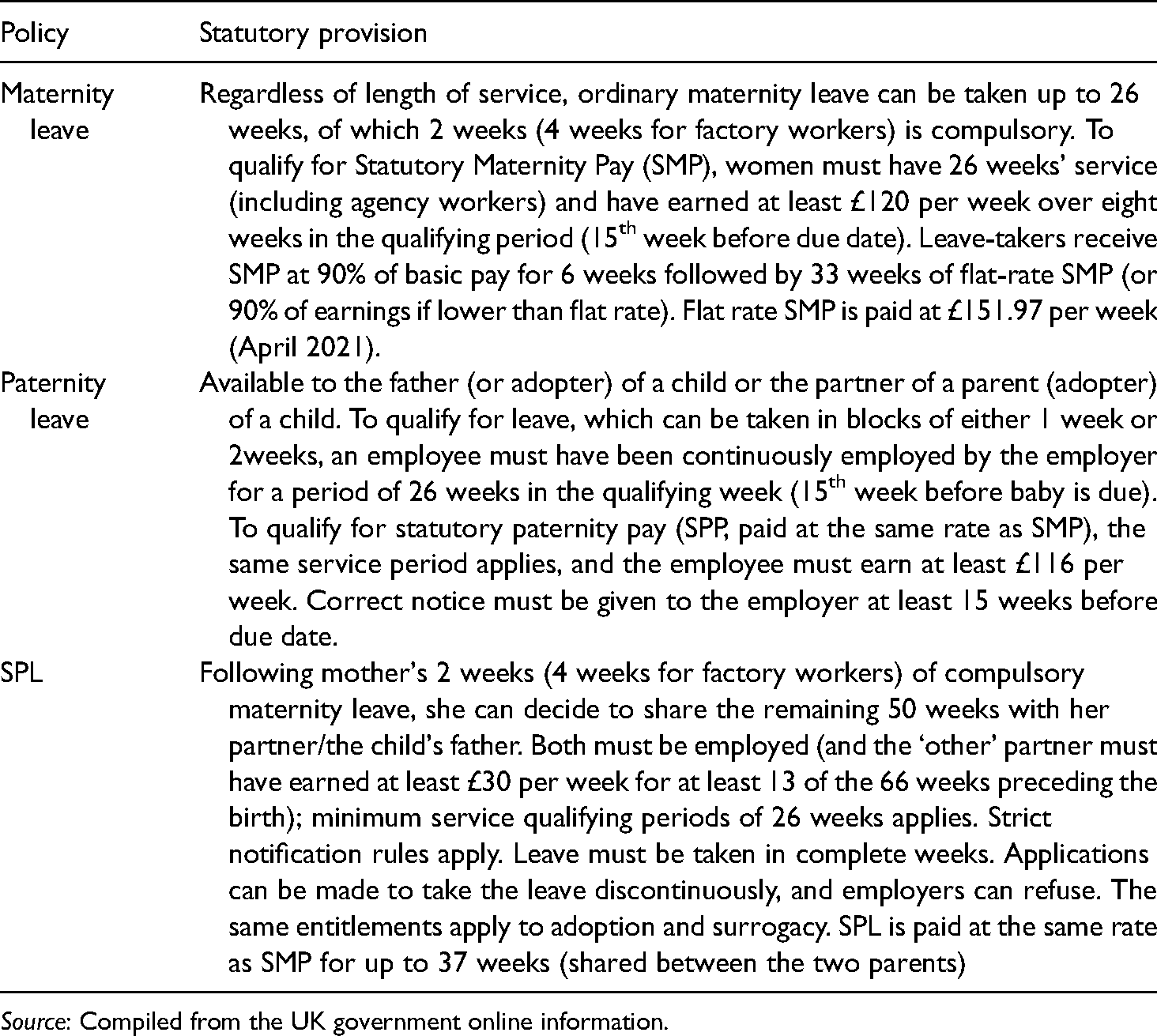
Legislation saw significant changes in the period 2000–2015. Policy started with an extension of maternity leave and the introduction of paid paternity leave and of unpaid parental leave, which was subsequently amended to include statutory pay (Table 1). However, from a gender equality perspective, the UK's set of leave policies for working parents are amongst the worst in Europe (Castro-García and Pazos-Moran, 2016). Statutory maternity pay at close to salary replacement level is limited to 6 weeks, with all other statutory paid leave at low levels (less than half of the national minimum wage). Low replacement rates constitute a significant obstacle to take-up, particularly for lone parents and those in low-pay households. Consequently, increased leave pay has been a major focus for trade union work–family policy (LRD, 2001).
Statutory maternity, paternity and Shared Parental Leave (SPL).
Source: Compiled from the UK government online information.
Strong exclusionary mechanisms reproduce socioeconomic inequalities. First, low replacement rates reinforce a ‘modified breadwinner model’ based on a high primary earner, usually male and often working long hours; second, the existence of qualifying periods excludes the growing number of workers on temporary or short-term contracts; third, other conditions restrict effective take-up (such as dependence on partners’ employment status or earnings, or business service restrictions); fourth, lack of readily available information means that take-up and build employees’ sense of entitlement are not encouraged (Birkett and Forbes, 2019; BitC, 2019; Chanfreau et al., 2011; UK Parliament, 2017).
Whilst all mothers have the right to maternity leave, a qualifying service period of 26 continuous weeks applies to all forms of statutory leave pay (before set periods before the birth of the child: thus, for paternity leave, this amounts to 41 weeks before childbirth). This excludes all workers on zero hours contracts, and in other forms of discontinuous and variable employment such as freelancers. Qualifying periods have been described as ways of ‘easing’ the introduction of new rights in the field of work–family policy, allowing legislators to limit the scope of application (Grabham, 2016: 401). Whilst this discretion for policymakers allows them to expand provision later, in practice exclusionary qualifying periods have become a norm, creating a strongly inegalitarian effect on individuals and households.
Shared Parental Leave (SPL), introduced in 2015, falls short of being considered a truly shared leave for parents (Blum et al, 2020; Kaufman, 2018); take-up has not shifted beyond around 2% of eligible fathers. Whilst low take-up has been widely attributed to the low level of statutory pay, which is amongst the lowest in the OECD (Atkinson, 2017; Baird and O’Brien, 2015), it is also explained by the complexity of the policy design (Javornik and Oliver, 2019; Sharp, 2021b). Access depends on both parents being in employment and the second parent earning more than £30 per week; the qualifying service requirement applies to both parents.
Moreover, the framing of SPL as a portion of maternity leave which the mother can decide to share with her partner creates effectively a ‘parasitic’ entitlement for fathers (Javornik and Oliver, 2019: 65) and the idea of primary and secondary rather than shared caring (Busby and Weldon-Johns, 2019). For all these reasons, SPL has been described as symbolic or ‘sound-bite’ legislation giving little substantive entitlement to parents (Mitchell, 2015: 124). Campaign organisations in April 2021, including the TUC, called for the ‘deeply flawed policy’ to be replaced with equal leave rights for fathers and mothers (Topping, 2021).
This overview of the main components of the opportunity structure highlights its unevenness, with countervailing pressures encouraging and restricting the space for bargaining to take place. Two key questions are raised: how do statutory rights influence how work–family benefits are taken up in collective agreements, and how do trade unions respond to the opportunities provided by legislative interventions and other external aspects of the opportunity structure? The first question relates to statutory rights: public policy ‘sets a floor for the parties in collective bargaining’ (Berg et al., 2013: 501), but there is little research on how the design and scope of policy affects bargaining opportunities, particularly in the private sector. The second concerns trade union strategy and how it responds to the uneven opportunity structure.
Methodology
This article analyses collective agreements lodged in the Payline database, which is the most comprehensive set of collective agreements in the UK, totalling 2487 currently valid agreements in February 2021 (2466 in January 2020), all concluded between 2017 and 2020. Excluding agreements which refer to statutory provision only, a total of 264 agreements was found for maternity and paternity leave and SPL across the public, private and voluntary sectors, or 10.6% of the total.
Agreements in the Payline database including work–family benefits in the form of maternity and paternity leave and SPL were tabulated by sector and by level of enhancement in relation to duration, payment and qualifying service periods or other conditions (initially in July–August 2018, then in December 2018, January 2020 and February 2021). A smaller number of ‘best practice’ agreements was identified, offering better than average enhanced entitlement on any combination of these three criteria.
Analysis was limited to the private sector, which has been relatively little studied to date. Investigation of the private sector provides insight into the rationale for the interplay of sectoral and organisational dynamics, because collective bargaining is more decentralised than in the public sector, and there are strong differences in coverage levels by sector (Waddington, 2019). A recent employer survey of enhanced leave showed that whilst private sector organisations were less likely to report better-than-statutory provision than the public sector, private services followed closely behind the public sector, whilst manufacturing and production offered significantly less enhancement (Sharp, 2021a,b). The Payline database shows a higher number of agreements in the private than the public sector for maternity (95 and 35, respectively) and paternity leave (93 and 34, respectively), and most include better-than-statutory provision. However, for SPL, there is a smaller number of agreements overall, and a lower number in the private than the public sector (12 and 19, respectively), with only half of the private-sector agreements going beyond statutory provision.
Finally, agreements in rail transport and retail, which have a relatively high number of agreements in the Payline database, were selected for further analysis. Interviews with equality officers were carried out in the National Union of Rail, Maritime and Transport Workers (RMT) and Union of Shop, Distributive and Allies Workers (USDAW) unions (one interview, one officer, September 2019 and one interview, three officers, December 2020). The choice of unions was based on an interview with the TUC's equality and diversity officer July 2018; in the TUC's 2018–2019 equality survey, transport and retail/distribution were also identified as seeing opportunities for equality bargaining despite the adverse economic climate (TUC, 2021b: 12-14). It allows comparison between unions with male-dominated and female-dominated membership. Interviews were used to confirm choice of ‘best practice’ agreements and give insights into bargaining strategy.
This method has limitations. The Payline database depends on submission of agreements by subscribing unions, and therefore has gaps. However, most of the large TUC-affiliated unions subscribe, so it provides the most reliable overview of bargaining trends and is used by the TUC for this purpose. Interviews were with a small number of national officers only, based on their reports from local negotiators, and did not follow any bargaining processes ‘live’, unlike some of the studies using the opportunity structure framework outlined above. The interviews nevertheless offer a contextualised discussion of sectoral practice of bargaining on enhanced work–family benefits, based on the patterns identified in the database.
Findings: Overview
The number of agreements dealing with enhanced maternity and paternity leave and pay rose after 2009, responding to changes in statutory provision: the extension of statutory maternity leave entitlement in 2007, the introduction of additional parental leave in 2010 and of SPL in 2015 (LRD, 2012, 2014, 2016). This pattern of agreements increasing in volume in response to statutory changes has also been observed in Australia (Baird and Murray, 2014).
Two general trends were observed. First, organisations which had enhanced maternity provision in 2009 have continued either to extend similar provision to fathers or to increase the duration or level of pay in subsequent agreements, as was found in the Australian case in the period after 2005 (Whitehouse et al., 2013), and in the French context of equality bargaining where successive ‘generations’ of agreement were concluded (Milner et al., 2019). Second, there is some evidence of a mimetic effect whereby ‘best practice’ agreements in a given sector lead to upgrading of benefits in other organisations in the same sector, in sectors with the largest number of agreements (transport, finance, retail, food and drink, and manufacturing).
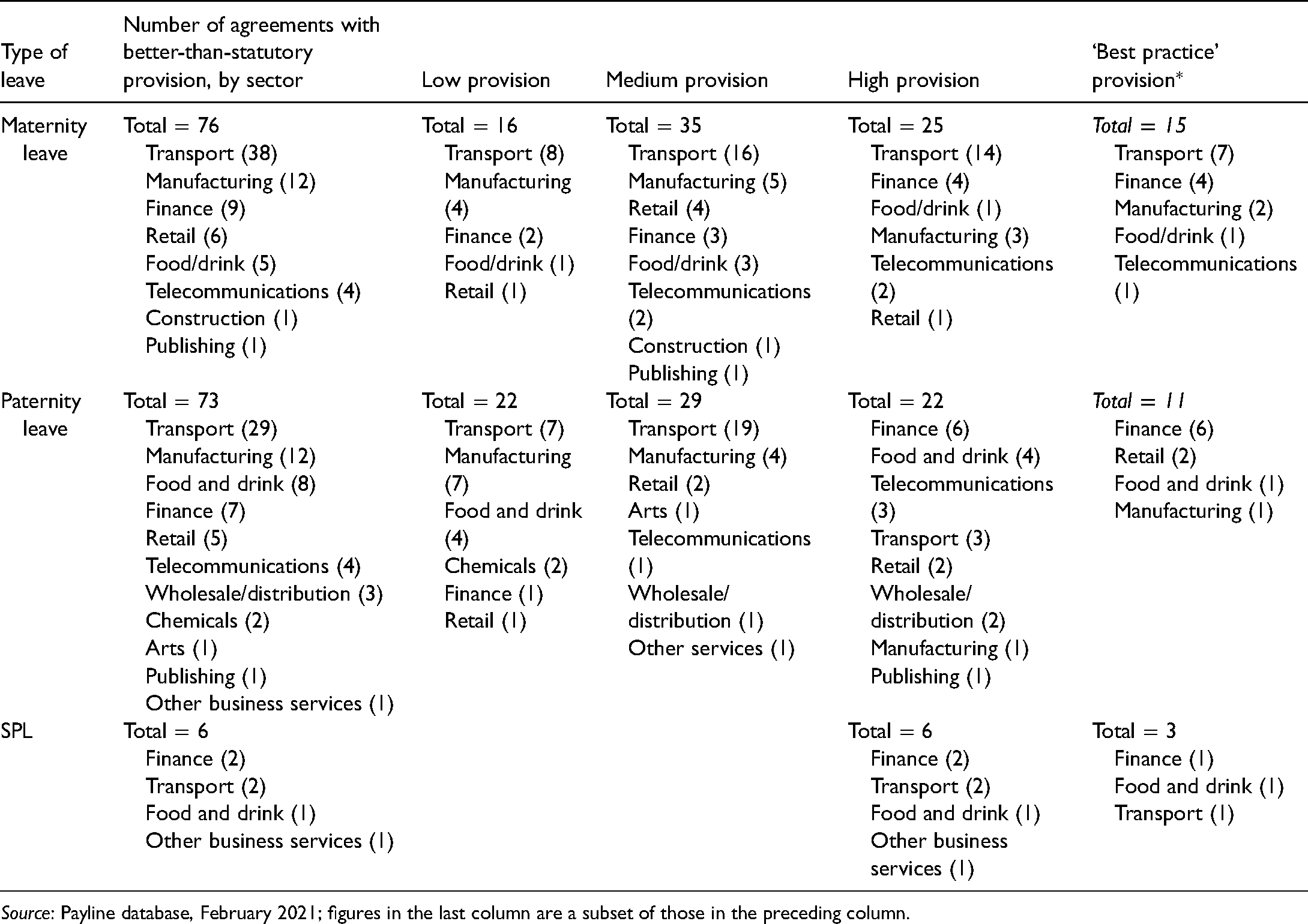
Table 2 presents leave enhancement provisions by sector. Following Baird and Murray (2014), provision is presented in bands, as there is considerable variation in the combination of duration and levels of salary replacement, particularly for maternity pay. Qualifying service periods also vary although to a much lesser extent, with 6 months the most common. Very high qualifying periods of a year or more are present in a minority of agreements, across all sectors; in a small number of cases, differentiated provision is offered depending on length of service. Absence of qualifying period is even less common and is associated with ‘best’ practice’ agreements.
Enhanced work–family benefits in collective agreements, by sector (private sector).
Source: Payline database, February 2021; figures in the last column are a subset of those in the preceding column.
The bands presented in Table 2 are labelled ‘low’, ‘medium’ and ‘high’ levels of enhancement in relation to the statutory entitlement (Table 1). For maternity leave, low provision is defined as 10 weeks at full pay or less; medium as over 10 weeks but less than 18 weeks at full pay; high as at least 18 weeks at full pay. Compared to most recent available evidence on employers’ reports of enhanced maternity leave and pay (Sharp, 2021a), even ‘low’ levels of collectively agreed provision offer a significant improvement on the average. Overall, most collective agreements go significantly beyond statutory provision, particularly for maternity leave.
Of the ‘high’ category of provision, over half are classed as ‘best practice’ agreements offering at least 26 weeks at full pay. Nearly half of these best practice agreements are in the transport sector. The finance sector has a disproportionately high number of its agreements in the best practice category, relative to other sectors. Best practice agreements for maternity leave and pay are exemplified by Aviva, which regularly appears in surveys of ‘best employers for working mums’ (see for example Baxter-Wright, 2019) which stands out as having no qualifying service conditions for access to 26 weeks’ leave at full pay; Aviva appears in the best practice category for paternity leave and SPL, too. In 2020, 99% of new fathers employed at Aviva took up parental leave (see Topping, 2021). Also in this best practice category, agreements for train drivers at Avanti and Chiltern provide exceptionally long periods of leave at full pay, at 39 weeks.
Paternity leave provision is also presented in bands although there is less variation overall, in line with the statutory provision which defines entitlement to leave as either 1 week (5 days) or 2 (10 days): 42% of agreements offer 10 weeks’ leave at full pay, classified as medium provision here. Low provision falls below this norm (often the first week only at full pay, the second at statutory or 90% pay), whilst high levels of enhancement provide more than 10 weeks at full pay; ‘best practice’ here starts at 26 weeks on full pay, usually aligned with maternity leave and pay. For paternity leave, ‘medium’-level enhancement at ten weeks’ leave at full pay represents a significant improvement on statutory provision. Unlike maternity leave and pay, collectively agreed paternity leave enhancements are closely aligned with employers’ self-reported provision (Sharp, 2021b).
‘Best practice’ paternity leave and pay provision takes it beyond statutory rights by aligning entitlement with maternity provision, sometimes explicitly in the form of a policy for carers: as well as Aviva mentioned above, the drinks producer Diageo has a well-publicised care policy which aims to promote equal parenting (see Moss, 2019) by offering employees 52 weeks’ leave, 26 of these at full pay. Table 2 shows that, compared to maternity leave, ‘best practice’ enhancement of paternity leave and pay is more likely in finance and in retail, and less likely in transport.
As for employers’ self-reported provision (Sharp, 2021b), enhancement is much less common for SPL. The very small number of companies offering better-than-statutory SPL are those offering a carer's policy (six in total); these are primarily located in finance and transport. All these ‘pioneer’ companies are in male-dominated sectors. Best practice is again led by Aviva, which has no exclusive qualifying service conditions for its SPL paid at full salary (including SMP) for 26 weeks. Three other companies provide 26 weeks’ leave at 100%, subject to the usual qualifying period of 26 weeks’ service for access to SMP.
Overall, sectoral distribution roughly follows that for collective agreements more widely (Waddington, 2019) and reflects the composition of the Payline database which is heavily dominated by transport (32%) and manufacturing (29%), followed by information and communication, retail and energy follow. Trade union density is linked to distribution of agreements: transport and energy have the highest union density rates in the UK (36.1% and 36.7%, respectively), with manufacturing and finance at around half that rate; wholesale and retail, information and communication, and professional services have lower rates (11.9%, 8% and 7%, respectively). However, compared to the full Payline database, energy and information and communication have a lower than expected number of agreements dealing with work–family benefits, whilst finance has a higher number. ‘Best practice’ agreements are located in transport, finance, and retail, whereas in manufacturing in particular fully paid leave is usually of lower duration and is subject to restrictive qualifying periods.
Gender composition of sectors has some relation to leave provision, with certain male-dominated sectors (finance and transport in particular) more heavily represented in enhancement of provision and the development of carers’ policies. Female-dominated retail represents something of an exception in this respect. These findings indicate that gender composition itself is less important in determining the likelihood of agreements than factors associated with collective bargaining itself, including structural sectoral features and trade union strategy. To investigate these factors in greater depth, the next section considers the cases of rail transport and retail.
Sectoral dynamics of collective bargaining in rail transport and food retail
Rail transport
Train operating companies account for a large proportion of agreements in the transport sector, which altogether has the highest number of agreements on work–family benefits in the Payline database. All the train operating companies in the database offer ‘high’ better-than-statutory maternity leave (Table 2), ranging from 6 weeks at full pay to 39 weeks at full pay at Arriva Rail North and CrossCountry (for drivers only), and there are a significant number of ‘best practice’ agreements. Twelve weeks at full pay is the most common arrangement. Paternity leave enhancement is more commonly ‘medium’, at 5 days at full pay with the second week at statutory pay. In most cases, statutory qualifying periods apply.
Compared to other British industries rail transport is relatively concentrated, and many companies belong to the same group. The large size of companies, all employing over 1000 people, helps to explain the concentration of agreements in this sector, as do other institutional factors: cross-company similarity in service and workforce organisation, and the high degree of bargaining coverage, facilitating coordination of union strategy.
The industry is heavily male-dominated: 22% of employees are female, and women are concentrated in lower paid occupations, accounting for only 11% of managers and 4% of drivers and train operatives (Wright, 2014). Male domination of the workforce and especially of higher-paying occupations such as train driving is linked to working conditions in the industry (Wright, 2016): working hours are long and inflexible, relying on unencumbered availability of employees. In the highest-paying occupations, opportunities for part-time work are scarce, although they are more easily available in some of the lower-paying occupations such as catering; job-sharing is rare.
The RMT union is the largest of three main unions in a highly unionised sector. Its membership is largely composed of non-driving personnel, compared to ASLEF which organises train drivers, and TSSA whose members are white-collar and professional staff (Conley et al., 2019). 15% of members are female. The RMT is known for its combative strategy which is underpinned by a strong network of workplace activists, whose efforts to engage with members’ demands have resulted in membership resilience in adverse times (Connolly and Darlington, 2012).
Its policy on work–family benefits is set out in a ‘Charter for Women’, updated in 2021 to take account of working in the pandemic (RMT, 2021). The charter prioritises the need to win better-than-statutory maternity leave pay, with ‘day one’ benefits (no qualifying service period) as an aspirational goal. As the equality and diversity officer argued, ‘Statutory is not a normal wage, you can’t live off air. For most people, you couldn’t possibly live off statutory.’
Union policy as described by the equality and diversity officer is ‘resolution and decision-based, so […] that booklet with our policy, that is our starting point, because I mean, that is aspirational, so enhanced maternity pay for women, and also from day one. […] Then I would say, but what we get, obviously is not that. […] The [employer] policy will be, you know, we abide by the law, thank you, but […] to try to get anything above that, seems a big leap.’ Similarly, on qualifying service periods for work–family benefits, which apply in agreements across the sector, ‘you argue for what you can get, and… I mean, you get it with holidays, you’ve been here five years, you get a couple more days holiday, but with parental issues, why should it be that after five years you’ll get an enhanced deal. But you know what, we’ll take it, because it's above the statutory minimum, whatever we can get, we’ll take it.’ The Eurostar agreement was therefore seen as setting the standard for the sector both because the period of leave at full pay was extended in 2018 to 26 weeks (up from 7 weeks at full pay plus 23 weeks at half pay) and because the qualifying service period was reduced at the same time from a year to 6 months.
Enhanced maternity pay is relatively widespread. This, the RMT officer argued, is because maternity benefits are easier to secure thanks to a reasonably strong statutory base and a favourable environment due, on the one hand, to recent policy attention to gender pay gaps which ‘shone a light’ on organisational practices, and on the other to the business case for retention of women: ‘I would say there is a huge business case for retention of staff. Getting through maternity and coming back at the end of it is the big clincher, isn’t it? Being able to get women to be able to come back, to be able to come back, to be able to afford it.’ Indeed, the Eurostar agreement refers explicitly to management's commitment to working with the union on ongoing equality and diversity initiatives to ‘support us in reduction of our gender pay gap’.
Although common ground between management and unions exists on maternity leave provision, paternity benefits have proved less straightforward. This is not because of lack of demand from male union members, as the RMT officer reported a ‘culture change’ with more men wanting to take time off to be involved with family after the birth of a child. Rather, an uncertain climate for bargaining on fathers’ leave entitlement emerged after the introduction of SPL. Virgin's moves to feminise its workforce also offered an opportunity to push for enhanced maternity pay in an otherwise difficult bargaining context where the RMT feels it is regarded as ‘the enemy’.
The RMT argues that whilst the introduction of SPL ‘was welcome, it has caused confusion, and without proper funding only a tiny proportion of fathers/partners are able to take it up’ (RMT, 2021: 24). The rail sector was the site of the first legal challenge to employers over SPL when a father pursued a case of sex discrimination against Network Rail in 2016 (Snell vs. Network Rail). The Scottish tribunal awarded Mr Snell £28,231, ruling that he had experienced indirect sex discrimination as a man, as he received statutory parental leave pay whereas his wife (who also worked for Network Rail) had received enhanced pay. Later that year, Network Rail changed its policy to ensure that men and women sharing parental leave would receive statutory pay (Faragher, 2016), resulting in a ‘Pyrrhic victory’ (Javornik and Oliver, 2019: 64), since the change meant that women employees lost their enhanced pay. Although it was only a first-instance ruling (employment tribunal) and therefore not more widely applicable, its effect within and beyond the sector was to make employers wary of enhancing SPL, and to add to existing confusion about the policy.
On the other hand, the RMT sees the possibility for gains on paternity leave. Its policy sets the aim of flexible paternity leave-taking (which in statutory provision must be taken in blocks of 1 week) (RMT, 2021: 24). This approach is exemplified by Chiltern Railways, where the second week of paid paternity leave can be taken as separate days, and the rail sector has a number of agreements offering relatively long fully-paid paternity leave.
The prevalence of maternity leave agreements in a male-dominated sector conflicts with previous research which finds that unions in male-dominated industries are less receptive to work–family demands (Ravenswood and Markey, 2011). However, the TUC's equality officer highlighted male dominance as a reason for common ground between unions and management on family-friendly benefits: ‘I’ve always had the feeling that it's the male-dominated unions that made the most headway on maternity leave, because it's minimal cost, it helps in recruiting more women, if that's on their agenda’ (interview, July 2018). Recruitment aims influence the bargaining agenda rather than workforce composition. Coordination of bargaining, facilitated by sectoral structure, also forms an important part of the opportunity structure, together with a relatively favourable bargaining climate caused by the need to retain female staff.
Food retail
The food retail sector has a relatively high number of work–family agreements but for maternity leave and pay they are more likely to fall into the ‘medium’ category of provision whilst for paternity leave and pay a proportionally greater number of agreements are classed as ‘medium’ or ‘best practice’. No agreements on SPL appear in the database.
The food retail sector is characterised by large number of small companies but dominated by a few giant supermarkets, employing over half the total workforce. The sector has undergone far-reaching change over the last decade, resulting in mass redundancies and widespread job insecurity. Restructuring has made it even more difficult to enforce rights across units within the same parent company, for example in seeking to claim redundancy rights (Butler, 2018) or in applying comparisons for the purpose of equal pay claims.
These changes on top of existing challenges such as rapid labour turnover, high proportions of female part-time working compared to male full-time employment, extensive use of casual contracts and workforce characteristics have created a difficult climate for union activism and campaigning. For the sector as a whole density is low: an estimated 11% in 2007 (O’Brien-Smith and Rigby, 2010) and 11.9% in 2019 (BEIS, 2020), around half the overall national figure. However, USDAW represents an atypical case of strong union renewal (Parker and Rees, 2013). Membership numbers have grown by some 26% over the last decade and appear to have remained stable since then.
USDAW's renewal strategy combined organising (setting up its own organising academy in 2000) and a centralised, targeted approach to bargaining (Evans et al., 2017). The targeted approach focuses on the ‘big four’ supermarkets (Co-op, Morrisons, Sainsburys and Tesco). USDAW is the main union organising in the sector and has recognition agreements with five of the biggest retailers (Parker and Rees, 2013). As a relatively ‘moderate’ union USDAW's strategy tends towards cooperation rather than antagonistic relations with employers. Its membership is mostly female (55.3%; around two thirds of employees in the sector are female), younger than for most unions, and also ethnically diverse. Most of its members are low paid. Its leadership is male-dominated, although since 2018 it has a female president Amy Murphy.
USDAW's Parents and Carers campaign in the mid-2000s was considered to be exemplary among TUC-affiliated unions (O’Brien-Smith and Rigby, 2010: 211; see also USDAW, 2019). USDAW officials stated that demand from members for maternity, and to a lesser extent paternity, leave is strong and growing, because low replacement rates make it difficult for parents to stay on leave. Officers referred to a 2019 internal survey of members which found that, without enhanced benefits, parenthood often caused financial hardship for its members: ‘92% of our women members are cutting their maternity leave short because they run out of money. We calculate that if you’re a checkout operator and you take your full 52 weeks of maternity leave you’d go back with a debt of over five thousand pounds, it's just not stable when you work in Tescos obviously, and we know that men, particularly men who are in higher paid jobs such as HGV drivers, are not taking their full two weeks paternity leave, unless it's been enhanced, because the flat rate is so much lower than what their earnings are, so it causes a huge drop in income at a time when they can least afford it.’
However, SPL was not raised by members: ‘I can count on one hand the number of queries we’ve had about it, and I don’t see pressure from members. I just don’t think it's on people's radar at all […] yeah it doesn’t work for our members, partly because you would lose your enhanced contractual maternity pay, you know, before that enhanced payment ends’. Restrictions concerning partners’ employment limited possible uptake: ‘members aren’t qualifying either, because the partner, because of the employment status of the partner if you like. So I’ve taken calls from men who are keen to take up shared parental leave, and then it transpires that their partner who isn’t a member, actually they can’t because they don’t qualify for it, for example because she isn’t in work’. Overall, the ‘horribly complicated’ nature of the regulations limited access and made it more important to secure and improve enhanced maternity provision. Consequently, SPL did not appear on the bargaining agenda: ‘From Alliance Healthcare, Argos, the Coop, obviously Morrisons, Tesco, Tesco warehouse…. In terms of maternity and paternity leave. But I can’t think of anywhere where we’ve made progress in terms of shared parental leave and pay.’
In line with O’Brien-Smith and Rigby's earlier findings, despite growing demand for and attention to improved maternity pay, work–family measures struggled to gain traction in difficult times: ‘I don’t think it's that members don’t see care as one of their priorities, but there has been I think a narrowing of the bargaining agenda in recent years, there's so many pressures in the retail sector as a whole, people are concentrating the focus on one or two issues. Something like shared parental leave, particularly, wouldn’t get a look-in. People are concentrating on the base line, pay’.
However, local negotiators were able to make headway in some organisations. Tesco is an important benchmark for the sector because of its size: its recognition agreement with USDAW is the largest of its kind in the private sector and a significant proportion of USDAW members are employed there. Its agreements on maternity and paternity leave corroborate the significance of the internal and external opportunity structure for work–family bargaining. Internally, USDAW equality officers argued that it reflected priorities of local negotiators: ‘the fact that we’ve got such a significant improvement in Tesco is down to the fact that we have an official leading those negotiations that we have a very close working relationship with, and who gets it, and who has been prepared to bang on about it for year after year after year. We don’t necessarily have that across all agreements’. Externally, they highlighted both a long-standing culture of bargaining in the company, and renewal of the employer negotiating team to make it more receptive to union demands, conditioning responses to adverse economic situation: ‘I think this was an opportunity to show that they care about their workforce, from a business point of view maybe’.
This example highlights the interplay of internal and external components of the opportunity structure. Internally, the union has long prioritised work–family benefits with the aim of minimising the motherhood pay penalty for members, in a female-dominated sector, although they are difficult to achieve in a bargaining agenda dominated by low pay and poor working conditions (TUC, 2021b: 48). The targeted approach resulted in partnership agreements with a leading organisation in the hope of wider diffusion of practice, facilitated by a high degree of sectoral concentration (as in rail transport) and increasing employer receptiveness to business-case arguments for retention of female staff.
Conclusion
In tough economic times, work–family policy slides down the bargaining agenda (TUC, 2021b), but agreements continue to be made in some companies, and in certain sectors. On maternity pay in particular, collective agreements show higher durations of fully paid leave than available evidence on employer enhancement indicates. Analysis of agreements shows a continued trend towards enhancement of maternity and paternity pay, based on ‘generational effects’ whereby those companies with better-than-statutory provision upgrade it in subsequent agreements, and on mimetic effects within sectors where existing bargaining dynamics are relatively well-established.
In line with the literature on opportunity structures, union strategy matters: in food retail, in the attention to the influence of a large partnership agreement, and in rail transport to a strong push for better pay. However, union strategy is in turn highly dependent on the external opportunity structure at national, sectoral and local levels. Maternity leave and pay in particular stay on the agenda where workforce feminisation matters to employers for reputational or other reasons such as renewal of management teams, when local union negotiators are responsive to growing membership demands, and when an existing dynamic of pay bargaining exists. The prevalence of large organisations within relatively concentrated sectors helps to spread enhancement, not least through unions’ increased capacity to coordinate bargaining strategy.
Public policy strongly influences the opportunity structure for bargaining. Paternity leave enhancement is less developed than maternity leave and pay. SPL has not led to significant enhancement, due to two main aspects of policy design: first, the complexity of SPL not only discourages demand from members but also reinforces the idea that benefits for fathers entail sacrifices by mothers, with the resultant embedding of gendered expectations about parenting. Second, the policy norm of exclusionary qualifying periods legitimises employer resistance to union demands for wider access.
Overall, the number of real enhancements in agreements is small. This finding, which confirms earlier research (Den Dulk et al., 2012) highlighting the gaps in provision where work–family benefits are left to the market, should give policymakers pause for thought, because reliance on private-sector innovation means that statutory provision is likely to fall behind the pace of social change. The disparity between occupational enhanced maternity leave and statutory SPL has left a regulatory gap which private regulation, including collective bargaining, is too weak to bridge.
Unions have had relatively little success in pushing for universal (day one) benefits. Where qualifying periods extend beyond statutory provision (in some cases to 1 year or even 3 years’ service), the number of eligible employees is likely so limited as to inhibit employees’ wider sense of entitlement. Restriction to certain groups of employees indicates labour market segmentation or dualisation whereby employees with high skills on stable contracts find it easier to access work–family support (Chung, 2018). Although bargaining for work–family benefits is continuing in the current highly unfavourable economic climate, labour market dualisation is accelerating, reserving enhanced benefits for an ever-smaller group of employees, even as a small group of multinational employers move in the opposite direction and create inclusive care policies. Successive policy interventions have made the opportunity structure for bargaining on work–family benefits more, rather than less, uneven.
Footnotes
Acknowledgements
The author would like to thank staff at the Labour Research Department for assistance with access to the database of agreements.
Declaration of conflicting interests
The author declared no potential conflicts of interest with respect to the research, authorship and/or publication of this article.
Funding
The author received no financial support for the research, authorship and/or publication of this article.
