




Abstract
Traditional actors such as trade unions are inevitably challenged by digital technologies, not only from the perspective of labor relations, but also in relation to outreach and communications strategies. In fact, as online and offline realities become increasingly intertwined, the presence of organized labor institutions within the Internet’s current networked environment is unavoidable. This article debates digital trade unionism as a strategy for trade union renewal, particularly the implications of using social media platforms to connect and interact with a broader audience beyond the labor movement. Through a comprehensive comparative analysis of the Facebook pages of six trade union confederations from Brazil, Canada, Portugal, and the UK, we find that despite the possibilities for horizontal dialogue enabled by the new digital communication and information technologies, trade union confederations maintain an outdated ‘one-way’ model of communication, hindering opportunities to reach and engage with both union and non-union actors.
While the trend towards digitalization is not entirely new, the impact of related technological changes on the world of work in general, and in trade union activity in particular, is increasingly significant. Even if discussions around the future of work have highlighted that workers’ concerns have largely remained unchanged, in spite of technological developments (Vandaele, 2018), traditional labor actors have faced new pressures and new practices of collective action. 1
There is extensive debate about the labor movement facing a crisis of identity and legitimacy. This is often attributed to several factors: changes to the labor market caused by neoliberal globalization; weakening of the bonds of worker solidarity and of union loyalty, as a direct consequence of individualism and the unraveling of modern-day societies; decline in union representativeness and the resulting deficit in terms of mobilizing workers for union action initiatives; the modest scope of trade unionism’s transnational struggles, as it takes a back seat to national priorities; the excessive proximity to, and even dependence on, party strategies; and the fragile nature of the policy of social alliances established between trade unions and other non-labor actors (Bernaciak et al., 2014; Burgmann, 2016; Crouch, 2017; Estanque and Costa, 2012; Hyman and Gumbrell-McCormick, 2010). Along with these, two other challenges particularly relevant for the purposes of this article are the difficulties of effectively reaching the increasing mass of precarious workers and of organizing workers in the burgeoning digital economy (Degryse, 2016; Vandaele, 2018).
Three strategies have often been suggested as key to revitalizing organized labor’s reach and influence: grassroots organizing, coalition building, and connecting labor issues with a broader social and environmental justice agenda (see e.g. Behrens et al., 2004; Frege and Kelly, 2003; Heery, 2005; Ibsen and Tapia, 2017; Kloosterboer, 2008; Murray, 2017; Tattersall, 2010).
Within this context, this research aims to draw attention to trade union uptake of digital technologies, especially social media platforms, as a potential element to support implementation of these strategies. We start from the basic assumption (Schein, 1985) that, nowadays, an online presence is not only inevitable, but is also increasingly interconnected with offline dimensions (Rogers, 2013). This requires embracing the dynamics of ‘globalized networked capitalism’ (Waterman, 2004) and of Web 2.0 (O’Reilly, 2005) in order to communicate more efficiently and effectively. Hence, we raise a few exploratory questions: Considering the hybridization of online and offline dimensions, what does Web 2.0 mean for trade unionism? Is there a digital trade unionism in the making? How do organized labor movements from distinctive industrial relations backgrounds face emerging digital spaces and discourses?
In light of these questions, we begin with an overview of literature about trade unions, Web 2.0, and social media. We identify several concepts, as well as both optimistic and pessimistic perspectives regarding the role of digital technologies within trade union renewal strategies. Our research puzzle is supported by breakthrough content analysis of the use of Facebook by top-level labor organizations in several countries, to reflect on the ability of trade unions to take advantage of new communication technologies to strengthen networks, advocacy, and outreach.
Web 2.0, social media, and trade unions
The growing influence of the internet on people’s lives is undeniable. A report by the Broadband Commission for Sustainable Development (2019) affirmed that 2019 marked the first year in which more than half of the world’s population (51.2%, or 3.9 billion people) logged on to the internet. Social media giant Facebook boasts more than 2.3 billion monthly active accounts, followed by YouTube with 1.5 billion users, and Facebook’s messaging service WhatsApp with 1.3 billion monthly active users.
As the most prominent part of the internet, the World Wide Web plays a crucial role within the technological infrastructure of society (Fuchs et al., 2010). The term Web 2.0 was coined to express the evolution of the web after the crash of dot-com companies in 2001, which marked the end of the ‘first era’ of widespread access to the web (O’Reilly, 2005). While many scholars have highlighted the transformation of the web into a highly communicative network (Castells, 2009, 2013; Kerr and Waddington, 2014; Lupton, 2013; Rogers, 2013), O'Reilly's denomination caught on. Despite critiques of its theoretical foundations (Fuchs et al., 2010; Han, 2010; Song, 2010), it remains a dominant term to refer to the web as a platform for horizontal participation, the user as a consumer and producer of content, collective intelligence, and decentralization.
Manuel Castells (2013) argues that communication and social interaction are the base for the production of meaning. As such, the continuous transformation of information technologies in the digital era, especially the web's evolution from one-way interaction (where holders of information like businesses, governments, or the media could disseminate information) to two-way social networks (where communication is multimodal and horizontal), has expanded the reach of communications tools to all aspects of social life. These networks are at the same time global and local, generic and personal, and continuously changing. The web environment has become an ever-familiar space of constant – or near constant – presence, where ordinary activities, from interacting with friends to perusing news, from shopping to dating, take place (Dahlgren, 2013; Lazer et al., 2009). Within the web, some of people's most important activities happen on social media platforms, be it through chats, posts, information sharing, or activism.
As social networks link the many dimensions of people's lives, they have also resulted in blurred lines between online and offline identities (Bernal, 2012). In fact, today's digital realm has engendered ‘new’ dimensions that pose a challenge for the ‘old’ trade unions organizations. For instance, the notion of the web as a ‘third place’ (Belk, 2013: 486) – where opportunities for shared interest that exist online can be considered a part of the aggregate extended self, or the concept of ‘networked individualism’ – which argues that due to technological developments around social networks, personalized Internet, and mobile connectivity, people ‘have become increasingly networked as individuals, rather than embedded in groups’ (Rainie and Wellman, 2012: 6). This new digital reality calls on trade unionists to reflect upon issues of spatiality, inclusion, information management, uniformity of thought, collective connection, and transparency, among others.
This is furthered by the complexity of the web as a broker of networks through its various platforms, particularly as social media become main sources of information (Bakshy et al., 2015; Mitchell and Weisel, 2014). Some studies indicate that while Web 2.0 technology enables access to vast amounts of information, it also has ‘the potential to limit exposure to attitude-challenging information’ (Bakshy et al., 2015). This is because the flow of information depends on how individuals are connected both to social networks and to algorithms selected by service providers that ‘prioritize’ certain contents – often for commercial purposes – based on a person's online behavior (Bakshy et al., 2015; Rogers, 2013).
Other studies have shown that users tend to have circles of friends or contacts that reflect their own ideological views (Mitchell and Weisel, 2014). This results in the creation of ‘echo chambers’, where ‘individuals are exposed only to information from like-minded individuals’, and ‘filter bubbles’, in which content selected by the algorithms once again exposes users only to information aligned with their views (Bakshy et al., 2015: 1130). Moreover, as all major social networks are privately owned, profit-making conglomerates such as Facebook, Alphabet, and Twitter, they can make decisions about how information is used and disseminated without being held accountable (Lee, 2018). Due to recent controversy involving Facebook’s treatment of user data, discussions around privacy, data control, and echo chambers have reached a broader audience through political commentary and analysis on mainstream media.
Such debates are relevant to trade union renewal because the pervasiveness of digital networks has added new pressures at both the individual and the institutional level. At the same time, it also points to the potential for organized labor to consider digital trade unionism, which we define as a set of institutionalized practices that result from a new way of conceiving the role of trade unions in contemporary societies. As a potentially decisive factor for trade union revitalization and for the reversal of several setbacks – such as membership loss, the dismantlement of representation structures, or the weakening of mobilization capacity, especially among atypical and young workers – the influence of social media is witnessed through distinctive but complementary (and interconnected) perspectives. These include organization, participation, and union democracy (Dencik and Wilkin, 2020; Greene et al., 2003; Hodder and Houghton, 2019; Kerr and Waddington, 2014); renewal of collective action repertoires and building bridges between labor market insiders and outsiders (Murray, 2017); union membership improvement (Bryson et al., 2010); transnational forms of labor solidarity (Geelan and Hodder, 2017; Lee, 2018), external coalitions between trade unions and other social movements (Ibsen and Tapia, 2017; Tattersall, 2010); challenges posed to the collective voice of workers and the impact of flexibility and adaptability of collective bargaining structures (Prassl, 2018).
Under the ‘multi-dimensional nature of social media’ (Chivers et al., 2017: 1), building consensus ‘over which factors within and beyond unions will promote change’ (Heery, 2005: 101) becomes more difficult. In parallel, since ‘networking in the information age is the subject of a range of tensions between organizational hierarchies, competing communities of practice, and competing understandings and traditions of the Internet itself’ (Martínez Lucio et al., 2009: 116), embracing social media is not the panacea for trade union renewal. While early writings about the digital technologies were optimistic about the perspectives of a ‘global labornet’ or a ‘new social unionism’ that could unite workers across the globe (Diamond and Freeman, 2002; Lee, 2004: 71; Waterman, 1998, 2004), over time, the Internet in general, and social media platforms in particular, have become a saturated and fraught space. Various groups and interests dispute the attention of citizens and consumers (Earl and Kimport, 2011), resulting in challenges to secure a space in the digital ecosystem. These challenges include digital illiteracy; the democracy deficit in the workplace, which limits workers’ access to the Internet; cultural and language constraints to achieve a truly global labor network; and organic mobilization in an increasingly data-driven environment. As simply existing online is no longer enough to get a message across, and since revitalization acquires different meanings depending on the specificity of national contexts (Behrens et al., 2004), it has become necessary to continuously create, curate, and adapt content that is tailored to the specific audiences trade unions intend to reach.
Moreover, many of the limitations to digital trade unionism stem, in large part, from skepticism displayed by union leaders, not only with regard to the effectiveness of digital mobilization (Darlington, 2004), but also due to the potential threat to traditional union structures enabled by decentralized, user-driven communication (Burgmann, 2016; Upchurch and Grassman, 2016).
Nevertheless, trade unionism did benefit from Web 2.0 through the ability of organizations – and individual workers/activists – to communicate faster and cheaper with broader audiences, and to create their own narratives (Burgmann, 2016; Rego et al., 2016). Transmitting information in real time, such as denouncing workers’ rights violations, sending out calls for action, or raising awareness of workers’ issues, have been invaluable to outreach and mobilization efforts. An example is the ‘Right2Water’ campaign, 2 a European Citizens' Initiative comprised of citizen groups and trade unions, which managed to gather almost 2 million signatures in a petition for European Union (EU) legislation recognizing the human right to water and sanitation, through a combination of online and offline, decentralized campaigning (Costa, 2017: 668). In another instance, the strong social media focus of the ‘Fight for 15’ movement in the United States has succeeded in elevating an online discourse that connects social justice to the right to unionize and to a fair wage (Pasquier and Wood, 2018). Moreover, Jansson and Uba’s comprehensive analysis of Swedish trade unions on YouTube (2019) showed that unions did experiment with different strategies in the platform to establish (new) narratives and engage with strategic audiences.
As such, while social media present platforms that ease horizontal interaction, they are far from resolving the aforementioned challenges on their own. The high expectations placed on digital trade unionism by the internet optimists are often confronted with two situations. One is the realization that many workers’ struggles happen in day-to-day situations that require direct intervention or a combination of online and offline efforts (Upchurch and Grassman, 2016). The other is that patterns in the use of digital communications tend to replicate traditional practices associated with top-down information dissemination and passive receipt on the part of workers, rather than the active pursuit of dialogue online (Kerr and Waddington, 2014: 677).
Assessing trade union use of social media platforms from a comparative perspective
Considering the literature discussed above, the central research question of this study is: to what extent do trade unions leverage social media platforms such as Facebook to support trade union renewal through outreach, alliance building, and widening labor’s agenda?
Although trade unions were slow to embrace new digital technologies, despite varying levels of professionalism, their use is now widespread through websites, online membership applications and other support services, social media profiles, blogs, videos, and petitions (Fowler and Hagar, 2013). But while a presence on social media is almost inescapable, if this presence is not successfully engaging with the intended audiences, it may easily go unnoticed among the masses of information exchanged constantly on the various platforms. Hence, assessing the types of content, how they are disseminated, and their engagement with platform users sheds light both on the narratives constructed by organized labor and on the level of participation by page followers.
As such, the research presented in this article is a comparative study of the social media presence of organized labor institutions in several countries with distinct social, economic, and cultural contexts, as well as varying patterns of industrial relations. We selected four countries for analysis: Brazil, Canada, Portugal, and the UK. From an economic perspective, Canada and the UK represent liberal market economies, while Portugal is characterized by a post-crisis ‘Mediterranean’ model and Brazil represents an emerging economy. From a union structure perspective, the four countries range from ‘unitary peak confederations and market-oriented unions’ (Frege and Kelly, 2003: 8) in Canada and the UK, to class-oriented union confederations in Portugal (Costa and Estanque, 2019) and the social movement unionism of Brazil (Flores et al., 2011; Seidman, 1994). However, regardless of their specificities, the organized labor movements in all four countries have faced – to varying degrees and contexts – the challenges imposed by neoliberal capitalism, the precarization of the workforce, increased trade union representativeness in the public and service sectors to the detriment of ‘traditional’ industrial laborers, membership loss, among others.
The investigation narrowed down on the main trade union confederations for each country, as the top-level institutions in the respective countries – irrespective of the dominant model of industrial relations – and whose focus on advocacy, policy, and agenda-setting affects trade unionism at the grassroots level (Bernaciak et al., 2014). Hence, the trade union confederations analyzed were Central Única dos Trabalhadores (CUT) and Força Sindical (FS) from Brazil; Canadian Labour Congress-Congrès du Travail du Canada (CLC) in Canada; Confederação Geral dos Trabalhadores Portugueses-Intersindical Nacional (CGTP-IN) and União Geral de Trabalhadores (UGT) from Portugal; and the Trades Union Congress (TUC) from the UK.
Methodology
As the boundaries between the virtual and the real become increasingly blurred, the internet offers an entirely different channel for understanding what people are saying, and how they are connecting. Consequently, new research methods have surfaced that propose moving beyond assessing how much of society is online and towards investigating cultural and social transformations through the internet (Resce and Maynard, 2018; Rogers, 2013). Based on this concept, this study proposes a comparative approach to assess the content disseminated by trade union confederations on their social media channels, in order to find out what they are saying and how they are engaging with different actors, as well as to consider whether their virtual presence has any implications to the wider discussion about trade union renewal.
An initial exercise to map the online presence of the selected trade union confederations identified the platforms they use. With regard to timing, they all went online at around the same period by launching websites between 1997 and 1998. The six confederations are all present on the four largest social media platforms: Facebook, Instagram, Twitter, and YouTube. Presence on other platforms varies considerably, as no other social media are clearly preferred by all confederations – some feature photo albums on Flickr, some keep professional profiles on LinkedIn, while others maintain blogs and podcasts.
From among the top four platforms, we selected Facebook for further analysis as it was the most actively and consistently used by all organizations. Moreover, despite significant differences in general population size, the Facebook penetration rates for the four countries were very similar: the number of active personal profiles accounts for 67% of the population in Brazil, 3 Canada, 4 and the UK, 5 and 70% in Portugal. 6
In order to assess how trade union confederations use Facebook – the types of content they share, the tone of messages, the connections they forge with other organizations, the engagement with users/followers, among other aspects – we applied a descriptive content analysis approach and developed a custom conceptual framework based on the theoretical foundations of this method (Holsti, 1969; Landis and Koch, 1977; Neuendorf, 2002; Stone, 1964). While the framework draws from existing literature on social media analysis and trade union usage of the internet (e.g., Bryson et al., 2010; Carneiro, 2018; Chivers et al., 2017; Geelan and Hodder, 2017; Hodder and Houghton, 2015; Jansson and Uba, 2019; Panagiotopoulos and Barnett, 2015; Pasquier and Wood, 2018; Rego et al., 2014), it is structured based on Facebook’s affordances to specifically investigate content in the platform from a comparative perspective. We employed the conceptual framework to analyze the entire corpus of posts and to carry out an in-depth review of a random sample of posts from the confederations’ pages.
Content analysis is a qualitative method used to assess the extent to which certain words, concepts, messages, or attitudes permeate a given text or sets of texts. Researchers quantify and analyze the presence, meanings, and relationships of such words and concepts, making inferences about the messages within the texts, the writer(s), the audience, and even the culture and time of which these are a part of (Macnamara, 2005). As a technique, descriptive content analysis consists of systematically and objectively identifying characteristics of messages and is classically characterized by three key overarching notions (Holsti, 1969; Krippendorf, 2013). First, the categories of analysis provide the conceptual structure for organizing data into predefined groups or categories. In this study, the categories of analysis were divided into ‘cases’ and ‘themes’ which are described in detail below. Second, the unit of enumeration and recording unit represent the unit in terms of which quantification is to be performed. This analysis considered the individual post as the unit, which can contain text, links, images, and/or video. Due to time and resource constraints, analysis considered only content directly available on the post – links were not clicked through unless necessary to clarify any information. Lastly, the sampling strategy is determined by the research question. As this study is focused on information that can be extracted from Facebook, the main sample is composed of all the posts from the official, main Facebook pages of the six trade union confederations between 1 October 2015 and 31 December 2019. The selected timeframe was based on the most recently created Facebook page, by Portugal’s UGT (created in September 2015). Data collection happened on two occasions: first, in March 2019 by employing Netvizz (Rieder, 2013) and NodeXL, two academic data-mining tools that extracted publicly available data from the six Facebook pages; and second, an update on the dataset was undertaken in June 2020, but these tools were no longer operational as Facebook had suspended their licenses to its API (a controversial decision regarding academic access to information). As such, the second data collection relied on cooperation with fellow data scientists, who made a Python code available for scraping the social media platform.
We produced descriptive statistics and a thematic analysis for the entire sample and carried out an in-depth content analysis of a randomly selected subset of posts to cover 1 month per year of analysis from 2015 to 2018 (covering only the first data collection). The random sample was chosen over a purposive sample in order to capture snapshots of day-to-day use of Facebook. This strategy provides a broader view of how the confederations use the platform, the issues they focus on, and the ordinary engagement with page followers, rather than narrowing down on particular campaigns with specific targets and themes, as has been the subject of previously mentioned research. The ‘Random Integer Generator’ feature from Random.org was used to generate random numbers in a set interval: three random integers (representing the 3 years of the sample) with values between 1 and 12 (representing the months of the year). The numbers generated were 1, 2, 10. Therefore, the in-depth content analysis was carried out for all posts from January 2016, February 2017, and October 2018.
The conceptual framework for the content analysis is illustrated in Figure 1. The categories of analysis were divided into two distinct types: case coding and thematic coding. This structure ensured flexibility for analysis when the coding was complete.
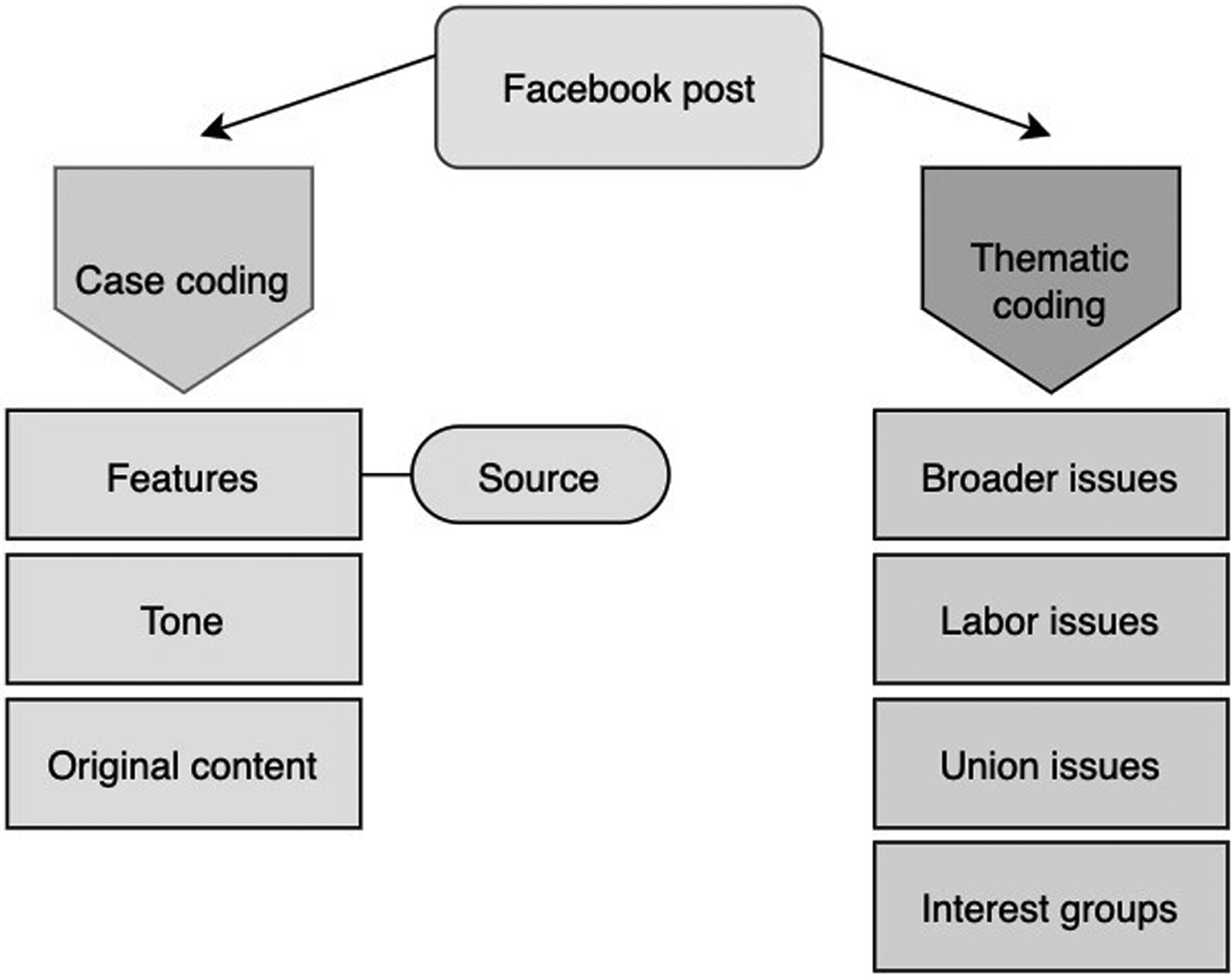
Conceptual framework for the content analysis of posts on the official Facebook Pages of trade union confederations.
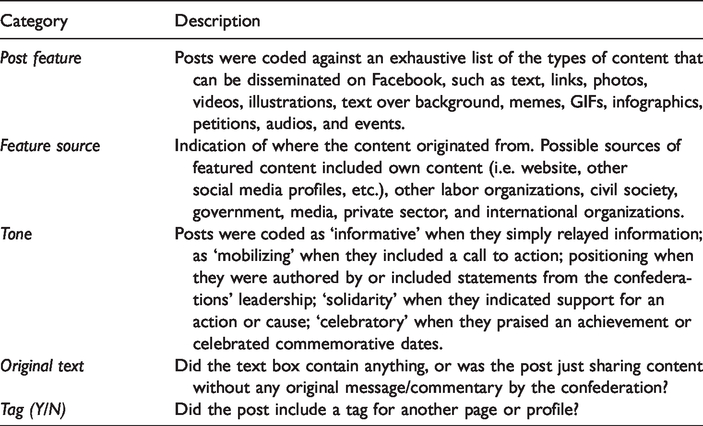
First, case coding indicators aimed to classify the characteristics of the posts. Taking into account Facebook’s affordances and interface, we devised five categories: post feature, feature source, tone, presence of original text, and presence of a tag. Table 1 details each category.
Case coding indicators.
While case coding described the possible ways content could be shared through Facebook, thematic coding described the subject or content of the post. This category had four groups, which aimed to determine the breadth of issues prioritized by the confederations and any particular special interest groups targeted. Hence, the first three were organized into levels: first, topics related to direct union activities such as strikes, demonstrations, collective bargaining, meetings, services, and so on; second, themes related to labor issues: wages, worker’s rights, health and safety, pensions, and several other topics also directly linked to the traditional labor agenda. Finally, the third group encompasses broader themes that are not specifically about labor or trade union activity, but that represent a wider agenda of issues that indirectly affect the world of work, such as human rights, immigration, climate change, trade, and so forth. Lastly, if the post mentioned or was intended for a specific segment of the population, like women, young people, migrants, minorities, among others, they were coded under interest groups. Whereas case coding indicators are mutually exclusive, a single post could be attributed several themes. By crossing the findings from thematic coding with the descriptive indicators of case coding, the results tell an interesting story about the types of information contained in the Facebook posts and how they are presented.
The sources of data were all 13,451 posts shared by the six trade union confederations in the period described above. In-depth content analysis comprised 630 posts. Textual analysis of the entire corpus was carried out with Voyant Tools, a web-based text reading and analysis environment (Sinclair and Rockwell, 2020), while qualitative data analysis software NVivo (version ‘NVivo 12 for Mac’) was used for the in-depth analysis against the custom framework.
Main findings
Statistical analysis of the metrics metadata mined from the pages shows that, despite regular activity on Facebook, the level of interaction between the trade union confederations with their page followers is low, both in comparison to their membership base and to average engagement with followers within the platform as we will demonstrate below. Table 2 summarizes the most basic page metric available about Facebook pages, on the date of the last data retrieval, and presents it against trade union membership figures. The last column, ‘Likes received on page’, shows the number of direct, unique ‘likes’ a page has received and is generally the first measure considered when assessing reach. In this study, the largest pages, by significant margins, are the two Brazilian confederations, CUT and FS, which have more than 210,000 and 110,000 likes, respectively. However, these figures are most likely related to the country’s population and to the sheer size of Facebook in Brazil, which currently ranks third in the world, with 120 million registered users. 7
Membership figures of the main trade union confederations in Brazil, Canada, Portugal, and the UK, and number of likes for their official Facebook pages.
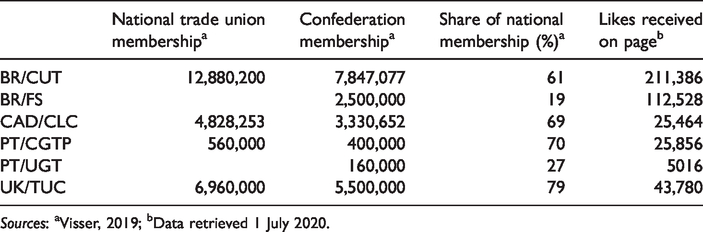
Sources: aVisser, 2019; bData retrieved 1 July 2020.
Nevertheless, considering the membership figures, these metrics highlight that all six confederations have a low number of followers, given the potential population just within the labor movement in each country. Taking CUT as an example, while at first 200,000 followers seems like a significant figure, as CUT represents 61% of Brazil’s unionized workers (Visser, 2019) – that is, more than 7.8 million people – the number of likes on its Facebook page would constitute less than 3% of this membership. Similar – or lower – patterns are visible for the other confederations: in the Canadian and British confederations, which represent 70% and 80% of unionized workers, respectively, the number of Facebook followers represents less than 1% of this membership.
The reach of the pages is further illustrated by another metric: the engagement of a particular post, measured by the sum of likes, shares, and comments. The median and maximum engagement of posts in relation to the number of page followers highlight that, in general, very few followers interact in any way with posts by the confederations; the TUC had a median engagement of 0.38%, while in the cases of Brazil and Canada, the figures were even less than 0.1% (see supplemental material online, for detailed table). Considering that, on average, pages can expect on average a 4% engagement rate of content disseminated – that is, posts will appear on followers’ newsfeeds without paid advertisement and they will either like, share, or comment on it 8 – the trade union confederations are well below this figure. Furthermore, if we disaggregate the metrics and consider the comment feature on posts as an opportunity for horizontal dialogue not only between followers and the confederations, but between the followers themselves, the low level of interaction is evident: for Brazil’s FS, Canada’s CLC, and Portugal’s UGT, the median comments were null, while CUT, CGTP, and TUC had a median of seven to eight comments per post.
Yet as the maximum engagements achieved demonstrate, it is possible to reach a sizeable number of users. Posts with the most clout were often during important events at the national level. For example, in Brazil they were related to the impeachment process of then President Dilma Roussef and the arrest of ex-President Lula in Brazil, when social movements across the country mobilized against incumbent Michel Temer and his subsequent reforms to pension and labor legislation. In the UK, Brexit negotiations and their effects on working people achieved high engagement, while in Portugal the same happened during the national elections in 2015. In Canada, an advocacy campaign for improving the national pension plan received the most engagement. Figure 2 shows a timeline of the average monthly engagement on the confederations’ pages. It is possible to visualize peaks of engagement at specific moments, such as the signing of the withdrawal agreement for Brexit in November 2018. The other two peaks for the TUC refer to a highly shared post about Ireland legislating against zero-hour contracts, and a celebratory post about May Day. In Brazil, demonstrations jointly organized by trade union confederations to protest labor and pensions reforms in May 2017 mobilized a larger number of followers for both confederations; on CUT’s timeline there is also a peak of engagement in April 2018, when ex-president Lula was arrested on corruption charges. The CLC-CTC pension campaign in June 2016 was its most engaging effort, followed by a Labor Day message advocating for a universal prescription drug plan in September 2017. In Portugal, a nurses’ union strike generated engagement with CGTP in October 2016, with another peak during the celebration of the confederation’s anniversary. UGT’s statement about collective bargaining for public sector unions is responsible for the peak in July 2018, whereas in February 2019, statements of support for a nurses’ strike and against the government generated higher engagement levels.
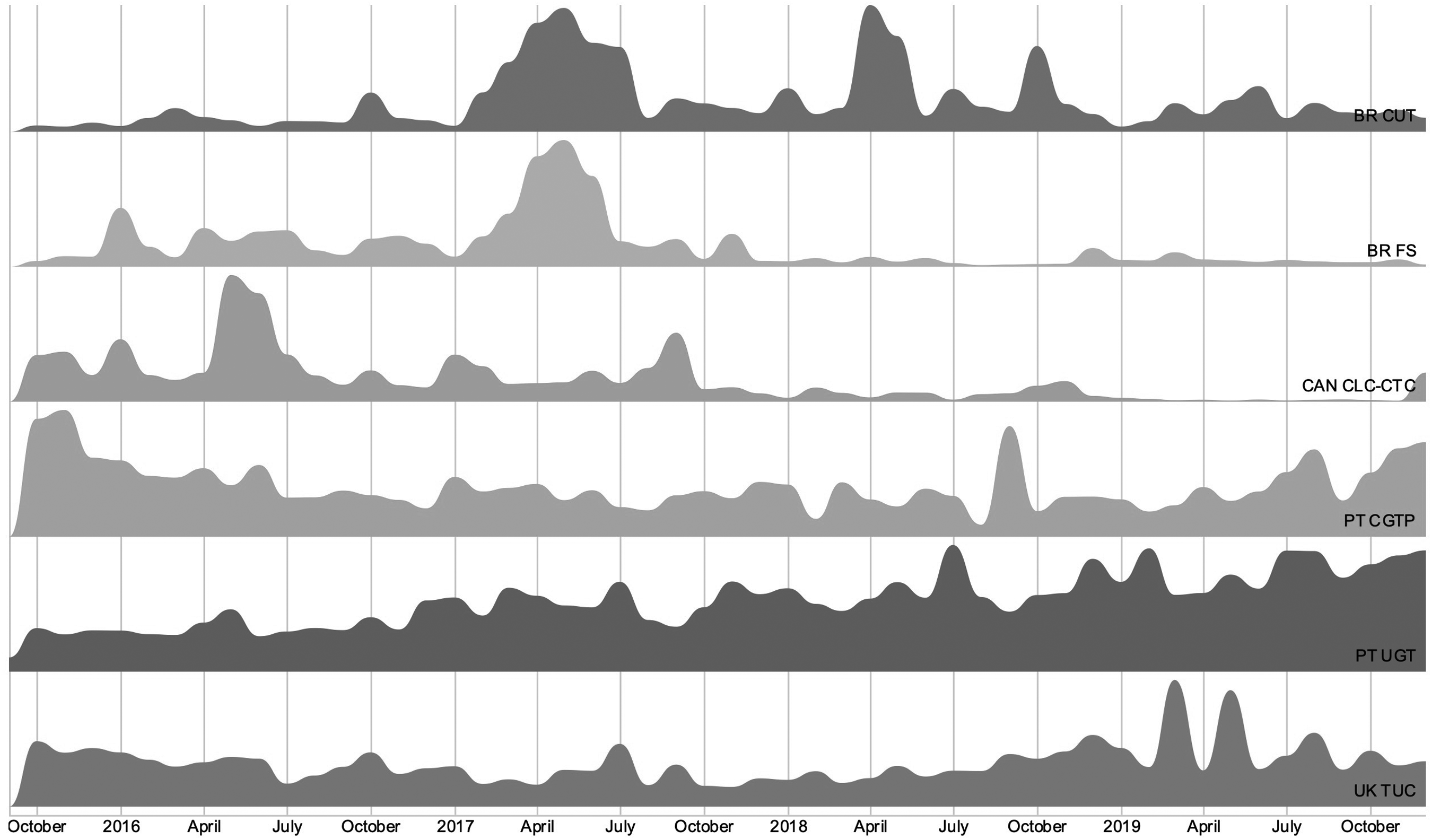
Timeline of post engagement by confederation from October 2015 to December 2019, calculated by the average of monthly engagement metrics (n = 13,451).
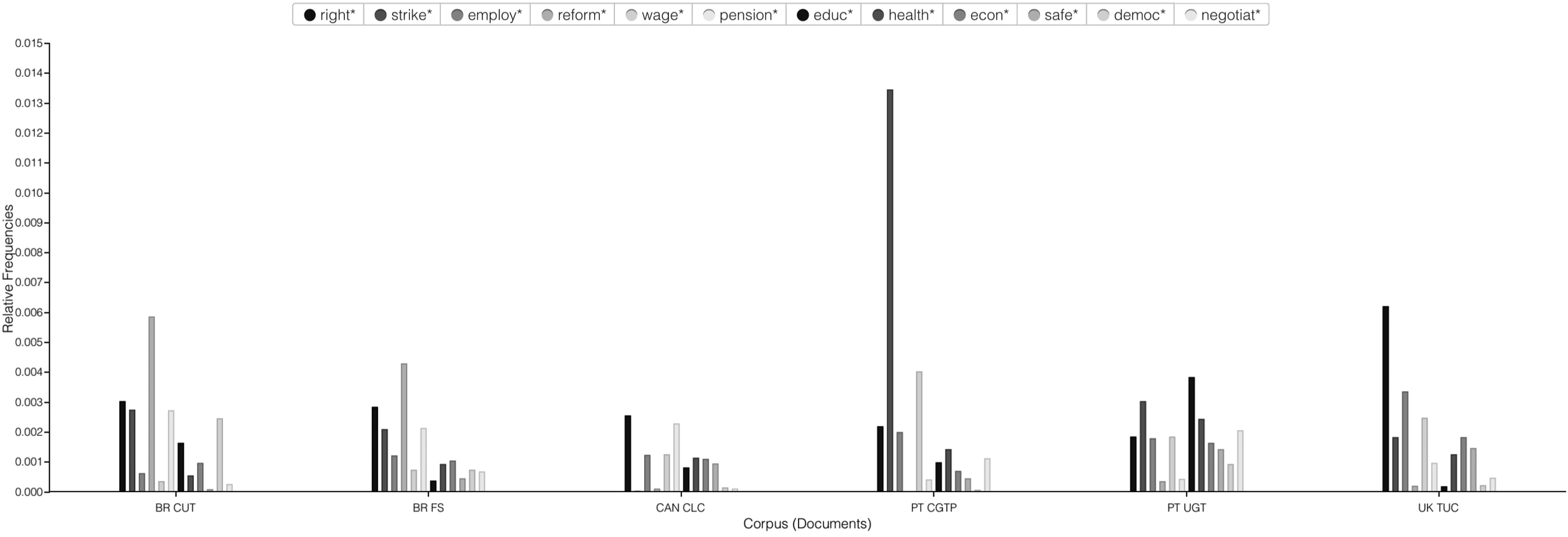
Relative frequencies of stem words related to themes (n.13,451). Source: own construction, based on data retrieved 26 June 2020.
While these trends are reflective of the ‘offline’ modus operandi of the confederations – remarkably, CUT’s strong relationship with the Workers’ Party, CGTP’s and UGT’s involvement with sectoral conflicts and negotiations, and the CLC’s and TUC’s prioritization of advocacy – there is not a particular topic that stands out as highly compelling. What is noteworthy, however, is that engagement seems to increase in instances where the confederations take a clear position on an issue. For instance, the most commented post from the TUC condemns then Prime Minister Theresa May’s handling of the Brexit negotiations, stating ‘It’s no wonder that people are angry – they must have the final say on Mrs. May’s ruinous deal’ (7 January 2019); in Portugal the most liked post in CGTP’s timeline linked to a statement on its website celebrating election results, which shifted power from conservative parties to a center–left coalition government (‘We won! The PSD/CDS coalition is done!’, 10 November 2015); from CUT’s page, its most shared content was a video produced by the confederation with the presence of national celebrities denouncing labor and pension reforms, entitled ‘What do we want for Brazil?’ (21 October 2016). Whether confederations were declaring support for ex-President Lula, defending striking workers, or taking a stance on Brexit, asserting convictions elicited greater interaction.
In order to characterize the posts, we assessed types of content shared by the confederations (see supplemental material online). Globally, almost half the posts contained links (48%), followed by images and videos (present in 29% and 23% of posts, respectively). The TUC and the CGTP were the confederations that shared most links, which were present in 67% and 66% of their posts, respectively; conversely, the Brazilian CUT shared a link on just 9% of posts and favored videos. Regardless, it is noteworthy that in all cases the links shared were ostensibly from the confederations’ own websites. CGTP is the most extreme example, where almost 90% of the links featured on posts originated from its website, but the prevalence of own content was visible across the dataset, with almost two-thirds of all links taking users to a confederation website.
Still regarding sources of content, Facebook is the top root domain globally and for most confederations. This indicates that the majority of content disseminated was originated on the platform itself, most likely either images or videos uploaded directly to a page’s timeline, as well as live streaming and content shared from other pages. A third of the posts contained content from the confederations’ own domains, such as their websites and campaign microsites (see supplemental material online).
The in-depth content analysis of a subset of posts validates this information. As the case coding further broke down possible sources, the analysis corroborates the overall assessment that confederations prioritize posting their own content on social media, rather than sharing information from other sources – whether it be the media, other labor organizations, or civil society organizations. Portugal’s UGT was the confederation that gave most space to labor organizations, mainly their own member trade unions, which featured on 23% of their posts. All other confederations were overwhelmingly endogenous (see supplemental material online).
Moreover, the presence of tags – which essentially link another page or person to a post – was very sparse across the confederations. Tagging, as a specific affordance of Facebook, can be used to show alignment, to acknowledge others, to give space to knowledge produced elsewhere, and, as a tagged page or person is notified of this mention, it is also a strategy to reach out and encourage dialogue. Yet of the 600 posts, only 60 contained a tag, from which almost all – except for one celebrity tag by the CLC and one international labor confederation tag by UGT – mentioned confederation leaders or member unions, thus falling short of proactively engaging with other actors within the labor movement or broader social movements.
Regarding the presence of a message or commentary in the text box of posts, overall, 23% of posts from all confederations did not contain any original text. There is a notable contrast between CGTP and the other confederations: while CUT and TUC added some kind of commentary to every post analyzed, posts with no text represented 68% of the content shared by CGTP. This means the user had to click on the feature (link, video, etc.) in order to find out what content was shared.
The tone of the posts was considered, that is, whether they are intended to inform or mobilize page followers, whether they express an opinion, stand in solidarity with other struggles, or celebrate achievements of the confederations or other relevant actors. Across all confederations, a significant majority of posts aimed to inform about issues the confederations consider pertinent to themselves and their audience – that is, they passively disseminated information without an explicit call to action or perspective. Taking a stance on an issue and mobilizing followers were second and third overall, respectively. Some variation is noted: the CLC frequently featured their leaders’ opinions about current affairs, and many posts encouraged followers to get involved in signing petitions or joining campaigns. Likewise, the TUC promoted organizing campaigns that both celebrated the achievements of trade unionism in the UK and called on followers to unionize (see supplemental material online).
Besides the characterization of the posts, content analysis enabled assessing the topics that the trade union confederations addressed over the period. Based on the thematic structure of our conceptual framework, a text analysis was performed on the whole corpus of posts, in which the stem words for key concepts from each category were analyzed. Figure 3 presents the relative frequencies of the top stem words related to themes, where strike* and negotiat* are attributed to union issues; employ*, reform*, wage*, pension*, safe*, and equal* are attributed to labor issues; and right*, educ*, health*, econ*, democ* are attributed to broader issues.
The prevalence of certain themes is visible, first in that the confederations dedicate the majority of content to labor and union issues. The exceptions are the significant presence of democracy-related posts in CUT’s Facebook – which, as discussed previously, related to the confederation’s support for ex-presidents Lula and Dilma Roussef – and of content about education and rights by UGT and TUC, respectively. However, while these keywords have been attributed to the broader issues theme, the context around them shows that they are used in relation to workers’ training and rights, rather than in an ampler sense.
The in-depth content analysis confirms these overall trends and provides a more nuanced perspective. A prevalence of labor-related issues was followed closely by union activities; just under a quarter of posts addressed a broader agenda. Again, when the data are disaggregated at the confederation level, it is possible to see what each organization focused their Facebook communications on: within this subset, the CLC was the only confederation that posted more about broader causes; the other five emphasized labor- and union-related content. Proportionally, the Portuguese confederations posted least about broader issues, but gave much more space to content regarding trade union activities (see supplemental material online).
With regard to the specific sub-themes addressed by the confederations in the sample analyzed, Figure 4 illustrates the most frequent topics for each organization, with the different shades representing the three overarching themes. Themes vary greatly among the confederations, as there is not a single category recurrent within the top mentions in all six. However, the graphs show a tendency of trade union confederations to focus on traditional labor messaging around labor policy and legislation, pensions and retirement, workers’ rights, and strikes/negotiations.
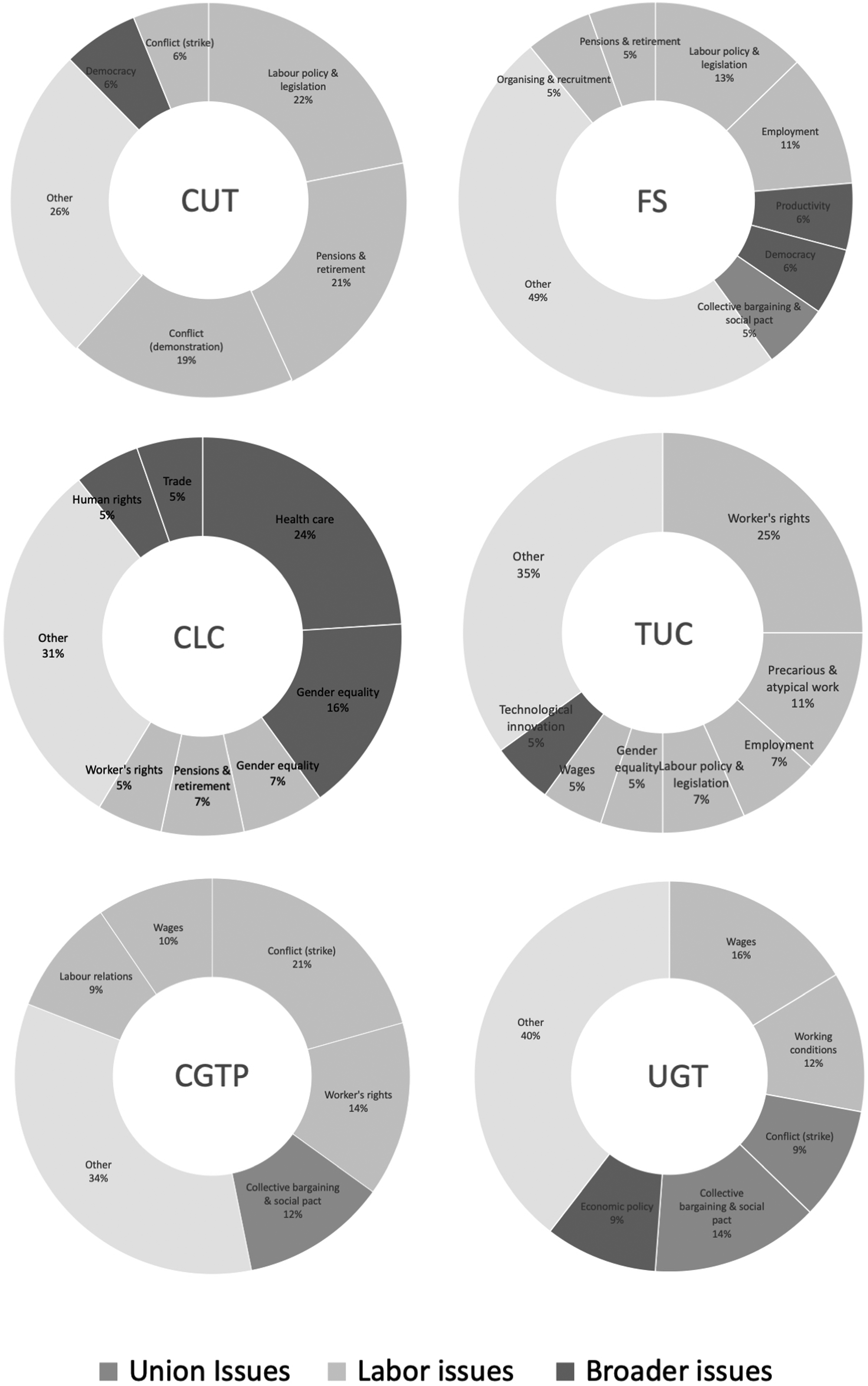
Top themes featured on the official Facebook pages of trade union confederations, by confederation (%) (n = 630).
Lastly, in terms of content aimed at specific interest groups – especially considering those ‘hard to reach’ groups such as young people, migrants and people of color (Bernaciak et al., 2014) – trade union confederations make sporadic attempts to address them directly. Following the same approach as above, stem words related to special interest groups were searched across the corpus. The relative frequencies for the top terms are shown in Figure 5, namely for words related to women, young people, Indigenous peoples, Black people, people with disabilities and migrants. Posts directly aimed at women account for the majority of segmented posts in all confederations except the TUC, which aimed at young workers more frequently. Canada’s focus on women and Indigenous peoples is interconnected, as the confederation ran a campaign to raise awareness about the high rates of murder of Indigenous women in the country. The subset analyzed in-depth highlights that posts directed at women and young people were present across the confederations, while the LGBTQA+ community and the unemployed were addressed once each, by the CUT and the CLC, respectively (see supplemental material online).
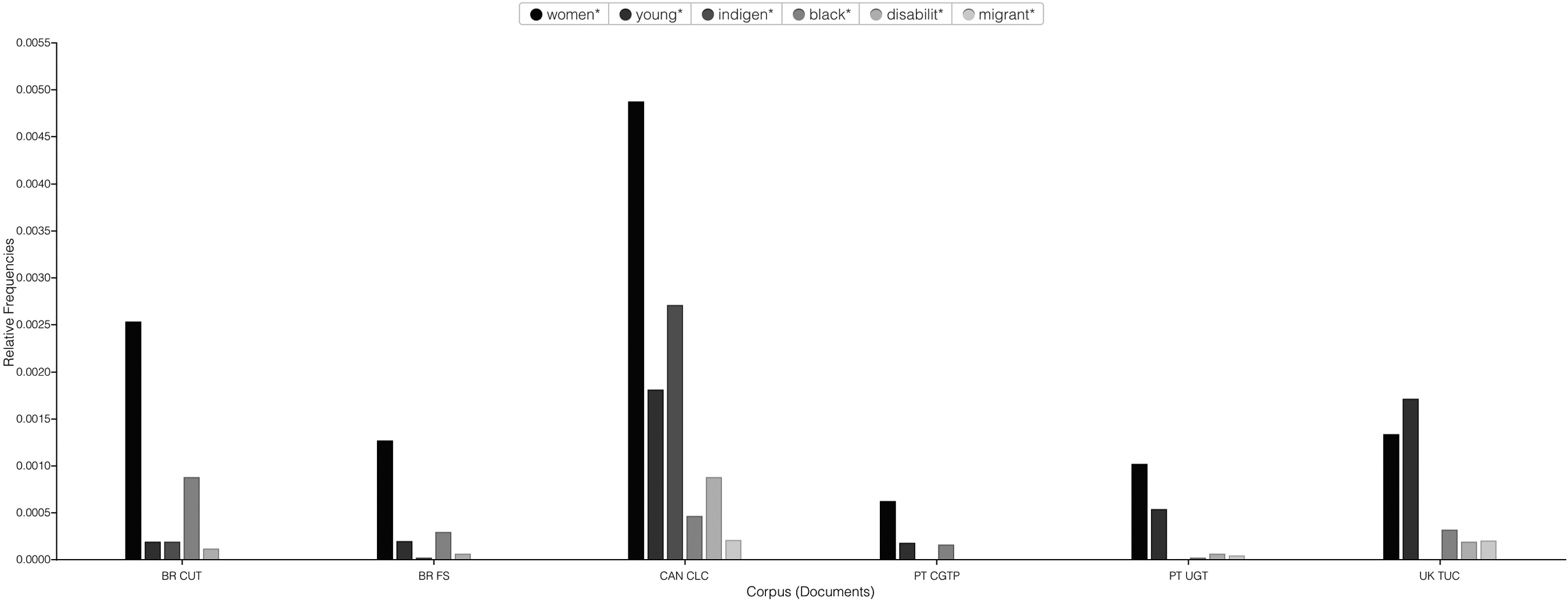
Relative frequencies of stem words related to special interest groups (n = 13,451).
Discussion
Our analysis of the official Facebook pages of six trade union confederations in Europe and the Americas supports previous research that suggests that, in spite of the Internet consisting of an unavoidable tool for union recruitment and mobilization strategies, the opportunities for digital trade unionism seem to have found more acceptance among scholars and digital industry professionals than among rank-and-file trade unionists (Rego et al., 2016). Thus, the ‘virtual’ unionist is still far behind the ‘real’ unionist (Costa, 2018), and while the number of unionists connected to the web may already be at the same level as the unionists on the ground, as envisioned by Lee at the turn of the century (2000: 14), it does not mean they are actually engaging with labor institutions on digital platforms.
Consequently, the results presented above provide some pertinent contributions to the debate around trade union renewal. First, the focus on disseminating their own content and the few tags beyond confederation leaders indicates that connections with other organizations or people are occasional and restricted to an immediate sphere of influence, thus reinforcing the ‘echo chambers’ of the confederations and hindering possibilities for outreach and alliance building. As noted, discussions around trade union renewal strategies have a strong focus on developing alliances with diverse social movements to defend a common social justice agenda, connect labor issues with other causes, and, on a practical level, organize hard-to-reach workers, such as those with atypical and precarious contracts (Bernaciak et al., 2014; Martínez Lucio et al., 2017), while at the same time strengthening mobilization of existing membership (Hickey et al., 2010). Our findings corroborate other recent studies on different platforms (Hodder and Houghton, 2019) that show that, at least on social media, organized labor may be missing out on expanding their influence. This alludes, in part, to the fact that the deficit of real alliances between trade unionism and other social movements is seemingly being replicated in (rather than compensated by) the virtual domain (Costa, 2017).
Second, even if confederations should be positioned at the forefront of technological developments that help advance the cause of trade unionism, they reproduce an outdated ‘one-way’ model of communication, using Facebook mostly to relay information rather than taking advantage of the interactive affordances of social media and the opportunity for horizontal dialogue. The content analysis revealed that all six organizations focus much of their efforts on posting links to resources from their own webpages – often without any analysis, call to action, or encouragement of dialogue. The lack of dialogue is corroborated by the low engagement metrics, especially regarding comments on posts, which are close to non-existent in the majority of posts of all confederations. Interestingly, the four Portuguese-language confederations have a strong focus on descriptive/neutral information sharing, with few posts calling on followers to take any action, clearly stating a position on an issue, or expressing solidarity with workers’ struggles and other causes. Conversely, while awareness raising was also the prevalent tone for the CLC and TUC, these confederations much more frequently directly encouraged their followers to act by signing petitions, joining campaigns, or attending demonstrations. This could reflect the predominance of the organizing model in North American and UK trade unionism (Vandaele and Leschke, 2010), which focuses on grassroots mobilization, hence requiring a more dynamic discourse to stimulate participation. Likewise, the trends regarding themes detected in the content reproduce local/regional trade union cultures. As Southern European trade union activity is still very much based upon traditional working-class discourses (Costa and Estanque, 2019; Estanque and Costa, 2012), online communications reproduced this dynamic, as both the CGTP and the UGT placed a heavy emphasis on collective action – whether strikes, demonstrations, or negotiations – as opposed to the other confederations, which distributed their content across different themes. For instance, Brazilian, Canadian, and UK confederations frequently posted content related to labor policy and legislation.
However, irrespective of predominant trade union models, this study shows that trade union confederations reach a limited audience on social media. This could be partially justified by the very controversial – and consistent – decrease in organic exposure of unpaid content on Facebook (as the platform increasingly monetizes its services), which means less and less people see content from pages on their personal newsfeed unless that content is ‘boosted’ through advertising. However, the confederations’ reach is still below the average organic reach expected for pages. This may also be a signal that the type of content and/or messaging shared by the confederations is failing to generate a meaningful reaction from followers. As shown by the posts that elicited most reaction from page followers, higher engagement is achievable when position-taking messages are disseminated. Moreover, that the content is seldom targeted at special interest groups sends a warning sign regarding the perceived inclusivity (or lack thereof) of trade unions – from coverage of labor issues that concern particular segments of the population to content that positions trade unions as allies in identitary struggles– that dialogue is simply lacking.
The systematic analysis of engagement metrics, of the types of content shared on Facebook, and of the themes covered by trade union confederations reveals a challenge faced by the labor movement as a whole: how to effectively amplify reach, on social media and beyond. To stand out in a virtual world saturated with information, the ability to be creative, to tell stories that foster connections, and to move away from the top-down communication model are essential elements. By building a strong narrative, encouraging dialogue, and addressing issues beyond the workplace, trade unions are able to integrate into broader networks, enhance solidarity, and expand their influence in social change processes (Bieler, 2014; Geelan and Hodder, 2017; Lévesque and Murray, 2010).
Conclusion
The digital age confronts organized labor with a diversity of concepts and ideas that range from individual experiences to transformations in social relations in both the virtual (Web 2.0 as a platform for networked two-way communication) and the ‘real’ world (the hybridization between online and offline dimensions). Within this context, digital communication technologies and social media present a significant opportunity for trade union renewal as platforms for outreach, advocacy, and alliance building. So far, the findings of our investigation into the Facebook activity of trade union confederations in four countries corroborate other research on this matter (Haake, 2017; Hodder and Houghton, 2015; Kerr and Waddington, 2014; Rego et al., 2016) that indicates that despite the widespread use of digital communications by trade unions, there is still a long way to go in terms of fundamentally changing the way they communicate. In fact, ‘the uncertainty of democratic experimentalism for union renewal’ (Murray, 2017: 23) stood out in our analysis.
Bringing together the theoretical and empirical contributions of our research, we conclude that the ability to embrace the tools and concepts of the digital era is crucial for trade unions and for unionists to face the future of work, its new context, and communication mechanisms. But while incorporating digital unionism in day-to-day trade union activity is a basic assumption, it nevertheless confronts two realities: that of the opportunities generated by new information and communication technologies, versus the ‘physical’ struggles and needs of workers (even when the ‘physical’ may now happen online as well). As a consequence, digital trade unionism is far from being the generator of a ‘common culture’ shared by workers of all kinds; rather, it can be a contentious space where there is no consensus in terms of strategies and expectations, and where the ability to react quickly to changing online environments is another challenge for longer term strategic planning.
Moreover, if we consider that the virtual and the ‘real’ are no longer separate realms, then we can also extend the findings of this study beyond the web, to reflect on whether social media behavior is essentially a reproduction of the offline dynamics of trade unionism that persists on maintaining a vertical relationship with its ranks and restricted relationships outside labor, in spite of widespread consensus on the need for horizontal participation. While social media platforms are a relatively recent development, these challenges are not. Effectively, any social media strategy will only support trade union renewal if the structures are in place to convert online engagement into offline mobilization.
In this regard, trade unions could greatly benefit from reaching out to non-labor organizations and grassroots groups that already have a solid presence on social media and a track record of online mobilization in order to exchange expertise and develop joint campaigns that make the link between their causes and the world of work. An initial effort online could reap tangible offline results with regard to membership levels and succession, as such alliances would not only demonstrate a willingness by organized labor to expand their agenda, but also open doors for engagement with segments of the population that represent a potential for organizing, such as young people and minorities. In return, these potential allies would benefit from the well-established institutional structure of trade unions, their experience in negotiation and advocacy, and their capacity to mobilize their ranks.
To say that ‘the Internet belongs to everyone’ (the title of Lee’s seminal book) means to recognize it as an instrument for trade unions to renew themselves and their communication strategies in order to broaden dialogue with organized labor and beyond (Martínez Lucio et al., 2009), should the workers choose to do so. The challenge is convincing workers and unions that it can also be a way to achieve practical results. In this sense, by helping overcome geographical, institutional and class barriers, digital unionism can become an important mechanism for maximizing emerging opportunities. For that, it is important that this form of communication is embraced not only as a technical tool, but also as an ethical principle towards more democratic communications.
Supplemental Material
sj-pdf-1-jir-10.1177_0022185620979337 - Supplemental material for Digital unionism as a renewal strategy? Social media use by trade union confederations
Supplemental material, sj-pdf-1-jir-10.1177_0022185620979337 for Digital unionism as a renewal strategy? Social media use by trade union confederations by Bia Carneiro and Hermes Augusto Costa in Journal of Industrial Relations
Footnotes
Acknowledgements
We wish to thank fellow researchers Giuliano Resce and Giosuè Ruscica for their support in text mining and web scraping.
Data availability
Raw data used to generate the results presented in the article are available from the corresponding author at biacarneiro@ces.uc.pt.
Declaration of conflicting interests
The author(s) declared no potential conflicts of interest with respect to the research, authorship, and/or publication of this article.
Funding
The author(s) disclosed receipt of the following financial support for the research, authorship, and/or publication of this article: The authors gratefully acknowledge the financial support of the Portuguese Foundation for Science and Technology (FCT) and the European Fund for Regional Development through COMPETE2020 for the research project ‘Rebuilding trade union power in the age of austerity: A review of three sectors’ (PTDC/IVC-SOC/3533/2014 – POCI-01-0145-FEDER-016808), and of the FCT for the PhD research grant SFRH/BD/111641/2015 for the PhD project titled ‘Does labour get online to mobilize young workers offline? A comparative analysis of the relationship of trade union congresses with young workers through the Internet in Europe and the Americas’.

Supplemental material
Supplemental material for this article is available online.
Notes
Biographical notes
References
Supplementary Material
Please find the following supplemental material available below.
For Open Access articles published under a Creative Commons License, all supplemental material carries the same license as the article it is associated with.
For non-Open Access articles published, all supplemental material carries a non-exclusive license, and permission requests for re-use of supplemental material or any part of supplemental material shall be sent directly to the copyright owner as specified in the copyright notice associated with the article.
