




Abstract
This article addresses debates in contemporary industrial relations about practical application of pluralism. We compare the potential efficacy of ‘radical-pluralism’ and ‘neo-pluralism’. Data comes from analysis of employment relationships in two unionised public transport sector organisations, in the comparative country contexts of the UK and Republic of Ireland. It is argued that radical-pluralist framing of the employment relationship is better equipped than neo-pluralism to provide deeper and contextually sensitive understandings of the realities of unequal employment relationships. Desired (pluralist) democratic values differ from real world application of joint regulation (praxis). This raises implications regarding constraints on state regulation and public policy goals institutionalising pluralism as fluid and uneven praxis.
Introduction
‘Frames of reference’ have attracted considerable debate in contemporary industrial relations literature (Ackers, 2014, 2019; Budd, 2020; Budd and Bhave, 2019; Cullinane, 2016; Edwards, 2014; Heery, 2016a). There remain issues concerning application of frames. Although both unitarist and Marxist frames are relevant, we focus here specifically on ‘zones of contention’ within pluralism. A central tenet of pluralism is ‘a widespread diffusion of power such that no one class or group or stratum can dominate … the rest’ (Fox, 1979: 106). Pluralism has been a dominant concept in public policy prescriptions regulating employment systems (e.g. Donovan Commission, 1968), and a frame of reference long contested by industrial relations (IR) scholars (Hyman, 1978). Contemporary ‘zones of contention’ persist within pluralism as a broad church, between a ‘radical-pluralist’ synthesis and ‘neo-pluralist’ renaissance. Ackers (2019: 35) has been prominent in advancing constructive debate about ‘pluralisms’, proposing ‘different approaches to pluralist theory itself, and an intellectual framework where pluralism is always in vibrant debate with alternative perspectives’. While agreeing with Ackers’ point about vibrant debates within pluralism, this article contests his criticisms of radical-pluralism.
In advocating debate about application of pluralism ‘in action’, it is important to revisit Fox’s (1979) crucial distinction between pluralism as a theoretical value concept and the extent of its practical application. An important contribution, therefore, is to illustrate that pluralism in ‘action’ (praxis) is neglected and differs from pluralism as a ‘concept’. The article also draws on empirical data, using qualitative research methods to test the pluralist frame in practice, and reveal what differences in context (e.g. internal/workplace and external/country comparison) add to knowledge about pluralist frames, particularly its praxis. Specifically, we contrast pluralist approaches in two unionised transport sector organisations (RailCo and BusCo) in the comparative country contexts of the UK and Republic of Ireland.
The next section reviews literature and debates relating to ‘zones of contention’ within contemporary IR pluralism. The ‘Case contexts and methods’ section outlines the case contexts and qualitative research methods. The findings are reported next, illustrating three distinctive (radical) pluralist themes: (1) contextualising employment relations, (2) asymmetrical power relations and (3) structured antagonism. Case study evidence reveals variation at micro, meso and macro levels in pluralist praxis across country contexts. The article finishes with a discussion and implications for policy and (pluralist) value praxis.
‘Zones of contention’ within IR pluralism
There is common ground between neo-pluralists and radical-pluralists, especially about the quantifiable features of the demise of collective bargaining, joint regulation and pluralist institutions (Van Wanrooy et al., 2013), leaving an employee representation gap (Towers, 1997). There is consensus among pluralisms, therefore, of the need to revitalise pluralist values and policies that may enhance or re-stimulate democracy in workplaces and society. Ackers (2014) raises fundamental issues, observing that work relations are ‘mostly’ asymmetrical, that ‘many but not all’ actors interpret policy in different ways in different contexts, and that empirical enquiry is required.
Nonetheless, there are theory and practice points of divergence between ‘neo-pluralism’ and ‘radical-pluralism’. The radical-pluralist synthesis originated from a critique of classical pluralist reformism by Fox (1973, 1974, 1979, 1985) and Goldthorpe (1974). Radical-pluralism ‘recognises the plurality of groups and interests in society (and welcomes social pluralism in principle) whilst observing the more basic patterns of power and inequality which tend to shape, and be shaped by it’ (Watson, 2017: 344). The essence of radical-pluralism is the argument that the bases of conflict and consent are deeper and more socially embedded in structures of power, authority and inequality in workplaces and wider society than classical pluralism acknowledges. These analytical foundations have subsequently been built on by other radical-pluralists (Blyton and Turnbull, 2004; Edwards, 1986, 2014, 2018 – who prefers the term materialists; Gold, 2017; Watson, 2017). Radical-pluralists (materialists) draw on theoretical insights from Marxism, but maintain distance from ‘political’ Marxists prescribing potentially violent revolutionary overthrowing of the prevailing wider socio-economic system and possible imposition of totalitarian governance (Edwards, 1986, 2014, 2018; Gold, 2017; Thompson, 2010); or what Kaufman (2015) terms a ‘form of socialist unitarism’ (p. 281). That said, Marxism is also a very broad church.
Fox (1973, 1979) recognised that theorising radical reform of inequalities and power relations in society, and workplaces, requires transformative enactment of values: the praxis of pluralist principles through achievable action. In countries (and workplaces) with acute structural inequalities of class, opportunity, power and wealth, like the UK, it is unsurprising if social consensus and cooperation are problematic and do not function as predicted. The result is that low-trust work organisation and work orientations are more prevalent than high-trust relations (Fox, 1974; Siebert et al., 2015). Edwards’ (1986, 2014, 2018) subsequent materialist analysis of structured antagonism in the employment relationship has influentially built on Fox, synthesising radical sociological with pluralist IR scholarship. Central to Edwards’ (2003) radical-pluralist synthesis is the ‘fundamental nature of the employment relationship’, based on accumulation of surplus value, structured antagonism, power imbalance and indeterminacy of the effort-reward bargain. Turning to capitalist social structures, there is a relation of ‘structured antagonism’ between capital and labour, comprehensively theorised by Edwards (1986, 2014, 2018). Structured antagonism reflects ‘managerial strategies … about the deployment of workers’ labour power in ways which permit a generation of a surplus’ (Edwards, 2003: 16–17). Antagonism is structurally embedded within capitalist employment relationships, deriving from ‘workers [being] subjected to the authority of management and the need to plan production in accord with the needs of capitalist accumulation’ (Edwards, 1986: 5). Employers require workers’ creative capacities to labour but cannot concede free rein because of the need to extract a surplus and maintain control over work activities. This includes the public sector, where work is increasingly organised along private sector capitalist market-driven principles, notably marketisation, outsourcing and competition (Edwards, 2014; Hastings, 2003).
The radical-pluralist synthesis has been challenged by contemporary ‘neo-pluralists’, noticeably Ackers (2002, 2005, 2014, 2019). Ackers (2014: 2618–2623) identifies five empirical objections to radical-pluralism, which together ‘suggest that questions of power, conflict and collective behaviour at work are better explained by political and socio-economic context than by any essential features of the capitalist employment relationship’. Three specific criticisms of RP stand out and are questioned and unpicked in this article: a ‘methodological problem’ (alleged preference for structural generalisation over concrete empirical evidence); an ‘ideological problem’ (an alleged Marxian emphasis on power imbalance and conflict over cooperation); and alleged failure to explore public policies supporting workplace cooperation, including partnership (Ackers, 2014: 2621).
These RP objectives can be refuted both conceptually and, as we report later, empirically in terms of pluralist praxis. Neo-pluralism revives Durkheim’s analysis about how moral communities and social institutions bond work and society together. It is these original Durkheimian functionalist roots, seeking integration, cooperation, stability and order, that Ackers (2014) argues are wrongly severed by radicals. Recent neo-pluralist revival prioritises ‘positive’ employment relations and collaborative mutual gains through labour–management partnership (Ackers, 2014, 2019; Johnstone and Wilkinson, 2016). Through social partnership, neo-pluralism endorses a normative consensual order for advancing employee participation as an alternative to adversarial Marxist goals of workers (unions) challenging capitalism. Indeed, partnership can at times achieve desirable and collaborative redistributive goals. However, such a goal is not always realised or achievable in actual practice. Furthermore, neo-pluralist institutional functionalism neglects elements of Durkheim’s original analysis, specifically emphasising structural equality of opportunity and fairer redistribution of ownership and wealth as essential preconditions for realising social consensus (Gold, 2017).
Ackers’ (2014) critique of (materialist) radical-pluralism wrongly conflates it with revolutionary Marxism and mistakenly suggests that radical-pluralists accentuate conflict over cooperation. Conflict and cooperation do coexist as key features of radical-pluralism, and consensual social dialogue is a desirable end goal. The neo-pluralist view is to presume that adversarial conflict-based interests are both counterproductive and self-defeating within competitive capitalist markets. In contrast, cooperative mutuality through social partnership is perceived to generate higher quality employment outcomes. However, radical-pluralist (materialist) analysis recognises that antagonism is a ubiquitous structural undercurrent. But this is very different than saying it explicitly ‘advocates’ conflict as a preferred modus operandi and/or that conflict is omnipresent at the surface level in daily effort–reward bargains. In short, radical-pluralist analysis injects a nuanced dialectic of degrees of both ‘cooperation’ and ‘conflict’ on a variable spectrum. Cooperation is a more prevalent day-to-day phenomenon than conflict, otherwise organisations would become mired in anarchy and not survive. Of significance is that cooperation and consensus are shaped by structural (in)equalities and institutions mitigating labour decommodification that exist in different country contexts and organisational rules at any one time.
In developing the case for radical-pluralism, several zones of contention within pluralisms are identified below: (1) unequal power relations; (2) antagonism, conflict and cooperation; (3) capital and labour interest formation; (4) contextualising employment relations over both space and time; and (5) policy enactment (and non-enactment) relating to pluralist values versus realisation (praxis).
Unequal power relations
Respective frames make different assumptions about power relations between actors (Heery, 2015, 2016a, 2016b). Radical-pluralism is well-placed to incorporate nuanced analysis of power dynamics. It advances theoretical insights that structural imbalances of power characterise employment relationships under capitalist exchange, which shapes the behaviour of actors, processes and outcomes. Power imbalance is reflected in employers’ ownership of capital and the means of production, and workers’ needs to secure subsistence to survive. The decision of when, where and how to invest capital provides employers with fundamental power to permit or deny individuals possibilities to become or remain workers. Employers have authority over hiring and firing, and control organisational decision-making. Even where unions (and workers) exert some influence over the ‘frontier of control’ in workplaces, this is mostly narrowly restricted to economic issues around defending the immediate effort–reward bargain, rather than broader participative industrial democracy (Goodrich, 1920; Hughes and Dobbins, 2021; Hyman, 2016). Imbalance is more than an initial condition. Capital, crystallised in liquid money, is possessed of mobility inaccessible to more geographically rooted workers, and this capital mobility has intensified under the financialised phase of capital accumulation (Thompson, 2013).
Neo-pluralism rejects in-built power imbalance within capitalism. Neo-pluralists avoid this because it is deemed to ignore fluctuations in power, instead preferring to treat power as an empirical assessment of who achieves what in a given situation (Ackers, 2014: 2618). Yet a big reason for Fox’s ‘road to Damascus’ conversion from orthodox pluralism to radical-pluralism in the early 1970s was his realisation that assuming power balance in capitalist exchange relations is mistaken, because of unequal access to power between the controllers of capital and workers whose livelihoods depend on employers’ decisions. Like Lukes (2005), Fox (1985) recognised the complex faces of power in both its visible and invisible guises. Radical-pluralism further refines imbalances with regard to ‘power over’ and ‘power to’ distinctions (Edwards, 2006; Lukes, 2005). Some Marxists still view power too deterministically through the prism of one economic class (capitalists) exerting ‘power over’ and dominating and controlling another economic class (workers), assuming that wider class struggle emerges from this exploitative power differential. Conversely, unitarists and pluralists tend to exaggerate the functionalist scope of ‘power to’ achieve orderly cooperative mutual gains under contemporary neoliberal capitalist political economy.
Antagonism, conflict and cooperation
There is contention between radical-pluralists and neo-pluralists (and Marxists) about antagonism, conflict and cooperation at work. The radical-pluralist (materialist) concept of structured antagonism (Edwards, 1986, 2003, 2014, 2018) between capital and labour need not imply that capitalists and workers will meet as opposing classes with clearly opposed interests. Yet nor should analysis go to the other extreme of denying that such embedded antagonisms exist. In conceptualising structured antagonism, Edwards (1986: 5) suggests that ‘conflict is the more basic principle’ than cooperation because ‘workers' ability to work is exploited for it is deployed in the creation of a surplus that goes to another group’. However, Edwards is clear that underlying antagonism does not mean that conflict will manifest itself. This will depend on how employment relations are managed in different empirical contexts, indicating different levels of analysis. In contrast, mainstream pluralism portrays conflict as a temporary rather than underlying structural phenomenon in employment relationships (Budd, 2004).
It is arguably a moot point whether conflict is the ‘more basic principle’ than cooperation: each is likely to vary by context. However, for Edwards (1986: 10), it is only after the underlying structural antagonism that ‘cooperation comes in’, shaping then how work relations are organised. Cooperation is structurally fundamental given daily mutual dependency, albeit asymmetric, between employers and workers: the existence of one actor is conditioned by the existence of the other, and for exploitation to occur requires cooperative exchanges of some sort, even under conditions of compulsion or expedient compliance (Fox, 1985). An underlying antagonism is not the same as conflict, and both conflict and cooperation can be equally present (Blyton and Turnbull, 2004: 38). 1 A limitation with other IR frames of reference is too much relative focus on either conflict or cooperation, at the expense of the dialectical interplay and combination.
There are degrees and combinations of conflict and cooperation patterns. It is important to foster improved conceptual understanding of cooperation and how it intersects with conflict (see Bray et al., 2020). Cooperation in the employment relationship is defined by Bray et al. (2020) as ‘managers, workers and their representatives, if any, working together towards the same end’ (p. 118). We might only say conflict is more fundamental than cooperation if we accept that the dynamics of exploitation objectively conflict with interests and concerns of workers. Yet workers often actively consent to, or at least comply with, their own exploitation in the labour process. Burawoy (2013: 533) observes that exploitation has become ‘a privilege desired by ever more people’, characterised by a precariat, rather than Marxist proletariat, ‘desperately seeking to defend its exploitation’. Potentially, Polanyi’s (1957) analysis of waves of market fundamentalism offers valuable insight under contemporary financialised capitalism. Commodification of labour through free exchange in self-regulating markets threatens workers’ capacity to engage in productive activity to sustain themselves and their families, with destructive consequences for human existence in an economic system (capitalism) where most people depend on paid work to survive (Burawoy, 2013: 533–534). This constitutes coercive compliance through despotism in situations where workers perceive the power balance so overwhelmingly imbalanced against them – far from willing commitment (Wood, 2020).
Capital and labour interest formation
Workers may resist or consent to their exploitation and commodification, cooperate in producing surplus value, depending on how they experience and perceive their situations and concerns in specific contexts. A framework of concerns exists (Bélanger and Edwards, 2007; Edwards et al., 2006), whereby capital and labour each have two distinct sets of ‘concerns’ shaping conflict and cooperation: ‘control’ of the workplace and ‘developmental’ concerns. ‘Control’ concerns encompass who exerts ‘power over’ work relations, including the extent of management power to hire and fire workers, how work is allocated and by whom. In contrast, longer term ‘developmental’ concerns involve positive sum mutual gains and ‘power to’ generate cooperation. Potential for conflict always exists, even where common developmental concerns are identified (Bélanger and Edwards, 2007: 715). Moreover, radical-pluralist scholarship explains why workplace compromises, where control and developmental concerns are in sync for both parties, may be rare and/or unsustainable, especially under liberal market regimes (Bélanger and Edwards, 2007; Dobbins and Dundon, 2017). Neo-pluralist optimism about diffusing mutual gains compromises appears misplaced, given global economic contexts where ‘power over’ mostly favours employer concerns by squeezing more effort out of workers. To this end, normative judgements can identify ‘real interests’ (Edwards, 2015a, 2015b), for example when workers develop collective solidarity ‘because they are workers’ (Simms, 2012: 113, emphasis original), without arguing that solidarity will actually be pursued and realised. Workers and managers have sets of real interests (or concerns) due to their materialist positions in capitalist labour processes.
Importantly, Heery (2010) identifies different dimensions of (real) interests: ‘workers are reasoning subjects … [who] require effective institutions of representation to allow their participation in decisions that determine their incomes, job security, and quality of working life’ (p. 546). On this basis, interests can be examined along four dimensions: level: workplace, national, international level; diversity (e.g. gender-related interests may shape other sets of interests regarding representation); range of issues, including skill and job quality; depth, do they encompass the immediate status quo, an incremental improvement or wider social change?
Contextualising employment relations over both space and time
Contextualising employment relations is another zone of contention. For neo-pluralists, the employment relationship is no more important than other social exchanges in wider society (Ackers, 2014: 2622). But, there remain solid grounds for insisting that the employment relationship warrants special attention (see Budd, 2020). Ackers (2014) has challenged radical-pluralist conceptualisation of the employment relationship for over-generalising in claiming insights into the nature of ‘all paid work’, when this can only be addressed by empirical research into local context and institutions. For Ackers, radical-pluralist analysis, once the employment relationship is presented, descends into institutional detail indistinguishable from standard empirical pluralism (Ackers, 2014). Better, Ackers (2005: 540) maintains, to start with institutional analysis: Once we start asking important questions, such as why are there more strikes in manufacturing than in retail, or more in France than in the UK, the employment relationship per se can tell us little, the labour process not so much more. Instead, we turn to institutions (in their broadest sense) for explanation. And were these institutions grown from the seed of an employment relationship? Well, yes, in a certain very generic sense, as with trade unions and employer associations, but they grew on very different soil, in traditional societies that existed before capitalism, and shaped its local development. The employment relationship is a useful ideal type to build IR around, but institutions are the historical forces that pour life into it.
Moreover, taking a vital insight from labour process theory, the employment relationship has ‘relative autonomy’ from external contextual influences; ‘relative’ in the sense that external factors shape conflict and cooperation, but ‘autonomous’ because the degree of influence external factors exert depends on specific contextual circumstances (Edwards, 1990: 133–134; Thompson, 2010). Therefore, interpretation of ‘structured antagonism’ as generating tendencies rather than ‘iron laws of motion’ means that (non-Marxist materialist) radicals refute deterministic assumptions of ‘spill over’ effects from external conditions to workplaces. For example, unlike some Marxists, they do not assume an automatic/linear correlation that capitalist accumulation regimes generate workplace conflict/resistance and politicised struggles against capitalism more generally (Dundon and Dobbins, 2015; Edwards, 2014; Thompson and Vincent, 2010). Worker and employer ‘concerns’ evolve historically and are sculpted by contextualised circumstances, including institutions. ‘Concerns’ should not simply be deterministically read-off from systemic capitalist structures and assumed to be homogeneous or singular (Bélanger and Edwards, 2007). Therefore, Ackers (2014: 2610) opens up an unnecessary division between structural sociology and historical institutionalism. Both matter for radical-pluralist analysis (Gold, 2017).
Policy enactment and non-enactment (values versus praxis)
Adopting the normative vision of accommodative pluralism and mutual gains employment relationships, neo-pluralism maintains that scholarship will exercise greater policy relevance, and contribute to a good society based on positive employment relations (Ackers, 2014, 2019). Ackers (2014) is critical of radical-pluralist pessimism about public policy prospects for diffusing workplace cooperation. However, neo-pluralists overstate the potential for realising pluralist values like integrative cooperation and mutuality/social partnership in the contemporary political economy context of neoliberal capitalist accumulation (notably permissive voluntarism in Liberal Market Economies (LMEs) like the UK). Revisiting Fox’s (1979) crucial distinction, radical-pluralists may endorse measures like mutuality and industrial democracy as part of a liberal pluralist set of values (something that ought to be), while also realistically reasoning that industrial democracy is largely unrealisable in practice under currently existing capitalism. Endorsement of pluralist values is very different from believing that robust enduring cooperation is realisable through existing institutions and policies.
Neo-pluralism does not satisfactorily address Fox’s (1979) vital distinction. Indeed, radicals have criticised contemporary pluralists for over-exaggerating prospects for mutuality, cooperation and workplace order, and for moving too far towards managerialist unitarism in accommodating collaborative ‘new realism’ prioritising business performance (Dundon and Dobbins, 2015; Heery, 2015, 2016a, 2016b; Thompson, 2013). For example, neo-pluralists argue that unions can only survive by engaging in partnership with management, by ‘adding value to the business organization’, contributing ‘to business success’ (Ackers, 2019: 44). In so doing, they risk being sucked into the vortex of managerialist performativity and neoliberalism like unitarists, omitting that many employers are unwilling (or unable) to engage in partnership or share power with employee representatives.
This reality is also reflected by gradual erosion of collective forms of (pluralistic) worker participation in practice: from industrial democracy/co-determination, to robust management–union cooperation, to non-union employee representation (NER), to individual employee involvement, to employee engagement. As the terrain for cooperation diminishes more and more, so do neo-pluralist expectations and prescriptions. For example, Johnstone et al. (2010) suggest that NER is better than nothing, concluding that when assessing effectiveness of partnership or worker participation more generally, there is a need to re-consider benchmarks for success, and to set them in contemporary employment relations realities. This claim is contentious. NERs often lack required independence from management to function as robust voice mechanisms, though voice efficacy depends on context (Dobbins and Dundon, 2020; Tuckman and Snook, 2014). Moreover, why should (pluralistic) praxis, under the rubric of business realism, be so limited to the lowest common denominator of accepting crumbs from the employer table? What about emancipation and industrial democracy as a fundamental human rights yardstick for worker participation? (Hyman, 2016b). As Heery (2016b) observes, Whereas the use of business performance as an evaluative criterion relies upon neoliberalism’s own standard in assessing pluralist institutions, the advocates of labour rights and the social justice standard are less willing to appease neoliberalism or submit to its hegemony. (p. 12)
Emphasis by radical-pluralists on constraints of structure and power in the employment relationship does not imply that policy interventions supporting cooperative endeavours between employers and workers (unions) are unobtainable, even in the UK. On the contrary, radical-pluralists recognise alternative ways of managing employment relations, identifying various public policy interventions aimed at advancing good employment relations (e.g. see Sisson, 2016, 2020). This includes, for example, conditions required for workplace compromises to endure (Bélanger and Edwards, 2007; Dobbins and Dundon, 2017); policy changes required to enhance mutual gains from employee information and consultation regulations (Dobbins et al., 2017); job quality (Findlay et al., 2017; Sisson, 2016); workers’ rights (Sisson, 2020) and worker-owned cooperatives (Wren, 2020).
The essence of a radical-pluralist approach regarding public policy possibilities is more realistic than neo-pluralism, in terms of remaining conscious of structural constraints on sustaining cooperative workplace bargains within contemporary capitalist economies, especially LMEs like the UK. This is because the radical-pluralist sees the employment relationship embedded within an increasingly dysfunctional marketised system. Providing theoretical and empirical insights into such turbulent structural constraints helps to explain why favoured neo-pluralist policy prescriptions like workplace partnership may occur under specific conditions, but have often proved so disappointingly difficult to diffuse and sustain, even when employers and employees want collaborative bargains to endure (Thompson, 2013).
Awareness of structural constraints does not discount progressive policy reform, but is necessary for realism in better understanding the challenges and opportunities affecting realisation of pluralist values (see Edwards, 2014; Fox, 1979; Sisson, 2016). This is more realistic than simply stating that cooperation should be at the centre of public policy because it is a good normative orderly vision of how workplaces and society should function. The next section briefly outlines the case contexts and methodology.
Case contexts and methods
The article draws on empirical data to compare pluralist praxis patterns in two highly unionised, state-owned, public sector transport organisations in two country contexts: the UK and the Republic of Ireland (RoI). RailCo in the UK employs around 17,500 workers, while BusCo in the RoI employs around 3500. Like many other public sector organisations, marketisation, competition and other private sector principles have impacted in recent years, fuelling restructuring and cost-cutting strategies in both organisations. Market-driven change in the public sector has been more extensive in the UK/RailCo context. While management of change in both organisations remains subject to a degree of joint regulation through formal collective agreements, union and worker influence has decreased in recent years, but more so at RailCo. The cases are important for demonstrating how marketisation combines with other contextual factors to shape conflict/cooperation dialectics in British and Irish public transport sectors.
How country contexts impact IR in both cases is revealed further in the findings. A key national-level difference between cases is that while the Thatcher government implemented a unitarist neoliberal revolution in the UK, Ireland adopted a softer, more pluralistic ‘social partnership’ model until its breakdown in 2009. Social partnership collapsed after the 2008 financial crisis, largely due to public sector cost-cutting strategies and austerity (Dobbins and Dundon, 2016; Regan, 2017). Union power in Ireland has diminished, but not as sharply as in the UK.
The article uses qualitative research methods: semi-structured interviews, ethnographic non-participant observation and documents (e.g. newsletters, collective bargaining agreements, union press releases). Interviews were conducted between August 2016 and August 2017. At UK-based RailCo, interviewees included four train managers, four station supervisors, two former senior managers, one member of current senior management and two marketing and communications managers. At UnionUK-A, interviews were conducted with 2 lay members, 20 workplace employee representatives (from trains, stations, cleaning and engineering), 3 national executive members and 2 other head office employees. Four workplace representatives were interviewed from UnionUK-B, along with eight lay member drivers, three national executive members and one official. At UnionUK-C, two national executive members, two other head office employees, two station workplace representatives and two lay members were interviewed. RailCo workers are mainly represented by UnionUK-A and UnionUK-B.
In Ireland, three senior BusCo managers and seven garage-level managers were interviewed. BusCo workers are mainly represented by UnionROI-A and UnionROI-B. UnionROI-A interviews included 15 workplace representatives, 10 lay members, 2 national executive members, 2 union officials and 2 other union employees. In UnionROI-B, 15 workplace representatives, 10 lay members and 2 national executive members were interviewed. Additionally, one UnionROI-C clerical representative was interviewed. The study primarily focuses on RailCo and BusCo drivers, but interviews with other grades were important to analyse driver power relative to other grades. Ethnographic notes from observing and talking to drivers on shift and during breaks provided valuable comparative insights into job demands, co-worker relationships, manager–worker and customer–driver interactions, union rivalry and workplace cultures.
The data were analysed iteratively by oscillating between the data and literature and applying a realist cross-country thematic analysis (Edwards et al., 2014). Data were classified using qualitative codes drawn from the data, for example power, conflict, cooperation, context, union rivalry, relative autonomy and manager–worker concerns. Evidence of different codes was merged to create broader themes (Mills et al., 2010). Themes were reviewed, combined and eliminated, generating three core themes, illustrated next in the findings.
Findings
This section uses empirical cross-country data from BusCo and RailCo to test the pluralist frame of reference under three specific interrelated themes: (1) contextualising employment relations, (2) asymmetrical power relations and (3) structured antagonism.
Contextualising employment relations
State and manager imposition of private sector accumulation principles (e.g. neoliberalism, marketisation, competition, outsourcing, and precarity) into public sector employment relationships significantly shapes IR in the UK and Ireland. This is more acute in the UK, yet how it impacts workplace-level IR depends on the nature of different employment relationships and the extent of joint consultation with unions over change. In the UK, employers like RailCo have expanded externalisation of the employment relationship, with precarious, agency and outsourced contracts increasing. Some RailCo agency workers (e.g. cleaners) are unionised, but their inferior working conditions compared to directly employed RailCo staff have sparked numerous disputes. Significantly, they can be substituted by other agency workers during strikes.
That said, RailCo drivers are one of the few occupational worker groups who can still mobilise relatively strong bargaining power collectively during IR struggles in the UK context. However, drivers referred to how union power in RailCo and the UK generally has declined significantly since Thatcherism: ‘The UK labour movement is much smaller since Thatcherism. Even in transport organisations where workers tend to have more power it knocks their confidence. Workers can feel isolated’ (UnionUK-A representative).
The UK Trade Union Act 2016 constrains UK strike organisation because unions must meet stricter balloting/voting thresholds. RailCo ballots usually meet the thresholds, but they still place additional pressure on RailCo representatives: ‘The Trade Union Act demonstrates the government’s anti-union approach. Even if we meet the thresholds, other less powerful UK industries may not which can lower member confidence’ (UnionUK-B representative).
The continuing post-Thatcher neoliberal marketisation agenda foregrounds ‘modernisation’ and cost-saving: ‘The focus everywhere seems to be on cost-cutting, efficiency, “value for money”. These strategies usually attack worker terms and conditions’ (RailCo driver).
RailCo’s part-privatisation in 2003 was justified by the state as cost-efficient modernisation. Working conditions, including pensions and travel benefits of workers transferred to private companies, worsened, generating union–manager–state hostility. Partial privatisation collapsed in 2010, but RailCo’s government funding has decreased significantly since, stimulating cost reduction plans, tighter control strategies and firmer management stances: We need more funding. RailCo is always looking for new ways to cut costs, which aggravates relationships with unions. (UnionUK-B representative) RailCo is under financial constraints. There’s a lot of pressure on managers to get more out of what we have. (RailCo manager) Social partnership united everyone in society to some extent. Even workers in non-union companies had pay rises. Then you had Thatcher over in the UK saying there’s no such thing as society. (UnionUK-A representative) It reduced industrial conflict and got stakeholders together to discuss pay and other matters. (BusCo senior manager) Workers from various industries had a degree of voice through social partnership, but that’s different to actually changing things day-to-day. (UnionROI-A representative) During social partnership agreements were established to prevent strike action, but I think we could have secured better working conditions through striking because of our power. (UnionROI-B official)
Respondents felt that social partnership values around tripartite collaboration between government, unions and employers provided somewhat greater union protection and delayed BusCo privatisation during the 2000s: ‘Social partnership helped delay tendering because the government was obliged to engage in formal discussions with unions about any reforms. Plus, the Taoiseach Bertie Ahern supported social partnership and wanted it to continue.’
However, marketisation has recently intensified in Ireland, particularly since the 2008 financial crisis, subsequent recession and collapse of social partnership. BusCo cost reduction plans were implemented, including redundancies and bus fleet reduction. BusCo’s government funding has reduced, but less so than RailCo’s. BusCo started re-accumulating profit in 2013 and its financial position is more stable than RailCo’s. Nevertheless, in 2016 BusCo workers staged industrial action over pay, and secured a pay rise in return for a ‘lean management’ programme.
Precarious contracts and outsourcing have increased in Ireland, but not as widely as in the UK. The state recently tendered 10% of BusCo routes. During the BusCo privatisation dispute, unions feared that the successful contractor would not recognise unions: ‘In Ireland, unlike the UK, there’s no legislation enforcing union recognition. This is a major issue in the private sector’ (UnionROI-A representative). However, the UK-based contractor, aware of driver (union) industrial power and the long-running privatisation dispute, negotiated a collective bargaining agreement with UnionROI-A.
A legally binding Registered Employment Agreement was established during the BusCo tendering dispute to protect working conditions of drivers transferring to the successful contractor. But driver transfer has provoked BusCo conflict over working hours changes. Unions and BusCo managers also aimed to establish a Sectoral Employment Order (SEO) regulating bus-industry pay and conditions. Legally binding sectoral regulations that potentially help cement workplace consensus are absent in the UK, and only cover three industries in Ireland. Moreover, their prerequisites are challenging. For example, unions must be substantially representative of all Ireland’s bus drivers, when many work for private companies and ‘substantially representative’ has no definite quantitative measure. Finally, the Labour Court must consider the SEO’s impact on industry ‘competitiveness’ before recommending that the minister (who may disagree) establishes a SEO.
Asymmetrical power relations
Observations demonstrated that in both cases unions are still powerful due to high membership density, driver position at point of service delivery, and their specialist skills and knowledge (e.g. regarding driver/passenger safety), which cannot be substituted during strike action:
It’s more about what we know than what we do. (RailCo driver)
If drivers decide they’re not doing something or they’re not coming to work it can have major consequences. (RailCo manager)
BusCo management explained: ‘In the past we’ve had drivers leaving, but then they come back after realising the grass isn’t greener the other side.’
Structurally imbalanced power relations restrict wider democratic union participation in more substantive strategic level decisions and joint regulation of change. Union concessions tend to reflect defending immediate day-to-day effort–bargain issues. Furthermore, many strategic decisions are made by the state under market-driven change, rather than by the RailCo and BusCo managers with whom unions negotiate day to day. For example, BusCo did not want to tender routes, but a manager said: ‘The government is our shareholder so you don’t bite the hand that feeds you. We have to work with them…’
Similarly, RailCo’s part-privatisation did not sit well with managers: ‘We weren’t necessarily comfortable with the arrangements but we had to try to make it work.’
Employers tend to have better media portrayal than unions, especially in the UK, further reflecting structurally unequal power relations: ‘Newspapers make us look greedy, we’re asking for more when we already have relatively good conditions. But we get our conditions through challenging employer power’ (UnionUK-B representative).
For instance, framing RailCo’s various recent marketisation strategies as ‘modernisation’ in company disclosures and news media helps RailCo secure public support and highlight customer-focused strategies, while depicting unions as old-fashioned and hindering progress. Similarly, BusCo’s tendering was justified by Ireland’s government in the media as enhancing value for money and customer service. Negative media coverage does not seem to weaken driver solidarity significantly. It may reinforce stronger occupational identities as only fellow drivers understand their work experiences. Nonetheless, it can affect union power and morale by diluting public support. Public support for BusCo workers during disputes seems greater than for RailCo workers. This could be due to comparatively less abrasive media reporting of unions in Ireland. Observations also indicated that daily interactions between BusCo drivers and passengers foster bonds, whereby drivers are perceived as people with needs and concerns, rather than just bus drivers: ‘Regular passengers wish us good luck before strikes and say they hope we get what we want’ (UnionROI-B representative).
Observations revealed that RailCo drivers are usually in their cabs, invisible from passengers, thereby lessening interpersonal interaction. Notwithstanding, BusCo drivers sometimes dislike passenger interaction and can experience abuse.
Union rivalry in both cases can constrain union (and worker) ability to resist management. For instance, some company proposals advantage or disadvantage one union’s membership more than the other, thereby dividing workforces. UnionUK-A is traditionally more militant than UnionUK-B. In some cases, UnionUK-A organises all-grades action but UnionUK-B does not. This occurred during a modernisation dispute over closing RailCo ticket offices, where UnionUK-A argued that fewer station workers would hinder driver and passenger safety. Drivers who did not perceive the issue as a significant driver concern could avoid striking by transferring to UnionUK-B. RailCo station workers occupy a relatively weaker position and have been substituted during strikes. This can divide drivers, with some strongly advocating grade solidarity but others feeling that drivers ‘carry weaker grades’. Senior RailCo managers tended to distinguish between unions, claiming that ‘Some want to engage, but others immediately oppose change’.
BusCo managers did not differentiate between unions but emphasised union rivalry: We have two strong driver unions and almost by nature if you’re making progress on a particular issue and one of them is inclined to agree with you, almost inevitably the other one won’t. If I had a frustration it would be that we spend an awful lot of time going around that circle.
A UnionROI-A representative referred to UnionROI-B introducing cheaper driver insurance with a non-union company. UnionROI-A must deal with unionised external organisations and they initially lost 600 members until a unionised insurance company matching UnionROI-B’s price was identified. However, BusCo unions tend to strike together, although their specific position during disputes may differ, sometimes significantly.
Structured antagonism
Antagonism between employers and workers (and their unions) in both cases is integral to the employment relationship because of structural power imbalances discussed above. However, antagonism must be analysed at multiple levels because whether observable conflict surfaces depends on empirical circumstances. Importantly, cooperation is a more prevalent day-to-day feature of the employment relationship and effort–reward bargain, notably at BusCo: I think we get on well with union reps here. We disagree sometimes, we have our rows, I shout at them, they shout back, but in general. (BusCo garage manager) You can’t keep beating the drum, you will get nothing out of that. You can play it sometimes, but you can’t just keep beating it. (BusCo representative) BusCo growth is important for workers and managers, we’re competing against private sector bus companies. (UnionROI-A representative) If we lose routes, growth will be really important. (BusCo manager) I agree with some agreements but others I think why are we agreeing to this? This isn’t in the best interest of the customer, or the fare paying public. (RailCo manager) Allocating everything based on seniority is fair, which is important, but I think it would sometimes be better to interview for particular routes. (BusCo manager)
Driver responses to patterns of conflict/cooperation vary at RailCo because individual worker concerns are diverse: ‘We’re never going to please everyone. Members prioritise different, sometimes contradictory things’ (UnionUK-A official).
Members may participate in strikes to avoid crossing picket lines and offending co-workers, but have reservations: If we’re striking for better pay and I lose pay by striking it defeats the object really, but you do it. Although unions have secured very good working conditions for us, I would like them to fight for other things like longer breaks. (RailCo driver)
However, a UnionUK-B representative explained: There’s been times when UnionUK-A are striking and when we say we’re not crossing the picket line, management will say if you don’t come to work we’re booking you absent and you’re going through disciplinary action. Some members get worried then.
BusCo/RailCo drivers mentioned how reciprocal employment relations have weakened over time and managerial control over issues like punctuality, discipline, attendance and work allocation has intensified. However, observations demonstrated that in both cases line managers apply different styles, which shape degrees of conflict/cooperation: ‘Some managers stick rigidly to the rule book and issues get referred up to head office. Others apply more flexible approaches with unions’ (BusCo senior manager).
For example, a BusCo garage manager sometimes applies discretion over individual issues (e.g. attendance) to gain union consent over bigger collective issues such as route scheduling changes, thus maintaining general control: ‘I prefer sorting things in the garage, head office don’t want to hear from us they have enough to do.’
A BusCo garage manager, described by a representative as ‘approachable’ and ‘helping drivers when he can’, stated: ‘I try to keep everybody happy. Keep the driver happy, they come to work. You don’t, they go off sick and I have to explain why routes are not covered.’
In both cases managers may ask union representatives to communicate with an employee (e.g. for swearing offences) to stop conflict escalating further: We can just say to reps, look, I think that person is going to get into trouble if they keep doing this. Any chance that you can find out if they’ve got any problems that are making them behave like this?
Discussion
Ackers (2014, 2019) has provided valuable impetus to vibrant IR debates between pluralisms. In that spirit, this article contests his critique of radical-pluralism, backed by conceptualisation and empiricism. In doing so, the article draws on cross-country empirical data to compare pluralist praxis patterns in two state-owned public transport organisations affected by marketisation: BusCo in the Republic of Ireland and RailCo in the UK. Two contributions are offered. First, the article reveals ‘zones of contention’ (Heery, 2016a) within the contemporary pluralist frame of reference between the ‘radical-pluralist’ synthesis (Dundon and Dobbins, 2015; Edwards, 2014, 2018) and ‘neo-pluralism’ (Ackers, 2002, 2005, 2014, 2019) under three interrelated themes: (1) contextualising employment relations, (2) asymmetrical power relations and (3) structured antagonism. Our multi-level radical-pluralist analysis is presented in Table 1, illustrated by empirical findings from the two case studies.
Multi-level radical-pluralist framing of case findings.
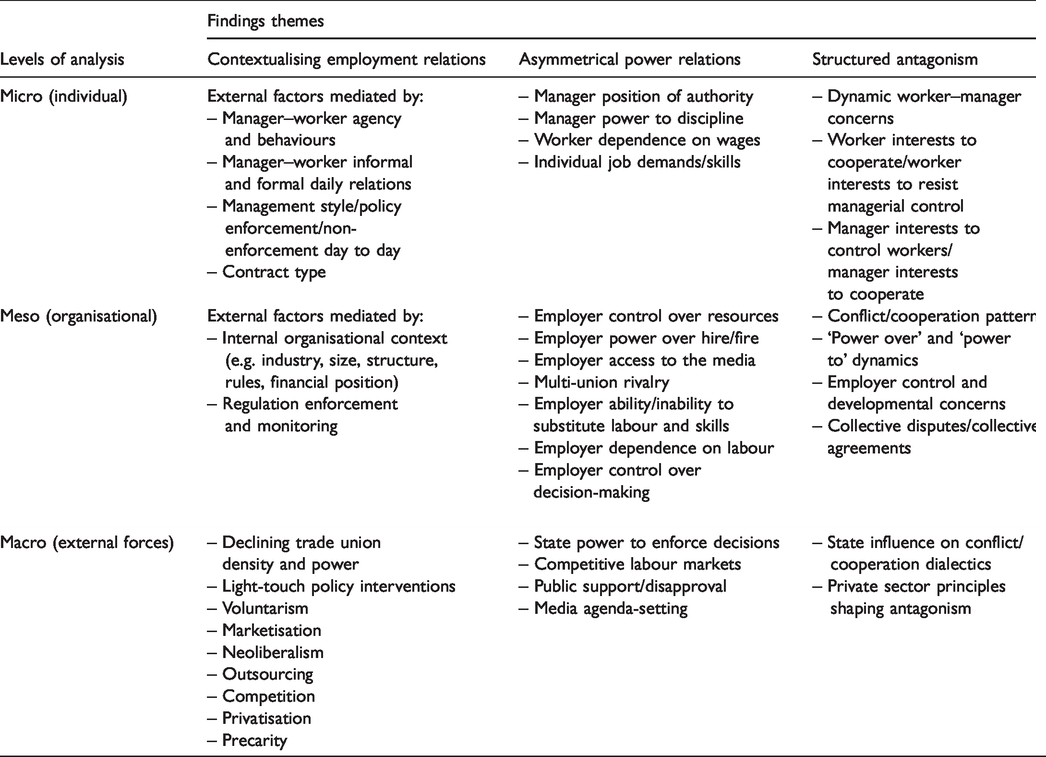
The findings illustrate that underlying ‘structured antagonism’ is omnipresent, but does not always ignite surface conflict at BusCo or RailCo. Cooperation and accommodation are evident through, for example, concession bargaining, reciprocal mutuality around common developmental concerns, along with informal day-to-day give-and-take between workers and line managers. Cooperation and compromise are more widely institutionalised at BusCo than RailCo, although sustained mutuality has reduced in both cases over time. Our BusCo case may at times seem closer to ‘classical’ pluralism (e.g. advanced bargaining and joint decision-making arrangements displaying cooperative intentions). However, as at RailCo, BusCo also displayed episodes of conflict and embedded antagonism, for example strike action over route tendering. By foregrounding ‘structured antagonism’, a radical-pluralist lens is better equipped to support multi-level analysis of how pluralist praxis is itself nuanced and weaves in and out of fluid zones of contestation and cooperation. Unlike neo-pluralism, which gravitates too exclusively to the cooperative dynamic, radical-pluralist praxis is as much about collective agreement-making as it is the capacity to resist, as evidenced in uneven episodes of conflict ‘and’ accommodation at both BusCo and RailCo. As we see it, radical-pluralism is a synthesis of radical (sociological structuralism) and pluralist (institutions) framing, so will inevitably reflect aspects of traditional pluralism (bargaining, accommodation, rules, job regulation, etc.).
Contextualising employment relations in our case studies is crucial, but we argue that neo-pluralism overlooks how proliferating private sector accumulation practices and principles constrain diffusion and endurance of workplace cooperation. In our study, this is comparatively more evident at RailCo, shaped by post-Thatcher UK public sector marketisation. At surface level, social partnership in Ireland may appear to reflect ‘classical’ pluralism by initially insulating Irish unions somewhat from neoliberalism and marketisation, at least more than in the UK. Notwithstanding, BusCo respondents questioned the depth of worker influence and voice achieved during the social partnership years (1987–2009). Moreover, neoliberalism and marketisation intensified in Ireland after the 2008 financial crisis and the social partnership’s collapse in 2009, though again, less so than in the UK (Dobbins and Dundon, 2016; McDonough and Dundon, 2010; Regan, 2017). Furthermore, Ireland has not enacted union recognition legislation, arguably a key pluralist public policy measure (Dobbins et al., 2020). Additionally, as found in the Irish manufacturing industry following the global financial crisis and the collapse of a structured corporatist partnership arrangement, subsequent robust sectoral collective bargaining has been decentralised, fragmented and often uncertain (Hickland and Dundon, 2016); or at best, peppered with concession bargains and union accommodations (Roche and Gormley, 2017). Against such an uneven context, the BusCo case supports radical-pluralist assumptions by recognising both internal cooperative dynamics alongside structurally constrained policy prescriptions in contemporary neoliberalised political economies like the UK and Ireland. Such framing is arguably more nuanced and informed than overly optimistic neo-pluralist assumptions around public policies advancing an exclusivity favouring a presumed conflict-free social partnership model.
RailCo and BusCo unions are relatively strong compared to other sectors, due to drivers’ positional power at the point of service delivery, high union membership density and mobilisation strategies. Indeed, the very praxis of radical actions may be necessary to mitigate employer power imbalances, something that is harder for workers and unions in other contexts such as the gig economy (cf. Wood, 2020). Crucially, employers who own resources and capital tend to action ‘control over’ others (workers) who depend on selling their labour effort. In our case studies, the state as ultimate employer adds additional layers of complexity, because workers and their unions tend to interact and negotiate day to day with RailCo/BusCo managers, rather than with government.
Regarding the second contribution, we illustrate that Fox’s (1979) radical-pluralist distinction between pluralism as a ‘concept’ and pluralism in ‘action’ (praxis) is neglected by neo-pluralism. It is vital for all pluralists and pluralisms to contest the growing hegemony of managerial unitarism manifest in much of contemporary human resource management (HRM) research and practice (Dundon and Rafferty, 2018; Godard, 2020). There is, however, a further risk that neo-pluralism could enter the unitary household uninvited, then become part of the furniture. We emphasise that radical-pluralism argues for more inclusive democratic emancipatory alternatives for societal and workplace justice to transform values into actions in workplaces and wider society. Progressive public policy reforms focused on pluralist praxis are required to narrow discrepancies between pluralism as a value concept, and its real world application. Neo-pluralism understates the scale of progressive reforms required to change the status quo, rather than just conform to it.
Conventional employment relations and HRM scholarship does not always fully recognise and/or acknowledge the scale of assault on institutions of pluralist collectivism by political neoliberalism (Peck, 2013; Thompson and Harley, 2012). A key analytical contribution is that radical scholars examine capitalist structural causal roots and systemic impacts to connect with outcomes, for example the hollowing-out of pluralist institutions (e.g. trade unions, employers’ associations, collective bargaining, social partnership) and ‘public good’ erosion by private sector capitalist accumulation principles. Problematically, for public policy reform, institutional pathways in LMEs like the UK and Ireland remain firmly oriented towards a hegemonic unitarist frame that explicitly prioritises maximising worker performativity and capital accumulation, over and above citizens’ democratic rights in workplaces and society (Hyman, 2016). Therefore, the prognosis for pluralist social partnership and mutuality based on sustainable workplace ‘social contracts’ is not optimistic when set against such embedded and unequal constraints. The state and many employers are increasingly offloading the risk emanating from market turbulence onto workers, illustrated by expansion of a commodified low-paid precarious reserve army of labour, competing to be exploited by employers (Burawoy, 2013).
Consequently, while arguing that the radical-pluralist frame of reference offers more refined synthesis of complex workplace social phenomena than neo-pluralism, it also adds an applied utility of praxis. There is considerable scope for future research and theoretical debates on framing pluralism(s) (and radicalism(s)), including comparative country research exploring comparable themes and/or identifying new research dimensions for testing pluralism(s) in action.
Footnotes
Acknowledgements
The authors would like to thank the special issue guest editors and reviewers, and the research participants in the two case studies. We also thank Niall Cullinane for inputs into earlier versions of the article.
Declaration of conflicting interests
The author(s) declared no potential conflicts of interest with respect to the research, authorship and/or publication of this article.
Funding
The author(s) received no financial support for the research, authorship and/or publication of this article.
