




Abstract
The role of the state in directly regulating employment through enforcement mechanisms is increasingly significant and politically contentious in a context of weakened unions and the increasingly fragmented and precarious nature of the labour market. This article focuses on qualitative research on labour market regulatory actors in Britain, including the Health and Safety Executive, the Gangmasters and Labour Abuse Authority, as well as referencing relevant changes in HM Revenue and Customs, trade unions, legal and advice services and other state agencies. The article argues that a curious dynamic is emerging in labour market regulation involving simultaneous processes of deregulation, greater levels of direct intervention in some areas alongside marketisation, and innovative forms of collaboration between relevant state agencies. Much of this is, however, driven by constraints imposed through economic austerity and neoliberal policies with an increasing focus on immigration and policing concerns, creating notable sets of organisational tensions within and between the agencies and the work of their relevant inspectors.
Keywords
Introduction
The enforcement of labour standards has emerged as a policy challenge in liberal market economies and elsewhere. The decollectivisation of industrial relations and weakened unions has, to varying extents, led to a greater emphasis on individual rights at work (Howell, 2005). Such developments are clearly visible in Australia, parts of the US and Canada, and Britain, but typically state resources devoted to enforcing such legal rights are inadequate (Clibborn and Wright, 2018; Dickens, 2014; Fine, 2017; Vosko et al., 2017). This article focuses on the changing nature of state enforcement of employment regulation in the context of Britain, a neoliberal, deregulatory, but in some ways increasingly interventionist, marketising political economy (see Clark, 2000; Gamble, 1988; Smith, 2009), particularly in terms of migrant groups, policing and social policy. The case of Britain is of interest as reforms and restructuring of regulatory actors herald (for some) a new and more indirect, strategic form of labour enforcement which is innovative and flexible (Blanc, 2016: 221). Direct state enforcement of employment regulation is in many countries conducted through a singular, centralised labour inspectorate, but in Britain such direct regulation is more diffuse with responsibility for regulating health and safety at work, labour subcontracting (particularly in the agriculture and food industries), employment agencies, minimum wage enforcement and forced labour divided among the Health and Safety Executive (HSE), the Gangmasters and Labour Abuse Authority (GLAA), the Employment Agencies Standards Inspectorate (EASI), HM Revenue and Customs (HMRC), the police and the Border Agency. This more de-centred approach corresponds to different spheres and fragments of the labour market and employment relation, being seen as an innovative response to the changing nature of work (Blanc, 2016: 221; Taylor et al., 2017). Recently, the politically nominated figure of the Director of Labour Market Enforcement has been entrusted with overseeing coordination between the main bodies entrusted with enforcement in relation to work and employment, excluding the HSE. The research this article draws on aims to develop an analysis of such agencies that goes beyond more institutionalist or legally focused studies by exploring the impact of such changes on external dynamics, including collaboration (or otherwise) between agencies and the changing nature of regulatory work carried out by the state-employed inspection and enforcement workforce. The article builds on this externally focused analysis by exploring the wider political, regulatory and legal context (featuring a deregulatory agenda alongside an ostensibly more interventionist approach in other areas). To a lesser extent, but importantly, these broader structural changes are also discussed in terms of their impact on the internal dynamics of these agencies’ work.
The article reviews some of the key literature with regard to the wider regulatory context, legal changes in the context of Britain, and labour inspection and enforcement. The empirical findings focus mainly on the external coordinating aspect of the state, including the changing nature of labour regulation, the impact of such changes on regulatory work, and collaboration between otherwise fragmented enforcement agencies. This is followed by a brief focus on the organisational context and dynamics within these agencies, including how regulatory change, shifting priorities and risks, and public sector marketisation impact on the work of inspection and enforcement. The findings outline the effects of public sector austerity since 2010, the ongoing politics of deregulation, and labour market fragmentation on inspection and enforcement agencies and their workforce. They define the dilemmas and tensions of developing an enforcement regime that is simultaneously more interventionist yet deregulatory and marketised. Our argument focuses on the way the question of enforcement has evolved in highly contradictory ways, being limited in scope, in breadth and in terms of engagement with other actors on the one hand, while simultaneously developing a more commercial yet relatively dirigiste logic through alliances across various state agencies on the other. They have also been forged in the context of a politicisation of migration issues and new forms of xenophobic political agendas (Geddes and Scholten, 2016). These developments have significant implications for the internal management and employment experience of labour inspectors.
The article is broadly divided into two main sections as our research followed these multi-dimensional features of regulation, although the emphasis is on the first. First, the external dimension of enforcement is considered, relating to how legal, regulatory and institutional change and political and ideological influences impact on enforcement and inspection agencies. The second section focuses on the internal dimension of enforcement, focusing more on the institutional work of inspection and enforcement agencies and how political dynamics, regulatory change, shifting priorities and risks, and marketised institutional restructuring influence such work, underpinning different contextually determined ‘styles’ (Kagan, 1989) of inspection and enforcement. The changes across the two levels have implications for the nature of labour market regulation and how it is enforced, but also have broader political implications regarding the role of the state and the contradictory relation between both deregulatory and more interventionist tendencies within it. The authors consider it important to look at the new tensions, issues and contradictions that emerge from these reforms and changes within the boundaries of the organisations being studied, as some of the external inter-agency changes analysed later are replicated within the organisations themselves in terms of their working practices. To that extent, the article concerns itself with the following research questions: How has the form and overarching structure of labour enforcement evolved in a context of greater economic austerity and political antagonism in relation to issues of bureaucracy and health and safety? And to a lesser extent as a research question, how have these reforms and new patterns of labour inspection in relation to a more fragmented labour market created new sets of organisational tensions within the state (between agencies for example) and within the working practices of labour inspection and enforcement agencies themselves?
Literature review
The external coordinating context
When discussing the state in relation to enforcement-related issues it is important to comprehend the various dimensions of that feature of the state, both externally and internally. The activity of labour inspection is located in an ambivalent position in relation to the state. Inspection is not simply a coercive or ‘enforcement’ feature of the state in the literal sense, as it is related to the extension of many (although not all) forms of worker rights in such matters as health and safety, minimum wage compliance and others. For this reason, the agencies of the state may relate to representative roles within the state (e.g. through participative processes) and interventionist features which focus on direct presence within society and the economy (see Jessop, 1982). It may be seen as an institutional ensemble (Jessop, 1982) of various organs and structures covering features of both representation and intervention, and some agencies have highly ambivalent roles depending on the political context and particular projects they develop (Jessop, 2002). What is more, the question of inspection relies on entering specific workplace environments and dealing with particular sets of individuals and organisations, including employers, management and trade unions. Such engagement is premised on developing dialogue and a culture of collaboration, at least in principle if not always in practice. There is an external dimension and a political nature to labour inspection, as while it can rely on the rule of law and be mediated by the more interventionist, policing features of the state it does rely on cooperation as well.
This collaborative logic is contingent on a framework of shared rights and concepts of fairness as well as on the expertise and social skills of inspectors, in addition to closer, more proactive working with companies and other actors (Hopkins, 2007). The extension of agencies such as the HSE from the 1970s onwards (even during the Conservative governments of the 1980s and 1990s) and the emergence of newer agencies such as the Gangmasters Licensing Authority in the period of the Labour governments (1997–2010) contributed to a culture of inspection based on various alliance-building processes. In fact, during the latter years of the Labour government up until 2010, some reforms (including cases supported by the subsequently abolished Union Modernisation Fund) related to developing greater collaboration between agencies around questions of health and safety, wage enforcement and employment agency standards, as well as a greater sensitivity to the need to work with civil society groups and trade unions in a more strategic manner (Mustchin, 2014).
Yet this project of reform and modernisation was in part a response to, but also challenged by, a series of developments that were reshaping the space of the workplace as a stable environment for the state to act on. In the first instance, the proliferation of precarious work and a greater degree of fragmentation of the labour market led to an environment in which access for inspectors and clear frameworks for intervening were undermined. It could be argued that emergent employer and working practices that challenge the implementation of the minimum wage – and lead to the ongoing abuse of a more vulnerable workforce – have been growing in significance for some time (Trades Union Congress (TUC), 2007). Enforcing regulations covering health and safety, minimum wages and labour subcontracting has also been undermined by a politics of austerity and the restructuring of regulatory agencies, and not just the proliferation of precarious work (e.g. James et al., 2015; Rogers, 2016). Cases of employers using non-payment of wages as a deliberate cost-reduction strategy have become an increasingly widespread problem, facilitated by the weak nature of the enforcement system and the barriers faced by workers seeking redress (Clark and Herman, 2017). Even with the post-2010 expansion of direct forms of state intervention in work such as the Modern Slavery Act 2015, increased fines for National Minimum Wage breaches and the Immigration Act of 2016 which expanded the remit of the GLA (Grimshaw et al., 2016; Metcalf, 2017), much of this reform of regulation was driven by a narrative of controlling the periphery of the labour market which was framed by the state through an anti-immigration narrative (Geddes and Scholten, 2016). Much attention has been paid to labour abuses within hand car washes, nail bars and food production (Clark and Colling, 2018), arguably at the expense of industries such as construction where problems of fragmentation and regulatory evasion are entrenched. The increased focus on ‘severe’ forms of labour exploitation is problematic as it can marginalise more widespread, ‘routine’ abuses of employment rights (Davies, 2019) with greater levels of insecurity in employment leading to poorer health and wellbeing among the most affected workers (Dawson et al., 2017). The growing use of temporary employment agencies also raises major challenges for workers in terms of the nature and regulation of their working conditions (Mizen and Robertson, 2017) as they are caught between different ‘employers’ or are subject to different employment conditions when placed by an agency with an employer (Forde and Slater, 2005).
Policy in this area has increasingly revolved around direct forms of state intervention in more focused areas of the labour market. The recently established government Director of Labour Market Enforcement (David Metcalf, formerly head of the Migration Advisory Committee, held the post from 2017 to 2019, with Matthew Taylor taking over the role on an interim basis from July 2019) has a remit of further linking together HMRC, GLAA and EASI (but not the HSE) in terms of the approach to enforcing labour market regulation (Metcalf, 2017). Merging these three bodies into a single enforcement agency was proposed during the Cameron government but ultimately scaled back to this more limited form of oversight. The recent Taylor review of modern working practices recommended a strengthening and broadening of functions and sanctions available to enforcement agencies (Taylor et al., 2017). Nonetheless, the system remains fragmented, operating within silos, and excludes health and safety from wider concerns regarding labour market regulation. This separation is evident elsewhere, including Australia and the US, where the inspection system is similarly specialised and divided between numerous agencies, with widespread ‘protective gaps’ consistent with what would be expected in a liberal market economy following decades of deregulatory policy agendas. This contrasts with the ‘Franco-Latin’ model of inspection where a single agency is responsible for violations of employment standards (Piore, 2011: 148–149). While outcomes of the British system of health and safety enforcement are broadly similar to those in Germany, where inspection activity is more common, with the former case praised for its historical efficiency and risk-based approach, concerns have been raised regarding the reduction of inspections in Britain, the removal of a large number of workplaces from the remit of inspectors, and threats to efficiency and performance driven by budgetary constraints (Blanc, 2016).
Collaborative work – which is emerging as a driver of innovation within various enforcement regimes (Weil, 2018) – has, in the UK, mainly focused on an inter-state agency approach: especially as non-state actors including trade unions were increasingly marginalised by both employer practices and restrictive legislation such as (most recently) the Trade Union Act (Bogg, 2016): the decline in collective bargaining since the 1970s and greater emphasis on legislative approaches contribute to this declining collective voice and role (Colling, 2010; Howell, 2005). Significant changes have also taken place at the institutional level; the HSE has historically had three spaces on its board for members nominated by employee representative bodies, but government hostility to such vestiges of tripartite social democratic institutions has in recent years seen the government vetoing the nomination of the Fire Brigades Union general secretary with a business figure installed in their place. What is more, the individual dimension of enforcement mentioned earlier was limited by the post-2010 governments’ curtailing of access to Employment Tribunals through various reforms and changes to fees (Dickens, 2014), although these were reversed by the Supreme Court in the UK; however, the intention was to limit access to legal redress. The combination of difficulties in accessing tribunals and lack of capacity among enforcement agencies results in the denial of employment rights for a growing population of vulnerable workers (Barnard et al., 2018; Kirk, 2018). What we will argue in the following is that the attempted ‘socialising’ and modernisation of enforcement under the 1997–2010 Labour governments was coupled with a move to a more targeted approach focused on more vulnerable workers and an advisory role. Since 2010, this more targeted focus in relation to specific groups of workers has been built upon and extended. Additionally, the internal context has been reformed as well with regard to the state and its relationship to enforcement and inspection work.
The internal organisational context
Internal change with regard to the state and enforcement has taken a number of contradictory forms, involving marketisation and constrained enforcement activity (Tombs, 2016). While enforcement concerned with gangmasters, modern slavery and minimum wage compliance has been strengthened to some extent (Weatherburn and Toft, 2016), simultaneously there have been attacks on health and safety from government ministers, the proposals in the 2010 Young and 2011 Löftstedt reviews of health and safety (Almond and Esbester, 2016), and a wider discourse concerning government intervention in labour markets, regulation and a claimed ‘regulatory burden’ (e.g. Coulter and Hancke, 2016), addressed through instruments including the Enterprise and Regulatory Reform Act 2013, the Red Tape Challenge and the Deregulation Act 2015 (Lodge and Wegrich, 2015). These legislative interventions demonstrate the wider deregulatory focus of this government, but have a specific relevance here as the Deregulation Act removed many health and safety requirements from self-employed workers and the Enterprise and Regulatory Reform Act limited civil liabilities for employers with regard to health and safety. Regulation is in some respects becoming increasingly privatised and unilateral, with the influence of trade unions and the state declining alongside an increased prominence for private consultancies, insurance and law firms, and unilateral employer regulation of both health and safety and supply chains (Tombs, 2016).
Nationally and internationally, a ‘crisis’ has been identified within labour inspection due to changing industrial composition, labour markets, regulation, resources allocated to enforcement activity, and the weakening of trade unions (Weil, 2008). The ‘Anglo Saxon’ approach to labour inspection, as in the UK and Ireland (Teague, 2009), has involved an increasing use of ‘innovations’ characterised as ‘soft law’ approaches to regulation in terms of recommendations and suggested practices (as well as online toolkits for employers regarding these). Colling (2010) uses the distinction of purposive and educational enforcement to explain the distinct nature of these new latter forms of communicative processes. Two key approaches to enforcement work include standard setting approaches, which establish a system of compliance and sanctions, along with more programmatic approaches involving collaborative work between agencies and other stakeholders including employers, with both argued to be necessary in order for enforcement to be effective (Osterman, 2008: 132). In the UK case, it appears that both of these approaches have weakened in recent years, with increasing evidence of standards being breached and the more innovative, collaborative approach fostered before 2010 weakened as well. Such innovations and an ostensibly more ‘strategic’ approach to inspection have attracted positive attention within various international institutions including the International Labour Organization (ILO) (Ellis, 2005: 56) and Organisation for Economic Co-operation and Development (OECD) (for a comparative analysis of innovative and challenging aspects of enforcement reform in the UK, see Blanc, 2016). However, scaled-down or ‘strategic’ approaches to enforcement and the emphasis on compliance approaches -- a common feature of enforcement systems in liberal market economies -- rather than deterrence appear inadequate to deal with issues such as wage theft and the denial of employment rights within labour markets increasingly dominated by insecure employment (Vosko et al., 2017). The relationship between worker organisations and state agencies contrasts according to the nature of industrial relations reforms – in France, for example, where workplace representatives have maintained a greater degree of power, there is evidence of more open, explicit approaches from workers to labour inspectorates (‘loud reporting’) over safety issues compared to the UK, where decollectivised industrial relations and weaker protections for whistle-blowers militate against more public approaches to raising problems with regulatory agencies (Etienne, 2015). Even more regulated contexts including Sweden have, in recent years, seen calls for ‘market-based’ approaches to regulation and enforcement (Frick, 2011: 209).
Within studies of enforcement and regulatory agencies, three key factors emerge in terms of enforcement ‘style’ – ‘characteristics of the regulatory “legal design”; features of agencies’ “task environment”; and the regulatory “political environment”’(Kagan, 1989: 89). These issues – the nature of regulation, the nature of enforcement work and the political context – frame how regulation is enforced and regulatory work itself. As public sector employees, the inspection and enforcement workforce have been subject to austerity and organisational restructuring, facing pressures relating to ‘staff cuts, reviews, market testing, efficiency gains and … government induced alarms about deregulation’ that were evident even in earlier periods of Conservative government and austerity (Nichols, 1997: 213). In comparing the fragmented labour inspection functions of the US and the more centralised, unitary labour inspectorate in France, Piore (2011) highlights the greater autonomy and discretion granted to French inspectors. Whether labour law is narrowly defined or more expansive plays a major role in determining the character of enforcement work, along with wider political orientations towards regulation, the institutional structures tasked with inspection and enforcement, and the autonomy, resources and authority held by those working in inspection and enforcement themselves. The question of discretion among state agents has been highlighted as a means of social control in controlling populations and determining access to resources; the state ‘comes into being through its acts’ (Dubois, 2013). A focus on the workforce engaged in institutional work and enacting the aims of particular agencies (McCann et al., 2013), involving an assessment of how such ‘street level bureaucrats’ enact the priorities of their host institutions in a context of inadequate resources and ‘contradictory and ambiguous job expectations’ (Lipsky, 1971: 394), is in this case applied to those working within enforcement, inspection and regulatory actors. This provides the basis for a more nuanced assessment of regulatory, institutional, legal and political changes and the impact they have at the ‘front line’.
Methods
The research underpinning this article builds on the authors’ long-standing interest in the regulation of work more generally, including earlier research projects focusing on the work of enforcement and inspection agencies in Britain (Martínez Lucio, 2011) and the relationship between unions, civil society organisations and enforcement agencies (Mustchin, 2014). The four main themes explored within this overall set of linked projects included the changing nature of regulation and enforcement; the influence of the post-2010 governments’ wider deregulatory agenda in conjunction with more interventionist approaches in some areas; changes in the nature of labour inspection work driven by restructuring and the context of public sector employment within a regime of austerity; and collaboration or otherwise among unions, enforcement agencies, civil society and other actors involved in regulation, inspection and enforcement. Fieldwork was conducted in 2016--2017, involving 30 in-depth interviews with 40 individuals (four of the interviews were with multiple respondents) working in the area of employment rights enforcement. These data build on the 30 interviews conducted as part of the 2011 and 2014 studies cited above, providing a rich, longitudinal empirical basis for the analysis that follows. Securing access to the public sector organisations within this sample was challenging, reflecting both the political sensitivities associated with labour market enforcement and inspection, and the workload pressures evident among their workforce.
The interviews included 12 inspectors from the HSE, GLAA and HMRC, trade unionists (the TUC, Unite, Union of Construction, Allied Trades and Technicians (UCATT), Prospect, the Public and Commercial Services Union (PCS), the Union of Shop, Distributive and Allied Workers (USDAW)), non-governmental organisations (NGOs) concerned with health and safety, modern slavery and employment tribunal access, the Advisory, Conciliatory and Arbitration Service (ACAS), the police, advice services and employer associations. EASI representatives were interviewed in earlier projects but were unavailable during this particular project; however, they are by far the smallest of these regulatory agencies and are subject to some common bureaucratic and legal pressures along with the three main agencies analysed here. Local authorities maintain a role in inspection and enforcement issues, particularly in the food and retail industries, but this function has been drastically scaled back due to funding reductions within councils and our focus here is more on agencies explicitly focused on employment. The Equalities and Human Rights Commission also plays a role in terms of enforcing equalities legislation but this is increasingly limited to small numbers of investigations and cases seeking to set precedents. A number of practitioner conferences focusing on health and safety and labour exploitation were also attended and observed. This material was triangulated with publicly available secondary data and analysed inductively with regard to the wider literature. Data from the earlier projects cited above were reanalysed to develop a more longitudinal assessment of how such processes had developed over the last decade. For this article, the qualitative data were analysed using templates to develop insights into the approach to inspection and enforcement taken by the key agencies under review, how wider political and regulatory changes impacted on their work, and how internal restructuring affected their work and their capacity to regulate. Research elsewhere in the public sector has utilised the concept of ‘street-level bureaucracy’ (Lipsky, 1971) as a means of conducting highly contextualised research on how those working within state bureaucracies enact policy (e.g. Dubois, 2013; McCann et al., 2013). Such research typically utilises detailed qualitative interviewing, observation and case study methodologies that provide insight into how policy is enacted, permitting an exploration ‘of complex processes and patterns that cannot be adequately understood through experimental or quantitative research designs … [offering] a richly descriptive foundation for exploring the dynamic processes through which bureaucratic patterns of practice develop and shape policy’ (Brodkin, 2003: 156–157).
The external coordinating dimension of enforcement: Innovation, politicisation, realignment and fragmentation of enforcement between state agencies
The enforcement agencies forming the basis for this discussion differ widely in terms of resources, their remit, their ‘style’ of enforcement and their ideological underpinnings. Table 1 outlines some of their basic descriptive characteristics.
Overview of labour market enforcement agencies.
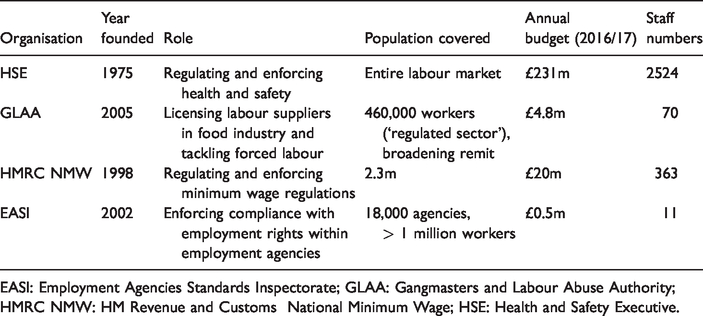
EASI: Employment Agencies Standards Inspectorate; GLAA: Gangmasters and Labour Abuse Authority; HMRC NMW: HM Revenue and Customs National Minimum Wage; HSE: Health and Safety Executive.
Each of these agencies has seen changes in their resourcing and activity in recent years; the minimum wage compliance unit has expanded from around 100 staff in 2005 (Croucher and White, 2007) to 363 in 2016--2017 (Metcalf, 2017), and the GLAA had been allocated an additional £2m per year from 2017 onwards to invest in Labour Abuse Prevention Officers with new police-style enforcement powers as established in the Immigration Act 2016 (Metcalf, 2017: 22). This investment reflects the growing political awareness of informal employment practices and issues of migration and gangmasters, although resources remain relatively low and not sufficient to cover the sheer expanse of individuals and ‘employers’ working in this area. EASI has seen its levels of targeted inspections and cleared cases fall by over half in the last 5 years, but in general the three agencies linked together under the auspices of the new Director for Labour Market Enforcement have seen their resources increase over the last 5 years. This contrasts sharply with the HSE, which is excluded from this grouping of enforcement agencies – the agency has lost 331 or 25% of its inspectors since 2010 and numbers of prosecutions have halved in the same period. Its budget will have faced a 46% cut since 2010, and annual inspections have fallen from 60,000 to under 20,000 between 2001 and 2016. While a certain level of increased support is evident in terms of HMRC and the GLAA, government hostility towards the HSE and its regulatory approach has meant considerable attrition and erosion of its capacity, remit and resources. The agencies vary in terms of the labour market spaces they intervene into and their cultures of ‘investigation’, with the GLAA dealing with less transparent, informal employers such as in agriculture, whereas the HSE in the main deals with more established employers and the development – traditionally – of longer-term collaborative cultures.
The reforms that were introduced during the previous Labour government were in large part premised on the need to create a specialised and renewed expert approach in relation to a changing, increasingly fragmented employment arena, although for some this development was framed by greater interest in an austerity-driven, deregulatory agenda (Tombs and Whyte, 2009). While HMRC took on responsibility for enforcing the minimum wage, the government complemented the work of the HSE with a new set of organisations and specialist agencies, organised around the regulating and monitoring of employment agencies (EASI) and new forms of micro-level gangmaster hiring processes (the GLAA). Additionally, ACAS became increasingly important as an informational reference point and support mechanism focused around individual rights, although it is not part of the inspectorate as such: this was the reason for including interviews with ACAS national and regional officials within the research, given their importance to the educational and consultative dimensions of the state (Martínez Lucio, 2011). Overall, there has been a greater amount of multi-agency state collaboration, largely driven by political imperatives and the focus of employment regulation-related resources on the informal economy, undocumented labour and vulnerable workers more generally: traditional approaches assuming a stable workforce or workplace are increasingly problematic. The case of the Migrant Impact Fund under the pre-2010 Labour governments illustrates how additional resources were provided to organisations such as the HSE to address such concerns, such as funding interpreters to interview migrant workers after accidents at work.
Hence, while organisational innovation through joint working grew in importance, the new regulatory politics of enforcement was increasingly premised on a diminished role for trade unions, elements of an emerging anti-immigration political context 1 and the need to share resources in a period of financial cutbacks, especially after 2010. Prior to 2010 the problem with what could be labelled New Labour regulatory innovations 2 was that they were never the subject of extensive state investment, meaning collaboration and creativity were constrained within these less traditionally interventionist forms of regulation involving creating alliances and new joint forms of working in an attempt to enforce labour rights (Martínez Lucio, 2011; Mustchin, 2014). Indeed, when it took place, multi-agency work increasingly focused on links with the police, immigration enforcement and others adding a more direct and interventionist dimension to their work. For some interviewees, this brought the possibility of creating a more coordinated and robust approach to the question of labour enforcement – legitimating activity such as health and safety inspection that had been weakened by economic austerity (James et al., 2013) and a political and media stigmatisation conceptualising it as ‘red tape’, 3 although new resources supporting such work were relatively small-scale.
However, these pressures were such that, especially after 2010, the HSE was increasingly expected to work with the police, Home Office and Border Agency. There was much reluctance to engage in such collaboration as it would undermine inspectors’ ability to support and gain the trust of vulnerable workers: … you go to these multiagency raids, such as scrap yards or whatever, the police go in, arrest everybody, you find some health and safety issues and there’s nobody to talk to about them, there’s nobody to serve a notice on because the guy’s down in the cells somewhere being questioned. The running joke on a multiagency raid is ‘how do you tell which one’s the health and safety inspector? He’s the one at the back without the stab vest.’ So, they go in fully armed and we get sent along just as a peripheral role. (HSE inspector) … the HSE’s role is to protect working people regardless of whether they’re legal, illegal, or whatever it may be. The role is to protect people in their place of work. It was felt that to use that unfettered access to the workplace to assist with border control would do two things. One, it would undermine the HSE’s impartiality in the minds of working people, whether legal or not, and also it would create a high level of mistrust with employers who may be unaware of the illegal status of workers that come in. (HSE inspector/union representative) … what you’ve got now is a situation where labour exploitation … [is] seen as a security, law enforcement kind of issue, which is problematic in terms of encouraging exploited workers to come forward, particularly migrant workers and especially undocumented migrant workers. But in a way … at least some attention’s being given to labour exploitation, which ten years ago there wasn’t at all. (Anti-slavery NGO policy officer) we assess everything that comes in [through] a triage matrix system which allows us to prioritise our recourses … a process that says, are the GLAA the best placed organisation to progress that? Or actually do HMRC possess some better opportunities? Or do the police possess some better opportunities? … in terms of intelligence sharing … in some countries you have a unified national labour inspectorate … here it’s split across about five or six agencies … [and] if we’ve got something that’s been shared by HMRC to us, we can’t share it, because … they’re very difficult about what you can share that belongs to them. (GLAA operations manager)
There were serious challenges emerging from the systematic undermining of representation in the work and labour market environment. One Unite official pointed out that problems arose from the limiting of facilities time. Most unionised companies still have health and safety committees, ‘but it has become less of a priority, and the proactive side is not as extensive as it was’. In some cases, employers would frequently cancel health and safety committee meetings or delay them. Management were not generally challenging health and safety processes directly, but there was reportedly an emerging reticence towards (and slowing down of) consultative processes in various cases. Insufficient time was devoted to meetings on health and safety and some companies were beginning to involve non-union representatives, often selected and appointed by management. It was observed that management were trying to take control of the health and safety agenda, doing less proactive health and safety inspection work. The emphasis has increasingly fallen on weaker forms of auditing and minimalist risk assessment, sometimes by external consultants engaged by management. There were more private insurance and consultancy firms working directly with employers for the purpose of dealing with risk assessments in relation to health and safety, often excluding trade unionists with human resource management functions increasingly individualised, marketised and outsourced. These forms of marketised regulation, along with the constrained remit of the HSE, were struggling to address the exponential increase in workplace-related illness including stress and mental health problems. The wider context discussed here had a significant impact on the work of the main state agencies themselves, which is turned to next.
The internal organisational context of enforcement: Innovation as commercialisation, competition and the intensification of inspector-related work
This second empirical section of the article focuses on the internal organisational context and dynamics, including how regulatory change, shifting priorities and risks, and public sector marketisation impact on the work of inspection and enforcement: this dimension creates a further disconnect and set of pressures that undermine the innovations (partly driven by austerity policies themselves) outlined earlier. Internal changes with regard to enforcement have taken differing forms since 2010. HMRC has, since 2015, been provided with some increased powers and resources to enforce the minimum wage, and while the GLAA was initially threatened with abolition it was subsequently given a wider remit and some increase in resources deriving from the Modern Slavery Act (2015) and the Immigration Act (2016). In contrast, the HSE has been subject to competing pressures relating to austerity, policy changes and commercialisation. In all three of these enforcement bodies, there have been significant changes in terms of legal design, their task environment and the regulatory political environment (Kagan, 1989: 89). These have had a significant impact on both the nature of enforcement work and the pressures faced by individuals working within these institutions.
As stated earlier, the HSE had seen its budget almost halve since 2010, resulting in mass job losses and loss of expertise across the civil service, compounding earlier rationalisations from the New Labour period. Wider problems of work intensification, stress and low morale were reported among employees of regulatory agencies, exacerbated by long-standing pay constraints in the public sector. Many senior inspectors within the HSE had left or been made redundant, with pay erosion leading to some HSE, local authority and GLAA inspectors taking jobs in private sector firms’ internalised health and safety and supply chain regulation functions. This had led to a significant loss of specialised knowledge and experience of operating regulatory agencies under the auspices of the broadly tripartite structures and processes established since the 1970s: ‘we’re losing the memory of how to regulate, how to inspect, how to enforce. And we’re getting more and more a body of people who are advisors to business’ (Union/NGO health and safety advisor). Within the HSE, recruitment was increasingly based around a graduate trainee scheme developing generalist inspectors, in contrast to the historical prevalence among inspectors of experience within engineering, manufacturing or construction. There’s a distinct lack of industrial understanding about the concept of health and safety and welfare and the environment in an industrial setting. Much of it had been professionalised, much of it had been located around their promotion and marketing literature about that issue or that hazard as if that was a sufficient contribution to dealing with that issue rather than engaging with employers, being out in the field, problem solving and raising awareness, naming and shaming, ensuring that prohibition and improvement notices were enforced. When you start seeing a decline in some of those hard performance indicators then it’s almost like the tortoise has retreated into its shell. It just isn’t there and you can’t spin a good story when there isn’t that level of activity that there used to be. (Unite trade union official) Chris Grayling [formerly coalition Minister for Employment then Justice Secretary] … set a number for the first time ever of the number of inspections in a year. It’s 22,000 inspections next year, which is what HSE now sticks to … It’s a cap. That figure was achieved because Chris Grayling came to HSE and said ‘how many inspections did you do last year?’ ‘33,000.’ ‘Right, I want to cut a third off it. I want to be able to go to the Conservative party conference and say I’m cutting inspections by a third … .’ So there’s an absolute terror of getting more than about 100 inspections out at the end of a year off the 20,000. So the cap has become a target … However, the biggest impact is resources, because now HSE’s biggest problem is actually making the 20,000 because it doesn’t have enough inspectors. (HSE inspector/union representative)
Fragmentation was an issue across inspectorates; a service-level agreement between the Department for Business, Energy and Industrial Strategy (who ‘owned’ National Minimum Wage policy) and HMRC committed funding to the latter based on certain levels of performance, and this internal quasi-market caused notable problems within the process of enforcement: Getting agencies to come out and work with you can be difficult. I’m not sure it’s because they don’t want to, I think maybe it’s just like they need it to be worthwhile for them. Because everybody’s got that performance data, so there’s got to be something come out of it … if [someone is] going to get charged with a modern slavery offence, they’re not going to pursue them for the National Minimum Wage … any evidence that we gather will go into supporting that. So, there’s nothing in it for them. They’ll go away after two days work and they’ll say, well, you know, which boxes have you ticked? (GLAA inspector)
In general, a move away from proactive inspection work could be seen in both the HSE and to an extent HMRC. Resource constraints along with wider government-driven attempts to move away from more interventionist forms of inspection and enforcement were evident in the HSE but also in HMRC: predominantly I think there’s a reliance on people contacting us themselves with issues … and you know, you need to be able to go out and have that kind of presence, to be able to go out and speak to people that have made that approach … There seems to be a bit of a switch away from, you know, expecting the policing to be done by people going out and doing checks, to having marketing campaigns to try and nudge. (HMRC union representative)
Discussion: The tension between austerity and innovation in relation to state reform
There has been a curious tension in terms of labour rights enforcement in recent years in Britain. On the one hand, in terms of agencies’ ‘task environment’ (Kagan, 1989) there is a developing innovative and collaborative discourse and practice across various agencies, each with their own specialised knowledge frameworks and particular focus on elements of regulation and enforcement. Yet the challenges faced by such institutions are being exacerbated in the context of a more fragmented workforce and labour market with an expanding informal economy (Clark and Colling, 2018). These innovative approaches, which could be seen as a way of creating synergies and bringing together different specialisms and expertise in the face of overlapping employment problems (the extent of undocumented workers, minimum wage enforcement, forced labour-related issues and poor working conditions), are nevertheless not quite the ‘soft regulation’ one might assume given wider trends regarding regulation and ‘legal design’ (Kagan, 1989). In the British case, this collaboration – which during the period of the Labour government (1997–2010) was also meant to involve engagement with NGOs and trade unions – was later underpinned by greater collaboration with the police and Border Agency. In terms of the regulatory ‘political environment’ (Kagan, 1989), much of the focus was on concerns with the growing vulnerable workforce, especially undocumented migrant labour, arguably at the expense of more ‘routine’ abuses of employment rights (Davies, 2019). The growing focus on migrant labour and its control has been shaping policy agendas in the UK and European Union for some time (Andersson, 2016; Boswell, 2003). Wider government policy of creating a ‘hostile environment’ for migrants since 2010 was evident in the increasing focus on immigration enforcement and policing that was now prominent in the actions of enforcement agencies.
These developments created tensions within these agencies, especially among certain groups of inspectors in the HSE, who historically worked through what could be called a social partnership model. Hence, it appears to be a further embodiment of the fundamental and underlying tensions at the heart of the state on questions of worker rights and the relations between its dual legitimation and accumulation functions (Offe, 1984). However, such a link across agencies did for some HSE inspectors have the curious effect of bringing labour inspection into the public eye and countering its misrepresentation by the right-wing press. Public associations between the wider deregulatory agenda and, for example, the Grenfell disaster and high-profile modern slavery cases created a new legitimacy for socially oriented labour enforcement issues – or the potential basis for it.
Many of these tensions and challenges have emerged from a politics of economic austerity in the past decade which fundamentally curtailed the resources and activities of the main enforcement agencies, although the New Labour period of government was important as a point of origin for some of the ‘reforms’ discussed in this article. The challenges facing the HSE as a central part of the inter-agency enforcement matrix can also be seen as part of a wider government and political strategy to erode and marginalise it and the culture of tripartism that emerged in the post-war period in relation to health and safety (Almond and Esbester, 2016). The formal reduction in cases to be investigated has for some been the outcome of ministerial dictat. To that extent, the politics of coordination and of information sharing across the state has been fundamentally undermined by economic retrenchment which has seen enforcement increasingly follow innovative paths by necessity rather than through choice (Tombs, 2016). The politics of austerity has also challenged the broader project of innovation through collaboration around worker rights and questions of enforcement. One way of engaging with a much more fragmented and increasingly segmented workforce was to have agencies of the state working alongside organisations like trade unions, NGOs and legal centres in various forms (James et al., 2015; Rogers, 2016). Such collaboration was significant within the strategic enforcement rhetoric of the previous Labour governments, under-resourced as this was (Martínez Lucio, 2011; Mustchin, 2014). Programmatic, cooperative work in conjunction with standard setting approaches is argued to be necessary in order for enforcement to function effectively (Osterman, 2008), and while the latter approach has in some respects been strengthened, the undermining of more collaborative approaches calls into question how such standards might be enforced.
Furthermore, notable organisational and knowledge disconnects within the state have therefore emerged in relation to this more complex external dimension. The continuous undermining of trade union representation and roles means that the partnering culture inspectors and enforcement officers often had with trade unionists has been weakened, especially as the latter are being increasingly challenged in their health and safety roles (James et al., 2013: 43; Nichols, 1997). The difficulty in securing these types of links has become a problem, and within the trade union movement the undermining of trade union education due to cuts in state funding has meant that the capacity of trade union representatives in this field is being eroded, although considerable activity is evident within the labour movement that counters this, as with the trade union-supported Hazards network, which has campaigned and developed resources on workplace safety since its establishment in 1988 (http://www.hazards.org/index.htm). The question of the state is to be discussed in relation to deregulation not just in formal terms, but in terms of the curtailing of institutional roles that are directly supported or indirectly supportive of the state's more progressive reach.
A final dimension of change has been an ‘internal’ one within these state agencies. Many of the changes discussed have had a marked influence on the internal dimension of enforcement mechanisms. The story of labour enforcement reform works across various dimensions as boundaries between agencies and within established operational teams are diminished. The increase in charging for some aspects of state regulatory intervention, as seen in the HSE, has the effect of potentially breaking the trust relations between management and the state as well. In addition, the declining capacity and numbers of labour inspectors and their responsibility for a wider range of sectors means that knowledge resources can be undermined in terms of the individuals working for these agencies, especially as they turn to using more trainees and less experienced staff. In the longer term, this has the effect of undermining the complex, sustained and socially oriented interventions of the inspectorate.
Conclusion: The declining and changing legitimacy of enforcement?
Enforcement has evolved in highly contradictory ways, involving both commercial and more dirigiste logics, through alliances across a range of quite different and often competing actors. Such change is partly forced, due to austerity policies and economic retrenchment, but also innovative and deliberate in terms of how agencies adopt different approaches determined by the changing legal and political context. Our understanding of these changes and developments is enhanced by considering the impact of changes resulting from external political dynamics on the nature of inter-state agency working, external links with civil society and internal inspectorate cultures. In this respect, we see a deliberate fragmentation of the state played out across various dimensions within these agencies, their social counterparts and inspectors themselves. Internal changes and managerialism have to be placed alongside these external changes to appreciate the changing nature of the work and knowledge of inspectors. The future of labour enforcement therefore needs to be studied with a greater sensitivity to the complex nature and multi-level structures of the state. The changing economic climate alongside a context of financial austerity within the state impacts more broadly than simply reducing resources and thus capacity. It leads to projects around which the external and internal relations of labour inspectorates are redefined and reconfigured. There is, therefore, a fundamental tension emerging between the language and practice of innovation, on the one hand, and the economic context of austerity and political context of migration and labour market ‘xenophobia’ and control, especially, on the other. The latter shapes the nature of legitimacy and structures of the former such that it potentially undermines the socially inclusive potential of innovative state practices and their longer-term legitimacy.
Footnotes
Declaration of conflicting interests
The author(s) declared no potential conflicts of interest with respect to the research, authorship and/or publication of this article.
Funding
The author(s) received no financial support for the research, authorship and/or publication of this article.
