



Abstract
This article investigates the impacts of negative labor market experiences on the life satisfaction of European East–West mobile workers by taking Czech, Slovak and Hungarian cross-border commuters working in Austria as an example. The recent literature has indicated a ‘dark side’ of East–West mobility, as many mobile Eastern Europeans face negative labor market experiences in the Western labor markets. If East–West commuters accept such experiences, employers and employees may quite easily subvert working standards, with detrimental effects on host countries that are intertwined in cross-border labor markets. Empirically, this study used a sequential mixed-methods design, based on quantitative and qualitative data from a research project on East–West commuters in Austria. The empirical findings showed that the negative labor market experiences are not important for commuters’ life satisfaction. From a multitude of those experiences under investigation, only ethnic discrimination experiences had a significantly negative impact. Instead, life satisfaction was mainly influenced by the overall health status and the perception that one’s own living conditions have improved in comparison with those of others from one’s country of origin. The in-depth qualitative findings corroborated the quantitative findings in terms of the low relevance of negative labor market experiences for the subjective assessments of commuting.
Keywords
Introduction
This article investigates the impacts of negative labor market experiences on the life satisfaction of European East–West mobile workers by taking Czech, Slovak and Hungarian cross-border commuters who work in Austria as an example. Considerable economic benefits may be associated with East–West mobility on an individual level. However, the recent literature has clearly identified a ‘dark side’ inherent to East–West mobility, as many mobile Eastern Europeans face evident negative experiences in the Western labor markets, such as job overqualification and earning disadvantages (e.g. Janicka and Kaczmarczyk, 2016; Johnston et al., 2015; Přívara et al., 2019). Up to now, the impacts of negative labor market experiences on economic migrants’ subjective perceptions and assessments of mobility have not been sufficiently investigated. The present article addresses this research gap by considering the impacts of such negative experiences on East–West commuters’ life satisfaction. Individuals’ life satisfaction will be defined as the result of an overall evaluation of their living circumstances with a subjectively chosen comparison standard (cf. Diener et al., 1985: 71). The research-guiding question is: How do detrimental labor market experiences affect East–West cross-border commuters’ life satisfaction? If East–West commuters accept negative labor market experiences, working standards can quite easily be subverted by employers and employees, while crowding-out processes among other groups in the host-country labor market become evident. Against this background, the present article also contributes to the body of knowledge concerning the effects of East–West mobility on the working standards of host countries that are intertwined in cross-border labor markets.
The focus of this investigation is on East–West commuting in the Central European Region (Centrope), as this regional context is of particular importance. In total, the cross-border area covers eight regions of the Czech Republic, Slovakia, Hungary and Austria (cf. Verwiebe et al., 2017: 253). On 1 May 2011, in Centrope as well as elsewhere in the European Union (EU), the last barriers to free movement were removed for the workforce from all Eastern European countries that had joined the EU in 2004. 1 Since then, all citizens of these states have had the right to work in Austria and in any other EU member state, under the same conditions as citizens of the latter (cf. Verwiebe et al., 2017: 261). Freedom of movement is one of the fundamental freedoms of the EU and a medium on which to build a European labor market. In the European Commission perspective, it is beneficial for employees, employers and the member states of the EU alike by establishing a more flexible and efficient labor market (cf. European Commission, 2002: 3). The life chances of the approximately 6.5 million inhabitants of Centrope remain characterized by a strong East–West welfare gap. Thus, cross-border commuting between the East and West in Centrope is an important means to improve individual living standards (cf. Haindorfer et al., 2016: 51). Against this background, the case example of East–West cross-border commuting in Centrope provides novel facets of post-1989 European East–West mobility, which integrates unequal welfare zones into a common living space and labor market.
In the next step, the case example of East–West cross-border commuting in Centrope will be described. The case description will be followed by a review of preliminary research on labor market experiences of Eastern European mobile workers in the EU, including Centrope. Theoretically, the reason why East–West cross-border commuters may differ from short-term migrants in the context of their acceptance of negative labor market experiences will be discussed, resulting in the deduction of the main hypothesis of this article. This will be followed by a description of the data and methods used. Subsequently, the empirical findings derived will be outlined. In the conclusion, these findings will be discussed in light of the previous empirical results and theoretical considerations.
The case example of East–West cross-border commuters in the Central European Region: Conditions and motives for commuting
Centrope is situated in the heart of Europe and covers an area of 44,500 km2, about twice the size of Sicily (see Figure 1). Commuting in the cross-border region is relatively undemanding due to short distances and a well-developed highway and train infrastructure. For instance, someone may commute between the capitals of Slovakia and Austria, namely between Bratislava and Vienna, the two most populous metropolitan areas in Centrope, which takes about 1 hour (cf. Verwiebe et al., 2017: 253). The economic living conditions of the population in the Centrope region remain characterized by a strong East–West welfare gap. On these grounds, East–West cross-border commuting can be a crucial life strategy to enhance one’s economic living standards. For instance, gross domestic product (GDP) per capita in purchasing power standards (PPS) in Centrope has been on the rise since 2004, but still varies greatly between the countries and regions of the border quadrangle. The national average of economic living standards in Austria is nearly double that of the living standards in Hungary. Compared to Austria, the Czech Republic and Slovakia fare only slightly better than Hungary. Despite some catching up in the Eastern member states, the East–West welfare gap between the countries and regions of Centrope has not considerably changed since the accession year of 2004 (own calculations based on Eurostat, 2018).
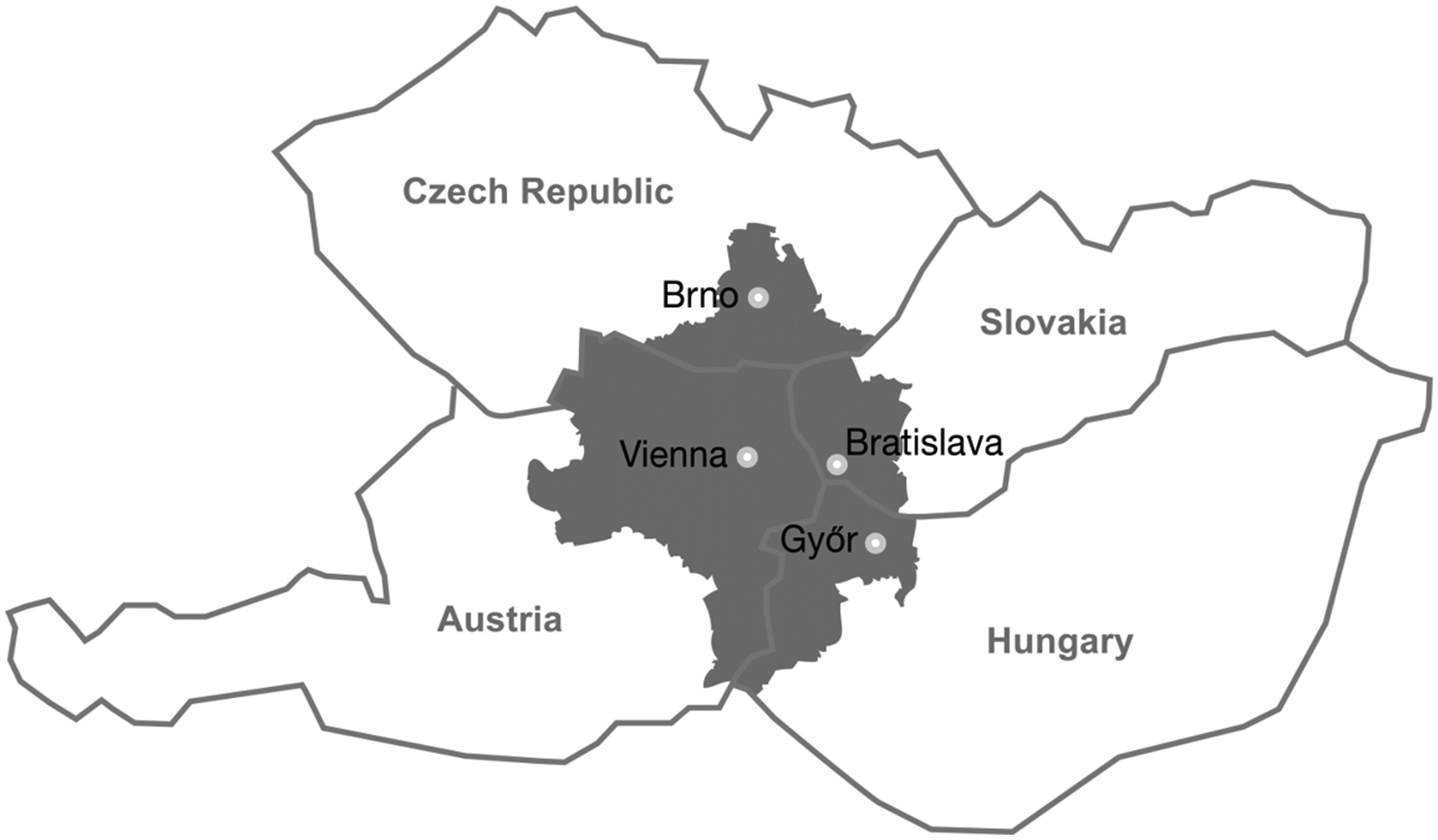
The Central European Region (Centrope).
The high relevance of economic inequalities in the region is also reflected by the typical incentives for cross-border commuting. The most important motive for cross-border commuting from the Czech Republic, Slovakia and Hungary to Austria is the subjectively anticipated higher incomes in this country. This was a crucial motive to work in Austria for nearly 96% of the commuting interviewees in a previous study published by the author. The two other most important commuting motives also reflect the high relevance of the financial aspect of East–West commuting: assurance of one’s own living standard (circa 88%) and the notion that the income opportunities in Austria are more beneficial for individuals who hold equivalent qualifications (84%). Compared to salary-related reasons, job-related motives seem to be less relevant: merely 46% of the interviewees assessed improvements in occupational qualifications as crucial commuting motives, and 76% indicated better working conditions in this country (cf. Haindorfer, 2019: 165ff.).
The ‘dark side’ of East–West mobility within the European Union: Research on the labor market experiences of Eastern European mobile workers
Having written an article titled ‘The new face of East–West migration in Europe’ as early as 2008, sociologist Favell suggested that the labor market experiences of Eastern European migrants in Western Europe are characterized by exclusion and exploitation. Many East–West migrants would engage in jobs at the low-end niches of the labor markets, jobs that Western European citizens would no longer accept, and they would put up with sharp downward mobility in terms of status and qualifications (cf. Favell, 2008: 711). Reviewing recent empirical studies on labor-related East–West mobility across the EU, there is strong evidence of what might be termed a ‘dark side’ of East–West mobility. These studies together show that East–West mobile workers are highly concentrated in the industry sectors and occupations marked by relatively low wages as well as skill requirements, that they are comparatively often overqualified and that they experience earning disadvantages (Felbo-Kolding et al., 2019; Friberg et al., 2014; Fries-Tersch et al., 2018; Janicka and Kaczmarczyk, 2016; Johnston et al., 2015; Khattab and Fox, 2016; Přívara et al., 2019; Voitchovsky, 2014). In an overview of research on Eastern European migrants’ wage differentials, mobility and qualification gaps in comparison to native workers, Fox et al. (cf. 2015: 729f.) even argued that the disadvantaged labor market position of Eastern Europeans can be seen in terms of structural discrimination.
Using the insightful perspective of dual labor market theory, it can be deduced that mobile Eastern Europeans are relatively strongly prevalent in the so-called secondary segment of the Western labor markets. According to this theory, the labor markets of states with industrial mass production have both a primary and a secondary segment. Unlike the primary segment, the secondary segment is characterized by a concentration of poor jobs, for which high instability, disadvantageous working conditions, and low social prestige are typical. Natives avoid the secondary segment. To fill the shortage of manpower at the bottom of the labor hierarchy, temporary migrants are particularly suitable for companies, as they perceive their employment in the receiving country as transitory and therefore accept the poor labor market conditions in the secondary labor market segment (cf. Parnreiter, 2000: 28f.).
So far, studies specifically addressing East–West cross-border commuters within the EU are scarce, as is the case for European cross-border commuting in general (cf. Verwiebe et al., 2017: 252). Therefore, the subsequent literature review addresses all pertinent studies on Eastern European mobile workers in the Western labor markets of the EU. Notably, most of these recent studies have focused on the UK, and most frequently on Polish migrants. This makes Polish migrant workers in the UK appear to be the prototypical East–West migrants. However, as this study addresses Czech, Slovak and Hungarian cross-border commuters in Austria, the literature review also discusses other host countries and origin groups of migrants. This broad approach seemed to be particularly important in embedding the study in the current body of knowledge on East–West mobility.
East–West mobile workers within the European Union
Analyzing the migration strategies of Poles on the EU labor market in the crisis and post-crisis times, Janicka and Kaczmarczyk (cf. 2016: 1702f.) established that in 2014 approximately 30% of the Poles working abroad were employed in manufacturing or construction. Furthermore, in most sectors, the shares of employed Polish migrants remained almost constant over time. According to these authors, this points to the fact that ‘data on Polish migrants are hardly consistent with the European Commission’s report pointing to significant changes in the sectoral allocation of intra-EU movers in favour of high-skilled occupations and at the cost of employment in construction and manufacturing’ (Janicka and Kaczmarczyk, 2016: 1703). In the Danish capital of Copenhagen, for instance, 48% of the total Polish workforce are employed in low-skilled services, which include a wide range of occupations such as newspaper delivery, kitchen work and certain customer-related services. The construction sector is the most important branch for males, employing 44% of the men. Remarkably, most of the Polish migrants have some sort of vocational training and as many as 20% have completed university (cf. Friberg et al., 2014: 45).
Even controlling for personal traits and length of work experience in the UK, it was demonstrated that Eastern European migrants are more likely to be overqualified for the occupational positions they had obtained in comparison to the native British population, much more so than Western European migrants. Moreover, Eastern European migrants were paid less than the native British population and Western European migrants in similar jobs and with similar backgrounds, whatever the match or mismatch between qualifications and occupations (cf. Johnston et al., 2015: 214). Just recently, one of the few investigations on Czech, Slovak and Hungarian migrant workers in Britain indicated that in terms of overqualification, Hungarians and Slovakians seem to be more disadvantaged compared to the UK and EU-15 nationals: 6.2% of Hungarians and 7.1% of Slovaks were highly overqualified in contrast to 4.4% of UK nationals (cf. Přívara et al., 2019: 591). In another study, Eastern European cross-border commuters from the member states that joined the EU after 2004 were shown to have higher over- but lower undereducation rates than noncommuters and internal commuters in their respective countries of origin, implying higher problems of cross-border skill transfer (cf. Huber, 2012: 352). Research has also illustrated various ethnic discrimination experiences of Eastern Europeans in the Western labor markets and other spheres of life (Fox et al., 2015; Van Ostaijen et al., 2017).
Czech, Slovak and Hungarian East–West commuters within Centrope
The literature-based image of a dark side of East–West mobility within the EU can be translated quite well into the case example of East–West cross-border commuting within Centrope. For instance, cross-border commuters from the Czech Republic, Slovakia and Hungary have been shown to receive comparatively low average wages in comparison to natives and other migrants in Austria (cf. Haindorfer et al., 2016: 55f.). Carried out before the Austrian labor market was opened in 2011, one study established that approximately 62% of all the highly educated commuters interviewed were overqualified for the job positions obtained in Austria (cf. Breinbauer, 2008: 65). With the example of Hungarian cross-border commuters, and again before the opening of the labor market, a number of discriminatory practices on the Austrian labor market were identified, including irregularities in salary payments and inadequate job classifications by employers (cf. Lechner et al., 2010: 25) or defiance due to the commuters’ ethnic origin (cf. Hárdi, 2005: 215).
Theory and hypotheses: Why cross-border commuters may differ from short-term migrants in their acceptance of negative labor market experiences
The concept of dual labor market theory – that migrants view their engagement in the labor market of the receiving country as transitory and therefore accept poor labor market conditions – appears to apply especially to short-term migrants. Piore (2008), who is the main representative of dual labor market theory, even characterized the temporary migrant as ‘probably the closest thing in real life to the Homo economicus of economic theory’ (p. 54). The temporary character of the migration flow seems to create a sharp distinction between work and the workers’ social identities. Whereas individuals’ social identities are ingrained in the place of origin, the home community, migration to the host country and the work done there are purely instrumental. Work is a means to gather income that can be taken back to the home community and used to fulfill or enhance the individuals’ roles within that social structure. The workers’ social roles and self-perceptions are deliberately separated from their work. This separation was illustrated by examples of Latin American migrants who would accept jobs they would not accept back home (e.g. men swiping floors) (cf. Piore, 2008: 54f.). It is important to note that when migrants view their stay as permanent, their ambitions will extend to the same economic positions occupied by natives (cf. Piore, 2008: 56f.). As temporary migrants become more permanently attached to the places where they work, and social structures increasingly develop around them there, it becomes more difficult to separate the status of their jobs from their social roles and self-perceptions. Their attitudes towards work shift, leading them into competition and conflict with the native population (cf. Piore, 2008: 64f.).
Elements of these conceptual considerations can be found in the literature on East–West mobility, as it is argued that ‘what might be interpreted by some analysts as labour market penalties are, to those experiencing such situations, acceptable contexts for short-term financial gains alongside cross-cultural experiences’ (Johnston et al., 2015: 215) and that ‘the payoffs, if any, are in terms of their status in relation to their peer group back home’ (Favell, 2008: 712). However, in contrast to temporary migrants, it is very likely that East–West cross-border commuters in Centrope view their commuting as long-term projects due to the relatively stable East–West welfare gap and the short distances in the area. Therefore, a sharp distinction between work and the workers’ social identities cannot be expected among the commuters and, consequently, negative effects of detrimental labor market experiences on their life satisfaction seem to persist. Their very likely perception of long-term labor market integration in Austria may overrule the setting that they are still anchored in their countries of origin and also still compare themselves with their fellow countrymen: in the migration literature, migrants are often assumed to have a ‘dual frame of reference’, one frame being based on their situation in the host country and the other on their situation in their country of origin. In comparing their situation in the host country to that of their family and peers back home, migrants often conclude that they are doing better, even in spite of a possibly dire situation in the host country (cf. Ogbu and Simons, 1998: 170). Against this background, I propose the hypothesis, as examined in this article, that negative labor market experiences (e.g. ethnic discrimination experiences) have a statistically significant negative effect on commuters’ life satisfaction.
Until today, the impacts of negative labor market experiences on the subjective perceptions and assessments of migration have remained a less thoroughly explored issue in the literature. A number of studies at hand have ascertained relatively positive subjective assessments of migration, despite migrants’ negative actual situations or experiences (Amit and Chachashvili-Bolotin, 2018; Sardadvar et al., 2017). Thus, these studies have shown a little-explained phenomenon, discussed as adaptation or ‘satisfaction paradox’ in the general literature of quality of life research (cf. Zapf, 1984: 25), thereby leading to an alternative explanation of why negative labor market experiences do not have much impact on migrants’ life satisfaction. According to the comparison theory, which is the most dominant theoretical perspective within life satisfaction research on migrants, objective living conditions only have a minor influence on subjective assessments (cf. Schyns, 2001: 176f.). Instead, individuals’ happiness derives from subjective comparisons between perceived living conditions and different quality-of-life standards set by individuals. Those comparison standards can be based on experiences of one’s past, individual future expectations or experiences in the social environment (i.e. comparisons with peers etc.). These three different comparison mechanisms are mirrored in the different variants of the comparison theory, the adaptation level theory, aspiration theory and social comparison theory (cf. Schyns, 2000: 86f.).
By using life satisfaction as an indicator of subjective migration assessments, the present study joins the growing field of life satisfaction research in the context of migration (cf. Hendriks, 2015: 7). These studies have mainly dealt with the question as to whether migration changes migrants’ life satisfaction, often pointedly formulated as whether migration makes people happy. So far, there is evidence of positive as well as negative effects of migration on life satisfaction (e.g. Bălţătescu, 2014; Bartram, 2010; Nowok et al., 2013; Safi, 2010; Stillman et al., 2015). However, perhaps because migration itself is a highly diverse phenomenon, it is very complicated to find general answers. Therefore, it seems equally important to analyze specific experiences of migration and their effects on life satisfaction (cf. Bartram, 2013: 160).
Data and methods: A mixed-methods approach to researching subjective assessments of mobility
This study is empirically based on data acquired in the framework of the TRANSLAB research project, funded by the Vienna Science and Technology Fund and conducted at the Department of Sociology of the University of Vienna (2012–2016). As to data collection, the project was oriented toward the established methods of ‘ethnosurvey’, developed to investigate labor migration between Mexico and the USA (Massey, 1987). Against this methodological background, different types of data were generated in TRANSLAB, of which the following are used in the present study: (1) a standardized survey (the TRANSLAB-Survey) of cross-border commuters to Austria and non-migrants living in the regions of the Czech Republic, Slovakia and Hungary bordering on Austria (N = 2,687), which was realized by the project team in cooperation with GfK Austria, and (2) qualitative, episodic interviews with Hungarian commuters who had gathered experience in Austria’s catering and hotel sector (N = 27), conducted by the present author. In the present study, the quantitative and qualitative data and methods are connected systematically within the framework of a sequential mixed-methods design (‘Mixed-Methods Sequential Explanatory Design’: Ivankova et al., 2006; Tashakkori and Teddlie, 2009). The basic principle of this approach is that the quantitative analyses provide a general comprehension of the research problem. The qualitative analyses refine and explain these statistical results through more in-depth investigations of the participants’ perceptions (cf. Ivankova et al., 2006: 4). This procedure seems especially instructive when subjective assessments are under investigation. The first quantitative analysis showed that the selected detrimental labor market experiences can be observed relatively often in Austria’s catering and hotel sector. Thus, the sample of the qualitative in-depth study was restricted to commuters within this sector. A study on Polish migrant workers in the UK hospitality industry also endorsed the bad image of this branch, indicating detrimental working standards in terms of ‘low wages or problems with being paid, racism and long working hours’ (cf. Janta, 2011: 815). The qualitative sample was also restricted to Hungarian commuters, due to experience in approaching this group (Haindorfer, 2013) as well as pragmatically driven research considerations.
Quantitative methods
The TRANSLAB-Survey was based on a sample of 1347 commuters to Austria and a comparison group of 1340 non-migrants who were interviewed (face-to-face) between 2012 and 2013 in the border regions of the Czech Republic, Slovakia and Hungary to the north-east of Austria. The target population was currently employed persons (at least 20 hours a week), aged 21–65 years, whose primary residences were within those border regions. A further eligibility criterion was that commuters required no more than 120 minutes to commute to their jobs in Austria. Hence, as intended, the sample chiefly captured daily commuting close to the border. As comprehensive information concerning the East–West commuters’ labor market integration in this country was only limited, a quota sample was done on the basis of available official statistics. For the best possible approximation, the quotation of the gender and age distribution of the commuter subsample was based on AMS (Public Employment Service Austria) statistics. To ensure systematic comparisons between the cross-border mobile and non-mobile population groups from and in the border regions, the subsample of non-migrants was collected with a quota sample as well, using quotas for gender, age and education based on official labor market statistics (Labor Force Survey). As the survey was not based on a random sample, the findings are not representative of the basic population of commuters and non-migrants in Centrope in a strictly statistical sense. However, the challenge of quantitatively observing circular migrants is not restricted to the Central European region, but applies to all regions around the world. For comparable challenges and handling in primary surveys on circular migrants, see for instance Massey (1987) or Pries (2004) on the Mexican-USA border region.
The dependent variable of life satisfaction served as an indicator of the subjective assessments of commuting. Life satisfaction was based on the question ‘How satisfied are you – all in all – with your current life?’ (1 = very unsatisfied, 10 = very satisfied) (Bartram, 2011). To estimate the impact and importance of negative labor market experiences for the life satisfaction of East–West commuters, the effects of various detrimental experiences will be analyzed within the overall context of commuters’ lives. This is done by applying a human needs-oriented and multidimensional approach to conceptualizing life satisfaction. Therefore, the sociological conceptualization of quality of life, the triad of ‘Having, Loving and Being’ proposed by Allardt (1997), which aims to cover the central economic and non-economic needs required to achieve high quality of life, is transferred into the context of this study. 2 More precisely, the set of independent variables was based on the transfer of Allardt’s (cf. 1997: 89ff.) indicators for measuring Having, Loving and Being in the Scandinavian countries to the context of East–West commuting in Centrope. Additionally, the quantitative analysis used a number of variables on the commuters’ socio demographic and labor market characteristics to gain profound insights into the structure of life satisfaction, such as regional origin, sex or work experience in Austria (years). The analysis applied both descriptive and multivariate methods (OLS regression analysis) (Backhaus et al., 2008). Variables in regression analysis are supposed to be independent from one another. As the education and job-education matching variables were directly interdependent (e.g. highly qualified individuals cannot be under-qualified), the education variable was excluded from all analyses. Self-employed persons have been excluded from all analyses (several variables are not applicable to this group). Table A1 describes the operationalization and the descriptive statistics of the dependent and independent variables used in this study (see Table A1 online Appendix). 3
Qualitative methods
The qualitative, episodic interviews with the commuters were conducted by the present author in 2014 during a 4-week field trip to the Austrian–Hungarian border region. Corresponding to the mixed-methods design, interviewee sampling consisted in a theoretically and empirically founded selection, namely ‘selective sampling’ (Schatzman and Strauss, 1973). Concretely, the commuters’ characteristics of age, gender and job-education matching did indeed vary in the qualitative sample (see Table A2 online Appendix). 4 The interviews were guided by an interview guide and were designed according to the methodology of the episodic interview (Flick, 2011). All of the qualitative interviews were conducted in German, digitally recorded and transcribed. 5 The method of thematic analysis (Froschauer and Lueger, 2003) was chosen to analyze the qualitative interviews. The themes of the qualitative observations were defined with regard to the quantitative findings, for example the subjective assessments of job overqualification.
Empirical results
Descriptive findings: Negative labor market experiences among the cross-border commuters and their average levels of life satisfaction
Regarding the prevalence of the negative labor market experiences commuters may undergo in Austria, the descriptive analyses on commuters’ current jobs in Austria ascertains a medium confrontation with ethnic discrimination experiences (mean = 1.82) (see Table A1). Furthermore, approximately 18% of all cross-border commuters were overqualified for their current job in Austria and 10% were irregularly employed (due to the 0/1 coding of the variables, the means can be interpreted as percentages as well). These selected findings support prior empirical results revealing a high prevalence of negative labor market experiences among the group of East–West cross-border commuters in Austria (Breinbauer, 2008; Hárdi, 2005; Lechner et al., 2010).
Now, what are the average levels of life satisfaction among the East–West cross-border commuters in Austria? Regarding life satisfaction levels, the analysis of the TRANSLAB-Survey demonstrated that the average life satisfaction among the cross-border commuters (mean of 7.44 on a 10-point scale) was significantly higher than that of the non-migrants (6.46) (see Table 1). Comparable average differences of the life satisfaction levels between commuters and non-migrants were also present in the Czech Republic, Slovakia and Hungary, the particular countries of origin. These results are in accordance with previous findings, showing East–West migrants from many Eastern European countries to be happier on average than persons who stayed in those countries (cf. Bartram, 2013: 164).
Life satisfaction among Czech, Slovak and Hungarian cross-border commuters and non-migrants in Austria (means).
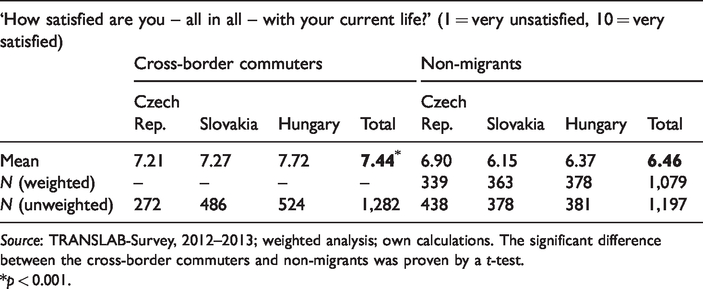
Source: TRANSLAB-Survey, 2012–2013; weighted analysis; own calculations. The significant difference between the cross-border commuters and non-migrants was proven by a t-test.
*p < 0.001.
While the commuters’ life satisfaction is relatively high (in comparison to that of the non-migrants), a prior study by this author – comparing the average life satisfaction levels of the cross-border commuters to other major groups in the Austrian labor market based on pooled data and scale transformation – indicated that commuters’ life satisfaction is significantly lower compared with natives in Austria (a native–migrant life satisfaction gap also identified by Bălţătescu, 2014; Bartram, 2011; Safi, 2010) as well as with EU-15 migrants and migrants from the former Yugoslavia and Turkey. Only EU-12 migrants, who were the most comparable group due to their similar regional origin, did not differ significantly (cf. Haindorfer, 2019: 174). So, in comparison to other major groups in the Austrian labor market, commuters are more unsatisfied with their lives. In the subsequent multivariate regression analysis, I will solely focus on the group of cross-border commuters. Investigating the determinants of their life satisfaction by analyzing the impacts of various economic and non-economic living conditions will ascertain the relevance of negative labor market experiences in terms of life satisfaction.
Multivariate findings: Impacts of negative labor market experiences on commuters’ life satisfaction in the overall context of their lives
The multivariate linear regression analysis explaining commuters’ life satisfaction included the variables of various negative labor market experiences (e.g. ethnic discrimination experiences), as well as other economic and non-economic living conditions (i.e. the needs of Having, Loving and Being by Allardt, 1997) and a variety of socio demographic and labor market characteristics that are also potentially relevant (see Table A3 online Appendix). 6 By adjusting or controlling for these other variables, the life satisfaction differences of commuters who were and who were not exposed to negative labor market experiences were calculated in the presence of other identical characteristics (e.g. same income, same age). By this means, the most relevant determinants of life satisfaction among the commuters were identified. In other words, the importance of negative labor market experiences for the commuters’ life satisfaction was analyzed within the overall context of their lives. Now, what are the most relevant factors for commuters’ life satisfaction and what importance do the various negative labor market experiences have?
Regarding the effects of the Having dimension (material and impersonal needs), regression analysis showed a higher monthly income to significantly positively affect the commuters’ life satisfaction. Thereby, the present study confirms an often identified positive relationship between income and life satisfaction (Easterlin, 1974, 2001; Kämpfer, 2014). The subjective perception that one’s own living conditions have improved in the last years in comparison to those of other persons in one’s own region (relative wealth development) showed a highly significant impact and was one of the most important determinants for commuters’ life satisfaction (standardized regression beta coefficient = 0.2052). Thus, the commuters profited considerably from (downward) comparing their living conditions with non-migrants in their countries of origin. Only the overall health status was slightly more relevant for commuters’ life satisfaction (beta = −0.2551). The high weight of the variable relative wealth development substantiates previous findings of a comparably higher role of relative versus absolute incomes for individuals’ life satisfaction (Ball and Chernova, 2008). Work-related health risks (Lechner et al., 2010) and job security (De Witte et al., 2016; Sverke et al., 2002) did not show a significant effect on commuters’ life satisfaction. Commuting time initially had a weakly positive effect but was followed by a much stronger negative effect in the long run (quadratic term). For this reason, there was rather a negative effect of commuting time on life satisfaction, as previously identified (Stutzer and Frey, 2008). Proficiency in German was again a very important factor for commuters’ life satisfaction (beta = 0.1267); these skills function as a central resource for migration and the integration of migrants in general (Dustmann and Fabbri, 2003; Esser, 2009).
Regarding the effects of the Loving dimension (social needs), commuters who rather self-conceived themselves as Europeans were observed to have higher rates of life satisfaction than commuters who identified primarily with their countries of origin (Amit, 2010). Moreover, commuters in partnerships and those without children had significantly higher levels of life satisfaction than their reference groups (Diener et al., 2000; Riederer, 2018), indicating that childlessness may reduce stress due to commuting. In addition, a better subjectively assessed work-family balance had no positive impacts on the commuters’ life satisfaction. There were no significant differences between commuters’ having more or less contact with Austrian friends and fellow countrymen also working in Austria. Perceiving a good working climate in the firm increased their life satisfaction significantly, whereas life satisfaction dropped significantly when encountering disadvantages in the firm due to ethnic origin (ethnic discrimination) (Safi, 2010; Verkuyten, 2008).
Regarding the effects of the Being dimension (needs for personal growth), regression analysis revealed that none of the indicators under investigation significantly affected commuters’ life satisfaction. Whereas there was a negative sign of overqualification (Dumont and Monso, 2007; Huber, 2012) and irregular employment, as well as of possibilities for professional advancement in one’s job, the life satisfaction differences between commuters experiencing these disadvantages in the Austrian labor market compared to those who did not were not large enough to be statistically significant. Also, the possibility for realizing one’s own ideas at work did not significantly affect the commuters’ life satisfaction.
In terms of the socio demographic and labor market characteristics, it should be noted that commuters from the Czech Republic have a significantly lower life satisfaction than Hungarians. 7 In addition, commuters’ life satisfaction is U-shaped over the life course (Blanchflower and Oswald, 2004, 2008) and there is a negative impact of having been in training before the current job (as against having been in employment before).
In-depth qualitative findings: Subjective perceptions and assessments of negative labor market experiences
In line with the quantitative findings above, all of the qualitatively interviewed commuters shared the opinion that it was a good decision to work in Austria. Some of the commuters did not make even a single negative assessment. For example, Kristóf, who was working in a café in Austria, responded to the author’s question – as to whether, looking back, overall he believed it was a good or a bad decision to work in Austria – by saying it was a good decision. In his comment, it becomes clear that the central scale in assessing his commuting project was his perception of wealth gains compared to his former schoolmates (i.e. relative wealth development): Kristóf: That was a good decision. I know that for sure. That was a good decision. Author: And what occurs to you first when you think about it, that it was a good decision? Kristóf: I see my former schoolmates who still work in Hungary. They’ve achieved a lot less than I have, for instance. Author: In life or at work? Kristóf: In life and at work as well, everywhere, everywhere. Perhaps it’s just in my case, I don’t know. But, I mean, I know some who have always been working in Hungary since 1998 and I see how they live and how I live. Then, then honestly, I must say that it was a good decision that I went to Austria. (Kristóf, 36 years, daily commuter and waiter in Burgenland) Yes, but I also understood it. Because in any case, the Austrians are born in Austria and in any case, we are foreigners in Austria. (…) And in Burgenland [easternmost province of Austria], for example, I was told that this isn’t Hungary here and that one doesn’t do this like that, you know? (…) For instance, I had made a mistake. And then he said: ‘F****** Hungarian, what is it, what are you doing here?’ And then I said: ‘Yes, I’m a foreigner in any case but I’m not that stupid’. (…) But what can you say back to the chef on that? Nothing, yes, yes, I also understand that, but I wouldn’t say that to a colleague or other people, that you’re bad or f****** or something like that. I do not say that. (…) When I had a job, then I was glad that I had a job, you know? And then I didn’t say, for example, the Austrians earn three or four hundred Euros more than I do or that they get more time off, for example. I can’t say anything about this because I’m just an employee, you know? And if I say this to the boss, then the boss will tell me you can leave, there are ten people behind you who will follow, tomorrow morning, for example, it doesn’t matter how good you are. Of course, I experienced such situations, but rarely, rarely. (Ede, 44 years, daily commuter and waiter in Burgenland)
Teréz was an example of such commuters who were overqualified for their positions, and critical about that status, and yet saw a positive outcome of their current employment situations for their lives. She had received a Bachelor’s degree in nature conservation in Western Hungary. As her parents were unable to offer her sufficient financial support, she discontinued her Master’s studies. She started to look for a job, yet not in her learnt profession in Hungary, as the chance to be adequately employed would have been slim, much to her disappointment. Instead, she started in a fast-food restaurant near Vienna. She considered this job to be an interim solution until a better job would offer itself. Her prime objective with this employment was to improve her German in order to be prepared for other jobs. Her former fellow students could not understand why she was working in a fast-food restaurant. To justify her occupational decisions, Teréz accentuated the financial component. She opposes this criterion with a better professional position in Hungary, with all the trade-off in prestige. Asked how she felt when she switched to catering, she answered: Hm, I don’t know, both. I was happy and also sad. Happy, because I’m independent. So I don’t depend on my parents anymore, I can even help them a bit sometimes. And well, when I see my fellow students, some already have a good job and a good position in Hungary. And they’re proud, or do you say it? And I’m only a fast-food seller, and that bothers me a bit. But they earn, no idea, 400 or 500 Euros a month, they’re happy, but they cannot plan that well, like, to buy a flat or something of the kind. So, for me it’s better because of the financial stuff, but otherwise it’s bad. (Teréz, 24 years, daily commuter and fast-food seller in Lower Austria)
Conclusion
The present article has explored the impacts of negative labor market experiences on cross-border commuters’ life satisfaction in the course of East–West mobility in Europe. The empirical findings show that cross-border commuters’ life satisfaction is relatively high (in comparison to the non-migrants of their countries of origin); however, it is significantly lower in comparison to other major groups in the Austrian labor market (e.g. natives, Turkish migrants) (Bălţătescu, 2014; Bartram, 2011; Haindorfer, 2019; Safi, 2010). In explaining commuters’ life satisfaction by means of multivariate regression analysis, the impacts of various negative labor market experiences (e.g. ethnic discrimination experiences), as well as other economic and non-economic living conditions (i.e. the needs of Having, Loving and Being by Allardt, 1997) and a variety of socio demographic and labor market characteristics were investigated. The main hypothesis of the present article, that negative labor market experiences have a statistically significant negative effect on commuters’ life satisfaction, was not substantiated by the empirical findings. Overall, negative labor market experiences do not show as being important for commuters’ life satisfaction. From a multitude of variables of those experiences under investigation in the regression analysis, only ethnic discrimination experiences have a significantly negative impact on commuters’ life satisfaction. The in-depth qualitative findings corroborated the quantitative findings in terms of the low relevance of negative labor market experiences for the subjective assessments of commuting. Those experiences were not considered to be highly relevant in the overall context of their commuting projects in Austria. Therefore, as did some other studies in the field, the present article ascertained relatively positive subjective assessments of migration, despite the migrants’ obviously negative experiences (e.g. Amit and Chachashvili-Bolotin, 2018; Sardadvar et al., 2017).
Significant impacts of negative labor market experiences on life satisfaction were expected in the present investigation on account of the assumption that, in contrast to temporary migrants who are often regarded as purely economic target earners, Czech, Slovak and Hungarian East–West cross-border commuters in Austria view their commuting projects as long-term projects due to the relatively stable East–West welfare gap and the short distances within the Central European Region. Therefore, aspirations should go beyond purely economic incentives.
Regression analysis clearly demonstrated that the overall health status and the perception that one’s own living conditions have improved in comparison with others from one’s country of origin have the highest impact on commuters’ life satisfaction. The findings presented here underscore the commuters’ high economic orientation and motivation, as was expected by previous literature on the motives for East–West cross-border commuting to Austria (Haindorfer, 2019; Lechner et al., 2010; Nowotny, 2011). Theoretically, these findings substantiate the relevance of aspirations and social comparisons for individuals’ life satisfaction (Schyns, 2000). Overall, the present article concludes that cross-border commuters are economically highly motivated and also gain life satisfaction primarily from the perception that their living conditions have improved in comparison with others from their country of origin (relative wealth development), enqueuing them in line with the characterization of temporary European East–West mobile workers who are primarily target-oriented in economic terms (Favell, 2008; Johnston et al., 2015).
With regard to the situation in which the East–West commuters to Austria perceive commuting as a meaningful and essential way to a better life, despite all negative experiences, this study draws a new, positive picture of East–West mobility in Europe from the mobile workers’ perspective. In social-political terms, however, a critical stance is necessary with regard to the effects of commuting on the functioning of a cross-border labor market in the context of open borders, welfare gaps and high economic incentives to commute. The readiness on the part of the East–West commuters to accept detrimental labor market experiences poses a considerable challenge for the Austrian labor market. Inasmuch as detrimental labor market experiences are being accepted, working standards can be subverted by employers and employees, while crowding-out processes among other groups in the Austrian labor market become evident. Their commuting will presumably prove to be long-term endeavors due to the relatively stable welfare gap and the short distances in Centrope. Rather, it seems that the poor labor market conditions will be accepted in the long term or even permanently. Thus, the equal treatment principles of the EU in the common labor market are undergoing a hard test. Yet it is not only the Austrian labor market that be confronted with these challenges, but also other labor markets in the context of open borders, welfare gaps and strong economic incentives for migration.
Supplemental Material
JIR897087 Supplemental material - Supplemental material for Impacts of negative labor market experiences on the life satisfaction of European East–West mobile workers: Cross-border commuters from the Czech Republic, Slovakia and Hungary in Austria
Supplemental material, JIR897087 Supplemental material for Impacts of negative labor market experiences on the life satisfaction of European East–West mobile workers: Cross-border commuters from the Czech Republic, Slovakia and Hungary in Austria by Raimund Haindorfer in Journal of Industrial Relations
Footnotes
Declaration of Conflicting Interests
The author(s) declared no potential conflicts of interest with respect to the research, authorship and/or publication of this article.
Funding
The author(s) disclosed receipt of the following financial support for the research, authorship and/or publication of this article: This article was supported by the University of Vienna, Faculty of Social Sciences.

Notes
Biographical note
References
Supplementary Material
Please find the following supplemental material available below.
For Open Access articles published under a Creative Commons License, all supplemental material carries the same license as the article it is associated with.
For non-Open Access articles published, all supplemental material carries a non-exclusive license, and permission requests for re-use of supplemental material or any part of supplemental material shall be sent directly to the copyright owner as specified in the copyright notice associated with the article.
