




Abstract
Background:
Existential philosophy and psychotherapy focuses on the “givens” of human experience, including feelings of meaninglessness, isolation, death anxiety, and concerns surrounding identity and freedom. Although borderline personality disorder (BPD) is arguably characterized by issues in a number of these domains, it has not been systematically examined through the lens of existential therapy.
Method:
The current systematic review included 37 articles which examined existential concerns in relation to BPD.
Results:
These articles highlighted the predominance of chronic identity and isolation-related concerns in BPD, as well as the potential role of meaning in buffering against the distress of BPD, such as suicidality and comorbid depressive features.
Implications:
The implications of existential phenomenological findings in the conceptualization of BPD, treatment and future existential research are discussed.
All humans live with the awareness of their inevitable death, grapple with questions of purpose (meaninglessness), face uncertainty over their self-concept (identity), the guilt of choosing suboptimally in the face of an overwhelming number of options (freedom), as well as the knowledge that others cannot fully understand their private, subjective experiences (isolation; Frankl, 1959; Koole et al., 2006; May, 2004; Samuolis et al., 2015; Yalom, 1980). Consistent with claims that these five existential “givens” cause psychological pain across life (e.g., Frankl, 1959; Yalom, 1980), poorer existential well-being has been implicated in the development of various mental health problems including depression, anxiety, disturbed eating and life-threatening self-injury (Berman et al., 2006; Fox & Leung, 2009; García-Alandete et al., 2009; Koole et al., 2006; Samuolis et al., 2015). Some existential concerns, such as death anxiety, have been argued to be transdiagnostic, and may be critical to the effective treatment of individuals with recurring mental health concerns (Iverach et al., 2014; Menzies et al., 2019; Menzies et al., 2021).
Given this, it is surprising that little is known about the role of existential concerns in personality disorders. These chronic and debilitating characterological problems emerge in adolescence (American Psychiatric Association [APA], 2013), a period in life in which identity is being chosen, death awareness is fully formed, the freedom to make life choices is occurring for the first time, and concerns about interpersonal isolation appear most salient (Fitzgerald, 2005). Longitudinal research of individuals with BPD indicates that 10% of patients will die by suicide (APA, 2001). Given the substantial costs of BPD to self and society, it is essential to improve our understanding of this condition.
Challenges in Conceptualizing BPD
In trying to conceptualize BPD, there are several challenges presented by current approaches. First, Zanderson and Paranas (2019) argue that key characteristics included in the diagnostic criteria for BPD (e.g., “identity disturbance” and “chronic feelings of emptiness”) are poorly defined both in the Diagnostic and Statistical Manual of Mental Disorders (5th ed., text rev.; DSM-5; American Psychiatric Association [APA], 2013) and the wider literature. They further argue that considerable overlap is found with symptoms of other disorders, such as schizophrenia spectrum disorders (e.g., disturbances in the experience of a self; Zanderson & Paranas, 2019). This therefore impinges on the construct validity of BPD, and complicates differential diagnosis between BPD and other disorders with similar criteria. Second, the etiological roots and theoretical conceptualization of BPD have undergone extensive debate (Amad et al., 2019; Shemmings & Shemmings, 2011). Behavioral approaches to diagnosing BPD limit the understanding of etiological and phenomenological features relevant to the lived experience of people living with this condition (see further, Sagan, 2020). Instead, examining BPD at the experiential and existential-phenomenological levels may potentially help clarify differential diagnoses, and inform effective treatments.
The Five “Givens” of Existence
While numerous authors have proposed varying frameworks for existential psychotherapy (e.g., Spinelli, 2007; Van Deurzen, 2012), the earlier conceptualisations by Frankl (1959) and Yalom (1980) are arguably the leading approaches in clinical psychology. As such, the existential constructs outlined by these authors served as the foundations of the present review.
Existential Isolation
With regard to specific existential themes, existential isolation has been described as an “unbridgeable gap” whereby an individual is inherently separated from others, and the world at large (Yalom, 1980, p. 355). That is, we can never truly understand the innermost experiences of others, nor can our innermost feelings and thoughts be experienced by others. The core existential conflict involves attempts to reconcile the desire to belong to a larger whole, in the face of our knowledge of inevitable and absolute isolation.
Why might existential isolation be relevant in the context of BPD? First, the diagnostic criteria directly implicate patterns of unstable interpersonal relationships (APA, 2013). These interpersonal difficulties may be influenced by the significant deficits in communicative social skills found among patients with BPD patients (McKay et al., 2004; Yeomans et al., 1994), in addition to impairments in Theory of Mind and mentalisation skills (Diamond et al., 2014; Jeung & Herpertz, 2014). Second, given these deficits, it is perhaps unsurprising that loneliness is a common experience reported by people with BPD (e.g., Sagan, 2020). Loneliness is argued to be a common manifestation of existential isolation (Yalom, 1980) and has also been shown to be strongly associated with the “chronic feelings of emptiness” criterion of BPD (APA, 2013; Klonsky, 2008). Third, qualitative research on the phenomenological experience associated with the “frantic efforts to avoid real or imagined abandonment” criterion of BPD illustrates feelings of being estranged from others and being left alone to navigate the world (O’Boyle, 2002; Rued-Fraser, 2014).
Identity
Questions about one’s own identity, and the experience of fragmentation, wherein the self is seen as being “split” into opposing parts, is another existential concern (Yalom, 1980). Self-concept disturbances are a core diagnostic feature of BPD (APA, 2013), and the experience of splitting has been associated with affective lability and dysregulation in people with BPD (Koenigsberg et al., 2001). Yalom (1980) states that psychotherapy should aim to assist clients in integrating parts of themselves that are perceived as being split off. Interestingly, RCTs have shown that psychological interventions which focus on the integration of these parts (i.e., schema therapy) are efficacious in the treatment of BPD (Farell et al., 2009; Giesen-Bloo et al., 2006).
Existential Freedom
Yalom (1980) argued that the infinite number of choices available to us leads to a need to accept personal responsibility for one’s choices in life, alongside the suffering or guilt which comes from choosing poorly. Yalom argues that conscious awareness of one’s own will, and distinguishing between desires and decisions are critical for the ability to take personal responsibility. Questions of will, personal responsibility, and agency become pertinent when one considers the diagnostic inclusion of impulsivity in areas of life that are potentially self-damaging (APA, 2013). In addition, neuro-imagining and neuro-cognitive studies point to relevant cognitive deficits in BPD such as difficulties with executive functioning, planning and decision-making, and impulsivity and risk-taking (Bazanis et al., 2002; Dinn et al., 2004; Haaland & Landro, 2007; Monarch et al., 2004; Ruocco, 2005; Van Reekum, 1993). Despite this evidence regarding decision-making difficulties in BPD, research extending this into the area of existential freedom in BPD is lacking.
Meaninglessness in Life
Yalom (1980) asserts that there is no inherent meaning to life, outside of the meaning, goals, and values a person creates for themselves. Thus, the experience of living a full and purposeful life presupposes a strong narrative view of self and a sense of agency and direction (Frankl, 1959). Given the aforementioned difficulties with identity and agency in BPD, individuals with this condition are likely to be particularly vulnerable to feelings of purposelessness and dissatisfaction with life, which may in turn contribute to the chronic suicidality which often characterizes BPD (APA, 2013). Notably, dialectical behavior therapy (DBT), originally developed for BPD, contains modules targeting values-based living and has been shown to produce significant improvements in BPD symptoms (Kliem et al., 2010). DBT has also been adapted with a more intensive focus on value-based work (Cameron et al., 2014), further highlighting the relevance of meaninglessness as a relevant factor in the conceptualization and treatment of BPD.
Death Anxiety
The inevitability of death, and the consequent fear in response to mortality, is another given of human existence (Yalom, 1980). Death anxiety has been proposed to be a transdiagnostic construct (Iverach et al., 2014), with evidence that it plays a role in numerous mental health conditions across several diagnostic categories (Menzies et al., 2019). However, its specific relevance to BPD is currently unclear, with a dearth of empirical findings exploring fears of death in the context of personality disorders. Given the chronic suicidality and high rates of suicide completion in BPD, it is vital to increase our understanding of attitudes to death among this population.
The Present Review
Given these theoretical links between existential concerns and BPD, the present systematic review aimed to examine the existing evidence for these proposed relationships. At present, there has been no attempt to systematically investigate this potential relationship. Such findings would theoretically inform the conceptualization of BPD from an existential perspective, and in turn, may lay the groundwork for improved treatments of this condition. In particular, should the results of a systematic review reveal the relevance of existential concerns to BPD, this would support the need for specific experimental investigation into this relationship, using an explicitly existentially oriented framework. In this article, we will first outline the search strategy and process for the systematic review, before synthesizing the results from included studies. Given the dearth of existing work examining BPD through an existential lens, we will include any empirical research (e.g., both cross-sectional and experimental) measuring the five existential concerns (i.e., isolation, identity, freedom, meaninglessness, and death anxiety) in relation to BPD symptoms. Finally, the findings of the review will be discussed in relation to their implications for theory and practice.
Method
Sourcing the Literature
The methodology for the present review was guided by established guidelines for conducting systematic reviews (e.g., Booth et al., 2016). The protocol was prospectively registered with Open Science Framework. 1 The electronic databases PsycINFO, MEDLINE, and Web of Science were systematically searched using the following search terms: “borderline personality disorder” or “borderline” and “existential*,” “existential concerns,” “logotherapy,” “experiential psychotherapy,” “death anxiety,” “fear of death,” “attitude to death,” “meaningfulness,” “meaning in life,” “sense of coherence,” self-concept,” “identity crisis,” “identity,” “self-assessment,” “individuation,” “social isolation,” “freedom,” and “volition.” The first two search terms were designed to capture BPD specifically, whereas the remaining search were developed based on existing literature regarding existential concerns, and relevant treatment approaches and outcomes (e.g., logotherapy due to its relevance to the existential issue of meaning). This search was conducted on 17 September 2020.
Selection Criteria
The inclusion criteria were as follows: (a) research articles needed to present empirical data concerning borderline personality disorder in relation to the five existential concerns (i.e., identity, isolation, freedom, meaninglessness, and death anxiety), (b) be published in English, and (c) be peer-reviewed empirical papers (i.e., not conference presentations, or purely theoretical papers). In relation to the first criterion, any empirical data (e.g., empirical and cross-sectional) was included for the purpose of this review, and studies did not need to include a sample of participants with BPD to be included. Furthermore, articles referring to “borderline-like features” (as found in other disorders, such as schizophrenic spectrum disorders; Torgersen et al., 2001) or related but distinct concepts such as “borderline organization” (i.e., a term emerging from psychodynamic theory to refer to the middle ground between neurotic and psychotic personality organisation) or “borderline functioning” (a term most commonly used to refer to intellectual functioning rather than personality traits), rather than DSM-5 symptoms specifically and explicitly related to BPD were not included. No other exclusion criteria were used.
Analysis of the Literature
Overall, the search yielded 894 articles, of which 83 were duplicates (see Figure 1). In Step 1, the titles and abstracts of the remaining 811 articles were screened for eligibility. A second researcher reviewed 10% of these articles (n = 82), with substantial inter-rater reliability (Kappa = 0.74). Disagreements were settled by consensus. A total of 762 articles were excluded via title and abstract screening on the basis that they were only theoretical in nature or were not relevant to existential concerns in BPD. In Step 2, full text articles of the remaining studies were reviewed, resulting in a further 13 papers being excluded. A total of 37 studies were included in this review (a complete list and summary of all studies can be found in Table 1 in the supplementary materials).
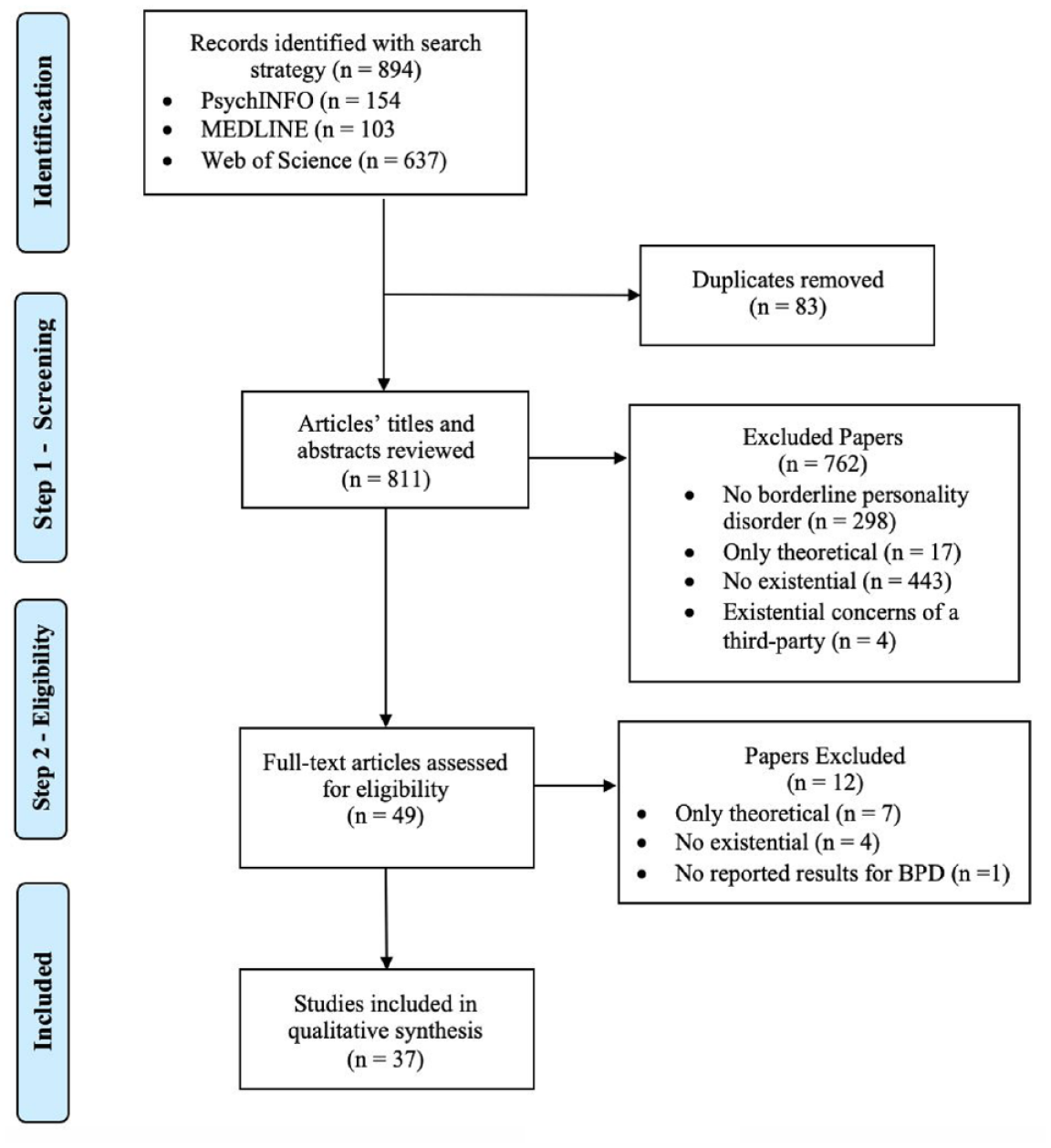
Search Process and Selection of Studies.
Results
The aim of the current review was to examine the existing evidence for the relationship between existential concerns and BPD. The characteristics of the studies, and their findings in relation to the five existential concerns, are outlined below.
Study Characteristics
Across the included studies, the total sample was N = 7528 (M = 244.29, SD = 805.54; range: 1–4636). The mean age reported of the samples was 30.52 years (SD = 9.64; range: 15.37–59.45), and samples were on average 79.58% female (SD = 18.88; range: 49.2%–100%). The majority of studies (84.48%) included a clinical sample and were conducted in Europe (59.38%), with 31.3% being conducted in North America. The mean time since publication was 8.0 years (SD = 6.78; range: 2–28).
Identity
Given the prominence of identity disturbance in BPD (APA, 2013), it is unsurprising that the most frequently discussed existential domain was identity, in relation to fragmentation in the experience of self. In total, 21 studies reported results related to identity concerns.
Studies utilizing thematic analyses to examine global concerns in the lived experience of BPD unanimously pointed to difficulties with the incoherence of the narrative self across time and context. This was apparent in both self-reported (Agnew et al., 2016; Lind et al., 2019a; Sagan, 2020) and therapist-reported accounts (Wilkinson-Ryan & Westen, 2000), and also in both adolescence (Spodenkiewicz et al., 2013) and late mid-life (Adler et al., 2012). In addition, themes of disconnection and a lack of a coherent sense of self were illustrated in BPD (Sagan, 2020) and related to difficulties with forming a consistent, structured and logical self-narrative that was integrated with a broader experience of self (Adler et al., 2012). Agnew and colleagues (2016) also highlighted referential difficulties with defining the self in separation to others in adulthood. Interestingly, in the only thematic comparison of the lived experiences of individuals with and without BPD, processes of separation-individuation were implicated in normative adolescent development. However, the development of self-disturbance in adolescents with BPD appeared to be related to difficulties viewing their past selves with any degree of coherence, and then being able to meaningfully project themselves into the future (Spodenkiewicz et al., 2013) or defining oneself in terms of a single role or cause (Westen et al., 2011). In adults, similar difficulties were evident in the overidentification with their BPD diagnosis (Ng et al., 2019).
In factor analyses of self-reported identity difficulties in adulthood, an inauthentic sense of self was also implicated as one of three factors (including an absent and incoherent sense of self) associated with BPD severity (Bogaerts et al., 2018), and was linked with greater ruminative identity exploration (Verschueren et al., 2017). Importantly, inauthenticity only yielded a small correlation, and an absent sense of self was moderately correlated with BPD severity (Bogaerts et al., 2018). This suggests that, although there may be some continuity of self-disturbance processes across development, identity-related difficulties in BPD in adulthood may be better characterized by unsuccessful attempts to establish a sense self despite repeated mental attempts to achieve a satisfactory and stable identity. However, longitudinal research examining self-disturbance in BPD from adolescence to adulthood is needed to substantiate this claim. Furthermore, in a study with the same sample, Bogaerts and colleagues (2021) found that an absent sense of self was a similarly strong predictor of variance in paranoia, schizotypal and borderline personality disorder symptomology, highlighting the need to examine diagnostic differences beyond self-concept structure.
Similarly, Nelson and colleagues (2013) found that disturbances in a basic sense of self (a “first person quality” to one’s experience and awareness) which are commonly evident in psychosis were not found in BPD, suggesting that self-disturbance in BPD may be qualitatively different. Taylor and Goritsas (1994) demonstrated that identity confusion characterized by uncertainty around one’s personality, preferences and goals were related to general personality pathology, whereas chronic feelings of emptiness were more specific to BPD. Similarly, cognitions and emotions relating to a lack of identity, fragmentation in self experience, feelings of abandonment and betrayal, and self-destructiveness distinguished individuals with BPD from those with other personality disorders (Zanarini et al., 1998). In contrast, general dysphoric states, such as sadness and depression, were more severe in, but not specific to, BPD.
Only one study used a longitudinal design, necessary to capture changes in negative self-states over time. Gad et al. (2019) found that adults with BPD experienced feelings of being worthless, “a complete failure,” and “evil” 3 times more frequently than individuals with another personality disorder. The BPD group showed differences in the rate of decline for some negative self-states compared with the other personality disorder group, and negative self-states were negatively associated with history of symptom remission, highlighting potential mechanisms specific to recovery in BPD. This is reflected in thematic analyses of the recovery narratives of individuals with BPD, which implicate increasing metacognitive awareness of thoughts and emotions, and a reframing of negative self-perceptions in the strengthening sense of self (Ng et al., 2019).
Experimental studies have utilized a card-sorting task to examine self-concept in BPD (Beeney et al., 2016; Evans et al., 2015; Vater et al., 2015). These studies consistently found that, compared with individuals without a psychiatric disorder, individuals with BPD had a greater tendency to organize information about the self into dichotomous (i.e., either good or bad) categories. They also reported having more negative and fewer positive attributes, and weighted negative attributes more heavily, resulting in a compartmentalized and negative self-concept. Beeney and colleagues (2016) conducted functional magnetic resonance imaging (fMRI) while participants completed the card-sort task, concluding that observed differences in self-representation in the BPD and non-BPD group were mediated by differences in activation of brain regions that support social cognition. This provides tentative support for mentalisation or social-cognitive accounts of self-definition difficulties in BPD (Jeung & Herpertz, 2014). In addition, in the one other study utilizing fMRI, Bozzatello and colleagues (2019) found differential brain activation of regions implicated in autobiographical memory in individuals with and without BPD, which may be related to difficulties in BPD with constructing a coherent life story. Thus, it is likely that self-disturbance difficulties in BPD are multifaceted and related, but not limited to, functional differences in neural substrates associated with memory, self-referential processing and social cognition. However, in the only study to control for comorbid psychiatric symptoms, the association between BPD severity and greater negativity in self-concept was driven by depressive symptoms (Evans et al., 2015). More research is needed to clarify the mediating role of depression in the negative self-concept found in BPD.
Interpersonal and Global Existential Isolation
In total, 12 studies reported findings concerning interpersonal and existential isolation. Pervasive feelings of loneliness, alienation and disconnection from others are illustrated in the narratives and self-reported concerns of individuals with BPD (Liebke et al., 2017; Sagan, 2017, 2020; Southward & Cheavens, 2018) and appear as early as adolescence (Spodenkiewicz et al., 2013). Severe distress associated with existential isolation in BPD is described as trait-like qualities of inner “deadness” or “emptiness,” which are present even in the company of others (Sagan, 2017; Sagan, 2020). These are quantitively associated with, but not accounted for by, reduced social functioning and smaller social networks compared with individuals without a psychiatric diagnosis (Liebke et al., 2017). This is supported by research on schemas (i.e., habitual cognitive, emotional and behavioral responses to life occurrences). Specifically, two studies found greater endorsement of maladaptive schemas in the disconnection/rejection domain, particularly social isolation and mistrust/abuse schemas, in individuals with more severe BPD (Leppänen et al., 2016), compared to individuals with Major Depressive Disorders (Hulbert et al., 2011).
Despite the ostensible importance of interpersonal and existential isolation in BPD, there are only two experimental studies examining these concerns. In one study, a grid-design task was used to examine the relative relationships of attributes individuals assigned to themselves, and in reference to others generally (de Bonis et al., 1995). Individuals with BPD viewed themselves as being more different to others, compared with individuals without a psychiatric diagnosis. Unlike the Schizophrenia comparison group, the BPD group did not tend to view others as undifferentiated, suggesting that comparisons in BPD may be more complex than global self-other differentiation. Using a computerized task to manipulate situations of social ostracism, inclusion and overinclusion, De Panfilis and colleagues (2015) found that individuals with BPD reported an improvement in negative emotions when included and over-included but low feelings of social connectedness across all inclusion conditions, when compared with individuals without a disorder. This suggests that perceptions of social disconnection in BPD may not be ameliorated by changes in objective conditions of inclusion.
Similarly, Adler and colleagues (2012) found that, while individuals with and without BPD did not differ significantly in their degree of preoccupation toward others, the fulfillment of intimacy and affiliation needs were impoverished among those with BPD, thereby supporting the idea that existential isolation in BPD may be a difference in kind, rather than degree. Importantly, lower fulfillment in affiliation needs were moderately associated with greater BPD symptom severity. Overall, research in interpersonal and global existential isolation has largely relied on cross-sectional studies, and it is still unclear whether (a) BPD features contribute to lower relationship fulfillment or (b) less relationship fulfillment exacerbates or drives BPD symptomology. However, research on isolation overall highlights the potential importance of fulfilling relationships to BPD. Consistent with this idea, individuals with BPD reported themes relating to meaningful interpersonal relationships that enabled connection, intimacy and care in supporting their recovery (Agnew et al., 2016; Ng et al., 2019).
Existential Meaninglessness
A total of nine studies reported on the existential concern of meaninglessness in relation to BPD. Individuals with BPD have been found to report a lack of meaning in life, compared with individuals with other psychological disorders (Huguelet et al., 2016a). Meaning in life is also strongly negatively associated with BPD symptom severity across various age groups (Marco et al., 2017a; Lorca et al., 2019), even after controlling for clinician ratings of participants’ symptoms (Marco et al., 2017b). Similarly, research has found that meaning in life is negatively associated with both suicidality (García-Alandete et al., 2014), and frequency of nonsuicidal self-injury at baseline and at 1-year follow-up (Marco et al., 2015) in BPD patients. Furthermore, meaning in life has been found to moderate the relationship between suicide risk factors and hopelessness in individuals with BPD (Marco et al., 2015), supporting the view that existential meaninglessness plays a crucial role in vulnerability to feelings of hopelessness. This is corroborated by two single case studies of young adults with BPD receiving individual logotherapy or goal-focused positive psychotherapy emphasizing life meaning (Hawley et al., 2020; Rodrigues, 2004). Therapist reflections in both approaches attributed improvements to helping individuals identify and pursue meaningful life goals. Although the single case study design limits the Generalizability of these findings, the results support those found in the more robust longitudinal studies described above.
In the only study to examine culturally diverse sources of meaning in individuals with BPD, Huguelet and colleagues (2016b) found that the minority (9%) who endorsed spirituality as being personally important showed higher self-esteem and less hopelessness, but no difference in overall meaning in life. This suggests that some sources of existential meaning may confer a greater protective benefit than others, and poses a potentially important avenue of study in the relationship between meaninglessness and BPD pathology.
Existential Freedom
In total, 14 studies reported findings concerning existential freedom and BPD. As outlined above, research on existential meaning has relied on conceptualisations of meaning that presuppose individual agency in the formulation and achievement of goals. The assumption that existential freedom is necessary for life meaning is illustrated in two single case studies of young adults with BPD (Hawley et al., 2020; Rodrigues, 2004). In both studies, therapists observed that patients’ acceptance of existential freedom and personal responsibility in life was a cornerstone to successfully therapeutic outcomes that made subsequent meaningful life engagement possible. However, the use of single case studies naturally limits the Generalizability of these findings.
However, there has been no research to date that has employed longitudinal designs or experimental tasks to examine the potential role of existential freedom to BPD. In the extant empirical literature, thematic analyses have highlighted perceived reductions in agency in BPD pathology in adults (Agnew et al., 2016) and adolescents (Spodenkiewicz et al., 2013). Self-reported emotional states relating to impoverished agency (e.g., feelings of hopelessness) have been found to be positively associated with reduced meaning in life, and greater symptom severity in BPD (Marco et al., 2015; Marco et al., 2017; García-Alandete et al., 2014). The inverse has also been observed, with the acceptance of existential freedom (Ng et al., 2019), and increased themes of agency appearing in narratives of active recovery processes in BPD (Lind et al., 2019b). Related constructs, including self-reported purposefulness (Marco et al., 2017) and the perception of one’s environment as being well-resourced for goal achievement (Lorca et al., 2019) has also been associated with lower levels of BPD symptomology. Another relevant line of inquiry has focused on commitment. These studies have found that general commitment-making (e.g., to occupations, values, or spirituality) was low in individuals with BPD, according to both patient (Huguelet et al., 2016a; Verschueren et al., 2017) and clinician reports (Westen et al., 2011; Wilkinson-Ryan & Westen, 2000). However, these conclusions are limited by the absence of comparisons with nonpsychiatric or other patient groups, and the absence of longitudinal or experimental designs.
Death Anxiety
Only one study to date has examined the relationship between mortality concerns and BPD, despite well-established relationships between BPD, high suicidality, and death-related ideation (García-Alandete et al., 2014). Gershuny and colleagues (2004) found that BPD symptoms increased with self-reported generalized fears about death. In addition, generalized fears of death and loss of control were found to partially mediate the association between trauma history and psychopathology, and explained an additional 20% of variance in this association. Although mediation analyses did not examine BPD specifically, these results point to the potentially important role of death-related concerns in BPD, given the relevance of trauma to this disorder (e.g., Ford, 2018). However, conclusions are currently limited, given that only one study has examined death anxiety and BPD.
Discussion
Overall, research to date has highlighted the potential importance of existential concerns, particularly existential isolation, freedom and meaninglessn, to the symptom profile, developmental trajectory and suffering of individuals with BPD. However, the extant literature has largely relied on cross-sectional designs involving self-report measures and interviews, which may be problematic given that (a) lack of personal insight is a feature of BPD; (b) there is a paucity of well-validated measures for existential constructs and; (c) existential concerns have largely not been clearly defined nor rigorously examined (e.g., through factor analysis). Research has also been limited by the small number of relevant studies, particularly in relation to existential freedom and death anxiety. Furthermore, few studies utilize longitudinal designs, experimental tasks or network analyses to examine the potential mechanistic role of existential concerns to BPD in relation to each other. For example, an impoverished sense of meaning in life has been argued to relate to more fundamental difficulties in commitment-making and the acceptance of personal responsibility (e.g., Hawley et al., 2020; Rodrigues, 2004). In turn, concerns surrounding existential freedom have been argued to be related to difficulties maintaining continuity in the self over time (Westen et al., 2011). These concerns are likely to interact with dynamic fluctuations in affective states which may be specific to BPD (Spodenkiewicz et al., 2013) or better represented transdiagnostically, for example, as depressive states found in other disorders (Evans et al., 2015). Future research incorporating multi-informant (e.g., therapist report) and phenomenological (first-person) accounts of BPD may offer a valuable extension to these findings, by informing curative factors to therapeutic encounters.
The following section outlines the strengths and limitations of the study. First, the search terms used focused strictly on the DSM-5 diagnosis of BPD. Although this was done to increase the validity and reliability of the findings, given that there is no formal consensus on the use of other diagnostic terms, it is possible that this excluded studies which focused on more contemporary terminology for BPD (e.g., Emotionally Unstable Personality Disorder, or Complex PTSD). Future research may benefit from investigating existential concerns using search terms relevant to these more recent or emerging diagnostic labels. Relatedly, despite the aforementioned overlaps between BPD and certain other disorders (e.g., schizophrenia spectrum disorders), it was beyond the scope of the current review to make comparisons between the current relationships and these other disorders. Future research may benefit from broadening the search to include these related conditions, to help better differentiate the relationships between existential concerns and BPD and those found in other disorders. In addition, due to the significant heterogeneity in study designs (e.g., qualitative analyses, correlational studies, single case studies, experimental designs, fMRI studies, factor analyses, and longitudinal designs), no formal appraisal of quality or risk of bias was conducted. Future research focusing on more homogeneous study designs may benefit from doing such an appraisal, to help establish the reliability and validity of the current findings. Finally, the lack of cultural diversity in the included studies should be noted. Psychological research has been criticized for its reliance on samples from Western, educated, industrialized, rich and democractic (WEIRD) societies (Henrich et al., 2010). Indeed, all studies included in the current review were conducted in a WEIRD nation. Future research would benefit from exploring possible cultural differences in the role of existential concerns for people living with BPD.
Despite these limitations, it is argued that the systematic review offered in this paper provides several important insights for existential-humanistic scholars and practitioners working with clients who suffer from BPD. The present review is the first to examine existential concerns in the diagnosis, symptomology, lived experience, and profound suffering of individuals with BPD. The strong grounding in the leading theoretical frameworks of existential concerns and therapy (e.g., Frankl, 1959; Yalom, 1980) enabled the review to have a clear focus on the five existential givens, and have direct implications for treatment and clinical practice. Finally, the current review did not exclude studies which used adolescent samples. Although this decision was made to include data from as many populations as possible, it should be noted that the validity of BPD diagnoses in adolescence has long been questioned (e.g., Bondurant et al., 2004). However, numerous reviews and meta-analyses have demonstrated that the BPD features in adolescents are comparable with those in adults, and that for many adolescents, their diagnosis remains stable into adulthood, supporting the validity and clinical utility of BPD diagnoses in youth (Miller et al., 2008; Winsper et al., 2016). Thus, the decision not to exclude adolescents in the current review, in line with current evidence, may be considered a strength of the current study.
Conclusion
The current findings demonstrate the relevance of existential concerns including meaninglessness, isolation, freedom, and identity, to the phenomenology and conceptualization of BPD. However, there is a dearth of research concerning death anxiety and its relation with BPD, which is surprising given the proposed transdiagnostic nature of this construct (e.g., Iverach et al., 2014). Several key implications follow from the current findings.
First, current medicalized diagnostic approaches, such as those outlined in the DSM-5 (APA, 2013) conceptualize personality pathology in terms of the absence/presence of discrete symptom categories. These approaches reduce the suffering of individuals with complex characterological problems down to a set of generalized criteria, which have been criticized for obfuscating a more nuanced, theoretically informed understanding which accounts for the complexity and chronicity of these difficulties across the lifespan (Lingiardi & McWilliams, 2017). This reductionist approach is particularly problematic given the current findings of the review. That is, defining oneself by a single role or cause, and/or overidentifying with one’s BPD diagnosis, was shown to be common problems among these groups (Ng et al., 2019; Westen et al., 2011). It is possible that the current medicalized diagnostic approach exacerbates this problem, in that the diagnosis of BPD becomes one of few stable sources of identity.
The findings from the present review support proposed revisions or alternatives to the DSM. That is, conceptualizations of BPD features may benefit from being organized around dynamic and existentially informed themes (e.g., involving both overinvolvement, anxious preoccupation and fearful withdrawal from others, as opposed to unidimensional fears of abandonment; Gunderson, 2010). Such a conceptualization would be in line with the Power Threat Meaning (PTM) framework, an alternative to the current DSM classification system (Johnstone et al., 2018). The PTM framework argues that mental distress is a response to threats (including threats to one’s ability to find meaning, exercise agency, and feel valued by others), not dissimilar to the existential conflicts outlined by Yalom (1980). Furthermore, it places a central emphasis on both agency (relevant to existential freedom) and meaning, which it describes as the “central thread and final common pathway in the experience and expression of mental distress at all levels.” According to the PTM, symptoms of BPD would then instead be framed as understandable threat responses (i.e., attempts, albeit unhelpful ones, to manage these threats). Such a conceptualization would be in line with existentially informed conceptualisations of BPD, by framing the condition as being driven by the same givens of existence to which all humans are subject. This may in turn serve to reduce the stigma often associated with BPD (e.g., Ring & Lawn, 2019).
Finally, given the relevance of these existential concerns to BPD, more research is warranted to examine whether explicitly identifying and targeting these concerns in treatment may help improve quality of life among people with BPD. This should be particularly considered for existential concerns with stronger evidence demonstrating their relationship to BPD (i.e., identity, isolation, and meaninglessness).
Supplemental Material
sj-docx-1-jhp-10.1177_00221678231165792 – Supplemental material for A Systematic Review of Existential Concerns in Borderline Personality Disorder
Supplemental material, sj-docx-1-jhp-10.1177_00221678231165792 for A Systematic Review of Existential Concerns in Borderline Personality Disorder by Candy T. X. Liu, Rachel E. Menzies and Ross G. Menzies in Journal of Humanistic Psychology
Footnotes
Declaration of Conflicting Interests
The author(s) declared no potential conflicts of interest with respect to the research, authorship, and/or publication of this article.
Funding
The author(s) received no financial support for the research, authorship, and/or publication of this article.

Supplemental Material
Supplemental material for this article is available online.
Notes
Author Biographies
References
Supplementary Material
Please find the following supplemental material available below.
For Open Access articles published under a Creative Commons License, all supplemental material carries the same license as the article it is associated with.
For non-Open Access articles published, all supplemental material carries a non-exclusive license, and permission requests for re-use of supplemental material or any part of supplemental material shall be sent directly to the copyright owner as specified in the copyright notice associated with the article.
