




Abstract
The purpose of this exploratory study was to underline the importance of a humanistic approach to peace studies against a scenario characterized by the failings and weaknesses of the liberal peacebuilding agenda. To do so, we employ a transrational peace research framework to investigate whether Kundalini yoga can be used as a peacebuilding tool by analyzing its role in the lives of young people living in an Alexandra township, in South Africa. We conducted semistructured interviews with yoga instructors, surveyed yogis online, and analyzed three annual reports of Yoga4Alex, an organization that provides young people in Alexandra with tools for a better life through Kundalini yoga (and other programs). The main findings of this study demonstrate that practicing Kundalini yoga plays a vital role in the yogis’ lives in Alexandra, creating a space where peace can grow. Many respondents consider that yoga creates a community that offers them support and mental well-being. Moreover, yoga practice helps to develop tools they can use for personal transformation, contributing to the creation of a new identity and offering a nonviolent alternative for everyday life. This study provides reflections for both research and practice.
Introduction
Within recent decades, the global conflict landscape has transformed significantly. Prolonged conflicts have led to high humanitarian and economic costs: almost 80 million people have been forced to leave their homes, which is approximately 1% of the entire human population (UNHCR Global Trends 2019, 2020). Nearly half of the displaced population are children (Child Displacement, 2021). The effects of armed conflicts always result in some level of difficulties for young populations (Yule et al., 2003). The disintegration of society, lack of basic safety and future prospects, witnessing deaths, and general toxic stress lead to many psychological problems such as anxiety, posttraumatic stress disorder (PTSD), and depression (Charlson et al., 2019; Dar & Deb, 2020; Hamber, 2009; Kadir et al., 2018; Myles et al., 2018; Thabet et al., 2018; Wagner et al., 2018).
The international community has tried its best to tackle conflicts through the peacebuilding paradigm, aiming to solve them with liberal Western values, such as free markets, democratization, and strong institutions (Chandler, 2017). However, half of the countries subjected to early peacebuilding interventions relapsed to conflict, with about three-quarters ending up ruled by authoritarian regimes (Barnett et al., 2007). The weakness of the liberal peacebuilding agenda was the naïve belief that a one-size-fits-all implementation of western policies would correct the world (Chandler, 2017). Thus, to build peace, an interdisciplinary approach based on the human condition is needed, including ideas from cultures other than the Western one, from post-Westphalian, and enlightenment-based sciences (Galtung, 2010). In other words, the peacebuilding process should have at its center the people, to improve their living conditions and empower them so that transformation is possible (Lykes & Coquillon, 2009).
One of the examples of unfortunate peace building failures is South Africa. While the international community’s involvement was very limited in this country, the peacebuilding process was based on the liberal peace ideology. However, it was unable to address the country’s socio-economic problems and resembled colonialism (Forde et al., 2021). Once claimed to be a highly inclusive rainbow nation, nowadays South Africa presents a vastly distinct reality (Omoyefa, 2014), punctuated by high levels of social exclusion and violence, an extreme inequality gap, and an HIV/AIDS crisis (Palmary et al., 2015).
Where the traditional peacebuilding paradigm seems to fail, existential and liberation psychology could offer a window of opportunity, as a holistic way of understanding the needs of conflict-affected populations (Blodgett & Yakushko, 2020). Humanistic approaches proved effective in tackling the global problems in the 1960s and 1970s (Aanstoos, 2003), affecting the outcome of the Cold War (Ryback, 2011). However, despite its potential to create inclusive peace, the role of humanistic approaches has remained diminutive. In this context, one of the holistic tools that could be used for peacebuilding is yoga, which is an embodied philosophy that has been practiced for centuries to reach liberation and inner peace (Singleton, 2010). Yoga has been increasingly used on conflict-torn countries as a grassroots peacebuilding tool (Lefurgey, 2018), producing impressive mental and physical benefits for the people practicing it (Gabriel et al., 2018; García-Sesnich et al., 2017; Liévano-Karim, 2019; Prasath et al., 2017). In some cases, though, modern postural yoga can be used to equally impose the very same liberal Western values common to traditional peacebuilding efforts (Lefurgey, 2018), undermining the original aims of such holistic interventions. Thus, in this exploratory study, we propose to turn our gaze to yoga styles that have stronger philosophical underpinnings, such as Kundalini yoga, which aims to seek liberation through awareness and holistic philosophy (Khalsa, 1996). In order to bring such a humanistic approach to peace studies, we employ a transrational peace research framework in order to ask whether Kundalini yoga could be used as a peacebuilding tool. We aim to identify what kind of dimensions could foster peace through a case study in the township of Alexandra in South Africa, where the organization Yoga4Alex provides young people with tools for a better life through Kundalini yoga and other programs. We conducted semistructured interviews with yoga instructors, surveyed yogis online, and examined three annual reports of Yoga4Alex.
In the following pages, we begin by situating this study in the relevant literature regarding the potential role of Kundalini yoga as a peacebuilding tool. We explore the advantages of examining it through a transrational peace research framework, which will then inform the analysis and discussion of this study’s findings. Subsequently, we outline the methodology employed and present the analysis of our case study. In the discussion and conclusion that follow, we reflect on how the lessons learned from the South African case can contribute to the debate regarding the role of yoga in the peacebuilding arena.
A Brief Description of the History and Practices of Kundalini Yoga
Yoga is an umbrella term for various forms of meditation, physical postures, and life philosophy of Indian origin, which is based on dharmic religions such as Hinduism, Jainism, and Buddhism (De Michelis, 2008). Built on an extensive philosophical system, the main goal of yoga is to unite the mind and the body to the cosmos and reach liberation (Singleton, 2010). The word Kundalini in “Kundalini Yoga” may be translated as “coiled up.” It is present in the old tantric and Hatha writings (Singleton, 2010), depicting the mystical, psycho-cosmological energy that is often characterized as a serpent sleeping at the base of the spine (Patañjali et al., 2007). Kundalini yoga aims for personal transformation sometimes referred to as “yoga of awareness” (Vallejos et al., 2016, p. 264). The origins of Kundalini yoga are unknown. Deslippe (2012) argues that it was brought to the western world by Yogi Bhajan in the late 1960s, but its pathway to Africa is yet to be documented.
In practice, Shakti Parwha Kaur Khalsa (1996) explains that Kundalini yoga is performed via carefully constructed sequences (kriyas). Kriyas are made of combinations of body movements (asanas), breathwork (pranayama), specific hand positions (mudras), deep meditation, and chanting specific words or sentences (mantras). After Kundalini energy is awakened, it coils up around the spine, raising seven points of the center of energy, also called chakras, which are aligned from the bottom of the pelvis to the top of the head (Mann & Singh, 2018). According to Khalsa (1996), each chakra has its responsibility area that affects human function, personality, and health. Once all chakras are clear, Kundalini energy will flow freely, connecting the person’s mind to eternal knowledge of the universe, creating peace and tranquility. Once the yogis have a connection to the universe, they no longer desire to resort to violence or to engage in wrongdoing, forming peace within the yogi, the society, and the universe.
Yoga—Building Peace From Within
How does yoga build peace? It has been thought that the yoga practice helps the yogi to create inner peace via improving the mind-body connection of the yogi, which makes the person′s mind more receptive to nonviolent alternative coping mechanisms (Lefurgey, 2018) and improve community-building feelings (Dard, 2019). Studies on Kundalini yoga have shown a general decrease in stress levels (García-Sesnich et al., 2017), positive effects on life values of middle-aged men (Prasath et al., 2017), and a decrease in somatic symptoms and general anxiety among adult women (Gabriel et al., 2018). Moreover, Kundalini’s yoga practice can increase emotional regulation and decrease stress (McMahon et al., 2021; Sarkissian et al., 2018).
Various yoga interventions for peacebuilding have been used in contexts such as Lebanon, Colombia, and Kenya (Lefurgey, 2018). Despite a lack of studies on the effectiveness of these programs, some studies show benefits to mental health on an individual level (Liévano-Karim, 2019), which also affect the wider community (Velásquez et al., 2015). Thus, when the individual problems ease, the people claim to be more receptive to the peacebuilding process. This new space strengthens an individual’s attachment to the peace effort (Upadhyaya, 2019).
Kundalini yoga could avoid the Western trap through its strong philosophical underpinnings of emphasizing balance and peacefulness that direct the practice and support the yogi’s progress (Khalsa, 1996). Still, Kundalini yoga should be practiced carefully and with caution, and guidance from a guru is highly recommended (Suchandra et al., 2021). While modern postural yoga has been praised in research, respected yoga master Gopi Krishna (1996) explains that yoga has the power to save or destroy, and it is up to the yogis which is the outcome. The individualistic and self-centered approach, without interest in the spiritual side of the yoga and Kundalini energy, is destructive. Modern postural yoga has been criticized for being too exclusive and materialistic (Lefurgey, 2018), a tool for spreading neoliberal values, at least in western societies (Godrej, 2017), and sometimes dangerous to the body (Cramer et al., 2018) and mind (Hofmann, 2013).
On an interpersonal level, yoga has gained implications on a state level in diplomacy and in the cabinets of parliaments with contradicting results. The Prime Minister of India, Narendra Modi, has been an active promoter of yoga since mid-2010. Pushing the United Nations to accept the cultural importance of yoga and establish an International Yoga Day, Modi has proclaimed India to be the cultural ambassador of yoga (Gautam & Droogan, 2018). Modi’s efforts for exporting yoga to China, Japan, and Israel has enhanced the bilateral relationships between these countries and promoted peaceful cooperation (Gautam & Droogan, 2018).
However, many scholars have criticized the political use of yoga. In an example, Jain states that the narrative of yoga being the only true ideology in India has led to exclusion of different minorities and religious groups such as Muslims (Jain, 2020). McCartney (2017) illustrates how most of the Western yogis are generally not interested in the political underlining of yoga despite the tradition’s connection to Indian culture and politics. Omitting the political backdrop could prevent the critical thinking toward the yoga industry and its teachings that could lead to unintentional support of the Hindu supremacy and expansionist ideology. However, yoga is a rather complex assimilation of philosophical, religious, and practical dimensions that should not be dismissed because of political connotations (Gautam & Droogan, 2018). Reflecting on this, Kundalini yoga could be a suitable tool for peacebuilding as it has little connection to political discourses.
In political systems, yoga-derived mindfulness has been studied, apparently resulting in increasing openness and understanding of different viewpoints. For example, Jamie Bristow (2019) presents a case from the British parliament, where a group of politicians did a mindfulness course. Besides individual positive effects, some politicians reported increased openness to new ideas, which helped them expand their approaches to unfamiliar perspectives. They also reported increased compassion and empathy. Other scholars (Ferguson, 2016; Moore, 2016) have been more cautious, as they do not believe mindfulness or Buddhist values can change the politics in the United States.
Transrational Peace Research
This study draws on Wolfgang Dietrich’s (2012, 2013, 2018) transrational peace research framework, which combines modern science with the whole human experience and beliefs from different religions, philosophical thoughts, and humanistic psychology (Dietrich, 2014).
In practical terms, Dietrich (2012) identifies four different types of peace: (a) human-centered energetic peace, which springs from the inner experience of peace and harmony; (b) institution-orientated moral peace, which is attained through justice; (c) modern peace, which is generated through security, strong institutions, and governance via authoritarian influence; and (d) postmodern peace, which questions the modern and moral peace-seeking truth. These four dimensions of peace are constantly in interrelated communication with each other, forming transrational peaces, which are plural to reflect the vast number of peace concepts worldwide (Dietrich, 2012).
Conflicts are described by transrational peace research as energy blockages that manifest within the society but have roots deep in human life (Koppensteiner, 2020). At the episode level, conflict is perceptible as wars, bombings, terrorism, or other forms of violence that disturb everyday harmony. However, the root causes of the conflicts are hidden “beyond the deeper layers of the involved people’s Ego” (Dietrich, 2014, p. 50). Therefore, the conflicts’ epicenter is not visible to the world. As the causes of conflicts are buried deep within, the experiences of peace are also often beyond the rational mind, as Dietrich (2014) discloses:
The mind does not have words for it, though peak- and peace-experiences happen precisely there when the Ego is twisted, that is, when for a moment the primordial, harmonious, and eternal unity of individual and universal existence is experienced by the human being. (p. 50)
Consequently, we can only build peace in the first place via addressing the intrapersonal layers of human beings (i.e., personal, sexual, socio-emotional, mental, spiritual). After approaching the epicenter of the conflict via such intrapersonal layers, the interpersonal layers of family, community, society, and policity 1 can reach peace (Dietrich, 2013). In a practical example, Kundalini Yoga addresses the intrapersonal layers, providing clear instructions on how to reach inner peace.
Methods
Participants
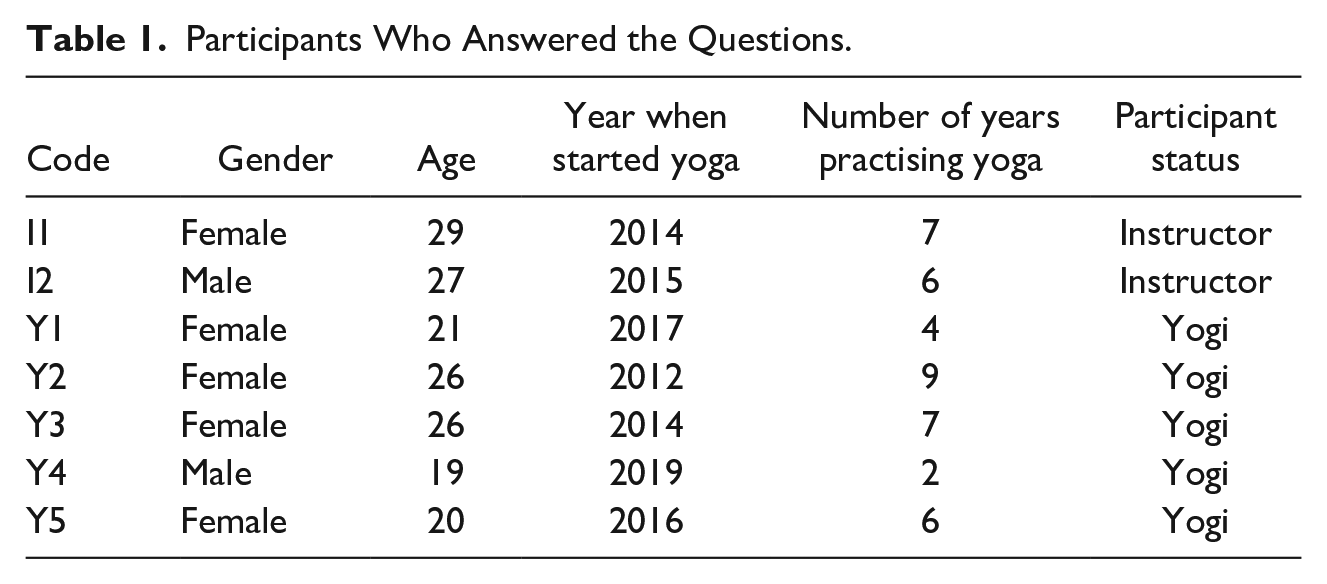
Of the seven participants in this study, two were yoga instructors, and five were yogis. The yoga instructors had 6 to 7 years of yoga practice, while the yogis had 2 to 9 years of yoga practice (see Table 1). All participants lived in Alexandra, South Africa, where everyday challenges are tangible. According to Harrison and colleagues (2014), Alexandra is home to 180,000 to 300,000, mostly Black people from a variety of cultural and geographical backgrounds. Languages spoken in the township include Zulu, Sepedi, and Xitsonga. More than 95% of the population is living in low or very low-income households resulting to poor living conditions in informal settlements, backyard sheds and in hostels that were originally built for factory workers. Xenophobia is often present in the townships, where many do not have legal residence permits, making them vulnerable to violence, discrimination, and exploitation (Fourchard & Segatti, 2015). This study was approved by the Ethics Committee of ISCTE—University Institute of Lisbon (nº 08/2021).
Participants Who Answered the Questions.
Data Collection
The first author contacted several grassroots yoga organizations in the initial phase of the research project. Yoga4Alex was selected due to their responsiveness, location, and population that it serves creating a suitable case study to answer the research question. Participants were contacted through snowball sampling via Yoga4Alex mailing list and were invited to participate in a study exploring their yoga instruction or their yoga practice in the case of both yoga instructors and yogis, respectively.
The first author conducted the interviews in April 2021 via Zoom. The semistructured interview guide developed for this study (and available upon request) included questions aimed at understanding yoga’s personal and societal implications from a yoga instructor’s point of view. Participants could speak for as long as they wished, with the interviews lasting between 47 and 50 minutes. All interviews were recorded and transcribed.
Due to difficulties in ensuring a stable internet connection to carry out a scheduled interview, the yogis preferred to answer the interview questions via an online questionnaire. The initial interview guide underwent minor changes (e.g., a question about any negative effects of yoga was added) to grasp the yogis’ personal experience with Kundalini yoga practice. To complement the interview and online questionnaire data, we also gained access to three annual reports of Yoga4Alex, which explained the organization’s primary goals and achievements from the respective years (from 2016 to 2018).
Data Analysis
We based the qualitative analysis employed in this study on principles common to RTA (see Braun et al., 2019), a researcher-centered approach used to seek common themes that reveal shared meanings in the data. The first author conducted a detailed analysis of the collected data according to the strategy outlined by Braun & Clarke, 2021. First, to increase familiarization with the data, the author read all materials, transcribed the interviews, and annotated both data sets. Second, data were coded inductively. Third, initial themes were generated. Fourth, themes were developed and reviewed in conjunction with initial notes, leading to the fifth step of refining and defining themes related to transrational theory. Through these steps, the first author generated three main themes according to which the data were reviewed and organized: (a) how Kundalini yoga practice affected the individual’s life; (b) how Kundalini yoga practice affected the society; and (c) how participants experienced peace. The sixth and last step included one last round of data verification and writing up the results.
According to established procedures (Yin, 1989), the second author conducted a mini audit of the transcripts and summary documents and agreed with the coding and themes identified. This exercise enhanced the coherence of the analysis, enabling the emergence of new themes and refining existing ones to determine that the final themes were representative of the data.
Positionality Statement
This article was an ambitious project to widen the hegemonic peace research project that, in its mainstream form, has not been able to fulfill its purpose—to build peace. We wish that this research could help policymakers in peacebuilding and peace researchers to be more courageous and study more the possibilities of humanistic values in peace work and include the oppressed people fully as part of the peace work. Choosing the research approach of the transrational peace research framework permitted us to explore Kundalini Yoga and bring the oppressed to the center of the study without reducing them to the victim position. Therefore, the research reflects our worldview where, to make a change, we must include the voices and wisdom from the edges of the traditionality. However, we do recognize our privileged position as White Europeans. Therefore, we have been careful not to become the “White saviour” but to concentrate on active listening, giving space without judgment or idealization.
Findings
In this section, we quote the participants’ views on how Kundalini yoga affected their life and society and how they describe peace. To protect their identities, we opted for a combination of letters and numbers to differentiate who speaks (Y for yogis and I for instructors). We also modified quotes for improved readability. Our findings showed great individual benefits of Kundalini yoga for both the yogis and yoga instructors, which translated into an overall increase in feelings of inner peace, self-development, and improved well-being, offering the opportunity to reflect on nonviolent alternatives for their lives. Feelings of increased inner peace cognate mild positive effects in the immediate social circle of yogis and instructors, which resulted in improved interpersonal relations and willingness to improve their community. However, the broader impacts of practicing Kundalini yoga at the societal level are yet to be further researched.
The Effects of Kundalini Yoga on Individuals
The participants started practicing yoga by attending a yoga class organized by Yoga4Alex, as part of their school curriculum or via word of mouth. Respondents reported significant changes in their mood, well-being, and school performance, and most stated finding Kundalini yoga as one of the most important experiences in their lives. Before starting yoga, most respondents suffered problems at some level. Many reported emotional difficulties (Y5), low self-esteem (Y4), and a lack of behavioral control (Y2). One respondent reported problems in the family and feelings of exclusion due to their skin color (Y3), and one did not report any problems but stated other challenges in their life—“I had a normal life but with lack of courage and positivity” (Y1)—underlining the lack of prospects for the youth living in Alexandra. I2 presents how the feeling of living in a place that is filled with everyday violence and lack of safety negatively affects their hopes for the future:
But then, even though having parents and friends, it doesn’t really stop you from the anxiety and the wider where will I be when I finish school? Will I be able to manage to escape the reality of that I’m living in? So, there were that kind of event. Anxiety the kind of that also can create it depression being in that space.
While all the participants reported positive changes in their mental health, five respondents also reported physical changes. These participants stressed that yoga gives a good physical body—“I find yoga interesting with more fun [activity]. It can also be our exercise routine. Make you fit” (Y5). However, the primary effect experienced was the transformation of the mind and the restored connection between mind and body. I2 elaborated on this:
For me, I think yoga is just . . . Just get in touch with yourself, that sometimes when you grow up, you lose that inner self or get clouded by what’s happening around you. But yoga is the way of returning to yourself and realizing that I have the power and realizing that there’s nothing outside. Everything starts with me, and again for you to be in that position.
In this sense, Kundalini yoga seemed to transform the outlook of the yogi toward the inner world and therefore seek help, not relying on the outside assistance but strengthening the yogi’s competencies. This caused multiple positive effects on the yogi’s mental health and emotional and behavioral control. Most respondents reported lower stress levels, increased self-awareness, increased concentration, better decision-making, and self-confidence. As Y2 said: “You develop self-esteem, self-reliance, faith, and a strong bond with your mind, body, and soul. You study yourself and master your abilities.” Thus, respondents demonstrated unexpected and holistic changes they noticed after starting the Kundalini yoga practice.
Yoga seemed to play an important role in offering tools to cope with the difficult life situations offered daily in Alexandra. In a way, Yoga created a new way of looking at things—“it changes the way you see things in life, and you see a positive opportunity in every situation and have a better way of handling things” (Y1). The increased feeling of taking control of their own life, which was restricted because of limiting beliefs and mental health problems, was translated into action. In doing so, the yogis were able to choose a nonviolent coping mechanism alternative to the typical violent township behavior, as I1 reported:
Alex [Alexandra] is not like everyone is doing drugs and . . . hum, and there are people who are trying to fight that while trying to stop that, but it’s like they’re struggling like even the law is struggling to stop it . . . The people in Alex, if they have nothing else to do in a day, are going to these groups and gangs . . . They can come and do it, so doing Yoga in schools gave them a new identity so that they don’t belong in certain groups of doing drugs.
What I1 suggests is that the yoga practice, and where the Yoga is practiced, creates courage for the yogis to work actively toward their well-being, instead of just passively falling into problems. Besides increased mental health, or perhaps because of it, some respondents reported improved career opportunities, which showed in higher grades at school and in the development of a sense of direction in life—“. . . I didn’t even know what I wanted to do after my matrix. But now during my yoga years, I’m more focused on my career” (Y5). Moreover, Yoga4Alex provided numerous learning workshops at their guesthouse for school children to prepare for their final exams (Yoga4Alex Annual Report, 2018). Workshops improved final grades and increased pass rates for some students. One respondent also reported gaining financial and material benefits, which partly encouraged them to continue practising yoga:
It was more than yoga; Dr Marianne helped me with our career choices, mentoring, tutors gave me a laptop for my studies (not just any, a MacBook pro) and paid for my one-year trip to Cape Town. (Y2)
Seemingly, yoga practice expanded from experienced inner change and tools to cope with complex life challenges to a framework that allowed the students to reach extra help that was not available elsewhere.
Negative Implications of Yoga
Only one participant expressed direct negative effects of Kundalini yoga—“I think I become too soft and too kind to a point where people take advantage of me sometimes” (Y1). This reflection highlights the violent living environment of Alexandra, where community trust is at a low level, and people with softer behavior are being taken advantage of.
Likewise, Yoga4Alex annual reports did not address any negative aspects of yoga. However, the two instructors interviewed brought up some concerns regarding physical misconduct. In an example, I1 stated: “We know that Kundalini is so powerful in a way that you can’t use it while we’re doing drugs.” In addition, I2 highlighted the physical risks of yoga: “putting pressure on the body where it’s not necessary, I think that also can be a negative side that I’ve seen with yoga” (I2). More importantly, I2 raised a question about the common misbelief of yoga being an answer to every problem:
A lot of people think that this one fixed and quick fix that fixes everything, but to me, it’s kind of like a process, so it’s kind of like a process and even feels like a life philosophy. It gives a little bit of direction to life. Scientifically it always has been proven that yoga does help with stress. It does help with blood pressure and does help with other sorts of diseases. Not cure them but either prevent them or reduce them.
In this vein, the essence of yoga is not to create false promises or to give a sense of automatic healing. Instead, yoga practice is a way of living that could lead to healthier lifestyles and increased well-being. However, if the yoga practice ends, the positive effects disappear.
Both instructors also addressed the importance of group work. They saw the classes as peaceful environments that could empower the students. However, I2 touched on critical dimensions regarding trust:
If you build that positivity within a student . . . then again, you disappear; it would cost a trust. This person is selling me false hope, you know? You need to take them through the chain until they can really understand on their own.
Therefore, not only does yoga play a part in the yogi’s life, but it also does so in the life of the instructor, who creates the environment and space where yoga is practiced. As many people living in postconflict zones could be in vulnerable positions, the stability and ethics of the yoga class provider becomes significantly more important for creating positive benefits within the society.
Effects of Kundalini Yoga on the Community
Most respondents were unable to directly reflect on how Kundalini yoga practice affected their community and political landscape. However, a close analysis of their answers revealed some society-level implications. Y3 stated that yoga made their environment more peaceful, while Y1 said that “it is much better, especially in the school environments.” However, Y2 did not see any difference. I2 highlighted the willingness to give back to the community:
There were so many things that I went through in life and being told that you can change that. And you, yourself realising that you can change your life, was like something that I also feel like I need to pass to others who are in the same situation as me or even worse.
They depict an example of the yoga philosophy that aims not only to address individual well-being but also to highlight the community’s importance. Yoga4Alex’s annual reports also showed that many previous students are engaging actively in the community via the work developed by this organization. Kundalini yoga classes, workshops, yoga events, alumni groups, and volunteering for the community all attracted previous yoga students. One of the broader impact activities was the annual Yoga4Mandela event, which Yoga4Alex has been organizing since 2016:
We held our first 67 minutes of the Yoga4Mandela event in 2016, and one hundred people participated, many of whom had never done yoga before. In 2017, Yoga4Alex asked ten youngsters from each school to recruit ten of their classmates. The organisers were delighted when two hundred learners attended. This year, we again requested learners attending afterschool yoga to recruit classmates, and over three hundred-and-one learners attended. (Yoga4Alex Annual Report, 2018, p. 10)
These events and regular yoga practice do not only take care of the individuals but, via instructors and volunteers, also seem to change the community’s mood. I2 reported: “I am not just a yoga instructor, but I go there with my group. It is kind of like a team in the community and the energy we bring in that area.” This unity creates a community that is there for the people instead of vice-versa. Thus, both yoga instructors and Yoga4Alex employees acted as ambassadors of goodwill, setting an example, and encouraging the people of Alexandra to take care of others instead of resorting to violence.
The support from the organization and increased openness of the individuals benefiting from its services resulted in decreased friction in everyday social life. A few respondents reported seeing these effects in their daily life at home. For instance, I1 witnessed the yogis’ families becoming more interested in yoga too:
I can say that yoga can really work if it is not only the learners doing it. The parents say I have realised that my child is doing this. Can I also be part of it, even if it’s not only one person but the whole family doing that.
The Kundalini yoga practice thus opened the space for the children to be heard and show their parents an example of a nonviolent alternative, as affirmed by I2:
We have had a significant impact on the students, and even sometimes you get a message from their parents: So, you know what, lately I have a better relationship with my daughter and my son. So, it means that whatever you were doing with my sons or with my child is really improving my child’s behaviour or attitude.
Although the two instructors mentioned good feedback from some parents, some other respondents did not agree—“some parents don’t want their children doing yoga” (Y3)—demonstrating the variety of opinions toward yoga in the community of Alexandra. One of the issues against Kundalini’s yoga practice was the religious beliefs that yoga is the work of evil. Concomitantly, some individuals and the community were sometimes against yoga because of a misconception of the religious nature of Kundalini yoga:
Some people are religious, and when you bring something that is . . ., that they don’t understand them, and specially with us in Kundalini yoga, you do chanting, which is in a Gurmukhi or Sanskrit, something that they don’t understand. Then there’s that question of what is this person bringing? Is it demonic? (I2)
The underlying thought here is that Alexandra is already a conflicted area, and bringing something completely new (like yoga) challenges the sense and security of basic trust, which then manifests in a rejection of the new idea. Christian worldviews also prohibited out-of-ordinary practices, as they were felt to be something to be afraid of by the community. I1 explained it further via their experience of going through a change with yoga.
I can say it’s fear. Fear of change, because, um. I think people will have their own beliefs, and if someone can just come and say: There is this thing that can wake you up, but they already have something that they believe in, it’s tough for them. I know it because I’m a Christian.
In this sense, if the person had had a closer relationship with the Christian religion, they would have stopped practising yoga. However, they were able to critically examine the widely adopted community beliefs and continue yoga practice, becoming an instructor later. Yoga4Alex mitigates the skepticism from the community by adapting the yoga practice. The instructors give information, explain the practice’s root ideas, and adjust relevant measures such as not including mantras in the yoga practice.
Views on Peace
At the end of the interviews and online questionnaire, the respondents were invited to spare a moment to reflect on how they define peace and what would be the best way to build it. The answers provided diverse definitions. Many presented peace as a state of being, rather than something politically or economically constructed. Peace was described as a personal feeling of safety, security, and inner peace. Thus, the responses highlight the importance of inner experience—the feelings of belonging and lack of fear and stress. I1 expanded on the relational dimension of peace:
A place where you can communicate in a freeway way like no one can interrupt you. That place where you can speak, and someone can listen to you so. Yeah, that’s how I can define peace.
Life without violence can be hard to reach or even to imagine, as according to some respondents, apartheid still has its legacy deeply rooted in Alexandra. This legacy represents itself as distrust to others when people are looking for someone to blame for their own problems. Instead, what people struggle to see, is that the difficulties are often caused by the societal issues in the larger structures. As I2 explained:
Like I should be living a better life now since you moved away from apartheid, and we still have high unemployment and drug abuse and sometimes people feel like they tend to look at and say, who is causing my trouble. They tend to look for someone they can blame and say you are the cause of my problem, and you know that when one person says it and then the next person, sooner or later, it is 20 then it is 50.
The illustration of the situation in Alexandra reminds us of the “broken phone effect,” in which the message gets distorted through a chain of people during its travels. In the same way, the rumors and negative thoughts are eroding the community. I1 shared:
If two people were together, they shared the same thing where the other person won’t listen, and the other person won’t listen. . . . I think that’s something we are facing in South Africa because everyone wants to be right.
When asked what the best way of building peace would be, I2 questioned the concept of peace. I2 presented valid questions regarding the definition of peace and on what values the peace process is placed. Also, the importance of cultural knowledge is present in their statement:
Just to fully understand what peace means for each individual and, especially in Alex, you are in the community where there are problems everywhere, and people coming from different places and speaking other languages, you can find maybe about 20 different languages. So, what does peace mean for each language? And I think peace is linked with democracy. How can you ensure that you have democratised the society in a way that it’s still in tune with their values and belief systems?
On how to build peace, the online respondents were unanimous, underlining the position of meditation and increasing compassion and self-knowledge. As Y5 commented: “calm your mind, be true to yourself, meditate.” However, the interviewees also addressed the importance of compassion:
If we can have that understanding with compassion and recognise that, okay, the other person is different and that the other person is here [as] we are. We are the same, and we can share the same thoughts. (I1)
Thus, all respondents expressed the importance of placing the people first in peacebuilding efforts. They stated that we should build peace primarily from within. The role of yoga in a peacebuilding process was concluded well by I2:
I think the role of yoga is just for us to reach as many students as possible. Really show them that they are the change that they want to be. If they want to see change, change starts with a man. You know, as much as you love to take care of yourself, you need to take care of your community. And you need to take care of your community needs to be clear about what you want. Your mind has to be straight. You don’t need to pick up a brick or stone and start hitting someone. Stop doing that ‘cause at the end of the day . . . You’re not solving any problems, just tried causing more problem.
Discussion: Yoga, a Tool for Personal Transformation or Peacebuilding?
In this exploratory study, we explored whether Kundalini yoga could be used as a peacebuilding tool. Following qualitative inquiry and case study in South Africa, we analyzed our data set through transrational peace research theory (Dietrich, 2012, 2013, 2014). It is evident that many of the respondents saw peace as an internal state, rather than an external construct. The yoga practice provided great individual benefits to the yogi’s improving their mental health and family lives, a safe community to express themselves, and offering physical relief and inner peace. Positive benefits allowed yogis to develop alternative, nonviolent lifestyles, which could save them from engaging in Alexandra’s common negative behaviors such as drug usage and violent behavior.
While the yogis benefited significantly from improved well-being, increased inner peace, and material and psychological support from the organization, we lack concrete evidence on how these effects would contribute to peace or peacebuilding. Thus, it could be argued that yoga practice does not contribute to peacebuilding, and benefits are only seen at an individual level. However, we think this would be not completely true as we identified two important dimensions.
First, through Kundalini yoga practice, our yogis gained improved well-being and experienced increased inner peace. This finding is aligned with a vast body of yoga research (some examples: Kishida et al., 2018; Mann & Singh, 2018; McMahon et al., 2021; Ross et al., 2014; Sarkissian et al., 2018), joining our humble study with the small number of studies on Kundalini yoga in a postconflict setting. It is important here to note that Kundalini yoga practice seemed to create a nonviolent alternative for yogis which prevented them from engaging in gang life and drug usage. Thus, yogis could actively reject participation in violence and choose peace instead. The trajectory here seems to be, as Kishida with colleagues (2018) observed, that yoga practice works in two ways. First, helping the yogi to cope with stress, increase mindfulness skills, and regulate their nervous system. Second, yoga seemed to allow yogis to learn new skills in emotional regulation that are later used outside of the mat. In other words, increased skills in kindness, compassion, stress management, and changes in mind-set could contribute to increased resilience and social skills. Clearing one’s inner layers as suggested by Dietrich’s (2012, 2013, 2018) transpersonal peace research, a person would be more capable of choosing their actions instead of choosing the mainstream.
Second, the importance of the yoga community should not be dismissed. Many of the yogis expressed the value of support provided by Yoga4Alex as significant. The organization was visible within Alexandra, promoted yoga classes at school and through events, and provided material and psychological support for some in need. This being said, instead of viewing yoga practice as an individual, one-directional, performance that magically affects surroundings, it would perhaps be more fruitful to see yoga as a two-directional container that facilitates personal and societal change. In other words, the yoga community itself could create material and psychological help, but also feelings of belongingness and reason for peace. Here, belongingness to the community seems to play an important role. Meléndez Guevara et al. (2022) found out, belongingness to the community either protected Colombian youth from the effects of armed conflict and witnessing violence or acted as a driver for boosting aggression by directing people to seek unity in gangs. Lefurgey (2018) also suggests yoga for peacebuilding initiatives often relies on the community-building process that works from the bottom up, and inside out. This study raises multiple questions. First, how can we measure the societal change that yoga practice could potentially create? Although yoga is used in several postconflict settings (Lefurgey, 2018) many of them are small-scale initiatives, and research is nearly nonexistent. Perhaps a more community-based or participation research design with wider samples including nonpractising society members could continue our work and reveal how the individual effects translate to the wider society. Second, what is the role of the chosen yoga style? Are the yoga styles with tighter philosophical frameworks more suitable for peace work? Not necessarily, as yoga can be potentially dangerous to the body and the mind (Suchandra et al., 2021). Perhaps then the way yoga is offered is more important than the yoga style. In Colombia for instance, yoga nongovernmental organization (NGO) Dunna is offering yoga to underprivileged people on a nonprofit basis. They aim to offer psychosocial help and community building to the entire society, therefore rebuilding trust in the society (Quiñones et al., 2018).
Third, does Kundalini yoga bring world peace? We do not think so, as it is not a practice for everybody and in every context. However, it can provide a thin but significant lifeline that could keep the people abstaining from violent activities, giving hope for the future and allowing the people to be part of an accepting community. As the consequences of armed conflicts can fundamentally alter life trajectories, making a tool for better life available should not be looked down upon. Thus when implemented correctly, without the pressure of neoliberal values, Kundalini yoga could work as a path of individual and societal transformation. It would therefore be essential to pay attention to the transformation and peaceful philosophy, rather than politicization and promises of quick healing. Henceforward, the potential of Kundalini yoga as a peacebuilding tool relies not only on the yoga itself but on the philosophical framework in which it is presented. In this sense, any meditative practice, breathwork, or singing and dancing could work as a tool to build a peaceful society. In this vein, further research applying a transrational peace research framework to such similar practices could uncover important contributions to peacebuilding efforts.
Therefore, we would like to conclude this section by wondering whether the peace philosophy is more important than the tools that are used. As the peacebuilding field has struggled to include alternative philosophies to the Western-orientated and liberal values-based approach (Gnoth, 2020), this study shows that the definition of peace should be expanded from the Galtungian positive–negative peace thinking to many peaces. While Kundalini yoga is only one tool, the philosophy that it bears prioritizes balance, collective well-being, and healthy lifestyles over liberal and individualistic thinking. Implementing an inclusive way of peace interpretations that first creates peace within opens the door for a more significant development pathway, where everyone is invited. Kundalini yoga, with its transformational philosophy that concentrates on balance and communal well-being (Khalsa, 1996), could be an answer to building peace from within.
To understand the mechanics of any alternative, person-centered, humanistic psychological peace initiatives, Dietrich’s (2012) transrational peace research manages to expand the understanding of the human experience. It also allows for the inclusion of nontraditional ways of building peace, such as Kundalini yoga. To reach peace, the human experience should be prioritized over liberal market values or politics. This does not only mean material needs but also psychological, spiritual, and emotional ones, which often are missing from peacebuilding efforts. As the case of South Africa demonstrates, violence does not stop with exceptional democracy plans if the human condition is left unaddressed.
Conclusion
In this exploratory study, we examined the proposal of using Kundalini yoga as a peacebuilding tool through the experiences of yogis and yoga instructors in the South African township of Alexandra. Our findings suggest that while Kundalini yoga practice positively affected our sample, a clear influence on society is yet to be discovered. However, many respondents experienced that yoga created a community that offered them support and mental well-being. Moreover, yoga practice helped the yogis develop tools they could use for personal transformation, which created a new identity and offered a nonviolent alternative for everyday life. One of the key players in this context was the organization Yoga4Alex, which worked as a safe haven offering study rooms and financial incentives, which were lifesavers for some community members. Moreover, according to our respondents, Yoga4Alex created positive energy in the community.
We are aware that this study is a modest contribution to the peacebuilding arena—a case study focused on seven semistructured interviews and three annual reports—limiting the generalization of results. Also, this study did not manage to include any voices from the population who did not benefit from (or experienced the negative effects of) yoga interventions. Thus, we advise caution in the considerations herein proposed. Nonetheless, we have started to explore peacebuilding through a humanistic framework, which is an alternative to mainstream approaches, and have widened the understanding and possibilities of Kundalini yoga as a potential peacebuilding tool. Futures studies should include larger samples and examine deeper the lived experiences of the yogis, including the population, which did not benefit from the practice of yoga.
Footnotes
Acknowledgements
The authors like to thank every participant of the study and Yoga4Alex for the hard work they are doing every day in creating some peace among the chaos. Also, they would like to show their appreciation to Kat Rowland and Tchilissila Simões for proofreading the article, as well as the anonymous reviewers for a very insightful and helpful review process.
Declaration of Conflicting Interests
The author(s) declared no potential conflicts of interest with respect to the research, authorship, and/or publication of this article.
Funding
The author(s) disclosed receipt of the following financial support for the research, authorship, and/or publication of this article: This work was supported by the Fundação para a Ciência e Tecnologia (FCT) under UIDB/03122/2020.
