




Abstract
Expanding on the work of Forstmann and Sagioglou, this study investigated the differences in personality and pro-environmental behavior (PEB) as a function of psychedelic-occasioned mystical experiences. A sample of 240 participants with prior psychedelic experience completed an online survey. Data were collected on participants’ psychedelic-occasioned mystical states, personality, and self-reported PEB. A measure of behavioral PEB was also included (Charity Task). The mean scores on self-reported PEB, openness and agreeableness of participants who met the criteria for a “complete” mystical state, were significantly higher than those who did not. Specifically, those who experienced a mystical state scored higher on the PEB types “eco-shopping and eating” and “one-off domestic conservation actions.” Participants who demonstrated PEB in the Charity Task scored higher on self-reported PEB than those who did not, supporting the task’s validity. Findings suggest that mystical experiences influence PEB. Future research with experimental designs could further illuminate potential causal relationships.
Keywords
Mystical experiences, which can occur spontaneously or be pharmacologically induced, are considered profound and pivotal events that can significantly influence an individual’s life (Doblin, 1991). Through the administration of psychedelics in controlled and clinical settings, researchers have observed remarkable shifts in some individuals following a psychedelic-occasioned mystical experience, including positive changes in attitude, behavior, and well-being (Doblin, 1991; Griffiths et al., 2006, 2008, 2011; Pahnke, 1963), improved sense of spirituality (Griffiths et al., 2018), increased openness (MacLean et al., 2011), and enhanced connectedness (Watts et al., 2017). As a result of such alterations, psychedelic-occasioned mystical experiences could have implications for people’s behavior and relationship with the natural world, including their pro-environmental behavior (PEB).
PEB involves protecting or conserving the environment and is pivotal to lessening the detrimental impacts of human behavior on the environment. As concern grows about escalating global temperatures, understanding what connects people with the environment is of considerable importance for individual well-being, and for the well-being of the planet (Martin et al., 2020). Although one study reported an association between lifetime experience with classic psychedelic drugs and increased self-reported PEB (Forstmann & Sagioglou, 2017), the quality of a psychedelic experience and how it might influence PEB has yet to be examined. Thus, the present study aimed to build on the findings of Forstmann and Sagioglou (2017) and further explore the relationship between psychedelic-occasioned mystical experiences and PEB.
PEB
PEB refers to conscious acts in which people engage, aiming to minimize their negative impact on the environment and behave in sustainable ways (Clayton & Myers, 2015; Kollumss & Agyeman, 2002). PEB has garnered considerable interest, both in contemporary scientific research 1 and popular discourse, 2 as combating climate change has become a focus for many countries pledging to lower carbon emissions (United Nations, 2019). It has been suggested that there are multiple types of PEB, with some possessing greater personal meaning in particular social and moral contexts (Gatersleben et al., 2014). For example, PEB such as purchasing secondhand items might not correspond with the social rewards individuals believe they deserve, based on their career and perceived sacrifices. Whereas alternate PEB, such as recycling, might enhance both self and social perception regardless of affluence (Darnton et al., 2010).
The motivators for PEB are complex, as multiple factors may influence a person’s tendency to engage in pro-environmental actions (Gifford & Nilsson, 2014). For example, differences in gender and education are thought to affect PEB. Women frequently report more PEB engagement than men (Davidson & Freudenburg, 1996; Luchs & Mooradian, 2012; Zelezny et al., 2000), and those with more environmental knowledge generally report more PEB than those with less knowledge (Ajaps & McLellan, 2015; Gifford & Nilsson, 2014; Torkar & Bogner, 2019; Vicente-Molina et al., 2013). For individuals to remain motivated, however, researchers have repeatedly emphasized the importance of intrinsically, rather than extrinsically, motivated PEB as it results in longer lasting and more robust pro-environmental actions (Baum & Gross, 2017; Hedlund-de Witt et al., 2014; Steg & Vlek, 2009; Thiermann & Sheate, 2020; van der Linden, 2015). The two-pathway model of PEB, for example, posits that individuals have a normative pathway and a relational pathway of PEB (Thiermann & Sheate, 2020). The authors argue that in addition to PEB via personal norms, the more connectedness and empathy one feels with nature, the more internalized and powerful PEBs become. Based on this framework, internal factors such as personality disposition (Gifford & Nilsson, 2014; Loiacono & Loiacono, 2013; Milfont & Sibley, 2012) or the degree of connectedness one feels toward nature and the environment (Gifford & Nilsson, 2014; Jensen & Olsen, 2019; Martin et al., 2020; Whitburn et al., 2020) may act as strong internalized motivators for one’s willingness to engage in PEB (Milfont & Sibley, 2012; Moisander, 2007). Therefore, psychedelic-occasioned mystical experiences, which have the potential to alter personality traits (MacLean et al., 2011; Nour et al., 2017) and increase an individual’s connectedness with nature (Gandy et al., 2020; Kettner et al., 2019; Lyons & Carhart-Harris, 2018), could have the potential to intrinsically motivate PEB, leading to longer lasting sustainable action.
Psychedelics and PEB
A growing body of evidence implies that connectedness with nature enhances PEB (Martin et al., 2020; Zelenski et al., 2015), therefore changes in nature-relatedness could be an important motivator of PEB. Kettner et al. (2019) describe nature-relatedness as the degree of self-identification and intimate connectedness people feel toward nature. There is considerable research that suggests nature-relatedness is enhanced following a psychedelic or mystical experience (Forstmann & Sagioglou, 2017; Lyons & Carhart-Harris, 2018; Nour et al., 2017). It is possible that through an enhanced connectedness and oneness with nature, individuals might consider the preservation of natural resources and reassess their everyday impact on the environment.
Although research supports an association between the use of psychedelics and nature-relatedness (Forstmann & Sagioglou, 2017; Kettner et al., 2019; Lyons & Carhart-Harris, 2018), increased environmental concern (Lerner & Lyvers, 2006) and fostering positive relationships with the environment (Studerus et al., 2011), few studies have looked specifically at behavioral outcomes. To date, only one study by Forstmann and Sagioglou (2017) was identified that examined the relationship between PEB and psychedelics. Using structural equation modeling, Forstmann and Saglouou (2017) found that in comparison to other drugs, experience with classic psychedelics exclusively predicted nature-relatedness-self (NR-self), which uniquely predicted PEB. NR-self is a sub-dimension of nature-relatedness, which refers to how people internalize their relationship with nature. Yet when NR-self was controlled for, the relationship between the frequency of psychedelic use and PEB still remained significant, suggesting this relationship may exist independent of personal inclinations toward nature.
Forstmann and Sagioglou (2017) also measured openness and conscientiousness, two of the big five dimensions of personality (McCrae & Costa, 1999), and observed an association between these two traits and PEB. The personality trait of openness, which is characterized by high levels of intellectual engagement, imagination, aesthetic appreciation, creativity, and permeability to novel ideas (DeYoung et al., 2005; John & Srivastava, 1999; McCrae & Costa, 1999), has commonly been associated with both psychedelic use (Erritzoe et al., 2018, 2019; Forstmann & Sagioglou, 2017) and mystical experiences (MacLean et al., 2011; Nour et al., 2017). The trait has also been consistently and positively related to PEB (Brick & Lewis, 2014; Forstmann & Sagioglou, 2017; Gifford & Nilsson, 2014; Hirsh, 2010; Markowitz et al., 2012; Milfont & Sibley, 2012). Forstmann and Sagioglou (2017) reported a negative correlation between conscientiousness and frequency of psychedelic use. Conscientiousness is a trait that is generally less explored in psychedelic literature, though has commonly been associated with PEB (Brick & Lewis, 2014; Markowitz et al., 2012; Milfont & Sibley, 2012), as has agreeableness (Hirsh, 2010; Hirsh & Dolderman, 2007; Milfont & Sibley, 2012), and on some occasion’s extraversion (Brick & Lewis, 2014; Markowitz et al., 2012).
Although Forstmann and Salgiolou (2017) provide preliminary support for a relationship between psychedelic use and PEB, one potential flaw in their study is the adoption of frequency of psychedelic use as a predictor. This presumably incorporated a spectrum of psychedelic experiences and contexts such as parties, festivals, and private homes (Jungaberle et al., 2018), which could be confounding, because individual encounters with psychedelics differ and context is a significant factor in psychedelic experiences (Dalgarno & Shewan, 2005; Erritzoe et al., 2018; Kettner et al., 2019). Evidence suggests that the quality of a psychedelic experience is more relevant for therapeutic outcome and personal transformations than frequency of psychedelic use (Griffiths et al., 2006, 2008, 2011, 2018, 2019; Smigielski et al., 2019; Watts et al., 2017). In addition, while Forstmann and Sagioglou (2017) observed that lifetime experiences with classic psychedelics predicted PEB overall, they did not explore different facets of PEB. Individuals may be more inclined to participate in certain environmental behaviors over others, based on their knowledge, availability of resources, and previous experience (Ajaps & McLellan, 2015; Gifford & Nilsson, 2014; Malandrakis et al., 2011; Reid et al., 2009).
The Present Study
Our study drew on and extended the work of Forstmann and Sagioglou (2017), by incorporating a measure of psychedelic-occasioned mystical states rather than measuring the frequency of psychedelic use. The present study also incorporated a “Charity Task” as a behavioral measure of PEB to accompany self-report measures, providing insight into the congruence of self-reported behavior ratings and actual behavior. Although some of the analyses were exploratory, two predictions were made. First, we hypothesized that mean self-reported PEB scores would be statistically significantly higher among participants who met the criteria for a complete mystical experience than those who did not. Second, we hypothesized that participants who engaged in the Charity Task would have statistically significantly higher mean scores on both the measure of mystical states and self-reported PEB, compared with those who did not engage in the Charity Task. Furthermore, we aimed to explore whether people who report a psychedelic-occasioned mystical experience were more likely to engage in specific facets of PEB, such as everyday behaviors (e.g., turning off a light switch), or behaviors at a macro-level (e.g., writing to a government MP to encourage policy change supporting environmental sustainability). Finally, we explored the relationships between personality and both mystical states and PEB.
Method
Participants
An online survey was advertised on various psychedelic Facebook groups, including the Global Psychedelic Society, the Australian Psychedelic Society, the British Psychedelic Society, and Psychedelics and Philosophy. To encourage a balanced sample, participants were also recruited from nonpsychedelic-affiliated web forums including the Global Psychology Network and local community forums.
A total of 76 females (31%), 161 males (65.7%) and eight participants who did not identify with either gender (3.3%) completed the survey. All 245 respondents confirmed prior experience with psychedelics. Using Mahalanobis distance, five multivariate outliers were identified in the data (p > .001, critical value of χ2 with 99 df = 148.23; Tabachnick & Fidell, 2018), and removed. An overall sample of N = 240 participants were retained, which consisted of 157 males (65.42%), 75 females (31.25%) and eight gender neutral participants (3.33%). Total sample age range was 18 to 67 years (M = 31.85, SD = 11.19). As can be seen in Table 1, 45.83% held a university degree (n = 111), 30.42% had partially completed a university degree (n = 73), 19.58% were high school graduates (n = 49), 3.75% held some secondary school education (n = 9), while 0.4% reported only primary school education (n = 1). Over half were from either Australia (n = 64, 26.7%) or the United States (n = 62, 25.83%), while just under a quarter were from the United Kingdom (n = 53, 22.08%).
Demographic Information for Participants.
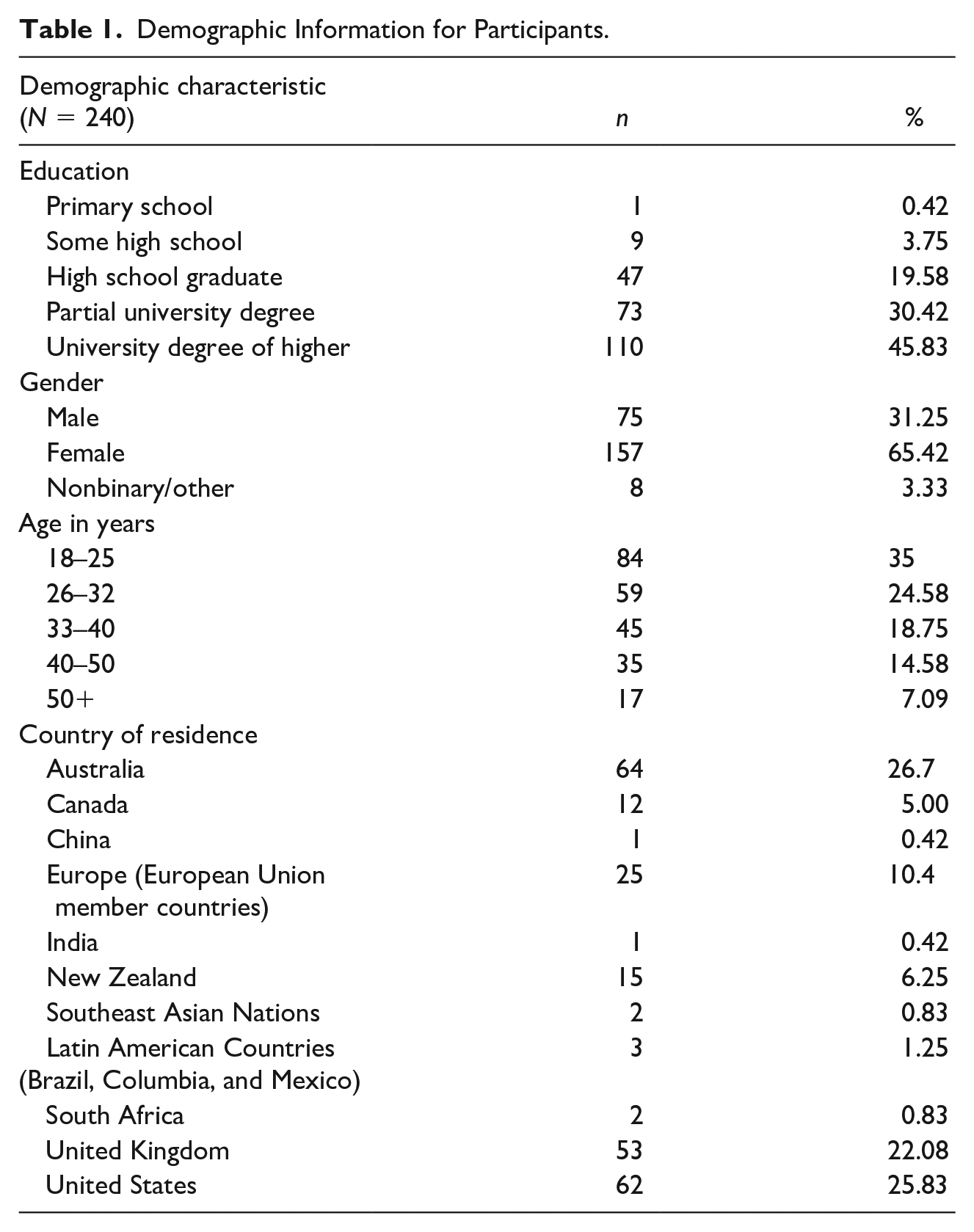
Magic mushrooms were the most frequent psychedelic drug participants had used, with the majority reporting use in the past year (n = 169, 70.4%). This was followed by lysergic acid diethylamide (LSD; n = 152, 63.3%), dimethyltryptamine (DMT; n = 65, 27.1%), other (n = 55, 22.9%), ayahuasca (n = 25, 10.4%), and mescaline (n = 20, 8.3%).
Procedure
Following Human Research Ethics Committee’s approval from Edith Cowan University [2020-01303-PATERNITI], an online survey was developed using Qualtrics (2020) containing the measures outlined below. The survey began with an information letter, which, to reduce potential demand characteristics, referred to behavior in a generalized sense rather than explicitly referencing PEB. This was followed by a consent page, which explained that participation was voluntary, and consent could be withdrawn at any time by exiting the survey prior to completion. Following survey completion, however, their data could no longer be withdrawn. By choosing to commence the survey, participants provided their consent. In addition to the measures outlined below, information was obtained about participants’ age, gender, education, and country of residence. Participants were not asked about their ethnicity.
Measures
Charity Task
At commencement of the survey, participants were required to partake in a raffle for a AUD$100 voucher. Participants were asked, in the event of winning, whether they would like to keep or donate the voucher to one of the following environmental organizations: Green Peace, Friends of the Earth, The World Health Organization, The Rainforest Alliance or Other. If participants selected Other, they were asked to specify the environmental organization of their choosing. Those who selected “yes” to donate were considered to engage in charitable PEB, while those who elected to keep the voucher were not. The task was presented at the commencement of the survey to minimize demand characteristics or potential priming that may have occurred following contemplation of PEB. Participants were provided with a unique code generated by Qualtrics, and the winner was randomly selected from the pool of participants in R Core Team (2020). Participants were asked to visit a dedicated URL after a specified date to see if their code matched that of the winner. It was not possible to inform participants of their odds of winning the raffle, as the total number of participants was unknown to researchers.
Alcohol, Smoking, and Substance Involvement Test-FC (ASSIST-FC)
A tailored version of the ASSIST-FC (McRee et al., 2018) was administered to gain descriptive information regarding participants’ substance use. The test is a two-item version of the original seven-item ASSIST, which was developed by the World Health Organization (Heslop et al., 2013) to detect harmful psychoactive substance use and substance dependence. The phrasing of the item “hallucinogens” was amended to “psychedelics” for theoretical consistency, as well as clarity. The psychedelics listed under this item were those that are commonly typified as “classic psychedelics,” a subclass of psychedelic compounds that act as a full or partial agonist at the 5-HT2AR serotonin receptor sites (Johnson et al., 2019). These consisted of psilocybin, LSD, DMT, mescaline, and ayahuasca, with an option to specify “other.”
Big Five Personality Inventory (BFI)
Participants subsequently completed the BFI, which is a 44-item personality questionnaire that measures the five personality constructs: openness, conscientiousness, extroversion, agreeableness, and neuroticism (John et al., 1991). All 44 items were rated on 5-point Likert-type scales (disagree strongly to agree strongly). The BFI has demonstrated convergent validity with the 240-item revised NEO Personality Inventory (r = .78; Rammstedt & John, 2007), as well as internal consistency, with Cronbach alphas of between .75 and .80 for its subscales and test–retest reliabilities ranging from .80 to .90 (John & Srivastava, 1999). The scale has also demonstrated cross-cultural validity among minority samples (Benet-Martinez & John, 1998).
Mystical Experience Questionnaire-30 (MEQ-30)
The revised 30-item MEQ30 (MacLean et al., 2012) assessed mystical experiences. The scale was developed to quantify single mystical states occasioned by psychedelic use (MacLean et al., 2012) and is thought to hold greater validity than Pahnke’s (1963) original 43-item MEQ (Barrett et al., 2015; MacLean et al., 2012). Psychometric examination of the original MEQ43 retained 30 items that revealed a four-factor structure (mystical, positive mood, transcendence of time and space, and ineffability), all of which have demonstrated high internal consistency with Cronbach alphas between .86 and .97 for each of the four factors (Barrett et al., 2015). The questionnaire asked participants to recall their most significant psychedelic experience and rate the degree to which the item applied to their experience on a 5-point scale (“none” to “extreme”). Classification of a ‘complete’ mystical experience was set at ≥60% of the maximum possible score on each of the four subscales, as recommended and utilized by previous researchers (Barrett et al., 2015; Griffiths et al., 2006; MacLean et al., 2011).
Pro-Environmental Behavior Scale (PEBS)
Developed by Whitmarsh and O’Neill (2010), the PEBS contains 24 items that have been shown to measure seven self-reported PEB components: waste reduction; eco-shopping and eating; regular water and domestic energy conservation; one-off domestic energy conservation actions; eco-driving; political actions; and reducing car use and flight. Participants were asked to indicate the last time they had acted on a variety of environmental behaviors on a 4-point scale (never to in the last year). Cronbach alphas ranged from .53 to .73 for each of the components (Whitmarsh & O’Neill, 2010). Although these Cronbach alphas are lower than recommendations (Anastasi & Urbina, 1997; Lance et al., 2006), the scale was primarily selected for equivalence, as the PEBS was used by Forstmann and Sagioglou (2017). Moreover, the overall PEBS score has demonstrated high internal consistency, with a Cronbach alpha of .92 for the 24 items, indicating that the items consistently relate to the overarching construct of PEB (Cortina, 1993).
Eight of the 24 items appeared biased toward homeowners and were subjected to minor modifications to increase inclusivity. Modifications were primarily made by combining items from Moore and Boldero’s (2017) PEB scale, which identifies one-off, continuous, or dynamic PEB. A copy of both the original and amended scale is included in the Appendix. Internal consistency analysis following these modifications indicated satisfactory internal consistency, with a Cronbach alpha of .81 for the overall scale.
Analysis
Data were imported from Qualtrics and analyzed using the SPSS version 24 (IBM Corp., 2016). All relevant parametric assumptions were tested and met. Descriptive statistics and correlation matrices were subsequently examined. Given the exploratory nature of this study, alpha was set at .05 for all inferential statistical analyses. To evaluate the first hypothesis, a one-way multivariate analysis of variance (MANOVA) was conducted to test for significant differences in PEBS scores between MEQ30 groups (met criteria for a “complete” mystical state; did not meet criteria). Due to the exploratory nature of the study, the inclusion of personality variables in the analysis was determined by the strength of their relationship with relevant variables. Only personality variables that were statistically significantly correlated with PEBS scores were included as dependent variables. Personality variables were excluded if their correlation with PEBS scores was below .2 (reflecting shared variance of <4%), as any statistically significant predictability would have likely been related to sample size and not validity of the variable as a predictor.
A second MANOVA was conducted to investigate differences in MEQ30 groups on relevant dimensions of the PEBS. A final MANOVA was performed to address the second hypothesis and tested for differences in PEBS scores as a function of the Charity Task groups. As the aim of the analysis was to understand group differences based on performance in the Charity Task, PEBS scores, MEQ30 scores, and relevant personality variables were used as the dependent variables, while the Charity Task was the independent variable. An additional independent t-test was performed to assess the validity of the Charity Task.
Results
Correlations
Pearson’s bivariate correlations were calculated to assess the relationships between the variables. As can be seen in Table 2, a small but statistically significant positive correlation was found between PEBS scores and MEQ30 scores, openness, agreeableness, and conscientiousness. There was also a low yet statistically significant positive correlation between MEQ30 scores and openness, agreeableness, eco-shopping and eating, and one-off domestic conservation actions. Further correlations are subsequently reviewed in the discussion section of this article.
Descriptive Statistics and Bivariate Pearson’s Correlation for Study Variables.
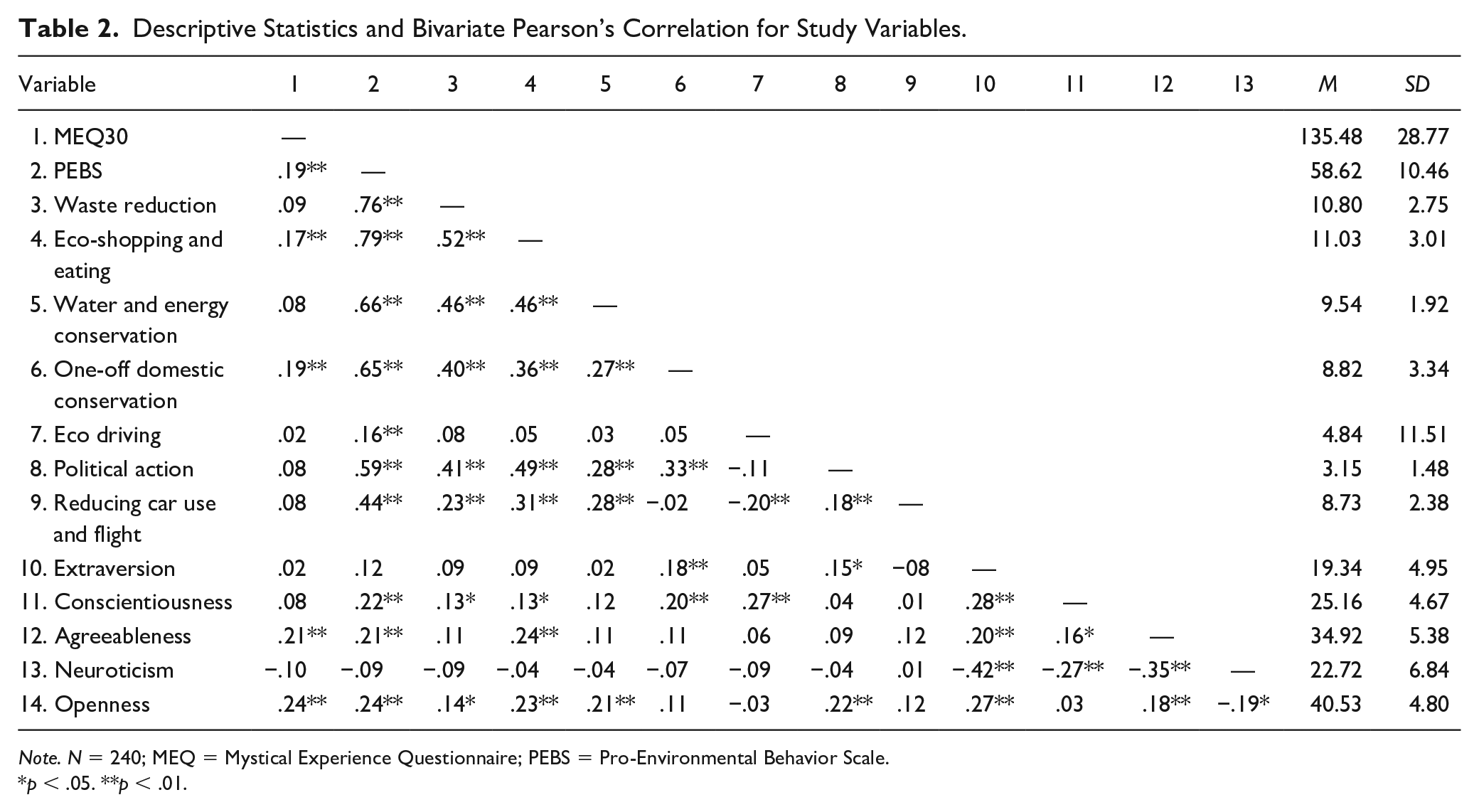
Note. N = 240; MEQ = Mystical Experience Questionnaire; PEBS = Pro-Environmental Behavior Scale.
p < .05. **p < .01.
MANOVA to Assess Differences Between MEQ30 Groups
To test the first hypothesis, a one-way MANOVA was conducted. The dependent variables were the total PEBS scores and the personality variables openness, agreeableness, and conscientiousness, as they were the only personality variables that demonstrated a statistically significant correlation with PEBS scores. The independent variable was MEQ30 scores with two levels (met criteria for a “complete” mystical state; did not meet criteria). A total of 134 participants (55.83%) met the criteria for a “complete” mystical state, while 106 participants (44.17%) did not. A statistically significant difference was observed between MEQ30 groups at the multivariate level, F(4, 235) = 3.25, p = .02; Pillai’s Trace = .05; partial eta squared = .05. At the univariate level, differences in PEBS scores were statistically significant, F(1, 238) = 4.09, p = .04, as were differences in openness, F(1, 238) = 8.59, p < .001 and agreeableness, F(1, 238) = 3.89, p = .05. All yielded small effect sizes, with partial eta squared of .02, .03, and .02, respectively.
As can be seen in Figure 1, participants who met the criteria for a complete mystical state scored higher on the PEBS (M = 59.83, SD = 10.42) than those who did not (M = 57.09, SD = 10.36). Those who achieved a mystical state also scored higher on agreeableness (M = 35.52, SD = 5.02) and on openness (M = 41.33, SD = 4.51) than those who did not (M = 34.15, SD = 5.74; M = 39.53, SD = 4.98). Differences in conscientiousness were not statistically significant.
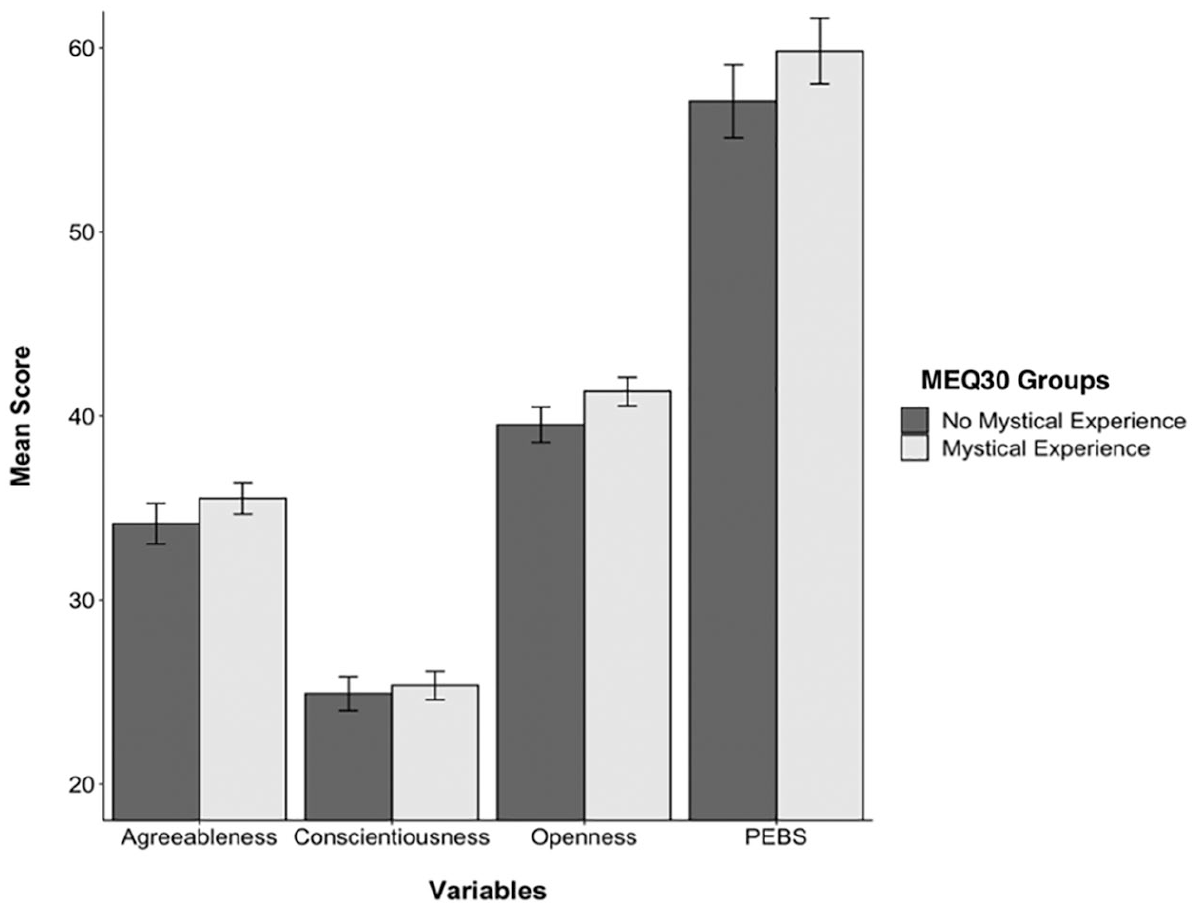
Mean Scores and 95% Confidence Intervals for Agreeableness, Conscientiousness, Openness and PEBS Scores by MEQ30 Groups (N = 240).
MANOVA to Assess Differences Between MEQ30 Groups by PEBS Components
To further explore the relationship between mystical experiences and PEB, a one-way MANOVA was performed to investigate group differences in mystical experiences on the highest correlated dimensions of the PEBS. As such, two dependent variables were used: one-off domestic conservation actions and eco-shopping and eating. No significant correlations were observed between MEQ30 scores and the remaining dimensions of the PEBS, hence they were excluded from the analysis. MEQ30 score was the independent variable with two levels (met criteria for a “complete” mystical state; did not meet criteria).
There was a statistically significant difference between the two MEQ30 groups at the multivariate level, F(1, 237) = 3.89, p = .02; Pillai’s Trace = .03; partial eta squared = .03. Univariate results revealed that differences between groups were statistically significant for both eco-shopping and eating F(1, 238) = 4.56, p = .03; partial eta squared = .02, and one-off domestic conservation actions F(1, 238) = 5.82, p = .02; partial eta squared = .02. Those who met the classification for a complete mystical experience scored higher on eco-shopping and eating (M = 11.40, SD = 2.99) and on one-off domestic conservation actions (M = 9.28, SD = 3.26) than those who did not (M = 10.57, SD = 2.98; M = 8.25, SD = 3.38).
MANOVA to Assess Differences in Charity Task
To test the second hypothesis, a one-way MANOVA was conducted with the Charity Task as the independent variable with two levels (donated; did not donate). Based on their theoretical relationship and observed correlations, the dependent variables were PEBS scores, MEQ30 scores, and the personality variables were openness and agreeableness. A total of 92 participants (38.33%) chose to donate the voucher, while 148 participants (61.67%) chose to keep the voucher. No statistically significant differences were observed at the multivariate level, hence no further interpretation of the MANOVA was warranted.
Independent t Test to Assess Validity of the Charity Task
As the Charity Task is a previously unvalidated measure of PEB, an independent samples t-test was conducted to compare differences in PEBS scores on Charity Task groups. The independent variable was the Charity Task with two levels (donated; did not donate) and the dependent variable was PEBS scores. A significant difference was observed in PEBS scores between those who donated to charity (M = 60.38, SD = 9.91) and those who did not donate, M = 57.53, SD = 10.73; t(238) = 2.07, p = .04, two-tailed. The magnitude of the differences in means (mean difference = 2.85, 95% confidence interval = [0.14, 5.57]) was small (d = 0.27).
Discussion
Our study aimed to extend Forstmann and Sagioglou’s (2017) research, which observed a positive association between the use of classic psychedelics and PEB. We further explored the relationship between psychedelic-occasioned mystical experiences and PEB, assessed all five domains of personality, and included a behavioral measure of PEB.
Mystical Experiences and PEB
As hypothesized, statistically significant differences were observed on self-reported PEB as a function of MEQ30 scores. Participants who met the criteria for a “complete” mystical state, on average, scored higher on self-reported PEB than those who did not meet the criteria, suggesting that the quality of a psychedelic experience has implications for PEB engagement. Those who met the criteria for a complete mystical state also scored higher on openness, which is consistent with previous research (Griffiths et al., 2018; MacLean et al., 2011; Nour et al., 2017), and on agreeableness, a finding less frequently reported in psychedelic literature (Barbosa et al., 2009). Effect sizes, however, were small, implying that the inducement of psychedelic-occasioned mystical experiences, as a vehicle for the promotion of PEB, should be considered along with other variables not captured by the present study. Thus, while individuals may feel more environmentally inclined following a mystical state, dispositional and circumstantial variables could influence or interact with their motivation to alter their PEB. Furthermore, set and setting are well-established variables known to influence psychedelic experiences (Dalgarno & Shewan, 2005; Erritzoe et al., 2018; Kettner et al., 2019). Individuals who reached a mystical state within a natural setting, may be more likely to feel an enhanced connectedness with nature, than those who experienced a mystical state within a non-natural setting. Considering connectedness with nature is one of the strongest predictors of PEB (Cheng & Monroe, 2012; Hinds & Sparks, 2008; Kals et al., 1999; Krettenauer, 2017), differences in context could result in considerable variability in environmental inclinations and effect sizes following a psychedelic-occasioned mystical experience. Future research should aim to control for context and relevant psychological variables.
Further investigation revealed that those who met the criteria for a complete mystical state scored significantly higher on two PEB types: one-off domestic conservation actions, and eco-shopping and eating. One-off domestic conservation actions involve isolated behavior aimed at conserving energy, such as purchasing an energy-efficient appliance. Eco-shopping and eating encompass daily ethical considerations around consumerism, such as purchasing sustainable products and adopting a vegetarian diet. Both facets are primarily day-to-day actions, which function at an individual, rather than a global level. It is possible that through personal transformations, attention is drawn toward accessible and immediate life practices that may enhance environmental sustainability, such as switching to a plant-based diet. Although mystical experiences have shown to increase individuals’ connectedness with the world and nature (Haijen et al., 2018; Kamitsis & Francis, 2013; Nour et al., 2017; Watts et al., 2017), which has global connotations, there are additional factors that may influence whether an individual is able to engage in PEB at a global level, such as sense of control, availability of resources and education (Gifford & Nilsson, 2014). Effect sizes for findings were again considered small and additional research is recommended to explore this relationship further. Notably, the identification of small effect sizes in the current study should not render psychedelic-induced mystical states powerless and/or irrelevant among various strategies for promoting PEB. This is particularly the case when the magnitude of contemporary environmental devastations is considered and the necessity for PEB practices by vast numbers of people.
Personality
Although bivariate correlations were generally low, there were some compelling relationships worth noting. Significant positive correlations between both openness and conscientiousness were observed for a variety of PEB types, supporting the robustness and consistency of associations observed in PEB literature (Brick & Lewis, 2014; Hilbig et al., 2013; Markowitz et al., 2012; Milfont & Sibley, 2012; Poškus & Žukauskienė, 2017). Extraversion, on the other hand, demonstrated a negligible correlation with overall PEBS scores, yet significantly and positively correlated with the PEB types of one-off domestic conservation actions and political action. Characteristics of extraversion, such as assertiveness, confidence, and social seeking (Milfont & Sibley, 2012), may only lend themselves to certain types of PEB, which could account for the inconclusive findings observed in extant PEB literature (Brick & Lewis, 2014; Markowitz et al., 2012). Meanwhile, agreeableness was significantly correlated with PEBS scores overall, yet only significantly and positively correlated with the PEB type eco-shopping and eating. Agreeable individuals are said to be co-operative, sympathetic, and generous (McCrae & Costa, 1999). Thus, those high in agreeableness might be both sympathetic toward animals’ rights and conforming with popular norms, as there has been a considerable rise in plant-based diets and animal-safe products within the last decade (Mintel Global New Products Database, 2019; Roy Morgan, 2016). Conversely, individuals high in agreeableness may be less drawn toward alternate PEB types, such as political action, as they might require elements of confrontation or other qualities that contradict agreeableness. Hence, it is important that future research examining the role of personality on PEB, measure different types of PEB.
The Charity Task
Contrary to predictions, the Charity Task showed no group differences in MEQ30 scores. Thus, among the sample of the present study, high scores on the measure of mystical states did not influence participant’s engagement in a form of actual PEB, constructed in this research as the tendency to donate to an environmental charity. This finding suggests that although mystical experiences influence an individual’s intention or beliefs about their PEB engagement, they may not incite tangible action. However, there are several possible alternative explanations for the absence of group differences. First, since the survey was advertised with the incentive to win an AUD$100 gift voucher, some participants could have been motivated by the monetary incentive or alternate socio-economic factors. As such, regardless of experiences or environmental values, their likelihood of donating may have been reduced. Second, it is possible that the task was not representative enough of PEB, but perhaps one facet of PEB. That is, individuals may be financially motivated to keep the voucher but make considered PEB decisions in other aspects of their life. Third, due to the cross-sectional study design, we cannot determine whether participants’ mystical experience influenced environmental attitudes and PEB relative to their preexisting attitudes and behaviors. Even if participants achieved a below average score on the PEBS, this could have been significantly higher than their rating might have been prior to their psychedelic experience. Finally, those who did not meet the criteria for a mystical state may have been pro-environmentally inclined regardless of their psychedelic experience, a plausible explanation given the significant differences observed in PEBS scores as a function of the charity donation groups.
As predicted, people who opted to donate the AUD$100 to charity reported higher PEBS scores compared with those who did not. Although this suggests the Charity Task might be a valid measure of PEB, the effect size was small. Demand characteristics could potentially account for the small effect size, whereby participants reported greater PEB engagement on the PEBS for social desirability, yet still chose to keep the voucher; a possibility considering pro-environmental attitudes and self-reporting do not always reflect behavior (Gatersleben et al., 2002). Future researchers who implement a similar behavioral task, may find it beneficial to offer participants the opportunity to donate a percentage of their reward, which would allow for categorical analysis and the identification of participant openness to charitable environmental behavior. For example, participants who choose to keep the reward due to financial necessity may be more willing to donate a proportion of the reward to an environmental charity if given the option. Additional refinements and validation of this PEB task is recommended before conclusions can be drawn.
Strengths and Limitations
Considering the sensitivity and potential legal implications of psychedelic use, online surveys are an accepted and widely used method of data collection (Carbonaro et al., 2016; Griffiths et al., 2019; Haijen et al., 2018; Kettner et al., 2019; MacLean et al., 2012). Online surveys possess an array of advantages including convenience for participants, absence of interviewer bias, flexibility, and anonymity for participants (Van Selm & Jankowski, 2006). We also acknowledge their limitations, which may include self-selection bias, distorted responses and technical issues (for review see Wang & Doong, 2010). The present study also relied primarily on self-report measures, which can be subject to bias and inaccuracy (Hoorens et al., 2003). A Charity Task was incorporated to mitigate these limitations for PEB measures, yet an online sample restricted the assessment of all other constructs to self-report measures.
Due to the nature of advertising on global social media platforms, participants from a variety of countries responded to the survey. However, data on ethnicity were not collected, so it is unclear how these findings relate to specific ethnic identities. It could be argued that this limits generalizability, as PEB has been shown to differ across countries due to various factors, including culture (Vicente-Molina et al., 2013), education (Ajaps & McLellan, 2015), and differences in urbanization (Gifford & Nilsson, 2014). Yet, over 90% of respondents were from Western countries, including Australia, Europe, and the United States, yielding a relatively homogeneous final sample. What should be considered, however, is the societal context and historical timing of the current study. The questionnaire was distributed amid the height of the COVID-19 pandemic, when much of the world’s population was under various conditions of lockdown, rendering some PEBS items irrelevant (e.g., questions pertaining to public transport use and flights) for some individuals depending on their geographic location. This may have influenced the ability of individuals to engage in or accurately recall PEB, affecting the accuracy of their self-reporting.
Suggestions for Future Research
Many of the limitations and concerns outlined for the present study could be minimized using an experimental within-subjects longitudinal research design. Controlling for various factors including psychedelic dosage, context and baseline measures of personality and PEB could uncover causal relationships, while exploration of additional socio-demographic factors such as ethnicity and disability, would add to the body of knowledge and allow for cross-cultural comparisons. Through a longitudinal design, researchers could also assess and monitor changes in behavior over time, allowing for more rigorous comparisons. Ratings of PEB before and after psychedelic experiences from third-party individuals, such as family and friends, could further add to the validity of observed differences.
Rather than relying on self-report measures alone, which is a common limitation of PEB research, future PEB studies would be more rigorous if laboratory tasks are developed that better reflect a variety of PEB. In relation to understanding the role of mystical states on PEB, such PEB tasks could be administered before and after psychedelic experiences to minimize the cost and invasiveness of behavioral observation.
Finally, it would be valuable for future researchers to utilize rigorous qualitative research, to gain a deeper understanding of the perceptions individuals hold about their psychedelic-occasioned mystical experience and subsequent changes in PEB. Through interviews or focus groups, researchers could identify patterns and persistent themes, which provide a more nuanced insight into subjective opinions and lived experiences regarding personal changes in behaviors. For example, such research could examine whether people directly attribute changes in PEB to their psychedelic-occasioned mystical experience, and if so, what elements of the mystical experience they believe instigated their change in behavior or fostered their improved relationship with the environment. Answers to these questions could direct future research and provide greater insight into the relationship between profound experiences and PEB.
Conclusion
The current study extends Forstmann and Sagioglou’s (2017) research, which found that psychedelic use was associated with increased PEB, since it is the first to observe how psychedelic-occasioned mystical experiences might influence PEB and PEB types. Our findings indicate that the quality of a person’s psychedelic experience is important for whether they engage in PEB; however, given the small effect sizes, changes in PEB subsequent to psychedelic-occasioned mystical experiences are unlikely to be substantial. This study further validates the relationship between mystical states and the personality trait of openness, while observing some interesting preliminary relationships between personality and PEB. Understanding the motivators for PEB is of pressing concern considering global warming and environmental degradation. As greater urbanization and digitalization alienates individuals from nature, strengthening the connection between humans with nature should be a priority if PEBs are to be enhanced. Future research employing experimental designs is recommended to further investigate the observed group differences in greater detail, as well as qualitative research, to illuminate participant experiences and perceptions toward their changes in behavior. This could improve our understanding of the relationship between profound experiences and PEB, which could assist in addressing the current global emergency.
Footnotes
Appendix
Declaration of Conflicting Interests
The author(s) declared no potential conflicts of interest with respect to the research, authorship, and/or publication of this article.
Funding
The author(s) received no financial support for the research, authorship, and/or publication of this article.
Notes
Author Biographies
 . Stephen is a leading Australian voice on the role of drug policy on emerging drug trends such as synthetic cannabis and darkweb marketplaces.