




Abstract
This study aimed to examine employment of relational leadership in Finnish teacher education to enhance leadership competency. Data were collected via semi-structured focus group interviews with student teachers (n = 15) and facilitators (n = 3). The study employed a theory-driven approach to qualitative content analysis, applying Komives et al.’s (2013) relational leadership model. The results revealed that implementation of relational leadership led to student teachers recognizing and adopting relational leadership approaches, suggesting that integrating relational leadership into preservice education could be a valuable strategy for supporting student teachers’ leadership development.
According to several scholars, the most effective way to conduct multifaceted and sustainable development work within school organizations is through leadership that employs collaboration and an inclusive approach among members of a school’s professional learning community (e.g., Jäppinen et al., 2016; Roberson & Perry, 2022; Yada & Jäppinen, 2022). For example, building a shared school vision for the future that sets the direction for school development requires the kind of leadership action that encourages dealing with and negotiating various views and goals represented by individuals within a professional community (Senge et al., 2012; Toikka & Tarnanen, 2024). Teachers play a central role in these shared leadership processes (Jäppinen & Taajamo, 2022; Senge et al., 2012).
To engage in leadership processes of this type successfully, teachers need to possess the corresponding leadership competencies from the beginning of their career, although student and early career teachers rarely are identified as potential leaders (Ado, 2016; Rutten et al., 2022). Consequently, teacher education has not provided sufficient leadership development support (Ado, 2016; Rutten et al., 2022), resulting in the topical need to strengthen and renew the given support. Teacher education-integrated leadership development support also has been identified as a topical development need within Finnish teacher education (Finnish Ministry of Education and Culture, 2022)—the present study’s specific context.
In this study, we examined a novel design with the aim of enhancing student teachers’ leadership competency. The design was conducted as part of a Finnish teacher education program and is referred to henceforth in this paper as the teacher leadership study group (TL). Although facilitated by teacher educators, TL is based on the idea that the learning community comprising student teachers is a central resource for leadership development. More specifically, student teachers’ leadership competency is supported in TL, particularly through the group’s daily operational culture and leadership actions. In this study, TL’s operational culture was identified as being based on relational leadership according to Komives et al.’s (2013) relational leadership model (RLM).
In the present study, we wanted to examine employment of relational leadership as a means of enhancing student teachers’ leadership competencies. Thus, the study’s first aim was to examine how teacher educators (i.e., facilitators) and student teachers (i.e., students) employed relational leadership in TL. In the literature, integrating leadership development support into initial teacher education has been viewed as challenging (Ado, 2016; Rutten et al., 2022; Xu & Patmor, 2012). Furthermore, application of a group’s operational culture as leadership development support is a complex process (see Chuang, 2021; Lave & Wenger, 1991) in which challenges potentially appear and should be identified to develop this type of support further. Thus, the second aim was to examine the challenges related to employment of relational leadership as teacher education-integrated leadership development support. Third, we wanted to gain insights into how employing relational leadership supported the students’ leadership competency development, that is, what kinds of leadership competencies they achieved in TL. The examination was based on the students and facilitators’ perceptions. The concept of perception refers to their subjective conceptions of and views on employment of relational leadership. The research questions (RQs) were as follows: (1) How is relational leadership employed in TL? (2) What kinds of challenges are related to employing relational leadership in TL? (3) What kinds of leadership competencies are enhanced in TL?
Literature Review
The RLM as the Lens of Relational Leadership and the Related Competency
In the present study, the RLM (Komives et al., 2013) is used to describe the components of leadership action and, simultaneously, related competencies. Thus, each of the RLM’s components is a specific aspect of leadership action that concurrently includes and requires related competencies to be employed successfully. The RLM stems from the basis of perceiving leadership as a process that unfolds through interactions and relationships among individuals within a group working together to achieve positive change (Komives et al., 2013). This perspective can be identified as the specific value of relational leadership compared with even some distributed or collaborative leadership approaches (Jäppinen & Taajamo, 2022; Kezar et al., 2006; Ramamoorthi, 2025; Uhl-Bien, 2006) because it helps identify leadership as a dynamic, situational, and holistically collective phenomenon. This perspective might help involve the diverse actors within educational and other organizations genuinely promote and engage in achieving common goals (e.g., Toikka & Tarnanen, 2024). The RLM assesses leadership based on five key components: 1) purpose; 2) inclusivity; 3) empowerment; 4) ethicality; and 5) process.
The first component of the RLM, purpose, emphasizes that relational leadership primarily emerges from a shared goal (e.g., leadership competency development in TL), rather than formal leadership positions (Komives et al., 2013). The fifth component, process (referred to in this paper as process-centeredness and discussed more specifically at the end of this section), can be perceived as a way of implementing purpose (see Komives et al., 2013), so some overlap is evident. Process-centeredness connects more clearly to the competency aspect, so we decided to exclude the purpose component from the present study. However, purpose notably is a central starting point for relational leadership action.
Inclusive leadership involves valuing diversity, recognizing individual differences, and embracing varying views. Participants in this context perceive diversity positively because it increases inclusion of different perspectives within a group and its activities. Furthermore, inclusive leadership entails building and promoting a culture that effectively involves different people (Komives et al., 2013). Notably, inclusivity, in this study’s context, does not refer to inclusive education, but to leadership that fosters diversity of views and group members.
Empowerment involves 1) environmental conditions that promote participants’ ownership and involvement and 2) participants’ recognition of and confidence in their right to be involved by expressing their thoughts. An empowering environment creates an ideal climate for learning. The group works toward success while acknowledging failures as learning opportunities and mistakes as nothing to be feared. The concept of power is central to empowerment: Through empowering leadership, positional leaders share their power with participants whenever possible. Participants then accept responsibility for the group’s outcomes. In an empowering environment, participants feel comfortable “interrupting” the decision-making process with their ideas and opinions (Komives et al., 2013).
Ethicality entails leaders translating their values––freely chosen personal beliefs or guiding principles––into action (Komives et al., 2013; see also George, 2007; Kouzes & Posner, 1993; Lewis, 1990). Central to ethical leadership is leading by example, in which leaders model and practice what they preach (Komives et al., 2013; Kouzes & Posner, 2008). In relational leadership, it is important that leaders and participants share values (Komives et al., 2013).
Process-centered leadership focuses on the group and its processes. This includes monitoring how the group functions and accomplishes its objectives, such as allowing and encouraging group members to continuously observe and question the process and the group’s way of operating. With process-centeredness, the focus is on 1) maintaining interaction and collaboration, 2) developing a shared understanding of the process through shared meaning-making, and 3) applying reflection to derive meaning (Komives et al., 2013).
Employment of Relational Leadership as a Means of Enhancing Leadership Competency
In TL, the group’s relational leadership-based operational culture, including daily leadership actions, is a central support to enhance student teachers’ leadership competency. It is specific for this type of leadership development support that the participants (e.g., TL students) are involved in authentic relational leadership actions (see Juutilainen et al., 2018; Niemi, 2002) and that this specific way of leading is demonstrated (modeled) to them by positional leaders (e.g., TL facilitators; e.g., Korthagen et al., 2005; Lunenberg et al., 2007). This kind of leadership development approach has connections with social learning (Bandura, 1977) and social cognitive theory (Bandura, 1986), as well as approaches such as those connected to the community of practice (Lave & Wenger, 1991), organizational learning (Argote et al., 2021), and workplace learning (Tynjälä, 2008). These approaches recognize involvement in authentic actions, practices, and a community’s culture as an effective way to influence learning and competency development through phenomena such as socialization and the gain of profound personal experience. Thus, leadership competency is gained in TL by applying relational leadership.
In this study, we define competency as encompassing diverse aspects, including practical skills, understandings, beliefs, and attitudes crucial for successful execution of action in a given area, such as relational leadership (Metsäpelto et al., 2021; Van Aalderen-Smeets & Walma van der Molen, 2015). Competency development refers to the process of gaining competencies (Desimone, 2009). We suggest that in TL, students develop their leadership competencies by 1) gaining insights into relational leadership and 2) improving their practical skills needed to employ relational leadership successfully. Gaining insights relates to relational leadership competency development so that it can be perceived as the preliminary development of future teachers’ (positive) attitudes toward (Bush & Grotjohann, 2020; Van Aalderen-Smeets & Walma van der Molen, 2015) and mental models of relational leadership, potentially increasing their motivation and activity participating in and promoting relational leadership action in their future working contexts (Senge, 2006; Toikka & Tarnanen, 2024).
Method
Context, Participants, and Procedure
The participants in this study comprised first-year (freshman year) student teachers (n = 15) and their facilitators (n = 3) in a Finnish teacher education program. All the participants were native Finns in terms of national and cultural backgrounds. The student participants’ ages ranged from 19 to 29 years. In the Finnish teacher education system, students first complete a three-year bachelor’s degree (180 ECTS), then a two-year master’s degree (120 ECTS) to qualify as primary school teachers (Silander & Välijärvi, 2013). In this particular teacher education program, first-year students engage in core studies in educational sciences (25 ECTS) in study groups. These study groups approach core studies’ learning content through specific lenses, such as special education or multilingual pedagogy, to strengthen students’ consciousness and expertise in various topical educational phenomena. At the beginning of their teacher education studies, students participate in an introductory event to acquaint themselves with all study group options and subsequently select the options they find most interesting. This study primarily examined the TL study group that focuses on teacher leadership development.
Integrated into other teacher education studies, joint meetings in the TL study group were held approximately once every two weeks. The TL students also completed TL-related individual and small group assignments beyond these meetings. Teacher educators facilitated the study groups, and the three TL facilitators brought a diverse range of expertise in educational leadership. In TL, leadership development support is based primarily on the group’s daily operational culture. We identified this culture as being based on relational leadership, according to RLM (Komives et al., 2013), the process of which will be discussed more precisely in the data analysis section. Furthermore, TL includes specific tasks and exercises to support leadership development, such as lectures and shared discussions on the leadership theme, as well as an exercise in which students interview an educational leader. Leadership-related learning objectives in TL emphasized coming to understand leadership as an interactive and value-based action characterized by caring for others, embracing group members’ diverse strengths, and maintaining an adventurous and open attitude. The facilitators did not apply an RLM-based curriculum originally, but the RLM aspects were identified and conceptualized later during the research process.
The philosophy in TL is that every TL member has unique expertise and valuable experiences in learning, pedagogy, and leadership, and that the group can learn through its members sharing and reflecting with one another on their individual and diverse expertise and insights. The present study examined the operational culture and authentic actions in TL; thus, the specific content of the TL participants’ views and experiences lied beyond this study’s scope. The TL students experienced their first teaching practice during their first year of study, but it was not connected closely with TL and, therefore, was excluded from the present study.
The present study was included in the broader DAWN research and development project (2018–2022), which aimed to examine and enhance leadership within Finnish educational organizations. The university’s data protection officer approved the DAWN project in April 2019. The student participants, who were reached with the assistance of the TL facilitators, signed consent forms for the DAWN project in October 2019, and the facilitator participants did so in June 2020. Before the present study’s data collection, all the participants provided oral consent for participation in this specific sub-study. We informed the participants that their participation was voluntary and that they had the right to withdraw from participation at any point during the research.
The authors’ positions in relation to TL varied. One author had connections with the design phase, and another had connections with the implementation phase. The authors’ personal connections with TL inspired them to examine it further, but throughout the research process, all the authors tried to avoid bias by critically reflecting on their possible personal wishes and expectations for, as well as interpretations of, the findings (see, e.g., Tracy, 2010). The first author––who primarily was responsible for conducting the interviews, choosing the theoretical framework, conducting the analysis, and interpreting the findings––had no previous connections with or role in relation to TL and did not know the TL students beforehand.
Data Collection
The data were collected using semi-structured focus group interviews (Patton, 2015). The students participated in these interviews in four groups at the end of the first year of their teacher education studies in May 2020. The facilitators also participated in a focus group interview in June 2020. Each interview group comprised three to four participants, and the interview schedule for both the students and facilitators’ interviews comprised 14 open-ended questions, although the questions varied based on the target group. The main themes underpinning both interview schedules and covering the more specific interview questions comprised: 1) the participants’ general descriptions of the TL study group; 2) their expectations for the study group work and perceptions of the realization of these expectations; 3) practical ways of working in the study group; 4) learning and development in the study group (from the perspective of the learning objectives and the achieved student development in the facilitators’ interviews, and of the achieved development in the students’ interviews); and 5) visions and wishes for developing the study group in the future. During the data collection phase, the specific research questions were not finalized, but rather were generated during the research process, which is typical in qualitative research (Agee, 2009).
The interviewer did not determine the order in which the participants answered the questions, but any participant could answer them first. The others continued building on the answers, such as by expressing agreement or disagreement and adding content, perspectives, and personal opinions so that the situation largely imitated a conversation. As is typical with semi-structured interviews, the interviewer did not necessarily ask the interview questions in the same order in all focus groups, but she followed the conversational flow in each group (Patton, 2015).
Focus group interviews were used as the data collection method because they can provide richer, higher-quality data than individual interviews through the synergetic nature of shared conversations between participants (Patton, 2015). This became evident during the focus group interviews, in which the participants brought new content to the discussion after being inspired by and commenting on previous speakers’ statements, such as, “… great that S1 could verbalize that; I didn’t come to think about that previously…” (S3, Group 1). Notably, the group interview method may introduce a bias in which participants provide answers they believe are socially acceptable to others (Patton, 2015; Stewart et al., 2007). However, we avoided this bias by using small student groups that previously were divided by the TL facilitators and were known for their open and safe atmosphere, and by the interviewer’s encouragement of the focus group participants to share their personal views openly.
The interviews ranged from 38 minutes to 1 hour and 24 minutes. The interviews were fully recorded and transcribed verbatim. A native English speaker meticulously reviewed the translations of the excerpts from the data used in the reporting.
Data Analysis
The data were analyzed using theory-driven qualitative content analysis (Elo & Kyngäs, 2008; Patton, 2015) in RQ1. From this basis, the analysis took a data-driven approach (e.g., Elo & Kyngäs, 2008) in RQ2 and RQ3. This approach also was utilized during the initial phase of the analysis. First, the first author transcribed the interviews and conducted several close readings of the transcripts. Concurrently, she initially identified and marked content that was relevant to the research scope (e.g., Elo & Kyngäs, 2008). It was observed that the TL students reported relatively often about matters related to the leadership and operational culture and actions in TL as matters significant or beneficial to them. This was an important step in the process of generating the following initial research question: “What kind of leadership is employed in TL?” Thus, relevant content during this phase primarily comprised the participants’ descriptions of the actions that the students and facilitators employed in TL regarding aspects such as interaction within and beyond pedagogy, as well as ways of operating and making decisions within the group.
Second, based on the initial examination of the data, it was noted that leadership in TL was largely shared and collaborative, varied situationally, and was characterized by respectful and authentic interactions among group members. Based on these initial findings, the conceptualizations and theoretical frameworks presented in the theoretical literature were examined (e.g., Patton, 2015). Consequently, Komives et al.’s (2013) RLM was selected as the framework for theory-driven analysis. This allowed for framing the research as an examination of the employment of relational leadership (according to the RLM) by students and facilitators in TL (with RQ1: “How is relational leadership employed in TL?”).
Analysis of the empowerment component.
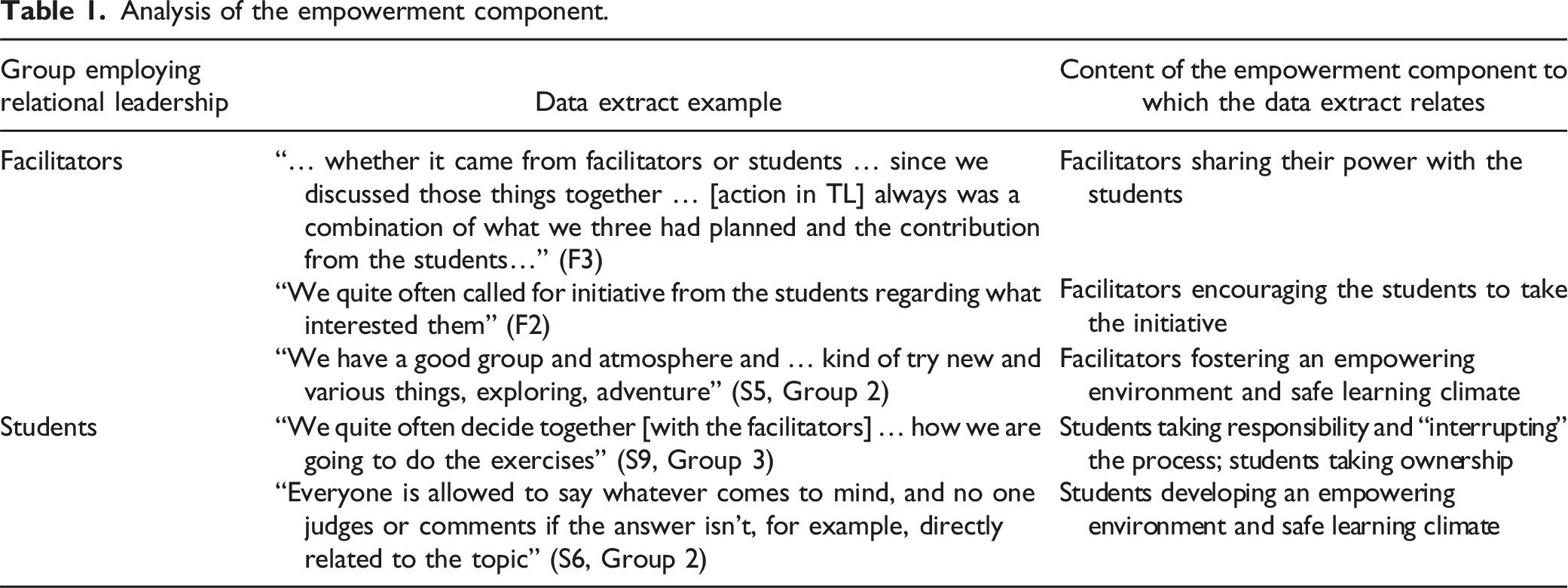
Fourth, based on the theory-driven identification of the employment of TL’s four RLM components, the examination was continued with data-driven analysis to examine the challenges related to employing relational leadership (RQ2) and the leadership competencies enhanced in TL (RQ3).
Notably, the four RLM components, although independent of each other, were strongly interconnected and partly overlapped; therefore, it was possible to position some of the findings under more than one of the four component headings. We decided to position the findings in the component heading to which they were primarily related. If a primary component could not be identified, we positioned the findings in all component headings to which they were equally related. For example, TL participants’ actions expressing commitment to the shared process for achieving the group’s goal were identified as strongly connected to the empowerment and process-centeredness components.
Direct quotations from the participants’ statements are included in this paper to strengthen our findings’ credibility and make our interpretations more transparent to readers (Patton, 2015; Tracy, 2010). The participants were provided with randomly assigned identification (ID) numbers to protect their privacy: Facilitators were given ID numbers F1–F3, and students were assigned ID numbers S1–S15.
Findings
The present study aimed to examine how relational leadership was employed in TL (RQ1), what kinds of challenges were related to it (RQ2), and what kinds of leadership competencies the students gained (RQ3). The RQ1 and RQ2 findings are discussed together under each RLM component because they are strongly related. The empowerment component was identified as particularly central in TL, which is why it is discussed first below.
Empowerment: Calling for Initiative From the Students
The facilitators reported that they aimed to act in a way that encouraged initiative from the students and enabled sharing their power with the students: We [facilitators] set few formal structures of learning and achieving. There were lots of dialogue, caring, and sharing but … whether it came from facilitators or students … since we discussed those things together. And they [the students] had several ideas, and I don’t think that we forced the students, but we always maintained a dialogical approach. And, probably, that [action in TL] always was a combination of what we three had planned and the contribution from the students … students’ voice included (F3).
According to another facilitator, F2, “We quite often called for initiative from the students regarding what interested them.” The students responded to the facilitators’ act of sharing power with them by assuming responsibility for group outcomes, which can be viewed as the reciprocal enactment of empowerment. In practice, the students expressed their commitment and sense of responsibility, as well as the courage to “interrupt” the process, by suggesting ideas and initiatives to the facilitators: We quite often decide together [with the facilitators] … how we are going to do the exercises. So, we are listened to very well if we, for example, want to switch the method from lecturing to discussion. So, it is part of the operational culture that opinions are quite well-listened in both directions (S9, Group 3).
The students also participated actively in shared discussions, built on them, and contributed to small group work to achieve the group projects’ goals. Furthermore, they developed empowering environmental conditions and a safe learning climate by expressing appreciation for one another’s ideas and views: “Everyone is allowed to say whatever comes to mind, and no one judges or comments if the answer isn’t, for example, directly related to the topic” (S6, Group 2).
In TL’s learning climate, success was expected, but mistakes were not feared. The facilitators fostered this positive climate by encouraging the students to try new and various ways of doing things, such as by providing examples. According to the facilitators, trying new ways of doing things was among the leadership development goals in TL and was employed consciously in the study group. As the facilitators reported: “… about the ways of acting and goals [in TL], things like interaction … caring and trying new things are about educational leadership. We applied those holistically” (F3). “We, indeed, pursued encouraging the students to try new things and act in various ways and showed … them example. Sometimes we did better and sometimes worse, but we bravely tried various ways of acting, being, and teaching” (F1).
The students described the climate and way of acting in TL as follows: “We have a good group and atmosphere and … kind of try new and various things, exploring, adventure” (S5, Group 2). Although the students mainly said that applying the “adventurous approach” in TL was a positive thing, they also mentioned a related challenge: They wished that there had been more clarity in TL: “… that we would think, in advance, carefully what we’re going to do and not apply the adventurous approach so broadly” (S8, Group 2).
The facilitators reported, as an empowerment-related challenge, that there were certain limitations and barriers to sharing their decision-making power with the students, which mainly were rooted in the strict teacher education curriculum, requiring a broad array of learning content: We actually had all kinds of plans and ideas about what we could have started to build, but then, after noting the reality of how much [time] the core studies take, with related mandatory assignments (which luckily included some flexibility), we modified them to [align them better with] the profile of the TL group. After all, they guided the action quite a lot, and we didn’t want to cram in too much content (F2).
An example of a student initiative that was implemented to a relatively limited extent in TL was their wish for a stronger emphasis on practicing leading others: “So, [it would have been better to] have an approach that provided opportunities to really lead people, not only observe and develop one’s own actions” (S12, Group 4). When the facilitators did not accept student initiatives that mostly regarded increasing the amount of leadership exercises, they argued for the reasons behind. For example, according to the students, the facilitators were cautious about emphasizing the leadership theme too strongly to avoid burdening the students with it during their first year of study.
As the third challenge related to empowerment, the students mentioned that building a safe and positive atmosphere possibly was emphasized too heavily in TL. According to the students, a relatively large amount of time was spent discussing how everyone is doing, and the facilitators gave the students heavily positive feedback: “We receive support and encouragement, perhaps.… We occasionally receive even overly positive feedback” (S13, Group 4). The students said that they would have preferred a relatively greater amount of content-related learning and critical feedback.
Inclusivity: Valuing Diversity in Views and Personalities
Inclusivity was evident in the valuing of group members’ individuality, diverse personalities, and expertise gained through unique experiences. The facilitators aimed to ensure inclusivity by respecting every student’s uniqueness and individual starting points, and by applying the kinds of pedagogical methods that utilized the learning community’s diversity as a learning resource. For example, during the launch phase of TL, the facilitators emphasized that the idea was to build the process together with the students, who are unique as people and learners. According to F1: When we stated … that we don’t actually know what we will do [laughs] … we wanted to show the students that this is not about pouring knowledge or views into people’s heads, but about building this from everyone’s individual starting points.… In my opinion, we rather multifacetedly applied … discussion and interaction, and doing things collaboratively.…
The facilitators also intentionally enabled space for the students’ diverse views and experiences as a resource for learning by building dialogue between these and other forms of knowledge, instead of just “pouring theory”: “We tried to bring in theory and … the reality of the operational environment. The students came with their own experiences, and we built a dialogue between these three [perspectives]” (F3). In practice, this became particularly visible during shared discussions in which the facilitators encouraged students to reflect on their own and others’ views and experiences in light of the theoretical content, and to learn from them. As S9 (Group 3) stated, “There’s a lot of free-flowing conversation, and one feels safe to express [their] personal opinions.”
The students demonstrated inclusivity by valuing each other’s uniqueness. The students said that it was a resource and a potential-increasing matter for the study group to comprise diverse people: “… rather strong personalities, differing significantly, but complementing one another well” (S11, Group 3). “Each of us is an individual, so we bring to the group something special, making it … a multifaceted group” (S13, Group 4). The students practiced inclusivity with each other and built an inclusive culture in the group by listening to each other’s views and experiences with respect and a genuine desire to learn from them: Perhaps when one hears another’s opinions and solutions to some issues, then it results in one suddenly starting to think, “Why didn’t I think like this?” or then there is a very different opinion from another side compared to my opinion. But then, somehow, when they are being argued for, it is possible to better understand how others think (S1, Group 1).
Notably, inclusivity seemed to take place in the study group rather effortlessly, and the students mentioned no challenges in relation to it. It is worth noting, however, that the facilitators’ starting point for supporting learning and leadership development in TL was actively enabling peer interaction in which sharing and reflecting on various teaching and leadership-related views and experiences among the students were emphasized.
Ethicality: Leading by Example and Building Shared Values
Facilitators employed ethicality by demonstrating congruence between their values and actions. Relatedly, they demonstrated exemplary leadership. They actively encouraged the students to act in ways that the facilitators modeled for them, which can be interpreted as their way of increasing the extent to which values were shared in the TL group between the positional leaders and participants. For example, the facilitators seemed eager to promote as TL’s values and ways of acting open-mindedness toward trying new ways of doing things, as well as openness, trust, and respect among the group members. As described in the findings on empowerment, the facilitators demonstrated trying new ways of doing things by acting in certain ways themselves. The students commented on the facilitators’ exemplary leadership during the circle discussions, which were conducted at the beginning of the group meetings, with the aim of offering study group members a safe space for sharing that day’s thoughts and feelings with others. The facilitators participated in these circle discussions with the students and, according to S12 (Group 4), did so in an authentic way: “At the beginning of the demo sessions, there is usually a circle discussion… It is possible to quite freely tell about matters, and the facilitators also talk about their own feelings … for example, if they’ve had harder times.…”
The students also displayed congruence between their values and actions, that is, they employed ethicality in their leadership. The students said that it was important for them to respect each other and each other’s unique views and personalities. Another related value of the students was that they genuinely wanted to work collaboratively. They translated these values into action, exemplified in how they conducted themselves during discussions, as described in the sections on inclusivity and empowerment in the study group.
Furthermore, according to both the facilitators and students, the students also adopted the example of the facilitators and modified their actions accordingly: “Then I would perhaps add that because our facilitators are very calm and optimistic … people who give positive feedback, perhaps I have also started to thank people more and, in a way, to give positive feedback” (S5, Group 2). The students did not mention challenges regarding ethicality.
Process-centeredness: Collaboration and Confusion
The facilitators employed process-centeredness by intentionally leaving space to allow the process to emerge and become genuinely established in collaboration with all the group members: “We didn’t necessarily finalize our decisions about doing things in a certain way, but pondered the various angles regarding how this kind of group could be piloted” (F1). “We continually asked the students” (F3). The facilitators employed process-centeredness by monitoring and caring about how the group and process proceeded and functioned. They monitored the group dynamics and students’ thoughts and feelings by, for example, regularly conducting circle discussions. Furthermore, the facilitators regularly questioned the students to gain updated information on how they perceived the process for achieving the group’s goals and purposes: “We inquire through discussion or written student feedback to regularly check that we have shared goals, and this has been about genuinely taking the participants and their thoughts into account” (F1).
The students employed process-centeredness by being considerate of how things were going in terms of the group’s individual members, cohesion, and goal achievement. In practice, as was discussed previously, the students did this by expressing respect toward each other during the shared discussions and group work, practicing shared decision-making, and expressing their views and initiatives (e.g., the suggestion about increasing the amount of leadership exercises) to the facilitators to boost effectiveness in achieving the group’s goals. F2 described the students’ actions and attitudes as follows: I think it has been wonderful, in our discussion exercises, how they appreciate and respect each other.… I see that this group had already, during the first year of their studies, reached an amazing level in supporting each other during a conversation.
The students mentioned two challenges related to process-centeredness and, concurrently, empowerment because the following aspects have connections to both components through shared goal-setting and power. First, the students said they sometimes experienced confusion about specific learning and development goals in TL, and about the connection between the TL actions employed and achievement of these goals: “From time to time, I found it a bit vague and confusing … what we’re supposed to do and why” (S11, Group 3). They wished that the facilitators had indicated the direction for the group more clearly: “… kind of a clarity, I mean, that someone is in control, and that is visible for the whole group” (S11, Group 3). “… that the power of making decisions wouldn’t be shared with us too heavily, after all” (S4, Group 1). Notably, however, employment of process-centeredness and empowerment as such was not necessarily the primary source of vagueness. Instead, lack of clarity and some sudden changes in the TL group’s plans along the way were related partly to the process of integrating TL into the broader teacher education program with a busy curriculum: “This clearly is a new study group… There’s lots of potential, but … the contents should definitely be clarified for the next years” (S9, Group 3).
Second, as a challenge related to the aspect of monitoring in process-centeredness, the students said discussing how everyone is doing was applied too heavily and took time away from dealing with the leadership theme: “… to improve one’s leadership competency.… That is the priority, and there could be less circle discussions and that kind of stuff. That we could focus on the point” (S11, Group 3).
Leadership Competencies Enhanced in TL
As for RQ3, we aimed to examine the kinds of leadership competencies enhanced in TL. We approached these competencies as 1) the students’ insights into relational leadership and 2) their practical skills in employing relational leadership. In relation to empowerment, the students reported, as an insight, that the safe atmosphere promoting openness had enabled sharing diverse views (cf. enablement of inclusivity), as well as the effectiveness of the group’s way of operating: “We have a rather open atmosphere … so that everyone feels safe about expressing personal opinions” (S1, Group 1). “Yeah, the openness … enables how well we function” (S3, Group 1).
Regarding inclusivity, the students mentioned that working and discussing as a group are particularly effective because of the diverse personalities and views within the group, resulting in widened perspectives and increased potential for the group: “Through the [shared] discussions, I’ve gained many new perspectives and found new ways of thinking” (S2, Group 1). “There is a great potential in this group, in everyone as an individual and as a group” (S5, Group 2).
Regarding ethicality, the students said acting according to certain values, such as respecting one another, in TL had enabled a safe and open atmosphere (cf. enablement of empowerment), resulting in the group functioning effectively: “That has even been surprising, how natural and good our conversations have usually been … especially, we give one another space; we prioritize taking everyone into account in those situations” (S3, Group 1). Furthermore, the students mentioned that the facilitators played a central role in creating a safe and warm atmosphere by acting in specific ways, such as demonstrating caring toward the students: “Our facilitators’ genuine interest in how we are doing has been a very positive matter.… They have succeeded in creating a safe atmosphere in our study group” (S9, Group 3).
In process-centeredness, the group’s shared and collaborative processes are central. Related to process-centeredness, the students mentioned having gained insights into a group’s efficacy: “I have perhaps seen how effective a group can be” (S15, Group 4). “When we start working, we really achieve good things” (S5, Group 2).
In summary, the students reported insights in relation to all four examined relational leadership components. These insights included recognizing the value and benefits of 1) building a safe and trusting atmosphere in a community, 2) diversity, 3) respectful and caring action, and 4) the effectiveness of pursuing goals through collaboration. The gain of these insights can be identified as the development of preliminary mental models of and attitudes toward relational leadership.
Regarding development of practical skills in relational leadership, the students reported that their interaction skills, conversation skills, skills in active listening, and courage to express one’s opinions and argue for them had improved in TL. S1 (Group 1) described: I think I have always had the kind of challenge that I have not been confident enough to open my mouth.… I feel that I have gained lots of courage, especially in the TL study group. It has been an important learning experience for me to become more confident in stating my opinions out loud and arguing for them.
The students also reported that they had expanded their thinking through having heard others’ views, which often differed from theirs: “I think that I have developed my way of thinking.… I approach matters from various perspectives more and more” (S4, Group 1). These are important skills in relational leadership that aim to foster shared processes involving individual participants’ varying views and personal goals.
One student mentioned that her general capacity for considering others’ actions had improved (cf., e.g., the process-centeredness component). Another student, as quoted in the previous section regarding employment of ethicality, reported having increased his activity in providing positive feedback as a result of having observed the facilitators’ way of acting accordingly (cf. the ethicality and empowerment components). S5 (Group 2) identified the circle discussions as an effective tool for creating a good atmosphere and common engagement: “It creates a sense of community, in my opinion, and, especially in future workplaces.… That kind of stuff is a very good tool for creating an atmosphere.” This is an example of the students having improved their understanding of tools and ways of acting that can help foster empowering and process-centered action in a group.
However, the students reported limitations in the leadership competencies that they achieved in TL, with all interview groups reporting that they had developed their leadership competencies in TL only to a limited extent. The students mentioned related factors, the first being that TL had included relatively few practical leadership exercises: “I expected more … concrete dealing with the leadership theme … but that was not broadly included” (S7, Group 2). Second, S3 (Group 1) said that TL had not included exercises for critically reflecting on the otherwise broadly applied collaborative actions: “I wished for … kind of an individual assignment to evaluate teamwork and interaction. For leadership is about interaction, and we need to be able to identify effective factors and those less effective for group dynamics.” According to S3, TL did not include facilitation or scaffolding of this type of reflective action. Instead, reflective action with this specific focus was the students’ responsibility and, thus, depended on their capacities to conduct it.
Discussion
The study aimed to examine relational leadership as a means of enhancing student teachers’ leadership competency in teacher education––more specifically, 1) how relational leadership according to RLM (Komives et al., 2013) was employed in TL among both facilitators and students, 2) what kinds of challenges were related to it, and 3) what kinds of leadership competencies the students achieved with the support of relational leadership-based operational culture. The findings indicated that all four components of relational leadership––empowerment, inclusivity, ethicality, and process-centeredness––were applied rather holistically in TL. The facilitators employed relational leadership, particularly by calling for the students’ initiatives, sharing their decision-making power with the students and demonstrating their values through their actions. The students employed relational leadership by working together actively to achieve shared group outcomes and by building a safe and diversity-friendly learning climate to support this process. While employing relational leadership, the facilitators simultaneously modeled it to the students, and the students seemed to modify their actions according to the facilitators’ guidance and the example they set (see Stofflett & Stoddart, 1994).
The challenges of employing relational leadership in TL as leadership development support were not about RLM components as such, but were related mainly to 1) applying specific aspects too heavily (e.g., empowerment) that, according to the students, took time and space from practical leadership development; 2) challenges in the process of integrating TL as a new design into a teacher education program (e.g., Xu & Patmor, 2012); and 3) relatively limited support for students to identify leadership exercises, achieved leadership competencies, and the connection between these two within the TL group’s daily operational culture. Generally, goals and their achievement, actions and their purpose, and decision-making in TL were somewhat unclear to the students. Notably, the TL students or facilitators did not mention challenges related to inclusivity and ethicality. Although the findings indicate that the TL facilitators aimed to create the kind of atmosphere and way of acting in the group in which inclusivity and ethicality were fostered, their related specific efforts remained partly vague in this study, and these two components seemed to be implemented relatively effortlessly in TL.
According to the present study, TL students gained various––largely positive––insights into (e.g., Toikka & Tarnanen, 2024; Van Aalderen-Smeets & Walma van der Molen, 2015) and practical skills in relational leadership by participating in and observing the given culture and actions. The students emphasized as the insights, for instance, the involvement of diverse personalities and views increasing the group’s potential (Roberson & Perry, 2022) and that working as a group itself is an effective way of working.
Limitations and Future Directions for Research
This study has certain limitations. The RLM may face criticism for some overlap among its components, but this feature might be essential for providing a comprehensive description of all components. Furthermore, the relationship between leadership action and followership action in the RLM appears to be somewhat ambiguous. However, the RLM, as the theoretical framework that aims to describe the leadership that positional leaders and participants construct together, was ideal for examining leadership in TL. Although the findings indicate that facilitators’ modeled leadership influenced students’ actions to some extent, this study does not allow for drawing firm conclusions regarding this connection. Because the interviews were conducted at the end of the academic year, this study partly lacks accurate and situation-specific descriptions of employment of relational leadership in TL (e.g., the facilitators’ concrete ways of fostering relational leadership in specific situations or exercises), while including relevant “general” descriptions of the given actions. A deeper understanding of the situation-specific level may be possible by collecting observational data.
Adoption of an action or behavior and its transfer to another context (e.g., from preservice teacher education to future working contexts) are complex processes (Chuang, 2021; Richardson, 2001) that should be examined further to evaluate the effectiveness of operational culture-based competency development support in teacher education. In relational leadership, and the designs that utilize the operational culture based on it, the aspect of leadership can remain partly ambiguous, resulting in the need to clarify and examine further whether the designs of this type hold extra value compared with “any collaboration.”
Implications for Practice
This study presents an example of a concrete design, TL, for conducting relational leadership-based culture, action, and demonstration in a preservice learning community (e.g., Juutilainen et al., 2018; Rutten et al., 2022). Notably, the TL types of culture and actions also can be integrated into existing courses in teacher education programs. However, we identified concerns and development needs in the TL type of leadership development support. First, integrating a new design that deals with the leadership theme into the existing teacher education curriculum can be challenging (Ado, 2016; Xu & Patmor, 2012). Involving various agents responsible for arranging teacher education in the design phase of a new type of leadership development support could help avoid surprises and “competition” between learning contents during the implementation phase. On a broader level that encompasses education policy makers, it would be worth clarifying the topical learning objectives in teacher education today and examining whether leadership is among these.
Second, student teachers seem to need more support in raising critical awareness (Brookfield, 2017) of their leadership development in designs that utilize the learning community’s operational culture as leadership development support. For example, facilitators could discuss and scaffold with them the process of how and where their leadership development occurs. This kind of support could help students deepen their leadership development. Furthermore, no operational culture component, such as empowerment, should be too heavily emphasized at the expense of multifaceted leadership skills development. Here, facilitators setting clear leadership-related learning objectives from the beginning of the process—together with a clear strategy for achieving these through the group’s action—could help intensify support for leadership development. This still would enable listening to students’ voices, simultaneously offering first-year students a concrete frame to inspire comments and modifications.
Third, the possibility of diversity-related challenges, as well as specific tools for fostering inclusivity, should be considered when implementing TL kinds of designs with more heterogeneous groups (e.g., Roberson & Perry, 2022). Finally, the present study identified teacher educators as modelers of leadership (Lunenberg et al., 2007) to student teachers. This aspect should be considered in future professional development support for teacher educators because modeling leadership requires holistic awareness of the given role and skills to reflect critically on both their own actions, including the use of power, and their students’ leadership development processes. Although relational leadership is about shared power and responsibility, teacher educators, in relation to student teachers, play an important role as “scaffolders” and “interpreters” of the group’s shared actions and goals. Teacher educators are required to consider that first-year student teachers in particular probably have strong expectations and mental models of positional leaders indicating the direction.
Conclusion
According to the present study, the TL type of leadership development support—utilizing a relational leadership-based (Komives et al., 2013) operational culture as a means of enhancing future teachers’ leadership competencies—can be an effective way to increase the important probability of future teachers applying relational leadership in their working contexts (Toikka & Tarnanen, 2024). This is because it enables gaining comprehensive personal experience of and immersion into the given leadership’s culture (Bush & Grotjohann, 2020; Lave & Wenger, 1991). This type of support seemed to help student teachers develop their relational leadership-related attitudes, beliefs, and basic-level practical skills (e.g., Metsäpelto et al., 2021). However, in designs utilizing an operational culture as a means of enhancing future teachers’ leadership competencies, it is particularly important that student teachers are sufficiently supported in recognizing their leadership development. The present study indicates that teacher educators not only model and coach students on teaching (Lunenberg et al., 2007), but they also show them how to lead. In light of extant literature, this is a novel insight.
Footnotes
Declaration of Conflicting Interests
The author(s) declared no potential conflicts of interest with respect to the research, authorship, and/or publication of this article.
Funding
The author(s) disclosed receipt of the following financial support for the research, authorship, and/or publication of this article: This work was supported by the Finnish Ministry of Education and Culture under Grant OKM/99/592/2018.
