



Abstract
This is a school-based intervention study to promote food label understanding among early adolescents. The researcher assessed the existing nutrition knowledge, attitude, and understanding of food labels. Based on Bandura’s social cognitive theory, an educational program was developed. The change was accessed from pre- and post-test intervention scores, using questionnaire technique. The sample comprised of 490 children. The developed program was implemented on an experimental group of 250 students. The control group consisted of 240 students. The test scores increased for nutrition knowledge from 2.62 to 8.24, attitude towards information from 20.41 to 29.92, practice of using information from 20.63 to 28.24, and understanding from 1.24 to 3.75, whereas no improvement in scores was observed in control group.
Introduction
Nutritional and lifestyle related transitions are widely evident in developing as well as developed countries. Food preparation methods, eating behaviors, and attitude towards food have altered radically over time. Research shows that food consumption patterns have significantly changed, with fewer people consuming traditional diets based on cereals, pulses, vegetables, and root crops. The use of ready-to-eat food, instant food, and packaged food is pervasive in people’s lives nowadays. The ready acceptance of processed and convenience foods by consumers is accompanied with a major shift in dietary patterns, resulting in change in the nutritional status of people (Ma Sofia et al., 2008). In India too, consumption of non-traditional fast foods, processed foods, and packaged foods has been increasing at a rapid pace, and more so among adolescents and children (Wasir & Misra, 2004; Misra & Khurana, 2008). Over the past 20 years, there has been an almost 300% increase in the consumption of packaged foods (Procter, 2007; St-Onge et al., 2003). These changes are accompanied by a rapid increase in chronic diseases such as obesity, diabetes, cancer, and heart diseases. A wide variety of readily available foods in the market make individual food choice an essential component of health maintenance. In the current scenario, when there are shifts from homemade to pre-packaged foods, food labeling could serve as a population-based approach to help consumers make healthy choices (Jessie, 2005; Goldberg, 1992).
The experiences during adolescence can substantially influence further development of an individual. The large size of the adolescent population in India makes it imperative to give them special attention as a vulnerable group. Sound food habits formed during early adolescence have the potential to persist into adulthood and can help prevent or delay the development of chronic disease conditions. The nutrition status of an adolescent is shaped by multiple environmental factors such as peer pressure and prevailing food fashions. Therefore, it is extremely important to guide them regarding appropriate selection of food items that empowers them to make sound decisions. Any intervention made at this stage can have a long term influence, which makes early adolescents an appropriate target group for nutrition intervention.
The food label acts as a direct means of communication of product information between buyers and sellers. It enables the consumers to differentiate between foods and brands in order to make informed purchasing choices. A label gives basic product information regarding nutrient content, ingredients, manufacturing details, cost, storage, etc. The label also serves as a vehicle for packed food marketing, promotion, and advertisement too (Jessie, 2005). Food labels are potentially powerful tools of communication which are often not considered when traditional methods are being used to discourage consumption of unhealthy packed food (Goldberg, 1992). The title “nutrition facts” that appears on top of the rectangular table includes the nutritional information of the food inside the packing. The nutritional information is listed in a particular order denoting its importance.
Today, nutrition facts on labels are being made mandatory on nearly all packaged foods in accordance with the Food Safety and Standards (Packaging and Labeling) Regulations, 2011, notified by Food Safety and Standards Authority of India (FSSAI, 2011). Consumers also have more nutritional information due to expanded food labeling, mandated by the government. Food labels are a secret weapon for healthy eating. A label is any written, electronic, or graphic communication on the package, containing a variety of information and a panel about the nutritional value of the food item. The nutritional information or nutritional facts on a food label are given as per 100 gm or 100 mL or per serving of the product and contain energy value in Kcal, protein in g, carbohydrate in g, fat in g, and the amount of any other nutrient for which a nutrition or health claim is made or omitted.
The nutrition facts on a label of a food product provide information on its total calories and calories from fat, sugar, protein, minerals, and vitamins (Anonymous, 2007). Nutritional labeling is an attempt to provide consumers, at the point of purchase, with information about the nutritional content of individual food products, in order to enable consumers to choose nutritionally appropriate food (Grunert & Wills, 2007). Thus, it is important that the nutritional information provided on the packet be appropriate and understandable to the consumers as it impacts food-choice behavior. Initially, food labeling was limited to food name, quantity, price, and identity of the manufacturer. But recently, its aim has become to bridge the gap between the consumers and the original food ingredients. Thus, detailed and well-informed nutritional labels have become an indispensable part of today’s consumption scenario (Singla, 2010). The principle reason for nutrition labeling is that the consumers have a right to know what is in their purchased food, so that consumers can make better decisions for their own well-being as well as for their family (Rotfeld et al., 2009). However, research on nutrition labeling formats is relatively scarce and virtually no insight is available into how labeling information is used in real world buying situations and how it affects consumers’ dietary patterns (Havish & Aparajita, 2015). Creating awareness about the use of label information among young consumers can enhance their skills in choosing healthy foods (Cowburn & Stockley, 2005; Subba Rao et al., 2012).
There is also an increasing amount of evidence indicating that the mere display of food labels cannot help the consumers make informed choices. For instance, a recent study on the perceptions and practices of the Indian Households (HHs) related to food safety revealed that as many as 60% of the HHs buy packed food occasionally, but only 20% check the food labels (NIN, 2006). Studies among South Indian women indicated that although women see the labels on packed foods for “date of manufacturing” and “best before date”, many of them are not aware of quality symbols like ISI, AGMARK, and FPO (Sudershan et al., 2008). In the Indian context, where the literacy levels are considerably low, addition of symbols to the routine labeling may be more beneficial. For instance, in developed nations, the traffic light scheme has been designed to provide at glance information on the quantity of fat/saturated fat, sugars, and salt content in the food preparations (Havish & Aparajita, 2015). Studies revealed that this kind of labeling is becoming more popular. But there are hardly any studies that have tested the effectiveness of using such symbols in the Indian scenario. The current status of food labeling in India is very primitive. In fact, the exact status is unknown, and there is also no study on educating children about Nutrition Fact Label (NFL). The outreach of marketing by the industry is seen and felt in rural areas also where people may not have access to clean drinking water or hygienic sanitation but has easy availability of variety of potato wafers, Coke, Pepsi, Noodles, and pastas (Seth & Jyoti, 2015).
Public health interventions in particular have the potential to affect youth, especially when disseminated through channels that reach a majority of adolescents, such as schools (Hoelscher et al., 2002). Research shows that nutrition interventions, especially those that are behavior-based, have been effective in producing dietary behavioral change among adolescents (Lytle, 1995). In addition, these behavioral changes are continued over time (Nader et al., 1999). Therefore, intervention in youth are cost effective and can reduce the development of chronic diseases later in life (Lenfant, 1995; Kelder et al., 1994).) Schools not only provide viable platforms to reach a large segment of children but also offer the advantage of carrying out educational interventions within the context of the child’s natural environment (Subba Rao et al., 2012; Gavaravarapu et al., 2009).
This present study is designed to provide nutrition education in schools about how to eat right. The study aims to assess the existing knowledge of early adolescents regarding NFL and educate them about NFL through innovative methods. Children are likely to benefit from educational programs that teach them how to use labels as tools to compare and select food items available in the market and make healthy food choices. The study aims to increase the knowledge and use of nutrition food labels among children. Thus, the objective of the present study is to design and test a nutrition education program to enhance the knowledge of 12–14 years old early adolescents regarding their understanding of food labels on packaged foods.
Methodology
The present study is a school-based educational intervention study designed to assess the knowledge of early adolescents regarding food labels and to educate them through innovative methods, so as to promote lifelong food selection skills and habits. More specifically, the broad objective of this present study was to design an innovative interactive nutrition education program to enhance the knowledge of 12–14 years old children regarding their understanding of Nutrition Facts on food labels. This study is designed to measure changes in nutrition related knowledge, attitude, understanding, and use of nutrition facts on food labels by obtaining pre-test and post-test intervention scores using questionnaire technique.
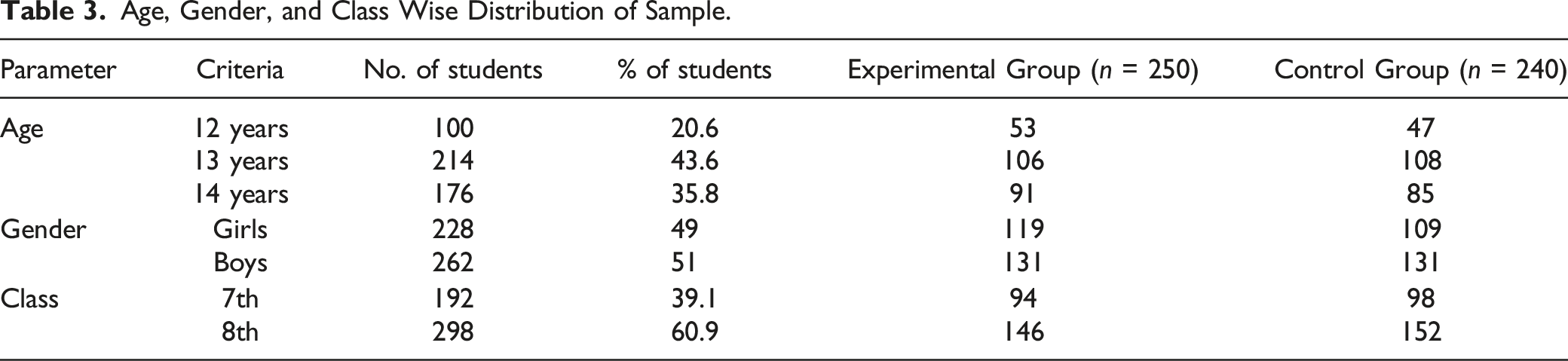
This study was conducted with 490 seventh and eight standard early adolescents in seven Delhi government schools. 250 students from four schools served as experimental group and 240 students from the remaining three schools served as the control group of the study. The study was conducted in a phased manner, phases were divided as PHASE-1: Assessment of early adolescent’s existing nutrition knowledge, attitude, practice, and understanding of nutrition facts on food labels. PHASE-2: Development of a nutrition educational program on NFL based on the findings of phase one and review of literature. PHASE-3: Imparting education to the early adolescents on nutrition labeling through the developed educational program. PHASE-4: Assessment of change in nutrition knowledge, attitude, practice, and understanding regarding NFL among early adolescents.
Phase-1: Assessment of Existing Knowledge and Understanding of Food Labels
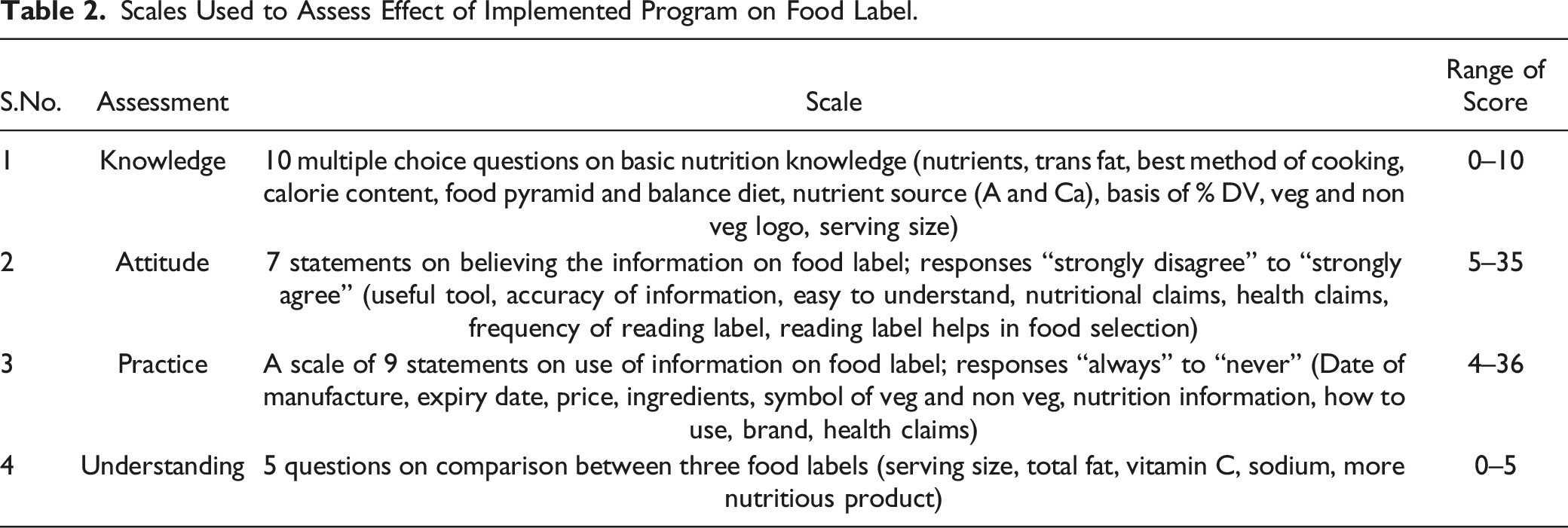
For development of effective educational strategies, there is a need for understanding the adolescent’s existing nutrition knowledge, attitude, and comprehension of nutrition facts on food labels. Therefore, a bilingual questionnaire comprising of 23 short questions for collecting the base line data was prepared. The questionnaire had four major sections: demographic profile (information on age, gender, class, and family), nutrition knowledge (multiple choice questions on basic nutrients, balanced diet, trans fat, and fiber), attitude towards reading food label (statements on frequency and importance of reading claims on food label during every purchase of package food), and practicing the information and understanding the nutrition facts on food label (comparison of food labels with respect to % daily value, serving size, footnote, symbols, and claims). Pictures of food labels from packaged food commonly consumed by the children were used for comparison in the questionnaire. Pilot-testing of the questionnaire was done to check the language and understanding. The questionnaires were pilot-tested on twenty adolescents (ten boys and ten girls) in the age group 12–14 years and these were not included in the study. After analyzing the responses elicited on pilot-testing, the questionnaire was suitably modified. The baseline data was collected from 490 early adolescents (12–14 years) children by administering the developed pre-score questionnaire, during their regular class period of 40 minutes.
Phase-2: Development of Nutrition Educational Program on Food Labels
Components of Developed Education Program on Food Label and SCT Constructs.
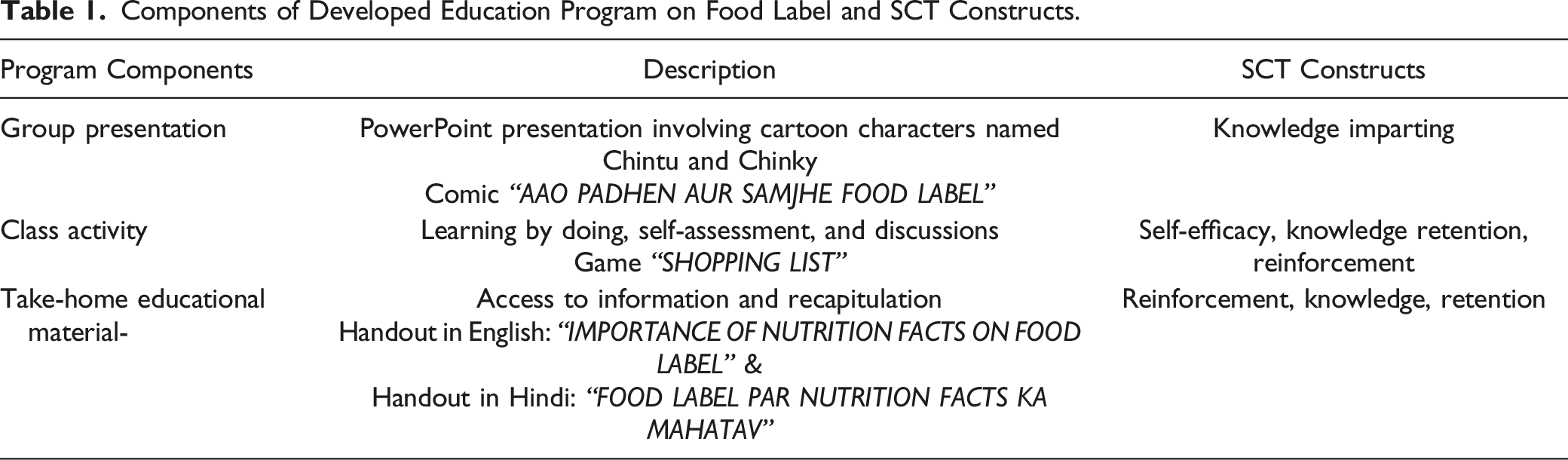
Group presentations: PowerPoint presentations were given involving cartoon characters named Chintu and Chinky, prepared for children using the findings of the survey done in PHASE-I and review of literature. To impart knowledge on food label, a presentation on food labels was prepared in Hindi and English mainly focusing on different sections of nutrition label. A game “Shopping List” was developed to reinforce the knowledge regarding NFL among children. The objective of the game was to make the educational component more interactive and interesting. Since children learn better by doing, a game was prepared using food labels from different foods usually eaten by 12–14 year-old early adolescents. Take-home material was also developed in the program. The objective of the take-home material was to provide information in clear and concise language so that the knowledge gained on NFL is retained by the children. A colorful well-designed handout in English “Importance of Nutrition Facts on Food Label” and in Hindi “Food Label Par Nutrition Facts Ka Mahatav” was provided. The PowerPoint presentation was converted into a colorful comic “Aao Padhen Aur Samjhe Food Label.” The take-home materials were the recapitulation of the program emphasizing on NFL. The handout also contained an interesting crossword game developed for the adolescents on nutrition knowledge.
Phase-3: Implementation of the Developed Program
The objective of this phase was to implement the developed educational program to the early adolescents on NFL. The intervention was done in-person by the Investigator of the study, assisted by two observers/helpers. The intervention was delivered in a single session to the student. The program was implemented by organizing 4 workshops of 40 minutes each. Each consisted of 55–60 students of the 250 experimental group students from the four schools selected for the study. Remaining 240 students from three schools served as the control sample of the study, who were not exposed to the program. During implementation of the program a PowerPoint presentation on food labels was done. Thereafter, the students were divided into groups of 5 students and the Shopping List game was played. In the end, handouts on “Importance of Nutrition Facts on Food Label” were distributed to the experimental group students.
Phase-4: Assessment of Change in Knowledge, Attitude, Practice, and Understanding of Food Labels
Scales Used to Assess Effect of Implemented Program on Food Label.
Data Analysis
The data collected was consolidated and systematically treated to calculate percentages, mean scores, and SD. Statistical tests were performed using SPSS version 10, 2000 for windows to compare the differences between the pre-test and post-test scores in the control and experimental groups. For comparison of means, a two-tailed dependent t-test was used to examine the significance for differences.
Ethics and Consent
To conduct the study, permission was obtained from the Government of National Capital Territory of Delhi, Directorate of Education: School Branch for schools. Principals of these schools were contacted for necessary permissions to carry out the workshops. Written consent was obtained from the school authorities and the participants to participate in the study.
Results
Age, Gender, and Class Wise Distribution of Sample.
Scores to Assess the Effect of the Developed Program on NFL.
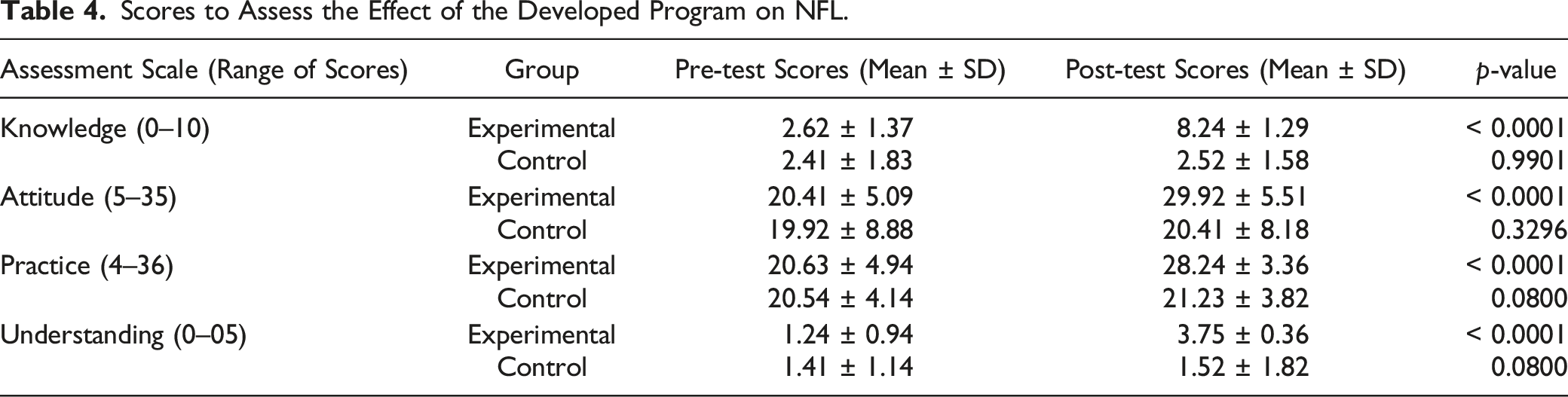
The average pre-test scores in the experimental group for nutrition knowledge were 2.62 ± 1.37 which significantly increased to 8.24 ± 1.29 (p < 0.0001). The pre-test scores in the experimental group for attitude towards information on food labels was 20.41 ± 5.09 which increased to 29.92 ± 5.51 (p < 0.0001) indicating a significant change, whereas no significant improvement in scores were observed in the control group. The average pre-test scores in the experimental group for practice of using information on food labels was 20.63 ± 4.94 which significantly increased to 28.24 ± 3.36 (p < 0.0001) and the average pre-test scores in the experimental group for understanding the nutrition facts on food labels was 1.24 ± 0.94 which significantly increased to 3.75 ± 0.36 (p < 0.0001).
It was observed that early adolescents had the attitude and practice of reading food labels and were aware about the information provided on the label too, but they failed to use it due to lack of knowledge and understanding regarding Nutrition Facts given on the food labels. The innovative and interactive program promotes learning by involving students’ active participation along with very interesting and informative handouts as take-home material for recapitulation and better retention of information.
Discussion
Indian consumers are aware about the nutritional information provided on the label but fail to use it because of lack of understanding. The impact of processed foods has been felt significantly in India, where the environment created by mass advertising has reduced intake of home cooked traditionally nutritionally rich foods (Seth & Jyoti, 2015). In the current scenario, label-reading skills can make it easier for an individual to use the NFL to make quick, informed food decisions in selecting food items for a healthy diet. The results of the present study with early adolescents are similar to the nutrition education intervention studies done by many researchers. Matvienko, et al. (2001) calculated the mean ratio of knowledge score to determine the improvement of the subjects’ knowledge between pre-test and post-test scores of interventions. They observed that the intervention group had improved mean scores, whereas in the control group, the change in scores was not observed. In the present study, the intervention group also had improved scores, whereas in the control group, the change in scores was not observed. Other researchers, in their study guided by Bandura’s SCT, also examined the relationship between behavioral, personal, and environmental variables on the eating behavior of adolescents (Cusatis & Shannon, 1996). Review shows that effective nutrition intervention and education strategies based on behavior therapy are needed for promoting adoption of healthy eating and physically active lifestyles in adolescents. Knowledge does not directly relate to behavior change; however, it is the first step in creating a healthy lifestyle. Behavior change occurs slowly over time and requires positive reinforcement. Research work on Development of Nutrition Education Module for Healthy Lifestyle of Adolescents also finds that nutrition education brings significant change in knowledge and attitude of adolescents in the experimental group with pre-test mean scores changing from 13.4 to 20.7 (p < 0.0001), whereas no significant improvement in scores is observed in the control group (Seth, 2008). Hawthorne, et al. (2006) in their study on “An Educational Program to Enhance Food Label Understanding of Young Adolescents” too show similar findings and state that a simple and brief educational program could significantly help the children in increasing their knowledge regarding NFL. On a similar note, a study performed by Seth (2008) also shows that mean knowledge, attitude, and understanding scores in children significantly increased from 5.5 ± 1.48 to 6.1 ± 0.77, 15.7 ± 1.61 to 16.3 ± 1.43 and 4.4 ± 2.44 to 5.5 ± 1.67, respectively. The subjects' scores improved significantly (p < 0.05) as reflected by a change in the pre-test and post-test scores of knowledge, attitude, and understanding of NFL; however, no significant change (p > 0.05) in pre-test and post-test scores were observed in the control group. The results thus demonstrate that children participating in this study successfully learned how to read and compare NFL. The research also demonstrates that the innovative teaching session on NFL can be an effective educational tool to increase nutrition knowledge in children. In this study, the food label-reading habit has been positively modulated by nutrition education. Thus, nutrition education is a potent tool that can improve and modulate the food selection of packaged foods, therefore improving the eating habits among early adolescents. To conclude, innovative ways and interactive nutrition education programs can help adolescents to better understand and use the information on food labels for food selection.
Study Limitations
The total sample size of the study is small. The intervention of Nutrition Education program was limited to only one session, because the timing of the study was towards the end of the academic session. Reproduction of this study on larger and varied age groups using the same pre- and post-test would increase confidence in its reliability.
Conclusions
Nutrition education intervention has a positive impact on nutrition knowledge, attitude, and understanding in adolescent children. The developed program’s concept, content, and presentation strategies and support from teachers and schools are the major factors that have contributed to the outcomes of the intervention. The education on understanding food labels given to children helps in developing healthy eating behaviors through choosing foods which are healthy for them after carefully reading and understanding the nutrition facts and other information given on labels. Existing literature also supports that dietary behaviors established during childhood and adolescence in future become lifelong habits.
Reproduction of this study on a larger sample and other age groups in private and government schools would increase confidence in its reliability. More students need to be exposed to food label understanding because it appears to be a potent tool in forestalling the harmful effects of unhealthy packed food selection.
Footnotes
Declaration of Conflicting Interests
The author(s) declared no potential conflicts of interest with respect to the research, authorship, and/or publication of this article.
Funding
The author(s) received no financial support for the research, authorship, and/or publication of this article.
