




Abstract
This study individually estimates and analyzes the contribution of public schools and fee-paid private tutoring classes to academic performance of students in Sri Lanka. Econometric models and measures of descriptive statistics were estimated and instructional time was graphically compared to test whether the private tutoring classes significantly contribute to students’ academic performance. Econometric results with descriptive statistics strongly confirm the contribution of private tutoring education in the academic performance of the students in public schools. The study concludes that in Sri Lanka, private tuition classes have a significant positive contribution to the academic performance of students in public schools.
Introduction and Literature
At present, in many countries, education is provided at the cost to the government to a certain extent. However, shadow education has been expanded worldwide over the past few decades (Baker et al., 2001; Bray, 2009; Southgate, 2009; Byun, 2014, p. 54) and has become a significant topic in education and sociology. It had increased in intensity in most parts of Europe and emerged in Nordic regions where it had been absent previously (Bray, 2020, p. 4–7). Bray and Lykins (2012) analyze experiences of shadow education in Armenia, Azerbaijan, Bangladesh, Brunei Darussalam, Cambodia, China, Georgia, Hong Kong, India, Indonesia, Japan, Kazakhstan, Republic of Korea, Kyrgyz Republic, Lao People’s Democratic Republic, Malaysia, Maldives, Mongolia, Myanmar, Nepal, Pakistan, Philippines, Singapore, Sri Lanka, Taipei, China, Uzbekistan, and Vietnam. In USA, private test preparation service serves more than one million students (http://www.kaplan.com/about-kaplan/company-overview/). Another study by Bray (2011) assesses the incidence of private tuition across Europe and reports six countries where more than half of the school students have received private tutoring (Cyprus [86%], Malta [78%], Lithuania [62%], Hungary [61%], Slovakia [56%] and Portugal [55%]).
In the Republic of Korea, nearly 90% of the elementary students receive some sort of shadow education, and in Hong Kong (China) about 85% of the senior secondary students receive it. Figures are equally striking in less prosperous parts of the region. In West Bengal, India, nearly 60% of the primary school students receive private supplementary tutoring, and in Kazakhstan a similar proportion of students receive it at the senior secondary level. Proportions are lower in other countries, but throughout the region the shadow education is spreading and intensifying (Bray & Lykins, 2012). Bray (1999) has summarized the percentage of public school students attending private tutoring classes in 17 developing and developed countries out of which more than 50% of the students in public schools attend private tuition classes. Dang and Rogers (2008) present 24 countries where private tutoring takes place. These countries include both developing and developed countries such as UK, USA, and Canada. Out of them, private tutoring for school education is greater than 50% in 12 countries. Diverse private tutoring industries have been developed worldwide.
Even though shadow education industry has been developed worldwide, it is still unclear whether it indeed matters in academic achievement of students and hence requires further analyses (Byun, 2014, p. 54; Bray, 2014; Cole, 2017). Findings of studies are inconsistent. Polydorides (1986) and Kulpoo (1998) state that private tutoring improved students’ academic achievement in Greece and Mauritius. Stevenson and Baker (1992) find that students participated in any form of private tutoring had a higher chance of being admitted by universities after they graduated from high school in Japan. Briggs (2001) analyzes the National Educational Longitudinal Study of 1988 data and explains the effects of tutoring on students’ Scholastic Assessment Test (SAT) and American College Testing (ACT) performance in the U.S. As the results show test preparation helped students who took the test before and would like to improve their performance at a small amount. SAT tutoring had benefited to students with improved socioeconomic background, students performed well in high school mathematics courses and students who were actively involved in extracurricular activities. The tutoring had the similar effect on comparable sections of ACT. Buchmann (2003) finds positive effects of private tutoring on student academic performance for Kenya students. Private tutoring improved test performance of students in the age group of 13–19 years, and improved their test performance to advance to the next grade. Berberoğlu and Tansel (2014) find a positive impact of private tutoring on students’ academic performance in mathematics and Turkish language, it is not so in the case of natural sciences.
On the contrary, in the case of grade 8 students in Singapore, Cheo and Quah (2005) find insignificant and negative effects of private tutoring on student achievement. Zhang (2013) states that private tutoring had uneven effects on students’ scores for math, Chinese, English and total score of Gaokao. The author further finds insignificant effect of private tutoring on average. However, in schools with more educational resources students in urban area private tutoring had significant and positive effect on students’ performance. Zhang (2011) finds negative effects of private tutoring in the case of rural students whose Gaokao scores below the 0.9 quantiles. However, private tutoring is negatively related with Gaokao score as finds by Li (2016). In other words, students who attended in private tutoring classes had lower Gaokao performance. In this inconclusive context, this study attempts to separately assess the contribution of public schools and private tutoring classes to students’ academic performance.
Justification of the Study
According to studies conducted so far it is still not clear whether the contribution of shadow education is significant determinant of academic performance of students in public schools. In Sri Lankan context, empirical studies on private tutoring are very few and not to assess contribution of private tutoring to student performance. Some of them inquire into reasons for demand for shadow education (Damayanthi, 2018; Pallegedara, 2012), and some are to analyze expenditure on the same (Pallegedara, 2011; Pallegedara & Kumara, 2020). Cole (2016) conducted a study after analyzing 5 months of private tutoring of primary students in Sri Lanka which found that there is no impact on Year five students’ exam scores. Thus, in presence of increasing demand, at global level, contribution of private tutoring to students of public schools is inconclusive and in Sri Lanka studies on the sane are so limited. In such a context, the present study is to make an attempt to examine whether shadow education significantly contributes the academic performance of students in public schools. Findings of the research provides directions and guidelines to public authorities in monitoring private tuition education in Sri Lanka as well as in similar economies. Also, the study persuades the teachers and principals of public schools to reform or reconsider their teaching methods and make their schools attractive for students. The study is also useful and beneficial for provincial and federal authorities of school education sector in Sri Lanka to modify their policies of school education. By opening more doors for further studies, the study contributes existing literature on shadow education.
Research Questions
Two research questions are guided by the study. Research question 1: Is private tutoring a significant determinant of public school education in Sri Lanka? Research question 2: Does Public school education contributes student performance?
Data, Measurements, Sample Selection, and Analytical Tools
Various names are used for private tutoring. Private supplementary tutoring, shadow education, host of structured outside-school learning, and fee-paying out of school classes are among such numerous names. In line with several studies (e.g., Bray, 1999; Bregvadze, 2012; Lee et al., 2009; Silova, 2009; Silova et al., 2006), in this study the private supplementary tutoring is defined as private tutoring provided in exchange for a fee by organized classes in private places. For the successful achievement of study objectives, data regarding student performance, private tutoring education, public schools and family characteristics (income and educational standards) are required. Student performance is available in some secondary sources, namely Department of Examinations of Sri Lanka. However, data on teaching hours, the attendance details of students and the coverage of subject matter in public schools and private tuition classes were gathered from primary sources.
These primary data were collected in three steps. First, informal interviews were held with selected public sector officials of the Department of Education, principals of selected public schools, the officials of private schools and famous teachers who conduct private tuition classes in order to collect preliminary data that were helpful to design the questionnaires. Second, two structured questionnaires were constructed, respectively, for G.C.E O.L and A.L students and pretested with selected students of public schools who attended private tutoring classes. Finally, primary data were collected by administering these questionnaires to two respective simple random samples drawn from public school students who attended private tutoring classes. The first sample consisted of 110 students who sat for the G.C.E (O.L) 1 examination in December 2017 and the second was with 260 students who completed G.C.E. (A.L) examination in August 2017. The units of the second sample equally represented selected G.C.E (A.L) subject streams, that is, arts, science, technology, and commerce. Considering popularity of private tutoring education among students of public schools and distribution of private tutoring classes, all these sampled students were selected in Colombo district.
To examine whether private tutoring classes significantly contributed to student performance, or out of public schools and shadow educational institutions which contributes more, input and output need to be compared. The output of education is knowledge or student performance which is mainly measured in Sri Lanka at G.C.E O.L and G.C.E A.L examinations. However, student performance is not separately available for public schools and private tutoring. It is available as an added variable of both sectors. Student performance at any examination can be measured as total marks a student obtains. However, in Sri Lanka, the results of G.C.E O.L examination is issued as letter grades for each subject and no total marks or marks for each subject are issued. Therefore, taking the average of lower and upper limits of a letter grade of a certain subject, the middle value was calculated and the sum of the marks of all the subjects a student studied in a tuition class was calculated. Then, the student’s total marks obtained for G.C.E O.L examination for all the subjects he/she studied in the fee-paid classes could be calculated and it was considered the overall student performance at G.C.E O.L examination. In the case of G.C.E A.L, in addition to the letter grade for subjects, student performance is issued by examination department as “Z” score 2 . It is an added figure for all the three subjects the student sat for his/her examination and cannot be distinguished between private and public tutoring like TIMSS data (Song et al., 2013). For any of these national examinations, student performance is mainly a function of the number of instructional hours (input) for all the subjects he studied in the private tuition class and public school. Instructional time of both of these educational institutions were collected from the field survey. Thus, the functional relationship between student performance and instructional time of both public educational institutions and private tutoring classes can be stated as follows:
Y = f (TH, SH), where Y is the student performance, measured for G.C.E. O.L by sum of marks obtained for a subject or all the subjects a student of public school studied in the private tuition classes and for G.C.E A.L by Z-score. TH (tuition hours) is the public school student’s study time spent in the private tuition class to study all the subjects under consideration and SH (school hours) is his/her study time in the public school spent for the subjects in question. In the case of G.C.E.O.L, the above model can be estimated with respect to overall performance as well as subject-wise performance of the student. In other words, since a letter grade for each subject is issued at G.C.E O.L, subject-wise performance can be analyzed by taking the average of lower and upper limits of the student’s letter grade as the response variable and his/her study hours of the subject at fee-paid tuition class and the public school, respectively, as control variables. However, for G.C.E. A.L subject-wise analysis is impossible since “Z” score includes marks obtained for all the subjects.
To consider other variables that may determine student performance, in the analysis, the above simple model can be extended by including such family characteristics as income and educational standards. Even if inquired, most of family members are unwilling to reveal their income details and therefore, it is very difficult to rely on income data alone. Therefore, in addition to collected income data, considering occupations and educational standards of parents, families of each student could easily be categorized as affordable (high income) and non-affordable (low income) to purchase private tuition education and family income was included in the regression models as a dummy variable. In addition, educational standard of family members may be another determinant of student performance. However, this has to be considered separately in the assessment of student performance at G.C.E. O.L and A.L. examinations. In the case of G.C.E.O.L, no specialized area for a student and therefore, if there is at least one G.C.E.O.L qualified family member, he/she becomes a definite source of education of the student/s in such families. In the analysis of student performance at G.C.E.A.L for the benefit of a student in his family, there should be at least one member who has studied at least one or more of his subjects. This situation is also included in the quantitative estimation as a dummy variable. Thus, the extended model can be specified as follows:

Where D1 = 1, if the household of the student can afford to spend on private tutoring education; =0 otherwise; D2 = 1, if the household of the student is with at least one member who can extend academic support to the student considered; =0 otherwise; e- Error term and other variables are defined as earlier.
Thus, equation for performance of the students whose families could afford for their fee-paid private tuition education and whom were supported by their family members for their achievement, can be stated as

Equation for students whose families could not afford for their private tuition education and who had no one in their families to support academically them for their education is

Equation for students whose families could afford for their private tuition education but there was none in their families to render them any academic support in their education.

Equation for students whose families could not afford for their private tuition education but were supported at least by one of their family members to achieve in their examinations.

Based on above econometric models, the individual contribution of both public schools and private tutoring to student performance was firstly examined and analyzed by estimating general linear, semi logarithmic, and logarithmic econometric models. Secondly, allocation of instructional time by both public schools and private tutoring institutions was compared as a related variable to student performance. Finally, inequality of mean instructional time of private tutoring institutions and public schools was assessed by means of the t-test and individual correlation coefficients of these two variable and student performance were estimated for further analyses.
Theoretical Basis
Even though literature on shadow education is growing, studies covering the theories behind decision making processes of students and parents with regard to the demand for shadow education is less in number. Instead, many research work have investigated the determinants and effects of shadow education (Byun et al., 2018). There are a closely related couple of theories of demand for shadow education out of which human capital model is the closest one. This theory was mainly developed by Nobel winner Theodore W. Schultz in his series of papers starting from 1959. Schultz (1961) points out that the productive capacity of human beings is now larger than all the other forms of wealth taken together.
In human capital perspective, parents and children demand shadow education as it provides another opportunity to invest in children which increases child labor productivity and job expectations (Dang & Rogers, 2008; Heyneman, 2011). This is because the labor productivity of children increases the children’s ability to compete in the job market. Thus, investment in shadow education promotes growth in human capital and it needs to be encouraged if it significantly contributes to student performance.
The institutional model explains the second theoretical view on shadow education. It argues that shadow education is becoming popular worldwide as a result of creating strong culture for formal education (Baker & LeTendre, 2005; Mori & Baker, 2010). Rapid institutionalization of shadow education leads to the increased norms of participation (Baker, 2014; Hout, 1988). Some countries like Canada and the United Kingdom have stronger institutions to monitor private tutoring. Moreover, private tutoring industry is growing in many countries relative to the formal education sector (Dang & Rogers 2008). In Sri Lanka also, the prevalence of private tutoring institutions and their massive publicity on shadow education have been able to attract both parents and students, and as a result, they learn in these institutions after school hours and/or in weekends.
Shadow Education and Public School Education in Sri Lanka: Suitability for the Study
In the late 1970s, Sri Lankan government introduced market based economic policies. Private sector was invited to invest in basic social services such as education and health. Consequently, private sector gradually opened up formal provision of all levels of education. At present, in Sri Lanka, “supplementary private tutoring has long been a pervasive part of many students’ everyday experiences” (Bray, 2003). Many Sri Lankan children start attending private tutoring targeting grade five scholarship examination (Cole, 2017). Among Sri Lankan students, the demand for private tutoring is very high, and the situation was the same many years ago. In 1990, it was estimated that 75% of the students were attending private tuition classes, and the proportion is 62% of G.C.E A.L Arts students, 67% of G.C.E A.L Commerce students and 92% of the G.C.E A.L Science students (De Silva et al., 1991; De Silva, 1994). Pallegedara (2011) has analyzed primary data of 11,628 households with 21,438 students between 6 and 21 years of age. Out of these households, 63.7% have spent money on private tutoring. Suraweera (2011) after surveying 2,578 students in grade 10 and 884 students in grade 12 finds that 92.4% of grade 10 students and 98.0% of the latter group receive private tutoring. In Sri Lanka, government always tries to provide education at its cost. And people always claim for free education. However, in such a situation, private tutoring escalates. Cole (2016) states “Private tutoring (or ‘tuition’) is widespread in Sri Lanka, with the overwhelming majority of students engaging in tutoring classes during high-stakes exam years, and many students taking classes other years as well.” This situation shows that parents enroll their children in public schools and send to learn in informal fee-paid private tuition classes. Consequently, parents have to spend a lot of money on private tutoring.
Public school education
At present, Sri Lanka provides free education at all the levels of school education. In addition to capital items such as buildings and furniture, the country’s free school education package includes free tuition in public schools, textbooks, once a year school uniform, meals for some primary level students, and financial assistance for students from low income families who have passed the grade 5 scholarship examination. In October 2017, these facilities have been included in a free insurance scheme (named as suraksha) for students in public schools. In the case of expenditure, on an overall basis the government spent Rs. 11,804 per-student in 2015 and Rs. 11,357 in the following year (Ministry of Education, unpublished data). By 2019, out of 4.3 million student population, 95% has been enrolled in 10,000 public schools where 247,000 teachers have been employed. When all the schools are considered, Sri Lankan public schools function with a significantly low number of students per teacher, that is, 16 in 2019 (Table 1). Even though the government had invited private sector to invest in many economic sectors, representing 3% of student population, formal private sector still shows a retarded growth in school education. In a sense, this means that, in the country, there is no increasing demand for school education provided private sector along.
Basic Details of Schools and Student Population in Sri Lanka, 2019.
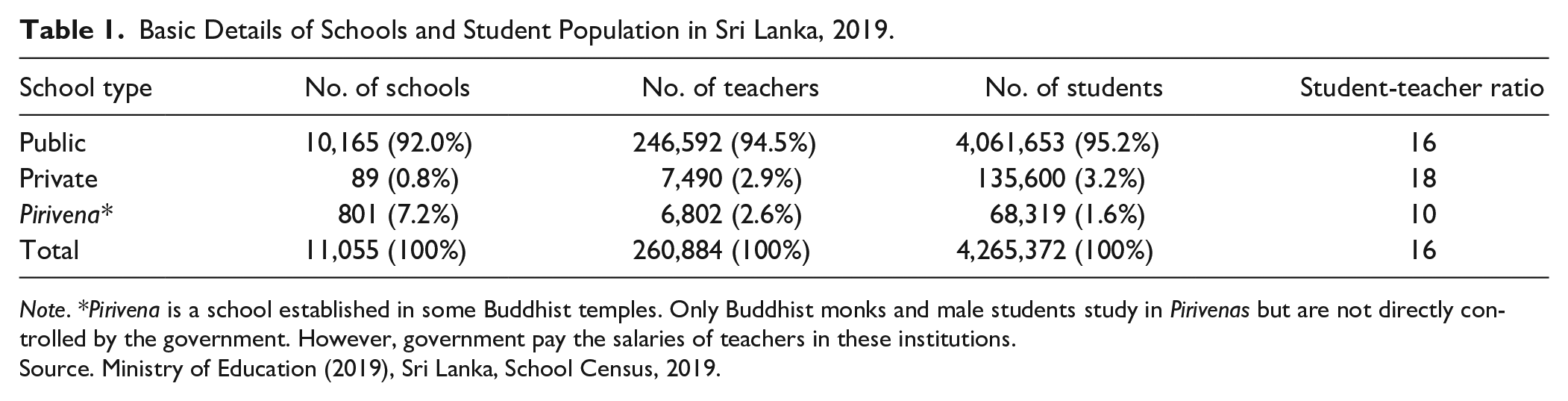
Note. *Pirivena is a school established in some Buddhist temples. Only Buddhist monks and male students study in Pirivenas but are not directly controlled by the government. However, government pay the salaries of teachers in these institutions.
Source. Ministry of Education (2019), Sri Lanka, School Census, 2019.
Comparison of subject-wise allocation of instructional time
In Sri Lankan public schools, teaching time allocated for each subject in both G.C.E O.L and A.L classes has been fixed by circular 09/2006 issued by the Ministry of Education (Table 2, Appendix A). According to the instructions provided by the Ministry of Education to the principals of schools, at least 4 hours (6 periods) need to be allocated per week for teaching both Mathematics and Science and 3.3 hours (5 periods) for both English and Sinhala Languages, respectively, for G.C.E.O.L classes. Those are the highest time allocation for teaching at this level and allocation of such a minimum time period may be based on difficulty of understanding the content of a subject. Once the allocated time periods are greater in number, a teacher is provided a sufficient time to complete the whole syllabus of the subject. The allocated time to teach 15 subjects in G.C.E O.L classes in both private tutoring institutions and public schools are compared in Figure 1. However, in G.C.E O.L classes in public schools those minimum teaching requirements are not fulfilled with respect to three compulsory subjects 3 ,that is, Science, Sinhala Language and English Language. Furthermore, it shows that the total teaching time of 06 subjects in public schools is greater than that of private tutoring classes. These subjects include five compulsory subjects and IT. Meanwhile, the teaching time of nine subjects in public schools is lower than that of private tutoring classes (Figure 1). As explained by the students in G.C.E O.L classes in public schools, the empirically taught time for many compulsory subjects in their schools is greater than that of private tuition classes (Figure 1). In the case of G.C.E.A.L teaching in public schools, according to the Ministry circular, the minimum time allocation for each subject is 6.6 hours (10 time periods) per week (Table 2). According to G.C.E A.L students in public schools, in all subject streams other than science (biology and maths), actual taught time with regard to all subjects in their schools is far behind the fixed time imposed by the Ministry. In science stream minimum teaching time requirement is not fulfilled with respect to all subjects other than chemistry, physics and combined mathematics (Table 3, Figures 2 and 3). When time allocation for G.C.E. A.L classes in public schools is compared with that of private tutoring classes, it is greater in public schools with regard to Buddhist Civilization, English Language, French, Geography, History, Japanese, Logic, and Music in the arts stream (Figure 2). However, it is greater in the fee-paid tutoring classes than in public schools with regard to all the subjects in commerce stream and again greater in technology stream except for one subject (Table 3). In the case of science stream it is greater in public schools than in private tutoring classes (Figure 3). This means actual teaching time periods in public schools are not consistent with the expectations of the Ministry of Education. Thus, insufficient instructional time in public schools may be a partial reason for the demand for private tutoring education by students in public schools.
Minimum Time Periods Need to be Allocated in the Timetable of Each Class for Teaching the G.C.E. (A.L) Classes.
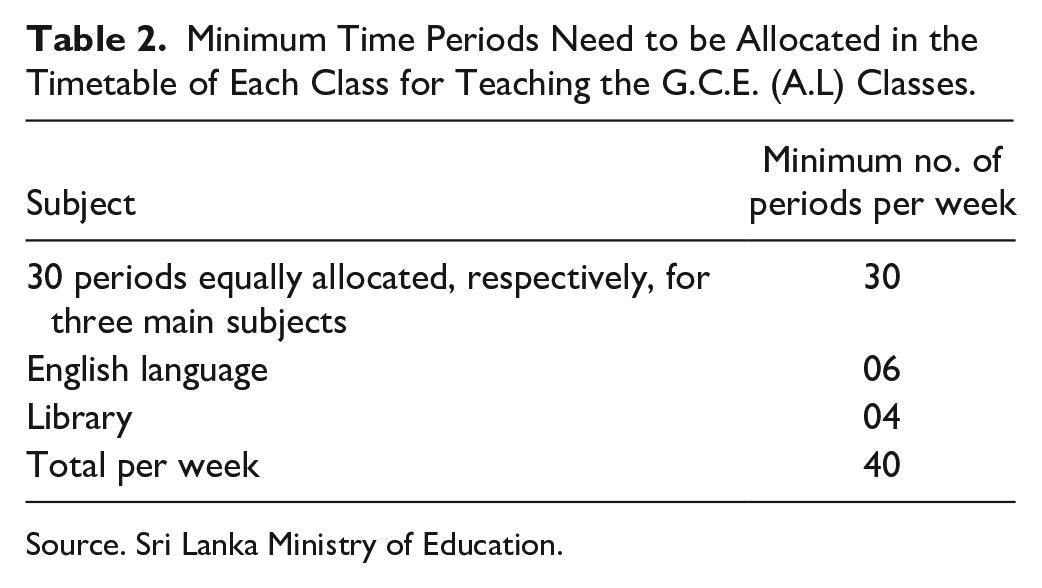
Source. Sri Lanka Ministry of Education.
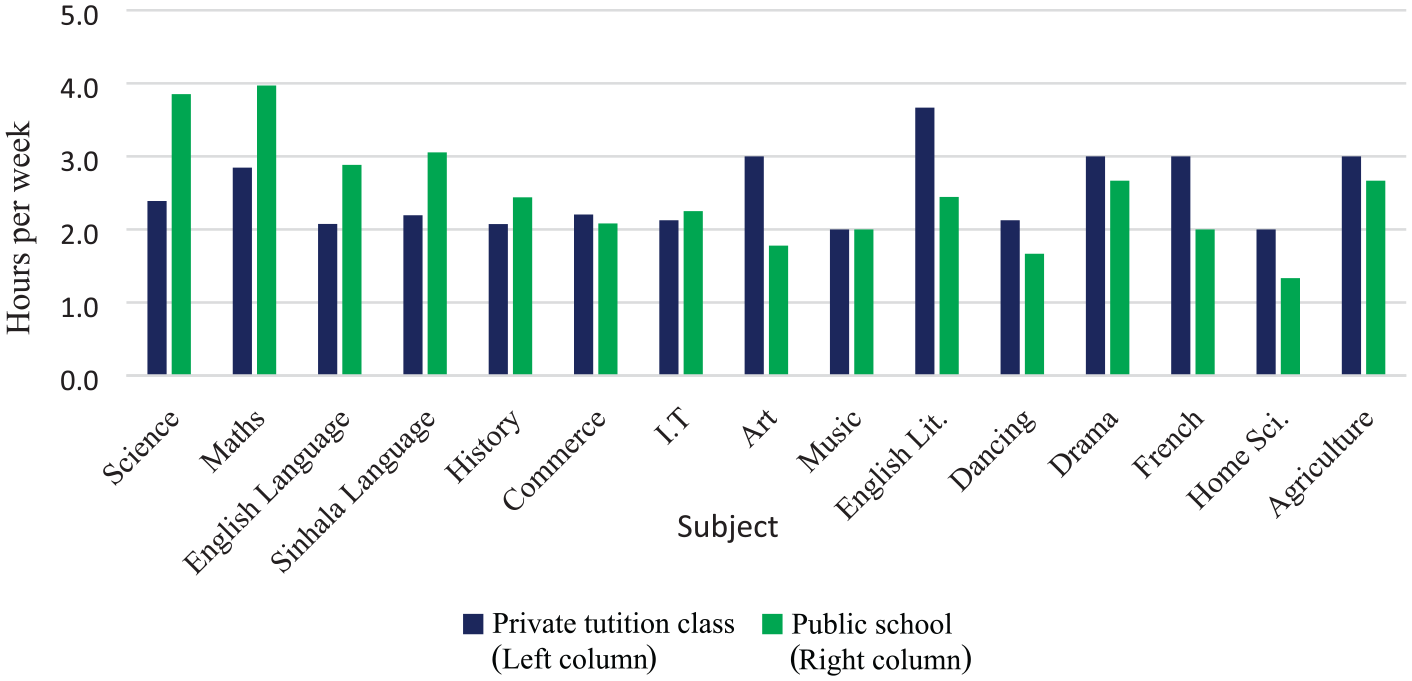
Average teaching hours of each subject in private tuition classes and public schools for G.C.E (O/L) as explained by students attending private tuition classes (hours per week). Source: Field survey, 2019.
Average Teaching Hours of Each Subject in Private Tuition Classes and Public Schools for G.C.E (A/L) (Commerce and Technology Streams) as Explained by Students Attending Private Tuition Classes.
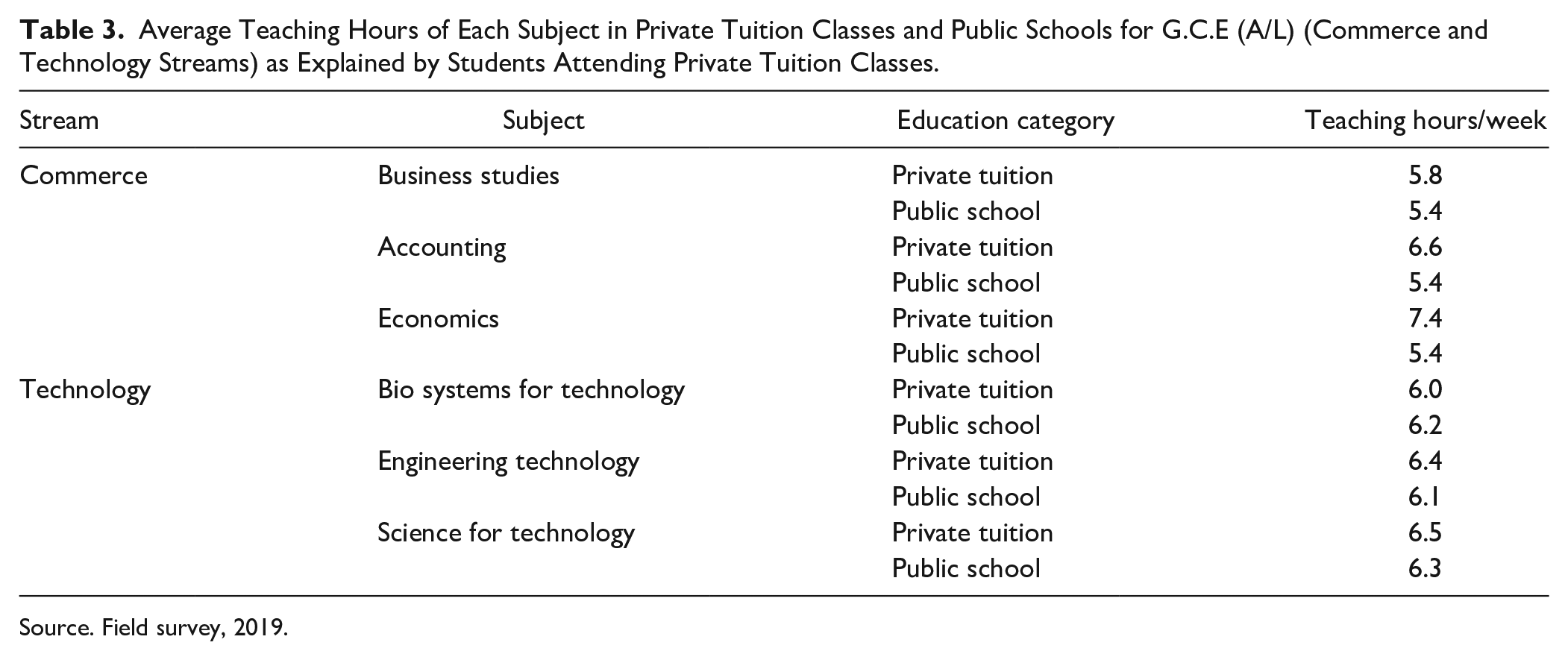
Source. Field survey, 2019.
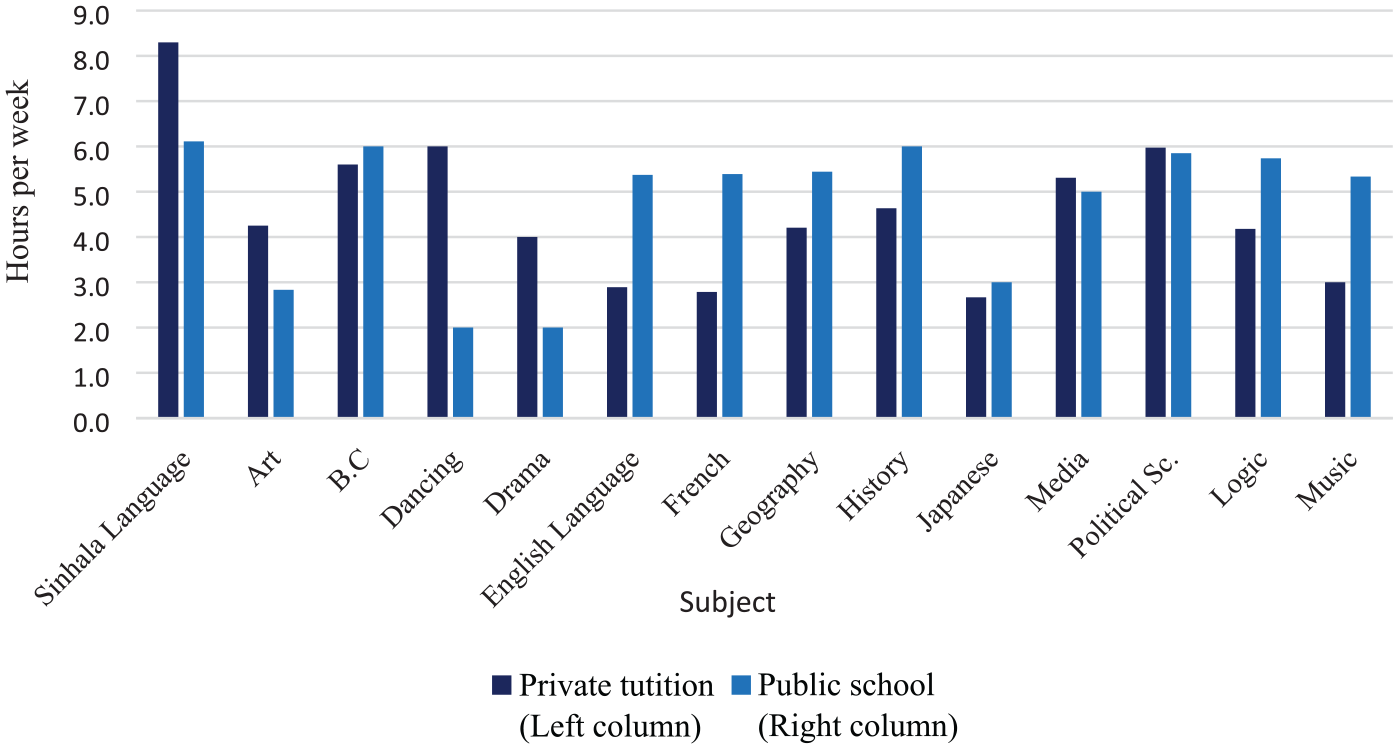
Average teaching hours of each subject in private tuition classes and public schools for G.C.E (A/L-Arts stream) as explained by students attending private tuition classes (hours per week). Source: Field survey, 2019.
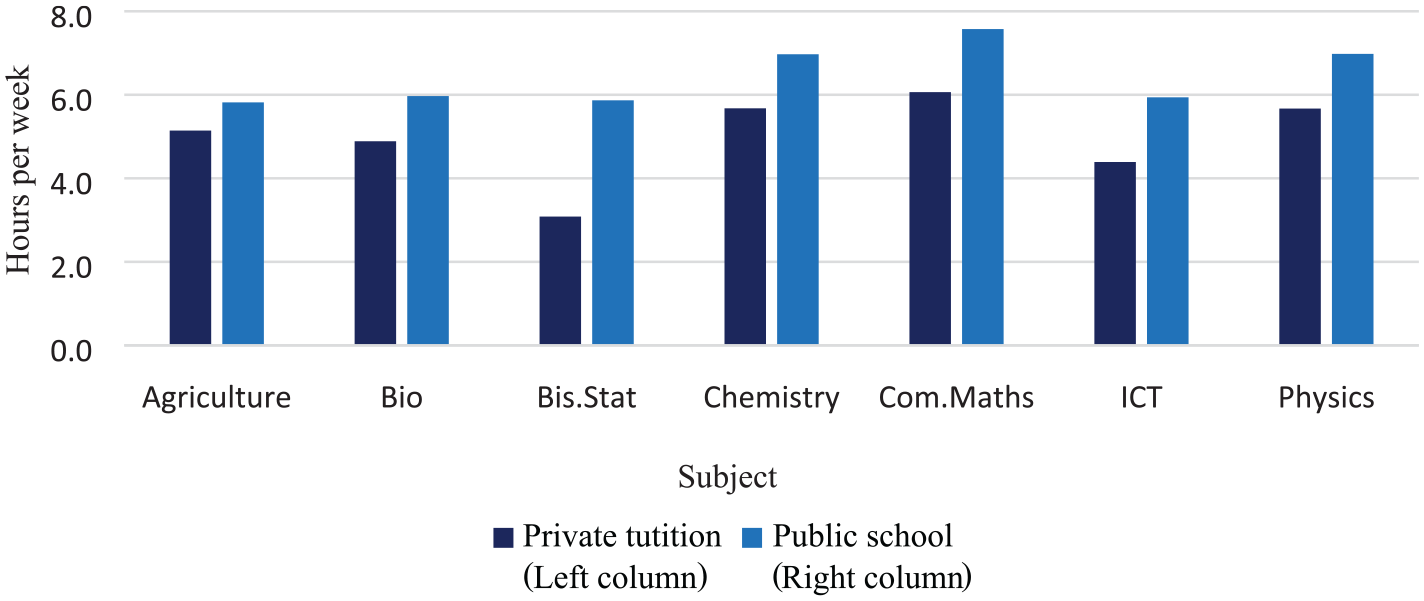
Average teaching hours of each subject in private tuition classes and public schools for G.C.E (A/L-Bio and Maths streams) as explained by students attending private tuition classes (hours per week). Source: Field survey, 2019.
Results and Discussion
Existing Findings on Instructional Time
Instruction time in education is an input and costly resource in the production of education. There is a remarkable scarcity of research which examines the relationship between these two variables (Cattaneo et al., 2016). Some recent research on this issue regarding instruction time and student performance show that both these variables are positively related. Lavy (2015), using PISA 2006 data, estimates the effects of instructional time. The study includes data samples from over 50 countries and conducts subject-wise analysis to recognize within-student and within-school variation and finds that instructional time significantly and positively affect student performance. However, Lavy finds this positive and significant relationship between the above variables is much low in developing countries. The same results were obtained by Woessmann (2003) who conducted a research in the light of international student-level database TIMSS using a cross-country setting. The study controlled for standard characteristics and for institutional characteristics of different schooling systems and revealed that instructional time and student performance are positively related. Mandel and Suessmuth (2011) also find a positive relationship between cumulative instructional time and student performance.
However, some studies do not find a significant relationship between instructional time and the success of the students. A study by Woessmann (2010) uses cross-country variation in Germany and makes an attempt to eliminate unobserved country-specific factors. The author did not find a significant effect on student performance. Several research studies state that the effect of instructional time varies from track to track (Betts, 2011; Hanushek & Woessmann, 2006). Based on an algebra program in Chicago public schools which doubled lessons to students in grade nine whose test score levels in the previous grade were below the national average, Allensworth and Nomi (2009) conducted an analysis of performance. According to the findings, the benefits of additional lessons to the lowest-skilled students were less than that of higher-skilled students. Telischak (2016) after controlling for instructional time, attendance, mobility, special education, limited English proficiency, and socioeconomic status, concludes that “instructional time is an educational topic that will continue to require additional research to determine whether or not it will increase student achievement, as the findings are inconsistent” (p. 155).
Findings
In the present study, to test whether the contribution made by private tutoring classes is significant or not, various regression models as explained in the methodological part were estimated. The sum of marks obtained by each student for his/her G.C.E O.L examination and the marks each student obtained individually for Mathematics and Science were considered dependent variable while the total number of hours studied, respectively, in his/her public school and private tutoring class/es together with dummy variables for family income (assigning unity for families that can afford to spend on private education and zero for non-affordable families) and educational standards of households (assigning unity for families with at least one member who can academically assist the student and zero for families with no one to help the student) were considered independent variables.
Regression results show that the coefficients of control variable “teaching hours” (TH) estimated in respect of G.C.E O.L after including values of “teaching hours” as total learning hours a student spent in private tuition class/es to study all the subjects are found to be highly significant with positive signs (Appendix B). According to results of estimated general linear models, it is clear that the coefficient of “teaching hours” in private tuition classes is 17 which means that on average, 1 hour’s additional teaching time in private tuition institutions contributes 17 units of student performance. Results also show that t-statistic values of the parameters of this variable, “teaching hours,” ranges from 7.0 to 9.0 and therefore the variable is highly significant. When both educational institutions are compared, value of the parameter of “instructional hours” in private tuition classes (TH) is highly greater than “instructional hours” in public schools (SH). This again provides evidence for the significant contribution of private tutoring education to students’ academic performance. These regression results become more striking due to presence of explained variation greater than 60% of the dependent variable and absence of serial correlation in the disturbance term as shown by Durbin Watson test statistic. However, in all estimated models for G.C.E. O.L, family characteristics (income and educational standards of other family members) are not significant at all (Appendix B). Results of models estimated with respect to two selected subjects of G.C.E O.L show that “teaching hours” in private tuition institutions (TH) is not significant for Mathematics 4 but it is significant at 90% for Science (Appendix C).
In the case of G.C.E A.L “teaching hours” in private tuition classes (TH) and public schools (SH) were regressed on standardized marks (Z-scores) obtained by each student for all subjects. Here also financially affordable families for shadow education and families with at least one member to academically assist the student were, respectively, represented by dummy variables for which unity was assigned for affordable families and families with a member or more to help the student. In all estimated models, the parameters of “teaching hours” in private tuition classes (TH) are again significant with the positive sign (Appendix E). All t-statistics values of these coefficients are greater than two. In all these models estimated to analyze the relationship between shadow education and overall student performance, instructional hours in public schools (SH) is also significant. Even though the “goodness of fit” of all models estimated for G.C.E. A.L and G.C.E O.L Science subject are low, it does not affect the above results. Gujarati (2004) states that cross-sectional data had their own problems, specifically the problem of heterogeneity (p. 27). For cross-sectional data, a high R2 is rather unusual. (p. 91). He further states that “[. . .]one generally obtains low R2 because of the diversity of the cross-sectional units. Therefore, one should not be surprised or worried about finding low R2s in cross-sectional regressions. What is relevant is that the model is correctly specified, that the regressors have the correct (i.e. theoretically expected) signs, and that (hopefully) the regression coefficients are statistically significant” (p. 229).
In terms of descriptive analysis conducted in respect of primary data, it is obvious that for G.C.E (O.L) average “teaching hours” per week in private tutoring classes (TH) is high in absolute terms but significantly less than in public schools (SH) (Appendix F). Difference between mean instructional time of the institutions is also significant according to the result obtained by conducting t-test (Appendix G). However, correlation between “total marks” obtained by G.C.E. O.L students (Y) and their study hours in private tuition classes (TH) is strikingly greater than that in public schools. Findings of the subject-wise analysis for G.C.E O.L Science show a clear similarity with those in G.C.E. O.L common analysis. Even though the average “teaching hours” of science subject in public schools is greater than in fee-paid tuition classes, it is less correlated with student performance. In other words, instructional hours of private tuition classes show a higher correlation with student performance than in public schools (Appendixes F and D). In the case of G.C.E (A.L), no a significant difference can be observed in average “teaching hours” in public schools (SH) and private tutoring institutions (TH). This means demand for education supplied by both institutions is closely same. Moreover, G.C.E. A.L classes in commerce and technology streams, “teaching hours” in private tuition classes is greater than in public schools (Table 3). Here one point of explanation is essential to be mentioned. Difference between allocated total time for teaching a subject by public and private teaching institutions varies according to period of time they are counted. Once instructional time is counted for a week, it is clear that teaching hours in public schools becomes greater. However, if it is counted for a year, teaching hours is greater in private institutions due to many reasons by which instructional time in public schools is lowered.
In almost all Sri Lankan public schools, in every April, August, and December schools are closed, respectively, for vacation at least for a period of 1 month or more. In addition, there are about 25 public holidays per year. During vacations and public holidays, teachers are not expected to report to work. Throughout the first term of the every year (January–March) public school students are trained for sports and their inter-school and intraschool competitions are held. Moreover, teachers in public schools are entitled for 42 days of annual leave. All these activities, results in diminished instructional time for teaching in a year. However, in fee-paid tutoring classes no such non-academic activities are taken place and they dedicate their total time only for teaching. For them there is no specific time for teaching. Sometime classes are taken during nights, weekends, public holidays and so on. When all these things are taken into account for a given year teaching time may be greater in private tuition classes than in public schools.
Conclusions
In this study, the relationship between instructional time and students’ academic performance was analyzed in terms of econometrics, descriptive statistics and comparison of instructional time of private tutoring community and public schools. Descriptive statistics show that in comparison with public schools, instructional time of fee-paid tuition classes is more significantly correlated with students’ academic performance at G.C.E O.L. In the case of G.C.E A.L instructional hours closely similar between both category of teaching institutions. The estimated regression results with respect to both G.C.E.O.L and A.L show that parameters of tuition time in private tutoring classes are highly significant with a positive sign. Furthermore, for G.C.E O.L science subject also parameters of instructional time of private tuition education are significant with the positive sign. Allocation of instructional time in public schools is far behind the minimum teaching time needs to be allocated for each subject at each level. All these issues verify that private tutoring significantly contribute the academic performance of students in public schools.
Policy Implications
Education is the blood of an economy. In terms of functional theory of education, the performance of all other sectors depends on the level of education. The national policy of almost all the countries is to provide free education at least to a certain extent. However, Sri Lanka provides free education at all levels, namely primary, secondary and tertiary. School education is provided by the public sector and, private sector also caters to a considerable amount of schooling population. In the meantime, private tutoring has emerged as a secondary private organization and the demand for school education is partially satisfied by this novel entrepreneurs. The demand for private tutoring education is escalating. These dynamics in the provision of school education leads to policy changes in the education system of the country.
First, the authorities of the public sector need to be aware of the utilization of inputs. Such a step not only maximizes output but also minimizes cost. Second, in order to get productive results through the market forces, the rapidly escalating private tutoring industry needs to be monitored by the government. Canada and the United Kingdom have stronger institutions to monitor private tutoring. In other countries too this can be achieved by adopting formal registration of private tutoring schools and fixing minimum qualifications of teachers at each level and for each subject he/she teaches. Finally, the increasing demand for informal fee-paid out of school education adds a big question mark to the presence of free school education.
Footnotes
Appendix A
Minimum Time Periods Need to be Allocated in the Time- Table of each Class for Teaching. Grades 10–11 in Public Schools.
Appendix B
Regression Results, G.C.E (O.L).
Dependent Variable: Total Marks Obtained by each Student for all Subjects Studied in Private Tutoring Class/es (Y)
Appendix C
Regression Results, G.C.E (O.L).
Dependent Variable: Marks Obtained by each Student for Science (Y).
Appendix D
Descriptive Statistics and Correlation.
G.C.E O.L—Total marks obtained by each student and instructional hours for Science.
Appendix E
Regression Results, G.C.E (A.L).
Dependent Variable: Z-score Obtained by each Student (Y).
Appendix F
Descriptive Statistics and Correlation -G.C.E. O.L and A.L.
Appendix G
Results of Tests for Equality of Means between Instructional Time in Private Tutoring Classes and Public Schools (G.C.E A.L and O.L).
Acknowledgements
The author extends his sincere thanks to Research Council of the University of Sri Jayewardenepura for funding the project and to an anonymous reviewer for his/her constructive comments on the original manuscript.
Declaration of Conflicting Interests
The author(s) declared no potential conflicts of interest with respect to the research, authorship, and/or publication of this article.
Funding
The author(s) disclosed receipt of the following financial support for the research, authorship, and/or publication of this article: This work was supported by the Research Council of University of Sri Jayewardenepura (ASP/01/RE/HSS/2018/04).
